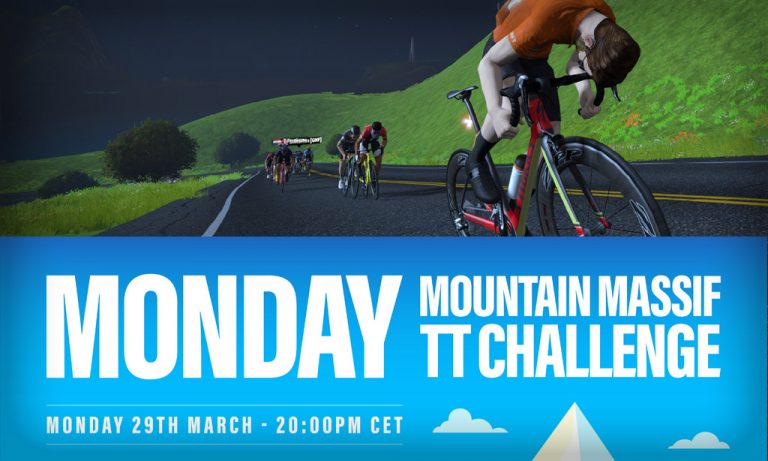
Zwift is hosting an epic Mountain Time Trial up the Epic KOM inspired by the drama of Stage 20 of the 2020 edition of the Tour de France.
(Stage 20 is where Tadej Pogačar outclimbed his fellow countryman Primož Roglič, winning the iTT stage while simultaneously ripping the yellow jersey off Roglič’s shoulders and winning the Tour de France.)
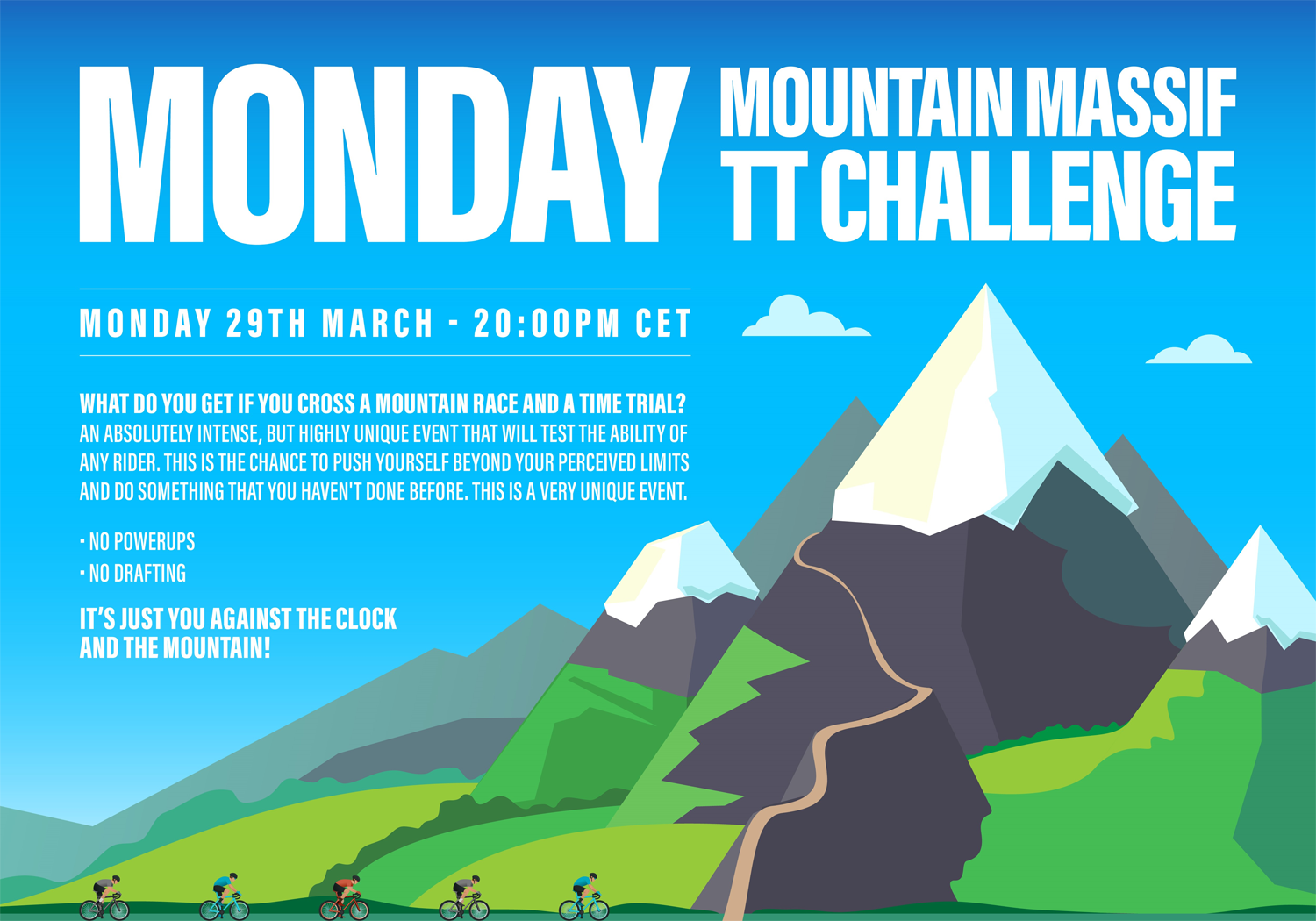
The event is called Monday’s Mountain Massif TT, and it’s my own personal brainchild. It happens this Monday, March 29 at 8 pm, CET… here are the details.
Event Details
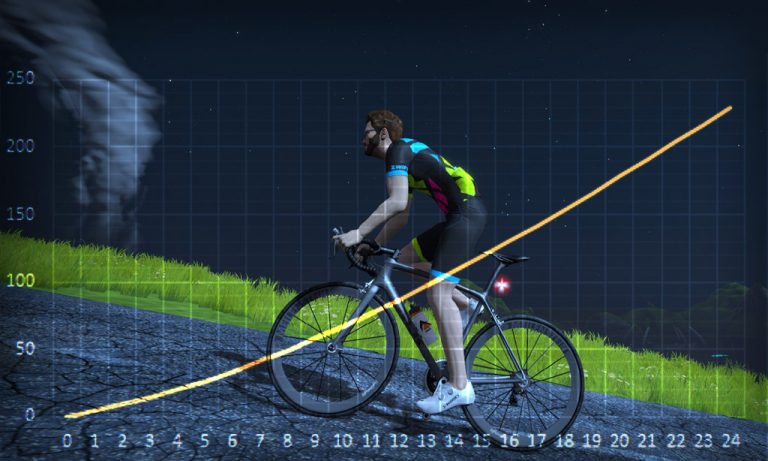
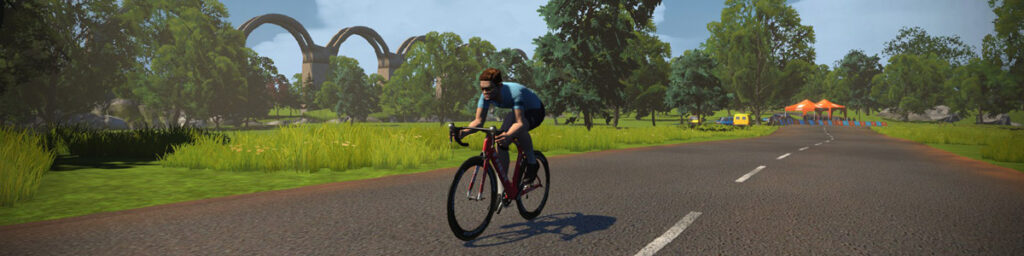
The event is super unique. It is a 12.2km Mountain Time Trial on a shortened version of Watopia’s Mountain 8 route. Riders will race up the reverse of the Epic KOM, finishing at the Radio Tower!
Equipment selection is crucial. With a short flat section from the pens before the start of the climb, do you opt for a full TT setup before switching to a Climbing setup? Or do you opt for an all-rounder setup? Your choices will dictate your result.
With no draft and no power ups, “It’s just you against the clock and the mountain.”
There will be the standard A-D categories, including E, exclusively for Women and all will start at the same time. Heart Rate monitors are required for official results, which will be on Zwift Power, with a winner for each category.
This event is a pilot and if it receives positive feedback and is well attended, then Zwift will look to run this in a regular, weekly slot.
The description of the event from the Companion app is as follows:
What do you get if you cross a mountain race and a time trial? An absolutely intense, but highly unique event that will test the ability of any rider.
This is the chance to push yourself beyond your perceived limits and do something that you haven’t done before. This is a unique event.
To time trial up a mountain will take absolute discipline and requires you to pace the ride as well as employ tactics. Do you opt for a TT bike to the base of the climb before changing to a lightweight climbing setup? Do you opt for a lightweight setup from the start? Only you can decide and the decision you make will impact your results.
If you are not interested in racing for the victory, treat this event as a 20 minute FTP test. Generate a consistently high power for 20 minutes and boost your ratings in Zwift Power.
This race is unique and offers something for all.
My thoughts on the event
I think this will be an extremely exciting event, and pacing is going to be critical for success. Go too hard on the lower slopes and that last kilometer to the Radio Tower will be torture. But that is part of the fun: getting the pacing and tactics right means the strongest riders might not win.
I am already looking forward to the event. It will certainly be a new experience, as I have never done a Mountain TT before! As the organizer, I’ve reached out to many people who I have been fortunate enough to engage with while writing Zwift Insider articles. I can share that Olympic Gold Medal winner and current triple jump World Record holder Jonathan Edwards has confirmed he will take part, actually making this his first race on Zwift (read my interview with him). Former pro cyclists and Grand Tour Mountain Stage winners Andy and Frank Schleck have been invited, with Frank confirming he will attend (his response being a classic “Ouch, this is gonna hurt!”) I reached out to Ed Laverack, British Hill Climbing Champion to invite him along and his response was “I’m due a 20min test!” (For us mortals, it will take longer than 20 minutes!)
I’ve been a Clif Bar fan for years. After testing various nutritional strategies for long rides, I discovered that a Clif Bar per hour, plus water, gets me through 2-5 hour steady rides quite nicely.
And I’ve confirmed these results over countless miles and centuries, both on Zwift and outdoors. In fact, I’m quite sure I’ve eaten my weight in Clif Bars several times over.
My favorite flavor, you ask? Blueberry Crisp, of course. Nothing better. Works at 6am. Still tasty in the afternoon. Got a bit of crunch to it, plus that lovely blueberry taste.
Just don’t make me eat another White Chocolate Macadamia or Chocolate Chip bar. Or any of the holiday Gingerbread flavors. Because I’ve had way too many of those, since they’re the only ones I find on sale at Costco or after Christmas.
Because I’m a Clif Bar cheapskate, you see. They regularly sell for $1.35 or more, but I like 95 cents or less.
That means 12 Clif Bars for $11. And 18 packs of Clif Bloks for $23. Come to Papa! Free shipping on orders of $50 or more.
Get ’em while supplies last. Here’s a link to the sale homepage – and if you buy through that link, Zwift Insider will get a small sales commission. So we can buy more Clif Bars, obvs…
With the update Wednesday to game version 1.0.64913 many – like really many – have suddenly experienced crazy power numbers when using one of these trainers:
Tacx Boost
Tacx Booster
Tacx Blue Matic
Tacx Blue Motion
The problem is not with your speed sensor, nor the trainer itself. Rather, Zwift has introduced a bug. It changed the power curves for these trainers which is defined in-game and used to translate speed to power.
We’ll have to wait for Zwift to fix it for real but in the meantime you can get riding with realistic numbers simply by selecting a different trainer model from the list in the pairing screen.
I dug into the defined power curves and found what seem to be fairly close matches:
Choose Jetblack M5 Mag Pro instead of Tacx Boost
Choose Tacx Blue Twist instead of Tacx Booster
Choose Jetblack M5 Mag Pro instead of Tacx Blue Matic
Choose Minoura MagRide-60 instead Tacx Blue Motion
Simply choose the alternative trainer instead of your Tacx when pairing. But let the trainer resistance setting be the same as always for your Tacx – simply ignore what Zwift says it should be for the alternative trainer.
Here are the power curves so you can see how they compare. The graphs show power (watts) as a function of speed (mph) – how much power Zwift calculates you are putting into the pedals based on the speed of your rear wheel:
Tacx Boost vs. JetBlack M5 Mag Pro
Tacx Booster vs. Tacx Blue Twist
Tacx Blue Matic vs. Jetblack M5 Mag Pro
Tacx Blue Motion vs. Minoura MagRide-60
Editor’s note: those article was originally published on ZwiftHacks. It is reprinted here by permission.
My passion for cycling started in a hotel bar when I was 49 years old, tipped the scales at 120kg, and never exercised. Three years later I’ve lost the weight (down to “almost” 75kg) and I’m on Zwift most days! I climbed real-world Ventoux twice in a day, and I vEverested Alpe Du Zwift. I love the WTRL TTT, and each week I publish a recce filled with a course profile, bike recommendations and even some target times. I have also started posting video recce’s and highlight reels, and you can find me on YouTube here.
For over a year now, the Thursday WTRL TTT has been the center of my week and Eric has been wonderful in letting me share that obsession with you.
This was a long one. Maybe the hardest route on the schedule – pretty close to it, anyway. As usual I livestreamed the Vixens… but totally forgot to unmute the mic. Some of you struggled through and watched anyway… watching me suffer in silence must be entertaining!
Here are the results compared to how the Coffee Classes have done historically on this course, and how my predictions went:
Category
#55 April
#69 August
My prediction
PL-Spot
My position
Vienna
1:05:39
1:07:17
1:05:00
1:05:32
10th
Doppio
56:39
58:06
56:20
56:01
16th
Espresso
57:17
58:21
57:00
57:18
7th
Frappe
59:48
1:00:21
59:00
59:41
5th
Latte
1:05:31
1:05:02
1:05:00
1:04:41
17th
Mocha
1:15:53
1:15:54
1:15:00
1:13:09
19th
Boom! What happened in Mocha – knocked almost 3 minutes off the previous best times around this course… you guys have been practicing!
This week Vixens Captain Trigg played a blinder, taking the opportunity to send our fast-4 up the road at exactly the right moment. The Vixens Highlight reel is turning into a weekly 5-minute TTT soap opera… Some new, some old… some positively ancient. Suspiciously Gaby has a “work appointment” crop up after finding out the course… but Polly stepped up and mysterious newcomer Jack steps in. Would it be enough to overhaul the Cheetahs? Will Sherpa Dave remember to hit the stopwatch to begin our “delay time”? Will he unmute the livestream? Only time will tell…
It’s a tale of team splits, drops and broken cyclists everywhere this week as our guest reports show! First Team Giant Gamden…
What an awesomely auspicious week it was. The 100th WTRL TTT, the first birthday of Giant Camden, and Captain Diego’s 8 day old baby Sienna watching us. For the first time LoaP had a full complement of 8 riders with GCs very own Queen Bi joining, so what could possibly go wrong?
Well banner up, 3 minute delay, pedals down – and we’re already down to seven – poor Jo had tech issues, five minutes of appearing and disappearing while we tried to wait for her but then she was gone 🙁
First 20km in good form, good line, good speed then the Volcano. Back after a three-week break Rob broke halfway up the hill, Osh newly joined struggled also, and Bernard and Pete only just held it to the top, behind the three leaders… but some coordination on the descent and five of us were back together… at least as far as the reverse KOM, anyway.
Bernard struggled on the climb, Captain Diego offered to drop back and give a pull, but the quads were gone and so was Bernard. Four remaining. So Diego, Bi, Pete and Sam bravely rotating and keeping it together for the last 5km and with a final heroic sprint Pete took it on the line, with the other three hot in his wheel.
Team Giant Camden run 8 teams – but my other contribution comes from an outfit with just 3 – vAmos, Blast and Crew. Here’s the report from Mark B of CICC Blast
So after what felt like a cycling version of the Hokey Cokey in the run up to Thursday (you put a whole cyclist in, a whole cyclist out, a whole team in, a whole team out) surprisingly Blast arrived on the line with 8 riders… but Crew and Dyno had reformed as DynoCrew and vAmos were down to 3.
Anyways, off we set with Mike declaring minute pulls on the front were better than 45 second pulls. He has 2 Maths degrees so Fraser agreed enthusiastically. With the longer distance we agreed 325w on the front (Sherpa’s note… this seems suspiciously precise!) and settled into a rhythm. We stayed as a team of 8 till the volcano erupted!! Plan was to tap up at 4-4.5 w/kg… which worked up the first ramp, then went to custard and we said goodbye to Carlos, Rich and Olivier. Chris stuck with it for a bit longer but I was scared he would out sprint me in Fuego Flats so I made sure we dropped him (kidding!).
That left 4 of us, Phil (relatively new to Zwift) had been introduced to the supertuck and it’s now his new favourite move. With the 4 of us effectively swapping minute turns to the reverse KoM, a bit of ghosting happened as we all disappeared and then reappeared fortunately still close together. Over the top, down the hill and a push to the finish – a tickle over the hour.
Thursday 25th March – Greater London 8
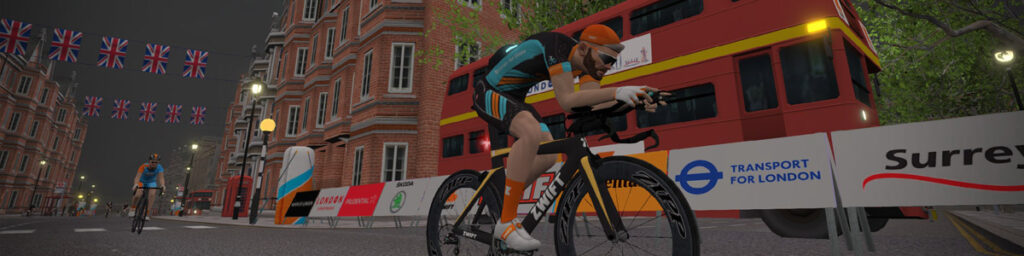
Back to London again this week for a single lap of Greater London 8, the first time for this route in a TTT, and more important, first time up Box Hill (and down Fox Hill on the other side). It’s a total of 24.3 km (including the lead-in) and 256 meters of elevation.
The ride starts in the pens as usual and runs along the Thames. Sharp right turn up Northumberland Ave to Trafalgar Square then left with the short downhill towards Parliament. Then its a 6.5km flattish loop around Greater London before heading into the Hyde Park Corner underpass. After that it gets lumpy for a while – down through the underpass and up Piccadilly on the other side, before stepping down as you loop back past Nelson’s Column and Parliament.
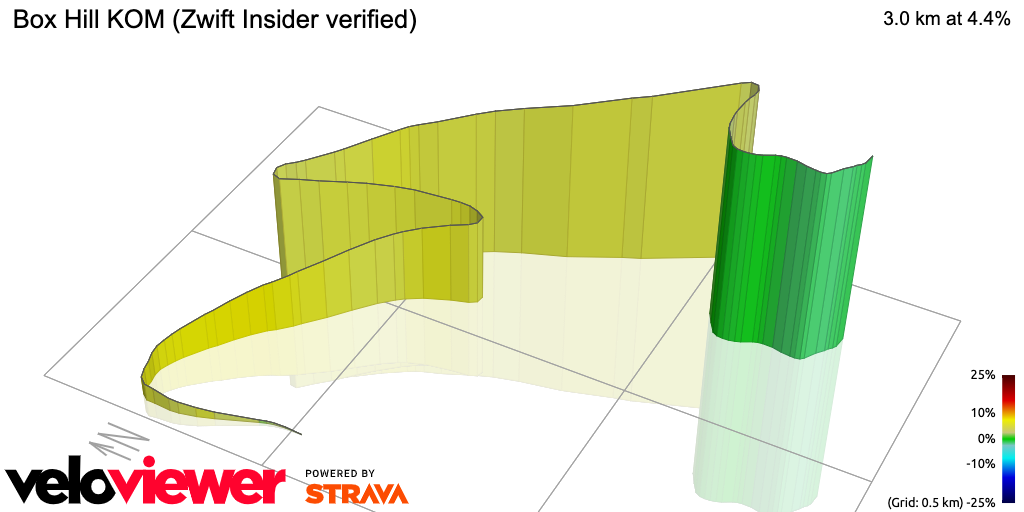
At 14.5km we cross the Thames River, and take the tube to Surrey. Shortly after emerging the road turns upwards and you hit Box Hill KOM at 16.1 km. Box Hill is a solid 3km climb, there is a brief 800m respite (which actually starts before the end of the climb) before the kicker – 150m peaking at 10%. After that it’s a nice recovery down Fox Hill before crossing back over to London proper and heading across the line.
This is another tough call – is it aero… is it hilly…? On balance, 21km of this ride will benefit from an aero bike, and for 3km a climbing bike. Unless you have your own (or team) reasons to go the other way, a good aero setup is the way to go. I will be on S-Works Venge/Super 9 rather than Tron… and hope to stay with our fast-4 on the climb.
If you don’t have these bikes, pick your most aero setup. Here are some recommendations on equipment at various levels but check out Eric’s page that looks specifically at the best bikes for a flat course:
Level 45 get those 858/Super 9 wheels and pair them with the S-Works Venge
Don’t have the Tron bike yet? The Giant Camden “Get the Tron” series is in full flight. This link on Zwifthacks will let you know the currently scheduled events. Team Giant Camden are well known for being a friendly lot and while they are based out of a bike shop in London, they have 200+ racers from all over the world with a very strong female contingent. The Tron Hunter rides are open to all…!
As always, the Zwift Insider reports on frames and wheels are superlative so if you want to find the perfect bike and wheel combo for you, check them out.
Grudge Match
In lieu of target times (first time on the route and I’ve no idea what Box/Fox will do to you all), here’s my take on our own battle this week:
This is a grudge match of epic proportions… last week Vixens beat arch-enemies the Cheetahs (another Rowe and King team) across the plains of Watopia, to the top of a volcano, and back again. This week Vixens heroine Gaby has been kidnapped by the Cheetahs, and forced to race for them… but the VIxens retained the new Queen Bee Polly, along with mysterious stranger Jack. As this race loops around Greater London and heads into Surrey will the Vixens keep the crown, or will the Cheetahs find a way back to glory? There are 1050 teams competing, but only two matter tonight. Both Vixens (hooray!) and Cheetahs (boo!) are Frappe teams of Cat B’s and C’s.
I will, of course, have the highlights reel published next Friday so you can see what happens in the soap opera that is R&K Vixens!!
Route Recon
I rode this route so you can recon from the comfort of your armchair!
But if you’re more inclined to read my recon, here we go!
As you go through the start/finish gate you have a 500m incline at 2%
Descend for 1km at 2% into the tunnels, then come back up the other side at a shallow 1.2%
At the 3.6km mark you will turn sharp right onto Northumberland. 300m at 4.5% ending in a left turn.
2-bump descent towards Parliament
Mostly flat for 5.5km until you start the descent to Hyde Park corner. Pick up speed as you descent into the tunnels.
Piccadilly ascent starts at 11km. It stretches 900 meters and averages 2% – but it is broken into two 3% sections with a short flat in the middle. You will see the end of the climb approaching because the road turn sharp right.
3.9 km of flat or descending until you emerge in Surrey and begin the main climb of the ride – Box Hill… but don’t forget the short, sharp drop into the Underground at 15km.
Box Hill starts at 16km. A lot of the climb is draftable but as it pitches over 5% and speeds drop the draft effect will lessen. Ideally stay together to benefit where you can. The climb breaks into into two sections
The first 800m (to the first sharp U-turn) is slightly steeper, getting up to 7.5%, averaging 5.5%
The last 2/3s (1.9km) is a steady gradient averaging 4.8%
The last 300m of the timed section is a slight downhill
Box Hill Kicker
150m peaking at over 10% – nobody can help you here… push hard and stay with your team-mates.
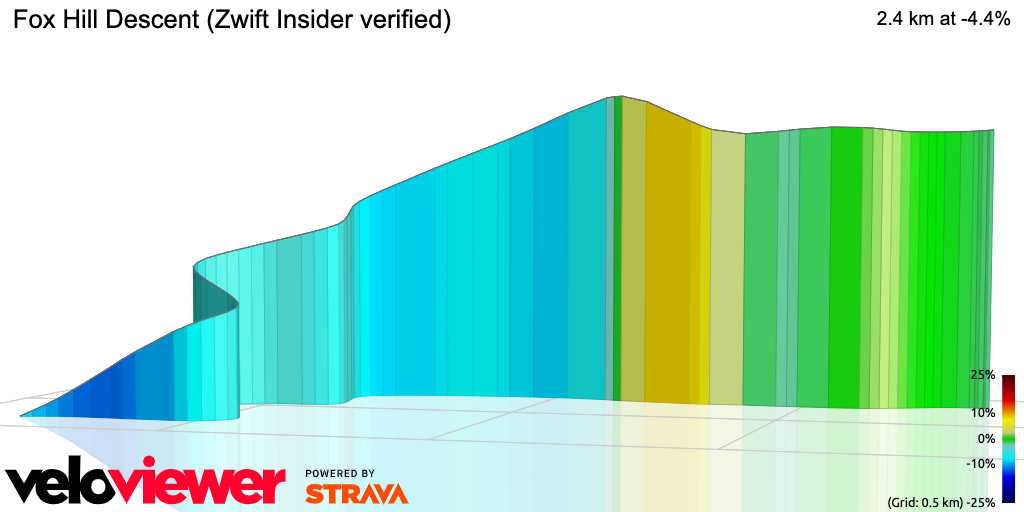
Fox Hill Descent is a beautiful 2.4km (less beautiful if you’re going the other direction). It breaks into two supertuckable (is that a word) sections with a short flat section in between
The trick to this descent is accelerate over the kicker and get speed up to supertuck speed as fast as you can… relax… but keep an eye on the gradient… when it dips below five, power on for 5-10 seconds to keep speed close to 55+ as you hit the second section.
Ride summary
Many teams will look at Box Hill as the decider on this course, but I believe your strategy in two key locations will actually make the difference: Box Hill’s kicker, and the Fox Hill Descent.
Hear me out – the weaker and/or heavier riders in the team will give 110% to get to the top of Box, but the kicker is like a wall and by then they have nothing left. You want them for the descent to allow the pack dynamics to kick in as you supertuck. DS’s, think about how to preserve some energy for the kicker, so you can get down the hill as fast as possible!
Cardiac Sarcoidosis is “a rare auto-immune disorder in which the body overproduces immune cells, which clump together into ‘granulomas’ that can build up in the heart, disrupting heart rhythm, blood flow, and normal heart function” according to the Mayo Clinic. The cause of Cardiac Sarcoidosis is ill-defined, but the symptoms, which mimic that of heart failure and heart attack, certainly aren’t. And they’re just as lethal.
She Had a Bad Feeling About This One
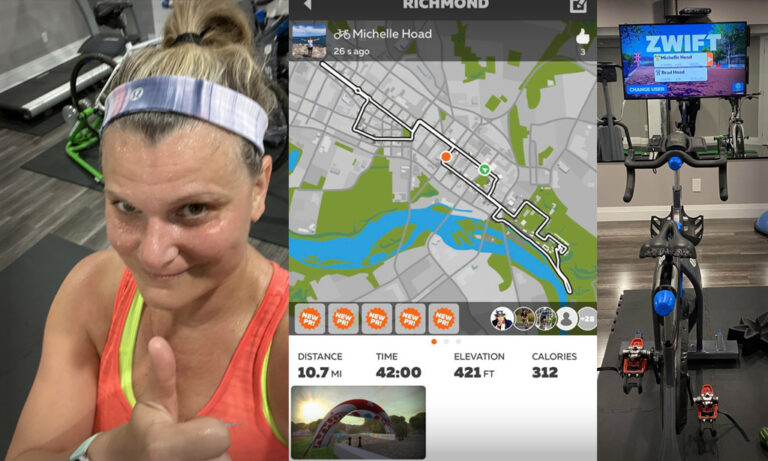
“I am in the 2% in the world where the granulomas formed around my heart, and cardiac MRI showed a cluster hiding on the back of it, affecting the electrical signal,” says the Hamilton, Ontario native Michelle Hoad (see Strava profile). This was determined after months of testing brought upon after a feeling she had during her 45th birthday party in 2015. Her heart was racing, but not like all the other times over the past 2 years. Those times, her doctors had explained it away with a diagnosis of anxiety after a myriad of inconclusive tests.
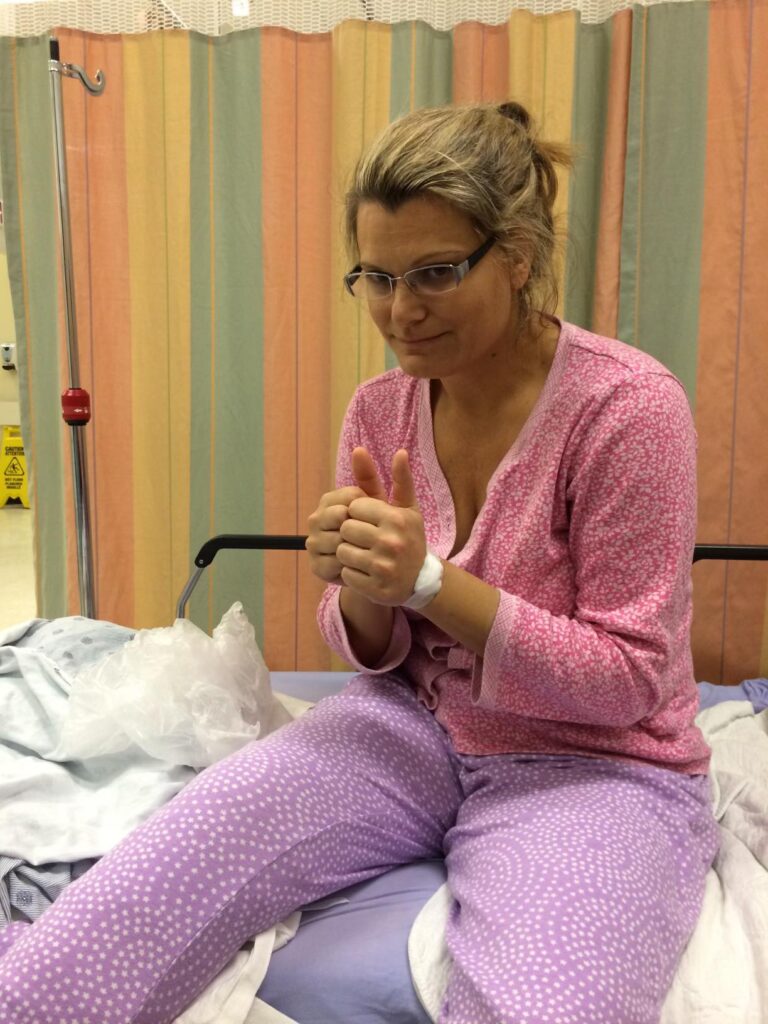
“After 13 hours of pretending nothing was wrong, my family called an ambulance as I had trouble walking to the bathroom due to exhaustion,” Michelle recalls. When paramedics arrived they found her heart beating an astounding 242 bpm and the hospital had to shock her back into normal rhythm. “Then life got hard,” she explains.
Michelle had a pacemaker and defibrillator surgically implanted and began treatment with heavy-duty immunosuppressant medications with the aim of shutting down her body’s own immune system. The treatment wreaked havoc upon her physically and thoughts of confusion hijacked her mind. She had always lived a clean and active life. “Why me?”
Michelle’s Doctor Puts it All Into Perspective
Her physician made it more clear when he said, “Autoimmune diseases are like the lottery, you just get selected. But make no mistake, the ONLY reason you are alive is because you are fit. Not many people can sustain a heart rate of 242 for over 13 hours.”
The lifesaving choice to pursue a healthy lifestyle was made by chance when an old boss bet her she couldn’t beat him during any stage of several triathlons he challenged her to enter. Michelle had never attempted one before.
“I deposited $2,400 into my account in October of that year,” she says when describing the reasons why she was hooked. “Three challenging sports and I loved the sweat, competition, and being outside.”
Michelle’s Tips For Staying Motivated While Battling Illness
The realization that you are still alive and many others don’t have the same privilege.
Knowing that there is so much more to do in life and I wasn’t going to let a near-death experience stop me from doing those things.
The belief that adversity makes us stronger. Tough times are like hills, some are long, some are steep, some are fast, and some are slow, and if you remain focused eventually you will get to the top.
Making a Withdrawal From Her Fitness Bank
It is also why, despite the heavy toll the treatments were taking upon her physically, Michelle had to stay mentally committed to cycling. “I can either get busy living or get busy dying,” she remembers telling herself when most rides ended in tears and exhaustion. Every time she was through, however, she always felt better.
As was true of her introduction to triathlon, Michelle stumbled upon the life-changing world of Zwift in 2019 through two fellow triathlete friends. “I tried Zwift in December and then proceeded to ride almost every day in January. I couldn’t get enough,” she exclaims. Zwift provided Michelle a sense of purpose and comfort in knowing that there were others riding indoors like her “who enjoy pain, just like me. Yes, yes there are, and there are thousands of them!”
Three Zwift Things That Keep Michelle Motivated
Thousands of riders doing the exact same thing I am, when I am.
The opportunity to be competitive with yourself and meet and exceed PRs on every ride.
So many different riders of vastly different abilities, experience, and backgrounds. Watching riders pass me at double and triple my w/kg gives me hope that I can get better and stronger.
A Better Perspective
“Zwift has given me a chance to experience my old life, but in a new way,” states Michelle when describing how fortunate she feels. “We are the lucky ones, because we get to wake up and ride. Many don’t get the privilege.”
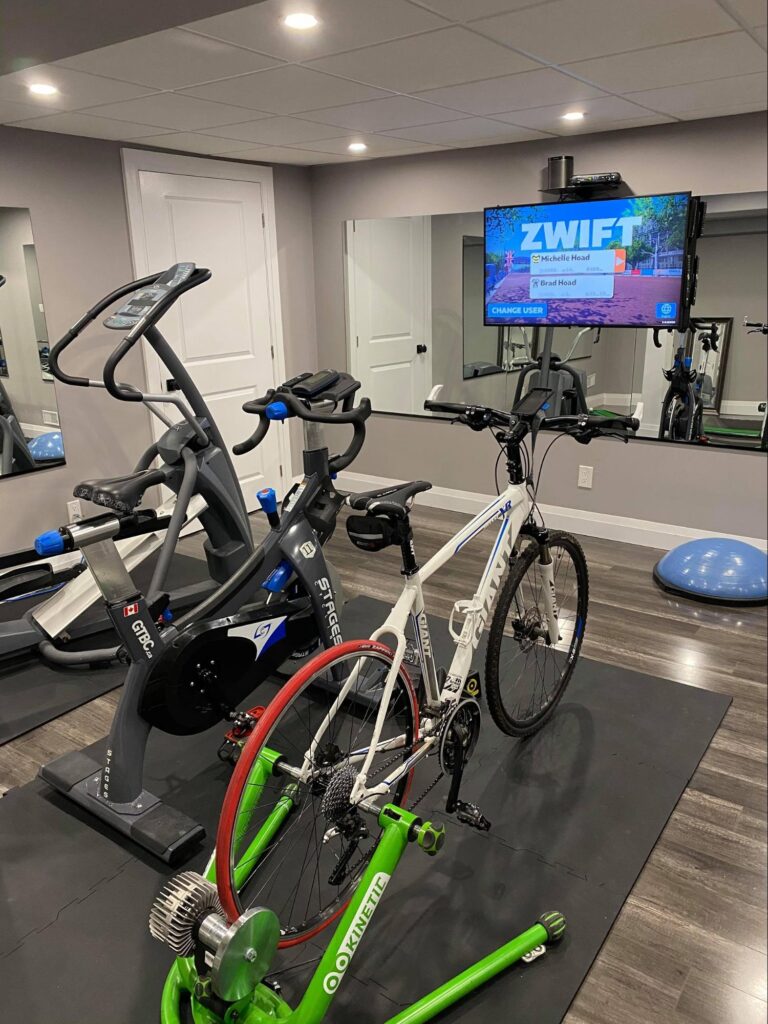
Michelle is truly hooked on Zwift. She rides a Stages SC3 Smart Bike an average of 50 miles per week, working her way towards 60. “I just rode my longest ride of 40km to get that badge,” she says with satisfaction, “and I am working on completing all the route badges.”
Zwift has provided her with the strength to achieve a much more important and momentous milestone, one which doesn’t come with a badge, nor can you put a value on it. “I got the clear to stop my meds for March!” I bet she will stay off them for good.
Ride On Michelle!
I Bet!
Have you ever placed a fitness or cycling bet on yourself? Tell us! I bet mine is better than yours.
Zwift Racing League has taken competition to the next level on Zwift. Now with two seasons completed, the good people at WTRL have clearly worked out most of the kinks in a series of events that requires massive amounts of planning, organization, and data crunching. Kudos to them for their longsuffering and hard work fine-tuning the biggest race league in Zwift’s history!
The third season of Zwift Racing League begins April 6th, and we’ll use this page to display all the key info and links in one place.
Rules (and Season 3 Changes)
The updated Season 3 ruleset is available at wtrl.racing/zwift-racing-league/#rules. This is a much more official and thorough ruleset than we’ve seen in past seasons, and that’s a good thing. It shows the league is maturing!
Here are a few key changes we spotted:
Nominated riders: in past seasons, any rider could race for any team, as long as they met the category requirements and only raced for two teams (or less) in a given week. In theory, this meant teams could have a totally different set of riders each week. (In practice, this didn’t really happen.) The new rule states that, “A Squad (roster) can be comprised of up to 12 nominated riders of which a minimum of 4 to a maximum of 6 riders can be selected from each week to form the Team racing in the event.”
A minimum of 4 riders must be nominated for the Squad before registration closes.
New riders can be added at any time up to the maximum of 12 riders per Squad.
New riders must be added prior to participating in an event.
Riders cannot be dropped from the Squad to free up space or if they have been asked to upgrade (UPG) within their first 4 events. Once the riders name is nominated for the Squad it is there for the entirety of the season.
Riders can only be nominated to two teams
In-game kit (no funny business): teams are required to select an in-game Team Kit at the start of the season and maintain use of the same kit throughout. Deliberately changing team kit or race names to confuse opponents would be considered as against the fair spirit of the competition and may result in a points deduction or disqualification.
Height/Weight verification: Each week The Board may randomly select teams from each Division to provide height and weight video per rider up to 12 hours pre and 12 hours post race.
If you’re new to ZRL, you’ll definitely want to get familiar with the ruleset and points structures, as these will inform strategic decisions made as a team.
Teams and Registration
New teams can register now at wtrl.racing/zwift-racing-league. Teams that raced in season two should receive an email invite from WTRL.
Want to race, but don’t have a team? Post your info on the Facebook group, and teams will get in touch.
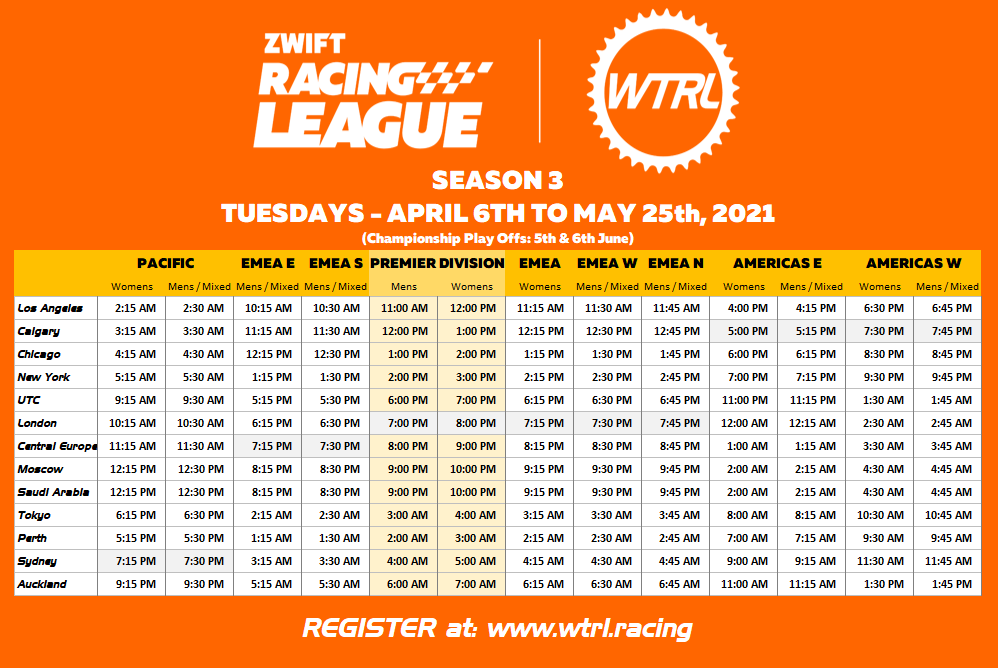
Timeslots and Divisions
Timeslots have been modified and expanded. More specifically:
New timeslots have been added for EMEA S, EMEA N, and EMEA (women’s only)
Premier Division moved from Mondays to a Tuesday timeslot
Race Routes and Dates
Note: “Intermediates” are sections on the course where riders will compete mid-race for additional points. Intermediates include both Fastest-Through-Segment (FTS) and First-Across-Line points, and the top 10 riders score points.
We’ve raced France’s R.G.V. route as the first TTT of Season 1 and 2, but this time around we’re going to switch directions! Douce France covers the same roads as R.G.V., but in the opposite way. That means the tricky “Les Intestins” section will come at the start, instead of the end – and we’ll have a long, straight run-in to the finish.
This is the Beach Island Loop route’s first appearance in ZRL, but Zwifters will already be familiar with the roads, since the route is nearly identical to Volcano Flat Reverse. Quite flat, with a sprint intermediate, this route is one’s for the sprinters. But watch out – it’s a tricky one, because that sprint comes just seconds after finishing the snaking dirt climb up to the Italian Villas!
This mixed course has something for everyone, with sprints to contest early on and the punch KOM to decide the overall winner.Lots of strategic decisions to made this week.
3 Laps (37km)
PowerUps: Aero Boost, Burrito, Feather
Intermediate(s): New York Sprint 4x, New York KOM (Finish)
Make no mistake: this race is going to be brutal. Each lap of the course takes you up Richmond’s three climbs: Libby Hill, 23rd St, and Governor Street. That means fifteen climbs, with 10 of them awarding intermediate points. How big is your matchbook?
5 Laps (46km) (lower categories will do 3 laps, 28km)
Riding on the Champs-Élysées may look like a parade on the final day of the TdF, but it’s far from that in reality… or on Zwift! Get ready for hill repeats and an uphill sprint intermediate.
6 Laps (42.8km)(lower categories will do 4 laps, 29.6km)
A “mostly flat” route, the Magnificent 8 made an appearance as the playoff TTT course for season 2. It’s a good test of a team’s full breadth of ability since it features slightly technical sections, a short climb, and plenty of flats for pacelining.
The regular season ends with one for the climbers. We’ll have a go at Fox Hill, Leith Hill, Box Hill, then the route ends atop Keith Hill for a mercifully-shortened version of Surrey Hills… for the lower categories. The rest will continue on and have one more climb up Fox hill, with a mountaintop finish. In terms of length + distance, this is definitely the queen stage of season 3!
1 Lap (45km) (lower categories have a 32km custom finish atop Keith Hill)
PowerUps: Anvil, Draft Boost, Feather
Intermediate(s): Leith Hill KOM, Keith Hill KOM, Fox Hill KOM
Simon, Shane, Nathan and, as it’s a red letter day, special guest Eric Schlange, discuss the advent of the most requested feature of all time.
Senior games guy Wes Salmon is on the Zwiftcast too – to discuss another sizeable development in the game this week – the tweaking of our virtual pelotons. The changes to pack dynamics, or blob behaviour, should make the Zwifting experience, smoother, more natural and more visually appealing. The regular crew and Eric discuss all the implications.
Simon also took the opportunity to quiz Wes on Sticky Draft – and his explanation may confound a few Zwifters who see it as nothing but a nuisance. In fact, it’s essential, as Wes explains.
The podcasters run the rule over two big new appointments to the Zwift board – and read the runes on what their skillsets and experience may yield up about Zwift’s intentions.
Simon also talks to a big new hire at Zwift, Lisa Bourne, whose brief includes diversity, equity, inclusion and belonging.
Along with some chat about game events and participation, the podcasters once again debate the utility of The Fence – this time in light of Wes’s belief that the recent changes to pack dynamics may improve its performance.
Concluding with a discussion about the disappearance of Zwift Transparency and the always-difficult subject of weight verification, the Zwiftcasters get a bit serious before reverting to type as Simon complains his training plan is too hard 😉
Most cyclists are painfully aware that you can’t just hop in the saddle and successfully complete a Gran Fondo after a long lay off without progressively building your fitness. Many cyclists have also learned the hard way that maintaining a high level of training and riding often leads to burnout and overtraining. Even the most experienced racers realize that it is impossible to maintain peak form successfully for prolonged periods.
The Theory of Periodization
The Theory of Periodization addresses these limitations by varying training loads throughout the season according to the timing of high-priority target events. Periodization acknowledges that the training demands of peak conditioning are psychologically and physiologically difficult to sustain year-round.
A solid training plan is scheduled carefully to build a base and then balance and maintain the many aspects of fitness required of the athlete’s sport, thereby reducing the risk of injury and burnout while maximizing performance.
Why is the Periodization of Strength Training Important?
The same is true of strength training for cyclists. Periodizing strength training for cyclists ensures that benefits are gained without disrupting key on-the-bike sessions. By simply adding strength training to your existing plan, or adding the wrong exercises at an improper point during the season, you may end up sacrificing the quality of your training and risk injury or overtraining.
Periodization of Strength Training for Cyclists
Phase One: Anatomical Adaptation (Preparing your Muscles and Connective Tissue for Strength Training)
Perform 20-30 repetitions per set, 2-5 sets per session, and allow 60-90 seconds of recovery between each set.
Perform each repetition in a slow and controlled manner.
Perform sessions 2-3 times per week for a total of 8-12 sessions total during a 4 week period.
Phase Two: Maximum Strength Building
Aim to lift heavy loads by gradually increasing weights and reducing the number of repetitions.
To avoid injury begin this phase conservatively and increase loads to tolerance.
Perform low repetitions (3-6) per set and 2-6 sets per session with 2-4 minutes of recovery between sets.
Perform 2-3 sessions per week for a total of 8-12 sessions over 4 weeks.
Phase Three: Power (Convert Strength into Speed)
Perform 2-3 sets per session of 8-15 repetitions with 3-5 minutes of recovery.
Lift the weight as quick and fast as possible, in an explosive manner, while maintaining control and proper form.
Perform 1-2 sessions per week for a total of 3-6 weeks, dependent upon progress, results, and priority.
Phase Four: Muscular Endurance (Extend Fatigue While Under Resistance)
Perform your primary exercises while under low load for 1-3 sets of 40-60 repetitions per set with 1-2 minutes of recovery.
Perform exercises at a moderate speed and pace the effort of the set.
Perform 1 session weekly for 4-8 weeks.
Phase Five: Strength Maintenance (Retain Strength While Increasing Cycling Training)
Perform 2-3 sets of 6-12 repetitions under moderate load with 1-2 minutes of recovery.
Avoid excessively fatiguing the muscles with each set.
Perform each session weekly and indefinitely unless tapering for a priority event.
Strength training is important for cyclists to reduce injury risk as stronger, more flexible muscles and connective tissue are less likely to break down through overuse. Strength, power, and endurance gains in the gym translate to improved performance on the bike!
It is a Wise Thing To Do… Period!
Do you follow a phased approach when performing your off-the-bike strength training program? Your fellow Zwifters would like to know how it works for you.
Bibliography
Hawkins, John. The Unconventional Guide to Strength Training for Cyclists. Simply Cycling Training, 2017. simplycyclingtraining.com.
Zwift has just announced via a forum post that they are rolling out the ability the “Return to Home” when saving your activity.
While it may sound a bit odd, this actually big news to many Zwifters, since it’s probably the most requested feature in Zwift history.
PC and Mac First
The feature will be released today on PC and Mac platforms only. Zwift says, “This feature will be released on iOS / Android / Apple TV at a future date.”
iOS / Android / Apple TV users may complain about the delay, but it’s important to note that these platforms have the easiest/quickest Zwift reboots. PC and Mac users, on the other hand, typically take 3+ minutes to save an activity then restart a new activity, and this update changes that!
How it Works
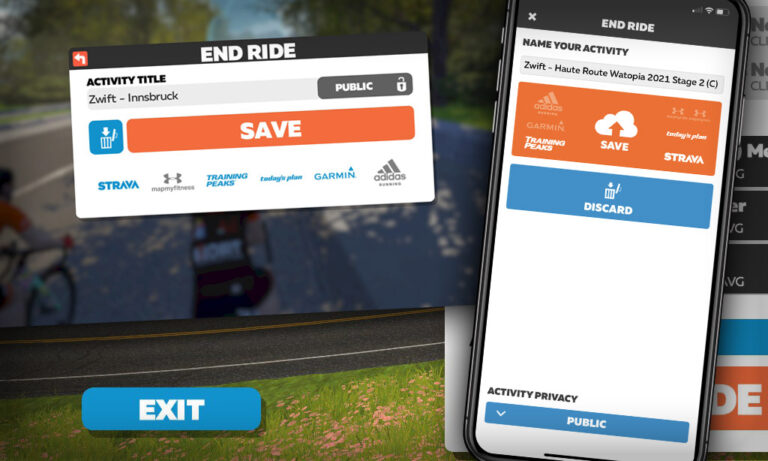
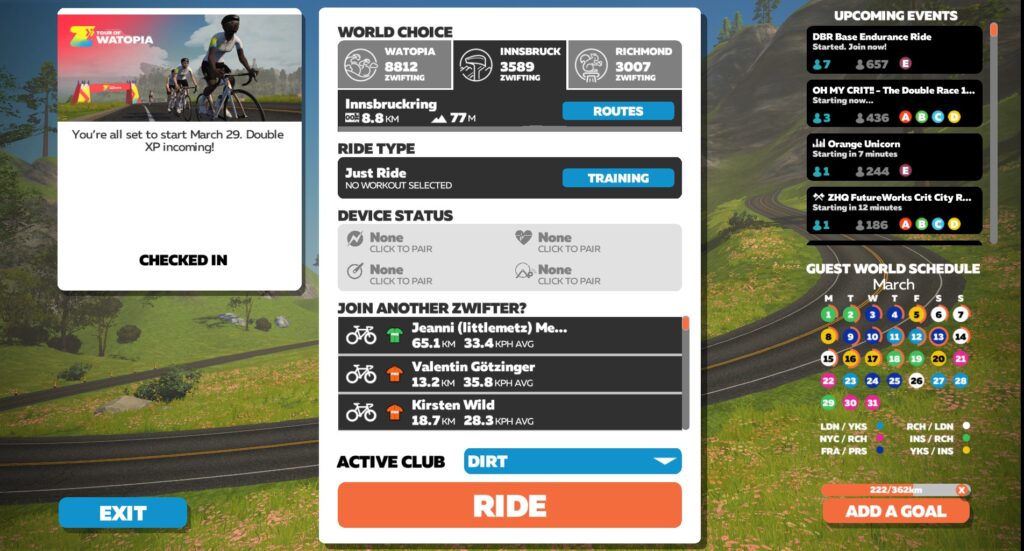
It’s not rocket science – it works exactly as you would imagine. Now when you save or discard your activity, you’re taken back to the home screen, where you can choose a new route, join another rider, choose a workout, sign up for an event… or click “Exit” to leave the game.
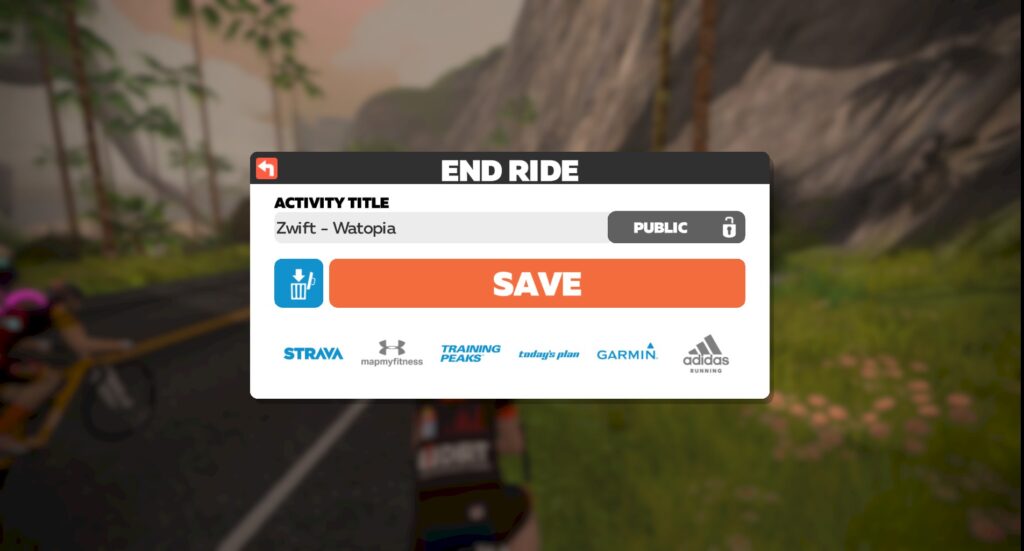
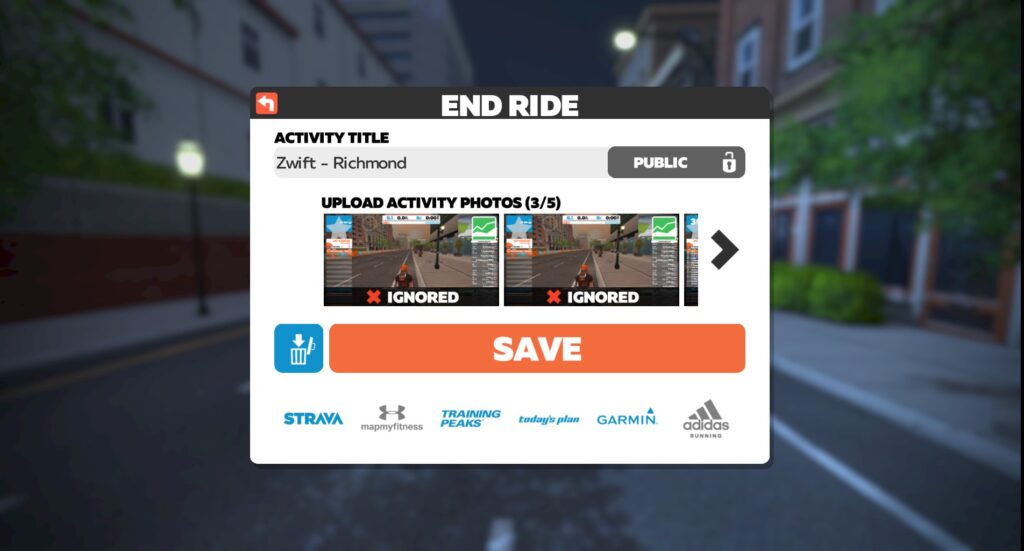
Users will notice two changes to the interface, which enables this “Return to Home” feature. The first is a revamped Save/Discard dialog. The second is the “Exit” button on the home screen:
New Save/Discard dialog
New “Exit” button
The new Save dialog includes a photo picker, but only if you’ve ridden at least 2km. (And yes, the photos that show up are only those taken during the current activity):
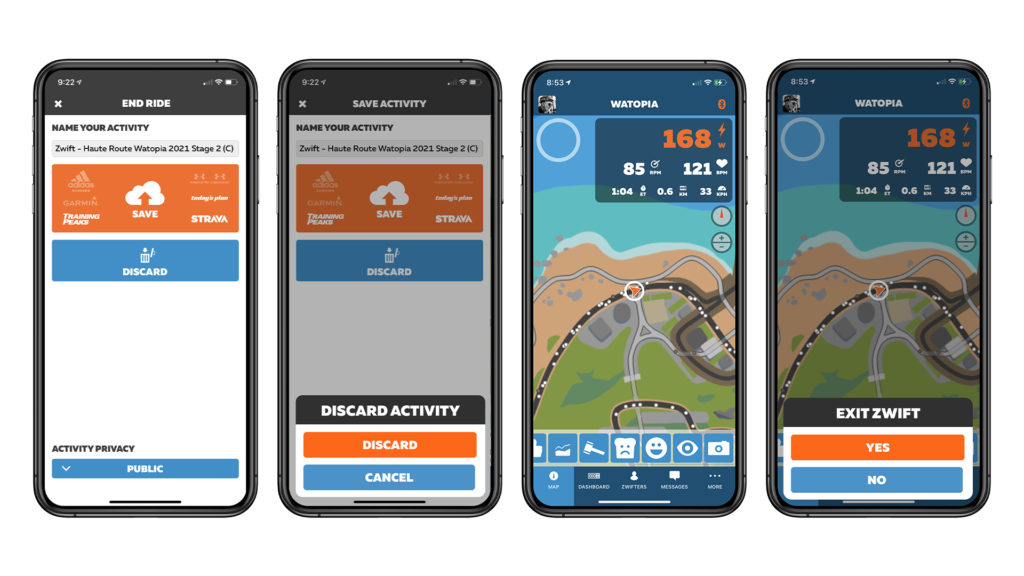
If you end your session using the Companion app, the new UI looks like this:
New Deployment Method – Who Dis?
We’re excited to finally have “Return to Home” – but we’re more excited about how Zwift rolled this feature out. Did you notice what changed?
This feature rolled out without an update to download!
That means Zwift has developed the ability, in some measure, to bake new features into downloadable releases, then remotely enable those features for select users (in this case, PC and Mac platforms). This opens up a world of new feature testing potential – imagine rolling out a new feature just to experienced (level 40+ users) for testing and feedback. Or only to users who have led rides.
Zwift says, “in an effort to better test new functionality roll outs, we’re evolving our feature deployment in a way that’s independent of a game client download. While we didn’t deploy this one perfectly, we are excited about additional capabilities to test features and functionality with smaller segments of our member base – this ensures better testing, better iteration, and a better final product for all Zwifters.”
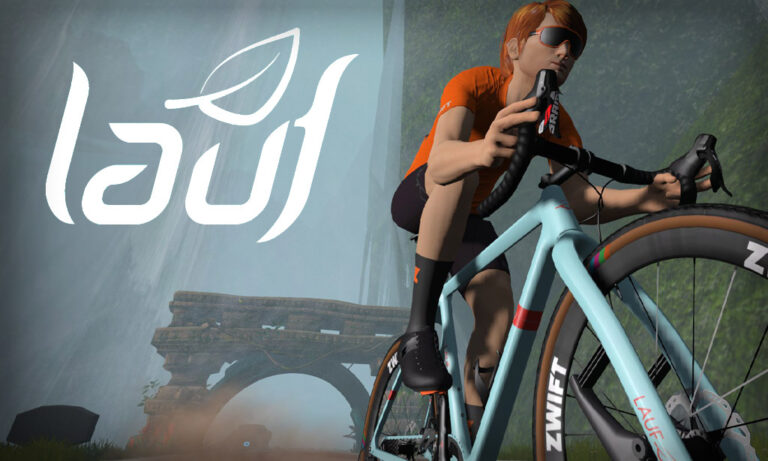
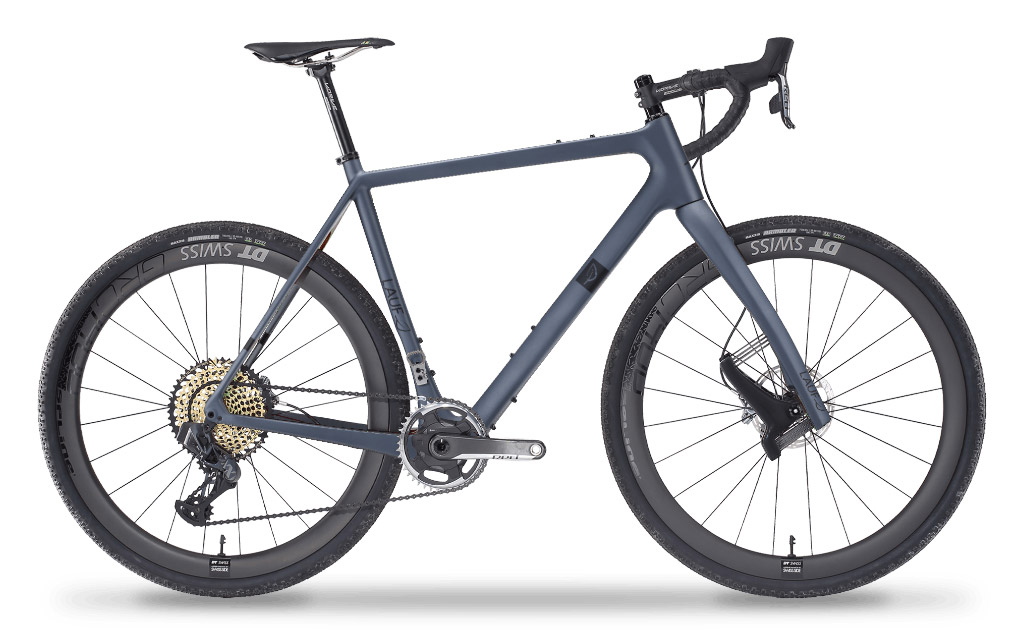
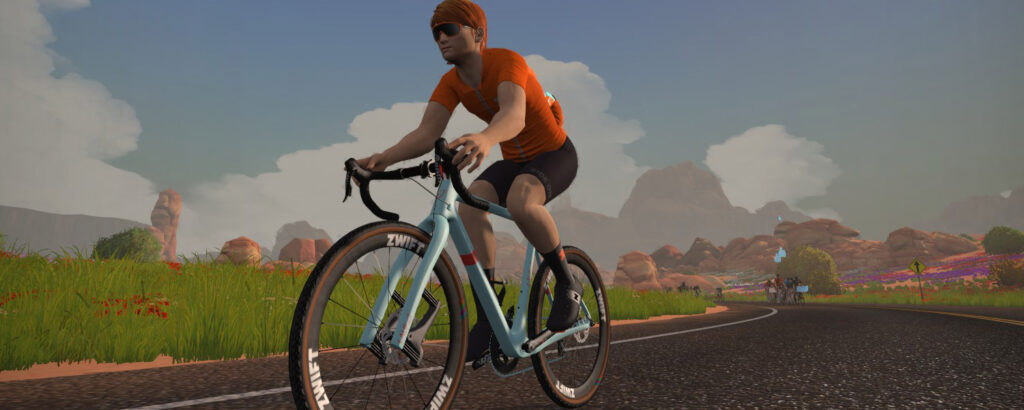
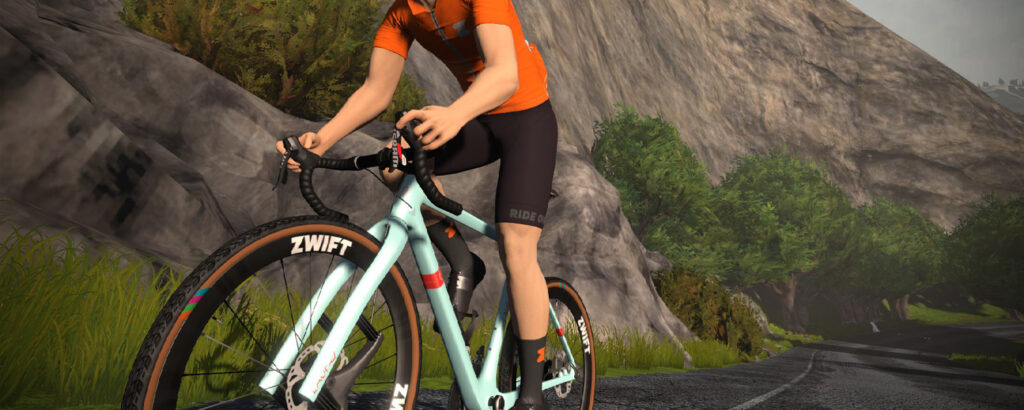
Zwift’s newest update includes a new bike frame – the first Lauf to show up in Zwift, ever! It’s the True Grit gravel bike, which is described in the Drop Shop like this:
The True Grit is a versatile gravel and endurance race horse, with nerves of carbon. Blast through gravel, sweep the singletracks, float on asphalt or open your recovery beverage of choice. At the core of True Grit is the Lauf Grit SL, with its 30mm of front suspension – the thing that changed how gravel riding is perceived, now taken to the next level.
Of course, experienced Zwifters know that real-world performance doesn’t necessarily translate to Zwift performance. So at Zwift Insider we run frames and wheelsets through a battery of tests to figure out just how well they perform in Zwift’s virtual world.
Here’s everything you need to know about the Lauf True Grit in Zwift…
The Lauf True Grit, IRL
Frame Basics
The Lauf True Grit is available at level 11, for a cost of 297,500 Drops. It is rated 2 stars for aero, 2 stars for weight.
The frame only comes in one colorway.
Aero Performance
The True Grit is only rated 2 aero stars, like most of the gravel bikes in game. That poor aero rating is reflected in flat course performance in our tests. In fact, this frame is one of the slowest in terms of aero performance, turning in the same time as the Canyon Inflite and Zwift Gravel.
The True Grit turned in a time of 53:53 on our test course (two laps of Tempus Fugit). The fastest gravel frame (Cervelo Aspero) turned in a time of 53:47, while the Canyon Inflite and Zwift Gravel frames turned in essentially the same times as the True Grit.
By comparison, the fastest road frame in game (Specialized Venge S-Works) turned in a time of 51:18 using Zwift’s stock wheelset, the 32mm carbon. That’s why, if you choose any gravel frame for a road race, you will be suffering!
Climb Performance
The True Grit doesn’t climb well, either. It turns in the slowest Alpe climb of any gravel rig.
The Lauf True Grit turned in an Alpe du Zwift time of 51:58. The fastest gravel climber (Canyon Grail) climbed the Alpe in 51:25, while the next-slowest gravel climber (Zwift Gravel) turned in a time of 51:56.
By comparison, the fastest climbing frame in game (Specialized Tarmac Pro) turned in a time of 48:57 (using Zwift’s stock wheelset, the 32mm carbon).
Final Comments
Apart from the super-funky True Grit SL gravel suspension fork, there’s really nothing special about this bike’s performance in Zwift. In fact, it has three strikes against it:
Poor aero performance: even compared to other gravel bikes in Zwift, the True Grit is quite slow
Worst-in-class climbing: gravel bikes in Zwift don’t climb really well anyway. But the True Grit is the slowest of the bunch.
It’s a gravel bike: unfortunately, the way Zwift has set up its Crr and gravel bikes means they’re not the best choice on any route. Road bikes outperform them on tarmac, and mountain bikes fly past them on dirt roads.
Until Zwift changes the way their gravel bikes perform, gravel frames will remain quite unpopular in Zwift. Which is a shame, given how popular gravel has become outdoors! And while Lauf lovers may use the frame because they’re fans, given its lackluster performance, we highly doubt we’ll be seeing many Zwifters on the True Grit anytime soon.