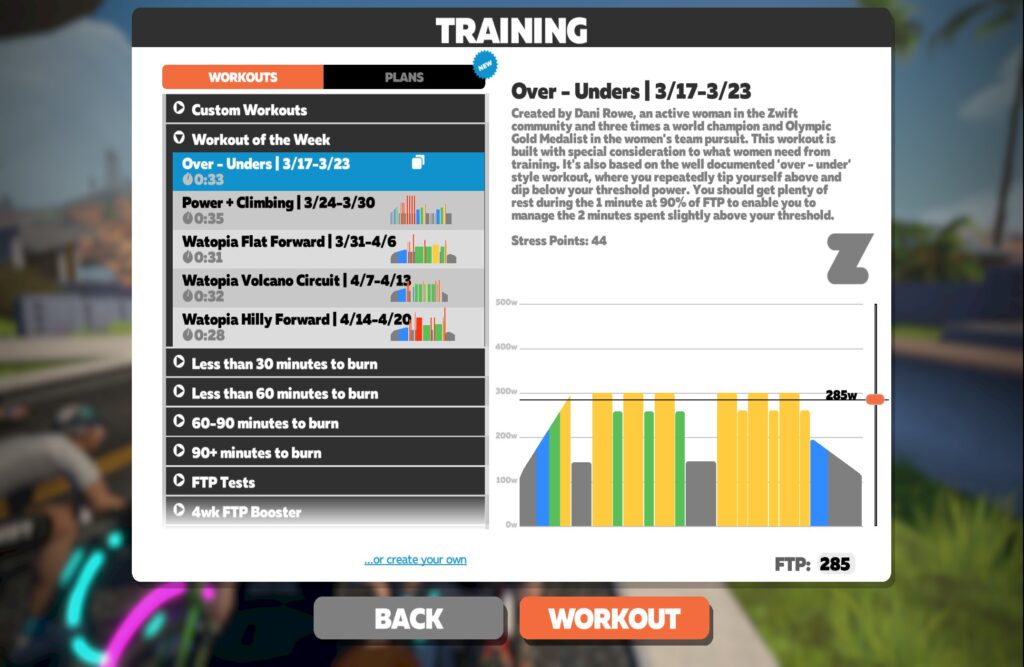
In a new series called ‘Coaching Explained’, Greg Henderson and Matt Rowe sit down to delve into the need-to-know facts about key coaching and cycling terms. To kick it off, they look at FTP and show you how to figure out what yours is, how to increase it, and what it actually means.
Tune in next Friday, when Greg and Matt look into bike positioning!
About the Podcast
The Zwift PowerUp Cycling Podcast features training tips from host Matt Rowe (Rowe & King), with regular co-hosts Greg Henderson, Rahsaan Bahati, Dani Rowe, and Kristin Armstrong.
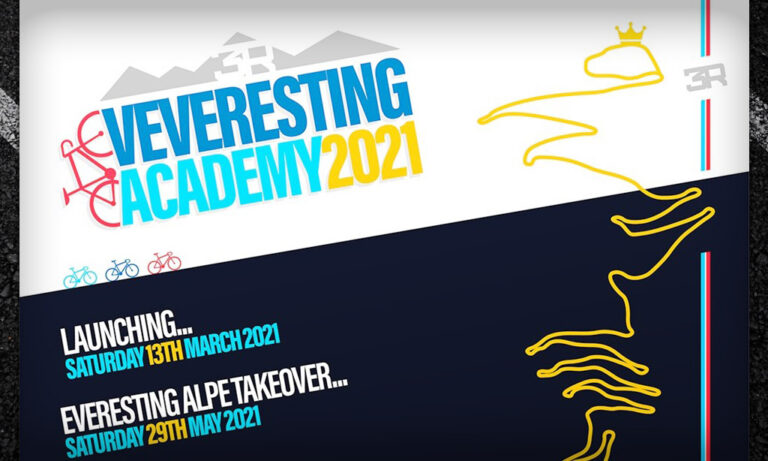
vEveresting. Ever fancied it? It’s one of those challenges which appears too daunting for some to even contemplate undertaking! Others have the idea that this would be good to attempt, but then the reality of the scale of the task becomes clear – the possibility of 10+ hours in the saddle is just a bit too much. And there are a select few who actually fancy the challenge…
Everesting has built up its own language and cult following and has thrived as a concept during the global pandemic. It was originally the brainchild of the Hells 500 Cycle Club who are also the custodians of the Everesting Hall of Fame. There are different rides and challenges that individuals can complete to enter the Hall of Fame, be awarded badges, and unlock the ability to buy real life kit via the Everesting shop.
The newly-announced 3R vEveresting Academy aims to give riders the ability to complete a supported Basecamp (half the height of Everest) or full vEverest ride. In Zwift terms, a full Everest requires 8.5 repeats of Alpe du Zwift.
Team3R have put together a series of weekly training rides with the aim of helping people to train and build up the necessary strength, mental fortitude, and stamina to complete the daunting vEveresting challenge on May 29, 2021. The Academy has been put together to provide a COVID secure program and endurance challenge which cannot be impacted by lockdown regulations.
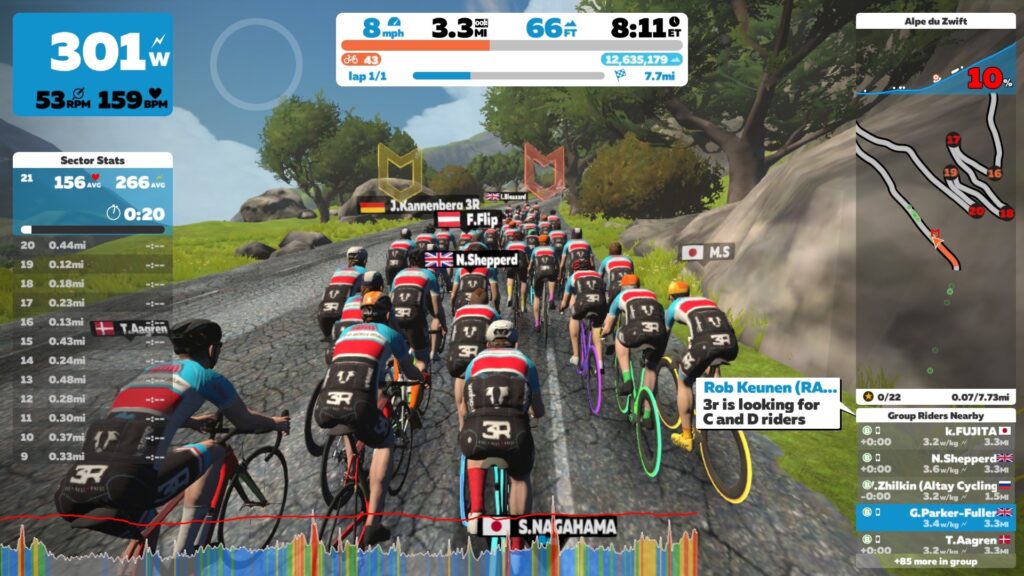
A recent vEveresting Academy group ride
Preparation Schedule
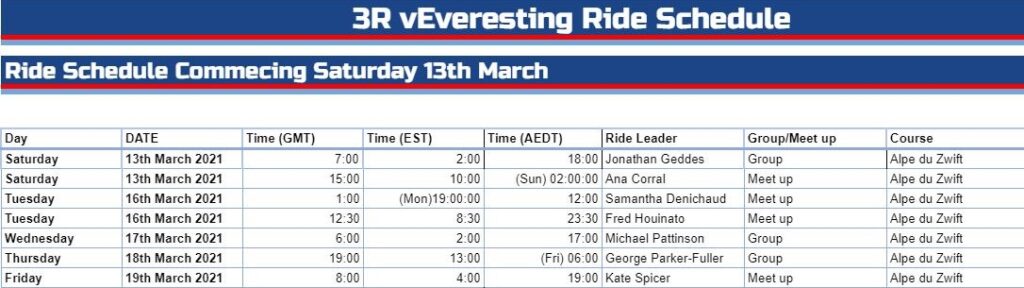
Each week, starting from March 13th and lasting for 12 weeks, there will be guided rides on the Alpe which will be hosted at a variety of times, making the Academy accessible to people across different time zones. There will be seven rides each week – three of which are set up as formal group rides in Zwift and four of which will be managed as Meetup rides.
All rides will be led by 3R Ride Leaders who have all completed a vEveresting themselves, so they are well-qualified to help and support you.
First week schedule
The Academy is the brainchild of George Parker-Fuller who heads up the Raise part of 3R (Ride, Raise, Race). George will happily tell anyone who will listen that he is an 82kg ZwiftPower Cat C who, at 45 years old, has successfully completed a Base Camp, vEverest and Roam (400km distance: 10km ascent) challenge year – and that with the right training and mindset, any reasonably fit cyclist can get involved in the Academy and the challenge.
The training rides will mostly take place on Alpe du Zwift. Scheduled group rides on Thursdays and Saturdays will be the main cornerstone of the training program where there will be guided Alpe repeats with the program building the number of ascents up the Alpe, topping out with 4 ascents on Saturday May 8 and Thursday May 13.
In addition to leading riders during their training, 3R Leaders will join their Academy teams during their challenge on the day. Riders who sign up to the Academy will also get physiotherapist-approved exercises to help with injury prevention and advice on nutrition. In addition, Team3R has secured a 30% discount from Veloforte who harness nature’s finest ingredients to produce the world’s finest all-natural nutrition.
In return for joining the Academy, Team 3R would like people to try and raise sponsorship for the charity World Bicycle Relief. World Bicycle Relief is an international, non-profit organisation that specializes in large-scale, comprehensive bicycle distribution programs to aid poverty relief in developing countries around the world.
The expectation is that people who are completing a Base Camp ride on the day will aim to raise £120 (enough to be able to supply one buffalo bike) and that people who are completing the full vEverest would aim to raise £240 (enough to be able to supply two buffalo bikes). People who subscribe to the Academy will also get support in sponsorship raising from the 3R raise team and World Bicycle Relief.
The Main Event
Once training has been completed, the main assault at the vEveresting Challenge will take place on May 29. There will be groups of riders at different phases of the challenge, depending on what time zone they have started in. With 107 riders already signed up for the event, it’s going to be a busy day on the Alpe!
There will be four Base Camp rides setting off at six hour intervals with the first at 7am GMT and two vEversting rides setting off 12 hours apart (7am and 7pm GMT). The aim is to take over Alpe du Zwift for a 24-hour period.
The plan on the day will be for the Ride Leaders to keep to a steady 2.5w/kg. This is a marathon and not a sprint and the aim will be to maintain the 2.5 w/kg pace for the whole of the ride. In time terms this translates to 75 mins per ascent and the plan will be to have breaks after the 3rd and 6th laps for food, showers, and general refreshments. One beauty of doing the challenge on the Alpe is that you get ten minutes of free time after each ascent while your avatar descends!
Prizes and Endorsements
For those who complete the challenge and raise the minimum sponsorship, there will be a prize draw with prizes from two of the partners who are sponsoring the event – Veloforte and Marmot Tours.
The Academy program and event is endorsed and supported by Hells 500 and Saris, who as part of their ongoing support will donate $5 per purchase between 19th – 29th March 2021 to the fundraising for World Bicycle Relief.
This update doesn’t include any new roads, but it does include some welcome changes, including much more flexible training plans. Plus, two new bikes! Let’s dig into the details…
New Pack Dynamics for All
Zwift has been fine-tuning some updated pack dynamics in selected events since December 2020, and this update takes those new pack dynamics live for everyone. That means free rides, workouts, events – everyone.
What does this actually mean for the in-game experience? Well, it should feel more realistic – pack shapes and your avatar’s path through the pack should feel more like what you experience IRL. We tested the new pack dynamics in a group ride today, and would summarize the experience as “looking and feeling different, but we’re not sure how it’s different.”
Here’s a quick video – see what you think:
We should also experience fewer positioning-related bugs, like:
Other riders riding off the side of the road
Riders surging repeatedly to new positions on our screen
Fence-related issues where riders see messages telling them to get behind the fence, when they already are
Our sources at ZwiftHQ tell us these updated pack dynamics will help riders positions to be more consistent across everyone’s screens. While riders may never be in precisely the same location on each Zwifter’s screen, this update goes a long way toward improving every Zwifter’s view of what’s really happening.
In theory, this should improve the experience for races like TTT’s, where positioning is so vital.
A note for event organizers: some have asked if there is a way to disable the new pack dynamics for their event, and the answer is no. Zwift opted to simply roll them out game-wide, to avoid the logistical nightmare of turning it on and off for select events.
Workout of the Week
In last month’s update Zwift said they’re working to expand and improve their workout library, and this month they delivered with a cleaned up folder structure and a new “Workout of the Week” category.
This category includes one new workout for each week of the month. Zwift’s plan is to populate this folder with fresh workouts each month. Some of these may be existing workouts, but it sounds like most will be new workouts, and they’ll be archived into other folders once the month is out.
More Training Plan Flexibility
Zwifters have long complained that the “flexible” Training Plans are anything but. This update includes changes that make Training Plans much more flexible in terms of scheduling.
Now, each week’s list of workouts is “unlocked” starting on Monday, and available through the next Sunday. You can pick which workout you do when. The only requirement is that you wait 8 hours between workouts.
Much more flexible. Nice!
New Bike Day: Lauf and Canyon
Two new frames arrived in this update:
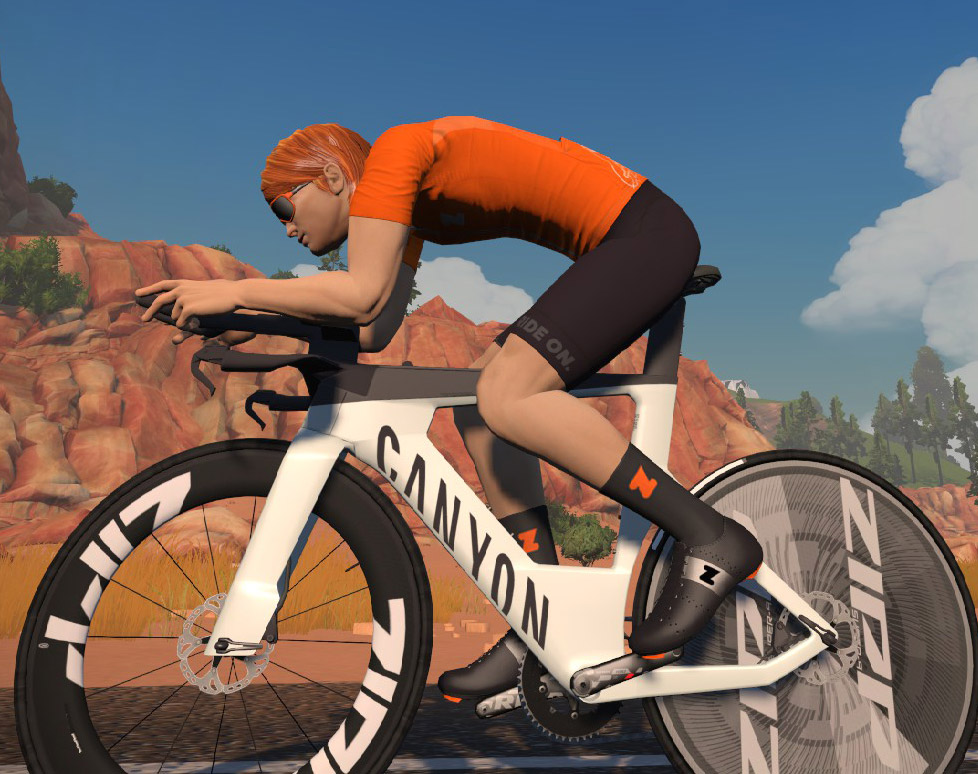
Canyon Speedmax CF SLX Disc TT Frame: 891,000 Drops, level 26 locked, 1 star aero, 1 star weight (that aero setting is definitely incorrect – Zwift has it on their list to fix) See performance notes
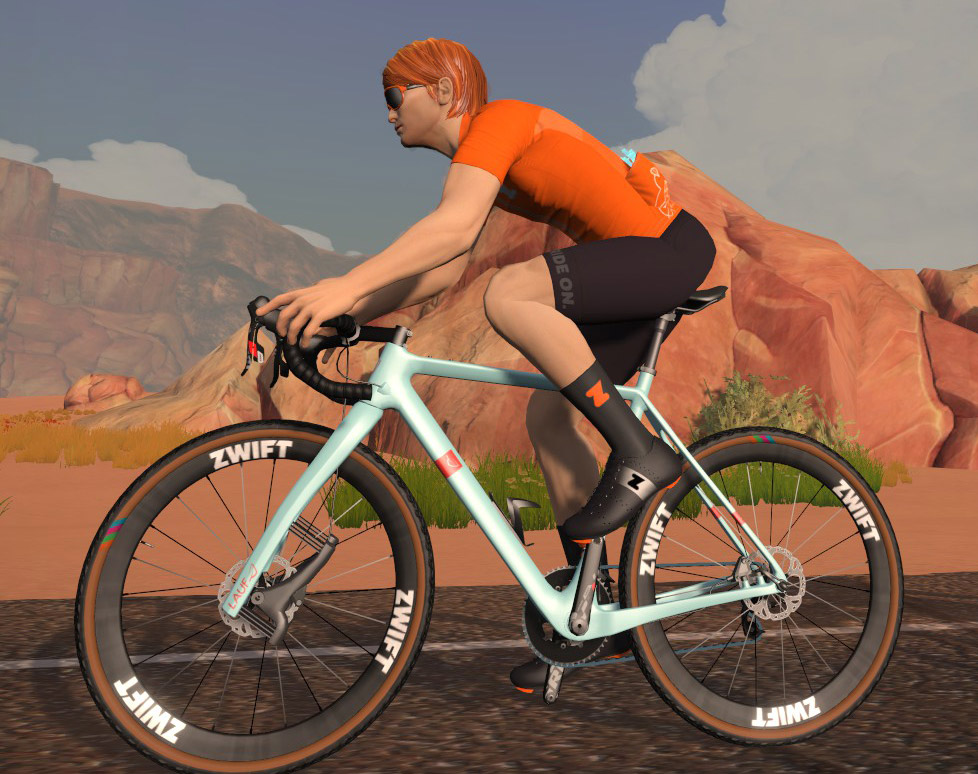
The True Grit is a versatile gravel and endurance race horse, with nerves of carbon. Blast through gravel, sweep the singletracks, float on asphalt or open your recovery beverage of choice. At the core of True Grit is the Lauf Grit SL, with its 30mm of front suspension – the thing that changed how gravel riding is perceived, now taken to the next level.
The Speedmax CFL SLX Disc held the title King of Kona for five straight years and the bike has only gotten better. The new frame sets the standard in adjustability, integration, aerodynamics and handling so you can smash your personal bests. The Speedmax cockpit delivers the perfect symbiosis of performance and comfort. The monospacer system is aerodynamically optimized. The Speedmax fork features a special surface that shadows the brake caliper, improving aerodynamics and reducing turbulence that can be caused by the caliper.
We’re speed testing both frames now, and will post separate articles with the results ASAP. But we definitely wouldn’t recommend the new Canyon frame until Zwift updates it with the correct aero setting, as it’s super slow right now!
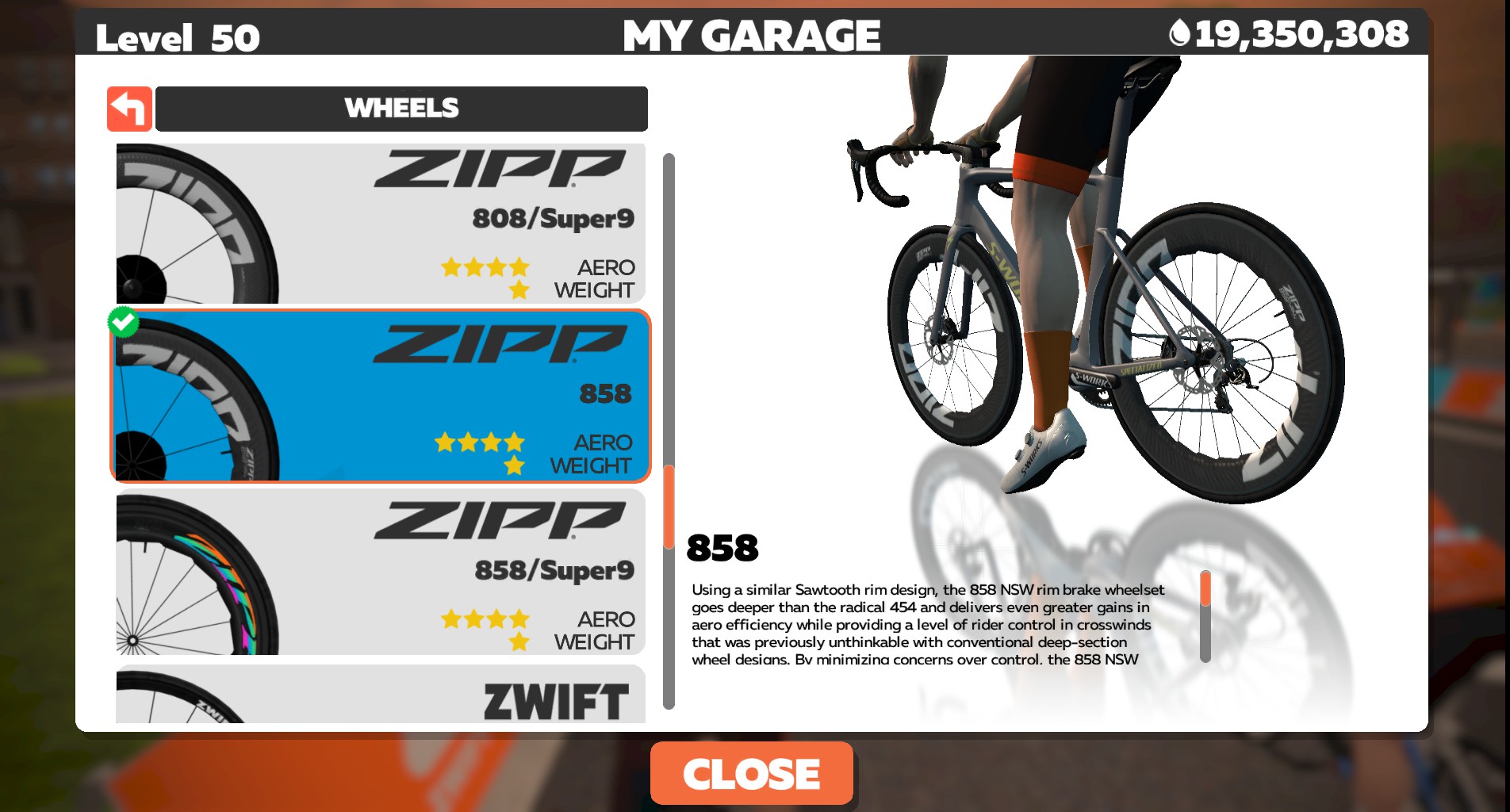
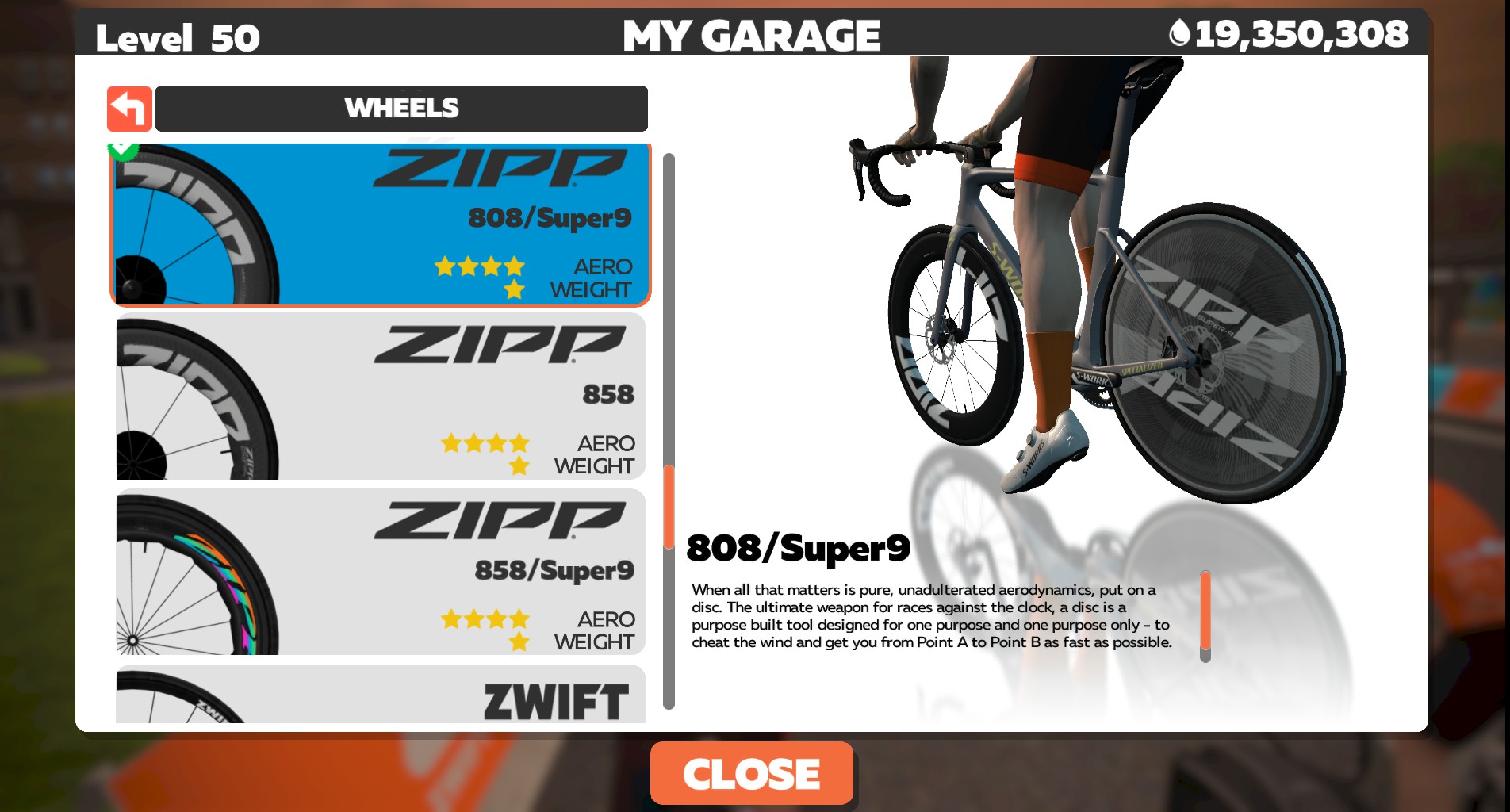
ZIPP wheels are favorites among Zwift racers, and this update includes a facelift for almost every ZIPP wheelset in the Drop Shop. The update uses ZIPP’s new logo:
The only wheelset that doesn’t have a new look is the rainbow 858/Super9 – the fastest wheelset in Zwift.
Bug Fixes/Improvements
This release also includes a pile of minor fixes… here’s the list from the release notes, with a few comments where appropriate:
Numerous cycling and running assets (kits, shirts, etc.) have been added or updated.
Updated the game client to include all of the country flags currently available in Zwift Companion. Additional flags will be available in the future.
Memory optimizations for both race results views and workout loading.
Fixed a bug in group workouts where riders would surge forward erratically.
Fixed a bug that would cause a user to miss their event or meetup if they signed up for the event then started their ride quickly after.
Fixed a bug where screenshots taken with the F10 key would not get uploaded to the activity feed or connected 3rd party services. This is a long-standing bug… we sure hope it’s fixed for good!
Fixed a bug where running shoe color changes are not being saved when exiting the app.
Fixed a bug where the name shown in the leaderboard UI does not match the actual user who is at the top of the leaderboard for the segment being completed.
Fixed a bug that caused the Quit Meetup button to appear when it should not.
Fixed a bug where the game and Wattbike devices were not in sync when paired over Bluetooth.
Fixed a bug that caused the cadence target for a workout to appear incorrectly in Zwift Companion.
Fixed a bug that caused special characters used in chat to not appear correctly in Zwift Companion.
Fixed a bug where awarded badges were not being properly saved to the Zwifter’s profile.
Fixed a bug that would cause chat from leaders and sweepers to not appear for some users. This has been a big complaint in the last month or two – I’m sure Ride Leaders are happy to see it’s fixed!
We also noticed a new “Exit” button on the start/join screen.
Zwift has just announced its next major event series – the crowd favorite, double XP-featuring Tour of Watopia!
The 5-stage tour begins March 29 and runs through April 22. And yes – Zwifters earn double XP in all ToW events. With lots of ToW events happening, you can bet Zwifters will be putting in the work to earn points and level up. Because everyone wants that S-Works Venge with 858/Super9 wheels…
There’s also a double kit unlock! More on that below.
Registration
Registration is now open at zwift.com/tour-of-watopia/, although ToW events are not yet on the calendar.
Note: registering really just sets you up to get some email reminders of upcoming stages – you will still need to sign up for specific events in order to ride or run the ToW.
Double XP
Typically riders are awarded 20XP per kilometer or 30XP per mile, depending on whether you have units set to metric or imperial. In ToW events, riders receive 40XP per kilometer/60XP per mile.
For the first time, this tour includes stage events for Rookies. These events feature a yellow beacon (ride/run leader). Leaders will be experienced Zwifters who will set a beginner pace, teach you how Zwift events work, and answer questions.
Ride Stages
Cycling events for ToW use the following category/group setup:
Group A: Longer Ride
Group B: Standard Ride
Group C: Women Only
Group E: Rookie Ride
Stage 1: March 29-April 2
A: The Magnificent 8 – 28.6 km (17.8 miles), 131 m (430‘), Lead-In: 0.2 km (0.1 miles)
B and E: Sand and Sequoias – 20.2 km (12.6 miles), 146 m (479‘), Lead-In: 2.4 km (1.5 miles)
C: Watopia’s Waistband – 25.5 km (15.8 miles), 95 m (312‘), Lead-In: 2.4 km (1.5 miles)
Stage 2: April 3-7
A: Muir and the Mountain – 33.9 km (21.1 miles), 767 m (2,516‘), Lead-In: 5.2 km (3.2 miles)
B and E: Volcano Climb – 22.8 km (14.2 miles), 192 m (630‘), Lead-In: 0.5 km (0.3 miles)
C: Mountain – 29.5 km (18.3 miles), 682 m (2,238‘), Lead-In: 0.5 km (0.3 miles)
Stage 3: April 8-12
A: Out and Back Again – 39.8 km (24.7 miles), 303 m (994‘), Lead-In: 2.4 km (1.5 miles)
There will be one week of make-up stages from April 23 – 29. During that one week, Zwift will host multiple covering all 5 stages.
Kit Unlocks
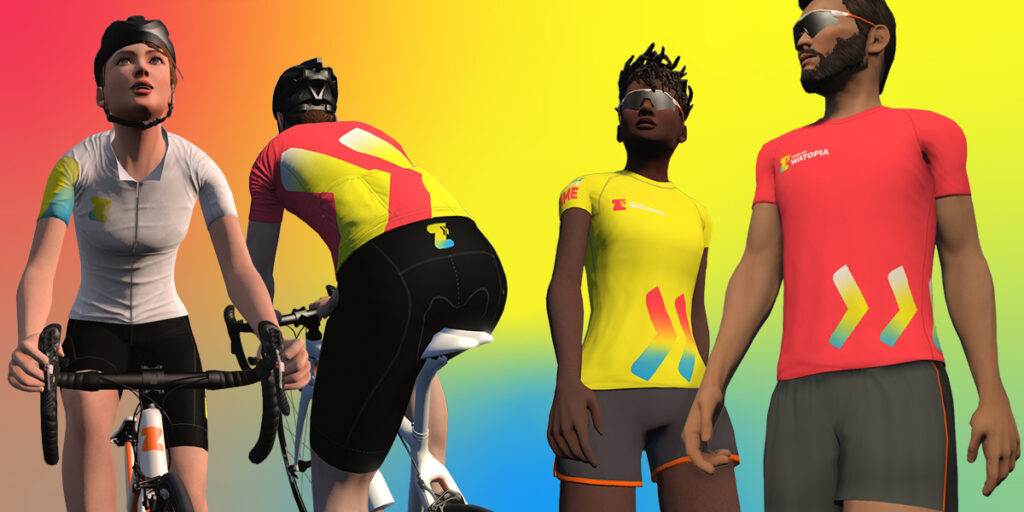
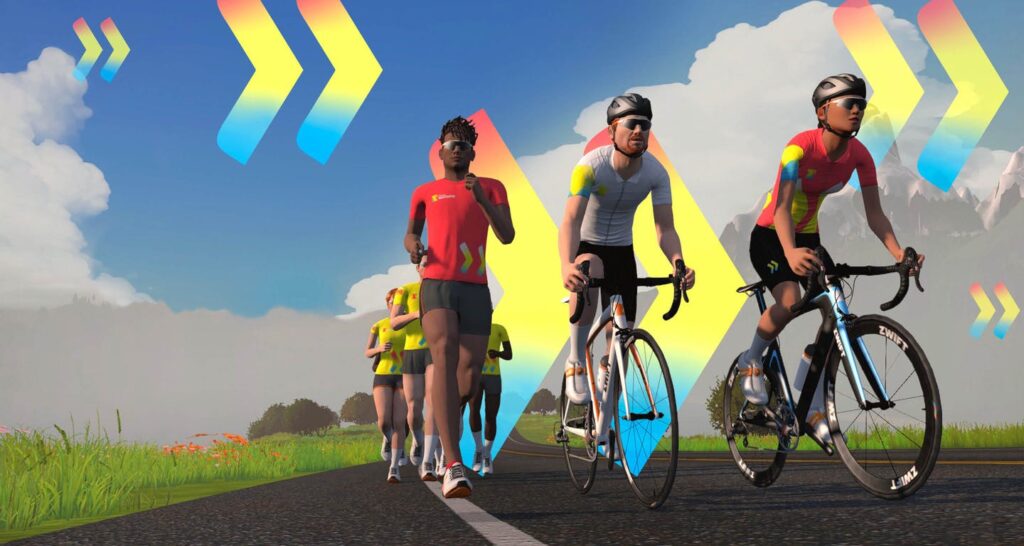
There are two kits to unlock, both for riders and runners. Complete one stage to unlock the Starter kit. Complete all five stages to unlock the coveted Finishers kit.
We aren’t sure which kit is the “starter” and which is the “finisher”, but these images show all four.
Questions or Comments?
We’ve shared everything we know above, and will update this post with new info as it becomes available.
Still got questions? Post below and we’ll try to get them answered. You might also check out the Tour of Watopia FAQ discussion in the Zwift forums.
After a very successful “Couch to Cat C” project, Boone is now well into the next training block: one we originally dubbed “C to Shining C”, but have since renamed simply “C to B”, as our new goal is to see him hit 3.2 w/kg in his ramp FTP test.
Here’s how this week unfolded…
The Plan
As a reminder: the basic plan we’ve settled on for the 6 weeks contains a mix of four different types of rides. (Many thanks to Alan Dempsey of HPP Coaching for giving us solid advice that sets Boone up for success).
Races: Boone will race the C’s every week or two to check his progress, work on race craft, and of course get in a good workout.
VO2 Workouts: this will be the cornerstone workout of each week. Nobody likes VO2 work, but we both agree Boone is getting a lot of benefit from these.
Pace Partner Intervals: we’ll use the Pace Partners (Diesel or Cadence) to anchor a fun, interactive interval workout. Warm up with the pace partner, then sprint off the front for 15s. Or drop off the back, and put in a measured 2-minute effort to get back on. Lots of options here.
FTP Ramp Tests: we’ll do at least two ramp tests to measure FTP progress.
Recovery Rides: some days, Boone will just need an easier effort in the saddle. Since he’s still a beginning cyclist, even easy efforts are far from wasted.
Ride 9: Welcome to the Jungle
Today we were just looking for a steady effort after the previous day’s race, and Boone felt like exploring some new roads. As I mulled over the options I realized he had never ridden the dirt of Watopia’s Mayan Jungle – so that’s where we went!
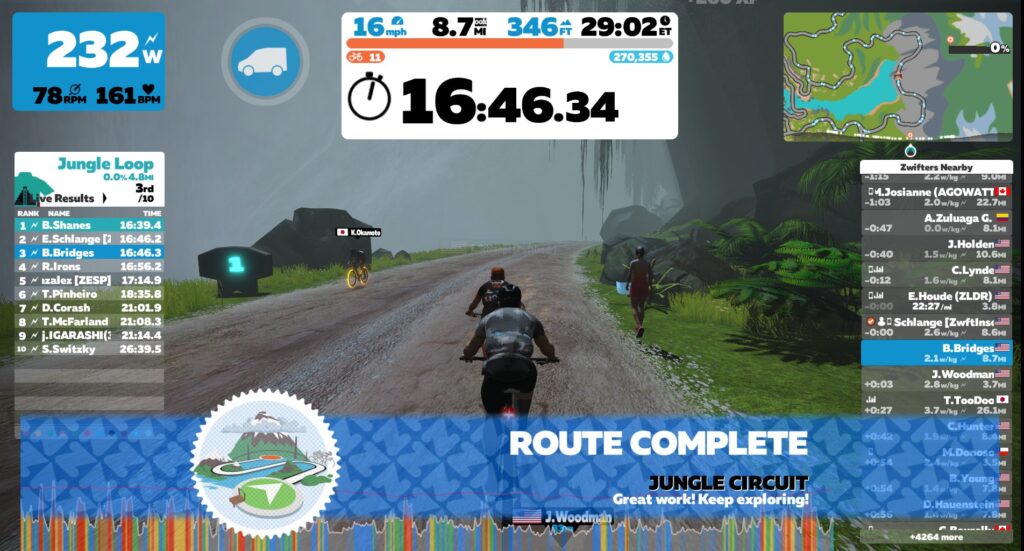
We both pulled mountain bikes out of our Zwift garages and headed for the ruins. After completing the lead in plus one lap of the Jungle Circuit, Boone noticed he got the route badge:
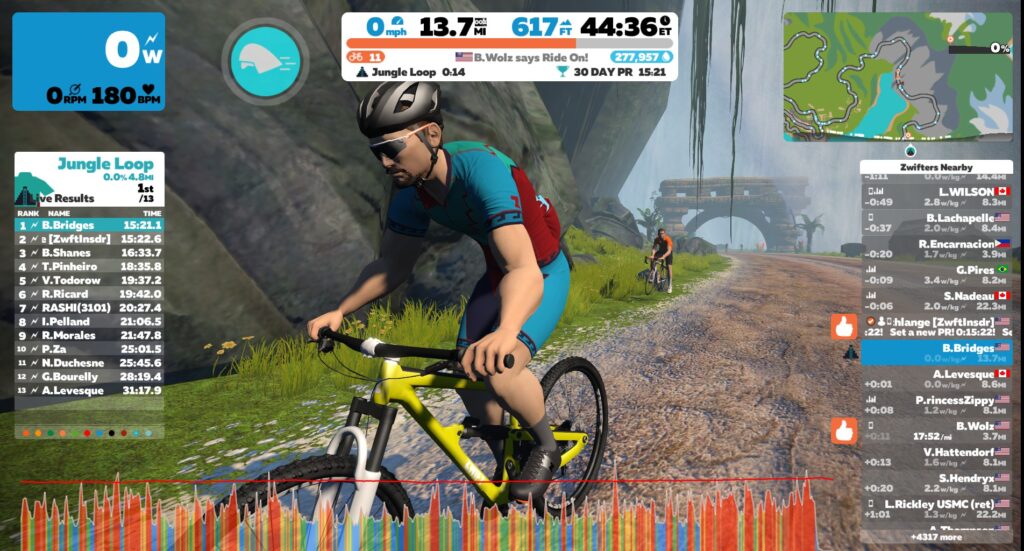
Check out that leaderboard: too close not to go for it!
But what I noticed was the lap leaderboard – we had just done a lap only 7 seconds slower than the currently leader, and we hadn’t pushed it anywhere near the limit. “You know what this means, right?” I asked Boone.
He didn’t know what it meant.
Most Zwifters will know what is required in this situation, though. Obviously, we needed to hammer the next lap and grab that leader’s jersey! (The Jungle leader’s jersey is affectionately known among the Zwifterati as “The Horse Blanket” due to its design. It may not be the most stylish kit, but we were going to work for it anyway.)
16 minutes later I led Boone out in a short effort to the line, and he got the jersey! After averaging 290W for the lap, it’s safe to say he earned it.
Boone and his Jungle leader’s jersey/horse blanket
Next, we explored the new Mayan Bridge cutoff section a bit… then looped back to the Jungle start/finish. I figured we’d be done since we were at an hour, but Boone wanted to keep going! I think he just wanted to show off his horse blanket…
We rode another lap, for a total of 77 minutes – Boone’s longest ride yet. A solid effort, stretching that endurance!
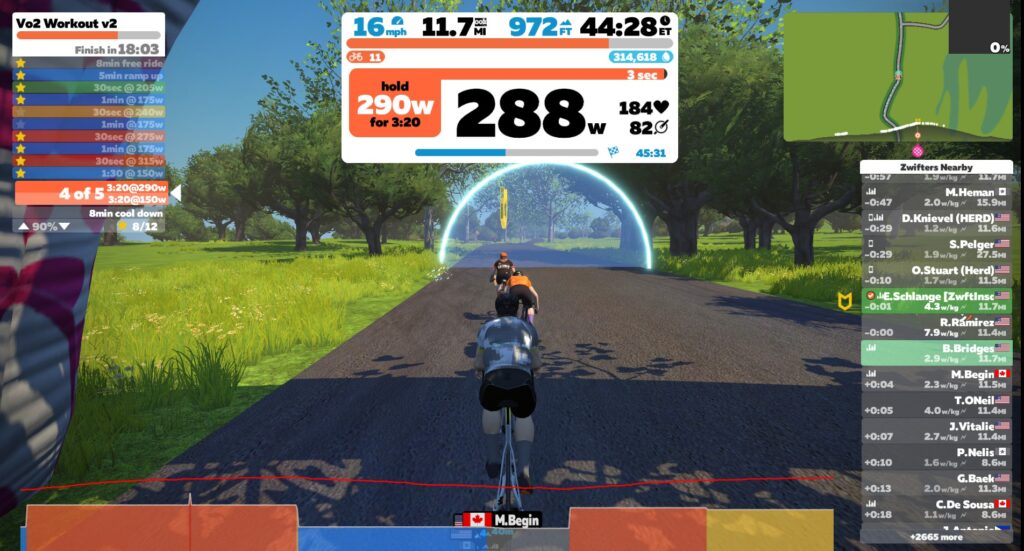
Ah, the VO2 workout. Is there anything more suffery in the world of Zwift? I had told Boone I’d join him for a VO2 workout, and today felt as good as any for a bit of pain. So we loaded up an “enhanced” version of the VO2 workout Boone has been doing, extending the VO2 interval by 10 seconds and reducing the rest interval so it matched the VO2’s length.
3 minutes, 20 seconds for each. 5x. Could Boone finish this “upgraded” VO2 workout? For that matter, could I?
Adjusting Boone’s weight down once again
Heading out for our workout
Cresting Leith Hill
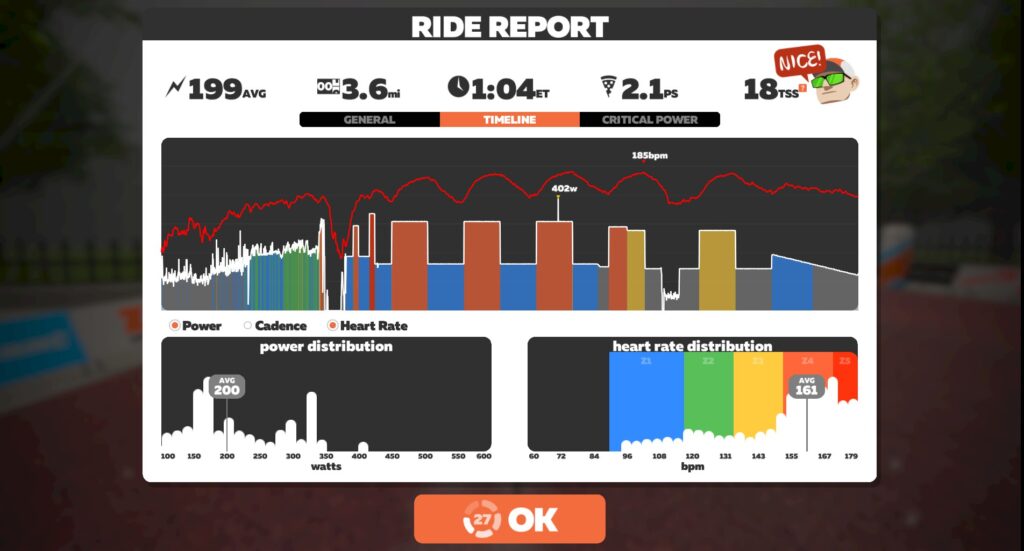
Boone’s workout report – this one hurt!
Pairing Snafu
In the warmup phase of the workout, Boone said his KICKR Bike didn’t feel right. The resistance wasn’t adjusting evenly, and his wattage on screen wasn’t matching the target watts. What was going on?
I clicked around on our two computer screens and finally figured it out: I had paired to his KICKR Bike as my controllable trainer… and nothing was controlling my KICKR.
Talk about a confusing mess:
On my PC, Zwift was reading in the power from my KICKR, then adjusting Boone’s trainer to try to hit my power targets.
On Boone’s PC, Zwift was reading in the power from his KICKR Bike, then trying to adjust the bike’s resistance to hit Boone’s power targets.
No wonder his resistance was all over the place. Two PC’s were battling for control!
The confusion happened because I was using ANT for the controllable trainers – and the KICKR Bike’s ANT ID simply says WAHOO FEC XXXXX” just like my KICKR says. They just have different numbers – the KICKR Bike is a higher number than my KICKR.
After seeing lots of support messages over the years, I’m convinced that this sort of thing, causes a lot of confusion in households where people ride together.
Working Together, Virtually
We set up this ride as a “Keep Together” Meetup, and I used the ol’ “workouts in a Meetup” hack so we both were following the same workout and riding together for the duration.
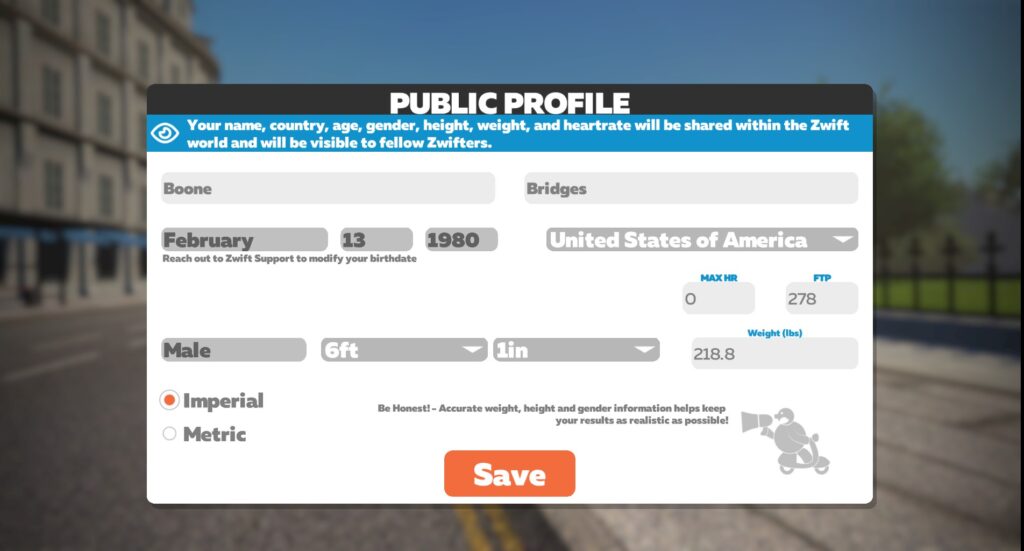
This could only work in a virtual environment like Zwift, of course . The workouts are based on percentage of FTP, so Boone’s intervals wouldn’t match mine exactly (his FTP was 278, mine 310. So his VO2 efforts were 320W, while mine were 355.) We could never do this workout outside and stay together.
But Zwift kept us together all the way round London and up and over Leith Hill. And that’s why we love Zwift.
Unfortunately, the increase in VO2 length and decrease in recovery was a bit too much for Boone. A few seconds doesn’t feel like a lot when you’re sitting at the desk making adjustments, but when you’re on the limit, it hurts! Despite having the best VO2 workout playlist in existence, we had to drop Boone’s FTP bias down to 90% for the final two intervals, so he only had to do 290W.
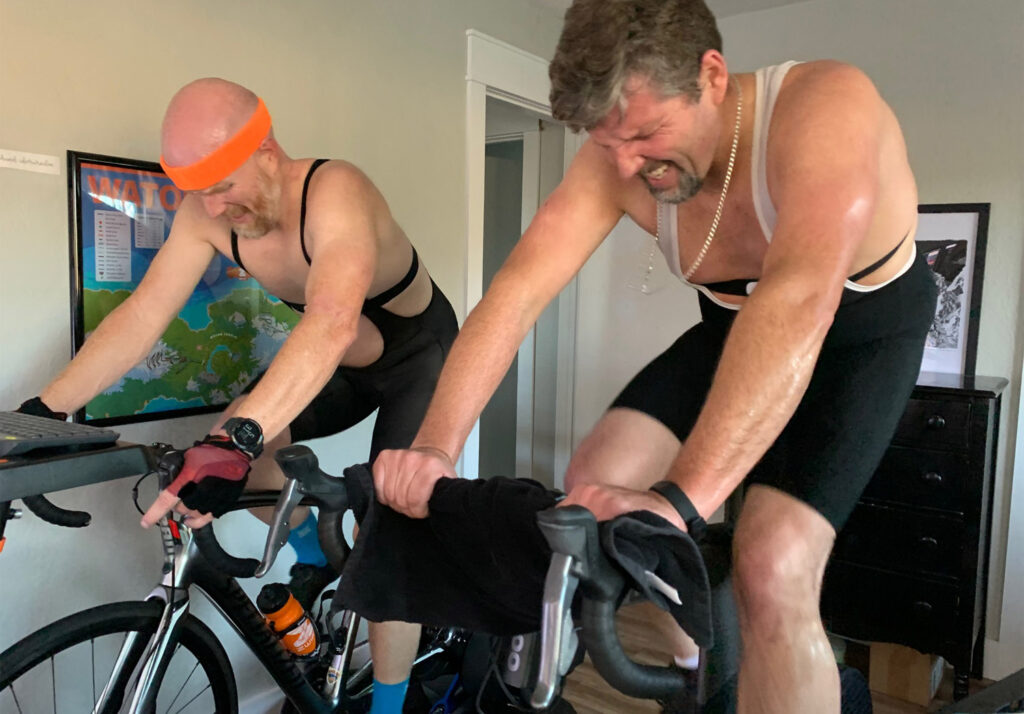
It still pushed him to the edge, but he completed the intervals. As for me? Yeah, this workout hurt for sure. But like any experienced cyclist, I did my best to keep a straight face so Boone couldn’t see me going to the dark side. That worked for the first few intervals…
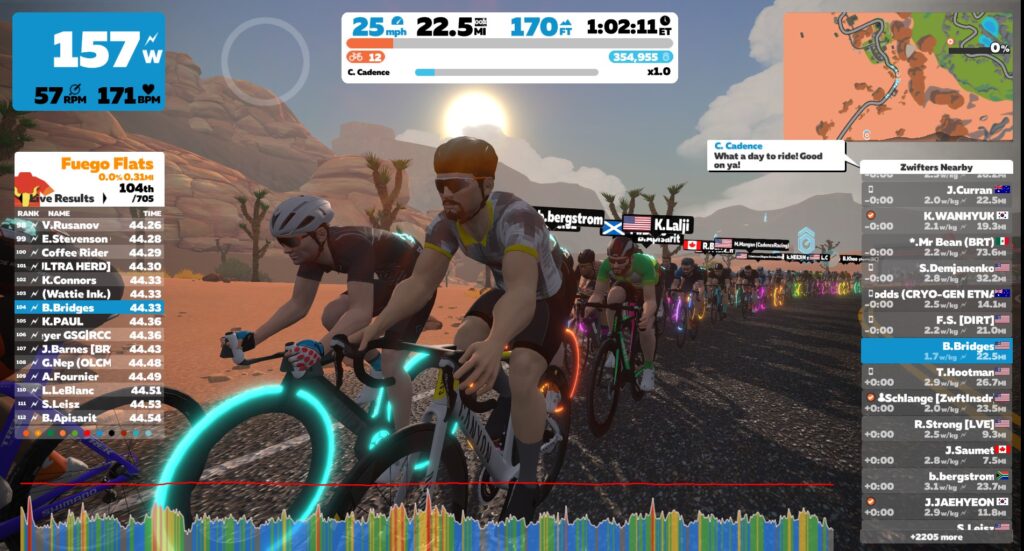
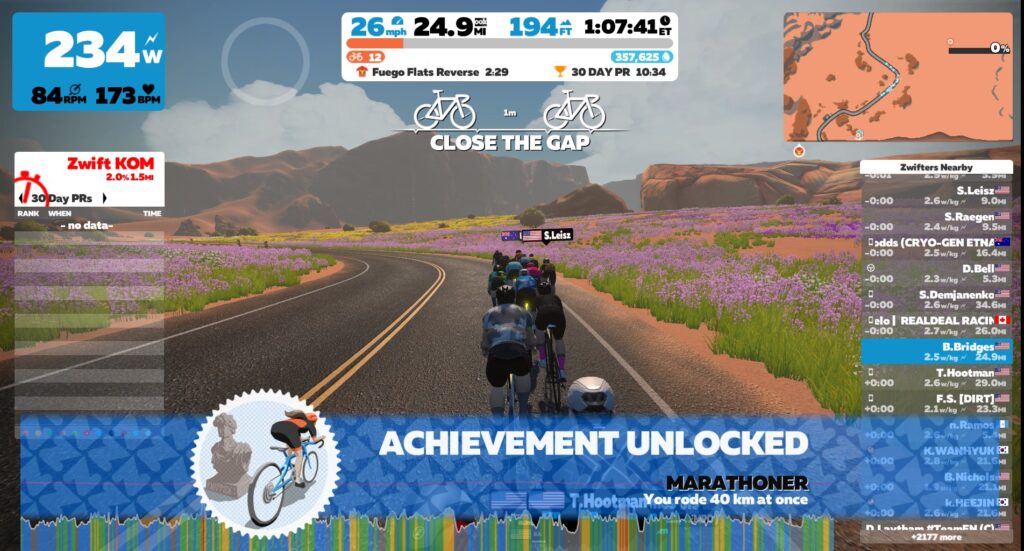
Since we’re halfway through this training block, we figured an FTP test was in order. It was a Sunday, so we invited a couple of local cycling buddies to join us on Zwift while Boone put in his effort on Fuego Flats.
Zane (who has made an appearance in past posts) joined us, as did my friend and backyard neighbor Mike. The four of us rode together, just clicking to “Join” the other riders as we entered the game. At the last minute, I fired up a Zoom meeting on iPhone, so the four of us had video and (admittedly poor) audio of each other.
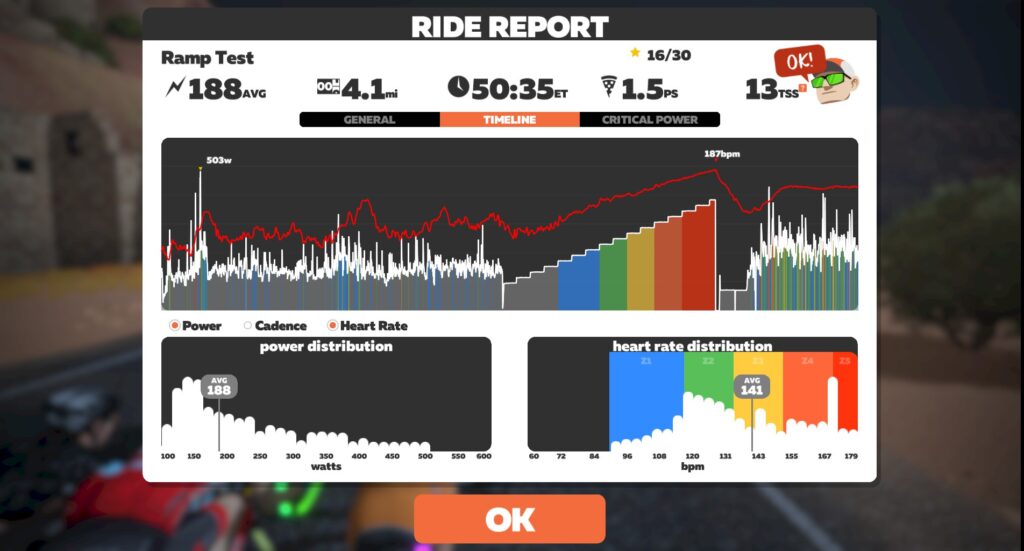
After a quick warmup, Boone began the ramp test. We eased up, staying near him as he worked through the initial steps: 100W, 120W… 200W, 220W…
Things started speeding up, and eventually it went from slowing for Boone to sitting on his wheel as he hammered his way through the intervals.
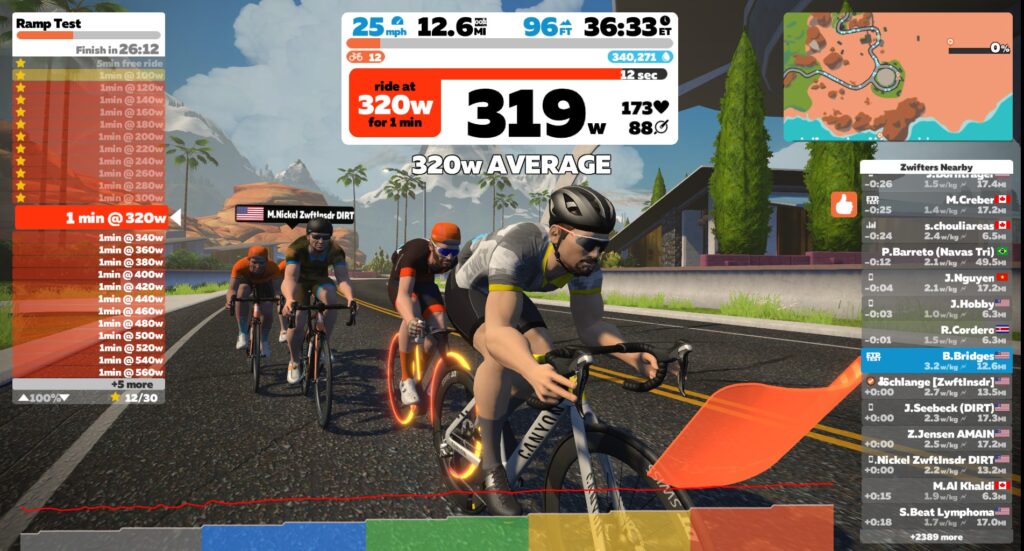
Around 300W the effort in the draft became significant. But Boone kept powering on while Zane, Mike, and I sat on his wheel! I would announce as Boone began each new minute’s interval: “320 watts!” “340 watts!”
He was on the rivet going into the 400W interval – but this was an interval he’d never reached in previous tests, so I knew he’d be getting an FTP upgrade today. He kept pushing to around 30 seconds into 400W before he couldn’t turn the pedals any more.
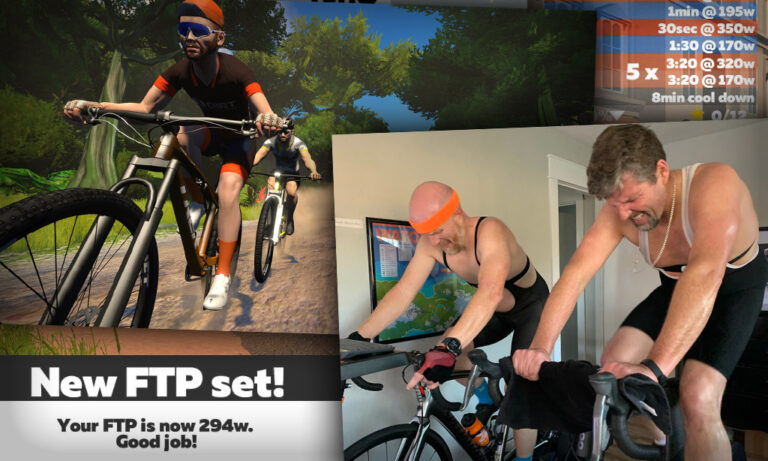
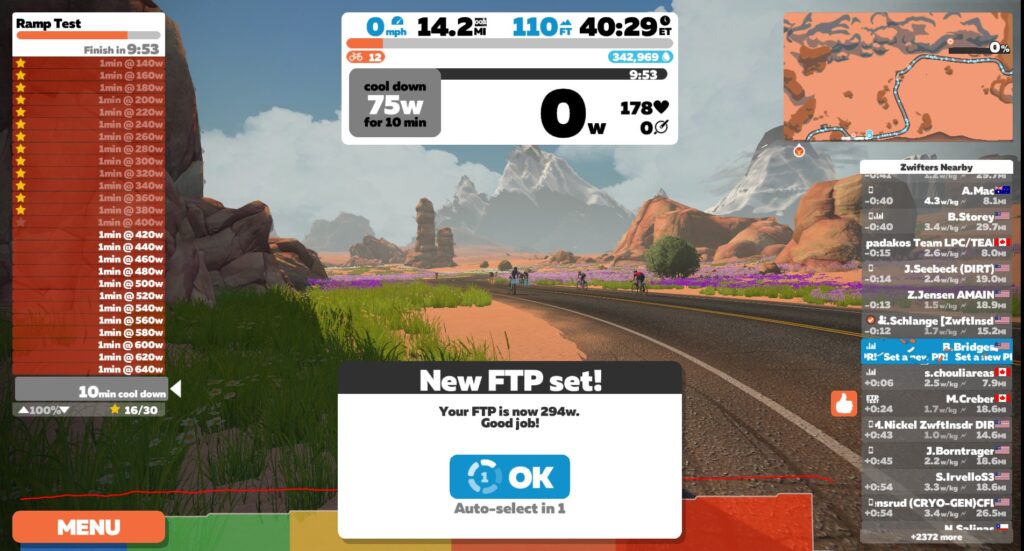
294W. His last test ramp test (4 weeks earlier) said 278W, so this was a significant jump for sure.
Four weeks ago he was at 2.62w/kg. This new FTP test, plus his continued weight loss, puts him at 2.96w/kg. Up up up!
Boone only got three sessions in this week since he was out of town for travel, but we made those sessions count, getting in that crucial VO2 workout. That’s an important lesson to learn for anyone trying to hit fitness goals: if you need to skip a workout, don’t skip the hard one.
I joined him for all three sessions, which was fun. I think perhaps riding with me is helping him to push his endurance a bit – there’s something about having a stronger rider next to you who keeps pedaling that makes you think, “I can keep going, too.” Of course, it also just helps pass the time. There are good reasons why cycling is such a powerfully social sport.
And he’s definitely building endurance. Where 25 minutes with C. Cadence was a huge challenge several weeks back, that’s a piece of cake now. In fact, we’re going to try riding with Bowie Brevet next week.
CeramicSpeed is just wrapping up a series of group rides on Zwift, but tomorrow is the first big event of their race series. With nearly 1000 riders already signed up, this is going to be a wild race!
The CeramicSpeed Race Series is a rather unique series in the world of Zwift, as the first race is a qualifier for a series of closed races which follow.
Along the way there are opportunities to unlock the CeramicSpeed kit, win prizes, and become a CeramicSpeed Ambassador. Details below!
Race Series Structure
The series begins with tomorrow’s qualifier race on the Out and Back Again route. This race “divides the pack” between those who will get to continue on into the Elite Closed Races, and those who can only race the open events.
Top 100 A-category finishers from the qualifier race will be invited to participate in the Elite Closed Race #2
Top 50 finishers from race #2 will be invited to participate in the Elite Closed Race #3
Top 25 finishers from race #3 will be invited to participate in the final race, Elite Closed Race #4
Separate closed race are being held for men and women.
If you don’t make it past the qualifier, there is an open series of races available to all which mirrors the elite closed races. These are already on the Zwift calendar.
Race Routes
Stage One: Out and Back Again, 1 Lap (39.8km/24.7 miles)
Stage Two: Beach Island Loop, 3 Laps (38.4km/24 miles)
Stage Three: Watopia Mountain Route, 1 Lap (29.5 km/18.3 miles)
Stage Four: Crit City Downtown Dolphin, 16 Laps (30.4km/19.2 miles)
This is a clockwise lap of the Crit City course, which means you go up the bricks on the prime sprint section, and the finish includes a bit of a rollercoaster downhill into a right-hand hairpin.
Points Scoring
This is a points-based series, not time-based. Points will be awarded on a category basis. For each category that finishes with a minimum of 10 participants, the following points will be awarded:
1st: 60 points
2nd: 55 points
3rd: 50 points
4th-50th: 48-2 points
All others will be awarded 1 point for participating in the race
These results will be available through ZwiftPower.
Prizes and Unlocks
Enter here for your chance to win one of three CeramicSpeed drivetrain upgrades (OSPW, bottom bracket, and chain).
Plus, when you participate in any of the races, you’ll unlock the CeramicSpeed Jersey (below).
CeramicSpeed is on the lookout for potential ambassadors in this Zwift series. They say, “we’re on the lookout for some true virtual racers that can help us explore new business opportunities within the virtual world of cycling as well as get involved in product testing of our components directed at e-cycling.”
If that sounds fun to you, be sure to participate in the race series in a way that makes CeramicSpeed recognize you! You don’t have to win the races, but you have to show how you’d be a valuable partner to CeramicSpeed on social media and within Zwift.
Are you experiencing the virtual ups and downs in Zwift as you would in real life (IRL)? Does a 6% climb in Zwift feel like a 6% climb outside? Does an 8% descent feel like an 8% descent? Chances are, they don’t. In fact, Zwift’s default Trainer Difficulty setting flattens the climbs by 50% and the descents by 75%. While this is totally fine, if you want to best simulate your IRL rides read on to find out where you should set your Trainer Difficulty.
But first, a quick primer…
Trainer Difficulty, Gears, and Gear Ratios
Trainer Difficulty is a Zwift menu setting, from 0-100% (MAX), which affects how your smart trainer treats climbs and descents. At 100% an 8% climb will feel like an 8% climb…at 50% it will feel like a 4% climb…and at 0% it will feel like a flat road.
Interestingly, Zwift automatically halves downhill gradients so it’s harder to “spin out”. At 100%, an 8% descent will feel like a 4% descent… at 50% it will feel like a 2% descent… and at 0% it will feel like a flat road.
While the Trainer Difficulty affects how your ride “feels”, it does not affect your speed in game. Speed is based mostly on power, weight, height, and gradient.
Gears allow cyclists to maintain a comfortable cadence when climbing and to feel resistance on descents. Most modern road bikes have two gears in the front (chainring) and 10, 11, or 12 gears in the back (cassette/cog).
For climbing, the “easiest” gear combination is the smallest chainring in the front and the biggest cog in the back. For descending, the “hardest” gear combination is the largest chainring in the front and smallest cog in the back.
The gear ratio is the number of wheel revolutions for each rotation of the crank. It is calculated by dividing the number of teeth on the front chainring by the number of teeth on the rear cassette.
For example, if the front chainring is on the small ring with 34 teeth and the rear cassette is on the biggest cog with 28 teeth, the gear ratio is 34/28 or 1.21. The lower the gear ratio, the “easier” it is to spin up a hill.
Effect of Trainer Difficulty Changes
So, what does this all mean? Well, if you take a lap around the Watopia Hilly route with the trainer difficulty set at the two extremes, 0% and 100%, you will notice the differences.
At 100%, if you’re on a Zwift route with similar gradients as your outdoor rides, your Zwift ride will “feel” more like your outdoor rides. You will likely be shifting quite a bit, using more force (legs) and less cadence (heart) on steep climbs, and feeling less resistance on steep descents.
Although the Trainer Difficulty setting doesn’t affect speed, at 100% the ride may “feel” harder and your legs may be more fatigued.
Dialing It In
The beauty of the Trainer Difficulty setting, however, comes in-between 0% and 100%. By adjusting the setting, your Zwift rides can simulate the “feel” of your IRL rides by virtually changing the gears on your indoor bike. If your indoor bike has different gearing than your outdoor bike, the Trainer Difficulty setting can offset that difference. If you’re riding a mountainous Zwift route and you need “easier” climbing gears, the Trainer Difficulty setting can do that as well.
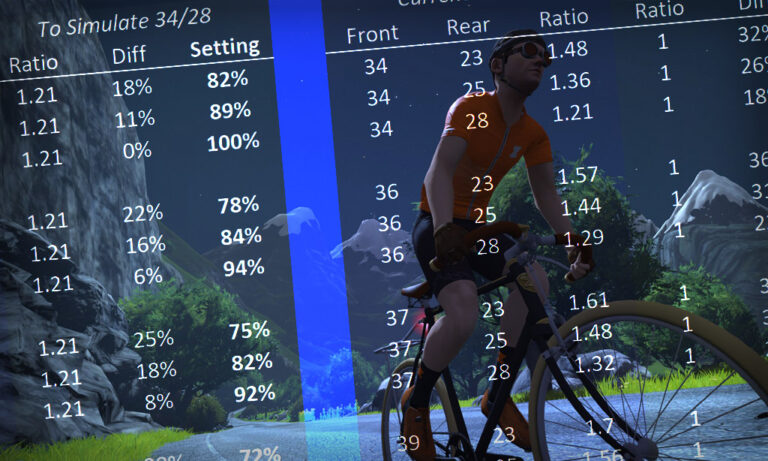
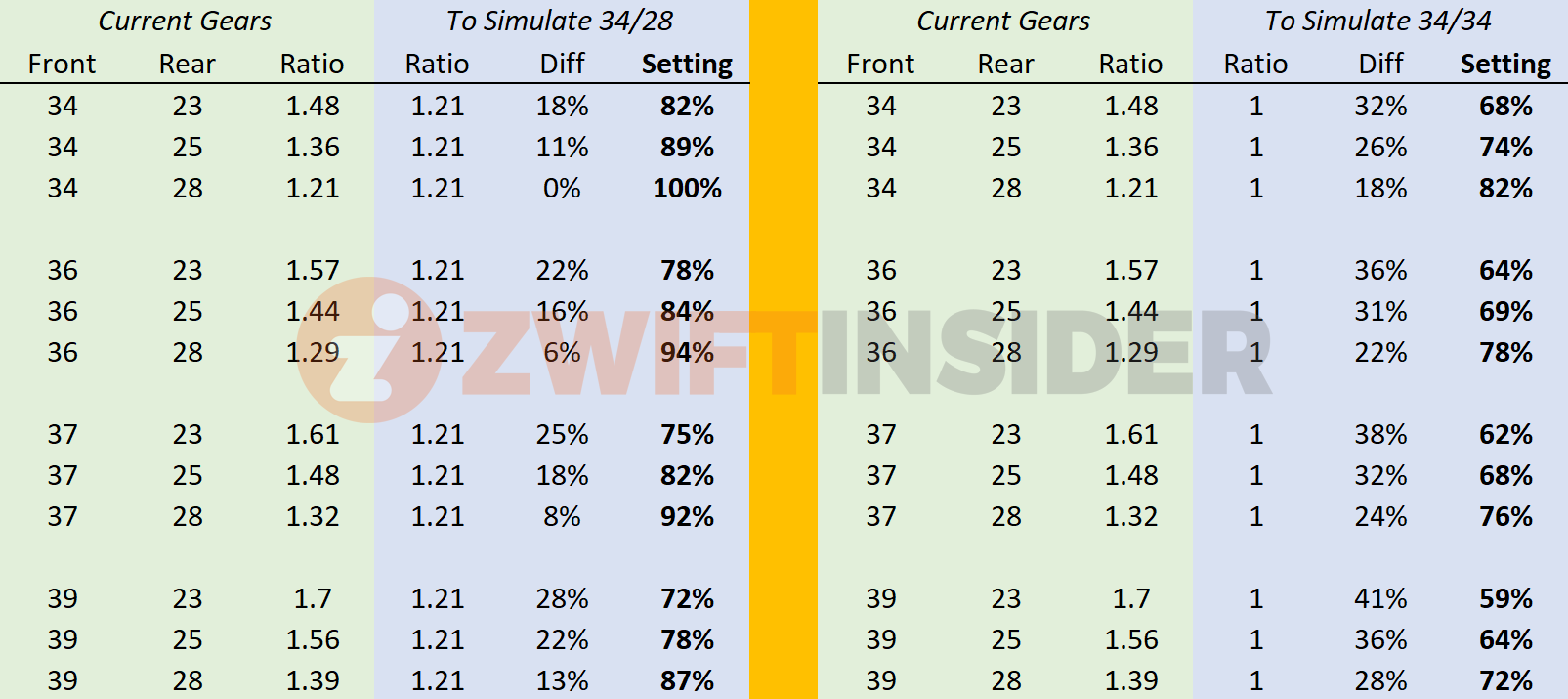
The chart below shows you where to set the Trainer Difficulty if you want your Zwift rides to simulate the uphill gradients of your IRL rides.
Here are a few examples taken from the chart:
Indoor bike’s easiest gears: 34 teeth in the front, 28 teeth in the rear Outdoor bike’s easiest gears: 34 teeth in the front, 28 teeth in the rear Are Zwift Roads similar to your IRL roads? Yes Set Trainer Difficulty to 100%
Indoor bike’s easiest gears: 36 teeth in the front, 25 teeth in the rear Outdoor bike’s easiest gears: 34 teeth in the front, 28 teeth in the rear Are Zwift Roads similar to your IRL roads? Yes Set Trainer Difficulty to 84%
Indoor bike’s easiest gears: 39 teeth in the front, 23 teeth in the rear Are Zwift Roads similar to your IRL roads? No. Climbing Alpe Du Zwift Desired mountain climbing gears: 34 teeth in the front, 34 teeth in the rear Set Trainer Difficulty to 59%
In conclusion, while the Trainer Difficulty setting doesn’t make you faster, it does affect how your ride feels. Experiment with the settings to see what works best for you. But if you want your Zwift rides to best simulate your IRL rides, refer to the chart above and you’ll be good to go.
In road cycling, there is a line of thought that you are either a “Grand Tour rider” (multi-staged events, usually over 3 weeks), or you are a “Classics rider,” meaning you are good at 1-day events. In Andy Schleck’s case, he could do it all. He won the biggest prize in cycling, the 2010 Tour de France, as well as winning a prestigious Monument, Liège–Bastogne–Liège, the year before.
When Andy won, he won big. And his ride on Stage 18 at the 2011 Tour de France, up the massive Col du Galibier (2,642m), was simply a climbing Masterclass.
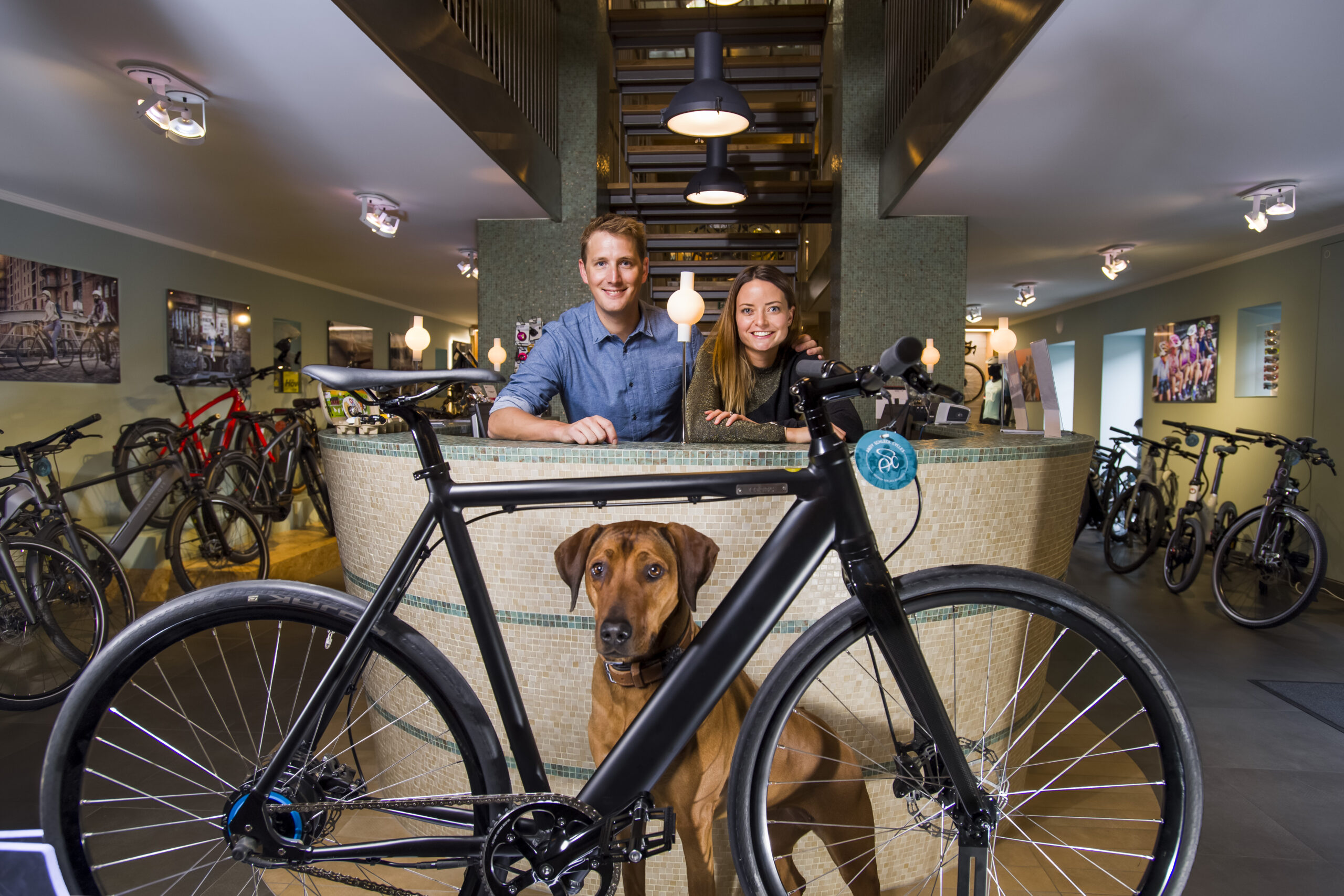
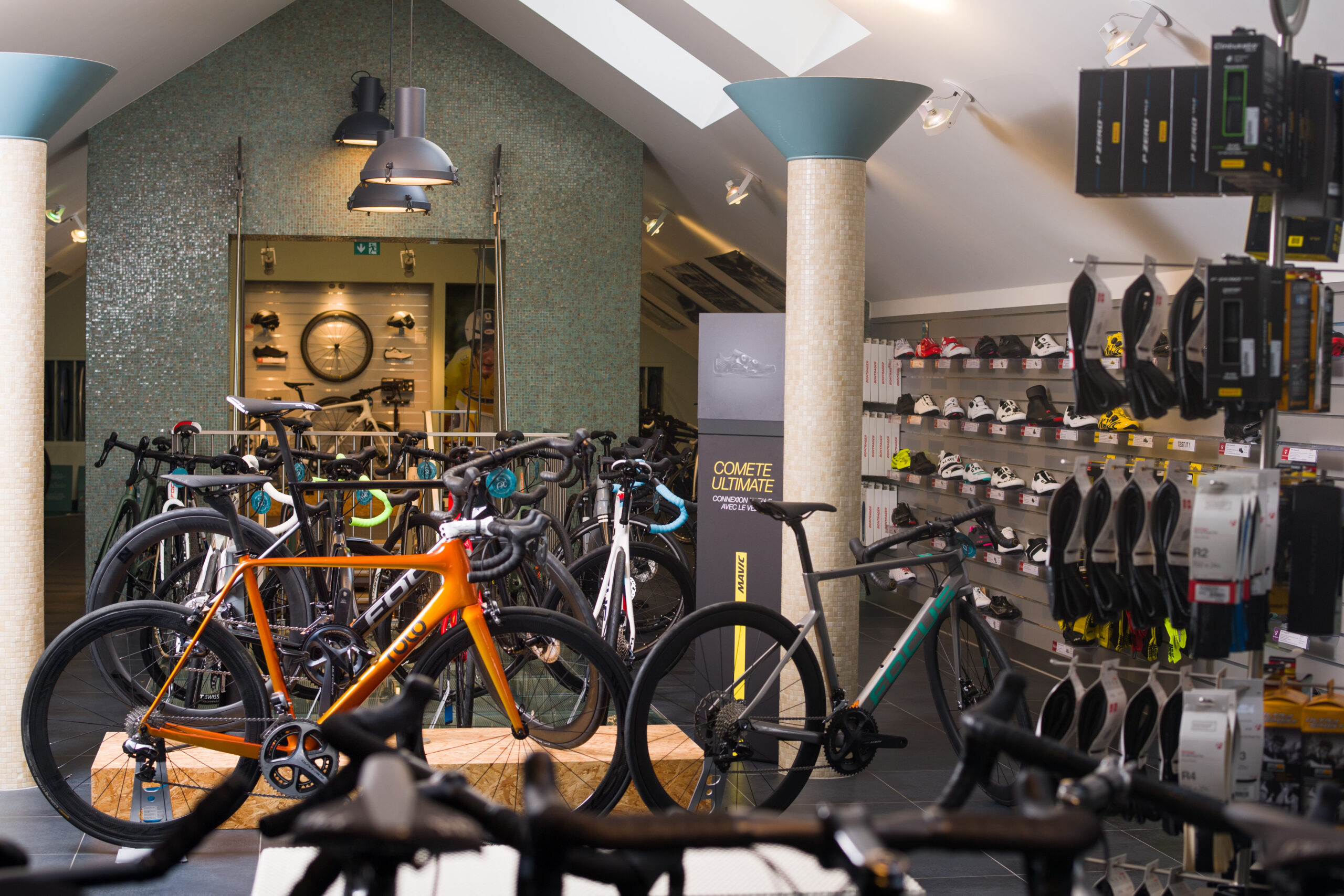
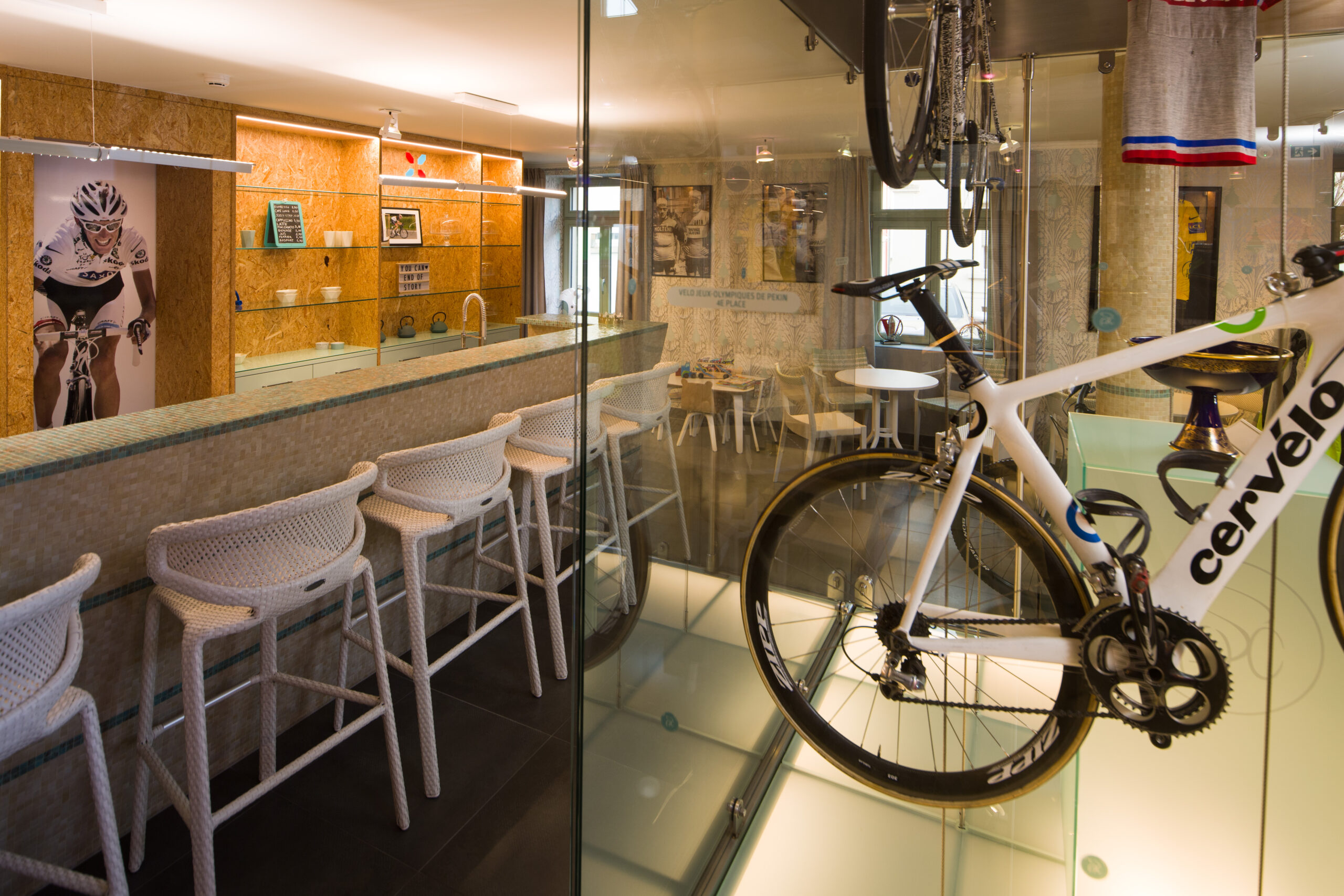
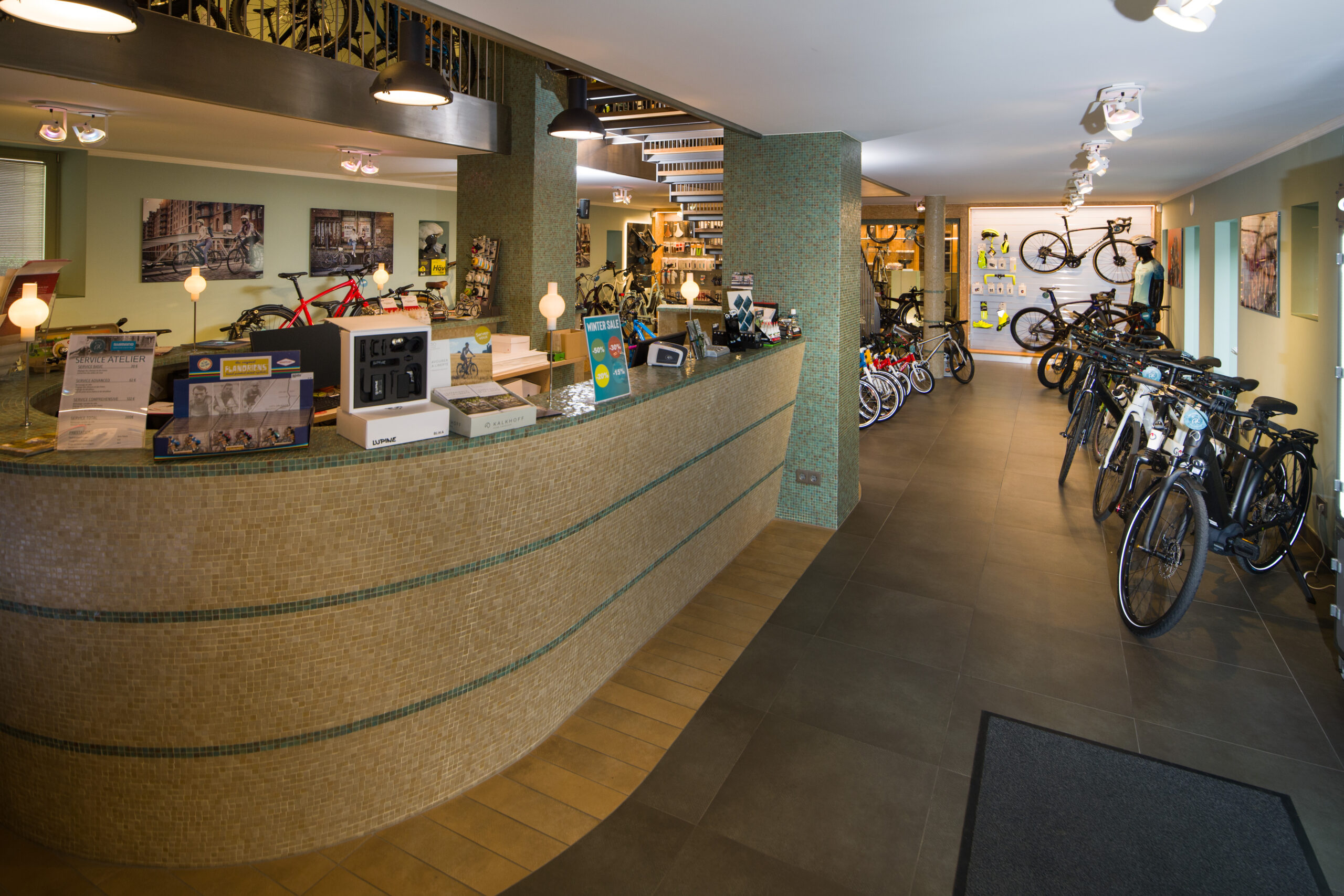
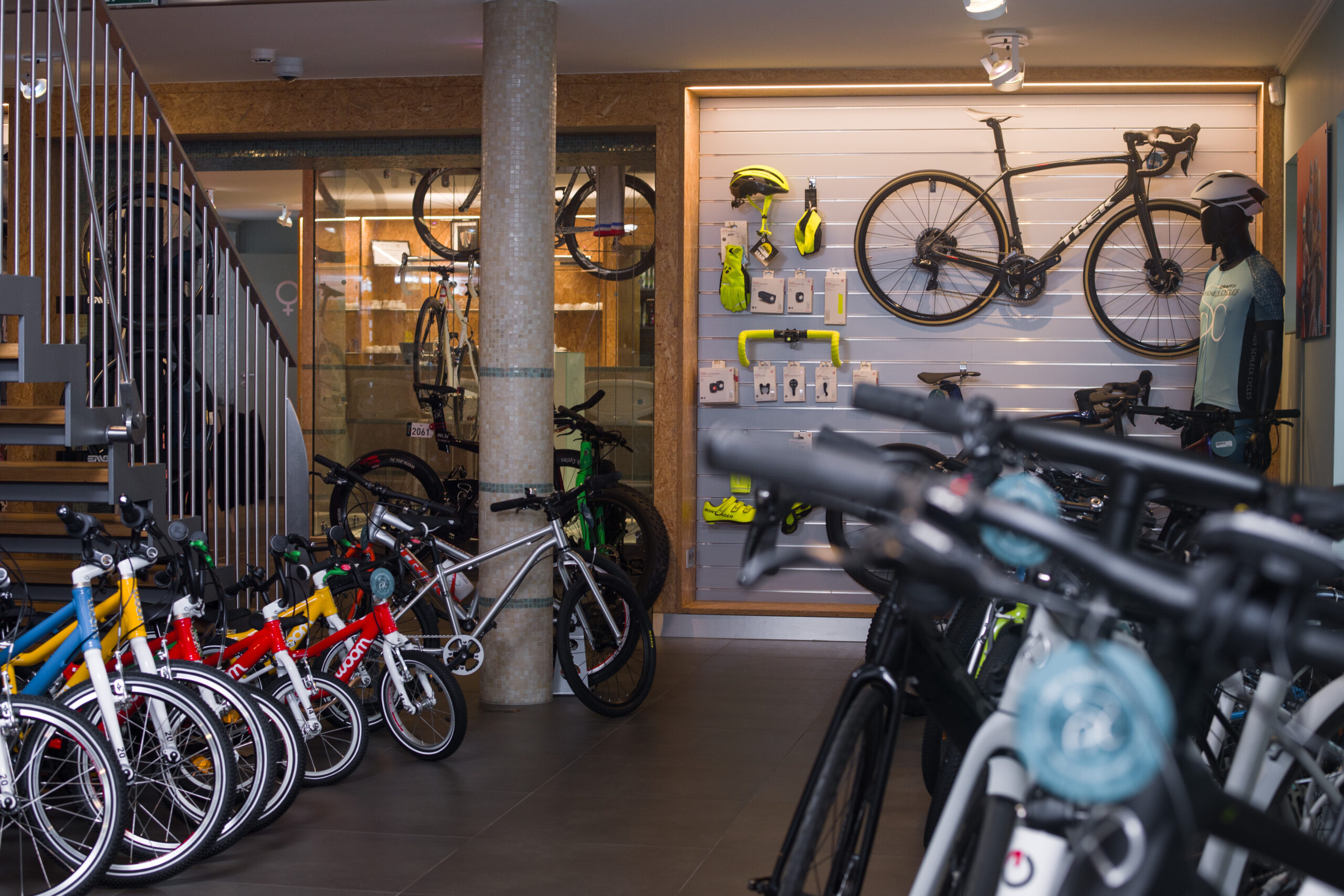
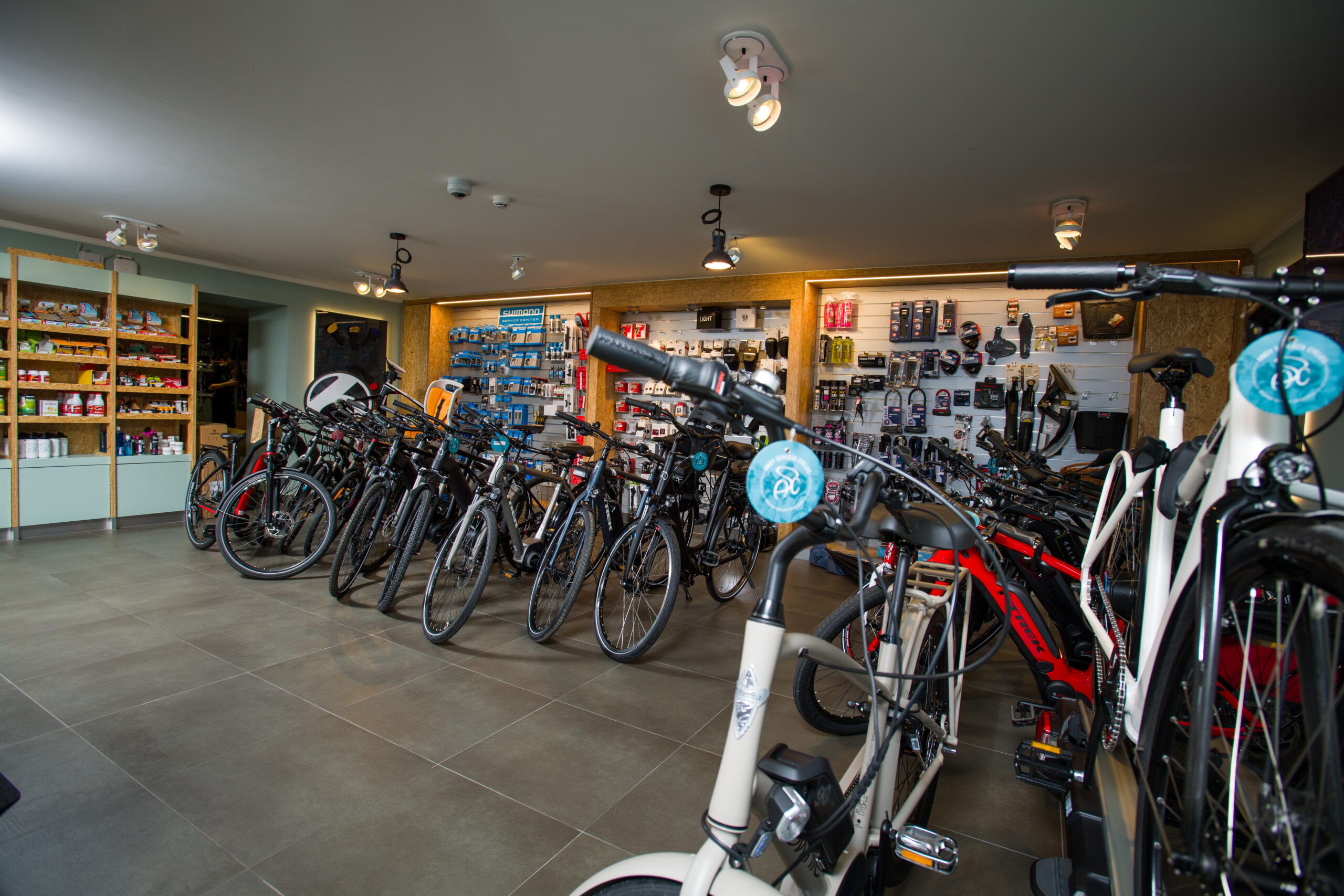
Since retiring from cycling in 2014, Andy has created a unique cycling shop (Andy Schleck Cycles) close to the town of Itzig, in his home country of Luxembourg. His shop offers a unique experience for cyclists. It’s not just a place where you can go and buy a bicycle but one where you can browse and view a whole host of cycling memorabilia, including Andy’s Tour de France jersey, a signed jersey from Andy’s ex-teammate, friend and cycling legend, Fabian Cancellara as well as a signed jersey from 5x Tour de France winner Eddy Merckx. Furthermore, Andy has a café inside the store for you to relax and watch cycling, whilst drinking a cappuccino.
Cappuccino Rides Origin Story
It’s from his café that Andy started his ‘Cappuccino rides.’ Andy wanted to bring cycling to the wider community and launched the event which would be a gentle 2-3 hour outside ride every Saturday morning with the only prerequisite being to drink a cappuccino (or other beverage) with friends, at the start of the ride. As well as the gentler rides, Andy would host as faster-paced ride called ‘Expresso’ and a women’s only ride called ‘Latte.’
The event was a success and became a regular part of people’s lives… then the world changed with the onset of the global pandemic. Wanting a way to continue these successful events and ensuring that people had an outlet for their cycling needs, Andy approached Zwift about hosting a ‘Cappuccino ride’ on the Zwift platform.
Cappuccino Ride Come to Zwift
Next thing Andy knew, his local community ride had gone global and Andy was hosting a weekly ride on Zwift, Wednesday evenings at 7:10pm CET. His first event attracting 600 riders!
Having participated in several “Andy Schleck Cycles Cappuccino Rides,” I can testify it is the closest thing you can get to riding with your friends, without being outside. The pace is relaxed, many of the community that were fortunate enough to ride with Andy IRL on his Saturday morning ride are present, and it has the same inclusive feel as being part of a cycling club, with a core of 200 riders regularly attending each week.
What makes this ride even more special is that Andy often invites his friends to participate. Now, if you are an ex-professional cyclist, then naturally your friends are going to be cyclists. Given the fact that Andy was and still is a top cyclist, his friends are also going to be top cyclists. So those who have joined Andy include former World Champion Philippe Gilbert, Fabian Cancellara, Bobby Julich, and 2004 Time Trial Silver medallist and 2005 Paris-Nice winner George Hincapie. And let’s not forget that ever-present in all the rides is Andy’s older brother, ex-professional cyclist, multiple Luxembourg National Champion, and winner of the 2006 Tour de France Stage up Alpe Du Heuz, Frank Schleck.
Needless to say, with so many unique people in attendance cycling stories are plentiful and before you know it, the time has gone. Paced at a relaxed 1.8-2.4 w/kg it’s an enjoyable group ride and ideal recovery ride for those who may have raced the day before. The event takes place on a different course each week.
To make the event more special, Andy is working with Zwift to develop a custom jersey that can be unlocked by undertaking his event and which will be replicated IRL so you can procure and wear one when out on the open roads.
Discussing Zwift
Having taken part in many of Andy’s rides, I caught up with him in Watopia outside the group ride on the Out and Back Again route where we rode and discussed Zwift and all things cycling-related.
Andy explained that he was one of the early adopters of Zwift and has been on the platform since the beginning, but due to having a young family doesn’t get chance to ride on the platform as much as he likes. But he still aims for 2-3 times a week, one of which is his Cappuccino ride and the other is usually in a Meetup with friends. One of which is Joel.
Andy explained that Joel has been instrumental in helping facilitate the event and only started cycling 2-3 years ago. He originally visited Andy’s shop to discuss bikes and get advice on one which he had just purchased and before long, the cycling bug had bitten and he had lost 25kg in weight and now participates in epic 300km rides.
Andy mentioned that he still likes a cycling challenge and occasionally races on the platform, admitting that he still can be very competitive, however, he enjoys more the simple side of cycling, being outside and participating in outdoor rides and noted that the evolution of electric bikes has made cycling even more accessible for people. Andy confesses that he hasn’t ridden all the roads on Zwift as he is “not chasing the badges” and his preferred route is Sand and Sequoias. He thinks the platform is a fantastic way to train during the winter months and it certainly helps improve general fitness.
At this point, I asked Andy to share any training advice. That’s when he pointed me to his older brother (and ex-professional cyclist) Frank.
Frank Schleck Training
Andy noted that since retiring from professional cycling, his brother Frank had moved into the field of coaching and training. Frank offers a personalised and tailored coaching service designed to maximise your potential at Schleck X-Perience.
In addition, Frank operates a Guest House at the base of Mount Ventoux in Bedoin, France, an excellent location if you are planning an ascent up the mighty giant of Provence!
I subsequently asked Andy to connect me with Frank as I certainly could benefit from structured training from a former elite rider.
Andy Schleck Cycles
Interested to know more about Andy’s shop, he explained that after retiring he was not entirely sure what he wanted to do, and had always felt that the bike shops he had visited in the past, never offered all of the services a cyclist required. There was always “something missing” as Andy stated. With that in mind, Andy went about procuring and refurbishing an old warehouse, creating a bespoke cycling experience that seamlessly integrates a shop, café, and museum.
The bike shop offers a range of different types of bikes and bikes for all levels and budges including the leading brands of bikes such as Trek and Cervelo, both of which Andy raced. The shop offers complete service from the standard bicycle mechanic service to bike fitting and even wind tunnel testing. It offers the whole 360-degree experience, you can even get insurance for your beloved bike and nutrition advice to help you on your journey. Plus there are 3 dedicated Zwift stations for customers to test and experience the product!
Andy has teamed up with Wahoo and Zwift and created a space where people can experience Zwift and the latest Wahoo trainers and accessories, including the KICKR Climb gradient simulator and the KICKR Headwind fan. In fact, Andy expanded the number of stations to 8 and hosted the Zwift Luxembourg Championship, with professional Zwift riders visiting and participating. Andy explained that he does have other trainers but has established a partnership with Wahoo.
Andy noted that his Zwift setup in the shop is more professional than his own at home which he admitted was more casual, comprised of a Wahoo KICKR, the KICKR Headwind fan, and an old bike.
It is evident that Andy has a clear vision for the shop, with a focus on professional service reflected in the positive feedback received. Acutely aware of the need to offer an online service too, Andy is working toward expanding that and is keen that through this avenue, he can cater to more of the needs of his customers.
Cycling Memories
Naturally, our conversation moved towards our experiences of cycling and Andy noted that his two best memories were firstly as a 12-year-old winning his first-ever event, which happened to include taking the National jersey. Secondly, he remembers coming second in the 2011 Tour de France where his brother Frank stood beside him, finishing 3rd on the podium in Paris. It was a fantastic achievement for his family and Luxembourg.
The Tour de France was the race Andy enjoyed the most. He told me, “it was 21 stages of emotions. You would love it, hate it, the whole thing was just immense.” And this is reflected in one of his proudest achievements on a bike: an attack which led to an outstanding victory on Stage 18 of the 2011 Tour de France, on the Col du Galibier.
Andy noted he has ridden with and against some incredible riders throughout his career, with his own teammates being superstars in their own right. Riders such as Jens Voigt, Bobby Julich, Fabian Cancellara, and his close friend Stuart O’Grady who he described as his right-hand man. Interestingly he said, “I don’t count Frank as he is my brother.” Classic.
We finished our ride together with Andy sharing one funny story from his times as a professional. “It was in 2007, when I was racing the Giro d’Italia. I was 50km from the end of the stage and the pace had quickened. But I had got a stone in my shoe and it was really hurting. I said to Fabian (Cancellara) I need to stop and take the stone out. He said “You can’t stop” so I decided to take my shoe off whilst cycling, with Fabian pushing me. But I dropped the shoe. So I had to cycle 25kms in my sock until I got a replacement shoe from a Director Sportif from one of the Pro-Conti teams.”
It’s stories like this that get shared on the Andy Schleck Cycles Cappuccino Ride… which is why I am already looking forward to the next one. Hope to see you there too!
*A special thanks to Jil Schleck, for helping arrange this
It was the winter of 1987 and I was riding a “turbo trainer” in my dorm room which was in the basement. They could hear me 3 flights up. The noise didn’t bother people, from what I was told it just sounded like a vacuum cleaner. The bike trainers of that year kept the rear tire on and took the front tire off. The rear wheel spun a small smooth cylinder that was attached to a couple of “rat cage” fans that created the resistance.
I don’t remember when exactly, but it was after college that I got a set of Kreitler rollers. They had the medium-sized red drums and were a beast. You could get a good workout, but had to be mentally focused the whole time so you didn’t ride off and crash in your own living room. For some reason crashing in your own living room seems to bring its own heavy shame no matter the reason.
Fast forward to the early Covid days of 2020 and my wife bought me an indoor trainer from Aldi. Yes, Aldi. The supermarket. It was less than $50 and had magnetic resistance. That is a serious step up from rat cage fans. It was a lot quieter than those fans as well. I was really quite surprised overall with the quality of resistance and the noise level wasn’t bad.
The drawback was the dynamic of the magnetic resistance and the static bike. Combined it glued my butt to the seat. I do not know how to explain it, but it was almost impossible for me to ride out of the saddle. Shift to a bigger gear, smaller gear, it not only didn’t feel natural, it was like an invisible force holding me down.
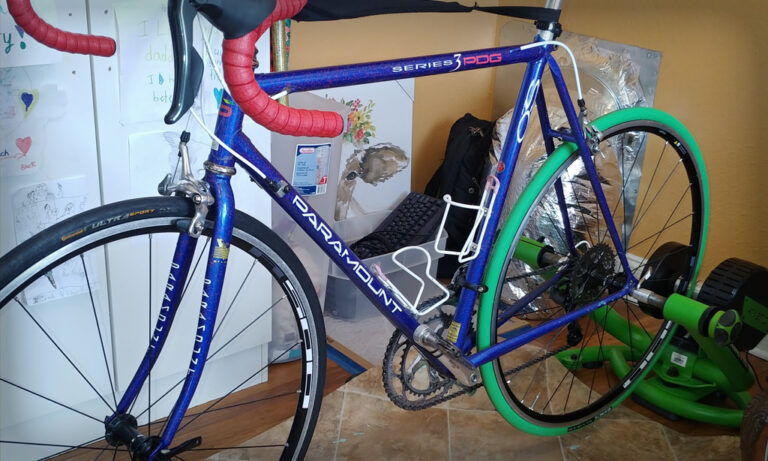
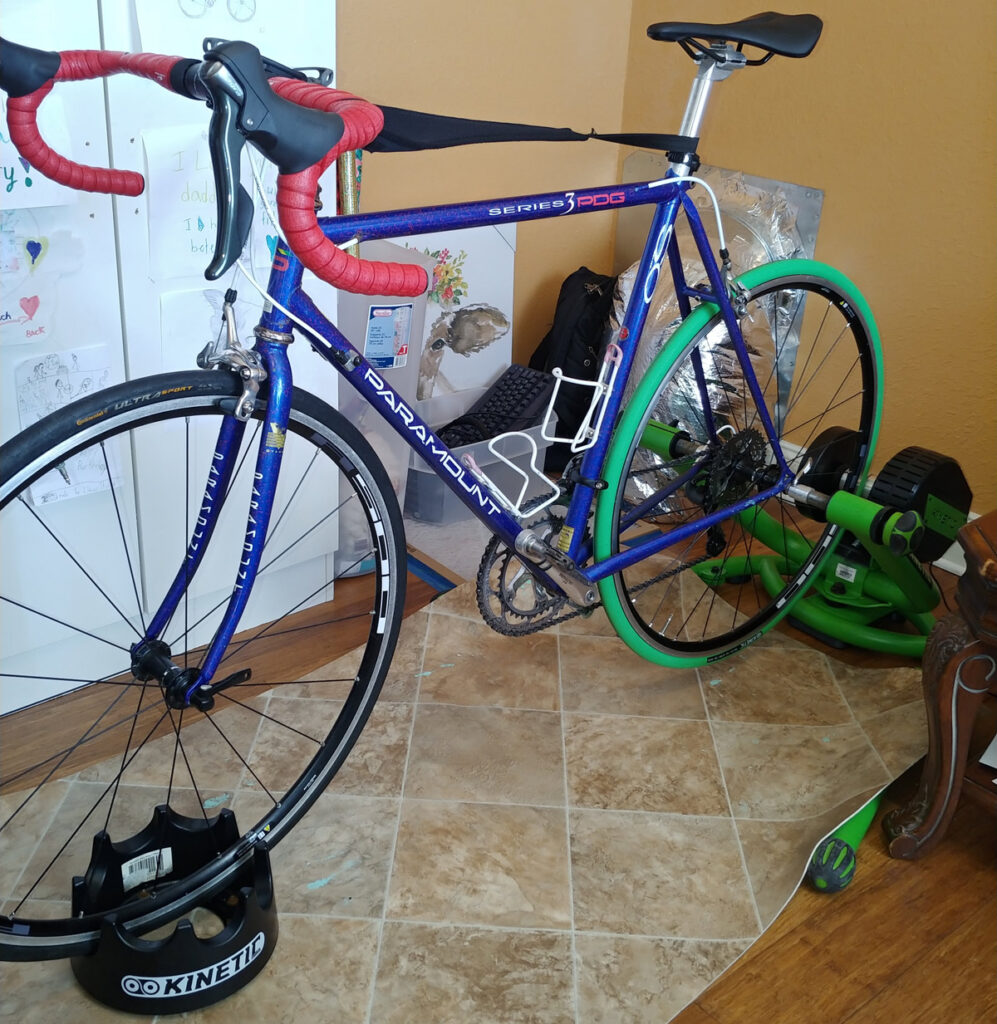
In order to rectify that I did what any good cyclist would do…I spent more money. I am on a budget, so I purchased a wheel-on Kurt Kinetic Rock-N-Roll Control. It is a big green heavy blob of workout torture device. Despite the struggles I’m getting ready to recount I really like it. The movement makes it more comfortable and most of the time the movement is minimal. It is only not minimal when I want more movement… like when I am climbing out of the saddle and swing the bike back and forth.
But enough about that. My main tale here is about the wheel-on portion of the trainer. When I got the trainer, I put my bike on it with my regular road wheel. In no time at all my road when had polished the section of roller where the tire made contact. A polished roller led to slippage.
Slippage is the bane of wheel-on trainers. You pedal harder and you hear the shriek of the rubber against the spindle. You know that the effort going into the pedals is less than the effort showing up on the screen. You find yourself dropping off the back of your TTT group knowing that you will be riding alone the rest of the race. What to do?
Well, clearly the problem was the highly polished area on the spindle. It was so smooth and slick nothing would stick to it. If it was a pancake griddle it would have been the world’s best non-stick surface. So…I roughed it up a little.
No, I didn’t take it down a dark alley and beat it with a hammer. I got a sheetrock sanding block and roughed up the surface a bit. You did read that right. I took sandpaper and scratched up the surface of the spindle roller. Which after a few rides smoothed out once more. Why stop now? I sanded it again.
Before long I noticed the tire had an incredibly smooth flat spot. The tire is polishing the roller and the roller is also polishing the tire… solution? Yes, dear reader… I sanded the tire.
OMG… did I really do that?
It took me a while to understand the error of my ways and I began reading about “training tires.” These are tires made specifically for wheel-on trainers. As luck would have it, pretty much everywhere I looked was out of inventory. My local bike shop (LBS) was out. Online dealers were out. After days, weeks, and months of searching and making phone calls…okay…maybe 30 minutes or so, I found a different LBS that had the Vittoria trainer tire on hand.
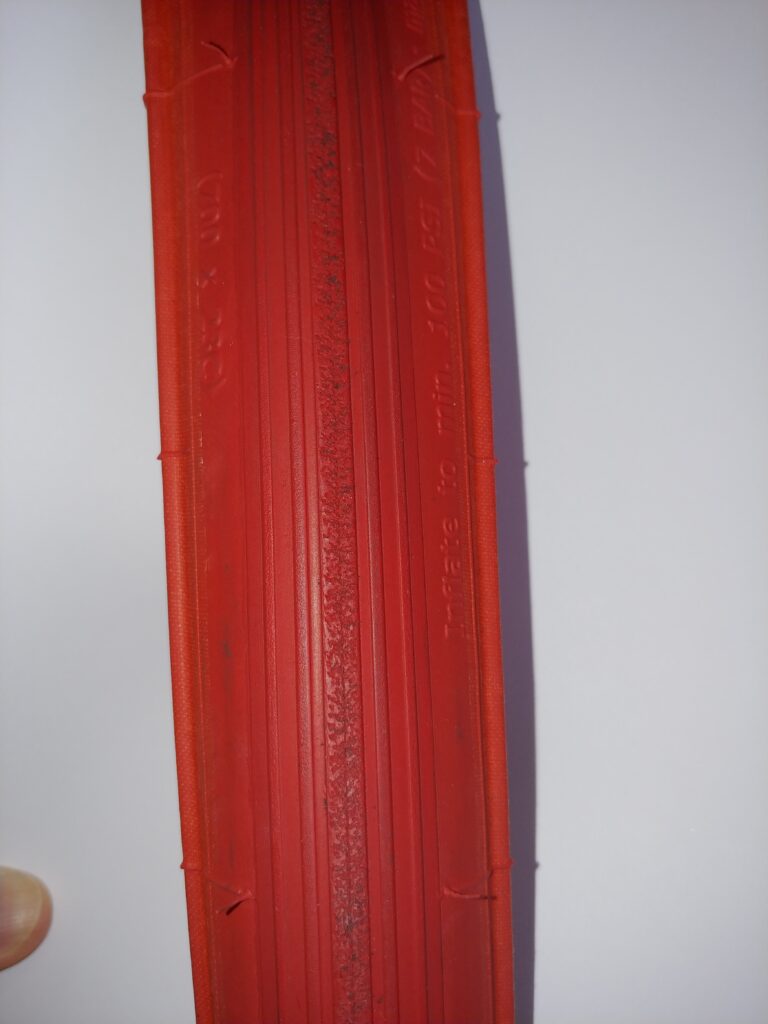
Vittoria tire
The Vittoria tire is bright red, which matched the speckled paint job on my 30-year-old steel bike. The tire is also ribbed for your training pleasure. The feel of the tread compound seemed much harder than my road tire and I guess that would make sense. Rolling against that darn spindle smoothed out the road tire in no time. That wasn’t going to happen with this rubber.
Something else did happen though. I got off the bike after the first ride on the Vittoria and lo and behold! There was a silver smooth streak down the middle tread rib. WTHeck? I deduced that it was probably fine metal dust from my days of sanding the roller spindle. I got a rag and some water to clean it off.
It. Didn’t. Clean. Off.
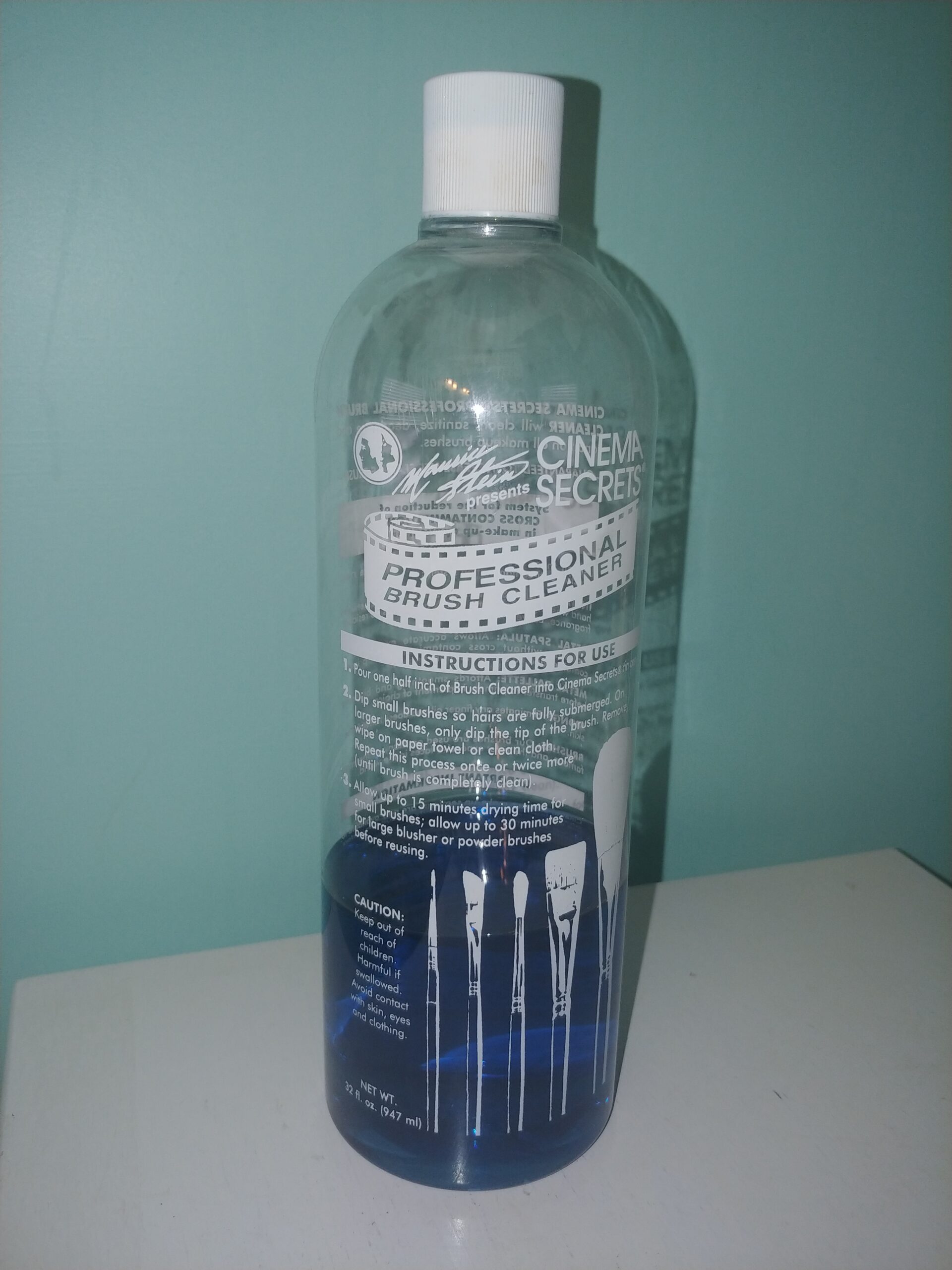
WTHeck! I tried various cleaners, rags, and brushes, but the smooth, slick metallic stripe would not come off the tire. I don’t know how I even got the idea, but my wife had a bottle of that blue liquid that barbers clean their brushes in. I uncapped it and took a whiff… it smelled like powerful stuff (I think there is acetone in there). I dabbed a bit on a rag and presto the silver came right off the tire. I also took the time to clean the roller.
Wife’s cleaner
Ahhhh. Life on my trainer was good. No squeaking, no wheel slippage. Until there was. WTHeck! The stripe was back. The smoothness was back. The slippage was back. Clearly, cleaning the tire and roller once was not enough so I cleaned them again (maybe a third time as well).
I cannot believe it myself, but the story does not stop there. Pretty soon I was having slippage again, but this time without the silver streak. There was no more sanded metal coming off the roller onto the tire. The problem was that the tire itself seemed to be disintegrating. The center of the tire developed an uneven rough texture similar to – I dunno – scrambled eggs? I tightened the spindle more, a full rotation more than the instructions said and yet… I still had slippage.
Mona Me! Aye Carumba! What is the world coming to? Will dogs and cats live together? What will happen in the next season of TWD? It was really just too much for my brain to process.
In reality my brain processed it. The stuff I used to clean the tire was clearly not good for the tire and was causing it to disintegrate when combined with the heat and resistance of the roller.
My solution? I went to the Kurt Kinetic website and checked inventory over and over until they had tires in stock… and I ordered one. I also got two new water bottle cages to replace my 30+-year-old cages. Instead of being ribbed like the Vittoria trainer tire, the Kurt Tire has a mottled top layer of rubber. It feels softer to the touch than the Vittoria, but harder than the road tire.
It’s now been a week since I put the bright green Kinetic tire on and it just works! I’ve ridden several courses where I used to have substantial slippage and I’ve had none. Not a squeak. That switchback at the start of the hilly KOM in Watopia? Not a sound or slip. The Alpe? I used to be a squeaky mouse going up that thing, but no more! The KOM on Sand and Sequoias? Everything was just hunky-dory.
Folks: if you get a wheel-on trainer, buy the darn tire that goes with it. Don’t be that guy who later says, “OMG, did I really do at?”