Home Blog Page 319

WattsUP – The Fakey Surprise Sprint

16

Game theory is the science of strategy, where the outcome for each participant depends on the actions of all.  I am a big believer in Game Theory as it relates to cycling tactics. For example: do you chase down a breakaway (e.g. Alaphilippe at the 2020 World Champs) and risk bringing with you someone that can beat you in a sprint?  Or do no work, let the sprinter lead the chase, and hope for second place?

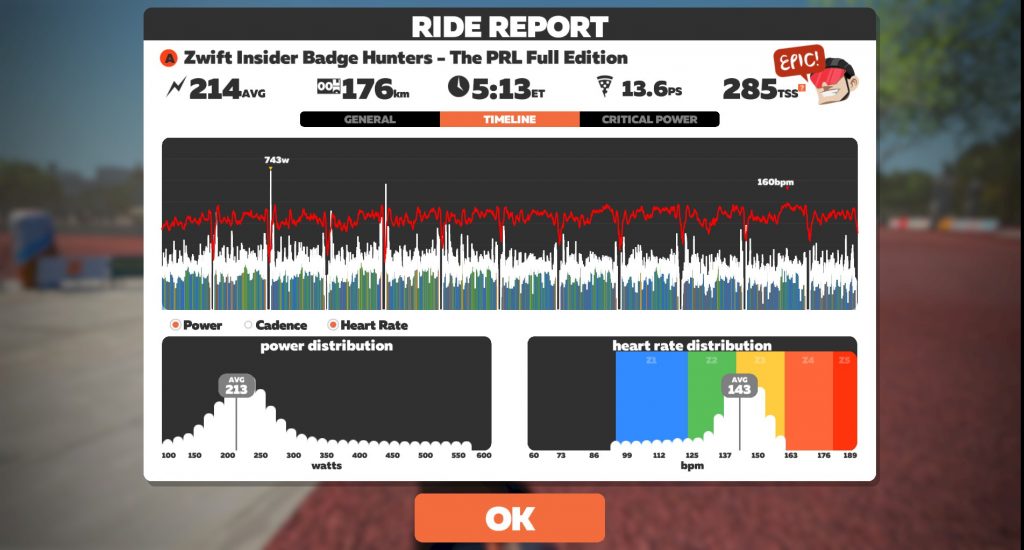
Watching the Zwift Racing League premier divisions and then commentating on APAC region, I realised that most races along the Richmond UCI Reverse course were ending in a big bunch sprint. 

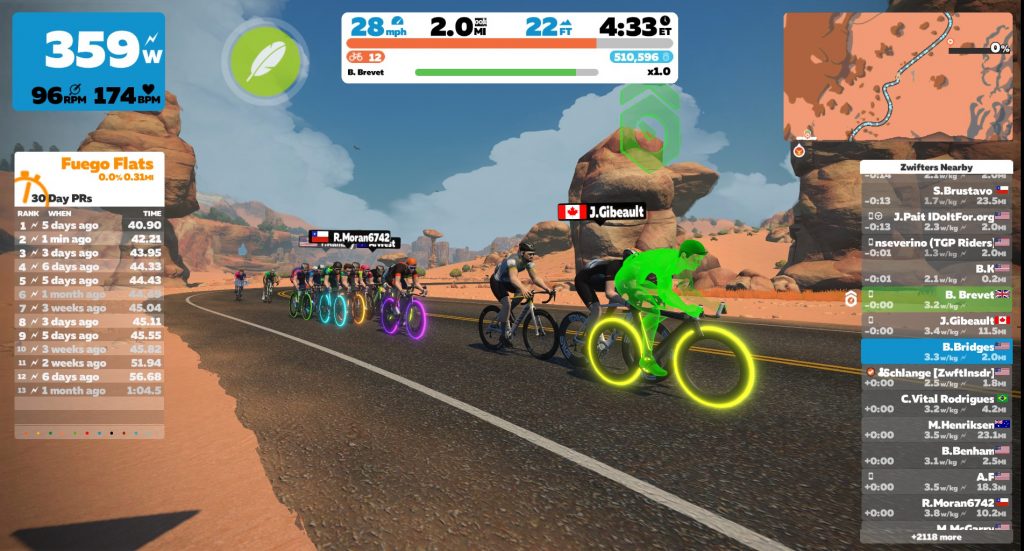
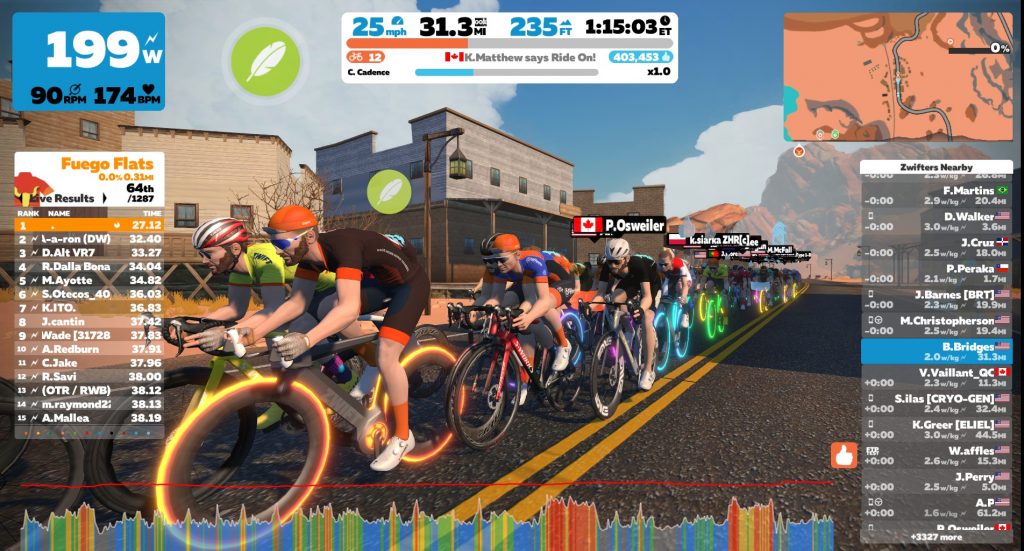
We decided at the end of our race to put some game theory to the test through a fakey sprint effort, with one rider (myself) putting in a fake sprint attack with 800m to go.  Check out the video:

There is always risk with any strategy employed in a cycling race, but using Game Theory you can minimise the risk or at least know what it is and mitigate it on the fly.  With the fakey sprint here were the scenarios:

  1. Fakey sprint draws out our competition and forces them into a chase, bringing up our teammates who can sprint over the top, our team wins
  2. Fakey sprint does not fool the competition, they stay with the bunch and ride wheels to put in a maximal sprint at the more opportune time, our team loses
  3. Fakey sprint does not fool the competition, they stay with the bunch but don’t catch, our team wins

So looking at the above there is a 33% risk that we will lose the race with this strategy, but a 66% chance that we will win the race.  Therefore, it was an easy decision to make… go for the fakey sprint.  

The alternate is obviously that we don’t fakey sprint at all and take the risk with a bunch sprint at the end.  But with 5 of our riders in the top 9 this only equates to a 55% chance of winning, still lower than 66%.  I have found that the odds always seem to be better when you are the team making the plays, being proactive rather than reactive. 

These strategic decisions are also faster and easier to make the better you know your competition and the more familiar you are with the course.  So: do your homework!

What About You?

If your team has pulled off something amazing in a race, or you’ve seen something tactically great, shoot me a message (or comment below) and I’ll do some analysis on why and how it worked.

Couch to Cat C, Week 2: Doing the Time

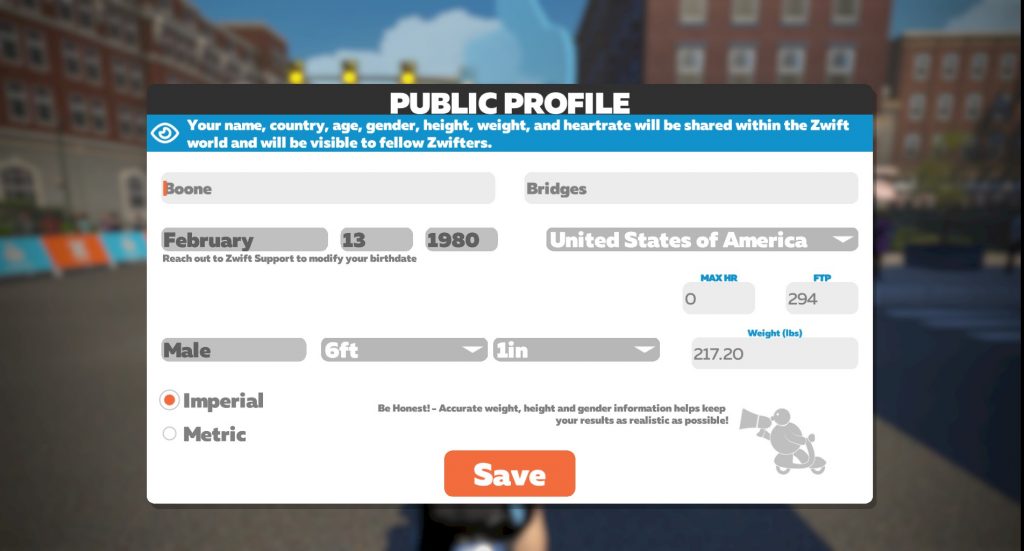
As explained in the first post, my cousin Boone and I are conducting a glorious experiment, not unlike the time much younger versions of ourselves taped a bottle rocket to a paper airplane and struck a match to see what would happen next.

We’re not sure how much fitness he can gain with a 6-week training program on Zwift, but he’s all in. Our goal: to transform a 265-pound rookie rider with a tested 1.92w/kg FTP into a cat C Zwift racer (2.5w/kg+) in 6 weeks.

The first week was mostly about orientation and baseline testing. This second week was about building endurance and improving form on the bike.

The Plan

As a reminder, here’s the basic plan we’ve settled on for the 6 weeks. (Many thanks to Alan Dempsey of HPP Coaching for giving us solid advice that sets Boone up for success):

  • Week 1: Benchmark testing + Endurance
    FTP test, attempt first Zwift race, and get some time on the bike
  • Weeks 2-4: Endurance + Cadence Work
    Lots of work from low zone 2 to mid zone 3, with some high-cadence drills to train the legs for efficient pedaling
  • Weeks 5-6: Endurance + Intensity, Finishing with Benchmark Testing
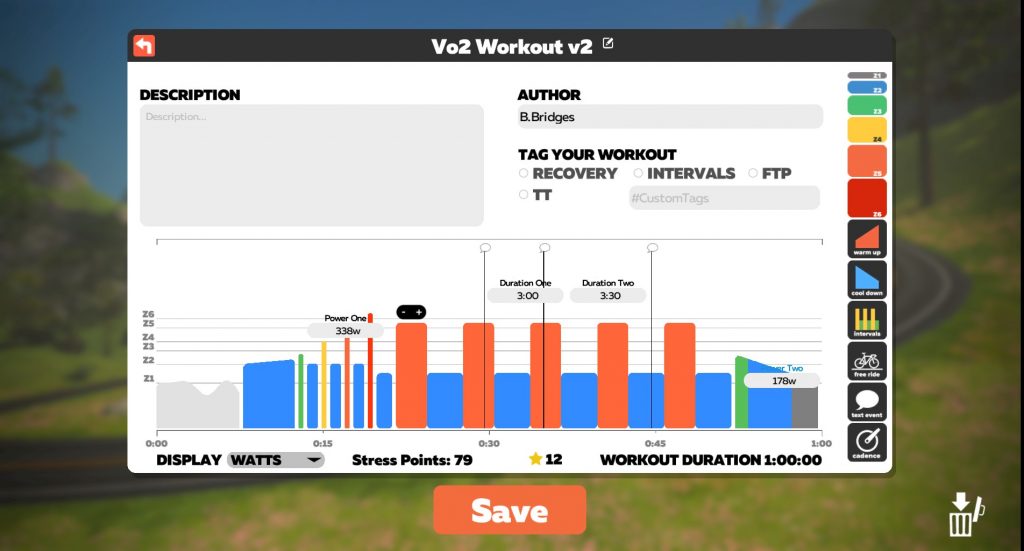
    Start with similar rides as weeks 2-4, with some VO2 and threshold efforts included in short durations. Toward the end of week 6 we’ll do another FTP test and Zwift race, so we can compare progress from week 1.

Ride #5: A Full Hour!

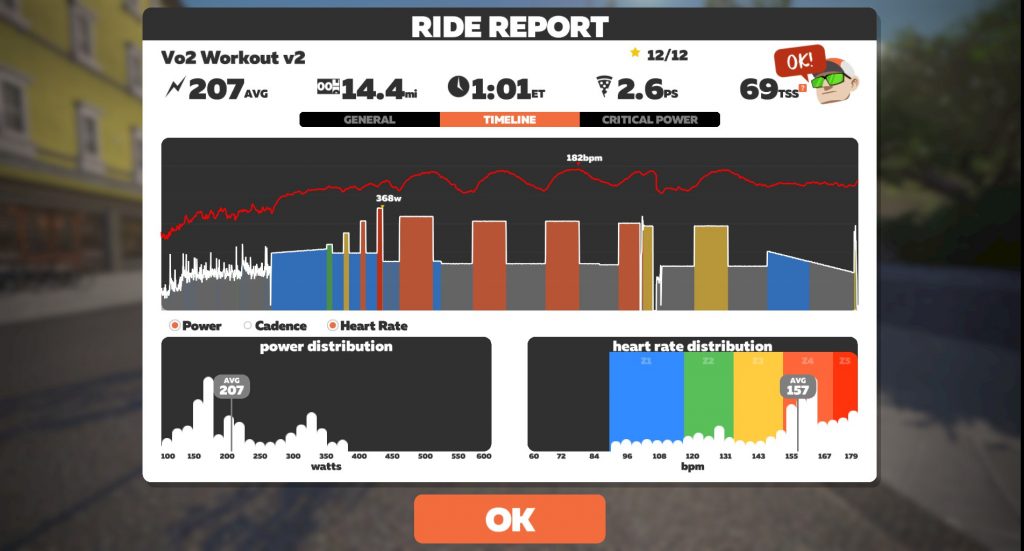
Boone had a simple goal for this ride: to stay on the bike for a full hour. He had been increasing his ride time on each effort, and he felt he had a full hour in him this time.

We put him in with Dan Diesel, Boone’s favorite riding buddy. And Boone spun with Dan’s group for about 45 minutes, before he ran out of steam, dropped off the back, and spun it easy for the final 15. He was pretty tired when he hit the hour mark… but he’d done it, and was stoked about that!

See this ride on Strava >

Boone after finishing his first hour-long ride

While his legs were tired, Boone said he felt like the biggest limiter was pain on the sit bones. But he knows that just takes time, so he’ll keep at it.

Ride data (this will be interesting for future efforts):

  • HR (avg): 166
  • Power (avg): 161W

Ride #6: More Fun with Dan

The next ride (two days after ride 5) was more of the same, although Boone went for 70 minutes this time. Once again, he lasted about 45 minutes with the Dan Diesel group, then dropped off and took it easy for the remainder.

  • HR (avg): 166
  • Power (avg): 155W

See this ride on Strava >

Ride #7: Breakthrough!

This ride’s plan was similar to the previous two, although Boone was going to try some “spinups” to work on muscle firing pattern efficiency and force production. In these spinups, he would just up his cadence to the max he could do without bouncing in the seat, then try to hold it for 10-15 seconds.

The wattage I saw from his first spinup was impressive (reminder: he’s using my Zwift setup with a Wahoo KICKR v5), so I told him to shift down a gear or two for the next one, to see what he could get to.

He hit 986W!

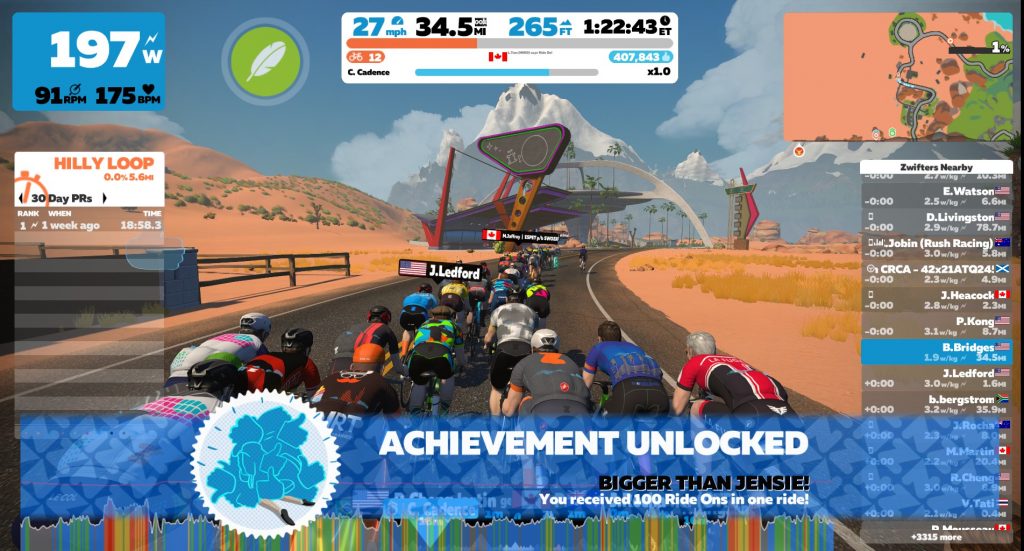
And here’s the crazier thing: it was a seated effort, and the reason he didn’t go higher is because he spun out. So we took a mental note to try another max wattage effort soon. I bet he can unlock the 1.21 gigawatts achievement. What do you think?

This ride was a bit of a “breakthrough” for Boone. He was able to keep it power high without “crashing” in the final ~15 minutes… and his heart rate was lower than it had been in the previous two outing. Looks like progress!

  • HR (avg): 162
  • Power (avg): 177W

He’s getting close to averaging 20mph for an hourlong effort, which is a fun carrot to chase. But to do it, he’ll need to ride faster than Dan Diesel, which means less drafting benefit. Hmmm…

See this ride on Strava >

Some power curve PB’s from Ride 7

Ride #8: Volcano Climb

Boone felt so good the day after Ride 7 that he hit the treadmill for a hard uphill hike. When he showed up the next day to ride, he was still feeling the previous days’ efforts.

Since Ride 8 would be followed by Ride 9 24 hours later, we decided to keep this ride short and work on out of the saddle form instead. Something that wouldn’t fatigue him too much, but still accomplish some useful goals!

We decided to tackle the Volcano Climb for this ride: a short flat warmup, then ~15 minutes of steady climbing where he could work on getting out of the saddle. (Boone’s a big dude, you see, and we had to bump up the Trainer Difficulty to give him enough resistance so he could stand and ride at 60-70rpm cadence.)

It started out a bit ugly, but by the end of the session Boone was looking pretty good out of the saddle. There’s still plenty of progress to be made here: he has to figure out how to get out of the saddle without drastically ramping up his effort. But he appreciates being able to get out of the saddle and relieve those sit bones a bit.

Boone did his first supertucking on the Volcano descent

See this ride on Strava >

Week #2 Takeaways

Boone lasted exactly 25 minutes in his first ride of week 1, and by the end of week 2 he was doing 70 minutes. Seems like progress to us! He’s also been watching his diet, and thus dropping weight. That’ll boost the ol’ watts per kilo. So far we’re both happy with the progress.

It’s been quite a while since Boone engaged in regular cardio exercise (outside of his work as a master carpenter, which often has him huffing and puffing). He’s already commented more than once that he’s really feeling good after these rides – so that’s a good sign. This is how the addicition begins!

Next week will be more of the same, although I want to get Boone to join Cara Cadence for 10-20 minutes, to see how he hangs with her faster group. And we definitely need to test his max sprint power – those legs are strong!

Support Boone

Thanks to everyone who followed Boone on Zwift and Strava and gave him lots of Ride Ons and Kudos. He’s loving it! If you haven’t done so yet, follow him on Zwift (name “Boone Bridges”) and Strava.

Your Thoughts

Got any tips for Boone? Comments on this week’s efforts? Share below!
An Active Approach to Cycling Injuries: Ankle and Foot

The majority of cycling injuries are overuse injuries which develop gradually over time due to repeated movement patterns.  In a 2012 study, researchers investigated the cycling habits and injury history of 397 cyclists and determined that nearly 54% suffered from foot pain, often requiring them to stop and remove their shoes to relieve the discomfort.

“Cyclists interface with the bike at three different points: the handlebars, the saddle, and the pedals.  Of these three contact points, the greatest forces experienced by cyclists are those at the pedals, where large forces have to be applied to transfer power, particularly during intense efforts like sprinting and hill climbs”.1

Ankle and Foot Pain Complaints and Injuries

Achilles Tendinitis

“The Achilles tendon, also known as the heel cord, is a tendon on the back of the leg that attaches the calf muscles to the heel (calcaneus) of the hindfoot. Overuse and poor technique can aggravate the Achilles tendon, causing pain and swelling over the hindfoot known as Achilles tendinitis.” 2

Plantar Fasciitis

“The plantar fascia is a thick band of tissue that runs across the bottom of your foot and connects your heel bone to your toes. Plantar fasciitis causes a sharp heel pain that is caused by repetitive irritation to the plantar fascia” 3, usually greatest upon your first steps in the morning.  Chronic fasciitis can result in a calcific deposit upon the fascial insertion to the calcaneus known as a heel spur.

Numbness in the Foot

Described as “pins and needles” this discomfort is caused by compression of the nerves that provide sensation to the foot and is most commonly experienced on the top of the foot and big toe.

Metatarsalgia

Pain localized to the ball of the forefoot that is brought about in cyclists by repeated stress during pedaling. 

Immediate First Aid for Acute Injuries

The PRICE principle, an acronym which stands for Protection, Rest, Ice, Compression, and Elevation, is the standard for the treatment of sports injuries during their initial phase of discomfort.  It should be applied as soon as possible for 24-72 hours.

Basic Bike Fit Recommendations

  • Achilles tendinitis: “Move the cleat back on the shoe so that the ball of the foot is more forward on the pedal, raise saddle height, address a limb length discrepancy with appropriate shim, decrease resistance and increase cadence.” 4
  • Plantar fasciitis: “Raise saddle height, move the cleat back towards the heel, address a limb length discrepancy with appropriate shim.” 5
  • Numbness: “Improper shoe fit and overtightened straps may bring about numbness, so it is important for riders to invest in properly-fitting shoes and loosen their straps.” 6
  • Metatarsalgia: Cyclists should be wary of pedaling with excess resistance, poorly positioned cleats and feet, and rigid cycling shoes, all of which may cause metatarsalgia. Soft-soled shoes or a soft insert may help decrease pressure and reduce symptoms.

Shoe Fit Suggestions

  • Cycling shoes should be selected to allow adequate width and support, especially in the forefoot area which could swell during long rides or in warm weather.
  • A stiff (carbon) shoe is acceptable provided that the footbed is properly structured and contoured to help relieve uneven pressure.
  • Avoid excessive and uneven tightening of shoe straps.
  • Cyclists who use clipless pedals should receive guidance on proper individualized cleat positioning and ensure adequate rotational freedom or “play”  during the pedal motion.
  • Encourage cyclists who suffer with foot pain to take frequent breaks, choose flatter routes, and pedal at a higher cadence.

Active Treatment Plan For Ankle and Foot Pain

What follows will be the foundation of a solid cycling injury active treatment and prevention plan, beginning with the basics of flexibility, strength, and recovery with a focus on the feet and ankle joint. 

By completing all elements of the program, and building upon it with each installment of the series, you will be equipped to withstand the physical stress of cycling with less pain and greater enjoyment in addition to having a resource to refer to when symptoms necessitate.

Flexibility Exercise of the Ankle and Foot

Find The Zwift Insider Foot & Ankle Flexibility Program complete with exercise descriptions >

Static Stretching Tips

  • Go to point of stretch and hold for 15-30 seconds
  • 3 repetitions per exercise
  • Don’t bounce!

Strengthening Exercise of the Foot and Ankle

Find the Zwift Insider Foot & Ankle Strengthening Program complete with exercise descriptions > 

Strength Training Tips

  • Perform 3 sets of 15 repetitions to start
  • Don’t perform if experiencing severe sharp pain (PRICE)
  • Increase intensity by adding weight or increasing repetitions
  • Strict form is essential!

Foam Roll Recovery Techniques

Find the Zwift Insider Foot & Ankle Foam Roller Program >

Foam Rolling Benefits and Technique

  • Improves circulation to enhance muscle recovery
  • Relieves muscle tension to improve flexibility
  • Roll slowly and when you find a tender spot, focus in on it by rolling back and forth until you feel it soften or release

The Follow-Up Appointment

Stay tuned, as in the next edition of this series I will provide a follow-up to the lumbar installment.  We will examine core strengthening and the importance of spinal strength and stabilization to keep you riding, training, and racing at your best!

What about you?

Is there anything special or unique that you do which helps to keep your feet comfortable while in the saddle for long rides?  Let us know what works for you!

The View from the Back: The Gran Fondo (Jan 3, 2021)

15

Have you heard the story about finishing a Zwift Gran Fondo with only two gears? No? Well sit down, make yourself comfortable, and get ready for the ride!

The supporting cast

Having ridden the Bambino and Medio Fondos the last couple of months, I had decided to ride the full Gran Fondo for January’s event, totaling 97.5km and climbing 1,196m.  Having completed the Rapha Festive 500 Challenge (which was riding 500km in 8 days), I felt that I would have the endurance to have a strong ride. 

To accompany be in this adventure, I had Michael, the Dutch Ironman athlete. He had ridden with me on the previous two fondos as well.

Setting the scene

There were 1920 riders signed up to the Gran Fondo alone.  A huge field, which meant that it was imperative to be at the very front of the pen otherwise it would be impossible to get into the front group.  35 minutes before the event started, I logged into Zwift and my avatar was sat at the side of the road, in Watopia.  However, so were about 50 other people! I immediately realised these people were also waiting to join the event, as soon as the option allowed. 

Sure enough, as soon as the “Join Event” button appeared, these riders suddenly disappeared and soon we were all decked out in the same grey jersey and at the front of the pen, for the start of the race.  Despite not being the “fastest finger on the button” I sat about 3 rows from the front, in a good position. 

With the first task achieved, I went about getting my supplies ready for the race.  Soon the table next to my bike was decked out like a kiosk, full of fruit, sweets, chocolates, gels, water and sugary drinks. 

I moved the turbo trainer closer to the monitor to get a better view and repositioned the fan.

I had left nothing to chance… or so I thought.

Michael was soon in the pen. We were ready to go.

Start with a bang!  

“How ironic!” I thought to myself as I endured a start to a race like no other. You see, I had only just written how the start to November’s Medio Fondo had been sedate by Zwift standards. But not this one!  The first comment I read was “OMG” followed shortly by “Wow”. I did want to reply, but I was pushing over 450 watts and holding the handlebars with a vice-like grip as I desperately tried to keep pace. 

A frenzied start

Within seconds of the start, I had been swamped and was down in 125th place.  I pedaled hard and was pushing well over 300 watts for the first few minutes. 

I got a message from Michael indicating he was near the front and by that time I was in 33rd position so replied “Me to” – I was too focused on pedalling and my position in the group to write any more, a theme that would continue.

I have never been in a start where changing position was so fluid.  One minute I was second, then 22nd, then 122nd, then 22nd again.  It was as if I was on some kind of weird ride where the position of my avatar kept changing amongst the melee of riders.

Hang On

“Hang On” Michael wrote as we approached the Zwift KOM.  He wasn’t wrong.  The melee of riders turned into a line as people were stretched by the pace.  I was pushing 6.9 watts per kilo and just holding my position. In the Head-up-Display unit I was able to see riders and their watts per kilo were exceeding normal parameters as they turned orange.  I wasn’t surprised, as I was on my limit and we had probably only been going for 15 minutes. 

Soon we were over the top of the climb and I had somehow survived in the front group, and so had Michael.  The descent was rapid and at the bottom we were joined by the second group.

To give you an indication of how insanely quick this was, as we approached the Volcano I remember seeing 18 minutes next to 15 kilometres and thinking “What?”

Too hot for me

As soon as we hit the Volcano, the pace got quicker and it was too hot for me.  I wasn’t going slow – pushing over 5 watts per kilo up the climb – but the front 50 riders had this power and pace that I and other mere mortals didn’t possess.  I reached the top in 6:44 and was already 40 seconds down with the top time being 6:04. 

There was some consolation as I think on the climb I passed Bryan Coquard, a French pro cyclist who rides for B&B Hotels-Vital Concept. He was a silver medalist at the 2012 Summer Olympics in the Omnium

I didn’t have too much time to think about Bryan as I was on the descent and in a good group, which now sat 2nd on the road.  We were joined by another group and we now occupied positions 56-89. 

Michael was in the group behind.

The intermission

During the descent, I refueled from my homemade kiosk and got to the front of the group so I’d be ready if anyone decided to attack near the base of the reverse Epic KOM.  Fortunately, no one did, so off on our Jungle trek we went.

Carnage in the Jungle

We had been cycling hard now for about an hour.  The change in surface in the Jungle makes this part of any Fondo the most challenging, yet somehow, despite now being a little tired, I was able to sit comfortably in the middle of the group.

The kilometers ticked over and I was able to get some form of recovery, that was until some ‘bright spark’ went to the front of the group and started pushing the pace on the exit to the Jungle!  I’m not sure what their plan was, as the group was working well and it seemed pointless to try and start attacking with such a long way to go (45km).  The pace upped and people were pushing 5 watts per kilo and then as I changed gear to keep pace, there was a loud crunch and my rear derailleur shifted to the smallest chainring and the gear shifter went loose. I knew instantly that the gear cable had snapped.

I watched in pain as the group eased away into the distance. 

In an instant I had gone from riding my Trek Madone with all the gears in the world to a single-speed bicycle. Well, it wasn’t quite that bad – my front derailleur worked so I did have two gears!

Honestly, I hate the Jungle.

Decisions, decisions

Any aspirations of a strong finish disappeared with the group ahead of me and for a moment it was quite depressing.  It wasn’t like I had just 10km to go, or even 20km, I had 56kms including an ascent of the Epic KOM and that was a daunting thought.  There was no way I wasn’t going to finish the race, quitting hadn’t entered my mind, it was more the question of “How am I going to do this?” 

You see, with no cable tension to hold the rear derailleur in place it was stuck on the smallest chainring, which is only really used for descending at speed or sprinting.  It was the worst gear to have.

The irony was that in my well-prepared kiosk, I had every food and drink beverage but I did not think to include a gear cable and multi-tool.  It just goes to show that despite planning for everything, there are always surprises that can trip you up.

Faced with few options I just pedaled on. Fortunately, I still had two pedals, which was more than I had a few years ago.

A brief interlude – Col du Galibier on one pedal

Several years ago, I was cycling the big mountains in France and on the ascent up the Col de Télégraphe, the carbon plate in my right Look Keo Blade pedal broke, leaving me to pedal the Col de Télégraphe and Col du Galibier with effectively one pedal, as it had no tension to keep my shoe in place!

Back in Watopia

Back in Watopia, the next 56km’s were just painful.  With a strong finish all but a distant memory, I was in “survival mode.”  I knew that my best chance to finish was to get in and stay with a group.  If I could “sit-in” I would save an awful lot of energy and time.  The problem was, how could you do this with two gears?

The first group that approached me, I got the timing all wrong.  I was in the small chain ring, which gave me a high cadence but a low power.  So when the group was on top of me, I shifted to the large chain ring and started putting the power but they sped past me.

I watched the map for the next approaching group and this time my tactic worked.  I shifted from spinning to all out power and managed to not only get in the group, but overshoot it.  They easily caught up to me and I was able to settle in. 

Staying in the group over the next 30km involved some of the most bizarre cycling I have done.  Left with a meandering, rolling route to the Epic KOM, surviving in the group meant paying close attention to the terrain and using it to my advantage.  As soon as we hit a slight incline, I changed to the small chain ring and span my legs like crazy.  This momentum would take me up the short rolling climbs, then I would change to the large chain ring and pedal as hard as I could, resulting in me passing through the group and up the next set of rolling climbs, where I would need to change to the small chain ring and repeat the whole process again.  This worked well until the rolling hills were in short succession and I didn’t have time to change gear, resulting in me grinding at 40 rpm up the second climb, pulling the pedals with all my force. 

I honestly wondered what the people in the group thought, but unable to let go of the handlebars to message them, they were now witness to the bizarre sight of me shooting through the group, only to be caught again. I prayed for the flat.  Ironically, it was during one of these efforts to keep in the group that I achieved the quickest time on a sprint near the Roman Villas.

Epic by name, Epic by nature   

As I approached the Epic KOM, I got a message from Michael who had a technical issue and had slipped down to 800th. He had worked himself to 400th position and was making progress.  I, however, was sitting around 130th position, and I knew I wouldn’t stay there for long.

I realised it would be near impossible to climb the Epic KOM competitively without shifting the rear derailleur into an easier gear, so I made the desperate decision to get off my bike and try and pull the gear into position.  I knew that without any cable tension to hold it in place, it would be impossible, but I needed to try. 

Predictably, without tension from the cable, the derailleur would not hold in position and slipped back to the smallest cog. 

I reluctantly got back on the bike, put it in the small front gear, and just started spinning up the mountain. With too little resistance I was only generating 3 watts per kilo.  I did consider changing the trainer difficulty setting, but the purist in me would not allow it, so I sat and spun and watched as riders streamed past me as a slowly climbed the mountain.  The climb up the Epic KOM was a stream of riders, like a conga line without any fun music to accompany the sight.

There was no swashbuckling finish, just a slow crawl to the finish in a time of 2:35:29, in 193rd position, nearly 30 minutes behind the leader.  My legs were in bits from the 45kms with two gears and I was exhausted. But at least I had completed my trilogy of Fondos. 

The Epilogue

My Gran Fondo experience just shows that cycling really is a metaphor for life.  There are thrills to have, mountains to conquer, and despite the best-laid plans and preparation, there is always something that comes along and changes them.

Ultimately the key is to not give up, but to “get round” the best you can. In the end, just to finish is the achievement, and at least there is a story to tell!

What About You?

Did you ride in January’s fondo events? Share your experience below!

Where To Buy a Smart Trainer Today (USA Retailers)

8

The crush of new Zwifters over the past several months has led to a worldwide shortage of smart trainers on the market. Major retailers and local shops alike are telling us that they get new stock in and it sells out within a day or two. Sometimes less!

This page is updated twice daily so you can easily find what’s in stock at major US-based retailers.

First, let’s look at where our top-rated direct drive trainers are available right now

Smart Trainers In Stock at US-Based Retailers:

Looking for a slightly cheaper direct-drive trainer? Here are our top choices – and here’s where they are currently available:

Our list of top-rated wheel-on trainers contains just two trainers – here is their availability:

Good Luck!

A quality trainer makes all the difference in your Zwift experience. We wish you all the best in your attempts to purchase the best trainer for you!

(Note: the links above are mostly affiliate links, which means we’ll get paid a small commission if you buy through the link. We appreciate your support!)

Michael Knudsen: Zwift’s vEveresting World Record Holder

On January 6, 2021 the 32 year old ultra-cyclist Michael Knudsen of Copenhagen, Denmark set the Strava vEveresting KOM in 7:17, besting the previous mark held by Tom Ove Kaland of 7:28 set on January 3, 2021. 

In doing so, Michael added this incredible accomplishment of endurance to a list which includes being one of only 7 athletes on the planet to complete the Trans-Siberian Extreme (9,100km) and a 5,100km “indoor RAAM.”

Read more about Michael’s background in part 1 of this 2-part post >

vEveresting Basics:

Why Did He Decide To Do It?

At his Zwift station

After completing a vEveresting for charity on Alpe du Zwift last year, Michael recalls, “I already knew back then I would go for vEveresting at some point and try and race it.”  It would have to wait, however, as Michael had set 2020 as the year he would try to win the prestigious 5000km Race Across America.  

“Covid-19 stopped that but I’d logged an average 23 hours of training per week so my base fitness was solid,” Michael says matter of factly.  By chance, Michael saw that there was a segment for the Strava KOM when Tom Ove Kaland set the record.  Michael says, “I felt like testing myself.” 

Zwift Setup

Michael describes his setup as “super basic and similar to most, I know.” He utilizes a Wahoo KICKR v5 combined with a Wahoo Headwind fan for cooling. In classic Knudsen style he adds, “I don’t have any special details or homemade features.”

Strategy and Mindset

During a recon ride on January 4th Michael dialed in his pace and power.  “I felt fairly confident climbing at 330 watts (Michael weighs 69.9kg and boasts an FTP of 375W) so I set Erg mode to 330 to see what time that would give me.”  Climbing steadily at 4.72w/kg allowed him to complete the Alpe du Zwift ascent in 41:50.  He remembers saying to himself, “OK…this could be interesting.”

Michael described his mindset as, “40 minutes of work and 10 minutes off doesn’t sound too bad.”  The realization that the work would be at nearly 5w/kg was not a thought he was eager to entertain.

After disabling ERG and setting his trainer difficulty to 100% Michael completed 3 more ascents in times ranging between 40:20 and 41:50.  “I felt good,” stating in an annoyed tone, “I wish I didn’t do the first climb in ERG or I would have just kept going.” 

He didn’t, which allowed him a moment to contemplate his strategy further.  Faced with a decision, Michael asked himself, “Do I pace purely for the record or do I give my absolute maximum effort and risk seriously blowing up in the process?”

Michael’s “Race” Day

Guess what?  He decided to go all out for a maximum effort. Are you surprised?

“I did my normal daily routine on the day,” Michael reports doing “nothing special or fancy.”  Which meant eating a light breakfast of bread with butter and jam, performing a few mobility exercises before jumping on the bike, and riding his girlfriend’s avatar to the bottom of the climb so he could join her there and avoid the time penalty of the Road to Sky lead-in.

“As with all big events it’s important to break it down into manageable pieces,” Michael explains, describing his mental approach. “The vEveresting to me was 8 times 1 climb and I focused on one at a time.”

The Race’s Lower Slopes

Michael started climbing hard to set a pacing benchmark at the halfway point.  He is no stranger to ultra-endurance events and through experience knows that most athletes break mentally.  Although he admits, “the physical challenge was greater than expected, as if I was sprinting a marathon.”

Michael ascended climb 1 in the low 40’s managing to resist the urge of pushing for sub-40.  The next few climbs went well, but as Michael recalls, “not diamonds in the legs and I was worried that the recon ride 48 hours prior was a tad too much too close.”

Michael reached the halfway mark in good style several minutes ahead of record pace.

Nutrition

When describing his food prep Michael admits, “I’m not the big planner to be honest. Which has cost me dearly in other events and races in the past. So I was actually more or less out of gels and other of my favourite sports nutrition for the event.”

Here’s what Michael consumed during the record breaking ride:

  • 3 liters of electrolytes (8 tabs)
  • 1.5 liters of energy drink
  • 2 liters of Sprite
  • 4 gels
  • 3-4 packs of carb gums
  • 1 bar
  • Some bakery stuff
  • Jam sandwich

“My tactic was just to eat as frequently as possible,” Michael explains. “It was easy to drink going up, but eating was more difficult because trainer difficulty at 100% meant changing gears all the time.”

The Hit The Wall Moment

The 5th climb proved to be Michael’s “hit the wall” moment, which worried him because “it came way sooner than I expected.”  Michael controlled his negative thoughts and with strong Zwift community support “nursed it to the top.”  After refueling and regrouping during the descent he began the 6th in what he termed through previous experience as “full-on defend mode!”

His mind and legs shifted into damage control knowing that the last 3 climbs would be “absolute savage.”  Michael recalls, “It’s quite stressful knowing that you have to keep climbing close to 5w/kg to stay in the game with zero room for error.”

A Second Wind?

On the 7th climb Michael caught his second wind and was climbing under more control. “I knew by then that if I just kept my concentration and nutrition I would be just fine.”

Unless of course you start to cramp? 

As he crested the summit Michael’s inner thigh began to spasm. While attempting to stretch and massage on the downhill all he could remember saying to himself was, “Don’t screw this up!”

Having collected himself and after delving into the vast experience of past ultra-events Michael adjusted his strategy for the 8th and final full ascent. Michael explains, “I dialed down the pace to make sure the cramp wouldn’t force me off the bike and derail this whole endeavor.”

The Most Scenic View is From Atop the Greatest Climb

The final 6 km up the 9th climb was as Michael expected, pure joy and the opportunity to celebrate with the fellow Zwifters who supported him.  Satisfied by the effort, Michael states, “I’m very proud of the ride knowing I couldn’t have gone any faster.”  Humbled by the support of what Michael calls his amazing Zwift community he had but one thing to say, “This is just awesome…thanks!”

vEveresting IS Hard!

In case you are still not convinced, take it from Zwift’s ultra-cycling Superhero, whose palmares are full of extraordinary feats unfathomable to us mere cycling mortals.

Michael states, “I dug as deep as I possibly could and that leaves your body in a big hole. I personally only have so many times a year I can push my head and body down in that hole and this event was surely one. It’s both your head and body which needs to recover after pushing for so long so hard.” 

Thoughts On Recovery

“To be honest, I actually had to go to work on a night shift 5 hours after completing the ride. But in the days that followed I tried to focus on sleep and food to boost my recovery. In terms of recovery equipment I’ve got recovery boots, as massage hammer, and foam rolling which I do from time to time. My biggest advice for recovery is sleep and quality nutrition.”

What’s Next?

Ever seeking the next challenge, Michael intends to complete every Zwift route badge as fast as possible and multiple vEveresting records before attempting to break the IRL record in the Spring.  He also intends to put the 1,000km in 24 hours notch in his belt in 2021.  

Michael Knudsen’s ultimate goal is to have the opportunity to pursue his passion as an ultra-cyclist full-time and thereby reward the family, friends, and sponsors who have sacrificed so much for him.  I am confident he will!  Ride on!

What about you?

What are your cycling goals for 2021?  They need not be as auspicious as Michael’s, but remember “A goal without a plan is only a dream.”

Smart Trainer Buyer’s Guide for Zwifters

19

Smart trainers aren’t the only way to get on Zwift, but they’re the best way. A smart trainer lets you feel resistance changes as you ride up and down hills in Zwift’s virtual worlds. This makes zwifting immersive and helps you train for the challenge of hard outdoor climbs.

Additionally, most smart trainers detect both power output (wattage) and cadence, sending these training metrics to Zwift so you can ride, race, and train your very best.

There’s no debating that a high-quality smart trainer is essential if you’re seeking an immersive and enjoyable Zwift experience. But which one should you buy? We’re here to help!

What Not To Worry About

Let’s start with some good news: smart trainers have come a long way in the past ~6 years. Current models all communicate via both ANT+ and Bluetooth, ensuring compatibility with whatever device you’re using for Zwift.

Additionally, as long as you follow the instructions, any smart trainer you get will be accurate and powerful enough to deliver an immersive and effective Zwift riding/training/racing experience.

Two Trainer Types

While we have 100+ trainers in our Smart Trainer Index, there are just two* types of smart trainers: wheel-on and direct-drive. It’s important to understand the differences:

  • Wheel-on: the lower-priced option, you don’t need to remove your back wheel for these trainers. Your bike mounts to the trainer by clamping onto your rear axle ends, and the trainer’s resistance roller presses against your back tire. Wahoo’s KICKR Snap is a very popular wheel-on trainer.
  • Direct-drive: these trainers replace your back wheel, so the trainer includes a cassette and your rear axle runs through the heart of the trainer. Wahoo’s KICKR is the most popular direct-drive trainer on the market today.

*Smart bikes, if included in this discussion, would constitute a third type of smart trainer.

Each type of trainer has its own strengths and weaknesses.

Wheel-on trainers are typically easier to pop your bike in and out of, since you don’t have to remove your back wheel or fumble with your chain/rear derailleur in order to attach your bike to the trainer. This is one consideration, especially if you have only one bike and plan to mix your indoor and outdoor riding.

That said, wheel-on trainers are the lower-priced option for good reason! They suffer from two key problems: power inaccuracy and poor road feel. Power is often inaccurate because it depends on proper calibration, which easily gets messed up if your tire pressure changes or your swap bikes. And wheel-on trainers don’t mimic the feel of riding outdoors very well, because they lack the inertia provided by the flywheels in direct-drive trainers.

Direct-drive trainers provide a much more realistic road feel thanks to their flywheels, and they’re generally much quieter than wheel-on trainers because there is no tire rubbing against a resistance roller. Since power is measured internally without involving the wackiness of inflatable, temperature-sensitive tires, your wattage numbers will be much more stable and accurate from ride to ride.

This premium experience and accuracy come at a cost, though – most popular direct-drive trainers cost at least twice what their wheel-on alternatives do.

Wheel-On Trainers

  • Affordable
  • Easy bike mounting
  • Lightweight and foldable

Direct-Drive Trainers

  • Accurate power
  • Realistic road feel
  • Quiet

Let’s dig more into the qualities of various trainers, so you can find the best smart trainer for your situation!

Price Points

Popular, reputable smart trainers on the market today range in price from $370 to $1400. On the low end of this scale you’ll find wheel-on trainers like the Tacx Flow Smart, while on the upper end you have premium direct-drive trainers like the Tacx NEO 2T.

We break our Smart Trainer recommendations into three budget tiers:

Accuracy

Power accuracy is typically stated as a percentage range such as “+-5%”. This means that, at 100 watts, the trainer may overstate power by as much as 5 watts and still be within spec. Or at 300 watts, it may understate power by as much as 15 watts.

5% may not sound like a lot, but it’s significant when you’re talking about tough training intervals or Zwift racing.

That said, the real power accuracy problems come when your trainer isn’t calibrated properly. This is a common occurrence with wheel-on trainers, since they rely on consistent tire pressure and temperature for accurate power readings. If you calibrate at one tire pressure and/or temperature, then ride at a different pressure or temperature, your power may be much less accurate than the specs state.

Direct-drive trainers, on the other hand, are usually accurate within +-2%. And they only need to be calibrated every few months, or if they’re moved and not handled carefully. The two most popular trainers (Wahoo KICKR and Tacx NEO) don’t need any calibration at all!

Maximum Wattage and Slope

Besides accuracy, there are two additional key specs worth noting when doing your smart trainer shopping: Max Wattage and Max Incline.

Max Wattage is the maximum number of watts the resistance unit (or “brake”) can produce. It’s a measurement of how hard the trainer can push against you, and this becomes a factor on sprints and steep climbs.

Max Incline is the maximum climb gradient the trainer can simulate. If you think about it, this is obviously linked directly to Max Wattage, since they’re both just talking about how much resistance the trainer can produce.

There’s a lot we could say on this topic, but let’s keep it simple:

  • The heavier you are, the more Max Wattage/Incline you’ll need
  • The stronger you are, the more Max Wattage/Incline you’ll need
  • Direct-drive trainers generally provide higher Max Wattage/Incline than Wheel-on trainers
  • More expensive trainers have stronger resistance units, resulting in higher Max Wattage/Incline

For more on this topic, read “How Much Trainer Resistance Do You Really Need?”

Portability and Storage

Does your Zwift setup have its own dedicated space, or are you setting it up and tearing it down between sessions?

With their small or non-existent flywheels, wheel-on trainers are generally lighter and thus more portable than their direct-drive counterparts. Example: the Wahoo KICKR weighs 21kg while the wheel-on Tacx Flow Smart only weighs 9.4kg.

Wheel-on trainers have legs that easily fold back for storage in tight spaces. Most direct-drive trainers fold as well, but many are awkward to lift and move due to their heavier weight. (The Tacx NEO is a good example of this: it folds up, but is difficult to carry because of its 21.5kg weight and awkward shape.)

There are heavier wheel-on trainers: the Wahoo KICKR Snap weighs a hefty 17.2kg thanks to its flywheel. And some direct-drive trainers are quite portable: the Elite Suito folds up into a very narrow package and weighs only 14.5kg. So be sure to pay attention to trainer weight and footprint, if portability and storage are important for you.

Bike Mounting/Compatibility

Determining whether a given trainer will work with a given bike can be a little daunting due to the wide variety of cassettes, tires, axles, and frame shapes on the market today. The good news is, most smart trainers will play nicely with most bikes. But here’s what you should keep in mind for each type of trainer.

Wheel-On Trainers

  • Tires: a normal road bike tire will usually work just fine on a wheel-on trainer. Knobby mountain bike tires will be super noisy, and probably not terribly accurate. The best tire is an actual trainer tire, but then you can’t just pop your bike off and ride it outdoors!
  • Axle: wheel-on trainers generally play nicely with quick-release axles, although you may need to swap your bike’s quick-release with the one shipped with your trainer so it will mount securely. Got thru-axle? You’ll probably need an adapter kit – make sure your trainer has one available.

Direct-Drive Trainers

  • Axle: most trainers include adapters so they’re compatible with popular quick release and thru axle standards. Read the specs to make sure.
  • Cassette: does your trainer ship with a cassette, or do you need to purchase and mount one? How many gears does your bike use? A 10-speed bike will work with an 11-speed cassette (it just won’t shift to one of the gears) but a 9 speed (or less) will not, and neither will a 12-speed, since the spacing between cogs is different. If you’re on anything other than a 10 or 11 speed you’ll definitely need to purchase a cassette for your direct-drive trainer.
  • Frame: most frames will mount on any popular direct-drive trainer, but certain frames have extra-narrow chainstays or seat stays which may rub the trainer’s body.

Road Feel

You’ll hear Zwifters talk about a trainer’s “road feel”. What exactly is this?

When we ride outside, our muscles engage mainly on the vertical portions of the pedal stroke. As your feet travel across the horizontal portions of the stroke they’re mostly “coasting” – taking advantage of the inertia you’ve built up.

Higher-quality trainers try to simulate this inertia by using flywheels – sometimes a real flywheel, sometimes a virtual one. Cheaper wheel-on trainers often have tiny flywheels, while more expensive direct-drive trainers have larger flywheels.

When it comes to realistic road feel, direct-drive trainers win the contest, hands down.

Note: the Tacx NEO has a feature named “Road Feel” which allows it to simulate various road surfaces by “jittering” the resistance so you feel the surface through your chain. This is different from the “road feel” discussed above.

Customer Support

Before you invest hundreds of dollars in a trainer, it’s a good idea to make sure you’ll receive quality customer support if you ever need it. Our Smart Trainer Index includes over a thousand reviews from actual trainer owners, and many talk about the level of support they’ve received.

Be sure to do your research! That super-cheap trainer from Alibaba may be tempting, but you’ll probably regret the decision if anything ever goes wrong and you need support from the manufacturer.

Top-Rated Smart Trainers

Hopefully you’ve made your choice between wheel-on or direct-drive by now. But you may still be deciding which trainer to buy.

We’ve created simple lists of the top 2-4 trainers in each of three categories. Click for our picks:

Top Wheel-On Smart Trainers
Top Budget Direct-Drive Smart Trainers
Top Premium Direct Drive Smart Trainers

A Note About Availability

Smart trainers have been in short supply since Covid lockdowns began in March 2020 and sales spiked to record highs. Retailers are still having a hard time keeping trainers in stock, and the most popular trainers often sell out within hours of restocking. This is especially true in the UK and Europe.

We’ve been maintaining a list of available smart trainers at major US retailers for several months now, updating it twice daily so you can easily see which of our top-rated trainers are in stock and where. The list is constantly changing, but every one of our top picks is usually available from one retailer or another on a given day. Most of these stores will ship to Canada and overseas.

See available smart trainers >

Questions or Comments

Share below!
Join Tomorrow’s Chase Event In Support of Cure Parkinsons

1

Tomorrow (January 16th) at 7am Pacific/10am Eastern/3pm GMT join a host of pro riders and celebrities in a unique Zwift event!

Drops UCI vs Tindall & Co: Chase! is a celebrity-led pursuit event where 4 groups (A-D) will depart with staggered starts over the 36.2km course.

Each category has celebrity lead riders, including:

  • DROPS Le-Col UCI Women’s Cycling Team (A)
  • 14-time gold medallist Paralympian Dame Sarah Storey (B)
  • Mike Tindall (C)
  • 2x World Champion Taylor Phinney (C)
  • Cure Parkinson’s Chief Executive Will Cook (D)

Hunt or be hunted: you choose your category! Double Draft is turned on, so work together and make it happen!

About the Route

The event is held over one lap of London’s “Keith Hill After Party” route which is mostly flat, until the final climb up Keith Hill. Riders will complete 36.7km and climb 407m over the course of the event.

Livestream Details

Want to watch yourself battle it out against these celebrity riders? Easy. You can follow on Zwift’s YouTube channel from 15:00 GMT.

Sky Sports presenter Alex Payne, Olympian Amy Williams, and road cycling legend Matt Stephens will be commentating on the action. You may also watch it below:

Support the Search for a Cure

This is a fundraising event for Cure Parkinson’s, a leading charity funding research to slow, stop, and reverse Parkinson’s. COVID19 has decimated Cure Parkinson’s fundraising, and they need your help to get back in the saddle.

Donate to Cure Parkinson’s and help fund their game-changing research! Whether you give £20 or £200, every penny raised up to £10,000 will be doubled by an anonymous matched donor.

Donate Here

Michael Knudsen: The Zwift Ultra-Cyclist

If you are reading this then you likely ride your bike on Zwift, and if you ride on Zwift you have likely ridden with Michael Knudsen.  Why am I so confident in this assertion?  The law of averages says so!  

Michael logged over 20,000km in 2020 alone on Zwift and trained over 1,000 hours.  He completed the Rapha Festive 500… in one continuous ride!  Then followed it up a few days later by taking the Strava vEveresting KOM in an unfathomable 7:17 while averaging 282W.  Chances are good you’ve crossed his wheel.

Michael with his son Noah

Residing in Copenhagen, Denmark, 32-year-old Michael is a former police officer who presently works as a mentor for children affected by autism.  He has a 4-year-old son named Noah and spends a lot of time in Switzerland visiting his girlfriend… although I can’t see where he finds much time for that!

Notable Past Achievements

  • 2nd place in 9100km Red Bull Trans-Siberian Extreme, 2018
  • 5x Ironman finisher
  • 12-hour Danish TT record holder non-draft (IRL)
  • 5011km “Indoor RAAM” performed in a shopping mall, 2019 
  • Premier Division rider for Zwift race team PO Auto-CeramicSpeed

The Making of an Ultra-Cyclist: Michael’s Early Years

Michael’s introduction to cycling was born out of a desire to lose weight in his early adolescence.  “I was extremely overweight as a teen,” describes Michael.  He fell in love with cycling after watching the Tour de France and begging his mother to help him join the local cycling club. 

“12 months later I’d lost over 30kilos and had begun to turn my life around,” says Michael.  “I just jump in the deep end and hope for the best,” says Michael, describing his all-in attitude toward life. 

Knudsen Krazy Fact

Michael slept less than 90 minutes during the 1,400km ‘King Stage’ of the Trans-Siberain Extreme and was observed falling asleep while riding for ~50 meters before awakening and continuing on! 

How it All Began: Michael’s Early Career

Appropriately, his first competitive experience in his early 20’s was in triathlon after being inspired by a friend’s father, an Ironman finisher.  Having never attempted an open water swim Michael jumped into the deep end in IRONMAN Nice, France, an experience he described “more as a controlled drowning.” 

He also had never done 180km on a bike or ran more than 20km.  “Needless to say,” Michael laments, “it was a sufferfest and I barely made the time cut to become an official finisher.”  He has gone on to complete four more IRONMANs in much-improved style.

Knudsen Krazy Fact

Michael hosted a Rapha Festive 500 ‘all in one go’ Zwift event on December, 26, 2020 whereupon he rode 313 miles in 14:02 while burning over 7,900kcal and receiving over 1,000 Ride Ons!  This, a mere 10 days prior to his record-breaking vEveresting!

An Ultra-Cyclist is Born: But First a Setback

Following the birth of his son in 2016, Michael decided to shift gears from triathlon.  Never lacking confidence and always searching for the next challenge Michael set his sights on taking his cycling to another level. 

“My original desire was the prestigious 5000km Race Across America but then I was introduced to ’the mother of all races’”, states Michael excitedly, “The 9100km Red Bull Trans-Siberian Extreme!” 

Suffering from a bad case of ‘cyclist’s amnesia’, Michael didn’t learn from what he describes as the “Nice fiasco” and failed to prepare sufficiently for the race that only 5 people in the world had ever successfully finished.  Michael dejectedly states, “I barely made the halfway mark before I had to DNF, the only DNF of my career.” 

Undeterred, Michael returned the following year “after licking my wounds” and making the necessary changes to take home 2nd place overall, becoming only the 7th athlete in the world to conquer this monster of a race.

Knudsen Krazy Fact

In preparation for the 2020 Race Across America (RAAM), Michael rode the distance virtually on Zwift…in a shopping mall. On October 28, 2019 he successfully completed 3,108.13 miles in less than 10 days total time (averaging over 19mph). In doing so, he also set the Zwift record for Fastest 5,000K while burning over 7,000kcal per day and 70,000 for the event!

Michael’s Keys to Endurance Cycling

  • Break the event down to manageable pieces: “When I hosted the Rapha 500km in one go on Zwift over the holidays I encouraged people to divide it into 5x100km, arriving at a mini-goal every 2:45 rather than counting down 13 hours.”
  • Control your mental state: “It’s the mental part that will break you and if you realize that it’s impossible to feel great all of the time the dark times will pass.”
  • Setting an example: “If one overweight kid like me gets up from the couch and changes their life I will consider my work a success.” 
  • Keep your motivation in perspective: “I think of my friends and family who have sacrificed for me.”

Knudsen Krazy Fact

During the 2018 Red Bull Trans-Siberian Extreme, a 9,105km race with 77,000 metres of altitude, Michael rode across eight time zones, completing it in 25 days!

What Do Friends of Michael Really Think?

One of his closest friends, Janni Sand, and co-founder of Michael’s largest sponsor Nortec, breaks it down this way when describing him and what makes him great:

  • “He’s always positive.”
  • “He’s not afraid of setting himself crazy goals despite knowing that he might fail.”
  • “He’s a kind and caring person who always wants to include people around him, like you see in the crazy amount of support that the Zwift community offers him.”
  • “He is such a strong cyclist with an even bigger physical potential than he might even know.”
  • “He likes crazy ideas!”

The vEveresting Record: A Krazy Idea?

Maybe not crazy, or perhaps not even special, but climbing the equivalent of the height of Mt. Everest virtually in one continuous ride while pedaling a bicycle affixed to a smart trainer in just over 7 hours IS EXTRAORDINARY

In a follow-up feature coming soon, I will detail what it took Michael to achieve this incredible goal, including why he chose to do it, preparation in the days leading to the attempt, and the remarkable ride itself.  We’ll also look at what it takes an ultra-cyclist to recover after digging a hole so deep!

How about you?

Are there any Krazy cycling things that you have done?  We would all love to hear.

Zwiftcast Episode 93: Peak Zwift, Coco is Cara! Zwift Power + all the Zwifty chat

3

A new episode for a New Year – and 2021 has dawned with, as usual, lots of Zwift news and developments for the Zwiftcasters to discuss. The trio start off with an exploration of the possible reasons why Simon’s very favourite pacer bot may have had an identity change. Coco is now Cara! But why? Simon has a theory.

The podcasters move on to discuss the big new Peak Zwift – with more than 46,000 users on the platform concurrently the growth of Zwift over the past year can now be quantified, using this public metric. Up from a mere 16,000 concurrent users at the same point last year, Simon, Shane, and Zwift celebrate the achievement whilst also exploring what it all means.

Just in time for the Tour de Zwift’s six remaining stages, the game’s developers think they may have found a possible bug which could explain why some users (previously described by the chaps as “potato-owners”) have hit problems riding big events. Are potatoes off the hook? The Zwiftcasters chime in.

A high profile departure from Zwift of a respected event organiser seems to have focussed some attention on the event management system – is a new hire at Zwift, combined with the drama of the departure, an answer to some of the gripes Event Organisers have?

And Zwift Power has been having a tough time recently – Glen Knight, one half of the service’s inventors tries to shed light on what may be happening.

Plus all the usual other Zwift news and chat! We hope you enjoy listening.