Home Blog Page 329

How the Race Was Lost: A Messy ZRL TTT #8

29

This week was the 8th event of the Zwift Racing League – a team time trial over 1 lap of the fairly flat Watopia’s Waistband route. A fairly easy course to attack, but my team’s race was made more interesting by a bit of Zwift buginess and some less-than-ideal interactions with other teams. Read the entire sordid tale below

The Start

We were using Google Meet for our voice chat, since some members have connection issues with Discord. (I warned my team that I’d be recording the stream, so they shouldn’t say anything too incriminating or explicit!) Soon enough Alex was counting down “30 seconds… 20 seconds…

Then Justin (our Aussie, who whispers into his mic since it’s crazy early in the morning and he doesn’t want to wake up his kids) came on with 10 seconds to go: “I’m out of the pairing screen and pedaling, but my guy’s not moving.” Uh-oh. Justin is our strongest rider!

3…2…1… alright guys, go!

“I’ve got pedal assist,” Justin said.

Super weird. Somehow the game gave Justin pedal assist at the start, which worked out ok as we all got together and started riding quickly. Justin let fly a few choice words within a few seconds of the race starting, making the stream was officially explicit before we were even out of the start pens. A bit of a hairy start, but we settled in and started hammering out the miles!

The Dreaded Internet Drop

3.8 kilometers in, the rider list suddenly shrunk to just my name, and my teammates disappeared on screen. Nooo!!!

This is indicative of an Internet connection problem, and it meant the game wasn’t giving me any draft from my teammates. All I could do was up my watts to keep my speed up, so if connection came back I would still be near my team.

Fortunately, the dropout was short – just a few seconds. The rider list refilled, my teammates showed up, and I was still in the pack.

A Taste of Things to Come

We rotated through in our set order, each rider taking 30-second pulls unless they felt good and wanted a full minute. Justin felt good, and took 1-minute pulls almost every time! We were trying to hold 46-47kph, but our speed wasn’t great. Was the Watopian air a bit thick today? It also seemed like we were having a hard time getting into and staying in single-file formation, which meant we were wasting effort.

At 7.3km we passed one “G Zande” who promptly sprinted and grabbed onto our wheels. A big no no in a TTT! “Hey, what’s this guy doing?!” Alex asked. It took a few messages from us, and finally one from his team up the road, before he dropped off at the 9km mark.

It’s really bad form to grab the wheels of another team in a TTT – and it can get your whole team disqualified if it’s reported. Why is it so bad? Mostly because the whole point of the TTT format is to do your best as a team, with no assistance (drafting) of other riders. Sitting on another team’s wheel would potentially let them pull you up to rejoin your team, which is against the spirit of the TTT. Also, sitting on another team’s wheel messes up the rotation of the riders.

This was, perhaps, a foreshadowing of a bigger mess we’d encounter down the road…

A Messy Pass

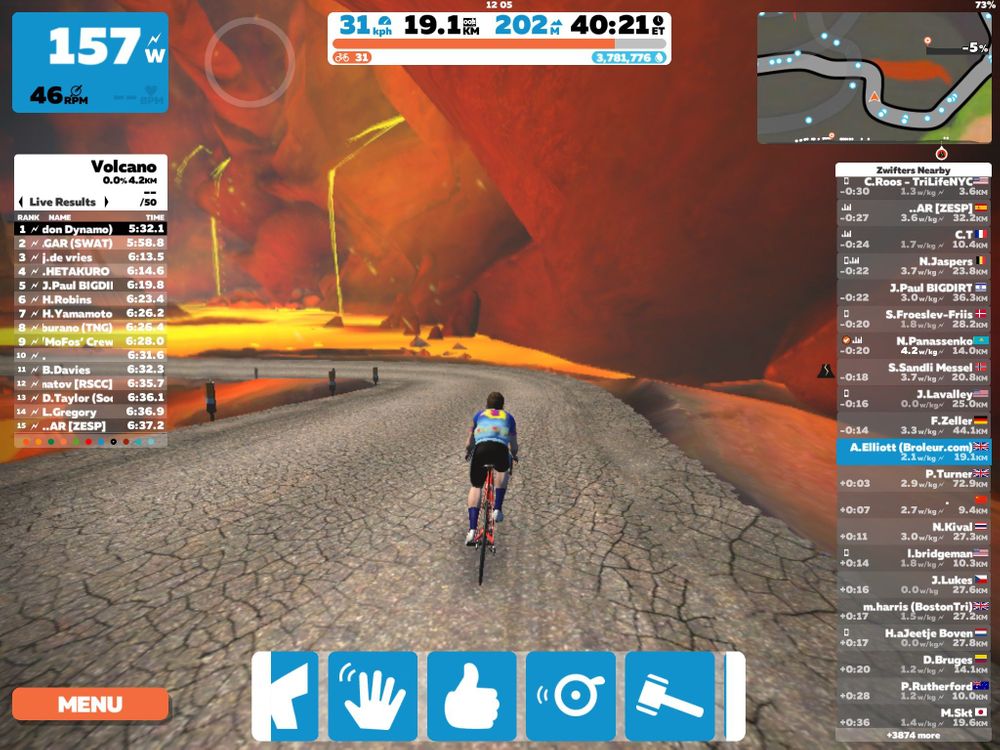
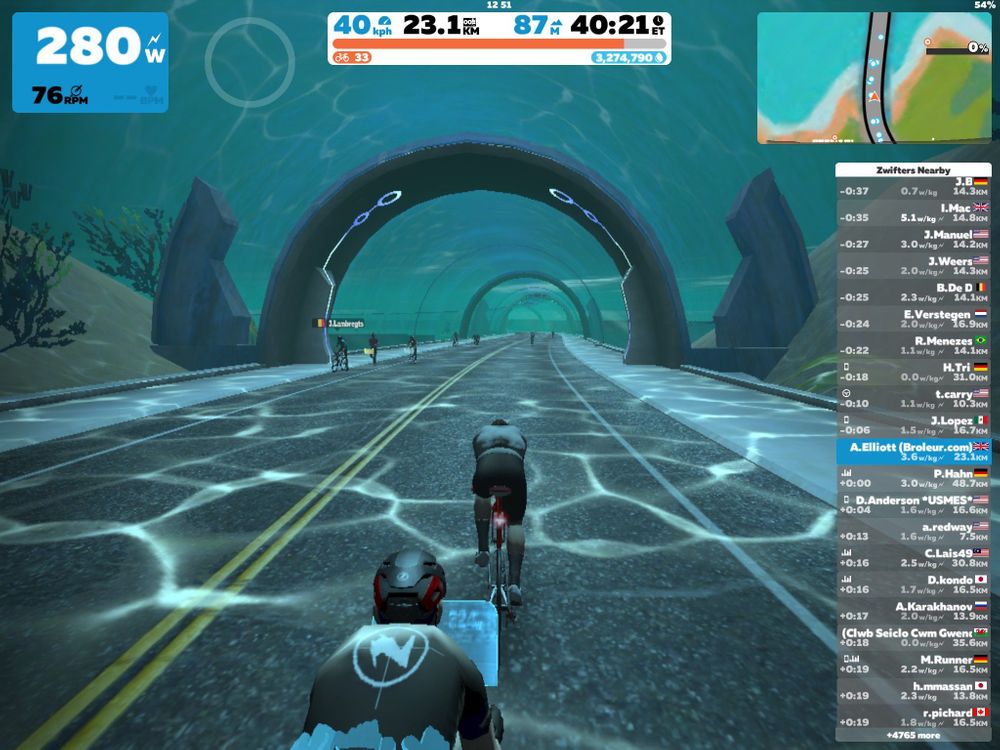
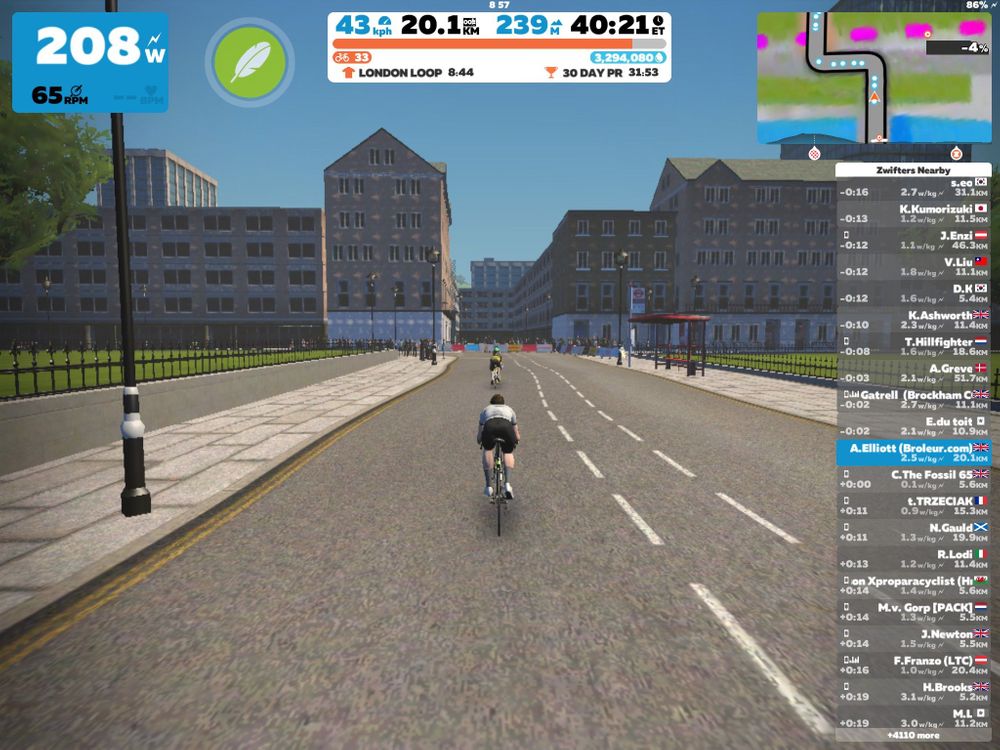
We kept hammering out of the desert, through the ocean tunnel, up to the Italian Villas and over to the Volcano. As we descended to the start/finish in Downtown Watopia, Justin announced, “We’re being hunted from the rear.” What? A team had caught us? This hadn’t happened to us yet in the ZRL series – we had caught a lot of teams, but nobody had passed us!

Justin came over the comms: “Hold tight formation, let them past.”

So far so good. The chasing team was approaching, and we were easing up. This is all going along with WTRL’s rules, pasted below for clarity:

Overtaking Other Teams or Being Overtaken

Drafting from riders other than your own TTT team is strictly prohibited. When a team passes another team BOTH teams are expected to change thier riding styles.

  • The Team being passed is expected to ease off on their power/speed once they know they are being overtaken. Do not fight them as they have made up a significant time difference to catch you up.
  • The Team making the pass is expected to significantly increase their power as soon as they are near or in the draft of the team they are overtaking and maintain this power to create a significant lead. Remember teams are watching whats in front and not necessarily behind them. A friendly onscreen message of ‘team approaching’ can help.

By creating a significant wkg difference between teams, riders can avoid a sticky draft when passing – a dynamic game feature of Zwift.

You may encounter dropped and rogue riders from time to time and they should not “join” your team or interfere in your TTT formation in any way. Please ensure you provide at least 3 warnings via onscreen/direct messages to any interfering team/rider and if they do not back off, please contact WTRL Race Control after the race to report them. Many teams are streaming or recording their rides and we are watching too.

My team all eased up on the power, but we were moving pretty fast (52kph) on the descent to the line, and the other team wasn’t coming around! 15 seconds after we eased up (it feels like an eternity) Alex came on: “Just keep going, guys. Let’s keep doing our thing.”

Now we had a decision to make. Do we hammer down, possibly violating the rules? Or do we stay eased, hoping the other team comes around? Clearly we weren’t winning first place since we were being caught by a team that started 30 seconds behind us… but we didn’t know if we were in 2nd or 22nd at this point.

Happily, their first rider came through our group, which made the decision for us. They obviously intended to ride through, so we would let them do so. Justin took the lead position in our team, wanting to make sure we let them all get through. “Just leave it with me until they go past.”

I had eased up on my power, but was dragged to the front of our group by the draft of the Team Vegan as they came through. They only had four riders left, but two of them flew off the front of their group, leaving the other two to chase while we sat languidly in their wake.

“They’re waiting, like they’ve dropped a guy,” Justin said. But there weren’t any Team Vegan riders chasing! And we had a decision to make. It had now been 1 minute since we eased up on the descent to let Team Vegan pass, and they were just 1 second ahead of our group, still trying to regroup, with us still eased on the power. How much more time were we willing to lose in order to let them overtake us cleanly?

Our patience was quickly evaporating. “Fellas? Vegan…. going?” Justin messaged. No response.

We started hammering again as we hit the incline before the left to Ocean Boulevard. Now the goal was to overtake Team Vegan and regain the time we’d already lost. Teammate Snowy busted through, with me on his wheel, and the rest of us hammering to get through. But Team Vegan wasn’t having it – they kept hammering too. And as we began the slight climb up to Fuego Flats, both teams were jumbled together, and confusion reined.

Thankfully, Team Vegan finally moved to the front, and we eased to let them get away. (I think we all figured they were lightweight riders and could get away on the climb!)

The Finish

As the ground leveled off, we were only 3 seconds behind Team Vegan. Clearly our 6 heavier riders had more pure watts than Team Vegan’s 4 lighter riders. Would we overtake them before the finish?

Our team captain Snowy messaged, “Coming past. Please do us same favor we did you.” But they didn’t write back, and didn’t seem too ease a bit. I was on the front pushing hard, with Monica yelling in my ear.

“Come on, come on! Dig deep! Keep it up!”

We hit the sprint start line for the final 400m and I shifted and stood, hammering with all I had to overtake Team Vegan just 1s ahead. I was leading out my teammates who were on my wheel – suffering and maxed out, but loving every minute of it!

We crossed the finish line with our 4th rider ahead of Team Vegan’s, which felt good even though we knew they’d beat us by ~30s. A messy final 7 minutes, but well-fought max effort from everyone. Once all the teams had finished we learned we had finished a disappointing 10th place (out of 21), 1:14 behind first place. 3 seconds faster and we would have been in 8th place.

See my activity on Zwift >
See my ride on Strava >

Watch My Race Recording:

The Aftermath

Soon after saving my race on Zwift and Strava, I got messages from Team Vegan riders apologizing for the messy pass. I got an email from one of their team members (Sean Leary) as well – so three different messages from three different riders!

All of the messages were similar in tone – apologizing that things got a bit messy. And I say kudos to Team Vegan for reaching out and acknowledging that they could have done things better. That’s good sportsmanship.

I had a nice email chat with Sean, who sent over his more detailed thoughts on what happened (at my request). I wanted to give Team Vegan a chance to share what happened from their perspective, so this wasn’t a one-sided post and we could all learn from it. (Note: Sean wanted to make sure I mention that what he wrote is just his view, and not an official team statement. “I don’t speak for others, and I certainly don’t speak for all vegans!” Ha!) Here’s what Sean wrote:

I watched your video of the race – an impressive push at the end! 190 BPM is no joke.

So I reviewed your video and our stream as well, and I think that gives me a reasonable view of the exchange, although I’ll concede I’m biased toward my own point of view, of course.

We definitely made some mistakes and can learn from this.

Here’s my take based on what I saw from the videos, and being in the thick of it:

We rushed it
We didn’t gather ourselves properly before attempting the pass, and we didn’t give your team a proper heads up. In fact, we were in the process of completing a lead change just before we made contact with your team. We should have sorted ourselves better first, coordinated the pass with you, and then pushed cleanly by. So that’s something we can do better.

We passed at the wrong time
We’re a light team, and we came past you at the bottom of a hill at full speed. Not smart. That definitely played in the perception of how fast each team was ‘pushing’ in relation to eachother. You were gliding easily into us with a huge momentum advantage that we simply did not have at the bottom of the hill.

We got jumbled up
The result of us executing the pass in haste caused us to open a gap between our four riders (two and two) just after we got clear of you. So we struggled to pull ourselves back together. We did our best to get together and push hard as quickly as possible, but I can see from your video it seemed slow and I understand the frustration. I would have felt the same way.

(Note: At the 32:15 mark someone suggests we were waiting for a dropped rider. Just so you know, that’s not the case. We were doing everything we could to just pull the four of us together and get clear from your team as quickly as possible. I didn’t even know we lost someone until down the road.)

In fairness, I nitpicked a couple of things from your video that may have contributed to the situation, and perhaps some interesting dynamics and perception points:

You slowed for us early, but powered up as we came through
Your team slowed well before we got to you on the downhill, a full 20 seconds (31:12-31:32 on your video). The intention was perfect of course, it just took us a bit longer to actually get there (we’re much lighter and only four versus your heavier six). But just before we reached you came the voice command “keep going guys, just keep doing our thing” and you all picked up the wattage. So unfortunately when we did overtake you seconds later, it was harder to push through. It’s still on us for the poor timing and lack of communication – but perhaps a questionable decision to return to business (wattage) as usual with us right on you and in the process of overtaking, especially downhill.

Looks like you jumped up and stayed there after we passed
If you look at the 31:53 mark, we’re just barely clear of you. Granted we’re not super fast here (also momentum differences still playing a role), but a rider jumps up doing 5.5w/kg and pulls you and your team right to the back of us as we’re trying to get away. So in my view that’s now a reset point – your team has clearly pushed watts (even accidentally) and slid right up into us, so it’s now on you to ease back and allow us to fully get clear again, and fade back out of our draft. I’m not sure we ever really get that opportunity.

Instead what follows are a series of comments about us “taking our time”, etc. But in fact at that moment our leader is pushing 5.6w/kg and our team is all doing 4-5w/kg. More importantly though, your team is doing 45-46kph! If you scan back through your video, your team rarely does more than 44kph even in perfect formation on flats. So at the moment you’re all expressing frustration at how we’re holding you up, you’re actually going faster than you were at any other point in the race (on flats). I feel like that’s simply you drafting us at that point. Going faster, not slower.

I think it just felt slower because you had effectively created a 10-man draft with us (in a pretty nice single-file line I might add) and were pushing much lower wattage back in positions 5-10. Felt slower, but was faster.

So I do feel like the data tells a bit of a different story than the perception you may have had, and reveals that game dynamics played a much bigger part of this than perhaps we both had thought real-time.

I still hold that the biggest issue was that we weren’t very smart about our pass. But upon review, especially of the actual speeds, what followed might be less a case of us being in your way, and more about you in our draft.

I hope that’s a fair take, if not totally over-analyzed. Let me know if you see it differently!

Did the messy pass cost our team valuable seconds? That’s the big question, I suppose. It may not seem like much, but our entanglement with Team Vegan lasted for approximately 2km, and a speed difference of just 2kph (going from 46 to 44kph) for 2 kilometers equates to about 7 seconds of time lost.

But I don’t think we actually lost time beyond what we would normally lose when easing for an overtake. (Note: some of my teammates may disagree). It sure felt like we were losing time, because we had eased our effort while waiting for Team Vegan to get away. But our actual speed (as Sean mentioned) is still 45-46kph on the flat ground. It’s also true that we benefited from a bit of Team Vegan draft, and probably in the end it was all a wash. No hard feelings, as far as I’m concerned. Life’s too short for that!

I think the interesting takeaways for me from this race are:

  • When we don’t ride in a strict formation, we don’t perform well. This was our messiest TTT to date, and it shows in our overall time/ranking.
  • Each rider’s view of an overtaking/pass is very different. There are a lot of variables at play that make overtaking a challenging proposition in some situations! Today’s situation was one of those, with a lighter 4-man team overtaking a 6-man team on a descent near the end of the race.

Your Thoughts

Ever been a part of a messy overtake? What do you think of the overtake from today’s race? Share your thoughts below!
Zwift Academy Road 2020 Finalists Announced

23

Zwift has just released the list of 10 finalists for the Zwift Academy Road programs – 5 women and 5 men. These riders will now be competing for a spot with a pro road team for the 2021 season!

Drumroll Please…

The 5 finalists competing for a spot with CANYON//SRAM are:

The 5 finalists competing for the contract with Alpecin-Fenix are:

Announcement Videos

What Next?

The 2020 Zwift Academy Road finals will run from December 13-19th. Unlike previous years where the Zwift Academy Road finals were held at team training camps, the 2020 finals will be held entirely remotely with each finalist in his or her home location. The Zwift Academy coaches at Dig Deep Coaching as well as the team coaches will be analyzing all performances of the finalists.

Though COVID has reshaped the structure of this year’s finals, the virtual format presents a new opportunity to bring viewers closer to the action than ever before and take a peek behind the scenes! Each finalist will be shadowed by a videographer as they show us their home roads, undertake their final tests, perform workouts, and of course race both onboard their Tacx Neo 2T Smart Trainers on Zwift, and outdoors.

Not only will the finalists be judged on their data, but they will go ‘speed dating’ with their prospective new teams. It’s important for a professional rider to gel with their teammates. The contenders will face daily challenges, with special guests dropping in via video link to encourage the finalists and share last-minute motivation. The finals will culminate in a live final show hosted by ex-pro Matt Stephens and streamed on Saturday, December 19.

A Banner Year for Zwift Academy

According to Zwift’s press release, a record-breaking 125,000 riders took part in Zwift Academy Road this year. Wow!

Best of luck to the 10 finalists!

The View From the Back – ZWC Hill Climb Battle Part 2 – Climb to Redemption

9

After the mishap of the previous week’s Zwift Hill Climb Battle and being impacted by the dreaded “power dropout” I was back again, with a point to prove to myself.  It was “Redemption Monday”.  That is the beauty of Zwift: you don’t ever have to wait long to banish the memories of a bad race. Just another reason why I am such a fan of this platform!

The route today was an assault up the Epic KOM, in reverse, with the customary finish at the Radio tower.  This route was shorter in distance, only 12.1km, but steeper.

A Frantic Start

As usual, there was the frantic start from the pens and the jockeying for position and never settled as the bunch meandered its way to the base of the climb via the Ocean underpass.  The already faster than usual pace quickened over the bridge and the race was already on as we hit the fork in the road where you can go right into the jungle or left up the KOM.  As we turned left, the pack had splintered as the road began to rise.  A relentless start after only a few kilometers of racing!

With no connection issues to hamper me, I was able to quickly settle down and began to find my rhythm, surprising, tapping out a pace equating to 5.2 watts per kilo.  This was somewhat of a shock and didn’t think it would last long, but I stayed with it. 

The beauty of climbing the reverse side of the Epic KOM are the switchbacks. They keep the ride manageable and enable you to focus on each part of the climb.  Several days earlier, I had taken part in the Zwift Academy Race up to Chalet Reynard, on the Mount Ven-Top.  I had only raced the route twice before because the long uphill sections just seem never-ending and are no fun.  In contrast, the switchbacks on the Epic KOM keep the racing entertaining and it was here that I was able to overtake two riders who had danced away from me on the early part of the climb.

Gaining Ground In the Zone

Now mid-way up the climb, I was still pushing a shocking 5.2 watts per kilo and after overtaking several riders who had clearly gone out too hard I was now sat in a steady 7th position on the road with a solid gap of 10 seconds to the rider ahead of me.  Despite clearly being in the red zone in terms of heart rate, I hoped that if I was able to keep this tempo, then perhaps I could gain a place up the steeper Radio tower. 

Whatever the outcome would be, at that precise moment I was climbing above my ability and started thinking perhaps I would get a new personal best for my 20-minute power output, or reach the magic 5 watts per kilo number? As I climbed, it almost felt like I was in a trance, like the type of daze you can enter when time trialing, when you are right on your limit, and where you are pushing hard enough to be in real discomfort, but not too hard that it is not sustainable – almost the worst kind of suffering.  I pushed on. 

After the final hairpin, a French rider pulled alongside me and as the road leveled and I took the opportunity to sit behind them, to get whatever draft I could and any respite before the final assault up the Radio tower.  In my daze I had lost track of the race behind me. “Where did they come from?”

Radio Tower Exhaustion

The rest from the draft was short-lived as the climb to the Radio tower began.  The 1.2km to the summit has to be one of, if not the toughest and steepest roads in Watopia.  To put it simply, it’s a grind.  Thinking of the long game, I slipped down a gear and began to spin my way up the climb, trying to keep a cadence of over 80 rpm.  That’s the thing with cycling, the “road always reveals” and my attempts at spinning probably only took me three-quarters the way up the climb before my cadence dropped off and I was grinding at 65 rpm. 

I had failed to make any gains to the rider who was 10s ahead of me at the start of the climb, however with 200 meters to go, I was sitting in a solid 7th now 10 seconds ahead of the French rider who I had started the Radio tower assault with.  It was now a case of just “finish the job” so I was out of the saddle trying to keep momentum as my legs faded and I could only push the pedals at 65 rpm.  That last exhausting, lung busting push felt like it would never end!                     

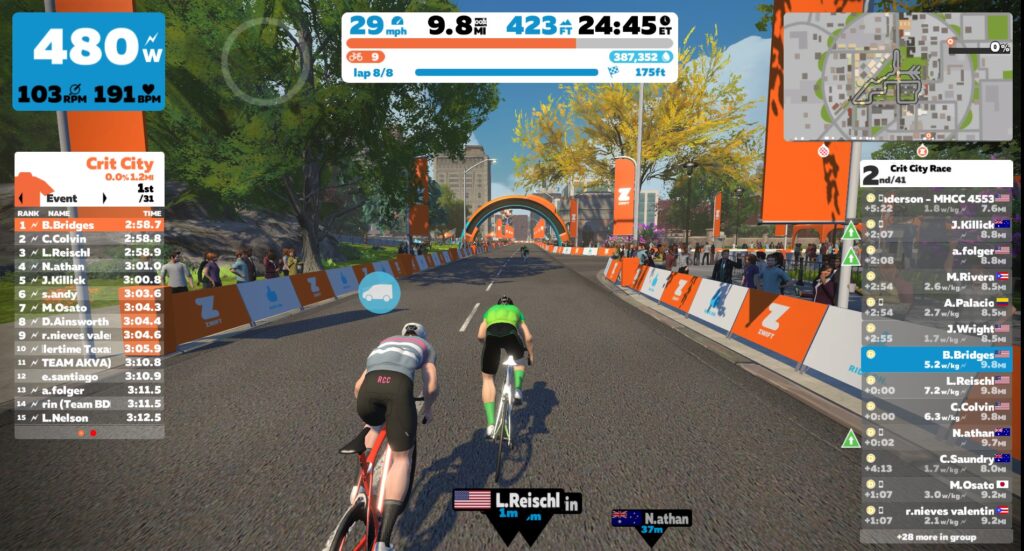
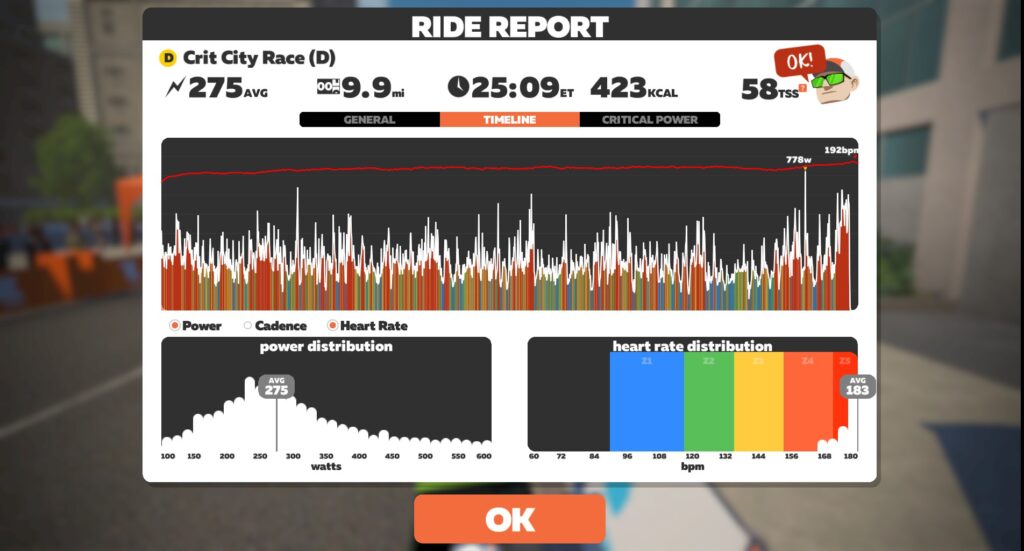
I crested the top in a time 28.01, 7th on the road but 5th overall on Zwift Power, with a new 20 minute PB of 5.02 watts per kilo (4.8 watts per kilo overall for the race)!

Wrapping It Up

An epic climb up the Epic KOM!  It transpired that I finished 1 minute behind Bartek Pawelczak, a Polish Olympic rower who won a silver medal in lightweight coxless four at the 2008 Summer Olympics – he took 3rd place.  This highlighted one of the great things about Zwift – I was pitting myself against a former Olympian and coming only 1 minute down is respectable. The winner was Marshall Wu, a former Road Cycling Tour of Shanghai champion from 2013-2016, in a time of 25.42. 

Granted I didn’t win, but against a strong field, I was happy with my 20-minute PB and how I had ridden, sustaining a solid effort.  I put the success of the race down to pacing.  Key for me was finding a rhythm early on in the climb, one that was hard, yet sustainable.  Redemption achieved, on to the next race!

Your Comments

Have you ever been “in the zone” on Zwift? When was the last time you had a “breakthrough” ride? Share your story below!
Special Episode Three: Lisa Brennauer (Zwift PowerUp Cycling Podcast)

0

About the World Champs Specials

Heading into the first-ever UCI Cycling Esports World Championships, the Zwift Powerup Cycling Podcast has produced a series of episodes with interviews from past and present world champions.

About this Episode

One time trial champion speaks to another! Lisa Brennauer chats with Kristin Armstrong about how she found her passion for cycling when she was just fourteen years old and how her first race went. Spoiler: it didn’t go well.

She calmly dissects her entire career—from the long drives with her family to the National Championships to the teamwork that got her to multiple World Championship wins. She also explains exactly what it feels like to claim those coveted rainbow bands, which she lovingly calls ‘chasing rainbows.’

About the Podcast

The Zwift PowerUp Cycling Podcast features training tips from host Matt Rowe (Rowe & King), with regular guest hosts Greg Henderson, Dani Rowe, and Kristin Armstrong.

Sticky Watts: Why They Exist, and How They Affect the Zwift Experience

I’ve been testing a set of Favero Assioma pedals as well as Garmin Vector 3 pedals for several months, and while I’m impressed with their performance both on Zwift on IRL, there’s one Zwifty niggle that bugs me. I call it “sticky watts”, and it’s what this post is all about.

Ready to head down the rabbit hole with me? Let’s go!

Sticky Watts: an Introduction

Zwift processes the data for certain power meters in such a way that the wattage reading in-game gets “stuck” on a particular wattage for 3+ seconds whenever a rider stops pedaling quickly.

To illustrate, here are two quick test rides I did yesterday.

The first shows how power data should look. It compares Vector data from my Wahoo ELEMNT computer with Tacx NEO1 trainer data from Zwift’s .fit file:

Chart 1: Vector (via ELEMNT) vs NEO (via Zwift):

Click to view live chart on ZwiftPower

The second shows sticky watts. It compares Vector data from my Wahoo ELEMNT computer with data from the same Vector pedals from Zwift’s .fit file:

Chart 2: Vector (via ELEMNT) vs Vector (via Zwift):

Click to view live chart on ZwiftPower

Notice how, in chart 1, the power reading is changing every second, for both lines. This is how power data should look – when we’re pedaling, our power output is constantly changing. (True, there are two times I see where the NEO had the same reading for two seconds in a row, but those occurrences aren’t consistent, or very long.)

Now look at chart 2. Note how, whenever I stop pedaling, the blue line (remember this is the Vector power data from Zwift) “hangs” for three seconds (and sometimes as much as 6 seconds!)

Pointing Fingers

I’ve replicated the sticky watts issue using Assioma pedals as well as Vector 2 and Vector 3s. You may ask: are sticky watts created by the power meter pedals themselves? Or is it due to Zwift’s recording of their power?

Chart 2 above shows that it’s not the pedals. That chart shows data recorded from the same set of pedals, on the same ride, but recorded on two different sources. The purple line is my bike computer, and the light blue line is Zwift. You can see my bike computer recorded the data properly, while Zwift’s data (and only Zwift’s data) displays the sticky watts issue.

The astute observer may say, “But sticky watts didn’t happen in chart 1!” And you would be correct. Sticky watts on Zwift only happen with certain power meters. It doesn’t happen with the smart trainers I’ve tested. Let’s look at why this is…

Event-Based vs Time-Based Power Meters

Power meters come in all shapes and sizes, but if you look at the way they calculate and transmit data, there are two types: event-based and time-based. Here are the definitions straight from the excellent “Power Meter 101” article on Slowtwitch:

  • Event-based. This type calculates and transmits power information based on ‘events’. For example, with a crank-based power meter, each cadence revolution is an event. That finite piece of time is the starting and ending point for our time in the power equation. Data will not transmit to the head unit if events aren’t happening (i.e. if you stop pedaling).
  • Time-based. This type is identical to the above, but with a caveat. Events happen and power is calculated the same – but this information is stored first, and then transmitted at a specific time interval. The CycleOps Powertap hub uses this. Why? Generally speaking, your wheels spin faster than your cranks – and when you stop pedaling, your bike keeps moving. Events happen much faster and for more of your ride, so they essentially bottle them up and shoot data to the head unit at regular intervals of one second.

As I understand it, pedal and crank power meters are generally event-based. Smart trainers are generally time-based. And that, my friends, is why Zwift appears to process their data in two different ways.

Full transparency: I’m no power meter/electronics expert. And I’m certainly not privy to the details of how Zwift’s code processes power data. But my guess is, this is what happens when I stop pedaling:

  • My pedals stop sending data. If they’re paired as the power source in Zwift, that means no power data is coming in. Zwift doesn’t know if this is a data dropout, or me just not pedaling! So it does what Zwift is programmed to do in the event of a data dropout – it holds onto the last power reading it received, for a few seconds. Then it drops to 0, because it is still paired with the pedals, even though it isn’t receiving power data from them.
  • My smart trainer keeps transmitting a power reading at regular time intervals, even when I’m not pedaling. So if I’m reading power from my smart trainer, Zwift gets a zero watt reading when I stop pedaling.

Can Zwift Fix It?

Comparing bike computer data to Zwift data might lead a person to think that sticky watts is a Zwift bug – but I don’t think that’s the case. Rather, it’s simply how Zwift has to work given the realities of data dropouts and event-based power meters. Let me explain my theory (and again, I’ll remind you that I’m not an expert here).

My ELEMNT head unit is receiving the same data as Zwift. So when I stop pedaling, it stops receiving data from my pedals (because they aren’t sending anything). So why doesn’t my bike computer show/record sticky watts? Well, the truth is, it does. Sort of. My Wahoo ELEMNT does, at least. if I stop pedaling, it will get stuck on a particular wattage for a few seconds. But it doesn’t record those sticky watts. That’s the crucial difference.

We have to remember that immediate power data on Zwift is much more integral to the experience when compared with power data on a head unit. If Zwift wants to keep its users from seeing a zero watt number (and slowing down!) whenever even a short data dropout occurs, it has to allow for sticky watts. And those sticky watts directly affect the motion of our avatars in game.

In contrast, my ELEMNT can display those sticky watts, but it doesn’t write them to my .fit file. My guess is, the ELEMNT’s data processing code detects a lack of signal and keeps displaying the last wattage read for a few seconds – just like Zwift. But the ELEMNT has the luxury (and Zwift does not) of being able to buffer its data and effectively go back in time and write a different value to its .fit file than it was displaying on the screen. And that’s why we see data like chart 2 above.

Implications for Riding/Racing

Now we get to what I think is the important part of this article: how do sticky watts affect our Zwift experience, if at all?

My guess is, most Zwifters using a “sticky” power source haven’t even noticed the extra watts. This could just be me projecting my own lack of awareness, though! While I’ve ridden probably 20,000 miles on Zwift with power pedals as my primary power source, it wasn’t until I started testing these pedals around April 2020 that I noticed the stickiness. But a look back at my early dual recordings on ZwiftPower (such as Sprintapalooza back in September 2019) shows the issue existed back then.

The good news is, sticky watts don’t matter, most of the time. As long as you’re pedaling, sticky watts aren’t an issue – and we all know that it’s rare to stop pedaling in a Zwift race.

There are a few situations, though, where it can have a significant effect on your race.

Situation #1: Going Into the Supertuck

The supertuck is one of my favorite moves in a Zwift race, since it allows me to hang with the pack on a descent while resting. But timing is crucial when supertucking – you want your watts to hit zero only when the road gradient is -3% or more, and only when your rider is going fast enough to drop into the tuck.

Sticky watts can wreak havoc on a well-timed supertuck, or they can actually make your supertuck an even more effective move. They wreak havoc when you stop pedaling, but Zwift sticks your watts at some low number (say, 100W), which means your dropping into the supertuck is delayed and your power is low while you wait. This can cause you to drop from the group you’re trying to hang with.

But if you hit the wattage hard then stop pedaling immediately, your watts will typically get stuck at a really high number – perhaps 500-600 watts! This speeds you up, then drops you into the supertuck as soon as the stickiness ends.

Is it cheating to use sticky watts to your advantage when entering a supertuck? I’d say so, if you’re doing it on purpose. But here’s the sucky part – event-based power meter users are stuck between a rock and a hard place here. Because the only way to avoid sticky watts getting stuck at a low number and possibly messing up your supertuck is to 1) go hard then stop immediately (cheating) or 2) slow decrease your watts, so your pedals send power readings all the way down to zero. Neither of those approaches is a good one.

Situation #2: TTT Sink and Sprint

The “sink and sprint” move is used by TTT riders to move from the front of the pack to the back of the pack (learn more about it on TTT Secrets from Matt Gardiner). Sticky watts making timing your sink a real challenge, since your watts get stuck at a particular wattage for a few seconds before going to zero. That means you have to stop pedaling before you really need to.

Situation #3: Mini Microintervals

I know for a fact that racers have attempted to exploit the sticky watts bug in events by doing super short intervals – that is, pedaling hard to spike power, then stopping the pedals so the power gets stuck at that high wattage for a few seconds. Then do it again, and again!

Here’s a power file of a short microinterval test ride I did using my Assioma pedals (the purple line is the power data from Zwift (notice the sticky watts) and the blue line is the power data from the same pedals from my bike computer):

Click to view live chart on ZwiftPower

Look at the difference in average wattage between the two readings: Zwift’s power is 20% higher!

Would this approach work over an entire race? Not for me – I couldn’t continue doing microintervals for 40+ minutes. But perhaps some riders could. More likely, a cheater could use this technique for a short (1-2 minute) attack at a key point in the race, or in the final sprint.

As I understand it, ZwiftPower has some detection built in for this sort of repeated sticky watts behavior.

Situation #4: Shortened Sprint Finishes

If a rider’s setup consistently produces sticky watts at or near their peak power, they can use this to “coast” across the finish line at full power. Hit the sprint hard, put in a few final pedal strokes at maximum effort, then stop pedaling for the final 3 seconds over the line.

You may laugh – but riders do it already in Zwift races.

Conclusions

Armed with the knowledge of sticky watts, event-based power meter users find ourselves in a bit of a predicament. Do I keep using my pedals as my primary power source (because I want consistent readings between indoors and outdoors) even though it can affect my race data? Or do I switch to my smart trainer – which may be less accurate and will generally not match my outdoor power meter?

The best answer will vary from rider to rider due multiple factors. But I think it’s safe to say this is a concern that will continue to simmer in the Zwift racing community for the foreseeable future.

Your Thoughts

Have you noticed sticky watts with your Zwift setup? Do they affect the Zwift experience in ways that I missed? Share your thoughts below!
RideOn for World Bicycle Relief 2020 This Weekend

3

Get ready to Ride On for World Bicycle Relief this Friday and Saturday!
The annual charity event is back for 2020, supporting World Bicycle Relief as they provide bicycles to students, healthcare workers, and entrepreneurs. Zwifters have a long history of supporting WBR, beginning with the first-ever 24-hour Zwiftathon in December 2015. This was followed with events in 2016, 2017, 2018, and 2019, making this the 6th annual Ride On for WBR event.

This year, Zwift will be hosting several group rides over 24 hours featuring professional cyclists and community leaders. If you donate to the campaign, you can get an invitation to post-ride “meet and greet” sessions with the pros!

Click here to learn more about Ride On for WBR 2020 and find out how to give or help raise funds.

About the Events

“RideOn for WBR” social rides will be held on December 4 and 5. Depending on the event, you’ll get to ride with pros from Roxsalt Attaquer, Canyon-SRAM, Trek Segafredo, and Movistar Team, as well as Zwift community leaders. All events will use the Watopia’s Waistband route, and are 60 minutes long with a pace of 1.9-2.5 w/kg unless otherwise noted.

The events begin at 1PM PST on Friday, December 4, and the last one kicks off at 9AM PST on Saturday, December 5:

Check the event list for times and sign up at zwift.com/events/series/rideon-for-wbr-15-year-celebration

Kit Unlock

Complete any event to unlock the World Bicycle Relief jersey and wear your support on your sleeve. If you want the real-life kit, you can order it from CUORE until Dec. 31! Proceeds benefit World Bicycle Relief.

Donating and Fundraising

You can donate, set up a fundraising page, or browse other Zwifters’ fundraisers at this link on World Bicycle Relief’s website.

The goal is to raise $25,000 (USD). Once again, presenting partner Trek is matching all donations 1:1! Traditionally, many Zwifters pledge to ride a certain distance or time. You don’t have to ride to give or raise funds, though.

In the past, there have been prizes for the top fundraisers, but WBR hasn’t listed any for this year.

Pro Athlete Meet and Greets

Donors to the 2020 Ride On for WBR campaign will be invited to post-ride “meet and greet” sessions with athletes from participating pro teams. These virtual events start 5 minutes after each of the four pro team rides and last 30 minutes. If you want to join one, make sure you donate before it ends!

Each of the teams has their own fundraiser, asking people to donate through their page to be invited to their specific “meet and greet.” We did find that a donation made through another Zwifter’s page also gave us an invitation to the events. If you want to be on the safe side, or just to show support for a specific team, here are their pages:

About World Bicycle Relief

World Bicycle Relief focuses on the life-changing impact bikes can make, especially in developing regions of the world. Founded in response to the Indian Ocean tsunami in 2005, the organization has since distributed more than 500,000 bikes to those in need.

Fifteen years later, World Bicycle Relief continues to empower families, rural students, healthcare workers, and entrepreneurs with rugged, purpose-built bicycles to solve the challenge of traveling long distances safely and fulfill their dreams.

The View From the Back – ZWC Hill Climb Battle, Nov 17

8

With so many events on Zwift, it’s very rare that I find myself doing the same event more than once. But there are a few exceptions, and the ZWC Hill Climb Battle on Mondays is one of those. 

The reason why this has quickly become one of my favourite races is because it is different to a lot of what is on Zwift.  The route is a custom one and usually consists of a 15.6km ascent up the front of the Epic KOM or the shorter, but steeper reverse side, at 12.1km.  The race time can be anywhere between 28-35 minutes, with both routes finishing at the Radio tower. 

The beauty of this race is that the intensity is high from start to finish.  It is relentless, as you are consistently working up the climb, with little or no opportunity to rest in a group.

Being a short race in distance and time means it is a perfect workout for those who want an intense session and are time-constrained.  This race, coupled with a 10-minute warm-up and a 5-minute warm down means you can have a complete workout in 45-50 minutes, making it the perfect lunchtime ride. 

The Start

As has become my Monday routine, I lined up at the start for the ZWC Hill Climb battle, with today’s route being the ascent of the Epic KOM from the front.  Feeling relatively fresh, I was hoping for a top 10 finish.  As customary with all Zwift races, the start was frantic, despite my earlier messages in the start pen pleading for a calm start. As all the different category riders merged into one blob, the pace quickened.

The Dreaded Dropout

Not what you want to see in a race!

We meandered our way through Watopia to the base of the climb, but then I noticed my avatar’s legs had stopped moving and the bunch starting to swarm me.  A quick glance to my power data and I could see dashes where my power should have been displayed.  We have all experienced this: the dreaded connection dropout! We just hope that when we do experience it, it’s in a social ride and not the crux of a race.  Unfortunately, mine was at a crucial point, just before the very base of the climb, just before the dotted blue line on the road to indicate the start of the climb.  I watched as my avatar coasted to a stop. 

I jumped off the bike and hobbled over to the tablet that was connected to the TV.  I dived into the pairing screen where “No signal” was displayed. Panicking, I unplugged the trainer and plugged it back in and watched as the pairing screen reconnected the device.

Chasing

Back on the bike, I was now down in 60th position of 91 riders.  All composure gone, I pushed on the pedals with all my might to get my avatar rolling.  I crossed the blue line of the start of the climb at 650 watts. I soared up the first part of the climb, pushing 5.3 watts, zipping past the individual riders and small groups that had formed.

The early part of the climb was simply a blur, my nervous energy meant that I was pushing way too hard and knew I would pay for it later.  But I couldn’t slow down.

I was conscious that as I approached the castle, my watts per kilo had dropped from 5 to 3.5. This was the first sign that the adrenalin had now worn off and I needed to settle into a rhythm. I selected an easier gear and started finding that. 

I started to make my way up the climb, steadily passing several small groups, using them as a springboard to chase down the next rider or group.  It was during the underpass that I started to feel the first bit of fatigue and took my first brief rest as the road descended over the bridge.  The rest was short-lived as I hammered on the pedals and pulled up the little incline.  I caught more riders and pushed to the KOM banner.  I crested in 20 mins and 10 seconds, my second ever fastest time and now in 15th position.  However, with still the Radio tower climb to go, there was no time or energy to celebrate that minor victory!

To The Radio Tower

The Radio tower section is hard, but factor in what felt like a 20-minute sprint for me, and I was in trouble.  I tried to push up the climb, but it was too steep and I was too tired to chase the riders ahead of me and the one rider that I was level with now just edged away.  I could do nothing, and I realised a top 10  finish was out of the question. So I settled for 15th and kept a tempo to ensure I didn’t get passed. 

The last 400 meters were torture and the meters ticked by so slowly.  The finish line crawled into sight.  I collapsed over the handlebars in 33.41, in 15th position.  I was cooked.

Wrapping It Up

Not my most composed race, but the anxiety and desperate chase at the start of the climb led to a new 5-minute power personal best in ZwiftPower.  The lesson learned is in the event of a technical issue, pace yourself back into the race and don’t overdo it (like I did) as you will pay later.

As former Tour de France winner Geraint Thomas said, “Mountains are where the biggest races are won and lost.”  Today, I wasn’t sure if I had won or lost, but one thing I did know and that is I would be back next week and as G states, “Enjoy, and suffer, and enjoy a bit more. My mountains are your mountains.  Let’s climb.”               

Editor’s note: watch for part two of Tim’s Hill Climb Battle to be published soon!

Special Episode Two: Anna Van Der Breggen (Zwift PowerUp Cycling Podcast)

0

About the World Champs Specials

Heading into the first-ever UCI Cycling Esports World Championships, the Zwift Powerup Cycling Podcast has produced a series of episodes with interviews from past and present world champions.

About this Episode

Greg Henderson catches up with three-time World Champion Anna Van Der Breggen, and the pair take a deep dive into the world of training in the Netherlands, which World Championship win she holds dearest, and how she’s preparing for the UCI Cycling Esports World Championships.

Plus, Anna and Greg discuss how to slow down the infamously fast Zwift race start!

About the Podcast

The Zwift PowerUp Cycling Podcast features training tips from host Matt Rowe (Rowe & King), with regular guest hosts Greg Henderson, Dani Rowe, and Kristin Armstrong.

2020 Rapha Festive 500 Strava Challenge and Zwift Workouts

13

Ready to end the year with a festive feat?

For the first time ever, your Zwift rides will count toward the Rapha Festive 500 Strava challenge!

Every year since 2010, Rapha has challenged cyclists to ride 500 kilometers between Christmas Eve and New Year’s Eve. The Festive 500 started in the south of England, and over the next 10 years it grew to become a global challenge. According to Strava, cyclists around the world have ridden a total of 130 million kilometers since the challenge began. In the past decade, 500,000 people have participated and 126,000 have completed it.

Find out more about the Festive 500 at rapha.cc/festive500.

The Challenge

Your task is to ride 500 kilometers (310.7 miles) in eight days, from December 24-31, 2020. Outdoor bike and handcycle rides count toward the total, and this year so do virtual rides, as long as you upload them to Strava.

The Prizes

If you complete this Strava Challenge, you can enter to win a brand new Canyon Grail CF SL 8 eTap gravel bike.

You also could win more top prizes in the Spirit of the Festive 500 Awards.

For a chance to win daily prizes from Rapha’s limited edition Festive 500 collection, follow Rapha on Instagram and share your ride using #Festive500.

How to Enter

Easy! First, sign up for the 2020 Rapha Festive 500 Strava Challenge. Then remember to claim your prize entry on the same page once you’ve finished!

2020 Rapha Festive 500 Workout Series

To help you get ready for the challenge, Rapha have created the Rapha Festive 500 Workout Series on Zwift. The series includes 60-minute structured workouts that you can do individually or as part of group events.

The focus of the workout series is on improving your endurance, by training in a smart way: plenty of varied efforts in and around Zone 3 (Tempo), suitable for any rider wanting to improve their general fitness and endurance.

The workouts were designed by Matt Rowe, founder of Rowe & King Coaching. With 25 years of cycling experience, Rowe coaches amateur cyclists all over the world to achieve their personal goals.

The group workout series finishes its first round this week with Workout 6. The second round starts the week of Monday, Dec. 7, but it will only get through Workout 3 before the challenge starts. Each session runs three times per week – once each in the evening for Asia-Pacific timezones, European and African timezones, and American timezones.

Miss some sessions? You can always do the workouts on your own. Find them by selecting “Training” at the login screen and scrolling to the “2020 Rapha Festive 500” workout folder.

Check the event schedule and sign up at https://www.zwift.com/events/tag/f500.

Group Workout Details

Workout 1: “2004”

Rapha was founded in 2004, hence the name of the first workout of the series.

You will complete 2 x 15 minute blocks, each containing a 10 minute ramped effort, followed by a short block of ‘Over-Unders’ where we tip above and under your threshold before a big 30 second push at the end. You will spend a lot of time during today’s session just below your threshold power, with a small amount above your FTP – an efficient way to help improve your endurance.

Workout 2: “Get It Done”

3 x 12 minute blocks of ‘Tempo – Endurance’ – this should feel nice and comfortable as you alternate between Zone 2 and Zone 3.

At the end of each 12 minute block, there is a 1 minute ‘free ride’ – depending on your current level of fitness, you can either drop the hammer and give it your max effort, or take some extra recovery. Today’s workout is one of the purest type of endurance workouts there is – no nonsense, keeping the chain tight and getting it done.

Workout 3: “Free Ride Sandwich”

3 x 10 minute blocks of effort. The first and third blocks are at 88% of FTP (top-end of Zone 3), with the middle block a Free Ride, so you can ride as hard or easy as you like (target being to complete another Zone 3 block).

This is another purist way to develop your endurance – no free wheeling and consistent muscle tension.

Workout 4: “Twelve Spikes”

3 x 12 minute blocks of Zone 3, with some surges thrown in for good measure! The Zone 3 riding should feel nice and comfortable, however the surges may sting a little. The surges in each block increase in intensity, but decrease in duration:

  • Block 1 – 100% of FTP for 30 seconds,
  • Block 2 – 110% of FTP for 20 seconds,
  • Block 3 – 115% of FTP for 15 seconds.

At the end of each 12 minute block, there is a 1 minute ‘Free Ride’ – depending on your current level of fitness, you can either drop the hammer and give it your max effort, or take some extra recovery. The significant volume of Tempo riding, coupled with the surges will help develop your endurance.

Workout 5: “Rolling Roads”

3 x 15 minute blocks of Tempo, made up of short ramps (lower through to upper Zone 3) to offer some variety to the effort. Remember, Fun is Fast!

At the end of each block, you will complete a 10 second sprint, just to keep in touch with your top end – you don’t want to become too one-dimensional.

Workout 6: “2015”

(Rapha Cycling Club (RCC) was founded in 2015, hence the name.) A 15 minute ‘Free Ride’ and 5 x short blocks of Threshold (Zone 4) before finishing with a ramped effort right up to Zone 6.

This is a really varied workout to keep your mind engaged and body working hard. The key block is the 15 minute free ride – will you push hard, or take it steady? Your answer should depend on how much you want the Festive 500? If you want it – go hard, to give yourself a big training stress in this final workout.

This Week’s Top 5 Zwift Videos: Zwift Academy Gains, GCN Races ZCL, App Map Guide

In the best of Zwift videos this week, GCN takes on the Zwift Racing League, the Vegan Cyclist does Zwift Academy, and pro cyclist Alex Dowsett rides a Zwift time trial. Also catch an educational race breakdown and a guide to the map on Zwift Companion.

How I stacked up in the Zwift Academy (EVERY Workout, 5 w/kg FTP)

The Vegan Cyclist looks back at his Zwift Academy workouts, rides, and races. See how he improves as he goes along, and hear expert advice and analysis by ZA Coach Stephen Gallagher of Dig Deep Coaching.

Can The Global Cycling Network “All Stars” Survive The Zwift Racing League?

The GCN crew jumps into Week 7 of the Zwift Racing League! Watch Simon Richardson, Hank (James Lowsley-Williams), Connor Dunne, Alex Paton, Loic Chetout, and Sebastian Haedo battle it out in the A category of the EMEA West league.

*Zwift Race Breakdown* Casual Mid Day Rip w/ Some Olympians and Pro Conti Riders!

Jonathan Crain breaks down one of his races to show us what went right, what went wrong, and lessons learned. Does he beat pro rider Max Stedman and Olympian Kristin Armstrong? Watch to find out!.

Zwift Companion App Map Guide

Ken Jobba is back with another map tutorial on his “Endurance Sweat” channel. This time, he walks us through how to use the map on the Zwift Companion App.

Why is Zwift time trialing so HARD

Earlier this year, pro TT specialist Alex Dowsett entered a mass-start time trial on Zwift. See how he did and how he thinks it compared to his first Zwift TT in Bologna.

Got a Great Zwift Video?

Share the link below and we may feature it in an upcoming post!