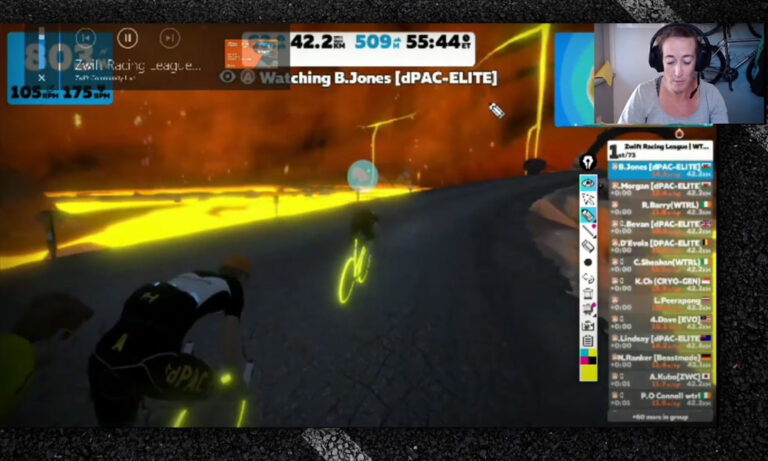
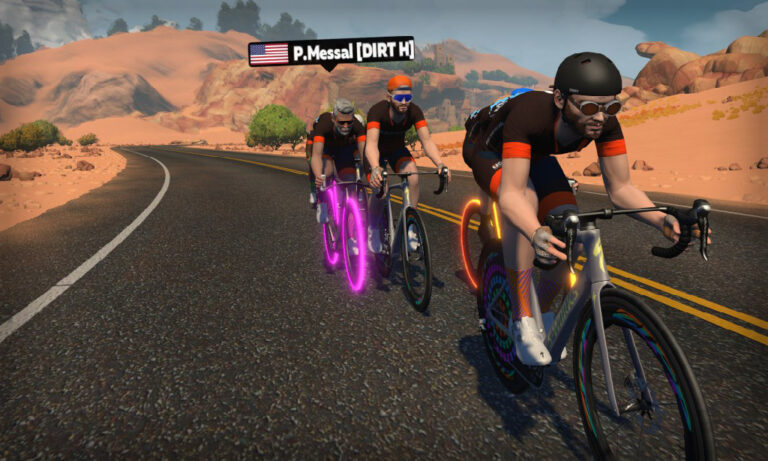
Three laps of Volcano, three times up the Volcano K/QOM, what a race this week in Zwift Racing League! Seriously one of the best courses (Whole Lotta Lava) I’ve seen with so many different dynamics playing out. Add into that a powerup often not seen in racing (pun intended): the ghost.
I was so excited to see how people used this powerup, what worked, what didn’t. What I didn’t expect to see was three separate races play out exactly the same: same powerups used, same tactics played out in the last 800m, same result. Amazing.
Check out the video:
So, what worked and what didn’t in that final 800m?
The Ghost sneaky long-range attack
I actually had my team try this tactic. Just when the road kicked up to 5% before heading into the Volcano (about 600m to go) the plan was to drop the ghost, disappear up the road and have other teammates jump on the chasers wheels. In each of the videos you can see this didn’t really work, and I think this is because the ghost powerup only lasts 10 seconds.
By the time you’ve moved through the pack you really only have about 7s to get a gap – not long enough. In each case the rider only managed to get 1s on the chase pack.
If the ghost remains at 10s (too short in my opinion) then when is the best time to use it? Perhaps in a more punchy climb like Innsbruck’s Leg Snapper or Richmond’s Libby Hill. Or even time it right to have two teammates drop a ghost at the same time and jump on the wheel of a teammate who puts in an attack off the front. Not many people would chase a solo attack, but imagine their surprise when it turns out to be a group of three teammates!
Aero or Feather
This is probably one of the trickiest sprint finishes in Zwift. Not only do you have to watch for the long-range attack on the rise into the volcano, but then you need to navigate around three twists in the road before it kicks up to 3% at the finish. The aero powerup is known to be the sprinting powerup but I am gaining more and more respect for the feather and its ability to give the user a serious kick at the start of their sprint.
In a race like this one, where that sprint is on an incline, the feather definitely won the day. In all three races covered in the video it became a head-to-head battle between someone using the feather and another using the aero. In all three cases the feather, if timed right, won the day.
What About You?
If your team has pulled off something amazing in a race, or you’ve seen something tactically great, shoot me a message and I’ll do some analysis on why and how it worked.
We’re getting close to the end of Zwift Racing League Season 2, with just 2 “regular” races left! This week we’re on Richmond’s Libby Hill After Party route – a sprinter’s delight, but the puncheurs may have the last laugh atop Libby Hill.
Playoff Notes
When Season 2 began, races 7 and 8 were marked as “Playoffs”. But this is no longer the case.
Instead, WTRL has just announced that additional playoff races will be held between the top 2 teams in each Division 1 on March 5th and 6th between 7-8pm UTC. (Lower divisions will simply have teams promoted and relegated based on ranking after race 8.)
A1 Divisions will be battling for a promotion to the Premiere League, while lower categories (B1, C1, D1) will be battling for the title of ZRL Season 1 World Champion. It sounds like some prizes may even be involved.
We’ll publish a separate post on these playoffs soon. Details will also be on WTRL’s website and Facebook page.
Looking At the Route: Richmond’s Libby Hill After Party
Here’s the course preview video from Rick at No Breakaways:
Route Breakdown
This route is basically 5 laps of the very flat Fan Flats circuit, followed by some flats and descents, with a finish atop the Libby Hill climb. It breaks down like this:
0-24.3km: flat, laps of Fan Flats, 5 sprint intermediate opportunities, 6 powerup banners
24.3-32.2: recovery as we’re done with the flat laps and make our way toward Libby Hill, including powerup banner and a long descent. The last 2km here could get dicey if riders decide to attack early.
32.2-32.9: Libby Hill climb
Out of 32.9km of racing, the first 32.2km are quite flat, or downhill. Sprinters, rejoice!
This route is obviously very aero-focused, with only 60-90s of all-out climbing at the very end. Don’t go with a climbing setup.
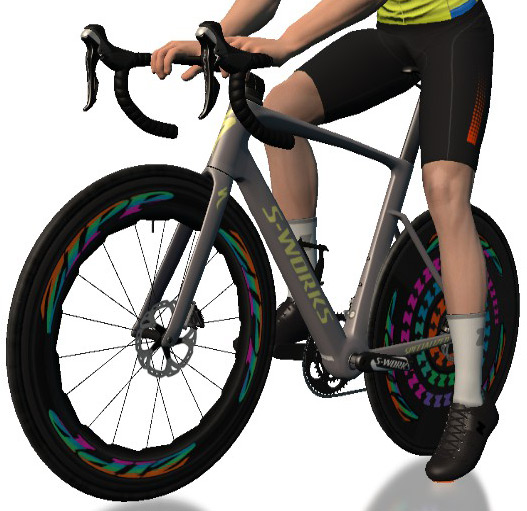
Our tests show that the Tron bike is just 1s faster up Libby than the S-Works Venge with disc wheels – but, the Venge is a bit faster on the flats. Either of these superfast rigs will do the job quite nicely.
Five times through the sprint banner means riders will have five chances for both first-across-line and fastest-through-segment points (10 riders deep). The Libby Hill banner is also awarding FAL and FTS points.
The first 32.3km of the 32.9km route are quite flat, or downhill. So this will be a fun route for the sprinters. But the Libby Hill finish makes things interesting, as it won’t be the pure sprinters who shine. Instead, the win will probably go to riders with very high 60-90 second watts per kilo… unless teams can execute more advanced breakaway strategies.
On that note: there are definitely some opportunities here for teammates to work together to get away for a long attack that earns first-across-line extra points. Will anyone be brave (and strong) enough to do it?
Expect early attacks on each sprint attempt, as well as heading into Libby Hill. Chances are the early attacks on the sprint will occur in later laps, as the overall pack speed drops a bit. The question will be whether to chase down/follow an attack, or let it go and hope the blob swallows them before the line.
Lastly, powerups: there will be seven opportunities for a powerup on this route, and powerups given will be an even mix of the Helmet and Van. Both powerups are quite useful in a sprint, but the Helmet is most desired for those chasing sprint points, while the van is a big help if you need recovery on flat roads sitting in the pack. Make sure you know how each powerup works, and use them wisely!
Your Thoughts
Care to share your thoughts about Tuesday’s big race? Comment below!
After almost a year of pandemic-related restrictions, many of us have come to terms and even found a lot of fun and community with indoor riding and racing.
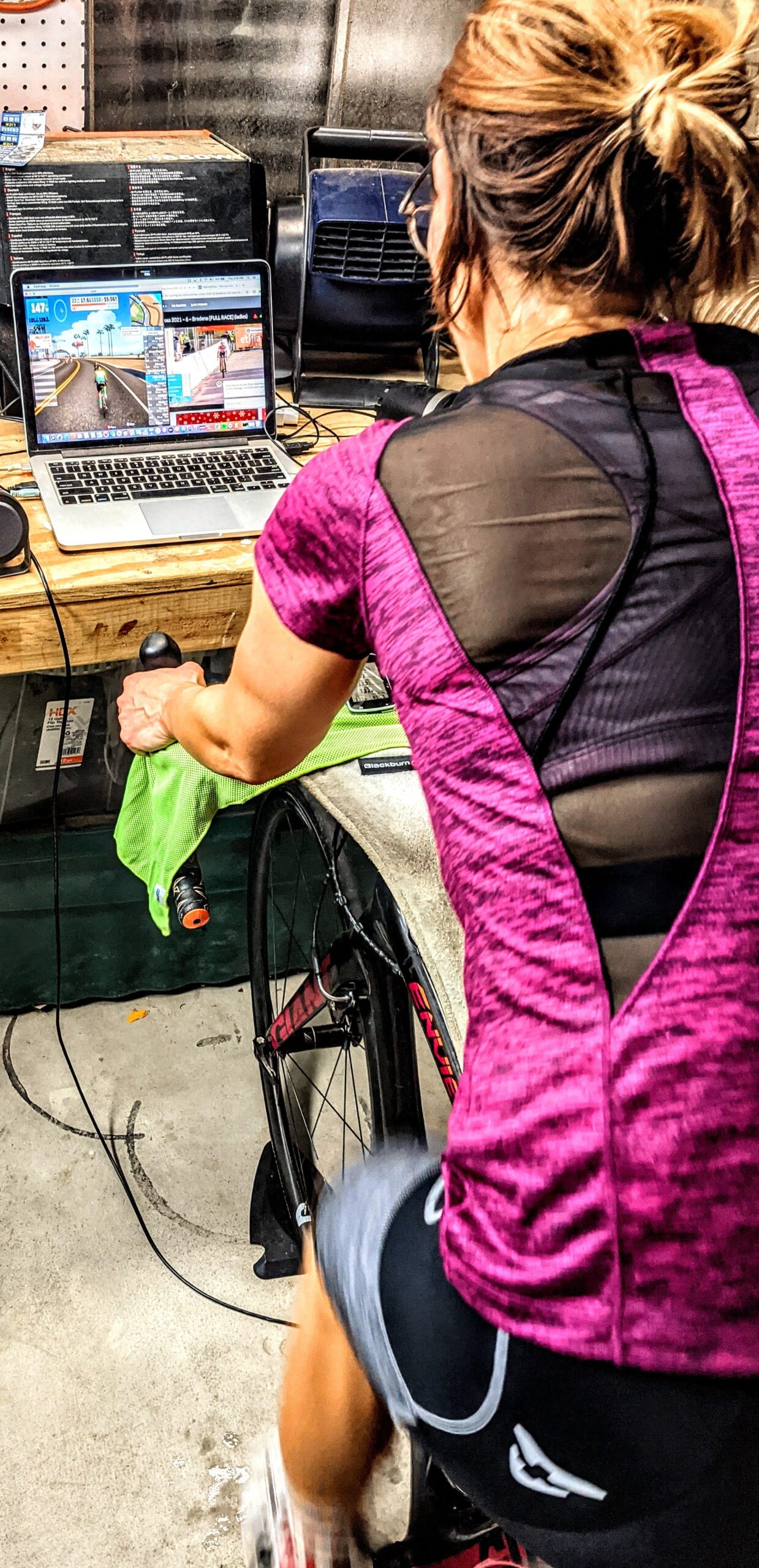
Now that your bike has been set up on the trainer and you’ve continuously leveled up on Zwift, you’ve likely already figured out that a few things are indispensable for indoor riding: one (or multiple) fans, copious amounts of water, and ample towels to protect your handlebars.
But have you considered changing your indoor wardrobe, dialing in your hydration, and using extra protection for your nether region? Check out our top 3 tips to make your trainer sessions more enjoyable and effective.
Are You Using Indoor-Specific Gear?
Heat is likely one of the most important factors in your indoor riding experience. Luckily, several cycling brands have recently launched indoor-specific cycling gear. With lighter fabric, mesh inserts, and even pockets for ice packs, those specific kits can give you the edge over your competition.
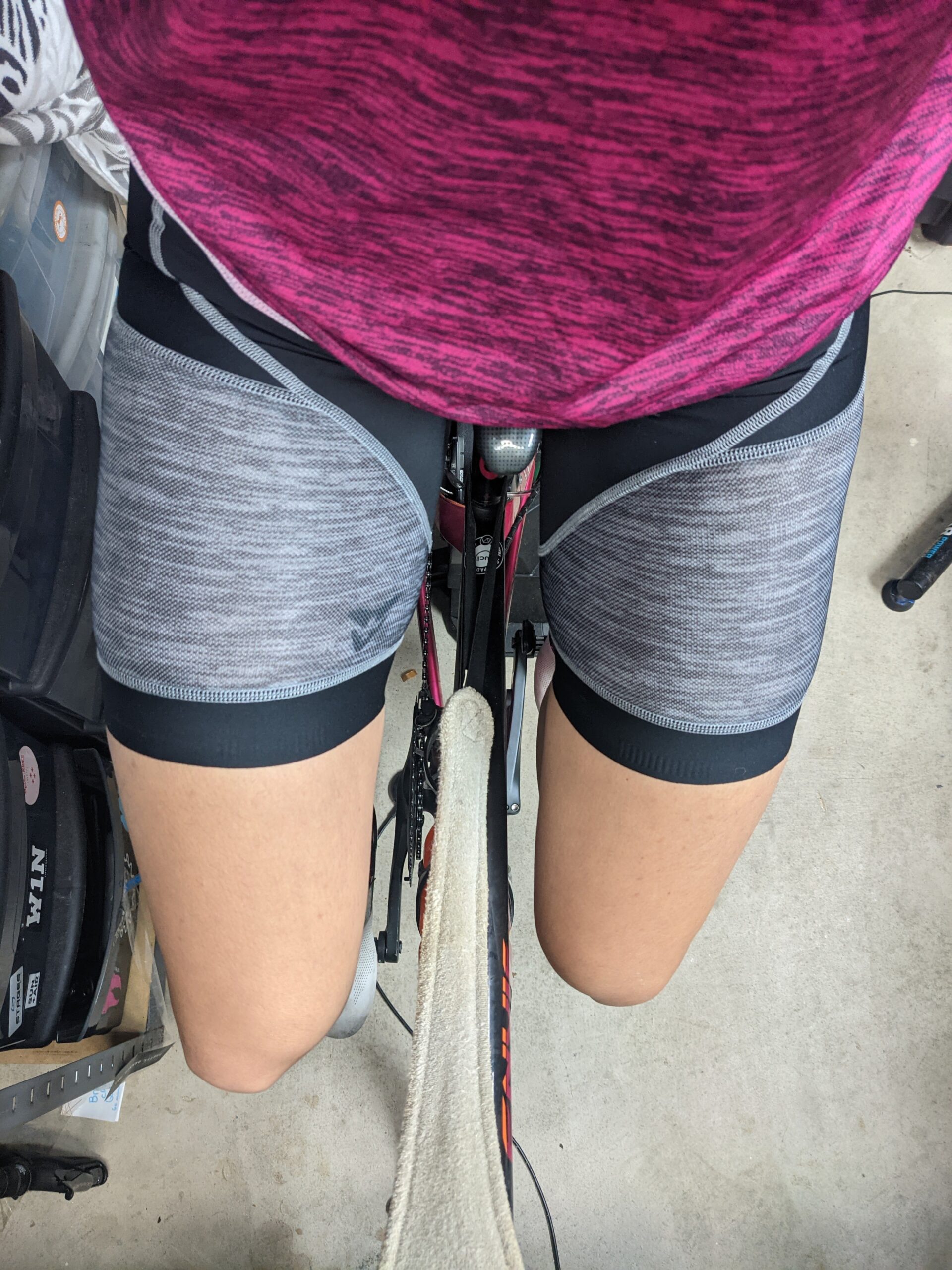
Indoor-specific kits like this one from CUORE of Switzerland implement highly breathable mesh fabric on the thigh as well as in the back and straps. In combination with high-performance material and the use of Carbon yarn, this improves moisture management and air circulation, helping your body stay cool and relaxed.
Trying out the CUORE indoor kit, I noticed that having large mesh panels along the quads helped dissipate heat from those large, working muscles. With a chamois that adjusts well to the different needs and positioning of indoor racing, the added comfort with an indoor specific kit is noticeable. Similar to the shorts, CUORE’s tech shirt features large mesh panels and lightweight fabric that helps air circulation and moisture management.
CUORE Indoor Tech ShirtCUORE Indoor Cycling Short
It is unfortunate to see that some brands neglect adding a women’s version to their indoor line, so having companies like CUORE offer a full, women-specific lineup is important. In addition to bibs and shirts, I make sure to wear cooling headbands, which keep the sweat out of my eyes and add a cooling sensation, if only for a short while.
Have You Dialed in Your Hydration?
What you put out on the bike depends significantly on what you put in your body. What indoor sessions might lack in duration, they sure often make up in intensity. Keeping an eye on your hydration and fueling status is therefore key!
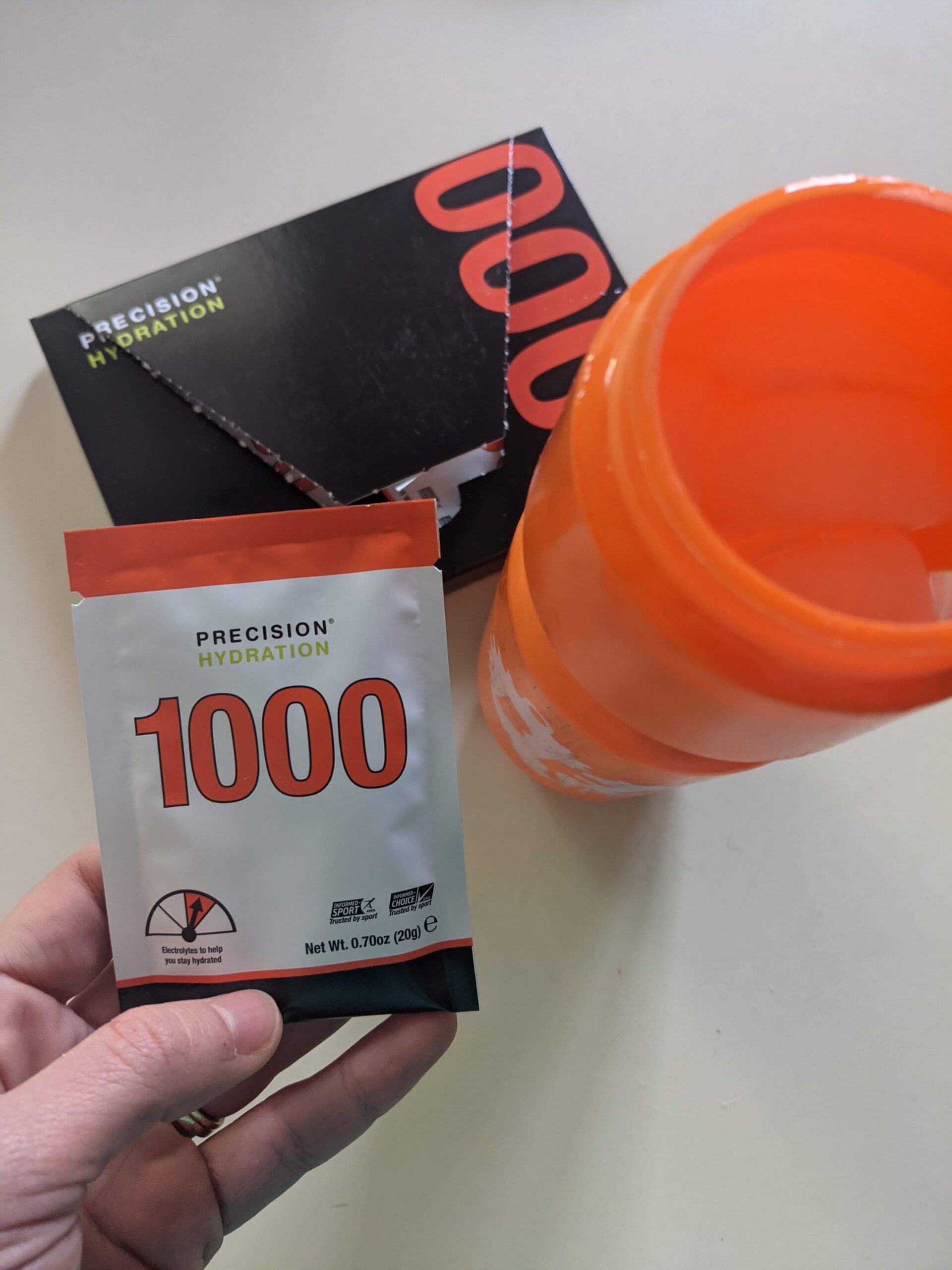
Even if most of your indoor rides are relatively short, you want to make sure you fuel enough and with the right amounts of electrolytes (and calories). While you might think that “men sweat more than women,” hydration is more individualized by physiology than gender. Therefore, it can be extremely helpful to do a simple sweat test to get a good indication of your individual needs.
Abby Coleman, Sport Scientist and “Sweat Expert” at Precision Hydration, notes: “Recording the volume of sweat riders lose as well as monitoring the concentration (saltiness!) of their sweat can be really insightful. These two factors, along with the duration of exercise, determine a person’s net sodium losses – which is the ultimate factor we’re trying to address with our personalized hydration strategies.” An initial test for your sweat rate can be simple:
Weigh yourself before a ride, ideally without clothing (A)
Measure how much water you took in during the workout (B)
Post-ride, towel yourself dry and weigh yourself again, ideally without clothing (C)
Subtract (C) from (A), add (B) and divide it by the time you trained
Studies show that a ‘normal’ sweat rate can range between 1-2 liters per hour. Figuring out whether you fall into this range or whether you had a more intense loss is helpful in determining specific hydration needs. Precision Hydration offers online sweat tests as well as one-on-one hydration strategy calls.
In addition to fueling sufficiently throughout your indoor rides, consider pre-loading harder and longer workouts with a strong electrolyte drink. Take some notes on how you feel with and without electrolytes and whether you notice a significant improvement in your performance. Similarly, if you feel extreme fatigue or cramps coming on, you might want to experiment with adding an electrolyte mix to your post-ride routine.
Did You Pick The Right Chamois Cream?
Riding indoors does not equal outdoor cycling. When you are Zwifting, you tend to move laterally less, coast less, and recover less than on the road. As you are spending more time in a static position, you will have a lot more saddle contact and experience increased friction.
For some, this discrepancy might warrant a whole indoor-specific set up, with a different saddle, indoor-specific chamois, or even an altered fit. For me personally, a high-quality chamois cream makes all the difference.
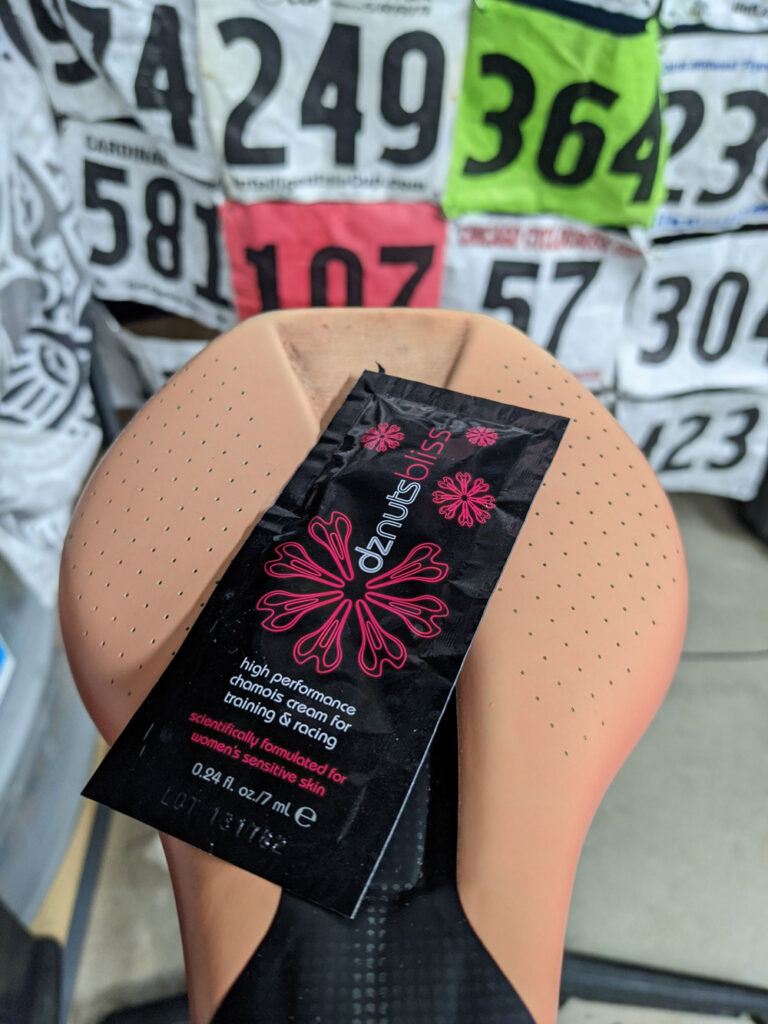
Chamois cream does not only protect your private parts from chafing, it is also anti-bacterial and protects your skin from nasty infections. When you apply chamois cream, moisture-absorbing polymers help regulate dampness and reduce the level of friction between saddle, chamois, and your sensitive skin.
While there is a lot of personal preference when it comes to scent, tingliness, and viscosity of chamois creams, it is worthwhile considering that women’s pH systems differ from men’s. This is why my go-to is a women’s specific chamois cream. dzNuts, the cycling company of TT specialist and pro Dave Zabriskie, features a unique women’s product. The dzNuts Bliss chamois cream not only helps protect your skin from nasty saddle sores but even encourages beneficial skin flora growth with its pre- and probiotics complex. With their focus on natural ingredients such as evodia, tea tree oil, and masterwort, dzNuts Bliss includes wound healing benefits to keep your netherregion happy and healthy for long hours in the saddle.
What About You?
Ladies: beyond the basics already mentioned, what do you find most helpful in your indoor sessions? Share below!
Race3R has typically organized shorter races on Zwift, but due to popular demand they’ve just announced a set of longer races in their new “Endurance Racing Series”. The routes selected cater to different types of riders, and it is one of the few race series with events over 90 minutes.
The Events Team from Race3R told us they “wanted this endurance series to be an exciting chance to get back to some ‘old school style racing’ with an emphasis on fuelling right to cover the 90min + stages.”
So if you fancy some ‘old school’ racing, this is certainly the event for you.
This series is actually four races in one. There will be the stage winners, as well as an overall GC competition for men and women based on a points system dependent on your placing. (The final GC result will be calculated on your best 6 results of the series, and the GC category racing is made fair by racing in your ZwiftPower rider category.)
There will also be a team competition based on the 3 best results per week from each team.
Event Times
Races will take place on every Saturday over 8 weeks at three designated time slots. To qualify for the GC competition, you must race in the same time slot each week.
This perimeter route covers portions of Watopia’s three “flat” routes, (Tick Tock, Volcano Flat, Watopia Flat). It’s called “Watopia’s Waistband” because it nicely encircles key landmarks in Watopia proper including downtown Watopia, Fuego Flats, the Italian Villas, the Volcano, and the Fishing Village.
This is a “figure of 8” route which covers all Yorkshire roads in both directions. This is the longest Yorkshire route in game. In the 18th and 19th centuries, Harrogate made its fortune by drawing often wealthy people to come and drink its waters, which had a supposedly curative effect. Known to locals as “The Pump Rooms”, the Royal Pump Room is one location where these odorous, sulfurous waters emerged from the ground.
Named for NYC’s first subway line, this route covers all the ground-level roads in Central Park. Created from GPS data of the actual park roads, this route accurately reproduces the Central Park ride experience.
The London course’s “PRL Half” route is meant to mimic the distance (but not the full course) of the real Prudential RideLondon-Surrey 46. It takes you on four circuits of the “London Loop“, then turns around at the Surrey roundabout and heads towards the sprint and finish banner on The Mall.
Looking for a tour of France? Released with Zwift’s France map for the first-ever Virtual Tour de France, the Petit Boucle route is the longest on the map (along with Tire-Bouchon). Its name references Le Tour’s “Grand Boucle” nickname, which means “big loop.” It covers all roads in both directions, except for the road up Ven-Top.
“The Magnificent 8” route was rolled out with Zwift’s October 29th update, and was used as the route for the Halloween dinosaur costume scavenger hunt. It’s a mostly-flat route, with the only significant climb being the reverse Hilly KOM.
The “Three Sisters” route covers Watopia’s three oldest climbs (Hilly KOM, Epic KOM, and Volcano KOM) in a forward direction. While not as punishing as The Pretzel and some of Watopia’s toughest routes, it’ll still put you in the hurt locker with almost 3000′ of climbing!
One of five routes rolled out with Zwift’s Titans Grove expansion, “Big Foot Hills” takes you on a meandering journey over the lower peaks of Watopia, including Titans Grove in both directions. This longer route is perfect for a ~2-hour free ride and includes 5 different KOM sections of short to medium length.
Competition Points Explained
The GC competition will operate on a scoring system based on your finishing position in ZwiftPower. This will apply for men and women as well as the team-based competition.
Prizes
The event is sponsored by OTE, who will provide prizes at the end which have not yet been determined. 3R assures us they will release an update confirming these details once available.
OTE Sports is a British-based company run by athletes who are experts in nutrition. They are passionate what they do and want to share their knowledge, so if you want to know more you can speak to them directly.
OTE Sports offer a range of naturally flavoured energy products and recovery drinks that have been developed by experienced sports nutritionists and athletes to bring you the best tasting and functionally effective products.
OTE Sports are proud partners of The Brownlee Brothers, British Triathlon, NTT Pro Cycling, Cannondale Factory Mountain Bike Team. They work in partnership with all their professional athletes to enable them to use their feedback to make the best products.
About Race3R
Team3R are a virtual racing team who race in both Zwift and RGT cycling platforms. With 390 active racing members, the club has 4 levels to cater for all abilities and is inclusive. There is the Nopinz R3R mens and ladies teams, which are the sponsored elite E-Sports teams, a Development Team (R3R Dev) to help riders improve their race craft and ability, a general club level team for both men and ladies, and a junior group ride currently with young riders aged 7-12 (zoomers).
Team 3R has a rich cycling history. The group started as Team DZI back when Zwift launched as one of the first teams and started with the Igniter ride.
The Team moved to Team WBR in line with their affiliation with World Bicycle Relief in approximately 2015, before finally evolving into 3R in late 2018. Within the membership, there are 390 active racing members and as a ride team offer over 35 available interval and group sessions per week.
Here’s one final reminder that we’re hosting our first-ever official Zwift event this Saturday – and it’s gonna be huge!
Riding The Über Pretzelis a bit nutty, by anyone’s standards. It’s the longest route on Watopia, after all: 128.3 km (79.7 miles) long with 2335 m (7,661‘) of elevation. And it finishes with a climb up Alpe du Zwift.
So we figured only a few hundred riders would be crazy enough to join us.
Yet here we are, with precisely 4,164 riders signed up with two days to go. Far more than any other event on Zwift’s calendar!
You’re all insane. And so are we. See you out there!
Event Signup
“Zwift Insider Badge Hunters – The Uber Pretzel Edition” takes place on Saturday, February 20th, at 6am Pacific/9am Eastern/2pm GMT.
Just about anyone can hop into a 1-hour Zwift ride unprepared, without worry. But when it comes to an undertaking like the Über Pretzel, you’ll want to put some extra time and effort into preparation. A few quick tips:
Extras are helpful: towels, sweatbands, gloves, socks, and cycling kit can get saturated with sweat and other grossness after 2-3 hours in the indoor saddle. Consider grabbing extras of these items and swapping to them halfway through. There’s nothing so refreshing as a fresh chamois after 3 hours of riding!
Charge the batteries: make sure any devices you’ll be using are fully charged, and/or you have charging cables within reach.
Carb up: consider eating a high-carb dinner (pasta?) the night before, to top up those glycogen stores.
Pre-hydrate: drink lots of water the day before the ride, so you’re fully hydrated when the event begins.
Keep hydrating: fill lots of bottles before the ride, or have someone on hand who can do that for you. You don’t want to be conserving water intake on a ride of this length.
Ventilate the space: if your pain cave gets humid, your sweat won’t be able to evaporate and cool you. Make sure your space stays well-ventilated by opening windows, running AC, etc.
Mind your fueling: hopefully you already know what sort of snacks you’ll need for a multi-hour effort. Have them on hand!
Chamois cream: highly recommended you remember this, if it’s something you find helpful on long rides.
This isn’t a paced group ride. There is no ride leader. Think of it more like a Zwift Fondo. With so many riders signed up, there will be people riding at all paces. Just find a group holding your desired effort level, and work together!
Will there be rest stops?
Only if you stop. To rest. You do you! But you’ll probably lose whatever riders you’re currently with, unless you can convince them via in-game messaging to stop with you.
How long will this take?
The very strongest riders on Zwift can complete the route in just under 4 hours. With such a massive signup list, and double draft being used, we may very well see a new course record on Saturday!
Most mortals will require closer to 4.5-6 hours to finish. You can use BestBikeSplit’s Uber Pretzel model to enter your weight and average power and get a time estimate.
We modified the segment early this week so the one segment will match both free-ride and event efforts. Strava isn’t doing a great job of going back in time and matching old efforts to the new segment, but you can do the “Activity Type Hack” to get your old ride to match. Just edit that ride, changing the activity type to something else. Then change it back to “Virtual Ride”. All done!
I live in Australia, and this event is at 1am. Any chance of getting a better event time?
Not this time around. We may change things up for future events, but this is really a test case to see if we want to organize more of these events moving forward.
Will you be organizing more of these events?
We’ll see how this one goes first. We only want to add events to the calendar if they’re going to be special and really add value to Zwifter’s lives. Based on the response to this event, it looks like there may be more tough “Badge Hunters” rides in the future!
Welcome to the first post in a series aimed at helping you avoid n00b powerup mistakes in Zwift races.
Powerups add a fun element of randomness and strategy to Zwift racing. While some purists deride their use, most racers welcome their addition to an indoor racing experience which can feel a bit oversimplified since it has fewer variables than outdoor riding.
While experienced Zwift racers seem to understand powerups well, we see them used incorrectly over and over again.
You won’t get in trouble for incorrect powerup usage, of course. When I say “incorrect”, I mean the powerup is deployed at a time when it doesn’t help you in any way. Some ill-timed powerups can actually hurt you, in fact!
To understand the Steamroller powerup, you must first understand a bit about how Zwift works. The Zwift worlds feature different road surfaces: pavement (of course), dirt, cobbles, bricks, wood, ice/snow, and grass. Each of these surfaces has a set Crr (rolling resistance) which affects how fast your virtual tires roll.
To make things even more interesting, there are currently three types of tires/wheels in game: road, mountain, and gravel. Each of these wheels rolls differently on each surface type. So, for example, road wheels roller much faster than mountain wheels on pavement, but mountain wheels are faster than road wheels on dirt.
When activated, the Steamroller makes whatever surface you’re riding roll as fast as a road tire on pavement. So if you’re using road wheels, it is only effective when deployed on a surface other than pavement. Here’s a table showing the Crr values for each surface and wheel type (lower is faster):
Surface
Road Crr
Gravel Crr
MTB Crr
Brick
.0055
.008
.009
Cobbles
.0055
.008
.009
Dirt
.016
.012
.01
Grass
.025
.0016
.042
Gravel
.012
.009
.009
Ice/Snow
.0075
.018
.014
Pavement
.004
.008
.009
Sand
.004
.008
.009
Wood
.0065
.008
.009
So if you’re using road wheels and you encounter any surface other than pavement, the Steamroller will help you roll faster. It helps the most on dirt, since dirt has the highest rolling resistance of any surface for road tires. The ideal scenario for the Steamroller would be a short patch of dirt like you encounter when climbing out of the Ocean Boulevard tube heading toward Watopia’s fishing village.
Using a mountain or gravel bike? The Steamroller will make any surface significantly faster, but helps the most on ice/snow or dirt. The savings for MTB wheels is substantial: a 75kg rider on a 7kg bike traveling at 40kmh (24.9mph) over dirt (perhaps in a Jungle Circuit race) will save 89 watts when the Steamroller is active!
The Steamroller lasts for 30 seconds, so keep that in mind when timing your deployment.
How It’s Misused
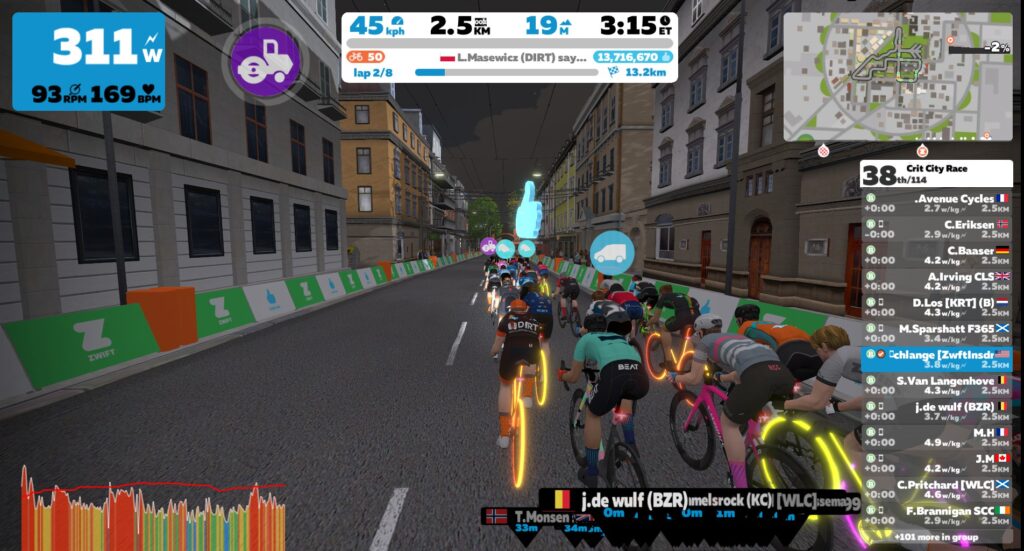
A misused Steamroller on Crit City’s tarmac
Of course, you’ve never misused a Steamroller powerup. But if you are looking to see one misused, join one of the daily Crit City races organized by ZwiftHQ. You’ll see the Steamroller deployed over and over again when riders are on pavement – which means it’s not helping them in any way.
Want to use your Steamroller effectively on Crit City? Use it on the bricks. Brick Crr for road wheels is .0055, compared to pavement Crr of .004. That means a 75kg rider on a 7kg bike traveling at 40kmh (24.9mph) will save 13 watts if they use the Steamroller to “smooth out” the bricks.
It’s not much, but it’s better than a kick in the pants.
Use the Steamroller to make the bricks roll faster
Simply put, a misused Steamroller is one deployed by a road bike rider while on pavement. Using the Steamroller in any other situation will provide the rider some benefit.
To maximize your Steamroller benefit, use the Steamroller on surfaces which roll the slowest – those with the highest Crr. (See table above for numbers).
Event-Only
The Steamroller isn’t part of the “regular” powerup distribution which Zwifters see when free-riding. It’s an event-only powerup, and event organizers must request that it be added to the event’s powerup distribution in order for it to be included.
Because of this, you won’t see the Steamroller when free-riding, and you’ll typically not see it in group rides or races, either. I’d love to see it used in Watopia races which include Ocean Boulevard, though, because it would make those dirt segments super-strategic!
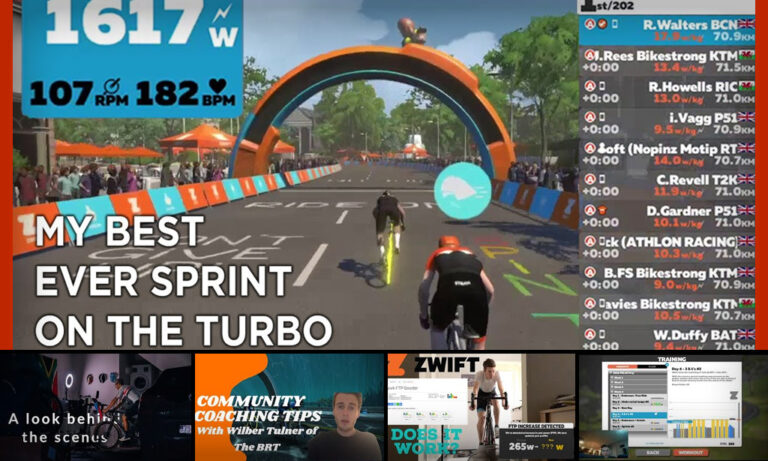
This week, get a behind-the-scenes look at some of the effort that goes into a high-ranking race performance on Zwift. Then get a tip on how you can contribute to a team time trial, even if you aren’t taking pulls. Finally, take a look at some reviews of Zwift structured workouts, including the 4-week FTP booster and some standout hard workouts.
Zwift Racing! Winning in the London Lockdown e-Race!
Just when you think he’s out, he pulls himself right back in! Red Walters (“The Redster”), with the Black Cyclists Network team on Zwift, rides to victory after some close calls in the London Lockdown race.
Going behind the scenes for Zwift Racing!
Follow pro triathlete Scott Bayvel as he prepares for and rides a WTRL Zwift Racing League stage. If you’ve raced the Harrogate Circuit in Yorkshire, you’ll relate to what he says afterward!
Zwift Community Coaching Tips: With Wilbert Tulner of The BRT
It’s possible to help your team in a team time trial (TTT) without taking pulls at the front. BRT’s Wilbert Tulner shares the way he does it in a tip for “Zwift Race Place.”
The Best “Hard” Workouts on Zwift
TacomaCyclist picks 6 hard Zwift workouts that he thinks are the best the program has to offer.
DOES IT WORK? Zwift 4 week FTP booster review | KickOn Cycling
https://youtu.be/KvIH4umTy5U
Does Zwift’s “4-week FTP Booster” plan do what it promises? Ross Birkett (“KickOn Cycling”) tries this set of workouts for himself.
Got a Great Zwift Video?
Share the link below and we may feature it in an upcoming post!
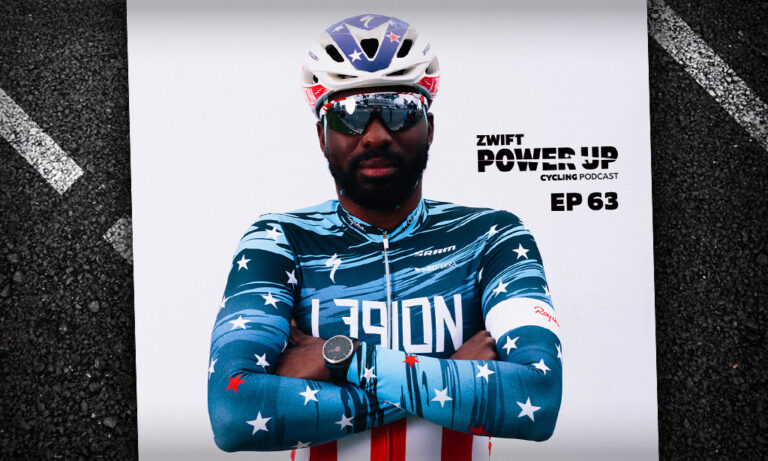
Following on from Part 1 of this episode, Justin Williams continues to discuss the future with Rahsaan Bahati, explaining how his younger years have driven him to foster change in the cycling industry.
He’s a man with lots of ideas, and his experiences from growing up in an area with no grocery stores and no suitable place to train have lit a fire in him to see changes made. The future of cycling is looking brighter than ever with Justin Williams in it!
About the Podcast
The Zwift PowerUp Cycling Podcast features training tips from host Matt Rowe (Rowe & King), with regular co-hosts Greg Henderson, Rahsaan Bahati, Dani Rowe, and Kristin Armstrong.
I love my team, I love each single one of them. And most of them I never met. What is incredible is that we start knowing each other to the extent we don’t care to get exposed.
Zwift racers like sharing fun moments before and after the races. If there is one part I enjoy big time it is the five minutes before the start of a TTT, when all team members are going back to their particular routines and you witness it through the Discord channel.
The captain checking everyone joined the event and is in the pen: “So you stop pedaling 30 seconds before the countdown otherwise you will cross the starting line and we will be disqualified, we go in 5 minutes afterwards, Jack and I put the timer, we tell you when it is time. Is everybody in the pen? I see only three of you, who is missing?” That last sentence is great, because obviously the one missing by default cannot answer because he’s not there, but next time the captain will ask the very same question…
You also have the superstitious one shifting gears one by one seven times up and down because one time, in 2004, he did it and finished second in the race crowning the champion of his neighborhood. Still to date his best result in his career. He does that in silence and almost hiding himself, because he is ashamed of it, however, he can’t prevent shifting the gears…
The Obsessive-Compulsive Disorder one: “Towel check, Isotonic drink check, Discord channel connected check, cereal bar check, shoes tightened check, Zwift Companion opened check, Bluetooth true wireless connected check, shoes laces adjusted check… Did I connect to Discord? Need to start again otherwise the world will come to an end before the start of the KOM. Towel check, isotonic drink check, Discord channel check…”
The one pretending not to be nervous and singing out loud totally out of tune: “………And I said, oooooooooooooooh, I’m blinded by the liiiiiiiiiiights. No, I can’t sleep until I feel your touch! I said, ooooooooooh, I’m drowning in the niiiiiiiiiiiiiight. Oh, when I’m like this, you’re the one I trust!”
The one reminding all others the distance and gradients of each single minute of the circuit, and nobody listens: ” … so kilometer 1.6 you have 166 meters at 3%, then 280 meters at 6% remember cadence at 80 there, 4.5wkg for 6 seconds before we reach the flat, that is when Joe takes the lead at 4wkg for 35 seconds unless he gives the signal he is toast and then it is Jack leading. Now remember Jack does not like to push hard in the first half so better to be always aware, right guys? RIGHT GUYS!!!!?”
The one with connection issues on Discord and repeating one hundred times the same sentence as if it would change something: “Do you hear me? Do you hear me? I don’t hear you, do you hear me? Can someone text me in telegram if you hear me?! Do you hear me? I don’t hear you do you hear me? Do you hear me? Now do you hear me? I am disconnecting and reconnecting so you hear me but do you hear me? Do you hear me?”
What is fun is that each of us believes the routines of the others are exaggeratedly ridiculous while underestimating immensely the craziness of our own routine…
Justin Williams joins Rahsaan Bahati for a trip down memory lane as they both look back on their younger years and how their upbringings helped them achieve big things in the cycling world. Their conversation traverses Justin’s youth, and how Rahsaan helped him get onto one of the coolest teams in cycling at just 17.
Jam-packed with anecdotes, jokes, and life lessons, you’ll be chomping at the bit for part 2, which will be released tomorrow!
About the Podcast
The Zwift PowerUp Cycling Podcast features training tips from host Matt Rowe (Rowe & King), with regular co-hosts Greg Henderson, Rahsaan Bahati, Dani Rowe, and Kristin Armstrong.