This week’s Top 5 Zwift Videos include persistent efforts to get some Lightweight wheels, tips for beginner Zwift runners and cyclists, advice for super-short races, and a guide for Zwifting on a single-speed bike.
Winning The Zwift Meilenstein Wheels…all the fails then. Boom!
To get one of the best climbing wheelsets in the game, you have to climb the Alpe du Zwift and spin a prize wheel. Black British Cyclist Kendizle hilariously documented his many summits of the Alpe while trying to earn the Lightweight Meilensteins. He even made some music out of the failed attempts.
How to Run Inside on Zwift
If running is more your thing, Fat Boys in Lycra have created a useful introduction to Zwifting on a treadmill. Check it out!
Top 5 Zwift Tips for Beginners
Josh Weight (The Vegan Triathlete) has some beginner tips that aren’t just about how to use Zwift. They also include ways to make your indoor rides more enjoyable.
How to Win a Zwift Sprint Race // Category C Zwift Racing // Innsbruck
Before you join a short race (sometimes called a “sprint” race), check out these tips from Caedmon Cycling.
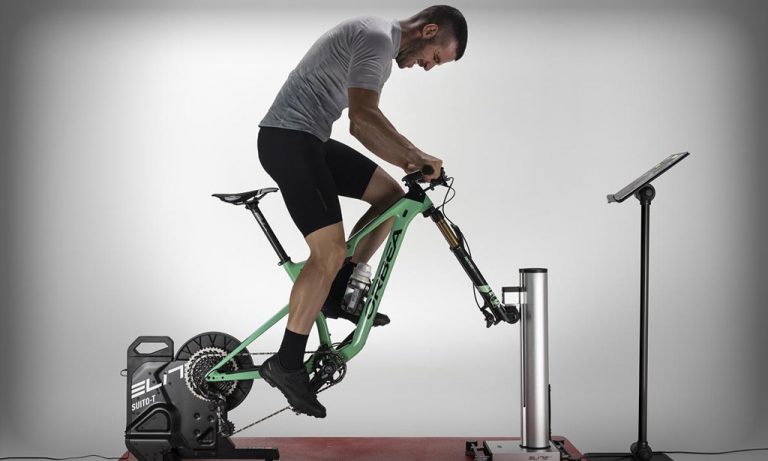
Single Speed / Fixed gear bike on a Smart trainer or Zwift
There are a few things to consider before trying to use a single-speed or fixed-gear bike on Zwift, and “silver_rocket” can walk you through them.
Got a Great Zwift Video?
Share the link below and we may feature it in an upcoming post!
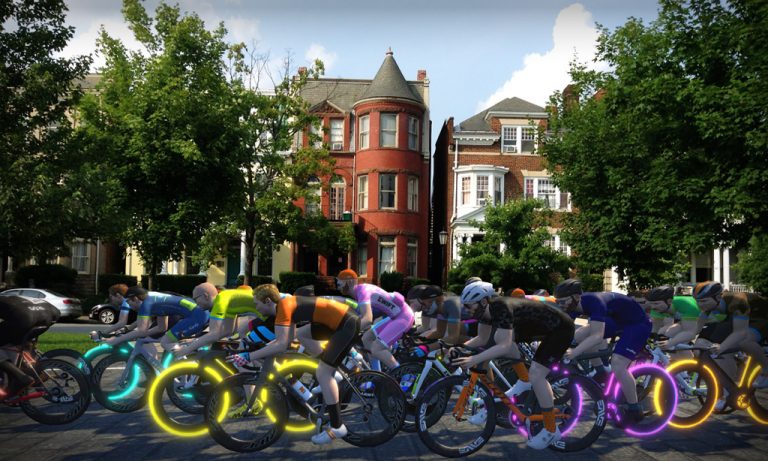
How Zwift’s 2015 UCI Richmond World Championships Course Was Created
Editor’s note: Charlie Issendorf, Event Director at Zwift, recently shared his perspective on the creation of Zwift’s Richmond map. This was Zwift’s third map, and it was used this week for the Zwift Classics race (hence Charlie’s post). Read his story below, along with a few of the original IRL pics he took, which he so generously shared with us.
Why is this race named the Richmond Challenge? Because getting virtual Richmond in Zwift was a challenge. This is the story behind virtual Richmond.
I joined Zwift in August 2014, when we were in full startup mode. Zwift wasn’t even open to beta testers (that came a month later) and Jarvis Island was the only route. Yes, it was very early days for us.
That same winter, I contacted the organizers of the 2015 UCI Richmond World Championships. I knew a few of the staff so I had my foot in the door. My proposal was simple: we wanted to make a virtual version of the 2015 World Championship course. The organizers had never heard of Zwift, or virtual cycling, and they were not quite sure what I was proposing. I explained how Zwift could make a replica of the Richmond World Championship course and, for the first time ever, riders from around the world could ride the same course as the Pro racers, from their homes. This would set the Richmond World Championships apart from previous editions of the World Championships and that was very appealing for the organizers.
For Zwift, it would be the first time we made a virtual version of a real world. As a U.S. based company, supporting the Richmond World Championships was a source of pride. The last time the road World Championships was held in the U.S. was 1986 so if we missed this opportunity, we might have to wait another 30 years.
The race organizer requested a Zwift demo before they would commit. So I packed my Zwift station into my car and drove the 6 hours from New York City to Richmond, Virginia to demonstrate how Zwift works. Also at the meeting was a UCI representative and several sponsors. They were impressed with what they saw and we signed the contract.
Did I mention we were still in beta?
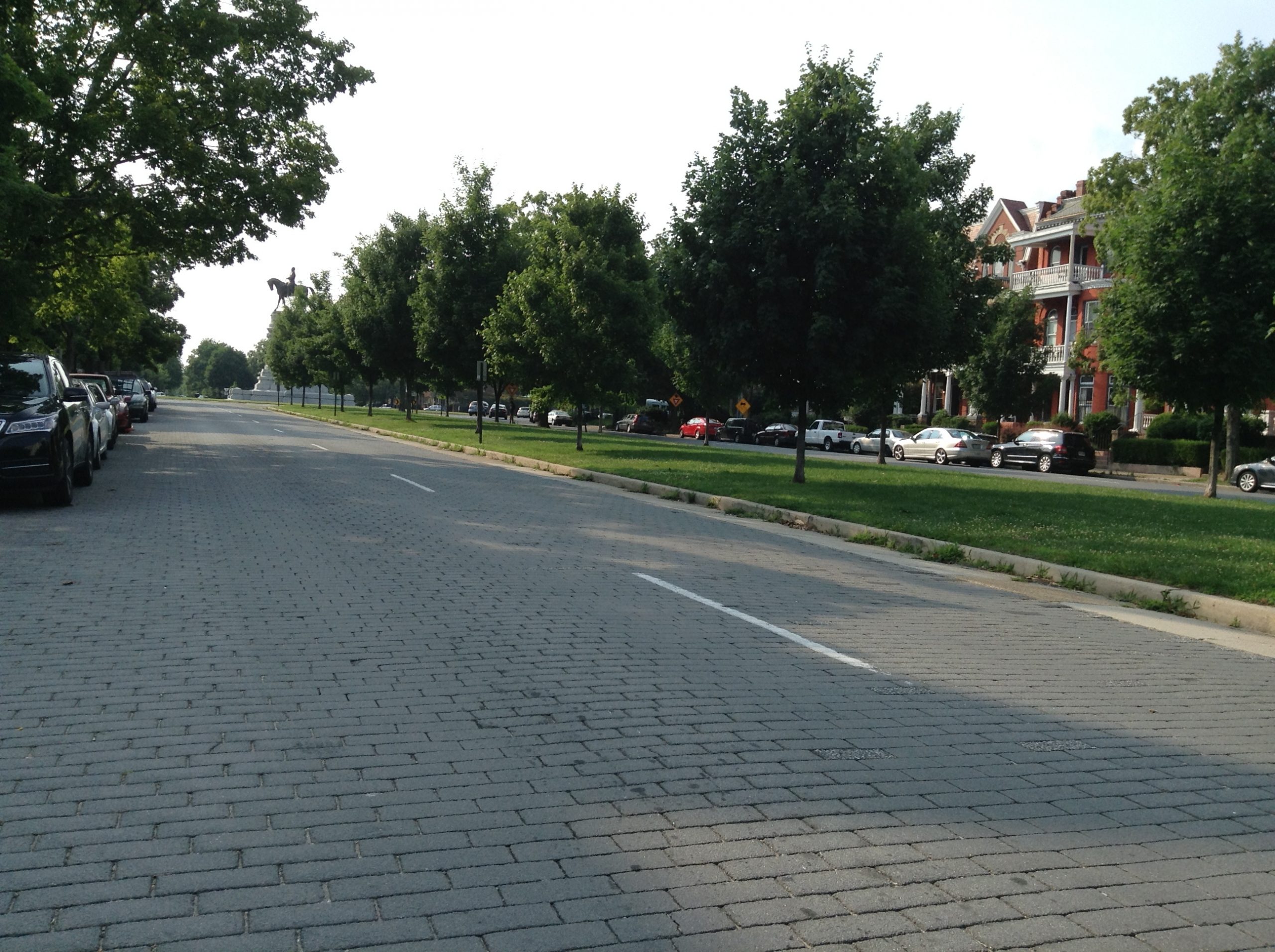
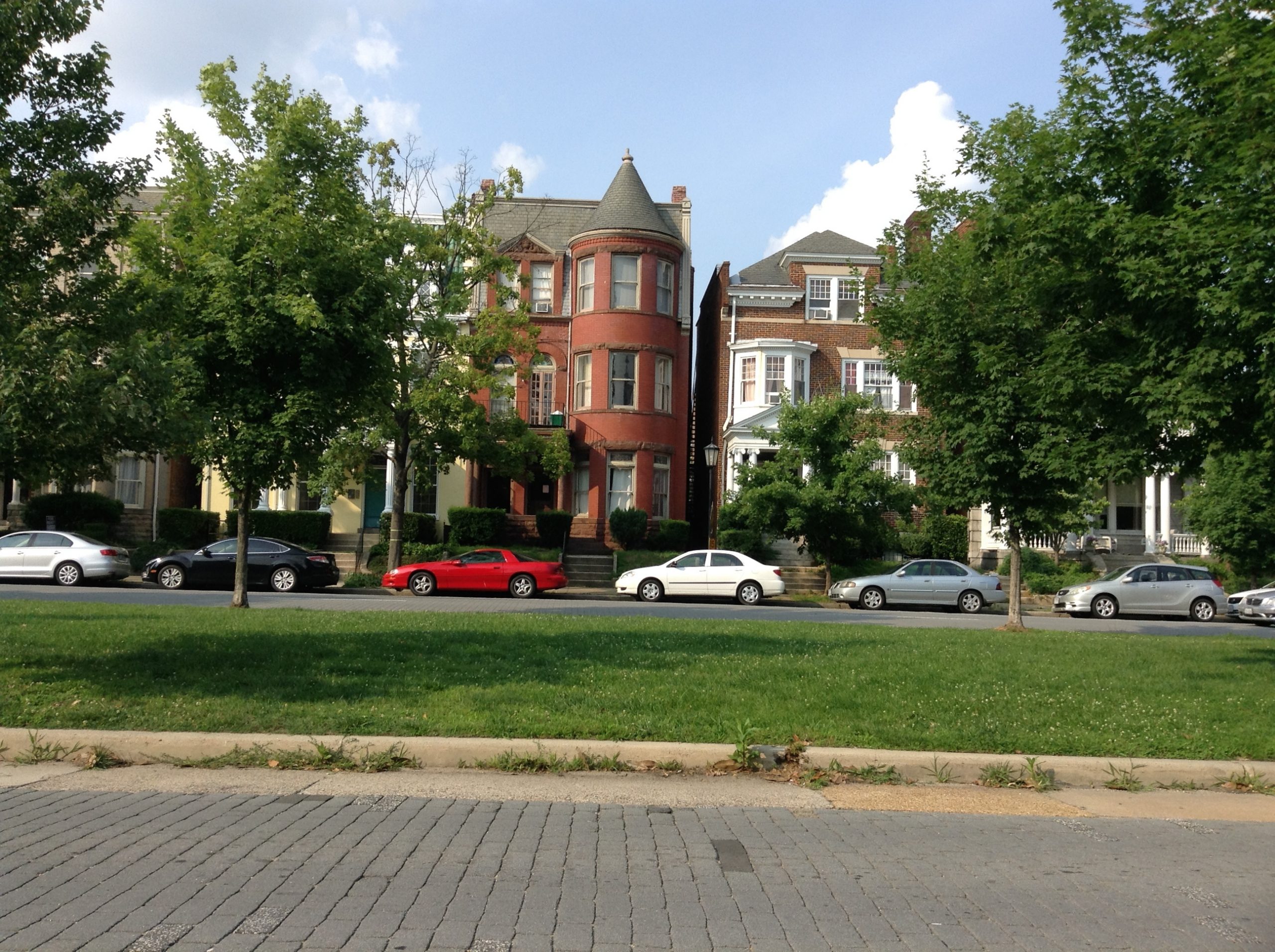
After the meeting, I drove around the race course and stopped to take photos of the key parts of the course. This was a request from Zwift HQ: they wanted our first real-world route to be stellar. I took photos of Libby Hill, 23rd Street Hill, and Monument Avenue. Seeing the climbs, I knew this would be a very demanding course and the virtual version would be super fun and technical.
Some of the original photos from 2015
23rd Street Climb
Course goes UNDER this building
Elevated Train
Monument Ave bricks (not cobbles)
Monument Ave houses
I then drove the 6 hours back to New York, excited about our first IRL world.
We launched virtual Richmond at the end of August 2015, about a month before the IRL World Championships. It was a success in two ways: we proved we could replicate an IRL course and we received a great deal of media coverage at the same time. Big milestones for Zwift.
The legacy of the Richmond World Championships still lives on with the virtual route. It’s a a superb course that always delivers an exciting race.
Questions or Comments?
Did you like the origin story of Richmond? Comment below… we’ll see if we can get Charlie to share more!
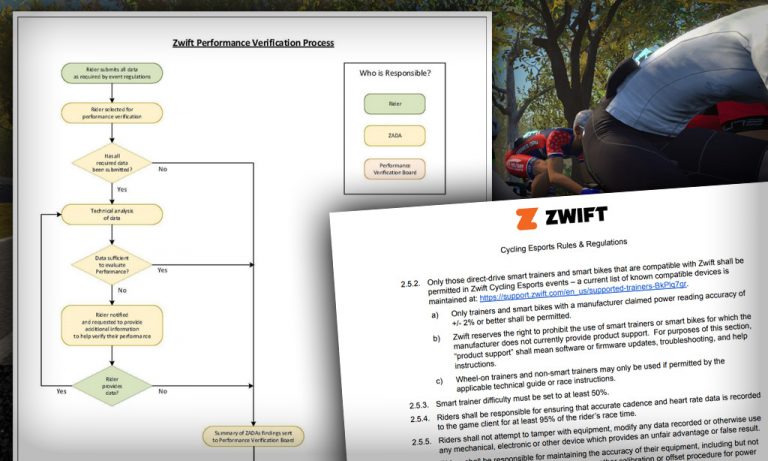
While these rules don’t apply to the vast majority of races on the platform, it’s interesting to track their evolution and see loopholes which are being closed and rules which may eventually trickle down to the Zwifting masses.
Zwift summarizes the changes in the latest version as follows:
Clarified minimum age for event and event series participation.
Smart trainers/smart bikes must have manufacturer claim of power accuracy of at least +/- 2%.
Equipment and techniques not permitted or effective in IRL cycling sport are prohibited.
Rules applicable in IRL events of a particular format shall be applicable to Zwift Cycling Esports version of that event format.
Revised performance verification process.
Pre-race test data must be submitted at least 14 days before the applicable event.
Updated pre-race test course instructions
Here are a few comments and details pertaining to some of the latest changes.
+/- 2% Trainer Accuracy
First Zwift required direct-drive trainers (because wheel-on trainers are notoriously fickle when it comes to power accuracy). Now they are requiring “a manufacturer claimed power reading accuracy of +/- 2% or better”. This is a logical next step as Zwift seeks to require more precision for top-level racers, and smart trainers continue to improve.
Which direct drive trainers are now ineligible for Zwift Cycling Esports events? A surprising number, actually. A quick look at our Smart Trainer Index of current models shows the following disqualified direct-drive trainers:
Notably, the flagship models of two smaller manufacturers (Kinetic and JetBlack) are disallowed. Additionally, there are some discontinued trainers which no longer qualify:
Zwift reserves the right to prohibit the use of smart trainers or smart bikes for which the manufacturer does not currently provide product support. For purposes of this section, “product support” shall mean software or firmware updates, troubleshooting, and help instructions.
This would probably rule out the use of any BKool trainers, since they exited the smart trainer business in late 2019.
With this rule change, Zwift is drawing a line in the sand with smart trainer manufacturers. If you want your products used in Zwift racing, you’ll need to ensure at least +/- 2% accuracy. Because yes, these rules only apply to top-tier Zwift races… but the racing community as a whole will follow the lead of the top racers.
Equipment and Technique Restrictions
New section 2.5.9 states:
Riders shall use equipment in a manner that is consistent with Zwift Cycling Esports events being cycling events. Use of techniques or equipment (other than a smart trainer or smart bike, or those relating to body heat management – fans, towels, etc.) that would not be permitted, or not be effective, in real life cycling events, shall be prohibited.
Note: This rule is not intended to prevent innovation, but simply to avoid the exploitation of “non-sporting” loopholes presented by the nature of esport. This includes, but is not limited to, exploitation of disconnections / lag / dropouts / software bugs, unusual pedalling styles, or use of equipment that is beyond what might reasonably be considered “sporting”. Any riders who are concerned that an innovation may be limited by this rule are strongly encouraged to seek the advice of Zwift before using it in competition.
This is Zwift tightening the rules to discourage the actions of a few bad actors. Most interesting in paragraph two is the restriction of “unusual pedalling styles”. This is doubtless refering to exploitation of Zwift’s “sticky watts” issue wherein a rider can pedal hard for a few strokes, then stop pedaling and effectively “coast” at a high wattage for a few seconds.
The interesting thing here is that, as far as we know, sticky watts is only an issue if you’re using an event-based power meter as your Zwift power source. But racers in these top-tier racers are required to use their smart trainer (which are typically time-based) as their primary source, so sticky watts would seem to not apply.
In the wild west of Zwift community racing, though, this rule could clean up a few sticky watters. Perhaps this rule will have some effect in those circles as well.
IRL Rules + Zwift Events
New Section 2.6.1 states:
Unless otherwise explicitly communicated by Zwift, the results of a race shall be judged by the standard real-world rules of racing for the applicable format of a race. For example, in a Zwift Cycling Esports event that takes the format of a Circuit Race, standard In Real Life Circuit Race rules and regulations (such as lapped riders not being permitted to interfere with the leaders) shall apply.
This is interesting, as there has been discussion in Zwift races about whether IRL rules should apply on Zwift. Generally the understanding has been “if you’re able to do it on Zwift, then it’s allowed” – because it’s simply too difficult to police such actions.
But Zwift is saying that, at least for its top-tier races, standard IRL rules will now apply. This is especially important in shorter circuit races as mentioned in the rule, where it’s easy for riders to jump back in when they’re lapped, and begin to affect the race. This is no longer allowed.
Revised Performance Verification and Pre-Race Data
Zwift (ZADA, actually) requires a substantial amount of information from riders before they are able to race. They may also do performance verification after a race.
Performance verification hasn’t really changed much in this latest ruleset – just a flowchart update to clarify precisely how the process unfolds, by the looks of it.
The more substantial changes are on the pre-race side of things. These changes are too detailed to lay out here, but racers are encouraged to read the rules document in detail if they’re looking to participate in a Zwift Cycling Esports event.
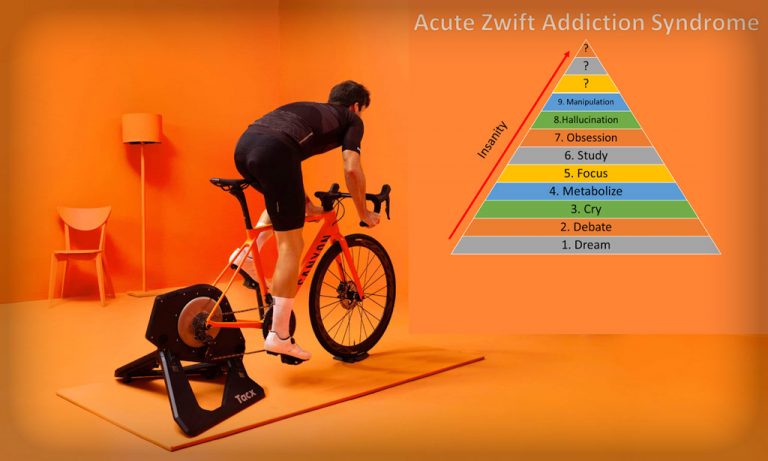
Lucianotes: Diagnosed with Acute Zwift Addiction Syndrome (A.Z.A.S.)
Back in March, I was upgraded to Category A. The immediate consequence was that I could no longer compete in the Zwift Racing League with my Jerbos team.
My Zwift routine was totally broken.
If at first, this seemed like something I could handle. But I quickly found myself falling into a depression. I felt my entire life had been left without purpose, and after discussions with some relatives, it became obvious I needed help.
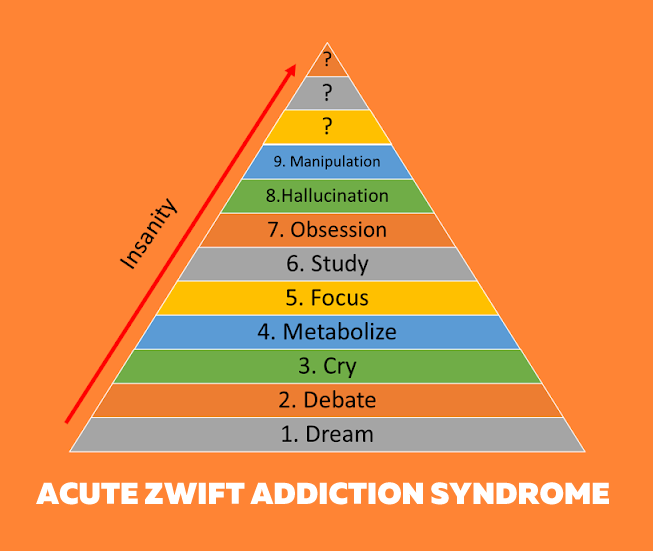
The intense sessions with my therapist have helped me understand how I ended up addicted to Zwift. Together, we have identified different stages leading to Acute Zwift Addiction Syndrome (A.Z.A.S.).
This is not something I am proud nor ashamed of, and I am sharing it with all of you in hopes that anyone in the same situation will understand they are not alone. Here goes my slow but steady descent into Zwift Addiction.
Stage 1
I have started to dream of Watopia regularly. It is one of the first signs of Z.A.S.
According to the shrink, if treated at the earliest stages of its manifestation it can result in superficial cognitive damage only.
Stage 2
I have started having heated debates about:
the fairness of Zwift categories
Zwift vs IRL accuracy
the most appropriate bike frame for one or another circuit
the beauty of a circuit versus another
in favor or against the use of Erg mode during workouts
the type of physical torture a sandbagger should be sentenced to
If you are at this stage of your Z.A.S. you should start getting worried.
Stage 3
After being disconnected at 150m from the finish line of a ZRL race, I cried like a baby for half an hour. After taking my time, my hopes, and my conversations, Z.A.S. was now taking control of my emotions.
Stage 4
I have had the Tron Bike quest fever for months. The most aggressive variant of the disease manifests itself with actual TBV antibodies (TBV=Tron Bike Virus) in your blood tests. This is the turning point when you actually metabolize your Zwift addiction and it will never leave you.
You may, after a tremendous effort, manage to get away from it temporarily. But your Z.A.S. will always be there, latent, ready to strike back.
Stage 5
On ZRL days (Tuesday for me) I could not think about anything besides the race. I would watch all the recce videos and read all forums in order to make sure I would not miss the marginal gains. My life was depending on it. I would watch live streaming from APAC races to see how they were evolving and where to use PowerUps, deciding on a strategy and changing it 1000 times until the start of the race.
Stage 6
First thing I do in the mornings is read Zwift Insider at breakfast. This symptom has evolved and has become more severe as I have started reading ZI while doing number 2 in the bathroom, staying there for an hour until my legs hurt and I no longer feel them. My entire world revolves around Zwift now, even the news.
I am officially diagnosed with Chronic Zwift Addiction Syndrome. If you reach this stage, you should disclose your condition to friends and relatives as you will need them big time to get out of this. Don’t wait. Call now.
Stage 7
I now desperately need everything Zwift related ASAP. Any new circuit I need to do it ASAP. Any new kit I need to get it ASAP. Any new challenge I need to do it ASAP. Any new gadget I need to buy it ASAP. Any new update I need to patch it ASAP. Any new article I need to read it ASAP. Any new frame or wheels I need to get them ASAP.
Does that ring a bell? If the answer is yes then you have experienced one or more O.C.A.Z.A.S.E. (Obsessive Compulsive Acute Zwift Addiction Syndrome Episodes).
Stage 8
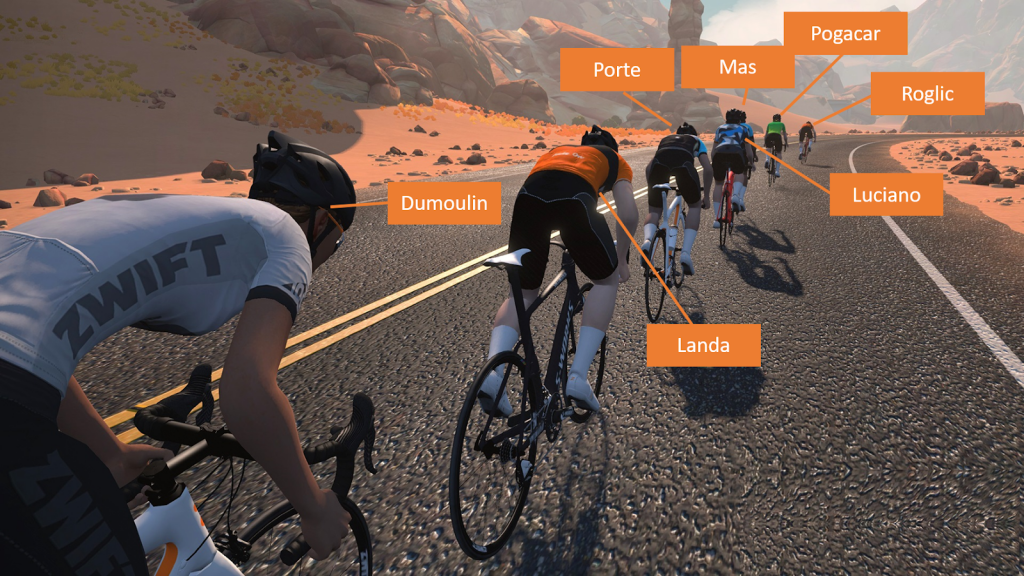
It happened during the Tour de France 2020. I was Zwifting on ADZ while watching a mountain stage on TV and all of a sudden I was there, with them… and I was part of the pack. There was Roglic, then Pogacar, and I was lagging just 16 seconds behind, between Enric Mas and Richie Porte. Unfortunately it seemed I was not going to make it to the Tour’s podium… but next year… take it for granted I am going to be a tough cookie….
If you are having those kinds of dystopian episodes, welcome to the world of severe Z.A.S. conditions.
Stage 9
One day when asked for the thousandth time “what’s this Zwift thing I spend all my time on”, I took a deep breath to start talking. However, when I measured the immensity and complexity of the challenge I was facing to get my ignorant interlocutor to grasp a blurry idea of what it meant to me, I answered “forget about it, you would not understand.”
This is called isolation. It is common to all cults and severe psychological pathologies. At one point you feel so far away from others that you just abandon the idea that others would understand you and you stop communicating. Scary, right?
Stage 10
One day I pretended I was sick to cancel a dinner with a friend while in reality I just wanted to Zwift. And that’s what I did.
An even more intense variant of this occurred when my wife and I were invited to dinner by some friends and I told her I was not feeling well, insisting that she should go by herself and have fun. As soon as she closed the door I jumped on my bike and smart trainer to Zwift.
If this happens to you there is no way easy or fast way back. Rehab in a Zwift Deconnection Camp becomes mandatory.
Stage 11
I’m not sure when it started, but I began talking to my smart trainer. Very quickly I gave her a human name: Amanda. My Kickr Climb is Hector and some of you have already mentioned to me that you have done the same.
If you have reached this degree of psychopathy there is no possible rehab. Just assume you have entered a new dimension of Z.A.S.
Stage 12
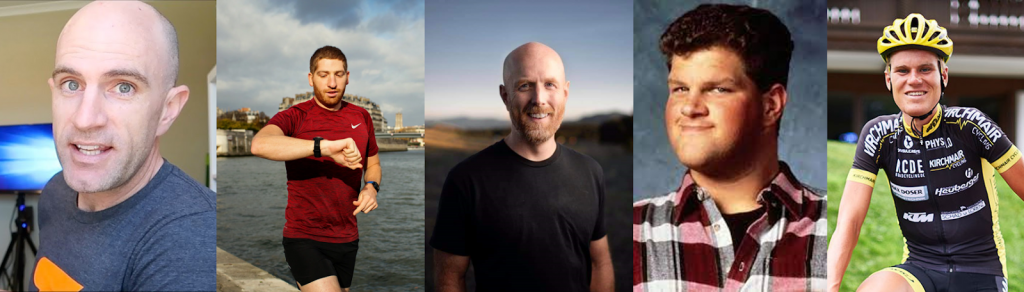
I could recognize the faces of any influencer in the Zwift Ecosystem. In increasing order of pathos: DC Rainmaker, GPLama Shane Miller, Stefan Kirchmair, Eric Schlange, and Abraham Benrubi (the actor interpreting “Kubiac” in “Parker Lewis Can’t Lose” TV Show). OK, the last one has nothing to do with Zwift but discovering I remembered his face allowed me to acknowledge I have a serious problem anyhow, independently of the Zwift one. Now, if you manage to recognize the other four faces, OMG…
Stage 13
I have started writing about Zwift, generating content to feed my own pathology.
Now, let’s be clear. If you have reached the end of this post you are done too. Who the hell would read an entire article about the things revealing if you are a Zwift addict if you are not actually the most Zwift Addict of all Zwift Addicts? Quod Erat Demonstrandum.
You are on an incline over 3% with a cadence below 73 and greater than 30 while traveling at a speed of 7 kph+
Sprinting out of the saddle: double your FTP wattsClimbing out of the saddle: below 73RPM on inclines over 3%
Thanks to updates rolled out in late 2019, everyone else sees your avatar come out of the saddle at the same time you do.
Default Behavior
If you have no cadence meter paired, Zwift will automatically stand you out of the saddle on any climbs over 3%.
Does It Slow You Down?
Any cyclist worth their chamois knows that standing upright with your hands on the hoods outdoors is a less aerodynamic position than remaining seated. Do you get more virtual air resistance when your avatar stands on Zwift?
We tested it, and can report that your in-game aerodynamics do not change when your avatar sits or stands.
The Tron Bike Exception
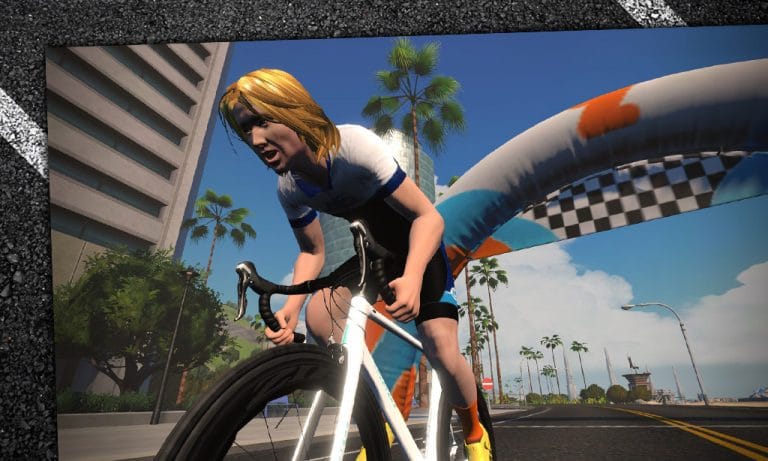
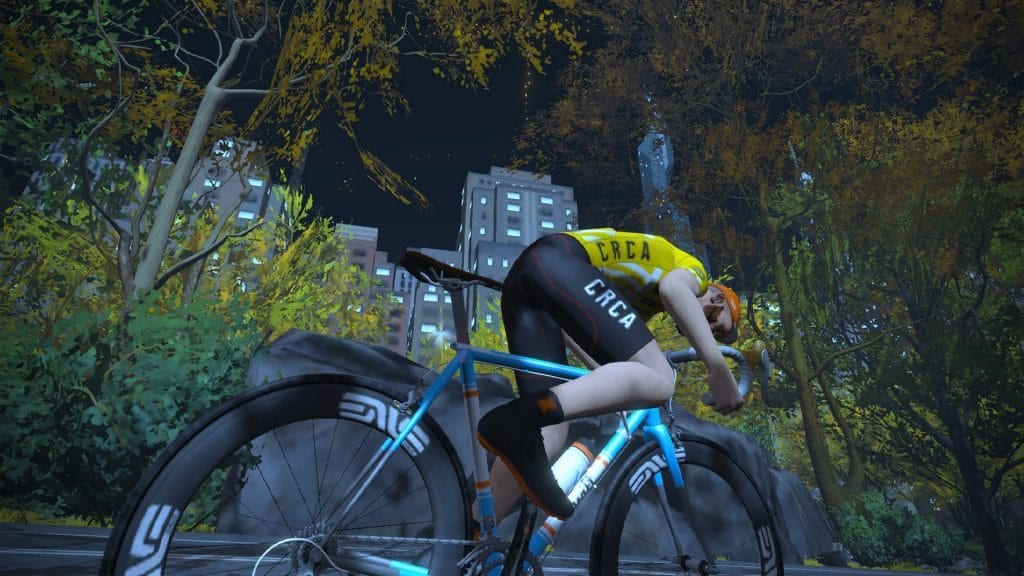
There is one exception to the 3%/72RPM rule, and that is the Tron bike. Zwift’s animators did not include an out of the saddle climbing posture for this frame, so you will never see a Tron rider standing up on climbs (or sitting up in the draft, for that matter). There is a sprinting posture, however.
Changelog
Aug 30, 2024: changed the cutoff of 70RPM to 73RPM… any cadence between 31-72RPM currently results in a standing avatar.
Aug 4, 2020: discovered that if your cadence is 30 or below, your avatar sits down. Added this.
Dec 31, 2019: Zwift changed the standing threshold back to 70RPM, and made it so everyone else sees your avatar stand on climbs at the same time you do.
Dec 10, 2019: Zwift changed the sprinting threshold from a flat 460 watts to 2x your FTP, and made it so everyone else sees your avatar sprint at the same time you do.
October 2019: Zwift released an update which changed the standing cadence threshold from 70 to 80.
Zwift rolled out “Hide the Display Mode” in its April 2021 release, allowing Zwifters to hide all on-screen heads up display (HUD) elements for a more immersive and uncluttered viewing experience.
Using the setting is quite easy on any Zwift device. Here’s a quick video showing how to toggle it on and off:
The “H” keyboard shortcut turns your HUD off and on. If you’re on iOS, AppleTV, or Android, though, you’ll need to swipe up from the bottom center of your screen to pull up the game’s actions menu, then click the button that looks like two overlapping boxes.
This same button is also available in the Companion app, so you can use your phone to toggle the HUD off and on if you wish.
“No HUD” Events
Event organizers are holding some “No HUD” events where participants are forced into No HUD mode (see these events on ZwiftHacks).
This offers a new twist on racing for sure! Think about how your racing experience might change if you didn’t have:
The nearby riders list
Your own numbers at the top-left
Overall distance (or distance to go)
Visible powerups
The minimap
If you aren’t very knowledgeable about the course you’re racing, the absence of these elements can negatively impact your results, for sure.
Companion to the Rescue
Luckily, we still have the Companion app. Your Zwifting device may be in HUDless mode, but you can still see most of the key info on your phone via Companion, as well as activating powerups. In No HUD races, having Companion running will give you a competitive advantage.
Clean Shots Bonus?
Next-level Zwifters know how to take killer photos in-game. And while it would seem that No HUD mode might help us take better pics, it doesn’t really change anything in its current implementation.
Why? Because PC/Mac users already get two shots saved with each snapshot (a clean one and one with HUD elements). And oddly, iOS and other users will get HUD elements in their shots whether they’re running in No HUD mode or not. (We assume this is a bug. Let us know below if you experience anything different.)
The Olympics are in full swing, and we’ve already witnessed a range of countries picking up medals and so many nice stories. It was great to see Tom Dumoulin picking up a silver medal in the Men’s TT, after taking a break earlier in the year from the sport. It was nice to see Primoz Roglic picking up a gold medal after the heartbreak of the last two Tours de France. And it was pleasing to see Tom Pidcock secure gold in the mountain bike race, Britain’s first-ever Olympic MTB medal.
However, easily the ride of the event has to go to Anna Kiesenhofer, in the Women’s Olympic Road Race. For those that didn’t see the event, she was in the first breakaway of the day before powering clear of her small group and soloing to victory with 40km to go. What is remarkable is that Anna doesn’t have a professional contract! As a fellow Zwifter, I’ve reached out to hopefully get an interview as it was inspiring to watch her hold off the peloton for the entire race. I’m not Austrian but I was willing her on to win the gold as such an effort deserved the medal.
Therefore, to celebrate the Olympics, I am highlighting events hosted on the Makuri Islands map this week.
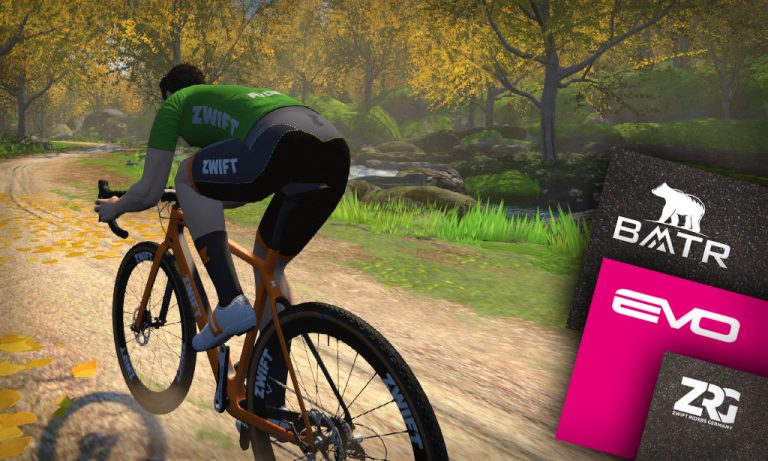
The BMTR Fundo
The BMTR Fundo is a personal challenge against the distance and/or the clock. Some participants will ride the event like a race and others will ride it more casually with their primary goal being just completing the course.
Ultimately, it’s all about getting on the bike, grouping up with others along the way, and having some fun. How fast or hard you choose to ride and how far you choose to go is up to you!
Even though it’s not “officially” a race, for those that may be treating it as such, there will be end-of-event results available.
This event is hosted on Suki’s Playground. There are a variety of distances to choose from:
Sometimes, it’s nice to just do a short race. To literally just blast a race out without a huge investment in time. This is the reason I have highlighted this shorter, more compact event. This is for the rider looking for an effective, high-intensity workout. Start fast, hang on in the middle, then sprint for the win at the finish. Expect to push your heart rate to its maximum.
Inspired by to Anna Kiesenhofer’s solo ride, I am highlighting the Evolution Cycling Club [EVO] Ladies-only social event. It is hosted on the Flatland Loop.
This is not a race, so no one needs to mirror Anna’s effort. It’s a nice group ride where riders are advised to follow the leader beacon’s instructions.
3 laps of the Countryside Tour route, totaling 47.8km. It’s a safe bet that with Zwift Racing League Season 4 scheduled for September, Makuri Island is going to be used. I have done plenty of group rides on the Makuri Islands map, but not any races, so if you are like me, this might be a good one to try in preparation for Season 4 of ZRL.
The three amigos are back together for the first time in a few Eps to chew through all the latest Zwifty news, chat, and gossip… in an episode recorded as Nathan nervously kept an eye on a tornado headed towards his studio!
Simon, Shane, and Nathan kick off with a review of the first interview from Zwift’s newish in post Chief Product Officer, YC, before meeting the Zwifter who accomplished a magnificently mad ride of 100 miles standing up. Prominent Zwifter Chad Tavernia goes one better chatting with Simon, promising to repeat the feat inside. Good luck with that Chad!
The Zwiftcasters move on to discuss what can only really be described as a pretty chaotic game update in July – and Shane switches on rant mode.
Auto-categorisation is a solution to sandbagging in racing long advocated by many Zwifters and now, thanks to Martin Carew at WTRL Racing, a nascent system is being tested in earnest. Simon checks in with Martin for a progress report.
The Zwiftcasters round off Ep 99 with a chat on the latest tech, including Elite’s RIZER device and Zwift’s decision not to attend the upcoming Eurobike show.
With an off-piste diversion into Speed Walking plus a little bit of news for runners on the platform, the boys wrap it up for this one. We hope you enjoy listening.
Elite Rizer Gradient Simulator + Steering Device Announced
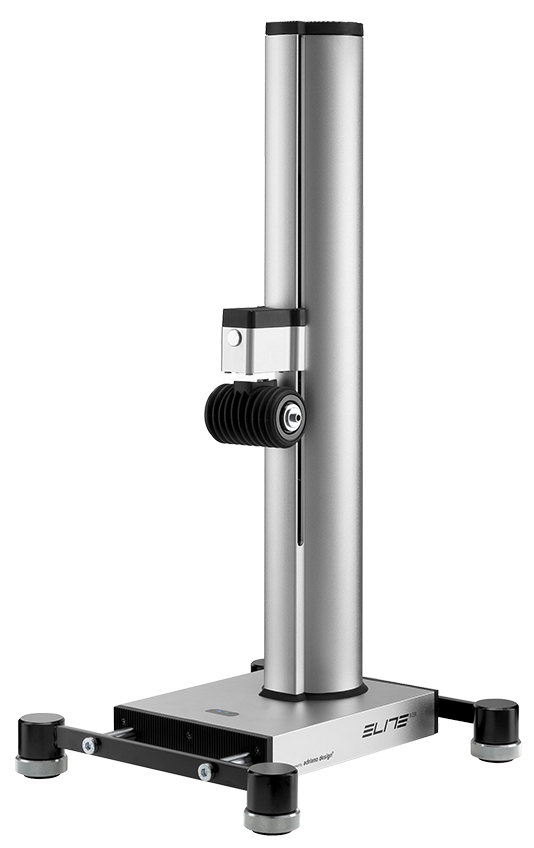
Elite has just announced a new indoor training product, the RIZER, which allows for both gradient simulation and steering on Zwift.
Elite RIZER vs Wahoo KICKR Climb
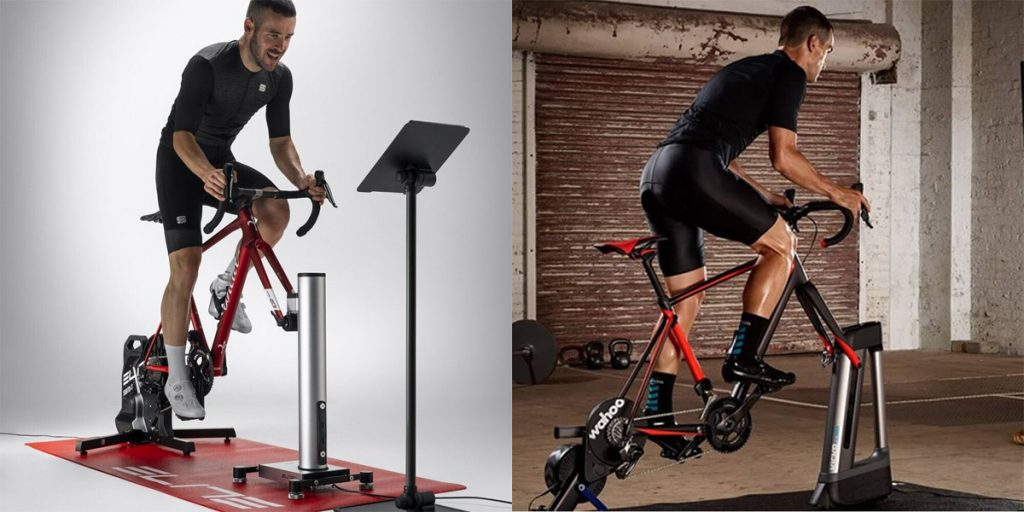
People will immediately draw comparisons between the RIZER and Wahoo’s KICKR Climb, since the Climb was the first (and to this point only)gradient simulator on the market. Here’s how the two devices compare:
Compatibility: The Climb is only compatible with certain Wahoo trainers. The RIZER can work with any trainer that supports ANT+ FEC, (which is pretty much all trainers) and allows for free up/down movement of the front of your bike, rotating on your rear axle.
Range: both units go up to 20% and down to -10%.
Design: the RIZER has a very stable base, while the Climb is purposely built with an unstable base.
Trainer Difficulty: Elite lets you configure the RIZER so its response is not tied to your Zwift Trainer Difficulty setting. Wahoo has no such setting, so if your trainer difficulty is set to 50%, your Climb is only moving half the distance it should.
Drive Mechanism: the Climb uses a belt to move your forks up and down, and some users have snapped this belt (ouch). The RIZER uses a metal screw which, according to DC Rainmaker, has no ability to snap.
Steering Functionality: the RIZER has Zwift steering functionality built in, which Wahoo’s Climb does not support.
Pricing: the RIZER is priced at $1099USD, while Wahoo’s Climb is priced at $599USD. Yikes! This disparity in US pricing is mostly based on the current state of international shipping rates, though. (Elite is based in Italy, while Wahoo is US-based.) In euros, the Rizer is priced at 799€, while the Climb is 549€.
How Gradient Simulation Works
The RIZER gets its gradient simulation data from your smart trainer. If you’re on a compatible Elite trainer (the Direto XR, Suito, and Tuo) your trainer will broadcast the current gradient directly to the RIZER. Other trainers don’t currently rebroadcast the gradient, so the RIZER instead computes the gradient based on the trainer’s broadcasted speed and power.
As one would imagine, that leads to a less-than-perfect simulation experience on non-Elite trainers. Ray from DC Rainmaker says, “As far as 3rd party trainers go, as I said above, it’s not a perfect solution in terms of responsiveness of the gradient simulation, at least until other companies implement the transmitted gradient in the data stream.”
More Reviews
We don’t have a RIZER in-house, so we can’t give you a hands-on review. But here are two reviews from some trusted sources:
In-Depth Review from DC Rainmaker
Review from DesFit
Availability
The RIZER is in production at Elite, but not yet shipping. Word is they’ll arrive in Europe in August, while North American markets won’t have access until late September/early October.