In our Top 5 Zwift Videos this week, one Zwifter shares his advice for his fellow cyclists who are heavier than average. Two others embark on rides of more than 100 kilometers, and another demonstrates a race tactic in events with combined categories. And in a video from GCN, see what happens when two cyclists climb Alpe du Zwift as they “climb” in elevation!
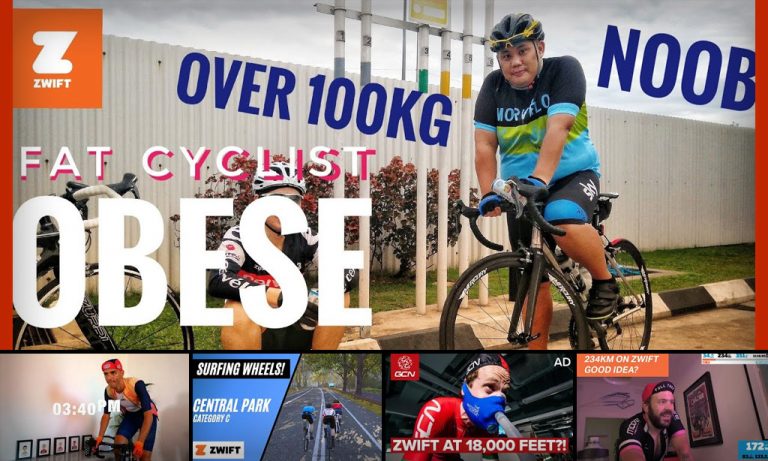
What do you need to know if you are an obese, fat, or heavy cyclist.
Melvin Tan offers some tips for the Clydesdales and Athenas in cycling, based on his own experience.
GCN Get High | Cycling The Highest Road In The World On Zwift!
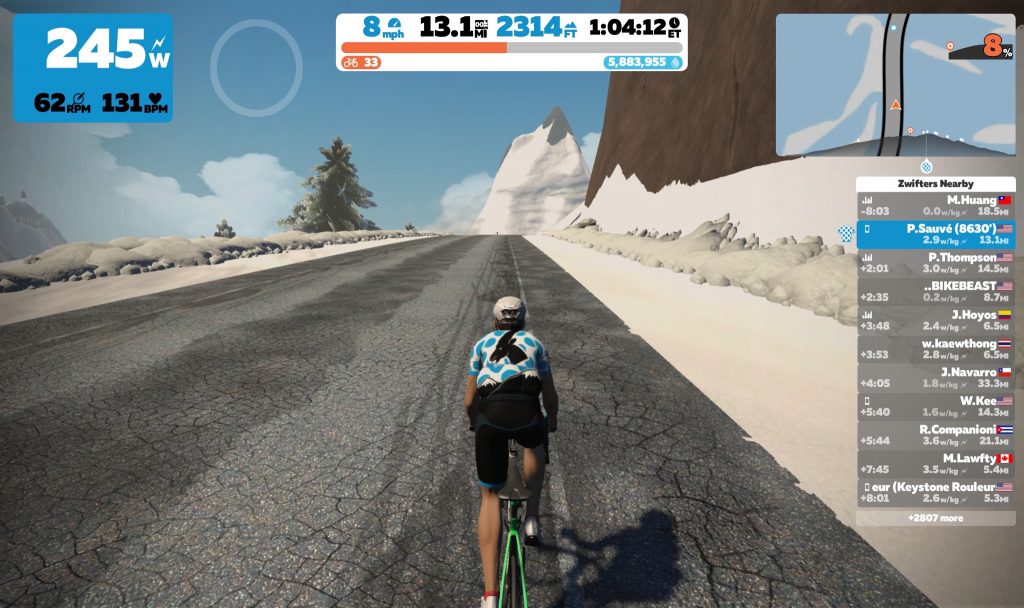
Connor Dunne and Alex Paton with Global Cycling Network climb the Alpe du Zwift in an altitude chamber to see how it affects them. Then they try again, but this time they lower the oxygen to simulate the highest paved road in the world!
Epic 11 hour 234km Zwift Ride
Follow along with Jim Wild as he rides 234 kilometers on Zwift in 11 hours. (Strong language warning, which isn’t a surprise with that kind of effort!)
I rode 262km on ZWIFT!
Another long ride! This time, Yota B pedals for 262 kilometers and shows off a bit of his indoor training setup.
Surfing Wheels with Cat B Riders //LaGuardia Loop Points Race // Zwift Race Strategy
It’s a controversial race strategy, but it often comes into play in races with combined categories. Caedmon Cycling demonstrates the benefit of grabbing the wheels of stronger riders who are passing you.
Got a Great Zwift Video?
Share the link below and we may feature it in an upcoming post!
Speed Tests: How Rider Height Affects Speed In Zwift
Astute Zwifters know the game calculates your virtual bike speed using a combination of “personal” factors (wattage, weight, and height) as well as external factors (bike frame and wheelset choice plus the virtual environment including road surfaces, gradient, etc).
Zwift racers know that height plays a significant factor in your in-game speed. Simply put, all else being equal, a shorter rider will be faster than a taller rider. But just how much of a difference does it make, across a wide range of wattages and rider heights? Let’s dig in and find out…
Speed Test Data
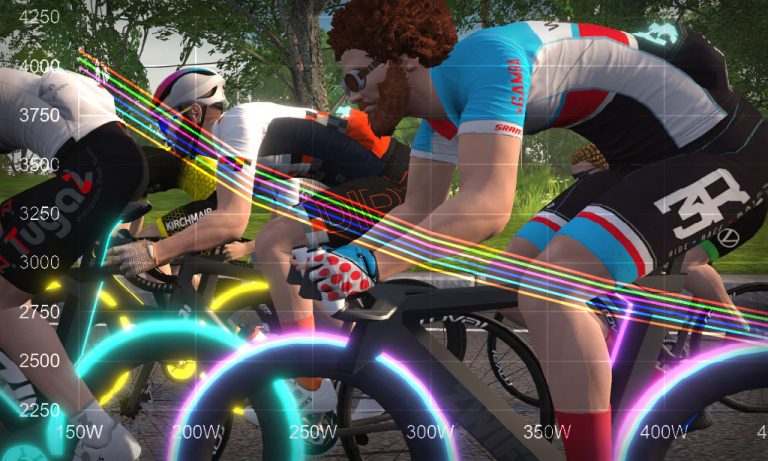
This chart shows the time it took 6 riders of varying heights to complete our standard flat test course at different power levels. Each rider was set at 75kg weight and used the same virtual bike setup – the only variance across the tests were rider height and wattage.
Height vs Speed at Various Power Levels
Conclusions
Zwift’s physics hold remarkably steady across a wide range of rider sizes (153cm to 203cm, or approximately 5′ to 6’8″)
Zwift’s physics hold remarkably steady across a wide range of wattages. We didn’t include it on the chart above, but we also tested at 750W and 1500W, and found the time gaps progressed as we would expect.
As power increases, speeds increase. As speeds increase, the time gaps between riders of varying heights are reduced.
For example, at 150W, the different between a 153cm and 203cm rider is 230 seconds. At 450W, those riders are only separated by 159 seconds.
While the gaps in seconds may change across power levels, in terms of percentage of overall time, these gaps hold pretty steady, with overall time increasing by 5.63% (at 150W) to 5.83% (at 450W) when rider height changes from 153cm to 203cm.
Why does the percentage difference increase at higher wattages? Because aerodynamics matter more at higher speeds.
At lower heights, adding a centimeter makes a bigger difference. Going from 193cm to 203cm slows you by approximately 1.06%, but going from 153cm to 163cm slows you by approximately 1.35%. This makes sense, because as you get taller each centimeter is a smaller percentage of your overall height.
Another way to look at the chart is that it shows how many watts each centimeter of added height costs.
For example, we can see that 163cm at 150W delivers the same time as 173cm at ~160W. So we know that a rider will need to hold ~10W higher to match a rider 10cm shorter. Or looking at it another way, every centimeter costs 1 watt.
At higher wattages this cost is even higher, with a 10cm jump costing closer to ~20W in the 450W range.
So how much difference does a centimeter make? Here are estimated numbers based on the chart above:
At 150W, every added centimeter
Adds ~4.6 seconds
Costs ~1 watt
At 225W, every added centimeter
Adds ~4.0 seconds
Costs ~1.1 watts
At 300W, every added centimeter
Adds ~3.7 seconds
Costs ~1.2 watts
At 375W, every added centimeter
Adds ~3.4 seconds
Costs ~1.8 watts
At 450W, every added centimeter
Adds ~3.2 seconds
Costs ~2 watts
I Wish I Were Smaller
Looking at the dramatic effects of height on Zwift speed, the inevitable questions of “height doping” will surface. Is this a real problem on Zwift? Are riders pretending to be midgets so they can win races?
Sure they are. But it’s a very small minority of the serious racing community. (And yes, I wrote that on purpose.)
With WTRL requiring random height verification videos, Zwift Cycling ESports requiring them for top-tier events, and ZwiftPower tracking every rider’s height history, serious racers know that lying about your height can get you into hot water. Quickly. And it’s not like weight, where you can perhaps make the case that you gained or lost 5-10kg in a short amount of time. With height, change is slow and minor. Significant changes stand out quickly in the data, and get riders flagged for cheating.
Is the system foolproof? No. But the system isn’t being overrun by wannabe Cavs, either. Perhaps someday we’ll have a Zwift Racing Passport, where our height can be marked as confirmed after submitting a video?
Should Height Matter So Much?
Whether or not Zwift’s height physics accurately reflect the real world is a matter of some debate. With some online bike speed calculators not even taking rider height into account, why does it figure so heavily into Zwift’s algorithm?
Zwift calculates your avatar’s frontal area based on your weight and height (your BMI, essentially). That frontal area, in turn, is the key factor in Zwift’s CdA calculation, which accounts for the majority of the virtual air resistance your avatar encounters.
At a glance this seems logical – a taller person will be in the wind more, right? But what about the example of two riders who weigh the same, but vary greatly in height?
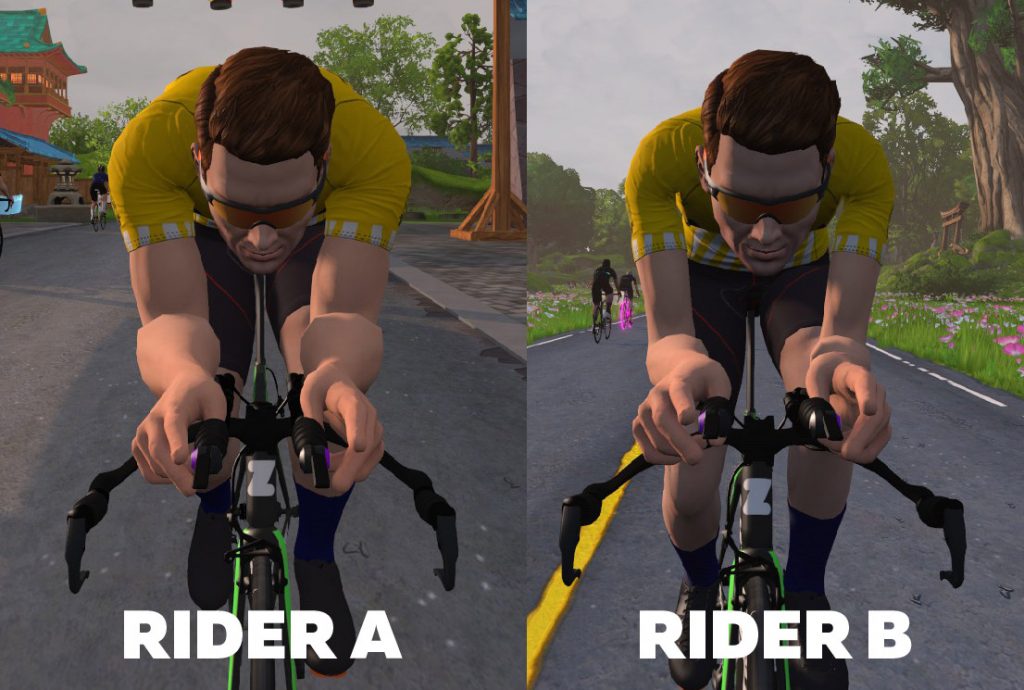
Rider A: 160cm tall, 80kg
Rider B: 190cm tall, 80kg
If both riders hold the same power on flat ground, who would be faster? Our speed tests above show that, at 300W steady, Rider A would be faster on Zwift by approximately 2 minutes over an hour effort due to their reduced height.
But in an aero position with a flat back on a TT bike, Rider A would actually present more frontal area, and therefore be slower in real life. Zwift’s own graphics support this:
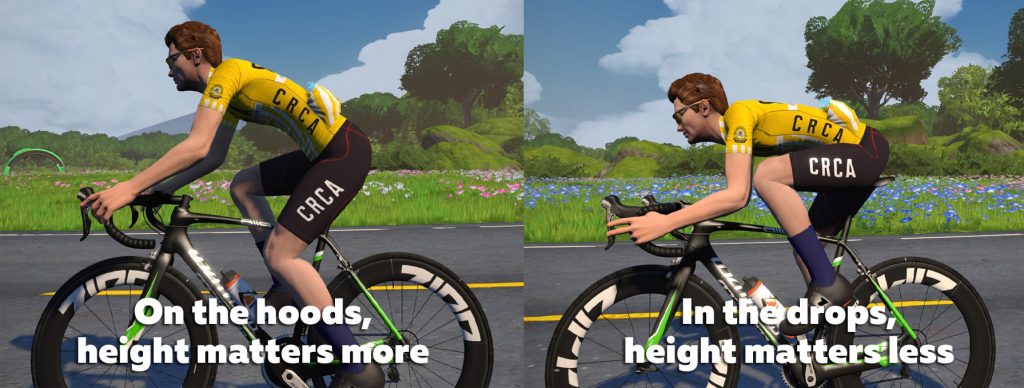
It all comes down to rider posture, really. Or at least, it should, if we’re trying to simulate outdoor riding. If Rider A and B are both “on the hoods”, height would matter quite a bit, and it’s reasonable to believe Rider A would be faster due to his reduced frontal area. But if they’re in the drops, height matters less.
Could Zwift change things so your rider’s CdA differs based on avatar posture? Sure they could. But they would need to change the logic which determines when your rider “sits up” or gets into the drops as well.
And would that be the best solution anyway? Possibly not. When you’ve got riders pedaling away in their pain caves in a variety of postures, how should we expect Zwift to fairly decide what everyone’s virtual front area should be?
(It’s worth noting here that calculating your front area in real-time based on a webcam feed showing your posture in your pain cave seems like a super-cool idea, even if it’s a bit before its time…)
It’s easy to say Zwift’s height physics aren’t quite accurate. But it’s also hard to propose a better solution than what they already have in place!
In the end, for better or for worse, Zwift takes a simplistic approach to calculating rider CdA. Some taller riders feel they are unfairly penalized by this, but it’s all part of the game. This is Zwift: a riding simulation. If you want to perfectly replicate outdoor physics, you’ll have to ride outdoors.
Dominating Your Zwift Race: 7 Tips from a Real Expert
Let’s just get this out there: I know what I’m doing when it comes to Zwift racing. I’ve been around since beta days, back when races were a “show up at the lap banner then go when the clock hits zero” sort of affair.
Some aspects of Zwift racing have evolved since then, but the fundamentals remain unchanged. Still, seeing so much advice popping up on YouTube and social media from Johnny-come-lately lockdown Zwifters who think they know everything drives me crazy!
So I thought I’d put together my own list of simple Zwift racing tips, from someone who actually knows how to win. Want to dominate your Zwift races? Here’s the only advice you’ll ever need.
#1: Route Recon Is a Waste of Time
We’ve only got so many hours in a day – I’d rather spend them hammering out watts than researching pretend roads. Zwift Insider has a complete list of routes with overly-detailed maps and descriptions of every friggin route, but who has the time?
Zwift shows a minimap while you ride, and that’s good enough for me. It seems pretty accurate most of the time. Plus I usually get lost anyway, because it’s hard to pay attention when I’m maxed out.
#2: Pick the Category that Suits You
I race to win, not for a “fun workout.” I like to attack off the front a lot, and I win almost every C race I enter. So that’s the category I’ve stuck with for years, even if it’s a little below what Zwift says my FTP is (how do they know, anyway?)
WARNING: Watch out for certain “FutureWorks” races in Crit City or Paris, because Zwift seems to be trying to flag people who they think are “out of category” (as if they can figure that out: they can’t even install pedals on their virtual bikes). Trust me, if you get slapped with a green cone during the race it slows you down and makes it nearly impossible to win. So I would just skip those races, as well as anything organized by WTRL (those guys are the worst).
#3: It’s All About the Watts
You can talk about strategy and routes and pacing and blah blah blah, but in the end, the only thing that matters is what kind of wattage can you throw down. Zwift racing isn’t about subtlety, it’s about powering your way off the front, destroying the peloton, and dominating the podium.
Follow my advice and you’ll start winning – unless you race against me. Then you’ll probably lose.
#4: ZwiftPower: More Hassle Than Its Worth
Look, you’re probably already tip-tapping away on your fancy MacBook, trying to look me up on ZwiftPower to examine my racing palmarès. But I’ve got news for you: I’m not even registered!
Some Zwift racers say, “If it’s not on ZwiftPower then it didn’t happen.” But I’m winning races right and left without even signing up. So how do you like them apples?!
Truth be told, I tried to sign up for ZwiftPower once. But it was pretty confusing, so I gave up. I’d rather just race. You should do the same.
#5: Don’t Take It Too Seriously – Everyone Cheats Anyway
Zwift is full of cheaters. Grown men who weigh 140 pounds? Come on. Kids who can outsprint me? Not possible.
Usually when I lose a race, I can find someone ahead of me who was obviously cheating. They’re the ones with super low heart rates, or the ones with a super strong sprint that blows away the field at the end of a hard effort. Come on, man. You’re not fooling anyone.
I’ve done my share of outdoor racing in my local area, so I know where I stand in the universe of cyclists. Suffice it to say, there are either a lot of riders in the world who are super strong, or Zwift is full of cheaters. (The correct answer is obvious.)
#6: Teamwork? More like Dreamwork.
There’s lots of talk of “teams” racing on Zwift, but come on: does that really work? How is racing with a team any different than racing alone? If you think you’re teaming, you must be dreaming.
Why would I care about working with a bunch of people I don’t even know?
What good would it do anyway, since team tactics don’t work on Zwift?
As they say, “it’s lonely at the top.” That’s certainly been my experience on Zwift. So my advice is to keep your eyes open and race for yourself.
#7: Ride What You Want
Here’s another big time-waster: worrying about which virtual bike frame and wheelset you’re using in a race. I mean come on, people. They’re virtual! Just ride the pretend bike you like.
I have a Pinarello IRL, so I ride the F8 in game with Zipp 808 wheels. I’m grabbing podiums right and left, so it seems to be working.
Wrapping It Up
Well, those are my tips for winning Zwift races. I hope you learned something.
If you found this post useful, please say so in the comments so I can earn a few more greenbacks putting together Zwift racing advice for all you n00bs here on Zwift Insider.
Sometimes life can resemble “Groundhog Day” (that brilliant film starring Bill Murray and Andie MacDowell) and that’s true even on Zwift. This week I’m highlighting events that have that repetitive feel and also one event that has left me confused. I have done my best to translate.
Utsunomiya Blitzen Hill Climb Challenge Race
The graphics were striking, and the title enticing. But I have no clue about anything else with the event.
When I put it into Google Translate I got the following:
“I want to challenge the hill climb, I want to run faster, I want to get results in the race. We will hold a group workout event for hill climbing for such Zwifter!
Today, in the third week, we will challenge the hill climb race in which Hori also participates.
The advice received from professional athletes and the results of efforts and training will bear fruit in the race. Let’s enjoy hill climbing by connecting what you gained from this event to a further leap forward.”
From what I can gather, this is a 13.8km climb on the Lutscher CCW course. If that’s the case, it will be an intense FTP effort.
I highlighted this event last week but it is continuing.
You can represent Team US, Team Europe, or Team International. As this is novel and you are literally competing across continents, I thought it was worth another mention, this time with a focus on Team USA.
There are three events each day per team, for both run and run events. Event distances vary from short, medium, and long. You can help your team by racking up as many miles as you can throughout this series. Encourage other riders in your region and provide motivation because together, we can go farther and score more points! 1 point will be awarded for each km biked and 5 points awarded per km run.
Our friends at LEQP Provence are at it again. They are undertaking repeats of the Volcano Circuit route, 25 times to bag that 25 Volcano lap badge. (Along the way you may collect a few more, including the 100km one.) This ride is the embodiment of repetitive and having collected the badge, I can testify to this – it is a good challenge made more enjoyable by the company of friends!
The P Race is a decently long, flatter, double-draft event which has held the same Zwift time slot on Saturdays for years. It is described as “the virtual version of the famous non-virtual P Ride training race occurring year-round every Saturday morning in central North Carolina, USA” but I can’t find any mention online of the IRL event.
What makes the P Race special, though – and why I mention it this week – is because, due to some bug in Zwift’s event setup, there have actually been two P Race events at the exact same time on Zwift’s calendar each Saturday, for months now. Each event is held on a different route, but everything else is identical.
The end result, sadly, is that signups for the events get split, and the race isn’t nearly as well-attended as it was in years past. Perhaps Zwift will finally fix this dubious duplication now that it’s been mentioned here.
How the Race Was Lost: Zwift Classics Seaside Sprint Banter Bus
This week’s Zwift Classics race saw a controversial route change at the last minute, with the planned route (Muir and the Mountain) being swapped out for Seaside Sprint.
I gotta admit, this change made me happy. For three reasons:
There was no way I was going to come close to winning a race up the Epic KOM (with bonus climb). A race on Muir and the Mountain would be nothing more than a challenging workout from my standpoint.
The Seaside Sprint route has a special place in my heart, because I created it. That’s right – it began as a Rebel Route back in August of 2019, then Zwift made it an official (albeit event-only) route in its February 2020 update.
It’s a fun route that suites my strengths. Fairly flat, a few spots for cheeky attacks if I’m feeling good, and a short descent into the flat finishing sprint.
Autocat Development
I was placed in C3 this week, which seemed a little odd given my C2 placement in last week’s hillier race. But again, I’m not paying much attention to the numbers these days. So far every autocat race I’ve done has been competitive and fun, so I just go with whatever WTRL assigns. (Not that I have a choice anyway.)
C3 meant we had a 5-lap race of around 34.5km.
Bike Choice
Last week I went with a pure climber, but this week that would be silly since the race had no significant climbs, and it would be won and lost on the fast sprint sections.
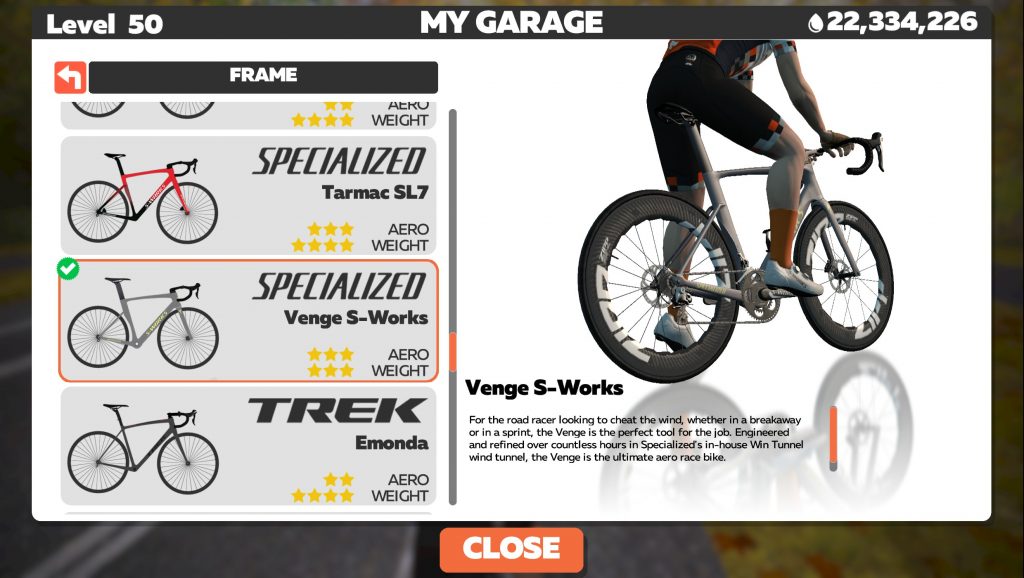
I thought about going with the Tron bike, since it would perform well up the little kickers as well as on the flats. But everyone rides the Tron bike. I thought about going with the S-Works Venge + disc wheels… but I can’t stand running disc wheels in a road race, even if it’s virtual.
In the end, I settled on the S-Works Venge + Zipp 858’s. A proper road racing setup, albeit a bit slower than the two options above.
Warmup
Another standard warmup this week. First a couple of pieces of caffeine gum one hour before the race. Then PR lotion on my legs before kitting up, to reduce the burn.
Then I hopped into the pens as soon as I was allowed, saving my place at the front before popping back out to join the C. Cadence group and spin my legs for a while, putting in a few hard digs to get my heart rate up and break the ice.
After around 30 minutes of warmup I headed to the pens. Let’s race!
Lead-In
We blasted out of the pens with 95 riders. I had already done a bit of homework and knew that my predicted finish was around 10th-15th place. That meant I should be able to stick with the front group, but it would be a long shot to get on the podium.
I had decided that I wouldn’t be chasing points for this race, but rather just working to win overall. (Probably not the best choice in hindsight.) Even though I wasn’t chasing the sprint points, I knew the pack would stretch out at every sprint, so I’d need to push on the sprints to stay in touch with the front.
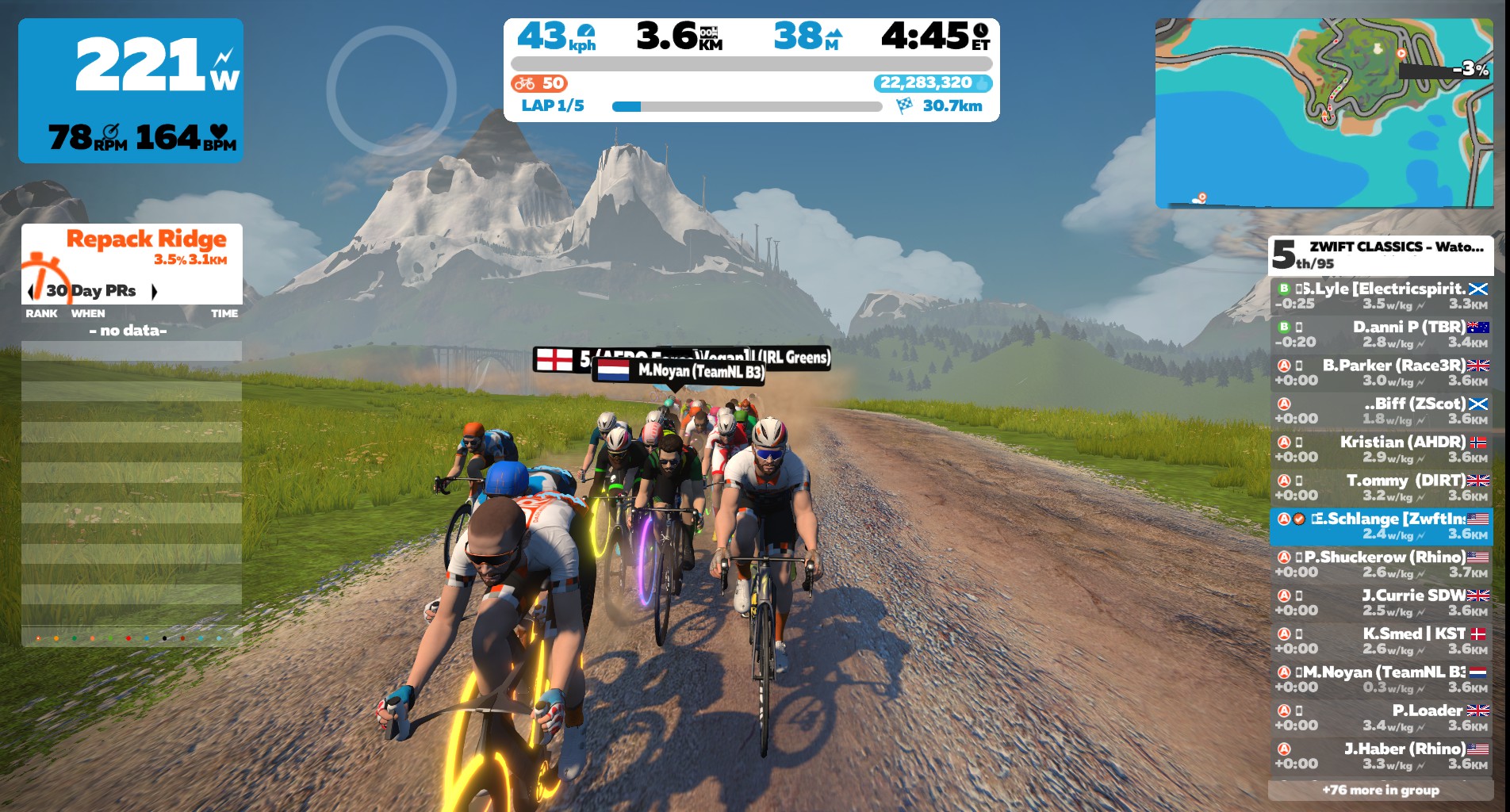
Sure enough, we stretched over the pre-sprint kicker, and that elastic broke as we descended and hit the sprint. By the time we hit the cobbles of the Italian Villas a front group of ~30 riders had formed. This was the key first selection of the race, and if you missed it, you were done.
Solidifying the gap on our first run down the Dirty Sorpresa
Lap 1: the Banter Begins
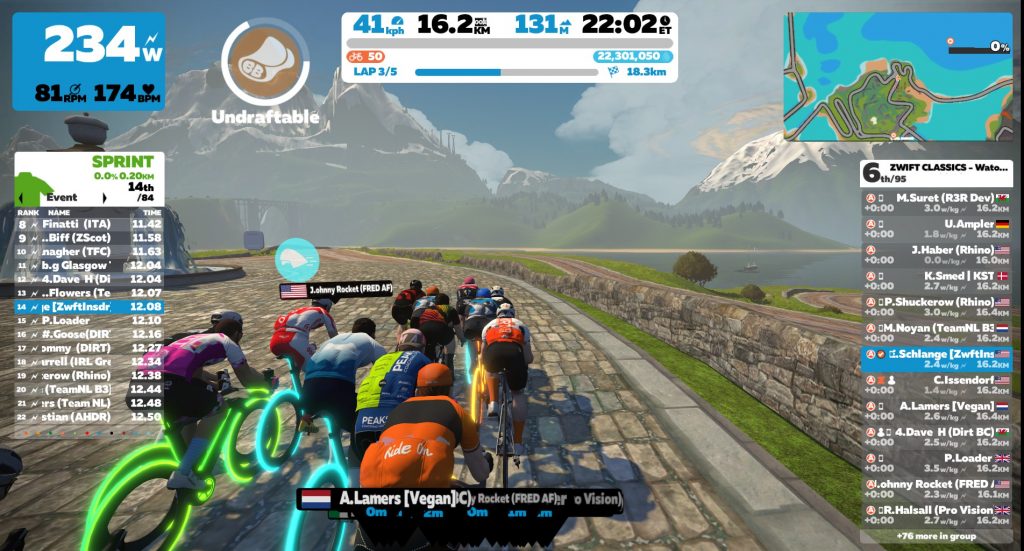
Once the selection was made, things settled down a bit. And that’s when the banter began. Johnny Rocket complained about the “fn burritos” (they were flying everywhere). He also complained that he was “too fat for this crap”. Ha! Johnny’s a fun personality who has been racing on Zwift for a long time.
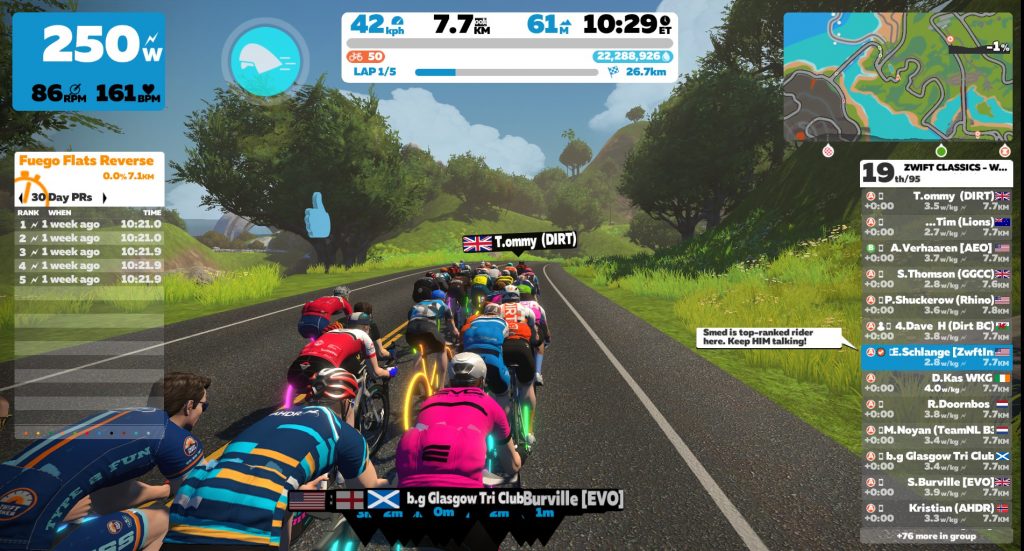
Then Smed started chatting with me, asking “Where u at, Eric?” Smed, I knew, was one of the top-ranked riders in this race. “Living the dream!” I wrote back. I followed up with “Working for Charlie” (Issendorf, Zwift’s Director of Events, who was in the race as well).
As we made our way up the kicker into the Volcano, messages kept flying. This was a fun bunch.
A Marked Man
It’s interesting being in a race where people know who you are. Lots of racers recognize my name from these Zwift Insider posts, plus I’ve got the Zwift verified check next to my name and [ZwftInsdr] in there too. Racers will greet me in the pens, say it’s a privilege to race with me, etc. Super cool, and I enjoy all that.
But what I’ve found is that some Zwifters seem to think I’m a really strong racer, despite the fact that I have literally written the book on how to lose a Zwift race. So I end up being a marked man, where riders watch what I do and sit on my wheel if I ride off the front. Don’t tell anyone, but the truth is, even if I had the legs to attempt a breakaway, I don’t think I could do it in most races.
Speaking of breakaways: at some point in today’s race one of the 3R riders messaged that I was riding near the front because I was concerned about being “Danno’d” – a reference to last week’s Classics race, where 3R rider Danno broke away and never came back. While I wasn’t thinking specifically about Danno, it’s true that I do prefer to ride within a few bike lengths of the front, to avoid getting gapped off the back. (As a bonus, if there is a decent attack I want to follow, I’m close enough to be able to do so.)
So yes – I suppose I was afraid of being Danno’d. Once bitten, twice shy.
Another Lap, Another Sprint
Our front pack settled into a pattern as we pounded through the laps. A hard sprint across the bridge, regroup and descend the Dirty Sorpresa, easy across the land bridge, a dig into the Volcano all the way across the line, then more sitting in until the next sprint.
Powerup Possibilities
Along the way we had two opportunities each lap for a powerup, so there were plenty of them flying. I tried to use my aero helmets and drafting vans at the spots where I’d be working hardest between now and the next powerup banner – which basically meant I used them near the banners for sprinting or reducing my workload in a strung-out pack.
The burrito is always dicey, though. And I had several of those. If you use it in a strung-out pack you can hurt those around you – but it’ll require you to do extra work as well. Instead, I would sometimes take my burrito close to the front of the pack, when everyone was pushing somewhat hard, and drop it there. Make the strong riders suffer a bit more.
Using my burrito on the front riders
Scheming
In lap 4, Smed messaged everyone: “Pst… Eric. After next sprint we attack. Ready?”
He followed it up with, “We just need a couple more.”
“Sounds good,” I wrote. “Just don’t tell anyone else!”
“Can I join?” Johnny Rocket said. “I’ll suck wheels for our attack.”
“No Johnny. You’re too fat,” I wrote.
“:(” says Johnny.
“We still have 1 slot,” comes Smed’s reply.
Let me be clear here: I had no idea if Smed was serious or not. What I did know was I didn’t have the legs to stay away from a pack of ~25 riders if I was in a small breakaway where I would need to take pulls. So I had no intention of actually trying to make a breakaway happen.
But whether Smed was serious or not, everyone knew what was going to happen after the next sprint. Even if Smed didn’t attack, even if I didn’t attack, heck, even if Johnny didn’t attack… the pack would surge. Because riders were expecting an attack. And other riders (like myself) were expecting that riders would surge, expecting an attack.
It’s a vicious cycle.
To his credit, Smed did attack. He was riding on the front through the Italian Villas. We reached the bottom of the Sorpresa and he messaged “go eric”.
But I wasn’t going anywhere.
The pack wasn’t even strung out, and my legs were already hurting from the previous minute’s effort. I didn’t foresee anyone getting away here.
“Well, that didn’t work!” Mark Suret wrote.
“Eric… you let us down…” Smed said.
“Story of my racing life,” I replied, with just the tiniest twinge of guilt.
The Final Bit
I got a burrito through the final banner. Booooo! As we hit the glass bridge to The Esses one rider jumped off the front, but our pack was flying along and I figured their solo attack wouldn’t stick.
With 1.2km to go Haber jumped off the front. He’d done the same repeatedly throughout the race, and I thought for a moment, “He may have what it takes to stay away.” I put in a little dig to chase him, then realized our pack was surging hard, and I could just sit in for the catch.
1km to go and it was getting wild near the front. Riders were flying off the front, but I was unable to grab their wheels, which left me just sitting in the wind. I drifted from 7th to 12th as we hit the pre-sprint kicker, and I was still holding onto my burrito, unable to figure out a good place to use it.
We begin the descent and I’m in 15th. I hit the burrito, hoping to slow those ahead of me and anyone coming through. I’m hammering away, but where are my watts? I’ve got nothing left. A pack of riders flies past. I cross the line in 25th, decidedly outgunned. That final minute was tough.
TeamNL’s “Harm Verhoeven” took the win. Well done, sir.
This was a fun race, even if I blew up at the end. The banter was on point, and the course kept things interesting with plenty of spots to rest, attack, and grab powerups.
Could I have raced it better? I’m not sure. I’ve won races on this course before where I contested every sprint – but those races were against a less competitive B field. It would be really interesting to attempt the same race, but just go for FAL sprint points instead of the overall.
I could have ridden the last minute or two more efficiently, staying out of the wind and saving a few watts instead of thinking I was going to grab someone’s wheel and attack off the front. But without a useful powerup I was never going to get close to the podium, no matter what I did. (I did get a “Breakthrough” performance on XERT, so at least I know I went deep!)
In the end, this event embodied a lot of what I love about Zwift races: being pushed to my limits, enjoying fun banter with other riders, and having a bit of “Insider knowledge” that maybe, just maybe, gives me a slight edge.
Racing with a BMX Beast
Here’s a fun side-note: this was the first week where the women’s race (B category) started at the same time as the A’s, so we effectively raced together, with separate results.
I noticed just one B who was able to stay with the front group of A’s for the duration of the race: “A Verhaaren”. Not a familiar name to me, but it turns out Arielle Verhaaren hails from Williamsburg, Virginia and was selected to compete at the 2012 Olympic games until a crash during a training run hospitalized her and left her out of the team. She’s obviously still got it, finishing 9th overall!
Anyone who has given me a “Ride On” using the Companion App may have noticed from my avatar that I’m more of a jersey hunter than a badge hunter. Not the jersey/kits you can collect from events or using unlock codes, but those that can be temporarily earned for various routes, climbs, and sprints in each world. Route badges can be collected just once, but the Leaderboard jerseys can be made into a personal challenge every ride.
Racing on Zwift has never appealed to me. Among other things, there’s having to schedule around when it begins, including getting warmed up, the tactic seems to make it more like a bunched time trial, and there’s the much-discussed cheating that may or may not be prevalent. Besides, I’m right on the border between two categories – so Leaderboard jerseys are the way I get motivated and push myself.
With that experience, I’ve discovered a few things along the way to improve my chances during each outing. Some are well known and others possibly not quite so obvious. Let’s jump in!
London’s Keith Hill KOM Jersey
The Competition
The way the Leaderboards work, you’re competing against riders who have ridden the segment during the preceding 60 minutes. There’s no controlling this, so if a pro-level Zwifter rode it five minutes before your effort, you’ll be out of luck. And until a recent update, that individual’s best time was locked in until it timed out 60 minutes later (or they exited Zwift).
Bug, or Feature?
As it currently works, riders can also “self-eliminate” themselves by riding a slower time on a subsequent try, even if their best effort remains within the 60 minutes. For instance, the sprint Leaderboard lists Rider A at 10.00 seconds (with the Green Jersey), Rider B at 10.20, and Rider C at 10.30. If Rider A re-rides the sprint and now finishes in a time of 10.50 seconds, that erases the 10.00 effort and Rider B now has the Green Jersey. (Previously, Rider A would remain on the Leaderboard and stay in Green with the 10.00 effort until someone rides faster, the 60‑minute mark, or exiting.) Personally, I don’t care for this revision as it makes earning combined jerseys more difficult, despite already putting in the effort to achieve a segment.
What should be obvious is that the more riders who are Zwifting, the harder it probably will be to earn a jersey. The odds that several riders among 10,000 Zwifters will be faster than you is higher than if only 1000 are Zwifting. But there’s no guarantee that riding with fewer on the course will make it easier to be atop a Leaderboard. It only takes one!
So that’s what motivates me – can I outride, outsprint, or outclimb those who rode the segment the previous hour before me, and can I keep the jersey in the hour afterward?
The Routes
Generally, there is at least one route, one sprint, and one King of the Mountain (KOM) in each world. Exceptions are Paris, with no KOM, and France with no route (although the Marina Sprint earns an Orange jersey rather than the usual Green one.)
Most segments also have a reverse direction Leaderboard. If earned, you always have to be riding in the appropriate direction to wear the jersey (if not, it’ll still show up next to your name and if you do a U-turn it’ll pop back on). Segments with no reverse equivalent are certain unidirectional KOMs including Alp de Zwift, Ven-Top, and the Volcano climb.
By my count, there are over 70 individual Leaderboard jerseys (Watopia = 16; London = 10; Yorkshire = 8; Innsbruck = 6; France = 10; Paris = 4; NYC = 6; Richmond** = 10; Maruki Islands* = 9). To make things more challenging, standard route, sprint, and climb jerseys can be combined: Orange-Green, Orange-KOM, Green-KOM, or all three.
Designated routes (forward and reverse) that can win the combined Route-Sprint-Mountain are: Watopia Hilly Route, Yorkshire World’s course, Innsbruck World’s course, and Richmond World’s course. For the others, you have to do some manual turning. The London Loop has the route and KOM, but the sprints are over at the Classique segment. France has to be a combination of the Marina Sprint (for Orange) and the various other sprints and KOMs. NYC’s Perimeter Loop has the route and sprint, but not the KOM. Makuri Islands* needs more work, and there’s no KOM for Paris.
Yorkshire Combined Jerseys (note the jersey icons to the far right)
* Makuri Islands is buggy. Over the course of the various updates, combined jerseys still are not possible, the Flatland Loop Leaderboard wasn’t seen (initially it was labeled Countryside Tour), the auto-turning took you off route, and the Orange Jersey wasn’t available. Some issues have been fixed, but as of this writing, if you’re wearing a jersey, it won’t show up as an icon next to your name. That is until you go off route. Then the jersey you’re wearing disappears and the jersey icon shows up – for both directions!
** Richmond’s dual KOM and Sprint segments are somewhat confusing, and I still haven’t figured out the logic – for instance, being the fastest of both sprint Leaderboards gets you the Green, but atop just the Broad St. won’t (it has a blue, not green-colored, Leaderboard). But you’ll still show a Green jersey icon next to your name for Broad St. It’s similar for KOM.
The “Easiest”
Besides taking into account the total number of active Zwifters in a world, some jerseys generally see less competition than others. And of course, winning one will always depend on one’s own fitness, fast-twitch vs slow-twitch muscles, etc.
In my experience Watopia’s Jungle Loop (either direction and with a unique jersey) and reverse Hilly Loop (Orange) tend to have minimal activity. Sometimes only a few, or even no one, has ridden them over the previous hour despite 1000s riding in Watopia.
For sprints, Fuego Flats (unique jersey), and either direction of both France’s Marina (Orange) and Makuri Islands’ Village (Green) seem to be the least competitive. I find Fuego Flats odd, given that it usually has 100s who have done it at any given time, but the percentage who sprint it seems relatively low.
KOMs always seem to have a lot of fast efforts. But try reverse Titans Grove, Hilly Loop, London’s Keith Hill, or Richmond’s KOMs. For the combined jersey, if your climbing ability is best, try reverse Hilly Loop. If it’s sprinting, then the forward Hilly Loop. Otherwise Richmond World’s reverse.
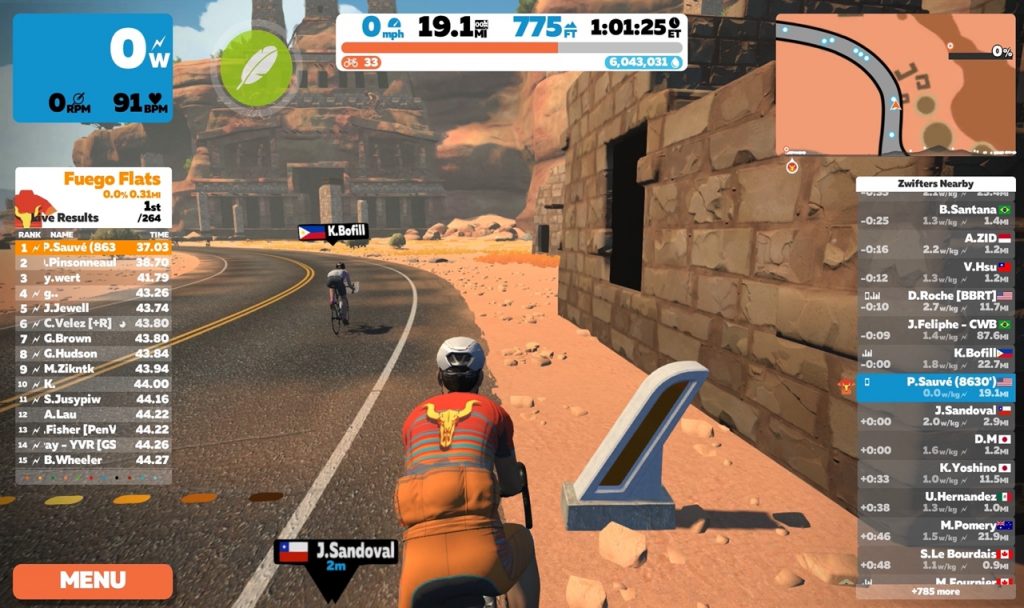
Fuego Flats Sprint Jersey (after returning to the Starting Line)
The “Hardest”
On the flip side, some jerseys are much, much harder to get. I’ve found the most elusive are generally the KOMs, and I suspect that is because Zwifters looking to do a recovery or easy-paced effort, won’t be riding up mountains. People riding the big climbs tend to put out big watts.
In particular, Alpe du Zwift, Ven-Top, and Volcano see a lot of good competition. And the first two are not just a few-minute effort!
Some Hints
Pick times when there are few Zwifters in the world. There are occasions when there can be 2000 or fewer in Watopia, and under 1000 in the other worlds.
Check to see what events are happening around the time you’re planning to ride. If there’s a race that includes the Volcano Climb, then best to pick a different jersey to attempt to win.
Be flexible. If you’re doing the London Loop, but see few Zwifters heading up Leith Hill, turn and give that a go. Heading up Volcano KOM but see your estimated time won’t even make the top 15? Do a U-turn and try something else.
Scope out the segment:
When does the KOM reach the maximum gradient? Do your legs tend to get wobbly near the end? If you have the feather powerup, know when the best time to use it is.
Where does the sprint actually start? DO NOT start your sprint (or even KOM climb or route effort) as you cross the starting line. If you do, you’ve just thrown away valuable time as you ramp up to speed. A hundredth of second can make a difference (I recently won the Marina Sprint jersey by 0.01 sec; my wife came in second in the Hilly Loop sprint with the exact same time showing as 1st place). Always cross the start at speed.
Another good example is the reverse Hilly Loop sprint. There’s a rolling hill just beforehand, where you should be able to build up your speed to over 50kph (31mph) as you come down the backside just before the start on the bridge. Got a feather powerup? There’s a rise just before the start that can sap your speed – so yes, a feather can help on a sprint. Got an aero powerup? It lasts for more (15 seconds) than it might take you to finish the sprint – so use it before the start.
Another example is Richmond’s reverse Broad St sprint. It’s a whopping 4/100th of a mile – about 70 meters. So about five seconds of sprinting. And the starting line is immediately after a blind corner. You should be at full speed as you’re turning the corner, before you can even see the starting line.
A KOM example is Titans Grove. The end is not marked by the typical overhead arch, but by rock cairns on either side. In the reverse KOM, there’s a similarly-sized rock a few meters before the cairn. I once made the mistake of thinking that was the end and eased off, losing out on the KOM jersey by 10ths of a second.
When trying for multiple jerseys that are not on the same route, pre-plan your turns so you know where you’ll head next. The longer it takes you to get there, the more time someone else has to take away the jersey you’ve already won. NYC (KOM) and London (sprint), in particular are key, since the path to get to the separate segment is not obvious.
NYC Combined Route-Sprint-KOM Jersey (which requires manual turns)
The Volcano Circuit (either direction) has a Leaderboard, but not an associated jersey (it used to, but that jersey was stolen and used for the Volcano KOM)
Ride the right setup. For the Jungle Loop and parts of Makuri Islands, a gravel or mountain bike. For (most) KOMs something lightweight, etc. There are other articles on Zwift Insider that go into the details on this, like this one.
Don’t ease up at the end when you see you’ll get the jersey. You’ll have to defend it, and those after you will be able to focus on besting your time. Make them work for it.
Keep an eye out for short-timers. When riders on the Leaderboard are 5 minutes from reaching their 60-minute deadline, a little countdown timer appears next to their name. I’ve been motivated to push harder, knowing that 1st place will soon shift to the slower 2nd place rider. That may come into play on a KOM or route effort.
Let powerups decide. Before a recent update, I knew that I would always collect the aero, feather, and van powerups in that order. That was perfect for the reverse Hilly Loop, as the sprint comes first, then the KOM, and then finish is downtown were there tends to be a higher concentration of riders. Now I sometimes choose my ride based on which powerup I get first.
By the way, the unique jerseys don’t combine with other jerseys (e.g. there’s no combined Green sprint and Epic KOM jersey). And from what I’ve experienced, any Leaderboard jersey you’re currently wearing will not be replaced with a subsequent win. So if you really want to be wearing the Fuego Flats jersey you just scored, but you’ve already won the Hilly Loop jersey, you’ll be out of luck until the Orange jersey times off of you or someone takes it from you.
Give yourself a DNF. If you’ve found yourself on a segment that you don’t want to risk “self-elimination” with a slower time thanks to Zwift’s odd new leaderboard logic, do a couple of U-turns. That will purge your attempt, while letting you continue on your way.
Hack into off-calendar worlds. I think this is a “foul” and have never done it and never would, but there’s the world hack to ride outside of the calendar. You probably would have few others on the course to compete against.
Don’t get discouraged. I’ve been delayed in getting atop the Leaderboards many times when a zPower rider is in first, 25% or so faster than anyone else. I’ve also been on pace to get a jersey, only to have A Anquetil come fast from behind, with others in tow. They’ll time out eventually or exit just like everyone else.
Watopia’s Epic KOM Jersey
That’s my life these days on Zwift – chasing jerseys, waiting for Makuri Islands to get fixed, and trying to combine those jerseys that I haven’t already. I probably shouldn’t have written this, as I may have just decreased my chances. But hey, that will just make any we do win that much more enjoyable. Good luck!
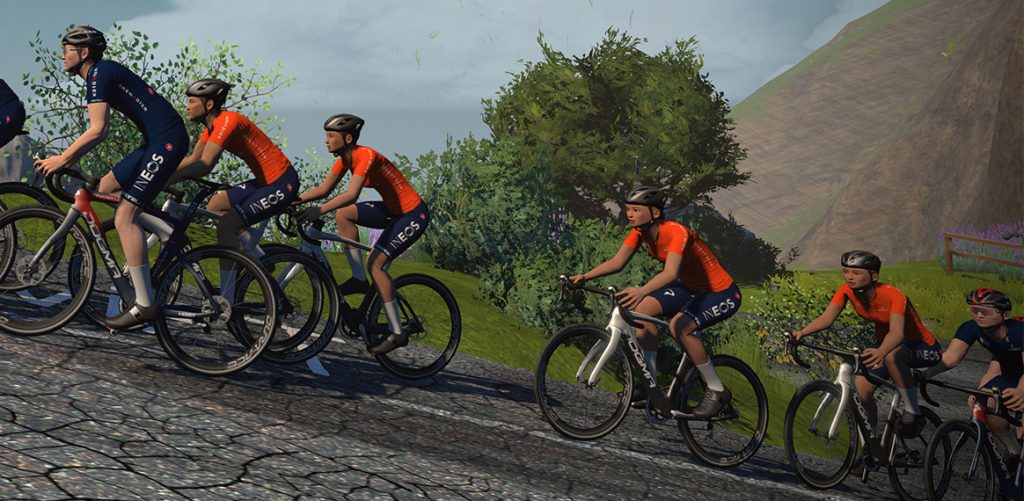
Zwift + INEOS Grenadiers have just announced a short event series happening this week. The “INEOS Grenadiers’ Greatest Hits” series runs from Wednesday, August 11 through Friday, August 13.
Why the “greatest hits”? Because the team’s star riders are leading individual events, often coupled with retired pro riders or other well-known personalities. For example, the first chase race is being led by Geraint Thomas in the fast A group, and World of Zwift personality OJ Borg in the slower B group.
There are 6 events, each taking place on a different route. Whether you want to push yourself to the limit in a chase race, or just enjoy a more socially-paced ride, this series has something for you. Here are more details…
Event Schedule
This series is a combination of group rides and chase races, although all the events are classified simply as rides in Zwift, so they won’t count toward your ZwiftPower ranking stats.
The chase races have just two groups: A and B. Each group is being led by a guest rider (see below). The B group is the “slower” group and will begin a few minutes before the A group, with the intention of both groups coming together near the end of the race for a mad dash to the finish.
There are three chase race events:
Wednesday at 2:15pm CEST/1:15pm BST/8:15am EDT/5:15am PDT Route: Tick Tock, 2 laps Guest Riders: Geraint Thomas and OJ Borg
Thursday at 6:30pm CEST/5:30pm BST/12:30pm EDT/9:30am PDT Route: R.G.V., 1 lap Guest Riders: Brandon Rivera and Sebastian Henao
Friday at 11:30pm CEST/10:30am BST/5:30am EDT Route: The Magnificent 8, custom length (38km) Guest Riders: Jonathan Castroviejo and Christian Knees
Looking for a slower pace? There are also three social rides:
Wednesday at 8pm CEST/7pm BST/2pm EDT/11am PDT Route: Greatest London Flat, 60 minutes Guest Riders: Cam Wurf and Ben Foster
Thursday at 2:30pm CEST/1:30pm BST/8:30am EDT/5:30am PDT Route: Volcano Flat, 60 minutes Guest Riders: Rohan Dennis and Matt Stephens
Friday at 7:30pm CEST/6:30pm BST/1:30pm EDT/10:30am PDT Route: Beach Island Loop, 3 laps Guest Riders: Ben Swift and Leonardo Basso
Finish any ride in the series to unlock the orange INEOS Grenadiers Fans kit!
About INEOS Grenadiers
The INEOS Grenadiers are a British professional cycling team that competes at the UCI WorldTeam level. Based at the National Cycling Centre in Manchester, England, the team is full of world class talent including recent Olympic Gold medal winner Richard Carapaz (Ecuador), Tour de France winners Geraint Thomas (Great Britain) and Egan Bernal (Columbia), current World Time Trial Champion Filippo Ganna (Italy), former World Time Trial Champion Rohan Dennis (Australia), and former World Champion Michal Kwiatkowski (Poland).
This year they won the Giro d’Italia (for the second year in a row) following their victory last year by Tao Geoghegan Hart (Great Britain), who still rides for the team.
The team is so good, they even have cyclists who can win not only on a road bike, but a mountain bikes – see Tom Pidcock (Great Britain), who won Great Britain’s first ever MTB medal in the Olympics.
In summary, they have one of the strongest teams in cycling, with a diverse and multi-national roster. If it wasn’t for a series of crashes involving key riders, I am sure they would have been contesting the yellow jersey at this year’s Tour de France – and they still managed a third place podium with Richard Carapaz.
The architect of this team is Sir David Brailsford (also a Zwifter). He was formerly performance director of British Cycling and is currently general manager of the team. He guided Sir Bradley Wiggins to become the first British winner of the Tour de France and guided British Cycling to unprecedented success in the London 2012 Olympics.
In January’s event I was dropped from the front pack on the very first climb, never to return again. (My chase group nearly pulled back the diminished front group by the end, but not quite.)
This time around, I knew the race would be different for a few reasons:
Different riders: we were using the autocat system now, which had slotted me into C2. Looking at the signup list, I was ranked around #8 in terms of ZwiftPower ranking, which was a much higher ranking than I had in January when competing against the big hitters in Division 1 of the Bs.
Smaller pack: today’s event featured about half as many riders as January’s (50 vs 100). That meant overall speeds should be slower, and pack sizes would be smaller.
Different legs: my fitness was a bit higher when I last raced this route.
Autocat Development
It’s been interesting to watch as WTRL continues to tweak their autocat system. This week they added a Class 0, which meant my class 2 was probably closer to the Yorkshire week’s class 3.
Every Classics race I’ve raced with autocat (3 of them now) has been a good race, despite the numbers not always making sense to me. (How was I C3 for Yorkshire, and C4 for Crit City?)
Anyway, I’ve come to not really pay much attention to which number I get. Instead, I look at the signup list on ZwiftPower to see where I sit in the field!
Bike Choice
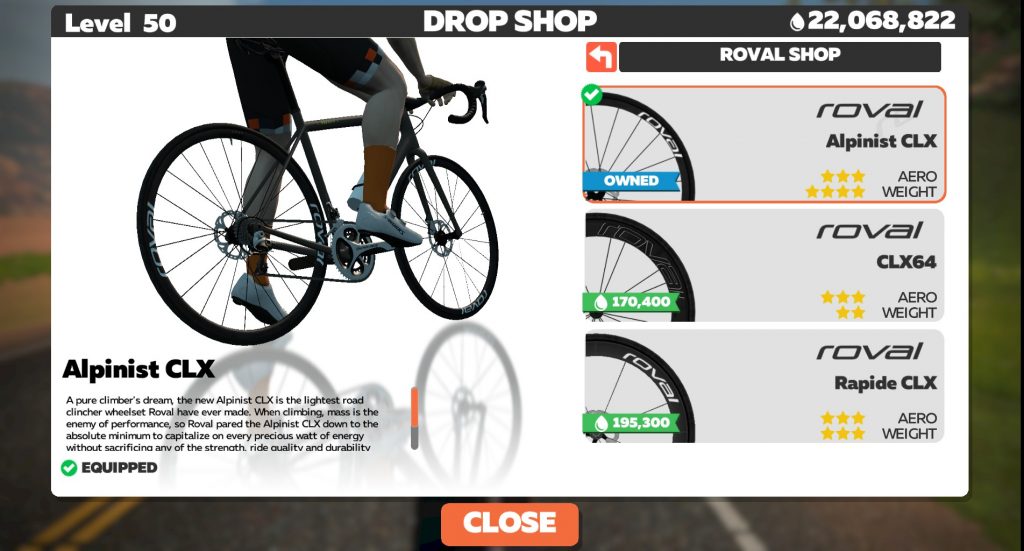
Knowing from experience that the climbs would be where I get dropped, I decided to do something I’ve never done on Richmond: go with a pure climbing setup. So I hopped into the Drop Shop and laid down some cold virtual cash for a new Specialized S-Works Aethos and the Roval Alpinist CLX wheels.
My thinking was: I’ve never been dropped on the flats or downhills of Richmond. Every time I’ve been dropped from the front group in Richmond (which is almost every race I’ve done here) has been on one of the climbs. So why not try something new in terms of bike choice, and give myself a bit of an advantage on the climbs?
I would pay for that advantage somewhat in decreased aero performance on the flats, but here’s the thing: if I got dropped on the first climb like I did in January, all the aero performance in the world wouldn’t help me anyway.
Warmup
I did a pretty standard warmup heading into this race. First it was a couple of pieces of caffeine gum one hour before the race. Then PR lotion on my legs before kitting up, because that bicarb palpably reduces the pain levels.
Then I hopped into the pens as soon as I was allowed, saving my place at the front before popping back out to join the C. Cadence group and spin my legs for a while, putting in a few hard digs to get my heart rate up and break the ice.
After around 30 minutes of warmup I headed to the pens. Let’s race!
Lap 1 (The Start)
This is one of the easiest starts in all of Zwift racing, if you’re a bigger rider like me (84kg). Get up to speed in the first 20 seconds, then hit the Governor Street descent and just hang with the pack. (This downhill is actually supertuckable, but I find I can never quite supertuck the full descent without getting gapped off the back. It’s not quite steep enough.)
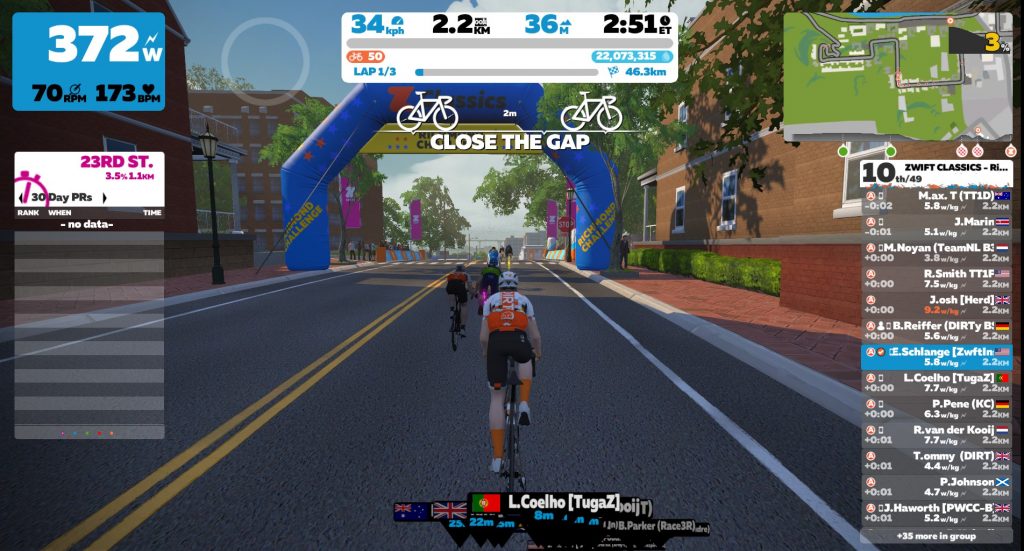
The field of 49 was almost entirely together as we hit the decisive first climb up 23rd St. I positioned myself near the front (a classic “overmuscled cyclist” trick) then pushed hard to try and hold a good position. Cresting the climb around 10th place, I tried to continue hammering so I could stay in touch with any front group that might form ahead of me.
Finishing the 23rd St KOM
That first 23rd St Reverse KOM was finished in 1:50, at a 416W average. My second fastest time ever, bested only by my PR from January’s race of 1:46 at 420W.
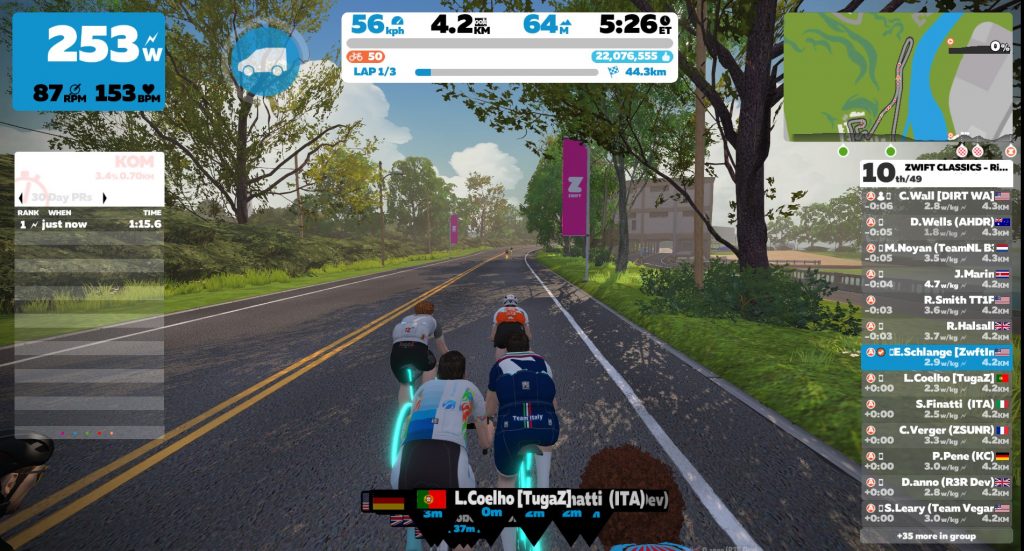
At first I thought I may not be able to hold onto the 9 riders ahead as we started up the reverse climb to Libby, but a handy drafting powerup combined with my virtual inertia and a bit of a well-timed dig on the steepest portion (did you know it hits 19%?!) actually moved me up in the field as we crested the climb.
Or so I thought.
As I eased up over the crest, others kept hammering toward the KOM banner (there is a points race after all) and I found myself sliding from 5th to 7th to 10th as we crossed the banner and began descending Libby Hill.
I was gassed, so I waited for the riders just behind and we worked together nicely to close the gap to the front group.
Working to pull back the front group
My Aethos in a sea of Trons
Things stayed mostly together on the E Main St climb, with Max T (TT1D) going up the road in pursuit of Broad Street sprint points (the shortest sprint in all of Zwift!) He went too early, though, and was caught by other riders just before the line.
Then things calmed down again, until the Monument Avenue sprint. That’s when the pace picked up once more, and I used my drafting boost to try to stay in touch with the front riders while putting out minimal watts.
As we wrapped up the first of three laps, I took this lesson to heart: I wasn’t chasing points in this race, but plenty of riders were. That meant everyone had to stay on their toes. There was no coasting through the KOM or sprint banners – each one was contested, and if you didn’t push your watts you’d be dropped off the back of the front group.
Lap 2 (The Middle)
There were around 20 riders in our front group as we headed into the second lap. Once again I crested the first KOM around 10th, got gapped from the front group, then chased back on with my small pack before the E Main St climb.
Everything seemed to have calmed down on the flats between the two sprints, then Danno (R3R Dev) jumped off the front. This is a rider who had been in my chase group after the initial KOMs on both laps, so I figured he wouldn’t be able to stay away. But the two strong TT1D riders joined him, and I watched as the gap to these riders began to stretch out to 14s as we hit the Monument Avenue sprint.
Surely those 3 couldn’t stay away from our pack of 10… right?
Lap 3 (The Finish)
Heading into the final lap, the breakaway group of 3 was 24 seconds up the road, and I was in the peloton of 10 riders just behind.
I lagged behind on the final climbs, so I knew I wasn’t the strongest in this group. But the truth was, nobody really seemed to have the legs or willpower to put in the work to pull back the breakaway. The first two KOMs reduced our group to just 7 riders, and the breakaway kept riding smart, maintaining a safe gap.
It’s rare that a breakaway of 3 will stick in Zwift, but I was doubting our ability to pull this back. One breakaway rider (Robert Smith of TT1D) had a 20-minute power rating of 371 watts, and he put that power to good use on the flats, using it to help the breakaway maintain a gap, then eventually jumping off the front for a long solo breakaway attempt as we headed through the final Monument Avenue Sprint with around 4.5km to go.
(This is standard team tactics, of course. If you’ve got two teammates in a breakaway of three, that third man is doomed because the teammates can just trade attacks, forcing the third man to chase down each attack if he wants to stay in contention.)
Our group was putting in a half-hearted chase, knowing we wouldn’t make up the 25s gap before the finish line. But then a rider in our pack alerted us to a group that was pushing from behind, just 10s back. If we didn’t keep pushing they’d catch us!
That lit a bit of a fire beneath us, and the group cruised quickly to the finish. My final sprint was weak, and I finished in the back of our group. 10th place on the day. Well done to the breakaway for working together to make it stick!
I wasn’t chasing points in this race, but the riders who were sure animated things. This was a far more action-packed event than the typical Richmond scratch race where you attack each climb and sit in on the flats.
Did my Aethos + Alpinst climbing combo help me? Hard to say – there are a lot of variables in play. But I will say that the flats didn’t seem any harder, and I felt I was able to hang just a bit better on the climbs. (Note: it might have been all mental – but that doesn’t mean it didn’t work.)
Would I go with the pure climber again on this route? Absolutely. In fact, I may try it on some other routes as well. Because I’d rather make it to the end of the race in the front group too tired to sprint than get dropped on a climb and never even be in contention.
Questions or comments?
What do you think of my bike choice? How did your Classics race go this week? Comment below!
In terms of big branded events over the last month, things have been pretty quiet by Zwift’s standards. This just goes to show the very high level of events that are now regularly hosted by Zwift and how, as a consequence, we become accustomed to them.
However, this week sees a couple of unique and interesting headline events to challenge ourselves with. Let’s go!
Off the MAAP: Stage 2
If you can’t make it to London this year for a summer holiday, how about taking a virtual trip instead?
Stage 2 of the Off the Map event is hosted on the London map, and there are multiple events throughout the day. There are even varying distances and routes depending on what you fancy.
If you fancy a long ride, you can tackle the 56.2km London Pretzel, or if you have a bit of time crunch, you can tick off the Greatest London Loop at a nice distance of 26.1km. You can read more about the Off the Map events here.
This is the first-ever team triathlon event on Zwift! You can represent Team US, Team Europe, or Team International. In this instance I have highlighted Team Europe.
How this works is for both ride and run events, there will be three events each day per team. Event distances vary from short, medium, to long. You can help your team by racking up as many miles as you can throughout this series. Encourage other riders in your region and provide motivation because together, we can go farther and score more points! 1 point will be awarded for each km biked and 5 points awarded per km run.
What I like about this event is the Run and Ride events are staggered so you can literally go from one to the next and have a complete workout.
In my opinion one of the best events this year so far on Zwift was the multiday Haute Route Watopia event in February. Those that took part can testify that it was the equivalent to running a half marathon on three consecutive days. That’s why I am keen to highlight the Haute Route Nations Ride, which is hosted on the Surrey Hills route in London and totals 44.2km.
This is a 5km mass start event and runs at multiple times every Saturday.
It is open to runners of all abilities so whether you are a recreational runner or an elite athlete you are welcome on the start line.
Interestingly, this a different take on the British creation of “parkrun” which has developed into a global phenomenon. Parkruns are free, weekly, community events all around the world.
Saturday morning events are 5k and take place in parks and open spaces. In the UK, parkruns have restarted after being stopped as a result of the pandemic. For those who are still a little wary of training in groups (and I include myself in that category) this event on Zwift is the perfect way to recapture the magic of a parkrun.