

Zwift Update 1.0.53028 Released
The latest Zwift update is now available on PC, Mac, and Android, with iOS and Apple TV releases coming quickly as usual. The update is a big one in terms of download size, because it’s stuffed full of new assets for two new worlds! Let’s dig into the details…
Not sure if your Zwift install is up-to-date? Here’s how to check >
New Maps: France and Paris!
The update notes say:
- The newly added France map includes 7 new routes between 12 and 37 miles (21-61km) in length, with elevation gains of over 3,000 feet for some routes (+1000m).
- The newly added Paris map includes a new flat 4.1 mile (6.6km) route in two directions so you can race around downtown Paris.
Virtual Tour de France?
Rumors have been swirling since early this month that Zwift would be hosting a virtual Tour de France in July. While Zwift is undoubtedly bound by embargo agreements with partners, it would seem that today’s release all but confirms the rumors.
If what CyclingNews posted earlier this week is accurate, the France map includes Mont Ventoux, and the Paris map includes Champs Elysées. Spendide!
My guess is we’ll be seeing official announcements regarding Zwift + TdF very, very soon. (The Tour generally starts in early July, after all.)
But for now, let’s just enjoy the fact that we’re getting some new roads – and in fact, a substantial amount of them!
Event Only?
The release notes say “More detail on these event worlds will be coming soon” (emphasis added). Zwift is taking some heat in the forums for releasing new maps and making them event-only, but I want to propose an alternative reading. Follow me…
- Zwift hasn’t officially announced a single thing regarding a virtual TdF… yet. (But my sources in Zwift tell me there is big news coming early next week. And the update notes say, “Today we have a new update for you and it’s a BIG ONE.” Big one. All uppercase. Italics. Bold. There’s a message there.)
- If the virtual TdF is happening (and all signs point to “yes”), then Zwift will be carefully coordinating the release of this big news with ASO and other partners. (This would be huge news, after all: Zwift’s biggest news to date!)
- The new France map is big. The download took a while! 7 new routes between 12-37 miles in length, with an elevation gain of “over 3,000 feet” for some routes (Ventoux, anyone?). Zwift’s two event-only maps (Bologna and Crit City) are 8km and 2km in length, respectively. I highly doubt that Zwift would build a new map this large, then relegate it to event-only status forever. (2020 has been a crazy year – but not that crazy.)
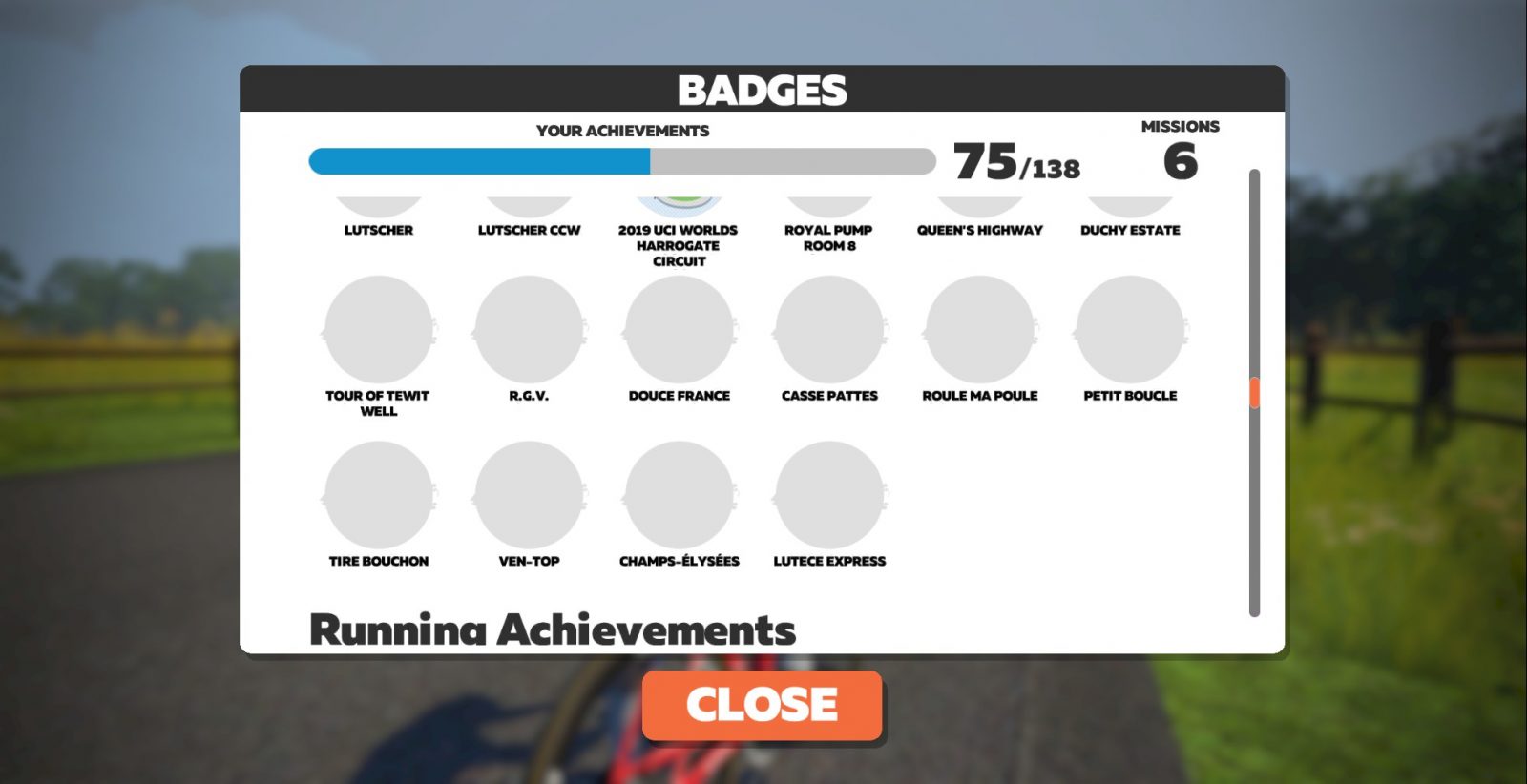
- Perhaps the biggest piece of evidence: badges. There are new route achievement badges that showed up in today’s update (see image below). Presumably for the new maps. Zwift has never had route achievement badges for event-only routes, only for free-ridable ones.
- If the TdF is happening on these new maps, Zwift would obviously make the new maps be event-only on a temporary basis. They’ve done this in the past when new UCI courses were launched – it adds some excitement and exclusivity to the launch. Then the worlds are opened for free-riding once the big events have passed.
- Zwift didn’t call the new maps “event-only”. That’s very specific language which they’ve always used in the past for event-only routes and maps. They called France and Paris “event worlds” – which is exactly what they would be, if they’ve been built for the virtual TdF. This, I think, is very specific, careful language.
This alternative reading would suggest that these new maps will begin as event-only, but make their way onto the guest calendar rotation in the near future. So I wouldn’t get too up in arms about today’s announcement – it’s all good news, if you look closely.
Read/discuss Wes Salmon’s full release notes >
Questions or Comments?
What do you think? Is a virtual TdF announcement just around the corner? Will we get to free-ride these new maps some day? Share your thoughts below!
6 Zwift Events Not To Miss This Weekend
Opportunities to challenge oneself are always available on Zwift. There are big Zwift events, as well as unofficial events and solo challenges. Here are 6 events this weekend you may want to check out.
Special thanks to Jesper at ZwiftHacks with his Events app which provides powerful event filtering tools that help us create this list each week.
Chasing Cancellara
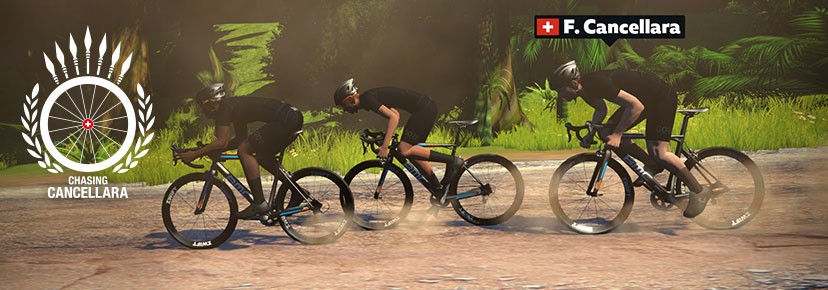
With nearly 3,000 riders already signed up, this will certainly be the weekend’s biggest event! Join the correct category, then work with your “teammates” to try to stay away from Olympic gold medalist, 3x Paris–Roubaix champion, and multiple Tour de France stage winner Fabian Cancellara, who will start a few minutes back. Learn more >
Sunday 7pm BST/2pm EDT/11am PDT
Sign up at zwift.com/events/view/796537
Raid Local
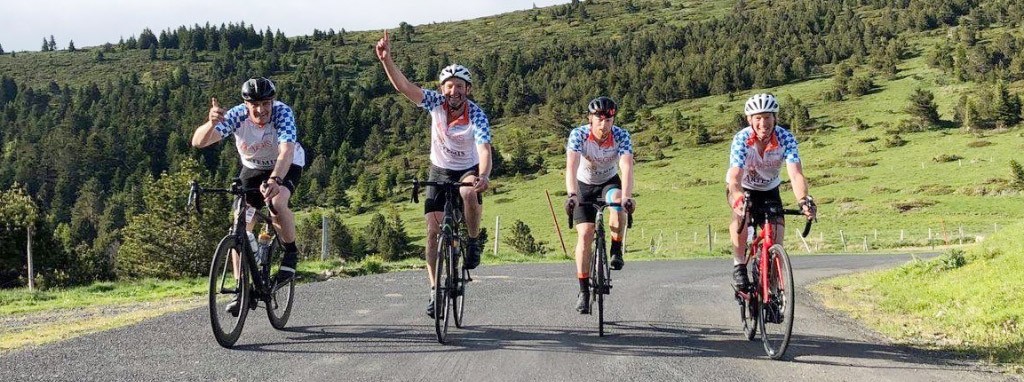
This unique 3-stage charity event is being hosted by sporting legends in support of The Cure Parkinson’s Trust (CPT). Learn more about the event >
Stage 1: Ride leader Chris Hoy (8am BST/3am EDT/12am PDT)
Stage 2: Ride leader Austin Healey (11am BST/6am EDT/3am PDT)
Stage 3: Ride leader Shane Williams (3pm BST/10am EDT/7am PDT)
Cervelo Rise to the Challenge: Social Ride (TT)
The precursor to next weekend’s big Cervelo Rise to the Challenge Ride, this “social ride” is being done on TT bikes (which means you’ll see a lot of riders hammering instead of socializing). Hosted by IRONMAN World Champion Anne Haug!
Two event times: Sunday 10am BST/5am EDT/2am PDT and Sunday 6pm BST/1pm EDT/10am PDT
Sign up at zwift.com/events/view/914978
Alpecin Cycling Series Fondo
This Sunday sees the first in a new Euro-centric monthly fondo series in partnership with pro team Alpecin Cycling. The “Alpecin Cycling Series” includes a big prize drawing and a chance to try to hold the wheel of cycling superstar Mathieu Van der Poel. Read event details >
Sunday 9am BST/4am EDT/1am PDT
Sign up at zwift.com/events/view/887314
Hope Challenge Virtual Edition
Take on the Hope Challenge – the world’s largest virtual Everesting event! The vEveresting Hope Challenge is a fundraiser event like you have never experienced before. Ride alongside fellow cyclists from all over the world on virtual roads through Zwift and conquer your mountain. With expert commentators, guests, and live feeds from cyclists attending, be a part of the Ride for Freedom and help put an end to modern-day slavery.
Everesting not for you? Fear not. There are plenty of distances to choose from in this year’s Hope Challenge: El Capitan (2464m) – Everest Base Camp (4424m) – Everest (8848m) – 10K (10.000m).
Saturday-Sunday. Sign up for more event details.
Movistar Team “Restart” Ride
This just seems like a cool reason to ride, especially for Movistar Team fans! “As we reach one month before our official return to racing, the Movistar Team’s men’s and women’s squads join all the Zwift community for a ‘season restart’ ride, to be broadcast live both on Zwift and the Blues’ social media channels. Our only goal here: enjoying one of our final weekends without a number pinned – with you! Just sharing the Zwift roads, commenting on the plans ahead and seeing how everyone’s doing with a nice push at the end of the ride. Only the last few kilometers will be at free speed; the rest will be covered at a social pace.”
Saturday 6:30pm BST/1:30pm EDT/10:30am PDT
Sign up at zwift.com/events/view/917444
Your Thoughts
Got other events that stand out this weekend? Share below in the comments!
Alpecin Cycling Series Announced – Ride a Fondo with MVDP
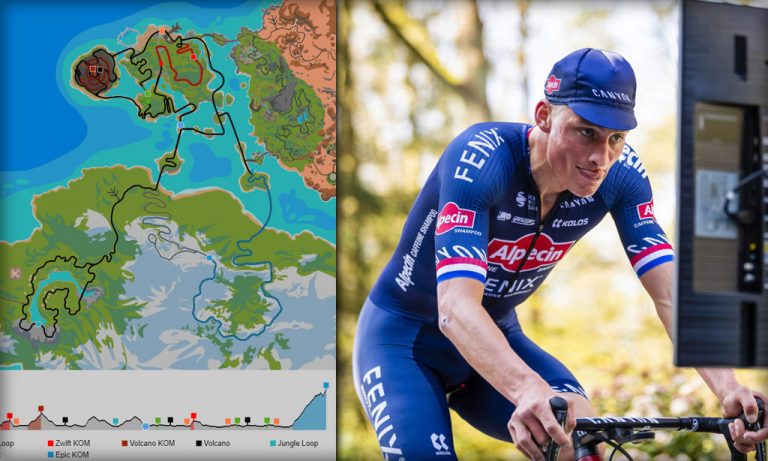
Zwift has just rolled out a new Euro-centric monthly fondo series in partnership with pro team Alpecin Cycling. The “Alpecin Cycling Series” includes a big prize drawing and a chance to try to hold the wheel of cycling superstar Mathieu Van der Poel. It all kicks off this Sunday, June 28!
Is this a Race?
Officially, no. But many riders will treat these as races. Ride your ride. Find a group traveling at your pace and enjoy the challenge!
Schedule
There is one fondo each month for June, July, and August:
- Sunday, June 28 (9am BST/4am EDT/1am PDT) – Sign up at zwift.com/events/view/887314
- Sunday, July 26 (9am BST/4am EDT/1am PDT) – Sign up at zwift.com/events/view/887332
- Sunday, August 30 (9am BST/4am EDT/1am PDT) – Sign up at zwift.com/events/view/887334
Routes
Each month’s event is set up the same way. The category you select determines which route you will ride.
A: Gran Fondo - 97.2km (60.4 miles), 1148m (3766′)
B: Medio Fondo - 72.6km (45.1 miles), 981m (3219′)
C: Bambino Fondo - 52.1km (32.4 miles), 553m (1814′)
Prize Drawing*
There is a giveaway associated with this fondo series, but it’s only for Zwifters in particular countries. The official rules state “The Promotion is open to individuals who reside in the countries of Germany, Austria, Switzerland, Luxemburg, Belgium or the Netherlands and are 18 years of age or older as of date of entry…”
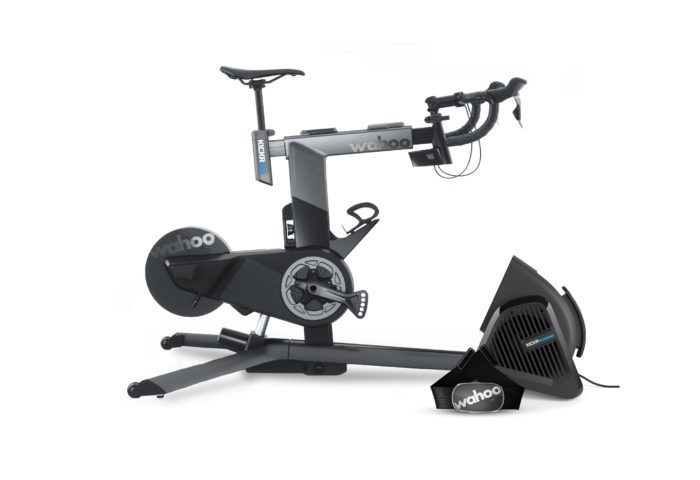
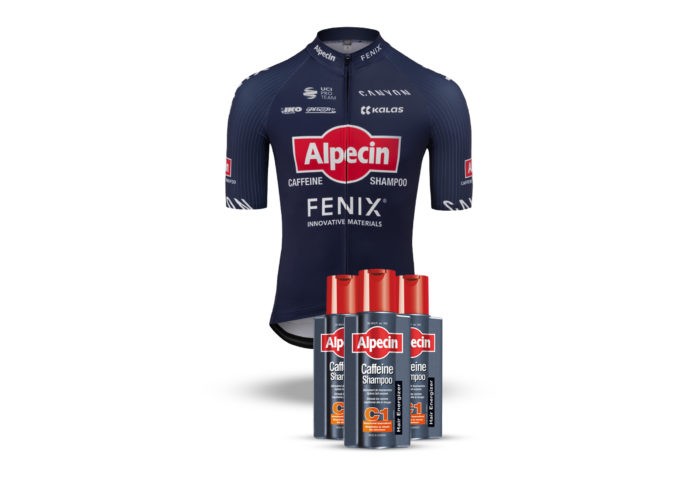
The grand prize is a Wahoo KICKR bike and Headwind fan. In addition, Zwift is giving away 10 Alpecin-Fenix sets (jersey + bib short) and 50 Alpecin Caffeine shampoo product sets.
We reached out to Zwift HQ for clarification on these drawings and confirmed that only Zwifters in the countries listed above are eligible to win these prizes. This is due to Alpecin’s market and product availability.
Maize Wimbush on Aiming to be the First Female African American Olympic Cyclist (Zwift PowerUp Cycling Podcast #54)
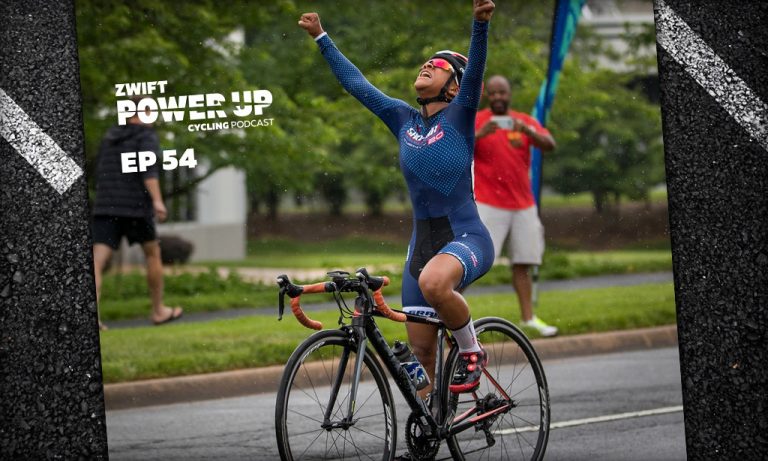
Kristin Armstrong talks with 14-year-old future star cyclist Maize Wimbush about the passion of wearing the red, white, and blue and representing your country. Maize opens up about her dream of being the first female African American to make the Olympic Team in cycling before receiving advice from 3x Olympic Champ Kristin Armstrong.
About the Podcast
The Zwift PowerUp Cycling Podcast features training tips from host Matt Rowe (Rowe & King), with regular co-hosts Greg Henderson (Coach Hendy) and Kev Poulton (Powerhouse Cycling).
3-Stage “Raid Local” Event Announced for June 28th
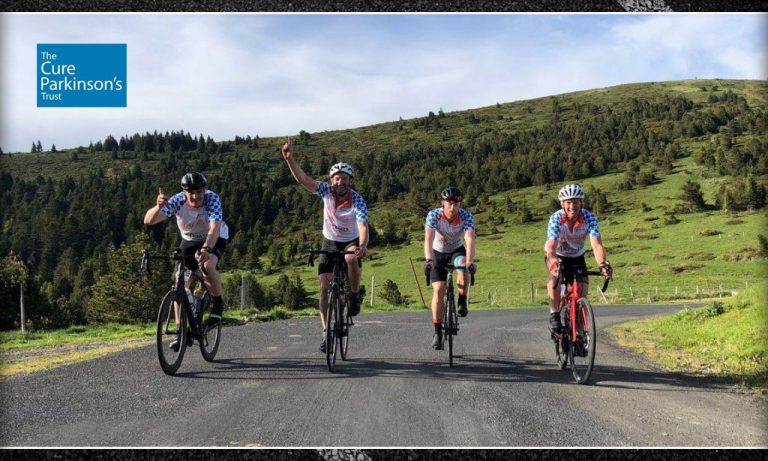
A unique 3-stage charity event has been announced for this Sunday, June 28th. The “Raid Local” rides will be hosted by sporting legends in support of The Cure Parkinson’s Trust (CPT). Here are the details…
About Raid Local
The Raid Local event was born as a result of CPT’s scheduled ‘Raid Alpine’ cycle challenge – its biggest ever – being postponed due to COVID-19 restrictions. With significant loss of income due to this postponement, CPT needs our support more than ever to continue its vital work of supporting those who are working to find a cure for Parkinson’s.
Raid Local includes two cycling challenges – you choose what works best for you. Ride local roads covering 137km distance and 3700m of vertical ascent, or do it on Zwift! Read more about Raid Local on CPT’s site >
Ride Leaders and Participants
Rugby World Cup winner and CPT Patron Mike Tindall MBE is leading the IRL event, taking on the grueling hills of Gloucestershire. His team of sporting legends will be leading the virtual Raid, and Zwift riders are invited to join them in support of CPT. Mike’s team includes:
- Olympic and World Champion cyclist Sir Chris Hoy (leading stage 1)
- Ex English Rugby International Austin Healey (leading stage 2)
- Ex Welsh Rugby International Shane Williams MBE (leading stage 3)
- Rugby World Cup winner Iain Balshaw MBE (sweeper across all 3 stages)
- British Olympic skeleton racing champion Amy Williams MBE
- English professional golfer Lee Westwood OBE
- TV and radio broadcaster Kirsty Gallacher
Stage Details
- Stage 1: Ride leader Chris Hoy (8am BST/3am EDT/12am PDT)
- Route: Innsbruck Achterbahn (1 lap)
47.38 km (29.4 miles) long, 973m (3,192‘) elevation gain
- Route: Innsbruck Achterbahn (1 lap)
- Stage 2: Ride leader Austin Healey (11am BST/6am EDT/3am PDT)
- Route: London Surrey Hills (1 lap)
44.1 km (27.4 miles) long, 1029m (3,376‘) elevation gain
- Route: London Surrey Hills (1 lap)
- Stage 3: Ride leader Shane Williams (3pm BST/10am EDT/7am PDT)
- Route: Watopia Quatch Quest (1 lap)
45.9 km (28.5 miles) long, 1683m (5,522‘) elevation gain
- Route: Watopia Quatch Quest (1 lap)
Is This a Race?
It’s not a race… until it is! These events aren’t formatted like your typical Zwift group ride or race.
Celebrity lead riders will target a 2-2.5 w/kg pace for the first hour of each stage. Riders are encouraged to ride as a group during that time, and at their own pace for the remainder of the stage. Challenge Chris Hoy, Amy Williams, or Lee Westwood to a sprint or climb and see how you do!
Zwifters are welcome to ride one, two, or all three stages.
Kit Unlock
Complete any of the three stages of the Raid to unlock the Rapha Classic Flyweight 2019 jersey.
Donations Welcome
CPT is asking all who join to make a donation of £20, or more if you are able, to The Cure Parkinson’s Trust on JustGiving.
You may also take your support to the next level by setting up your fundraising page through CPT’s team JustGiving campaign, then asking friends and family to help spread news of your challenge and sponsor you!
Tales from the Blunt End: Part 3
It’s me again, back once more to fill the void left by a lack of real-life professional racing by telling the tales of a somewhat unfit, heavy, and slow nobody trying to make it in the blunt end of Cat D events. Huge thanks to all the people who have read so far, and for all the positive encouragement and constructive advice provided. If nothing else, Zwift has a great community of users. Ride On!
End of the Beginning
So 6 weeks ago I signed up to a 6-week FTP Builder program in hopes of getting my w/kg closer to 2.5 (the top end of the D category) so I could challenge D podiums, sans sandbaggers.
There have been many times during the last few weeks where I regretted signing up to such a lengthy program.
A lot can happen in 6 weeks, and it certainly did. For starters, the weather was amazing! The UK had its sunniest month on record in May, and I was kind of gutted I was indoors not outdoors.
Now the plan (and the coronavirus lockdowns) is finished, the weather has turned back to winter, and I’m stuck inside once more. Maybe I should start another plan to coax the summer back? I could toughen up and ride in the rain, but then what would Zwift be for?
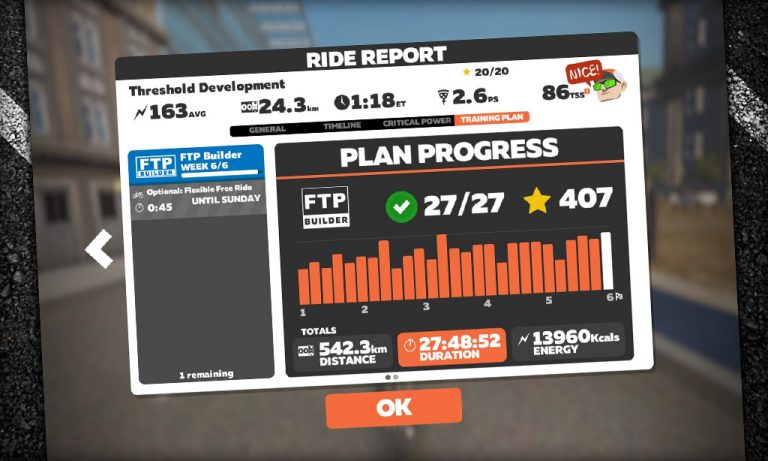
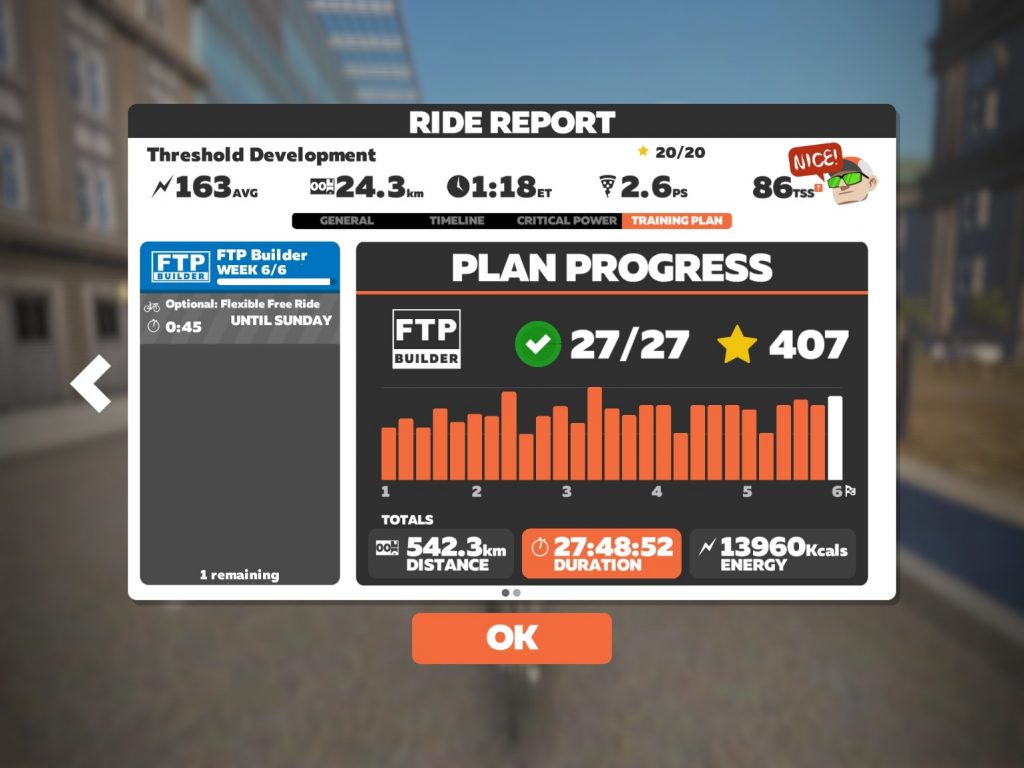
I also had to skip some interesting events, challenges, and rides with friends as they just didn’t fit with the plan I was doing. But it’s done now, and after nearly 28 hours, 550km and 14000 calories I’m free to ride how I want to. With my new weight and fitness, I’m ready for races and sunshine if and when it returns.
Here’s how the second half of my program progressed and what the outcome of the new ramp test was. Will I be ready for races, or still drafting the joggers?
Badges and Trophies
I had feedback after my previous post that I wasn’t following the plan properly as I was adding extra sessions. I couldn’t agree more! In the first few weeks, the plan was very relaxed. But the fatigue was growing as the days went on, and I was almost certainly impeding the correct training zone development at least somewhat. I knew as the plan progressed it would be harder to stray and I therefore stuck to the plan much more closely after week 3.
The problem is, I’m using Zwift to get fitter because I enjoy it. Yes, being quicker will help me enjoy it even more, but if I take it too seriously I worry it may actually lose motivation and it will be counterproductive. So there were a few occasions where I added a little bit more, and I don’t feel at all bad about it either.
The main extra effort was in the last week. I’m currently hammering climbing routes for the elusive Tron bike, but also to grab the Strava badges related to climbing in June – very challenging for the heavier rider. There was one Strava challenge I really wanted to add to my trophy cabinet, a climb up the Alpe from Strava Japan Club. #BordersAreImaginary
My previous trip up the Alpe had taken 2 hours and 25 minutes, so I knew I wouldn’t get to the top in my typical 75-minute workout using the Road to the Sky route. Based on my previous rides, my 75-minute workouts were getting me around 600m up the Alpe before they finished and I freewheeled back down. To make it easier, I paused my work out before I started and coasted down the hill through the Jungle to the base of the Alpe. This saved me around 15 minutes of riding and took no effort. Once the road turned up I unpaused the workout and enjoyed the low watt 10min warmup which took me most of the way to the first corner.
The workout was intense, with intervals in the green and yellow training zones. Although I was happy to be quickly ticking off the corners one by one, it’s particularly depressing when you’re hammering away in the yellow zone and someone glides past you in their blue or even grey zones. This happened a few times and I think it should be banned, or there should be Mario Kart powerups so I can boop them back down the hill!
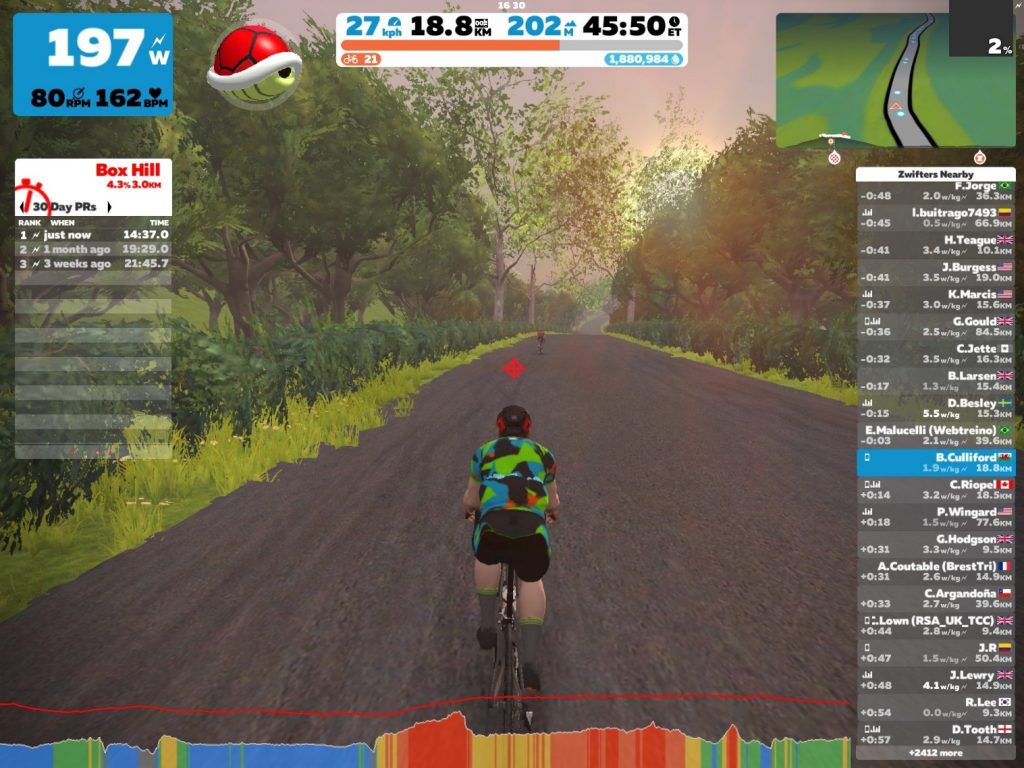
I persevered and when I ran out of workout I was at around 750m climbed, or 300m from the top. My head was telling me to get off the bike, by my heart reminded me that the Strava Japan Club had challenged me to complete this climb and this was my best opportunity. (Admittedly, they had not challenged me directly, I found it on a Strava hack site, but I had accepted none the less.) It took me another 30 minutes to reach the top, a total of 1:55 on the Alpe itself. 30 minutes faster than my previous ascent! For my troubles, I got a second helmet from the prize wheel which I immediately listed on eBay, then managed to shower quicker than Digital Bryan could freewheel back down the hill.
Glitch in the Matrix
Yet more badges were earned a few rides later, this time Zwift ones. When I say earned though, my efforts were merely a result of owning an old second hand turbo, which glitched to give me a very brief power output of exactly 2000w. This brief surge was enough to unlock all the power badges above 800w in the process. Very annoying as I’ll have to earn them all properly now before I can sleep guilt free, especially as WADA are still on my case about the weight doping in my recent Crit City loss. If the 2000w badge actually provided a Delorian I’d go back in time to stop it happening, but if one of Eric’s Minions reads this, please take them away!
Glitch in the Matrix
No, it’s not deja vu, I get a lot of these. I love Zwift, it’s great, but there are times when I feel like it’s still beta software. If it’s not because of compatibility and connectivity issues with hardware, or quirky route issues where I go the wrong way, it’s the fact that so much of what I’m paying Zwift for occurs on third party websites.
Using Zwift costs the equivalent of buying a new console game every 4 months. It’s not cheap, especially when you need plenty of expensive hardware to make it work. I also now have a subscription for Strava which displays many of the stats that I would prefer Zwift to give me directly (I could feel myself getting fitter as I pressed the subscribe button). Then there is ZwiftPower who do a better job of managing race results for free than Zwift do with their paid subscription. That would be like paying to watch an NBA game on ESPN, but having to check what the score is on some random fan’s Twitter page. I know there are plenty of other sites out there which, in my opinion, do the jobs that Zwift or Strava should be providing, especially for the premium rates we are paying. VeloViewer is another example, or if Strava tracked our calories like Myfitnesspal it could calculate all our meals and macros (or wine, pizza, and chocolate) automatically too. Instead, I have a growing number of random apps and websites all meshed together to provide something resembling a finished product, I think I need an app to manage my apps if anyone wants to make one. It also makes sense to me for Zwift, with their majority winter income, and Strava, with their majority summer income, to merge into a new subscription service. It’s like the ice cream stalls that sell hotdogs in the winter.
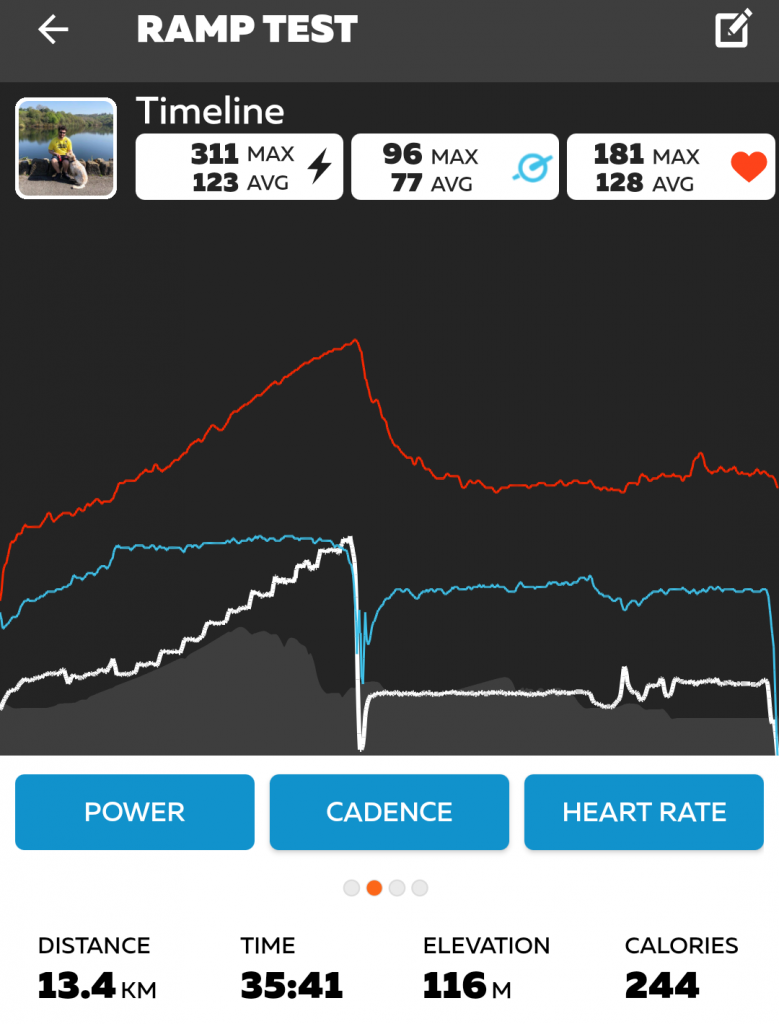
Enough of the rant and on with the glitch. This particular one was the most infuriating I’ve had so far as it occurred right at the end of my FTP test. I started the test full of confidence and excited to see an improvement on my previous 217 watts, and I know you are all equally excited to find out how much fitter some random novice you’ve never met can get in 6 weeks. I have to admit though, I’d kind of had a falling out with my legs on the last day of the workout program, and I’m not sure they had forgiven me after just 1 day off the bike. I was pedaling ok through most of the test, but could certainly feel some background ache in my quads, and my hamstrings were quite sore from a gardening session the day before too, although this didn’t seem to be troubling my cycling at all. I hoped that as the test progressed and I warmed up a little they would loosen up, but alas, it was not to be. I’m sure they would have cost me a few watts when the results came in.
Sadly though, we will never know. Just as the test ramped up to 300+ watts, the resistance on my trusty second hand Bushido kept dropping away. I had already lost the ability to hold a steady cadence at this point, so was mashing the pedals a little, but still had some left to give, then suddenly there were 3 very brief moments over a 5 second period where the power cut allowing my legs to spin a little more freely. I kept going through the first 2 instances before deciding that I may end up giving myself an artificially higher FTP. Not wanting to fatigue myself for no reason, yet quite angry it had sabotaged my efforts, I stopped early, and despondently cooled down while googling for trainer upgrades I can’t afford right now. I have to admit this also left me somewhat disillusioned and lost with the cycling process as a whole, similar to how I felt when I’ve had other tech issues in the past.
I’ve hammered my trainer in some high wattage uphill sprints since then and while it’s not replicated this issue or any other glitches, it hasn’t restored my confidence it won’t reoccur in my next test, race or group ride.
Previous FTP test 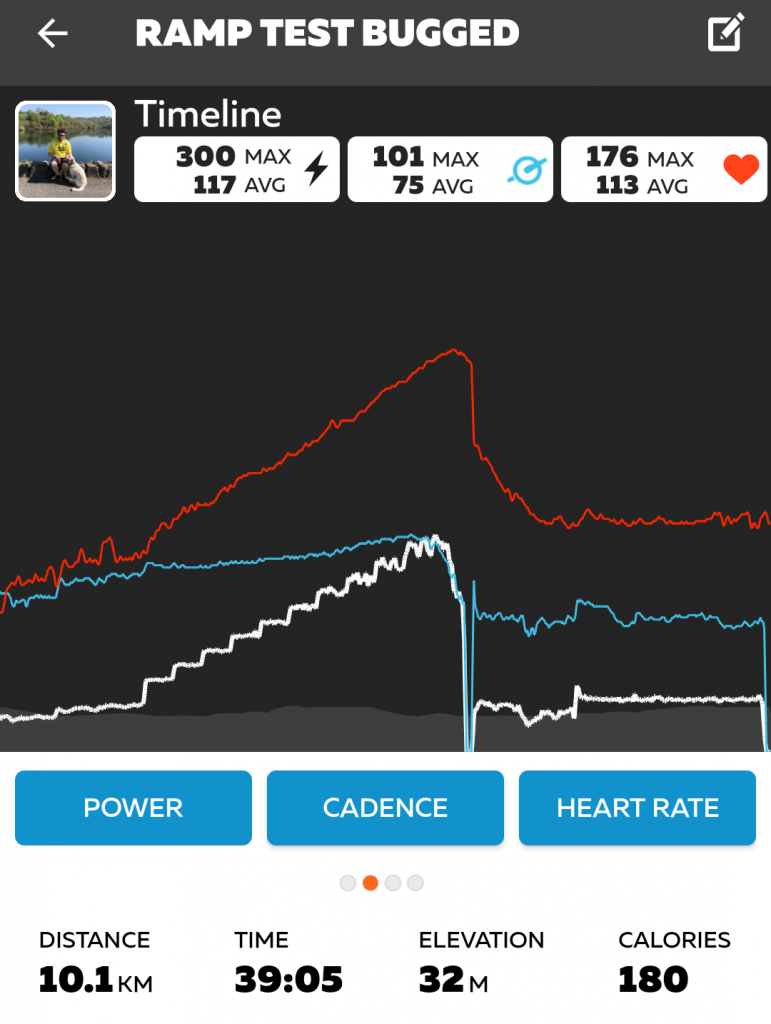
Glitched FTP test
There is some hope though! Based on the less than fresh legs and the early finish to the test, I’d expected a really poor result to show up, but was delighted that I’d in fact scored 216, just 1 watt down on my previous best. I won’t update what this means for my w/kg as it’s inaccurate and marginal at best, but the positive I can add to this update is that I’ve finally returned to 102kg, dropping 7kg during the 6-week program.
I have to confess, Digital Bryan is no quicker yet. When I discovered my post-honeymoon fat increases I wasn’t able to bring myself to change my in-game weight, so this weight loss simply means I’m no longer lying about it. Better yet, every kilogram I lose after this will result in a faster DigiBry and I’m also off the self-imposed WADA most wanted list so I can race again, even if this actually means I sign up to a race and pedal around on my own after everyone slides over the horizon together.
Make Fun Fast Again
Now that I’m done with the program, it’s time to look for some races and group rides to put the fun back in my exercise. In a week or so I will try the FTP test again in hopes it’s glitch free so I can see some progress. But first I’m going to take a day or so to rest and recover as my legs and I are clearly not fully on talking terms yet.
Then I plan to scour the Zwift Hacks event listings (another free site doing a better job than the app I pay for) looking for some group rides and races I can join. I really want to add some social to my cycling so I’m looking for a team to join too, a GMT friendly one with chatty and supportive group rides, workouts, and progression if I ever get faster. Also, a slick looking kit would be nice. Team suggestions welcome!
Questions or Comments?
Share below!
Zwiftcast Episode 87: New Roads to Ride? TdF on Zwift and all the Zwifty chat
Could we be about to get a series of new roads to ride? Simon, Shane and Nathan assess the impact on Zwifters of the (as yet officially unconfirmed) news that Zwift is to stage a virtual version of Le Tour de France, complete with the IRL planned start and finish stages in Nice and Paris.
Perhaps more excitingly, there is speculation that the talk of a “marquee climb” may be a new TdF climb, rather than the existing recreation of L’Alpe D’Huez.
If so – and it’s still an “if”, which one might it be? Simon boils down the likely choices and the Zwiftcasters decide which one of those candidate climbs it might be.
Taco Cat has made a name for himself with his occasionally bizarre, and very frequent, posts in the Zwift forums online. Simon tracks down Taco Cat to his lair to find out more about his owner, Craig Hulce.
Despite an uninvited guest in the form of a large and very noisy jackhammer directly outside Zwiftcast Central, the podcasters push on to discuss the recent Race for Heroes and how successful and entertaining the charity event was. Could this be a pointer towards the chase format figuring more strongly in Zwift racing?
Zwift CEO Eric Min has been named as the 30th most influential person in cycling. Did Cycling News’ Power List get this right? The Zwiftcasters discuss.
Pride Month has seen a whole series of events across the platform spreading the inclusivity message and Zwift has backed the initiative with a substantial donation to Athlete Ally, an advocacy group. Simon talks to the organisation’s executive director Hudson Taylor.
Finally, the Zwiftcasters wrap up the episode with a tech round-up, including a plea to Strava to sort out the “long straight line” quirk which would, for example, make linking rides in Paris and Nice not possible on Zwift.
We hope you enjoy listening.