Home Blog Page 196

How the Race Was Lost: Dropped In Pain Cavern (Turf N Surf)

23

How the Race Was Lost: Dropped In Pain Cavern (Turf N Surf)

While I haven’t shared a tale of race loss for several weeks, there’s no reason to fear, dear reader: I’ve been losing races both handily and frequently despite my lack of reporting. The simple truth is, they haven’t been interesting losses.

Today’s race, though, was worth recounting about because it was on a brand-new and (I think) quite interesting route. The race course 1 lap of Turf N Surf, as featured in Stage 3 of November’s Race Makuri series.

If you haven’t ridden this route yet, give it a go! I found it to be visually stunning, with ever-changing views. You begin and end in Neokyo but will also covers the two Urukazi connector roads (which I think are the coolest parts of the new map) and Urukazi proper as well.

Warmup with Coco

Since this was just a “fun race”, I did my typical casual pre-race prep: two pieces of caffeine gum (200mg) around an hour before the race, plus some PR lotion on my legs.

Then I hopped in with the Coco pace partner pack in Watopia and spun out my legs for about half an hour, getting my heart rate up around 160 to blow out the cobwebs. With a few minutes to go I joined the pens, seated atop my trust virtual S-Works Venge + DT Swiss Disc wheels.

What I Knew Going In

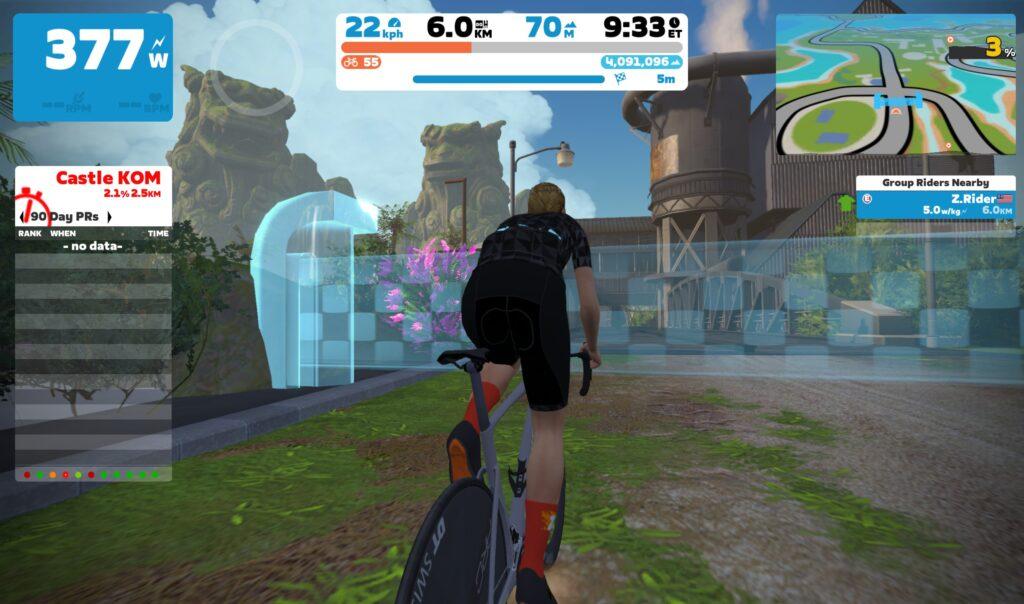
Having spent no small amount of time in and around Urukazi these past few weeks, I had a solid idea of what I was getting myself into with a race on Turf N Surf. Or so I thought. In my head, the course was a fairly simple counter-clockwise loop starting at Neokyo Harbor, riding through Neokyo, then descending to Urukazi before climbing back to the finish at Neokyo Harbor.

I knew there would be two difficult spots: the climb up to the Shisa sprint (not an official KOM but I made a segment anyway) and the climb up through the cavern back to Neokyo (another newly-minted segment). Interestingly, both of those climbs have very similar specs, on paper. Both are just over 2km, averaging 2.5-3%. But the Pain Cavern Climb (as I’ve named it) just hurts so much more. Maybe it’s because the gradient isn’t steady. Maybe it’s because it comes later in the ride.

Regardless, I figured Pain Cavern would be my nemesis in this race. If I could survive in the front group through the cavern, I might have a shot at a good result.

The Start

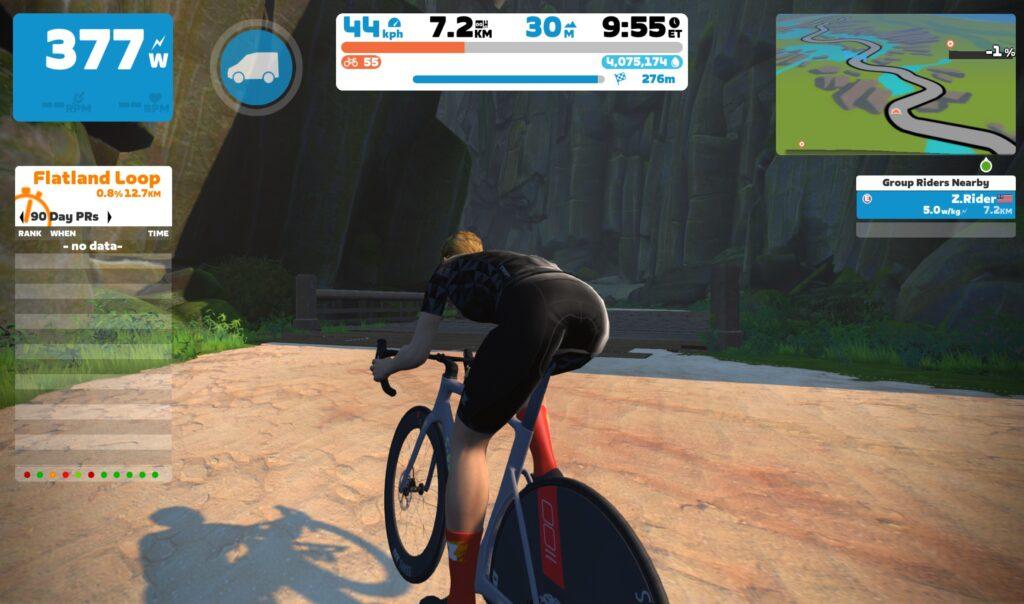
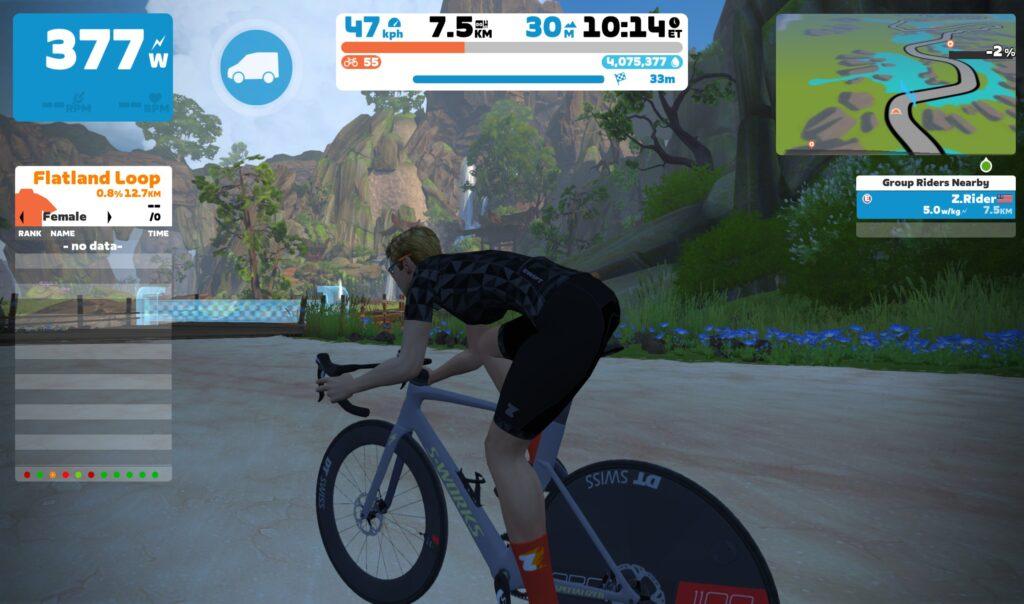
Turf N Surf begins tamely enough, with ~8km of flat roads through Neokyo and out Neokyo Tunnel, before taking a left into the slot canyon connector descent. We had a big group of 163 Bs which included some strong riders, meaning the pace would be high regardless of what I did. So I just sat in the pack and conserved my energy!

The Weirdness of Large Pelotons on Zwift
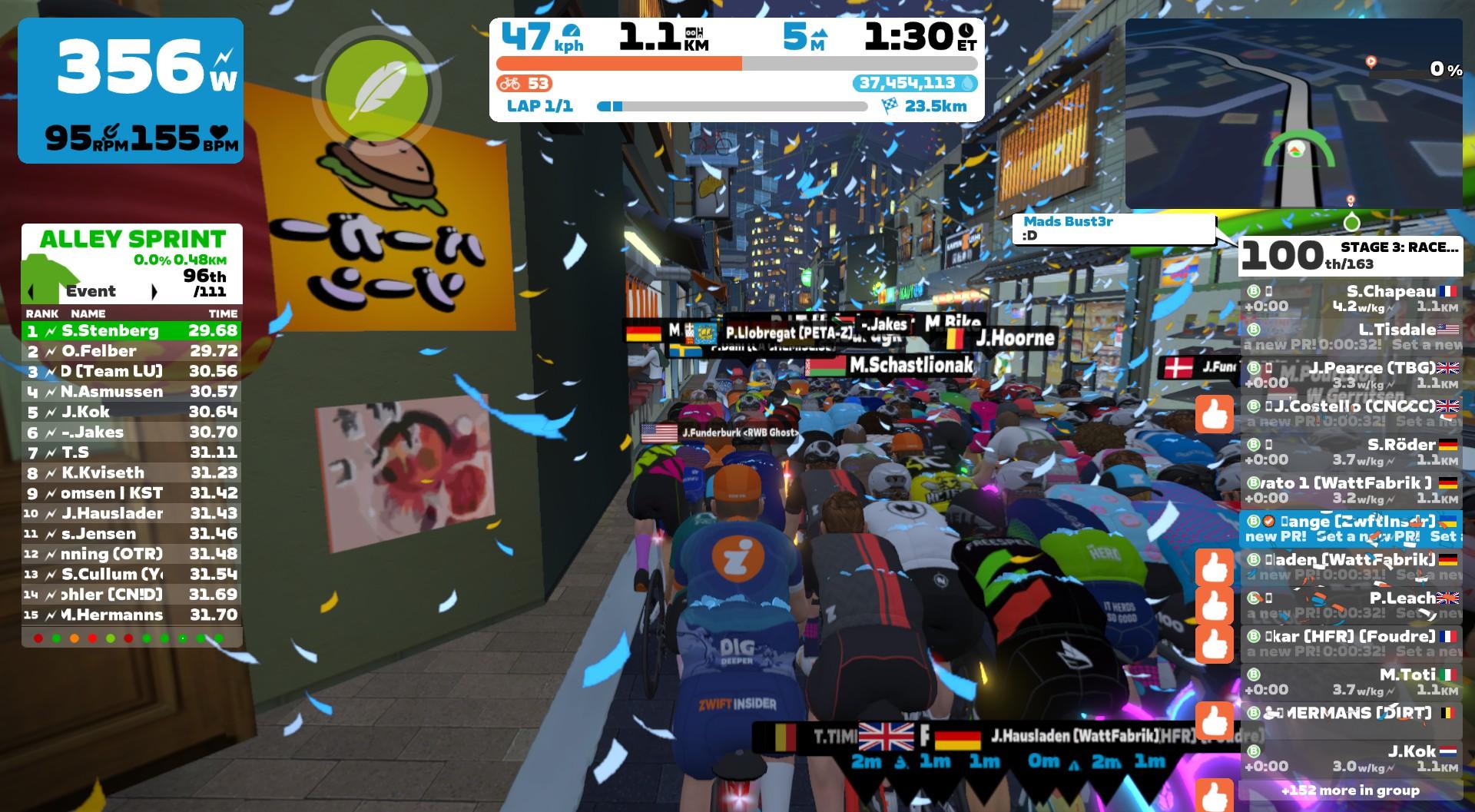
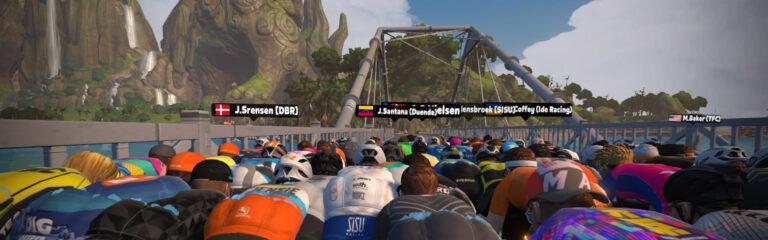
A big ol’ blob (and I’m only seeing part of it)

Racing with large groups on Zwift can be a bit crazy since Zwift only renders the closest 100 riders. Yes, it’s true: whether you’re looking at the avatars on screen, or the dots on your minimap, Zwift only shows the 100 nearest riders! (This is done to keep the CPU load down, since each rider’s position must be constantly computed by your machine.)

This presents an obvious problem in a race with 163 Bs: what if I’m so far back that I don’t see what’s happening at the front?

It can be a real problem, especially in places where attacks happen and gaps form. If you’re too far back your minimap and screen will make it look like you’re sitting in the front pack, but there may actually be a pile of riders ahead who aren’t even visible on your screen. Yikes!

One way to get some added visibility in this situation is to have ZwiftPower’s live view of your event up on another screen. This only updates every 30 seconds, though, so it’s far from perfect.

The only foolproof method of seeing what’s happening ahead is to stay near the front. I like to ride a few bikes from the front, which put me around 30-60th place in today’s race. Be warned, though: this strategy gets increasingly challenging as pack size increases, which is why big races of 300+ riders are never easy on Zwift – because everyone is pushing to stay near the front!

Ascending to the Shisa

Our first climb of the day (which I’ve named the Festival Harbor Climb CCW) came 14.5km into the race. At 2km long and 2.6% gradient, last week’s Tiny Races taught me that this climb is draftable and short enough for me to hang on, even with a strong pack. So I buckled down and hammered my way up, staying in the wheels and averaging 342W over 3:36 to stay with the front group.
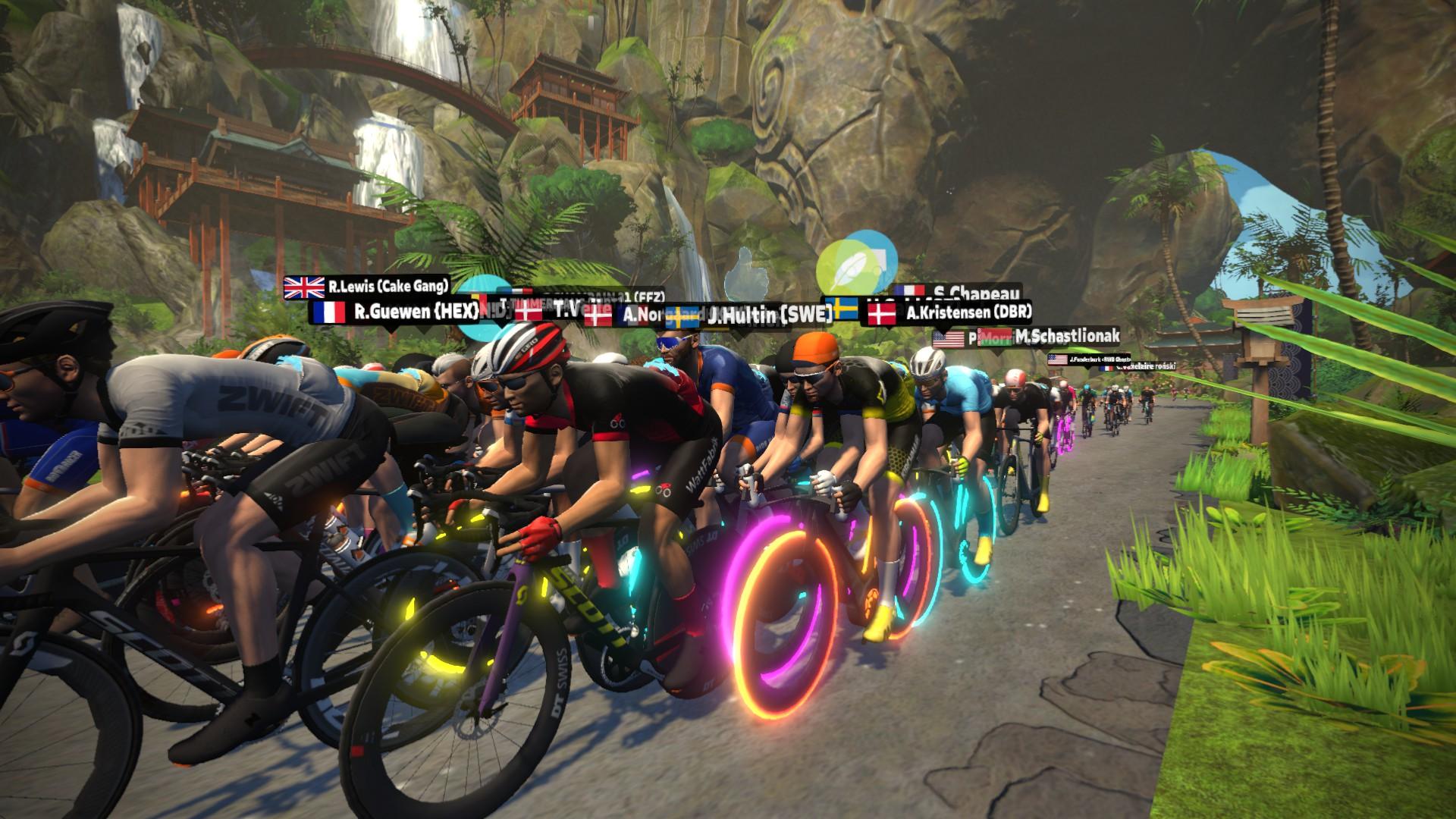
In the pack at the top of the Festival Harbor Climb CCW

This climb whittled our front group down from over 100 to around 70. I settled in for the descent to the boardwalk, then surfed the wheels through Mangrove Maze to the next big challenge: the cavern.

Pain Cavern
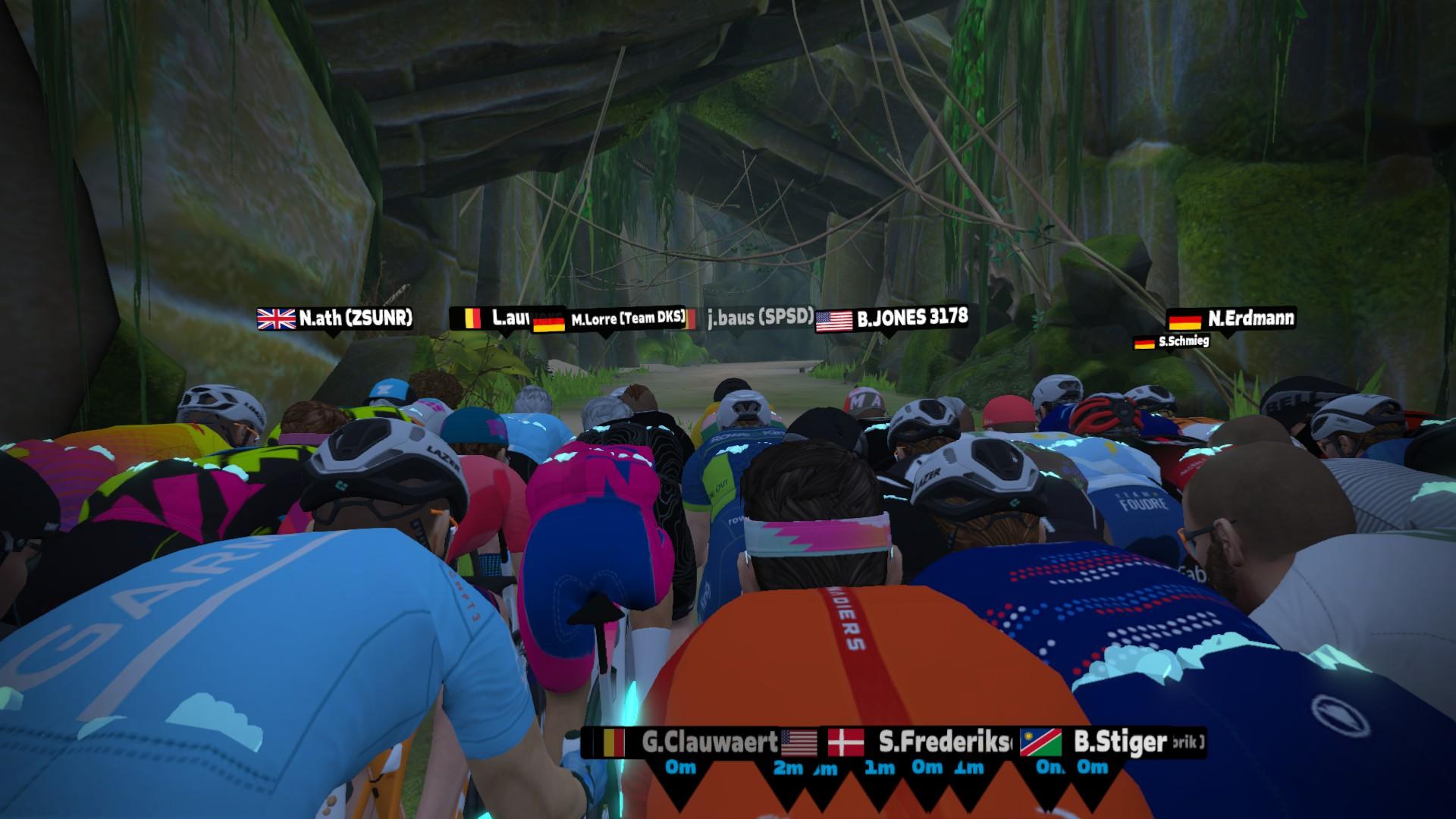
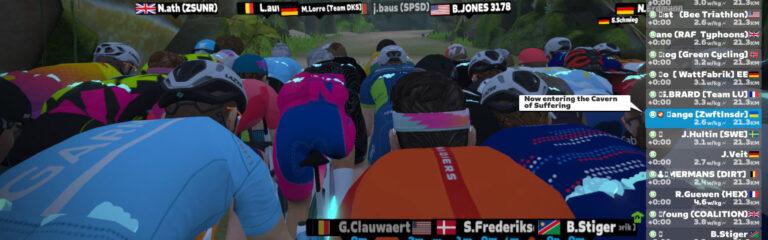
Entering the cavern of despair

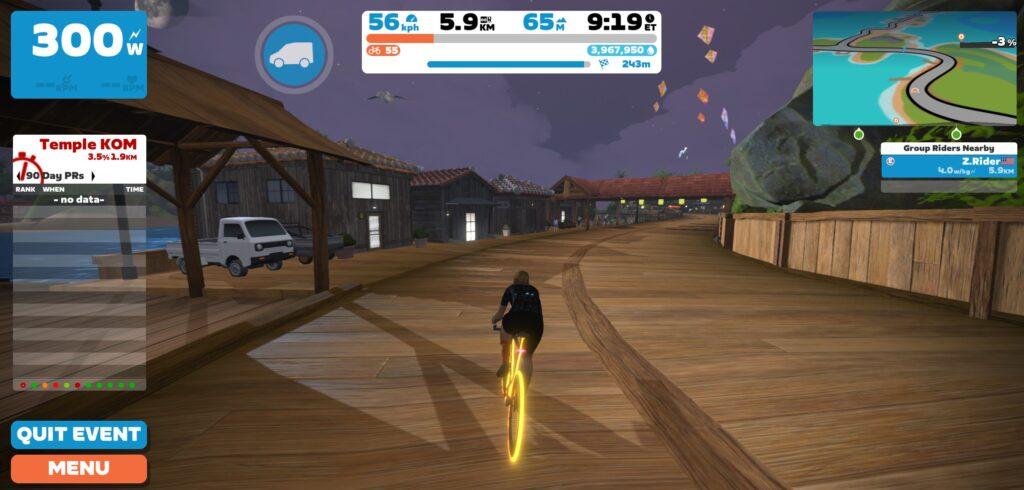
We turned right out of Urukazi, and the road tilted upward. That’s when I realized something unsettling: I really didn’t know this climb well at all. I knew it wasn’t terribly long – my HUD said we only had 3km left. But where were the steep bits that required hammering, and where were the flatter parts useful for recovery?

Some riders are content to just hop onto an unfamiliar route and hammer away. That makes me nervous. I like to know the route intuitively, but you don’t get that by looking at route maps or riding it once. It takes time, repeatedly riding a route at race pace, to make it something you can ride intuitively.

The group began hammering, and I did the same, just trying to climb efficiently while staying in touch with the front. I thought I was doing well, holding a good position up the figure 8 climb. But I didn’t know what was ahead.

The road flattened a bit after the figure 8, and one rider attacked. Another followed. I was on the rivet just trying to hold on, and as the pack began to stretch out, riders were passing me and I had nothing left. You know that feeling, right? The. Worst.
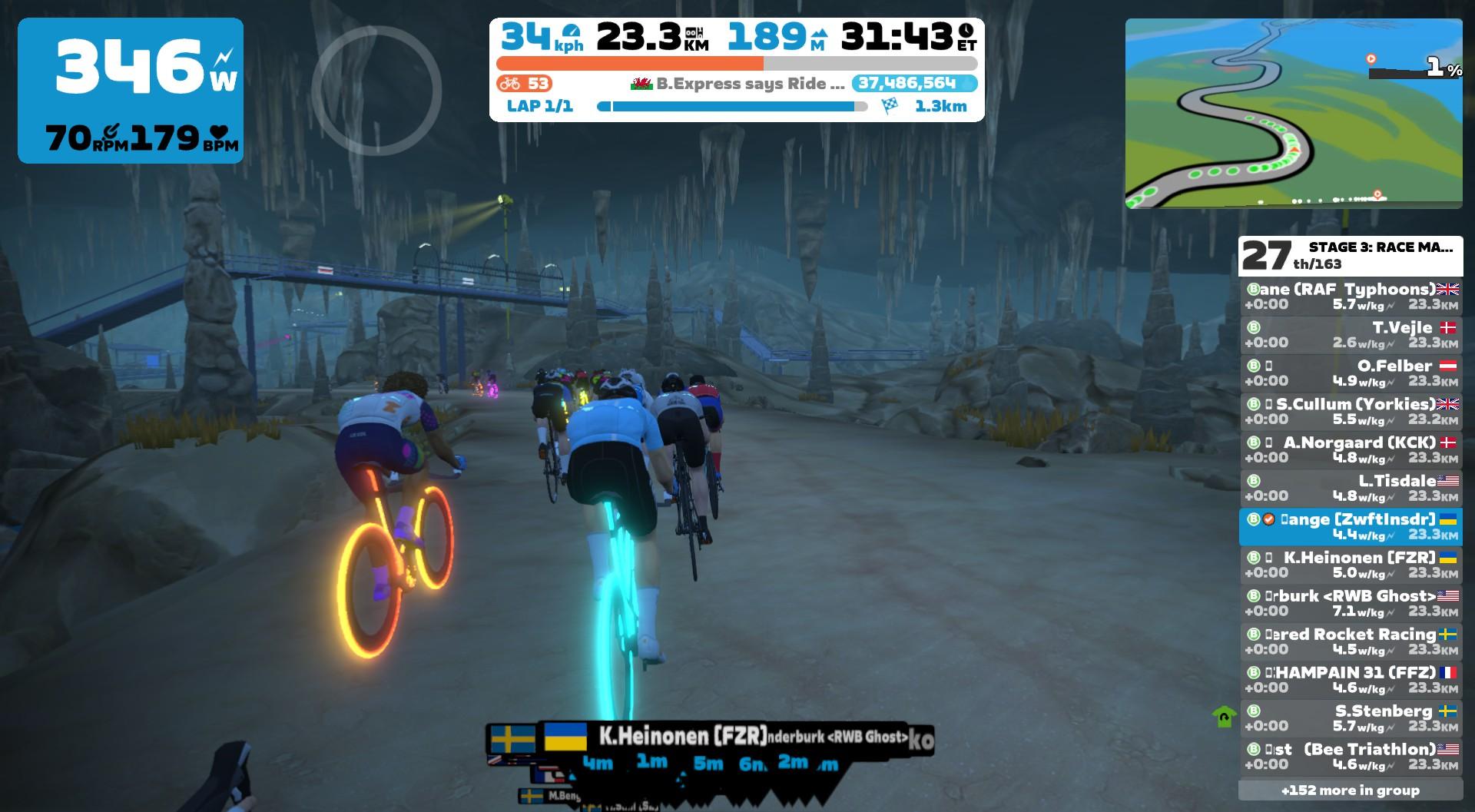
Vainly trying to hold onto the stretching pack

With only 1 flat kilometer to go, a pack of ~25 front riders formed ahead, with a few pushing the pace off the front. All I could do was sit in the wheels of my chase group, trying to recover a bit for the final push to the line.

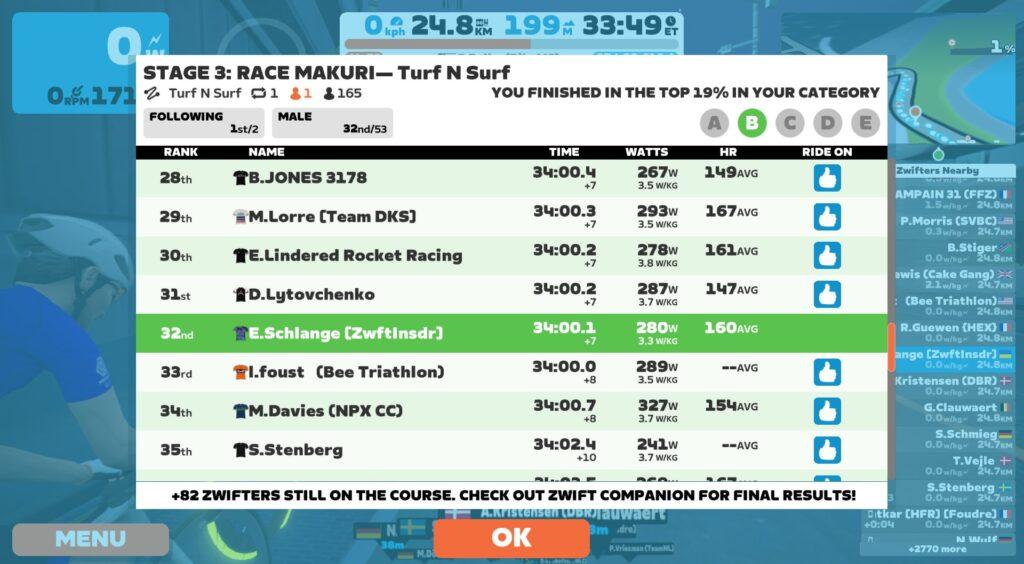
That final push was nothing special – a weak-legged standing half-sprint, bringing me across the line in 32nd place.

Race Results on ZwiftPower >
Activity on Strava >
Takeaways

My first takeaway is that Turf N Surf is a fun race course. Everyone gets to spin together for the first 14km or so, riding on the flats and through the connector canyon descent. But the two key climbs prove attritional: they whittled our pack down from ~100 to ~70 to ~25.

Those two key climbs are brilliant places to push the pace and shed some competitors if you’ve got the legs for it. The Pain Cavern, especially, can reward a late attack near the end of the climb when many others are already on the rivet.

Takeaway #2: this route is a perfect example of how strong VO2 power is so crucial for much of Zwift racing. The two key climbs on Surf N Turf are 3-5 minutes long (depending on your race category), so if you’re strong in that power window you can push hard on the climbs, sit in for the other parts, then smash the finish against a much-reduced pack.

For me, I hammered hard on that final climb, averaging 364W for 3:48, which is near my limits. It just wasn’t enough. I set a 6-week power PB in the 15-33 minute window with this race, but a combination of me riding that last climb a bit inefficiently plus some strong Bs attacking at the right time (wrong time for me, right time for them) meant I wasn’t even close to the front at the end.

Last takeaway: the B category is growing more competitive as winter arrives. Almost all of the top 10 finishers had a ZwiftPower ranking of 150 points or better (I’m currently at 147), and a few were close to 100. A strong bunch of killer Bs for sure!

Final Note: An Elevation Mystery

Here’s a fresh Zwift mystery for you to ponder: how is it that Neokyo Harbor, which sits just above the ocean, is ~60m higher in elevation than Urukazi’s Festival Harbor? Here’s the Strava elevation profile for Turf N Surf:
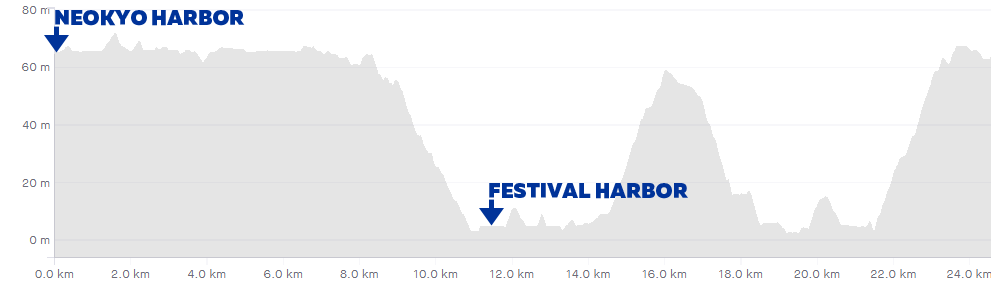
Based on the minimap from Zwift, both harbors are on the same ocean:
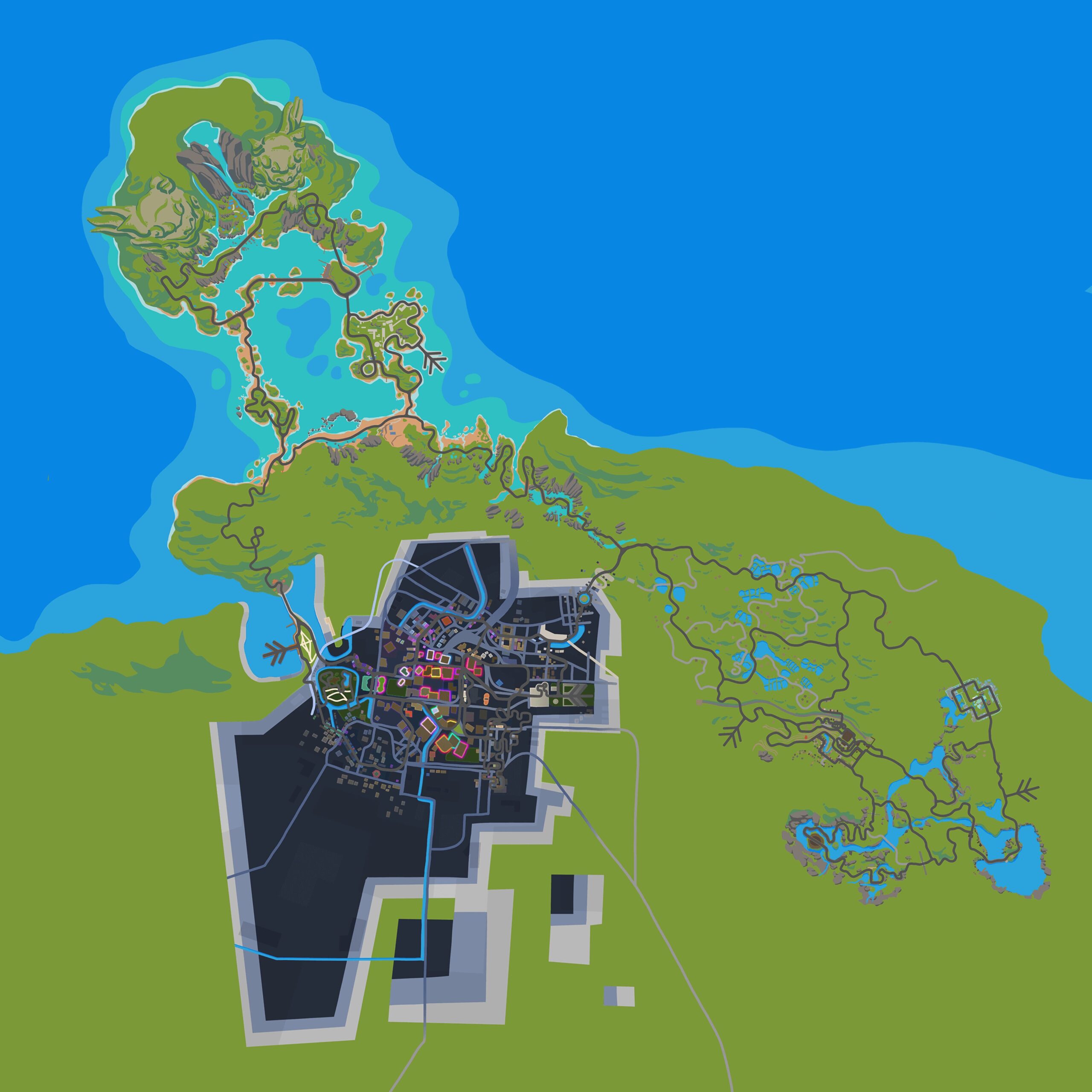
Clearly, Zwift’s worlds allow real-world physics to be warped. Or perhaps there’s a series of giant locks outside of Neokyo Harbor that isn’t visible on the minimap? 😊

Your Thoughts

Have you raced Turf N Surf yet? What did you think? Share below!

ZwiftRacing.app Rankings Update and Mystery Matchmaking Trial Race

10

ZwiftRacing.app Rankings Update and Mystery Matchmaking Trial Race

From the editor: since the first post introducing the ZwiftRacing.app ranking system, Tim Hanson has been hard at work iterating through many improvements that have been discussed with the racing community. Here, James Eastwood talks us through the recent changes, what’s up next, and a whole new format for the next trial race which is taking place on Sunday.


ZwiftRacing.app is now on v1.2, and there have been some significant changes based on feedback from the community.

Change 1 – New Ranking Algorithm

Previously the rankings used an exponential component which heavily weighted finishing position when assessing a rider’s race result. What this meant is that riders that finished highly typically ranked up, and those that finished towards the bottom of the field lost rank. This had some undesirable consequences:

  1. Riders could lose rank even if they overperformed versus expectation
  2. Riders that raced frequently in weak fields would be promoted far above their actual ability (cat C riders with Grand Champion status)
  3. In races with a large number of participants, ranking changes were inflated

The new algorithm uses a linear calculation so that in almost all cases you will rank up if you exceed expectation, lose rank if you perform below expectation, and have minimal change to your rank if you meet expectation. This will still promote riders that consistently win, but will further improve the accuracy of the ranking, which is critical if used for pen definition. Check out ZwiftRacing.app to see how your rank has changed from race to race. If you are the 7th highest ranked rider and finished 7th, you will see that your rank barely changes.

Here is a graph showing all changes to rank that have happened so far, based on how large the delta was that was applied. Occurrences is on the Y axis, and delta change on the X axis. As you can see, most riders are very accurately ranked, and typically only have small changes to their ranking applied.

Change 2 – New Initial Seeding Methodology

One of the most difficult choices with a ranking system is how to deal with new or returning riders. Whilst the algorithm can adapt a rider’s rank quickly in the first few races, it is still important to get that initial placing as good as possible.

The old system used 20m w/kg from 90-day race history. For new riders that may mean only 1 race, so often this would not be a very accurate initial placing. Alongside this, lightweight riders would end up with an overly high initial ranking, and heavyweight riders an overly low ranking.

In the new version, Compound Score is used. This is a calculation of 5m power using both raw Watts and W/kg to neutralize the weight element. 5m power is also much more reliable in terms of applicability to Zwift.

This is the only time power is used as a ranking component, and the rankings quickly adapt after initial placement.

Note that the ranking values and boundaries between ranks are now different. Check out the site for more information.

Change 3 – Podium Bonuses

There is now a small bonus applied to podium positions. This is to ensure that racers who typically race as the highest-ranked rider (for example always at the top of a power-based category, or at the very top of overall rankings) can still progress upwards. This is applied in an exponential fashion, where there is little bonus applied if the field is small.

Socks4Watts Mystery Matchmaking: 20th November 3pm UTC – Makuri 40km

The next trial race is now set up, and it’s a bit different! Sign up before the deadline (19th November 10PM UTC), and you will be sent the link to the race on the morning of the race. The split of riders between pens is decided after signup has closed. This is hopefully the first step in creating a fully automated matchmaking process.

Socks4Watts Mystery Matchmaking Race Signup

What’s next?

Tim has a number of changes planned that I am sure we will see soon:

  • Login functionality
  • ZP-compliant points racing support
  • iTT support
  • Racing achievements
  • New graphics-first approach for rank and progression

Questions/Comments

Have you checked out your ranking yet and how it is impacted as you race? Comment below!


Notable Zwift Events for the Weekend of November 19-20

1

We’ve selected a mixture of races and social rides at a variety of paces and lengths this week… with a special focus on Urukazi, since Zwifters love new roads!


🤝 Stage 5 | Tour of Makuri Islands

We’re more than halfway through Zwift’s big “Tour of Makuri Islands” and this weekend Stage 5 events begin… on two new Urukazi routes!

There are two courses to tackle for stage 5 rides: (A) Makuri 40 measured at 40km and the shorter (B) Turf N Surf route at 24.7km. With a large number of attendees already signed up, this is the “must-do” event over the weekend!

Read more about the Tour of Makuri Islands >

Multiple dates and times
See upcoming events at zwift.com/tour-of-makuri-islands


🥇 Pineapple Torturefest Crits

Have you been missing the Crit City races that used to be on the calendar regularly? Zwifter Arran Leach is bringing them back on Saturdays and Sundays with the Pineapple Torturefest Crits series, starting this weekend!

Their tagline: Turn up, take souls, leave victorious.

Races are scheduled every 2 hours, with Saturday featuring the Bell lap and Sunday featuring Downtown Dolphin. Events alternate between power-ups and no power-ups.

Saturday and Sunday, Nov 19-20, at multiple times
See events on ZwiftHacks


🤝 Vikings Valhalla Sunday Skaal

The weekly Sunday Skaal event from the Vikings team is a popular weekly long ride with a “no one gets dropped” approach. Each category has a leader, and riders are expected to respect the group’s pace.

This week they’re on the new Makuri 40 route for 100km, with two categories to choose from:

  • C (2.3-2.7 w/kg)
  • D (1.7-2.1 w/kg)

Sunday, Nov 19 @ 8:05am UTC
Sign up at zwift.com/events/view/3245292


🥇Stage 3: Race Makuri – Turf N Surf

The 3rd stage of Zwift’s monthly ZRacing series is being held on the new Turf N Surf Urukazi route, which means if you finish this race you’ll also get credit for finishing stage 5 of the Tour of Makuri Islands!

This gorgeous route takes you on the two connector roads that are rarely ridden between Urukazi and Yumezi/Neokyo. Watch out for that last connector road through the cavern back to Neokyo – the climb is going to break up the peloton!

Multiple timeslots
See upcoming events at zwift.com/events/tag/zracingnov2022


🤝 Seattle Baby Steps 1.0-1.3 w/kg

The event description nicely explains what this event is all about: “Are you looking for a supportive beginner or recovery ride? If so welcome to Seattle Baby Steps! This weekly ride will be paced at an average of 1.0-1.3 w/kg on the flats and is intended for riders who are newer, younger, older, and recovering from injuries. This is an enjoyable and conversational social ride where your participation is encouraged. Baby Steps’ goal is to help you build strength and confidence to try the hundreds of advanced rides, races, and events that are available every week on Zwift.”

This ride is hosted on the new “Country to Coastal” route on Makuri Islands and is 1 hour long.

Sunday, November 20 @ 4:15pm UTC/11:15am EDT/8:15am PDT
Sign up at zwift.com/events/view/3245421

Your Thoughts

Got other events that stand out this weekend? Share below in the comments!

Tiny Race Series – Results and November 19 Routes

31

Tiny Race Series – Results and November 19 Routes

Last week’s Tiny Races on the new Urukazi map were a lot of (Type II) fun, so we’re returning to Urukazi for another go. One of this week’s routes is a repeat from last week (because it was such a crazy finish!), while the other three are fresh Tiny Races. With many riders unfamiliar with Urukazi rides, those who do a bit of recon may be rewarded!

Here’s my video from last week. Although my results were decidedly unremarkable, if you missed racing last weekend you may want to check out race 2 on Mech Isle Loop, where the gravel bikes (and strong roadies) created a big split that stayed away to the finish. And check out the finish of race 3 on Island Outskirts, which was crazy thanks to a descent and lots of anvils!

Last Week’s Results

Overall Winners

Zone 1 (8am UTC)

A: Maciek M (ZTPL.CC eRT)
B: Joachim Kjældgaard (EDDK)
C: Paul Smith (ART)
D: Jonathan Rigby

Zone 2 (2pm UTC)

A: Simon R (Skylab)
B: Magnus Wiklund (eSRT)
C: Daniel Lundberg (eSRT)
D: Jon Sparkes (EVO)

Zone 3 (8pm UTC)

A: Kevin Bouchard-Hall (Velocio)
B: Scott Mossop (eSRT)
C: BroFessor (SISU)
D: Jonathan Chambers (SMCC)

Women’s Winners

Zone 1 (8am UTC)

A: none
B: Sandrine Etienne (FFZ)
C: Christa Thoma (AVC)
D: Lesley Unwin (Rave)

Zone 2 (2pm UTC)

A: Laurence Mottas
B: Anja Buckley (KC)
C: Gabriela Fajardo (GXY)
D: Emily Brown (BMTR)

Zone 3 (8pm UTC)

A: none
B: none
C: Sonia Foote (ATP Racing)
D: Alex Dutchie Klever (QB)

This Week’s Routes: More Urukazi!

Like last week, all four races this Saturday will be held on Urukazi routes. We’re repeating one of last week’s routes, but the other three are fresh routes we haven’t featured before! Here are finish line shots for your reference:

  • Race 1: Fine and Sandy (6.85km, ends at Tidepool Sprint)
    Hit the Mech Isle climb early, then it’s a flat, fast ride through Festival Harbor and Mangrove Maze before we take on the beachfront Tidepool Sprint.
    • Powerup: Aero
  • Race 2: Mech Isle Loop (6.06km, ends atop climb)
    We raced one lap of Mech Isle Loop last week, but this week we’re doing more like 1.5 laps, finishing atop the dirt climb. Gravel bike or road bike? Choose your weapon!
    • Powerup: none
  • Race 3: Turf N Surf (7.55km, ends in slot canyon)
    Begin in Neokyo, then ride out through Neokyo Tunnel and onto the twisty connector road to a custom finish in the scenic slot canyon.
    • Powerup: Steamroller
  • Race 4: Island Outskirts (6.2km, end on boardwalk after descent)
    A repeat from last week, because this finish was crazy! Race from Mech Isle up the Shisa Sprint climb CCW and descend back down to the boardwalk for the final sprint. Timing is everything – when will you use the anvil?
    • Powerup: Anvil

Sign up at zwift.com/events/tag/tinyraces

ZwiftPower Results

Zwift displays preliminary race results in game when you cross the line, but points are computed after all four races are finished, with final results on ZwiftPower. (We have to do some data processing on our side to compute results, so if your rankings don’t show up right away, be patient.)

Riders will earn points based on finish position in each of the 4 Tiny Races. The category winner of each week’s series is the rider with the most points across their timezone’s 4 races. Here are the links for each timezone’s results on ZwiftPower:

Rules

Tiny Race rules are simple. Four races, four rules:

  • You must have a ZwiftPower account, because final results are processed by ZwiftPower (learn how to sign up)
  • No skipping then returning. These races are meant to be raced as a set of 4. If you need to leave early, that’s fine… but once you miss a race in your hour’s set of 4, don’t come back and race another or you’ll be disqualified from that race since you rested while others were racing! (Example: racing only races 1 and 2 is fine. Racing 1, 2, and 4 is not.)
  • Heart rate monitors are required for podium finishers
  • ZPower/Virtual power is not allowed. Smart trainer/smart bike or power meter required.

Join a Chat & Chill Cooldown

Immediately following each hour’s racing, we’ve scheduled 30-minute “Chat & Chill” events where riders from all categories can spin out their legs together and have some fun chatting about how it all went down. Find them at zwift.com/events/tag/tinyraces.

Questions or Comments

Post below!


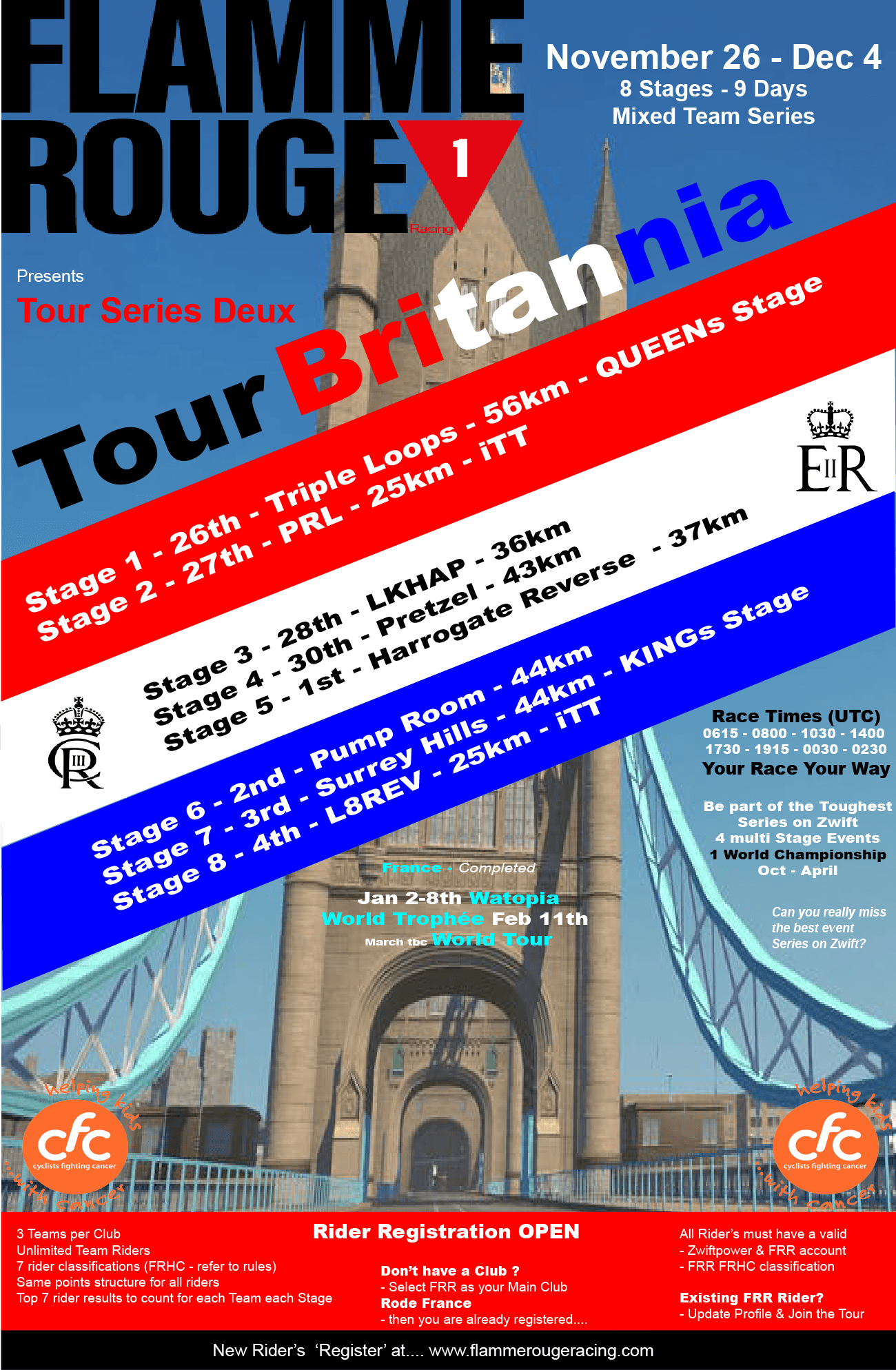
8 Stage “Tour Britannia” from Flamme Rouge Racing Begins November 26

3

8 Stage “Tour Britannia” from Flamme Rouge Racing Begins November 26

Flamme Rouge Racing (FRR) is one of a handful of Zwift community race organizers who are pushing the boundaries of Zwift racing. Their back-to-back, multistage event style coupled with a unique categorization system create an inclusive yet highly competitive race environment.

I caught up with Richard Vale, the founder of this racing series, to get his thoughts on the recently-concluded “Tour France” event and a look at what’s next.

Tour France

“Tour France” saw 1362 riders from over 80 different clubs form 59 teams to compete in this multistage event that covered 265km in 8 stages over 9 days. This included over 4000 meters of climbing! 302 riders completed the whole event. 

To facilitate this event and the racing series, Richard designed an integrated web-based platform to help manage the entire process. This can be seen at flammerougeracing.com.

Racing with a difference

This event is very different from anything on Zwift (including Zwift Racing League) as its primary focus is to build fatigue over consecutive stages, replicating the effects of a Grand Tour. As such, this series requires riders to develop a different approach to competing and recovering than what is required if you’re only racing hard once or twice each week.

Over the course of the event riders compete in a team competition as well as an individual GC, Sprint, and Polka-dot jersey competition. There is also a points league for their own class to keep them engaged in every stage.

Riders can do as many stages as their schedule allows, sign up at any time, and ride any of the event times on offer.  This has been termed “Your race Your way” by Richard.  The event is fully inclusive as Richard ensures every rider has a team and places riders without a Zwift team into the Flamme Rouge Racing Team for the event.

Another major difference compared to other Zwift races is rider classification.  Instead of applying the traditional A-D categories based on your 20-minute power, a more holistic view is adopted which looks at weight, gender, and normalised power to place riders into “split” categories.

As Richard explains, “the current Zwift category system is too wide for 50% of the platform as those at the lower end of each range simply cannot compete within their assigned category. The FRR classification produces a fairer racing environment for everyone by placing riders within a seven-category scale, where each class is much tighter and therefore more competitive.”

The process considers riders equally to produce a w/kg value which then places the rider within the Flamme Rouge Racing Heat Category scale (FRHC), which uses the chili heat scale naming convention with Capsaicin being the hottest and most powerful riders down to Jalapeno.

Feedback

Rider feedback has been very positive, particularly regarding the different classifications. Riders seem to agree this system is quite fair. In one of the categories after 8 stages and over 8 hours of racing, the result was separated by just 13 seconds!

One rider noted, “I have to say I have been really impressed by this league setup. It seems fair and consistent and encourages you to do your best. Can’t wait for the next one.”

In addition to this, there was special recognition in the form of the “Sheer Determination” award going to Hilary Readhead, who completed the event over 13 hours!

Next Up: Tour Britannia

The next event starts on November 26th and is called “Tour Britannia”. It’s the second run of this tour (we wrote about the 2021 Tour of Britannia here.) 

This is 8 stages in 9 days, with early morning and evening event times for NZ/AUS/EMEA/US-EST/US-PST.  This will be followed by “Tour Watopia” in January.

If you are interested, visit the Flamme Rouge Racing website for more information and register your interest by clicking to register and create your account.

Charity Link-Up

FRR have linked up with Cyclists Fighting Cancer, a charity that helps young people recover from cancer. 20% of funds FRR raises are donated to CFC, and over the summer they are planning to do a number of virtual events to further fundraise.

Questions or Comments?

Post below!


Zwift Grand Prix Tomorrow: Points Elimination Reverse

3

Zwift Grand Prix Tomorrow: Points Elimination Reverse

As explained in a previous post, this season’s top-level Zwift racing looks very different from previous years. Now decoupled entirely from Zwift Racing League, the “Zwift Grand Prix” series is happening each Friday at 6pm UTC, with men featured one week and women the next over 6 rounds.

Tomorrow (Friday) at 7pm UTC, Zwift Grand Prix Round 4 kicks off with the men’s race, in a format called “Points Elimination Reverse”. Women will race the same event next Friday.

Points Elimination Reverse Race/Route Details

This race is a more straightforward affair than some of the past rounds, at least when it comes to understanding its format. This is a points race across 1 lap of Makuri Islands’ Chasing the Sun route, and points will be given at 5 intermediates as well as the finish line.

What makes this format extra interesting is that riders are eliminated from the race as soon as they earn any points. The strategic question for teams is the same as any week: how to best utilize your whole team to maximize your points tally. But it’s a challenging question to answer with this format!

Here’s how the intermediate and finish will award points, and how many riders will be eliminated at each intermediate:

  • Alley Sprint: 1 point given for 1st across the line, 1 rider eliminated
  • Railway Sprint: 2/1 points given for 1st/2nd, 2 riders eliminated
  • Country Sprint: 3/2/1 points given for 1st/2nd/3rd, 3 riders eliminated
  • Temple KOM: 6/4/2/1 points given for 1st/2nd/3rd/4th, 4 riders eliminated
  • Tower Sprint Reverse: 5/4/3/2/1 points given for 1st/2nd/3rd/4th/5th, 5 riders eliminated
  • Finish Line: points given to first 6 riders (6/5/4/3/2/1)

So by the time the finish line arrives, 15 of the 60 starting riders will be eliminated. That leaves at most 45 riders to contest the finish, where only 6 riders will earn points.

The winning team will, of course, be the team that earns the most points overall.

Watch Live

Each Friday’s races are livestreamed with commentary on Zwift’s YouTube, Facebook, and Twitch channels. Watch tomorrow’s event below:

And next week’s women’s event here:

Questions or Comments?

Share below!

The Wrap, Episode 17: Eric Schlange

0

The Wrap, Episode 17: Eric Schlange

The one and only Eric Schlange joined the pod this week to take us through Urukazi and all the amazing things the new roads have to offer.  Eric loves the caves, Nathan loves the easter eggs, and Anna hasn’t ridden them yet (confessional corner).

The team discusses mob mentality and whether flagging someone during a race is fair or not.  ZRL has kicked off, banger or bust? 

Anna went old-school and new-school on the jersey and garage picks this week.  Jersey pick was one of the originals, the Alienware green alien kit (hot!).  Garage pick is the sweet new pink fade sunnies as part of the Makuri Islands tour unlock.

The Wrap is all about showcasing the awesome Zwift community, from upcoming events to must-have tech to community guests to the all-important avatar fashion segment.  The live nature of the show means that hosts Nathan Guerra and Anna Russell can interact directly with those watching, gaining valuable insights and opinions across a wide range of topics.

The podcast is available on all podcast platforms.  Subscribe to Zwift Community Live on YouTube to see the latest episode or tune in live 12pm CDT | 5pm GMT every Thursday.


Who’s going to 2023 UCI Worlds? See the Continental Qualifiers Results!

5

Who’s going to 2023 UCI Worlds? See the Continental Qualifiers Results!

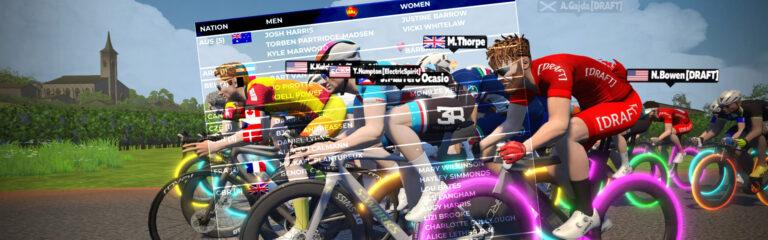
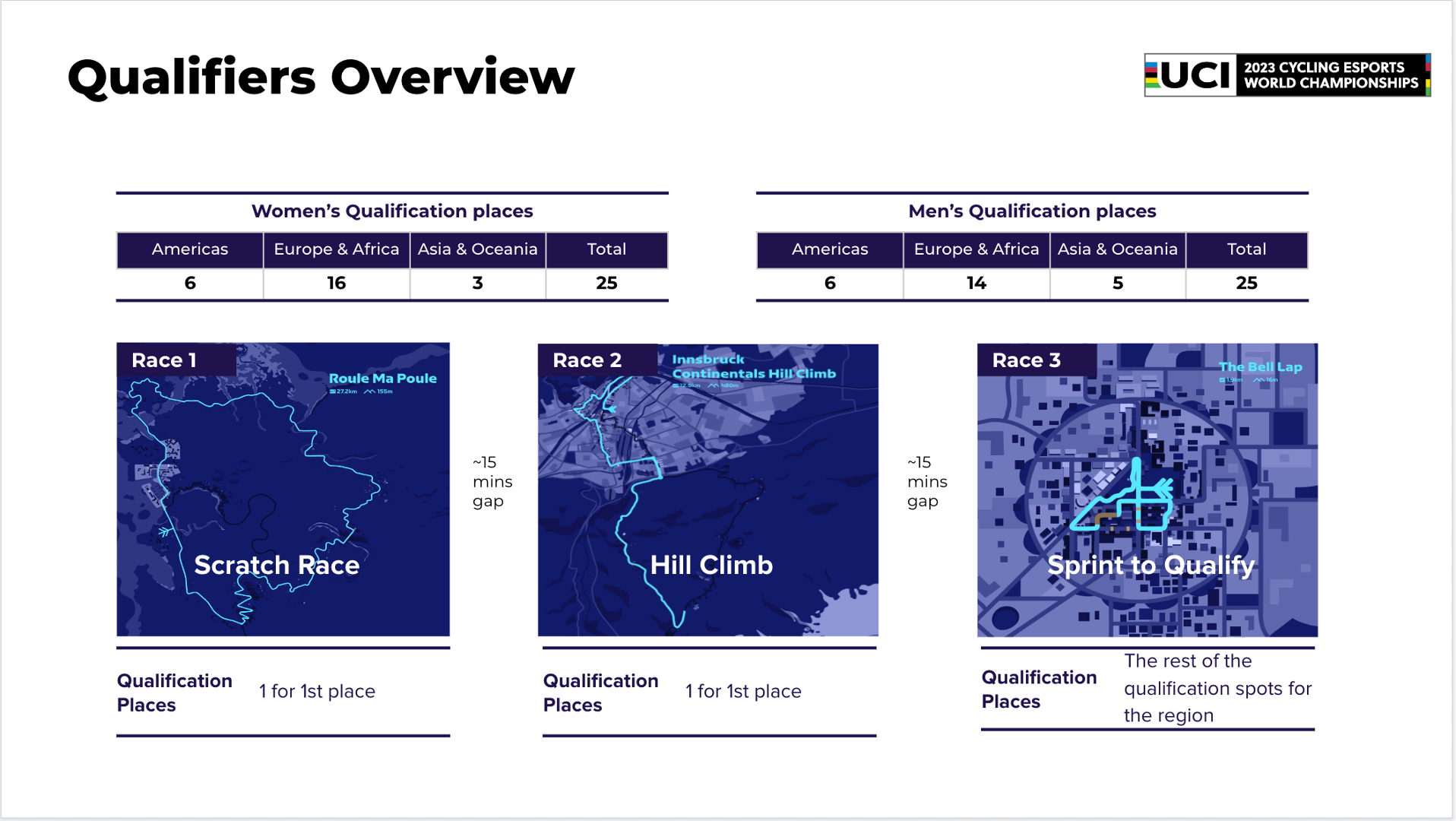
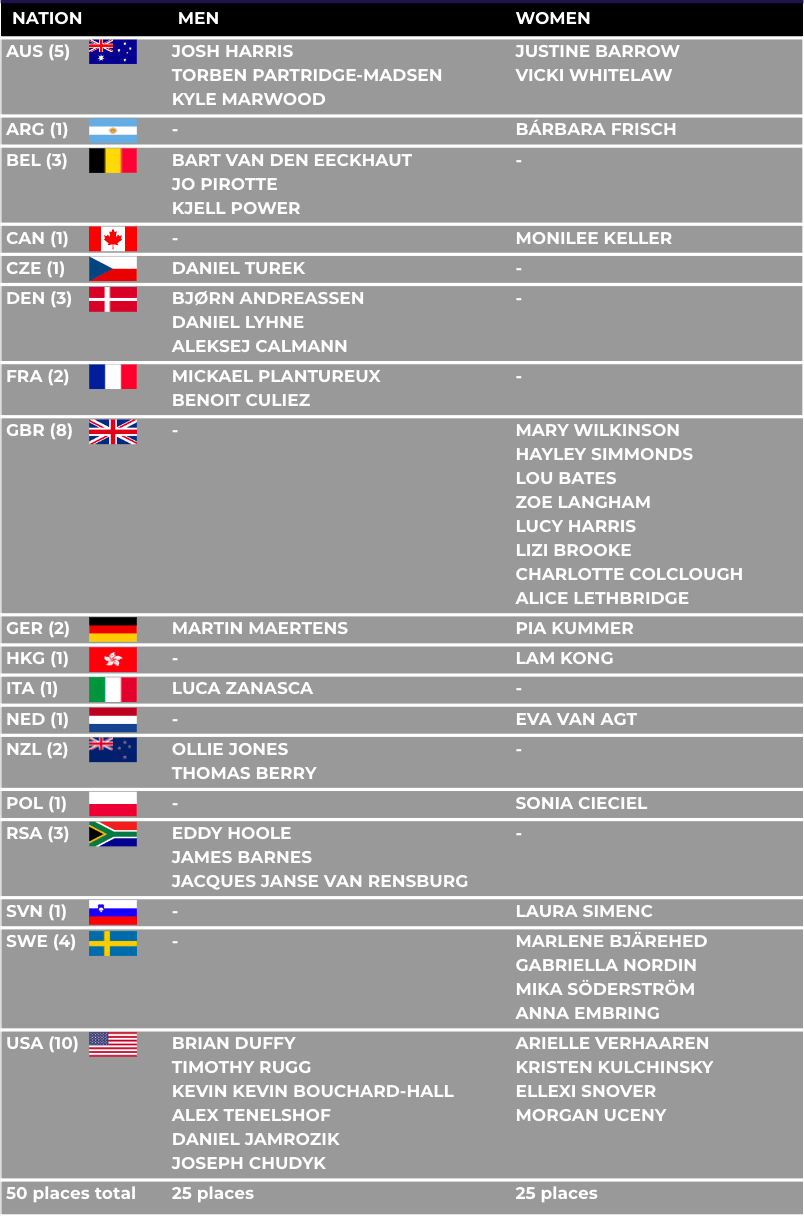
Last weekend Zwift hosted the much-anticipated (albeit awkwardly-named) “Continental Qualifiers to the UCI Cycling Esports World Championships”. These races were qualifiers designed to place 25 men and 25 women on national teams for the 2023 UCI Cycling Esports World Championships.

It’s important to note that the riders who qualified this past weekend will make up just a small portion of the overall race field for the UCI Cycling Esports World Championships. A total of 200 riders will take to the start line for the 2023 Esports Worlds (100 men and 100 women). Last weekend’s races selected 25% of these riders, and the remaining 75% will be selected by each nation’s cycling governing body.

Below you’ll find Zwift’s complete press release detailing the results of the Continental Qualifiers to the UCI Cycling Esports World Championships.


The qualification races for the 2023 UCI Cycling World Championships races took place this weekend and featured three short and explosive events, helping to further improve fan engagement. A similar three-race format, designed to prove the ultimate all round test, will be used for the 2023 UCI Cycling Esports World Championships in February on a brand new course set to be revealed in the coming weeks.

A total of 50 qualification places were up for grabs, split equally across the men’s and women’s fields. 200 riders will take to the start of the final in February.

The new formats proved hugely successful, creating new racing dynamics never seen before in Zwift. Tactics proved to be more decisive than ever before and those prepared to take a risk saw their efforts pay dividends, with nearly all of the qualification places decided by a small bunch or solo finishes.

The full list of qualifiers through to the 2023 UCI Cycling Esports World Championships can be viewed below:

You can catch up on all of the action here:


Zwift Racing League 2022/23 Round 2 Week 3 Guide: Two Bridges Loop

4

The third race of Zwift Racing League 2022/23 Round 2 happens Tuesday, November 22nd and we’re in Watopia, returning to the attritional Two Bridges Loop. Sprint points are crucial this week, but it’s the short climb on every lap that will force riders off the back and out of contention!

Let’s dig into the race, including tips for bike choice, powerups, strategy, and crucial segments.

Looking at the Route: Two Bridges Loop

One lap of this route is 7.1km (4.4 miles) long, with 73m (240′) of climbing. A/B categories will be racing 6 laps (42.9km/26.7 miles) and C/D racing 5 laps (35.8km/22.2 miles).

The race begins in downtown Watopia, riding in the reverse direction which takes us through the start/finish banner and up the short rise to The Esses. We’ll twist our way through these curves, hit the last short kicker, then descend to the JWB Sprint Reverse.

This is a short sprint (~10 seconds) with a downhill lead-in so speeds will be high and the aero powerup especially advantageous.

Strategically, this is a crucial part of the race since the sprint is awarding FAL points to the first 10 across the line on each lap, as well as FTS points to the 10 fastest through the segment for the overall race. This is the only intermediate on course, so make your choices wisely!

After the sprint we go through the cobbles of the Italian Village, then climb a few rollers past the waterfall. Most riders won’t be pushing the pace here, but sprinters who get away off the front on the intermediate may want to do so if attempting a long breakaway, perhaps on the final lap.

Soon enough we’ll arrive at the most crucial pinch point of the race course: a short climb up the start of Watopia’s KOM Reverse. The climb is ~700 meters long, averaging 4% gradient but pitching up to 11% at its steepest as it bends through the giant statues.

This short climb is what makes this an attritional race because the w/kg puncheurs will be putting in big digs to string out the pack and drop the pure wattage sprinters. If they’re successful in breaking up the pack, the front group will be able to grab those crucial FAL points and be better-positioned across the finish line.

Once you turn left atop the short climb it’s a shallow descent on the connecting road, then a steeper, supertuckable descent down the backside of the KOM. Speeds will stay high at the bottom of the descent proper as the road is still tilted slightly downhill. Then the road flattens out for the final ~350 meters to the start/finish line.

Read more about the Two Bridges Loop route >

PowerUp Notes

Riders will be awarded powerups through each segment banner, meaning we’ll get 2 powerup chances per lap for a total of 12 powerups for A/B, 10 for C/D. Three powerups will be randomly given out at each banner:

Aero Boost (helmet) (34%): makes you more aerodynamic (reduces your CdA by 25%) for 15 seconds. Use this if you’re contesting a sprint or attacking in the wind at high speed.

Draft Boost (van) (33%): increases the draft effect you are experiencing by 50% for 30 seconds. Use at higher speeds (flats and descents) when you are already drafting off another rider (since this powerup only helps when you are drafting.)

Lightweight (feather) (33%): reduces your weight by 10% for 15 seconds. Use on climbs, when weight matters the most.

Bike Frame + Wheel Choice

With a fast, flat finish and so many intermediate points on the fast, flat sprint, going with your most aero setup possible is the wisest choice here. See our handy “Fastest Frames and Wheels By Zwift Level” page to learn which bike setup is fastest at your current Zwift level.

If you want to give yourself just a bit of an edge on the crucial climb, or if you don’t have access to a disc wheelset, go with the Tron bike as it’s the fastest ride you’ve got access to.

See Tron vs Top Performers for a helpful chart of how different popular setups perform >

More Route Recons

Many events are now being planned each weekend on the upcoming ZRL route. If you’re unfamiliar with this course, jump into an event and do some recon! Here’s a list of upcoming Two Bridges Loop events.

Looking for a video recon? Check out Si and Oli’s videos below…

Oli Chi

Si Bradeley

Strategic Options

Points Distribution, Two Bridges Loop

These charts show the maximum points a team of 6 could earn in the 6-lap A/B race.

As you consider team strategy for this race, keep in mind that 1) it’s one of the longest of the season, and we’ll be seeing riders dropped on every lap and 2) sprint intermediate points are hugely important, comprising 63.8% of the overall available points.

Here are a few predictions of strategies we’ll see deployed:

  • Climbers attacking climbs: the only chance climbers will have to win this race will be dropping the sprinters on the key climb section. Look for climbers/puncheurs to put in big digs through the statues on every lap.
  • Sprinters chasing intermediates: sprinters will be going all-in for those intermediate sprint points, especially that crucial FTS on the first lap when the pack is largest.
  • Sprinters grouping up: some sprinters will get dropped, but their race isn’t over. They may still be able to grab FTS points if they’re riding with a fast enough group and have an aero powerup. Attempting a solo sprint won’t win you any points, but grouping up may do the trick!
  • Long finish: the final go at the key climb will see some riders who don’t fancy their chances in a pack sprint pushing hard to drop others in their group so they can solo to glory. Be ready for a long final effort on the last ~2.4km of the race, and hold onto a useful powerup if you can!

Your Thoughts

Any insights or further thoughts on this race? Share below!