

Yes, we’ve tested various frame/wheelset setups to see which one(s) deliver the best performance on Zwift’s new Bologna TT route – read our post about that here. But remember: just like racing outdoors, equipment tweaks only achieve marginal gains.
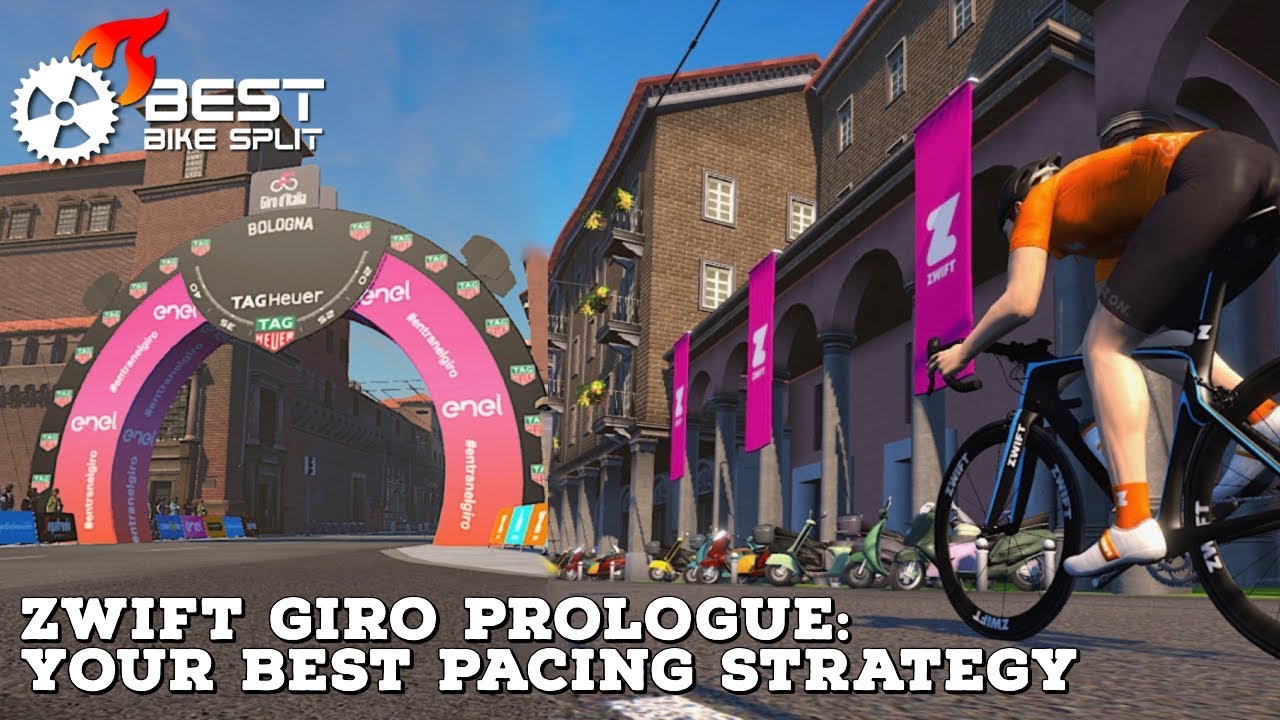
Want to turn in your very best performance on this route? You’ll need to give some thought to perfecting your pacing strategy. Here’s a video from our favorite Lama down under, Shane Miller (who happens to be a very experienced TT racer outside):
TT Pacing Basics
“Go hardest when you’re going slowest.” That is Shane’s basic strategy, and it’s backed by basic physics. The faster you are moving, the more power it takes to further increase your speed. So if you want to trim time, speed up your slowest section(s).
For the Bologna TT route in particular, the strategy can be summarized as riding slightly below threshold for the flat portion (first 6km), then above threshold for the climb (final 2km). For fairly strong riders (let’s say, B category and higher) this will roughly result in you riding under threshold for the first half of your ride (timewise) and over threshold for the second half.
This actually works out nicely as an illustration of proper pacing strategy. Let’s look at some numbers from BikeCalculator.com which illustrate why this strategy works:
- On flat ground, 300 watts will have you traveling at 40.07kph. Bump your effort up by 10% to 330 watts and your speed will increase to 41.51kph–a 3.6% speed increase, or approximately 19 seconds faster over Bologna’s flat 6km.
- On a 10% grade, 300 watts will have you traveling at 12.31kph. Bump your effort up by 10% to 330 watts and your speed will increase to 13.48kph–a 9.5% speed increase, or approximately 50s seconds faster up Bologna’s 2km climb.
So you can see, it makes good sense to conserve a bit on the flats so you can go over threshold for the climb.
Want a more precise race plan? Shane shows in the video above how you can use BestBikeSplit.com to create a precise race plan for your fitness level.
How Much Faster?
In Shane’s test, applying the BestBikeSplit strategy resulted in a time of 17:36. However, if Shane held a steady effort, his time was 18:15.
Both efforts averaged 292 watts, but the optimized pacing shaved 39 seconds off his overall time. That’s huge!
Hopefully this insight helps you smash your next TT effort. Go get it!


This is actually really useful information that applies in so many situations!
Hey Eric, really interesting! How much would you input for IF factor, and for MAX% ftp? thanks!
TT frame or Tarmac pro?
As Shane explained in one of his comments under the video, “A good aero setup is fine for climbing. I suspect overall the aero setup is faster.”
How about changing bikes ? I saw someone mention that on FB, can’t say I’d ever thought of ait and not sure it’s possible in a race !
In the Giro stage, only a few riders changed bikes, but non of them were going for the stage win. The KOM winner, based on the time only on the climb, changed: he just used the time trial bike to avoid losing too much time on the flats. But the time taken to change isn’t made up with a lighter climbing bike on so short a climb.
I used Eric’s data for flat and climbing times for both road and TT and used the flat/climb split of the course and all TT frames are faster than any road frame on this course. It looks like aero trumps lightweight for the most part (6km flat vs 2km climb so that makes sense). Best possible set up is either P5x or Felt IA with 858/super 9 wheels. Roughly 23 seconds faster than Zwift TT and 32mm carbon wheels. Good lower level/lower budget option would be Cervelo P5 with Zipp 808s which is about 20 seconds faster (for an 18 minute effort as per Shane’s video) and unlockable at level 15.
The relatively low power of Shane’s result, 292 watts for a sub-18 minute time trial, is suspicious. I wonder the program used NP = FTP as a constraint, rather than NP = maximum sustained power for the duration. Certainly for constant power, with NP = AP, and CP20 = around 105-107% FTP, he could have averaged in the 315-325 watt range with FTP = 300. So I’m not sure being so far substantially under FTP on the flat part is optimal. Maybe go close to FTP (8-9 minutes @ FTP empties only 13-15% of the tank) then spend your anaerobic capacity on the steep portion.
The principle applies though, that slower = harder.
I did this time trial for the first time today and ended up fading a bit toward the top of the climb, averaging just over CP20 for each section, so I’ll need to retune for next attempt.
This is an old post, but don’t understand why you were down-voted. So a thumbs up from me. I think close to FTP is possible on the flat, and the stronger you are (faster overall time) the closer to FTP you can be.
Thanks for the article. I used this strategy my last TT on the course. It worked great! I’m getting ready for it again. Looking for your following article. You mentioned a post about testing frames and wheels on the route. I can’t find it though.
Here you go: https://zwiftinsider.com/bologna-setup/
I’ll add a link above as well.
I just skimmed the article without watching Shane’s YouTube vid before giving this a go yesterday. Intuitively, I thought I’d maintain about 90-95% FTP to start, go to 100% at the start of the climb, ramp to 110% at the first steep portion, dial it back, then try to sustain 120% at the second steep bit (which is even steeper than the first), then whatever was left in the tank to the finish line.
If I’m reading the graph correctly, the Best Bike Split plan was to have Shane start with as low as 80% of his FTP on the slightly descending part of the course. Then the plan has him averaging 114% or so on the two steep sections of the climb, otherwise about 108%. So, I was roughly on the right track. It seems like I over-paced the flat run in, and that I could have had more power to spare on the climb overall.
Another issue is that I’m not 100% sure about this, but I think we all know that people vary in their anaerobic capacity. I’m going over my Strava file, and it seems like I averaged about 112% of my FTP over the entire climb in this run, which I think is just a bit over what Shane’s plan would have him averaging over the climb. I think I’m definitely keeping more in reserve on the flat next time, and I’ll see how it goes.
Another interesting datapoint: last week, I did a two-lap road race on this course. My TT time was 1:12 slower than my fastest lap time in the road race! That shows the power of drafting, even though I did not get to use this pacing strategy – to stay with the pack, I had to go slightly over FTP on the first lap flat section. Fortunately, I got a few seconds of supertuck on the descent and the group decided to go easy on the flat after that, because I would have been wiped out for the second climb if we had gone faster on the flat.