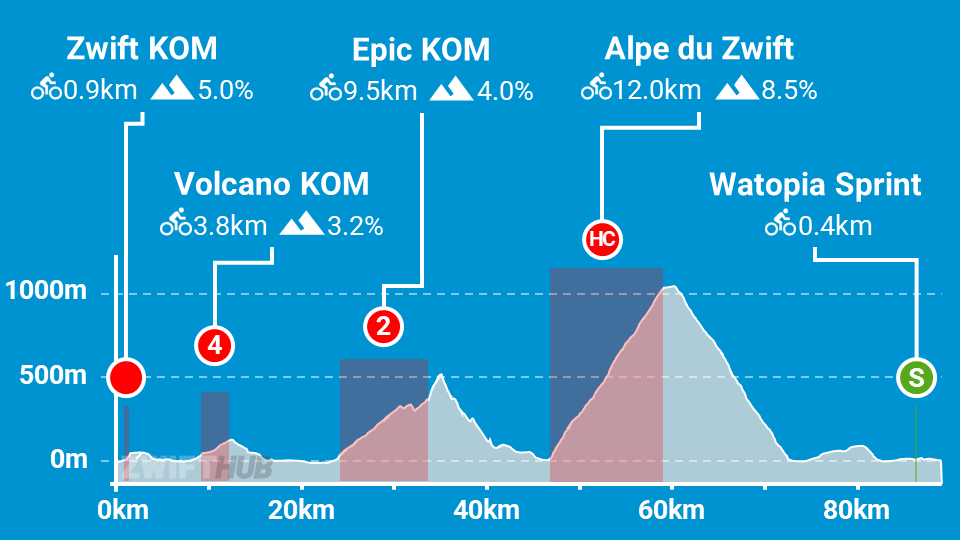
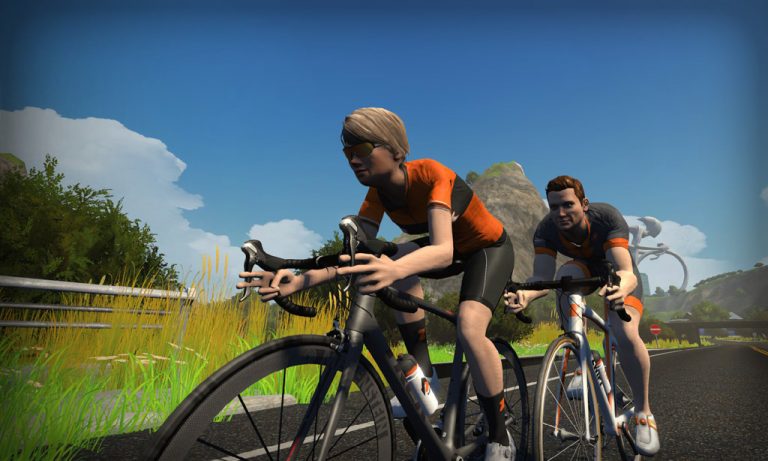
Watopia’s Four Horsemen may not be the longest route in terms of distance, but it is certainly one of the climbiest, taking riders up-up-up 2112 meters (6,929′) over 89.3km (55.5 miles). It takes on four of Watopia’s KOM segments, each tougher than the one before!
And that’s why we’ve selected this route for our next Badge Hunters event. After The Über Pretzel and PRL Full, Four Horsemen is the next-toughest route badge to cross off your list. So why not do it in good company, with thousands of other Zwifters?
The event takes place on Saturday, April 17th, at 6am Pacific/9am Eastern/2pm GMT.
When it was released in March 2018, the Four Horsemen covered all of Watopia’s timed climbs: the original Hilly KOM, Volcano KOM, Epic KOM, and Alpe du Zwift. Along the way it also covered (nearly) every bit of existing Watopian road.
Since that time the Fuego Flats and Titans Grove expansions have been added to our favorite cycling paradise – so Four Horsemen no longer covers all of Watopia’s KOMs or tarmac. But make no mistake: this route still packs a punch!
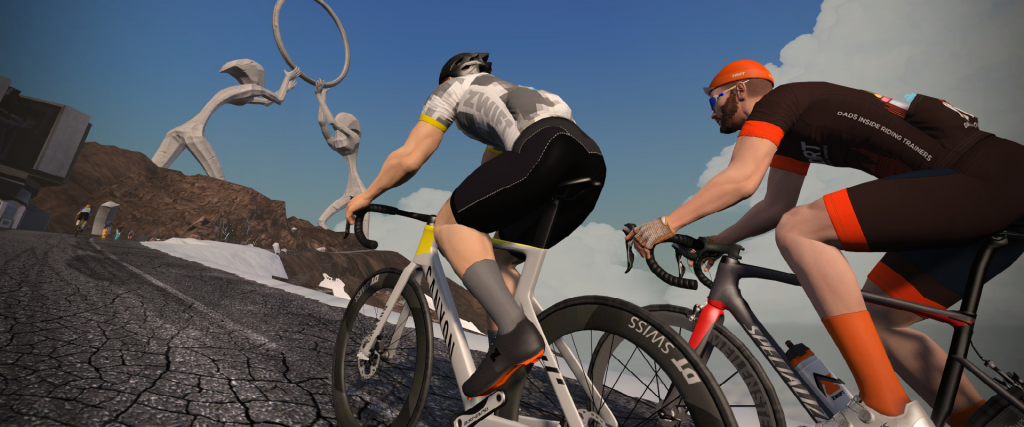
Fun fact: this is the only route in game which includes a descent of Alpe du Zwift. Here’s something you can’t do outside on a bike – descend mountain hairpins at 70+ kph, surrounded by other riders!
In an effort to reduce system problems, we’ve broken this ride into three categories: A, B, and C. These are not pace categories. They only exist to spread out the riders a bit at the start.
Categories will start 2 minutes apart so your Zwift device only has to deal with hundreds of riders at the beginning, and not a few thousand. Once riders get moving and spaced out, everyone’s systems should perform nicely.
If you’re concerned with your device’s ability to handle heavy traffic, join the category with fewer riders (B or C).
ALL categories will be visible throughout the ride.
More Ride Specifics
Show up on time, because there is no late join for this ride. Why? Because if you late joined more than a minute or so into the event, you wouldn’t unlock the route badge! And we don’t want that on our conscience.
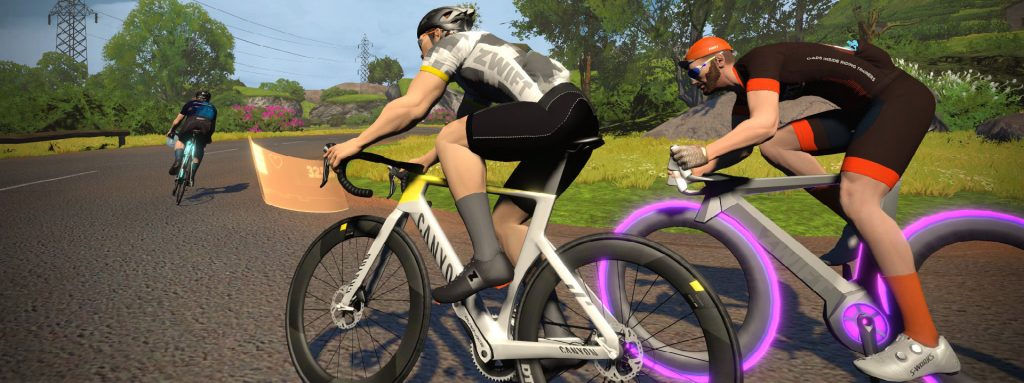
This will be a double draft ride, so sit in with others on the flats in order to conserve your energy.
Steering is enabled, to make it more engaging and fun!
We’re serving up a custom mix of only useful powerups, evenly split between the Feather, Van, and Helmet. Use them for a bit of relief.
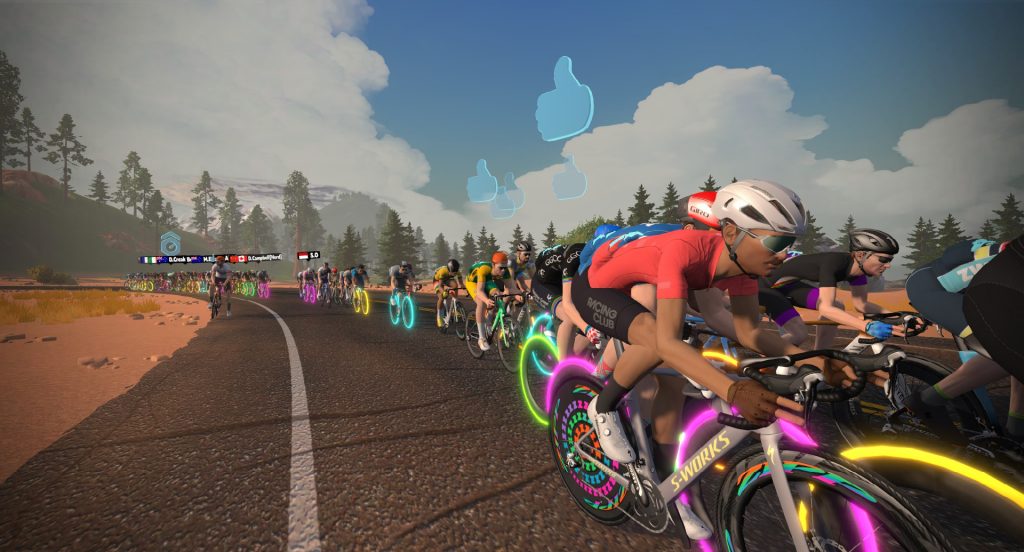
This is not a race – it’s a group ride. You can treat it as a race if you’d like, of course, but the ride will break up naturally into pace groups. Find riders working at your target pace and work together.
Based on the VeloViewer Leaderboard we can see that top riders crush Four Horsemen in just over 2.5 hours. But most mortals require 3-4 hours, with plenty taking even longer. You do you. Be sure to plan accordingly.
Discord
Zwift Insider’s Discord server will be used for voice chat during the ride. This really helps pass the time, so we highly encourage it!
In this Women’s Ride and Run Series special episode, we start a discussion about equality in sports from many different perspectives. Sarah Axelson, Director of Advocacy at the Women’s Sports Foundation talks about the work she and her colleagues do to improve equality in sports because of the many benefits it provides. Ayesha McGowan talks about her career and being the first African American woman to sign with a professional road cycling team, whilst also providing easy ways to be an advocate for change. Then to close the show, Joanna Hoffman (Director of Communications at Athlete Ally) has a conversation with Dr. Veronica Ivy, the first transgender world track cycling champion, about the inequality both female and male trans athletes face when trying to take part in sports.
About Women’s Sports Foundation:
Zwift is proud to support the Women’s Sport Foundation, which exists to enable girls and women to reach their potential in sport and life. Founded by Billie Jean King in 1974, WSF is building a future where every girl and woman can #KeepPlaying and unlock the lifelong benefits of sport participation. All girls. All women. All sports.®
Athlete Ally believes sport will change the world when it welcomes and empowers all people. As a leading national nonprofit working at the intersection of sport and LGBTQI+ equality, Athlete Ally works to end the structural and systemic oppression that isolates, excludes and endangers LGBTQI+ people in sport. We educate individuals and institutions to understand obstacles to inclusion for LGBTQI+ people and how they can build an inclusive culture within their athletic communities. We work to ensure sport governing bodies, teams and leagues adopt policies that reflect the diversity of their constituents. We incubate athlete activism to advance LGBTQI+ equality in and through sport. For more information, visit www.athleteally.org or follow us on Facebook, Twitter or Instagram @AthleteAlly.
About the Podcast:
The Zwift PowerUp Cycling Podcast typically features training tips from host Matt Rowe (Rowe & King), with regular co-hosts Greg Henderson, Rahsaan Bahati, Dani Rowe, and Kristin Armstrong.
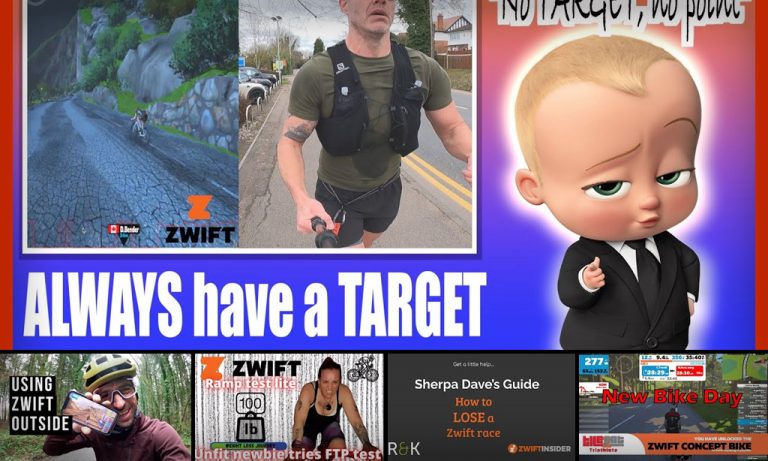
Our Top 5 Zwift Videos this week include tips for setting effective targets for your training, a new Zwifter taking a ramp test, an experiment in Zwifting outside, and a celebration of earning the Tron bike. Also see a tip for how to lose a race in Zwift! Yep, that’s right…
Is training without a TARGET pointless? | Plus Zwift’s FOUR HORSEMEN
Mark Lewis talks about the importance of defining targets for your training while working toward bigger goals. Then he demonstrates on Zwift’s challenging Four Horsemen route. To keep himself on target, he picks a time to beat, finds a video of another Zwifter riding the route around that time, and “races” him!
Zwift ramp test lite: Unfit noob tries FTP test (100lb weight loss journey)
Sam Flynn shares her weight loss and fitness journey before trying Zwift’s Ramp Test Lite – for the third time in a week. She wasn’t happy with how the first two tries went, but as it turns out, the third time was the charm!
Sherpa Dave’s guide to losing a race in Zwift
We’ve featured a lot of race analysis videos, but here’s one with a different angle. Sherpa Dave shows us how to lose a Zwift race based on his own experience.
Can You Use Zwift Outside?
Dave Noakes admits that it’s silly, but he’s always wondered whether it would work to ride on Zwift outdoors. Watch to see what happens!
New Bike Day – Zwift Concept Z1
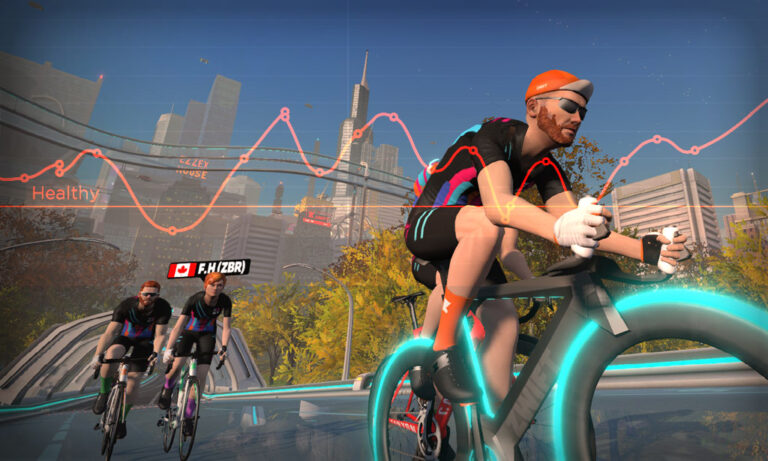
This is a simple video, but a satisfying one, as “The Fat Triathlete” conveys the pleasures of earning the “Tron bike”!
Got a Great Zwift Video?
Share the link below and we may feature it in an upcoming post!
I started Zwifting in January of this year after selling my other exercise bike. (I can’t decide if it rhymes with telethon or not). My first Zwift setup was a dumb trainer with cadence and speed sensors added, hooked to an old Apple TV and an even older TV. And it worked just fine. Really. I sat on my bike and pedaled while watching the tv screen.
Secretly though, I hoped to like Zwift enough to justify jumping into the 4K, smart trainer arena. I’m kind of a gadget weenie so I knew if I liked Zwift, many new dingles, dangles, and dongles were in my future.
Well… I liked Zwift. A lot. So I upgraded to a Wahoo KICKR, an Apple TV 4K, and a new 4K TV. And that’s when the real trouble started.
My lovely wife also rides and runs. A lot. But she tried the telethon bike (exactly once) and said it wasn’t for her. Add to that the fact that she’s not a PC gamer, and I simply never imagined she’d like Zwift. So I started to create the Zwift ecosystem that made the most sense to me.
I got used to the new smart trainer and video setup, and to my surprise I could tell my wife was interested in trying Zwift. So she did. And she liked it. A Lot. Trouble.
Apple TV and Zwift work just fine. Really. But I’ve been playing PC games since before there were graphics, and I knew there were better Zwift visuals and performance possible on a PC with a beefy graphics card. More trouble.
My wife didn’t understand why I would ever want a better video experience because “it looks just fine to me.” But I just couldn’t stop thinking about a better system so I bought a refurbed PC with a strong graphics card and hooked it all up. Better Zwifting ahead!
I couldn’t wait for her to do her first ride on the new rig and experience the new buttery smooth 4K graphics. The first time I rode I was blown away by all the new details and the smooth scrolling scenery as I rode around just taking in all the visual goodness.
So she did. And she said with a sniff and a shoulder shrug, “Looks the same to me.”
“What? The same!? No way! It’s TOTALLY different!” I blurted as I pointed out all the new things to look at. I was shocked she couldn’t see it too!
“Well… maybe, but I never look over there anyway…” Oy. How could she not see it?
It really bugged me. A lot. How could she not SEE IT? Puzzled, I went back through every setting on Zwift, the PC, and the new TV to make sure all were set to highest performance specs and true 4K resolutions. Just in case I’d missed something, because I knew it wasn’t “the same.”
And that’s when I saw it.
The new TV was only a 1080p TV, not 4K. WTF? How did I make THAT mistake? Crap. So, I did the only thing I could do. I hopped in the truck and headed off to buy a real 4K TV! (She was really going to see the difference now!)
An hour later, it was hooked up and I was riding through Tempus Fugit in REAL 4K! What a difference this makes! I couldn’t wait to get my wife back on the trainer so she could FINALLY see what all my fussing was about. She shook her head as she got on the trainer and began her ride. I was in shock when she said, again, “Looks the same to me…”
Awww come on! “But look at the rocks and birds and the trees and the leaves and the shadows and cracks in the road and the cute little fishies and ohhhh!! Look at her pink socks!! and…”
“Looks the same to me…” Oy.
I tapped out.
Having met my match in her once again, I realized that I still dearly love, and am still married to my wife of 34 years. And she’s still right.
And I have a kickass true 4K smart trainer PC Zwift setup in the garage I get to ride every day.
We’ve known that Zwift was getting into the hardware side of things since November 2019, when job listings surfaced for a new Zwift “FitTech” division in Surrey, UK. Since that time there has been much speculation about what Zwift is working to create. Everyone seems to agree that a new smart bike is in the works, but recent sleuthing showed Zwift is working on not just one, but three hardware products.
Zwift has been very hush-hush about all things FitTech, but they are clearly moving full steam ahead on the hardware front, with operations based in London. Their careers page currently lists 9 open positions in the “Connected Products” category, all based in London:
Embedded Software Engineer
Embedded Software Engineer (Mid level)
Hardware UX Designer
Lead Mechanical Design Engineer
Manager; Electronics Engineering
Mechanical Design Engineer
Mechanical Technician
R&D Design Manager, Mechanical/Product Design
Systems Electronics Design Director
The most recently-posted job on that list is “Systems Electronics Design Director” and the opening paragraph of that job description states:
The Director of System Engineering role is a new position within the Fitness Hardware division. The team primarily builds electrical and mechanical systems, as such the Director of System Engineering needs to have significant experience with consumer electronics, managing electronics and firmware engineers, and to have experience with system architecture. The director will manage a team of approximately 10 Engineers, Electrical, firmware, App Developers and Test Engineers.
This paragraph says a lot. It confirms that the FitTech team “primarily builds electrical and mechanical systems”. It tells us the team currently has ~10 members. And the job listing went live on March 15, 2021 – so Zwift is actively hiring in this space.
Updated Memorandum of Association and Articles of Association states 3(2): Zwift shall from time to time have the right for so long as it is the majority shareholder by notice in writing addressed to the Company, to appoint, maintain in office and remove, one or more persons to be director or directors of the Company and to remove any directors from time to time.
Appointment details doc shows Zwift CEO Eric Min as accepting the position of director at eDrive
Three separate documents indicate the three prior directors are no longer in positions of significant control
Registered address change from The Mill Rectory Farm Mews, Elton to 6th Floor 2 London Wall Place Barbican, London. Is this the location of Zwift’s FitTech division?
eDrive originally incorporated in September 2016 with the following directors:
Mark Cordner, Managing Director
Adam Malloy, Chief Engineer
Till Hanten, Engineer
Based on the documents linked above and a bit of LinkedIn research, it appears that Mark and Adam started Drive after working together at GKN Automotive. They appear to be remaining on as directors (or at least employees), while Till is no longer a director and possibly no longer with the company.
So what does eDrive do?
Our expert team of engineers draws on decades of experience and a track-record of delivering world-class electrical machine (eMachine) and electric drive (eDrive) solutions to leading Original Equipment Manufacturers (OEMs) and suppliers.
The team has worked on eMachine development and application projects for the automotive, off-highway, marine, industrial, aerospace and motorsport sectors.
So they are focused on developing electric motors, mostly for motor vehicle applications. But this sort of hardware and experience carries over nicely into the sorts of motors required for – you guessed it – smart trainers.
In fact, at least one smart bike manufacturer we’ve spoken with sources their circuit boards and motors from an electric car company, because smaller motors didn’t have the muscle needed to properly simulate a flywheel affect.
Additionally, eDrive’s list of services includes several items which would come in handy for FitTech’s nimble R&D needs:
We assemble small batches of eMachines for prototype evaluation, mule vehicle tests and niche applications.
Our established supply-chain and in-house assembly capability allows us to deliver custom-designed products very quickly, accelerating our customers’ development programmes and allowing them to evaluate representative hardware in record time.
Conclusion
It’s already been said, but it’s worth saying again – if Zwift wants to bring quality hardware to market quickly, acquisitions will be essential. Those acquisitions certainly include experienced employees already in the relevant industries. It may also mean purchasing the rights to patented hardware. And of course, given today’s news, Zwift is clearly willing to acquire a small, nimble company like eDrive whose existing experience and connections can help Zwift get hardware to market more quickly.
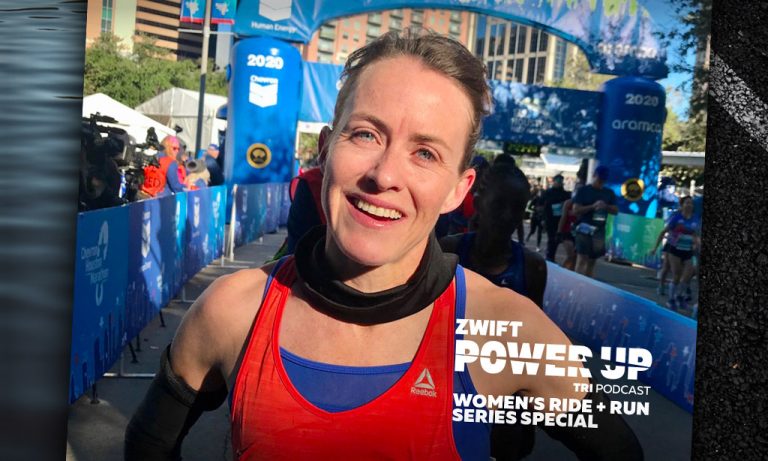
Malindi Elmore sits down with Sarah True and Matt Lieto to discuss her exceptional career and how she manages to balance work and home with her husband as her coach and raising her two kids.
She went from running in the 1500m, to competing in triathlon, to focusing on the marathon – if anyone knows how to handle a work-life balance, it’s Malindi. She also recalls a story about a Christmas present she sent to Matt last year, which didn’t quite go as planned!
About the Podcast:
The Zwift PowerUp Tri Podcast is hosted by former pro triathlete Matt Lieto and Zwift Academy Tri mentor Sarah True. Both are passionate about lending their in-depth knowledge of the multisport to the Zwift Tri audience.
On March 18th, 2021 the Zwift Cycling Esports Commision released Version 1.0.6 of its ruleset which governs races designated by Zwift as Zwift Cycling Esports events. Two changes in this version are noteworthy for their potential impact on reducing the risk of disordered eating and eating disorders in virtual cycling.
The changes are important not only for the direct and tangible effects they will have on racers, but because they signal Zwift’s acknowledgment of the importance of the issue and commitment to taking the necessary steps to help ensure athlete safety.
Zwift’s Statement On the Recent Ruleset Changes
As the Chair of Zwift’s Cycling Esports Commision Dr. George Gilbert explains, making appropriate and effective changes to the ruleset is not an easy task. Considerable thought and debate are required to achieve the appropriate balance between all factors:
“The blunt truth is that, as important as ‘extreme dieting’ is, it is just one of the several competing factors that need to be considered. In no particular order, broadly these issues include:
Extreme dieting: The mostly physical issues that arise from athletes manipulating their weight.
Body image: The mostly psychological issues that arise from athletes constantly focusing on the weight (even if their weight itself isn’t unhealthy).
Ethics: The mostly legal/moral issues that arise if athletes are not, or are perceived not to be, treated with respect and within appropriate boundaries.
Fairness: The mostly reputational issue that arises if athletes are not, or are perceived not to be, competing on equal terms.
Critically, optimizing the rules for any one of these will likely disproportionately affect the others, and our goal at Zwift is to find the right balance between all of them.”
Rule Change #1: Timing of Weigh-Ins
Rule 2.4.4 in the previous version of the ruleset read, “Riders shall use an in-game weight and height as measured in Real Life within 24 hours of the start of the event.” This was replaced by Appendix A of the current ruleset which states, “Weight measurement must be conducted within two hours of the event start and submitted to Zwift at least one hour before the event start.”
Reducing the weigh-in window (as explained in previous installments of the “Extreme Dieting in Virtual Cycling” series) reduces the likelihood of athletes engaging in the extreme dieting behaviors of calorie and fluid restriction prior to weigh-in followed by binging.
The logistical and organizational burden upon Zwift Cycling Esports this change creates are significant and should not be overlooked, making it that much more profound and noteworthy.
Rule Change #2: Weigh-In Videos Must Remain Private
Appendix A of the new version of the ruleset includes the addition of the following with respect to Pre-Race Weight Videos, “Please note that weight measurement videos must remain private. Publication of weight measurement, or otherwise sharing them with third parties, is a violation of these rules.”
This change is perhaps just as important as change #1 in ensuring athlete safety, although the reasons may not be as obvious, nor the effects as easy to predict.
The History of the ZwiftTransparency Social Media Group Page
ZwiftTransparency was created in late 2018 to fill the void left when the original community-run the original community-run Zwift Anti-Doping Agency (ZADA) was terminated. (ZADA had previously verified elite-level performances and awarded badges on ZwiftPower to riders who reproduced similar efforts in real-life scenarios.) The initial intent of ZwiftTransparency was to focus on elite-level racing, but the group wasn’t restricted to those racers, and after a year grew to over 500 members.
Matt Gardiner
Matt Gardiner (ZwiftPower profile), elite racer and ZwiftTransparency creator, shares his purpose for starting for the group:
“This was largely done publicly because ZADA did not require racers to weigh-in prior to events, so many of us did it out of respect for our competitors and in pursuit of fair sport.”
Lionel Vujasin (ZwiftPower profile), elite racer and ZwiftTransparency administrator, says this about the early days of the group:
“I was one of the first to post a weigh-in video on the ZwiftTransparency page. It was my way to battle the common idea that all Zwifters were weight-doping cheaters. The origin of the movement was to promote fair racing and show people there are ways to make virtual racing legit.”
The Real Public Weigh-In Story of Virtual Cyclist Tom Gakes
From the age of 13 Tom Gakes (ZwiftPower profile) had an undeniable talent and love of cycling, and by 15 had begun racing at a high level. As his competition became stronger, his ability to produce results, especially in hilly races, got much more difficult. Lacking the knowledge to identify the issue, Tom focused on his body weight. “At first, results were getting better, until the point where I was 57kg (at 180cm) and training 30+ hours per week,” he recounts as the cause of his “collapse.”
That collapse ultimately made him too weak to get on his bike, forcing an extended hiatus from racing and several years of recovery. As he started to regain form, he vowed to avoid any more weight-related issues, and one way was to not step on a scale again. Proud of the change, Tom recalls, “I had been racing at a top level, even doing World Cup races and winning National Championship medals, without even knowing my body weight.”
Tom’s formula was successful: he had his disordered eating issues well under control. Until he got hooked on virtual cycling. Forced to break his no scale rule when completing the Zwift profile, he was shocked to find that his weight had increased from 57 to 78kg.
As his fitness and eracing technique improved, he found himself at the “pointy end” of A races, and the pressure to publicly submit weigh-in videos followed. Describing the resumption of his unhealthy habits, Tom says, “The pressure from the community to upload videos publicly kept growing so I eventually joined in.”
Frequent scale checks and video weigh-ins confronted Tom with daily changes to his body weight, causing him to diet again. In the winter of 2019 he was back to 73kg. “I really didn’t want to do this [post a weigh-in video], but at a certain point the general opinion was that any high-level racer who didn’t was a weight doper,” Tom says. Tom’s physical condition deteriorated, he dropped from A+ to B, and his race ranking plummeted from 53 to 5300.
Incidentally, I appealed to Tom after admiring his courage in commenting on a Facebook post debating the shut-down of ZwiftTransparency. His posted comment was the only one of over 100 proposed theories which pointed to weight-related concerns as a factor.
The Elimination of Public Weigh-Ins
Episode 95 of Simon Schofield’s Zwiftcast, which aired March 19th, 2021, raised the topic of ZwiftTransparency and the mystery behind its disappearance. In addition to providing insight, it made clear that extreme dieting in virtual cycling may also be an issue of interest to the broader Zwift community.
Nathan Guerra
Nathan Guerra (ZwiftPower profile), the unofficial “voice of Zwift” as its racing broadcaster for Zwift Community Live, had this interesting take on the matter.
“When ZwiftTransparency was first created there was a lot of naming and shaming going on, but the community did a really good job of policing itself in that area. Another consequence, however, was body dysmorphia issues and that’s a big, ‘No no!’ It’s not OK to be promoting and teaching the narrative, ‘Let’s go and see how skinny I can get.’ You don’t want to create a space that encourages that or provides an opportunity for people to develop really bad behaviors around this stuff.”
The Decision to Remove ZwiftTransparency
The ZwiftTransparency public weigh-in group site was removed on March 11th, 2021 by Matt Gardiner. Despite being proud that the group’s concept has provided a precedent for private weight verification, Matt acknowledged its problematic potential and therefore knew it was the right time:
“As the creator and admin, I’ve been closely following the stories related to disordered eating, peer pressure within the Zwift community, and the potential problems a group centered on public weigh-ins presents. Since the original intent of the group, community-led elite-level racing oversight, had been ceded by ZADA through the Premier Division, it seemed the group had run its course. Ultimately, I don’t want to further a single person’s struggle with eating disorders, and despite being voluntary, the peer pressure of a group its size using it as normative behavior, definitely contributed to a feeling of obligation to join in.”
Public Performance Verification From a Race Organizer’s View
Although Matt confirmed that he acted independent of Zwift and other external pressure, the decision followed a conversation between himself and Steve Milliken of WTRL, who also decided to abolish their public verification site and allow Zwift Cycling Esports the opportunity to formulate their own plan for future verification. Martin Carew of WTRL offered this interesting opinion on the topic from the perspective of a promoter:
“I have never liked the guilty before innocent attitude and despise the desire for the more vocal in the Zwift racing community to pressure others to post their verification videos publicly. A race organizer is responsible for ensuring their races are fun, fair, and in the best spirit of competition. It should not fall on fellow competitors to turn vigilante. In fact, we believe that cyber and social bullying is actually more of a concern than weight problems.”
Martin further defined the responsibility placed upon race organizers by stating:
“WTRL believes that all verification should be done out of the public eye and that ZwiftPower needs to limit many areas to all but Race Organizers. There isn’t a single racer scenario in real life where a racer can walk up to another racer, scales and tape in hand, and demand that they weigh themselves or insist on the sharing of data from their head unit, so it shouldn’t be acceptable behavior within Zwift.”
Zwift’s Commitment to Finding the Right Balance
As previously stated by the Chair of Zwift Cycling Esports Dr. Gilbert, creating an environment where all of the factors which ensure a safe, fair, and trusted competitive environment are properly addressed is a monumental task, especially in a venue that lacks suitable precedent or time-tested examples. Zwift as a whole deserves to be commended for the recent changes to their policy and commitment to addressing extreme dieting risk.
Dr. Gilbert makes the intentions of Zwifts commitment clear in his closing statement to us:
“The points raised on extreme dieting are all very valid, and a great contribution to the debate, but if the answers were easy, then everyone, across all weight-sensitive sports, would have implemented them already. At Zwift we’re committed to finding the right balance between all these competing issues, and will continue to review whether the balance we have is right, and evaluate the wider impact of any changes to make sure an appropriate and proportionate balance is maintained.”
A Key Element Which Deserves Weight
One key area which deserves further serious attention and must be weighted heavily in this balance is identification and prevention of extreme dieting behaviour through training and education.
As an emerging sport which has yet to be truly regarded as professional, many athletes and teams lack resources and necessary professional medical, nutritional, and training knowledge and guidance.
With few options, athletes and team directors are forced to do their own research, follow instinct, imagination, and word of mouth or social media suggestions, rather than scientific results-based evidence. These practices pose a significant risk when specific biological and genetic predispositions, among other factors, are not accounted for.
The Proposal of a Virtual Cycling Training Module
With input from several of the most prominent experts in the field of sports nutrition, coaching, and psychology, the framework and key elements of an Esports Extreme Dieting Identification and Prevention Training module will be proposed in the next article of this series. Emphasis will be focused on the requirement for athletes, coaches, and race organizers to be knowledgeable in the identification and prevention of weight-related issues unique to virtual cycling.
With Zwift’s commitment to tipping the scales toward ensuring a safe and fair competitive environment coupled with the cooperation of athletes, teams, organizers, and coaches, that balance can be attained and the goal of placing all involved parties in the best possible position to succeed will be achieved.
Your Thoughts?
In addition to the recent changes announced by Zwift to their Esports Ruleset, what other steps do you feel are necessary to create the proper balance?
After a very successful “Couch to Cat C” project, Boone is now well into the next training block: one we originally dubbed “C to Shining C”, but have since renamed simply “C to B”, as our new goal is to see him hit 3.2 w/kg in his ramp FTP test.
Here’s how week 5 unfolded…
The Plan
As a reminder: the basic plan we’ve settled on for the 6 weeks contains a mix of four different types of rides. (Many thanks to Alan Dempsey of HPP Coaching for giving us solid advice that sets Boone up for success).
Races: Boone will race the C’s every week or two to check his progress, work on race craft, and of course get in a good workout.
VO2 Workouts: this will be the cornerstone workout of each week. Nobody likes VO2 work, but we both agree Boone is getting a lot of benefit from these.
Pace Partner Intervals: we’ll use the Pace Partners (Diesel or Cadence) to anchor a fun, interactive interval workout. Warm up with the pace partner, then sprint off the front for 15s. Or drop off the back, and put in a measured 2-minute effort to get back on. Lots of options here.
FTP Ramp Tests: we’ll do at least two ramp tests to measure FTP progress.
Recovery Rides: some days, Boone will just need an easier effort in the saddle. Since he’s still a beginning cyclist, even easy efforts are far from wasted.
Ride 16: IRL Volcano Climb
For this ride, I proposed something pretty wild to Boone: “What if we road outside?” Just a couple of miles from my house is the base of Mt. Konocti, our local volcano. (Wikipedia says, “Although it is often described as extinct, it is actually classified as High Threat Potential.”) There’s a dirt road that climbs to the top of Mt. Konocti, which is around 2400′ of elevation. But I generally ride to the halfway mark, where there’s a gate and signs that (theoretically) keep out cyclist and equestrian traffic.
I figured Boone would be up for it, since we wouldn’t be riding in traffic and it would be a good training climb around 40 minutes long. And he said he’d do it! So we invited a couple of local friends – Zane and Mike – and did a bit of bike swapping so everyone had a useable steed. Boone on my MTB. Me on Zane’s gravel bike (he’s trying to sell it to me). Zane on Mike’s extra (medium) Stumpjumper. And Mike on his other Stumpjumper!
My goals for the ride were just to get Boone a decent training effort and a fun IRL riding experience after not doing it for 20+ years. As we began to climb the dirt ride, I recalled the last time I was on that road with Boone. We were both in high school, sneaking up Konocti to change the gigantic “K” etched on the side of the hill to an “L”. A high school prank – I attended school in Lakeport, but Mt. Konocti is in Kelseyville, home of our rivals. So Boone helped me and some Lakeport friends change it – even though Boone attended Kelseyville. (He wasn’t a big fan of school, and we were always looking for crazy things to do together.)
That particular outing didn’t end well – we were caught by the cops. I hoped today’s ride would end better.
On the Konocti road with Boone, for the first time since high school
Zane showing off his aero helmet and bike position
I set the pace for our group, not pushing hard, but enough that Boone would get in a good training effort. We made it all the way to the top without stopping – Boone did really well, considering he had to master shifting, a new bike, and actually wearing a helmet for the first time.
Based on my perceived effort, I figured we made it up in 38 minutes. I’ve ridden my bike (the Stumpjumper which Boone rode today) up this road probably 30 times, so I know how different paces feel. Imagine my surprise when I looked at our time on Strava – 32:54! Wowzers. That gravel bike of Zane’s climbs much faster than my Stumpjumper. And this made Boone’s ride even more impressive – 32:54 is a solid time up this climb.
At the top!
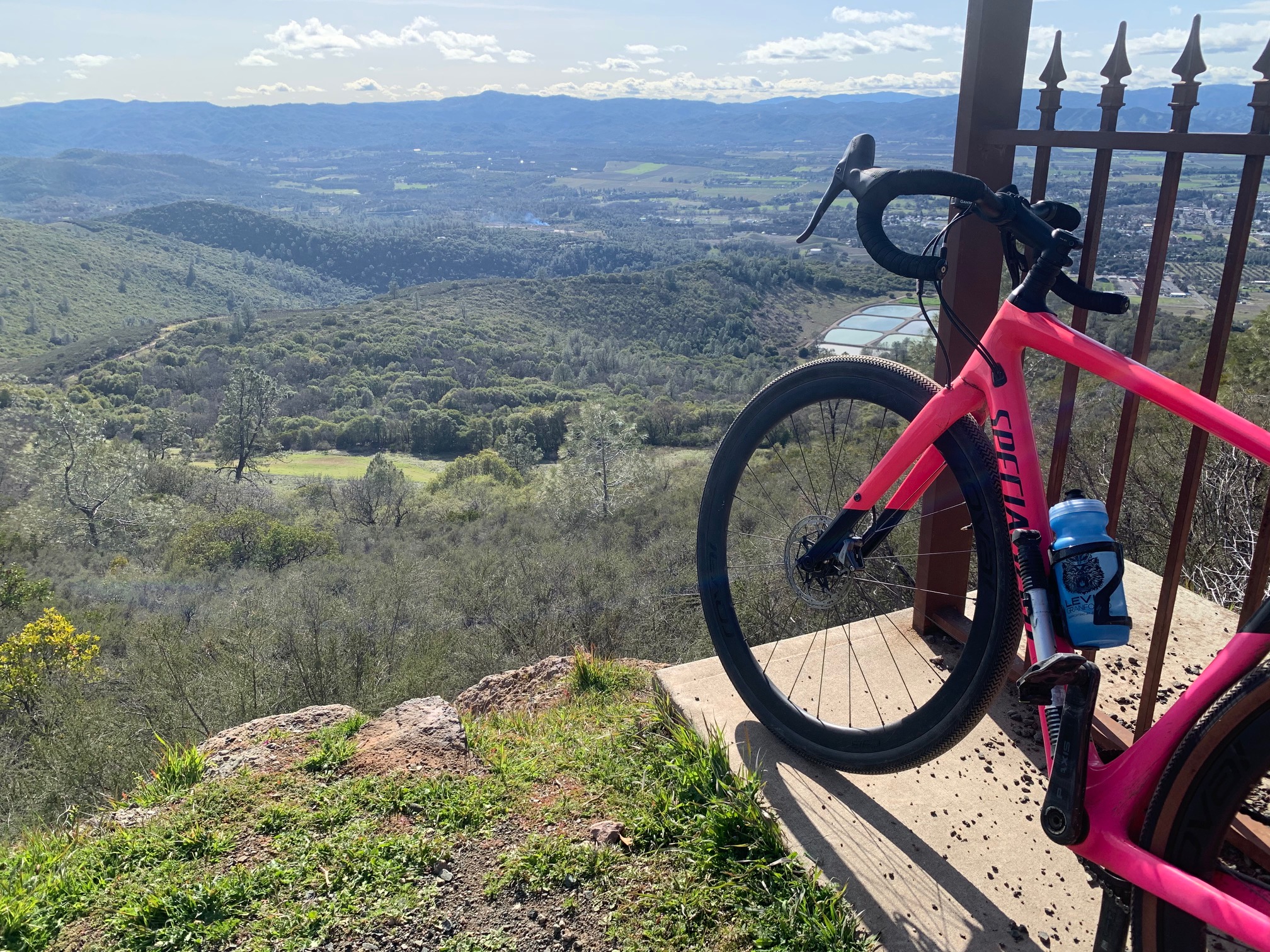
Not a bad view…
Two notable things happened on the way down the mountain:
Boone learned why you don’t wear 100% cotton shirts when riding outside. He almost froze as the wind cut through his soaked shirt!
Boone wisely realized that zwifting has taught him nothing about bike handling. So he didn’t push it speed-wise.
The VO2 workout has become Boone’s cornerstone tough effort, and this week I joined him in France for the ride. (I say “joined him,” but my goal was to sit on his wheel and do as little work as possible, having raced the previous day.)
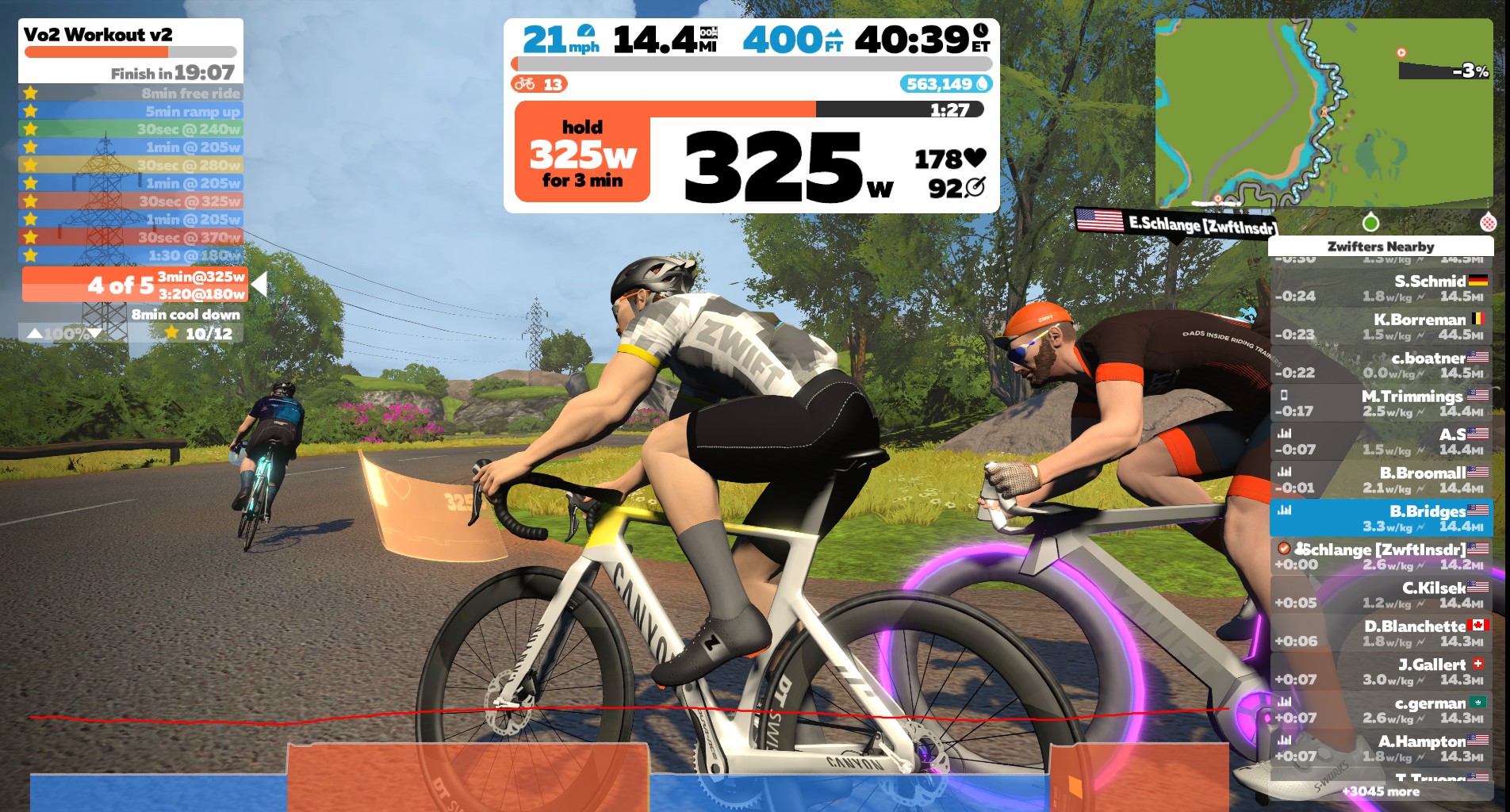
We bumped his VO2 intervals up to 325W, and set his times to 3 minutes on, 3:20 recovery. He kicked butt, completing all the intervals and earning all his stars.
Today’s ride was just about getting a steady effort in that wouldn’t sap the legs too much, since we had a tougher ride planned for the next day.
So Boone jumped in with the C. Cadence crew, who were on the Tick Tock route now that Pace Partners are rotating between routes. We got to lower his weight again – down to 216#! Then he just sat in, trying to stay in the draft and keep it steady.
What impressed us both on this ride was Boone’s heart rate. Where it used to quickly jump into the 160’s then low 170’s when riding with C. Cadence, it stayed in the low 150’s for the first 30+ minutes, and only got into the low 160’s. He’s building that cardiovascular fitness for sure.
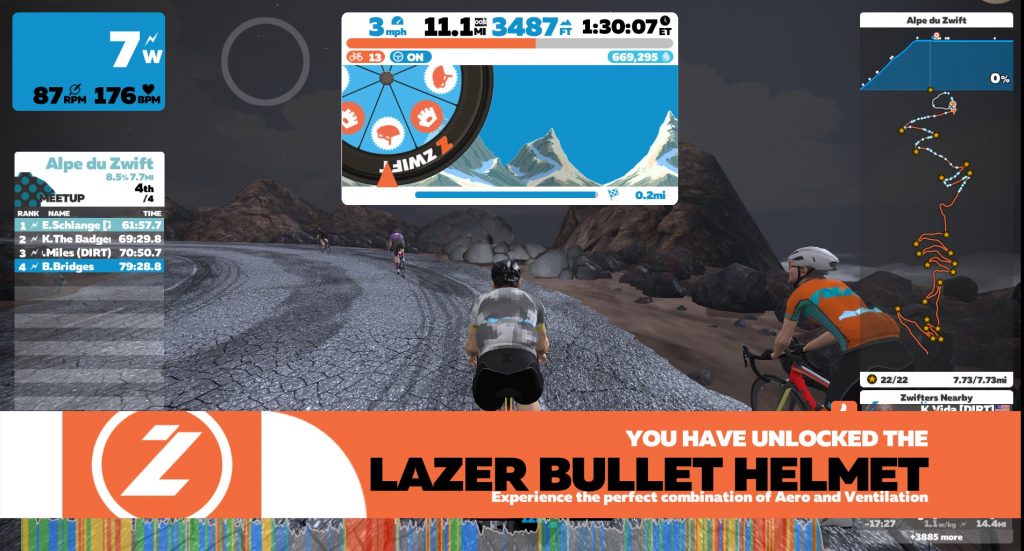
Several days earlier I’d learned that DIRT teammate Jason Mutchler (read his incredible story) had taken on a challenge – to ride up Alpe du Zwift in under an hour while eating an entire Large Domino’s pizza and drinking only Mountain Dew.
The hilarious “Alpe Dew Pizza” challenge was created by DIRT rider Ken “The Badger” Powell, who did it in February 2019 – I remember watching his attempt and laughing, so I decided I would join Jason on his Meetup this time around.
Then Boone said he needed to ride on the same day, due to some scheduling challenges. “Perfect!” I said. “You can make your first Alpe du Zwift attempt!”
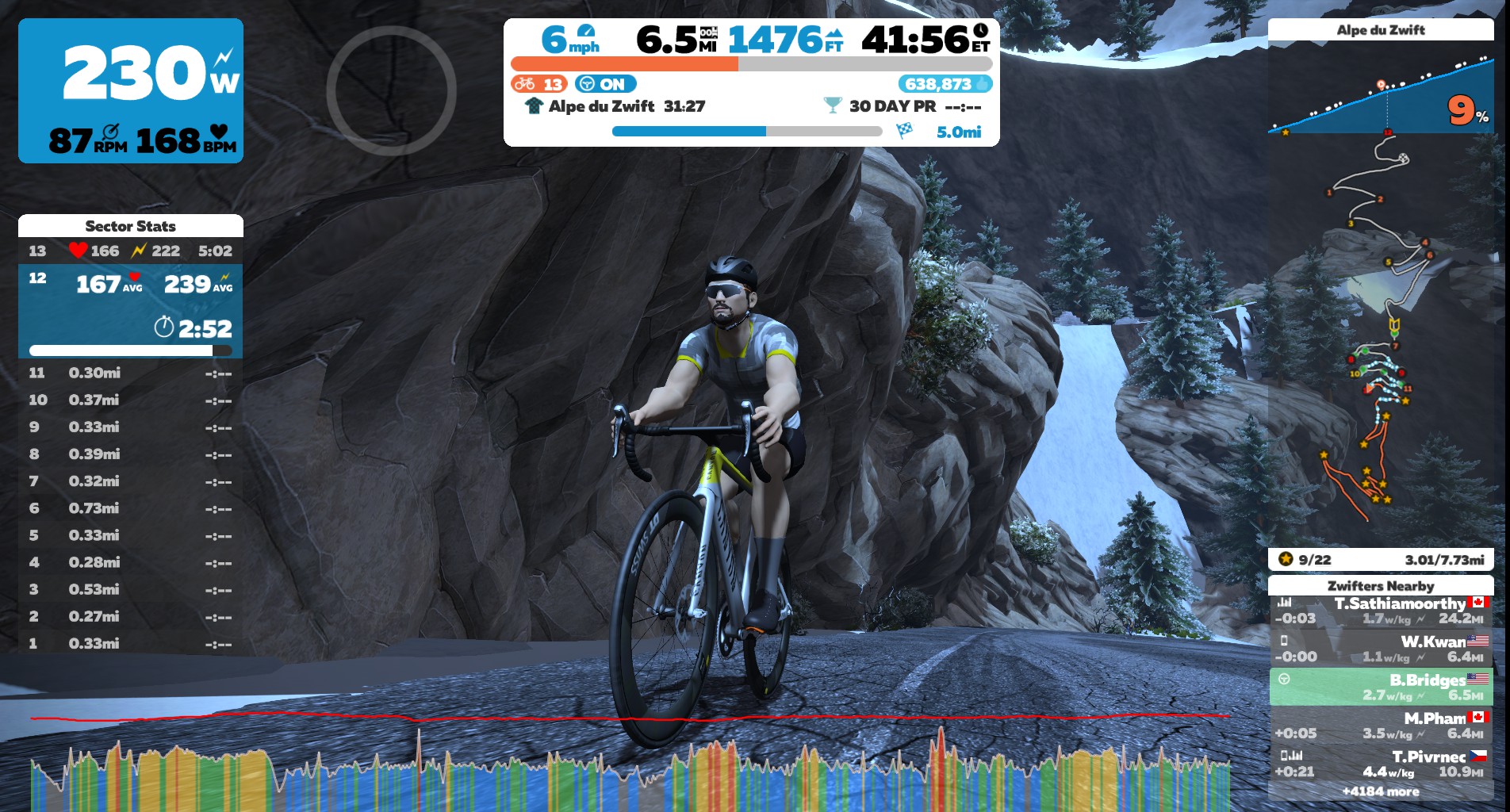
We figured it would take him 70-80 minutes, given his current weight and the power numbers he’s done for an hour+ up to this point. I told Boone to look at his average power numbers for each segment and to shoot for around 230 watts. He could always bump that up near the end, but you don’t want to burn out early on the Alpe!
He kept the power pretty steady, and we watched Jason’s livestream as we did our own climbs. Jason was flying – he ended up finishing in 48 minutes, with a large pizza down the hatch. Amazing!
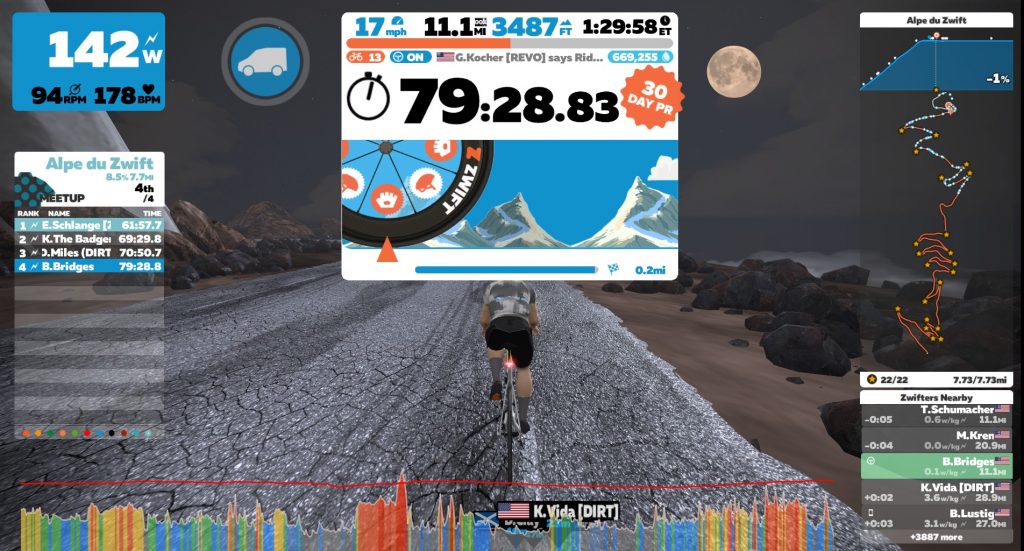
It took me just over an hour on my “time for a rest week” legs, then I descended to where Boone was and rode the rest of the way up with him, just like I would do outdoors. He finished in just under 80 minutes, setting some power PB’s in that 65 minutes+ range. And he averaged precisely 230W for the climb – nice pacing!
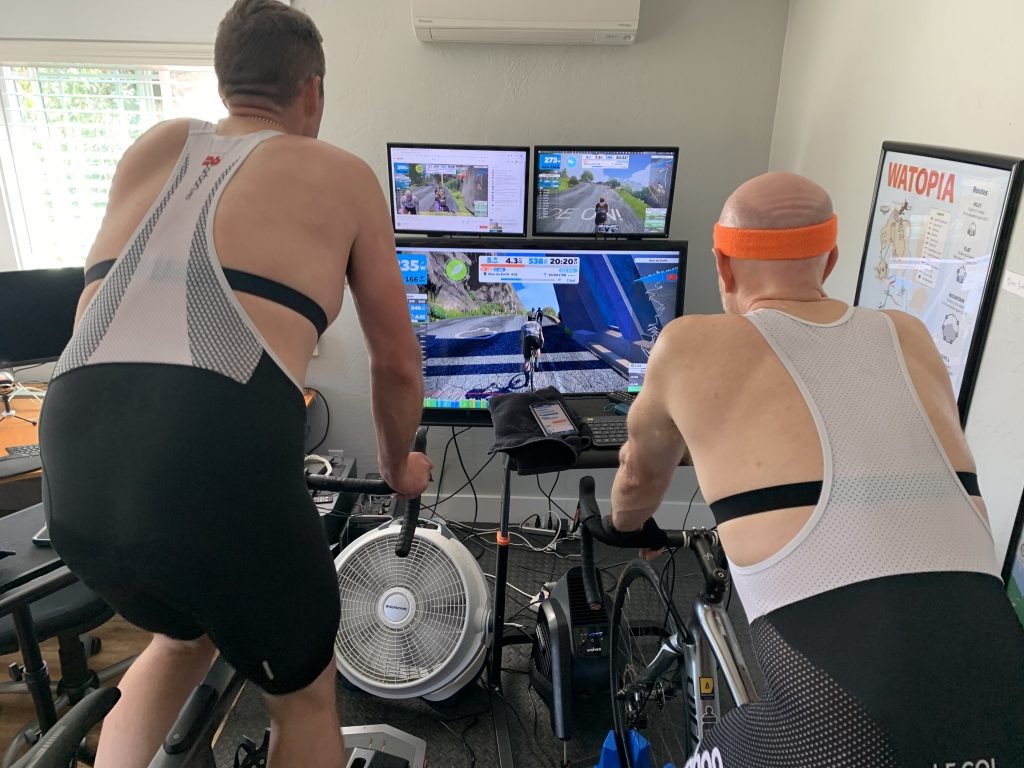
Riding with Jason’s stream in the top-left monitor
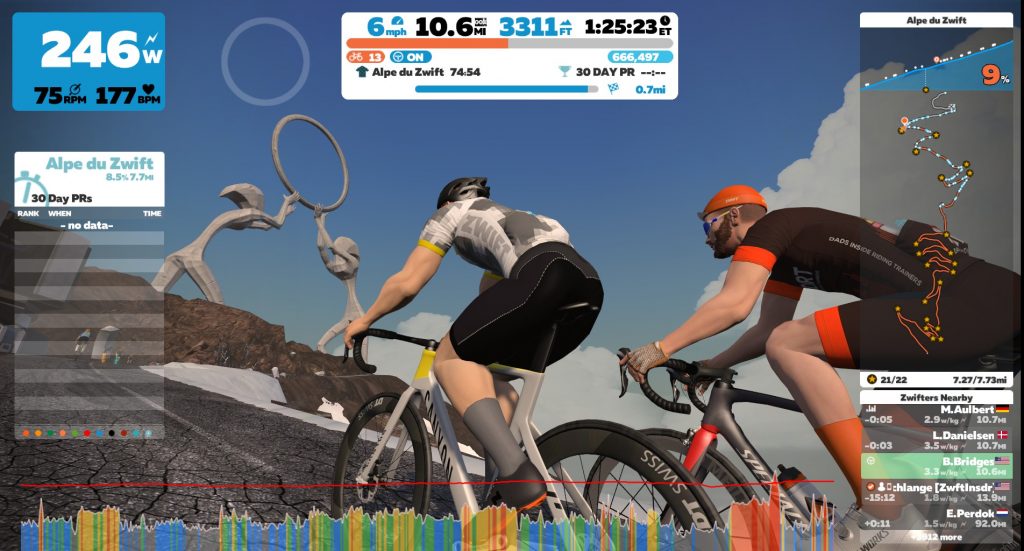
Climbing with Boone in the final meters
Ah, that “I didn’t get the wheels” letdown!
Supertucking our way down
I think Boone felt like he was pretty slow on this climb – it’s hard not to feel slow when you watch a guy who started with you eat a large pizza and finish in 48 minutes. But I told him 80 minutes up the Alpe is pretty impressive for a dude who, less than three months earlier, was totally untrained and weighing 265 pounds.
It’s all about perspective, right? Each of us is at a different place in our fitness journey. The big question is – are you getting stronger, and having fun doing it?
Consistent time on the bike is leading to Boone building exceptional endurance and mental toughness. This is clearly seen in his ability to quickly climb our IRL Volcano this week, as well as his first Alpe du Zwift summit.
Boone’s training rides have now reached the level where he has to make sure he’s adequately fueled for his tougher efforts. (A 250 pound dude may be able to push 200W for 30 minutes without worrying about fueling, but a 216 pound guy has to put a little thought into things when pushing 230W for 90 minutes.) He’s also started drinking chocolate milk after some of the hard rides, to get that protein/carb mix in to aid recovery.
He told me if he’d known he could drink chocolate milk after every ride, he would have started riding years earlier! I’m right there with you, Boone. Love me some chocolate milk.
We’ve only got a couple of weeks left before our target date to get him up to a B racer (3.2 w/kg FTP). Between his steadily-dropping weight and increasing power, will we get there? It’s going to be close! This will be a bit of a rest week for Boone, so he should be ready to make a hard push once he’s back in the saddle. Stay tuned.
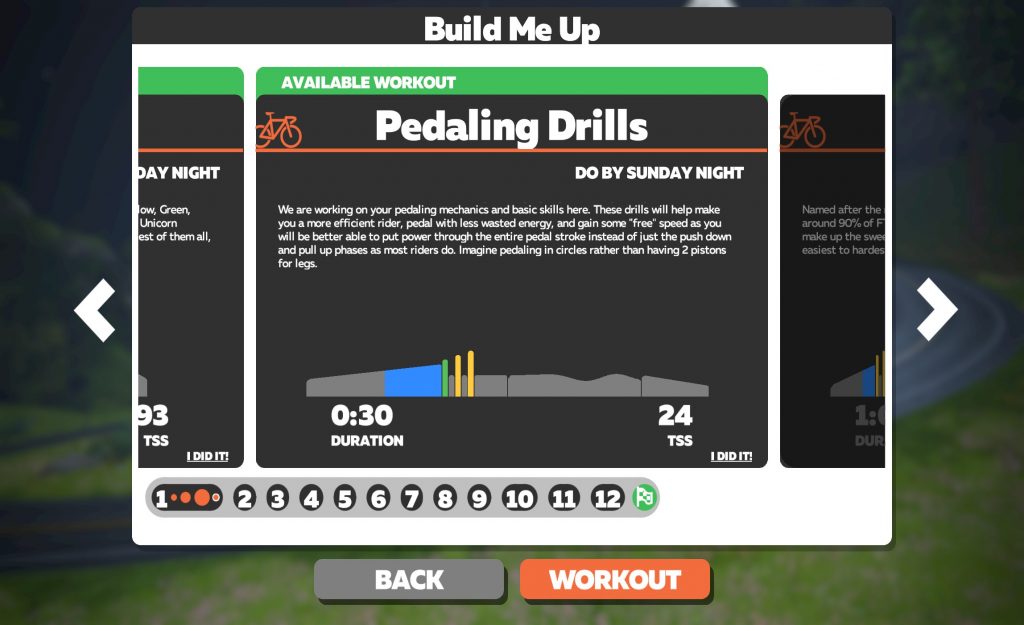
It’s been almost three years since Zwift released the first iteration of their Training Plans module, giving athletes access to free multi-week plans in addition to the one-off workouts which have been in the game since beta days. Since that initial release, several new plans have been added to the list which now includes 15 training plans for cyclists and 6 for runners.
While Zwifters loved the additional structure of a progressive training plan, they didn’t like the lack of flexibility built into the planning software. (For example, a forced “blackout window” meant you couldn’t do a workout at night and another in the morning.)
With its latest changes, though, Zwift is putting Zwifters back in the driver’s seat.
Shorter Blackout
First, Zwift has shortened the “blackout window” (how long you must wait between workouts) to just 8 hours. That means you can do one workout after dinner, then do the next workout the following morning.
It should be mentioned that recovery is essential for effective training (read “5 Training Mistakes for Zwifters to Avoid” and “How To Recover Better, Faster“). Just because you can do workouts closer together doesn’t mean you should. Still, some of Zwift’s Training Plans offer workouts which can be completed on back to back days without issue, and in those cases, this shorter blackout window lets Zwifters squeeze workouts into our often-hectic schedules.
Week-By-Week Availability
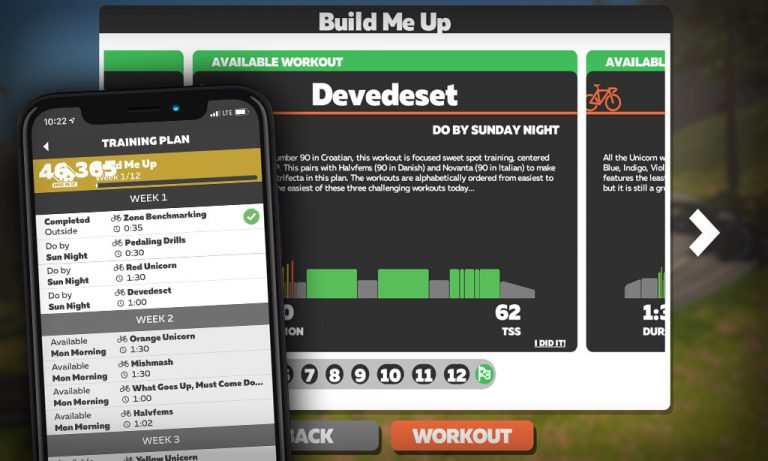
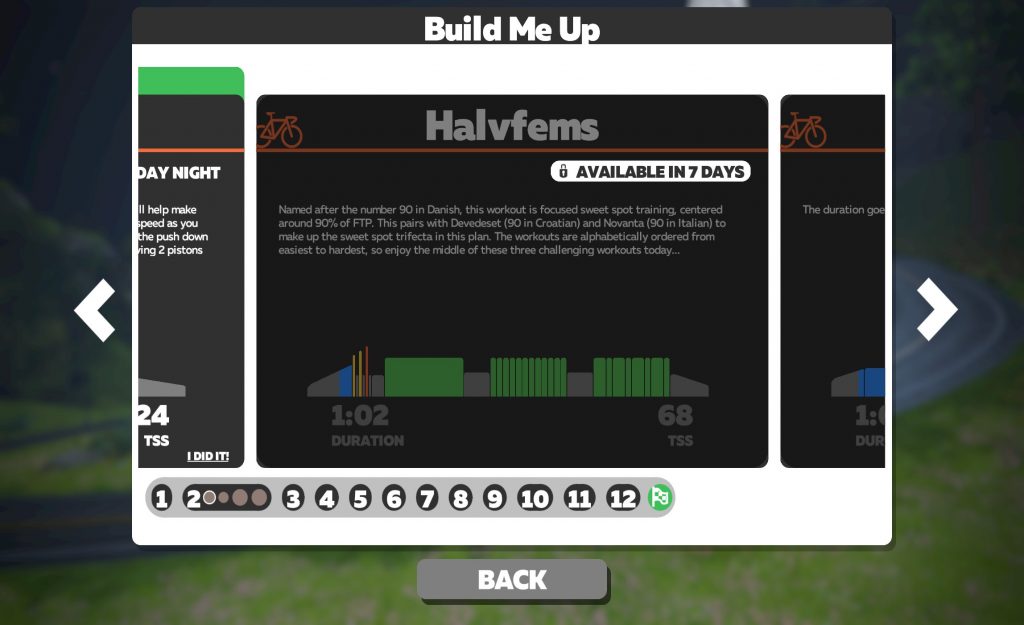
With Zwift’s latest change, the full week’s workouts become available every Monday, instead of just the next one in the list. This gives you the flexibility to choose when you do which workout. Maybe you’re going out of town for a couple of days, but still want to make sure you get the hard workouts in? Plan your workouts around your week’s schedule.
Full week of workouts available
Next week’s workouts are locked
Which Order?
There’s been a bit of confusion with the latest change, because each week’s workouts may show up in a different order on the Companion app than they do in game. This will probably be fixed in a future release, but until then – don’t sweat it! Here’s what coach Shayne Gaffney (who designed a lot of the Zwift training plans) said on a Zwift forum topic asking about the order of workouts:
It’s entirely athlete-dependent and based upon how much time they have available to train on a given day, how fresh they feel, etc., so it’s impossible to say. Before the training plans were opened up with greater flexibility levels, the shorter workouts would be available during the week and longer available during the weekends. This assumed the athletes had more training time available on Sat/Sun, which wasn’t always the case.
Coach Shayne Gaffney
Pick the workouts that fit your time availability and level of freshness. It really doesn’t matter what order you do the workouts in each week, as long as you get them done!
What’s Next?
According to Zwift’s forum post, they are actively working on additional Training Plan features:
Ability to pause and extend plans:this is a common request from people who get a bit sick or take a multi-day vacation. The just-released new flexibility will help in some of these cases, but allowing us to pause and extend plans would also be welcome.
Ability to provide input for when you have availability to train – to improve workout recommendations
Expanding upon current offerings to better serve any Zwifter:additional training plans (and perhaps better ways to search/filter the plans) are always welcome!