

Astute Zwifters know the game calculates your virtual bike speed using a combination of “personal” factors (wattage, weight, and height) as well as external factors (bike frame and wheelset choice plus the virtual environment including road surfaces, gradient, etc).
Here at Zwift Insider we’ve done a lot of testing to attempt to tease out the speed effects of each of those factors. We’ve posted about how much each kilogram of weight loss or gained speeds or slows you down, including doing so across a range of w/kg. But we’ve never really done a thorough analysis of how height affects speed – until today!
Zwift racers know that height plays a significant factor in your in-game speed. Simply put, all else being equal, a shorter rider will be faster than a taller rider. But just how much of a difference does it make, across a wide range of wattages and rider heights? Let’s dig in and find out…
Speed Test Data
This chart shows the time it took 6 riders of varying heights to complete our standard flat test course at different power levels. Each rider was set at 75kg weight and used the same virtual bike setup – the only variance across the tests were rider height and wattage.
Height vs Speed at Various Power Levels
Conclusions
- Zwift’s physics hold remarkably steady across a wide range of rider sizes (153cm to 203cm, or approximately 5′ to 6’8″)
- Zwift’s physics hold remarkably steady across a wide range of wattages. We didn’t include it on the chart above, but we also tested at 750W and 1500W, and found the time gaps progressed as we would expect.
- As power increases, speeds increase. As speeds increase, the time gaps between riders of varying heights are reduced.
- For example, at 150W, the different between a 153cm and 203cm rider is 230 seconds. At 450W, those riders are only separated by 159 seconds.
- While the gaps in seconds may change across power levels, in terms of percentage of overall time, these gaps hold pretty steady, with overall time increasing by 5.63% (at 150W) to 5.83% (at 450W) when rider height changes from 153cm to 203cm.
- Why does the percentage difference increase at higher wattages? Because aerodynamics matter more at higher speeds.
- At lower heights, adding a centimeter makes a bigger difference. Going from 193cm to 203cm slows you by approximately 1.06%, but going from 153cm to 163cm slows you by approximately 1.35%. This makes sense, because as you get taller each centimeter is a smaller percentage of your overall height.
- Another way to look at the chart is that it shows how many watts each centimeter of added height costs.
- For example, we can see that 163cm at 150W delivers the same time as 173cm at ~160W. So we know that a rider will need to hold ~10W higher to match a rider 10cm shorter. Or looking at it another way, every centimeter costs 1 watt.
- At higher wattages this cost is even higher, with a 10cm jump costing closer to ~20W in the 450W range.
So how much difference does a centimeter make? Here are estimated numbers based on the chart above:
- At 150W, every added centimeter
- Adds ~4.6 seconds
- Costs ~1 watt
- At 225W, every added centimeter
- Adds ~4.0 seconds
- Costs ~1.1 watts
- At 300W, every added centimeter
- Adds ~3.7 seconds
- Costs ~1.2 watts
- At 375W, every added centimeter
- Adds ~3.4 seconds
- Costs ~1.8 watts
- At 450W, every added centimeter
- Adds ~3.2 seconds
- Costs ~2 watts
I Wish I Were Smaller
Looking at the dramatic effects of height on Zwift speed, the inevitable questions of “height doping” will surface. Is this a real problem on Zwift? Are riders pretending to be midgets so they can win races?
Sure they are. But it’s a very small minority of the serious racing community. (And yes, I wrote that on purpose.)
With WTRL requiring random height verification videos, Zwift Cycling ESports requiring them for top-tier events, and ZwiftPower tracking every rider’s height history, serious racers know that lying about your height can get you into hot water. Quickly. And it’s not like weight, where you can perhaps make the case that you gained or lost 5-10kg in a short amount of time. With height, change is slow and minor. Significant changes stand out quickly in the data, and get riders flagged for cheating.
Is the system foolproof? No. But the system isn’t being overrun by wannabe Cavs, either. Perhaps someday we’ll have a Zwift Racing Passport, where our height can be marked as confirmed after submitting a video?
Should Height Matter So Much?
Whether or not Zwift’s height physics accurately reflect the real world is a matter of some debate. With some online bike speed calculators not even taking rider height into account, why does it figure so heavily into Zwift’s algorithm?
Zwift calculates your avatar’s frontal area based on your weight and height (your BMI, essentially). That frontal area, in turn, is the key factor in Zwift’s CdA calculation, which accounts for the majority of the virtual air resistance your avatar encounters.
At a glance this seems logical – a taller person will be in the wind more, right? But what about the example of two riders who weigh the same, but vary greatly in height?
- Rider A: 160cm tall, 80kg
- Rider B: 190cm tall, 80kg
If both riders hold the same power on flat ground, who would be faster? Our speed tests above show that, at 300W steady, Rider A would be faster on Zwift by approximately 2 minutes over an hour effort due to their reduced height.
But in an aero position with a flat back on a TT bike, Rider A would actually present more frontal area, and therefore be slower in real life. Zwift’s own graphics support this:
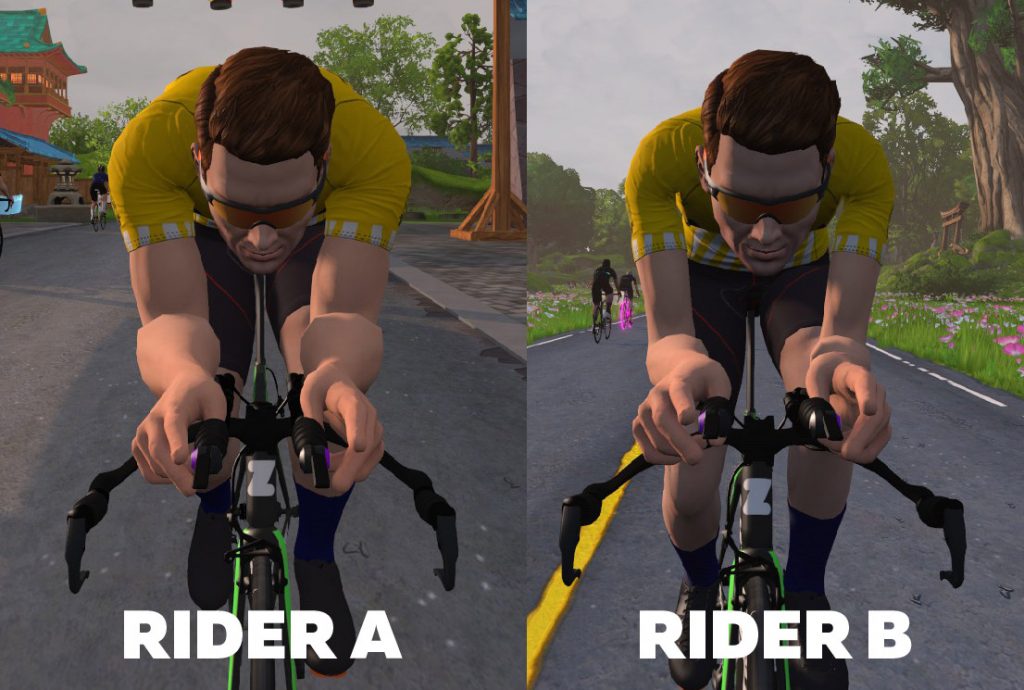
It all comes down to rider posture, really. Or at least, it should, if we’re trying to simulate outdoor riding. If Rider A and B are both “on the hoods”, height would matter quite a bit, and it’s reasonable to believe Rider A would be faster due to his reduced frontal area. But if they’re in the drops, height matters less.
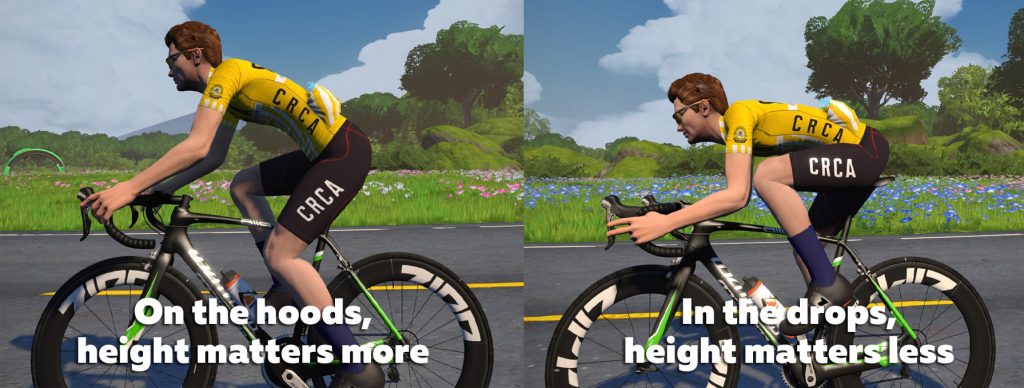
Could Zwift change things so your rider’s CdA differs based on avatar posture? Sure they could. But they would need to change the logic which determines when your rider “sits up” or gets into the drops as well.
And would that be the best solution anyway? Possibly not. When you’ve got riders pedaling away in their pain caves in a variety of postures, how should we expect Zwift to fairly decide what everyone’s virtual front area should be?
(It’s worth noting here that calculating your front area in real-time based on a webcam feed showing your posture in your pain cave seems like a super-cool idea, even if it’s a bit before its time…)
It’s easy to say Zwift’s height physics aren’t quite accurate. But it’s also hard to propose a better solution than what they already have in place!
In the end, for better or for worse, Zwift takes a simplistic approach to calculating rider CdA. Some taller riders feel they are unfairly penalized by this, but it’s all part of the game. This is Zwift: a riding simulation. If you want to perfectly replicate outdoor physics, you’ll have to ride outdoors.
Questions or Comments?
Share below!

Nice, thanks Eric. I’d been trying to get Zwift’s factors for height out of Tempus Fugit TT race results myself. This fits with what data I’ve got, but actually doing bot experiments is much higher quality data. Very much appreciated!
Maybe I missed it but when you say gain 4s or loses 3s what is the distance duration? It’s early here so I could have glossed over it. Love the site ! Cheers
Somewhere up above he says their standard course, so I’d assume that’s 2 laps of Tempus Fugit (something like 36 km).
Great catch Eli! That is not a small detail… that pretty graph needs a time (seconds per hour) or distance (seconds per km/10km/etc.) variable, without it it makes 0 sense.
I’d understood that Zwift used one of the established CDA estimators (maybe you can find out which one). Speaking as a short guy (168 cm), I know there are other factors you haven’t mentioned here: I’m riding a 150cm frame and my saddle height is low, so it’s easy to get a good draft. Conversely, big riders complain that it’s pointless riding second wheel with me on the front. Try factoring that into a Zwift washing machine!
That is a good question. Do I at 188 cm and 108 kg provide a bigger draft in Zwift like I would in real life, or is amount of draft provided constant?
Thanks for doing this. I’ve gotten in a number of conversations with people who are of similar BMI but shorter weight than me who always claim that racing against me is unfair because of my advantage on the flats. I counter about my added wind resistance, but it appears that weight still trumps my added wind resistance based on your data.
They could add complexion, like thin, middle, wide, because I’m tall but thin as a rail, the opposite of wide shoulders. Cycling is the only place this is good for me, but not in Zwift.
I totally feel this going down hills in Zwift. My 96kg should give me an advantage but my height takes some of it away. I see people with small avatars flying by me and the amount of watts I have to put out to stay with them is ridiculous. I say lets let Zwift fix the important things like racing and we can worry about dialing this in down the road.
I’m right there with you. I think my 108 kg should help me descend with the slipperiest of folks, but I was part of a TTT that got dropped going down Fox Hill (the Box Hill descent) while all of us were supertucking and I weighed 10-15 kg more than the next heaviest rider. I tried pedaling to catch back on but didn’t do it. Fortunately, the team didn’t need me for the finish.
I’d love to see that realtime frontal area calculation on Zwift (in my dreams, I know…); this would turn out to be so much more useful as a training tool for outdoors riding as well as so much more fun for races.
What I’m more curious about is how it affects the draft itself. I agree that I’m TT mode, it’s good enough the way it is (mostly), but in racing situation is where I feel height is really penalized
The TT mode is also screwed. Look at the data from a TT race from Monday 13th. Look at the data from Watopia pier to the foot of the Volcano KOM. It must be what’s called flat.
https://www.strava.com/activities/13345695317/analysis/0/1027 Keypoints:
Looking at some of my IRL TT’s where I have done significant less power (restrained in the TT position, and having to break in turns, and such), I have done somewhere about 20-35w less, but still been SO much faster. https://www.strava.com/activities/7699151395/analysis https://www.strava.com/activities/9010397810/analysis https://www.strava.com/activities/9227804732/analysis https://www.strava.com/activities/9667430958/analysis https://www.strava.com/activities/11425658794/overview https://www.strava.com/activities/11644743924/analysis https://www.strava.com/activities/11224291140/analysis https://www.strava.com/activities/11602506362/analysis https://www.strava.com/activities/12272746447/analysis https://www.strava.com/activities/11658277150/analysis https://www.strava.com/activities/11378003370/analysis
My IRL results includes 2 World Championship bronze medals in AG 40-44y, and back to back National Champion in the same AG.
Hey Eric, “midget” is considered offensive to little people, as they generally prefer to be called. It’s jarring to read—maybe you can find a different term? Or just replace it with the minimum height number?
At 6′ I’ve always felt that I am being unfairly penalised in ITTs, which has been borne out both in the numbers for my races but also it appears to be the case here too. I’m pleased that you have addressed the TT position here in your post as I have long questioned how a tall rider in a TT position can be so dramatically slower than a shorter one in the same position.
Average height of top 5 in the Olympic time trial was, by my calculation, 6′ 1.4″. (sorry for imperial units but Dan used them first :)).
“(It’s worth noting here that calculating your front area in real-time based on a webcam feed showing your posture in your pain cave seems like a super-cool idea, even if it’s a bit before its time…)”
No it doesn’t, that would be awful. Why would I want to ride in my living room all hunched over? I want to sit up and be comfortable and expose as much front area as possible to my cooling fans.
What next, a check to make sure we’re only drinking from bike bottles and not reaching for drinks or snacks on a tray?
Because it would make it more realistic, and would encourage better training. If you’re out the saddle smashing away on a flat course, you should be penalised (by CdA) versus someone who can put out the same power in an aero position.
Not that it matters to me, at 6’7″ I just have to be happy getting dropped everywhere on Zwift by the little people.
IRL – 5″8
Bumble – 5’10
zwift – 5’8
I disagree Eric. If Zwift is all in on making their game about racing (which is clear by the lack of fixing basic QOL issues that have existed since beta), then they need to make their game fairly reflect everyone’s performance not just people who are skinny and short.
Even a previous hour record holder commented how the games physics arent there. https://forums.zwift.com/t/fix-physics-simulation-on-the-flat/317921/82
Eric, will you perform a similar test on a climb as well? Would really like to see the difference there. Although the speeds are lower on a climb, the heavy and high rider is disadvantaged by both height and weight…
Hi Eric
You sort of missed a couple of big points when it comes to aerodynamics and height. Aerodynamics is never just about rider posture because you can never adjust position to remove the drag from your legs. So riders with long legs will always have a penalty compared to riders with shorter legs in CDA. Then in real life, calf size, is again quite a big factor for the legs and big calves agains makes for a higher CDA. Zwift obviously can’t account for that but at least leg length it will be the reason for the difference your have find.
Again take a look at a rider and check just how much of the upper body is actually breaking the air compared to the legs. People have a tendency to forget that while you only really can optimize upper body position a lot of the CDA is from the legs. It can only really be optimized with bike choice, and it is at least part of the idea behind the very wide forks on the britains Hope Lotus track bike
Maybe it’s time for some special events for riders sorted by height to give pocket rockets and string beans the chance to race against similar 🤔🚴♀️
It’s kind of hard to work out what the first graph means. I can see the difference between riders of different heights, but without the distance of the course it is hard to see how significant they are.
Hi Eric
thanks for the great article. I enjoy reading all your articles and it makes me enjoy Zwift much more. I have one question: can you check at Zwift if and when they plan to introduce a new challenge? Most of us have completed the Everest, Italy and California, but I do not understand why Zwift is not adding new challenge like: Cycle around the world (40K KMS) for new shoes. or to the moon: (400k KM) for new helmet. To me this sounds fairly simple to implement and will give lot of us a new long-term challenge. Thanks for raising it.
(ps. I posted this before but could not find it in comment section, hence this new attempt)
Your analysis of the effect of the *torso* is good, but don’t forget leg length (and bike size) also presumably scale with height, and legs are normal to the wind. So while the cross-sectional area of the torso may be higher in the higher BMI, shorter rider, their legs are shorter. Think Cavendish or Ewan: each get extremely low. I think rider CdA proportional to sqrt(height times mass), frame CdA proportional to height, and wheel CdA constant is a decent heuristic approach.
The results, however, are counter-intuitive. At higher speed, wind resistance becomes a larger fraction of the total. A CdA reduction should reduce result in a *proportional* reduction in wind resistance. So as one goes to higher power, the % power reduction from a lower CdA should get gradually higher, asymptotic to the case where all power is wind resistance. Yet the results show the opposite — going to higher power *reduces* the fractional effect of height. 450 watts is 3x 150 watts but the height effect is only 2x as large (absolute watts). What? Precision may be an issue because the jump from 300 watts to 450 watts is closer to what I’d expect. But the data in the plot appear to show excellent precision. So I wonder if Zwift is using an ad-hoc equation that’s not grounded in physics.
At on point last year I was adjusting my weight, having lost quite a bit. I think I accidentally rolled the scroll wheel while the cursor was on the ‘height’ box, and reduced my height from 6′ to 3′. I rode one of the Tour de Zwift rides that day, I think the one that did the Epic KOM and the Radio Tower. In addition to being able to keep up with riders doing a lot more w/kg on the flat, I FLEW down the descents! As soon as the ride was done, I checked my settings and saw the 3′ height. 3′ tall and 200#. No wonder I coasted up to > 100 km/hr!
Filippo Ganna has such a disadvantage right? Height should only be a factor while sitting up. On the drops/TT bars taller riders can achieve an equally good if not better aero tuck.
Zwift definitely penalises taller riders – Ganna, Wiggins, David Millar et al would have struggled to beat Quintana in a Zwift TT.
Frontal area is majoritively driven by position, as Zwift has no way of knowing a riders position it is unable to make any frontal area assumptions and should remove this as a factor in the ride physics engine. Essentially Zwift is telling me a 163cm commuter always has a significantly lower CdA than Steffan Kung or Fillipo Ganna because they are 30cm shorter. On flat roads when you have people passing a TT bike on a road bike riding at a significantly lower wattage you know something is really wrong. Zwift should only look at what it knows: watts, weight, gradient & CdA of bike/wheels and quit making assumptions which aren’t remotely borne out in the real world. If the reality was, as Zwift is asserting, that tall riders are giving up 30-60 watts then they would rarely if ever win anything. As its patently ridiculous to allocate a linear CdA penalty based off height they should just completely abandon it.
Very important: can you do a test and post on if taller / heavier riders provide a better draft to riders behind them?
I posted the following on a recent response to a recent post about drag variation with height on handcycles. I think it bears repeating here.
Viscous drag consists of pressure drag and skin friction. The reference area for pressure drag is the projected frontal area. The reference area for skin friction drag is the wetted surface area. The simplified treatment of drag using a composite CdA captures both of these drag components into a single term. The Cd can be viewed as a ratio of the wetted surface area to the frontal area. If you are evaluating drag for a body of a certain shape and orientation, but with varying size, you can treat the Cd as a constant and simply consider changes in the reference area with size. But when the shape and orientation of the body is changed the Cd changes as well as the reference area. The For more streamlined bodies, such as a rider on a hand cycle or on a time trial bike, the pressure drag is lower and the skin friction drag is higher, because of the greater ratio of wetted surface area to frontal area. The wetted surface area and the projected frontal area of an arbitrary body of fixed density in any orientation both vary with respect to height and weight in the same proportion. This is why height and weight both affect drag on all of the different bikes in Zwift in exactly the same way. Zwift has got this right, in my considered opinion, and based on my own testing and analysis. It just isn’t sufficient to think of the Cd as being a constant across all of the bike/rider combinations and the projected frontal area as being the only variable and then making conclusions about the affect of height based on it having relatively little affect on the projected frontal area. You have to consider the object in three dimensions and understand how the air is interacting with that body in total. For an upright rider on a standard bike, the air is crashing into a blunt body and stopping with fairly great force, creating a large pressure drag, but that air doesn’t spend much time moving over the surface of the body, hence a low skin friction drag. On the other hand, the hand cycle rider and the time trial bike rider are slicing through the air much more cleanly, not stagnating much air on their front surface, but the air is spending much more time moving over the surface of their outstretched body creating a greater proportion of skin friction drag. The height of that outstretched body should, and does, affect the drag computation.
That post made me ask my wife to measure my height. Turns out the rounding up I was doing to be able to say I’m six feet tall (even tho I’m falling short of that and I’m in metric country) which then I rounded up to 183cm doesn’t pay me favours in Zwift. And was not my height.
So yay, I’m a documented case of shrinking due to Zwift lol.
LOL. EXACT same thing happened to me a couple of years ago. I went from 183 to 180cm and I’m not looking back!
“Some taller riders feel they are unfairly penalized by this, but it’s all part of the game. This is Zwift: a riding simulation.”
Written by a short person..
(and yes, I’m a 200 cm heigh bitter person, that can’t win a TT if my life depended on it)
Hi Eric,
thanks for the stats. This clearly is the explanation why my freind lost the ITT. Both pushing the MAX allowed in B (4,2 Wkg) My friend had more absolute watts. So he should win this flat race.
But instead he became only 5th. The winner was more than 20s ahead of him just because he was 25 cm smaller.
Since boundaries are layed on w/kg we couldn’t put out more watts.
Shorter people will always win ITT.
This alos explains why we lose the TTT’s in ZRL while we are pushing out a lot more watts than the opponents. We thought it was out technique to ride 1 straight line. But this is just because we are all tall guys over 190 cm.
So I have 3 questions for you:
1) Is the draft also bigger behind a taller person? If you want to create the physics of outdoor riding, this should be and will improve our chances in TTT’s.
2) On a TT-bike, the difference between a tall or little rider is smaller than on a road bike. I think Zwift also has to take this into account.
3) If you go over 30 km/u on a road bike, your avatar will change and take the drops. I think here also a recalculation on CDA should happen. And the difference in CDA between tall and little will also be smaller.
Could you please report these suggestions to zwift?
Right now little people have a big unfair advantage in ZRL because in B1 actually everyone is pedalling at 4.2 Wkg. This will stimulate height doping.
1) Zwift says draft is bigger behind taller people. I haven’t tested to confirm this (yet).
2) They should. I’m not sure they do (again, haven’t tested it).
3) Agreed that would make sense. But it would also be confusing, since in the pack your rider sits up and rides on the hoods if you’re drafting. But other people’s avatars don’t show that same animation…
Hi Eric,
Thanks for the tests.
Is it possible that the dynamics changed?
In our experience height has a much higher factor than the 1.2 watts per cm in the article @ 300 Watts.
Maybe it is because it is on a Time trial bike.
But in fact on a TT, the difference should be smaller than on a road bike because you are not sitting up straight.
Take for example this race in the B.
The winner is 165 cm, puts only 246 W and finishes 33:11.
The second is 192 cm and puts 362 W, this is 116W more, it’s like almost 50% more than the winner, but he is 25s slower.
The course is not pan-flat, but you should expect that in real life the 2nd guy should always win a TT with that power on that route “Douce France” with only 107 hm and no big grades.
https://zwiftpower.com/events.php?zid=4285552
Can you please run some tests with TT-bikes if you have the time and contact Zwift with this difference between real life and zwift’s calculations?
Comparing the numbers on this article to the frame and wheel speed tests, it seems like the difference between the fastest frame/wheel setup and the safety bike is the equivalent of 22cm height.
As a taller rider I might be a bit biased here, but that seems ridiculous.
With Zwift recently introducing more (long overdue in my opinion) courses for racing that include mountain climbs and descents (such as Peak Performance – currently being used for Zwift Games), have you considered re-running this analysis for descending? The difference in descending times by height would presumably be much greater because CdA differences matter more at higher speeds and the Watts required to accelerate at higher speed are much greater? I’m a 191cm, 67kg rider, very much with vested interests here!
With the new ZRS system tending to put larger riders in higher cats than their w/kg would suggest, especially if they can sprint, it potentially now leaves taller riders at a double disadvantage.
In my team we found I went at pretty much exactly the same speed for a given w/kg as my team mate who is ~25cm shorter and ~15kg lighter than me (i.e. higher raw watts cancelled out by higher CdA.
But I would be given a much higher ZRS base score than him if we both do efforts that deliver the same w/kg and the same speed in a race (and I think this is true both on the flat and on climbs).
Somehow my height got 6 ft . 11 inches instead of 5 ft. 11.Explained how hard it had become keeping up downhill- even in draft- and the red mark I power point.
Almost five years later, why does pen allocation not also account for rider height in any system used (effectively raising the Zwift “ability” of little people), when riders can claim to be as short as ~120cm if claiming to be under 16 years old?