Home Blog Page 377

Can Zwifters Draft In Workout Mode?

Can Zwifters Draft In Workout Mode?

Here’s one simple question which Zwifters disagree on: can we draft while in workout mode?

A very recent Zwift Riders thread, in fact, shows the level of confusion on this topic. Or check out this Zwift forum thread from a year ago. Some Zwifters say yes. Others say no. So what’s the answer?

Well, the answer is yes–we can draft in workout mode.

Why the Confusion?

One reason why Zwifters may believe there is no draft is that the “Close the Gap” message is turned off while doing a workout. In normal riding (outside of workouts), this message is meant to encourage riders to get closer to the rider ahead in order to enhance the draft effect, but in an ERG workout we can’t modulate our power in order to catch a rider up the road, so the message would only be an annoyance.

There’s also confusion on this point simply because the question has never been clearly answered in Zwift forums and groups, as far as we can tell. So today we’re providing a clear answer!

Prove It

Don’t believe there’s drafting in workouts? Here are a few screenshots from a recent test we did in Richmond. One rider pulled at 300 watts steady, the other was in workout mode, doing whatever wattage was required for testing.

Here you can see our drafting rider sticking on the wheel of the 300 watt domestique while only putting out 228 watts. This lines up with our free riding drafting tests, showing that the draft effect in workouts is the same as any other ride type in Zwift. Additionally, note that the drafting rider is “sitting up,” indicating that they are drafting.

We then put the drafting rider on a TT bike – and he quickly dropped off the back at 260 watts. Which of course is correct, because TT bikes can’t draft in Zwift!


How-To: Ride the Saris MP1 (and Other Rocker Plates)

How-To: Ride the Saris MP1 (and Other Rocker Plates)

Saris MP1

Editor’s note: Matt Gardiner rides for Team Indoor Specialist, which is sponsored by Saris. As part of that sponsorship, team members were recently given Saris MP1 Nfinity Motion Platforms to test and use. As a big rocker plate fan myself, I was keen to see what Matt thought of his first experiences using the MP1!

It’s no secret that Saris has received some pushback due to the MP1’s “tightness”, lack of adjustability, and price point. (I’ve even written about it on Zwift Insider, and GPLama Shane Miller’s recent MP1 review video mentions the tightness as well.) That said, users seem unanimous in saying they love the MP1’s fore/aft movement, solid build quality, and additional comfort afforded by the rocking motion.

Shane Miller mentioned in his recent video (linked above) that there is a learning curve to using a rocker plate, and that’s true to some extent. It’s especially true if you’re accustomed to riding a typical rigid trainer setup, which doesn’t replicate outdoor movements well at all. But here’s the good news: the learning curve is not steep, and it’s well worth the trouble (in my humble opinion)!

After spending some time riding and racing the MP1, Matt put together a solid tutorial to explain how to properly use this motion platform. But the videos and advice apply quite nicely to all rocker plates. In fact, it may be the best rocker plate “How To” tutorial I’ve seen so far, which is why I asked Matt if we could share it on Zwift Insider.


You may not realize it, but riding your bike on an unmoving indoor trainer is not at all like riding your bike outdoors. Indoors, there is no need to contend with gravity to balance yourself (unless you are one of the lucky few who has managed to fall off the indoor trainer).

As you pedal, your upper body subtly leans towards your powering leg in an attempt to gain leverage through the power-phase of your pedal stroke. Outdoors, this motion is enabled by leaning your bike away from that powering leg as you propel yourself forward and work to stay upright. On the static trainer, it is not necessary (or even possible) to lean the bike as you would outdoors.

This video demonstrates the proper and improper forms for riding an indoor trainer rocker plate such as the Saris MP1:

When you introduce a rocker platform to your indoor riding setup, immediately you will notice your natural inclination to lean towards your powering leg (i.e. applying power with right leg, and leaning body towards right leg). This motion gets the rocker platform moving, but it will feel a bit foreign, as your entire bike and body will lean in the same direction: towards the ground.

To get the bike moving more similarly to how it would outdoors, you will need to apply gentle pressure with your hands — moving the bike away from your powering leg. To do this, as your right leg is entering the power phase (down-stroke) apply gentle pressure with your left hand, rocking the bike and MP1 to the left. As you progress through the power phase with your right leg, transition that pressure to your right hand as your left leg enters its power phase. The platform should rock side-to-side with each pedal stroke.

This concept is a bit hard to grasp by reading, so check out the following videos to get a clearer view on how to ride the MP1!


Seated

This video explains the simple motion involved in riding the Saris MP1 Nfinity at a steady, seated effort. Subtle use of your upper body by applying pressure on the handlebars makes riding on the MP1 far more like riding outdoors than a static setup.

Through each pedal stroke, push your bars away from the foot that is currently in its power phase. The MP1’s fore/aft movement will be felt as you do this, giving you the sensation of speed and inertia. The sensation of inertia on the stationary bike makes for an incredibly immersive experience in games such as Zwift!


Climbing

This video explains the motion involved in riding the Saris MP1 Nfinity out of the saddle in a climbing effort. Apply pressure on the bars through your upper body, leaning the bike away from your powering leg for each pedal stroke. This allows you to generate constant force to maintain a fluid motion.

As you rise out of the saddle, the bike will respond to the movement by shifting backwards. Begin maneuvering the bike to initiate the fluid side-to-side rocking motion. Each pedal stroke should be met with a corresponding lean of the bike towards the other side.

This motion is comfortable and replicates the motion of climbing outdoors far better than simply raising the bike’s front end.


Sprinting

This video explains the body’s motion involved in riding the Saris MP1 Nfinity out of the saddle in a sprint effort. Sprinting is the most complicated of the efforts on the MP1, requiring complete upper body interaction with the bike.

As you throw the bike side-to-side, you will be pulling and pushing with your arms to generate leverage. Your legs will work to push against that leverage to produce as much power as you can through the pedals.

Once this motion is nailed down, you will be sprinting with the best of em’!


Interested in learning more about the Saris MP1 or indoor riding in general? Leave a comment below!

This post originally ran on teamindoorspecialist.com


Tour of Watopia 2020 Pro-Am Race Series Details

9

Tour of Watopia 2020 Pro-Am Race Series Details

Zwift has just released the news that Tour of Watopia 2020 will include “Tour of Watopia Live”. Here’s how Zwift describes it:

The night before each stage, get a preview of the stage to come as pro riders throw it down in a live race.

This sounds a lot like the Pro-Am Invitational Series Zwift organized for Tour de Zwift… except this ToW series includes overall series leaders jerseys (see below).

Schedule

The ToW Pro-Am races will happen at 12pm PDT/7pm GMT the day before each new stage begins. Here’s the full 5-stage schedule:

Points and Leader’s Jerseys

These races will be scored based on a points system, with the top-scoring men’s and women’s riders being given a yellow leader’s jersey to wear for the next race. The points system isn’t new (Zwift used it for Tour de Zwift’s races) but this is the first time we can remember Zwift giving an overall leader’s jersey to the points leaders. Cool stuff!

Women and men will each have three races, with the final points leaders after the third race being crowned the overall yellow jersey winners.

Where to Watch

Zwift has created a page where the live streams of each race will be available – see it at zwift.com/video/tour-de-zwift-live. Races will also be broadcast on Facebook via the Zwift Live.

We’ve also included each stream below, where it can be watched once Zwift goes live.


Couch to Route Hero, Active Rest Week Done

Couch to Route Hero, Active Rest Week Done

Editor’s note: Monica is undertaking the “Couch to Route Hero” challenge of riding all 67 “free-ridable” Zwift routes (and getting all the badges) in 11 weeks. Each week she shares her story of the previous week’s struggles and accomplishments. Follow along on her journey, take the challenge yourself, and be sure to give her a Ride On if you see her on course!


I’ve found there are two horrible things about taking an active rest week. The biggest one is that you can’t eat as much as you do on the big ride weeks. Sad. The second is the feeling of guilt and sadness as you pine for your bike. “It’s okay, little bike. I’ll be back. It’s not you, it’s me.”

On Monday I rode the Volcano Climb route for the badge and while I did finish I just didn’t have anything in me for that ride. Both Sunday and Monday I had a sore throat and general fatigue. Also, my left hip/lower back/leg weren’t really happy with me anymore. A handful of people had told me I might consider a rest week in the middle of this 11-week challenge and it seemed my body was beginning to agree with them. So with bravery I resigned myself to an active rest week. 

The Rides Lined Up

Because I didn’t decide until Monday that I’d take time off I did end up getting one badge this week, making that 48 done!

Route completed: Watopia’s Volcano Climb

The ACTIVE part of the rest week

Wednesday I rode Watopia’s Tick Tock (which I already have the badge for). It took me 47 minutes as I forced myself to stay in Zone 1. That was HARD to do! I averaged 71 watts, trying to keep my heart rate between 105-110bpm. Haha! Was I even riding?

Thursday I walked outside. It was a warm, sunny day here in Northern California. As I was about to leave I called up to Eric, “I’m going on a walk!” He yells. “Have fun!” I inform him, “I won’t have fun. It’ll be slow. I’m walking. Slow isn’t fun! Fast is fun!” And there it is, folks! My first time finally realizing what Zwift’s new tagline meant! Fast is fun! So true!

On Friday I rode Innsbruckring. A whole 8 miles on the bike since I was trying to stay in Zone 1 again. I averaged 81 watts, this time with a goal of keeping my heart rate between 110-120. That kept me just inside Zone 1 but let me push the ride just a little bit more than when I rode Tick Tock.

Saturday found me itching to just ride again already. I no longer had a sore throat or fatigue. My body was feeling better after going to the chiropractor on Wednesday. He said I must use my left side more as my hip was so tight it was rotating my entire pelvis in that direction anytime I moved. No wonder I was in pain! Since I was feeling better by now I really had to resist the temptation to give a real effort. Instead, I stayed in a lower Zone 2: 115-125 bpm, averaging 81 watts.

The NON-ACTIVE part of the rest week

I found I was really behind on some projects at home and at work since I started this whole challenge. Riding was consuming more and more of my time so each of my real jobs were being done more sloppily. This week I caught up on projects. What a relief!

I also decided that my brain really needed a rest week as well. Remember the time I almost jumped out of my skin during a ride because of Eric sneezing while I was intensely concentrating? This was my week to let the brain relax. So I quit berating myself over food choices and I ate a piece of cake mid-week. And I sat out in the sun during some of my lunch times instead of trying to catch up on work while I ate. And I put my loud cycling music on while I cleaned instead of listening to a podcast. Little things that made a difference to me.

Lastly, I was intentional about doing what my chiropractor told me to do: use the Accugun on my hip and IT bands, do plank exercises, and continue to stretch my legs for long amounts of time. 

What I learned

This is the first time in my entire life I’ve ever started to get sick and was able to stop myself from it. Between the active rest week, taking my supplements, praying and sleeping well things turned around for me! So exciting!

It was apparent in the first half of the week that I was slacking off about drinking lots of water. Drinking lots of water during a rest week is still important. I ramped that back up.

And my biggest aha moment came when Eric told me one key system the body uses when trying to recover from hard effort rides: the immune system! THIS EXPLAINS SO MUCH! 

Coming up this week

Since I already rode one of Route Badge Quest routes this week I’ll finish up with the other 4. Likely riding Tour of Fire & Ice, Greatest London Loop, Surrey Hills, and the 2018 UCI Worlds Short Lap in Innsbruck. 

Coming up this month: London PRL Full

I’m planning to do a world-wide group effort on the London PRL Full! Read all about it here and start preparing now to join me!

How about you? 

What did you do this week?


Absa Cape Epic Mission Announced for March 2020

59

Absa Cape Epic Mission Announced for March 2020

Zwift has just rolled out an in-game mission for the month of March: its first MTB mission ever! This mission is centered on the Absa Cape Epic, a race held on South Africa’s western cape that covers 600+km and over 50,000′ of climbing in 8 back-to-back daily stages.

Here are all the mission details…

Completing the Mission

Begin by joining the mission – click “Let’s do this!” from the startup screen, then agree to the terms.

This is important: only rides done on the Scott Spark RC bike count toward the mission.

You can “Auto equip Scott Spark RC”, which puts you on that bike for your ride. Or uncheck that option to use a different bike.

This option is confusing a lot of Zwifters already – we’ve received several emails from people saying “Why am I on a mountain bike?” Just uncheck that box and you’ll be good to go!

As long as you’re riding the Scott Spark RC bike, your climbing will count toward the mission. Ride a total of 2,850 meters/9,350′ (you can do it in one epic ride, or across multiple rides) and you will unlock the extra Drops and Absa-inspired paint scheme (see below).

Why 2,850m? Because that’s how much climbing riders will be doing for the 85km (53 mile) long stage 5 of the Absa Cape Epic race. Wow!

The mission ends at 11:59pm PT March 31st, so make sure you get your MTB climbing in by then!

Forced (Accidental) Bike Swaps

Zwifters are reporting a bug wherein the game is placing them on the Scott Spark when the Zwifter hasn’t yet signed up for the mission.

The quick fix: sign up for the mission! Then you can turn off the “auto equip Scott Spark RC” option and it will stay off.

Important: if you’re joining an event, especially a race, make sure you’re on the right bike beforehand! You won’t win a road race on this (or any) mountain bike, since it rolls much slower on tarmac.

Mission Unlock

When you complete the mission you will receive a bonus of 100,000 Drops, while also unlocking the zebra-inspired paint scheme for the Scott Spark RC bike.

Absa-inspired paint scheme

Note: you will need to own the Scott Spark RC in order to ride it outside of the mission. It’s one of the best mountain bikes in game currently, so it’s worth picking up!

Grand Prize

Everyone who completes the mission will earn an entry into the grand prize drawing for a custom-painted Scott Spark RC bike.

**Note from Zwift: the image is a representation of what the bike will look like with paint applied. The components shown will differ from the prize bike. The prize bike will have Sram XO1 or XT level components and alloy wheels.

For more details on the mission, see the Zwift’s official mission page.


How Long of a Break Can You Take In the Middle of a Zwift Session?

How Long of a Break Can You Take In the Middle of a Zwift Session?

Here’s a question someone recently asked us:

Sometimes I’m working to complete a long route and get the badge, but I can’t do it all in one session because of scheduling issues. I know I can get off the bike, keep my Zwift session running, then come back and finish the route even an hour or two later. But is there a limit to how long of a break I can take in the middle of my session?

That’s a great question! Here’s the answer…

Why Take a Break?

We’ve all taken short intermissions during a Zwift session, pausing things for a nature break, a bidon refill, or a variety of other reasons. But why would someone want to take a longer break? Here are a few reasons:

  • Schedules: you’re trying to complete an event or route which will take 3-4 hours, but you only have 1-2 hours free at a time. Parents of young kids, people with busy schedules – you know how it is!
  • Recovery: you desperately want the PRL Full badge, but your nethers can’t handle being in the saddle that long. So you consider splitting the effort up over two days.
  • Unexpected emergency: we’ve heard of Zwifters who were in the middle of a long session when they got a phone call requiring them to drop everything and address an urgent matter. They may want to pause their workout and come back to it hours later so they can get all the stars for completing it and/or receive the route badge.
  • Hardware malfunction: if your trainer or bike breaks in the middle of a long, hard session, you may want to finish the session hours or days later after everything gets fixed.
  • Internet outage: your Internet connection may drop in the middle of a session, and you want to ride with others and/or make sure the session will save properly when you’re done. This may mean waiting hours or days before your Internet is restored.

How Long Can It Be?

Zwift shows the overall time, not the moving time

The official word from Zwift is that there is no limit to the length of time you can rest in the middle of a Zwift session.

Zwift does automatically put you into a “lurking” state if you’re inactive long enough, which basically means you stop being broadcasted to the network so others won’t see you on course or see you in the list of active riders to join. Once you start moving again, though, you’ll be taken out of “lurking” mode. We aren’t sure how long you must be inactive before you’re set to lurking status, but it’s at least 5 hours in our tests.

To test how Zwift would behave if we took an especially long break, we began a session at 10:23PM on February 23rd, rode a couple of kilometers, then got off the bike and left the session running. We returned at 9:25AM on February 27th (~83 hours later), rode a few kilometers, then saved the ride. Here it is on Strava >

Everything worked perfectly fine on Strava’s side. The only weirdness we spotted is Zwift displaying the overall ride time (from the start of the ride to the last pedal stroke) instead of the “moving time.” So it shows the activity time both in Companion and in our zwift.com dashboard as 3 days, 11 hours, 4 minutes, and 38 seconds!

A Few Considerations

So Zwift allows us to take very long breaks if desired, which is great. But that doesn’t mean we should all start recording crazy-long Zwift sessions! Here are a few things to consider:

  • Hardware/software glitches: the longer you leave an active session running on your device, the better chance some sort of glitch will occur and you’ll lose your session data. Sure, it can usually be retrieved one way or another, but there is a risk you could lose your activity to a computer crash, power outage, or other unexpected glitch.
  • Training data accuracy: taking big breaks in the middle of a “single activity” can play tricks on your training metrics. The various calculators and tools are really built around the idea of measuring one continuous activity, and throwing a long break in the middle can have some unintended consequences.
  • Tainted achievement: taking a 12-hour break in order to finish the PRL Full route may let you get the badge, but that’s a different “achievement” than doing it all in one go. There’s nothing wrong with it as far as we’re concerned, but make sure you’ll be able to live with yourself if you make the decision to take a long break in order to complete a route.
  • Massive “ride time”: again, as mentioned above, Zwift currently displays the total time from your first pedal stroke or step to your final one, which will make it look like you did one very long activity.
  • Loneliness: if you’re riding on the guest map then stop to take a long break, you may return only to discover everyone is riding on a different guest map due to the scheduled world changing (Zwift’s version of the first Twilight Zone episode). You may be rather lonely for the remainder of your activity.

What about you?

What’s the longest break you’ve ever taken in the middle of a Zwift session, and why did you take it? Share below!


Running On Zwift With Your Garmin Watch’s Virtual Run Profile

Running On Zwift With Your Garmin Watch’s Virtual Run Profile

Garmin recently updated the software for some of their newer watches, adding a new “Virtual Run” profile which allows the watches to connect directly with Zwift.

Supported Garmin Watches:

  • Garmin 245
  • Garmin 945
  • Coming soon: Fenix 6

While in theory you could use your watch’s accelerometer to detect running speed, this is not recommended as accuracy is poor. Rather, you should pair your footpod or treadmill to the watch, then pair your watch to Zwift.

This is especially useful if you have ANT+ only devices like older Garmin footpods or heart rate monitors. Garmin’s new Virtual Run Profile lets you connect these to your Garmin watch, which will then re-broadcast that data as Bluetooth signals. Handy if you’re using Zwift on a Bluetooth-only device like an iPhone or iPad!

Watch a full explanation from Stephen Cousins below:

And here’s a how-to video from Garmin:


How the Race Was Lost: Moving Up to the A’s

22

How the Race Was Lost: Moving Up to the A’s

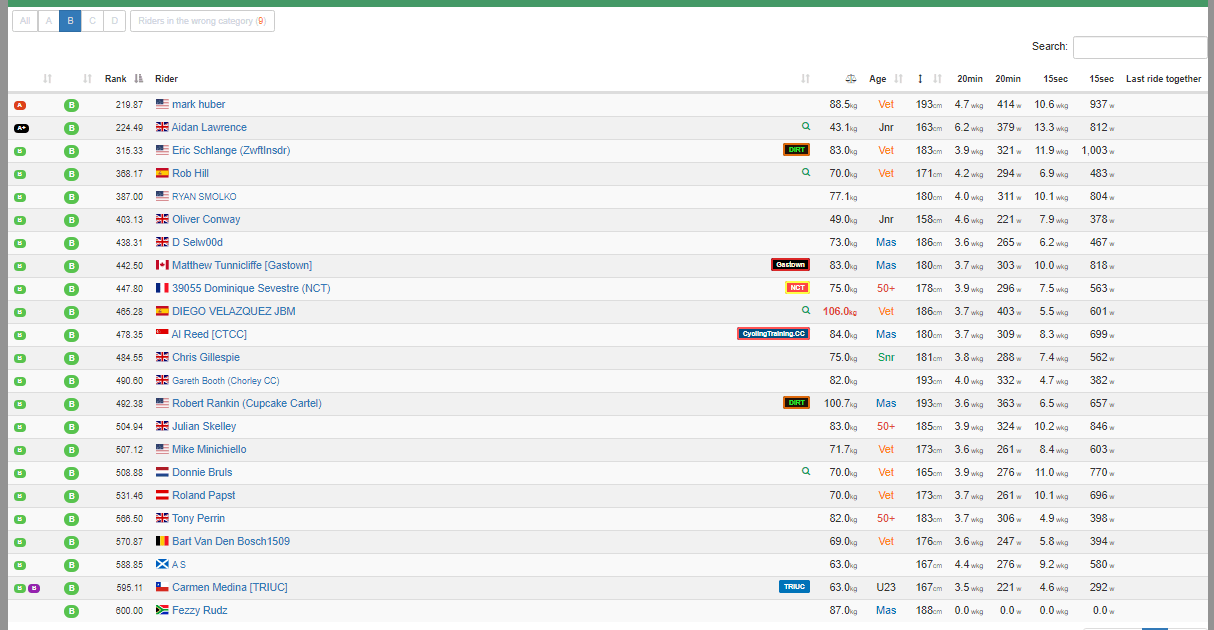
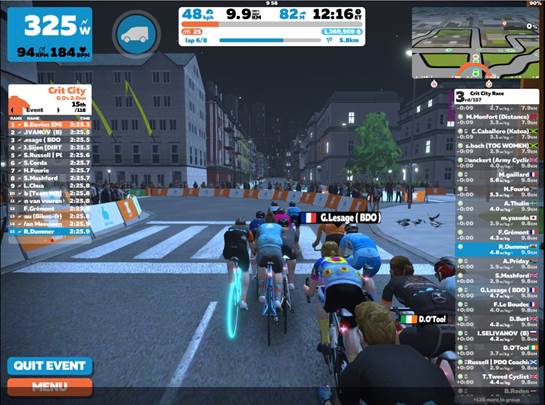
I’ve lost hundreds of Zwift races in a variety of ways, but today was a new experience: purposely racing up a category (moving from B to A) just to see what happened.

Sure, I’ve done some “mixed cat” races, where everyone starts together but the results are divided by category. And the A’s handed me my butt on a silver platter at those events! But I’d never raced against just the A’s. And I had never raced any A riders, even in a mixed group, in a short event like Crit City.

So I wasn’t sure what to expect. Would I get dropped by a hard start? Would repeated attacks eventually break me? Or could I hold on all the way to the finish? I didn’t think I’d make it to the end in the front group. But there was only one way to find out!

Warmup

My alarm went off at 4:45am and I immediately began questioning my plans. Was I really going to take on an A race this morning? 8 laps of Downtown Dolphin. Could I survive the punchy prime climb against the w/kg powerhouses? And why did my legs hurt already?

Running Legs

I had gone for a pathetically slow, short run the day before, and my legs were tight and sore. Does anyone else have this problem? I run so infrequently that when it does happen my legs hurt for 2 days. It’s ridiculous and fascinating how our bodies work. I can ride my bike for 4 hours with no pain the next day, but get me running for more than 15 minutes and I’ll feel it for 48 hours!

The good news is: I’ve learned that my legs being “running sore” doesn’t mean they’re ruined for cycling. And in fact, riding seems to help them recover from running. So I climbed out of bed and got to work.

Race Prep

I’d done a little reading recently about the benefits of caffeine for cyclists, and those articles seemed to agree on two things:

  1. I need more than 100mg of caffeine for any noticeable performance effect
  2. I needed the caffeine in my system hours before the event, not minutes, for maximum effect

I wasn’t going to wake up at 3am to chew caffeine gum, but I figured I would pop two pieces (200mg of caffeine) as early as possible this morning and see how it worked out. Slapped on some PR lotion as well, of course – because that’s what I do!

Then it was off to Tempus Fugit for a quick warmup. The legs felt ok, and I was able to get my heart rate up into the 160’s, so things looked good for a strong race effort. Let’s go!

The Start

There was a decent number of riders (39) in the A pen. I’ve noticed that some of my B race lap times have been faster than the A race happening at the same time, but in those cases the B field was always much larger than the A field so it wasn’t surprising. (My race earlier this week is a good example.)

We had a larger group today, though, so I knew our lap times would be fast. And I hoped this meant I could stay in contact with the front group by riding smart: sitting in the draft, letting the group pull me around, and letting other riders close down any breakaways. That was my survival plan.

The A start pen was all business – no pre-race chatter. “Is this how the big boys do it?” I thought to myself. I played it cool, like I knew what was going on, like I deserved to be there among these strong racers. But as Owl City’s “It’s Always a Good Time” ironically played in my earbuds I knew I was deluding myself: this was going to hurt. I’d probably get shelled quickly. How much of the race would I be riding by myself?

Focus Eric, focus. Just hold the wheels.

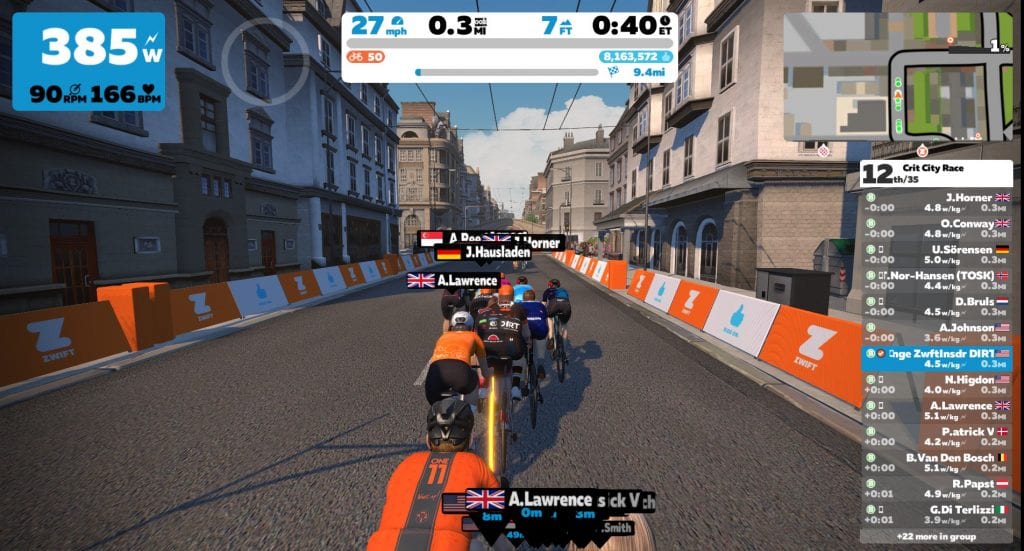
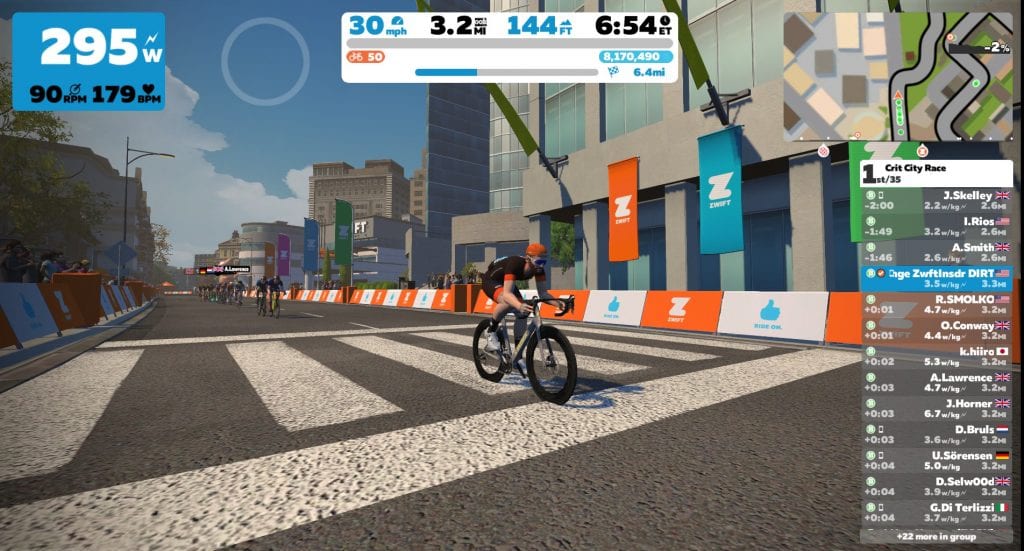
The clock hit zero, and we were off. I pushed especially hard, not wanting to get dropped if the group quickly charged away. But the pace wasn’t as high as I’d anticipated: ~400 watts for 50 seconds then we settled into a rhythm.

The first lap was done in 2 minutes and 5 seconds. Of course, I didn’t know this at the time: I just knew we were moving fast. (As it turns out, every lap of this race would be faster than my previous best racing as a B. More on that later.)

The Middle

Our group settled into a rhythm: easier through the start/finish banner, hard up the bricks to the prime banner, then easier again back to the start/finish. The pace was tough, but doable. We were pushing harder than any of the Crity City B races I’ve done, but I was able to hang on.

This surprised me, to be honest. Even up the little prime climb, where I thought the power-to-weight monsters would go hard and I’d get dropped, I found myself able to stay near the front of the group. Were they just waiting until later to pounce, knowing a breakaway wouldn’t stick for long at these high speeds? I wasn’t sure, but I tried to stay alert, maintain a good pack position, and recover every chance (and powerup) I got. Popping the van after the prime climb on the 4th lap was especially helpful.

Gotta love the draft boost for recovery!

Our group was whittled down from 39 to 20 by the halfway point of the race.

Fake Attacks/Real Attacks

One rider, “D. Alban”, had his FTP set too low. How did I know this? Because his avatar was out of the saddle sprinting almost the entire race! (Read how sprinting posture is determined by your FTP setting). It was comical, but it was also annoying because every time I saw him “sprinting” I instinctively went on alert to defend against his attack. But that attack never came. Not from D. Alban, at least.

On the 5th lap, some riders hit the bricks hard, stringing out the pack. Gaps were opening up, I was a ways back in the group, so all I could do was pray that we would all come back together as I worked to hold the wheels ahead. It was touch and go until we hit the hairpin before the start/finish banner, but the group eased up and came back together, “resting” until the final laps.

Chasing the attack after the prime climb

The Finish

The final two laps of a Crit City race are always nailbiters. In my experience, everyone is on edge, watching for a long attack on the penultimate lap – but that attack never comes. It’s the final lap where everything goes crazy. It’s not a question of if, but when.

On Downtown Dolphin, that when is usually up the brick climb. Whoever attacks there usually doesn’t win, but they do succeed in stretching the field out. The winners are the strong sprinters who can handle the attack and staying within striking distance until they launch their wattage assault in the final seconds.

Our front pack hit the bricks fast, and we began to stretch out as riders pushed hard off the front. I was giving it all I had to stay in touch, but the front of the group was getting further away! I kept hammering, then deployed my aero powerup near the bottom of the twisty descent. That’s when I shifted and got out of the saddle for the final sprint. I knew the front of the race was too far away for me to catch, but I thought I might be able to pass a few riders, so I gave it everything I had.

Which admittedly wasn’t much. My legs were cooked and my heart and lungs were maxed out!

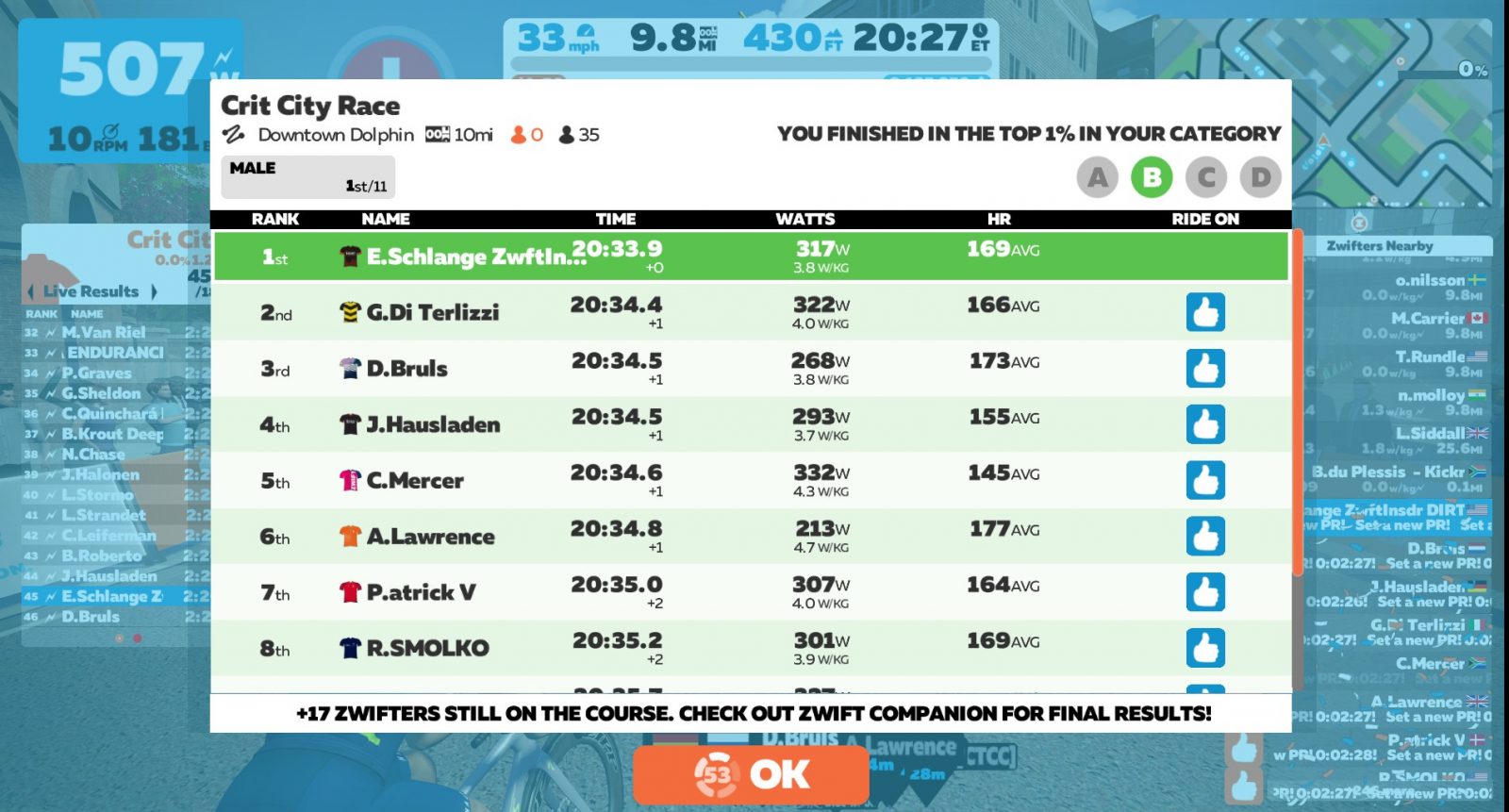
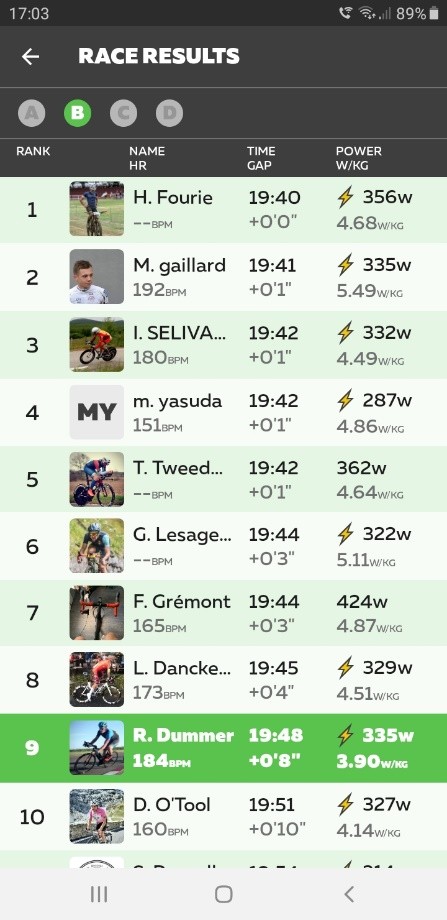
I crossed the line in 11th according to Zwift’s results… ZwiftPower would place me 8th. It wasn’t a win. But finishing just 3 seconds behind the winner certainly felt like a big accomplishment to me.

See my ride on Strava >
See my ride on Zwift.com >
See race results on ZwiftPower.com >

FTP Increase?

Zwift’s race results showed me averaging 329 watts (3.9w/kg), which is more than I’ve ever done in a Zwift race. This makes sense: I would logically get my highest average wattage in a short Crit City race, and this was my first time racing as an A, so the pace was bound to be higher than the B’s.

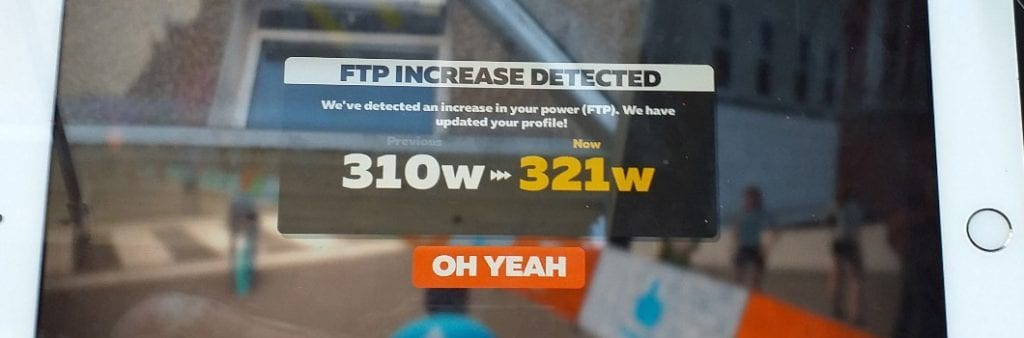
Here’s where it gets weird, though. I was greeted with this when saving my ride:

I’m not sure how Zwift got the 314 number, since I averaged 329 for the race, which only lasted 19 minutes and 44 seconds. My 20-minute power for the event was 323 according to Strava, which would put my detected FTP (95% of 20 minute power) at 306-307.

TrainingPeaks sent me an automated email saying I’d hit a new threshold value of 308. That seems pretty accurate. My previous threshold value was 301, from a recent Crit City race.

Riding at Threshold

This race definitely pushed me to the edge of my abilities. One way I know this is by looking at my heart rate, which usually stays consistent throughout a Crit City race, until the final lap. Each lap will show my heart rate bumping up on the uphill portions, then dropping down as I recover – but overall, each lap’s average heart rate is about the same until the final effort. Here’s an example from a Downtown Dolphin race I did back in December (average power: 309):

Check out today’s A race, though – this is what bumping up the power average by 20 watts will do!

This is what riding just over threshold looks like. You can see how my heart rate steadily increased throughout the race – meaning this was not a sustainable (eg, 1-hour) pace for me! My first lap was done at 168bpm, then the second lap was 170, then 172, 175… it just kept climbing!

Lap Times

As I mentioned above, every lap of this race was faster than my previous best on Downtown Dolphin (2:09). Our lap times ranged from 2:03 (final lap) to 2:07, whereas most of my B races have lap times closer to 2:12-2:20.

I didn’t feel like I was working that much harder in this race, but the heart rate and power data definitely show me pushing my limits to keep up.

Takeaways

Here are my takeaways from this race:

  1. I can hang with the A’s, at least in a short Crit City race. This is a big deal, because if I’m able to stay in contact with the front of the race, it makes things more fun. And that means I’ll be willing to race the A’s more often. Racing against stronger riders helps us get faster, but it’s no fun if you get dropped hard and early every time. But today was (type II) fun!
  2. When I’m going hard, it’s tough to go harder. Like my B race earlier this week, today’s race showed me that I lack the fitness to deliver a strong sprint after pushing well over threshold to stay near the front of a hard-charging pack in the final seconds of the race. More training required.

Your Thoughts

Are you a B who has raced in the A’s? How does my experience line up with yours? Share below!

Rebel Routes: Three Little Sisters

31

Rebel Routes: Three Little Sisters

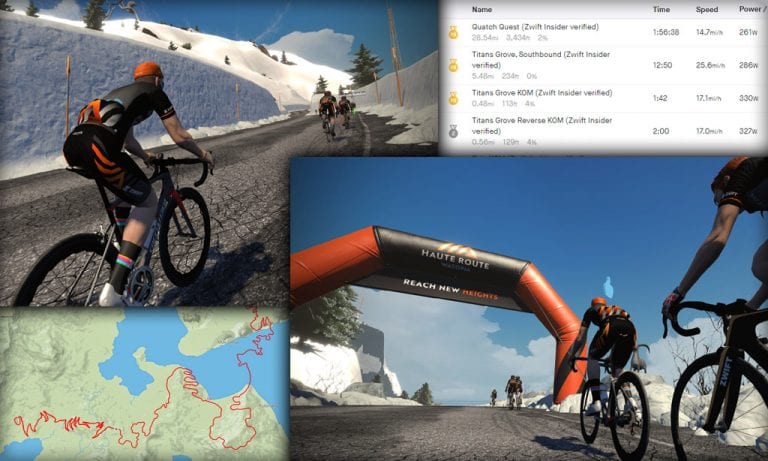
Our newest Rebel Route was suggested by Zwifter Gene Kruger, who rides a slightly modified version of this route. Gene named this “Three Little Sisters” in homage to Zwift’s official “Three Sisters” route which takes us over the Hilly, Volcano, and Epic KOMs.

Three Little Sisters, in contrast, takes us over the Hilly, Titans Grove, and Volcano KOMs – in that order. Each new climb is longer than the one before, and we took the shortest possible route to get from climb to climb.

Here’s an animation of this route:

The Hour Challenge

The length and difficulty of this route make it perfect for a “1-hour challenge.” Who can complete this route in under an hour? Let’s see what you’ve got!
About Rebel Routes

“Rebel Routes” are Zwift rides which are not available on Zwift’s routes list, thus requiring manual navigation.

See all rebel route posts >

The reward for your rebel ride? Exploring a new route, knowing you’ve gone where few Zwifters have gone before. And a Strava segment rank in the tens or hundreds instead of the thousands! They are included as a separate category on our Veloviewer Route Hunter leaderboard.

Route Description

This medium-length route begins at the downtown Watopia start/finish banner. Pick the Hilly Route from the route picker and the game will start you out at the right place.

You’ll quickly hit the first climb of the ride – the very first timed KOM to exist on Watopia! The Hilly KOM is the steepest climb on today’s route, but also the shortest. Hit it hard to finish in a couple of minutes, or take it easy. The choice is yours!

After the first climb you’ll descend down through the statues and past Hank’s Gas Station, then turn left onto Ocean Boulevard. A right turn at Sequoia Circle takes us toward the Epic KOM, but don’t worry – we’re not tackling that climb today! Instead, we’ll turn left toward the desert and Titans Grove, then another left to get into the Grove.

Up the road a bit (just past the dinosaurs) is the start of our second KOM of the day. The Titans Grove KOM is really two sections of climbing with a small downhill in between. It’s not a steep climb, but it’s long enough to hurt if you’re trying to grab that KOM jersey!

Once you crest the Titans Grove KOM you’ll ride the rollercoaster roads down and out of Titans Grove then turn left to head back to Ocean Boulevard and downtown Watopia. Head through Watopia to the Volcano, riding around the mountain’s north side to the entrance of the Volcano KOM – our third and final climb of the day.

This is our longest climb. It’s not particularly steep, so use the draft of other riders for a little added advantage if you’re trying to make good time.

Finish the Volcano climb with a hard final kick, then circle around the top and descend back to sea level. Finish the Volcano Circuit CCW and head back to downtown Watopia where the route ends at the start/finish banner. Well done!

Profile

The KOM banners on this course come at the 2km, 15km, and 30km markers. Each climb is bigger than the one previous.

Turn by Turn

Here are the turns you’ll need to make to successfully complete Three Little Sisters. Start by choosing the Hilly Route.

  1. Straight (Right) to KOM
  2. Straight (Left) to KOM
  3. Straight (Left) to Bridge
  4. Straight (Left) to Italian Village/Sprint
  5. Left to Sequoia Circle
  6. Straight (Left) to Sequoia Circle
  7. Right to Epic KOM
  8. Left to Desert Flats
  9. Left to Titans Grove
  10. Left to Ocean Boulevard
  11. Right to Downtown
  12. Right to Downtown
  13. Right to Volcano Circuit
  14. Right to Volcano Circuit CCW
  15. Straight (Left) to Volcano KOM
  16. Straight (Left) to Volcano Circuit CCW
  17. Left to Volcano Circuit CCW
  18. Right to Downtown
  19. Left to Downtown

Route details:
Distance: 37.7km (23.4 miles)
Elevation Gain: 401m (1316′)
Strava Segment

Rebel Route Suggestions

Got an idea for a great rebel route? Share it below and maybe we’ll publish a post about it!


Zwift Update 1.0.46572 Released

25

Zwift Update 1.0.46572 Released

A minor Zwift update was pushed out last night. Game master Jon Mayfield says this update is “primarily to add support for our upcoming March cycling mission as well as other content updates for the month.” Here are the details…

New Singletrack Slayer MTB Training Plan

This plan was announced a few months ago as “coming soon” – and now it’s here! The plan is “designed for veteran riders who are experienced in completing challenging high-intensity sessions.”

Zwift’s description says:

With a good level of volume behind you, now we prepare specifically for the demands of XC racing. By implementing specific high-intensity sessions targeting cadence and power, you will be prepared for the unique features of XC racing.

This plan is designed to be completed as your final training phase leading into your key event. It provides both a build in volume and intensity, along with an adequate taper period.

Arch Power-Up Bug Fixed

The previous update introduced a bug where some banners (most notably Watopia’s downtown start/finish) no longer awarded powerups. This has been fixed.

More Changes

This update also includes the following:

  • Removal of Bluetooth spindown on certain trainers due to incompatibilities. This will be re-enabled when fixed.
  • Added route achievement for May Field run track
  • Fixed crash that could occur on AppleTV
  • Lots of kits updated/added
  • Misc smaller fixes and small features

Read/discuss Jon Mayfield’s release notes >

Other Changes?

Notice anything else new in this update? Comment below!