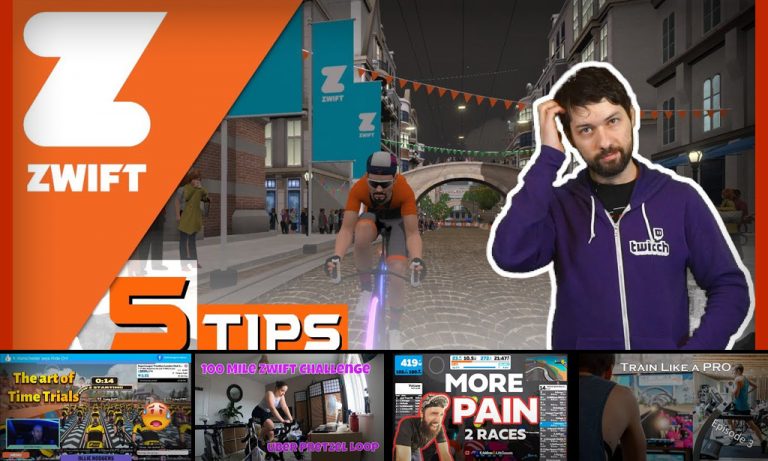
Three of this week’s Top 5 Zwift Videos offer race advice and analysis, including one focused on time trials. The others feature a different sort of challenge – long endurance rides. One Zwifter tackles the PRL Full route, while another takes on the Uber Pretzel.
Pick the Right Race – Zwift Top 5 Tips
General Elost’s advice about picking a race is especially helpful for beginner Zwift racers. He goes over how to find events and see details on Zwift and ZwiftPower, how to identify your strengths and choose a race that suits them, and how to sign up for the right category.
Getting Stronger (2 race breakdowns)
Sometimes it can take a while to get used to the type of hard efforts that you need in Zwift racing. Claudio Marquez goes through two of his races and talks about what he’s learned over the past few months.
Riding the Zwift PRL FULL, Long Runs & Strength
Eric Abbott had a long ride on his training schedule, so he jumped into the Zwift Insider Badge Hunters ride on the PRL Full course. He soon found out that some Zwifters take “it’s not a race” as a challenge!
100 Mile Zwift Challenge | Uber Pretzel
If you’re going to do a 100-mile ride on Zwift, the Uber Pretzel is a tough route to choose! And that’s exactly the challenge Eloise Park set for herself.
Zwift Racing: the Individual Time Trial
Wonder how Zwift’s time trial racing mode works? Oliver Rodgers will show you, and he’ll also give you some insights based on how he completed the race.
Got a Great Zwift Video?
Share the link below and we may feature it in an upcoming post!
The Zwift community is special. When you do something that the community does not like, they will tell you about it. But equally, when you do something they like, they will let you know. Those are rules I like and can relate to because it makes things clear.
The event that I created for the purpose of the ‘Behind the Scenes’ article left me nervous. I was nervous that people would not attend, I was nervous that people would not like the format of the event, I was nervous about the feedback I would receive. I was nervous. All week.
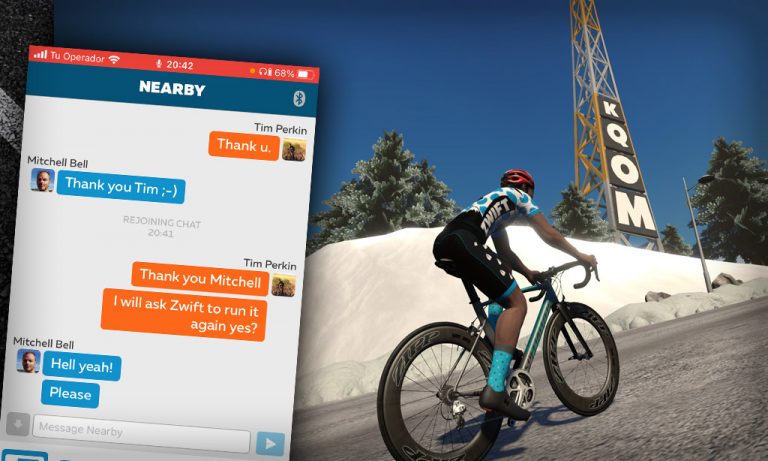
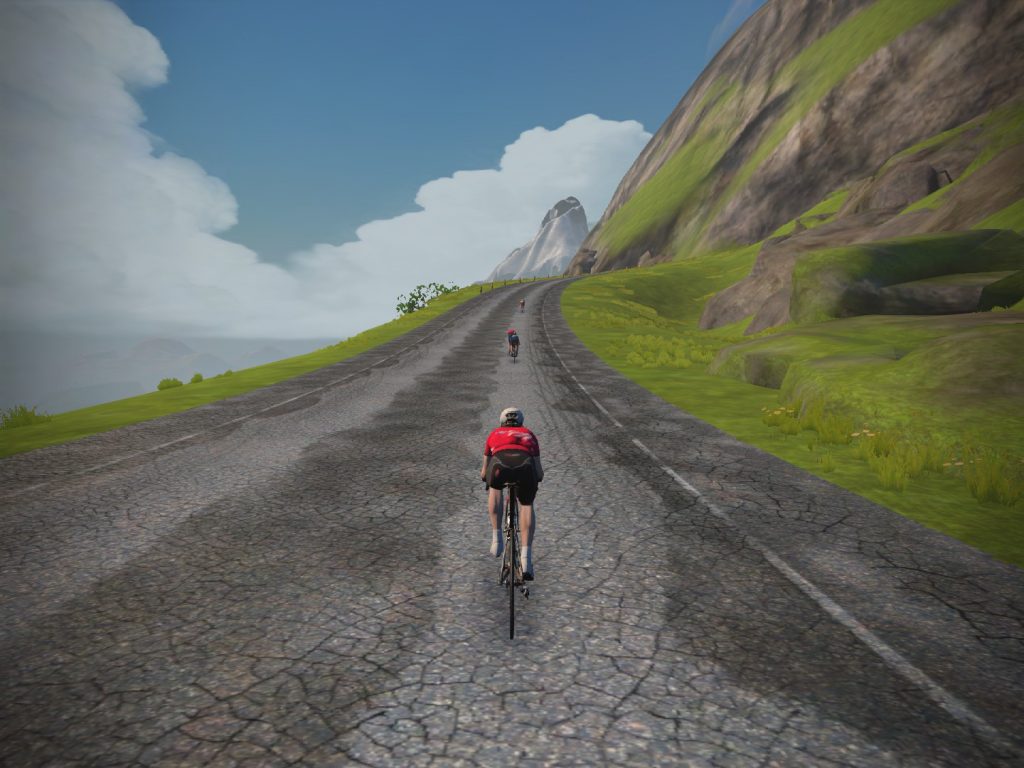
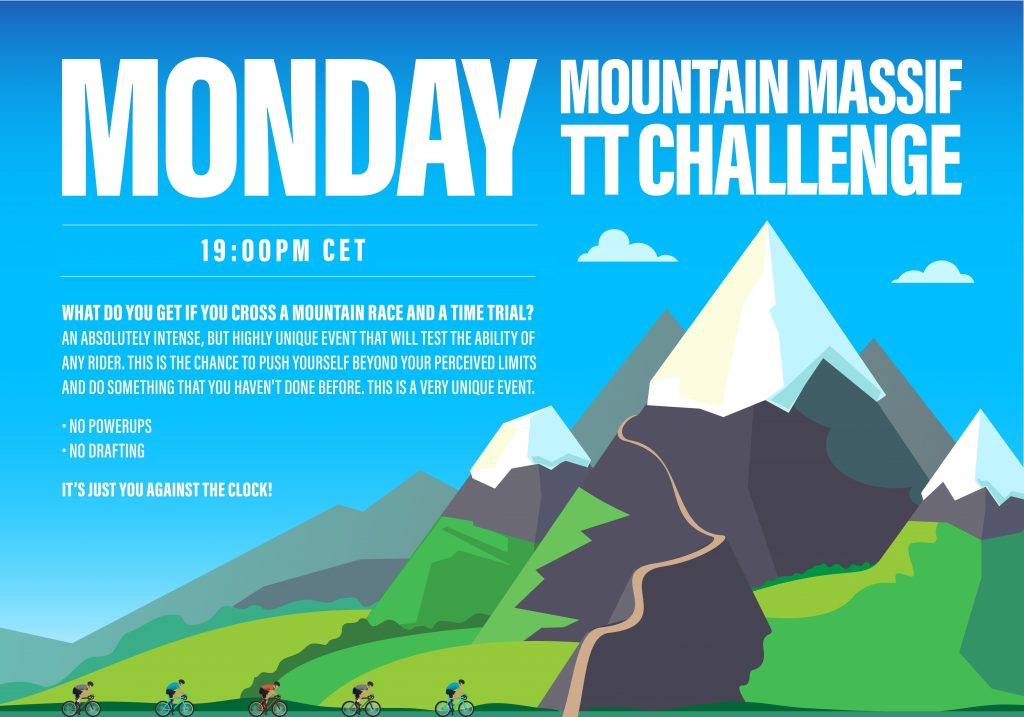
The name was “Monday’s Mountain Massif TT,” a 12.2km TT up the reverse side of the Epic KOM, finishing up the Radio Tower. I developed the event concept for the purpose of explaining the work that goes into setting up an event. The event created an internal pressure within myself to deliver an exciting and new experience for my fellow Zwifters. How did I do?
The stats
460 signed up riders. 188 finishers on Zwift Power, across all categories.
Feedback
“Very nice event! If this becomes a regular event it would be great.” – Ole Christian Fagerli
“Thanks for organizing! I’ll certainly do more of these if it becomes more of a regular event! Nice addition could be to make it into a real TT event. Would be cool to have another climbing TT besides Bologna.” – Joris
“Great event Tim and a real race of truth, at least for finding your FTP. Perhaps next time (I hope there will be a next time) you might want to call it sandbaggers exposed.” – Russell
“It was a great event! It was a long time ago that my legs were so sore. I really enjoyed it. I blew up on the radio tower climb. It was also the first event where I was so overthinking my bike choice. I really loved the prep for the event. All total it made a great experience.” Ronald
“Love it hate it and love it and again and again and again. Heart, legs shouts to stop but after finish line and some downhill ride thoughts come maybe i will do it again! Thanks and till the next time!” Rob
Next Steps
The Zwift community had spoken, they liked my event, I was relieved as much as I was delighted. I promised that if people liked this event, I would approach Zwift about hosting it on a permanent basis, with a couple of minor tweaks to enhance the experience, including:
Changing the time to 19:00 CET
Moving the finish line back by 50 meters, so it just finishes a little closer to the top of the Radio Tower summit.
I contacted the Zwift Events Team who responded that they would see if it was possible.
Mountain Massif HQ
Behind the scenes, I did feel nervous in the lead up to the event. The day before, I had to reach out to the Zwift Events Team to enquire if everything was setup correctly because it was not visible on my Companion app, it had literally disappeared when I looked for the Monday event. Saturday night, the clocks had changed to signal the start of summertime and I feared that the change in time had impacted things.
In my previous article, I rightly praised the Events Team stating “If the IT function of Zwift are the cranks of the bike, then Mark’s [Cote, Director of Content Programming] Events Team are the handlebars, brakes, shifters and saddle, because his team is so integral to our experience and the unsung heroes.”
I should have added that “they are the mechanics too, fixing any issue we experience.”
I was extremely impressed when Mark personally responded and investigated the potential issue. Shortly after, he confirmed that the event was visible on all apps. I had previously checked the filters and had done all the obvious error checking, but no sooner had it disappeared; it reappeared in my Companion app, along with a few other events. It was strange, especially as I had taken screenshots and sent to Zwift to assist with error checking and verified with several friends.
What all this experience did was to reinforce my established belief that the Zwift Events Team do an excellent job and deliver first class service, even on a Sunday. Without them, these events we all enjoy and look forward to would not happen. Furthermore, I was impressed with Mark’s leadership in personally taking responsibility and ensuring everything was correct. I am confident that Mark’s vision of having “any Zwifter being able to find any content, within 15 minutes” will be achieved, sooner rather than later and for the benefit of the entire community.
The Event – The View from the Back
The time arrived to start the event. I had set up a Discord server and was pleased to warm up while chatting to my fellow Zwifters who were taking part. This was set up to provide a user experience similar to real life where you meet before an event and exchange stories whilst warming up. I was wanting to create an inclusive experience, to make this more than just a race. With 10 minutes to go, I left Discord and entered the pen. There would be no last minute joining for me.
It was nice to see the pen full of people; my one fear of putting on an event and being the solo participant was averted.
I’m not going to write my usual detailed story of my struggles, but let’s just say the race could be split into 3 sections, 1) the start 2) the climb 3) the Radio Tower.
The first 6-10 minute flat section, before the start of the climb, was punishing. I opted for a climbing set-up of the Specialized Tarmac Pro and Env 3.2 wheels, as recommended by Ben in this YouTube video. My tactic was not to go too deep and push too hard but at the same time not let the people on the TT bikes get too much of an advantage. This was more difficult than I thought, as you naturally try to keep pace.
My heart rate tipped into the 170s, which was an indicator that I was pushing too hard. Part of my trouble was my heart rate was naturally elevated due to nerves. I don’t normally get nervous before a Zwift race, but when it is your event, it’s a totally different experience!
The start of the climb couldn’t come fast enough and fortunately I was able to make up several places as I noticed some people who had started on a TT bike had stopped and were changing to a climbing setup. I thought that was an interesting tactic, but I’m not sure how successful it was.
Onto the climb. I tried to get into a rhythm, but couldn’t find it. I certainly wasn’t in my groove like my previous mountain climb. Despite this, I just kept turning the cranks, trying to do myself proud in my own event.
As I progressed up the mountain, I was trading places with various riders and was starting to tire, a long way before the last difficult climb up to the Radio Tower.
I would say the last 8 minutes was pure torture. But, I had nobody else to blame except myself. This was harder than I expected. A lot harder. I would go as far as to say “brutally hard!”
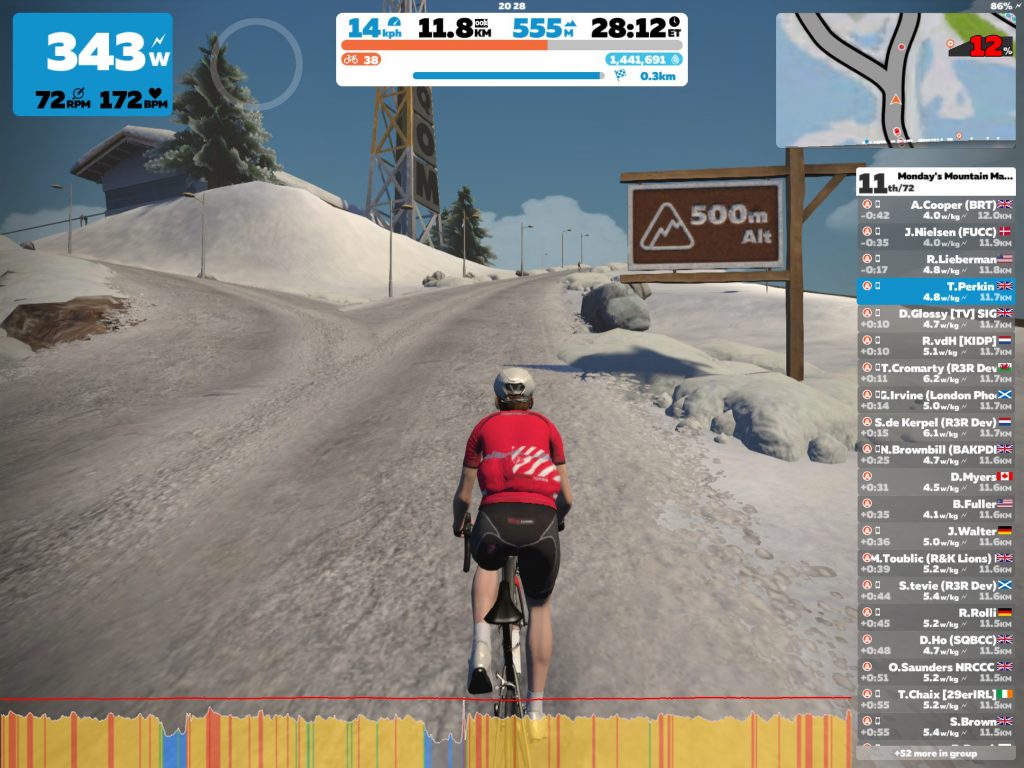
On the final climb up to the Radio Tower, I was able to pass a fellow competitor on a TT bike. They had done exceptionally well; it just looked like the TT bike seemed too heavy to make it up the 13% gradients. That put me in 11th place and now it was simply a question of holding on to the end. I became more focussed on the gap to the people behind me instead of ahead.
As I crested the climb, I was expecting the finish line to be just at the top of the final little climb, by the Radio Tower. But it was probably 50 meters further than I planned, which was simply too much for me. My legs gave out and I coasted over the line.
Despite the exhaustion, I was happy. I had competed in a race of my own design and enjoyed it. Then as other racers finished, I started receiving live feedback, which delighted me. The Zwift community had spoken – they liked the event. Mission accomplished!
My final thoughts
I thoroughly enjoyed the process of designing an event and engaging with Zwift to get it built. Equally, I enjoyed my attempts to promote it through my network. I was worried about the outcome but the pilot showed that I had delivered something the community liked. Ted, a rider from Race3R told me on Discord that the 30 minutes all-out effort was a thoroughly intense workout and that he enjoyed the fact that the event was slightly shorter than the normal Zwift races.
The Zwift Events Team deliver – again!
As I finished writing this article, my e-mail “pinged,” Mark had responded. The opening sentence read:
Brilliant! I had established a new regular recurring event for the Zwift community to enjoy. I could not be happier. That’s my Monday nights taken care of, for the foreseeable future.
I will leave the final words to the first-ever event winner, Ed Laverack who posted on Twitter “A great event it was too! Absolutely cracking format.”
Watch Ed’s race recording:
See you all Monday night, 7pm CET. Thanks to all of those who participated.
My passion for cycling started in a hotel bar when I was 49 years old, tipped the scales at 120kg and never exercised. Three years later I’ve lost the weight (down to “almost” 75kg) and I’m on Zwift most days! I climbed real-world Ventoux twice in a day, and I vEverested Alpe Du Zwift. I love the WTRL TTT, and each week I publish a recce with a course profile, bike recommendations, and even some target times. I have also started posting video recces and highlight reels, and you can find me on YouTube here.
For over a year now, the Thursday WTRL TTT has been the center of my week and Eric has been wonderful in letting me share that obsession with you here on Zwift Insider.
Remember, I’m trying to hit 11th place with my predictions. Apologies to Vienna, Frappe, and Mocha – I was way out! But well done Doppio and Espresso.
Category
#80
Prediction
Actual PL Time
My position
Vienna
39:44
38:00
39:53
3rd
Doppio
36:10
35:50
35:44
12th
Espresso
36:20
36:10
36:24
11th
Frappe
37:08
36:45
37:31
1st
Latte
40:03
39:30
40:09
6th
Mocha
44:28
43:00
44:56
2nd
Our regular columnists from Team Giant Camden filed the following report on their trip around Watopia:
Thursday rolls round again the Giant Camden team machine winds into top gear to get the teams ready for the start line. As a regular in the Livin on a Prayer team I thought I would have to sit out this week’s ride due to family commitments and with one or two other regulars doubtful LoaP was retired from the roster and the riders reallocated, Captain Diego went up a notch to the Eagles and the remainder went to help the Holy Rollers. Come Thursday and I’m back in the reckoning along with Jo so we both go to the Rollers. At the last minute Rollers captain Debs got stuck at work so the five-strong team were 4 LoaPers and one Roller.
On the start line (without the Trikes), banner up and a 9-minute delay to discuss tactics (maybe we should have done that a bit earlier?). Time to go and we’re pedaling – something very odd…, all riders are together no glitches!
A tidy pace line held through the first 10km, a slight hitch as Bernard lost his Discord connection and 10 seconds while reconnecting then a furious sprint to catch the group. Franky held his own throughout despite the colorful comments, Rob and Pete pulled us along and used their superior physiques to help on the downward inclines. All five of us together the whole way and then to the final 500m sprint finish.
Harrogate Circuit Reverse
Next Thursday we have a 27km ride around the Yorkshire countryside. This is a technical course with nowhere to hide. It is a sequence of hills and descents with few stretches of flat to regroup.
Each lap is 13.8km with 240 grueling meters of climbing. Simon Schofield, head voice on the Zwiftcast comes from Harrogate has a nice race recon of the forward route… I dunno… read it backward or something. Alternatively, you can watch my recon ride of Harrogate Circuit Reverse. I’ve been practicing with my new video editor so let me know if you like what you see!
This course is best described as lumpy. It’s not a mountain, but goes up and down throughout the ride. If you’re practiced maybe you can balance the relative masses of your riders so the lighter ones lead you up the hills and the heavier ones lead you back down… but there’s no getting away from the fact that heavier riders will have their suffer-faces on.
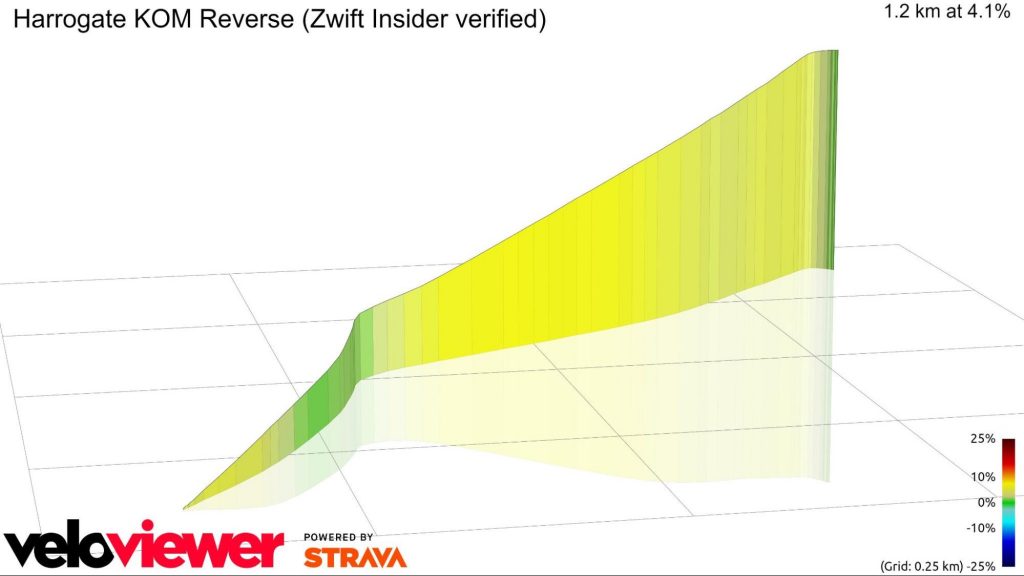
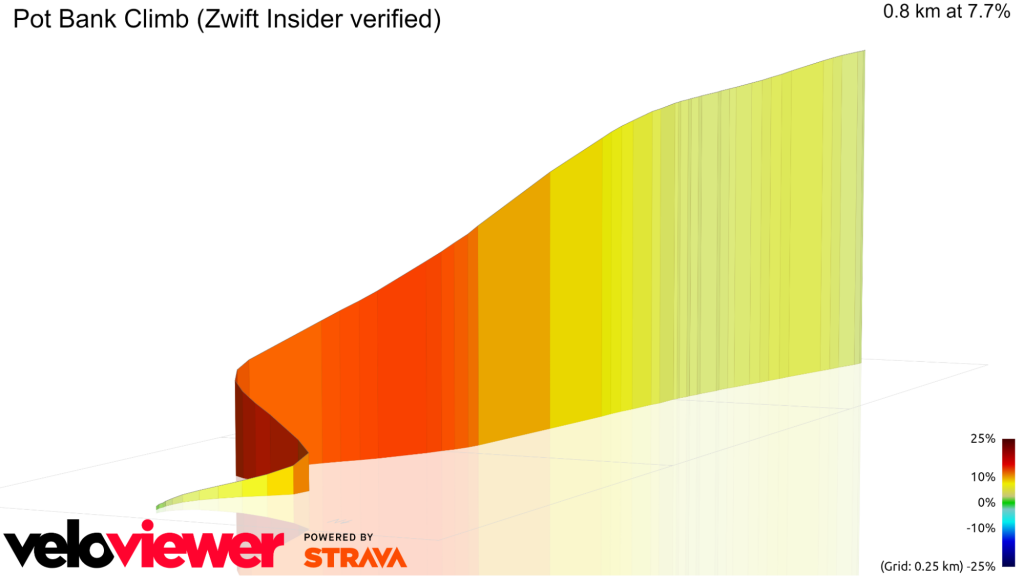
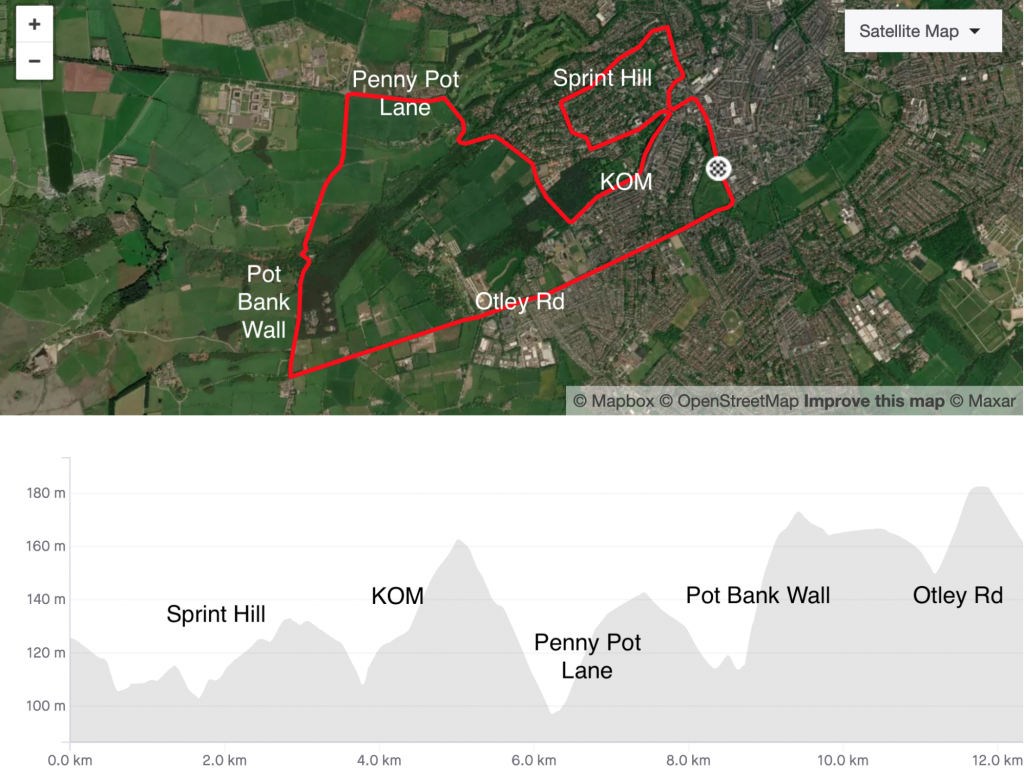
The ride starts with a nice easy 2% decline, but don’t let that fool you into a false sense of security. DO use it (and the slight incline that follows) to get into formation and sort yourselves out. After that it’s a sequence of hills; the first is the sprint hill (because the Sprint is on it) at just 2.5% to test the legs, then the Reverse KOM is 1.1km at 4.5% to sap your strength, and a little bump up Penny Pot Lane (1km at 4%). Next comes the aptly named Pot Bank Wall which is 750M at 8% and then a bump up Otley Rd (500M at 5%) before descending down to finish the lap back in the center of Harrogate.
What to ride?
Which bike should you use? When Eric tested this it came out a complete tie between S-Works Venge versus Tron. I’ve ridden this on both and frankly neither bike seems to make any difference.
My suggestion is pick a bike that mitigates your weaknesses – if you hate the hills go lighter weight, if you are a weight weenie yourself pick something aero to help on the descents.
Route Recon Rides
There aren’t many rides or races on this course – check out the event listing on zwifthacks.com to see for yourself. Your best bet is just to watch me suffer through this ride in my video recon above!
Race breakdown
Race breakdown here is tricky. This ride isn’t about knowing the route for me – it’s about knowing your team and managing the effort. For each hill there is a descent, so there is a corresponding recovery – but only if your fellow teammates can manage their effort in sync with you.
Every one of these hills and the descents can cause splits in the team – make sure you stay together.
Start to the sprint banner
The ride starts with a nice easy 2% decline… don’t let that fool you into a false sense of security. Do use it (and the slight incline that follows) to get into formation and sort yourselves out.
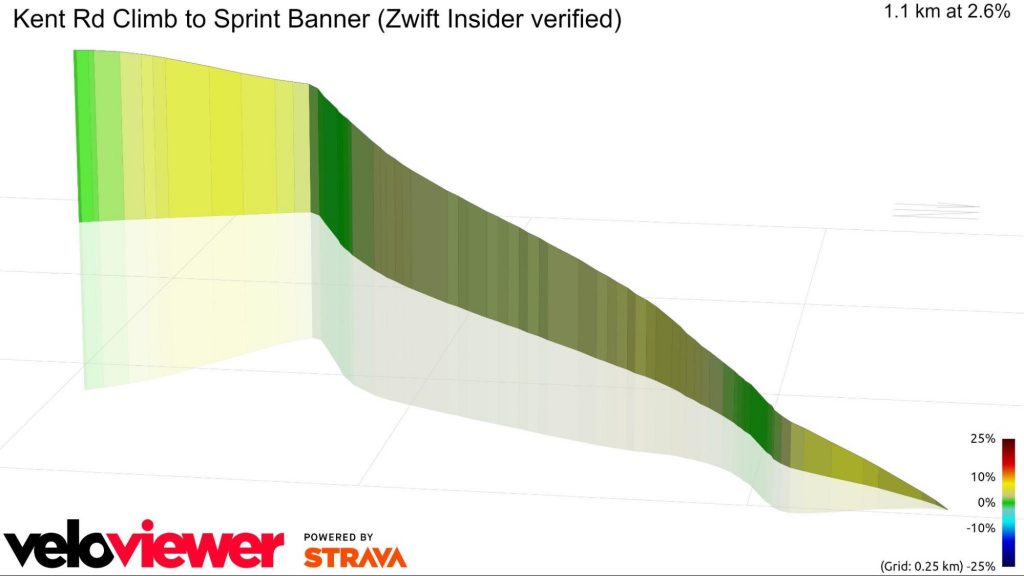
The first proper hill is Kent Hill, which appears at 1.6km (and 15.4km). This is a 1.1km hill averaging 2.5% but actually broken into three 3% rises as you can see from the Veloviewer profile. This hill ends at the sprint banner, then you descend towards the KOM.
The Kent Road Climb shouldn’t give you too much trouble – just watch your friends!
Up and down the KOM
Descend from the Sprint Banner to 3.7km where the Reverse KOM starts.
Reverse KOM is a hill in three parts – part 1 is just 100m at 5% then it eases for 200m to 2.5km before the long steady 600m climb to the KOM banner at 5%. After the KOM banner the incline turns to a decline and you head towards Penny Pot lane.
Unlike the gentle Kent Hill Climb this is a proper gradient. There is benefit to sticking together as it is below 5% for significant parts, but to do that you will have to be disciplined.
The descent is 5%. Group together and get your speed up… maybe you can supertuck a little.
Penny Pot Lane
The descent from the KOM turns upward into the Penny Pot Lane at 6.3km – no flat here! Penny Pot Lane is in 2 parts, a 400 meters at 7% then 600m at 2.5%. You reach the top when you turn sharp left from Penny Pot Lane on to the B6161 and take the short descent to Pot Bank.
Pot Bank Wall
There is no easy answer to Pot Bank. I swear doing the recon ride I saw the gradient clock 24% for a moment.
The climb starts at 8.6km and it is the first 300m that’s the worst, averaging over 10%. Then the climb eases back to a much more manageable 4%.
I’ve done this climb in two different TTTs. Both times my team crumbled on the second lap. In a way that is OK – let the 4 riders with something left in the tank take it to the finish while everyone else limps home!
Otley Road to the start
On its own, the Otley road climb isn’t bad at all – its just 500 meters at 5% – but after the rest of this route it kills. Gather yourself after Pot Bank and work at the best speed you can. Be disciplined!
After the top of the hill it’s a lovely 2.2km 2.5% descent to the start finish gate, where you get to do it again for one more lap!
Target times
Here are my predictions for this week!
Category
#85
My Prediction
Vienna
44:41
44:30
Doppio
39:18
38:45
Espresso
39:44
39:45
Frappe
41:13
41:00
Latte
45:37
45:15
Mocha
53:45
53:30
Wrap up
This is a technical, lumpy course. There is no defining feature of this course, rather, it is a sequence of hills that will sap the energy of the whole team. If you know your fellow riders, and modulate effort to stay together, you will deliver a great result.
My race week centers on the two WTRL events – Tuesday is Zwift Racing League (ZRL)… Thursday is for the TTT. Martin and Steven of WTRL have cracked the code of making Zwift racing practical and I’m all in!
Each week I publish a recce filled with a course profile, bike recommendations, and even some target times. If you like your recces delivered visually find me on YouTube here.
I rode ZRL Season 1 and 2 with a small contingent of rebels from Rowe & King, first in the Ewoks, then the Droids. But for season 3 the club is going to town with ZRL – ten teams to start and new rider requests coming in daily. I will be with the 11-rider squad of the R&K Hyenas. I hope to see all 10,000+ of you out there on Tuesday!
What’s a Team Time Trial
Season 3s opener is a Team Time Trial. If you’re a returning ZRL racer you know the drill (skip this section!) but if you are new to ZRL and haven’t ridden in the Thursday league, you’ve probably gathered the Team Time Trial format is different from your everyday rides and races. Let’s explore that a bit…
In the ZRL TTT your team of 4-6 riders sets off at a pre-ordained time (more on this later) and works together to get around the course in the fastest time possible. Sounds simple… and it is. But the trick is in how you get the best performance out of the team.
What makes a TTT different?
What makes a TTT different? Basically it’s about the teamwork. In a normal race on Zwift, you are pretty much on your own. You might get comfort in seeing team jerseys, but frankly that’s about it. In the TTT you are working together the whole time: using the stronger members to help the weaker members, using climbers to pull the team over the hills… you get the idea. The mission is to either be in front of the team pulling, or be safely in the draft resting.
Sherpa Dave’s 5 tips for a better TTT:
Master the team start Assuming you all survive the team delay time, make sure you coordinate the start as a team. My teams always does a 20-second countdown, and we start pedaling at 5 to make sure the trainers wake up. You should aim to be in formation and at race pace within 15 seconds with no stragglers.
Communicate Discord is the way to go here. Share clear and crisp updates so everyone knows where you are and how your legs are doing.
Have a plan Whether it is a speed target, a w/kg target, or something else, make sure everyone knows what they are meant to do. If there is a significant hill, have a plan for it… and a fallback plan!
Situational awareness Know who is ahead of you, and who is behind. If you see a 1-second gap anywhere say so. Look after your teammates.
Have fun! Whether it’s getting to know each other in the pen, chatting afterwards in your group chat system of choice, or bantering mid-race, make sure you have fun. R&K Team Captains all do a weekly write-up to capture the team’s spirit, culture, and humor so we end up with fantastic intra-team and cross-team community. I highly recommend it!
Douce France route recon
One fast lap… that’s all this is. But this route is a little more technical that it looks at first.
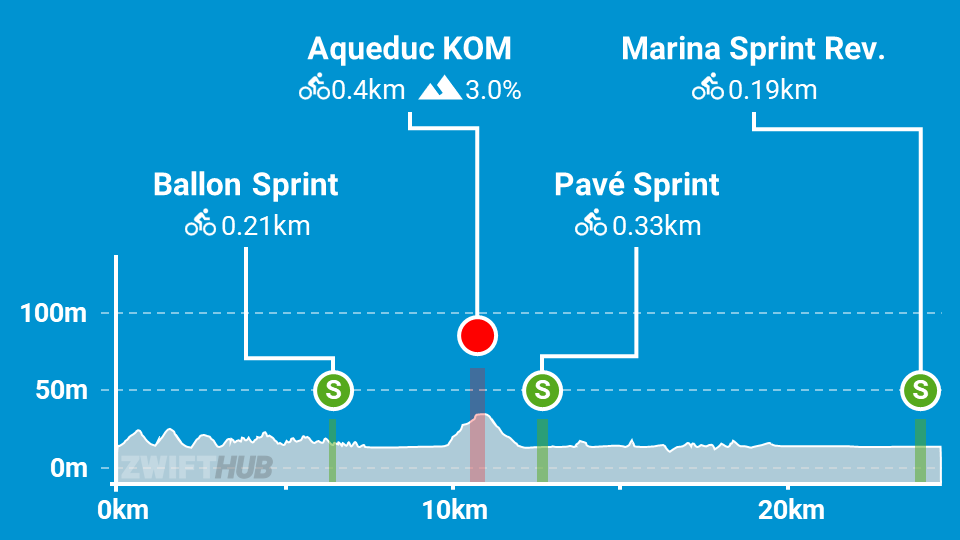
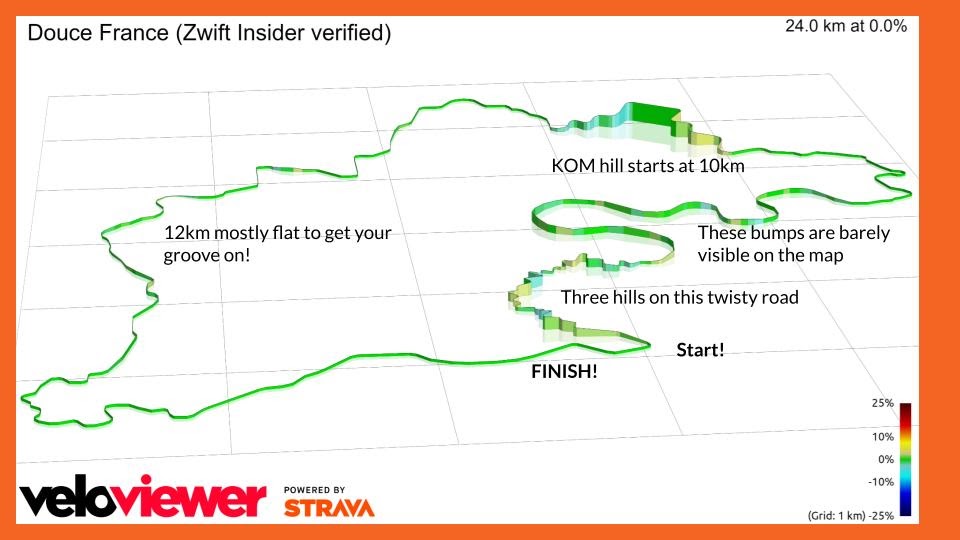
Take a look at the ZwiftHub profile below. The route starts with three rollers which change into a series of small bumps and then is pretty much flat from 7km to 10km before you start the climb up the aqueduct. The aqueduct climb starts well before the actual KOM marker. After descending (around 11km) the route is mostly flat (there are a few little rollers) all the way to the finish at 24.1km.
What to ride?
Bike recommendation on this route is pretty straightforward: aero rules the day. I will be riding my S-Works Venge with the pretty Super9 disc wheels. You should pick your most aero bike and wheels.
That said, I rode this route yesterday so you don’t have to… France is one of the most beautiful Zwift worlds but on Tuesday you will be going too fast and hard to notice. Here is my recon ride in glorious HD!
And here’s a recon from Rick at No Breakaways:
Race breakdown
This is a beautiful ride, almost perfect for a Team Time Trial. I break this route into four sections:
Three small hills to get you started (3km)
Bumpy stuff for the next 5km, then flat to the aqueduct hill
Up the aqueduct hill and down the other side
Flat with occasional bumps for the remaining 12km
Part 1 – Three small hills
Don’t underestimate these three small hills. They start at 1km and the road is windy, so it can be challenging to get your group working well together. Keep an eye on your teammates and keep communicating. Don’t over-exert here, your first priority is to stay together.
Part 2 – 5km of bumpy stuff
Each of these bumps is tiny – maybe 1 or 2 meters max… but the repeating change from ascent to descent will throw everyone off. The effect is similar to the dreaded Esses in Watopia. What is helpful here is a strong voice – a DS if you have one, but in reality (sorry DSs) anyone will do. Just call out the top and bottom of each bump reminding the team to manage their momentum.
At 8km, shortly after the Ballon Sprint, the terrain settles down and it’s flat until you begin the climb to the aqueduct.
Part 3 – Up and down the aqueduct
Many will tell you this is a 400 meter hill averaging 3% – in fact, that’s what the ZwiftHacks map says. That is just the timed KOM though! The hill itself starts at the 10km mark and is 800m at 2.5% manifesting as a series of short 5% steps. The descent is the same, 800m at -2.5% in a series of steps.
From 24km to the start/finish gate is 1.2km of downhill and flat. Finish with a group sprint to show the crowd what you’re made of.
Part 4 – Mostly flat to the finish
Once you descend the aqueduct (approximately 12.4km) it is mostly flat all the way to the finish.
That’s 12km for you to get into formation and ride like the wind. There are a couple of minor bumps along the way but nothing to slow you down.
Wrap up
If you’re new to the TTT format this route is a wonderful starting point. A little technical undulation at the start to see how well you operate as a team, but a long flat section at the end to practice formations.
If you are experienced at TTTs this is a flat out ride. Start with 6, end with 4, claim your points!
Video games, social media, and exercise – individually these topics invoke a range of reactions, both positive and negative. The three are rarely ever contemplated in the same context, but for three Zwifters, a fortuitous connection was made through the common shared bond of cycling + Autism.
Autism Affects So Many of Us
Autism spectrum disorders (ASDs) are the fastest-growing developmental disability in the world. According to the U.S. Centers for Disease Control and Prevention, 1 in 68 children are diagnosed, and ASD is approximately 4.5 times more common in boys (1 in 42) than in girls (1 in 189). Individuals affected by ASDs typically have three major areas of difficulty: communication and language, social skills, and repetitive and inflexible behaviors.
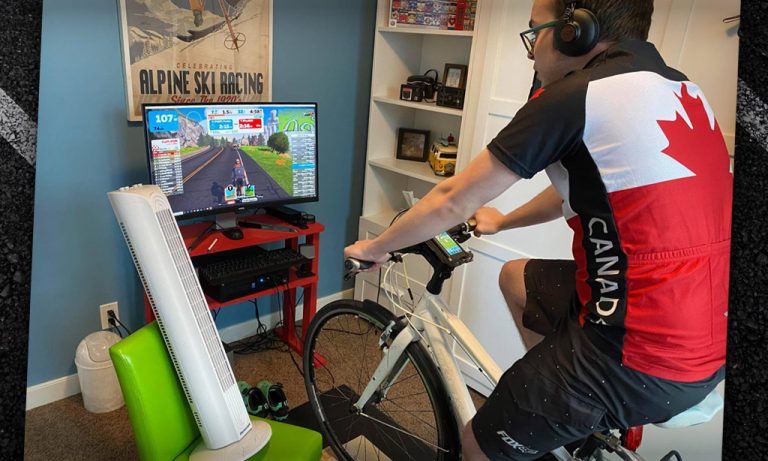
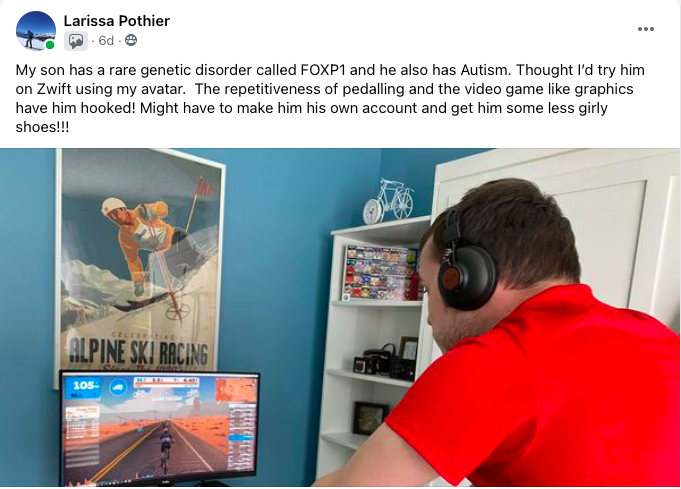
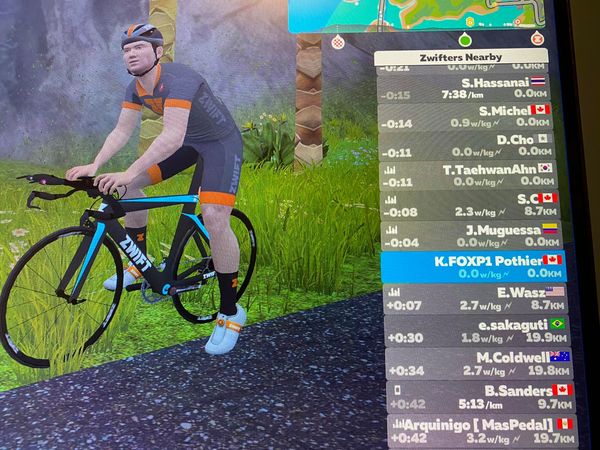
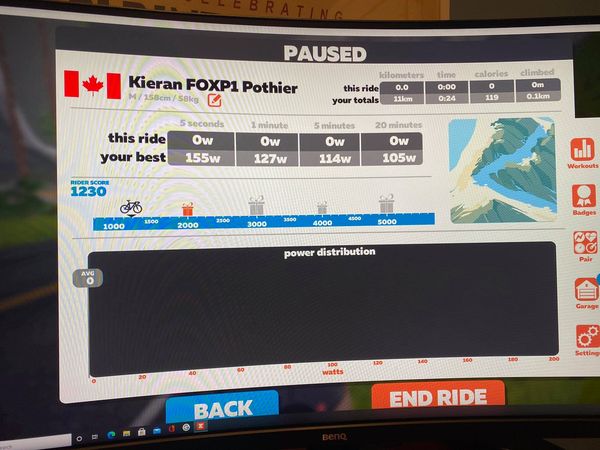
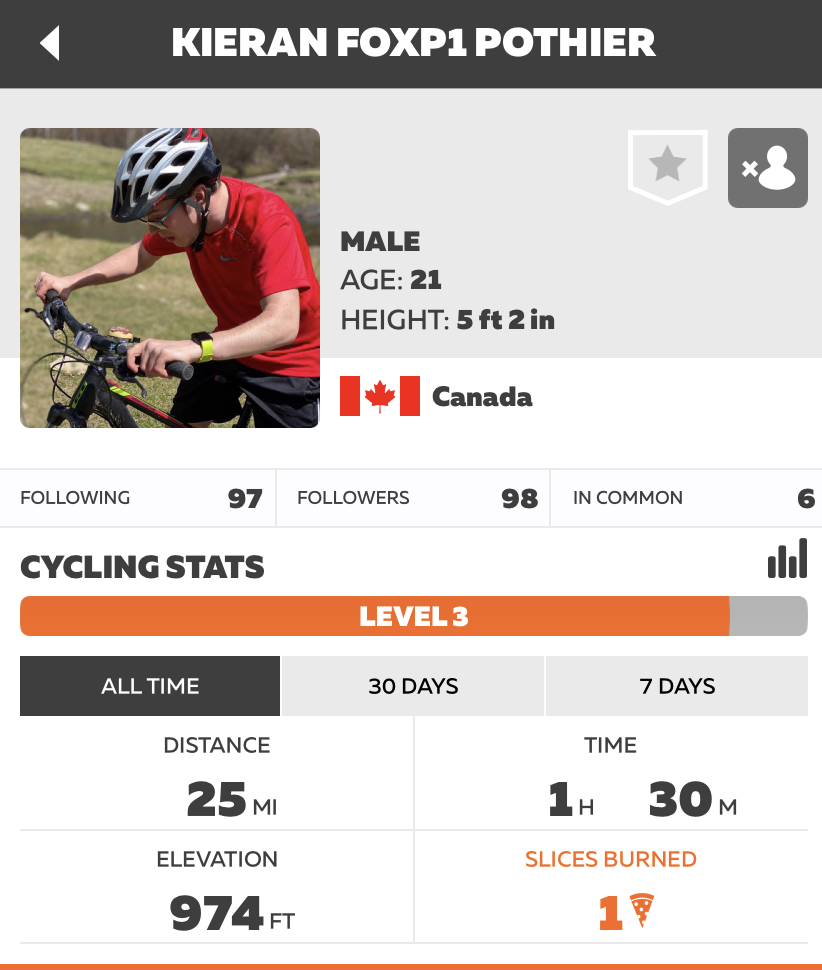
When Larissa Pothier decided to post to the Zwift Riders Facebook group on March 10th, 2021 about her son Kieran who is on the autism spectrum, there was no way that she would have anticipated the overwhelming response, nor the effect it would have on others. Especially Russell Jolliffe.
It Started As a Simple Post
Larissa describes her son as sweet, fun-loving, and happy. FOXP1 and autism have greatly affected Kieran’s speech, and have also created developmental and behavioral challenges. Despite having a tremendous amount of energy, he struggles to learn gross motor skills. But, “Once he masters a skill,” remarks his Mother, “there is no stopping him!”
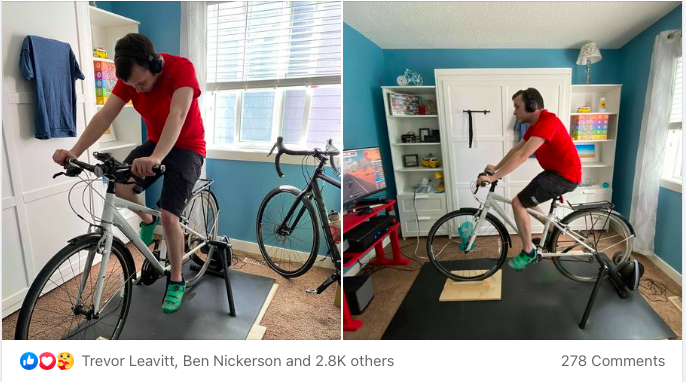
At the time Larissa simply thought others might enjoy seeing the effect Zwift has had on her 21-year-old son. When after only three hours her post received over 1,200 likes, it became apparent that it struck a chord with many.
Kieran was introduced to Zwift by watching his parents. When the sound of their indoor trainers piqued his curiosity, he was quickly fascinated by the excitement on the screen. “He would cheer us on and laugh when we grunted and groaned while struggling up a steep climb,” recalls Larissa. Her initial invitation to join them was greeted with an emphatic “NO!” Over time, however, Kieran’s curiosity got the best of him.
Video Games and Individuals With Special Needs
Larissa attributes Kieran’s love of video games to keeping him “coming back for more.” There is an ongoing debate whether video games and technology are beneficial for children affected by autism. In a study published in the journal Pediatrics in 2013, Mazurek and Englehart found that “many kids affected by autism are overly focused on video gameplay, experience difficulty while transitioning from video gameplay to other activities, and may become argumentative and oppositional.”
In instances in which video games and technology are used as a means by which to engage, as is the case with Larissa and Kieran, rather than as a tool for managing difficult behavior in attempts to provide a brief respite, they can be a powerful tool to help kids with autism.
Video games allow an opportunity for joint attention and shared interest with peers, as 70 percent of all video gameplay is now social. Repetitive and inflexible behaviors which interfere with problem-solving are common traits shared by many kids with autism, but they are a formula for failure in most video games which facilitate and rewarding flexibility, learning from mistakes, and adapting to new demands.
Clinical researcher Christina Whelen, PhD., and her colleagues found that computer games increased motivation and attention when compared with traditional methods of teaching children with autism. Larissa has found the same, explaining, “Kieran likes watching all the data that is presented on the screen and tracks his wattage, speed, distance, elevation, and time and enjoys looking at all the different avatars, their outfit choices, and especially their bikes.” Larissa feels these aren’t the only improvements noticed in her son.
Challenging Autism With Exercise
Those diagnosed with autism are at risk of obesity and other chronic disease, with studies indicating that U.S. adolescents with learning and behavioral development disabilities are 60% more likely to become obese, and 31.8% of adolescents with autism were obese. “Kieran has only been riding a short time but I already see positive changes,” confirms Larissa. Larissa notes that her aon’s stamina is improving and he appears to be “shedding some of those Covid pounds.”
The Components of Physical Fitness for Children with ASD
Body Image: Through exercise teaching children the parts of the body and what actions each part performs
Posture and Motor Coordination: Exercise can have a significant impact on the child’s gross motor development, sensory systems, and cognitive development.
Muscular Fitness: Strength and endurance are a top priority in a child’s health-related physical fitness.
Cardiovascular Fitness: A challenging component to add due to the repetitive, uninteresting, and distracting nature of most gym exercise equipment, this requires creativity to achieve. (Zwift is a perfect solution.)
In a study published in Psychology in the Schools the authors concluded: “participation in a physical activity intervention contributed to overall academic engagement for students diagnosed with ASD.” It seems Larissa may have stumbled upon something in encouraging her son to join her. By combining the benefits of a video game with physical activity, Zwift has the potential to be a powerful learning, behavior modification, and treatment modality for individuals affected by ASD.
Comments from An Adult Cyclist With Autism
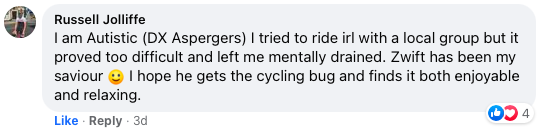
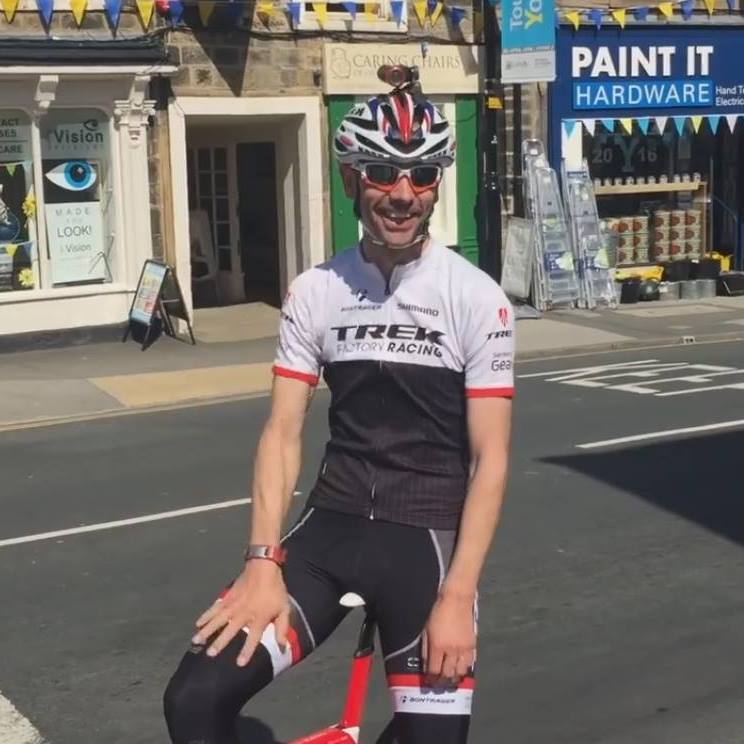
The same can be said for 45-year-old Russell Jolliffe who, unbeknownst to him when commenting on Larissa’s post about Kieran, had organically gravitated towards Zwift for the many problems it solved in his life. Russel was diagnosed with Asperger’s Syndrome in 2012 following the diagnosis of his son. A long-time cyclist, Russell was encouraged to join his local cycling club in 2010. Unfortunately, it did not go well and at the time Russell had no explanation for it.
Russell always considered himself routine-oriented and thankfully his club always took the same route, stopping at the same cafe for coffee and cake before returning. The problems arose when the club would unexpectedly change the route or deviate from the routine in some fashion. “I would panic, drop to the back, and go the usual route by myself or head home,” recalls Russell.
The group riding dynamic, with its emphasis upon the ability to read body language, understand sarcasm, and maintain eye contact, was a challenge. “Interacting with people I don’t know is a struggle and conversations tend to be short,” explains Russell. Although he enjoyed feeling “normal” as part of the group, the “mental cost was too high” for him to continue.
Zwift Was the Answer to Questions Russell Didn’t Know He Had
Russell’s setup
Russell lauds Zwift as his savior, stating, “It’s almost as if it had been designed with autism in mind.” Russell thrives on the ability to ride set routes, follow predetermined specific rules and parameters, and interact socially on his terms in a safe, comfortable, and nurturing environment. “Deep down I do miss my club,” laments Russel, “but it was just too much for me and now I am a part of a great team on Zwift.”
Russell (see his ZwiftPower profile) is a rider and A racer for Team Cryo-Gen. “I have never been under any pressure while I race and always feel welcome, especially on the team’s group rides,” he says. While Russell admits that his Zwift setup is not much different from most, he acknowledges that he always wears headphones and listens to music while riding. “In everyday life I have to wear headphones also, like in the supermarket, to filter out anything external and allow me to concentrate,” he explains.
Larissa says the same about her son. “Keiran pretty much goes everywhere with his headphones on listening to music and loves to sing,” she states proudly. He also loves shoes, described by his mother as having a “shoe fetish”, and the brightly-colored pair he chose to wear in Larissa’s social media post further endeared this sweet young man to the incredibly supportive Zwift community.
Kieran also loves receiving encouraging Ride Ons from his new Zwift friends, which prompted Larissa to create him his own Zwift account. “Kieran is always super proud of himself after each ride,” states Larissa when attempting to describe the impact that seemingly innocuous social media post has had on her family. Using Kieran’s words, “that’s cool…so cool!”
When I saw Larissa’s post about Kieran it inspired me and I thought I would offer up a piece of equipment that would make it more fun for him on Zwift. Larissa said Kieran’s face lit up when she told him.
Bradlee Twigg
Larissa and Russell Want to Say, “Thank you!”
Larissa feels that she owes a lot to the Zwift platform and the sincere response she received when sharing with the community. “I hope that others with special needs individuals in their life can be encouraged by all the positive things Zwift has to offer. Thank you for giving Kieran this opportunity to share his love for cycling.”
This is a sentiment which Russell echoes, but in much simpler terms by stating, “clipping in and riding a sunny Watopia instantly makes me feel happier.”
To Kieran, Russell, and Larissa… Ride ON!
What do you think?
Do you have a loved one with special needs who might benefit from Zwift or who has already? Your Zwift family would like to know your experience!
Zwift has announced that a planned outage will take place on Monday, April 5th at 7pm Pacific Daylight Time (2am Tuesday April 6 UTC). Since there’s almost nothing worse than planning a Zwift session only to have the game unavailable, we thought we’d share the news here!
The outage is planned for 2 hours and will affect all key Zwift services:
Zwift game launcher
Zwift game app
Zwift Companion app
Zwift.com website and sub-pages including the forum and user dashboard
ZHQ says the outage is necessary in order to allow them to “upgrade our system performance and stability, ensuring even greater service and reliability for you and the entire Zwift community.”
This year Zwift recycled some of the funny stuff they’ve done in the past (with a twist). That’s right – the big wheels are back!
Changing Bikes
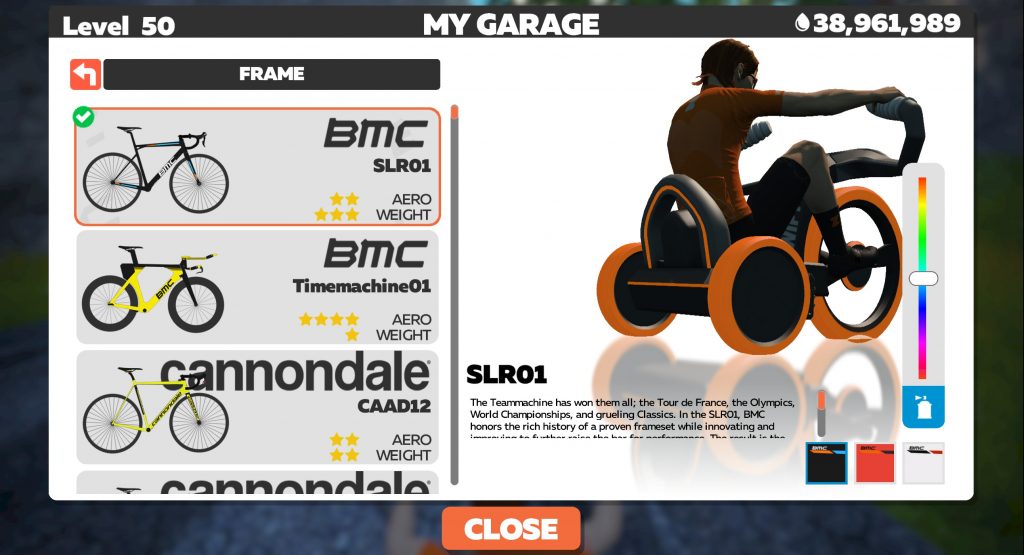
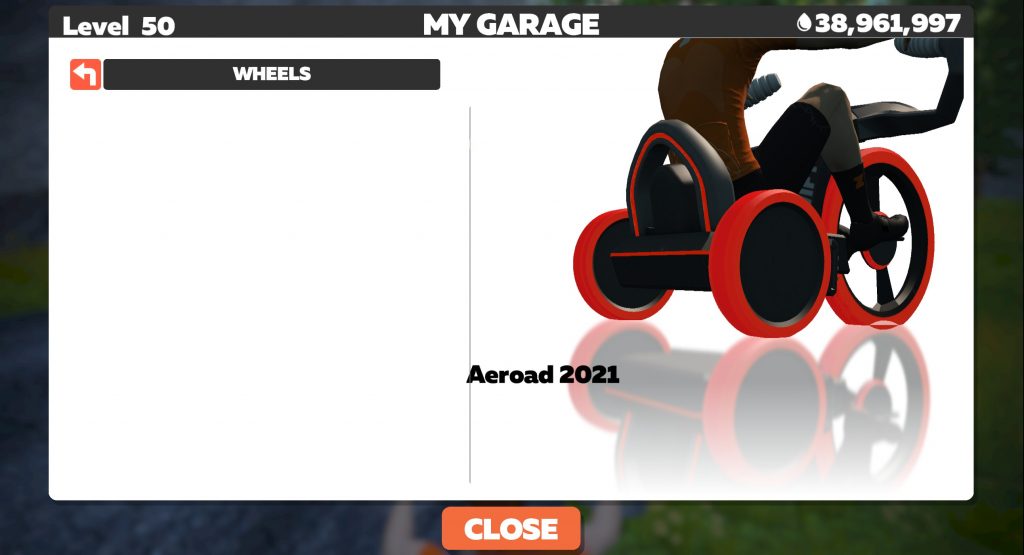
If you’re free-riding in game today, you’re stuck on the Big Wheel bike. Attempting to change to a different bike simply changes your bike’s colors. But if you head back to the garage, you’ll see your frame change wasn’t saved. And you can’t change your wheels, either!
Changing frame just changes your color
You can’t change wheels
Not Used In Events
It appears that the big wheel isn’t being used for official events – Zwift says they definitely aren’t being used in races. Which is good, since today is TTT day, and these trikes do not perform well (see below)!
Tron Trike
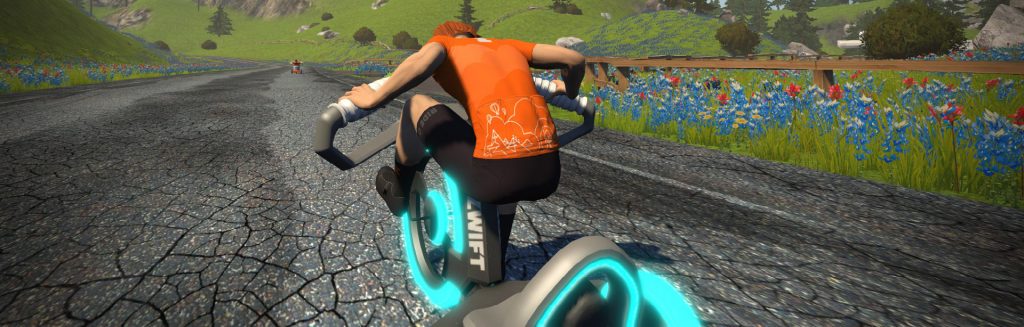
Some riders are seeing themselves in game with a Tron trike. This is the first time we’ve seen a Big Wheel with a tron look! It seems as though only you see yourself on the Tron trike, though – other riders see you on the normal trike.
And not everyone gets a Tron trike. It seems to be level-based, but we’re not sure what level that is! Our test account at level 13 didn’t have the Tron trike, and our test account at level 42 did have it. So the level unlock, if there is one, is somewhere in between 13 and 42.
Speed Testing the Big Wheel
We took the Big Wheel for a spin on our regular flat and climb tests. (We also tried testing it after “changing” frames, to see if it made a difference. It didn’t.) Here are the times the Big Wheel turned in:
Flat Test: 51:37 – this is quite slow – the same time as the Zwift Safety bike, and about 80 seconds slower than the fastest road setup.
Climb Test: 50:04 – this is quite slow – the same time as the Scott Plasma TT bike with the stock 32mm carbon wheels. Slower than any of the road frames, coupled with the 32mm wheels.
Runners
Some runners are showing up in the Delta Daring skin, which debuted in game for Halloween 2020:
But we’re not seeing that for all runners, and we’re not sure what determines who suits up and who doesn’t!
See It In Action
Watch our favorite Aussie Lama test the big wheels:
Your Comments
What do you think of April Fools this year? Did I miss anything in my summary above? Share below!
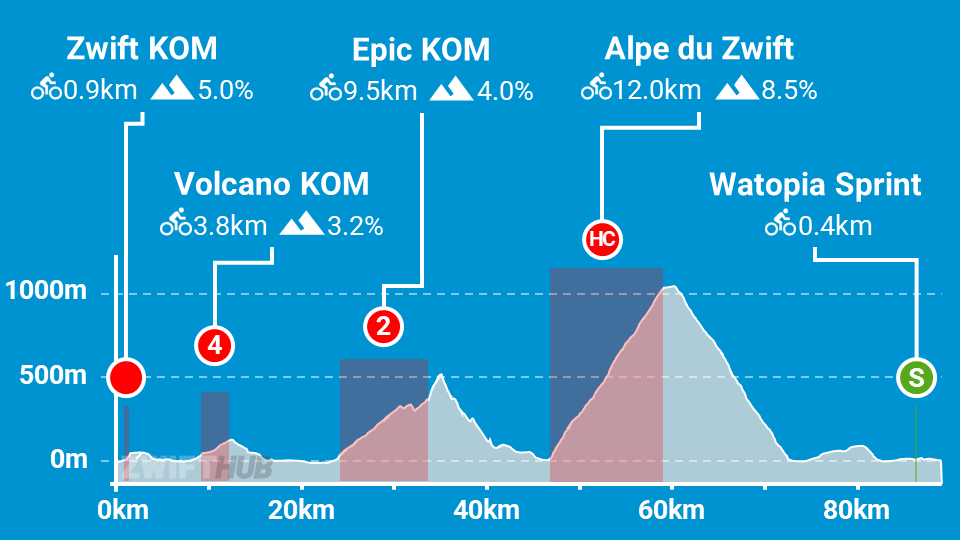
Watopia’s Four Horsemen may not be the longest route in terms of distance, but it is certainly one of the climbiest, taking riders up-up-up 2112 meters (6,929′) over 89.3km (55.5 miles). It takes on four of Watopia’s KOM segments, each tougher than the one before!
And that’s why we’ve selected this route for our next Badge Hunters event. After The Über Pretzel and PRL Full, Four Horsemen is the next-toughest route badge to cross off your list. So why not do it in good company, with thousands of other Zwifters?
The event takes place on Saturday, April 17th, at 6am Pacific/9am Eastern/2pm GMT.
When it was released in March 2018, the Four Horsemen covered all of Watopia’s timed climbs: the original Hilly KOM, Volcano KOM, Epic KOM, and Alpe du Zwift. Along the way it also covered (nearly) every bit of existing Watopian road.
Since that time the Fuego Flats and Titans Grove expansions have been added to our favorite cycling paradise – so Four Horsemen no longer covers all of Watopia’s KOMs or tarmac. But make no mistake: this route still packs a punch!
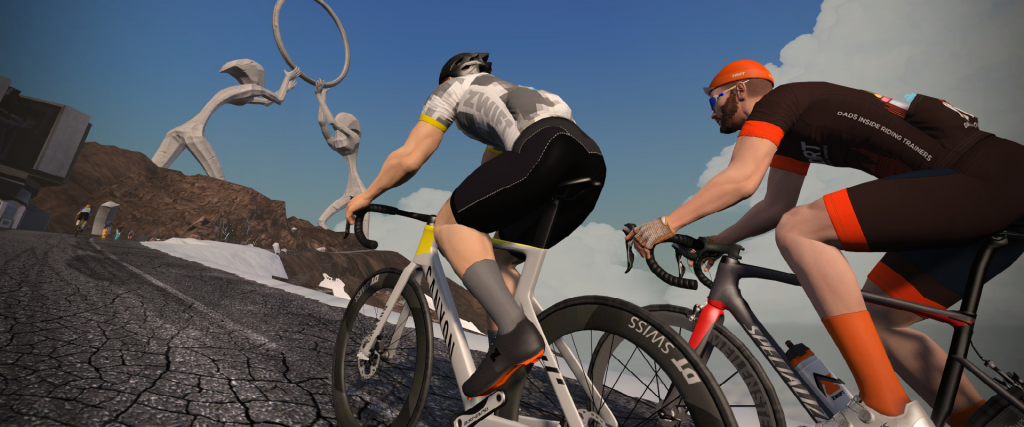
Fun fact: this is the only route in game which includes a descent of Alpe du Zwift. Here’s something you can’t do outside on a bike – descend mountain hairpins at 70+ kph, surrounded by other riders!
In an effort to reduce system problems, we’ve broken this ride into three categories: A, B, and C. These are not pace categories. They only exist to spread out the riders a bit at the start.
Categories will start 2 minutes apart so your Zwift device only has to deal with hundreds of riders at the beginning, and not a few thousand. Once riders get moving and spaced out, everyone’s systems should perform nicely.
If you’re concerned with your device’s ability to handle heavy traffic, join the category with fewer riders (B or C).
ALL categories will be visible throughout the ride.
More Ride Specifics
Show up on time, because there is no late join for this ride. Why? Because if you late joined more than a minute or so into the event, you wouldn’t unlock the route badge! And we don’t want that on our conscience.
This will be a double draft ride, so sit in with others on the flats in order to conserve your energy.
Steering is enabled, to make it more engaging and fun!
We’re serving up a custom mix of only useful powerups, evenly split between the Feather, Van, and Helmet. Use them for a bit of relief.
This is not a race – it’s a group ride. You can treat it as a race if you’d like, of course, but the ride will break up naturally into pace groups. Find riders working at your target pace and work together.
Based on the VeloViewer Leaderboard we can see that top riders crush Four Horsemen in just over 2.5 hours. But most mortals require 3-4 hours, with plenty taking even longer. You do you. Be sure to plan accordingly.
Discord
Zwift Insider’s Discord server will be used for voice chat during the ride. This really helps pass the time, so we highly encourage it!
In this Women’s Ride and Run Series special episode, we start a discussion about equality in sports from many different perspectives. Sarah Axelson, Director of Advocacy at the Women’s Sports Foundation talks about the work she and her colleagues do to improve equality in sports because of the many benefits it provides. Ayesha McGowan talks about her career and being the first African American woman to sign with a professional road cycling team, whilst also providing easy ways to be an advocate for change. Then to close the show, Joanna Hoffman (Director of Communications at Athlete Ally) has a conversation with Dr. Veronica Ivy, the first transgender world track cycling champion, about the inequality both female and male trans athletes face when trying to take part in sports.
About Women’s Sports Foundation:
Zwift is proud to support the Women’s Sport Foundation, which exists to enable girls and women to reach their potential in sport and life. Founded by Billie Jean King in 1974, WSF is building a future where every girl and woman can #KeepPlaying and unlock the lifelong benefits of sport participation. All girls. All women. All sports.®
Athlete Ally believes sport will change the world when it welcomes and empowers all people. As a leading national nonprofit working at the intersection of sport and LGBTQI+ equality, Athlete Ally works to end the structural and systemic oppression that isolates, excludes and endangers LGBTQI+ people in sport. We educate individuals and institutions to understand obstacles to inclusion for LGBTQI+ people and how they can build an inclusive culture within their athletic communities. We work to ensure sport governing bodies, teams and leagues adopt policies that reflect the diversity of their constituents. We incubate athlete activism to advance LGBTQI+ equality in and through sport. For more information, visit www.athleteally.org or follow us on Facebook, Twitter or Instagram @AthleteAlly.
About the Podcast:
The Zwift PowerUp Cycling Podcast typically features training tips from host Matt Rowe (Rowe & King), with regular co-hosts Greg Henderson, Rahsaan Bahati, Dani Rowe, and Kristin Armstrong.