In any ‘normal year’ (sans a global pandemic) April means one thing for many runners – the London Marathon. It is a massive event that sees the streets of London transformed into a carnival that is special to watch and amazing to participate in.
Sadly, with the pandemic, the traditional April London Marathon is not taking place, but runners need not despair. The magic of London can be replaced by the magic of Watopia!
Our friends at WTRL, who brought us the extremely successful Zwift Racing League, are launching the new Zwift Running League which lasts 6 weeks and starts on Friday, April 16.
Event Types, Explained
The Zwift Running League is a team-based running event. There are two types of events which alternate each week:
Points Race: based on the Cross Country format, this is a simple race where the higher you finish, the lower the points you earn. For example, finish 1st, you get one point. Your team’s top 3 finishers earn points, and the winning team is the one with the lowest points. To participate, you’ll need 3-4 runners. Distances for this race vary between 4.4km and 9km.
Relay Race: this race requires 3 runners. Everyone waits in the pen at the start, runner 1 starts and runs 2km, once they have completed their distance, runner 2 goes, then finally runner 3. You can’t start your leg until your teammate has finished their leg and any false starts will result in a 20-second penalty. The team’s overall time is calculated when the final runner crosses the finish line. The key to this race is communicating with your team member once you have completed your 2km distance. This can be done in various ways such as using Discord or simply messaging them to say “Start”.
Is this Competitive?
The event is competitive and caters to all abilities, since you only race people near your own abilities.
The way this is done is that you select what class you enter, based on your running speed.
Class
Average Minutes per MILE based on 3.2 miles
Average Minutes per KILOMETER based on 5 kilometers
1
4:00 – 5:29
2:30 – 3:25
2
5:30 – 6:29
3:26 – 4:02
3
6:30 – 7:29
4:03 – 4:39
4
7:30 -8:44
4:40- 5:25
5
8:45- 10:00
5:26- 6:12
Teams will consist of 3 runners for Team Relay Races and 3 to 4 for the Points Races. Once you established your Team’s ability, you select the relevant City event category to enter, meaning you are competing against teams of your own level.
The City category you enter is dependent upon the ability of the runners in your team, based on their Class.
City
Team Make-up
Atlanta
3 Runners x Class 1 (but can include other classes)
Helsinki
1 Runner x Class 1 – 2/3 x Class 2, 3, 4, 5
Munich
1 Runner x Class 2 – 2/3 x Class 3, 4, 5
Rome
1 Runner x Class 3 – 2/3 x Class 4, 5
Sydney
1 Runner x Class 4 – 2/3 x Class 5
Examples how this works:
If you had 3 quick runners that can average 4 to 5.30 minute miles, you enter Atlanta.
If your team consists of 1 quick runner of Class 1, but then 2 runners of Class 2, you enter Munich.
Winners
Both individual and team winners will be crowned:
Team Results and Leagues (collective/average time, points etc by CITY CLASS)
Individual Leagues & Results (times, points etc by AGE GROUP and CLASS)
Important Detail
The league that you join has a designated event time. If you do not compete in that designated event, you will not receive a result.
If you don’t have a Smart treadmill, there are other solutions. You can attach the NPE Runn™ treadmill sensor to almost any treadmill that transmits the belt’s speed in Bluetooth Low Energy (BLE). It is available in the Zwift Shop.
If you don’t have a treadmill and still want to participate, one way to do this is via attaching a stride sensor to one of your shoes and run outside, with your device. The two most economically-priced options that work are:
Running outside with your device comes with risks, so we would advise against this option. You have to physically check your phone (which must be actively running Zwift) while running, and it is quite challenging. Basically, a treadmill is the best way to participate.
Wrapping It Up
With an ever-increasing number of running events appearing on Zwift, it may just be time to start shopping around for a treadmill if you don’t already have one! Just as Zwift cycling has enabled people to compete around the world, Zwift running is bringing people together to compete from all corners of the globe. Zwift Running League will be the first real show of this global competition, but it certainly won’t be the last!
The potential here to have fun and get back to competitive running is appealing. WTRL has seen massive success with their Zwift Racing League and Thursday night TTT events, and we’re sure this series will be handled with equal attention to detail.
Since March I have become obsessed with the weekly WTRL Team Time Trial… so I asked Eric if I could share my obsession with you all, in weekly doses.
Each week I will give you a profile of the upcoming route, guidance on bike choice, and some target times if you want to aim for the Premiere League (top-10 in each coffee class get to be in a special race televised on YouTube).
If you can’t ride, or even if you can ride, but want more action, don’t forget to tune in to the live TV show on Zwift Community Live’s YouTube Channel at 6:15 (UK time).
Review of WTRL TTT #103 Harrogate Reverse
It was a sea of riders… parts of the ride felt more like a group ride than a TTT, particularly the last 5km. Unfortunately, I had a mechanical which needed a reboot, and I missed the pen by 5 seconds, leaving the already shorthanded Puffins with only 3 riders. Not an auspicious debut with a new club!
Category
#85
My Prediction
PL Time
My place
Vienna
44:41
44:30
45:12
6th
Doppio
39:18
38:45
39:32
7th
Espresso
39:44
39:45
39:28
14th
Frappe
41:13
41:00
41:13
7th
Latte
45:37
45:15
45:49
10th
Mocha
53:45
53:30
54:06
8th
Not bad, even if I do say so myself. The only fail on my part was Espresso who really went to town beating the Doppio class by 4 seconds.
Only one Rider Review this week – from our Paris correspondent Mark, in the CICC Blast team.
So with the spring weather now CICC consolidated down to two teams (forgetting that a good portion now live in Scotland where today’s spring weather was 50mph gusts). With the inclement and, for our lighter riders, downright dangerous conditions we were fielding a strong 7 (including a CICC vAmos conscript, Jan). We had made pace notes and studied Sherpa’s video, the videos are amazing (flattery will get you everywhere), had a plan and then concluded that the old Army adage ‘no plan survives first contact’ was likely to never be truer and a shambles was inevitable.
Off we set with the agreed strategy. Carlos dropped off (under-reporting turbo to blame) and sent us on with his regards. Really good tempo riding kept our team (with a spread of 17kg from light to heavy) together for the first lap, and we passed several teams cleanly. Phil unfortunately got caught up passing a team early in lap 2 and had to go red to get by. Since this course has nowhere to get unred, and despite briefly getting back on, the next hill came too quick and Phil sent the remaining 5 on. We stayed together and Jan paid Blast the ultimate compliment ‘I thought I was ‘dropping down’ for an easy ride, this is just as bad as vAmos!!!’
Jan and I got slightly distanced on the very last climb and couldn’t quite get back on for the run in. Slight schism in team but overall not the ‘shambles’ predicted and some fantastic performances. This is our ‘B’ team and we took a full minute out of our then ‘A’ team’s December time on this course… now all the Internet knows Blast beat vAmos!
WTRL TTT #104 Sand and Sequoias (2 laps)
I thought London was the first leg in a three-week European vacation: France this week, and Italy (Bologna) next week. So sure was I that I wrote this week’s recce and sent it to Eric for publication! I have no clue when it changed – but we are actually heading back to Watopia this week.
This week is two laps of Sand and Sequoias. This route is a regular on TTT – I have ridden it three times (once with CICC, twice with R&K). In fact, this was the route of my first TTT. Prior to that it was the route four times – #51, #39, #26, and #19!
Two laps at 20km plus a lead in make this a 43km ride – add in a KOM and what we have here is one of the longest and hardest TTTs, at least until the TTT visits Alpe Du Zwift on New Year’s Eve. Even top-flight teams will be in the saddle for 55 minutes, and the rest of us should expect well over an hour.
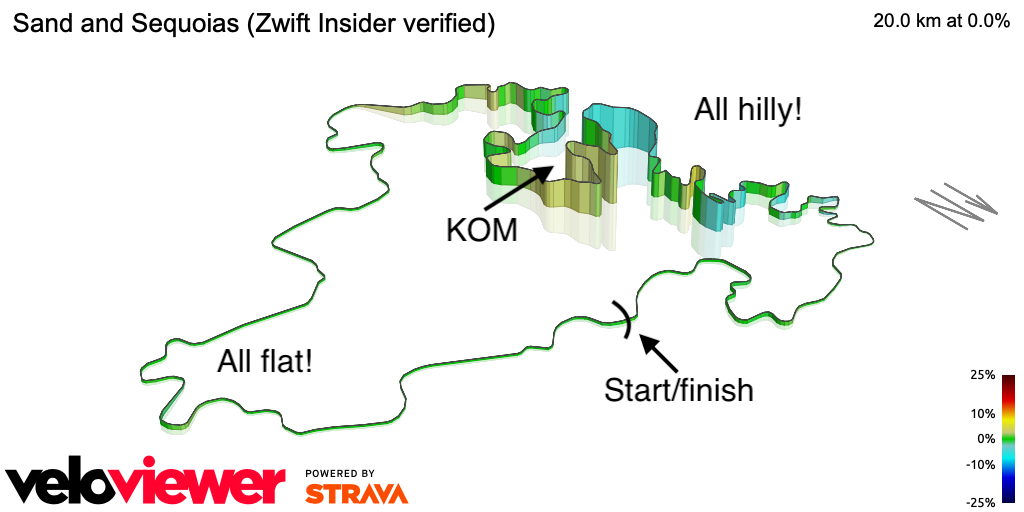
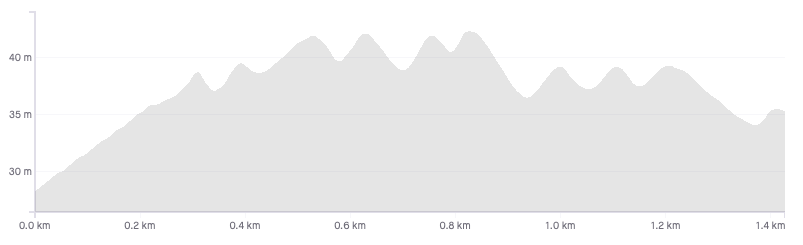
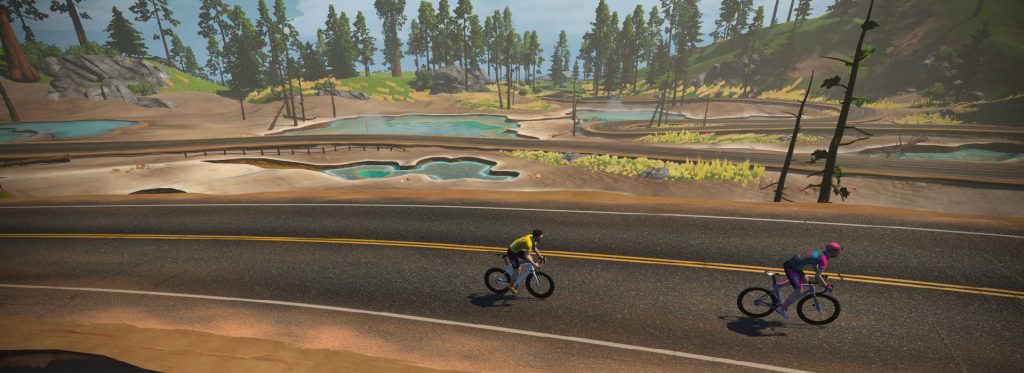
Essentially the route is out from the pens on the Fuego Flats desert then back via the Titans Grove sequoia forest – then repeat it all. This route ticks all the boxes – the flat of the desert, the KOM itself, and the rollers that bookend the KOM. And it’s long, too.
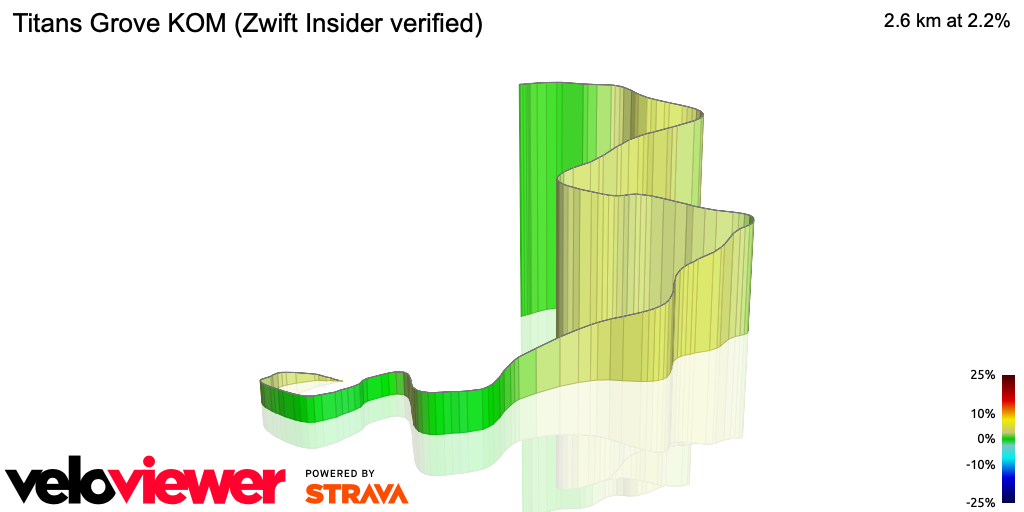
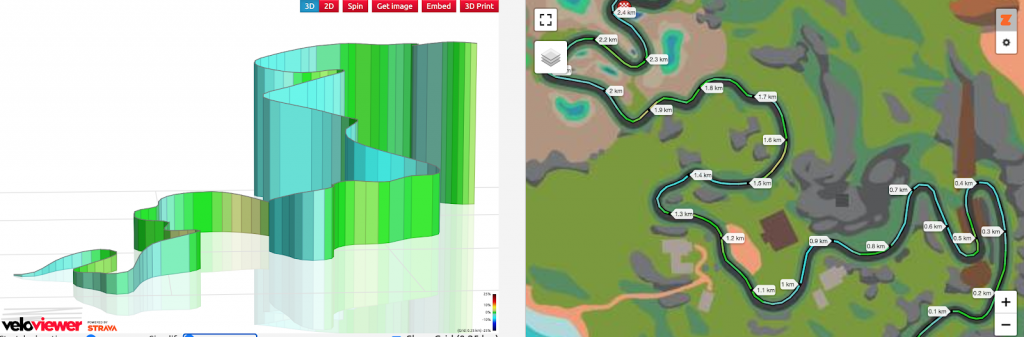
From the desert pens we head straight for the Sprint then through the start/finish gate. Through the desert for 10km (including the lead-in) before heading up the hill and into Titans Grove. From here it’s a sequence of rollers before heading up the KOM (2.6km at a pretty steady 3%) then more rollers. It flattens out as you hit the desert again for the remaining 3.5km to the start/finish banner – then do it again.
What to ride?
Bike recommendation on this route is tricky. For the Fuego Flats aero is king, but for Titans Grove the rollers give an edge to something more balanced. I will be on my Tron bike this week, leaving the Venge in the garage… although I did my recon ride on the Venge and it wasn’t awful.
Here are some recommendations on equipment at various levels:
Level 45 get those 858/Super 9 wheels and pair them with the S-Works Venge
In this case though, if you have a Tron, use it… it beats every other bike on this route hands down. I cannot stress highly enough that if you are racing you need to be working on Tron. It’ll take a while, but just set the Everest Challenge and forget about it for nine months… like having a baby.
Route Recon Rides
The last couple of weeks I have struggled to find good recce rides – but Sand and Sequoias is everywhere! – check for yourself on the event listing on zwifthacks.com.
BUT! As I do every week now, I rode the route (just one lap) and created a recce ride for you:
Race breakdown
As you can see from the route map courtesy of VeloViewer, the route is divided into two parts – flat in the desert, hilly in Titans Grove. There is an official Zwift race recon – but i didn’t think this one translated well to a TTT.
Start through the end of the Flats
It’s 10k from the pens to the start of the rise into the Sequoias. There are a couple of tiny rises but you won’t notice them as you speed through. Practice your paceline here!
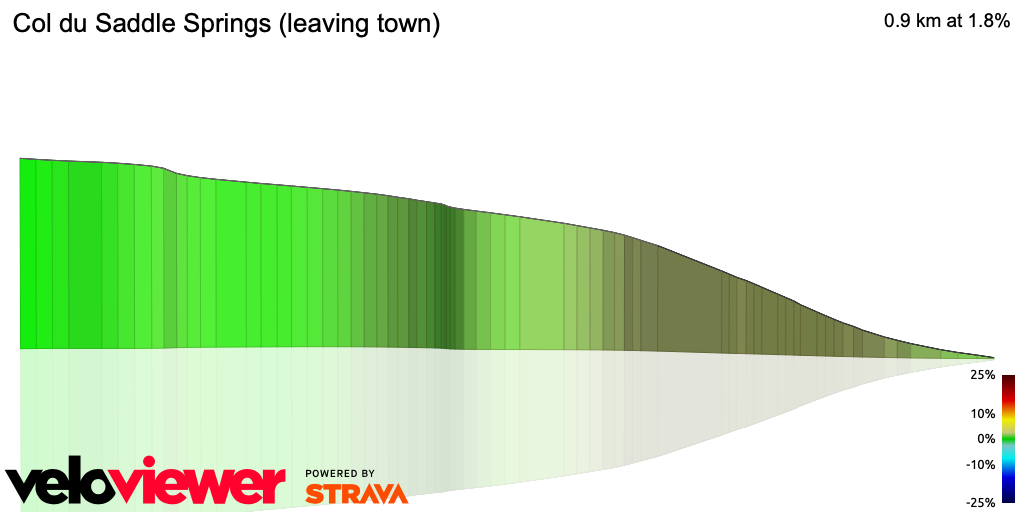
Some wag on Strava coined this term for a segment and I couldn’t resist using it. After 10km flat this is the first real rise – a perfect opportunity for your lighter, stronger climbers to jump ahead and create a split! Rein in those riders and keep everyone together. This first little hill is just 2% for 900m up to the turn into Titans Grove.
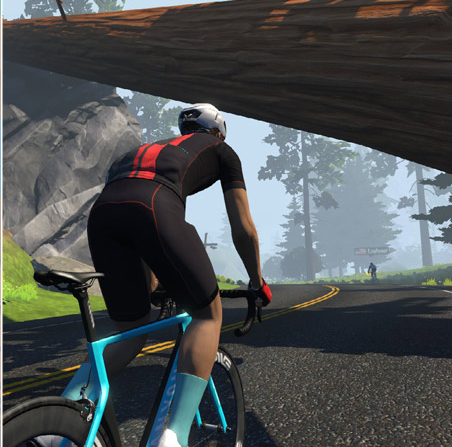
Rounding the bend from the Col you head into Titans Grove – a very pretty section, although you won’t have the energy for sightseeing. Before the KOM itself are a jagged series of bumps heading upwards before the descent that marks the approach to the KOM itself. This segment feels just like The Esses to me – plenty of opportunities to gain momentum and increase the team’s speed, but you also run the risk of splitting up.
On the face of it, this is a simple 2.5km pull at 2%, as it winds up and around the mountain with three beautiful switchbacks. But the top and the bottom are kinda flat, so the middle is steeper.
Think of this as a 1km at 4%. That’s enough height and distance to create a split – particularly on the second time around. I have raced this on the TTTs and both times we lost someone on this segment. Depending on your race strategy that might be fine on the second time through of course.
Once you go through the KOM the grade heads downwards. There’s a 4% downhill for a 1.4 km where you will pick up speed, then a series of rollers. Tired legs after the KOM (particularly on lap 2), will put strain on the team. Keep an eye out for splits in the group.
After the rollers it flattens out as you speed back into the desert, through the sprint and on to the Start/Finish banner.
Target times
The WTRL splits here are at 10, 20 and 30 kilometers.
Split 1 (10km) – Just before the Col du Saddle Springs
Split 2 (20km) – As you reconnect to the Desert from Titans Grove on Lap 1
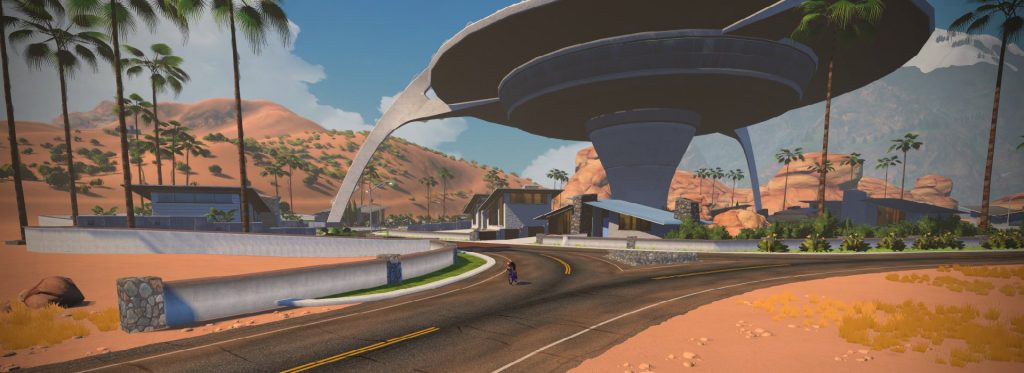
Split 3 (30km) – Passing the LAX Control Tower in Saddle Springs on Lap 2
How have you done in the last few attempts on this course? Here are the PL time markers from the past three rides on this course.
Class
9th April / #51
9th July / #64
8th Oct / #77
17 Dec / #87
Vienna
1:11:12
1:04:14
1:03:17
1:05:03
Doppio
58:03
Espresso
57:04
55:38
56:07
58:10
Frappe
59:42
58:55
58:44
1:00:38
Latte
1:04:51
1:04:03
1:03:10
1:04:58
Mocha
1:22:45
1:11:06
1:11:39
1:15:22
Here are my split and finish predictions for everyone:
Class
Split 1 (10km)
Split 2 (20km)
Split 3 (30km)
Finish
Vienna
15:00
30:10
45:30
1:04:00
Doppio
12:45
25:55
38:45
55:30
Espresso
13:00
26:10
39:20
56:45
Frappe
13:30
27:30
41:30
58:00
Latte
14:20
30:15
44:30
1:03:00
Mocha
16:00
33:30
49:30
1:11:00
Wrap up
This race is all about team discipline. You will be flat out on the flat, and the hills will strain the team… people will get dropped. But for me the critical section are the rollers before and after the KOM… hold together on those and everything else will come together! Climbers… if you can stay with the team on the hilly stuff they will help you on the desert plains!
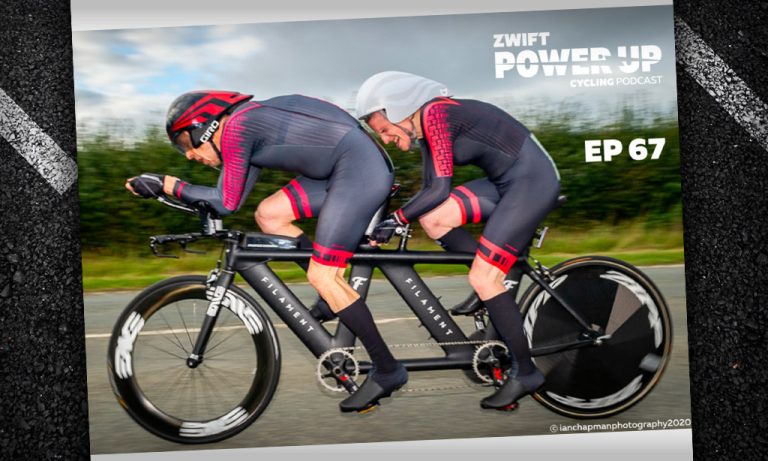
She’s a renowned Zwift community member, IRL record holder, and now Paralympic hopeful. Rachael Elliott has not let her 2018 stroke stop her from living her life to the fullest, and she sat down with Kristin Armstrong to discuss the TT mindset, how her stroke changed the way she trains and whether we might see Rachael at the Paralympics some day.
About the Podcast
The Zwift PowerUp Cycling Podcast features training tips from host Matt Rowe (Rowe & King), with regular co-hosts Greg Henderson, Rahsaan Bahati, Dani Rowe, and Kristin Armstrong.
The first points race of Zwift Racing League Season 3 has arrived, and it’s one for the sprinters! We’ll be riding 3 laps of Beach Island Loop, a newish route introduced in December 2020.Let’s dig into the course, including some tips for bike choice and key selection areas.
Looking at the Route: Beach Island Loop
Beach Island Loop is nearly identical to Volcano Flat Reverse, a route most racers will be very familiar with. But there is one crucial change, and that is going to make all the difference!
On Volcano Flat reverse, we hit the twisty dirt climb up to the Italian Villas, then turn right at the fountain to go past the noisy waterfall. On Beach Island Loop, we hit the dirt climb, but turn left to ride through the Villas and onto the Watopia Forward Sprint. This sprint point is the intermediate for our race, so teams will be working to earn those precious first across the line (FAL) and fastest through segment (FTS) points on each lap.
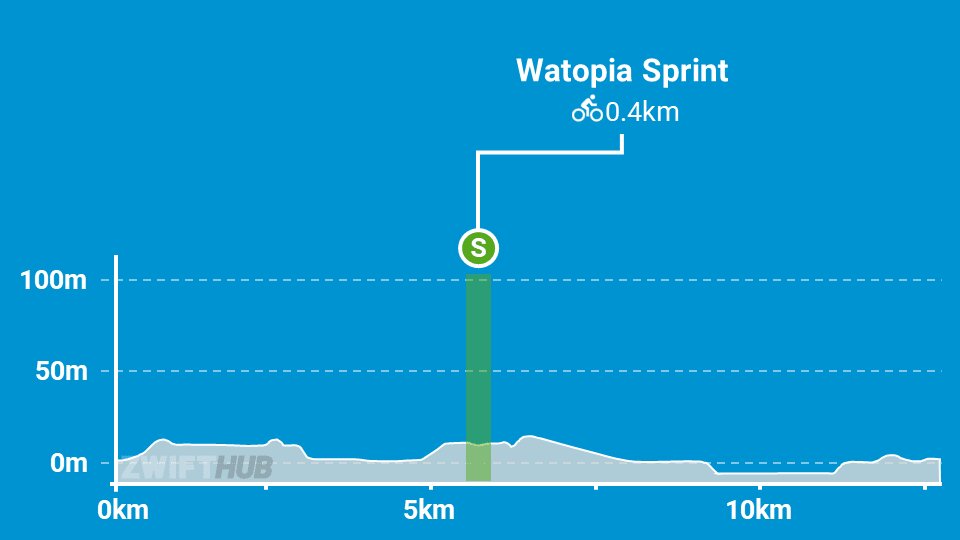
This would be a pure sprinters race, except the sprint comes just seconds after riders will be attacking hard up the dirt climb. Look at the profile from ZwiftHub below, and notice the short climb just before the sprint:
It’s what we call the “Dirty Sorpresa”: 570 meters of slow-rolling dirt on a snaking incline up to the Villas:
Dave’s Route Notes
Sherpa Dave has put together a race recon video, which you can watch below. And he put together some helpful notes, which you can also find below.
For me, every meter of a points race breaks into one of two decisions: am I trying to hold on to the group, or can I make a breakaway? In this race there are a few areas where a break becomes possible (or handling someone else’s break is necessary).
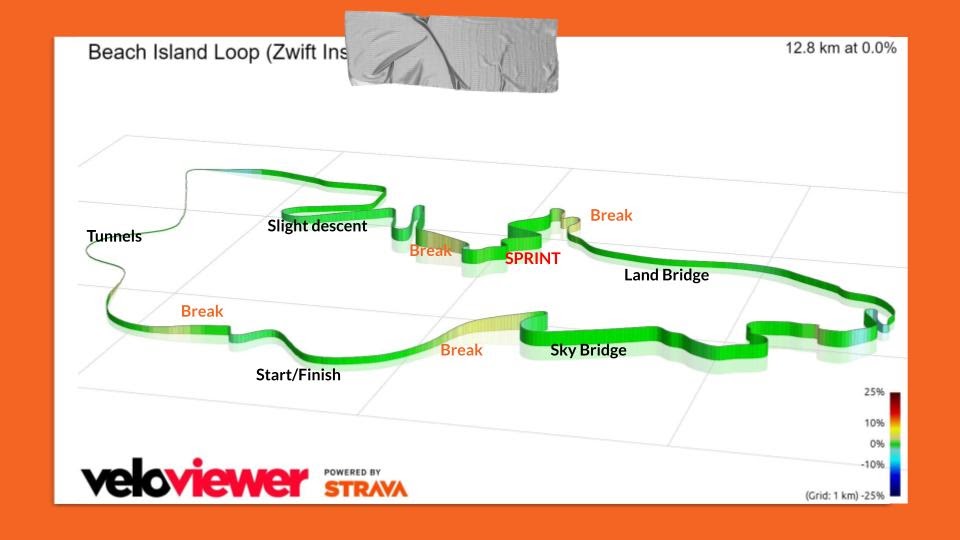
I marked up the Veloviewer map with some key points (orange text for break opportunities or break threats, black for landmarks, and red for the sprint):
Hill out of the start/finish: Small hill (400m) at around 3%. Not really much of an opportunity to gain a strategic advantage but someone will have a go. It “summits” as you go through the little tunnel.
Gravel section up to the Italian Village: Flat 300m then winds up the hill… all on gravel. This is where the Steamroller comes in handy. Effective use of that powerup will set you up for FAL points on the sprint which comes just a little down the line.
Sprint: If you’re in the lead group, go for FAL points, if you’re not… fear not, you can go for FTS.
After sprint break: Everyone is gassed after the sprint… can you make a break on this short rise?
Up and out of the tunnels: The section up out of the tunnels and around to the start gate always causes breaks in my experience… that’ll happen every lap but definitely on the last lap.
Rick’s Route Recon
Here’s a recon video from Rick over at No Breakaways:
Powerful Powerups
PowerUps will play a crucial roll in this race. Riders will be awarded powerups through the start/finish banner as well as the sprint banner, meaning we’ll get 6 powerups in the course of the three laps. Three powerups will be given in this race:
Aero Boost (helmet): makes you more aerodynamic (reduces your CdA by 25%) for 15 seconds.
Draft Boost (van): increases the draft effect you are experiencing by 50% for 30 seconds. In a double draft event, this powerup will give you 3x the standard draft effect.
Steamroller: reduces Crr for 30 seconds so you roll as fast as a road tire on pavement regardless of wheels or road surface.
The steamroller is a widely-misunderstood powerup (see “Misused Powerups: The Steamroller” for details), but let’s just say it will prove very useful on the Dirt Sorpressa. Riders will use it to help them attack early on the sprint, or (more likely) to help them conserve energy on the climb so they’ve got a little more left for the sprint just down the road.
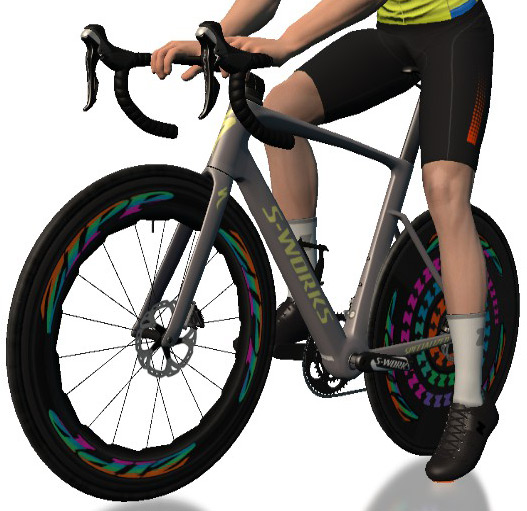
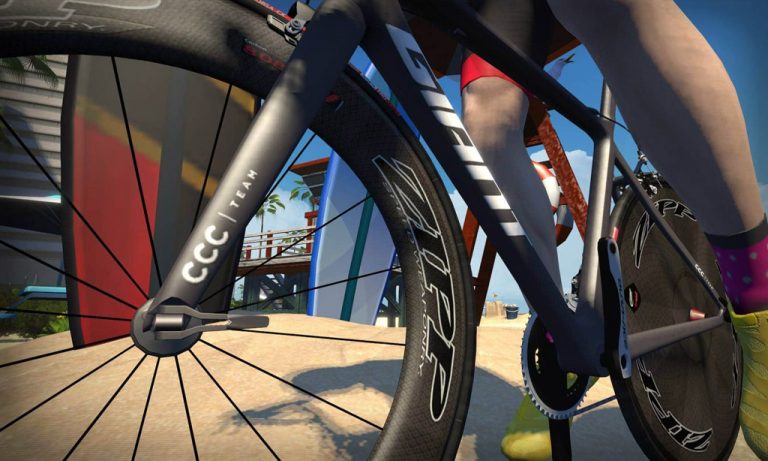
If you’re at level 45+, you have access to the fastest combo in game: the Specialized Venge S-Works + Zipp 858/Super9 wheels.
Strategic Options
This is a points race, so everything comes down to the sprint on each lap, as well as the finish. All the miles in between are just the setup.
Riders have a few options on the sprint:
Go early, attacking off the front on the dirt climb then trying to stay away to the line. This will earn FAL points, and require a super-strong 90-120 second effort. Steamroller powerup holders will be attracted to this approach.
Conserve on the climb, attack on the sprint: this may earn FTS points, and even FAL points, if early attackers don’t stay away. Helmet and Van powerups holders may tend toward this approach.
Survival: if you aren’t strong enough to contest the sprint, but you’re trying to maximize your finishing points, you’ll want to conserve as much as possible on the Dirt Sorpressa and through the sprint, while maintaining good pack position.
Of course, this is a team race. Smart teams will use a mix of the above strategies to maximize results. Example: got a rider with strong 1-2 minute power and a steamroller? Send them off the front at the bottom of the Sorpressa, and let your pure sprinters sit in with their aero powerups to contest FTS times.
The finish here offers strategic options as well, and always becomes both a mental and physical slugfest. Do you attack early on the climb up from the underwater tunnel? Sit in and conserve until the last second? Execute team tactics, perhaps for a strong leadout effort?
It may be a flat route, but it’s far from straightforward. Good luck out there!
Your Thoughts
Any insights or further thoughts on the big race? Share below!
Your body is kitted with a ticking time bomb, a developmental weakness in the masterlink of your neurological chain, its detonator set to go off anywhere, at any time. Lying dormant in the recesses of your brain, without any warning or clue of its presence, allowing no opportunity to prepare, plan, or process its arrival. The explosion signaled by a silent shockwave of fright, you tremble as you realize your basic physical abilities are being stripped from you.
It was December 22, 2020 at 8:58am.
Steven on an outdoor ride
The Day Began Like Any Other
The day began like any other for 39-year-old Steve Curran. Stepping from the shower following his normal morning routine, he dismissed a minor slip by blaming it on the wet floor. Wrapped in a towel, he dried himself as he started towards the bedroom, but with each step his feet met the floor with less surety until both his legs collapsed and he lay unable to move with his arms cramped in pain.
“I looked at my watch at 0900,” the trauma having etched the detail in his throbbing head. He recalls thinking to himself, “In two minutes I have gone from feeling absolutely fine to paralyzed from the waist down.”
Steven’s wife of 8 years was in shock as she watched him flail around upon attempts to stand. He refused the assistance of the paramedics as he crawled to the stairs and slid himself down to meet the trolley, determined to get out of the house on his own, grasping at the last bit of control he still had left. Due to Covid restrictions, Steven’s petrified wife could only watch as the ambulance sped away from their home in Poole in Dorset, UK.
The Day Ended Like No Other
Shortly after arriving at a neuro specialist hospital in Southampton, Steven received a myriad of diagnostic tests, including a CT, CT angio, MRI, and an MRI angio. Then a cerebral angio (a surgical procedure whereupon a camera is inserted via catheter pushed from the femoral artery to the brain while dye is injected to visualize the blood vessels) confirmed that Steven had experienced a hemorrhagic stroke, the result of an arteriovenous malformation (AVM).
An AVM is an abnormal tangle of blood vessels connecting arteries and veins in the brain which disrupts normal blood flow and oxygen circulation. The vessel walls become weak and rupture, causing bleeding into the brain, stroke, and brain damage. AVM cause is poorly understood, and may be genetic, hereditary, or congenital in nature. In Steven’s case, the malformation was in the portion of the brain which controlled the motor and sensory function of his right side.1
A Holiday He Will Never Forget
For the next few days Steven was monitored to ensure the brain bleed remained stable while he lay sleepless, wondering, “Am I going to die, and if not will I ever walk again, let alone cycle?” Once stable, he was discharged on Christmas Eve and scheduled to undergo brain surgery on January 5th, 2021 to remove the damaged malformation. After allowing himself Christmas day to rest, he immediately began the journey to recovery on the 26th.
By that time, Steven had regained full movement of his left leg but remained unable to move his right from the knee down. He was given a series of exercises and advised to start at 20 and work his way up, but he saw little point in that and used 100 reps as a starting point. He also refused to use the assistive devices he was given to walk. In stubborn satisfaction Steven states, “I had a constant headache, didn’t sleep properly, and worried constantly, but pushed on with rehab and achieved my goal of 3 sets of 100 reps and balancing for 30 seconds on my right leg the day before surgery.”
The Shocking and Disappointing News
It had been determined that the AVM affecting Steven spanned the length of the main artery supplying oxygen to a large region of the brain. He was informed that the entire vessel would have to be removed in surgery. The surgeon detected Steven’s shocked disappointment on hearing the news and stated frankly, “Waking up unable to move your right side is better than dying.”
The choice wasn’t as clear-cut for Steven who tearfully responded, “I don’t know, actually, my life revolves around being active.” Steven spent the next hour preparing for the life-changing procedure by stroking his leg, one final effort to stimulate it to move and squeeze out the last drop of feeling he was soon to be without.
Surgery With a Smile
Steven awoke in recovery after the 9.5 hour surgery to see his surgeon, who smiled as he told his patient he was able to remove the AVM without sacrificing the main artery. The surgeon’s smile grew wider as he performed the initial post-surgical neuro tests and detected traces of movement in Steven’s right foot. “It only moved like a millimeter,” Steven gleefully recalls, “but I was elated and at that moment told myself that I will recover and ride my bike.” Steven was discharged 18 hours later.
The first morning home Steven walked down the stairs without help. He went for a half mile walk two days later, and three days after surgery noticed that he was able to do a calf raise. On the eighth day post-surgery, he awoke to the sense of movement in his toes and knew it was the day. “If I can flex my toes then I can clip into my pedals,” he recalls telling himself.
The First Zwift Ride Back
Steven describes the 13km in 31 minutes on Zwift as “the best and worst ride of my life.” A four-year Zwift subscriber (see Steven’s Strava profile) who predominantly utilized the Zwift platform (see Steven’s ZwiftPower profile) as a poor weather riding option prior to Covid, Steven gained a greater appreciation for Zwift when UK lockdowns were imposed in 2020. “I found it addicting completing the challenges and earning the badges and was on the trainer even on sunny days,” he says.
Steven’s appreciation for Zwift became immeasurable and its worth invaluable to his rehabilitation. “It would have been impossible to get on my bike on the road without movement in my leg and foot,” he says. Steven would clip his right shoe into the pedal prior to climbing onto the saddle, then with his wife’s help put his foot in and tighten the closure. “Zwift enabled me to focus purely on my leg and how it was feeling and moving,” without the stress, distractions, and dangers of training on the road, which Steven admits would have surely deterred him.
It Hasn’t Been Easy, but Zwift Helped Him Get His Nerve Back
Approximately 10 weeks after surgery Steven had full range of movement in his right leg, foot, and toes. While he felt that his right leg wasn’t ‘doing anything’ during the first few rides, Steven recalls, “I genuinely think the pedal stroke woke up the nerves and helped me relearn the pathways to get my foot moving again.”
Although the speed and degree of Steven’s recovery has been remarkable, it hasn’t been easy, mentally or physically. “It’s unbelievably hard looking at your leg and telling it to move and getting nothing,” he says when describing the trauma he experienced. (This also explains the importance of the treatment he receives for PTSD symptoms.) Steven credits the ease of accessibility to Zwift and the ability to ride in the nurturing comfort of his home with helping him to cope.
Healing by Giving Back
Steven’s next goal is to do his part to raise awareness of AVM and help others in his situation to cope. He is planning a century ride to support the life-saving neuro ward of Southampton Hospital (if interested in donating please designate Neuro and mention Steven and this article). “I will leave home at 0858 22 Dec, the moment my life changed, and ride to the hospital and back to symbolize my journey.”
A journey which would have been difficult to start, and which continues strongly today, with appreciation to Zwift. Ride ON Steven!
Steven’s Goals for the Future
Raise £100,000 for the neuro ward that looked after me by turning my hospital 100 miler into an annual event.
Live to see my 100th birthday and don’t waste the second chance I’ve been given.
Teach my son how to ride a bike, surf, ski, and play football.
Never ride in the back of an ambulance again.
Raise awareness for AVM and other rare brain conditions.
Complete all the route badges and challenges on Zwift (including getting the Lightweight wheels) before autumn.
Do you and your significant other fight over who gets the big screen and who has to ride with their nose pressed against their mobile phone?
Do you long for the warm nostalgic embrace of split-screen multiplayer gaming?
Well, read on, because this article is the answer to all your problems! (disclaimer: this article will not solve all your problems.)
You’ve got troubles? Well I’ve got ‘em too!
Like many couples that zwift, my partner and I often find ourselves wanting to ride at the same time. Until recently, we’d been making this work with one of us on a PC connected to a TV, and the other on a Surface Pro 7 perched on an old music stand. And for a time that was working very well. But then, disaster struck. Zwift developed an issue with the Surface Pro’s integrated graphics. What followed was a series of mid-race crashes and post-crash sulks that threatened to turn our lockdown harmony into Surface-smashing discord.
To avoid a costly Surface Pro ‘accident’, I decided to look for an alternative way to get us zwifting zimultaniously (TM). The front-runner for some time was to run Zwift on a mobile phone and then cast it to the Surface Pro, but the lag and instability over Wi-Fi made that option rather less than attractive. (Plus, it just seemed horribly inelegant.)
With no fix for the integrated graphics issue in sight, I set my mind to a better solution. A purer solution. A solution to harken back to the golden days of gaming.
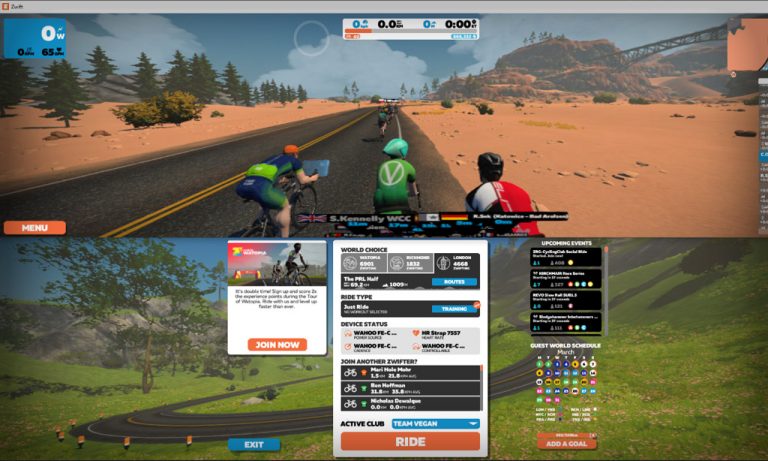
Could I run two instances of Zwift split-screen on a desktop PC?
The answer, happily, is ‘yes’!
Don’t Sandbag. Sandbox!
To make our split-screen dreams come true, we’ll use a program called Sandboxie (get it here). In a nutshell, some applications, like Word and Excel, let you run more than one instance of themselves at a time. Others, like Zwift, only allow you to run one instance. (This is usually for a good reason. For example, because the program needs to recruit most of the CPU/GPU.) Sandboxie presents a way around this limitation by letting you create an isolated ‘sandbox’ environment in which to run a second instance of a restricted application.
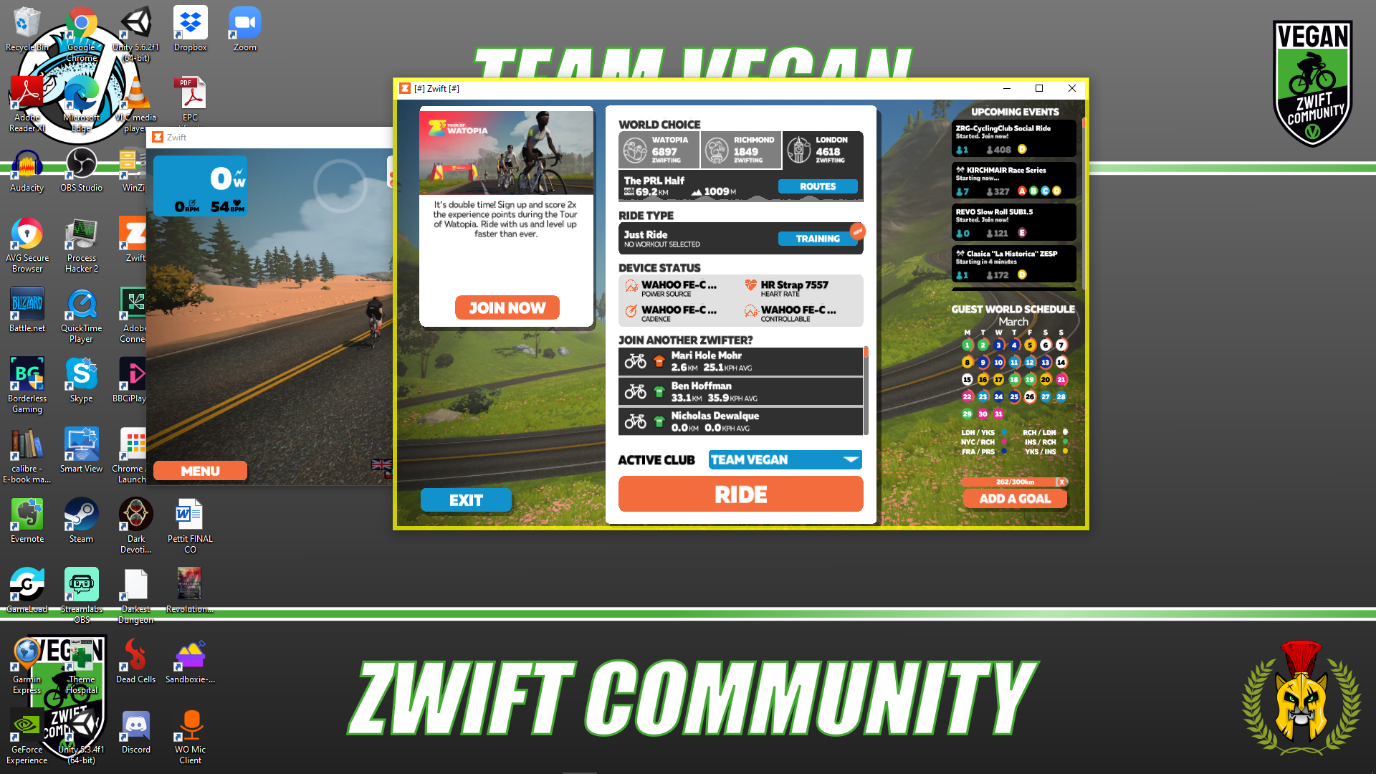
To get started, download and install Sandboxie and then right-click the program you want to run. There should now be a ‘Run Sandboxed’ option. Give that a click and your program will open up in its own environment. (You can tell if an application is ‘sandboxed’ by hovering over its title bar, which will turn its border yellow).
Right click on the Zwift tile and select ‘Run Sandboxed’Sandboxed window with yellow borders
Now all you need to do to get your split-screen up and running is load Zwift as normal with one log in, and then load a second sandboxed instance with another.
And for those of you wondering, the Companion app works with each instance of Zwift as normal.
Doubling Up
OK, so, a little more detail:
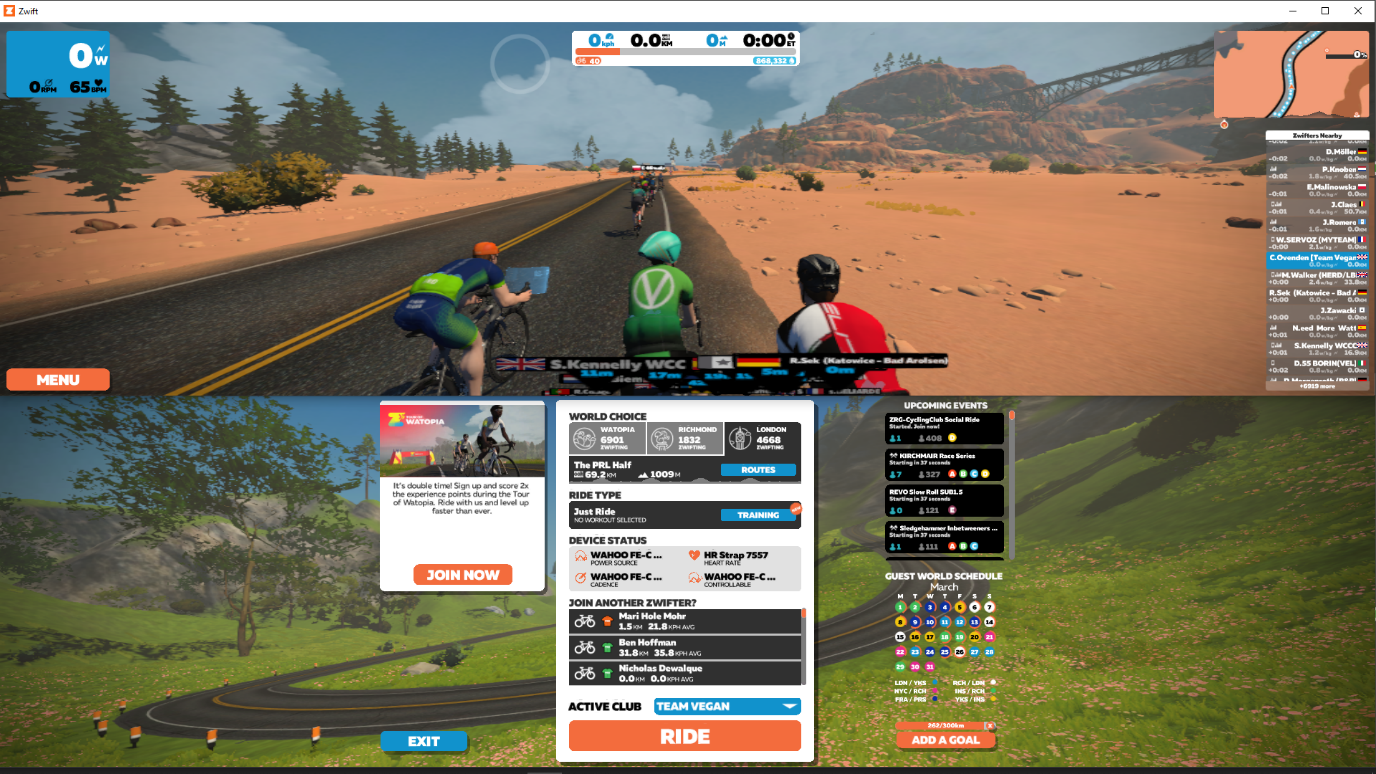
First, you are going to want to run Zwift in Windowed mode (you’ll struggle to see both screens otherwise!). You can then resize your windows and move them to the locations of your choosing. My partner likes a side-by-side set up. I’m more a fan of a top-and-bottom deal (Goldeneye64 style). Resizing the window will alter the field of view, so that may affect how you want to organize things. Also, text will be stretched or squashed depending on your chosen aspect ratio, as you can see below.
Side-by-sideGoldeneye64!
Next you need to think about how you will connect your trainers. The best method I’ve found is to use two ANT+ dongles:
First, load up Zwift normally with just one dongle plugged into the computer. Connect the trainer you want to use with that instance in the normal way.
Next, load up your second instance of Zwift. Now plug in your second dongle and you should get the option to connect the second trainer. (If you have both ANT+ dongles plugged in when you load up, one instance of Zwift will use one and the other instance will use the other. The problem is that you won’t know which instance is using which dongle. If, like me, you use a USB extension cable to put your dongle closer to your trainer, that’s a pretty important piece of information!)
I’ve had mixed success with getting the second trainer to connect via a Bluetooth dongle (I get the ‘no signal’ issue). Another option, if you don’t have two dongles, is to connect your second trainer via the Companion app. This works well, but locks you out from using Discord on your phone for your comms.
And voila, you are now ready to Zwift split-screened!
Life without Borders
‘But, Chris!’ I hear you cry, ‘what about that ugly Windows border ruining my immersive gaming experience? I’d rather run Zwift on my Nokia 3310 than spend another second looking at that.’
Well, dry those eyes, Sweetums, because I am one step ahead of you. We can use an application called Borderless Gaming (‘[BG]’) to remove those pesky frames (get it here).
[BG] is a neat little program that lets you run an application in windowed mode while making it look like a full screen app. (Why would you want to do this? It turns out for quite a few reasons, but now’s hardly the time, Curious George).
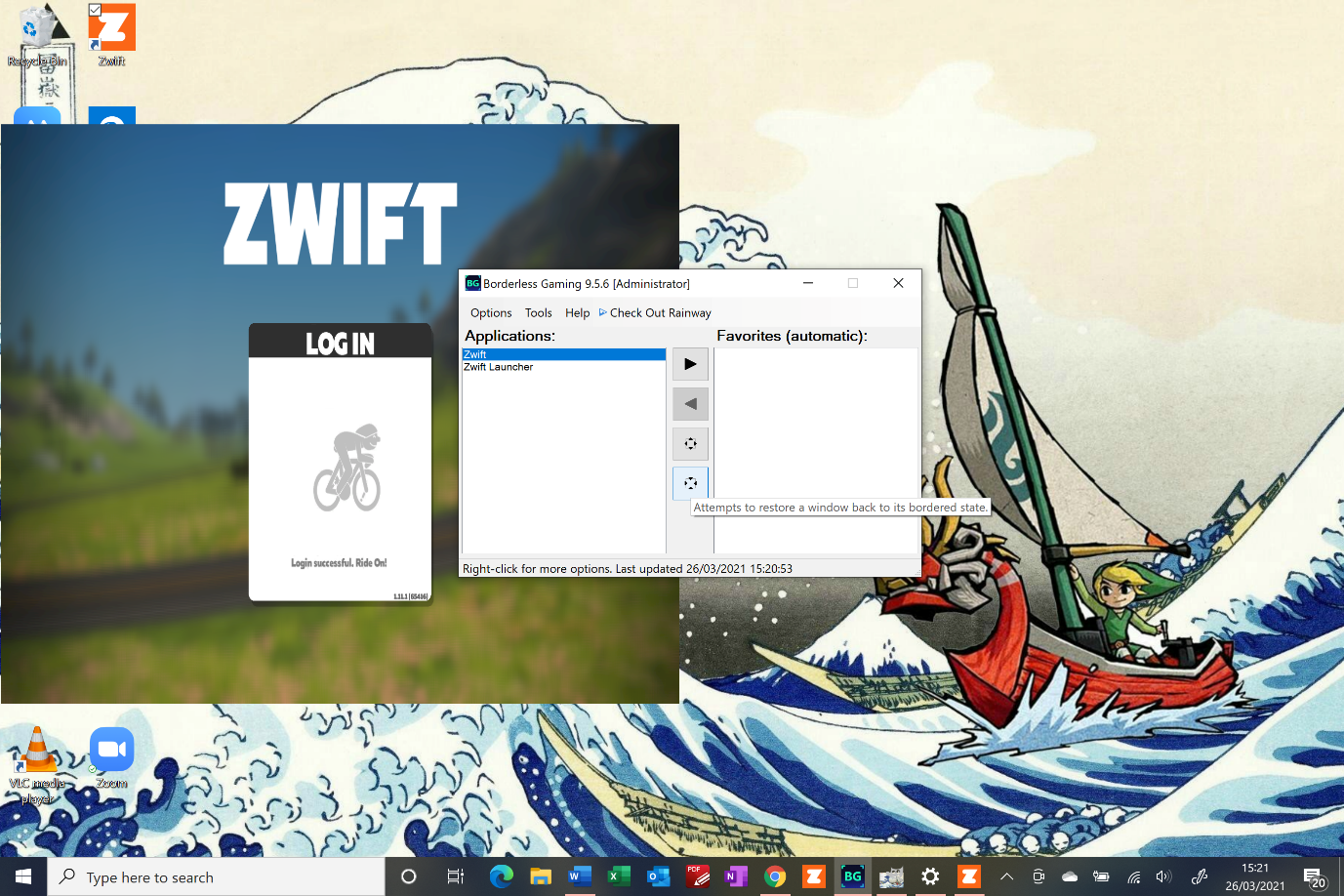
Download and install [BG] then open it up. In the ‘Applications’ Window on the left you should see ‘Zwift’ and ‘[#] Zwift [#]’. Select them one at a time and press the button to ‘Attempt to restore a window back to its bordered state’ (the box with four arrows pointing inwards). Next, press the right arrow to move them into the ‘Favorites’ box. This will automatically maximize the windows, so Alt+Tab back to [BG].
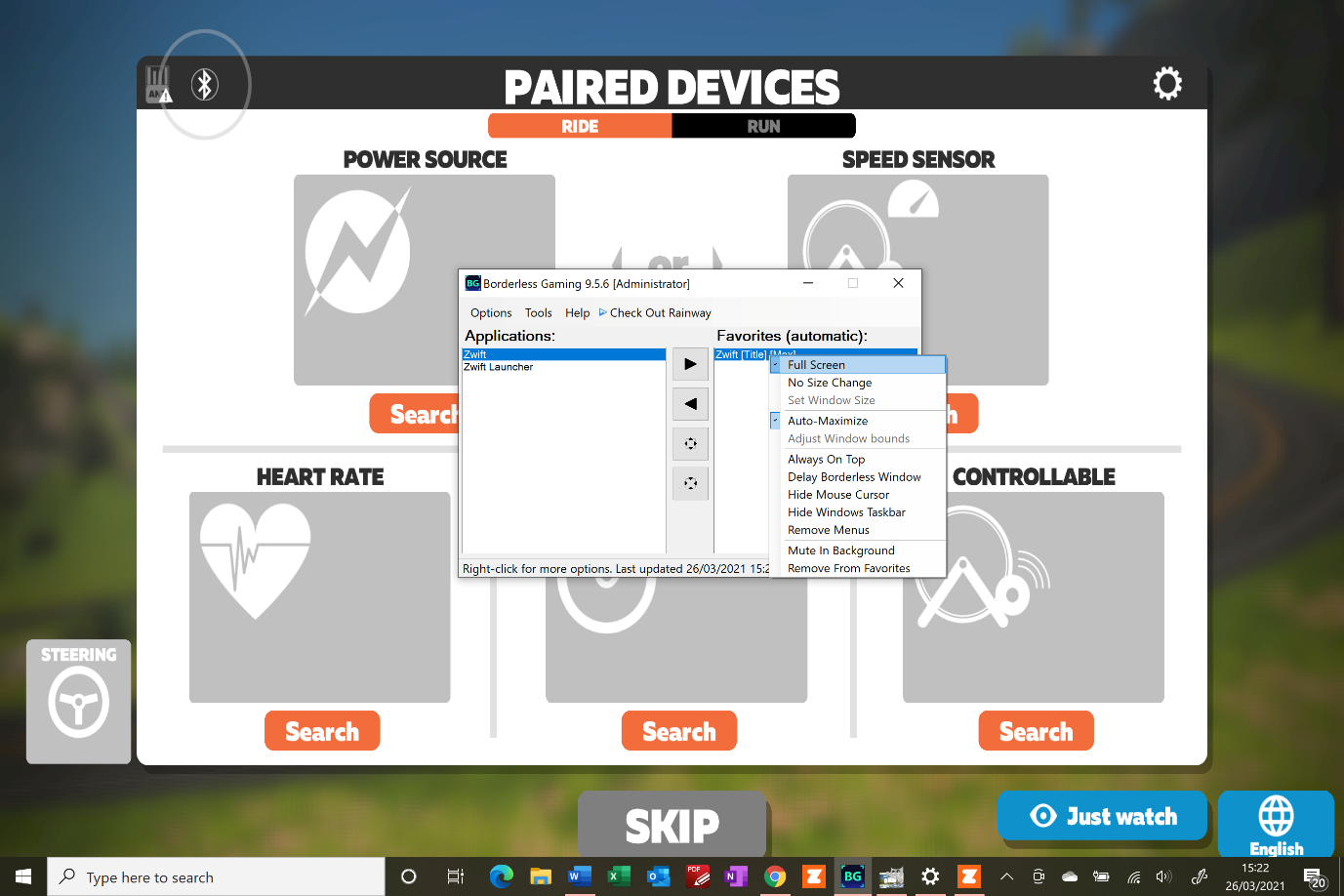
Right-click on ‘Zwift’ in the favorites window and uncheck ‘Full Screen’ then right-click on ‘Zwift’ again and select ‘Set Window Size’. Drag out a box where you want your Zwift window to go and then double-click to confirm your selection. Finally, press the ‘restore window’ button again. (I have no idea why this is the button that works, but it does!) After a second or so, your full-screen window should size down to your selected size. Do the same for [#] Zwift [#] and you are all set.
Select each application and press the ‘Restore Window’ button.De-select ‘Full Screen’ and then select ‘Set Window Size’
If you want to be precise, work out how large you want each window to be and then select ‘Set Window Size’, but this time press ‘no’ when it asks you if you want to select area. This will allow you to enter an exact size and location for the two windows. For a 1080p screen and Goldeneye split screen, set your first window to x=0, y=0, width=1920 and height=540. The other window should then be x-0, y-540, with the same width and height. For side by side use [0,0,960,1080], [960,0,960,1080].
[BG] will keep these settings saved for ‘Zwift’ and ‘[#] Zwift [#]’, so the next time you want to zwift together just open up your two instances and start [BG]. (If it doesn’t work straight away, select the applications in [BG] and press the ‘restore window’ button.) When you go back to zwifting zolo (TM, again), simply open up Zwift as normal and set it to full screen mode (requires a restart). Alternatively, you can keep Zwift windowed but set it to full screen mode in [BG] (but make a note of the settings for when you want to split-screen again). Easier still, you could just load Zwift without opening [BG] and maximize the window (but only if you can tolerate that Windows border).
If all goes well, you should now be looking at two borderless windows, each running Zwift.
My partner’s preference is a slightly smaller window so that the text isn’t stretched. Depending on your screen size, you might like to mess around with the exact window sizes. Add in a custom desktop background and, hey presto, things are looking pretty slick! (Be sure to hide desktop icons for a cleaner look.)
Lookin’ sharp!
Caveats and Tech Specs
This does take a bit longer to set up than running Zwift on two separate devices, so make sure you leave enough time before your chosen events to avoid disappointment. I’d also recommend giving things a trial run the night before. It can get pretty tight time-wise if, like us, you get up to ride early in the morning.
Tech-wise, I’m running an old AMD Phenom II I bought back in 2013 and a NVIDIA 1650 Super. That setup handles a single instance of Zwift on ultra and 720p streaming, no problem. Running two instances of Zwift is a bit more of a challenge, and I had to drop the graphics to ‘low’ to get a steady framerate. Once I did that it was all smooth sailing. Streaming was another matter. I found I had to use ‘Desktop Capture’ to get both windows to register in my OBS. (‘Game Capture’ wouldn’t pick up the sandboxed window at all.) That proved too much for my system, though, and completely killed the framerate. Those with a more powerful gaming rig may have more success!
My setup:
Windows 10
CPU: AMD Phenom II Black x4 3.4Ghz
GPU: NVIDIA GTX 1650 Super 4Gb
8 GB RAM
I’ve tried to get split-screen running on my Surface Pro 7 (just to see if I could) and the sandboxed Zwift crashes on start-up. I suspect that you’ll want a discrete graphics card to get it working, so bear that in mind. With that said, Zwift is notoriously temperamental and I can’t promise this will work on your machine, whatever the spec!
A further caveat: after installing the latest Windows Feature Update, I encountered a whole host of problems with USB ports not registering properly. This not only stopped the Sandboxed instance of Zwift from connecting via ANT+ USB (causing the app to crash), but also caused various Internet dropouts from my USB Wi-Fi adapter. A quick roll-back to the previous version and everything is hunky-dory. Moral of that story: if it ain’t broke, don’t Windows Update it.
Wrap it up, Chris
We’ve run this setup on group rides, the Thursday TTT, and for a few hours of general riding around Watopia. So far everything seems very stable. We have a large TV linked to the PC and this is a much better option than having one of us on a huge screen and the other on a phone or tablet. It’s also great to ride side by side on the same screen (it certainly makes it easier to cheer each other on, mid-ride!).
So for those who ride with their partner (or children, siblings, friends etc.) but don’t have two large screens, this is a really attractive option. I have a more powerful PC on the way and I am definitely considering this for when we are racing at the same time (hopefully with the option to stream both races from the same machine).
Questions or Comments?
So that’s the long and short of split-screening with Zwift! Drop a comment below to say how you get on or let us know your solutions to zwifting together.
One of the things characterizing most of the intensive Zwifters I know is that we can have endless heated debates about the most nonsensical and useless topics as if they were a matter of life and death.
Forget politics, religion, who is the NBA, NHL, or NFL GOAT. For a Zwifter there is nothing more important and controversial in the world than:
What is the best bike for a specific circuit or race: Tron absolutists (Tron for all races) vs Cherry Pickers (each race deserves its specific bike choice). Each participant goes with his own analysis, projection of weight and aerodynamics of the bike combined with his own weight and height, Zwift Insider analysis and consolidated frames and wheels performance Excel file showing you are one second faster with this setup vs this other setup. Then the acid remarks “All this time wasted for just one second in a race? I told you Tron is always the best choice” and the other one going “What do you mean by ‘just one second’??!!! One second means the world to any respectable Zwifter, it is the difference between winners and losers.”
How close the experience on Zwift is compared to IRL road cycling: goes from 0 to 100% and everybody refers to his own superior racing experience or alleged biomechanical expertise.
W/kg vs absolute watts: to what extent one performance indicator is prevailing over the other on the flats, the climbs, and the course of an entire race.
Wahoo, Tacx, or Elite? The bell rings, beginning of round 1. FIGHT!!! The only way to win is by exhaustion as literally nobody will ever disavow their own smart trainer. Mine is more accurate in power measurement vs mine is more realistic, electromagnetic vs kinetic flywheel, connection stability, gradient simulation, is road feel a gimmick or a must… you name it. Endless “mine is bigger than yours” debates.
How to solve the flawed ZP categorization? I think this one is the one we’ve spent the most time on within the team. How the current system incentivizes or not people to cheat on their weight and/or sandbag, and what would be a better one. Between those rooting for a ranking by points, the ones praising a ponderated average on P5 – P20 – P60 (not only P20), and those advocating for a wild jungle with no categories at all, we never reach a conclusion. We all are perfect devil’s advocates, destroying the idea of the colleague without offering a better alternative ourselves.
There are as many useless and nonsensical topics to debate as there are Zwifters in this world.
One of the most memorable debates I had with my ZRL team was when I dared to say that my preferred circuit, by far, was Bologna, especially when it is an individual time trial (the “Zwift Fast Fridays: Bologna Time Trial” event is the best).
Think about it. You have everything Zwift can offer in 8km:
From a circuit profile perspective: an almost perfect balance between the flats and this incredibly beautiful and steep climb.
A tactical choice to make on the distribution and management of your effort: do I start at 100% or do I negative split it (on this precise topic I highly recommend reading this article by Eric).
An almost perfect circuit to benchmark a 20-minute FTP test until you reach CAT B (then the circuit becomes a little short).
The scenery: diverse, changing, and most important very realistic. For those who fell in love when visiting Bologna IRL, it brings back the nostalgia, flavors, and sounds of the city.
Enough was enough for Andoni. He would not stand one more word of praise for the Bologna circuit:
“I HATE IT!!!! I HATE IT, HATE IT, HATE IT!!!! This is the worst circuit ever!! A pain. There is no way to find your rhythm in there, and just when you start finding your pace BAM!!! It’s already finished!!! RI-DI-CU-LOUS!!”
Each of those words felt like a bullet slowly breaking through my body and leaving me bleeding to death. As my jaw clinched over such an absurd and ungrounded statement I prepared to shout, “Blasphemy!!!! Let’s solve it with a trial by combat!!!”
But before I could even react, Oskr bounced on Andoni’s initial statement: “Oh yes!!! Bologna is horrible. Whoever likes Bologna has for sure childhood issues to resolve. Liking Bologna is almost as worrying as liking fresh beetroot juice!!”
I felt all by myself, misunderstood by the entire world and ready to retreat forever in silence and isolation to one of the Pyramids of Watopia’s Mayan Jungle.
However, as always when you are drowning in deep waters, a friend catches your hand to get you out. This time my savior was Albert:
“Bologna is the Holy Grail!!! A monthly pilgrimage to Bologna should be mandatory for each Zwifter to keep his Zwift membership! We should have Scotty the Squirrel reminding you that you are not in compliance with your Bologna monthly pilgrimage and at risk to lose a category, or even better, your Tron bike!!!”
Beyond the fact that the mere possibility of losing my Tron bike left me quietly weeping for several minutes, knives started flying around, each camp getting growingly dismissive and inconsiderate towards the other one, and eventually questioning the respectability and honorability of our corresponding mothers (like in most of languages, the basic list of insults in Spanish involves mothers).
So Albert and I were Bologna fans. Andoni and Oskr were Bologna haters. What about the other members of the team?
In each debate you need a Switzerland. A permanently neutral camp which will use fake empathy to try to find a meeting point between fans and haters, almost denying the unsolvable differences between the parties. And it works. The best possible outcome was to agree to disagree, and in the end this is the status we attained. We also agreed to never mention the topic again. Never. It would revive wounds which will never heal. What happens in Watopia stays in Watopia.
Now, jokes aside, hopefully by now you understand that my recollection of events is highly exaggerated and any resemblance with what actually happened is mere coincidence. But I do love passionate debates. For me, those can only happen with the people you feel close enough to expose yourself without feeling judged, because they are as crazy and involved in the game as you are. My ZESP Jerbos team is definitely a safe space for that.
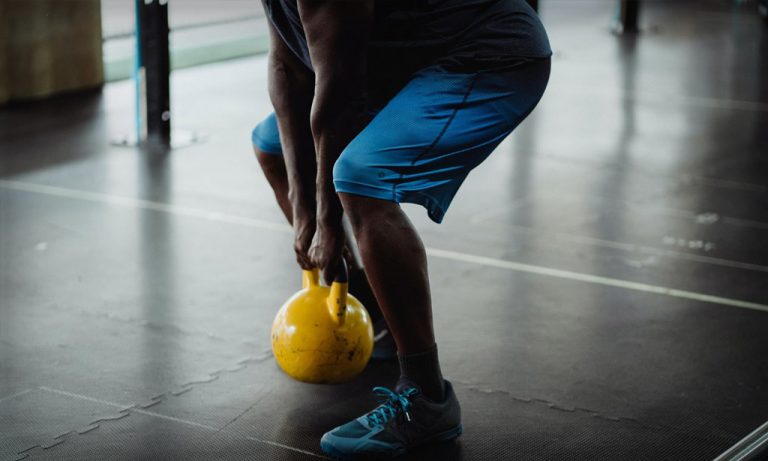
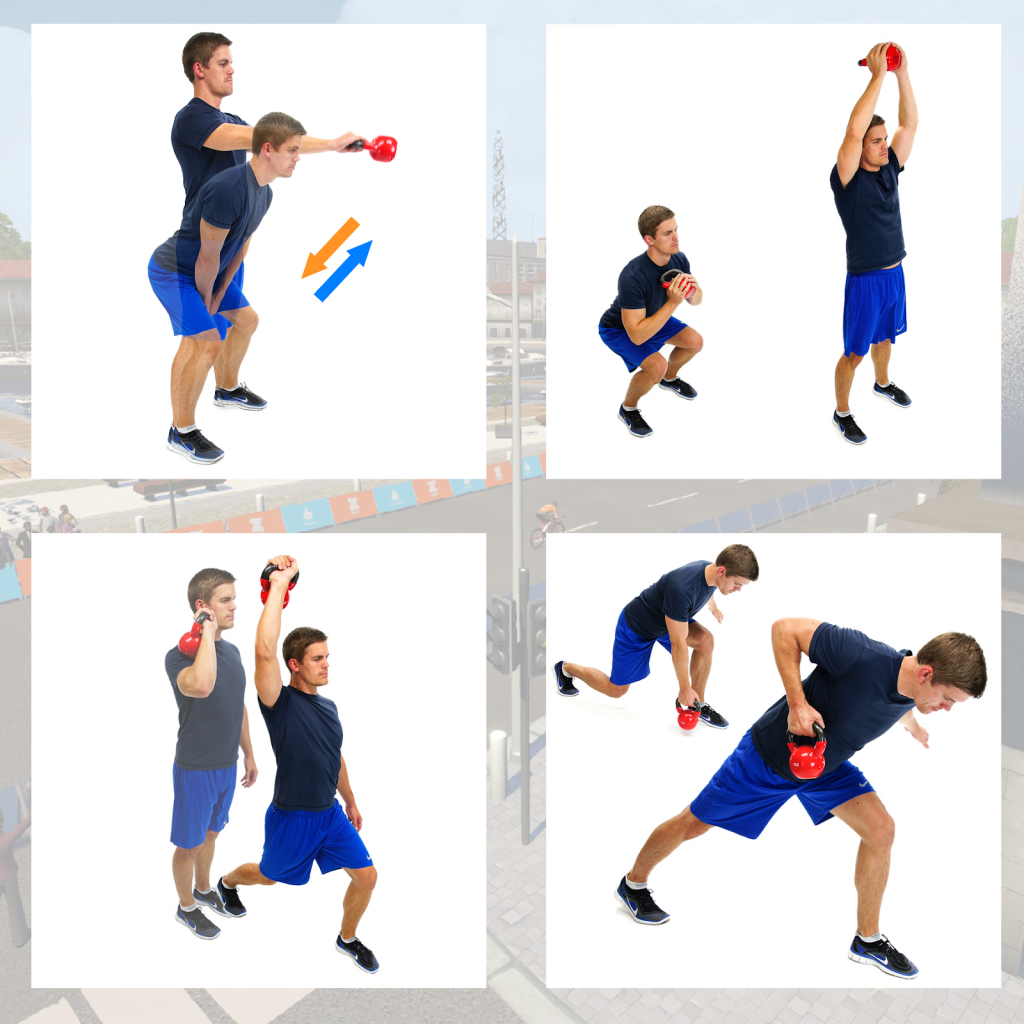
Using the kettlebell in your cycling strength training program provides several unique benefits, making it an appealing choice for off-the-bike training.
The Benefits of Strength Training with Kettlebells
Efficient use of training time: The ability to flow from one exercise to the next without the need to adjust or change your equipment results in shorter, more intense workouts.
Total body training: Most kettlebell workout plans employ a vast range of muscle groups, allowing you to stimulate a greater number of muscle fibers in a shorter period of time.
Cardio aspect: The dynamic nature of the exercises and greater muscle recruitment cause an increase in heart rate while developing muscle strength and endurance.
Less equipment required: Due to the flexibility and adaptability of the exercises, with the utilization of only one piece of equipment you are able to perform a challenging and progressive workout.
Little space needed: Most exercises can be performed in a compact space and in the safety of your own pain cave.
Functional for daily life: The exercises are based upon normal everyday movement patterns which translate as improvement in the performance of daily living activities as well as cycling.
Counteracts the negative effect of prolonged sitting: By dynamically engaging core and postural muscles, the exercises negate the deleterious effects of prolonged sitting in the saddle and out.
When I started Zwifting in 2019, I wasn’t sure what was all the hype. I was happy to sit on a turbo with some music or watching a TV show and follow my workout on my watch. To me, indoor training was just the less-than-enjoyable thing you have to get through midweek before the real and enjoyable outdoor cycle day arrived, which I would do on the weekends with my teammates at Giant Camden Team Liv.
Seeing all the Zwift maps on my Strava gave me some “FOMO” though and I opened an account. Four weeks later my coach had to have a sit down with me as a form of intervention; my Zwift addiction was in full swing: I was doing all my workouts from my coach, and on top of them, joining everything from the Zwift Academy tri, races and group rides and don’t even get me started with leveling up to get new kit and bikes. I was Zwift addicted and I LOVED it.
How Team GC Zwift was born
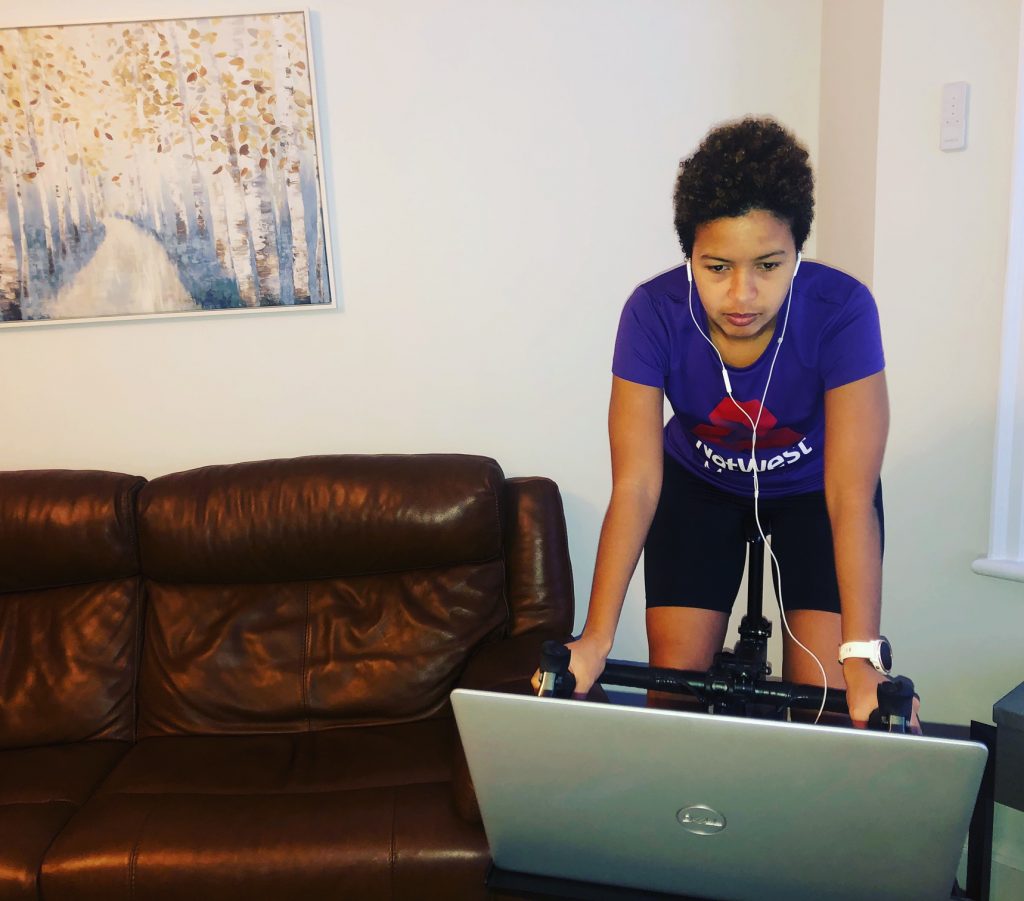
This is me Zwifting whilst on a Town Hall – nothing gets in the way of my workouts!
I will never forget the first day of lockdown date as it was my birthday. I had planned a big ride with my club teammates (Giant Camden Team Liv was the first exclusive female club in London); all that was canceled and I spent my birthday on Zwift instead. I had a chat with Nick (Giant Camden store owner) on what we could do to keep our clubs and communities together during what looked like pretty tough months to come. We started with “let’s just put a few Meetups in place for our trainings”, and from that conversation, team GC Zwift was born!
None of us could have predicted what our club was going to become. We had just a few riders from our affiliated clubs and amazing ride leaders and coaches who were giving out time to lead Meetups and group workouts. We also had just 1 team in the weekly WTRL TTT (now 10+!). As I look back to 2020, I see how we were all adjusting to life in lockdown and all its challenges, but getting together on Zwift, keeping that sense of community, is one of the things that kept us sane and helped us get through the year.
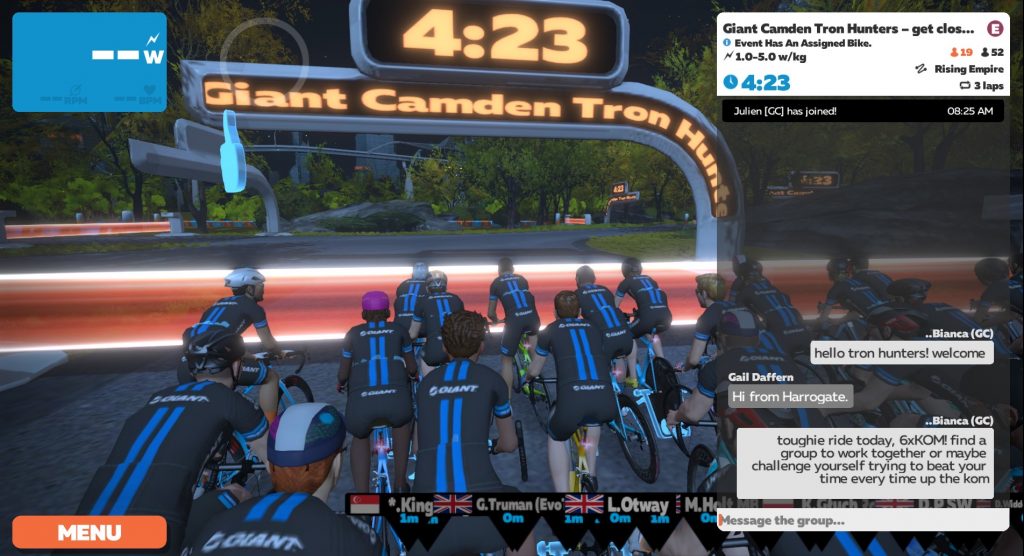
Tron Hunters Rides – getting you closer to the Tron!
As we became pure Zwifters (no more “indoor is the gateway to outdoor”, Zwift won us over), the question became “how do you get the Tron”. We had a lot of new zwifters, plus more experienced clueless zwifters like me who did not know you had to have the Everest challenge selected (I could have 3 Trons by now!). All I know is that we wanted that sweet, fast, and neon-looking bike!
We started scheduling our Meetups and personal workouts exclusively on hilly routes, grinding the Alpe and subsequently Ven-Top – I have climbed Alpe du Zwift so many times I never want to do the route again!
During our pitch to Zwift we sent the proposal of a “Tron Hunters” ride to be added to the official events for all the Zwift community. We are sure lots of Zwifters can’t wait to get their hands on the Tron, but it’s so hard!
Here’s how we view these rides: there are a lot of hilly routes on Zwift that aren’t a grind, and you can rack up elevation quickly with multiple laps (we did the math). Also, everything is more fun in a group, so that 2% more progress towards the Tron you’ll get at the end of the ride will be an enjoyable 2%! And even if you have the Tron, these are excellent endurance sessions with a first-ride bonus of getting to keep the Giant jersey:
Event Schedule
Our Tron Hunters rides are every Sunday at 8:30 AM GMT. In the future, we may add additional slots for our Zwifters across the globe. Find our rides at https://www.zwift.com/events/tag/giantcamden
Our last ride we climbed NYC KOM 6 times!
What’s next?
We have a few ideas of more rides for the community and one topic we are passionate about is encouraging more females into cycling – every day is Women’s day! We have a strong female base and are lucky to have Amy Pritchard, a team GB AG World Champion, in our ranks. With her deep knowledge of cycling skills and how she manages training and coaching being a full-time NHS worker and mother of 2, we believe this will be an amazing opportunity for women (and men!) to learn from her on future weekly ride-outs.
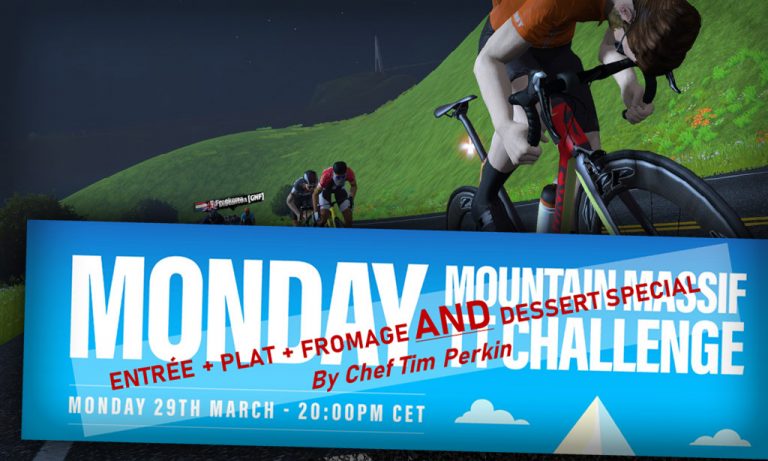
In France, many degustation menus include a Fromage (Cheese) or Dessert (Dessert) option. Meaning the price of the menu includes cheese OR dessert, and you have to choose between one or the other. You can also, for an additional fee, go for the Fromage AND Dessert. Your choice mainly depends on your appetite for the day. Freedom of choice.
And then you have the “Chef Tim Perkin Special Monday’s Massif Mountain TT Degustation Menu”. The particularity of Chef Tim Perkin is that he makes Fromage AND Dessert mandatory. You get Time Trial AND Mountain by default. No way out. Want it or not. If you are toast, done, full, you can’t take it anymore, too late… you get both and that’s it.
The invite was everything but attractive. It seemed like Tim wanted to have dinner by himself, positioning the event as close as possible to what the definition of a torture session is:
“What do you get if you cross a mountain race and a time trial? An absolutely intense, but highly unique event that will test the ability of any rider.
This is the chance to push yourself beyond your perceived limits and do something that you haven’t done before.”
Who would be lunatic enough to go for this? Well, close to 500 Zwifters enrolled, including some legends like Jonathan Edwards (Triple Jump World Record Holder), all proudly and publicly acknowledging their insanity by RSVPing.
Chef Tim prepared a shortened version of the Mountain 8 route for our consumption: close to 6km flat portion Fromage, followed by a 6km Epic KOM Reverse Dessert, with an Antenna hot fudge topping.
Dinner was due at exactly 8PM Central European Time.
The original intention was, through the event, to create an allegory to the 2020 Tour de France 20th stage, where Tadej Pogačar (without a power meter by the way) destroyed the Climbing TT one day before the end of the race. He distanced Primož Roglič by 1 minute and 56 seconds and won the Tour de France against all odds in one of the most outstanding overturns in cycling history. A typical David against Goliath story.
In line in the pen, galvanized by this incredibly inspirational story, we were all Rocky Balboa underdogs ready to ignite the world with our wattage output. In reality my main concern was to check the bike choice of my enemies beloved fellow Zwifter colleagues. With such an eclectic route profile, the bike choice was not that obvious, and I eventually opted to go as light as possible: Tarmac Pro and Meilenstein Lightweight.
Music choice is utterly important for me in these circumstances. The last minutes of the wait were accompanied today by the classic but never aging “Final Countdown” by Europe. IT’S THE FINAL COUNTDOOOOOOWN!!!! NA-NA-NA-NA-NAAAAAAAAAAAA, NA-NA-NA-NA-NAAAA!! For sure I was singing way too loud and out of tune because a shoe hit my back in objection (or maybe it was only a survival reflex from my wife).
3…..2……1….. GO!!!! I unleash close to 700w for 15 seconds, then sit and maintain 450w for another 30 seconds to finally stabilize around 320w, which is 4.11 w/kg for me, my cruise pace. (Yes, point eleven. Not the same as point ten or point twelve. If you believe it is the same you should return your Zwifter diploma to ZADA and sell your smart trainer to someone who actually cares. You don’t deserve to be part of our community. 😁)
Remember that Rocky Balboa spirit I referred to earlier? It lasted exactly 7 kilometers. Three km into the Epic KOM reverse I started my mutation. I downgraded from the Hulk to James Bond in the third km of the ascent, from James Bond to Gru the Villain in the fourth, and finished somewhere in between an anemic version of SpongeBob and an undertrained variant of Steve Urkel by the time we were finishing the KOM.
As many riders were overtaking me, not even noticing me, I turned on the first gear of my excuse-maker machine. Since I knew I would need to stick to one of those self-made excuses until late in the night, and that I was certainly going to be writing about the event, it needed to be rock solid. I was tempted by two equally laughable alternatives. I let you choose for me the one you prefer:
I enrolled very late to the race so I could not prepare for it as I normally do.
As Zwift was displaying crazy numbers, the only reasonable explanation is that I have not calibrated my smart trainer in three weeks, it is certainly not working properly and misrepresenting my wattage output.
If anyone is interested, just send me a private message. I can generate tons of them spontaneously, customizing the excuses to your individual skills, physical attributes, local climate, gear, apparel, isotonic drink of choice, astrological sign, and past traumatic events. I am still in Beta mode, but in a month or two I will ask for royalties if you use them.
By the time we turned right to the antenna, the crowd looked like a long procession of Spongebobs. Even the ones pretending to still be Hulks were debunked by their avatar’s cadence in the low 60s.
A quick look at the top of the climb and now it’s my complaining and swearing machine turning on. We, French, are all provided with a very powerful one within our DNA:
“I can’t believe I have put myself in this situation again. How can I be so stupid, what’s the point, who even cares? Plus this thing is not even real… I am by myself in my pain cave like an idiot, all this because I could not resist Tim calling on me… freaking testosterone. I took it as a “I bet you don’t have the guts to enroll in the climbing TT” and like a jerk I fell into it. And now my legs burn and I am sweating like a steam-cooked Chinese dumpling for what? Nothing!! Literally nothing!!”
I bet it sounds familiar and resonates with most of the people experiencing the 17% gradient on the last segment of the race.
Once at the top of the mountain, I would be lying if I said that the verb “enjoying” was the first coming to my mind to describe how I felt about the Fromage AND Dessert meal.
I felt I needed two or three antacid tablets to digest it all.
Now, seriously, the service was excellent and deserved a 35% tip for sure. We had tons of fun before and after the event through the Discord channel.
In any case the event was a great great idea. It felt like an immense meet-up combined with a huge challenge and at the same time the celebration of being together.
Cherry on the cake from a personal perspective: today I improved my FTP 11 watts and was upgraded to Category A by ZP.
@Chef Tim. This was presented as a “unique” one, but I can’t wait to receive an invite for the next “unique” Fromage AND Dessert event.
Editor’s note: thanks to the success of the first Monday’s Mountain Massif TT event, it is now a weekly event on the Zwift calendar, held at 19:00 CET.