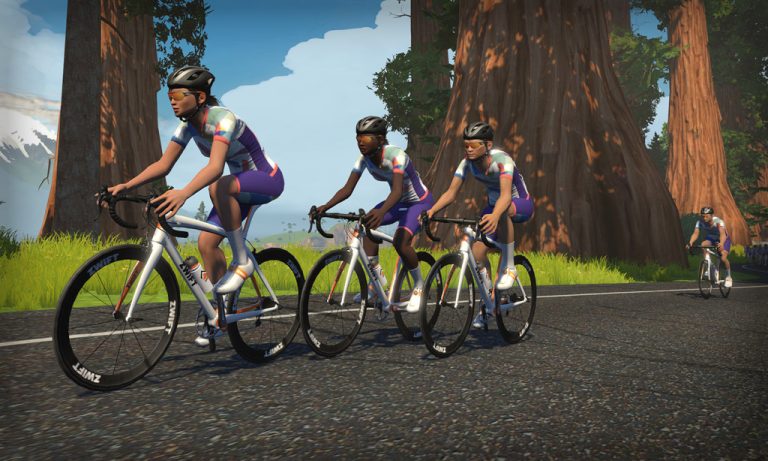
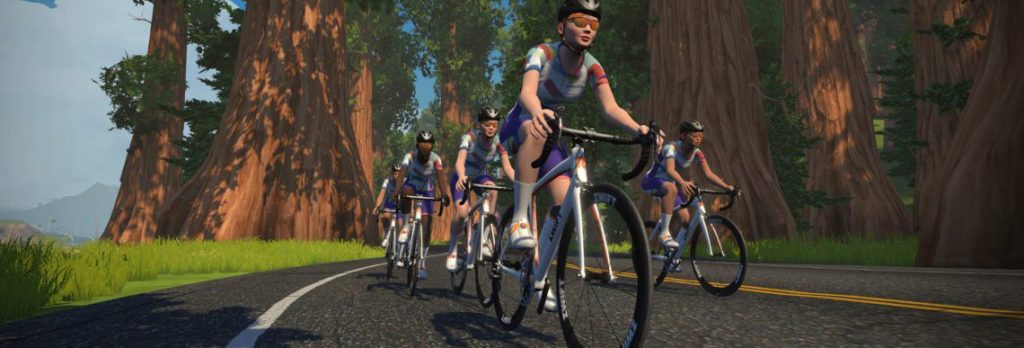
In September 2020, Giant launched the Crit Crushers Series on Zwift. The series was scheduled for Asia-Pacific riders and proved such a hit that the newly-announced 2021 Giant Crit Crushers Series has expanded to cater to North America and Europe time zones and offer categories to suit all rider levels.
Event Format
This series lasts 4 weeks and totals 8 races, with short back-to-back events each week lasting between 10 and 15 minutes. But due to fact that events are back-to-back, you need to pace it accordingly.
The top 20 riders for each event earn points, but you need to have a ZwiftPower account. Series winners will be the riders with the most points. There are separate race events for men/mixed and women.
For those not familiar with Giant, they are a Taiwanese bicycle brand recognized as the world’s largest bicycle manufacturer.
I caught up with Giant Ambassador, Lee “Hollywood” Turner to get more details about the event. But before that, I want to tell you about Lee. Lee has been a Giant Ambassador for the last 10 years and is a huge cyclist. He rides for fun, fitness and for the social interaction that it brings. He was the President of the largest cycling club in Melbourne called the St Kilda Cycling Club. What is interesting is that Lee has approximately 250 different cycling kits, with his favourites being the Aqua Sapone, Saunier Duval, and Mapai. Check out last year’s promotional video to see his extensive cycling kit collection:
After discussing his extensive wardrobe, Lee went on to explain that the first series of the Crit Crusher was excellent fun, with the beauty being that the events were not too long, around 10-15 minutes, so that if you are unable to hold the frantic pace of the front group, you could still cycle at your own pace and finish the event. As Lee described the event to me “It’s short, sharp and if you get dropped you can roll to the finish.”
Lee noted that the event was well-received, so Giant and Zwift were keen to offer it in multiple different timeslots catering to riders around the world. I recommend watching Lee’s promotion video for the event – see if you can spot fellow Australian Zwift Legend, Tim Searle!
Categories
Standard race categories apply based your watts/kilogram. New riders are recommended to start out in group D (1-2.4 w/kg). The fastest riders should register for group A (4+ w/kg). More information on choosing your race category can be found here.
When Watopia’s “Mega Pretzel” was released in February 2018 it was the longest Watopia route in game, covering every segment of the course except (strangely) the radio tower climb. In fact, it covered nearly all segments in both directions!
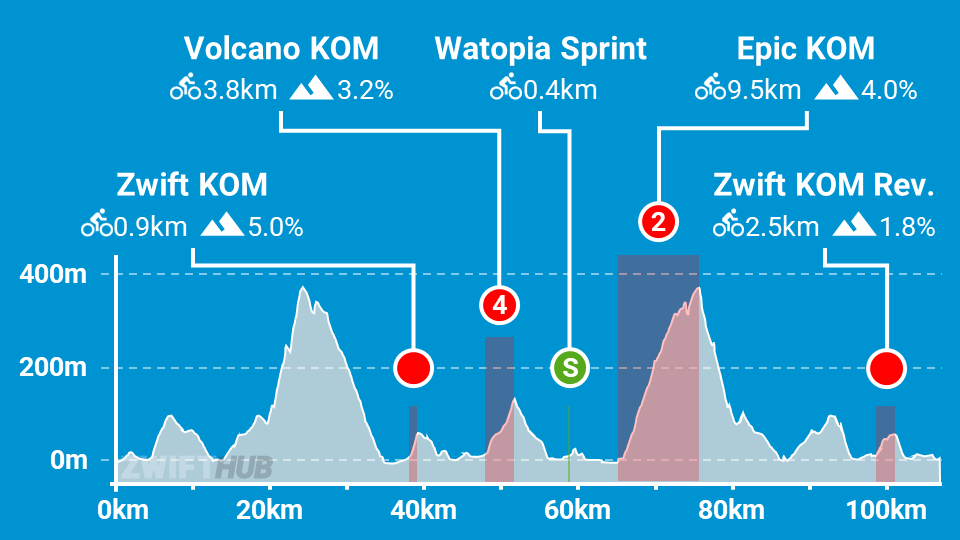
More than three years later the Mega Pretzel is no longer the longest Watopian route, and of course it misses new roads that have been added since its release (namely Fuego Flats, Titans Grove, and Alpe du Zwift). Still, this route packs a punch with 1,642 m (5,387‘) of elevation gain over a length of 107 km (66.5 miles).
And that’s why we’ve selected this route for our next Badge Hunters event. We consider this to be the 4th-toughest route in game after The Über Pretzel, PRL Full, and Four Horsemen. So why not do it in good company, with thousands of other Zwifters?
The event takes place on Saturday, May 15th, at 6am Pacific/9am Eastern/2pm GMT.
The Mega Pretzel begins with a trip out to the Jungle Circuit (CW), then we head up the Epic KOM Reverse. Because of the stop off at the Jungle we don’t ride the timed Epic KOM Reverse segment, but we are covering all the same ground!
Descend from atop the Epic KOM and have a go at the shortest timed climb on the route – where it all began – Watopia’s Hilly KOM Forward. Then ride the corkscrew road up the Volcano, descend and have a go at the forward sprint if you’ve got the legs. But you may want to save them for what’s coming up next…
The longest single climb of the route is the Epic KOM forward. But take comfort – you don’t have to climb to the Radio Tower! Then descend the other side, hit the Jungle in the CCW direction, and head home by way of the Hilly KOM Reverse.
This route has the distinction of ending in a really weird place. Instead of the standard downtown start/finish banner you’ll continue out to the Volcano and wrap up the route as you pass under one of the crumbling stone arches.
In an effort to reduce system problems, we’ve broken this ride into two categories: A and B. These are not pace categories. They only exist to spread out the riders a bit at the start.
B riders will start 2 minutes after A so your Zwift device only has to deal with hundreds of riders at the beginning, and not thousands. Once riders get moving and spaced out, everyone’s systems should perform nicely.
If you’re concerned with your device’s ability to handle heavy traffic, join the B category which will have fewer riders.
ALL categories will be visible throughout the ride.
This event is actually part of a pile of events Zwift has scheduled in May to highlight community teams and support riders who are chasing badges. Check out the full list of Badge Hunt rides >
More Ride Specifics
Show up on time, because there is no late join for this ride. Why? Because if you late joined more than a minute or so into the event, you wouldn’t unlock the route badge! And we don’t want that on our conscience.
This will be a double draft ride, so sit in with others on the flats in order to conserve your energy.
Steering is enabled, to make it more engaging and fun!
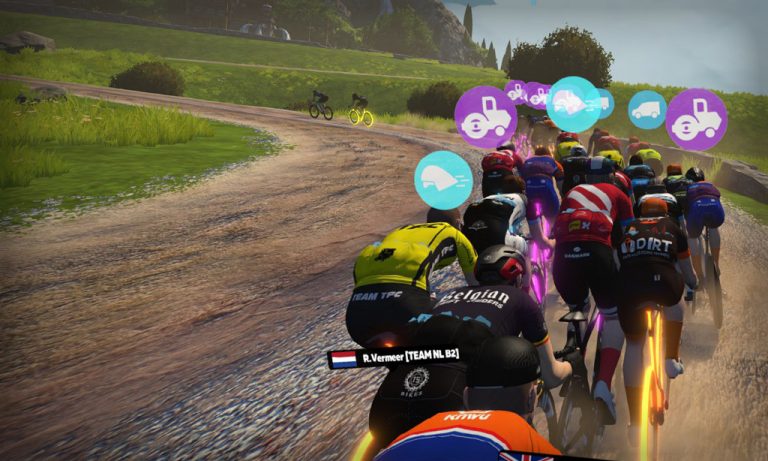
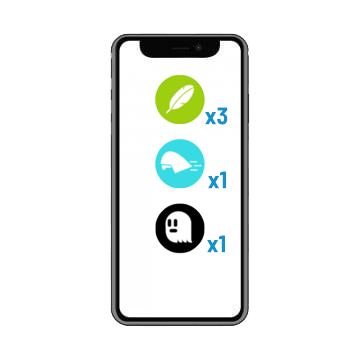
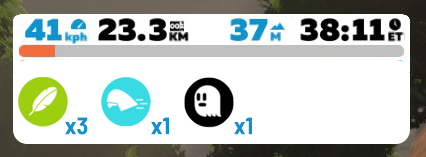
We’re serving up a custom mix of only useful powerups, evenly split between the Feather, Van, and Helmet. Use them for a bit of relief.
This is not a race – it’s a group ride. You can treat it as a race if you’d like, of course, but the ride will break up naturally into pace groups. Find riders working at your target pace and work together.
Based on the VeloViewer Leaderboard we can see that top riders crush the Mega Pretzel in around 2:45. But most mortals finish in around 3:15-4 hours, with plenty taking even longer. You do you. Be sure to plan accordingly.
Discord
Zwift Insider’s Discord server will be used for voice chat during the ride. This really helps pass the time, so we highly encourage it!
Hey Zwifters! In a recent Outside the Draft episode, Anna Russell suggested changing the steamroller after witnessing how this PowerUp completely changed the nature/outcome of the Beach Island Loop ZRL race.
Thinking about this idea grew into what I believe is one of the easiest (and most interesting) enhancements Zwift can do right now. Because I know many of you also spend a lot of time thinking about how we can help make Zwift better, I wanted to outline this idea here to encourage it to continue growing, and to have people like yourself respond back with their thoughts.
The Idea
Imagine a world where Zwift has modified the distribution of, and access to, PowerUps, with the goal of making the game more dynamic.
The Details: 2 Big Changes
First: Allow PowerUps to be selected before the race
The Issue: As we all know, PowerUps are randomly assigned as racers go through a banner. This creates a race dynamic where (sometimes) the winners are the people who get lucky, not necessarily the people working the hardest.
The Change: Before every race, the race organizer determines the number and types(s) of PowerUps available. Racers then select their PowerUps when heading into the pens and start the race with all selected PowerUps available to use when desired. This creates a few dynamics:
Organizers can be more strategic with PowerUps. If a racer has 3 laps of the Innsbruckring and has only 3 PowerUps, it forces competitors to figure out a strategy balancing the climb and the finish.
Teams can deploy new strategic tactics. Imagine all team racers selecting 5 aero helmets and then each racer using them, in a row, to attempt a team breakaway!
Individuals would have a much wider range of tactics in the race. Maybe the racer uses all their PowerUps to fracture the field. Or maybe a racer saves all PowerUps until the end to try a 2k break to the finish (even though those almost never work now.)
Competitors will not know what PowerUps other racers have. Right now, all racers know, when passing through a banner, there is a good chance everyone receives a PowerUp. This change would result in racers not knowing what anyone around them has kept, even when entering the final minutes of a race.
How would selection work? We’re veering into UI and programming details here, and I’m confident Zwift, who has already built a great app, and this audience (who is filled with creative Zwift advocates) have some great ideas on the best way to make these enhancements a reality. In my dream world, the racer experience for selecting these would be any one (or a combination) of the following:
Navigate to a new screen option in the app, where the entire phone screen is PowerUps only and the racer selects the one they want
Move the mouse to the desired PowerUp at the top of the screen
Press spacebar to select the desired PowerUp as each moves from left to right across the screen.
So how would this look in game? I know the Zwift UI people are WAY better at this than me, but I made a mock-up to illustrate what I am thinking:
Second: Make PowerUps roughly equivalent to one another
Credit to Anna, Jordan and YouTube commenter, Dean, for this idea.
The Issue: Powerups have vastly different effects today. For instance, we rarely see people break away with a feather PowerUp, but can see massive differences with the steamroller on the dirt.
The Change: Modify PowerUps so they each offer a different but comparable effect, enabling more strategic uses.
Here is a list of PowerUp tweaks that may allow us to move towards this change:
Aero: Keep as is
Draft Van: Extend to 1 minute to enable better rest
Feather: Last for a whole climb or 2 minutes, whichever is less
Burrito: Increase the radius to 5 (or even 10) meters to create group chaos
Ghost: Make this at least 30 seconds (I would prefer 2 minutes) to allow people to attempt a move. Imagine if an entire team dropped ghosts at once! I think all racers should be visible the last 200 meters of a race.
Steamroller: Make this a little less powerful on dirt – it is too powerful now
Anvil: Remove this
New PowerUp type ideas:
The Fence: No one can pass you for 3-5 seconds (cannot be used within the last 3k of a race)
Crosswind: Everyone 10 meters behind you gets a 20% decrease in their W/kg
Anvil: Everyone within 5 meters of you gains an extra 5% of their weight for 20 seconds
Additionally, it’s interesting to imagine a Zwift world where racers can select if PowerUps affect other racers or not. How awesome would it be if you could drop a Burrito and it wouldn’t affect your teammates? Or if you could drop an anvil on the one person you knew was a big threat in the race?
I know some of this would make things more complicated, and some of what I am proposing would be terrible in practice! But the thing I keep coming back to in Zwift is we can do anything. Try some strange stuff out in different races, iterate through things quickly and dump whatever doesn’t work.
Your Thoughts
Let me know what you think in the comments, and if you have any other cool ideas for making PowerUps an even more fun part of the game, share them as well!
Zwift is popular in Japan. I know so because my friends from Zwift Warrior Cycling (ZWC) told me so! The nation is stacked with good riders as witnessed by the fact that in the Nations Challenge last year, Japan was leading the event after the first day, eventually claiming 3rd position overall.
I have raced Zwift Racing League in the APAC Division 1 and I suffered, usually at the hands of riders from Japanese Team ZWC Blast. Despite my best efforts, I rarely beat any of their riders in my frequent races up the Epic KOM in the excellent ZWC Hill Climb Battle series which takes place every Monday. They are simply excellent riders, especially good at climbing.
So it was no surprise when I heard rumors that Zwift may launch a new map that ties in with the Tokyo Olympics, which would include Mount Fuji – the country’s tallest peak at 3,776 meters and a planned keynote in the Olympic cycling road races.
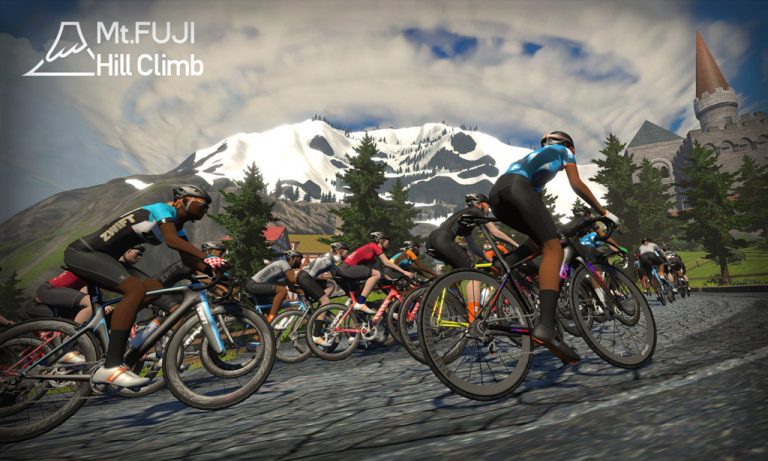
Talking of Mount Fuji, there is an annual race up the mountain called the “Mt.Fuji Hill Climb Race”. This is one of the largest hill climb races in Japan and it takes place on the Fuji Subaru Line, a World Heritage Site in Japan. The event has been held since 2004 as a hill climb race with an average finish rate of more than 98%, even for beginners.
A dojo is a hall or place for immersive learning, the term means “place of the Way” so in this context it is about teaching us to be better climbers – something which many of us aspire to be.
This series of training events has been taking place every Wednesday at 8:00pm JST or 1pm CST since early March. These 1-hour events are designed to help you become a better climber, and there have also been monthly TTs to measure your progress up the Alpe du Zwift.
This is all leading up to the main event: a Zwift race on May 30. And this event is also designed to prepare people for the hill climb up Mount Fuji in real life on June 5.
So join the dojo to master the art of climbing and when you are tired, remember the old Japanese proverb 継続は力なり。 (keizoku wa chikara nari) English Translation: “Continuing on is power.”
Schedule of Events:
5/5 (Wed) 20:00 JST Mt.Fuji Hill Climb Dojo Workout Series #7 Specialty with Special Guest
5/12 (Wed) 20:00 JST Mt.Fuji Hill Climb Dojo Workout Series #8 Specialty
5/19 (Wed) 20:00 JST Mt.Fuji Hill Climb Dojo Workout Series #9 Specialty with Special Guest
5/26 (Wed) 20:00 JST Mt.Fuji Hill Climb Dojo Workout Series #10 Specialty
5/30 (Sun) 10:00 JST Virtual Mt. Fuji Hill Climb Race
The latest version of Zwift’s Companion app (v 3.25) includes modified reporting features designed to foster an “inclusive, respectful, and fair environment in which Zwifters from all over the world can thrive.” Let’s take a look at how Zwift’s reporting tools work…
Existing “Flag User” Feature
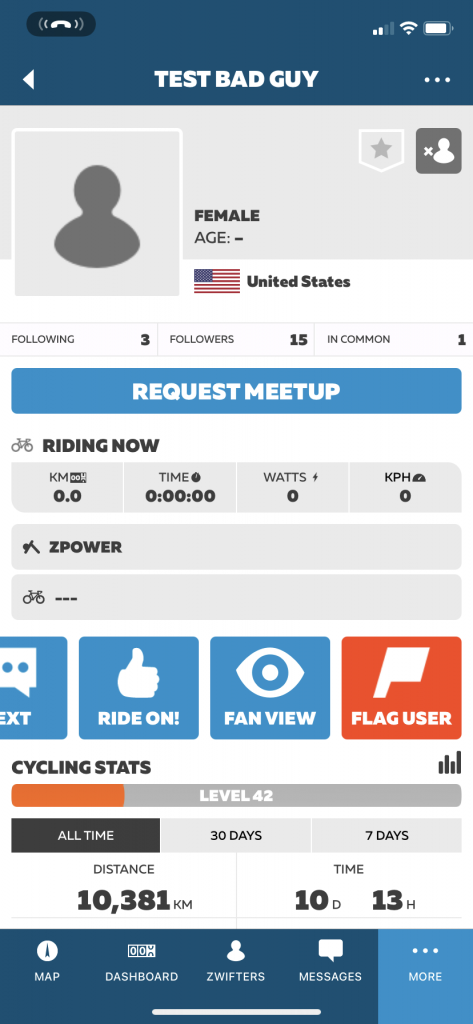
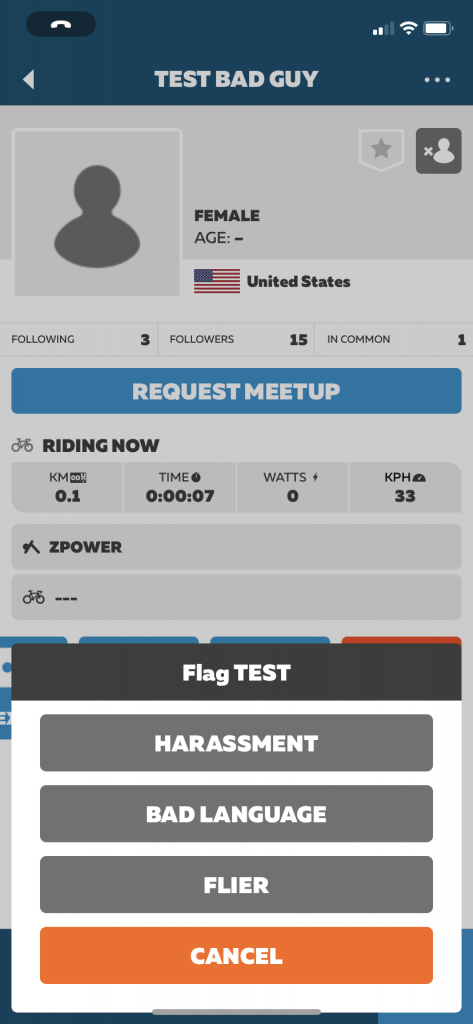
The existing “Flag User” feature has been in place for years, but its functionality is quite limited (and a bit mysterious). More specifically:
The “Flag User” button option only shows up if both you and the Zwifter you want to flag are actively Zwifting
There is no way to enter details explaining why you are reporting the Zwifter. All you can do is click “Harassment”, “Bad Language”, or “Flier”
It isn’t clear what happens after you flag someone – the dialog simply goes away
New “Report Users” Feature in Companion
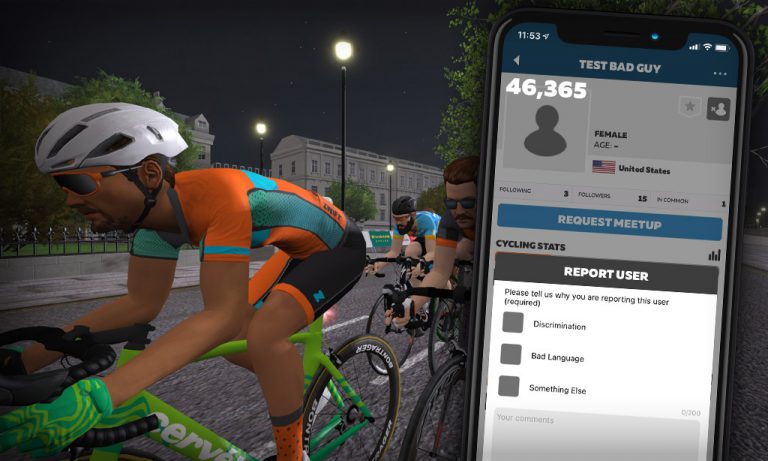
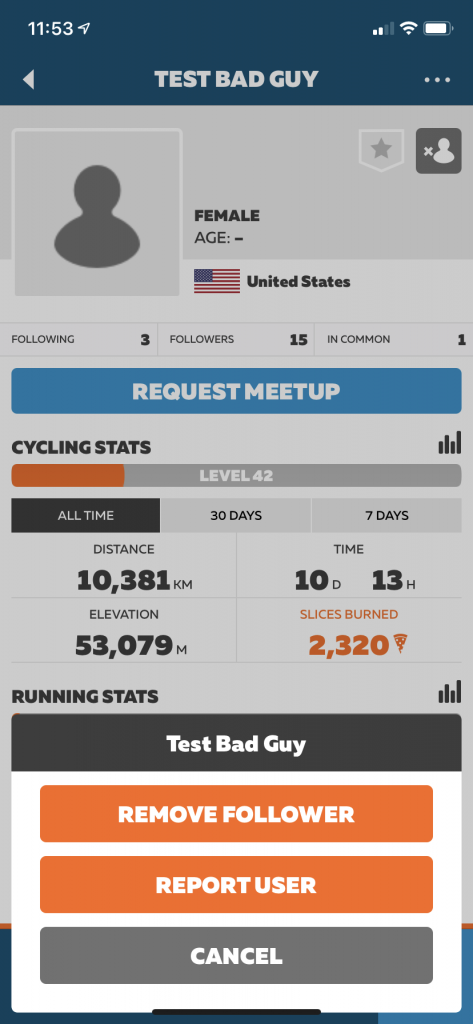
While “Flag User” is still an option in Companion, Zwift’s new “Report User” functionality is much more robust, addressing some of the limitations of old flagging tool:
You may report another user regardless of whether you or they are currently online
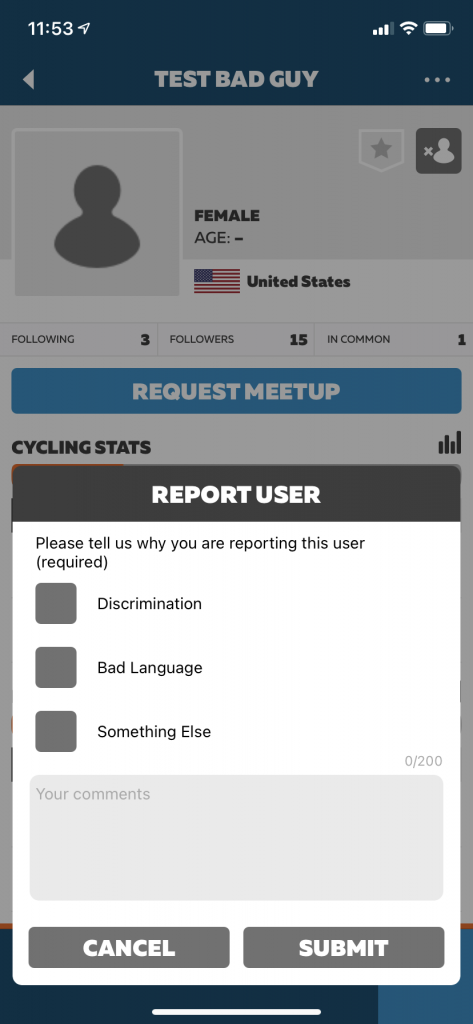
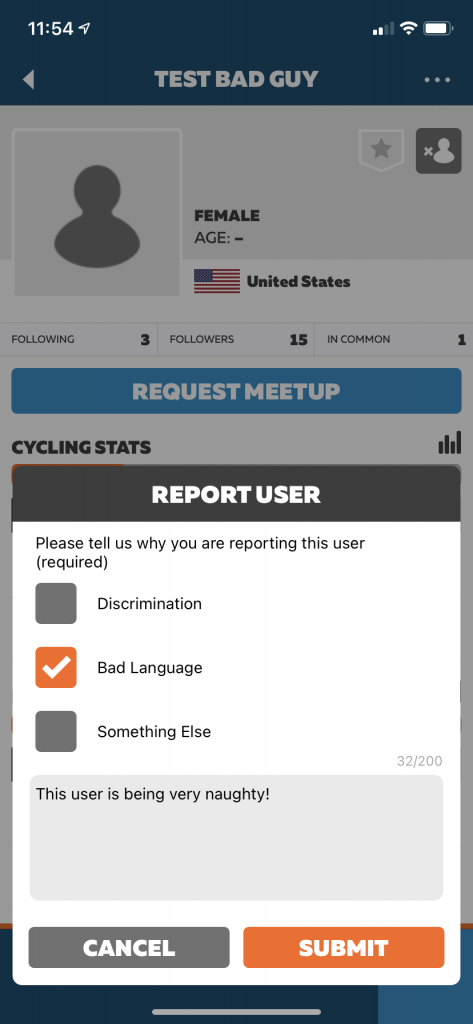
Along with selecting a reason for your report (“Discrimination”, “Bad Language”, or “Something Else”) you may enter a comment to give your report some specific detail.
(Our guess is that “Flag User” will go away soon, or simply link to the “Report User” UI, as two separate reporting mechanisms on the same screen is a bit odd.)
Reporting a user is a simple process in the Companion app:
Find the Zwifter and click the 3 dot menu
Click “Report User”
Fill out the report form and click “Submit”
So what actually happens after you report a user? This isn’t entirely clear, but we can gather some clues based on Zwift’s recent forum posts on this topic. Here’s an excerpt from the original announcement a few weeks back (emphasis added):
An expansion to the existing flagging feature, the reporting feature allows riders and runners to report discrimination, bad language, or other forms of harassment inreal-time by clicking the three dots in the upper right-hand corner of a member’s ZC profile. This feature will allow our team to monitor the situation and enact shadow banning when appropriate.
It sounds like the report user feature is feeding directly to Zwift support personnel who can see the reports as they come in. in real-time, even taking action while the offending rider is still actively Zwifting. It’s possible we’re overstating this, though – Zwift support staff may not be equipped or even expected to respond to situations in real-time.
If you’re curious about the term “shadow banning” – this is a well-known tactic used against trolls and other bad actors in online communities. It has also been used by Zwift as well. Being shadow banned on Zwift means you can still use the product, but nobody else will see you or your messages. Essentially, it’s not obvious to the banned Zwifter that they have been banned – but they can no longer negatively affect others.
More Info
It’s also possible to report users via Zwift’s online support form. More information on reporting riders can be found on Zwift’s support post.
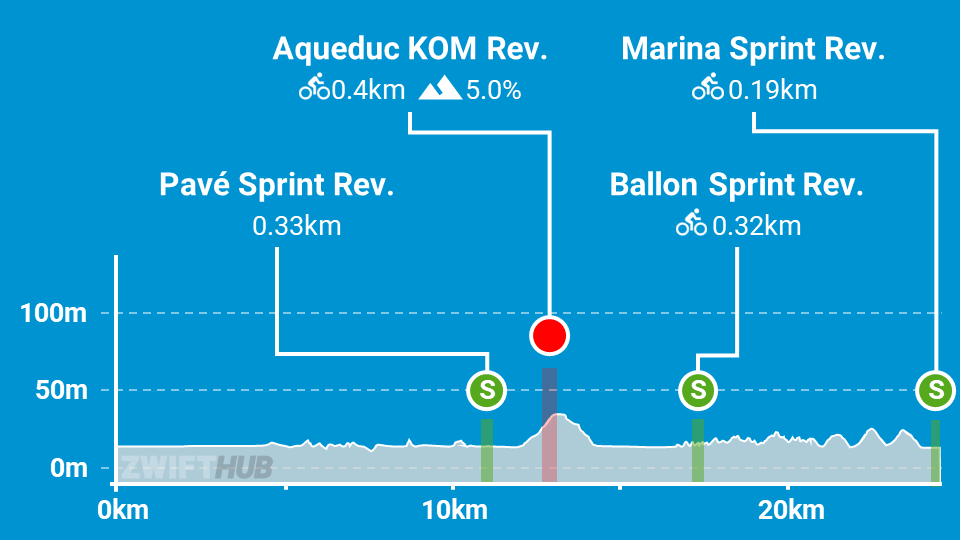
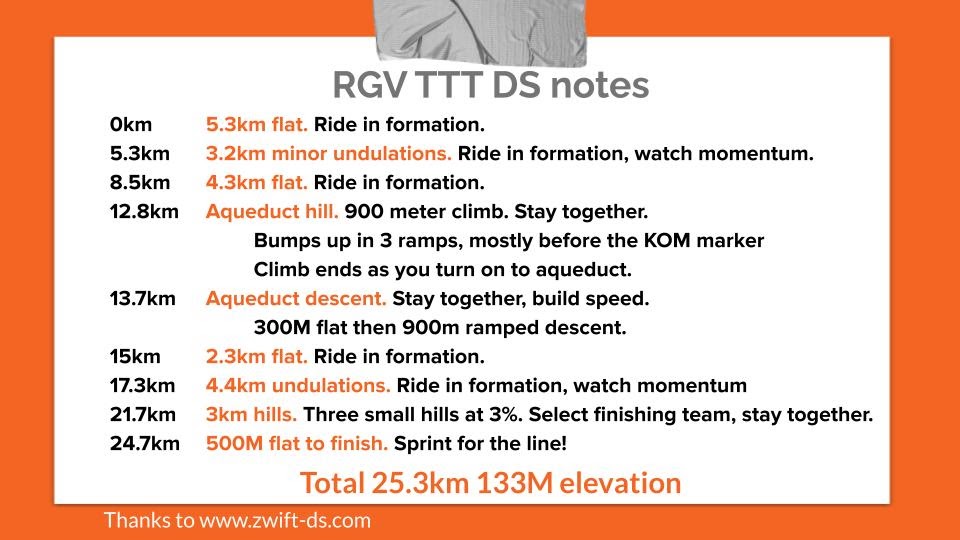
One fast lap… that’s all this is. 24.1km plus a lead in of one click making it 25.1km all the way around. This is one of the shortest and fastest TTT routes. It’s not as flat as it looks, but pretty flat all the same.
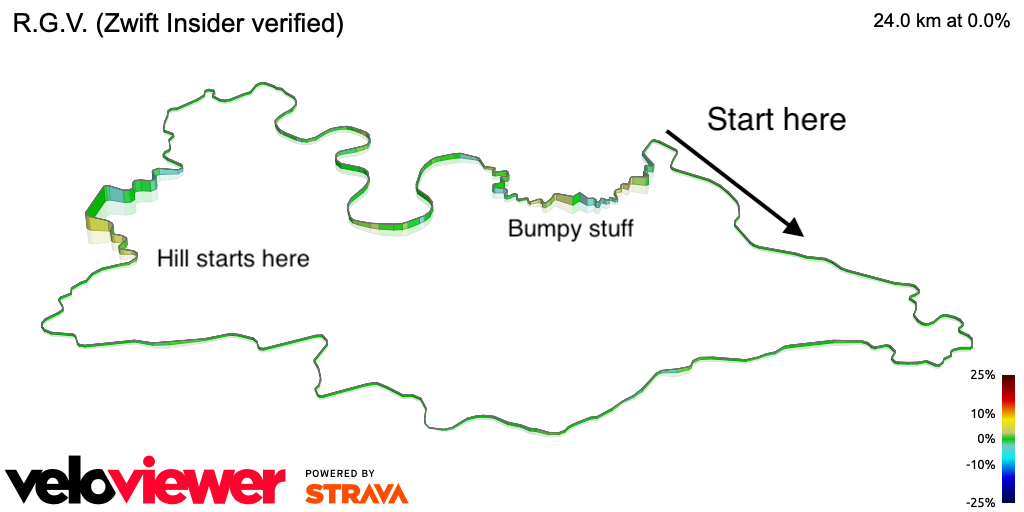
This is basically flat to the aqueduct (about halfway around), a continuing series of rollers that starts around the 17.5km mark and three decent bumps at the end. The trick is to handle the rollers like the Esses – use momentum and communication to carry you through at speed.
What to ride?
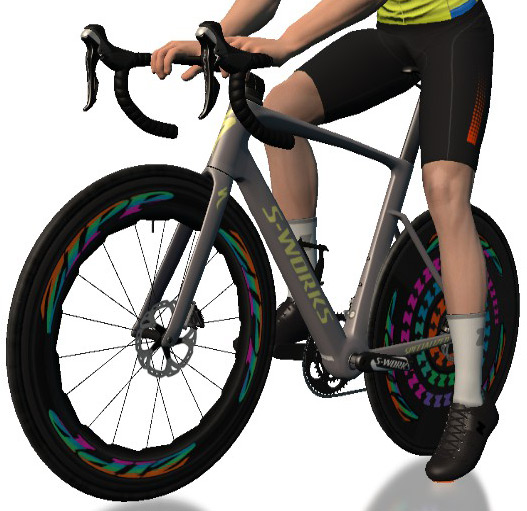
Bike recommendation on this route is pretty straightforward. Aero rules the day. I will be riding my S-Works Venge with the pretty Super9 disc wheels and you should pick your most aero setup.
Here are some choices – but if you want to look at all the options head over to Eric’s main page.
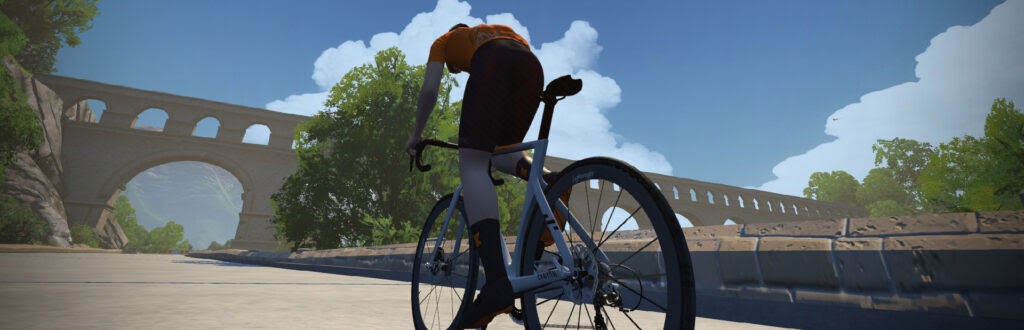
France is a beautifully-rendered world – my favorite of all of them. On Thursday you will be going too fast and hard to notice, so make sure you have a look at my recon ride (with new musical selections this week courtesy of Streambeats!)
It’s a beautiful ride, almost perfect for a Team Time Trial. I break this route into four sections:
Flat for 13.5km
Up the Aqueduct hill and down the other side
A little more flat
Bumpy stuff then a flat sprint to finish
Part 1 – Flat
R.G.V. is the perfect route for a team that is still learning about each other. It starts with a 13km flat to sort yourselves out then gets a bit more technical but never too much.
Use the first flat section to work out your formation (whether you are blobbing, running a paceline, or something else). And get to know each other’s strengths and weaknesses.
Those with more experience will just get in formation and ride!
Part 2 – Aqueduct Hill
Many will tell you this is a 400-meter hill averaging 2.5% starting 13.5km into the ride. They lie. What they are telling you is where the Aqueduc KOM starts, and that segment’s overall statistics. Unfortunately, the KOM segment starts two thirds of the way up the hill – and ends halfway along the flat.
Right around 13km you will begin the rise – it is 2.5% on average and goes for 900M. The trick is that the actual aqueduct hill starts at 12.8km and bumps up in three ramps – two of which happen before the KOM marker. Even so, it’s not that hard. The technique here is simple – don’t let your lighter riders race ahead. It’s not that bad and if you’re careful you will barely notice it.
Part 3 – More Flat
After a 500m flat across the Aqueduct itself you’ll drop back down the other side and it will be flat once more until you hit 17.3 km. This is a good time to regroup after the climb/descent and get yourself back into formation.
Part 4 – Bumpy Stuff
This is the most challenging part of the course. A series of undulations – at first each one is just a meter or two (barely there!) but they are just enough to mess with the team’s momentum. You will be exhausted by now so concentrate on staying together. 4km of that sets you up for three small hillocks – each one approximately 10m ascent at around 3%. This whole area winds around and around, making it hard to get your bearings. Keep your eyes on the rider in front and stay there!
Don’t underestimate these three hillocks. The team will be wiped out by now if you have been going fast enough, and these three will split what’s left of you. Just remember you need 4 across the line, and it is the 4th rider’s time that matters.
From 24km to the start/finish gate is 1.2km of downhill and flat. Finish with a group sprint to show the crowd what you’re made of.
Target times
I was surprised to find we haven’t TTT’d this route since August. ZRL have done it, but not the Thursday crew. So, here are my predictions to land a coveted PL spot. I’m being brave and having a go at predicting the Vienna classes this week!
Vienna
Mixed
Doppio
31:50
Espresso
36:50
32:45
Frappe
37:20
33:20
Latte
38:50
35:40
Mocha
42:30
39:55
Wrap up
This course is not as boring as it looks at first. The last third is actually pretty technical – think of the Esses but stretching for a couple of KM – then three hills! But overall it’s a lovely course for a fast TTT. Plenty of flat to practice your skills, and a little bit of technical undulation at the end to see how well you operate as a team.
Zwift’s third annual Voxwomen Tour (aka “VoxTour”) was recently announced. It begins today, and runs through May 16th.
VoxTour has the objective of introducing more fans to Women’s pro cycling while showcasing the training undertaken by women in the pro peloton. And this year men are invited to take part in the events as well!
Event Types
Voxwomen Tour 2021 is made up of group workouts and recovery rides.
Group Workouts
There are three unique pro workouts designed to train different aspects of performance:
Tanja Erath FTP Builder
Lauren Kitchen HIT Intervals
Ella Harris Climbing Power
Recovery Rides
The recovery events are 45-minute events on flatter routes. These are meant to be social rides. Pro tour riders will be dropping in to join in the fun!
Schedule
Each group workout will run for 3 days, with a social recovery ride day in-between. The final 2 days will be make-up workouts.
Completing any Voxwomen Tour event and unlock the new Voxwomen jersey.
About Voxwomen
Zwift has partnered with Voxwomen to support their mission to inspire and motivate women who ride. The multi-media platform puts you at the heart of women’s cycling. Learn more at voxwomen.com.
Three days ago I understood my Zwift pathology had won over my real life when, while I was reporting on my last performance on Monday Massif Mountain Time Trial, my wife claimed she did not understand a single word I’d said in the previous five minutes.
This was the last sentence I had spoke before she interrupted me:
“I raised my FTP to 339w during the Monday Massif Mountain TT event so I have been UPG by ZP to A which means I can no longer compete with the Jerbos on EMEA E1 B division of ZRL”.
Instead of feeling embarrassed, I immediately launched myself into an exhaustive explanation and definition of each of the terms and acronyms. Easily ten minutes into my monologue, my wife’s stupefied face led me to realize that we, Zwifters, are definitely living in a parallel universe where words have a different meaning, and even the official definitions sometimes misrepresent their real significance. Guys, in case you didn’t notice, we live in a Cult (capital C on purpose).
To reestablish the link between the normal people (and by normal people I mean us, Zwifters) and the rest of humankind, and since I am utterly maniculous, I made the decision to start a Zwift jargon dictionary, with both the official definition of the terms and acronyms and the meaning that a Zwifter gives to them.
Watopia
Official definition: The most extensive virtual world on Zwift.
Zwifter definition: Home or heaven. The place where all your fears disappear.
W/kg
Official definition: stands for watts per kilogram, meaning the number of watts you generate divided by your weight in kilograms. This is certainly the most important performance indicator Zwift uses in its algorithm.
Zwifter definition: The main obligation for any orthodox racing Zwifter is to permanently deliver as many w/kg. At any time, in any circumstance. This is the first of the Ten Commandments. You dream, you live, you struggle, you cry, you shout, you breathe w/kg.
ZP
Official definition: stands for ZwiftPower, the website collecting the data from all your races and establishing the category you belong to.
Zwifter definition: the website you run to each time you finish an event to check how well or bad you have done and complain when it is overloaded or crashes. ZP is the final judge of your Zwifting life. The one determining where you stand compared to others: prey or predator.
Tron Bike
Official definition: the bike you unlock once you complete 50,000 meters elevation having the Everest Challenge activated.
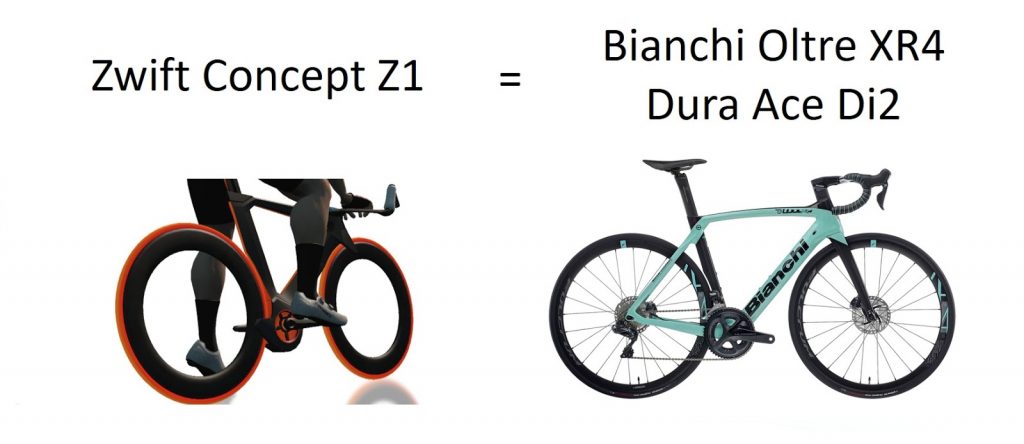
Zwifter definition: Its official name is Zwift Concept Z1, but make sure you call it Tron Bike, otherwise you might be expelled from the game for being such a loser. If w/kg is your performance obsession, the Tron Bike is your fantasy bike. The equivalent of a Bianchi Oltre XR4 Dura Ace Di2, but on Zwift.
Sandbagging
Official definition: voluntarily reducing your power output to cheat ZwiftPower categories.
Zwifter definition: the pandemic Satan has sent to Watopia to destroy our values as a community.
PU
Official definition: stands for powerups, which are the special powers you are randomly given in a race or in a circuit making you faster, lighter, more aerodynamic, etc…
Zwifter definition: did it ever happen to you that you are on the road on your bike and all of a sudden the gradient goes close to 13% and you check your bike computer to activate the feather? Where is my feather??? Or with your Gravel bike on a dirt road “I could really use a steamroller now… where is it????”
ADZ
Official definition: Stands for Alpe du Zwift, the replica of the legendary Alpe d’Huez within the game.
Zwifter definition: you are not a real Zwifter before you climb Alpe du Zwift. This is like a first communion, a Bar Mitzvah. You only become an adult once you cross the arch on the top of ADZ.
Scotty the Squirrel
Official definition: the Squirrel appearing anywhere in Zwift roads.
Zwifter definition: this thing you want to punch in the face when it smiles while you are suffering like hell. I am 100% positive the more I suffer the more it smiles.
ZI
Official definition: Acronym for Zwift Insider, number one source of information for all things related to Zwift and living fully the Zwift experience.
Zwifter definition: like in any religion or cult, you have the writings to disseminate the holy truth across the world. If it is not in ZI, it simply does not exist. ZI is the universal source of the Truth. ZI is our doctrine, our path to heaven.
IRL
Official definition: Stands for In Real Life, meaning your life out of Zwift.
Zwifter definition: for an authentic Zwifter, Zwift is your entire life, so there is no life beyond Zwift. Three months after joining Zwift, the boundaries between IRL and virtual become blurry. At one point things turn upside down and Zwift becomes IRL and the rest is the virtual/fake/nonsensical world. Most of the time, like in “Inception”, I need to flip a spinning top to figure out if it’s real (Zwift) or not.
Smart trainer
Official definition: a trainer connecting to the device you run Zwift on, which adapts resistance to simulate the gradient of the game.
Zwifter Definition: your best friend, your lover, the only thing in the world you confess everything to. The one suffering your pains and relieving you from your stress, your ultimate companion in life. Your smart trainer is the best, full stop. Nobody, except you, can even think of criticizing it.
ZADA
Official definition: stands for Zwift Accuracy and Data Analysis, the technical anti-performance-enhancement agency on Zwift.
Zwifter Definition: as powerful as Lord of the Rings’ Eye of Sauron. You cheat, you get ZADAd, and hopefully live forever on the wall of shame. Sandbaggers, sticky watters, height and weight cheaters, be aware that ZADA is here!! SO, WATCHA GONNA DO, BROTHER, WHEN ZADA RUNS WILD ON YOU ?!?!!?
UPG
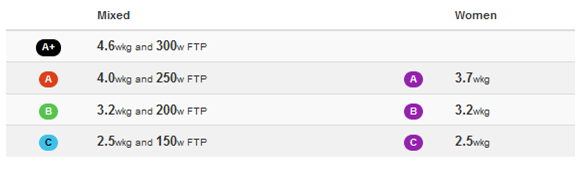
Official definition: your Zwiftpower category is calculated averaging the 20-minute best w/kg from your best three races within the last 90 days and multiplied by 95%. UPG occurs when this average goes beyond one of the category thresholds as follows:
Zwifter definition: the day you go from being the king of the world in one category to becoming the absolute victim in the superior one. As a Zwifter, you experience a paradoxical state of mind where at the same time you are proud of your progression and feel miserable because you have to begin climbing the ladder from the beginning.
Your Suggestions
That’s it for today, but there will be more. Feel free to suggest any other term or acronym you use which makes you look like a total weirdo in front of your friends and relatives. The objective of this initiative is to avoid having us Zwifters be excluded from family dinners and celebrations just because they have not yet seen the light.
There’s been a lot of chatter in the past two days as Zwifters have hopped into the Pace Partner groups only to discover the bots’ paces are different than usual.
We initially covered this topic yesterday, explaining that the bots had stopped drafting. At that time, based on a message we had seen from Zwift support, we assumed the lack of drafting was done on purpose. But that wasn’t actually the case! On top of all that, more updates have come in since yesterday’s changes, with some Pace Partners reverting back to their old drafting paces, while others remain slow (non-drafting).
Not long after I was alerted to this forum post, I received the following from Kristy Fulwider, Director of Marketing Communications at Zwift:
Hi Eric –
Hope you’re having a lovely Friday.
I wanted to follow up on something you noted in ZwiftInsider this week re: Pace Partners. We’re also putting a forum post up for the community, and wanted to make sure we shared some of the more technical elements with you at the same time.
As you noticed, Pace Partner paces were slower than usual for roughly a day. We were in the process of transitioning Pace Partners from client emulation to server entity emulation, a move that would eventually transition Pace Partners out of our experimental FutureWorks program. This change created unforeseen inconsistencies in drafting which impacted pace, and as parity was the goal, we reverted them back.
We’ll continue to work on this transition with an eye on consistency. We remain excited about what this change means: a path towards Pace Partners in worlds other than Watopia and equally important, a reduction in Pace Partner downtime.
Have a fantastic weekend.
Kristy
Client to Server Emulation
The most interesting part of Kristy’s message is her statement about moving Pace Partners from “client emulation to server entity emulation”. For the less nerdy among us, here’s what those terms mean in Zwiftland:
Client emulation: Zwift is running on a device just like you or I use for Zwift (the “client”), but the power and cadence data is being “faked” by software instead of created by someone’s legs. This is how Zwift Insider’s speed testing bots work – and how every bot on Zwift works. A normal Zwift install, reading in computer-generated data. This is how Zwift’s Pace Partners currently work – somewhere (we assume in a Zwift developer’s house, since Zwift’s offices are essentially closed), there are four PCs running Zwift reading in emulated cadence+power data. If one of those machines crashes, so does the Pace Partner. You get the idea.
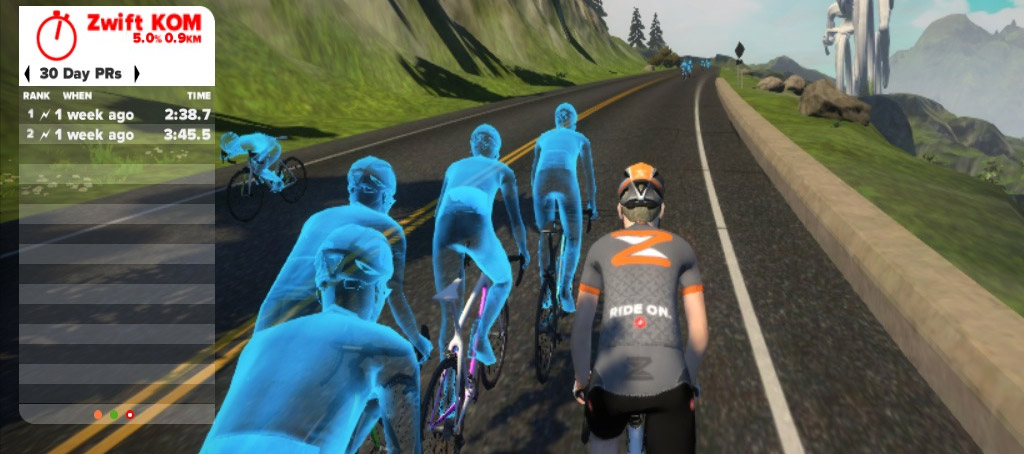
Server entity emulation: the Pacer Bots are no longer running on separate Zwift devices – rather, they are “generated” by Zwift’s servers and controlled entirely by code. (Think the blue ghosts of early Zwift days, which rode around on course with behavior automatically controlled by server code.)
Remember the blue guys?
Moving to server-based Pace Partners makes it much easier to spin up additional bots, with little increase in maintenance or other costs. Instead of requiring a developer to set up an entirely new computer (which could crash at any time), a new server-side Pace Partner would simply require another entry into a database table. And since Zwift’s servers are redundant and cloud-based, reliability should be rock-solid, provided the code behind everything is stable.
Next-Level Opportunities
Moving Pace Partners to the server-side is an essential step in order for Zwift to implement many of the cooler features which we’ve talked about for months. These ideas are listed and discussed on our main Pace Partners page, but here’s a quick list:
Roll Your Own: being able to spin up a Pace Partner with whatever specs you desire
Change of Pace: having Pace Partners change their pace in smart ways – like bumping it up on climbs, and decreasing it on descents
Smart Messaging: sending smarter messages to nearby riders, instead of just reading through the script like they do currently
More Options: having more Pace Partners available at various paces
All four of these ideas are much more doable using server-side emulation. In fact, I would say #1 is impossible unless the Pace Partners are server-side, and numbers 2-4 are made much much easier when implemented server-side.
A Good Sign
At the time of this posting, C. Cadence was still rolling without a draft, meaning her group was around 5kph slower than normal. Hopefully Zwift will get her fixed up soon.
But those are just growing pains. In the bigger picture, it’s clear Zwift is investing some work into taking Pace Partners to the next level – and that’s exciting! I’m looking forward to the server-side rollout happening soon, so Zwift can begin to grant Pace Partners more magical powers.