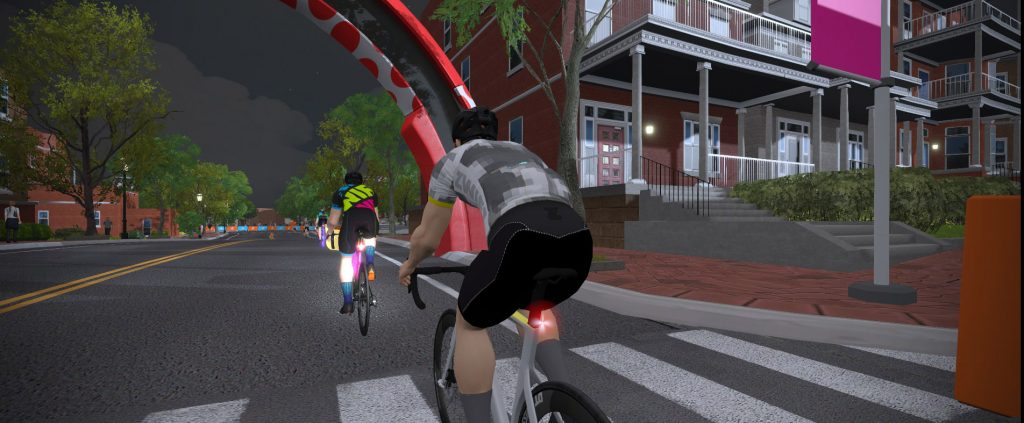
This week’s Top 5 Zwift Videos include different approaches to race starts, a handy keyboard shortcut guide, and a history of Zwift. Also, an old Dragons’ Den episode where an entrepreneur pitches a familiar-sounding product is worth a watch!
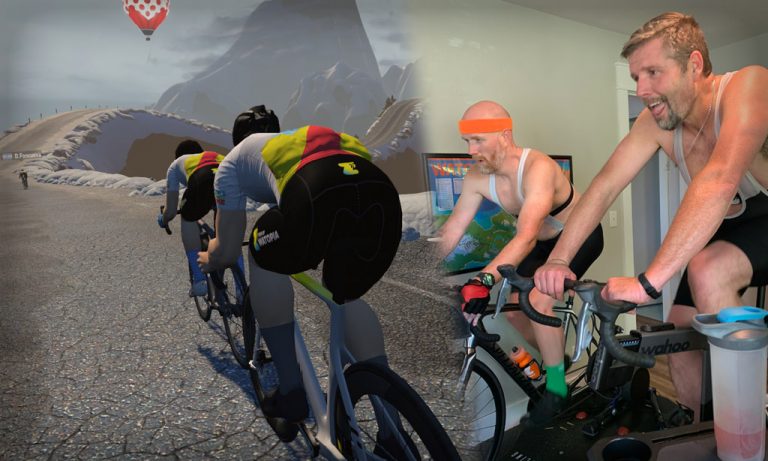
Zwift concept 10 years before launch: Dragons’ Den S2E6
In a 2005 episode of the British TV series Dragons’ Den (similar to Shark Tank in the USA), an entrepreneur pitched a computer program called “Personal Trainer” that could connect to personal indoor cycling equipment. The potential investors were not impressed! Wonder what they would think now… Thanks to Arlette Watowich for posting this one.
Trying a New Zwift Race Strategy – Does it Work???
Zwift race starts are famously fast, but Caedmon Cycling decided to try something different. He left the gate at a steadier pace instead of going hard at the start and risking blowing up. Watch the video to see how well it worked.
Race Winning Starts – Zwift Top 5 Tips
Having trouble starting races well in Zwift? Try out some of General Elost’s advice, whether it’s getting a good position in the pen or learning to start hard and quickly find your rhythm.
Zwift Through the Ages | A Complete History of Zwift
While we’re peeking at the past, why not look at the history of Zwift? The Zwift Race Place and guest Greg Hilton, a Zwift beta tester, talk about how Zwift has changed over time..
ZWIFT GUIDE: Keyboard Shortcuts and Tips You Might Not Know
Did you know that you can cue your avatar to say “bring it”? SMART Bike Trainers will tell you how to do that, along with several more useful actions, in this keyboard shortcut rundown.
Got a Great Zwift Video?
Share the link below and we may feature it in an upcoming post!
Spring is here in the Northern Hemisphere and most are drawn outside for a ride with friends around the local country lanes. If you are lucky, perhaps your local club rides have restarted!
But the dilemma we now face is that there are still some excellent events on Zwift! If you are like me, you’ll end up doing two rides: one outside followed by a session on Zwift. Here are my top events on Zwift over this weekend.
Ride with INEOS Grenadiers – Around the World
Pro cycling team INEOS-Grenadiers are hosting a series of 1-hour rides throughout the day May 1st. Each hour, a different pro cyclist from the team is going to lead a group ride on a different course across Zwift, so either ride at a time that suits you, or opt to race with your favorite riders – the choice is yours.
The cyclists leading the rides are current Giro d’Italia Champion, Tao Geoghegan Hart, recent Volta a Catalunya winner, Adam Yates, former World Champion, Michal Kwiatkowski, along with Ben Swift, Dani Martínez, Michal Golas, Dylan van Baarle, Ethan Hayter, Leonardo Basso, and Jhonatan Narváez
Team Challenge is a group of people riding together to help fight against Crohn’s disease and ulcerative colitis, two painful and debilitating inflammatory bowel diseases.
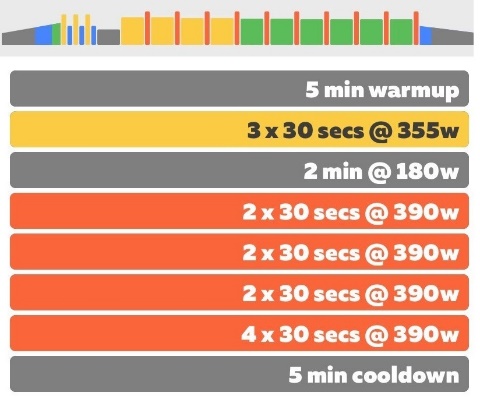
The ride is one hour in duration and this particular event offers a structured training session, consisting of an Over-Under session, meaning you are training a few beats below and a few beats above lactate threshold or FTP. This is designed to improve threshold and endurance.
No weekend is complete without a ride with the LEQP Provence Badge Hunters.
We covered about L’Equipe Provence Badge Hunters earlier in the year and the team are still out there hunting the badges. These excellent group rides are always well-attended. This week, the team are out hunting the 100km badge on Tempus Fugit. A customized jersey is your reward for finishing!
This is a new event aimed specifically at the Ladies. 3R is offering a Women’s steady (2.5w/kg) ride, with a brief warmup to get up to speed, lasting 60 minutes. It will be led by the women of Race3R and the group will remain a solid pack throughout. The women from the club are aiming to create an inclusive community where women come together to support and encourage each other, as well as build strength and fitness.
If you are short on time but still want to get a Zwift session done, you won’t go far wrong with this workout. 40 minutes in duration, this interval session is designed to work muscular strength and endurance. It is tough and will leave you gasping for breath by the end.
The third points race of Zwift Racing League Season 3 happens Tuesday, May 4th. And we’ll need the 4th to be with us as we’re heading to Richmond to have repeated goes at what may be the punchiest racecourse in ZRL history.
It’s multiple laps of Cobbled Climbs, a route featuring Richmond’s 3 climbs on every lap. Let’s dig into the course, including some tips for bike choice and strategic options.
Looking at the Route: Cobbled Climbs
We begin at the standard Richmond start/finish banner, but make a quick left turn, and another left, onto the descent of E Main St. (This is the longest descent on the route, so enjoy it while it lasts.)
After some flats and rollers along the river the road tilts up and you know what’s coming: our first KOM of the day. Twisty, bumpy Libby Hill!
Hammer your way up this climb, then recover for a few seconds as you descend to the start of our next KOM: the short, straight 23rd Street. This is essentially a “sprint-climb”, which is why Peter Sagan was able to drop everyone in his famous attack here in the 2015 UCI Worlds race.
Do everything you can to maintain good pack position up and over the 23rd Street KOM, knowing you’ve got a few seconds of recovery just up the road on the Broad Street descent. You can even supertuck the descent like Sagan did (but can’t anymore – thanks for ruining the fun, UCI!)
You’ll need every bit of recovery you can get, because just a few seconds after the descent we begin the final climb of the lap: Governor Street! This is not a timed KOM section, but it’s where the race-winning final moves are often made, and it feels so long in the final minutes of a race. Finish this climb then it’s a false flat straightaway to the finish!
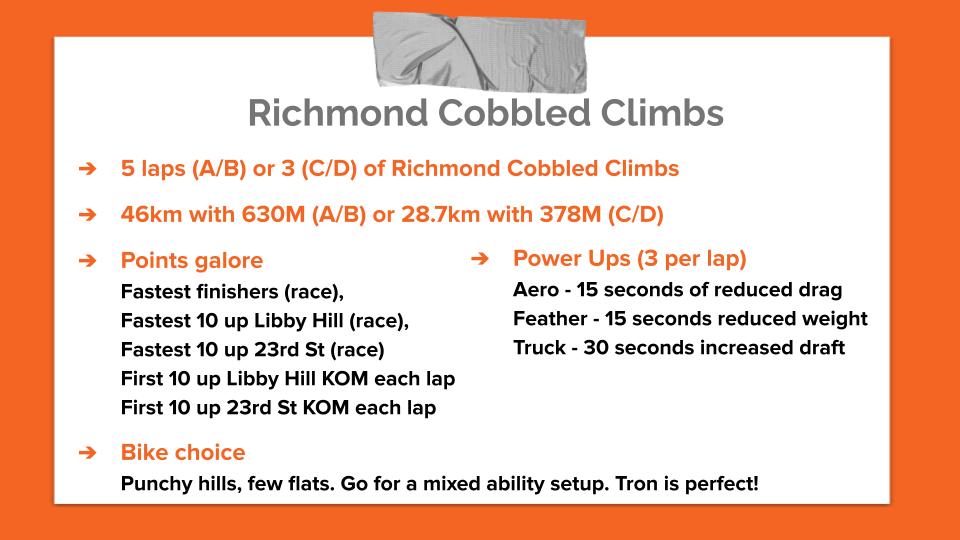
Each lap is 9.2 km (5.7 miles), and A/B teams will race over 5 laps, while C/D will race 3. This is going to feel significantly longer than most ZRL points races... because it is!
Dave’s Route Notes
Sherpa Dave has put together a race recon video and some helpful notes:
Sagan went for his break on the last lap coming over the 23rd Street KOM, but that’s a big ask for normal humans! More likely the field will be whittled down lap after lap and a small bunch will compete for the finish line (FIN) points. But keep in mind, there are more points available than just FIN – and I’ve spoken to plenty of teams and riders who are rethinking what success means when Fastest Through Segment points are available.
This is a puncheurs paradise! Pure sprinters might stay with the first lap or two and get some FAL (First Across the Line) points on the KOMs – maybe even FTS points (Fastest Through Segment). But can they stay the distance? Then again there are no sustained climbs for the Grimpeurs (climbers) to show off on. Yup, this is for the riders with enough muscle to punch their way up, but not so much that it’ll weigh them down… assuredly a puncheurs paradise!
If all you want are the facts… here is the one-page print-off sheet with the key distances.
This isn’t epic in the way NYC was – but you will leave this ride more depleted than you thought possible… particularly the B’s!
No Breakaways Course Preview
Here’s the course preview from Rick at No Breakaways:
PowerUp Notes
Riders will be awarded powerups through the start/finish banner as well as the sprint banner, meaning we’ll get 3 powerup chances per lap. Three powerups will be given out at each banner:
Aero Boost (helmet): makes you more aerodynamic (reduces your CdA by 25%) for 15 seconds. Use this if you’re contesting the sprint intermediate, attempting an attack at high speed, or just trying to catch a breather in the peloton on flat or descending road.
Lightweight (feather): reduces your weight by 10% for 15 seconds. Use this when the road tilts upward. Useful for taking the edge off of a ground-level road’s lumpy climbs, or to help you grab extra points on that final KOM.
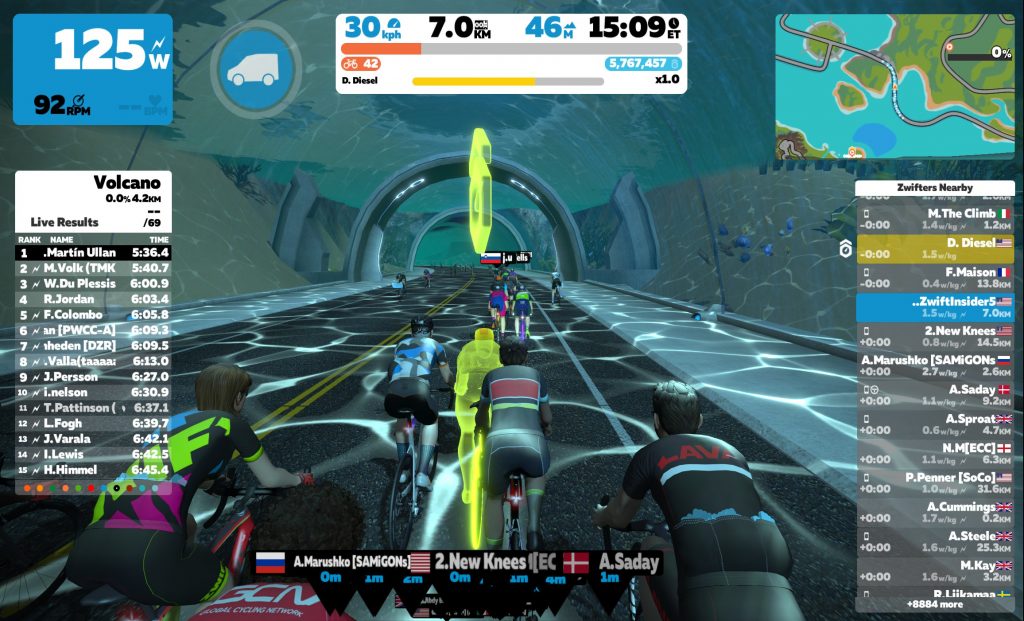
Draft Boost (van): increases the draft effect you are experiencing by 50% for 30 seconds. Use at higher speeds (flats and descents) when you are already drafting off another rider (since this powerup only helps when you are drafting.)
Bike Frame + Wheel Choice
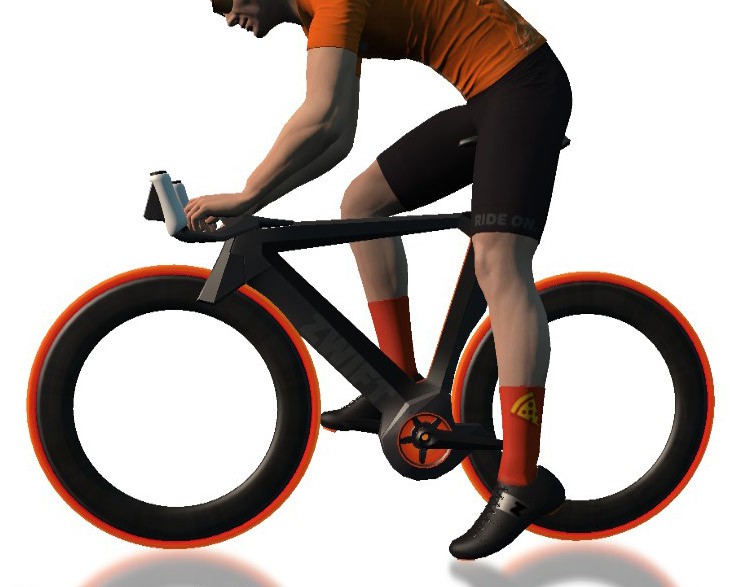
Zwift Concept 1 (Tron) bike
None of the climbs here are long or steep enough for a true climbing bike to be the sensible choice. And yet, going full-on aero with a disc wheel setup probably isn’t your best option, either.
The Tron bike is the best of both worlds, climbing a bit faster than the disc wheel but also performing very well on flats and descents. If you don’t have the Tron bike, go with an all-arounder frame like the Canyon Aeroad 2021 coupled with lighter-weight aero hoops like the ENVE 7.8, Zipp 858, or DT Swiss ARC 62.
This is a points race, so everything comes down to the two timed KOMs, as well as the finish. All the miles in between are just the setup.
Here are a few predictions about what we’ll see in this race:
The front group will get smaller on each lap, with a small pack of only 5-10 duking it out across the finish line.
Fastest Through Segment top 10 times will all be set on the first lap. Why? Because the pack draft will be largest then, plus riders will simply be too tired to better their times on subsequent laps.
Chase groups will catch some riders up the road at the start of each lap (through the flat/descent portion), but those same riders will attack again on the climbs and get away. Which begs the question: is it even worth chasing? On the other hand…
This is a long race – the second-longest in ZRL history, in fact, and with a lot of climbing! Riders will have a hard time pacing their efforts properly. Some will push hard to make the front selection, but blow up on subsequent laps. Chase groups shouldn’t give up hope, because that front group will keep shrinking, and there may be opportunity for intermediate and significant finish points if you’re in the first chase group.
Some riders who don’t fancy their chances of staying in the front group to the finish will go all-in on the first climb up Libby Hill – then do it again on 23rd Street if they’re still in the front group. These riders may take a few FAL and FTS points, but they’ll get dropped from the front group and miss out on oodles of points over the course of the race. For these riders, recovering then sitting in with a well-paced group is their best hope of a decent finishing position.
With the first 10 riders across the line receiving bonus points on each KOM, we’ve got a huge amount of intermediate points going to a small front group of riders. We predict that the final race win will come down to the simple math of how many riders each team puts into that front group.
Is there a place here for non front-group riders to earn some intermediate points? You’d like to think so, but we don’t see it happening. As we’ve already said, FTS points will go to the top puncheurs on the first lap. And once that front group is away, all the FAL and FTS and big finish points ride away with them. The stragglers will be left to battle over paltry finish points.
Your Thoughts
Any insights or further thoughts on the big race? Share below!
UPDATE: as quickly as it came, it left. Just a couple hours after this post went live, Zwift reverted the Pace Partners back to drafting mode. Some of them, at least. Learn more here >
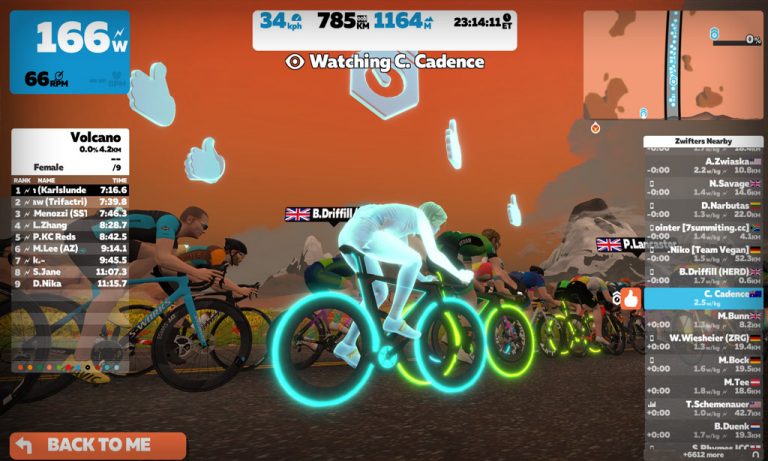
Yesterday reports started drifting in that the Pace Partner bots had slowed down dramatically. One Zwifter told us it felt like C. Cadence was around 5kph slower than usual.
So what’s going on?
Based on forum posts, it appears Zwift has turned off drafting for each of the Pace Partners. So while you experience the benefits of the draft, the Pace Partners do not.
Why would Zwift make this change? They haven’t said, but our guess is it’s to provide a more consistent pack speed. When the Pace Partners aren’t affected by the draft, their speeds should stay more constant and predictable.
Testing to Confirm
We tested this ourselves to confirm – setting up a bot with the same parameters as each of the Pace Partners, then joining the Pace Partner ride before enabling a firewall setting which hid all other riders. If the Pace Partners weren’t drafting, that means our rider would keep pace with the Pace Partner while riding alone at the same weight and wattage.
Starting next to Dan Diesel
Riding alone to test the non-drafting speed
There are some unknowns here, of course – we don’t know what sort of virtual frame and wheels the Pace Partners use, and we don’t know their height, either. But our test confirmed that the Pace Partners aren’t enjoying the benefits of the draft – after a few kilometers of riding alone, our riders were still within a few meters of the Pace Partner.
New Speeds
Based on our quick observations, the Pace Partners are now traveling at significantly lower speeds, meaning you can sit in with them at much lower wattage:
Dan Diesel now travels at 29-31kph on flat ground. (His speed has changed the least, since drafting matters less at slower speeds.)
C. Cadence now travels around 34-35kph instead of 40-41kph. Most nearby riders were doing 1.4-1.8w/kg to sit in.
BowieBrevet now travels at 38-39kph, with most riders nearby doing 2.4-2.6w/kg.
Amelia Anquetil rides a route with lots of dirt and hills, so it was hard to figure out her new speed. But she had a slightly larger group of followers than usual, and definitely moved slower than usual on faster paved flats and descents.
A Quick Survey
Zwift is no doubt getting a lot of feedback from their exit survey which pops up after riding with Pace Partners. Our guess, after taking a bit of a straw poll in the various Pace Partner groups, is that the feedback with this latest change isn’t very positive.
When we asked everyone what they thought of the change, the most common response was “the group moves too slow now!” Zwifters weren’t happy with the change, because it wasn’t what they expected. Example: one Zwifter told us they hopped into the C. Cadence group for a quick race warmup, but immediately dropped the pack because it was moving so slow.
A newer, slower Bowie experience
FutureWorks
It’s worth reminding ourselves that Pace Partners are still officially under Zwift’s FutureWorks banner, meaning they’re still being beta tested by the community and iteratively tweaked by Zwift. So we shouldn’t expect our experience with them to be completely consistent.
That said, this is the most significant change in terms of Pace Partner “feel” since the feature launched, because it dramatically impacts the wattage required to ride with each Pace Partner. So it’s not surprising that it’s raised a bit of a hullabaloo.
Managing Expectations
Our guess is, turning off drafting for the Pace Partners will in fact keep pack speeds a bit more consistent. (This may or may not be a good thing, depending on what you’re using the Pace Partner packs for. If it’s race training, then it’s not a good thing! If it’s for riding with a group at consistent power – then it would be good.)
The bigger challenge, though, is that Zwifters have come to expect a certain effort level with each Pace Partner. And now that effort level is dramatically lower. Additionally, the drop-in screen where you select a Pace Partner hasn’t changed at all, so it only shows the w/kg each Pace Partner is holding – which really isn’t a helpful metric when that Pace Partner isn’t drafting, since your w/kg will be much lower to keep up with them, at least on flats and descents.
For now, we predict that Bowie Brevet’s group will become the largest, since it’s the new “C. Cadence” group in terms of power needed to sit in. It’ll be interesting to see if Zwift keeps this change in place, or rolls it back.
Your Thoughts
What do you think of this latest Pace Partners change? Share below!
After a very successful “Couch to Cat C” project, Boone is now well into his “C to B” training block, where the goal is to see him hit 3.2 w/kg in his ramp FTP test and thus qualify as a B racer.
Our first two rides this week were pretty standard events, but it’s the FTP test at the end that really makes things interesting. Read on to see how it all unfolded…
The Plan
As a reminder: the basic plan we’ve settled on contains a mix of five different types of rides. (Many thanks to Alan Dempsey of HPP Coaching for giving us solid advice that sets Boone up for success).
Races: Boone will race the C’s every week or two to check his progress, work on race craft, and of course get in a good workout.
VO2 Workouts: this will be the cornerstone workout of each week. Nobody likes VO2 work, but we both agree Boone is getting a lot of benefit from these.
Pace Partner Intervals: we’ll use the Pace Partners (C. Cadence or Bowie Brevet) to anchor a fun, interactive interval workout. Warm up with the pace partner, then sprint off the front for 15s. Or drop off the back, and put in a measured 2-minute effort to get back on. Lots of options here.
FTP Ramp Tests: we’ll do at least two ramp tests to measure FTP progress.
Recovery Rides: some days, Boone will just need an easier effort in the saddle. Since he’s still a beginning cyclist, even easy efforts are far from wasted.
Ride 23: Tour of Watopia Stage 5
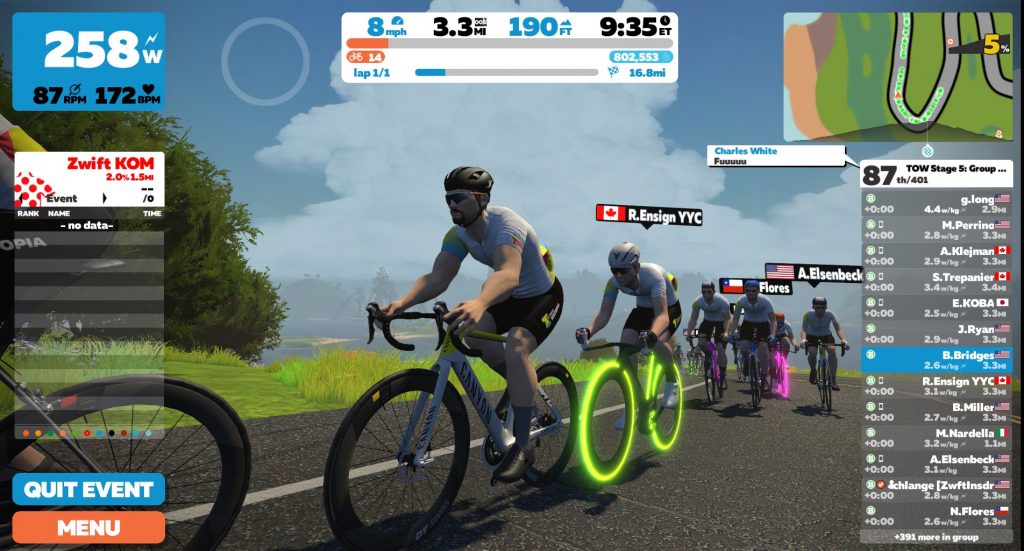
Boone hadn’t taken part in a Zwift “group ride” yet, so I proposed we join a Tour of Watopia event for today’s ride. Stage 5, in this case: one lap of the Mountain 8 route, the “shorter ride” for this stage. Since he’s only level 14, the double XP wouldn’t hurt!
I wasn’t looking to push hard since I had a ZRL race the next day. So I just rode along with Boone, who put in a solid effort, setting some new power curve bests on the ride. We had a good time putting in short efforts to hold the wheels of certain riders, then working with our ever-growing group to chase down stranded riders in the final miles of the event.
This was a wonderful example of the power of the Zwift group ride experience. It camaraderie, but also a bit of competition. And in the end, everybody wins!
Today was a fast day for Boone (“fast” referring to not eating), so we wanted to do another steady ride. He wanted to ride some roads he hadn’t yet covered in Zwift, so we jumped into a new world for him: Richmond, Virginia!
He’d been there IRL, but never on Zwift. He finished two laps as I explained to him why it’s my favorite race course, even though I never win.
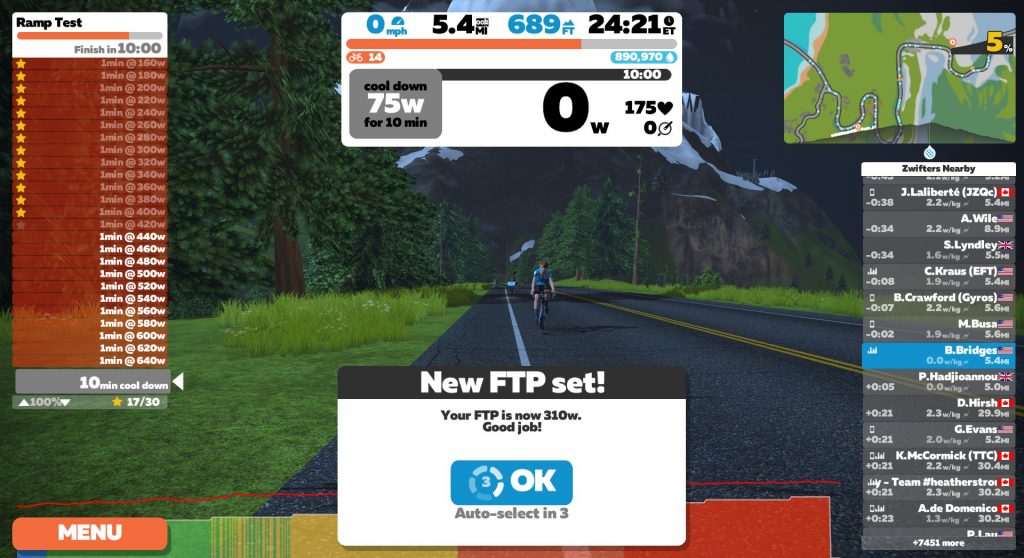
Boone hadn’t done a ramp test in several weeks, so we decided today was the day. And I was feeling spry, so I decided I would do a ramp test along with him. Boone has repeatedly told me he pushes harder when I’m riding with him, so I figured we would both help each other by suffering together.
Here’s where we stood before the test:
I’ve only done the ramp test once before, back when it was first released on Zwift. And I haven’t tested my FTP using a standard protocol of any sort for over a year. Instead, I’ve just used the “95% of my best 20-minute power” estimation in order to determine my rough FTP, which was set at 310W.
Boone had last done a ramp test 6 weeks ago, with a resulting FTP of 294W.
After doing some rough math, I decided I should start the test 1 minute before Boone, in hopes that we would both be on our limit at the same time. I envisioned us each turning ourselves inside out, trying to not be the guy who stops pedaling first!
The Ramp Test starts easy (at least for bigger guys like Boone and I) at 120W, and steps up the wattage by 20W every 1 minute until you fail. You’ll fail at a much higher wattage than your actual FTP – your FTP results is calculated by taking 75% of your best 1-minute power during the test.
I like to set a minimum target when taking these tests, so for me that was finishing the 420W interval. If I was able to do that, my detected FTP would be 315W – a respectable increase.
In Boone’s case, he wanted to at least complete the 400W interval, which would give him a detected FTP of 300W.
We chatted in the early intervals, knowing the pain was coming soon enough. The Ramp Test is quite easy, then you start to feel it for a couple minutes, then it’s just a few more minutes of pure suffering until failure. We were watching our heartrates on screen – mine was a bit below Boone’s as things started getting hard, but then I caught up to him and we stayed pretty close until the end.
Boone crushed his 400W interval, and kept going well into the 420W section. His new FTP: 310W, exactly what my FTP had been set to going into this test!
As Boone stopped pedaling I had just a few more seconds left. I finished a bit more than half of the 440W segment, with a final FTP of 324W.
If you ever need to take the ramp test, I highly recommend doing it with another rider on a voice call, and timing your tests so you’re ending together. It’s a super-motivating way to help you keep pushing.
Boone’s Ramp Test result, along with his continued weight loss, puts him at an FTP of 3.22 w/kg. The goal of this training block was to hit 3.2 w/kg in his FTP test, so… that’s another goal achieved! We were hoping to hit the goal in 6 weeks, and he finished it at the end of his 7th training week. Not bad. Not bad at all.
To B, or Not to B?
Now the question is: does Boone start racing the B’s, or should he stay with the C’s until ZwiftPower upgrades him?
He’s never averaged over 3.1 w/kg in a race (and those are short Crit City events), so he’s not even an “almost B” in ZwiftPower’s eyes. ZwiftPower determines your category based on the “average of best 3 races in last 90 days (4.1 + 3.9 + 3.8 = 3.9w/kg).”
Should Zwift racers categorize themselves based on the results of FTP tests, or based on the category ZwiftPower sets for them? For riders like Boone, the correct answer isn’t obvious. In Boone’s case, as a rookie rider, I doubt he would be able to hold his newly-detected FTP of 3.22w/kg for more than 30 minutes.
Does he belong in the B’s, where the front group in most races can hold 3.6w/kg for 45 minutes or more? Or does he belong in the C’s, where you can average 3.36w/kg for 20 minutes and still be under the B-category 3.2w/kg mark based on the “95% of 20-minute power” calculation?
His new FTP says cat B (barely). His race numbers indicate cat C.
On the other hand, he’s doing well in his C-cat Crit City races (although admittedly the pack sizes have been a bit small), and staying in cat C for short Crit City events may just stunt his growth. Wouldn’t it be better to jump into the B’s and really be pushed to the limit, with no chance of staying in the front group until the end?
Your Thoughts
Chime in below with your thoughts on Boone’s cat quandary. We welcome your input!
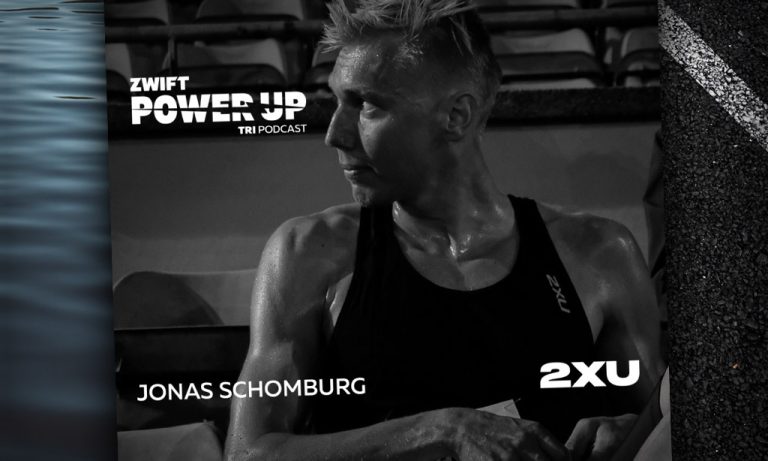
The 2XU Brick Training Series is a 6-week event series with top 2XU Pro Triathletes riding and running their favorite workouts throughout Zwift. What makes these workouts their favorite? Find out as they dish the details in exclusive interviews on the PowerUp Tri Podcast! This week, we are joined by German Pro Jonas Schomburg.
Tune in to the latest episode each Wednesday and have a live Q&A ride or run session with top pro triathletes like Brent McMahon, Sarah Crowley, Terenzo Bozzone, and Cam Brown. Or join a recast ride every Saturday, where you can zone in the workout with the podcast.
About the Podcast:
The Zwift PowerUp Tri Podcast is hosted by former pro triathlete Matt Lieto and Zwift Academy Tri mentor Sarah True. Both are passionate about lending their in-depth knowledge of the multisport to the Zwift Tri audience.
Amidst other signs that Zwift may be extending its plans to consult the community on some planned changes, the Zwiftcasters discuss the significance of the decision as well as the thinking behind the initial plans.
After a roundup of the Zwift news, including an easy way to ride without the Heads Up Display, the saving of the ZwiftHub site by friend of the podcast Eric Schlange of Zwift Insider, and how an early precursor of Zwift was laughed out of the Dragons’ Den, the chaps move on to discuss an innovative move from sports superstore operator Decathlon. The company has rolled out an advertising campaign championing prisoners’ use of Zwift inside a jail in the Belgian cycling heartland of Oudenaarde. The idea came from advertising creative and avid Zwifter Frederik Clarysse. He explains how the initiative came about.
Andrew Cotter – and his dogs Olive and Mabel – became global online superstars during the pandemic. Andrew, a sports commentator, is a keen Zwifter and Simon discusses how the platform has provided a valuable escape during the pandemic and lockdown.
Finally Shane reveals that he is again the target of lawyers… after seeing off the Peloton briefs last year, now a German IP expert is after our Aussie friend – over 10 dollars worth of T-shirts!
Since March I have become obsessed with the weekly Team Time Trial… so I asked Eric if i could share my obsession with you all, in weekly doses.
Each week I will give you a profile of the upcoming route, guidance on bike choice, and some target times if you want to aim for the Premiere League (top-10 in each coffee class get to be in a special race televised on YouTube).
If you can’t ride (or even if you can ride, but want more action!) don’t forget to tune in to the live TV show on Zwift Community Live’s YouTube Channel at 6:15 (UK time).
Thursday 29th April – Watopia Flat Route
We’re back in Watopia this week, with three laps of Watopia Flat Route. This route is old, pre-dating my existence on Zwift since it launched in December 2015 (I didn’t find Zwift until autumn of 2017). In fact, it is the second-oldest Watopian route. We are lucky that ZwiftHQ has written a race recon. The race recon profiles focus on scratch race dynamics, not TTT, but it is a good read regardless.
Three laps at a touch over 10km each make this a 30 km race – the observant among you will know this is one lap less than last time we did this course. Each lap is pretty flat (the clue is in the name), and all-told we have 180 meters of vertical climb. This is all about formation and communication.
There are two tricky areas on the route – the ramp out of tunnels through the dirt and up the false flat is the first, and the hill through the Esses is the other. Keep communication clean and keep an eye on your teammates and you will sail through.
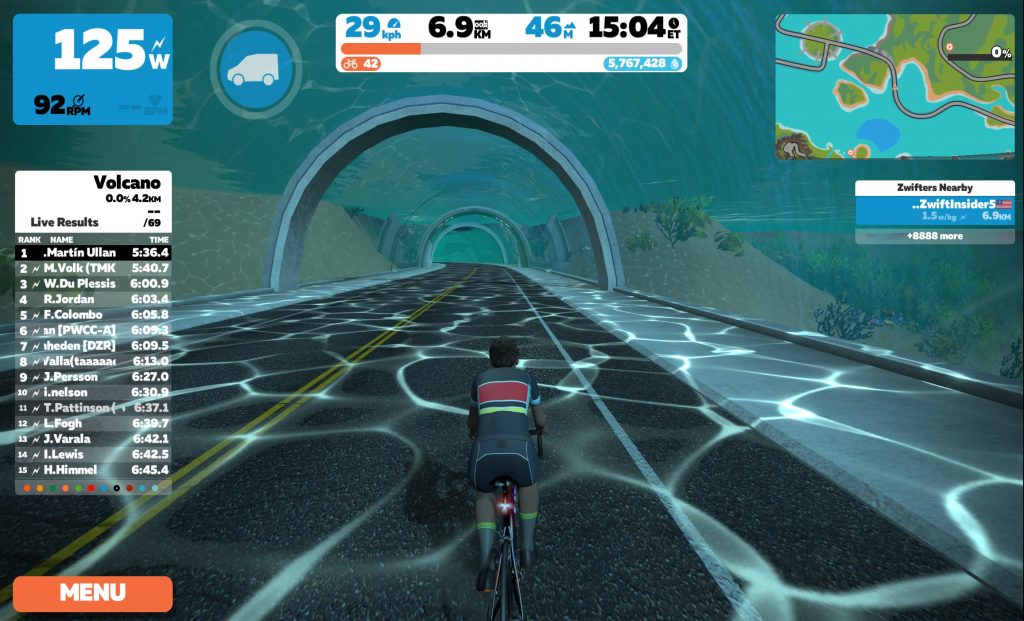
From the Pens you head towards the undersea tunnels (Ocean Boulevard) through the fishing village and up the winding false flat. Down the other side into the Italian Villas towards the sprint (don’t be tempted) and up the hill that precedes the Esses. Then it’s up and down the Esses, and down the hill to the start/finish. My fastest time through the course was the Team INEOS group ride in the spring, where I averaged 40kph.
What to ride?
Bike recommendation on this route is pretty straightforward. Aero rules the day. For me it’s Venge and Super-9 over Tron.
As I mentioned last week, the new Canyon Aeroad 2021 totally changed things for anyone between level 23 and 33. I don’t think there’s a lot of difference between the Aeroad and the Tron even.
Level 45 get those 858/Super 9 wheels and pair them with the S-Works Venge
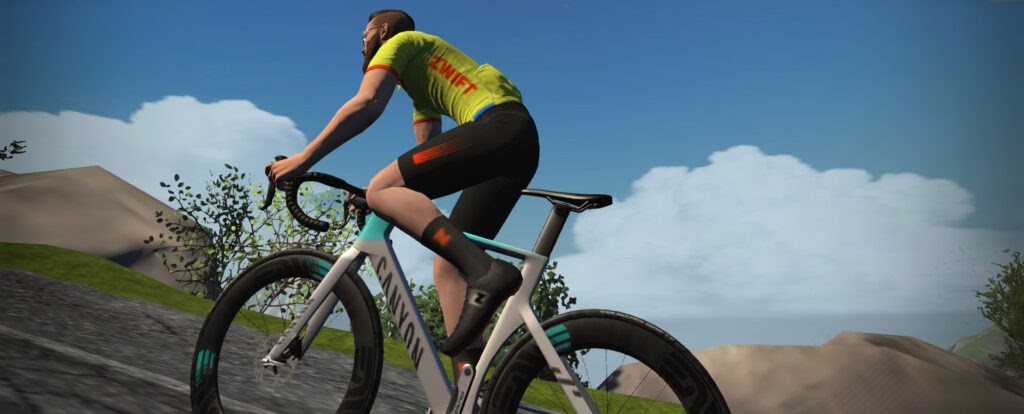
If you’re below level 35 and have a Tron, use it… it beats every other setup but the last two on this route hands down. I cannot stress highly enough that if you are racing you need to be working on Tron. It’ll take a while, but just set the Everest Challenge and forget about it for nine months… like having a baby.
Route Recon
If you prefer your recons in the visual style, take a look at my YouTube video. You can choose to watch the whole thing, or just pick and choose from these time codes:
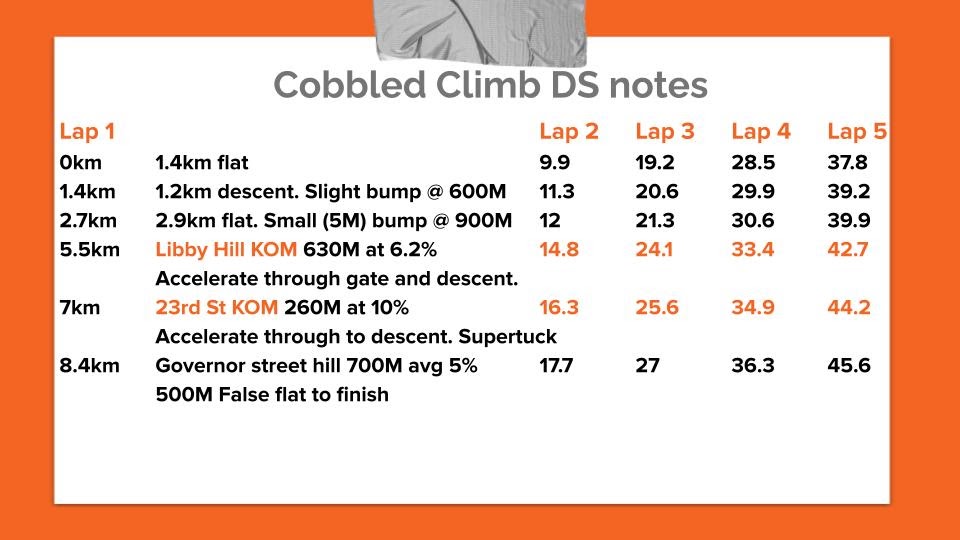
Here’s my handy-dandy DS summary for you to print off and put by your trainer if you so desire!
Regardless of how the official Zwift race-recon breaks the route up, I only see three sections:
Pen/Gate to the end of the undersea tunnels
To the Italian Villas
Esses through to the start/finish
Start to the end of the undersea tunnels
A flat 3.2 km from the start/finish gate to the start of the ramp. Around the same if you’re on lap 1 from the pens. You’ll pick up speed as you go into the tunnels. That is really all there is to say here.
Col Du Italian Villas
This starts with the ramp out of the tunnels (300 meters at 3%), onto the dirt roads around the fishing village and up the false flat. The kicker at the end of the false flat will be barely noticeable at speed. It’s 3.6m in total from the the ramp to the Italian Villas.
Esses and home
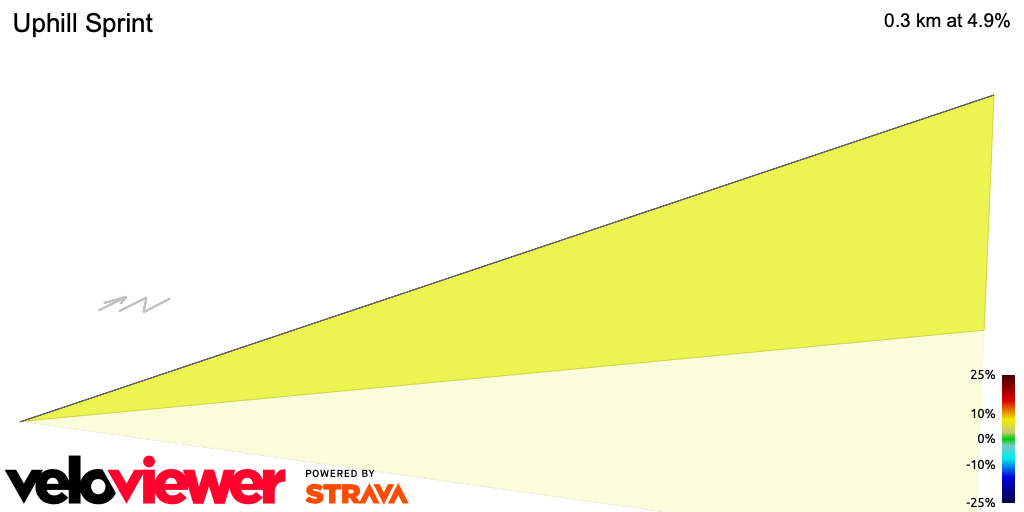
Through the tunnel and through the sprint. Cross the bridge and into the only real climb of the loop – 300m at an average of 5%. This one will take some care if you are all on the rivet because your smaller, lighter riders will shoot ahead if they aren’t careful. After that it’s the Esses.
The Esses are a series of humps. If you’re coordinated you’ll accelerate on the downhill and let the momentum carry you up the next. If you’re not coordinated the momentum delta between heavier and lighter riders will split you apart!
After the Esses its downhill to downtown. Don’t forget to sprint on the last lap!
Wrap up
This race is all about decision-making. You will be flat out on the flat, and the hills will strain the team… people will get dropped. The question is do you wait for them, or do you drop them?
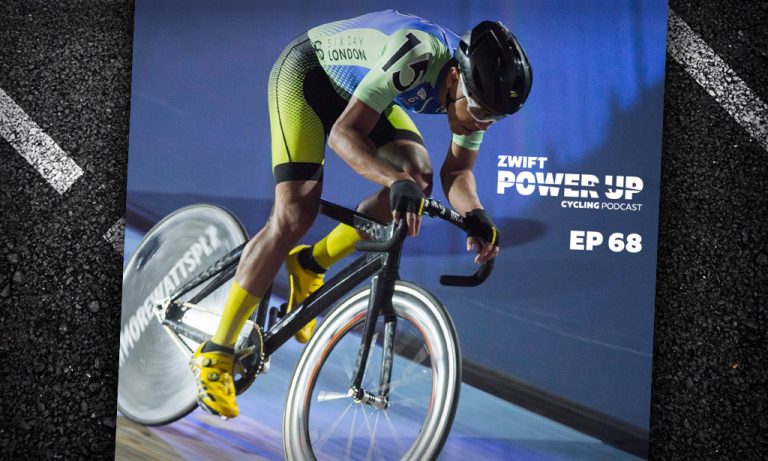
Red Walters has a very promising career ahead of him, but Covid-19 closed down racing for 2020 and he couldn’t show off his potential as he had hoped. Now he’s stuck with only 1 year left in the Under23 category, and 1 year to show off his talent and earn a pro signing.
He sits down with Matt Rowe and Rahsaan Bahati to discuss lockdown training, diversity in cycling, what he hopes the future holds, and let’s not forget his previous accolades in dinghy racing…
About the Podcast
The Zwift PowerUp Cycling Podcast features training tips from host Matt Rowe (Rowe & King), with regular co-hosts Greg Henderson, Rahsaan Bahati, Dani Rowe, and Kristin Armstrong.
My husband is visually impaired. Jim has been what we might call “a little accident-prone” his entire life. He has always been involved in sports, and injuries included ruptured achilles, knees, hip replacements, and more.
In 1990 while cycling to work A 3/4 ton truck hit Jim. He suffered a brain and neck injury and it took five years of rehabilitation and therapy to get him back to “normal”. This accident and another cycling accident seven years later caused optic nerve damage to both eyes. Jim continued to love cycling and eventually I got caught up in the sport as Jim organized various ride groups in Sherwood Park, Alberta for a well-known bike store “Mud, Sweat and Gears”.
In 2014 we moved to Kelowna, British Columbia where we continued to cycle. We became members of the Kelowna Newcomers Club and we organized an outdoor club that included hiking, cycling, and kayaking for up to 25 people. In the winter this group would also snowshoe with us. So you can tell that Jim was very active, both in his early years and later as he retired at the age of 58.
My Life Would Change Forever
We thought the worst of his mishaps were behind us. Little did we know. In February 2018 while in LaQuinta for a three-month stay Jim’s vision started to change. We had taken our road bikes and tandem race bike down to this area as the cycling is amazing and for that reason we chose it as an annual “snowbird” destination to avoid Canadian winters. Jim cycled over 1200 km in January using both his road bike and our tandem racing bike.
On February 10 we were out cycling on the tandem bike when Jim hit the curb. While we did not fall it certainly was a cause for alarm. By February 12 he could no longer drive our car. Jim had lived with controlled glaucoma for several years – all controlled by a simple eyedrop. While in LaQuinta his eyes became red and inflamed and we thought this was from the dryness of the region and the sweat going into Jim’s eyes. After Jim saw five ophthalmology specialists in the Palm Springs area we decided to return home to Kelowna, British Columbia, Canada.
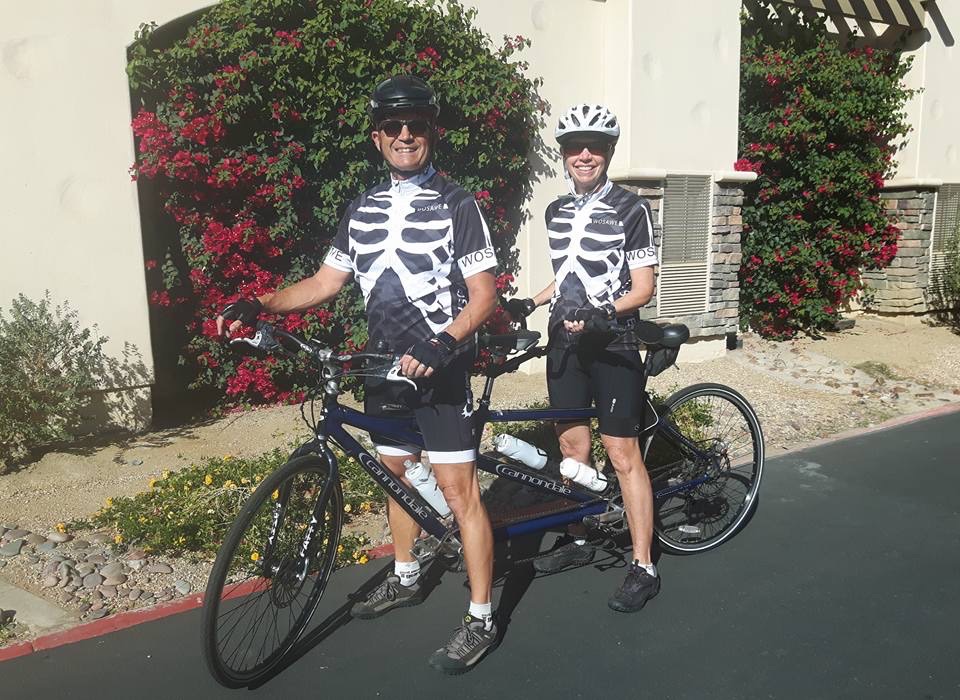
Our last Tandem Bike ride in LaQuinta, California
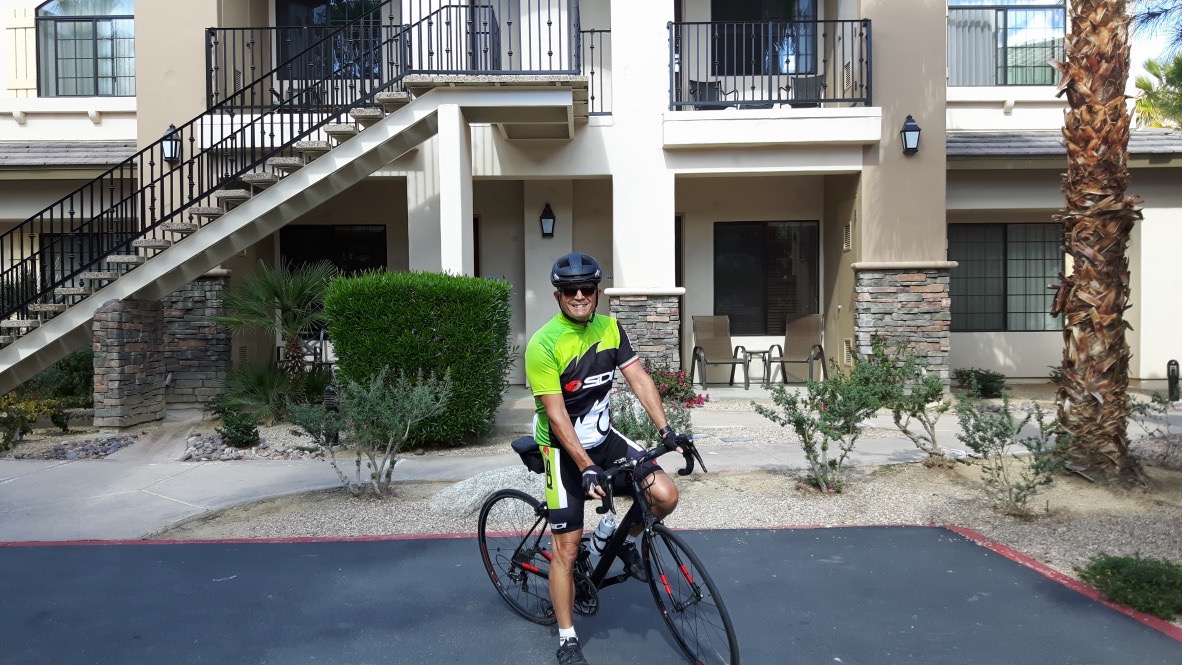
Jim’s last solo cycle ride in LaQuinta, California
We both thought we were coming home to get Jim “fixed”. This was not to be the case. Seven surgeries and one year later Jim was left with a small amount of vision up to a distance of five feet. He explains that it is like looking through waxed paper. He can see outlines but not faces.
Glaucoma is a group of eye disorders that have few symptoms in their early stages, but eventually leads to damage of the optic nerve (the bundle of nerve fibers that carries information from the eye to the brain), which can then lead to vision loss or complete blindness.
Glaucoma is a leading cause of irreversible blindness in the United States and the world.
Upon our return to Canada, our son who lives in New Zealand flew to see us. We all went to Jim’s Opthamologist together. At this time we all learned that Jim’s vision was not going to be repaired. We cried together. In 2018 Jim was diagnosed “legally blind”.
Our son Corey was already a part of the Zwift community. Neither Jim or I had been that interested in Zwift as we spent the winter months in California, taking our outdoor bikes with us. On the way home from the Opthamologist, Corey told his Dad that he was NOT going to see his Dad stop cycling. Jim had cycled for over 40 years.
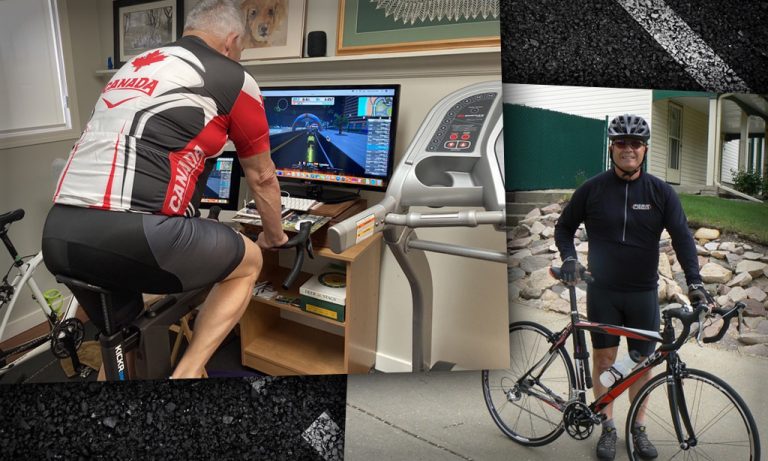
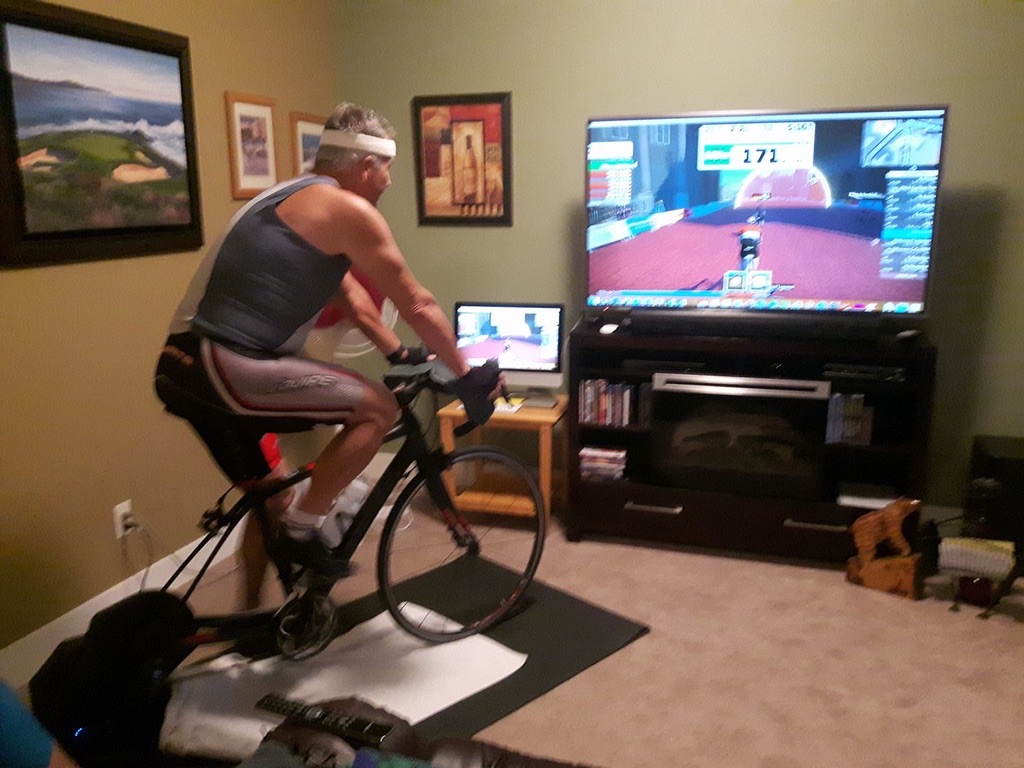
Together they drove to a local cycle shop and Corey purchased Jim his first indoor trainer. By mid-afternoon, Jim was now a member of Zwift and Corey had him cycling his first FTP test. Although Jim could not see the large screen TV, I was able to cycle beside him and give him his cues.
Jim trying out Zwift with the help of our son Corey.
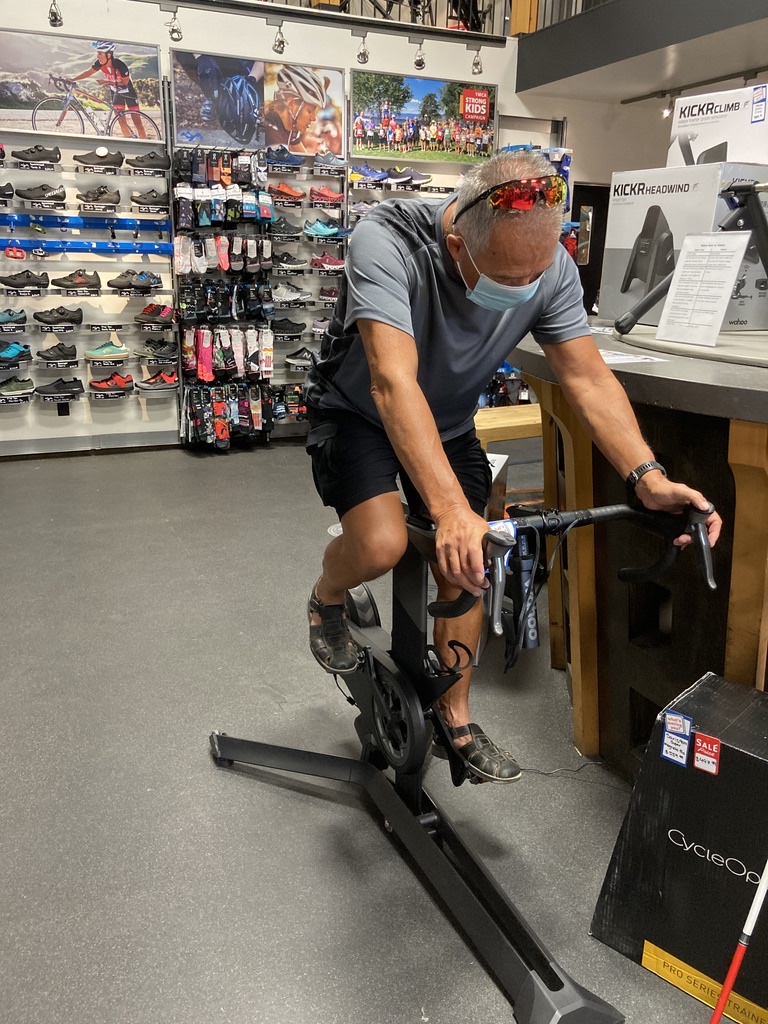
Eventually Jim was set up with a TV which he could make out on his own. Recently he purchased a new Wahoo KICKR Bike!
Life Continues On
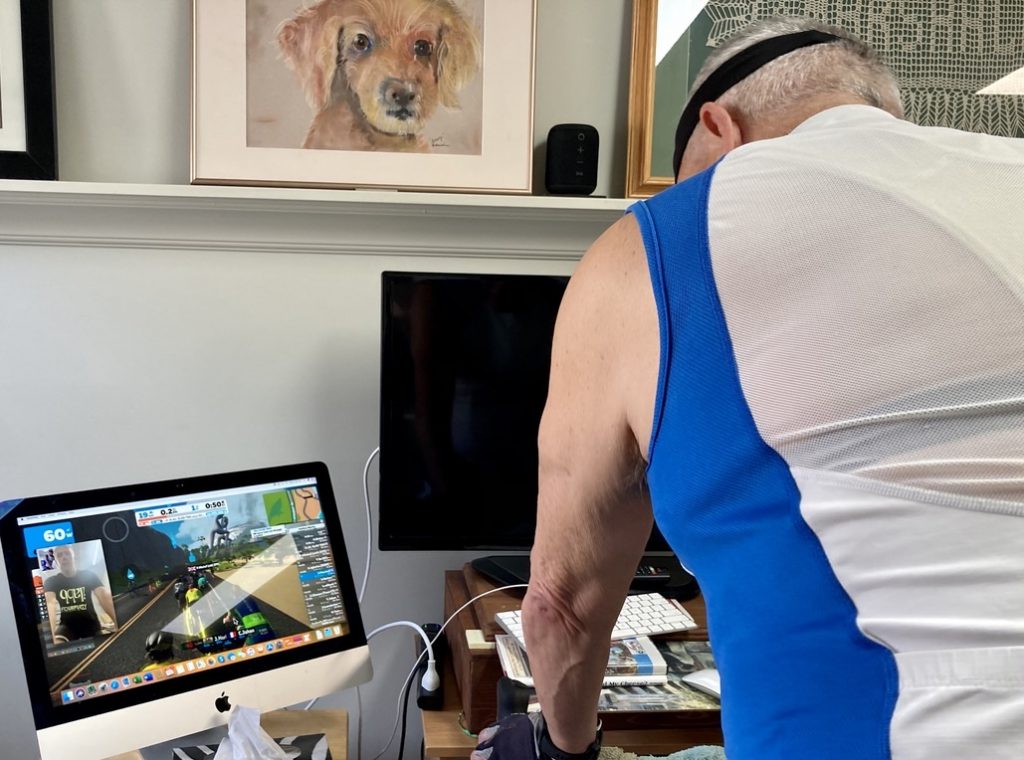
Over time he convinced me to also ride on Zwift. At least two or three times a week we do a Zwift Meetup, and Jim stays with me for the duration as I am still the “weakest link”.
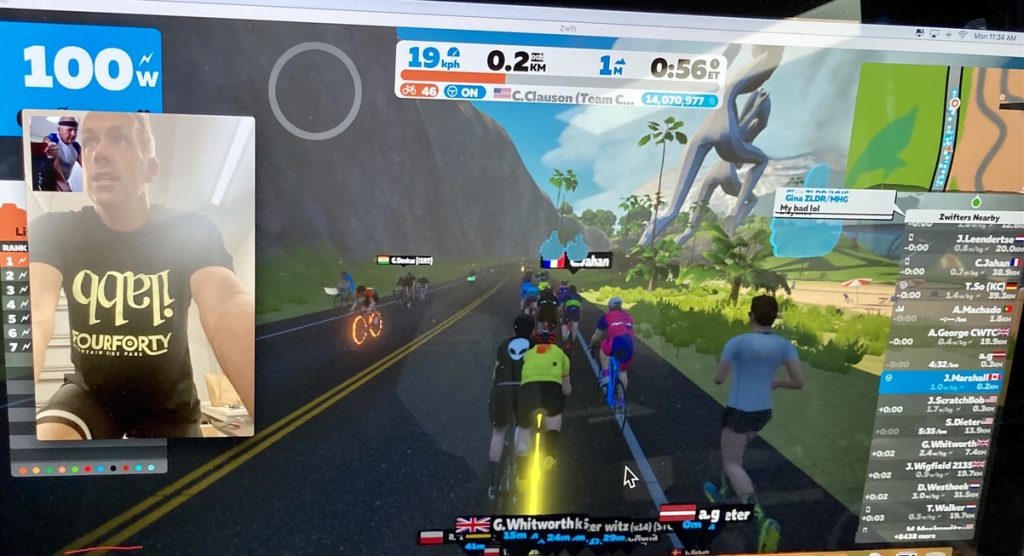
Monday morning is a very special day. Jim cycles with our son in New Zealand.
They use FaceTime to video chat while riding.
Last year when we flew to New Zealand (pre Covid-19) our son set Jim up on a trainer so they could cycle side by side.
The beauty of Zwift is that it can be used anywhere in the world!
Adapting and Overcoming
Jim is now back to golfing, hiking, and cycling outdoors. He had adapted to his present vision and realizes that there is little he cannot do, he just has to do it differently.
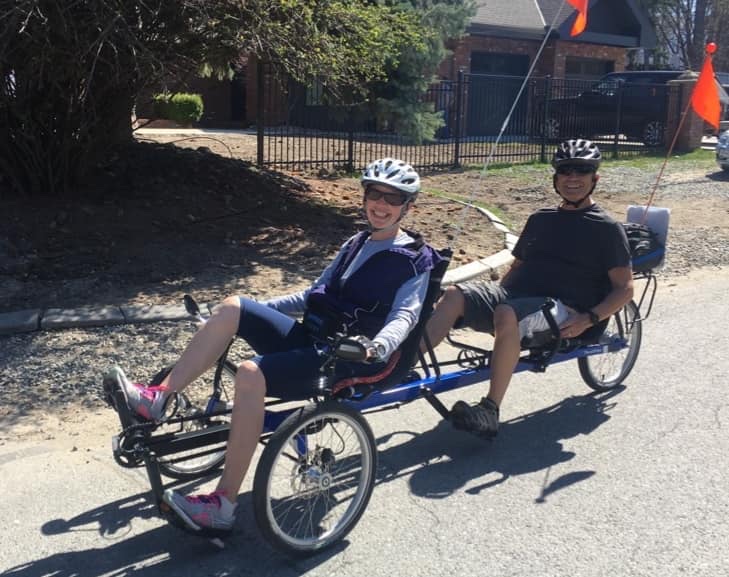
Last summer we purchased a Tandem Terra trike. We always loved tandem cycling. Unfortunately, due to Jim’s current eye status, we could not continue to ride our upright race tandem. Jim could not afford to take another bad fall from an upright bike as this would take away the little optic nerve he has left.
During the summer months you can see us out and about in the Kelowna area. Jim controls all of the gears, while I am the eyes for our special team. We have done many fundraising events on this trike.
I admit it took Jim some time to adjust to the fact that he was now the stoker
I often ask myself, “What if Jim had not been introduced to Zwift by our son?” Where would he have been today? Jim applauds Zwift as his savior, stating, “It’s almost as if it had been designed with me in mind.” Jim thrives on the ability to ride set routes, follow predetermined specific rules and parameters, and interact socially on his terms in a safe, comfortable, and nurturing environment.
He’s still competitive at the age of 66 and is always trying to achieve personal goals. Deep down Jim would be the first to admit that he does miss cycling on his own outdoors. But he is now proud to be a part of the Zwift team. He hopes that one day there will be more audio cues on Zwift for the vision impaired. He also hopes that one day research will give him some of his eyesight back.
We all have our ups and downs and health problems. Like Jim, though, there is little we cannot do when we adapt and overcome. I am proud to call him my husband of 45 years and I thank Zwift for all they do for Jim and others.
Questions and comments?
Do you ride on Zwift with glaucoma or other eyesight impairment? Share your story below!