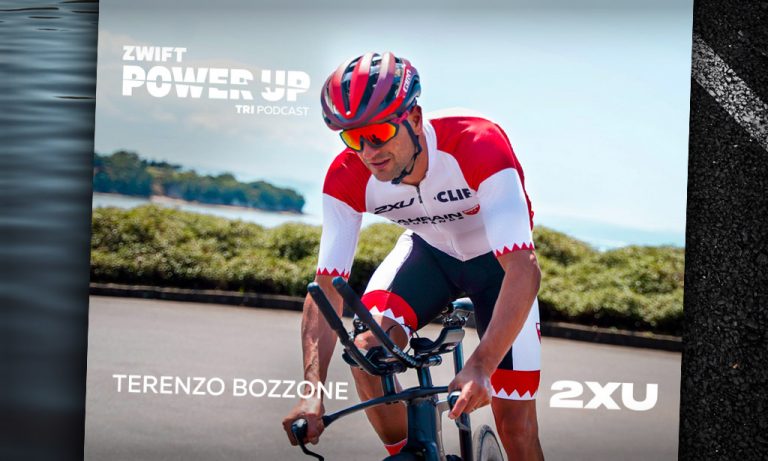
The 2XU Brick Training Series is a 6-week event series with top 2XU Pro Triathletes riding and running their favorite workouts throughout Zwift. What makes these workouts their favorite? Find out as they dish the details in exclusive interviews on the PowerUp Tri Podcast! This week, we are joined by Kiwi Pro Terenzo Bozzone.
Tune in to the latest episode each Wednesday and have a live Q&A ride or run session with top pro triathletes like Brent McMahon, Sarah Crowley, Terenzo Bozzone, and Cam Brown. Or join a recast ride every Saturday, where you can zone in the workout with the podcast.
About the Podcast:
The Zwift PowerUp Tri Podcast is hosted by former pro triathlete Matt Lieto and Zwift Academy Tri mentor Sarah True. Both are passionate about lending their in-depth knowledge of the multisport to the Zwift Tri audience.
How to Race Crit City’s Downtown Dolphin Route on Zwift
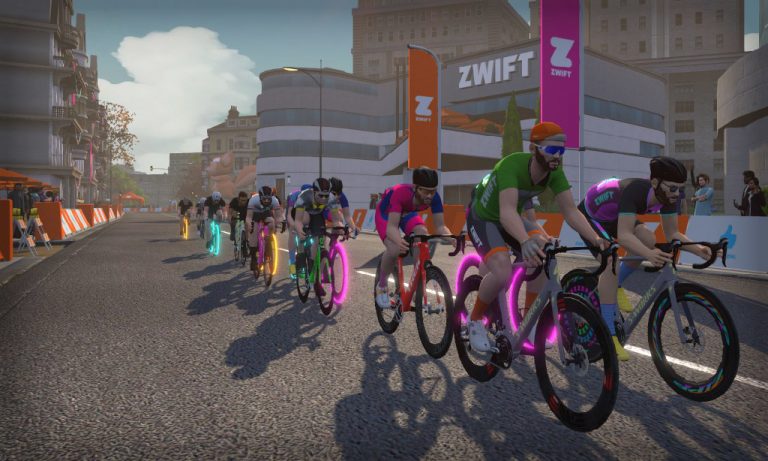
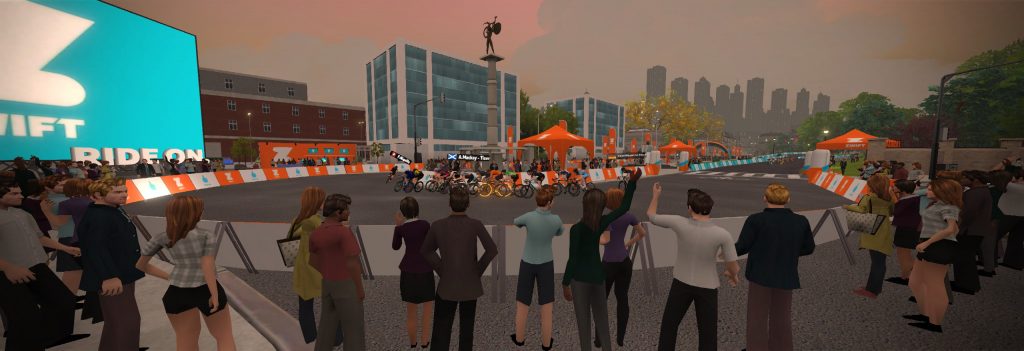
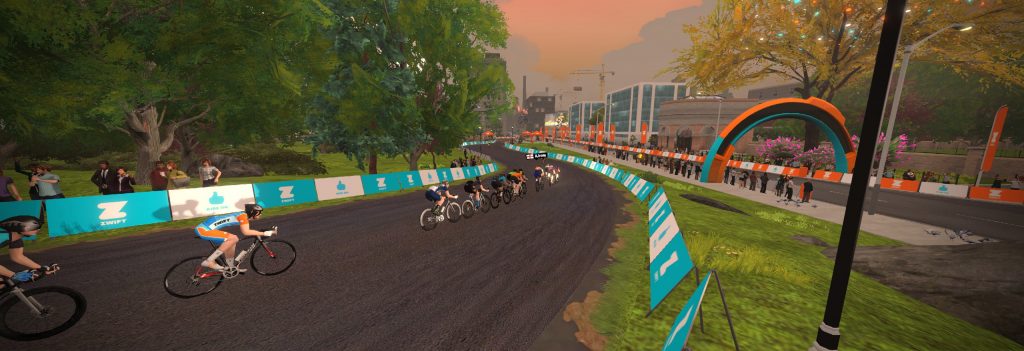
Downtown Dolphin is one of Zwift’s most popular race routes, and for good reason: events here are typically short, and the course is well-designed.
After racing literally hundreds of Downtown Dolphin laps, I thought it would be fun to put together a video with my tips for racing the course. Find the video below, with more detailed text notes to follow.
The Start
Starts on Downtown Dolphin are hard, like any other Zwift race. But the hardness here comes in two stages:
The first 15-20s you’ve got to hammer your way out of the gate to get up to the speed quickly and avoid being dropped. Several riders are always dropped here – don’t let it be you!
The first ~90s, to the end of the Brick Climb, will be a hard effort. Often 30-50% of the field gets dropped from the front group by this point. Don’t miss this key selection point!
After the brick climb things typically settle down and you can recover a bit on the downhill twisties and through the lap banner.
Dissecting the Route
Downtown Dolphin breaks into the following sections:
False Flat After Lap Banner: the slight uphill makes this a great place for a sneak attack – but that rarely happens. Usually riders are resting here for the Brick Climb effort just up the road.
Lead-in to Brick Climb: the slight downhill means you can recover just a bit, but watch out for riders pushing the pace as they move to the front before the Brick Climb!
Brick Climb (Prime) to Dead Turn: this is the most crucial attack point on the course. You’re looking at around 15 seconds of hard effort, followed by another 5-10 seconds to get up to speed after the short climb.
Straightaway Past ZwiftHQ: this is where the pack stretches out in the final lap, and where selections are cemented which began on the Brick Climb. Mind those wheels!
Downhill Twisties: the start of your recovery section, unless you’re in the final lap – then it’s a rollercoaster of pain!
Finishing Straight: more recovery, unless you’re sprinting for glory on your final lap. Also, the place where powerups are handed out!
The Finish
Finishes on Downtown Dolphin are always exciting. Someone always attacks on the final Brick Climb, which stretches things out. Then more people begin attacking on the Straightaway Past ZwiftHQ. If you’re not a strong sprinter, but have the power (or powerUP) to jump away and stay away for a minute, this is the place to attack.
You’ve only got ~50 seconds of racing left once you make the hard right dead turn after the Brick Climb. For sprinters, positioning is crucial here: if you’re too far back in the pack, you’ll probably be gapped and never see the front of the race again. So try to surf the wheels of the early attackers, without poking your nose into the wind just yet.
Sometimes those early attacks stick, but usually, the W goes to the cagey rider with a kick who surfs those early attackers’ wheels then hammers a well-timed sprint beginning near the bottom of the Downhill Twisties. For these riders, an aero powerup is highly desired. Trigger it well before the hairpin turn, then sprint to glory!
Powerups
Most Crit City races include powerups handed out at the lap banner. (If you don’t understand how each powerup works, read “Your Guide to PowerUps on Zwift“.)
With a fresh powerup every couple of minutes, it’s important to use those powerups to your advantage:
Lightweight (feather): this is an easy one – use it on the Brick Climb, triggered just as the bricks begin.
Draft Boost (van): I like to use this as a recovery aid on the Straightaway Past ZwiftHQ, since my heartrate is typically up there and the pack is stretched out. It will help you sit on a wheel or even work your way up in the pack a bit.
Aero Boost (helmet): highly desired for the sprint finish. Also comes in handy if you’re looking for some recovery mid-race, or looking to attack on a flat or downhill section.
Burrito: you’ll see a lot of these on the False Flat After Lap Banner, but it may be smarter to use it on the Straightaway Past ZwiftHQ when the pack is strung out and riders are struggling to stay in the draft.
Cloaking (ghost): can be used to surprise the competition in the final sprint or up the final Brick Climb, but only if you’ve got the kick to get away from the pack. This is the least-desirable powerup.
Steamroller: another easy one – use it on the Brick Climb. That’s the only place where it makes any difference at all.
Strategic Notes
Most riders race Downtown Dolphin in a simple fashion – sit in, then try to win the sprint. Heck, that’s what I do most days, unless I’m feeling especially strong, working with teammates, or trying to execute a workout instead of taking a race win.
Stronger riders will push hard up and over the Brick Climb, stretching out the pack, creating gaps, and dropping weaker riders from the front group. This is an effective way to thin the herd lap after lap.
Teamwork can be a lot of fun on this route – I’ve seen teams plan a hard jump on the Brick Climb, usually with 2-3 laps to go. If 3+ teammates all jump hard, you may be able to drop the rest of the group and stay away to the finish for ultimate team glory!
The penultimate lap is typically one of the easiest laps of your race on Downtown Dolphin. The pack has been thinned, and riders are keeping their powder dry for the final effort. If you’ve got a weak sprint but strong VO2 power, this is a great place to go for a surprise long attack, especially if the front pack is fairly small (5-10 riders).
The last strategic note is simply to know your power profile. If you don’t have strong 15-second power, don’t wait for the final sprint, because you’re sure to lose it! Instead, consider attacking on the Brick Climb, or just after it.
Aero rules the day here. Yes, the Brick Climb is the key pinch point of the route – but it’s only 15 seconds long, and not terribly steep. Speeds through this segment vary from approximately 35 to 42kph (21-25mph), so even on the climb, air resistance is a major factor.
This is my first attempt at a “How To” video for a particular route. A trial run, you might say. (Also, a way for my 14-year-old son to work on his video editing skills, which he’s having a lot of fun with lately.)
I’d love to hear what you think of the video (the good and the bad) and the prospect for future videos/posts covering other racecourses. Share your thoughts in the comments below!
The View from the Front: Tour of Watopia and Monday’s Mountain Massif TT
Victories on Zwift are likes buses – you can wait an eternity, then two turn up at the same time. That is certainly what happened to me.
Tour of Watopia – April 18
Like many other riders, I have been participating in the Tour of Watopia. It’s been an excellent event with a wide ranges of courses, some events I have raced, whilst others I have used as recovery rides. There was one Stage I had my eye on, all month – Stage 5: Mountain 8. Due to the Epic KOM reverse climb, this is easily my favourite route and even forms the basis of my new weekly event, the Monday Mountain Massif TT, a brutal 12.15km time trial up the Epic KOM reverse, with the finish at the Radio Tower.
I decided to race this event. Full gas. Due to racing the Epic KOM reverse on a weekly basis, I have learned how to tackle the climb, where to push to gain those extra important seconds, and where to ease off to catch my breath. This knowledge helped me take the lead in the ToW event when we hit the slopes of the climb. Well, sort of. You see, I was at the front of the race, pushing hard up the mountain and one minute I was in 1st position, then suddenly in 3rd, then 4th – yet no rider had passed me. Clearly there was a glitch in the system, or more likely there were some late joins that got catapulted to the front of the event.
I kept climbing and found myself alone out front with the nearest challenger 15 seconds behind. I crested the Radio Tower with the same gap which disappeared immediately on the descent of the mountain. I have to confess, I don’t understand how descending works in Zwift. I try everything:, pedaling, supertucking… whatever tactic I try, I can’t descend and I am always caught or lose the group I am in. This was no exception. The 15 seconds disappeared and by the valley floor I was with this rider out front but somehow it was still showing 4th place, which changed to 2nd and with 1km to go, to 1st. I was battling it out for the win. Over the last twists and turns before the finish line, my fellow escapee and I were trading 500-watt digs to try and break the other, punch and counter-punch, both determined not to yield. We approached the final 200 meters and they unleashed an early sprint, combined with a feather powerup which I could not respond to.
I was disappointed to take 2nd but out of 851 riders, I wasn’t overly so. I logged on to see my power data for 20 minutes on ZwiftPower and was surprised to see a golden trophy by my name. I’d won! But had I? I’m having trouble reconciling the fact you can lose on the road but win on ZwiftPower, exactly the same experience I faced several weeks ago with my ride up Alpe du Zwift.
Monday’s Mountain Massif TT – April 19
Mondays are quickly becoming my favourite day for cycling, simply because I really enjoy racing my own event. The 12.15km time trial up the Epic KOM is intense, no doubt about it. But it’s actually making me a stronger rider. My power output has started increasing marginally and I am currently outputting my biggest wattage.
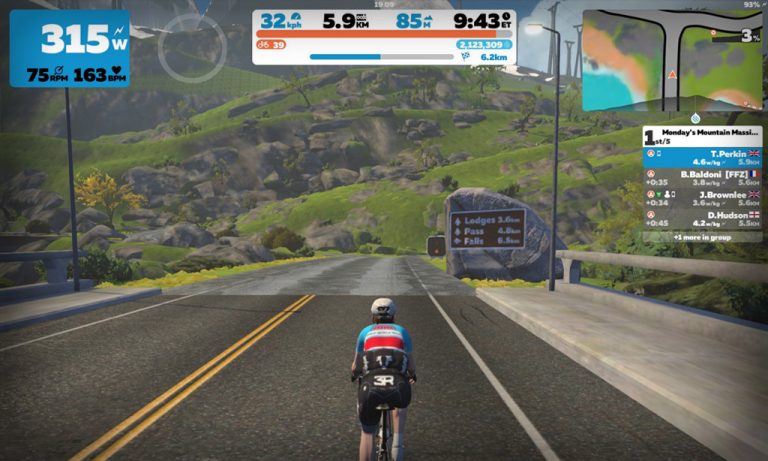
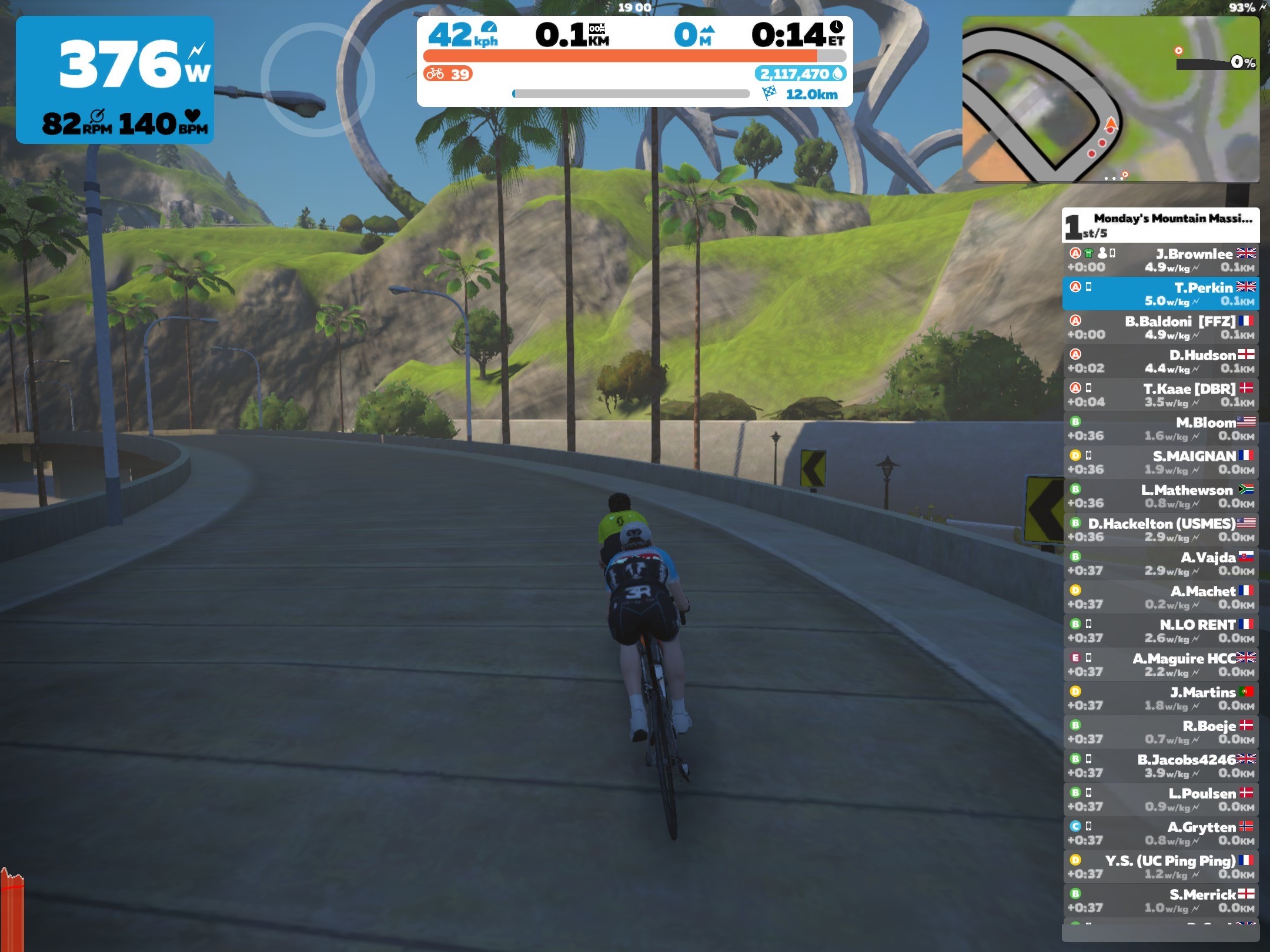
The event itself has seen many strong riders participate, with Ed Laverack currently holding the record of 26 minutes flat. I took my position on the start line in a somewhat reduced field the day after my ToW win. The nice spring weather had clearly tempted many to take to the roads outside, however one rider joined quite late and caught my eye. It was the green jersey next to his name that caught my attention, so I focussed on the name: J. Brownlee. It couldn’t be, could it? Could it be the two-time Triathlon World Champion Jonathan Brownlee? On closer inspection via the Companion app, I confirmed it was!
I felt very proud and privileged that he joined my event but at the same time I knew I would be now racing for second place as I could not compete with someone of that athletic pedigree. I thought “go full gas and hang on as long as you can.”
I spun up the legs and as the clock counted to zero, I exploded from the pen, but so did everyone else, including Jonny. He took the lead within the first 100 meters and so I made sure I took a photo on my Companion app, convinced I wouldn’t see him again and wanting a souvenir to show people that a two-time Triathlon World Champion attended my little event. But then something strange and unexpected happened.
I overtook Jonny.
I was in the lead of my own event. I was confused. It wasn’t meant to be like this. This wasn’t in the script. Jonny was supposed to be flashing past me, up the road and I would settle into a routine and try and fight my way up the mountain and battle for the top 10, at best.
But I was in the lead and we hadn’t even got to the climb. I started pushing, going as hard as I dared. I knew it would take between 6 and 7 minutes to get to the start of the climb, so focussed on trying to keep 5 watts per kilo until that point. But I started pulling away from Jonny. I’m sure he was just doing his own training programme, but in my world, I was flat out racing him, like a Triathlon World Championship title depended on it.
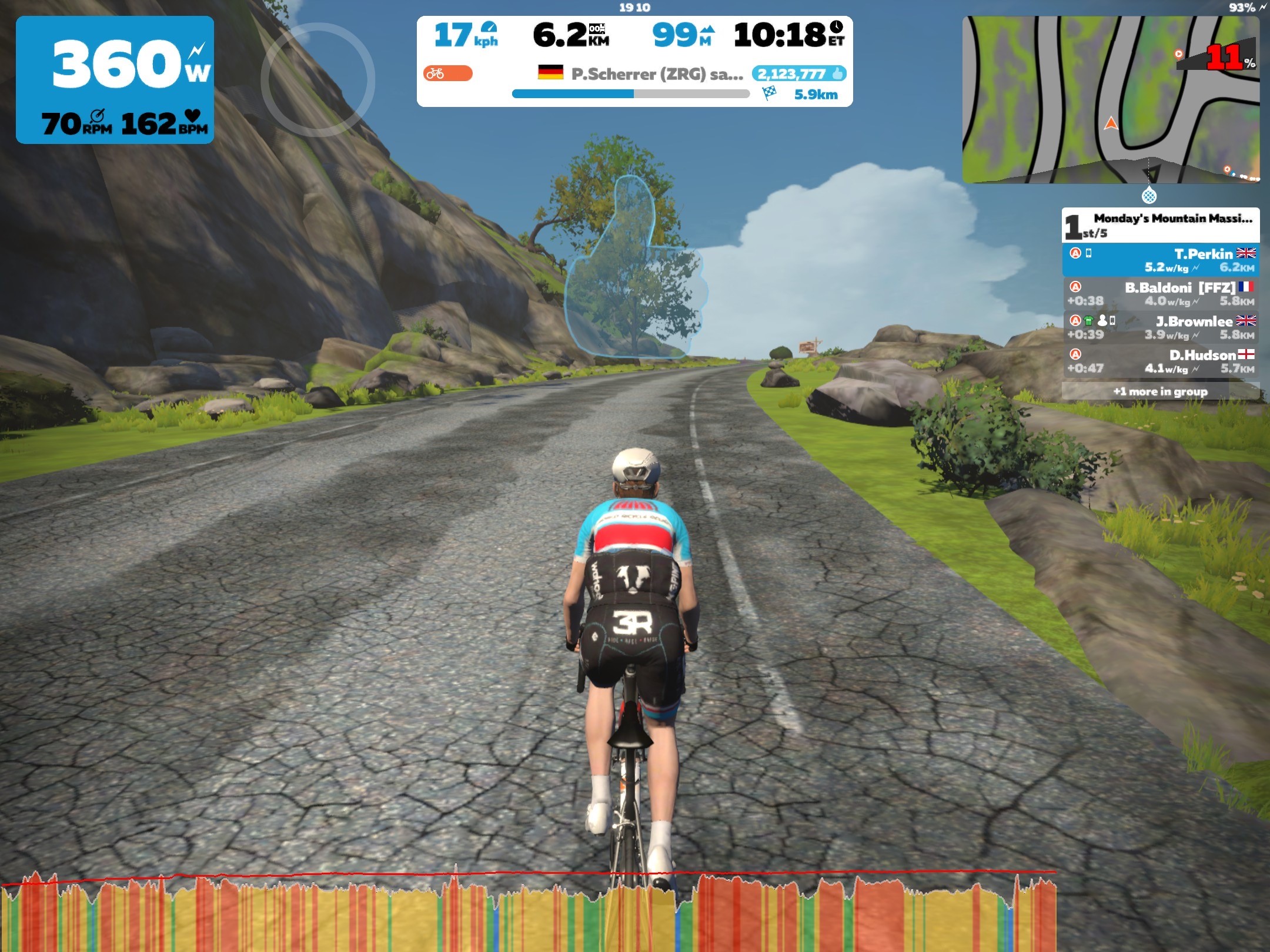
I like the start of the climb, just after the blue KOM line, that short steep section always explodes races and I use it as a springboard to get into my rhythm. I am able to push 6 watts up the first section before it plateaus. I think it’s the momentum from the flat that allows me to power up the first part of the climb, and I used that tactic to my advantage, pulling further away from the riders behind.
At the start of the mountain climb itself, Jonny had slipped to 3rd position and I had a 35-second lead. Had I pushed too early? Had I gotten overexcited and gone too hard? The next 20 minutes would reveal.
My legs were certainly not fresh as a consequence of the previous day’s all-out effort and I was in pain, but I was determined not to let the winning position I was in slip through my fingers. So I ignored the dull ache that was increasing and focussed instead on the time gap to the riders behind me. Despite my fatigue, I was eking out a slender lead and with 3.8km to the finish, I had a 1 minute 19 second advantage. I wasn’t confident of victory. I feared for a technical glitch as equally as I feared my legs failing on the final climb up the Radio Tower.
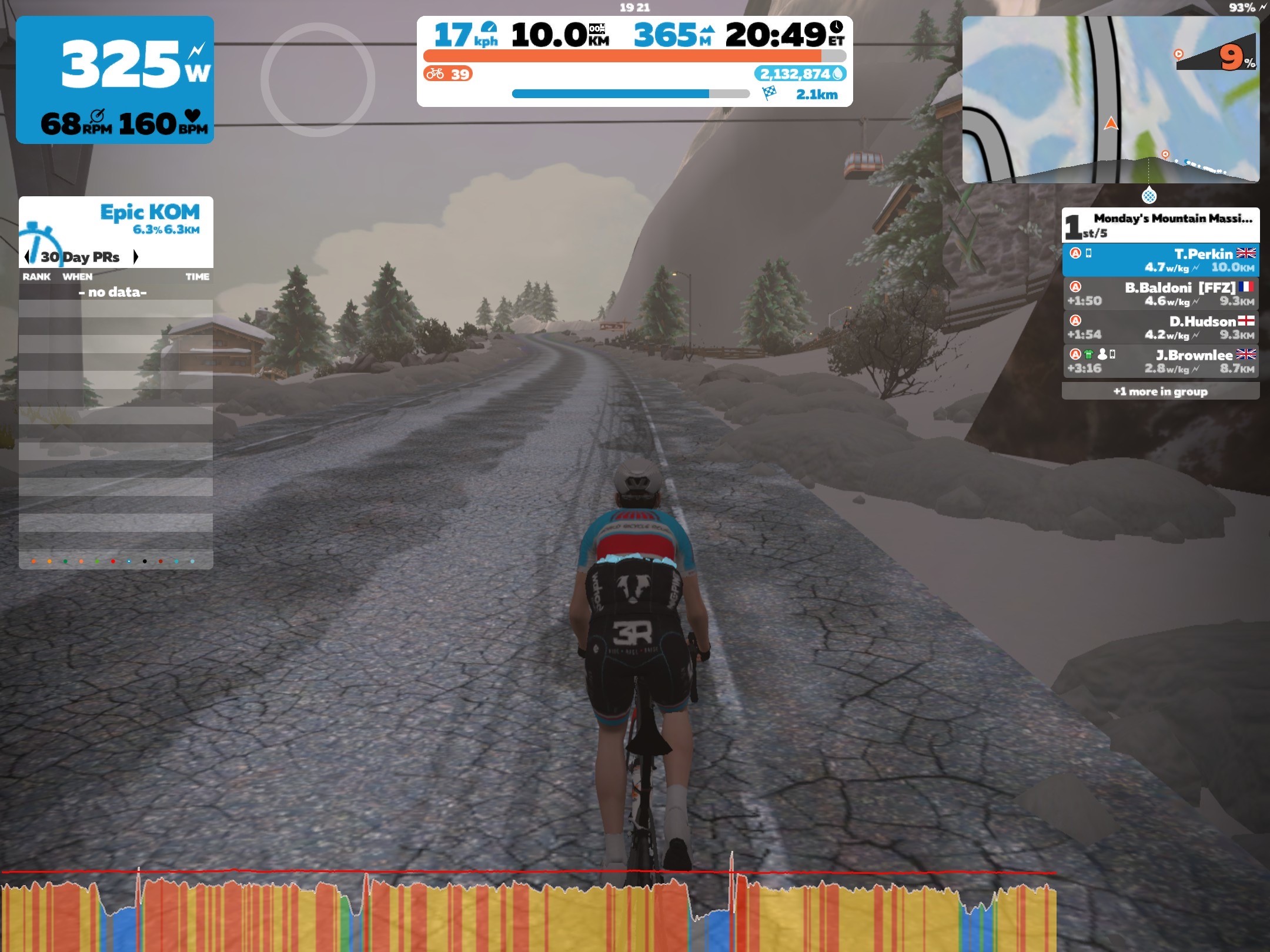
20 minutes into the event and I was now tired, but fortunately, so were the other riders as our watts per kilo were the same and I was starting to sense that I may be able to win. So I pushed, ignoring the pain in my thighs. I was able to increase my lead still further to 1 minute 50 seconds with 2km to go. I was pushing close to 5.1 watts and knew that if I was to be caught, someone would have to literally fly up that mountain or I suffer a mechanical.
Onto the Radio Tower climb! I was seriously fatigued, up and out of the saddle to relieve the strain on the legs, changing down to the lowest gear to keep the legs spinning – this was desperate stuff, and hilarious to watch I am sure. I certainly wouldn’t be good streaming on YouTube! With 500 meters to go and a lead of 2+ minutes, I started realising I was going to win and what was nice was that it was my own event! I didn’t relent, I kept pushing until the finish and I crossed the line in 29.03 – at long last, after 200 races, a legitimate win on the road, as well as on Zwift Power. Hallelujah!
Dare I say it, but Zwift is becoming more fun than cycling outside…
The OG KOM – Tips for WTRL TTT #108 – Watopia Hilly
Each week I give you a profile of the upcoming WTRL TTT route, guidance on bike choice, and some target times if you want to aim for the Premier League (top-teams in each coffee class get to be in a special race televised on YouTube).
If you can’t ride, or even if you can ride, but want more action, don’t forget to tune in to the live TV show on Zwift Community Live’s YouTube Channel at 6:15 (UK time).
Review of TTT #107 RGV
My prediction
PL Spot
My team’s place
Vienna Espresso
36:50
36:23
10th
Vienna Frappe
37:20
37:19
10th
Vienna Latte
38:50
40:12
8th
Vienna Mocha
42:30
40:00
14th
Mixed Doppio
31:50
33:34
7th
Mixed Espresso
32:45
32:05
17th
Mixed Frappe
33:20
33:13
14th
Mixed Latte
35:40
35:30
14th
Mixed Mocha
39:55
39:30
15th
How did I do? Gluttons for punishment can look at my live stream, but somehow I messed up the audio. Saving you the effort – I was dropped by the strong Bs in our Frappe team. I’d like to be recovering better but the legs can only do what they can do!
Thursday 13th May – Three laps of Watopia’s Hilly Route
From France back on Watopia… in fact, this week it is the oldest route in Zwift if you exclude Jarvis Island! This route hasn’t seen a lot of TTT action, though – just once last year, then all the way back in December 2019!
We will be doing three laps of Watopia’s Hilly Route for a total of 27.4km. Starting at the downtown pens go straight up the original climb, Hilly KOM. Down the long descent into the Italian Villas and through the sprint – then it’s across the Esses and back to downtown.
Hilly KOM is the obvious test here – but the Esses always add a piquant flavor to a team event too!
What to ride?
Hilly describes this course well – it’s not flat like last week, but it’s also not mountainous. Use the bike to balance your weaknesses so you can stay with the team. That means if you are weak on the hills, lighten your bike and wheel combo. But if you are strong on hills and struggle to keep with the team on the downhill and flat, go completely aero!
I’m taking the balanced line – I will be on my Tron, which I hope will give me a helping hand over Hilly, while not giving up too much aero on the descents and flats.
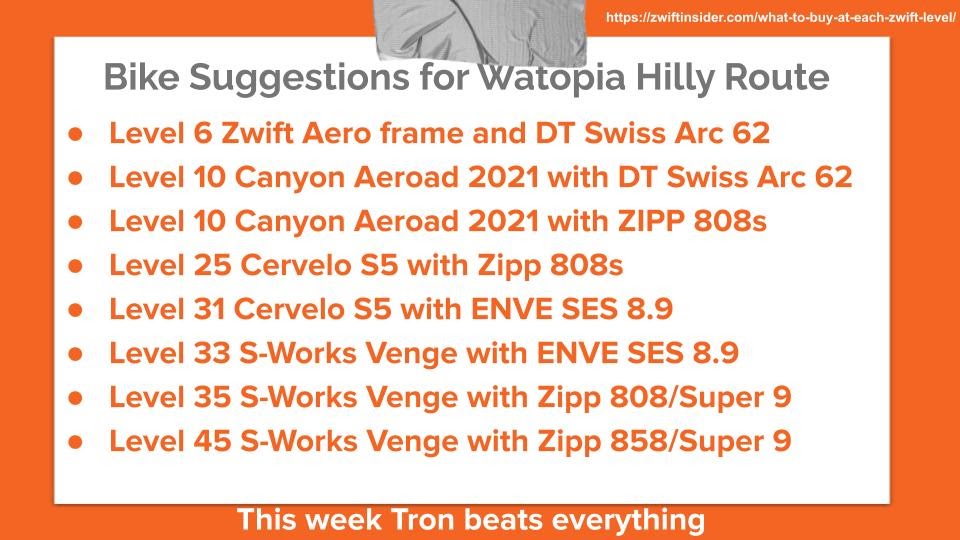
Here are some recommendations at various levels – but definitely head over to Eric’s page on what to buy at each level.
I know I say it every week but it is doubly important this week. Get the Tron! There is no better ride this week, and if you are Level 45 without having completed the Everest Challenge, shame on you (yes you, Simon Schofield!)
Route Recon Rides
There are lots of rides on ZwiftHacks but good news, I did the ride so you don’t have to!
Here are some key moments if you don’t want to watch the whole thing:
Two areas of this route will define your success – up and down the Hilly KOM, and then through the Esses.
You will climb the Hilly KOM with fresh legs at 1km, then again at 10km, and a final time at 19.5km. Each visit will have a different story! Just under a kilometer in length, the climb comes in four distinct parts – how much you feel the distinction will depend on how tired you are.
The first 400m is steep, averaging 7% but up to 10%
It flattens for 50m as you round the bend, then
Tightens back up to 6% again for 300m, then
Eases to 2-3% for the remainder of the climb.
Talk about how you will handle this among the team – but make sure you stay together.
The other area to watch is the Esses. Going in this direction, you start with the hill which is 300M long, averaging 4%. I find this harder than it should be… and I’m not sure why. After that, the Esses themselves are a sequence of four rollers. Not hard to ride, but the ascent/descent causes some instability in the team with different riders’ momentum causing some challenges.
Target times
Here are my target times if you want to bag a PL spot.
Category
Vienna
Mixed
Doppio
36:20
Espresso
39:30
37:20
Frappe
41:30
38:30
Latte
46:00
41:50
Mocha
49:45
48:10
Wrap up
This race is all about getting the team up the Hilly KOM, and whether you accelerate or break apart through the Esses. It’s a short TTT in distance, but technical in nature. As is often the case – quick decision making and good communication will be critical.
In the days before the internet and Zwift, the British Cycling scene consisted of 3 key pillars (in my opinion). These were your local bike shop, your local cycling club, and the latest edition of the Cycling Weekly magazine.
The world’s oldest cycling magazine
In 2021, Cycling Weekly is celebrating its 130th anniversary. It is actually the world’s oldest cycling magazine, first published by the Dangerfield Printing Company in January 1891. It is the only cycling magazine to be published weekly, the latest copy being available every Thursday in newsagents across the UK.
The magazine’s longest-lasting contribution to the sport was the creation on 4 April 1930 of the British Best All-Rounder (BBAR) competition for individual time trialists. The BBAR competition is a national event aimed at finding the time-trialists who can claim to be the best over a range of distances. However, all riders who attain the appropriate standard are recognised. It ranks riders by the average of their average speeds in individual time trials over 50 and 100 miles (160 km) and 12 hours for men, and over 25, 50 and 100 miles (160 km) for women.
Cycling Weekly on Zwift
When looking through the events on Zwift, I was delighted to see a time trial event hosted by Cycling Weekly. So I reached out to their Editor, Simon Richardson, to get more information.
Simon told me that last year, as a result of the global pandemic, people were missing their local, friendly cycling events, particularly the weekly “Club 10.” For the benefit of our non-British readers, the “Club 10” is a reference to a weekly 10-mile time trial that is most notable in the springs and summers as cyclists can be seen racing along the British country lanes.
With this in mind, Simon and his team contacted Zwift with the intention of recreating the local British institution of the “Club 10”. Before long the “Cycling Weekly Club 10” was born, linking back to the roots of Cycling Weekly and the creation of the BBAR.
The event takes place on Zwift every Wednesday (6pm GMT/2pm EST/11am PST) and is now sponsored by British clothing brand HUUB. Results are published in the magazine and online.
About the event
These TT events take place on different courses every two weeks, to cater for the abilities of different riders, for example, there is the flat course of Tempus Fugit to contend with, which is contrasted by Bologna’s hard and punchy climb. This is designed to ensure that the event remains competitive and also ensures people have to think about equipment selection as that can have an impact on timings and results. The event is well attended with around 250 weekly competitors.
What: 10 mile individual time trial
When: Every Wednesday, 6pm (GMT)
Course: Variety of courses including Tempus Fugit, London 8, Bologna, Tick Tock, Innsbruck, rotating every 2 weeks
Having raced the event myself, I can testify that the field is very strong, competitive and predominantly British, with the top 10 men pushing mid to late 5 w/kg, whilst the top 10 women were pushing a little under 5 w/kg. With a large field and with both sets of competitors starting at the same time in an organised system via the time trial conveyor belt, there is always someone to try and “chase down,” making you dig deeper than perhaps you would normally do.
Past winners
For the last several week’s Pete Younghusband has been winning the event, along with Cassy Smith, however, I did spot a victory for Zwift Insider’s very own Ed Laverack, with a time of 22:43 in week 6, on the Bologna course.
One past winner, Callum McQueen, used the Cycling Weekly event to showcase his talent and was recognised by the Canyon cycling team and as a consequence, has now secured a spot on their development team. At 21 years old, he is certainly a rider to watch out for in the future.
Summing Up
Looking at the results on Zwift Power, it is evident and no surprise that the mainstays of the event are British cyclists. So if you fancy testing yourself against “the British” and want to take part in this very traditional event, then sign up and have a go!
Remember, if you win, your name will be published in the weekly magazine and if you are an international winner and not able to pick up a copy to see your name in print, I am sure Simon would send you a copy for posterity.
Beginning Zwifters are starved for advice. And there are plenty of places, like Zwift Insider, where you will find valuable bits of knowledge. The amount of time and effort these resources have saved me is priceless.
At the same time, on certain occasions some Zwifter colleagues, with the best of the intentions, have given me the most useless pieces of advice. Sometimes because they are wrong, sometimes because they are so obvious, and finally sometimes because they raise the notion of stupidity to levels one might think impossible.
I am sure many of you have experienced that moment where someone, almost whispering as if he was about to reveal to you the secret of eternal life, tells you: listen to me because what I am about to tell you is reaaaaally important… and then says:
Keep some strength for the end of the race. Thank you! Because I was planning to give it all in the first kilometer, every single drop of sweat and just die in the second kilometer. Thanks to your wise words now I am going to give it all in the 5 kilometer…
Take it easy at the beginning. I followed that advice on my first Zwift race… only to discover after 30 seconds that everybody sprinted and I was by myself, 102nd out of 102. Thanks for the advice mate.
Press hard on the pedals. Oh really? That’s how cycling works? The harder you press the faster you go? What a strange mechanism! I did not think about it this way. Followup question: do you mean on both pedals or will only one be enough?
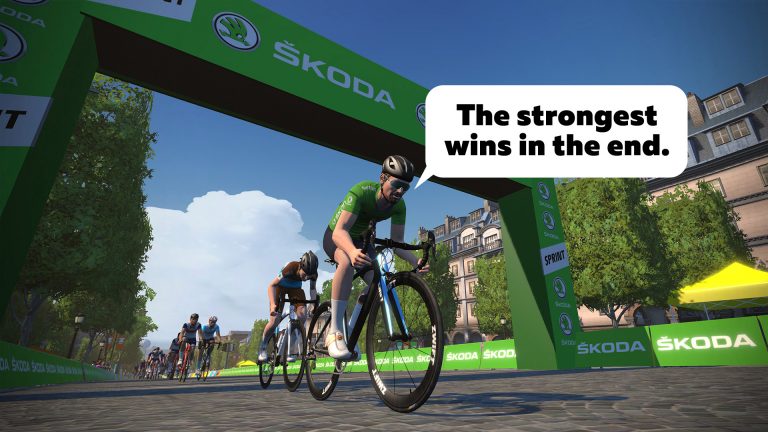
The strongest wins it the end. How unfair is this? Because in most of the other sports I am quite sure the weakest wins, right?
Use the feather at the highest gradient in the KOM. Thank you! Because I had spotted this absolutely flat 2km in the circuit where I was planning to use the feather if I had one. But now that you’ve told me this it makes sense!!! Thank you for existing!!! I don’t know if I would survive without your precious precious advice!!!!
Stay in the draft as much as you can. Thank you!!!! Since I love wind in my face slowing me down and making me waste tons of watts I was planning not to get my share of draft and give it to my competitors. Do you have any other gems of advice like this one you would like to enlighten me with?
You should warm up before the race. You mean it is not advisable to go from absolute deep sleep to 10000w in one second? Because my intention was to destroy all my muscles at the start of the race and injure myself for many weeks.
We should try not to lose anyone during the TTT. Hallelujah!!!! You deserve the Nobel Prize for the most useless advice ever. Because we are all idiots and were planning to free ride, each one at our own pace, without saying anything to anyone. But thank God you came through with this wonderful advice and now only two of us idiots will free ride!!!
Choose the lightest bike possible for your Everesting. Woah, what incredibly insightful advice!!!! Thank God you told me because I was planning to take the Buffalo Bike and tie two or three Watopian brontosauruses to the wheels for the entire twelve hours and almost 9k elevation of the challenge!
It’s all in your head. The stronger mentally wins the race. Are you serious?!?! Did you ever climb Alpe du Zwift? 18th turn, three to go, when all the veins of my body are about to explode, it’s just in my head?!? So it’s just a hallucination?
Join the pen before the start of the race. Thank you!!! So you mean I need to be in the starting area at the start of the race? I would have never guessed that without you telling me?!!!
You have to register for the event to be able to race. Whaaaaaaaat?! Is that a secret trick only the VIP ought to know? I thought Zwift would guess by itself the events I would go to and bring me there by magic!
Drink if you feel thirsty, eat if you are hungry. OMG thank you for that utterly useless advice!!! I did not know that! My plan was to totally starve, dehydrate myself to death and resuscitate in the form of a Pace Partner Zombie haunting the Fuego Flats!
Make sure you have connected your smart trainer before the race. Thank you!!! I have now been zwifting daily for over a year. But I never thought of connecting my smart trainer!!!
Don’t forget to breathe during the race. Really, are you sure I should breathe? Is this scientifically proven I need to breathe? I am going to think about that one because I am quite positive I can do the Uber Pretzel in apnea!!!
Be careful, it’s a short (for a 5km event) or a long (for an event on the Uber pretzel) or a flat (Tempus Fugit) or a hilly (Road to Sky) ride. Thank you! When I saw the profile of the circuit was saying 125km and 3.000 meters elevation I did not know what it was referring to! Now I know it’s long and hilly!!!
Do the best you can. Thank you!!!! I was planning to do the worst I can but now that you’ve told me I think it is not such a bad idea to try to do the best I can!!!
You should train to improve. What a disgrace!!!! I thought that only by paying my Zwift monthly subscription fee and slurping whipped cream milkshakes on the sofa I would improve by divine intervention! So you mean you need to actually make an effort to be better?
You should check your Internet connection. This one pushed me to near spontaneous self-combustion, as I had just been dropped out of a ZRL race literally 150 meters before the finish line. So thank you for this wonderful advice you sent to me via telegram that I would not have received without an Internet connection!
Within your circle of Zwifter friends I am sure you can spot at least one of those guys able to industrially produce utterly useless advice. I would really like to hear some of them – comment below!
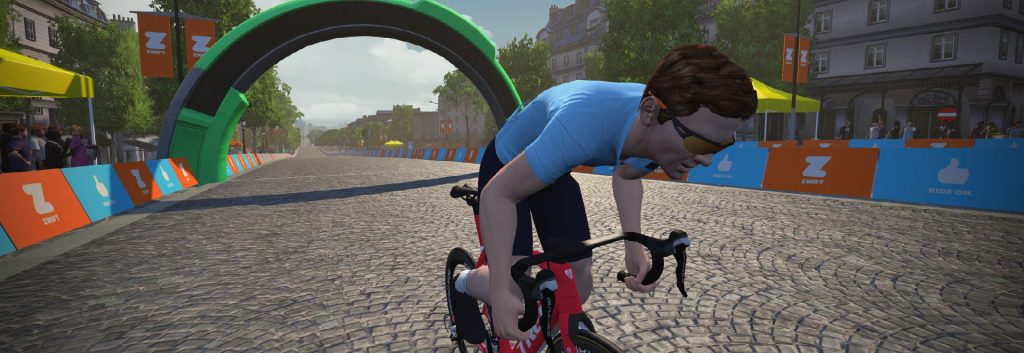
The fourth points race of Zwift Racing League Season 3 happens Tuesday, May 11th. After last week’s punishing Cobbled Climbs effort this week’s route may seem like a vacation. And perhaps it is – after all, we’re riding in Paris on what may be the most recognizable road in the world: the Avenue des Champs-Élysées!
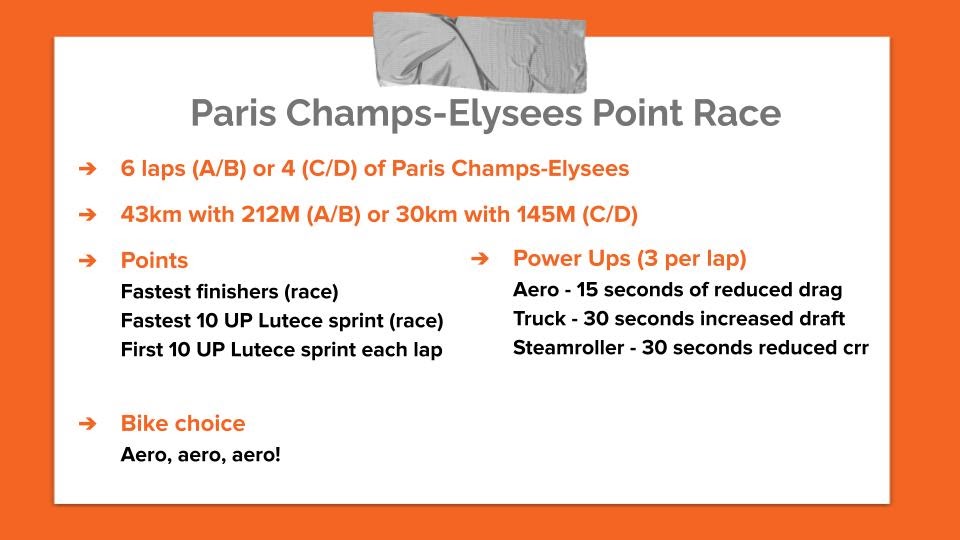
A/B racers will be riding 6 laps, while C/D will be riding 4. Let’s dig into the course, including some tips for bike choice and strategic options.
Looking at the Route: Champs-Élysées
Watching the Tour de France pros race on these roads for stage 21 may have given you the mistaken impression that it’s a flat route. But it really isn’t!
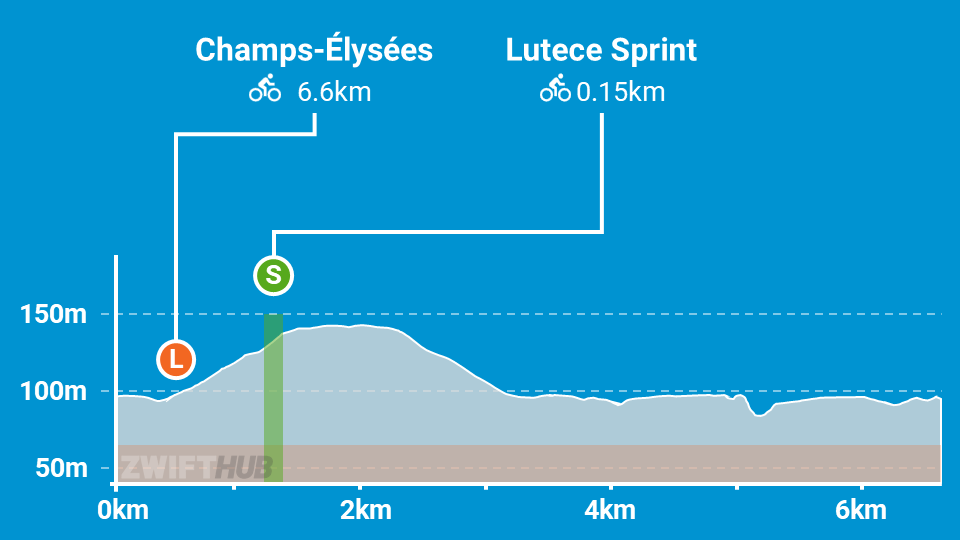
As you can see from the Veloviewer profile above (and the ZwiftHub profile below), the road climbs up to the Arc de Triomphe. This little climb even has a name – the 1.3km Montée des Champs Élysées!
It’s not a steep climb, averaging just 2.1%. But this is where the big efforts happen on every lap, especially when you’ve got an intermediate sprint near the top of the climb as we do this week.
The only other bump worth mentioning is the dip down then back up as you round the back of Jardin des Tuileries, with the Louvre on your right. In this direction, though, the rise is much less noticeable than when you’re going the other way – so just mind your pack position, and possibly use it to launch a final long attack with 1.3km to the finish line on your last lap!
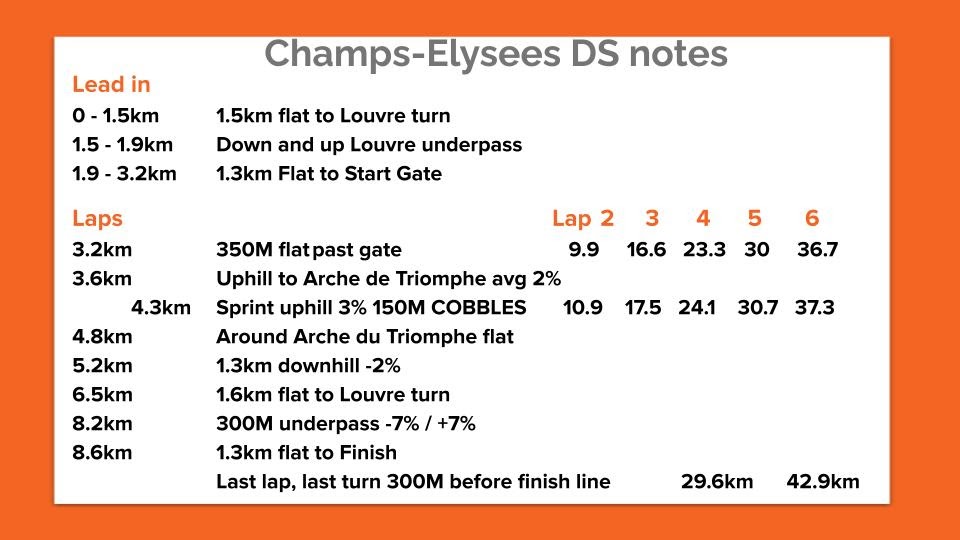
Each lap is 6.6km, and you’ve got a 3.2km lead-in from the start pens.
The sprint segment here will be the most animated section of the race (apart from the finish) since it’s on an incline and riders can earn intermediate sprint points. A few key bits of info on the Lutece sprint:
It’s short – only ~150 meters long. Expect times in the 10-15s range. Time your powerups appropriately.
It’s long: expect the hard effort to begin well before the sprint start line, since you’ll be on an incline for approximately 1 kilometer before the sprint starts.
The start line is nearly impossible to see. If you’re chasing fastest-through-segment points, we recommend pre-riding the route so you know where the sprint begins, because in a large peloton it’s hard to spot.
The hill continues after the sprint. Don’t just sit up after the sprint banner! Expect attacking riders to keep the power on through the banner until the road levels out, as this is the most logical place to attack and force a selection on this route.
PowerUp Notes
Riders will be awarded powerups through the start/finish banner as well as the sprint banner, meaning we’ll get 2 powerup chances per lap. Three powerups will be given out at each banner:
Aero Boost (helmet): makes you more aerodynamic (reduces your CdA by 25%) for 15 seconds. Use this if you’re contesting the sprint intermediate, attempting an attack at high speed, or just trying to catch a breather in the peloton on flat or descending road.
Steamroller: reduces Crr for 30 seconds so you roll as fast as a road tire on pavement regardless of wheels or road surface. If you’re on a road bike, use this when you hit a dirt patch. (It also provides an advantage on cobbles, bricks, wood, etc.)
Draft Boost (van): increases the draft effect you are experiencing by 50% for 30 seconds. Use at higher speeds (flats and descents) when you are already drafting off another rider (since this powerup only helps when you are drafting.)
After week 2’s steamroller craziness on the Dirty Sorpresa, some Zwifters are wondering just what sort of effect the steamroller will have in this week’s race on the cobbles. To understand this, you might first want to check out our post all about Zwift Crr.
Using some basic physics calculations, we can figure out what sort of wattage savings the steamroller delivers at a given speed for a particular weight rider. Here are some “race pace” numbers you may find interesting:
At 50kph, a 75kg rider saves 25W using the steamroller on cobbles
At 50kph, a 75kg rider saves 214W using the steamroller on dirt
At 40kph, an 85kg rider saves 23W using the steamroller on cobbles
At 40kph, an 85kg rider saves 195W using the steamroller on dirt
So you can see the steamroller’s effect on cobbles is much smaller than on dirt. But it’s still there, and it lasts for 30 seconds.
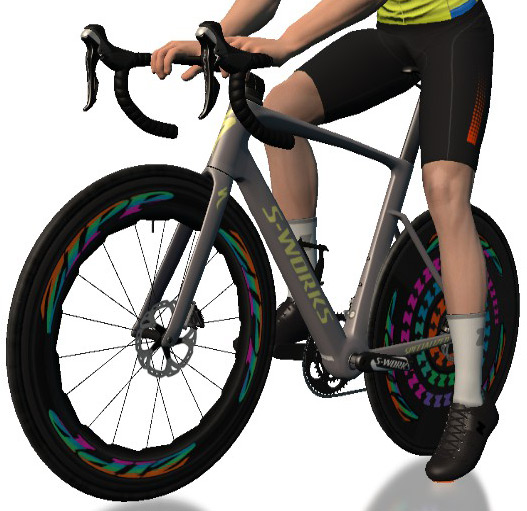
Venge S-Works with disc wheels
Bike Frame + Wheel Choice
While this route has a bit of an incline each lap, it’s very draftable. Aero wins the day, hands down.
Editor’s note: Sherpa Dave has put together a race recon video and some helpful notes.
Every year the Tour ends in Paris… and it’s a day for the sprinters. The Zwift version of Paris mirrors laps around the Champs-Elysees, looping the Arche-Du-Triomphe at the top and the Jardins des Tuileries at the bottom. (Funny story: on the video I don’t mention the Jardins because I had no confidence of how to pronounce Tuileries. And did Paris-based CICC help me out? No they did not!)
Last week was for the puncheurs, this week is for the sprinters with a fast 6.5km per lap, and one short uphill sprint each lap as the intermediate. I don’t think there is a lot in the way of strategy for this race: go hard, go fast, and don’t slow down! Even the powerups are pretty straightforward and each of them (aero, truck, steamroller) have pretty much equal benefit on the sprint!
Interesting but largely irrelevant observation: clearly nobody at Zwift has taken a sailboat up the Seine to Paris like I have. All the sailboats in the river have their masts up! How do they get under the bridges?
If all you want are the facts, here is the one-page print-off sheet with the key distances:
This one will be fast and furious! I love Paris, and the way Zwift rendered the scenery is wonderful, whether you’re using the drone to see the Jardins, or catching glimpses of the Eiffel Tower in the distance. Of course, you won’t be seeing any of that through the sweat dripping into your eyes!
No Breakaways Course Preview
Here’s the course preview from Rick at No Breakaways:
Strategic Options
This is a points race, so everything comes down to the sprint efforts and the finish. All the miles in between are just the setup.
Here are a few predictions about what we’ll see in this race:
The peloton will string out through the sprint banner each lap, but reform on the descent and flat that follows.
Fastest Through Segment top 10 times could be set on any lap, because the peloton will stay sizeable and the sprint is both short and draftable.
Speaking of sprint segment times – the battle for these will be fierce on every lap. Both FAL and FTS times will be hotly contested by a sizeable peloton, not a small front group like we saw last week.
The race will end in a pack sprint containing 30-50% of the original starting field.
Some riders will try to go long thanks to course features like the kicker on the backside of the Jardins, and the fact that the finish banner is visible from far off. This will force the finishing effort to be even higher (longer) than usual.
Your Thoughts
Any insights or further thoughts on the big race? Share below!
Lauren Kitchen’s HIT Intervals workout will be the focus of the VoxTour 2021 events this weekend. Lauren is an Australian professional cyclist riding for FDJ Nouvelle-Aquitaine Futuroscope.
The VoxTour has the objective of introducing more fans to Women’s Pro-Cycling and showcasing the training that is undertaken by these incredible athletes.
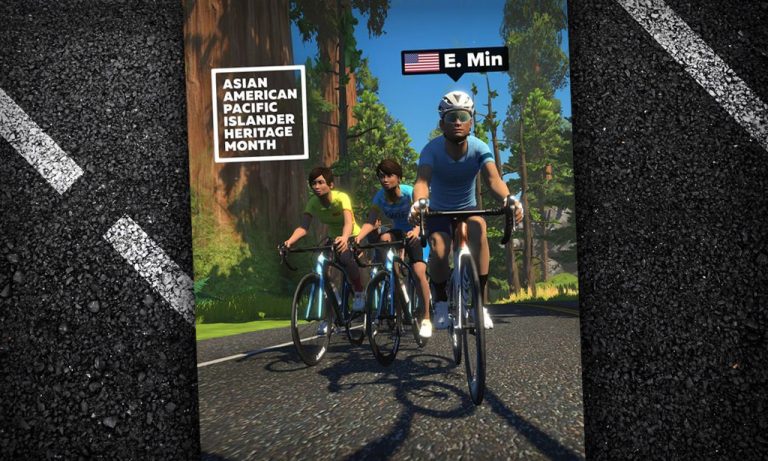
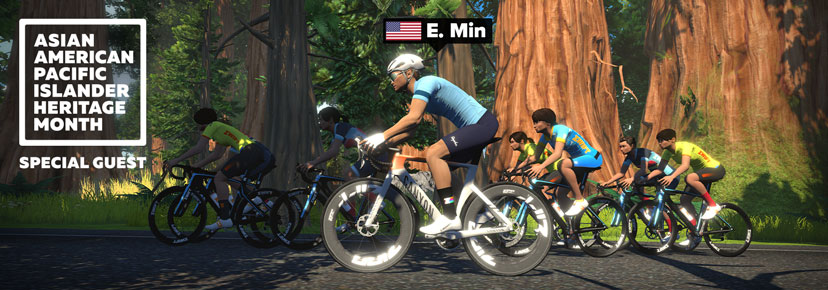
Ride with Eric Min – Asian American and Pacific Islander Heritage Month Ride
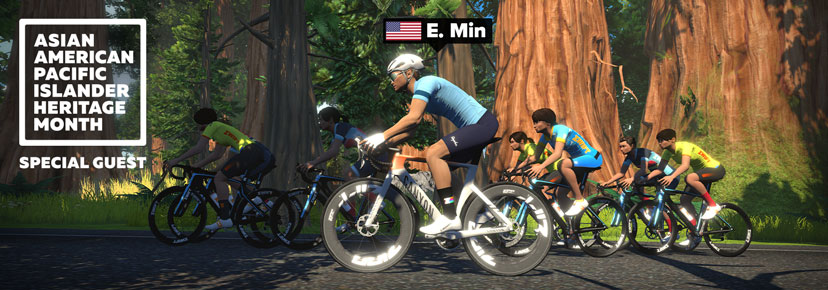
To celebrate Asian American and Pacific Islander (AAPI) Heritage Month in the United States, Zwift is hosting a marquee event tomorrow: a ride through Watopia led by Eric Min, CEO of Zwift. Eric and the team at Zwift have the goal of “send a resounding message to our AAPI employees and Zwifters that we embrace them, not just in May but throughout the year.”
This is a social ride led by members of the Invictus Games international community of serving military personnel and veterans who use cycling to recover from injury. It’s a sub-2.0 w/kg (Cat D) weekly group ride with the goal of keeping the group together.
The Invictus Games use the power of sport to inspire recovery, support rehabilitation and generate a wider understanding and respect for wounded, injured and sick servicemen and women.
The 3R LaGuardia Super Sprint is a short, high-intensity race. Basically, this event is insane. Being so short, you need to come prepared and by that I mean well warmed up. The start is one of the most frantic experiences on Zwift as people literally “blast from the blocks” and keep going. Everyone fights to stay near the front of the group. You have to be alert and cover every move or the pack will be gone and you will be wonder what happened. It’s such fun and we recommend giving it a try, at least once.
Asian American and Pacific Islander Heritage Month Ride with a Eric Min Tomorrow
To celebrate Asian American and Pacific Islander (AAPI) Heritage Month in the United States, Zwift is hosting a marquee event tomorrow: a ride through Watopia led by Eric Min, CEO of Zwift. Eric and the team at Zwift have the goal of “send a resounding message to our AAPI employees and Zwifters that we embrace them, not just in May but throughout the year.”
Event Details
The ride is being hosted on Saturday 8th May, 7:30PM CEST/10:30AM PST, on 1 lap of the Sand & Sequoias route, which is 20.2 km (12.6 miles) in length with a lead-in of 2.4 km (1.5 miles). It will be a gentle ride, between 1.5-2 watts per kilo.
Eric is leading the ride himself and is excited to join Zwifters from all over the globe in celebration of the AAPI community. Born in Seoul, South Korea, Eric’s family emigrated to the USA when he was a child (Eric considers himself a New Yorker). As a junior, Eric was an accomplished cyclist, reaching the USA Olympic training camp.
More Events this Month
Throughout the month, to continue the celebration, Zwift are hosting Ride and Run Events celebrating the AAPI community, including more rides and runs led by multicultural employees of Zwift.
What is Asian American and Pacific Islander Heritage Month?
For those who are not familiar, Asian American and Pacific Islander (AAPI) Heritage Month is observed annually in May in the United States to celebrate the contributions that generations of AAPIs have made to American history, society, and culture. Originally this was a week but in 1992 it got extended to a month, with May being officially designated as Asian-Pacific American Heritage Month.
Investing in Local Structural Change
It is also important to note that Zwift are going further than just hosting events. They are donating $25,000 to the LA chapter of Asian Americans Advancing Justice (AAAJ). Their mission is to “advocate for civil rights, provide legal services and education, and build coalitions to positively influence and impact Asian Americans, Native Hawaiians, and Pacific Islanders and to create a more equitable and harmonious society.”
Within the company
Within the company, Zwift are hosting a number of internal events to observe AAPI heritage month, partnering with leaders within the community and team to elevate important and necessary conversations around AAPI issues.