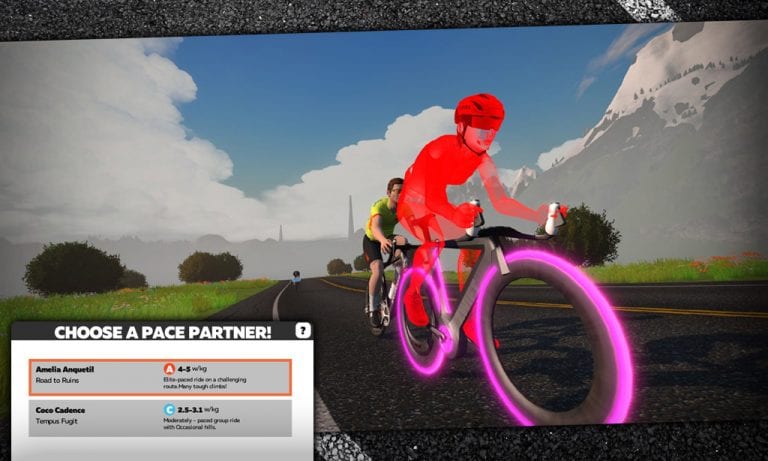
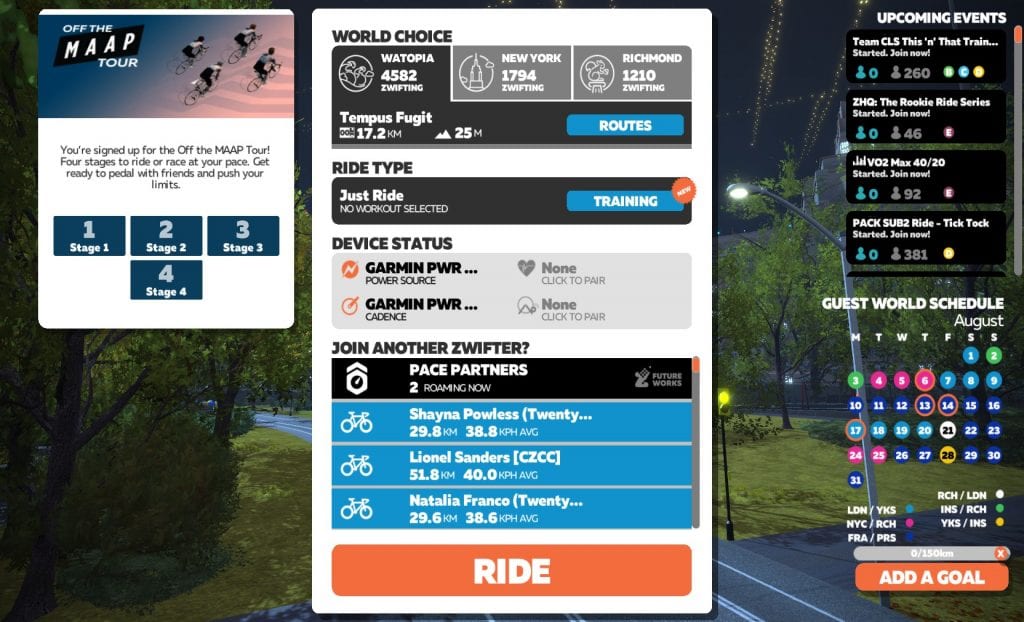
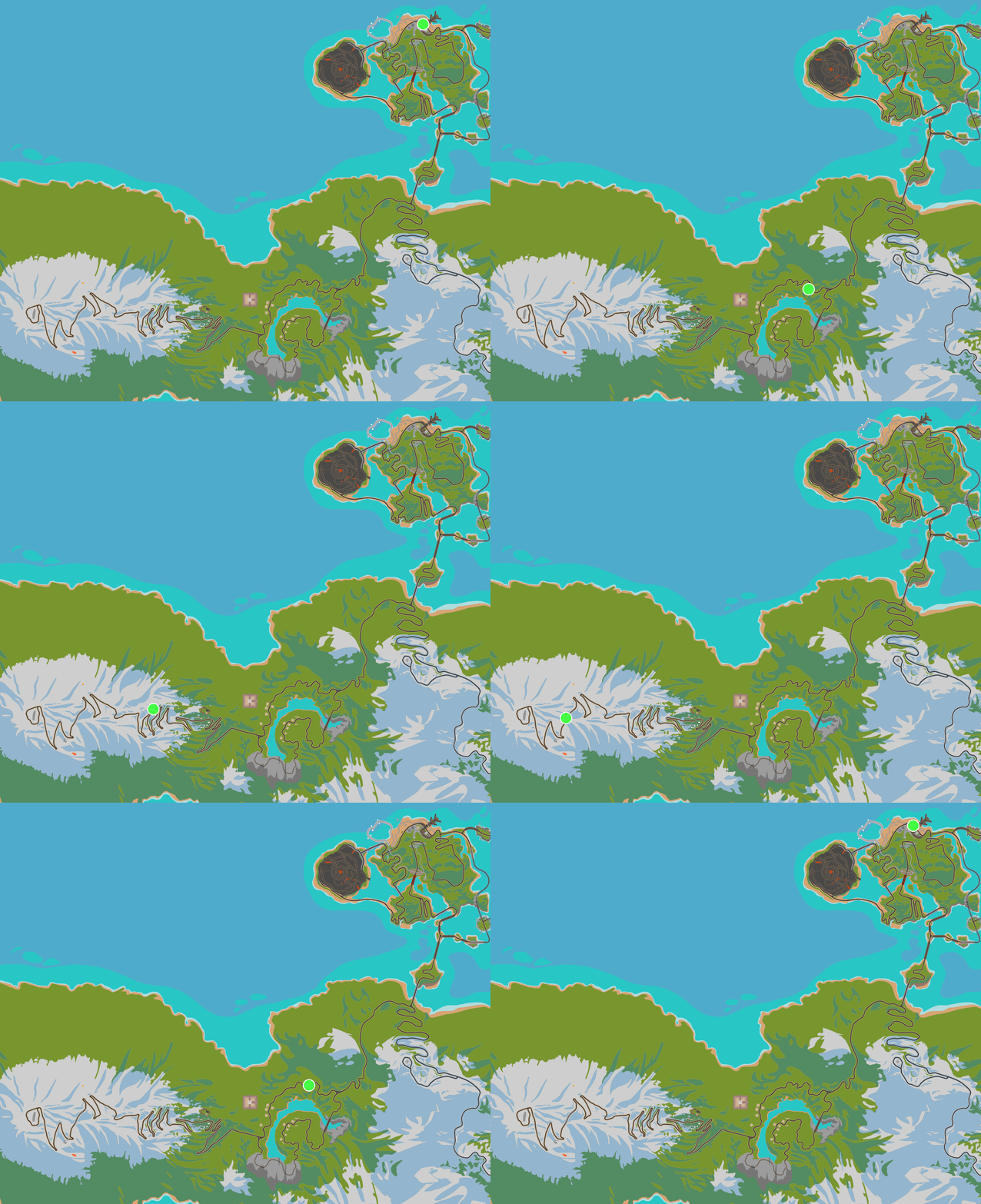
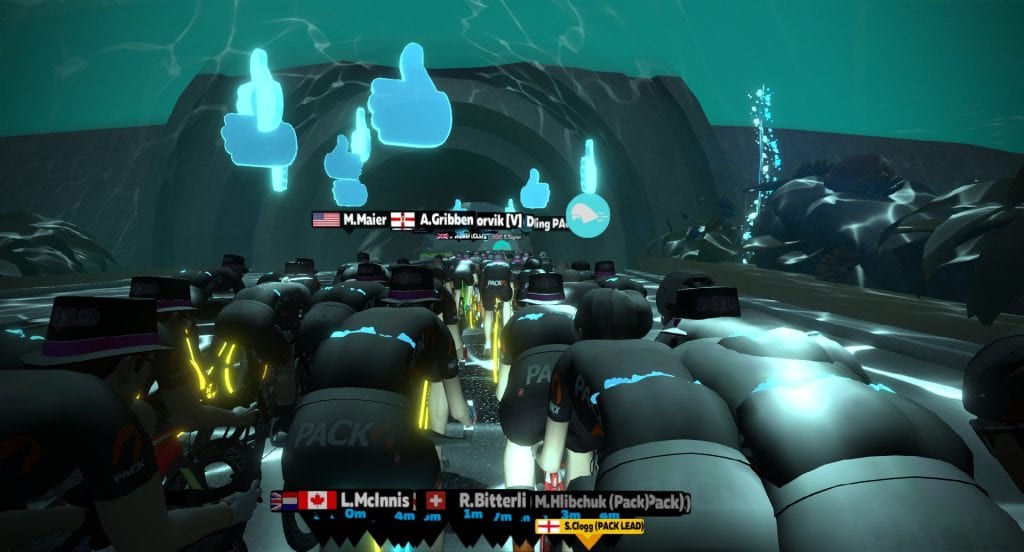
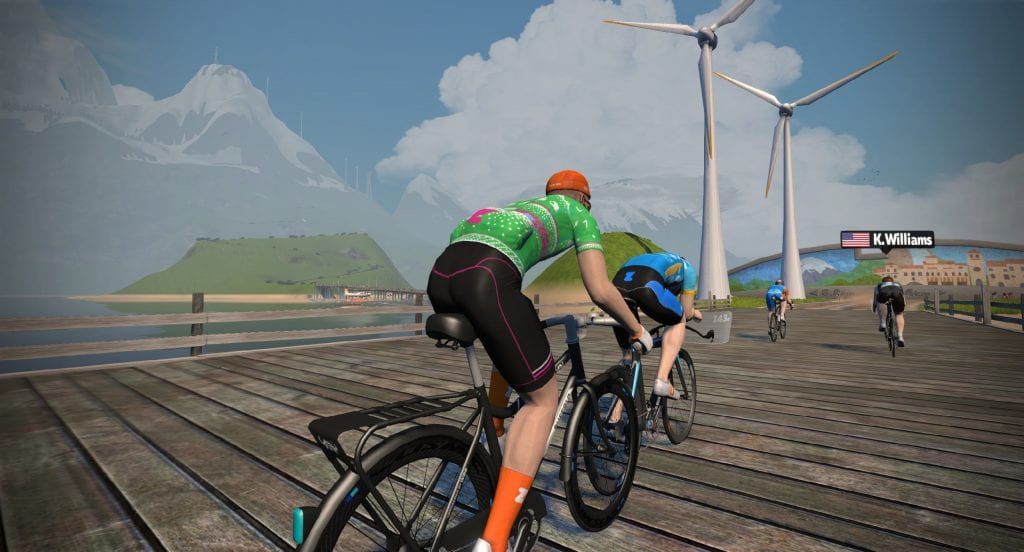
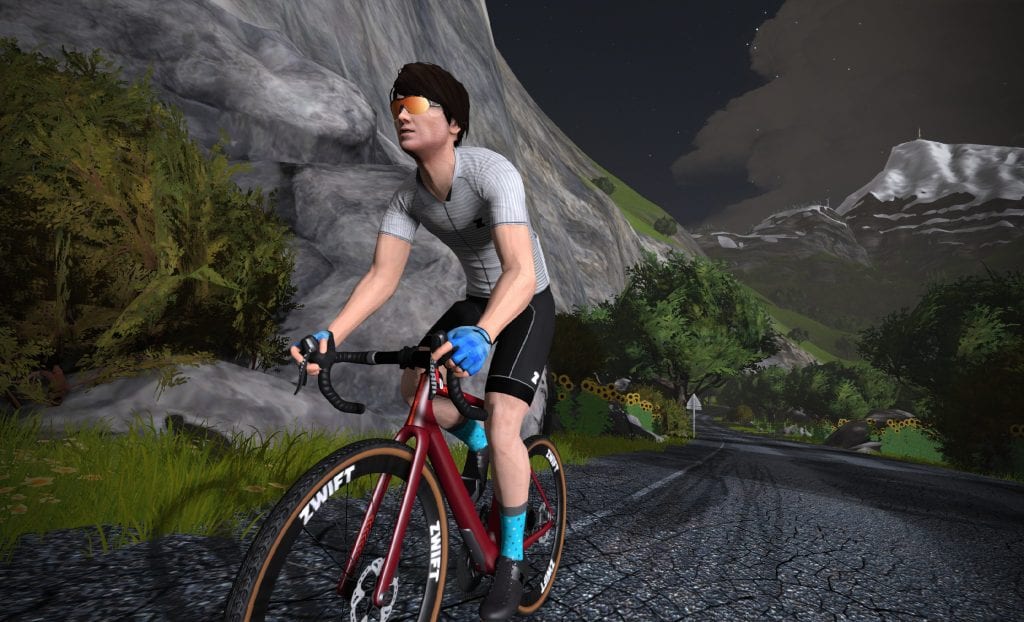
Zwift’s most recent update (August 6) included a new feature which just went live minutes ago on the roads of Watopia. “Pace Partners” are pacer bots which Zwifters can join from the drop-in screen. When you click to join a bot it will be just like joining a friend who is already riding – you will be taken to where that bot is on-course, and you can ride with them as long as you’d like.
Here’s what the drop-in screen looks like:
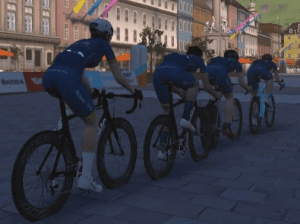
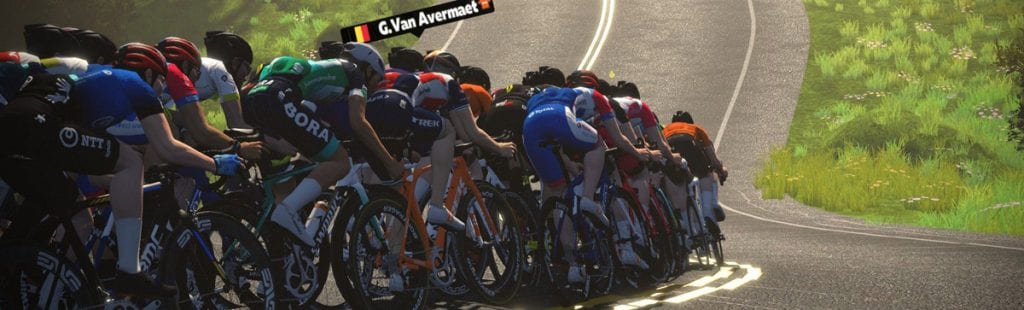
And here’s a quick snippet of one Pace Partner in action:
Our guess is each bot will always have a group of riders around it in a sort of ongoing group ride. The Pace Partners are visible to everyone, so even if you don’t click to join them from the drop in screen, you can always choose to grab the Pace Partner’s wheel if you see them in game.
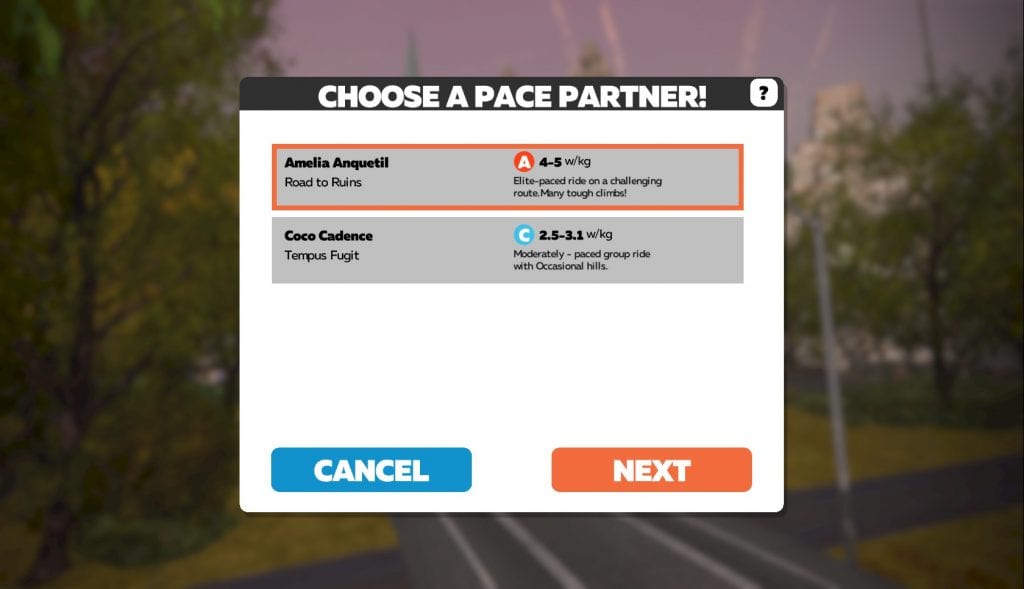
There are four bots, and last we heard they were scheduled to be available 20 hours per day (the 4 hour window allows for tweaks/maintenance from 8:30-10:30 and 20:30-22:30 Pacific time). Each bot rides at a set wattage on a particular Watopia route:
D. Diesel (1-2.4 w/kg)”: Casual-paced group ride with a few gentle hills
C. Cadence (2.5-3.1 w/kg): Moderately-paced group ride with occasional hills
B. Brevet (3.2-3.9 w/kg): Expert-paced group ride with frequent climbs.
A. Anquetil (4+ w/kg): Elite-paced ride on a challenging route. Many tough climbs!
When we checked, only Anquetil and Cadence were live, riding Road to Ruins and Tempus Fugit respectively:
Just the Beginning
This is just the “minimum viable product” (MVP) version of Pace Partners. There are lots of possibilities for this feature to expand in the future, including having bots modulate their power in smart ways (increasing on climbs, decreasing on descents), giving riders rewards for staying near the bot, running pacers, etc. But Zwift wants to test out the feature first to see if people find it useful.
As with all FutureWorks features, Zwift releases them so the community can test and provide feedback via in-game surveys and the FutureWorks forum.
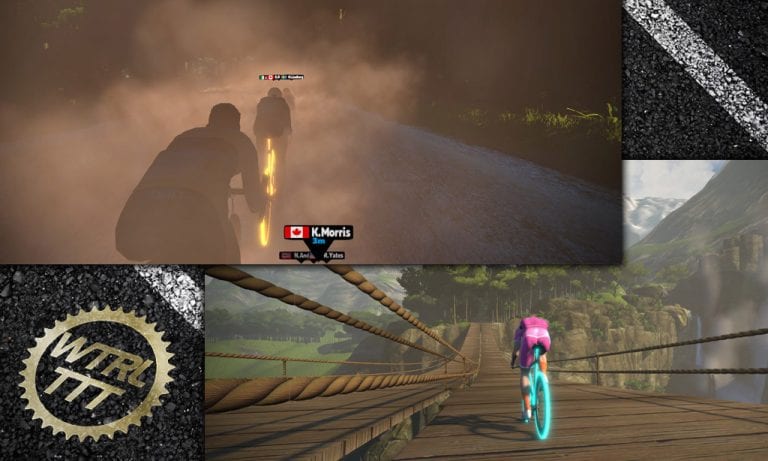
For the past 19 weeks I have become obsessed… so i asked Eric if i could share my obsession with you all, in weekly doses. For the past 19 weeks my entire Zwift experience has centered around the Thursday Team Time Trial arranged by WTRL. If you haven’t checked it out, you should – for me at least, it is the best of what Zwift can provide.
For the uninitiated, the WTRL TTT takes teams of (up to) 8 riders around a course that changes from week to week. The trick is to learn how to work as a team taking advantage of drafting, rotating turns at the front then resting at the back, while managing energy to make sure you get 4 riders across the finish line as fast as possible. Teams are categorized into 5 classes; Vienna (ladies), Espresso (no restrictions), Frappe (mostly As and Bs), Latte (Bs and Cs) and Mocha (Cs and Ds) so there’s something for everyone.
The WTRL website at wtrl.racing is a great place for more information on how it works.
WTRL’s TTT has become such a phenomenon it has caught the eye of the race commentators at Zwift Community Live. Each week Nathan Guerra and Dave Towle run a live commentary of the TTT – you can find last week’s coverage here – and there is already a placeholder for this week’s TTT, #71.
My weekly Zwift schedule for the past 5 months has revolved around examining the upcoming route, plotting target times for my team and helping with equipment selection. I typically ride and re-ride the upcoming course, and try to be at my freshest each Thursday because anything else would be letting the team down! Thursday evenings are spent poring over the results and comparing how we did to previous weeks, looking to glean something that will boost performance next week. Yeah – you could say I’m obsessed.
Each week on a Friday I will give you a profile of the upcoming route, guidance on bike choice and maybe even some target times if you want to aim for the Premiere League (top-10 in each coffee class get to be in a special race televised on YouTube).
Thursday 27th August – The Rumble in the Jungle
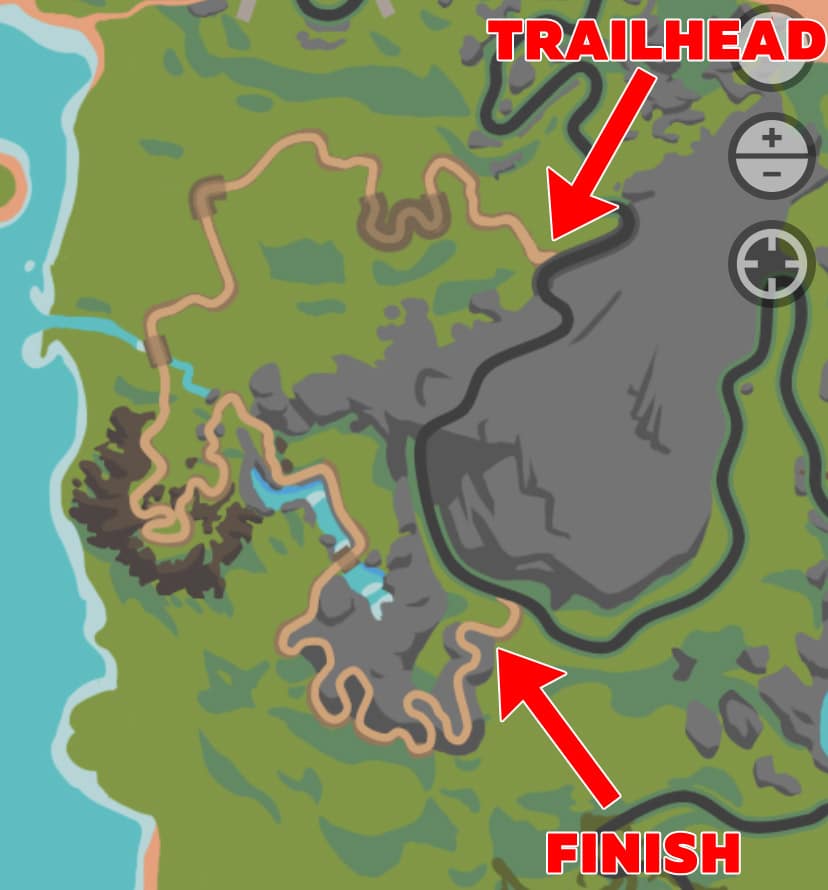
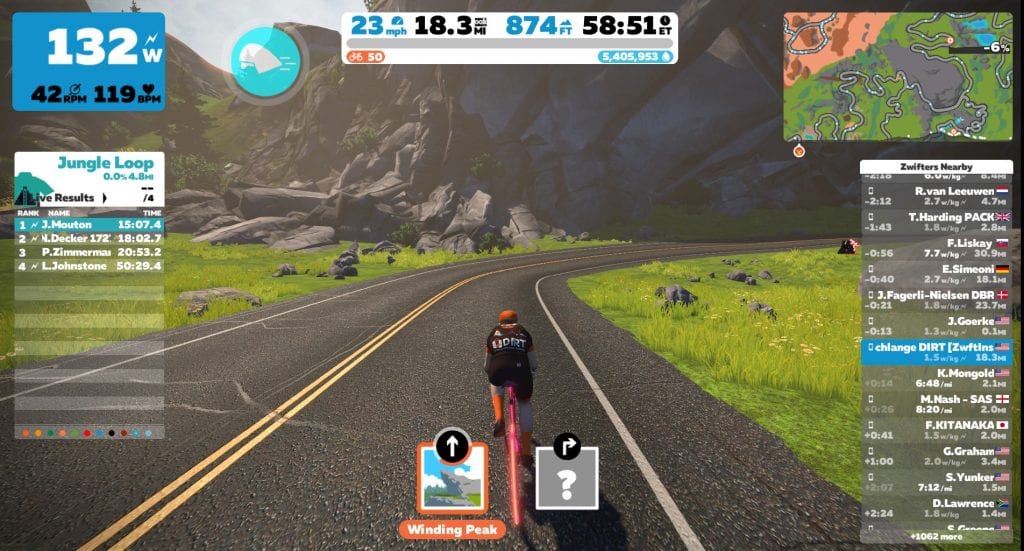
This week the route is the Jungle Circuit: a 5.7km downhill lead-in, then three laps of the hilly 7.8km Jungle Circuit.
The WTRL team are pushing our comfort level this week – not only do we have to contend with a dirt road, they are enabling some of the powerups, and it will be double draft. There were some rumors flying around that the new Sterzo steering plate would be working which caused plenty of debate… but unfortunately, ZwiftHQ hasn’t opened it up to events yet. Some of these additions are one-off experiments, and some will filter into later weeks’ TTT events.
Throughout the race you will have the three opportunities to collect a powerup – one each time you go through the start/finish of the loop. The powerups enabled are:
Aero – Use this when you are at the front of your team to lead the way
Feather – flagging on that hill? Hit the feather powerup for a brief respite
Truck – Extra help when you’re hiding in the draft… for 30 seconds
Steamroller – You might be riding on dirt, but for half a minute it will roll just like tarmac
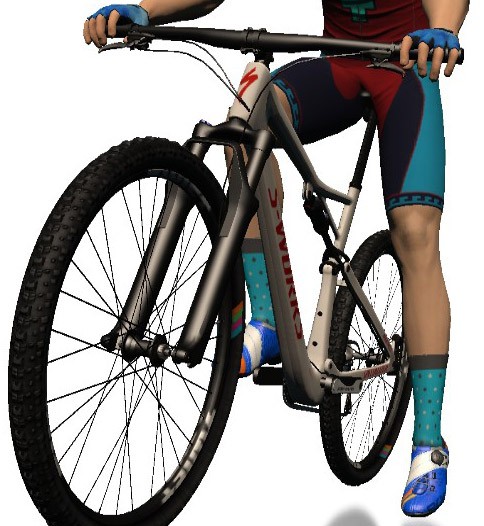
Specialized Epic S-Works
What to Ride
While the route starts on tarmac, it takes place almost entirely on the dirt surface of the jungle. Eric has run numerous tests on Zwifts dirt surfaces, and the results are conclusive – in a predominantly dirt surface a mountain bike will outperform a road or even gravel bike.
So for Thursday, I will be riding a Specialized Epic, but all the mountain bikes perform around the same. For the budget-conscious, the free-to-all Zwift MTB will do the course only a few seconds behind any of the others.
Route Recon
The lead-in heads down from the pens into the Jungle with the road changing from tarmac to dirt on the way down. In the forward direction, you roll through the lap banner at the loop’s lowest elevation, then ride a gradual climb (~3%), cross the rope bridge then back down to do it all again.
The best way to get the hang of a TTT route is to ride it. Whether you find a race/group ride, get your mates together for a Meetup or just jump in yourself… if you haven’t ridden that course in a while, I suggest riding around a few times, noting where your team is likely to break apart and lose draft (doubly important this week as double draft is enabled).
It’s been a while since I did the Jungle loop so I did a three-lap test ride Saturday. One thing to look out for is just how hard 29km on dirt is versus 29km on tarmac. This will feel like a 40km road ride and last as long. Expect your team’s time to be correspondingly longer.
If you are looking to practice Jungle Circuit ahead of the big race check out ZwiftHacks’ events app – and here are a few Jungle Circuit events happening this week:
On Tuesday, the WTRL Gravel series is over the same course and distance as Thursday’s TTT – evening Europe/UK and evening USA
If you’re looking for something laid back on Wednesday this ZHCC Sub2 ride will work perfectly!
What to Watch For
Familiarity with the route is one thing, but a Team Time Trial means sticking in the draft of your teammates – if a gap opens up it can be fatal. Gaps open up if your team isn’t disciplined or prepared, and you hit something that will change your speed. In a normal ride (like a race or a group ride) where you are drafting does not matter, but in a TTT it can make a huge difference to the team’s speed as you all slow down to regroup.
What are we looking for? Hills, descents, changes in surface, Let’s take a look at some of the key danger areas for The Rumble in the Jungle…
The lead-in is pretty straightforward – experienced teams won’t have any trouble at all. That said, there are two areas to watch for:
From the go it’s a nice downhill for 5km. Get into your groove and ride like the wind!
Just over a kilometer in, the road switches from tarmac to dirt-track. That change will cause a slow-down of the riders, with heavier and lighter riders behaving differently. That can cause a split. Luckily here everyone will have fresh legs – all pay attention and you’ll be fine.
Just after the Jungle Circuit “Y” there is a slight ramp – nothing in the grand scheme of things but enough to throw off your rhythm if you don’t pay attention. You’ll pass this three more times, but by then it’ll just be more grist for the mill.
After this, it’s all downhill to the banner
The rope bridge
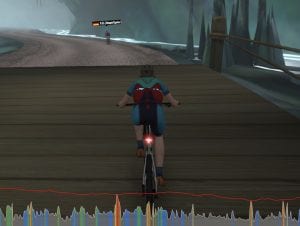
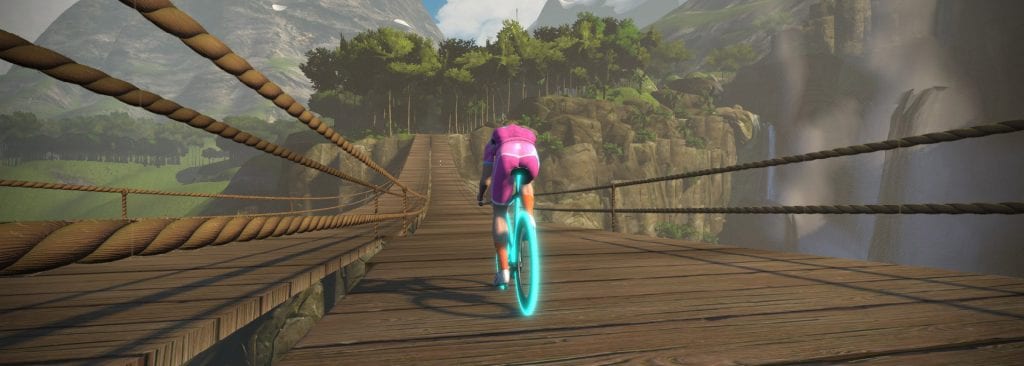
For the most part this is a simple 2.5% up for 2.5 km then a shallower descent averaging 2% for 3 km. There is one danger area: right at the top of the climb is the rope bridge – 200 meters going down at 7%, 200 meters coming back up. Just long enough to cause a split if the riders at the front are gunning it and not looking at their followers!
Wrapping It Up
The Jungle Route is a perfect introduction to Team Time Trialling. It’s one of the simplest routes without too many “gotchas.” This week for the first time ever the WTRL team are putting powerups into the race! If you don’t have seven mates to join you, there are teams at every level looking for fresh riders. Visit wtrl.racing to get signed up!
Questions or Comments?
Did you find this article useful? Will you be riding in this week’s TTT? Share below!
It’s with great pleasure that we are able to confirm the dates and plans for the first UCI Cycling Esports World Championships. The year has certainly been a challenging one for all, but we are now back to enjoying racing and have a new UCI World Championships to look forward to at the end of 2020.
Virtual races were hugely popular during the period that competitions ceased, and I truly believe in the potential of esports to help grow participation in our sport. This is a historic moment.
David Lappartient, UCI President
Almost a year ago it was announced that Zwift would be hosting the first-ever UCI Cycling Esports World Championships for 2020. It’s been a crazy year, though, and with all the UCI calendar juggling and COVID restrictions, there was uncertainty about whether the event would actually happen.
But today it was announced that the UCI Cycling Esports World Championships will be held on Zwift December 8-9, 2020. This is especially good news considering the continued uncertainty surrounding the 2020 UCI Road World Championships – the races were scheduled to take place in Switzerland on September 20th, but the Swiss Federal Council has banned events uniting more than 1000 people through September 30, so an alternative venue is being sought.
There are still some key details being worked out for the inaugural Esports World Championships, but let’s dig into what we do know.
Place and Time
Events will take place on December 8-9, 2020.
Riders will compete remotely from their own homes or training bases, much like we saw in the Virtual Tour de France.
Stage Details
The events will take place entirely on Watopia, and men’s and women’s races will take place on identical courses over equal distances. Route details will be unveiled in the coming months.
Race winners will be determined simply by “first over the line” instead of the points systems we’ve seen in recent pro races.
Riders
The UCI will be inviting national cycling federations to take part in the 2020 event. Similar to the UCI Road World Championships, national federations will be allocated a number of places determined by certain criteria including UCI Road Rankings as of June 2020, the number of riders in the anti-doping Registered Testing Pool and the number of eligible riders on the Zwift platform.
More detailed criteria will be released which ensures that all five continents are represented for both women and men and that the maximum possible number of entries for both genders will be the same.
Automatic invitations will go to 20 national federations (Italy, Belgium, France, Netherlands, Australia, Spain, USA, Great Britain, Germany, Switzerland, Canada, Denmark, Poland, Austria, Colombia, New Zealand, South Africa, Norway, Ireland, Japan) for the men’s event and to 13 national federations (Netherlands, Italy, Australia, France, USA, Germany, Belgium, Great Britain, Poland, Canada, New Zealand, South Africa, Japan) for the women’s event.
Additional wildcard invitations may be awarded to individual riders by the UCI.
New Rainbow Jersey
The World Champion’s rainbow jersey is a highly-prized bit of kit for any pro cyclist, and the Esports World Championships will maintain this tradition. Winners will be awarded a newly-designed rainbow jersey to wear within Zwift. Physical jerseys will also be given to winners to wear while participating in esports competitions for the following year.
Looking to the Future
Zwift’s press release quotes CEO Eric Min:
2020 has been a big year for esports as it has helped fill the gap left by traditional sport. We look forward to establishing this as a new discipline of the sport – not one to plug gaps, but one that’s truly complementary to other disciplines, whether that be road, cyclo-cross or mountain bike. There’s a huge opportunity to grow the sport with esports and I’m proud that together with the UCI, we are able to lead the way.
Clearly, Min is bullish on the future of Zwift and esports. He always has been! This year has seen Zwift racing make huge strides forward – the massive influx of pro riders on the platform, the Virtual Tour de France, and now the Esports Worlds have all brought Zwift closer to a realization of Min’s vision.
But we’re still in the early days, and there is much progress to be made. Min has his sights set on Zwift as an Olympic Esport even as Zwift takes over ZwiftPower, anti-sandbagging controls begin rolling out, and the eracing rules and hardware standards continue to evolve. It’s going to be an exciting winter!
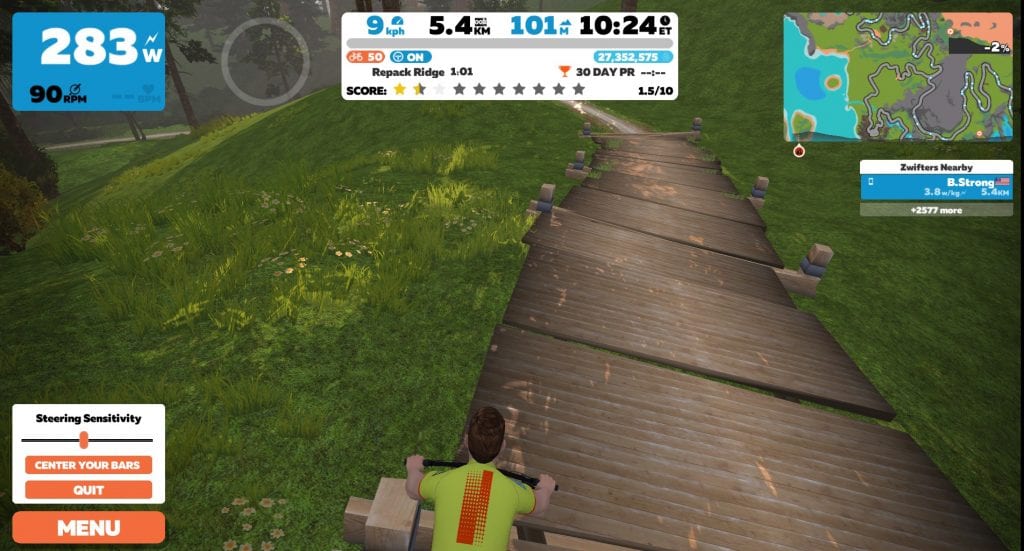
Rolled out with the first version of FutureWorks steering back in October 2019, Repack Ridge is Zwift’s first and only MTB singletrack. Steering here has always been accomplished by the Companion app running on your smartphone mounted to your handlebars.
Now Zwift has released an updated version of FutureWorks steering which allows us to steer on all Zwift roads, provided we have an Elite Sterzo Smart connected.
But can we use the Sterzo on Repack Ridge? The answer is: yes! Just access the trail the same way you always have, but with your Sterzo connected. Here’s how to do it…
Finding Repack Ridge
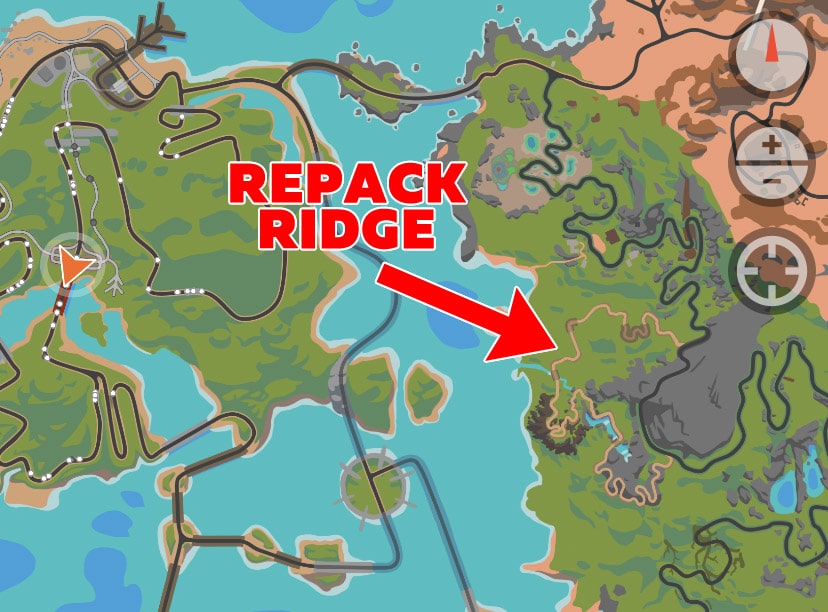
To ride Repack, you must first find the trailhead. It’s a one-way trail found in Titans Grove. If you enter Titans Grove from the north and ride south for another 2 miles you will arrive at the trailhead, which is on the right.
There is no route choice which puts you directly on Repack Ridge – the best you can do is choose a route which will take you to the trailhead after a few miles of riding.
Choose “Dust In the Wind“, “Muir and the Mountain” or “Quatch Quest” Watopia routes for the most direct line to the new trail. This way you won’t need to select any manual turns until you until the (?) prompt comes up near the new trail (see below).
Companion Required
There is one bit of weirdness when it comes to riding Repack with a Sterzo: you must have the Companion app connected to your ride in order to get the turn prompt which allows you to get onto Repack Ridge. This is a holdover from the original version of steering which used the Companion app. Here’s what that turn prompt looks like:
Turn right to get onto Repack
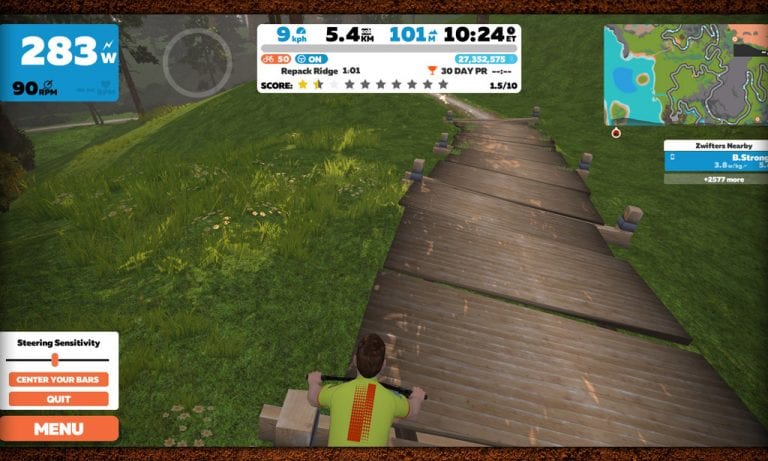
Once you’re at the Repack Ridge trailhead, you’ll see prompts which imply that steering is still being controlled by the Companion app. Disregard these – apparently if you have a Sterzo connected, then the Companion app doesn’t do any steering. Start your Repack ride, and steer with your Sterzo as normal.
I found that having the steering sensitivity slider in the middle worked best, but you can mess with this setting as you ride to dial it in just right. Now go shred some virtual gnar!
Our newest Rebel Route comes from Zwifter Craig Devonshire, who suggested a route planned along the same theme as the infamous Badwater Ultramarathon. This race travels 135 miles from the lowest point in North America (Death Valley) to the highest point in the continental US (Mount Whitney).
For our Zwifty version, we travel from the lowest point on Watopia (Ocean Boulevard, -5m elevation), to the highest point (Alpe du Zwift, 1047m elevation) then back again. Who will be the first to complete the route in under 90 minutes?
About Rebel Routes
“Rebel Routes” are Zwift rides which are not available on Zwift’s routes list, thus requiring manual navigation.
The reward for your rebel ride? Exploring a new route, knowing you’ve gone where few Zwifters have gone before. And a Strava segment rank in the tens or hundreds instead of the thousands! They are included as a separate category on our Veloviewer Route Hunter leaderboard.
Route Description
Before we begin, please note that since we summit the Alpe on this route, you must be a level 6 Zwifter or higher to ride it.
Begin in downtown Watopia by selecting the “Flat Route”. Turn left onto Ocean Boulevard, which will take us underwater to the lowest elevation on Watopia. Enjoy the flat roads while you can – they won’t last long.
Downtown Watopia start/finish banner
The lowest elevation in Watopia – below sea level!
Turn left at the windmills
After you climb out of the tunnel, turn left at the windmills to head over the dock and up the snaking climb toward the Epic KOM and Jungle. The climbing is beginning, but this is just the start! Turn right at the next fork toward the Jungle, then another right once you’re on the Jungle dirt to being the circuit in a counter-clockwise direction.
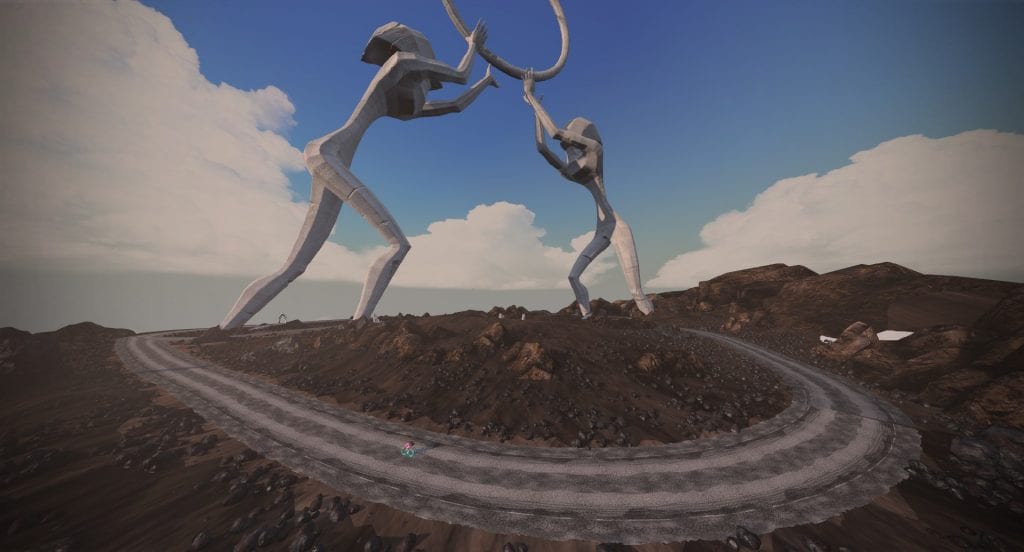
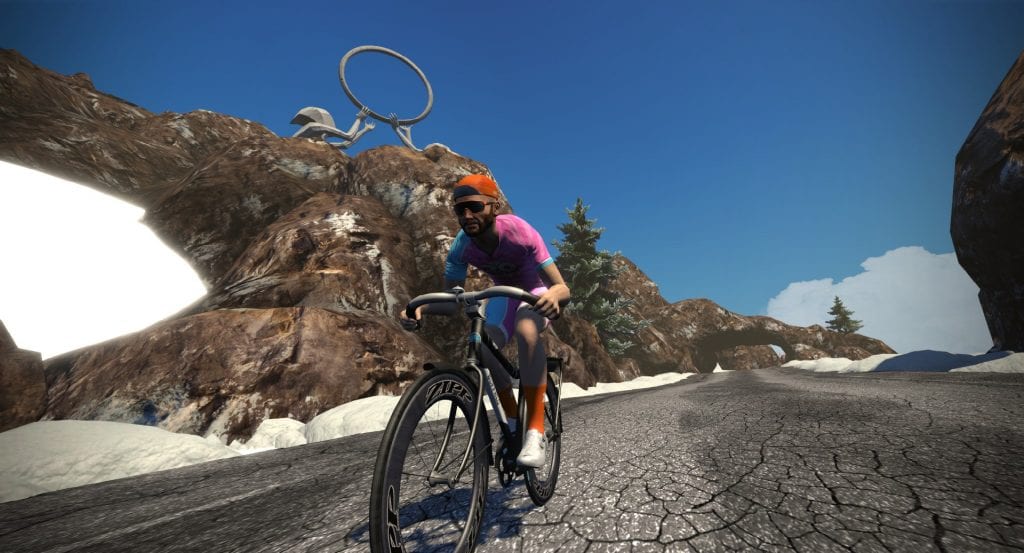
Another right finds us at the foot of Alpe du Zwift – time to climb! Hammer you way up those 21 turns, take a breather as you ride the ring road at the summit, then descend and retrace your path home!
Time to climb…
Enjoy your descent!
The route ends at the main downtown Watopia start/finish banner.
Profile
Getting Started + Lead-In
Start by choosing Watopia’s Flat Route. This will take you in the right direction for the first portion of the ride.
Turn by Turn
Here are the turns you’ll need to make to successfully complete Down Up Down. Start by choosing the Flat Route route, or any route that begins in downtown Watopia heading east. The official Strava segment begins at the downtown start/finish banner.
Matt and Jordan are stoked to have a pillar of the endurance industry, Dirk Friel, with them for this episode. Dirk shares the history behind founding TrainingPeaks and what it’s like to be the son of a true legend of the coaching world, Joel Friel.
They also talk about how to use metrics while training to stay on point during these strange times as well as some things to try to avoid.
About the Podcast:
The Zwift PowerUp Tri Podcast is hosted by former pro triathletes Matt Lieto and Jordan Rapp, lending their in-depth knowledge of the multisport to the Zwift Tri audience.
UPDATE (Sept 9, 2020): Good news! Elite made several improvements to the Sterzo Smart’s design in order to prevent rust/corrosion issues and simplify setup. Read about it >
Thanks to the new FutureWorks Steering feature, Zwifters can steer on all roads in game. It’s fun, especially in races!
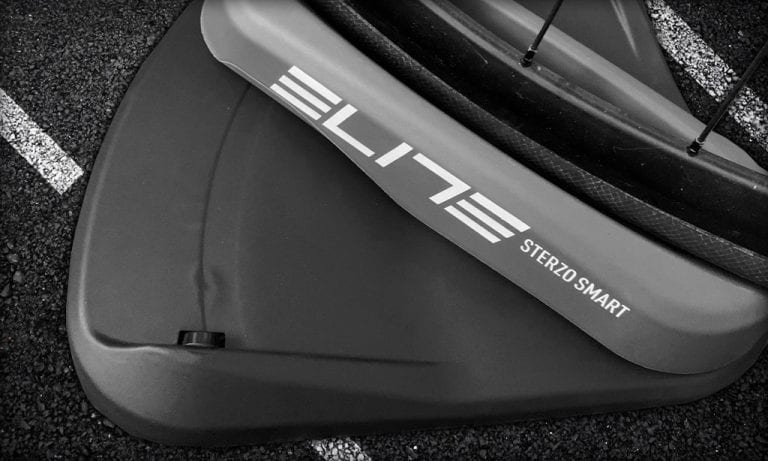
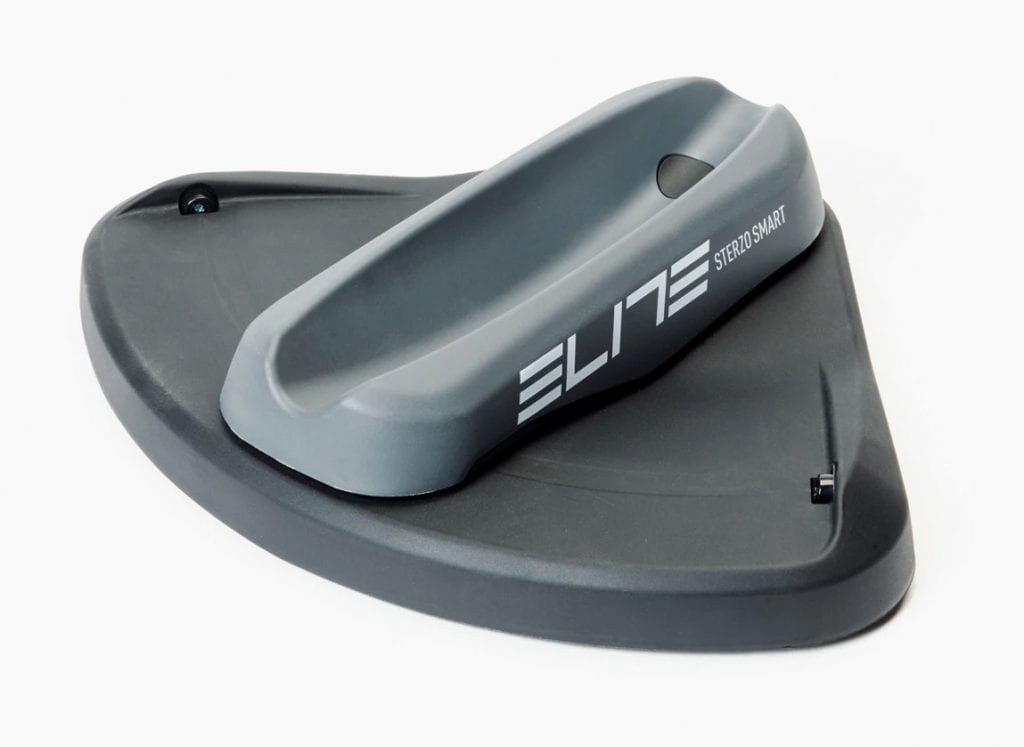
Now that I’ve put 20+ hours into my Elite Sterzo Smart, I figured it was time to review this unit. Additionally, sweat corrosion issues have started rearing their ugly head for some Zwifters, so I wanted to share that info and some tips for avoiding sweat-induced problems. Let’s get to it!
A Note About Supply
Zwifters must purchase an Elite Sterzo Smart steering block in order to steer on all roads. But Zwift quickly sold out of its stock and doesn’t expect more until early September. Someone seriously underestimated demand for these units!
I reached out to Elite and Zwift to inquire about when stock will be available for purchase, but that’s not an easy answer to give since Elite ships to distributors who then ship to specific stores. So while I don’t have super-specific dates, I do have this from Elite:
We are shipping product as we speak and we have taken actions to increase our production capacities by adding a new production line. We will start to see the benefits as early as next week. And some air-freight shipments are being done to reduce transit time from here in Italy where the Sterzo Smart is made to overseas customers.
The Elite Sterzo Smart will be available at other online retailers, but I don’t have that list yet.
Setup
Setup is quite simple. Unbox it, install the batteries, and place it under your front tire in the right direction. Easy!
My one complaint: the battery compartment (3 AAA batteries) has a small screw holding it closed. I’m not a fan of batteries that require tools to install – we live in the age of plastics, CAD software, and 3D printing. Certainly we can figure out a battery compartment that can be opened by hand!
When the battery compartment is poorly-designed in the first place, it’s like Elite is making me do extra work without any actual benefit. (If it uses an actual screw, shouldn’t it be tightly sealed?) But more on that seal issue later…
Pairing Up
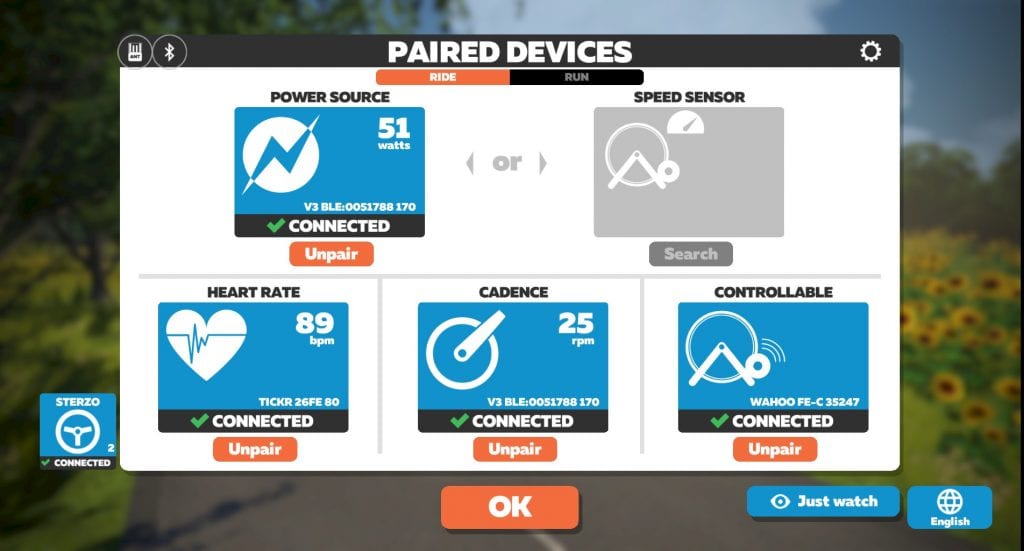
Moving your front wheel back and forth a bit will wake up the Sterzo, then it’s just a matter of starting up Zwift and pairing the Sterzo on the pairing screen. Typically this is a quick process, but I found that sometimes the “searching” window would take 20-30 seconds to find the Sterzo, even though the Sterzo was awake and blinking.
Pairing got more dicey mid-ride, if I decided to unpair the Sterzo and repair it. Zwift seems to have a really hard time finding the Sterzo in this situation, although it seems to find it eventually. I’m not sure if this is a Zwift issue (not searching for the Sterzo properly) or an Elite issue (perhaps the Sterzo still thinks it’s paired, so it isn’t broadcasting via Bluetooth in order to pair properly?) Regardless, this step needs some help.
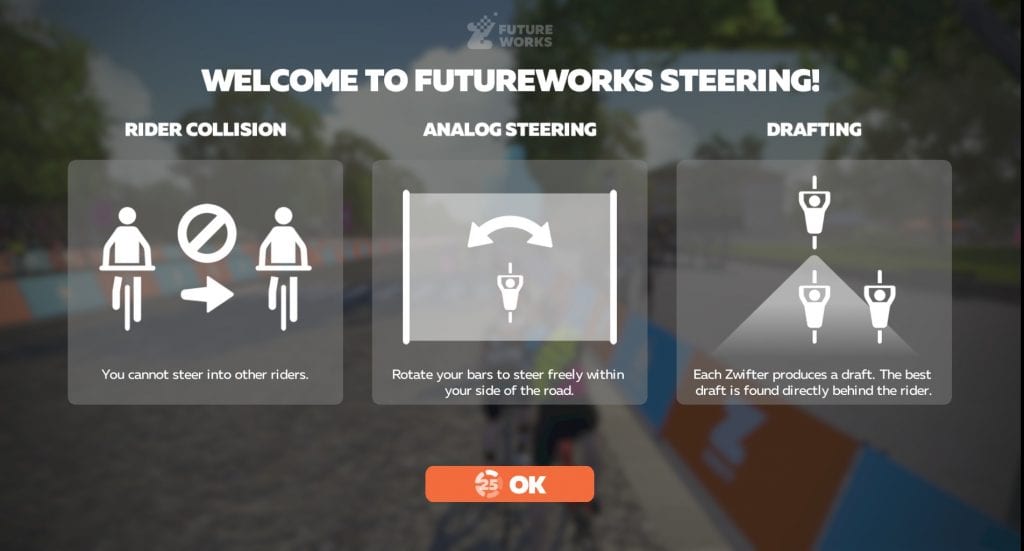
Once you are paired, you can move your wheel back and forth to see the reading for the Sterzo on the pairing screen. And once you begin your ride, you will be greeted with a Welcome screen that explains how FutureWorks steering functions. A simple, straightforward explanation… although I’d like the screen to stop showing up now that I’ve used my Sterzo for several hours.
In-Game Experience
Before I talk about what it’s like to ride in Zwift with the Sterzo, you must understand a few things about FutureWorks Steering:
If you don’t steer at all, you will basically stay in the same left to right lane position during the ride. Think of the road like a slot car track, with (I think) 12 slots in it. As you steer, you are moving between those slots. If you don’t steer, you stay in your slot… although you may get bumped around a bit when moving through other riders.
You can ride through riders front to back. When that happens, Zwift automatically steers your rider around the other rider.
You cannot ride through other riders side to side. So if you want to cut a corner sharp, but there’s a group of riders on your inside, you won’t be able to move all the way over.
Physical Steering “Feel”
Steering with the Sterzo on Zwift doesn’t feel exactly like steering outdoors. Outside, at any significant speed, bike steering is done more by leaning (and even countersteering) than it is pointing your front wheel in the direction you want to travel. Zwift steering feels more like what you experience when climbing slowly on a mountain bike, when you actually do point your wheel in the direction you need to go, and leaning isn’t an option.
One thing I really liked about the steering on the Companion app was that I could lean into turns and the app saw that as steering. That doesn’t happen with the Sterzo, obviously, because the Sterzo doesn’t know you’re leaning. That said, I still find myself leaning (on my rocker plate) into turns with the Sterzo!
The Sterzo is spring-loaded, so it stays centered unless you actively turn your handlebars. It’s a pretty stiff spring, too, which is good because we want to minimize accidental turning when riding out of the saddle or sprinting.
The Head Tube Angle Challenge
When Zwift first released steering via Companion on Repack Ridge, there was a lot of talk about creating a steering turntable which doesn’t force your trainer to “walk” as you turn the bars. It wasn’t easy, because the turntable needed to be tilted up to match your head tube angle.
I was curious how Elite would handle this challenge with the Sterzo, since the angle really depends on your specific bike. The Sterzo is certainly designed with some head tube angle in mind, but I found that it still pulled on my rear triangle quite a bit when steering – especially if I turned the handlebars to more extreme angles. I also found that it was harder than I’d like to turn my handlebars, due to the angle not being correct.
I ended up putting a small block approximately 1″ tall beneath the front of the Sterzo, tilting it up for a better fit with my Roubaix SL4’s head tube angle. This made it easier to turn, and noticeably reduced the movement in my rear triangle.
Race Positioning
Being unable to steer through riders left to right makes positioning a challenge in races with a lot of sharp corners such as Crit City. If you want the fastest line, you have to find a gap in the riders in order to cut the corner. This means anticipating the turn and moving over when there is an opening. It also means that, the busier the race is, the less your chance of an efficient line!
This isn’t a bad thing – in fact, it’s very realistic. In an outdoor crit race, everyone knows you can corner more efficiently when you’re on the front, or in a small group than when you’re in a mass of 50 riders. I think we’ll find that racing with the Sterzo is more fun in smaller groups, and more fun if more of your competitors are also using the Sterzo.
Clearly, the Sterzo will be a huge advantage in TT races, since pack positioning will be a minor issue and optimized lines will trim valuable seconds off riders’ times.
The sharper the turn, the more you can gain from cutting the corner. So you may find that you only focus on a couple of key corners, such as the hairpin leading into the finishing straight on Crit City’s Downtown Dolphin route. Making your corners count is important, too, because you may pop out of the draft while you’re doing it! Let’s talk about the draft…
Watch my recent Crit City race to see how this plays out in an actual event:
Dodging the Draft
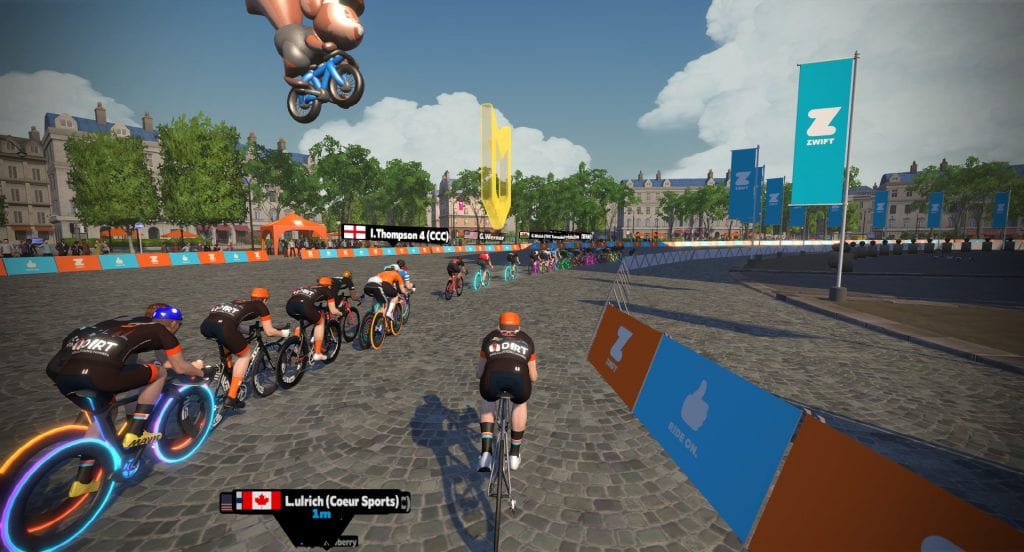
If the pack is on one side of the road, and you’re cutting the corner on the other side of the road, your rider will often go from the sitting up “drafting” position to the crouched “out of the draft” position, indicating you aren’t receiving any draft benefit. That’s a bad thing in races, where conserving your energy is paramount.
Me out of the draft, rounding the Arc de Triomphe
If you’re going to pop out of the draft, make it count, then get back into that draft as quickly as possible.
It’s worth nothing that the Tron bike does not show your avatar changing position based on draft status. This puts Tron riders at a bit of a disadvantage when steering in races.
Is It Faster?
Steering makes the ride more engaging and immersive, no one will argue that. But is it actually faster in a race? Absolutely yes, if you do it right.
Here’s the test I did: two laps of the Downtown Dolphin route at 250 watts steady, with no other riders on course. One lap without steering, one lap with steering.
No steering: 3 minutes, 11 seconds
Steering: 3 minutes, 4 seconds
So steering saved me 7 seconds on just one lap of the 1.2-mile route. That’s significant! Bearing in mind that you probably won’t be able to hit every corner perfectly when riding with others, and that lap times are shorter in races, I would say steering still gives you a 2-4 second per lap advantage on Crit City. That’s much more than any bike frame or wheelset gives you.
Battery + Rust Concerns
I’ve already seen a handful of posts from Zwifters dealing with rust issues on their new Sterzos. Hopefully this post will help other Sterzo owners avoid these problems!
There are two areas of rust concern on the Sterzo:
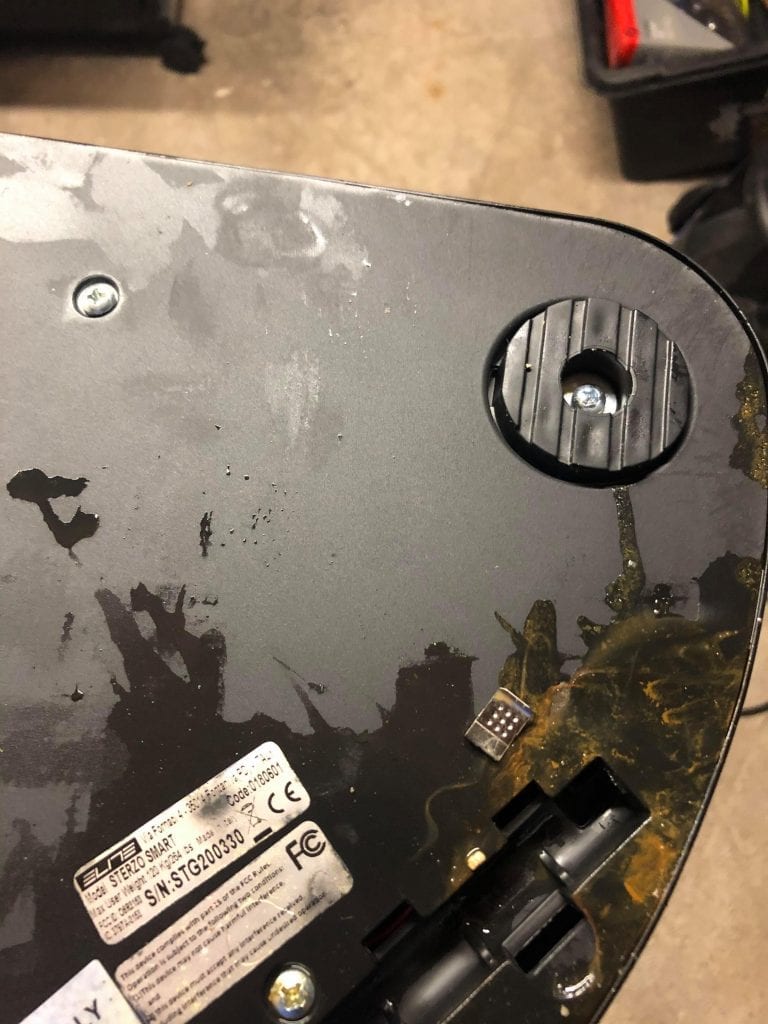
Battery Compartment: if you’re sweating on a softer foam floor (common in pain caves), that sweat can go beneath your Sterzo and work its way into the battery compartment. This will quickly corrode the batteries and contacts.
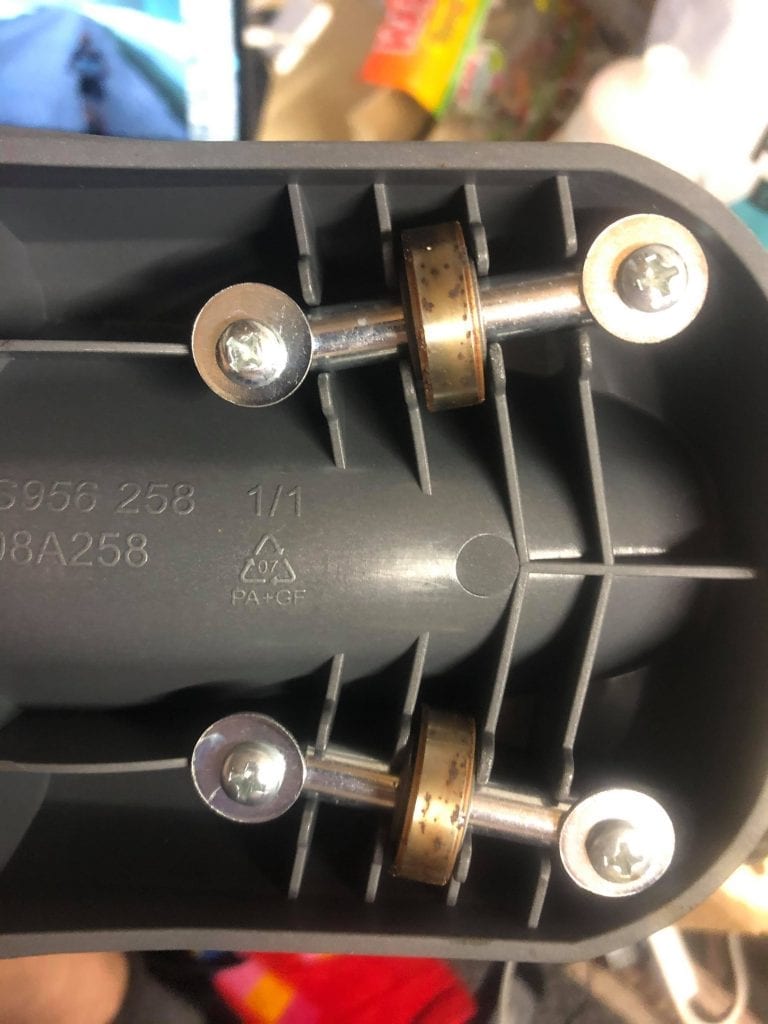
Rollers: sweat falling on the main platform of the Sterzo gets picked up by the rollers beneath the wheel holder, and those rollers quickly rust.
Here’s what those rust issues look like (after just three days of Sterzo use):
A rusted out battery compartment, complete with a broken conductor tabRusty wheels/bearings on the underside of the moveable wheel holder
I reached out to Elite about this issue, sharing the photos above which came from fellow Zwifter Mike Lister. Here’s what they had to say:
Needless to say we did testing with multiple persons for multiple training sessions for multiple weeks but the images you sent from FB are very clear. So to cut to the chase, we will clearly substitute next week this person’s Sterzo Smart and will do the same for anyone else encountering the same issue and we already have our Tech team working on solutions to keep the compartment isolated with Sterzo Smart totally submerged underwater.
Kudos to Elite for being willing to quickly replace rusted Sterzos. If you need a replacement, reach out to Elite’s support at support.elite-it.com.
Here are some simple ways you can avoid rust issues on your Sterzo:
Towels are your friend:
If you’re on a soft floor, lay a towel beneath your Sterzo so it can soak up sweat without allowing it to puddle and fry your batteries.
Place a towel between your Sterzo and front tire, large enough that it covers the entire Sterzo and moves smoothly with your steering. This will soak up any sweat drops and keep your Sterzo dry and happy.
Wipe any moisture off your Sterzo after each session, and run the wheels over a towel to make sure they’re dry.
Use a towel on your handlebars to catch much of the sweat that would otherwise drip straight down.
Duct tape fixes everything: apply duct tape over the battery compartment to seal it from sweat.
Fan support: a strong fan like the Wahoo Headwind should blow sweat drops back far enough that they’ll miss your Sterzo entirely. That’s been my saving grace!
Conclusions
The Sterzo works well as a steering device, although it isn’t perfect. (It’s a first-run product after all, and this is FutureWorks steering – so I don’t expect perfection at this stage.) Yet even in this early phase, steering on Zwift is fun, especially for races. I’m really looking forward to taking part in races where everyone has a Sterzo – that will be interesting!
There are three Sterzo improvements that need to be on Zwift/Elite’s shortlist, in my opinion:
Make Pairing Faster/Seamless: with such a simple device, pairing should be quick and easy, every time. I think we’ll get there.
Tilt-Adjustable: make the two front feet height-adjustable so users can dial in the tilt a bit, or offer aftermarket feet to accomplish this. (Note: this has the added benefit of keeping the battery compartment off the wet pain cave floor!)
Stop the Rust: rusting after just a few days of use is unacceptable. The battery compartment needs to be relocated and/or sealed, and the wheels need to be replaced with something that won’t rust such as plastic or stainless steel. I’m happy to hear that Elite is working on improvements in this area.
This weekend sees the continuation of two popular event series, as well as some long-running community events we want to feature.
Special thanks to Jesper at ZwiftHacks with his Events app which provides powerful event filtering tools that help us create this list each week.
LEQP Provence Badge Hunter Series: Achterbahn
This ride series is proving popular, helping Zwifters work together to earn badges for routes we may not otherwise ride. This weekend it’s Innsbruck’s Achterbahn – a decently long route (47.38 km/29.4 miles) with plenty of climbing (973m/3,192‘).
Various times, see this link for upcoming steering races
ZSUN Base Builder
This long-running training event is the perfect ride for C/B-level riders looking to get some base miles in. Typically a “fast group” gets away, and a slower group also blobs up. Pick your poison, ride at your pace, and build your endurance!
The popular Off the MAAP 2-week tour’s stage 3 is happening this weekend. Each stage includes group rides, races, and a pro-am invitational event. Complete all stages to unlock the exclusive kit!
Welcome back for the second installment of “How to Become a Top Category Zwift Racer” series! If you missed the article on Cat B, you can read it here.
Before I launch into findings, I have one request: some of the high ranked people in Cat C are very young, like under 12, so let’s be gentle in the comments. They are racing in the system provided.
If you don’t know about ZwiftPower and how it ranks racers, click on C in the standings report. Based on your feedback from the last article, I expanded the dataset and used the top 60 Cat C racers as a basis for analysis below. Only race data is considered; group rides and tours were excluded.
Based on the data, if you’re looking to move into the top 20 cat C positions, try to emulate the following:
Race Experience: These people race a lot and get very good at it. Zwift is a skill.
Ways to Win: There are more ways to win in Cat C than Cat B. It looks like you can win high-quality races with long climbs, breakaways, and sprints.
Draft Masters: While these riders can produce good power, they seem excellent at sitting in the draft.
High 15-Second Sprint Power: 8.7 W/kg
Near Top of Category 20-Minute Power: All of the riders in the analysis are capable of riding at or near the top of Category C power. Read “20-Minute Power” below for a more nuanced view.
Be Light: Being around 50 kg can help you exceed category W/kg limits without being forced to upgrade to B.
Race against good competition: Top C’s are doing a lot of series races and high-quality C races. Surprisingly, most of these people race in Cat C regularly.
If you’re curious about the specific data I used, check out all the data details at the end of the article. Otherwise, let’s jump into the number details.
The Numbers Breakdown
As a reminder, Cat C is defined as 95% of your 20-minute power being between 2.5 – 3.2 W/kg and above 150 watts.
I want to mention that there are riders in this group that average 30-50% higher than allowed by Category C limits. These riders skew the data pretty heavily in some areas, much more than in the Cat B analysis. I will try to break things down in a way that makes sense by analyzing the entire group while sometimes pulling out the outliers. I also broke this data into tiers of riders based on rank to see how things changed.
Let’s get moving. Here is the data table:
Raw 20-Minute Power
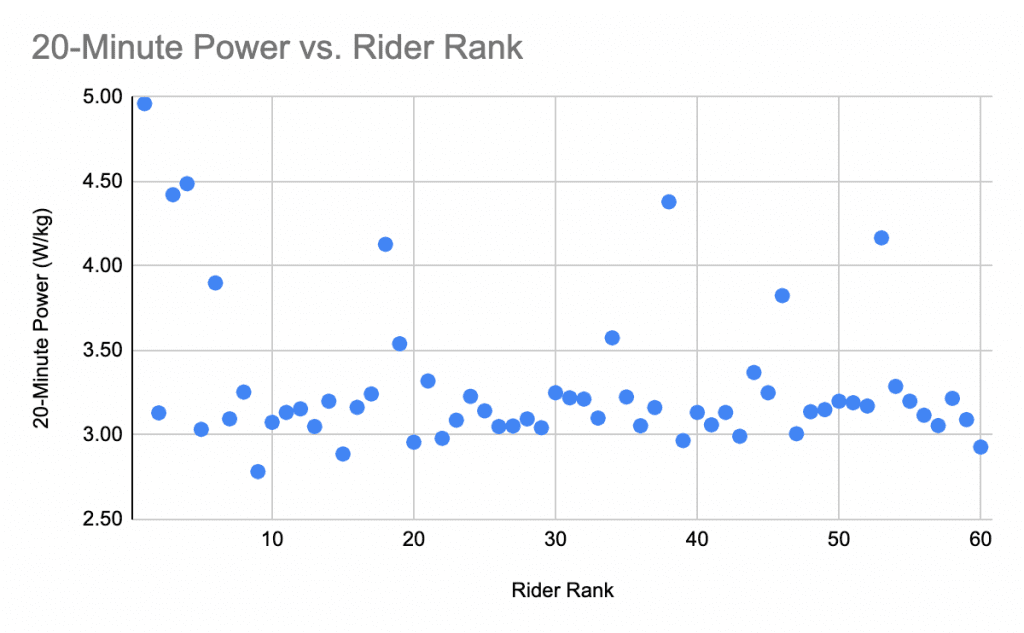
To get into the top 20 you have to be able to hold around 3.2 W/kg for 20 minutes. Why does the data above say 3.4? It is skewed by a few people who are significantly higher than 3.2 W/kg as shown in the graph. If you remove the riders averaging over category w/kg the average for the top Cat C riders is 3.1 W/kg.
As you can see in the chart, there is no real difference in the 20-minute power between the top 20 Cat C riders and the 21 – 60th ranked riders.
If we remember that the actual FTP ZwiftPower uses is 95% of this 20-minute power for their calculations (thanks to one of the commenters on the previous article for pointing this out), that means the ZwiftPower average for their 20-Minute power is only 2.95 W/kg. This seems to indicate these riders are very good at riding in the draft and conserving energy.
5-Minute Power
You need to be able to hang with this group up the hills. About 3.7 W/kg is the average for the group. The light riders average higher (obviously).
Head down to the Percent of 20-Minute Power section for more detail on 5-Minute Power.
1-Minute Power
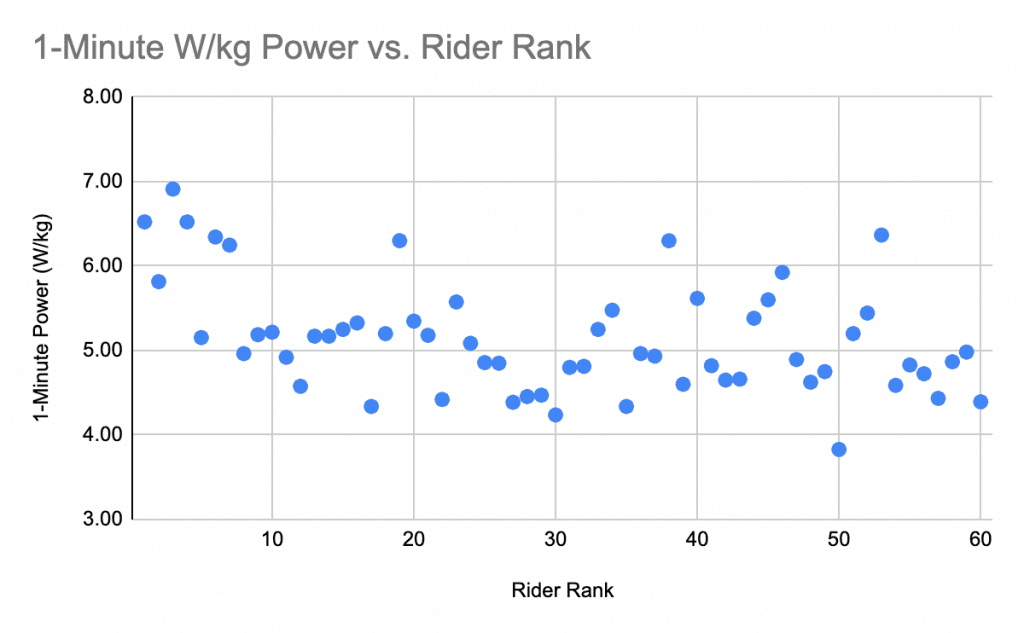
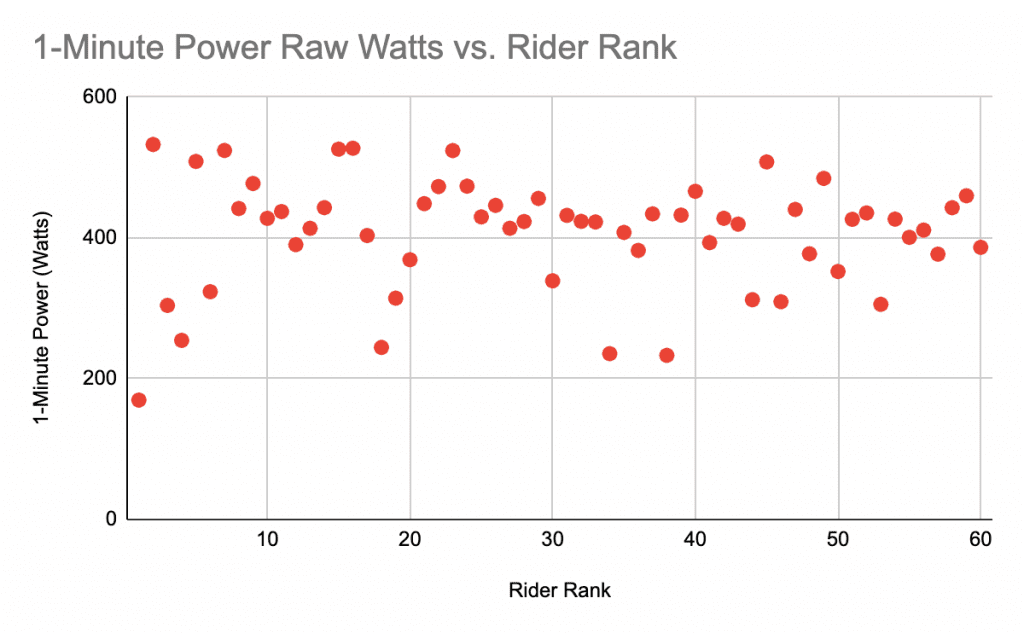
Because many of these riders weigh more, many of them are able to produce exceptional raw power over one minute, between 400 to 525 Watts. Their ZwiftPower profiles show them in the 80-95th percentile of all Zwift riders (I don’t have race-only data to confirm those percentiles are applicable to races). As Eric Schlange pointed out in this article, the higher your raw power, the faster you go given the exact same W/kg. I would be interested to see how that plays out in a race.
A few takeaways from the above graphs:
The very high end of Cat C has 1-minute W/kg power in line with very good Cat B racers (between 6 – 7.0 W/kg)
The 1-Minute Raw Wattage for these riders averages 402 Watts with the median being 426 Watts. So if you are an adult, you will need to average at least 400 Watts to keep up over the last minute.
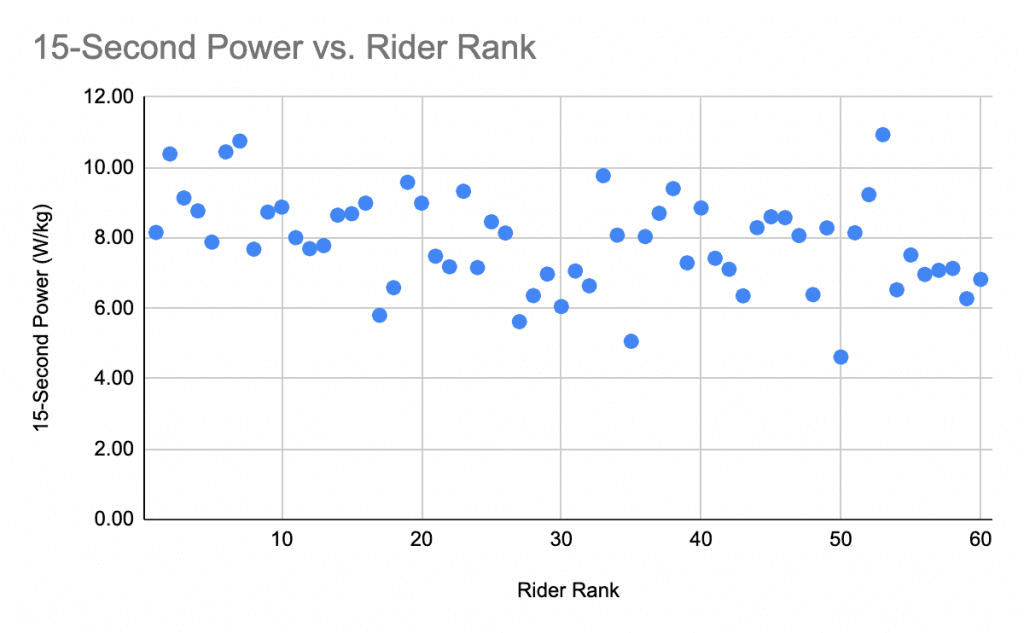
15-Second Power
Similar to the Cat B findings, it appears that a combination of 1-minute and 15-second power is the key. You have to be good at both. As you can see in the graph, you need to be able to average at least 7.5 W/kg, and realistically 9 W/kg to get into this upper echelon of C category racers.
Percentage of 20-Minute Power (Comparing C to B Riders)
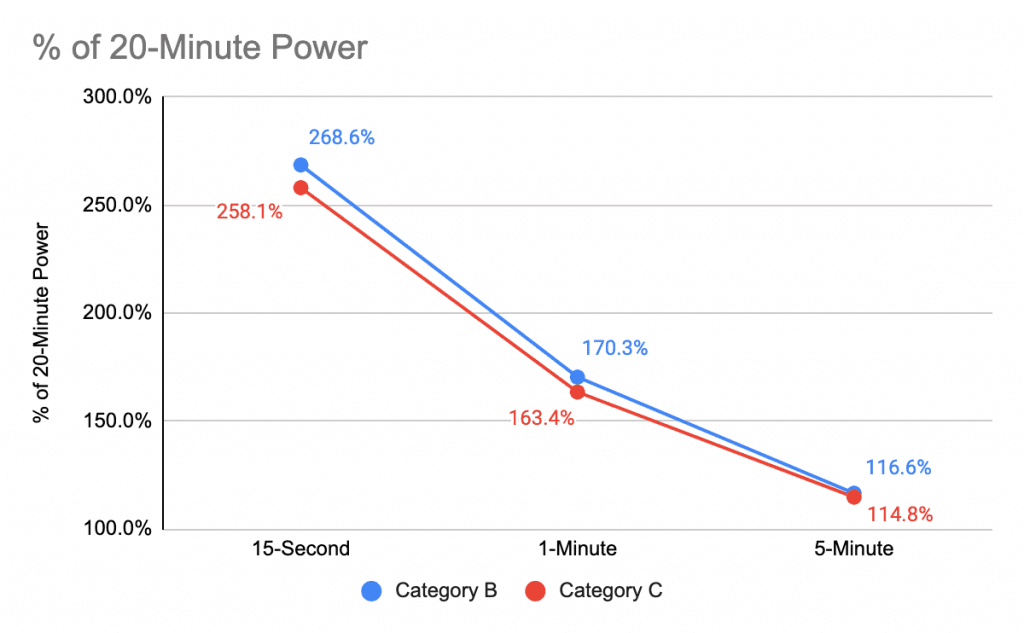
As I was running this data I kept wondering “How does this compare to Cat B”? So I decided to break the data down as a percentage of 20-Minute Power to see how the two categories stacked up. Below is what I discovered:
5-Minute Percentage: There is only a slight difference (1.8%) between the two percentages here, meaning that Cat B puts out about 1.8% higher wattage when compared to their 20-Minute Power for a race. Is this a meaningful difference? I don’t know. I think it is indicative of a challenge when moving to Cat B. Not only do the riders in Cat B have a higher 20-minute power, but they are also capable of going up a hill at a higher percentage of that power. As I am sure we have all experienced, even a 5-6 watt increase can be the difference in hanging with the group and the thread breaking with 20 seconds left up a long hill.
1-Minute Percentage: The difference is larger here, 6.9%, between the two groups. What this says to me is that there is a bigger wind up for the finishes of the Cat B races than the Cat C.
15-Second Percentage: Here we have a 10.5% difference, meaning the sprint is much faster in a Cat B race relative to the average 20-Minute power.
I would have expected all three of these numbers to be comparable, I don’t see an obvious reason Cat B would put out a higher % relative to 20-minute power than Cat C. It may be that the races are just very different, where Cat C are broken apart and Cat B stay together in bunches, so the people at the top in Cat B are the best sprinters. Even then I would have expected Cat C to put out a higher % on the 5-Minute power to create those breakaways.
It may be possible that as riders get better their shorter power numbers rise faster than their 20-Minute power.
Heart Rate (HR) vs. Percentage of Max Heart Rate
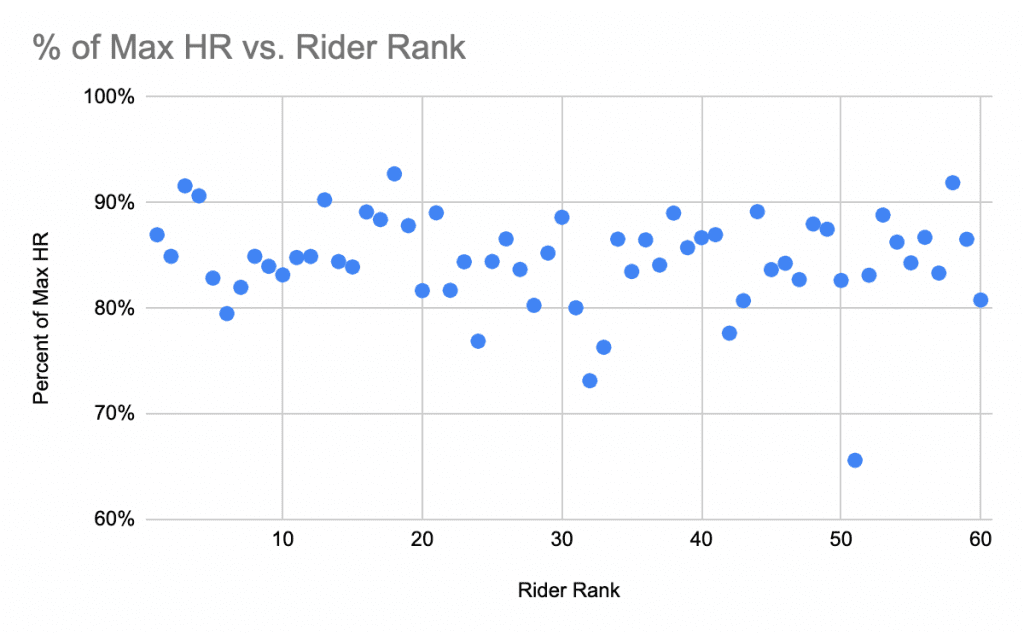
Many of the comments on my last article centered around the topic of “sandbagging”, or people not racing as hard as they can. The DIRT team had a thread going discussing the percent of max HR as a measure of effort, so I took a look for Cat C.
Looking at the graph, most riders are in a narrow band between 80 – 90% of their Max Heart Rate. This was taken as the maximum HR value I saw in all of their race data and seems totally reasonable!
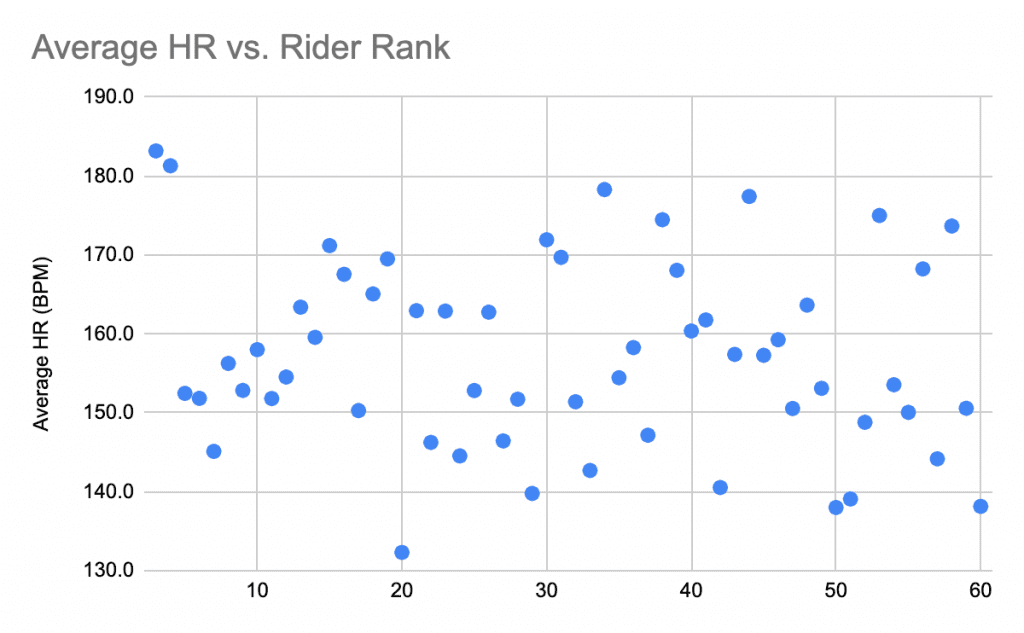
I know what you are thinking: “Rick, this data means nothing without knowing the raw numbers for average heart rate (Average HR). Don’t you know anything?” Well, here you go! See the “Average HR vs. Rider Rank” chart.
I really made every attempt to look smart here by summarizing good takeaways from this data, but after writing this paragraph 5 times, I just don’t think there is much to talk about…it looks pretty normal. I did want to share the data, however, to help answer questions around these data points.
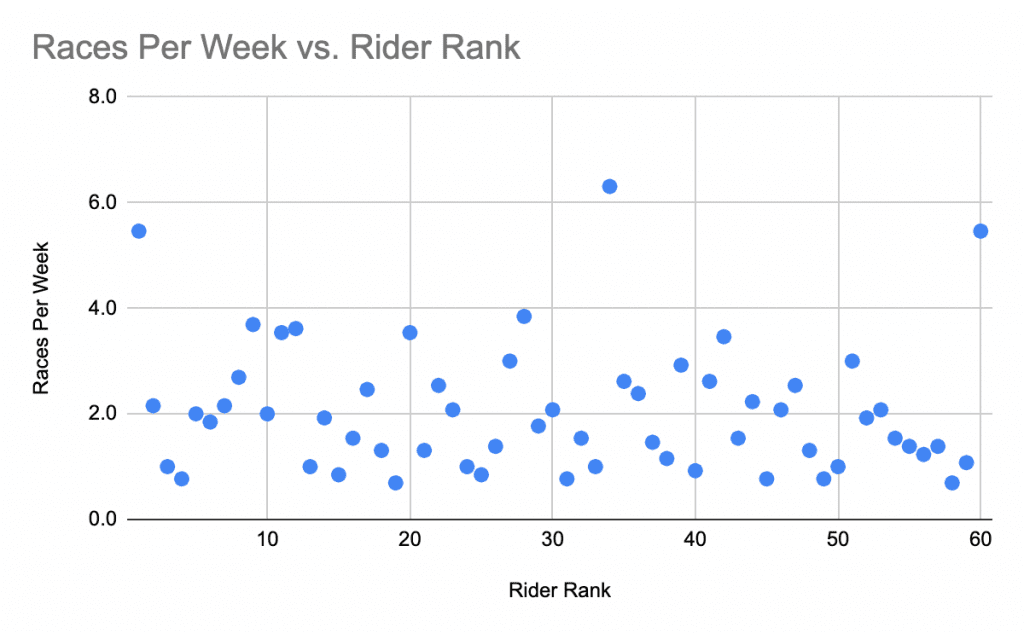
Races Per Week
Same as Cat B…If you want to get a good rank you have to race a lot. Don’t underestimate the power of learning how to race well and the luck of needing an aero to place high enough to get that race ranking.
The average is 1.9 races per week. But check out that person racing over 6 times a week!
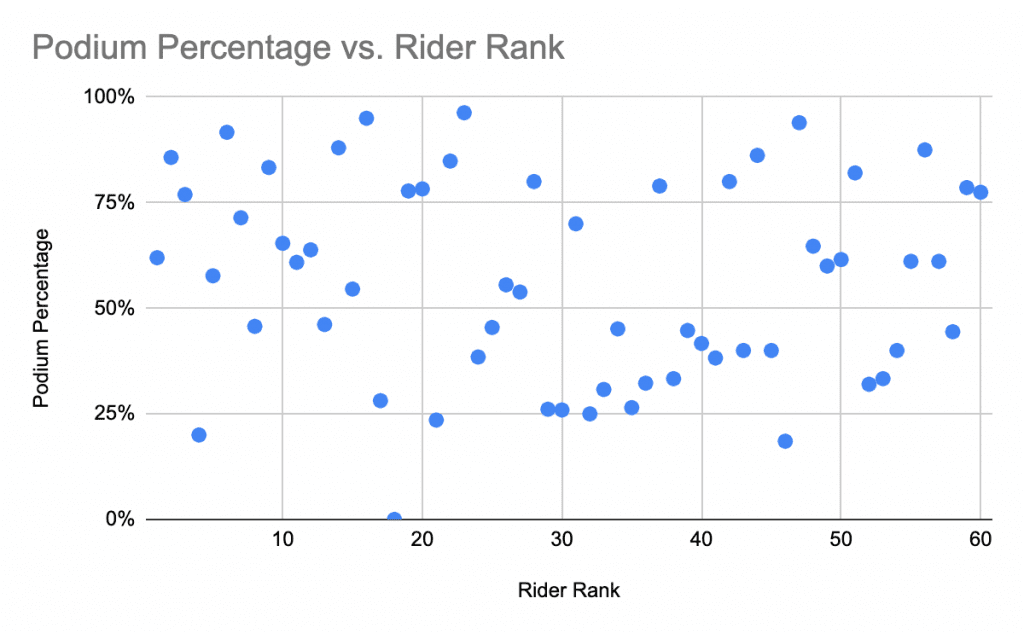
Podium Percentage
This was one of the more surprising takeaways. I anticipated that most of these people would be amassing points through racing Cat B, but instead 50 of the 60 race primarily in Cat C. As you can see from the graph, they are cleaning up. The average podium percentage for this group is 59.2% which is incredible. It continues to lend to the theory about Cat C races getting broken up more before the sprint, so getting on the podium is more a matter of strength than position / luck.
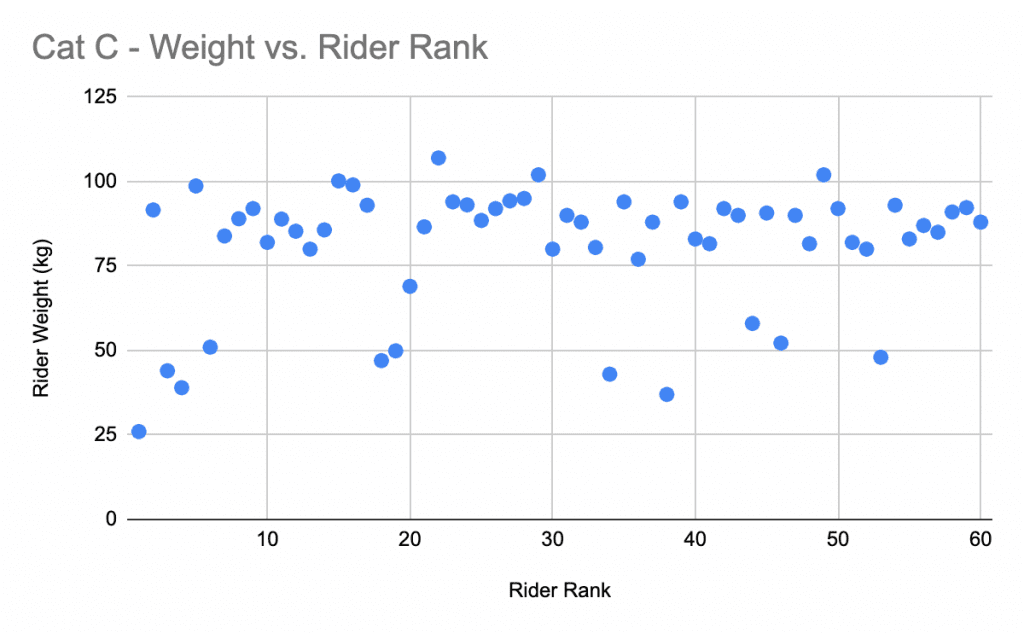
Other Tidbits
The racers are clustered around 50 and 90 kg
The 50kg group mostly made up of young athletes and women
The 90kg group is perplexing; I don’t know why there is a cluster here. One of the commenters on the Cat B article mentioned that they thought Cat C would be heavier than Cat B, so kudos to him / her!
A lot of these racers appear to be very new to Zwift, or at least ZwiftPower. It appears as though C is a common starting category, and I would guess there is more turnover in these rankings than any of the other categories
50 of the 60 riders race primarily in Cat C. Five race in B/C races, one races exclusively in Cat B, two race in A/B, and one races mostly in Women Only events
At a minimum, 3 of the 60 riders are women
5 of the 60 riders have fake names (this is a lower percentage than Cat B)
2 of the riders were verified by ZADA at some point
8 of the 60 riders are Under 20, 2 are between 23 – 29, 15 are between 30 – 39, 21 are between 40 – 49, 8 are over 50 and 5 are over 60. 1 person either refuses to be defined by ages or is immortal
33 of the people are from Europe, 17 are from North America, 6 are from Oceana and 4 are from Asia
A lot of the racers participate in Time Trials (ITT and TTT) as well as racing series. There didn’t seem to be a targeted race type like in Cat B.
The racers were DQ’ed 1.9% of the time due to UPG/HR/DQ
The Data Details
Data Source: ZwiftPower
Data Curation: Manually downloaded. I would love to pull more data and do other analyses (see other articles I’m planning at the end) but I haven’t found an API to download all of the data from ZwiftPower. (Guys who run ZwiftPower – hit me up.)
Data Filter(s): Past 90 days of racing from the Top 20 category C racers as of August 4th. When you look at the rider profiles you will see higher power than what is shown below because the data I used is only from raceswhere the rider achieved a rank of under 420 for the race ranking.Our goal is to identify how to become a top Category C racer in Zwift, not to see what everyone’s max wattage is during a 2.0 W/kg group ride with a sprint in the middle. Also, cutting off at 420 is arbitrary. Looking at the best five races from the racers between 50th and 60th it seemed appropriate.
Analysis Tool(s): Google Sheets and Excel.
Next Articles and Projects:
Below are additional data-focused articles I plan to write, also based on data from ZwiftPower:
Cat A+ is next, then Cat A
Women Specific article – I’m not sure of format and Categories
What it takes to win a Zwift race
Zwift Rankings and Category Improvements
How to Race like a Pro – This is a teaser for another project I’m working on. Details to come soon!
A huge thank you to everyone who read the last article and provided feedback. I really appreciated every single comment and tried my best to respond to everyone.
Also – thanks to my amazing wife for helping with the edits.
Ideas and Comments
Let me know your thoughts on this one and ideas for future articles in the comments below! I am particularly interested to hear your thoughts on whether my conclusions align with what actually works for real Cat C racers. I promise to respond to your comment (unless you say something mean about me, in which case I will immediately write a pithy response, followed by me deleting said pithy response, followed by me responding with “thanks for reading”, written with no exclamation point and no capitals because that way you know I am mad at you).
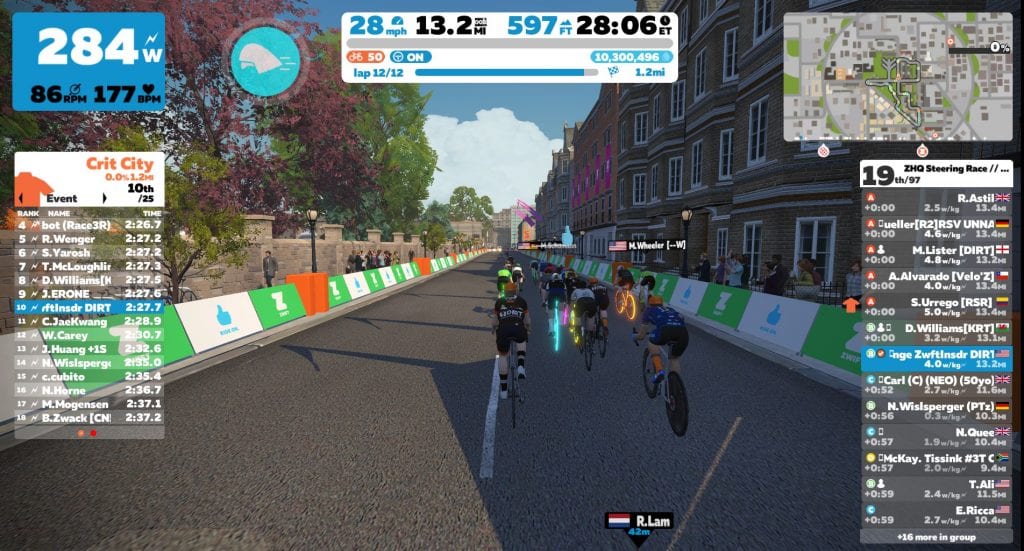
The challenge is, steering has been disabled by default on all races because Zwift doesn’t want the few riders with steering abilities to hop into races and win every time due to a competitive advantage. (It’s a legit concern – watch ZwiftPower’s James Hodges steer away from the pack in a recent WTRL Gravel Series event.) To Zwift’s credit, they’ve quickly spun up some ZHQ Steering Races where steering is allowed – and I jumped into the very first one last Saturday.
Saturdays are my long ride days, so I planned to get some miles in before and after the race. But first, I did my usual race prep: rubbing PR lotion into my legs, and chewing 2 pieces of caffeine gum.
Good news for PR Lotion fans, or those who want to give it a try: I’ve got a discount code! Use “ZwiftInsider” for 20% off your purchase.
My legs felt decent as I spun around France with my buddy Mike, working on my steering chops on the Petite KOM descent. I noticed that cutting the corner on each of the zigzags allowed me to gain about 5 meters on Mike, every turn. Significant! Then I headed over to the windy river road, the curviest road on Zwift, and worked on cutting corners there too. I was following a dude who kept trying to get ahead, but couldn’t as I would cut the corners and stay with him at a much lower wattage. Even grabbed the Ballon Sprint jersey. Fun stuff!
The Start
There was a good amount of chatter in the start pens, and it was interesting to note that at least a handful of the riders did not have steering capabilities. I was happy to see that, because I wanted to learn what those riders thought about racing against Sterzos. But that would have to wait until after the race…
The clock hit zero, we flew out of the start pens, and immediately I received an unsettling surprise – we were racing with the A’s! Curses. I had mis-read ZwiftPower’s explanation of the category setup for the race, and didn’t realize us B’s would be joining the A’s. But it was the first steering race ever on Zwift – I wasn’t about to give up! So I gritted my teeth and mentally prepared myself for a harder effort that initially planned.
383 watts for 90 seconds got me to the top of the brick climb in touch with the front group. But could I hang with them for 11.5 more laps? There was only one way to find out.
The Steering Experience
First Things First
There are a few things one must understand about FutureWorks Steering:
If you don’t steer at all, you will basically stay in the same left to right lane position during the ride. Think of the road like a slot car track, with (I think) 12 slots in it. As you steer, you are moving between those slots.
You can ride through riders front to back. When that happens, Zwift automatically steers your rider around the other rider.
You cannot ride through other riders side to side. So if you want to cut a corner sharp, but there’s a group of riders on your inside, you won’t be able to move all the way over.
Positioning Myself
Since the Downtown Dolphin route moves in a clockwise direction, almost all of the turns are right-handers… meaning the shortest line is on the right-hand side of the lane. There are three key left-hand turns, though, so being in position for those turns is also important, if you’re trying to optimize your line.
I quickly found that it was difficult to get into position for those left-hand turns since the main mass of riders was always occupying the left half of the lane, and (like racing outside) I couldn’t just steer through them. My guess (and I haven’t verified with ZHQ yet) is that non-steering riders are set to stay on the left side, while steering riders stay on the right. That was certainly how the group behaved in this race at least – the only riders I saw on the right half of the lane were clearly steering-enabled.
So I would move left as far as I could go, but unless there was a gap in the riders, I wasn’t able to cut the turn as sharp as I’d like. That wasn’t a huge deal to me, though: with only three left turns and seven right turns, I was happy to have an open right lane.
As the race progressed, I found myself battling for right-hand turn position with other steering riders. We definitely all wanted that tight, fast line! It was fun to try to time my moves so I could slot in just behind another Sterzo user, benefiting from the double draft while gaining several meters on the unsteering masses.
Taking the inside of the hairpin heading into the lap banner always gave me an extra ~5 meters on the other riders
Dodging the Draft
When I was in the right half of the lane with the peloton in the left half, my rider would pop out of the draft occasionally (as evidenced by my avatar going from a seated up position to a more aero, in the drops posture.) I would scoot over toward the peloton in order to get back in the draft, and my rider would sit back up.
This is definitely a place where Tron riders are at a disadvantage, since your avatar doesn’t change position based on draft status on the Tron bike.
Muted by the Double Draft
This race had double draft enabled, which I think made it a little less exciting. Steering-enabled riders may have attempted some breakaways in normal draft mode, but experienced Zwift racers know it’s nearly impossible to stay away from the pack in double draft, since it raises pack speeds so high.
I see the next ZHQ Steering Race doesn’t use double draft, so that’s good news.
Burrito Madness
This was my first race since the burrito powerup was changed to affect all riders within a 2.5m radius. Wow! What a difference. Especially in a double draft race, you really notice when you lose the draft effect, even for just 10 seconds.
There were a lot of burritos flying around as riders have begun to realize what an offensive weapon the revamped burrito really is. (If you want some tips on how to best use the new burrito, see my recent post.)
The Finish
I was stoked to still be in the front group of ~18 riders as we began the final lap. Then all hell broke loose!
Someone attacked on the front of our group, and a couple of riders followed. Then someone activated a burrito powerup, further lowering any hopes of the front of our group pushing up through the gap and bringing the attack back.
That’s what I realized after watching the recording of the race (below). But in the actual event, I didn’t even see the move. I was at the back of our pack, the move happened on the front, and all I knew was that suddenly several riders were off the front, and I was on the limit and unable to reel them back in from their position 3-4 seconds ahead.
Final lap, in a bad position to follow the break
So instead I prayed to the Zwift gods that no B’s had made the break, and tried to sit on the wheels and time my aero powerup and final sprint. I waited for the first rider to jump, and it turned out to be fellow B rider Scott Yarosh. He jumped hard, and when I went to put down the power, it just wasn’t there! Scott stayed away, taking first for the B’s while I came in second. Nice sprint, Scott.
Steering is fun in races: it definitely added an enjoyable element of interaction and immersion. Figuring out how to get the best line possible is an entirely new challenge, but a welcome one.
The burrito is a big deal: mark my words – this little powerup is going to play a much larger role in races moving forward.
Even though I dread it, I need to keep racing against A’s: it pushes me harder, and that’s how I get better. Also (bonus): beating some A’s helps me boost my ZwiftPower ranking!
The Non-Steering Perspective
I asked Bob Gorman, a B rider who raced this event without a Sterzo for steering, to share his thoughts. Here are some excerpts from what he said:
This was my first race with Sterzo steering allowed and since I do NOT have the device I was very curious as to how it would unfold. My initial thoughts were that not having the steering feature would put me at a disadvantage but that did not pan out. I am not strong enough to ride in the front group of B riders for very long and it seemed that most of the front riders were using the Sterzo more so than the midpack B riders where I find myself.
You don’t know, or at least I couldn’t figure out, who actually was using Sterzo and who wasn’t except for the few that could cut the apex of the corner and pull out for a break. I can see it being an advantage if you were podium hunting, had a team, or if everyone had it but for me it was a lot easier and not a handicap to ride with the group. I could ride through people, didn’t get boxed out, and could better take advantage of the draft.
Where I would have used the steering would be to get outside on the final sprint and cut the last corner.
If summary, it looks fun but I am happy to know that at least for now I can still have the same amount of fun without having it. I wouldn’t feel handicapped in any way by not having steering enabled. In the future I think there needs to be races that allow Sterzo only, now that would be interesting. And maybe find a way to let us steer with our Companion app!
Is Steering Advantageous?
After the race, I decided to try a little experiment. I set up a quick custom workout at 250 watts steady, and did two laps of the Downtown Dolphin route: the first without steering, the second using steering to take the best lines.
Lap 1 (no steering): 3 minutes, 11 seconds
Lap 2 (steering): 3 minutes, 4 seconds
So steering saved me 7 seconds on just one lap of the route. That’s significant! Bearing in mind that you probably won’t be able to hit every corner perfectly when riding with others, and that lap times are shorter in races, I would say steering still gives you a 2-4 second per lap advantage. That’s much more than any bike frame or wheelset gives you.
Your Thoughts
Have you tried steering in a race yet? What are your thoughts on it? Share below!