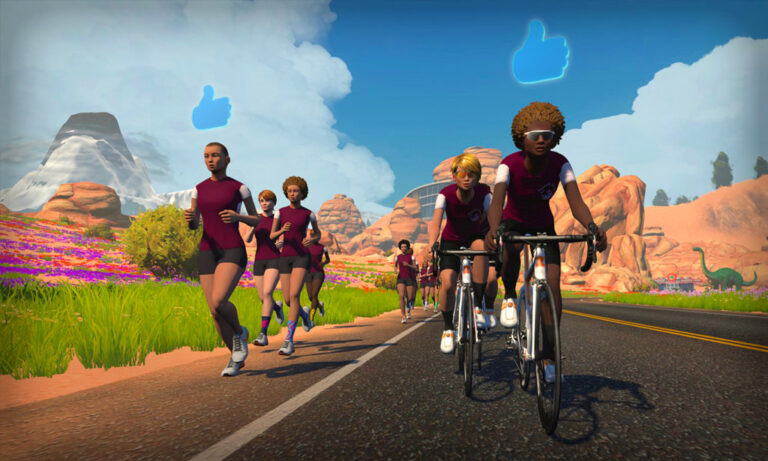
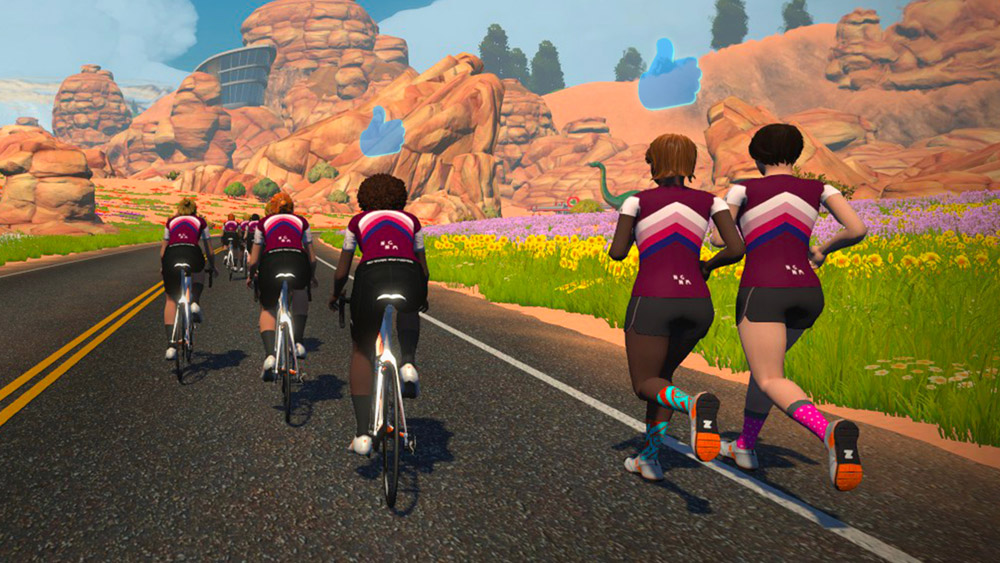
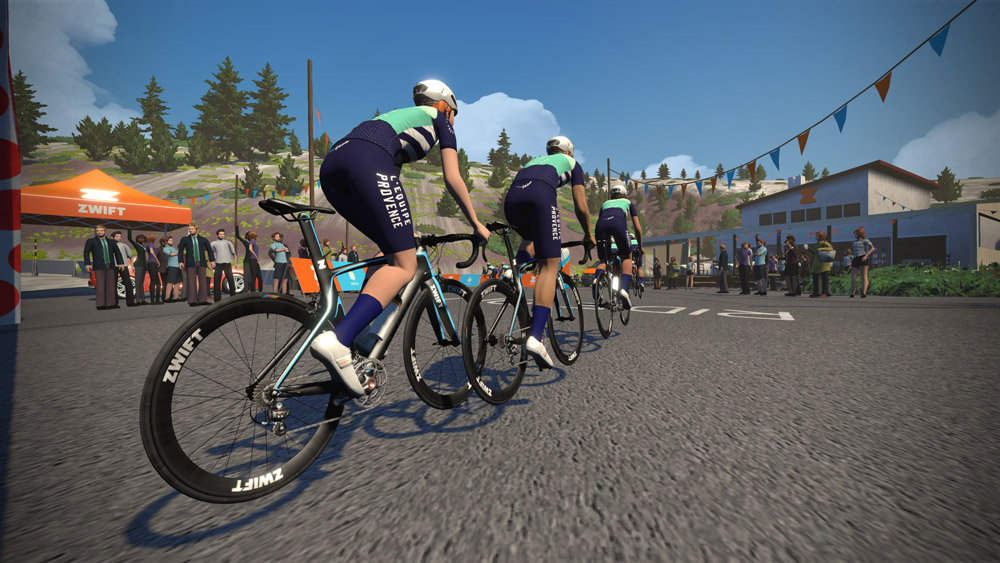
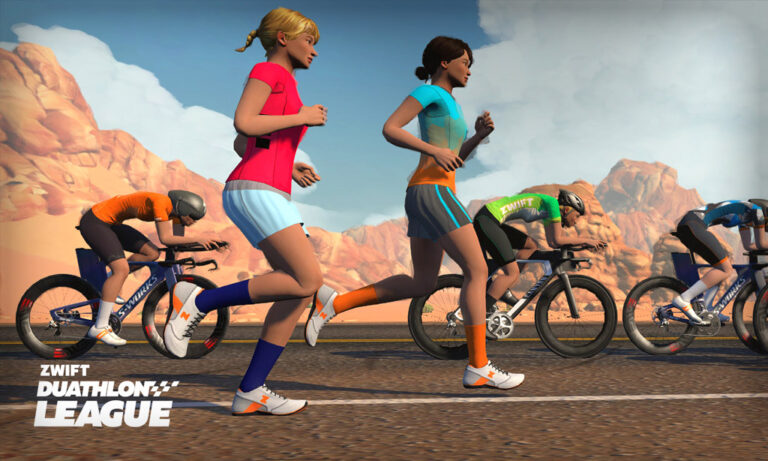
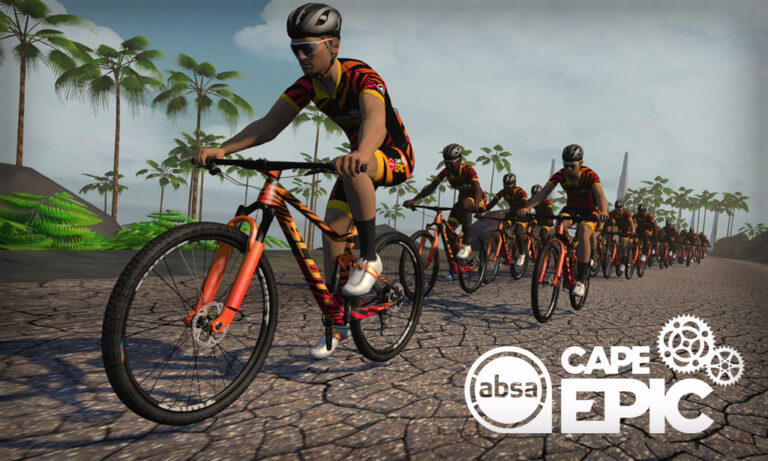
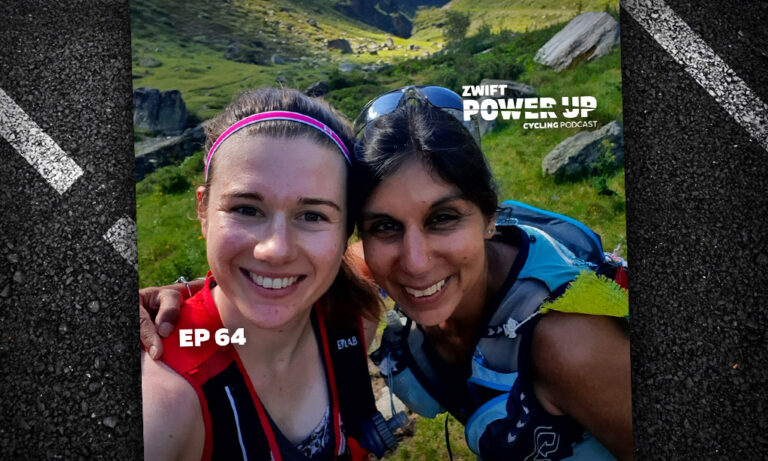
During the month of March (Women’s History Month), Zwift is dedicating itself to celebrating the power and strength of women everywhere through the “Women’s Ride and Run Series” (WRRS).
Women everywhere are invited to join the celebration with fun social events and energetic podcast episodes featuring our community of athletes. As Zwift states themselves: “Zwift is celebrating the strides taken for women’s sport equality while recognizing and promoting further gains to be had. Throughout March, Zwift is calling on the community to celebrate, connect and engage in an effort to raise awareness for gender equality in sport.”
Events
WRRS group rides and runs are scheduled throughout the month and feature multiple routes, with a dedicated route assigned to specific days of the week. All events are for women only.
Group rides are Category E—for all women—and will be led at a general pace (1.5-2w/kg)
Group runs are paced roughly between 5:30-6:15min/km—or decided by the group in the start pen at the time of the event.
These group events culminate in one big event on March 28th!
WRRS culminates on March 28th with a major event at 8am PST and 8am GMT. Join the mass participation ride and tackle Ven-Top—Zwift’s toughest in-game ascent!
Kit Unlock
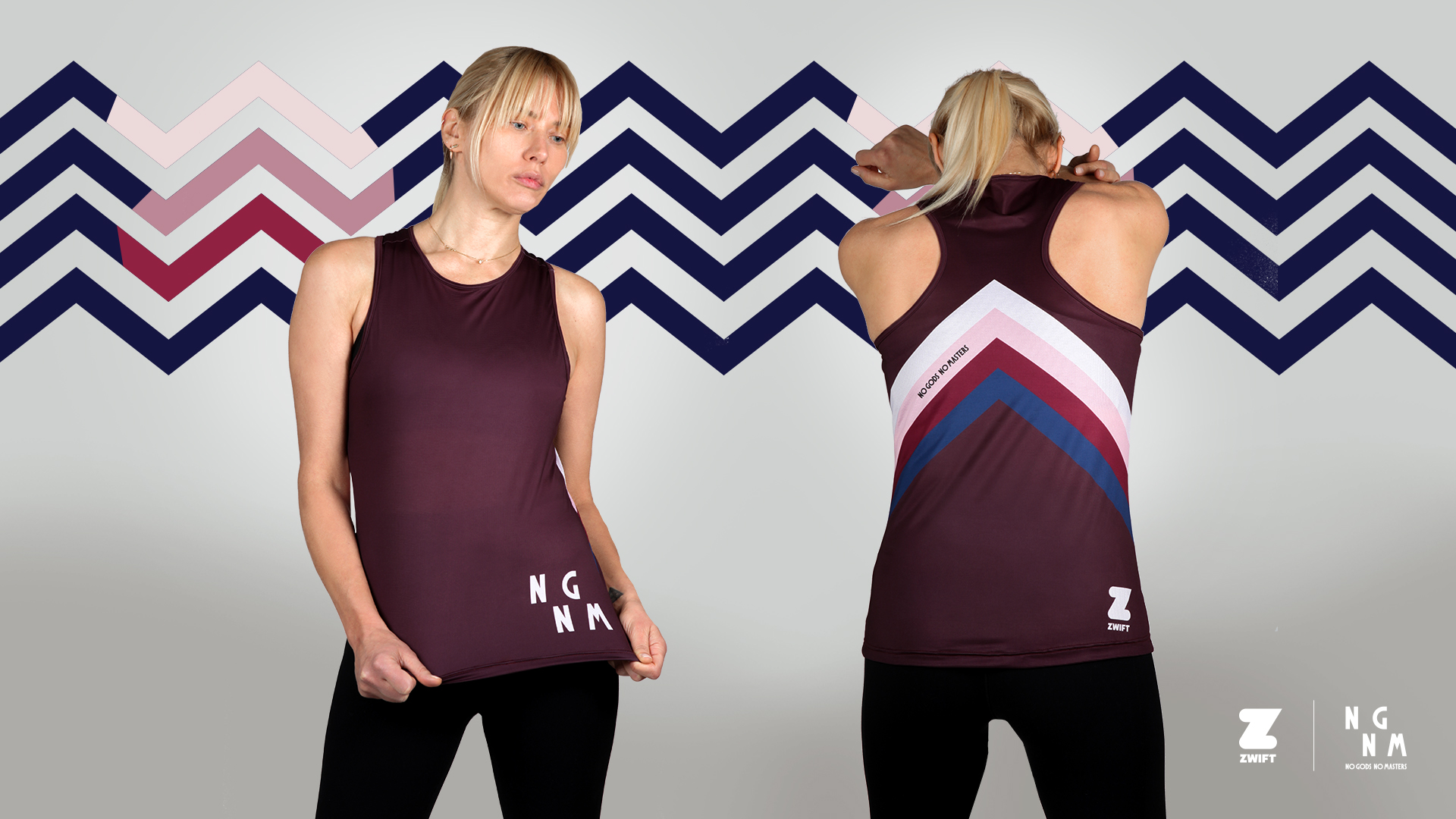
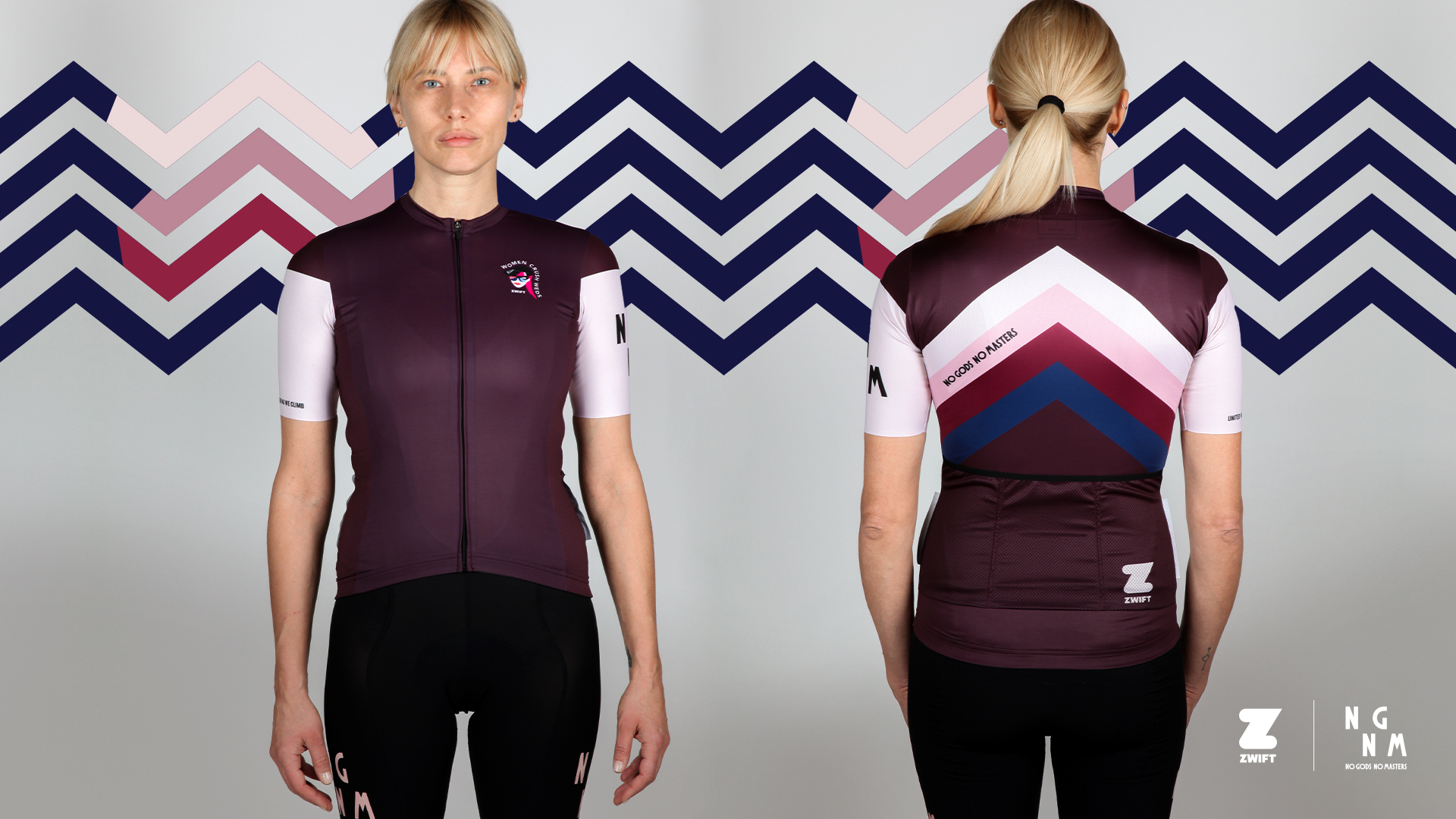
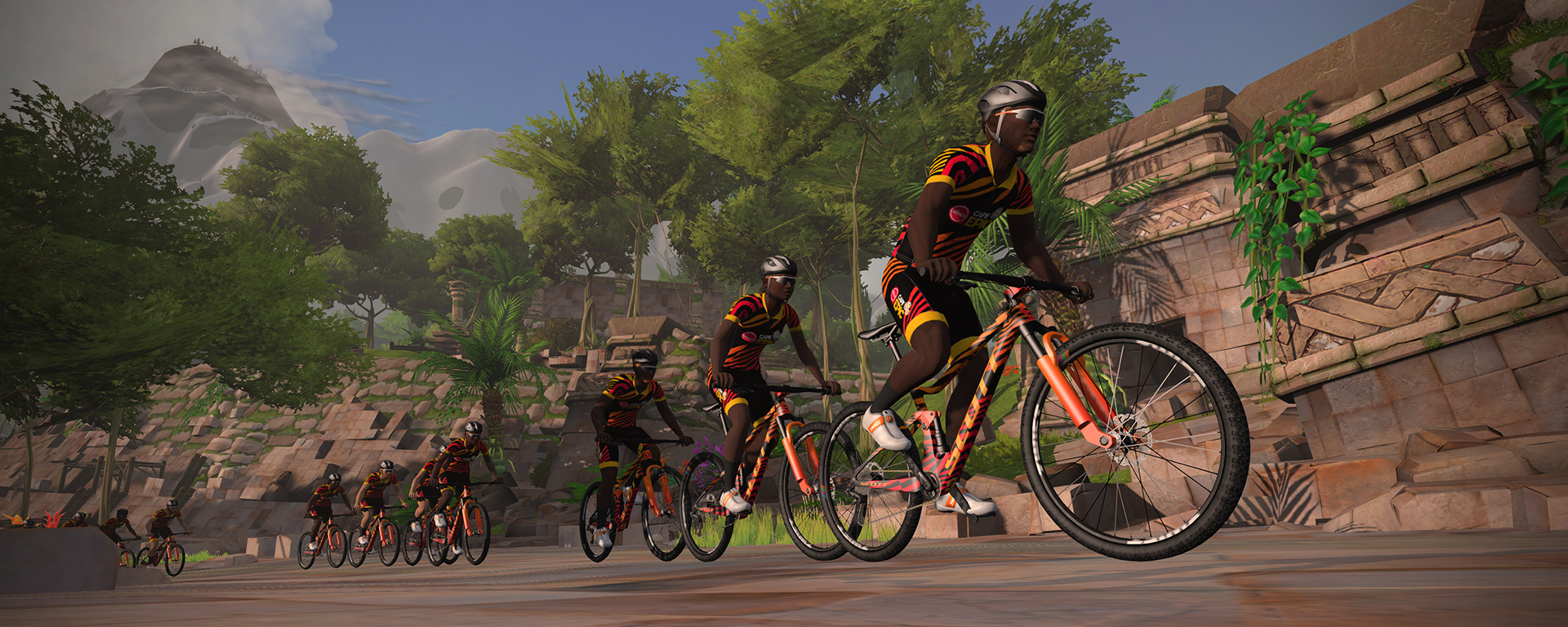
Participants in Women’s History Month events will have the opportunity to wear and unlock the official kit in game. Earn the in-game WRRS Ride Kit and Run Top when you complete one group event.
No Gods No Masters (NGNM) is the official apparel partner of WRRS 2021, and they are selling a limited edition NGNM x Zwift Women’s Ride + Run Series Cycling Kit and Run Tank Top.
Podcasts
Zwift has scheduled a series of podcasts which will explore equality in sports, training tips for women, Sika Henry’s story of being the first African American triathlete to go pro, and Malindi Elmore’s infamous run story.
March 4 – WRRS Special Sika Henry’s historic journey. Sika Henry is the 2015 and 2016 One City Marathon Women’s Champion as well as an 2019 IRONMAN World Championships finisher.
March 11 – WRRS Special: A discussion on equality in sport with special guests
March 22 – WRRS Special: Women’s Training with Dr Stacy Sims and more
March 25– WRRS Special: Malinidi Elmore on her exceptional Tri and Run Career. Malinidi Elmore is a 6 x Canadian Champion in track & field and former Olympian, representing Canada in the 2004 Olympic Games in Athens.
Live Panel
On March 18th, 11am PST / 2pm EST / 6pm GMT, hosted on Facebook, there is a live panel which features exercise physiologist and nutrition scientist Dr. Stacey Sims, 3 x Gold Medalist Kirstin Armstrong, sports nutritionist Gemma Sampson, and Olympic runner Gwen Jorgensen.
Charity
Zwift is donating $25,000 to the Women’s Sports Foundation (WSF) to support its mission of unlocking the possibilities for every girl and woman through the power of sport. The WSF was founded by American tennis player Billie Jean King in 1974, and is committed to building a future where every girl and woman can unlock the lifelong benefits of sport participation.
This week in the best of Zwift videos, learn what hardware will run Zwift fast (but it won’t make you go fast on Zwift!) and see a comparison of popular options. Then see former pro cyclists analyze Zwift racing from a perspective you might not know. Finally, go hunting for sprint points with a Zwift Racing League racer.
Apple TV vs. Gaming PC | Zwift 4K 60FPS | How to run Zwift as FAST as possible
Want to run Zwift on the fastest, best-performing hardware? Check out Eric Abbott’s tips. He talks about what to look for if you build your own PC (it’s not as complicated as it seems!) and compares how Zwift looks on his new gaming PC, Apple TV, and a typical laptop.
Zwift | Apple TV 4K vs GAMING PC || Direct Comparison
For a clearer comparison of Zwift graphics performance on three different systems, check out Eric Abbott’s follow-up video.
The ZWIFT Racing Technique That Will Change the Game For You
Zwift is testing out a new AI that may change the way drafting in races works. But until then, the tips in this video from Tom Danielson will help you navigate the pack like a pro.
Zwift Racing Vs REAL LIFE Racing // What I’ve Learnt From Experience
Ed Laverack looks at one of his recent Zwift races and shares how he applies his real-life racing experience to Zwift.
Hunting SPRINT Points | ZWIFT Racing League 2021 Round 4 in Yorkshire
When you’ve got a good sprint but won’t be going for the win, you can still rack up points in the Zwift Racing League. Mark Lewis is back to show you how.
Got a Great Zwift Video?
Share the link below and we may feature it in an upcoming post!
“If you build it, he will come.” That’s the famous line from Kevin Costner’s Field of Dreams, but it also applies to Zwift Insider’s first-ever group ride as 3900 people attended. This was the largest group ride I’ve ever participated in. It was nothing short of epic and all credit to Eric Schlange, the genius behind the Zwift Insider website.
When Eric contacted me to say he was putting on the Über Pretzel Badge Hunters event, I responded instantly saying that “I’m in.” I expected a group ride of several hundred people and was overwhelmed by the volume of riders, so much so, that I couldn’t even find my friends on the Companion app to coordinate our ride together! Prior to starting the event, I checked to see how many had registered to ride and it was over 5100. At the start there were ~3900 riders, which made it the largest mass participation event I had ever been involved with. I know through my conversations on the road that it was the same for many others.
I think it’s safe to say this event was a success and Zwift Insider rides needs to run with more frequency. This was certainly the response when I asked the question on the road with people wanting the PRL Full as the next one.
I appreciate many of you will have taken part in the event. Still, I would like to share the story of my experience.
The Start
It’s not like I was late to the party, I wasn’t. In fact I was 26 minutes early! However, due to the volume of people I was nowhere near the start line and I had to squint at the television to make out the start banner, I was that far back. In the 4 minutes since the event opened, the volume of riders who joined was already extensive. Having secured my place, I went about finishing preparations for the ride, including filling up the ever-essential bidons.
As the timer counted down, I checked the Companion app to message my friends who were also participating in the event. But they were not there. The little orange counter to indicate fellow friends was reading zero. I was a little concerned, so I connected to Discord, the communication app commonly used when riding, and found them there instead. They were experiencing similar problems with Zwift. They were in the event, but could not see people or connect with them.
As the event started, I set off at a steady tempo, chatting to my friends in the event via Discord. They noted that their avatars were experiencing “Ghosting” where they would disappear or the riders around them would disappear. I was also experiencing this. We put it down to simply the sheer volume of people in the event.
The Epic KOM
The double draft that was enabled meant that I was on the Epic KOM before I knew it and started climbing at my own tempo. I wasn’t pushing myself because I was really only here to participate – I was not racing and I hadn’t come into the event with any expectations except to cycle round, enjoy myself and represent Zwift Insider. To that end, next to my name I had inserted ‘Zwift Insider’ and was decked out in an orange jersey along with a matching orange Tron bike.
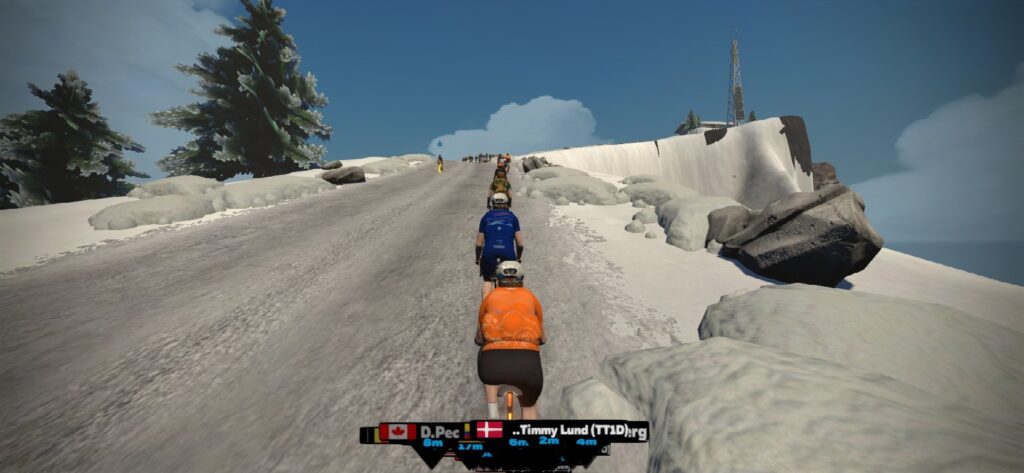
If I am completely honest, I wasn’t sure that I would complete the event, having had a tough week cycling which included two Zwift Racing League events totaling 80km of racing and 6 ascents up the Volcano, plus a Monday race where I achieved a new 20-minute PB, a Haute Route interval session on Thursday, and a 3-hour mountain bike ride the day before. So I was pretty tired! However, as I climbed the Epic KOM, I found myself edging towards the front of the field. I had climbed from 300th position and was up around 189 when we hit the brutal climb to the Radio Tower.
It was at this point that I really experienced significant issues with Zwift. As I climbed, I noticed Eric Min (Co-Founder and CEO of Zwift) was ahead of me. I went to send him a message of encouragement, but then I noticed that the Companion app wasn’t working, I couldn’t type, so instead I thought I would take a photo. So I pressed the button, but nothing happened. By this time, I had overtaken Eric, so thought I would change camera views and take a different snapshot, but when I pressed the button to change camera, again nothing happened. So I pressed it a few more times. Nothing.
So I gave up and continued cycling. 20 seconds later, the screen went haywire and the camera view changed multiple times along with taking a multitude of photos (that didn’t actually save). It was clear that there was a huge delay due to the volume of riders. I had never experienced anything like that.
Climbing to the Radio Tower
I crested the Radio Tower on my own and as I descended, I was isolated. I could see on my mini map that descending at speed was a large group, so I sped up, ready to integrate into the group. It was no good, the mass of riders flew past me like I was stopped at the side of the road. This was followed closely by a second group, who also came flying past but by now I was in a full sprint downhill trying to keep up and fortunately as the descent shallowed, I was able to latch onto the back of the group and there I sat as we sped off towards the Jungle.
The Jungle
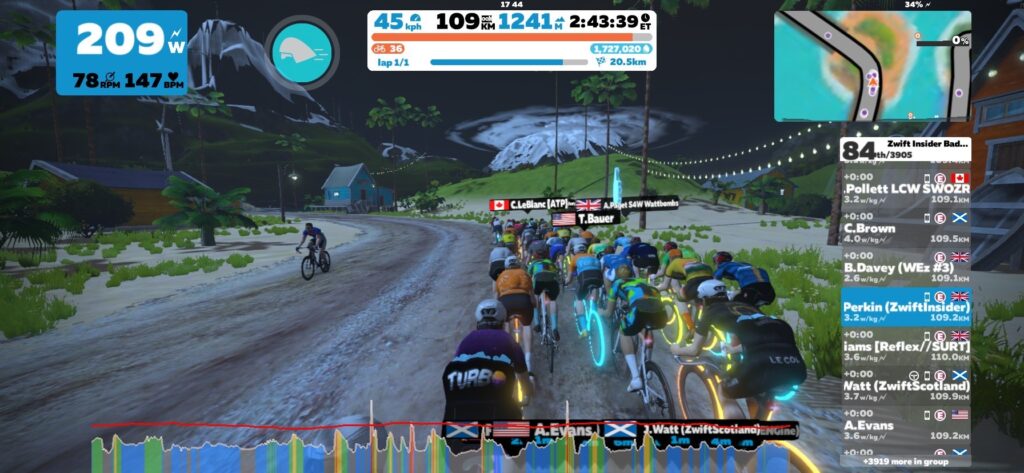
My group powered into the Jungle, and there were the usual complaints about the section of the route and it not being universally liked. Personally speaking, I like the scenery but not the road surface and there was also the usual discussion about changing to a mountain bike.
The conclusion I have come to is if you are in an established group and you are going at speed, it’s not worth the effort because you would stop, change bike, then have to catch the group, then pull ahead of the group so that when you change bike again, you can continue with the group. For me, it’s too complicated. Fortunately for us, one helpful soul had changed to a Mountain bike and was actually pulling our group along.
With the twists and turns of the course, I was able to see that we were gaining on the massive group that zipped through me on the descent from the Epic KOM. The gap was slowly decreasing from 20 seconds and it went down 14 seconds. At this point, we were nearing the end of the Jungle section, the section where only a few weeks previously, my gear cable had snapped in the Gran Fondo. It was the section where the road climbs up through a series of gentle turns, so I decided to chance my luck.
Fearing that my group would not be able to compete with the massive pack ahead on the paved roads to come, I rode to the front of the group and put in a hard effort, hoping to close the gap. I started pushing over 400 watts and was at 6.1 w/kg as the gap narrowed. My heart rate spiked to new levels but through this effort, I managed to latch onto the last two riders of the big group. I was so focused I was unsure if anyone came with me. Given this aggressive style of riding isn’t something I do, I was pleasantly surprised. I pulled through the group so as not to be dropped and sat in as we exited the Jungle. For once, I survived unscathed.
I still hate the Jungle.
The Volcano
I was relieved to be in the large group as it sped towards the Volcano. I sat in, recovering from my previous effort. I was now around 120 position and was just enjoying the ride. I was actually pleasantly surprised that my little tactical move in the Jungle had paid off. The benefit of being in this massive group was noticeable as it took no time before we made it to the Volcano. It was to be my 7th ascend up the Volcano this week.
This time up the climb I rode at my own tempo and was surprised to see that I pulled away from the group on the lower slopes. I was only 12 seconds behind another group ahead but could not get any closer than that. My group caught me as I crested the summit, which meant that I was safely in the group for the descent.
Interestingly, the top time up the Volcano climb during the event was 6 mins and 35 seconds, which would have been one of the slowest times in the races I had done earlier in the week. I crested in 7 minutes 18 seconds.
Fuego Flats
Our group made light work of reaching Fuego Flats and at this point we picked up the group of riders I had not been able to bridge to on the Volcano. Our 74-person group was simply massive, and I was now focused on staying in the bunch because it was like being in one giant bus. I think the group was from places 70 to 144, but I never got near the front to confirm. The one time I did slip near the back, I felt fear and upped my cadence and slipped safely back into the bunch.
It was around this point that I asked people would they be interested in another event and I was met with an overwhelmingly positive response with the PRL Full and ‘Rebel Routes’ being people’s preference. Apart from one rider who had been involved in an event with Andre Greipel, a professional cyclists for Israel Start-up Nation which had 6000 participants, this was the largest group ride that many of us had been involved with. I asked if Eric Min was in our group, hoping to get a few words, but I was told he was in the group behind. I certainly wasn’t going to give up this freeride to go back for an interview, so I sat on in and enjoyed the draft.
The Alpe du Zwift
Having reached the 2 hour mark, there was discussion that we could do the Über Pretzel in under 4 hours. Last time I did it, it took me a little under 5 hours, so this would be a huge improvement. And just like that, what had started out for me as a simple mass participation ride started morphing into a bit more of a personal challenge. Could I do the route in under 4 hours? I have to confess, I was utterly surprised to find myself in such a position and in particular, near the head of the race. The group I was in was absolutely flying.
I mentioned it was like being in a giant bus, I would like to correct that to being in an express train, as I picked up a new PB on Fuego Flats Reverse and Fuego Flats. I decided I would ride this express train until the end and stick with it as long as I could.
3 hours in
Before I knew it and after a little under 3 hours, we arrived at the base of the final climb: the mighty Alpe du Zwift. A daunting task at the best of times, but with 118km in my legs, it was going to be a painful ending.
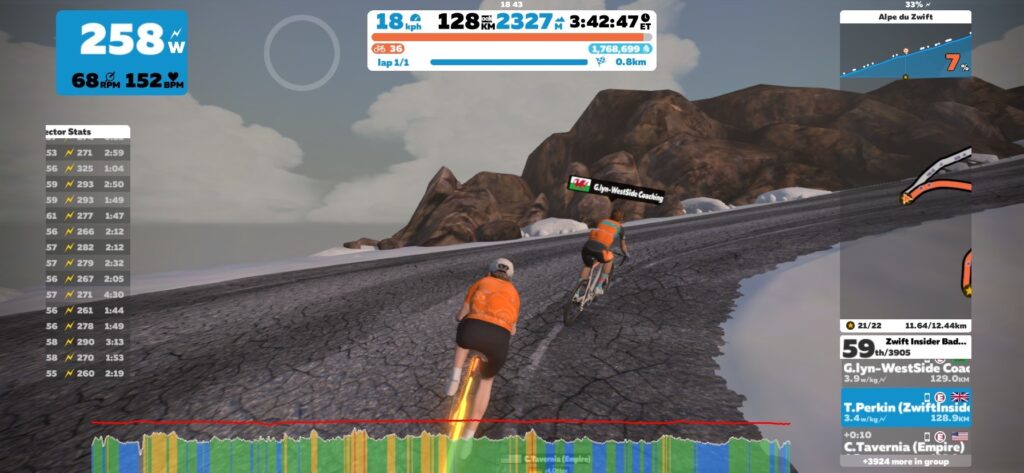
The difference the previous 118km had on my power output was 50-60 watts. On a good day, I can climb the Alpe putting out 330-340W. Today I was able to climb in the region of 270-280W. For me, though, at this point it was all about finishing and I was amazed to now find myself in around 60th position. I didn’t get sucked into racing anyone and I just rode at my own pace.
Interestingly, halfway up I found myself in 57th position, then without warning I had a connection drop. Instead of my normal panic, I got off the bike, pulled the power out of the smart trainer and went into the pairing screen on my device and reconnected. I got back on the bike and got straight back to work. No panic, no fuss, straight back into my rhythm. It was the equivalent of a professional cyclist changing a flat tire in a race. Yes, it messes your rhythm but I didn’t want it to lose my concentration.
I did appreciate how fortunate it was that the dropout happened on the mountain where my losses were minimized, because if that happened on the flat in the group it would have been disastrous and I certainly would have lost my seat in the express train!
Turning the final corner!
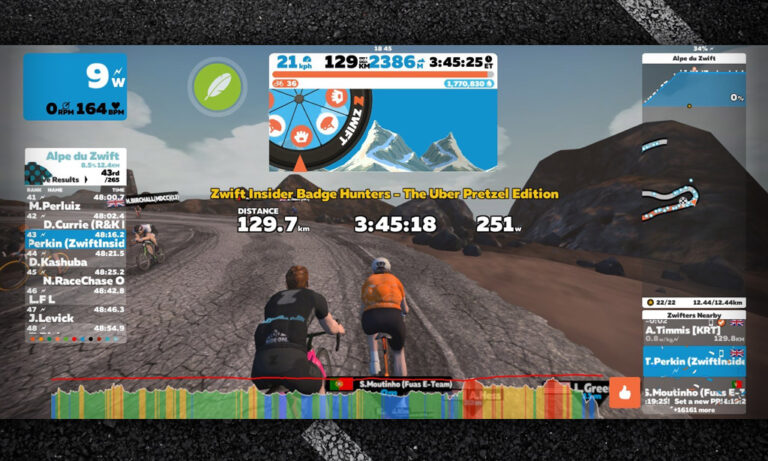
There were no further dramas and I simply climbed at my own rhythm, swapping places with a German rider name M. Otter as we edged our way little by little towards the finish. As I turned the last corner, I dug deep and pushed hard to the line, crossing in 3 hours 45 minutes, 18 seconds in 55th position.
I was pleased with my ride and my climb up the Alpe which was 48 minutes 16 seconds, although it was some way short of the KOM on the day which was posted at a staggering 35 minutes and 03 seconds. During the ride, I crossed the 10,000km ridden on Zwift threshold, which was a personal achievement and certainly a long way short of Tim Searle, the Australian legend, who clocked up 200,000kms only days before!
I couldn’t have been happier to have finished arguably the most challenging route on Zwift and honestly, what a fun 4 hours. I was only anticipated doing a couple of hours, but got caught up in the event and got swept along in the whole experience. And when I finished, my only question is – Eric, when is the next one?
PRL Full Next
Eric has announced the next Zwift Insider Badge Hunters event will be held on the PRL Full March 13th, 6am Pacific/9am Eastern/2pm GMT. See you there!
Matt Rowe sits down with Movistar CMO JP Molinero to discuss the formation of the new Movistar E-Team on Zwift and how his job in cycling has changed over the years. Taking a deep dive into the business side of the cycling industry and how eRacing/eSports fits into that, it’s plain to see that Movistar is ready to make their mark on the eSports scene.
Matt also provides some hints and tips for anyone wanting to take on Haute Route Watopia this weekend.
About the Podcast
The Zwift PowerUp Cycling Podcast features training tips from host Matt Rowe (Rowe & King), with regular co-hosts Greg Henderson, Rahsaan Bahati, Dani Rowe, and Kristin Armstrong.
Zwift can be a daunting place for first-timers in this new world of virtual cycling. There are so many unwritten, unspoken things – like who are those people on flashing blue-colored bikes and how to do I get one?
But the longer you spend in Zwift’s magical worlds, the more accustomed to these things you become. And before long, you are the proud owner of your own flashy blue bike, that we all casually call the ‘Tron bike.’
For many, myself included, I remember my early days on Zwift, partly because it wasn’t that long ago but also partly because I remember being overwhelmed by the many kilometres or miles of roads that laid ahead of me. I didn’t know where they all went. Then I learned that these roads formed routes that could be ridden and once ridden, a route badge was awarded for the achievement. Some of these routes were short and some were long, notably the Über Pretzel at 128km, but all routes once completed resulted in a badge and experience points, which facilitate faster levelling up and access to better and different bikes.
Then I learned there were badges awarded not for completing a route but undertaking certain challenges, such as cycling the Alpe Du Zwift, 5 times. I loved collecting badges and I still love collecting badges.
Then I came across a group ride on a Sunday morning (CET) whose sole purpose was to undertake rides to collect all these badges. They were L’Equipe Provence and ran the L’Equipe Provence Badge Hunters Series. These were my people.
Who are L’Equipe Provence?
L’Equipe Provence is a group of friends who banded together to explore the world by bicycle. In the summer of 2015 they set off for a week-long cycling tour to one of the most beautiful places in the world: the Provence region in the South of France. That’s where L’Equipe Provence was born (L’Equipe being the French word for “team”).
The team stay connected and enjoys meeting up weekly on Zwift between their next rendezvous in Provence. To put it simply, they love cycling, including collecting route badges.
Their goals
As they state themselves “We share two goals: stacking badges and having fun! It’s going to be a blast. Whether this is your first time badge hunting or you just want to tap into the contagious enthusiasm from like-minded Zwifters to help get you through a 100km ride, you’re in the right place.”
Ride Schedule
Due to the success of the series, the number of rides has expanded and now they will offer the chance to collect those badges on a Saturday morning (CET) and evening (CET) as well a Sunday morning (CET) and evening (CET).
The full schedule for their upcoming events are as follows:
Their first Saturday Hunt brings us to the bright lights and steep ramps of New York in search of the perfect bagel and badge. Never flat, but always fun, this route explores every inch of pavement of the New York world.
Things are going to get hot! This Sunday hunt will test your legs and equilibrium. We will embark on 25 dizzying laps of the Volcano Circuitand collect up to five badges, a new jersey unlock, and up to 6,000XP for newer riders!
Venturing deep into the wild forest roads of Titans Grove before climbing skyward to the KQOM Radio Tower, this is one of the most beautiful routes in Watopia, watch out for dinosaurs and Jarvis the Bear. Stick with the group as we begin our blistering descent of the Epic KOM for a chance to bag the 100KPH achievement badge!
March 14th: Watopia, Quatch Quest (47km / 1700m) +920XP
Keep your eyes peeled and your legs spinning. A day for the mountain goats as we ascend the legendary Alpe du Zwift! Whether this is your first or 25th time up this switchback laden climb, you will have a shot at spotting the elusive Yeti wandering around the frozen terrain. Grab a picture but refrain from feeding him—we will need all of the snacks for this ride.
Pretzel week starts with a stop in jolly old London town. Use the group draft early and often because this is a tale of two rides. The first part is flat with a few risers sprinkled in. The second half of our ride will take us into the Surrey Hills where Fox and Box Hill will put our teamwork to a proper test.
March 21th: Watopia, The Pretzel (73km / 1361m) +1440XP
The classic. This route was once the longest in all of Watopia. Long before the Uber Pretzel and Mega Pretzel, the original Pretzel was king. Just because it is the shortest of the three in Watopia, do not be deceived by its length: this route is notoriously difficult. We begin straight away on the Epic KOM before winding our way around to take it on again in reverse. With four KOM climbs to tackle, this will be one salty ride.
March 27th: France, Petit Boucle (61km / 483m) +1220XP
Bienvenue aux chasseurs! We begin this weekend on home French roads. This is some of the newest tarmac on Zwift, and was developed for the Virtual Tour de France in 2020. Enjoy the rolling roads past fields of lavender and rosé vineyards as far as the eye can see. You can also spot Mont Saint-Michel in the distance and climb over Pont du Gard. Meanwhile, our Giant of Provence–Mont Ventop–inspired by Mont Ventoux, invites us to dance up the slopes.
March 28th : Watopia, Four Horsemen (90km / 2110m) +1780XP
The final quest. The Four Horsemen route badge will put your mind and body to the ultimate test. Luckily, you have the team with you! Take each leg-sapping climb one at a time and settle in for a ride to remember. The Alpe du Zwift awaits us in the final. Keep fighting until you bag one of the most challenging trophy badges to call your own.
These rides have a leader (beacon) who sets the pace – see event details for information about your leaders and sweepers. Please follow the leader’s pacing instructions.
Feeling strong? Take some big pulls or offer to help the sweepers. All rides will be between 2.5–3.2 w/kg.
Following the first race in the new Zwift Duathlon League (ZDL) race on February 17, we caught up with Martin Carew, the mastermind behind WTRL and the ZDL latest series, to see how it went.
Martin says the event was a “resounding success.” There were some 2000 registered participants, making it one of the largest running events ever on Zwift.
The event format was praised. The 35-minute bike segment was challenging, followed by a 10-minute transition period which allowed people sufficient time to change from their cycling shoes to their trainers. The run event of 15 minutes made it accessible to all participants of differing ability. In some cases people opted against using a treadmill, instead wearing a footpod and running outside, Zwift in hand.
It is clear that WTRL have got the balance correct in terms of timings of the components with one participant stating that that they “love the fact it is only an hour. Just long enough to be painful but short enough to fit into most schedules.”
Across the growing community, helped by the launch of the new WTRL’s new Zwift’s Duathlon Facebook page, the feedback from participants has been overwhelmingly positive:
“The Zwift Duathlon series is the perfect way to motivate yourself back into racing, with a nice short sharp race time and accommodating race slots for all athletes.”
“The hardest I went in a long while! It might be “only” 35 and then 15 minutes, but there is no pause during the race, no downhill, no draft, no help only biking as hard as you can and then running even harder. Brutal. Awesome. More please.”
Results Issues
The only issue is that there has been a delay in the official results, which the WTRL team summarized to competitors in an e-mail:
WTRL and Zwift have been working together to streamline the process in which Zwifters race and participant data is exchanged. This will lead to faster, more accurate results in the future and we are keen to ensure the whole of season 1 is working from this data. Please bear with us while we transition and as soon as the Race 1 Results are available (aiming for before Race 2), we will be in touch!
We appreciate this isn’t ideal and thank you for your patience while we work on getting this right rather than have issues later in to this brand new format of racing that is only going to get bigger!
WTRL recently posted an update on the results processing to their Facebook page:
At the current time we are STILL not in a position to provide results for Race 1 nor Race 2 results for the Zwift Duathlon League.
Despite many weeks of very successful event testing jointly with Zwift, discussions, web and software development – the current state of Zwift game/race data available is (in all honesty) very poor to non-existent making results almost impossible at this time.
There were hopes that this would have been resolved last week with a new data source for us to use (since ZwiftPower is fundamentally broken) but the latest update received by WTRL (yesterday) from Zwift engineers is that another issue has taken priority. This is incredibly disappointing news to us here at WTRL and to the Zwift team that have been working very hard collaboratively to bring this brand new event format to Zwifters.
We are still hopeful that we may be able to rescue the situation but this remains very firmly in the hands of Zwift’s engineering team to fix. We will bring you a further update by Friday of this week.
Yours very sincerely, A very disappointed WTRL and Zwift crew
So, some very concerning delays/issues with results data but ultimately, the event itself went to plan and the format was well-received. Once the data exchange process is fixed, the event should be very efficient and results posted quickly.
Here’s hoping Zwift’s engineers can get race data flowing to WTRL quickly!
Dutchman Bart Brentjens, 1996 Olympic gold medallist in mountain biking and a former Absa Cape Epic winner, described the event as the “Tour de France of mountain biking.” For 2021 the event is moving entirely indoors, on Zwift!
This event lasts 4 stages, totaling 73.5km/45.7 miles with an elevation again of 789.4m/2,590’ and will be raced solely on mountain bikes. The race will also include a competition for the GC, with a leaderboard being created using ZwiftPower, keeping in the spirit of racing for the Cape Epic.
The four stages will include a TT on the second stage and span from March 7-14. There will be 3 events per day to serve worldwide timezones.
Stage Details
Race categories for the “Open” race events follow the standard ZwiftPower categorization scheme (A, B, C, and D). There are also women’s only events with their own women’s categories (A, B, C, and D).
The Cape Epic is the most televised mountain bike race in the world, and in keeping with the tradition, Cape Epic is going to be televising the Absa Cape Epic Exhibition Pro/Am Race hosted on Zwift’s Serpentine 8 course on March 17th
Want to race the pros? Make sure you complete all 4 stages above so you can take part in the Pro/Am race! This will be a handicapped race, so the amateurs will start before the pro men and women, then try to stay away.
Podcast Rides
In addition, there will be Absa Cape Epic Podcast Rides presented by Payson McElveen on his Adventure Stache Podcast from March 1-6.
The podcast will be focused around the Cape Epic and the athlete’s experiences of their time at the races, including discussing the race, the racing, team dynamics, kit, preparation, and the competition in general.
Greg Henderson sits down with Renee McGregor and Eloise du Luart to discuss the complexities of eating disorders and the impacts they can have on professional and recreational athletes.
Renee McGregor is a sports dietician who specializes in eating disorders and Eloise du Luart is a former Zwift employee turned professional triathlete who has suffered from an eating disorder for a number of years.
Together they discuss the highs and lows of living with an eating disorder, and offer professional advice for understanding disordered eating.
About the Podcast
The Zwift PowerUp Cycling Podcast features training tips from host Matt Rowe (Rowe & King), with regular co-hosts Greg Henderson, Rahsaan Bahati, Dani Rowe, and Kristin Armstrong.
Editor’s note: Luciano Pollastri’s notes about the Zwift racing experience caught our eye for their humor and insightfulness,and when we asked to publish his work here on Zwift Insider he happily assented. Here’s his latest entry, all about yesterday’s Zwift Racing League event. Want to read more? Get the full list of Lucianotes >
Libby Hill After Party: you will agree that the guy at Zwift who had the impudence to call the first 30km a “party” is to be hated by all of us, right? Words have meaning, and using them in such a misleading way is without a doubt a criminal offense, a form of torture punishable under article 5 of the Universal Declaration of Human Rights.
That being said, the “Party” started exactly at 5wkg for four minutes. While the usual monsters from CLS and Kirchmair riding disc wheels were having fun torturing the rest of the peloton, Peter, the captain, was permanently shouting at us not to panic and to stay protected in the draft. That’s what we all did… kind of.
Because the plan we all agreed on was to destroy the race at Km8 just before the first sprint, hoping some Vikings and WTRL Beet-it would help us to distance the lightest riders. But we had to abort the operation as we were already all dying just trying to stay with the group. All except Andoni aka Tchernobyl. We call him like this because of the watt generation he is able to deploy, and this time he decided he would try an escape by himself. He left the pack for 2km, raising the flag of the Jerbos big time. Grande Andoooooooooooniii!!!!
Andoni escaping
And then Libby Hill appears: 1 minute and 30 seconds of pure joy and harmony according to the same guy who called the first part a “party”.
Without surprise, Edu, the best rider of our team, managed to follow the leading pack. Edu is a Transformer. He has this unique capacity to turn himself into a dragster for any time needed. Mon (stands for Ramón) and I were experiencing the basic laws of gravity in our own unique ways: while I was feeling I had a dozen elephants hanging from my back wheel, Mon was taking off like a SpaceX rocket. Oskr wished for the tenth time he could be a lighter rider, cursing how most of the ZRL season 2 stages have a fatal climb and promising to get revenge in next week’s TTT. Peter was citing in circles all the humanly known synonyms of “I’m toast”.
When things get really difficult, our Discord channel usually goes silent and we focus on pushing on the pedals as hard as possible. The silence today quickly turned into a series of heavy breathing noises.
Let me correct this, as heavy asphyxiating noises would be a more accurate description. Anyone joining our voice channel at this point would have believed we were shooting a movie definitely forbidden to children.
The variety of sounds coming out of our lungs in such circumstances is something requiring a clinical study or at least a National Geographic documentary which would go like this:
“In periods of competition, each Zwifter has his own specific grunt which can be heard up to 25km away, and is only recognizable by his herd. This snarl is usually accompanied by a repulsive facial expression indicating a tremendous amount of pain or fear. The most common situations where a Zwitfer uses his grunt are when in danger of being distanced by the leading pack or the immediate 10 seconds prior to faint climbing a hill of Watopia. It can also happen beyond 6wkg, 185 HRM or anywhere in Alpe du Zwift”.
By now I am sure you are asking yourself about our final ranking and why I am using a multitude of diversion techniques not to mention it. Thanks for the question. And you are spot on: I would rather avoid the subject as it is still an open wound.
I captain a C team, the BRT Coyotes in Zwift Racing League Division 2. The team spends a fair bit of time discussing tactics, but as you know, it’s not often in Zwift racing that something planned ahead of time works…
But last Tuesday on the Whole Lotta Lava route (race 6) the team managed to pull off a pre-planned move for a 1st and 2nd place! Here’s how it unfolded.
(Video and images within this article are taken by Paul Arpino. I’d also like to say thanks to Zwift and WTRL for a second season of well organised, competitive, and fun racing!)
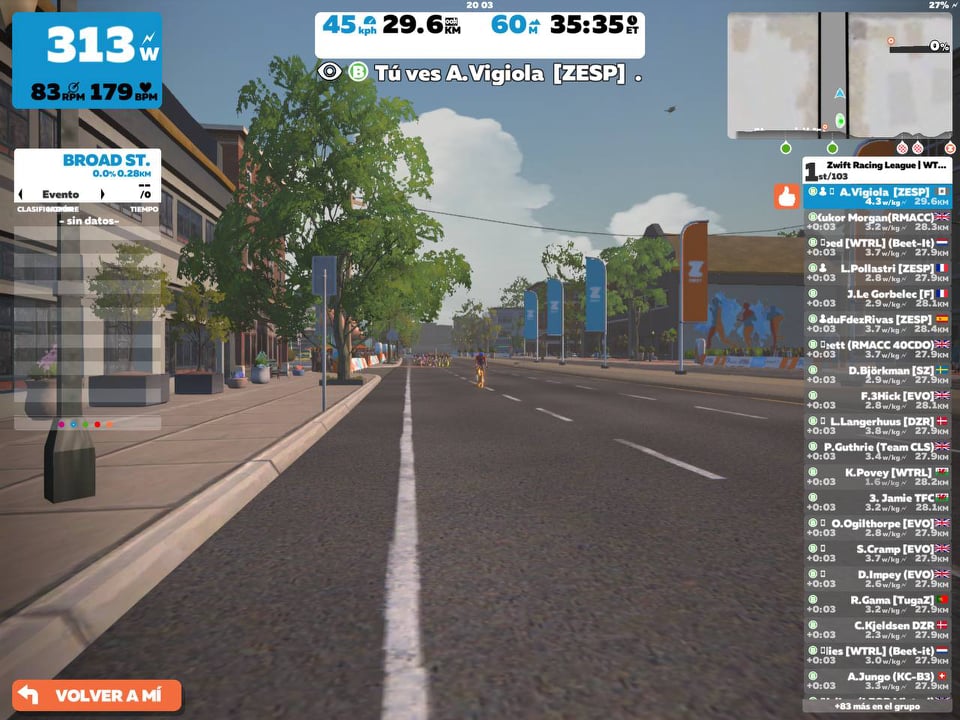
I’ve taken some screenshots to talk through what we did and how it worked, picking up the action with 800 metres to go. The three team members to watch are Andy White (eventual winner), Paul Arpino (2nd placed) and an under the weather Dan Goalen.
As a team we’d discussed tactics throughout the week after a recce ride,. Andy was planning to launch an early attack if he was in the front group and try to hold it. The rest of us had agreed we’d sit in the pack as if nothing had happened, with a plan to launch our attacks in a more traditional style from a few hundred metres out.
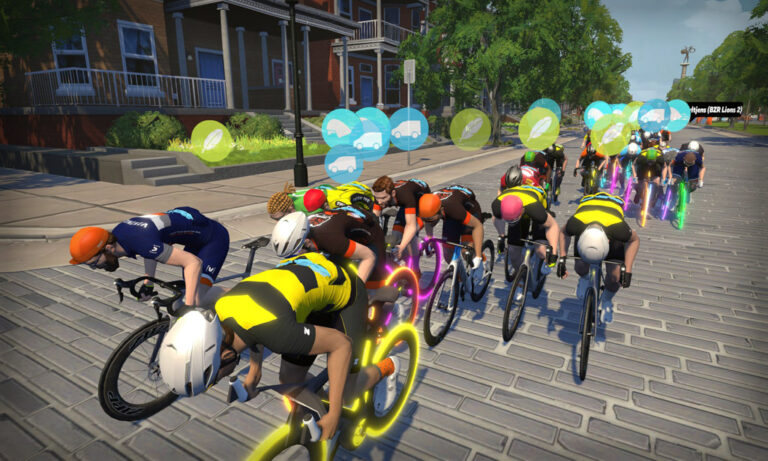
It is not often you see the Ghost powerup working well. Another rider tries it within this sequence without much success.
The last 800m
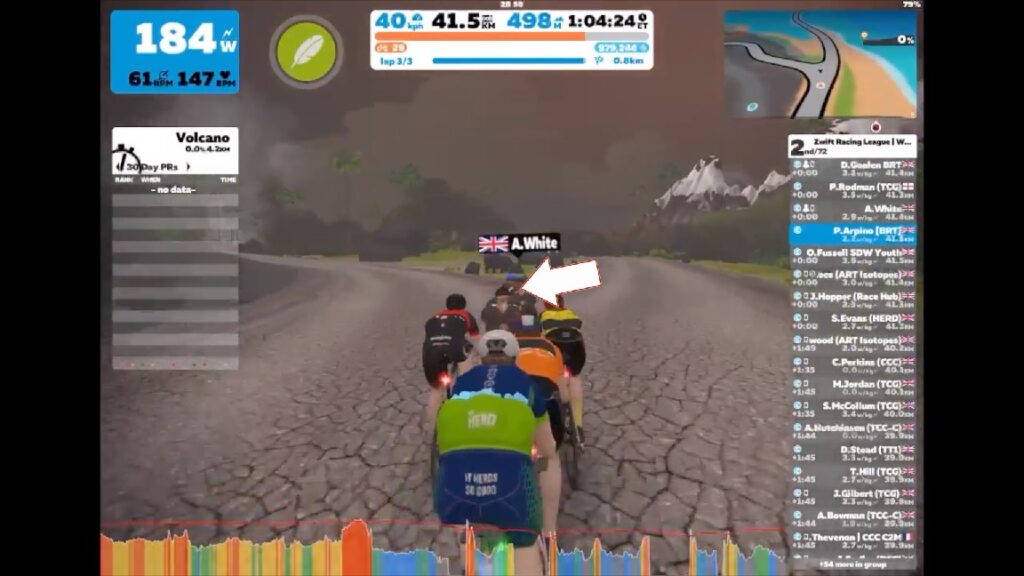
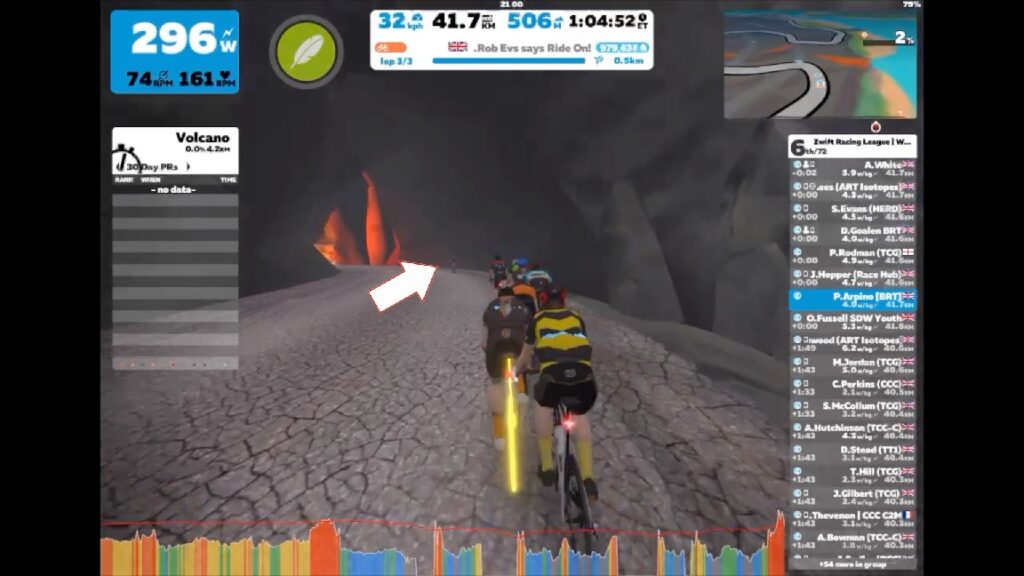
This first screenshot you can see Andy White sat nicely near the front of the pack of 8 riders. Dan is pulling 3.8 w/kg on the front and all looks pretty normal. We are all on Discord, and on the previous lap Andy had announced where he was going to go. Paul and I had a discussion about when to use a feather powerup. From the research done, the last left-hand bend appeared to be the right spot.
Fast forward 8 more seconds and Andy deploys the ghost and disappears. The pack is steady, no silly watts and 700m to go. Our guess that nobody would expect this move appears to be playing out well!
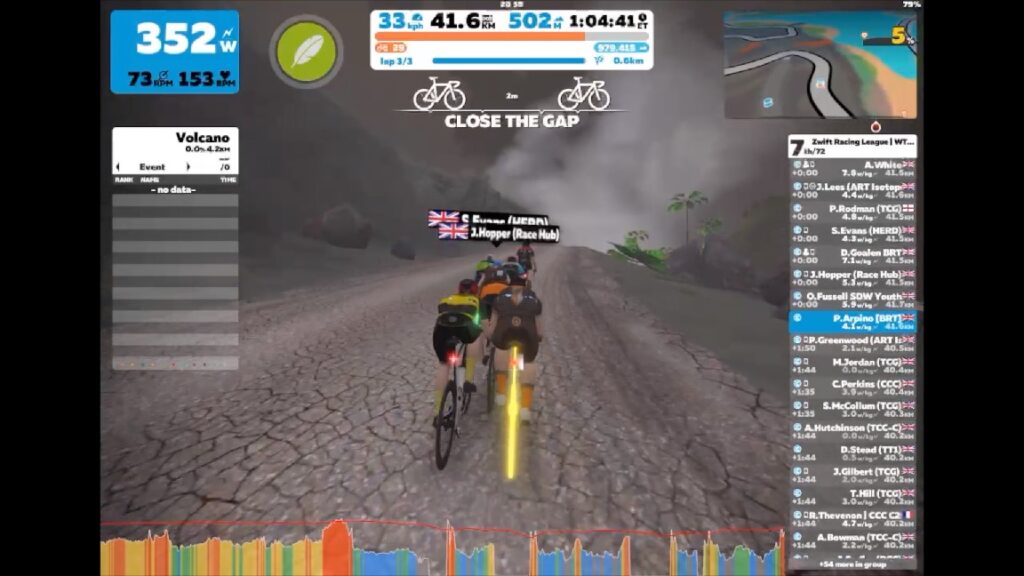
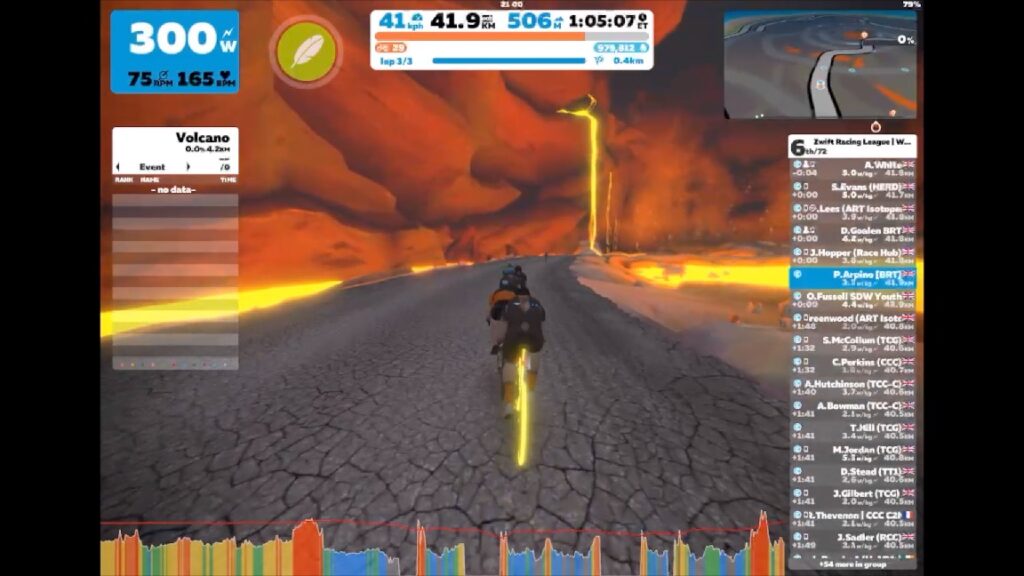
Now, the ghost powerup only lasts 10 seconds. Andy re-appears and he’s not got a gap on the leaderboard, but is pushing out 7 w/kg. Jonathon Lees is just starting to wind up and pushing out 4.4 w/kg. So Andy will be carrying more speed and should pull away, hopefully before Jonathon notices!
500m to go
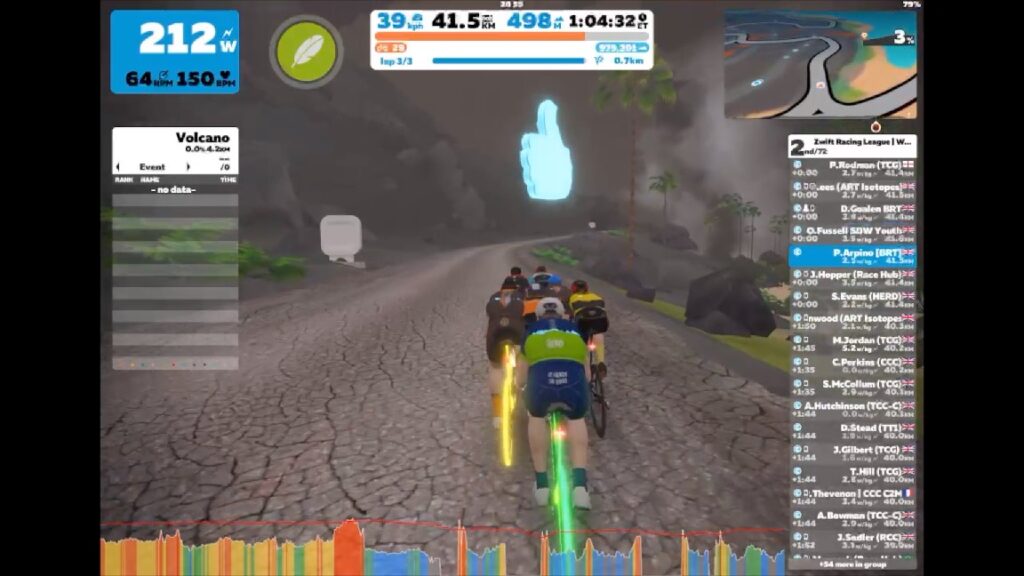
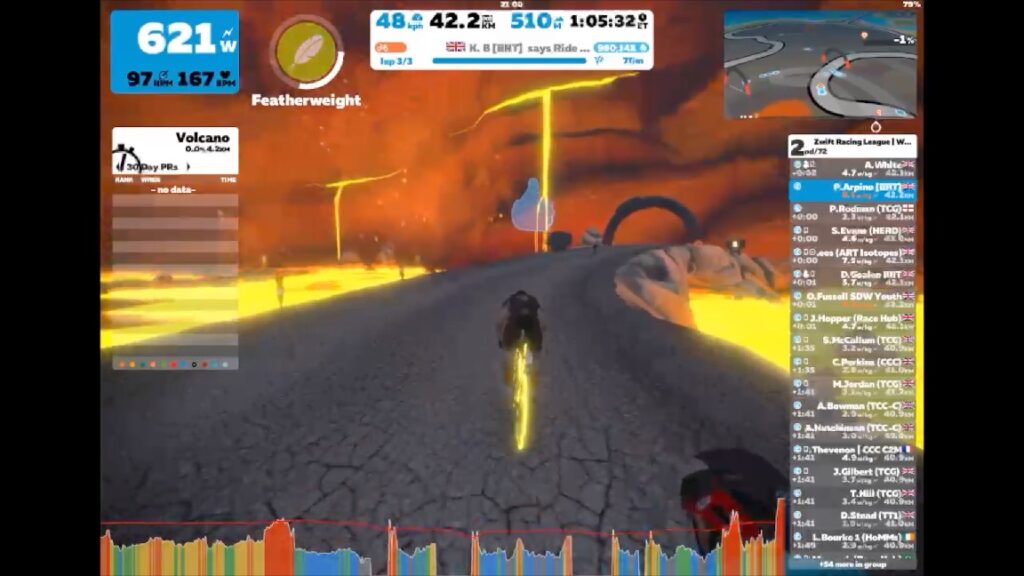
As we enter the Volcano with 500m left, Andy is still putting down more power than the others. Nobody appears to have realised what just happened! He’s got a nice 2-second gap on the leaderboard and a visible gap as shown below. Paul and Dan are happy to sit in and watch the race unfold.
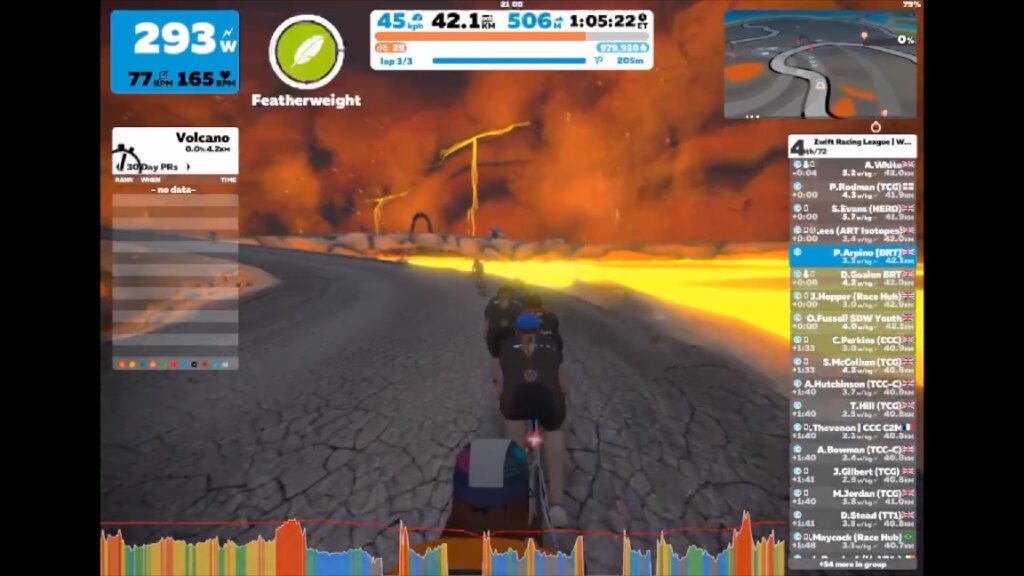
At this point both Paul and Dan are nicely placed with competitors doing the work. Paul has a feather ready to unleash!
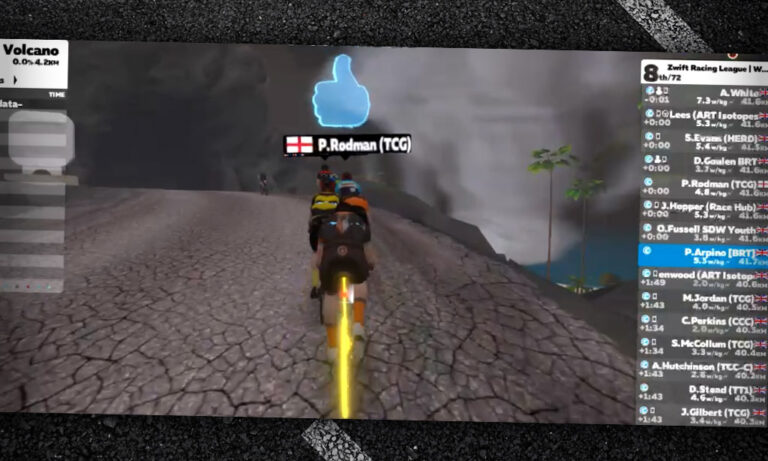
As we enter the volcano at 47 seconds, P Rodman is in fourth. He hits his ghost power up with 400m to go, and disappears from the pack. Paul is sitting 6th wheel and being patient with his feather. Andy’s lead is now 4 seconds, and he has managed to keep putting out some decent power.
In the volcano
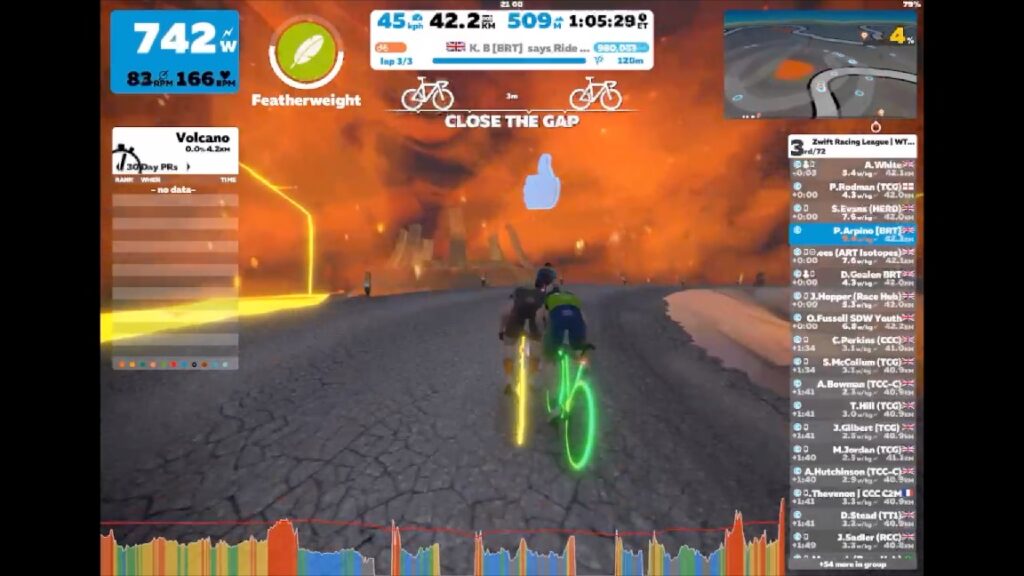
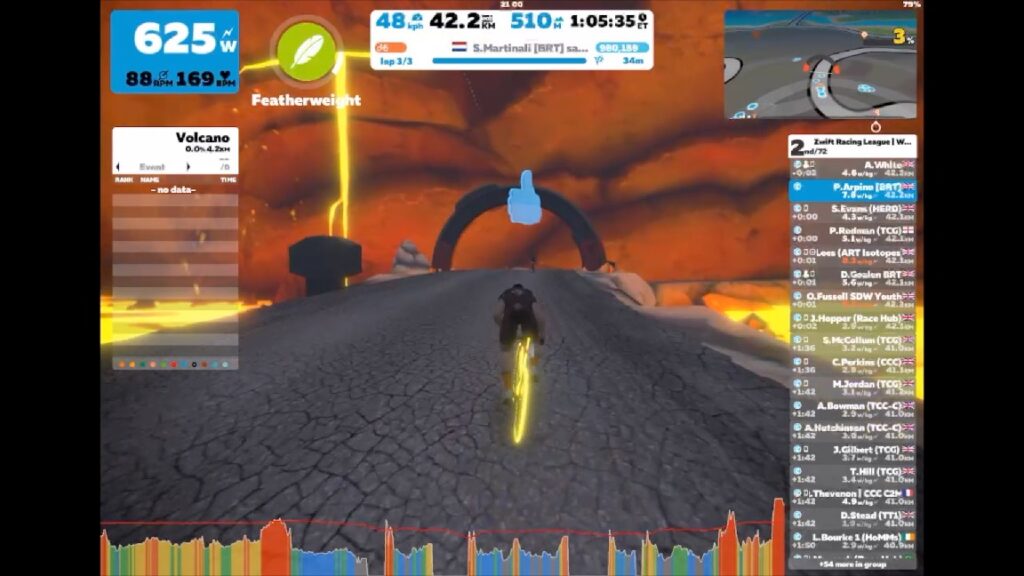
Rodman re-appears at 56 seconds at the front of the chasing pack. He only has a very slight gap, sub 1 second, which he holds with 208m to go. Andy’s gap is holding at 4 seconds. S Evans has reacted to Rodman and is dragging everyone else back onto Rodman’s wheel. At this corner 62 seconds into the video Paul hits the feather. He is very well-placed to slingshot thru the 3 riders in front of him.
At 69 seconds with 120m to go there is a 4% gradient kick. Paul is halfway through the feather powerup and lays down some watts to move into 3rd position. Rodman has held his gap of 3m but Paul is closing and we know Rodman has no powerups left. Andy has had 1 second knocked off his lead, but the finishing banner is in sight.
The final moves
Things are happening fast now, 3 seconds later Paul has moved into 2nd place. He is still putting down decent watts and quickly surges ahead of the 3rd and 4th placed riders. At this point we need to look at Jonathon Lees currently in 5th place. He’s been improving weekly and from talking to him after the race was up for a race win today.
So with 34m to go, 76 seconds into the video, Andy is crossing the line in first position, Paul has got a nice gap and is still benefiting from the feather, and now Jonathon is starting to wind up from 5th position. None of the other riders have hit orange watts, so perhaps 3 times up the Volcano is being felt in the legs!
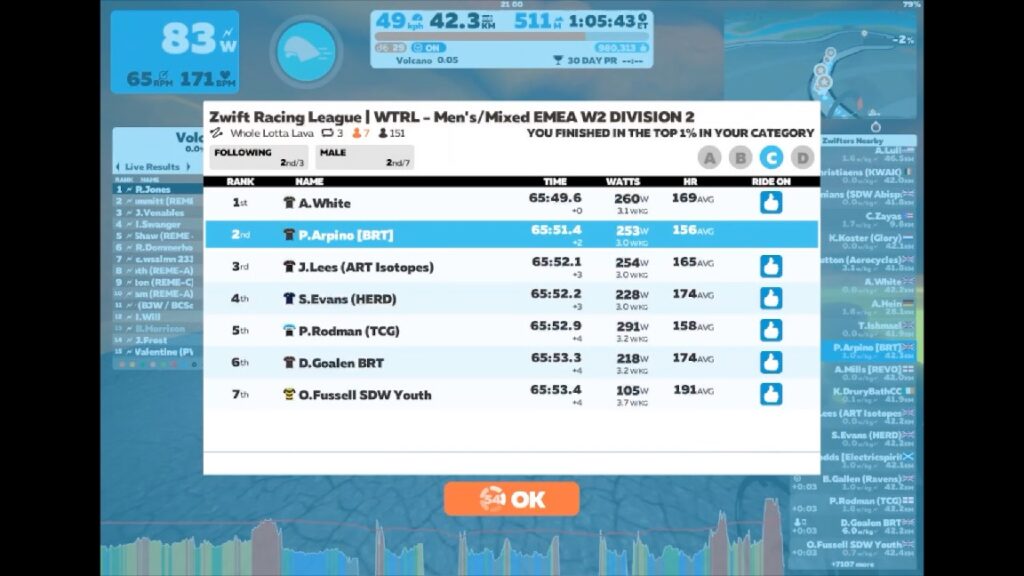
So the final results were a team 1-2 for BRT Coyotes with Jonathon’s sprint paying off for a third place. It’s not often a pre-thought-out plan works so well. Kudos to Andy, Paul, and Dan!
Rider Interviews
I’ve asked a few of the riders involved for their thoughts.
Andy White (the winner)
“After the usual fast start, I was able to keep with the front riders for most of the race. Losing ground on the final climb up the KOM, I managed to catch the lead group on the final descent. The pre-race plan was to sprint for the line with 1km to go, catching the group off guard. This would depend on how I felt. The lead group had 3 BRT riders including myself. A last-minute plan of action was discussed on Discord. I had the ghost powerup and a long-range surprise attack was on.
As I approached the final climb I was mentally preparing myself for the sudden invasion of pain. At 800 metres I released the ghost and kicked as hard as I could, exceeding 7.5WKG. Gaining vital metres on the other riders whilst been invisible was crucial to winning the race. My initial acceleration was short-lived, I could see the distance to the finish line slowly counting down however I had surprisingly gained 2 seconds on the next rider. It wasn’t time to ease up just yet. It was a game of survival, the legs were on fire the watts were falling quickly, and fatigue was the enemy. The finish line couldn’t come soon enough. A fantastic 1st place and overall win for the Coyotes. Pain never felt so good.”
Pauls Arpino (2nd place)
“The key reason the Ghost powerup worked was because we had a small group of eight and three of those were BRT Coyotes. We had managed to break the front group down over the 3 climbs to give us the best chance of winning and enable a Ghost powerup to work. After Andy broke away with 700m to go, me and Dan didn’t react and left the others to try and close the gap. I followed any moves till the second to last bend and used the feather powerup to gain 2nd place. If the front group was bigger, or another team had more numbers, the chase could have been stronger and a different strategy would have been needed to achieve the 1, 2 finish.“
Jonathon Lees (3rd place)
“Coming up to the last KM I had the feather powerup saved up so was going to make an attack at the 2nd to last bend. Approaching the last 700m mark I felt good and based on the 3 previous KOMs knew I was in for a good finish. I was happy to let the others in the group take the front until that point and draft them for as long as possible. As we entered the volcano I then noticed Andy 4s in front just hitting the first bend.
It clicked he played the ghost as I led the climb into the volcano and no one passed. I was debating whether to go for it and try and catch him but wasn’t sure if I had a 500m incline attack in me. I also thought that he might blow up on the last bend as it had been a tough race and the pack would catch him. Turns out he dug deep and played a blinder. I left it a bit too late and should have probably gone at about 350m in hindsight as I only just sneaked 3rd with my final sprint.”
Dan Goalen (6th place)
“With Andy letting us know the lap before where he wanted to attack on the last lap, we checked in with him on the descent to see how he was feeling. Knowing he was good, my main aim in the lead up was to keep the pace high in the run in to where Andy was going to attack. Keeping him out of the wind but near the front with us. When he dropped the ghost and went, Paul and I sat back slightly up the climb, and just chased wheels of Jonathon and the others as they tried to bridge. I then spent 15 seconds shouting at Andy to keep going rather than sprinting myself!“