Home Blog Page 379

How the Race Was Lost: Faux Finish

18

If you’ve been following my “How the Race Was Lost” series, you know I lose a lot of races. Most of those losses are the most humbling sort, where I simply wasn’t strong enough to win. On Zwift I’m regularly reminded that there are many, many cyclists in the world who are much stronger than me!

This doesn’t discourage me though: I’m always looking for ways to race smarter, and of course I also train so I can keep getting stronger. In the end for me it’s not about winning – it’s about being fit, pushing myself to the limit, and enjoying the rush of competition.

While I typically lose because other riders were stronger, occasionally it’s due to a major mistake on my part. Today was one of those races.

I decided to jump into a Crit City race that had low signup numbers. Lately many of my races have had 100 or more B riders, and I wanted to try something different – racing against a small pack. In a low-numbers race you get to know each of the riders, and a solo attack can really make a difference. So I signed up, and headed out to warm up.

The Warm Up
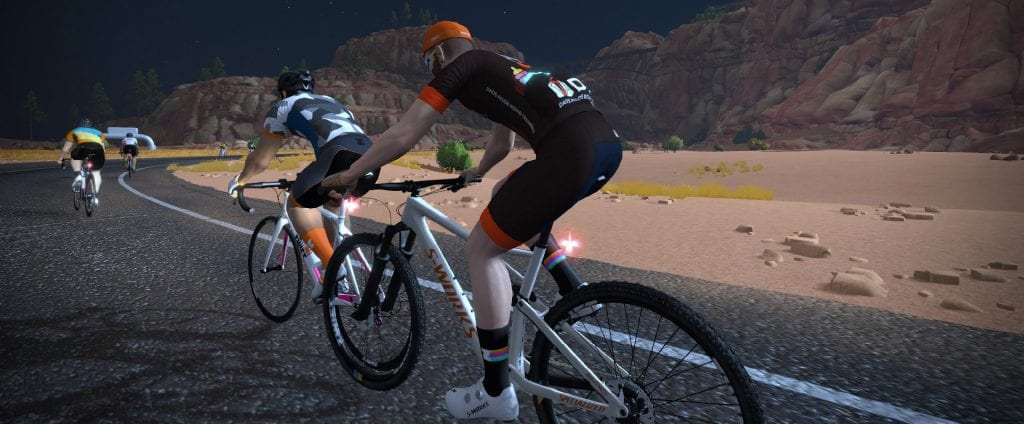
I slept in a bit, but still managed to chew three pieces of caffeine gum and get PR lotion on the legs. Then it was out to Tempus Fugit for my warmup! I pulled my Specialized Epic MTB out of the garage so I could get some MTB miles logged towards completing the CeramicSpeed Mission. (Sidenote: that bike is one of the fastest MTBs on Zwift, but it sure is slow on pavement, especially if the road tilts up at all!)

After less than 15 minutes it was time to hit the pens. Let’s race!

The Start

With only 11 riders signed up for the B category, this would be (by far) the smallest pack I’d ever raced in Crit City. Amazing how Zwift has grown. When I first started in October 2015, a pack of 11 racers was pretty normal, and many races had combined fields because we just didn’t have the numbers or infrastructure to support individual categories. I remember the first time I was able to race in a pack of 30+ riders of similar ability (a TFC C race), and what a different and cool experience that was!

This was an 8-lap race around Crit City’s Bell Lap route. As soon as the clock hit zero, our pack stretched out. One zPowered “J. Munday” was on the front holding 7+ w/kg, but happily nobody chased him so he rode away, never to be seen again until the orange cone of shame showed up a few laps later.
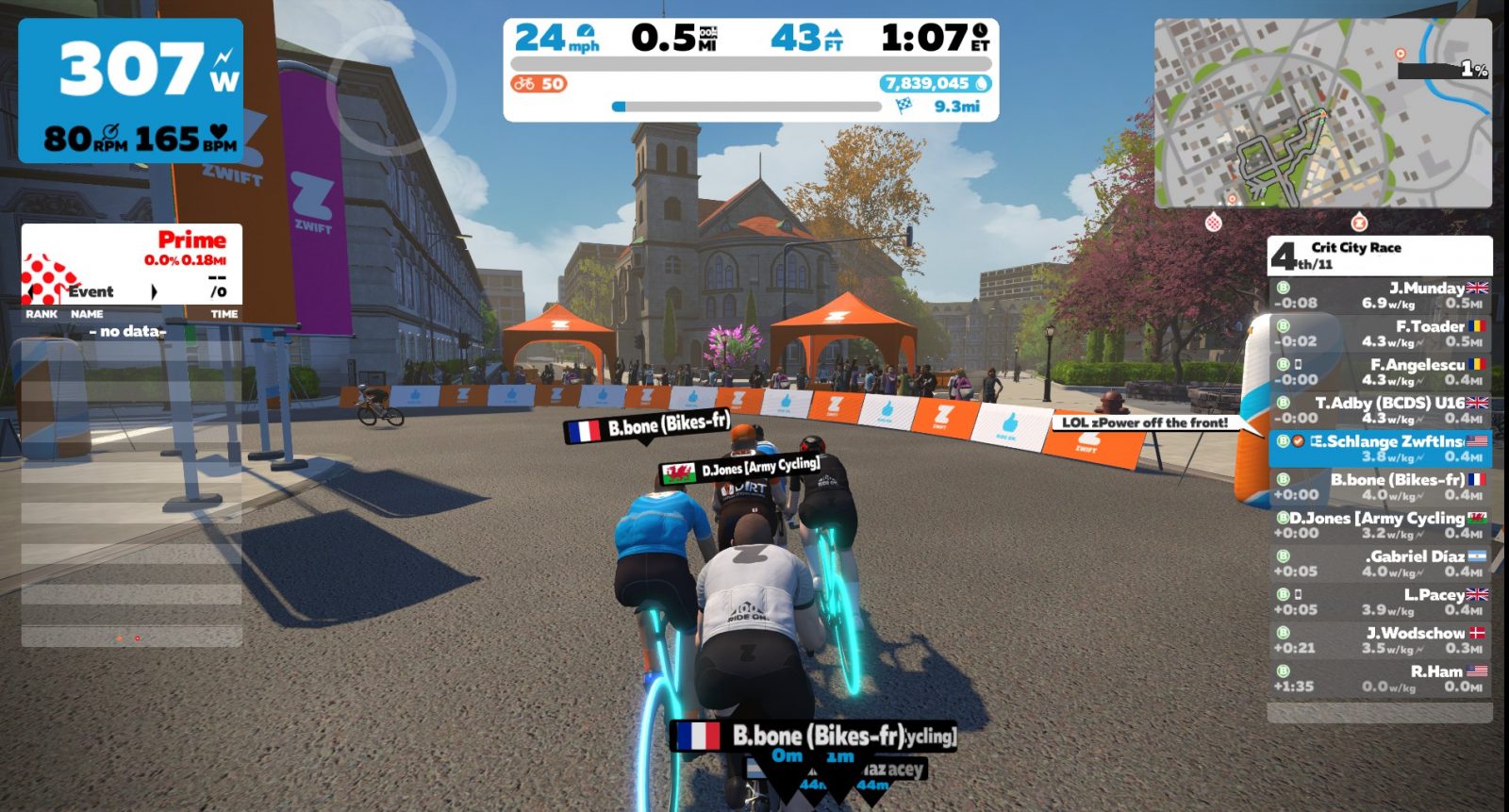
A little helpful in-game messaging…

Before the first lap was completed, our group was reduced to just six riders: Adby (a U16 rider), Toader, Bone, Jones, Angelescu, and myself. I knew from a quick glance at the signup list on ZwiftPower that Adby and Jones were the highest-ranked riders in the group, apart from myself. But I was ranked significantly higher than anyone in the pack, so on paper, this was my race to lose.

The Middle

At the end of lap three, Jones put in a hard attack – the first real attack of the race. That showed me he had a strong sprint and was feeling good! I should have grabbed his wheel, but I responded too slowly. (I have the same problem outdoors – I struggled to jump quickly when I see an attack happening.) So I waited too long, then had to work to catch him, while the riders behind me benefited at least a bit from my draft. Dumb move – I should have sat in and let the pack catch him.
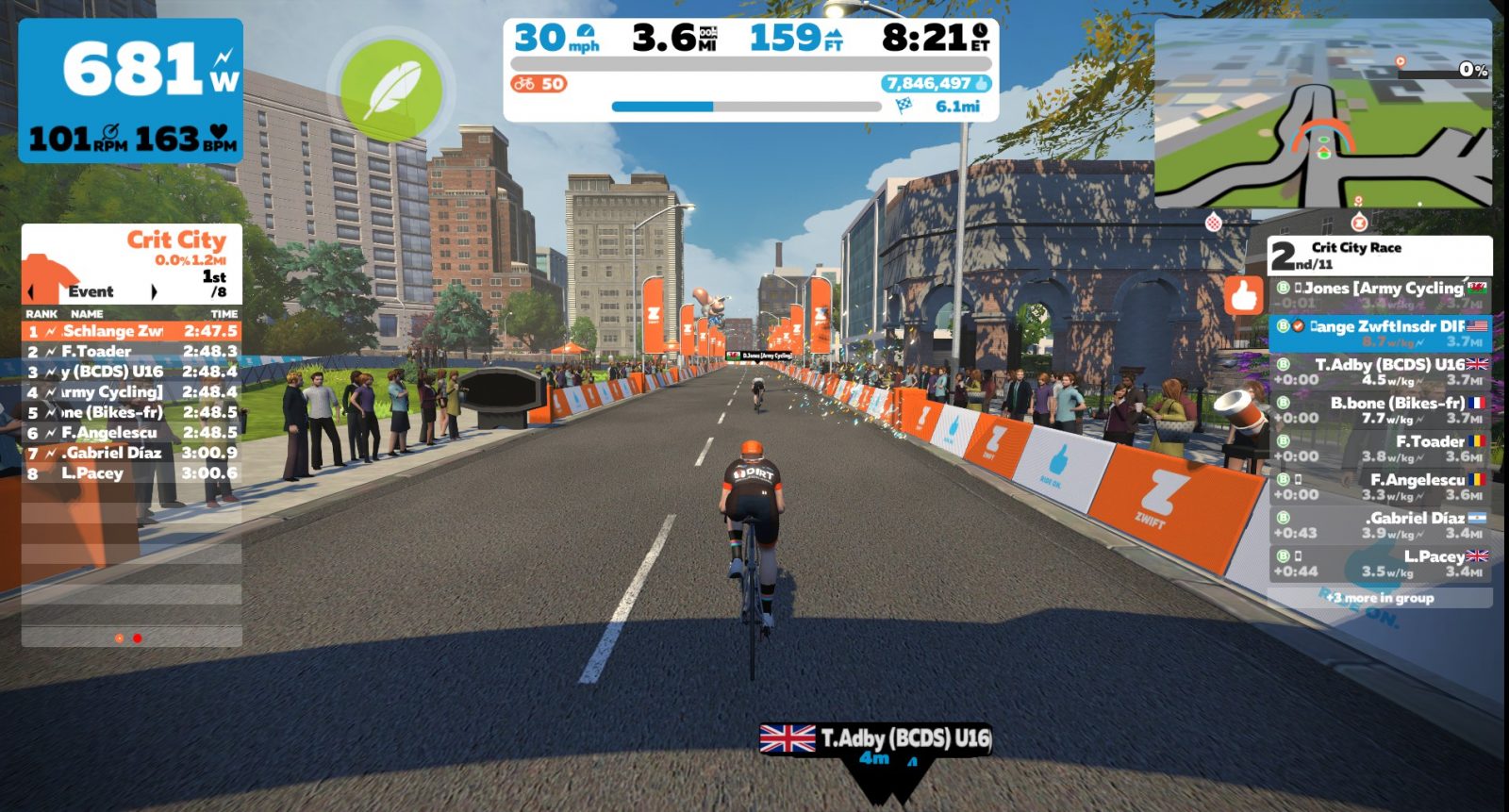
Following Jones, a bit late

We got into the typical Bell Lap rhythm, with effort ramping up on the twisty climb section each lap. Twice I pushed especially hard there, trying to drop anyone who was barely hanging on. Jones and his big avatar were struggling up the climb, but he always managed to claw his way back before we could drop him. Lightweight U16 Adby did well on the climb, which wasn’t surprising. While they were very different riders, Jones and Adby seemed to be my strongest competition. I made a mental note to follow any attacks they attempted.

Our pack of six would stay together until Toader got dropped on the 5th lap.

The Finish

I had a draft boost powerup for the final lap, which really wasn’t what I wanted – an aero helmet would have been welcome, but the powerup gods had not been helpful in this race. Why did I want the aero helmet? Because I wanted to be the aggressor in the final sprint. That sprint is short and fast, and I didn’t want to wait for someone else to jump.

I used my draft boost well before the final sprint, timing it so I could enjoy the 30 seconds of relief it gave as I sat in the wheels. Then just as it ended I shifted, got out of the saddle, and went all in for the final sprint. Glancing up at the screen mid-sprint I saw riders trying to grab my wheel, then it seemed like they gave up, dropping a couple seconds back as I crossed the line. Victory!

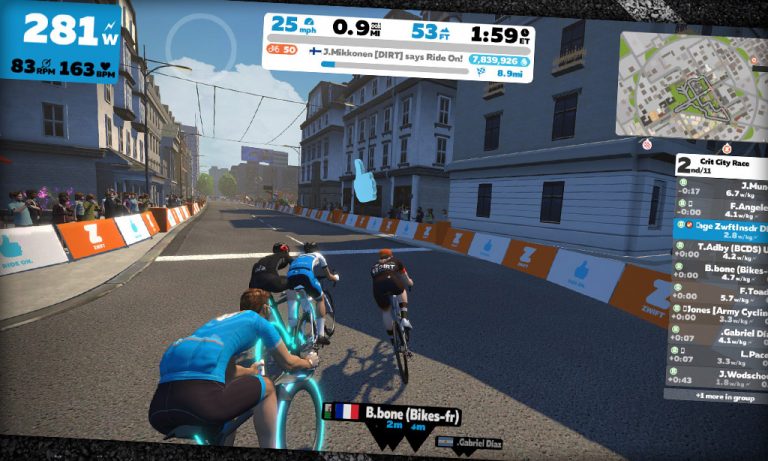
Except nothing happened. Where was the results list? All I saw was this:
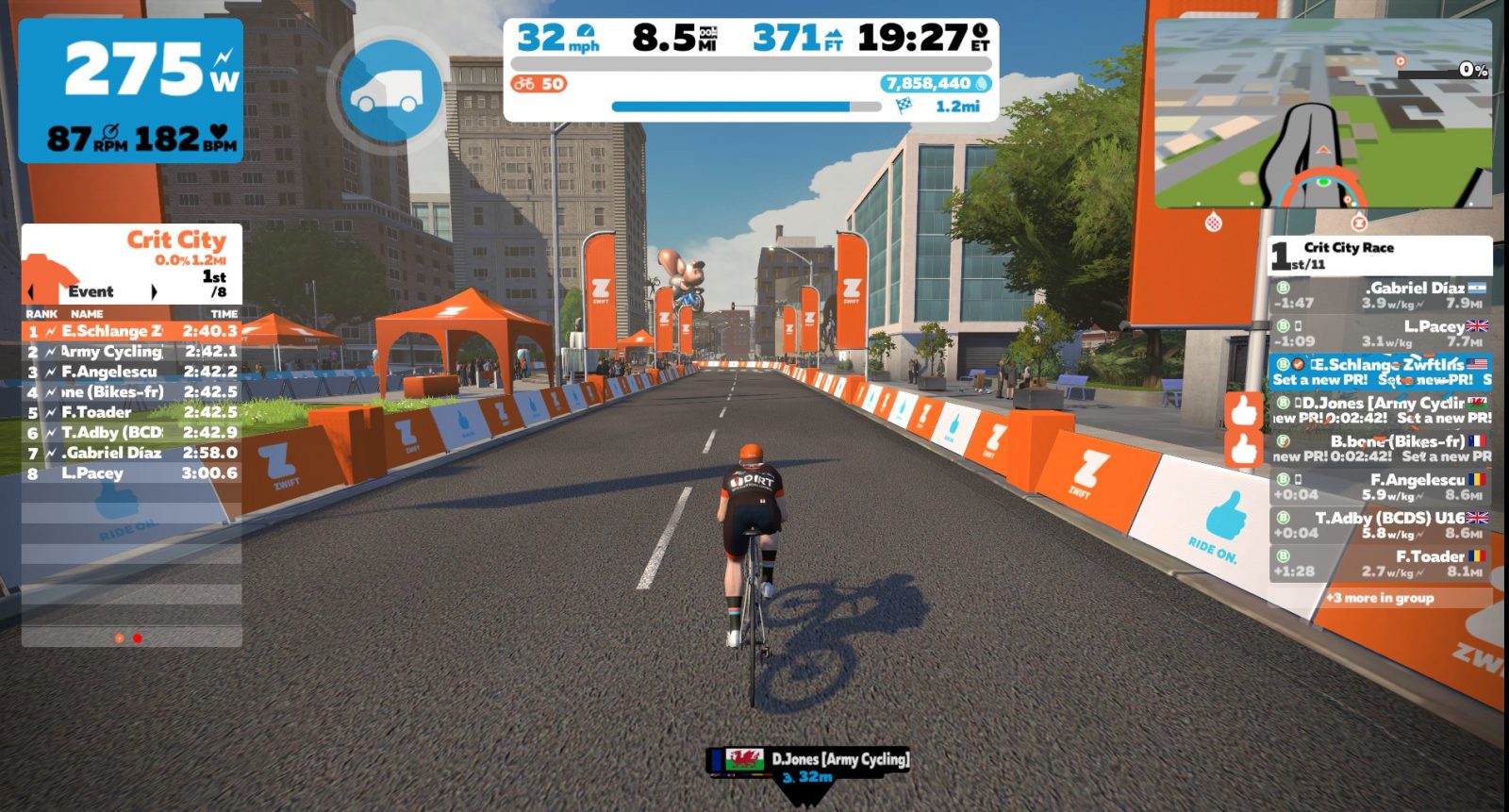
The realization took a moment to register in my race-addled brain: I had sprinted on the penultimate lap. And there were four riders charging quickly from behind!

My heart rate was high, my legs were burning, but I knew the pack just behind would catch and drop me quickly if I didn’t keep my speed up. So I gave it all I had to keep my power high, barely grabbing onto their wheels as they flew past and we made our way up the twisties for the real final lap.

If anyone in the group had been strong enough to attack hard at this point, I wouldn’t have been able to follow. Lucky for me, nobody pushed the pace, and I tried to breathe deeply and recover as quickly as possible before my second finishing sprint.

Jones jumped hard at the end with his strong sprint, and Adby followed. I gave it all I had, but wasn’t able to beat either of them over the line. Third place! I kicked myself all the way to the shower.

See my activity on Strava >
See my activity on Zwift >
See race results on ZwiftPower >

Takeaways

My first takeaway was that this “small pack” race was a fun changeup. It really was a different race experience, competing against a small pack of riders on a small loop where you could begin to see their strengths and weaknesses. In a small pack, you can clearly see who is on the front holding higher power and who is sitting in. You can also see where riders struggle and excel, which helps you understand their strengths and how to best compete against them.

I set new critical power bests in the 2:55-6:35 range (390-346W), so that was good to see. And I broke 1000 watts on my faux finish sprint, which I was also happy about, since I’ve been training to improve my race-ending sprints. (I’ve also begun taking Beta Alanine again, which should be helping those sprint efforts.)

This is actually the second race where I’ve sprinted for the wrong line (here is the first). Clearly, my biggest takeaway needs to be a reminder that my brain, when racing, simply doesn’t function well. Because of that, I have to keep things simple and take steps to reduce mistakes wherever possible. First step: know the finish line. Racing 101!

(Looking at the screenshots, it’s interesting to note that this race didn’t have a lap counter – neither in in-game lap sign or the lap counter in the HUD were working. Not sure why, but I bet I wouldn’t have made my silly mistake if they’d been visible!)

Your Comments

Please tell me you’ve sprinted on the wrong lap. Or perhaps share other race mistakes you’ve made, so I can feel better about myself!
How the Race Was Lost: Death Before DNF

53

Yesterday was my 41st birthday. Fairly fresh legs and a free Saturday morning meant a Zwift race was going to happen. But which race to ride? I scanned the schedule:

  • WTRL iTT Series: ugh. A TT on my birthday? That’s no gift.
  • Tour for All Stage 2 Race: I’d be racing against the top A racers thanks to how these event categories are structured. Nope!
  • DIRT Dadurday Chase Race: not a bad option, but a bit shorter than I’m looking for.
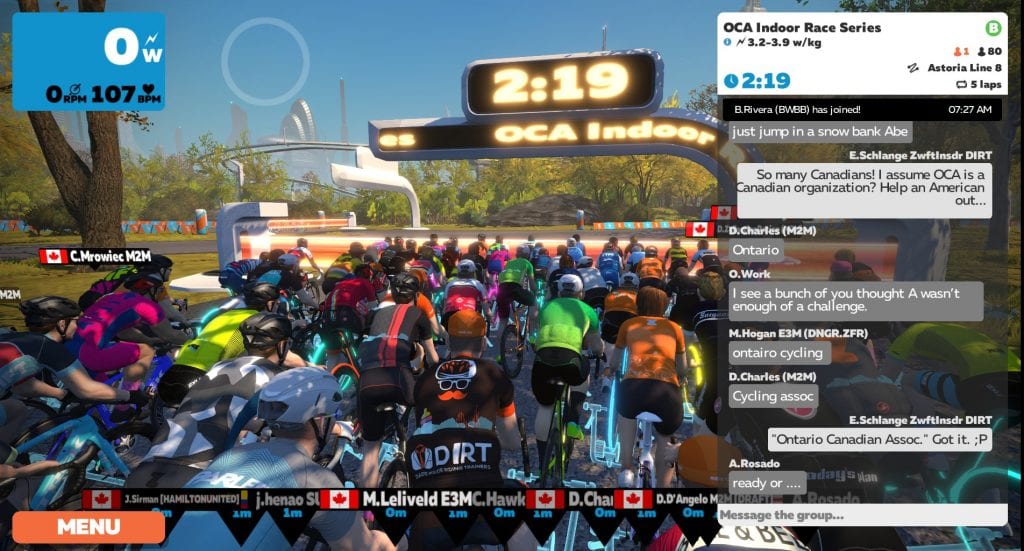
  • OCA Indoor Race Series: never heard of it. But it’s 36 miles long, and on a challenging route. Let’s do it!

When I checked the signup list it was stuffed full of Canadians, which made me wonder: what exactly is OCA? It turns out they’re the Ontario Cycling Association and they, like many local cycling associations, are holding a race series on Zwift to help keep their members active during this time. (A note to event organizers: the Zwift world may not know who you are. Help us out and include links and other details about your organization in your event description.)

My B category would be racing 5 laps of NYC’s Astoria Line 8 route – a course I’ve found both fun and challenging in the past. Fun because it’s a rolling course where you go fast but work hard. Challenging because the various short climbs require repeated big efforts for the “overmuscled” cyclist.

The Warm Up

I got on the trainer about 45 minutes early, after my pre-race ritual of three pieces of caffeine gum and PR lotion on the legs. This time I’d be using my new Garmin Vector 3 pedals on my trusty Wahoo KICKR. I spun my way around the Tick Tock route, put in a few digs to get my heart rate up to 160, then it was time to hit the start pens.

The Start

The clock hit zero, and 80+ B’s boiled out of the start pens. But wait, what’s this? A, C, D, and E riders were merging with us from other pens! Noooooo!!

I’ve really got to start paying attention to how these races are set up. That’s two races in a row I’ve joined with combined categories, and I’m just not a fan. Maybe in certain situations I wouldn’t mind jumping in with the A’s and trying to hold on, but I’m not good at switching my race outlook in the middle of a pell-mell start. And I really dislike seeing riders up the road, but not easily knowing if they’re even in my category. In short: I like the simplicity of racing against just my category.

Note: OCA race organizers contacted me after I published this post to let me know that the combined categories were a surprise to everyone, including themselves! Apparently Zwift HQ set up this even incorrectly, and categories will be separated in the future.

This race also had an “E” category, just for the ladies. That was interesting – I’ve never done a mixed race that included a dedicated women’s category. To make it more interesting, each category was racing a different number of laps!

So the A’s were on the front of our strung-out group, pinning it at 31mph, and I just tried to hold on as long as I could. Eventually the elastic snapped, and I found myself in the second group on the road, made up most of B’s and A’s.

New Goals

There’s the front of the race, riding away!

Racing without a goal is tough for me. And I can’t just have a goal of “doing my best” or “finishing the race.” I need something more tangible.

When you’ve been dropped from the front pack of a Zwift race, what’s your goal? For me, I usually try to work with my chase group to keep the pace high and vacuum up riders who are being dropped from the front group. If I’m feeling feisty I’ll even try to attack through the riders we catch, making it hard for them to grab our wheels.

It’s fulfilling to see my ranking improve as we catch more and more riders, and setting my sights on the riders just up the road gives me something tangible to work toward.

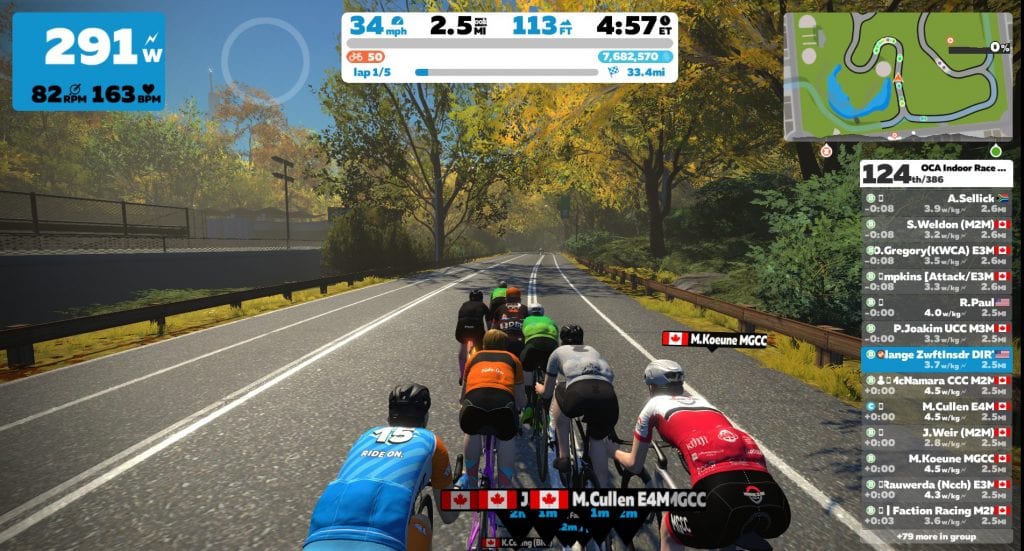
Is this the smartest approach? Perhaps not. It’s a better workout, for sure! But if you’re just going for a top finish, you may be better served by sitting in and conserving energy for the final sprint. It really depends on the race situation – and this was a double draft race, with small packs of riders up the road. That meant our pack could catch these riders if we kept working together. The front of our chase group was 122nd place out of 386 riders. Where could we finish if we kept pushing?

The Middle

Our group worked well together, swelling as the miles piled on. The Astoria Line 8 route has a particular rhythm to it, defined by the longer inclines you encounter. First you have the northern loop, which begins with a climb, then a supertuck-able descent into the twistiest, steepest climb of the route. Despite the climb, I find this section of the route to be pretty fun – supertucking is always a hoot, and the climb afterward is short enough that I can punch it without getting dropped.

The tougher section for me comes just after that northern loop, when you turn left and begin to travel south, encountering a couple of longer rises. Not steep enough to drop me, at least not in today’s race group… but steep and long enough to hurt.

We kept catching riders, and I found myself making calculated decisions on the front of the group. Do I use my powerup to pull us to the next pack? This is a long race, do we just wait to catch them on the next rise? This is one reason I enjoy longer races – the race has more time to evolve, and every move isn’t an emergency.

Disaster Strikes

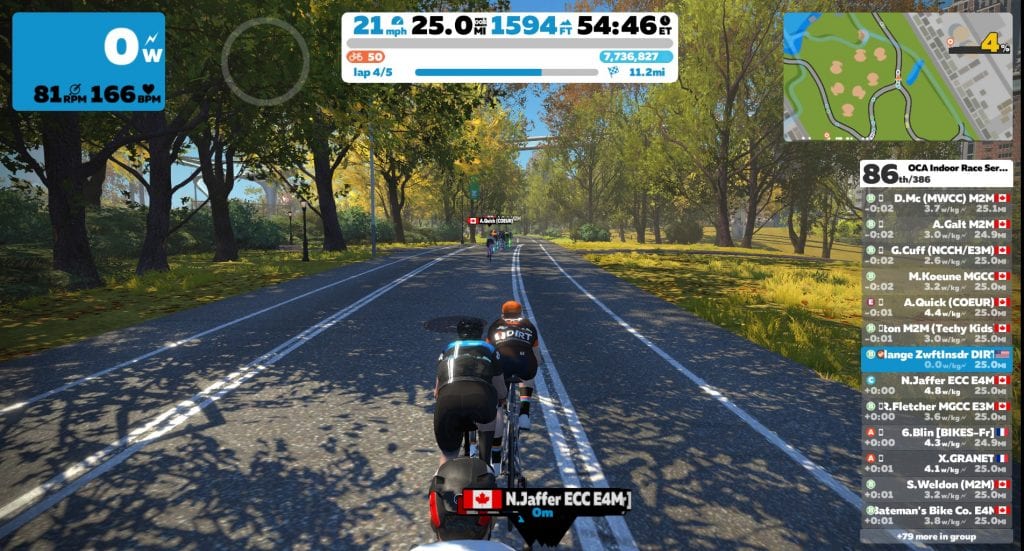
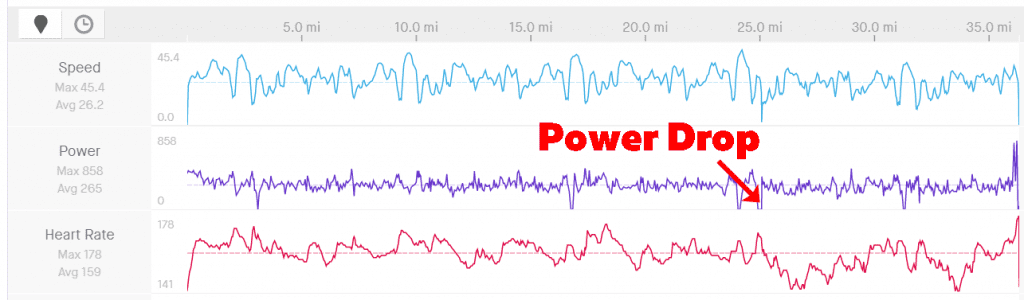
25 miles into the 36-mile race, I was near the front of our sizable chase group, in 86th place with a group to catch just up the road. And that’s when it happened: my watts suddenly dropped to zero. Nooooo!!!

The moment disaster struck

I hurriedly hit the “A” key to bring up my pairing screen, noting that my cadence (which was from the same Garmin Vector 3 pedals which were currently reading 0) was displaying properly. Very strange. But I couldn’t fiddle around with it – I needed to get moving! I swapped my power source to my KICKR, got back to the game, and assessed the situation as I pedaled up to speed.

My group was already 30 seconds up the road, and I had two riders come up from behind, with no one around me. I wasn’t going to rejoin my big group. #$%&!

The three lonely musketeers

Death before DNF

What is your DNF philosophy? I have friends who race (indoors and out) who will pull the plug as soon as they know they can’t win it. This seems silly to me. I once went to a race with a local buddy. We drove two hours to get there, and halfway through the race he got dropped from our front group, turned around, and rode back to his truck. This seems especially silly to me.

I was out of this race. But I was going to finish it! Because I don’t DNF. And certainly not on my birthday.

The Finish

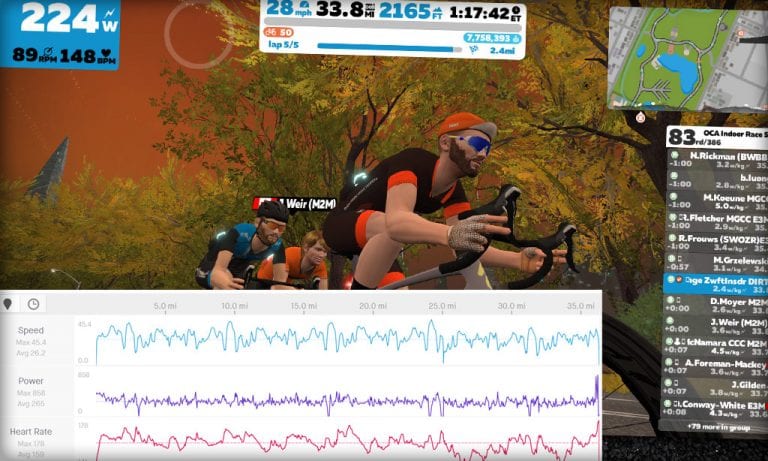
The remaining miles of the race were mostly unremarkable – our small group lacked the legs or gumption to attempt any sort of bridge to the large group which was now minutes ahead. In double draft mode, large groups move so much faster than packs of 2 or 3 – it just isn’t doable without a superhuman effort. So we road together, staying away from those behind, but not working particularly hard, either. You can see in my power chart how my average wattage and speed dropped after my dropout.

Apparently we were lulled into a sense of complacency, because with 2 miles to go we hit one of the cross streets, merging with traffic coming from another section of the course. Suddenly, from behind a pack of riders flew through us! I glanced at the rider list and noticed some of those riders were B’s and A’s, with the same mileage as myself. We’d been caught by a group from behind! Game on.

I sat in with this group, holding onto my feather powerup for the final finish up Cat’s Paw Hill. I stayed within a couple wheels of the front, then gave it all I had to the line, sprinting against two others for a “far from the podium” finish. In the end, one rider from our group beat me over the line. I finished 38th in the B’s, according to Zwift’s results. 22nd according to ZwiftPower.

Without the power drop, I would have finished with the group 3 minutes up the road: somewhere between 10th-20th on ZwiftPower. C’est la vie!

See my activity on Strava >
See my activity on Zwift >
See race results on ZwiftPower >

Takeaways

I had one takeaway from this race: to figure out what the heck happened to my power pedals. And I spent the next hour fixing it.

As it turns out, the pedals had a firmware update available which I hadn’t yet applied. (I won’t go into detail about why I didn’t update the firmware when I first got these pedals a week ago – suffice it to say, Garmin’s app isn’t the best. But let’s save that for another post.)

Firmware version 3.68: “Fixed issue where power would go to 0 over BLE”. Well there you go. Hopefully this issue is resolved for good now!

I’ll be posting a review of the Garmin Vector 3’s, along with a review of the Favero Assiomas, sometime in the future here on Zwift Insider. I will, of course, include the advice to update your firmware!

Questions or Comments

Questions or comments? What’s your view of the dreaded DNF? Share below!

5 Zwift Events Not To Miss This Weekend

3

With more big events than ever in our virtual cycling paradise, it’s easy to miss some really cool rides! Here are 5 events this weekend that you won’t want to miss.

Special thanks to Jesper at ZwiftHacks with his Events app which provides powerful event filtering tools so we can narrow the weekend list from 400+ events to just a handful.

Climb with N.Quintana & W. Barguil // Arkea-Samsic p/b Canyon

Join the team Arkea-Samsic ride led by world-renowned climbers Nairo Quintana and Warren Barguil. Climb the epic KOM on your Canyon Ultimate with the two pros at an easy pace at the bottom ramping up to a race pace at the top of the climb. Try to hang on as long as possible! Arkea Pro Cycling Team women riders will be present too.

Saturday, 4:45 pm BST / 11:45 am EDT / 8:45 am PDT
Sign up at zwift.com/events/view/743143

Join the Tour for All

Zwift’s massive Tour for All fundraiser series is in full swing, and this weekend’s events are going to be a blast! Learn more about the Tour for All, then join a ride or run. You can make it an easy group ride, or go for a race effort.

Multiple events throughout the day. See ride schedule at zwift.com/tfaride, run schedule at zwift.com/tfarun

Wahoo Shred Sessions

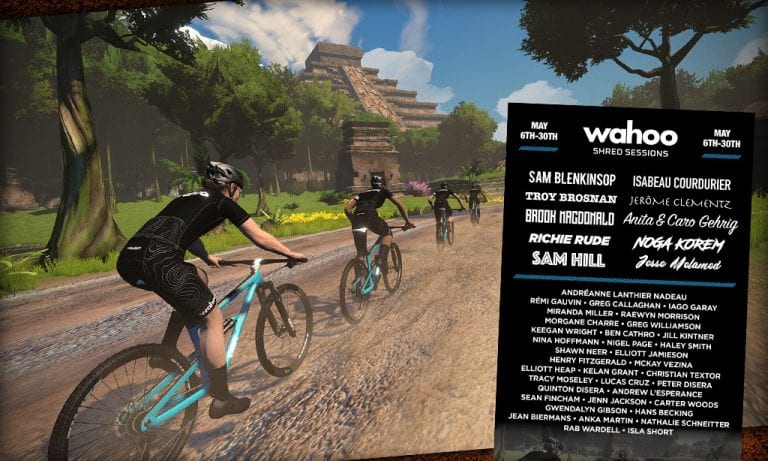
The just-announced Wahoo Shred Sessions bring top MTB stars to Zwift to lead a special series of group rides centered around the Jungle Circuit. Events are held on Wednesdays and Saturdays, and tomorrow’s events are already showing hundreds of signups apiece. Get some!

See the series events schedule at zwift.com/events/series/wahoo-shred-sessions

Ride a Fondo

Fondos are long, mass-start rides which you can ride at your pace. Many riders will race the event, but for some, simply finishing the challenging course is victory enough! We’ve selected two fondos to feature this weekend:

Movistar Team Charity Ride, in support of Red Cross

Unlock the achievement badge for Watopia’s Muir and the Mountain route while joining Movistar pros including Alejandro Valverde, Enric Mas, Carlos Verona, Barbara Guarischi, Aude Biannic and many other big names from both men’s and women’s squads. This ride is in support of the Spanish Red Cross, to help health workers and those most affected by COVID-19.

Donate to the Spanish Red Cross at movte.am/RedCross

Movistar has also set up a contest where you can win Alejandro Valverde’s 2019 Canyon Ultimate CF SLX! Check out this Facebook post for info on how to join.

Saturday @ 11 am BST / 6 am EDT / 3 am PDT
Sign up at zwift.com/events/view/687216

Your Thoughts

Got other events that stand out this weekend? Share below in the comments! And if you participate in any of these events, let us know how your ride went.

Wahoo Shred Sessions Announced

6

A new MTB-focused group ride series has been announced for Zwifters, complete with a star-studded cast of ride leaders. Dubbed the “Wahoo Shred Sessions”, these group rides take place twice a week, with each ride hosted by one or more big names in the world of off-road.

“With trails closed in many places, or too crowded to allow safe riding, we wanted to give mountain bike athletes the chance to ride together and socialize in a safe environment,” says Colin Eustace, Vice President of Global Marketing for Wahoo. “For many mountain bikers, this is a special opportunity to ride with some of the sport’s biggest stars — the kind of interaction that would be singular and memorable, with or without a global pandemic.”

Schedule

Rides are scheduled for three different time slots each Wednesday and Saturday through May 30th:

  • 2 am PDT/11 pm CET
  • 10 am PDT/7 pm CET
  • 5 pm PDT/2am CET Thursday/Sunday

See all upcoming Wahoo Shred Sessions events >

Routes + Bike Recommendations

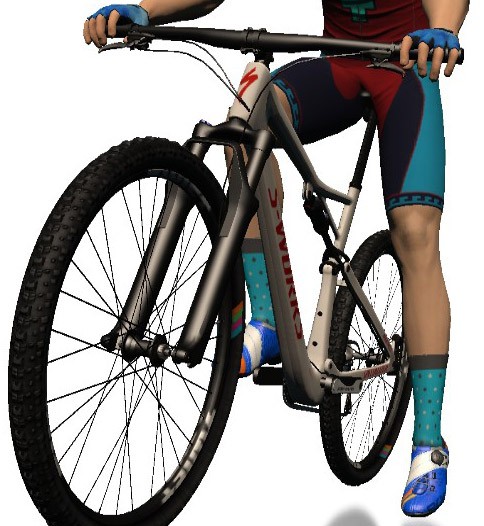
Specialized Epic S-Works – a solid choice for the Jungle!

Shred Sessions are held on Jungle-centric routes which rotate each week. Those routes are: Jungle Circuit (week 1), Road to Ruins (week 2), Jungle Circuit Reverse (week 3), and Dust in the Wind (week 4).

The Jungle Circuit routes are best ridden on a MTB, but Road to Ruins and Dust In the Wind may call for a bike swap once riders hit the jungle – it’s up to you to decide! Read about bike performance on the Road to Ruins route >

Ride Hosts

Currently-scheduled ride hosts include Hans Becking & Leon Van Bon, Greg Callaghan, Troy Brosnan, Ben Cathro & Rab Wardell, Norco Factory Gravity Team, Keegan Wright, Iago Garay, Richie Rude & Shawn Neer, Miranda Miller, Jesse Melamed, Andreanne Lanthier Nadeau, Nathalie Schneitter & Jenn Jackson, Norco Factory XC Team, Andreane Lanthier Nadeau, Damien Oton & Christian Textor, Jesse Melamed & Remi Gauvin, Josh Carlson, Isabeau Courdurier, Brook Macdonald & Sam Blenkinsop, Junya Nagata & Yuki Kushima, Morgane Charre, Emilie Siegenthaler & Pivot Team, and Sam Hill.

Kit Unlock

Complete any of the rides to unlock the Rapha Wahoo Race kit.

All About Zwift Run’s Goodr I.P.A. Mission

0

Zwift rolled out a new running mission for May, in partnership with Goodr sunglasses. Here are all the details!

Signing Up

Signup is easy – click “Let’s Do This” in the Goodr I.P.A. Mission box at the top-left of the Zwift startup screen. Agree to the terms, then start running!

Finishing the Mission

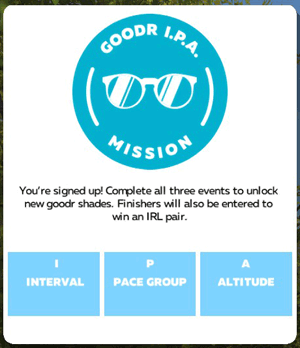
Mission progress

To finish the mission, you must complete one of each type of Goodr Mission runs by May 18th:

  • Interval session of 30 minutes 
  • Pace group run
  • Altitude (or hill) workout

Scheduled events for this mission are available on the Goodr I.P.A. mission homepage.

The mission box will show your progress each time you sign onto Zwift.

Unlocks

Completing the mission will unlock in-game Circle G shades and qualify you for one entry into the prize drawing.

Prize Drawing

Twenty five Zwifters who complete the mission will be randomly selected to win a real pair of Goodr Circle G shades!

Learn more about this mission on Zwift’s Goodr I.P.A. Mission homepage >

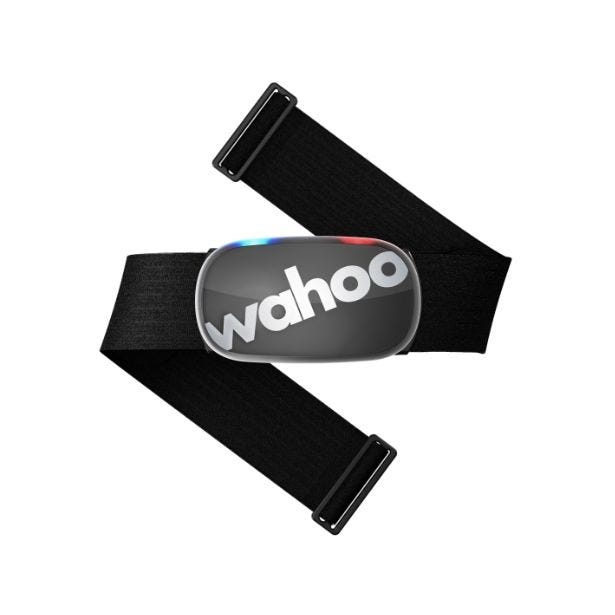
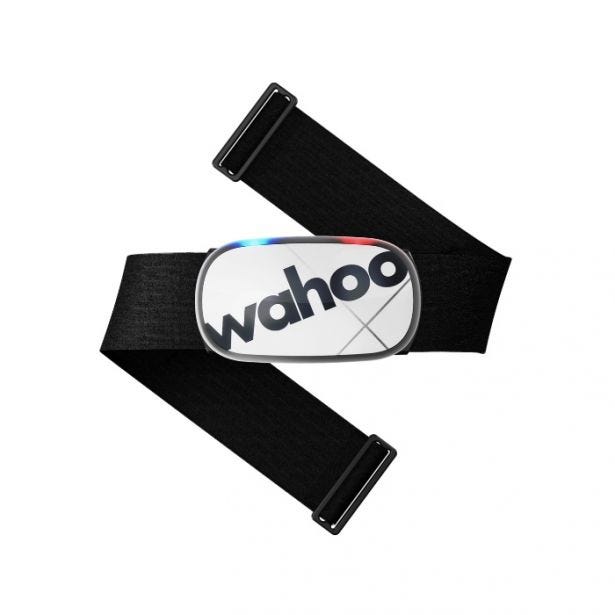
Wahoo Releases Updated TICKR and TICKR X Heartrate Monitors

I’ve been a big fan of Wahoo’s TICKR ever since I bought my first in 2015, replacing the two Garmin HRMs I had destroyed in a single season. While it’s quite rare for a simple product like a heartrate monitor to inspire a dedicated Zwift Insider tribute post, the TICKR left me no choice – it just worked too well, and took all the abuse I threw at it!

The original TICKR was released in 2014, and it has since become a hugely popular heartrate monitor – certainly the most recommended HRM if you ask the Zwift community.

Today Wahoo released long-awaited updated versions of the TICKR and TICKR X. Simple labeled “TICKR V2” on the back of the unit, the new TICKRs are incremental but welcome upgrades to an already established and hugely popular first generation line.

New Features

The TICKR and TICKR X include the following new features:

Wahoo TICKR V2
  • Increased battery life: Wahoo claims to have increased the battery life of the new TICKRs by nearly 50%, meaning you’ll get up to 500 hours of use on a single battery. If you ride 10 hours/week with 2 weeks of vacation annually, that means you’ll only need one 2032 coin cell annually!
  • Slimmer and lighter: most athletes want to be slimmer and lighter… why not ask the same from our heart rate monitors? 😃 The pod itself is about the same depth as before, but lighter in weight. The strap ends which attach to the pod are much thinner, making the whole assembly thinner. (Note: although Wahoo claims these are the lightest HRMs on the market, DC Rainmaker says otherwise!)
  • 3 Bluetooth connections: most Bluetooth devices only allow themselves to be connected to one device at a time – so (for example) you could pair the old TICKR to Zwift Companion, but not your Apple Watch at the same time. The new TICKRs support up to 3 different Bluetooth connections – like the Wahoo KICKR and KICKR Core smart trainers do after last year’s big KICKR firmware update.
  • LEDs more visible: the indicator LEDs have been moved to the top of the unit for easier visibility, so you can easily check to make sure your TICKR is connected and recording data.

All nice upgrades, though probably not significant enough to get anyone to go out and buy a replacement for an already-functioning HRM. The multiple Bluetooth connections is a feature rarely seen in HRMs, though, and it can come in handy if you’re running two training programs concurrently (eg, Zwift and Trainer Road) or want to connect to your watch or phone as well as Zwift via Bluetooth.

In addition to the upgrades above, TICKR X includes these new capabilities:

Wahoo TICKR X V2
  • Enhanced ANT+ running dynamics: enhanced running dynamics data can be transmitted to compatible smartwatches (Garmin watches, basically) via ANT+, giving runners real-time access to their cadence, vertical oscillation, and ground contact time. TICKR X also offers runners a proprietary Running Smoothness ® score through the Wahoo Fitness app, helping to improve their efficiency and form.
  • Expanded memory: TICKR X can also store up to 50 hours of workout data (up from 16 on the original TICKR X). This data will sync to your smartphone via the Wahoo Fitness app.

TICKR X is especially popular with runners – most of the features it supports beyond the standard TICKR are run-specific. It can even transmit your running pace to Zwift, which is handy if you don’t already have a RunPod, NPE Runn unit, smart treadmill, or some other way to get your pace into the game.

Conclusion

If you’re looking for a new heartrate monitor, I can’t recommend the TICKR enough. Read this post for a list of the 7 features which made me love my original TICKR, then go buy a V2 TICKR yourself! Retail price is $49.99US for TICKR, $79.99US for TICKR X.

Note: this post contains affiliate links to Wahoo. Zwift Insider makes a small commission on purchases made from these links, so please shop through them to support our efforts!

Zwiftcast Episode 85: Zwift beyond the crisis; Private MeetUps and Boost Mode plus all the Zwifty chat

Simon, Shane and Nathan return for more chat on the latest in Zwift.

This episode, Steve Beckett, Zwift’s Chief Marketing Officer, is a special guest, with lots to say on Zwift during and beyond the crisis, plus thoughts on Family Subs, Club Functionality, and community racing.

The podcasters range across the new Boost Mode in game; how Private MeetUps could be revolutionary and the current Tour For All.

There’s also an interview with Guy Voisin, the head of cycling at Eurosport on what changes he’d like to see in-game to make racing a more appealing TV proposition.

We hope you enjoy listening.

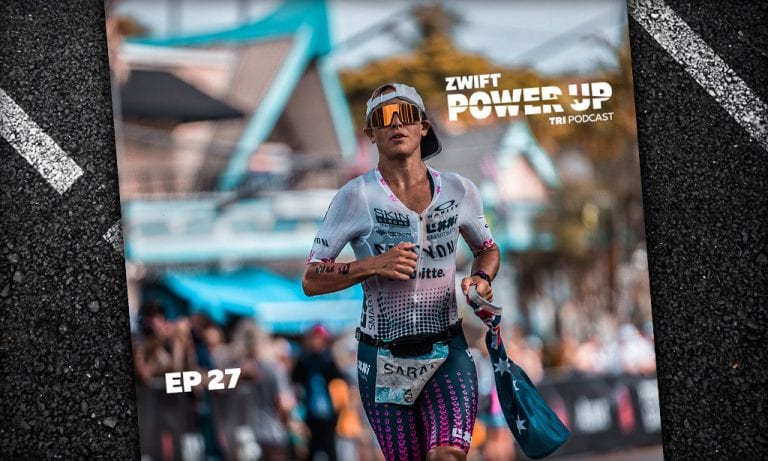
Sarah Crowley: The Coach/Athlete Relationship (Zwift PowerUp Tri Podcast #27)

Australian pro triathlete Sarah Crowley joins us for this week’s episode, and we pick her brain about the all-important coach/athlete relationship. Sarah has always been vocal about crediting her team, and there’s no doubt that coaches play an important part in every athlete’s success. Sarah sheds some light on just how important that relationship can be!

We apologize that the audio quality is not up to our usual standard, due to Covid-19 and social distancing we can’t use our usual recording equipment.

About the Podcast:

The Zwift PowerUp Tri Podcast is hosted by former pro triathletes Matt Lieto and Jordan Rapp, lending their in-depth knowledge of the multisport to the Zwift Tri audience.

Speed Tests: 4-Rider Drafting (TTT)

UPDATE: the test results below are now outdated, due to Zwift modifying their Pack Dynamics. See the latest version of these tests for accurate data.

Drafting plays a huge role in road cycling and thus was built into Zwift’s physics engine from the early days. Of course, Zwifters (especially racers) have debated the “correctness” of Zwift’s draft since the early days as well!

Perfecting a virtual draft is no mean feat, especially when you consider that there is no way to steer or brake on a trainer (not yet, anyway). Because of these restrictions, Zwift’s draft has a bit of “stickiness” to it, so if you approach a rider from behind, and your speed is close to theirs, you will get “stuck” in their draft. This allows riders to get into the draft and stay there more easily, but can be a bit annoying when you’re trying to come around another rider.

There are, perhaps, some improvements which could be made to the draft. In the past I’ve advocated for Zwift to let us “feel” the draft by changing resistance based on our draft status. And Zwift themselves implemented “double draft mode” back in 2018 – an optional event mode which increases the draft effect substantially so it’s more in line with outdoor levels. (It’s still used in some events to help groups stay together, but racers have found that it makes races less exciting since it raises overall pack speeds, making it more difficult for attacks to stick.)

We had already done some testing of the draft effect, but only with two riders. Our initial draft tests showed a wattage savings of approximately 25% when drafting behind a single rider. We also looked at draft savings up climbs and down descents. But what everyone really wants to know is how the draft behaves in larger groups! How much power am I saving if I’m riding 5th wheel, instead of 2nd? What’s the most efficient power plan for a team time trial?

Here’s a screenshot I grabbed from a recent GCN race broadcast. It shows a special secret “draft viewing mode” – fascinating! But just how powerful is that draft?

It’s much harder to test the group draft, because you have to have multiple Zwift accounts set up, each on separate machines, and be able to control each rider individually on a flat course without interference from outdoor riders. Zwift certainly has ways to do this internally, but for the rest of us mortals it means cobbling together a lot of Zwift accounts, computers, and ANT sticks… then figuring out a way for just those accounts to ride by themselves!

That last bit was the sticky part for us – there was no way to hold a “private” group ride, until Zwift released “Meetup-Only View” this week. Now we can arrange a Meetup on any Zwift course, and only have those we invite visible. Perfect! Let’s test the group draft!

Test Goals

This initial group test set out to answer just two questions:

  1. Is it more efficient to ride in a standard TTT format (single-file line), or for riders to simply hold high power and “churn” continually on the front like we see in most Zwift races?
  2. If it’s more efficient to ride single-file, what sort of power savings occurs in each successive rider in a typical TTT formation?

Test Parameters

All of the test riders were set to 183cm height, 75kg weight, and rode Zwift Carbon bikes with 32mm Zwift wheels.

Interesting side-note: Zwift’s draft effect actually takes rider height and weight into account – similar to outdoors! So a taller rider will create a stronger draft than a shorter rider, and a heavier rider a stronger draft than a light one. Zwift computes an estimate of a rider’s frontal area and uses this to compute the wind resistance they encounter, as well as the draft “wake” they produce.

Test Methodology

Tests were done in “Meetup-Only View” on Watopia’s Tempus Fugit route because it’s the flattest on Zwift, and it has a timed section (Fuego Flats Reverse, 4.4 miles long) which could be used to measure the speeds of each test formation.

All of the tests were done with four riders. Because I ran out of ANT sticks and computers!

Tests and Results

Test 1

  • All riders @ 300W
    Segment time 10:14.8
    Speed: 41.34 kph (25.64 mph)

Notes:

  • All four riders continually “churned” on the front, alternating between poking their nose into the wind, then getting slowed so another rider could come around to the front. This is what you typically see at the front of a non-TT Zwift race.

Test 2

The second test had the lead rider holding 300W, with the other three riders in single file behind, holding the minimum wattage possible to stay in formation. This is what you would see in an outdoor team time trial:

  • Rider 1 @ 300W, Rider 2 @231W, Rider 3 @ 205W, Rider 4 @ 199W
    Segment time: 10:47.7
    Speed: 39.24 kph (24.34 mph)

Notes:

  • The “minimum wattages” stated for riders 2-4 on this test and other tests below should be considered approximations, as it is impossible to figure out the precise wattage required to hold formation due to Zwift’s dynamic physics engine and very small undulations in terrain, even on Fuego Flats.
  • Riders received power savings of 23%, 32%, and 34%. So the more riders you’re behind, the bigger the draft effect.
  • In a TTT situation with all riders taking equal pulls on the front at these wattages, each rider would average 234W.
  • Test 2’s segment time was 23.1 seconds slower than Test 1’s, despite riders holding no higher than 300W in both tests. This may seem odd at first, but it’s a well-known result of the way Zwift’s physics engine works at the front of packs. In the “churn”, riders are speeding up while in the draft, then shooting ahead into the wind, only to be slowed and have another rider shoot past them. This little speed boost accounts for a significant time difference, as we see here!

Test 3

Next, I tried to guess what wattage the lead rider would need to hold in order to beat the time set by the churning group of 300W monsters from test 1. I settled on 320 watts – here are the results:

  • Rider 1 @ 320W, Rider 2 @244W, Rider 3 @ 225W, Rider 4 @ 209W
    Segment time: 10:22.4
    Speed: 39.83 kph (25.33 mph)

Notes:

  • Riders received power savings of 24%, 30%, and 35% (2nd, 3rd, and 4th rider respectively). This lines up with the power savings seen in other tests.
  • In a TTT situation with all riders taking equal pulls on the front at these wattages, each rider would average 250W.
  • This group didn’t quite beat the 300W churn, but it was close.

Test 4

This time around I wanted to make sure we beat the 300W churn group. So I bumped the lead rider up to 350W:

  • Rider 1 @ 350W, Rider 2 @270W, Rider 3 @ 244W, Rider 4 @ 235W
    Segment time: 10:01.2
    Speed: 42.28 kph (26.23 mph)

Notes:

  • Riders received power savings of 23%, 30%, and 33% (2nd, 3rd, and 4th rider respectively). This lines up with the power savings seen in other tests.
  • In a TTT situation with all riders taking equal pulls on the front at these wattages, each rider would average 275W. This is crucial to understand: that even with Zwift’s “speed churning” from test 1, the four riders in this test significantly beat test 1’s time by riding efficiently in single file formation.

Test 5

For the fifth test, I bumped power up to around the max we might see in a TTT. I also wanted to see how the power savings (in terms of %) changed with higher power on the front:

  • Rider 1 @ 400W, Rider 2 @306W, Rider 3 @ 277W, Rider 4 @ 261W
    Segment time: 9:31.9
    Speed: 44.44 kph (27.57 mph)

Notes:

  • Riders received power savings of 23.5%, 31%, and 35% (2nd, 3rd, and 4th rider respectively). This lines up with the power savings seen in other tests.
  • In a TTT situation with all riders taking equal pulls on the front at these wattages, each rider would average 311W. So just 11 watts higher than all riders held in test 1: but much, much faster due to smart use of drafting efficiency!

Test 6

For the final test, I reduced power down to the 3 w/kg line, where many D and C riders may ride a TTT effort:

  • Rider 1 @ 225W, Rider 2 @173W, Rider 3 @ 156W, Rider 4 @ 144W
    Segment time: 11:57.9
    Speed: 35.4 kph (21.96 mph)

Notes:

  • Riders received power savings of 23%, 31%, and 36% (2nd, 3rd, and 4th rider respectively). This lines up with the power savings seen in other tests.
  • In a TTT situation with all riders taking equal pulls on the front at these wattages, each rider would average 175W.

Conclusions

Power savings in a single file line of riders is quite consistent in terms of a percentage, even when the front rider’s wattage varying from 225-400W in the tests. Savings for the 2nd rider ranged from 23-24%, 3rd rider 30-32%, and 4th rider 33-36%.

Clearly, the single-file TTT formation is the most efficient way to travel in a group on Zwift. Racers competing in TTT competitions would be smart to practice riding in formation with a focus on holding that minimum wattage needed to stay on the wheel of the rider ahead. This is more challenging on Zwift compared to outdoors due to delayed response times and a lack of steering/braking, but riders can become very proficient with practice. And that will pay off in a big way in terms of TTT race results!

Your Comments

Got comments or questions? Share below!

How the Race was Lost: Boost Mode Beta Testing

Zwift’s latest update includes a new FutureWorks event type called “Boost Mode”. It’s already been the source of no small amount of controversy, with some Zwifters complaining they don’t want “fake” watts/artificially-boosted Strava segment times, Zwift should spend their time developing features Zwifters are requesting, and “we don’t want Mario Kart – we want a realistic cycling simulator.”

Fair enough. But I would push back on those complaints:

  • I don’t want fake watts: this isn’t like riding an ebike! Your own watts charge your “battery”, then you release those watts when desired. Zwift has been clear in saying there are “no free watts” in Boost Mode. In-game segment PRs are disabled in Boost Mode events. As for Strava segments – my guess is the boosts aren’t long enough to affect segment times, except on short sprints.
  • Zwift should spend time on other features: Zwift employs around 300 people, and there are always many projects underway in various stages. Just because Zwift’s developers are working on one thing doesn’t mean they’re neglecting another. Boost Mode is a great example of this – I first heard about it back in December 2019, when Zwift was talking about releasing it! So it was in development for months prior to this, along with a slew of other features.
  • We don’t want Mario Kart: here’s the thing: some people do! Zwift is different things to different people, which is why events have options. Boost Mode isn’t going to be used in every race – far from it. But it may be used in some races, and you can take part in those, or not.

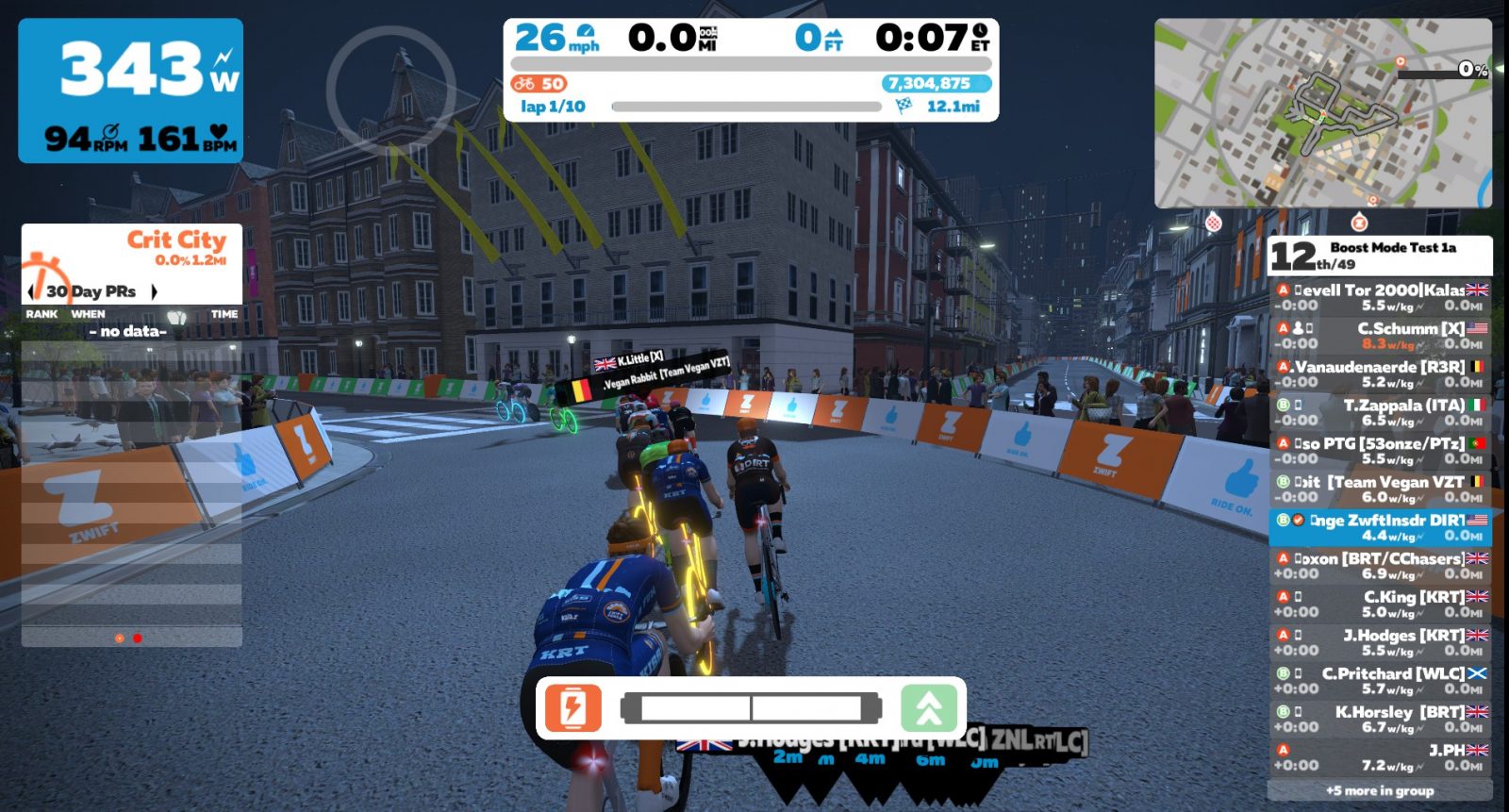
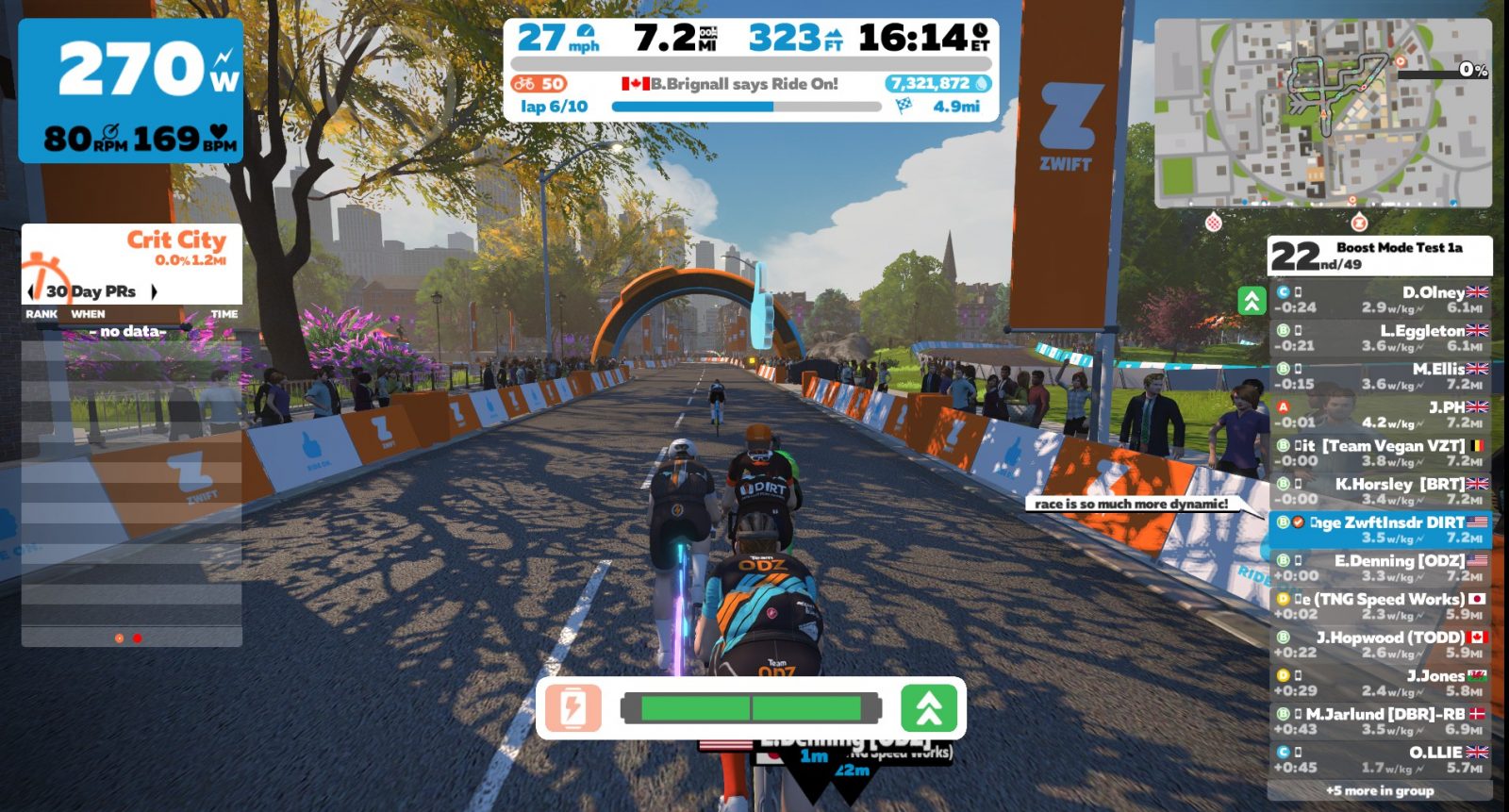
Yesterday I saw that the Jarvis Club has a private test event set up: “Boost Mode Test 1a”. 10 Laps of Crit City’s Downtown Dolphin, and the first-ever live test of Boost Mode. I had to sign up! I wasn’t entirely sure how Boost Mode worked, but I figured it would be simple enough. Turns out I was both right… and wrong. Boost Mode takes Zwift strategy to the next level! Here’s the story of today’s Boost Mode race.

The Warmup

Today’s warmup was a bit longer than my usual, because the race wasn’t until 8am and I was antsy to ride. So I got on around 7am after chewing three pieces of caffeine gum and slapping some PR lotion on the legs. I had to spend a little extra time tweaking my trainer setup, because I was testing out some new Garmin Vector 3 pedals and had my bike hooked to Monica’s rocker plate and Tacx Neo trainer.

A few hard efforts got my heart rate up to 160, then it was time to head to the Crit City start pens. Let’s race!

Welcome to Boost Mode

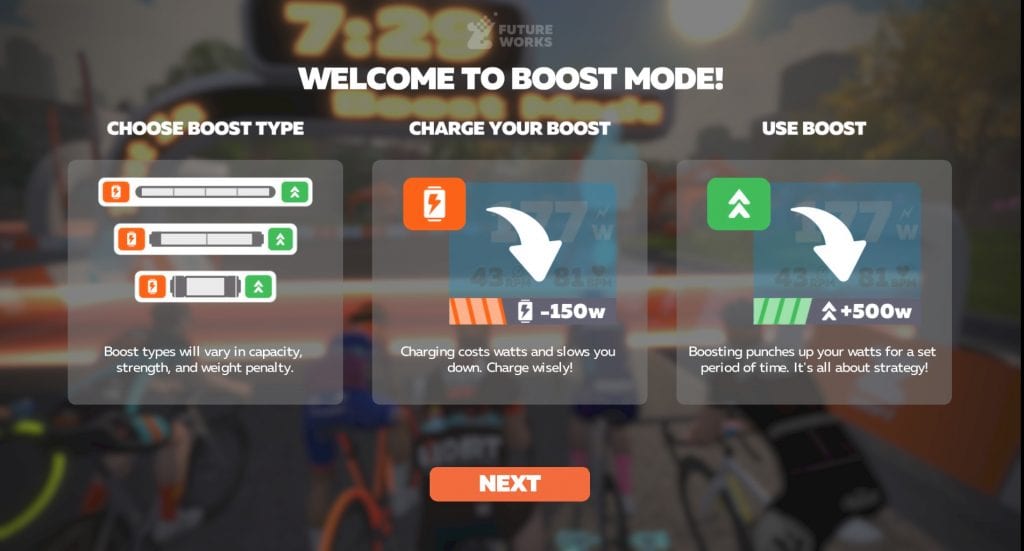
When I clicked to join the event, I was greeted with a “Welcome to Boost Mode!” screen. This introduced me to Boost Mode, and let me set my options:

Here’s how Boost Mode works:

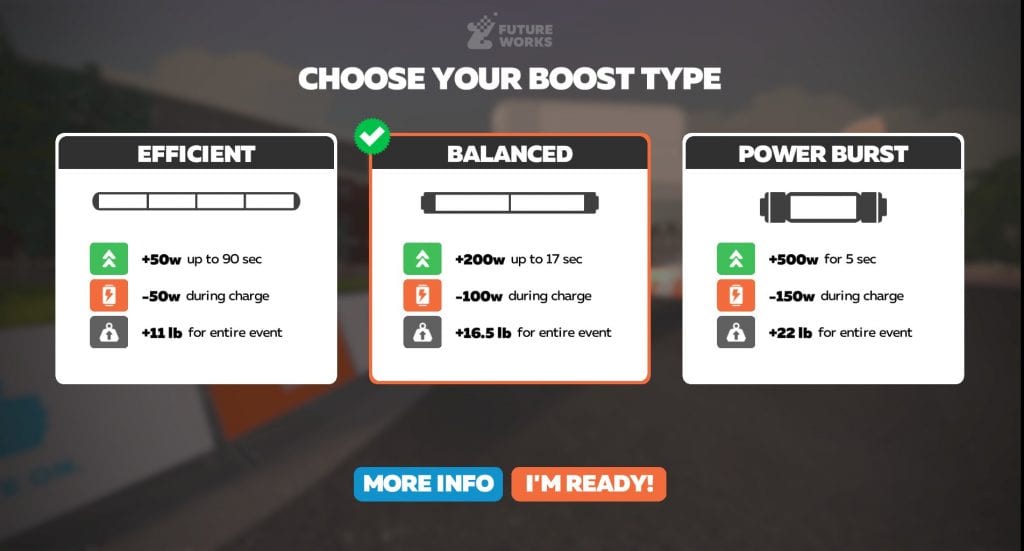
  • You have three different “Boost Types” to choose from, and you have to choose one. You only get to pick one of these for your event, and you can change it until the event begins. Think of these as on-bike batteries which you charge yourself.
  • For this test event, the three Boost Types were:
    • Efficient: 50w boost for up to 90 seconds. Requires 50w to charge. Adds 11lb to your weight throughout the event.
    • Balanced: 200w boost for up to 17 seconds. Requires 100w to charge. Adds 16.5lb to your weight throughout the event. This is the boost I selected.
    • Power Burst: 500w boost for 5 seconds. Requires 150w to charge. Adds 22lb to your weight throughout the event.
  • Each boost type has a different number of “stages”. You can store up 4 boosts with “Efficient” mode, 2 boosts with “Balanced”, and only one boost in “Power Burst”. Tapping once on the charge or discharge button will charge/discharge one stage. Tapping multiple times will charge/discharge as many times as you tap.
  • During the event, buttons in Companion and on-screen let you decide when you want to charge your Boost, and when you want to use it.
  • Small green icons show next to rider names when they are using a boost. You have no way of knowing which boost type they selected, or when they are charging their boost.

The Start

The clock hit zero and our small band of ~15 B’s headed out of the pens. And that’s when I encountered my first problem: the A’s showed up! I hadn’t looked closely at the event details, and didn’t realize we’d be mixing in with the other categories. (Have I mentioned how much I dislike racing with other categories?)

I pushed extra hard to hang with the front group, knowing the longer I could hang with the A’s, the better my chance at a race win. But I was off the back almost immediately – not surprising considering the A’s included heavy hitters like Kim Little, Casey Schumm, Nathan Guerra, and James Hodges!

My First Charge

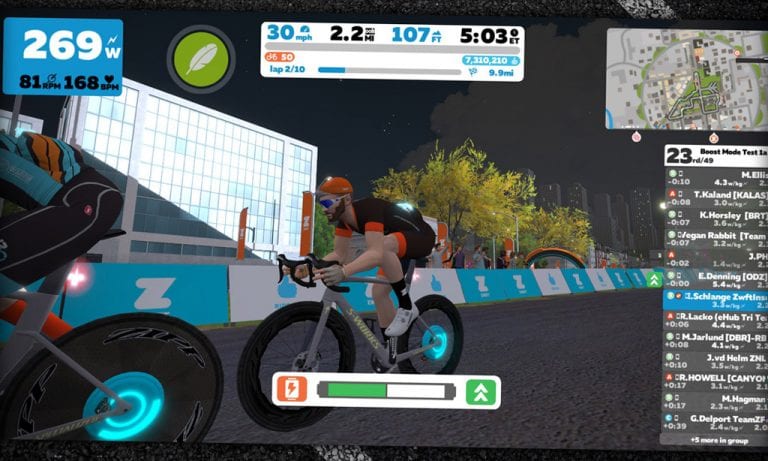
Once the failed fight for the front finished, I turned my attention to Boost Mode. I needed to charge my first boost! So as I began descending the twisties, I tapped the battery icon in Companion. This reduced my power by 100 watts while it charged, as indicated by the “-100w” graphic below the power number at the top-left of the screen:

Charging my boost

Zwift doesn’t change your power numbers shown on screen (pure watts or w/kg number) when you’re charging or using a boost. And they shouldn’t! We all want to see accurate power.

Crucially, Zwift also doesn’t change the power numbers it records while you’re charging or boosting. So your final fit file will be accurate, showing the actual power you put out during the event.

Timing Bug

There was one bug that Zwift will need to fix, though. I didn’t notice this until after the race, when I was watching my recording… but it took the same amount of time (8.5 seconds) for me to charge my boost as it took for the boost to discharge. Why does this matter? Because charging only cost me 100w, but discharging boosted me by double that (200w)! So I was getting 100 free watts for 8.5 seconds every time I used a boost!

I chatted with Wes Salmon at HQ about this – and he made it very clear that their goal here is for boost mode to give no free watts. Which is exactly how it should be. So this is just a bug which will be fixed in short order – probably by the end of today, according to Wes.

Wes also said they’re building in a bit of a “charging tax”, so the watts you get when activating your boost should be a little less than what you put in – like charging a real battery.

The Middle

As the race continued, I started paying more attention to what was going on around me, both in terms of the overall race situation, and how other riders were using Boost Mode. Our B group was quite scattered, with a few riders up the road with some A’s, and me with a small pack of B’s in what I assumed was the second group. (This is one reason why I don’t like racing with mixed categories – it makes it harder to track who is where!)

I had my eye on Chris Pritchard, who was up the road with some of the A’s. I figured he (as well as others) were live-streaming this effort, and you know how that goes: when you know the world is watching, you push yourself to the max!

My boost charging and discharging fell into a more regular pattern as the race continued. I would charge on the descending twisties, because descents are where it’s easiest to keep speed high even if watts drop off. Conversely, I would use my boost on the brick prime climb, because climbs are where wattage boosts help your speed the most. This had the effect of making my effort more “even” over each lap.

Extended Animation

But just because it evened out my effort doesn’t mean it made the race boring! The opposite was true, in fact: Boost Mode really animated this race, in ways I have never experienced before on Zwift. Having a boost in my back pocket gave me the gumption to attack hard on the climb or bridge up to riders ahead, when I would have otherwise sat in with my group. Instead of the typical Crit City race of attrition, I found myself in a constantly-changing small group of riders as we caught some up the road, dropped others, and got caught by others using boosts to chase us down!

The 200w boost was definitely noticeable – it made a huge difference in terms of effort up the prime climb, and really boosted my speed on the flats. The -100w hit when charging was also noticeable, but not too bad when done on the descent.

There was an entirely new level of strategy at play here as riders tried to leapfrog groups or attack hard and drop others. All of the Boost Mode madness was mixed in with the standard powerup fun, too, so it was possible to (for example) use a feather plus a 200w boost on the prime climb.

The Finish

In the final lap I found myself with a pack of two other B riders: Mike Ellis and Chris Pritchard. There were just a couple B’s well up the road, as far as I could tell… so we were fighting for a podium spot or two.

Mike had been putting in some hard attacks throughout the race, and I figured Chris had a strong sprint. I had held onto an aero helmet powerup for the final sprint, and charged both of my boosts. So I had 17s of a 200w boost to use, plus a 15-second powerup. What was my best strategy in the final meters of this race? Now you can see how Boost Mode brings another level of thought to Zwift racing! And my poor addled race-brain was having a hard time deciding the best move.

Given how I’d seen Mike attacking thus far, I figured he would go hard on the prime climb and try to stay away. Pritchard, on the other hand, had been racing smart – sitting in the draft. So I decided I would try to follow the wheel of anyone who attacked hard on the climb, using one Boost if needed. And I would save my other Boost plus aero powerup for the final sprint.

Mike jumped on the prime climb as expected – and he jumped hard! Watching the replay, he must have used a Boost, because he flew away quickly. I was gapped, even with my extra Boost power. Pritchard used a Boost as well as a feather powerup to make it up the climb easily, and we traded pulls as we chased Mike on our way down the descending twisties to the final sprint.

Timing the boost and powerup wasn’t easy, with Mike just within reach and Chris right on my tail. I hit both of my “assists” probably earlier than I should have, getting out ahead of Chris then passing Mike before Chris came roaring past in the final meters. I was right – he did have a strong sprint!

In the end I got 4th place. One nice thing about Jarvis Club private events – no sandbaggers! Our in-game results matched ZwiftPower’s results.

See my activity on Strava >
See my activity on Zwift >
See race results on ZwiftPower >

Watch My Recorded Race

Takeaways

My big takeaway from this event is that Boost Mode is going to be a big deal in Zwift racing. It will never be used for all races, and it shouldn’t be, because some racers want a more “pure” race experience (no powerups, either). But I believe once Zwift gets Boost Mode dialed in, Zwifters will find they really enjoy the way it animates races and adds strategic options.

There’s plenty of strategy and variability in outdoor bike racing which we don’t get on Zwift: wind, mechanicals, pack positioning, braking/surging, etc. Boost Mode, in my opinion, will bring some much-needed variability to Zwift races.

My second takeaway is that I’m happy with how Zwift is letting Jarvis Club members test these new FutureWorks features. This is exactly how it should be done – let experienced Zwifters test stuff out and provide feedback so things can be polished then released to the entire Zwift community. For Boost Mode in particular, Wes mentioned that next week they’ll have more events, and the numbers for the boosts will be tweaked, as HQ dials in what works best for charging wattage, boost wattage, and charge times.

Your Thoughts?

What do you think of this boost mode idea, now that you’ve read/seen it in action? Share your thoughts below!