Zwift’s own Lisa Bourne (Senior Director of Diversity, Inclusion and Social Impact) sits down with David Lipscomb (DEI and Organizational Development Consultant at USA Cycling and early Zwift adopter) for this special BCS episode.
Together they explain DEIB (Disability, Equity, Inclusion and Belonging) within cycling and the workplace, as well as looking at how Zwift and USA Cycling are using their platforms to inform change in the cycling industry.
About the Podcast
The Zwift PowerUp Cycling Podcast features training tips from host Matt Rowe (Rowe & King), with regular co-hosts Greg Henderson, Rahsaan Bahati, Dani Rowe, and Kristin Armstrong.
Have you ever wanted to see how long you can hang on with the pros?
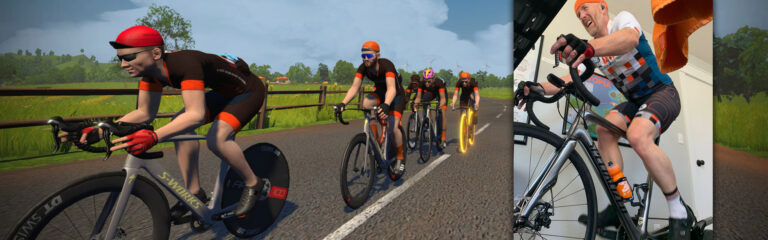
Starting on 17th February, Zwift is hosting a monthly race called the ELITE Pro Series. What makes this series special is ELITE inviting professional cyclists to line up and race shoulder to shoulder with fellow Zwifters, giving riders the special chance to measure their ability against the best.
While the events feature standard categories (A/B/C/D and women-only E), all categories will start together, allowing even lower-category riders to ride with pros… at least for a bit!
For the professional riders and their teams, this is a chance to connect with their fanbase and race not only the global community, but fellow pros. The competition will be intense and fun and even though I don’t expect to be anywhere near the front, just being in a race with a host of pros is exciting enough.
Courses and Schedule
Courses will vary from month to month, ensuring that everyone will be able to race on a route best suited to their strengths. This includes having to race up a big mountain climb!
The first event kicks off on 17th February at 6:30pm GMT/1:30pm EST/10:30am PST and will be hosted on Watopia’s “The Magnificent 8” course (28.6km, 131m elevation). Subsequent months’ events will also be on Thursdays at the same time. Here is the complete list of series events (click to sign up):
Season 2 of the 2021/22 Zwift Premier League runs from January 10th to February 14th. As a quasi-contributor to Zwift Insider and a rider/director of a newly promoted Premier League team, I wanted to give an unfiltered behind-the-scenes look at the action. Look for a recap each week here on Zwift Insider.
Team Time Trials. They look great in pictures. A team lined out, aggressively positioned on a billboard of carbon. Aero helmets floating just above fields of flowers, speeding through the French countryside. Fans across the world asleep on the couch, enjoying a nice nap with the race dreamily playing in the background.
Carbon and Flowers
It’s hard to make these races captivating, compelling. The Premier League had a plan to spice things up this season. This plan would be the destruction of my Velocio team.
The race was mostly flat, but it had some tricky rollers and a KOM segment for team bonus seconds. Each team’s fastest rider on the Aqueduct KOM would give their team a 10, 5, or 3 seconds bonus. In an event that can often be separated by a second, it sounded like a fun play.
My Velocio team’s best event is typically the team time trial. We have never had a guy that can win races, but we have lots of strong guys that communicate well. This race was our best shot to give us some breathing room from the relegation zone.
Great view from the broadcast of the draft zone in the TTT
The week before the race in the WTRL series, many Premier teams raced the Thursday TTT to practice for the upcoming race. Saris crushed the race and set a course record but Velocio finished second. I felt great and had one of my best TTT performances ever, completing all 10 of my pulls well above 500w.
The best thing we could have done for the race is do what we know: execute a dialed TTT. But the allure of those bonus seconds was strong, very strong. In the starting pens, Ryan, an actual World Champion, said “you know, trying new things for the first time in a race is always a bad idea.”
I might have said YOLO.
Instead of our typical 30 sec pulls, focusing on pulling through with momentum, conserving draft and staying lined out, we decided to change some of the pull lengths, and then planned on doing a leadout for the KOM. Stick with our theme of aggressive racing. Risk it for the biscuit.
This was absolutely a mistake and was 100% my fault. The race started well and we were close to pace with Aero and WeZ, the teams ahead and behind us in the start order. Leading into the KOM segment, things started to fall apart. I made our strongest TTT rider Dan Cassidy sit on the front too long because I misjudged the start of the KOM. Ryan, our leadout guy, got confused about the start of the segment and jumped early. To fix these mistakes I sent Charles to the front to glue us back together. We finally hit the KOM and Ryan did a great jump to lead us out, but then our sprinter Jason came off my wheel. I held the sprint to the line and we actually crossed with the fastest time at the time. Perhaps a success but nearly all the teams were still to come.
Behind me was absolute carnage. We detonated the team. We could have jumped from 5 different planes and parachuted in and landed closer together than how we were spread out on the course. Charles was gone and Dan was 15 seconds back. It took a long time to get everyone together.
Purple: Saris. Blue: WeZ. Orange: Velocio Community Team. Oops.
We regrouped and tried to recover our rotation with four riders. It became clear everyone was cooked except for Ryan. He held us together but it wasn’t long before we were down to just three. The team that started behind us was getting closer and closer. We literally sprinted to the line to not get passed:
Velocio 20m from being caught on the line
That team was WeZ. Not a team I get along with. I knew they were gunning for us and would have thoroughly enjoyed passing us. WeZ has had something like four annulments this year. They firmly believe it is unfair and they are being targeted. I am not making the rules, just saying what happened. If you listen to Nowhere Fast Podcast you will recognize some of their club’s members such as Tamper for his Zpower disqualification tag and the guy that got DQed from the playoffs for not following power meter rules. I see a pattern of rule-breaking and have no patience for it. After the race, the team director made sure to rub in the fact that they almost passed us.
Our team was ready for a good ride and we rode our faces off but I did a terrible job at strategy and ruined it. We finished 14th of 15. We did get second in the segment to score 5 bonus seconds. We gave up probably a minute to get those bonus seconds. You don’t have to be good at math to know that’s not a good trade. I would say “lesson learned”, but we are highly unlikely to be back to try again. The team is now 14th overall.
Saris, the team that won to break the NeXT Enshored win streak, raced amazingly. They are a team packed with big FTP guys and have made an art of keeping team speed, using the draft well, and getting seconds through incredible execution. All the teams in the top 5 have incredible watts. Winning also means mastery and kudos to them for a well-executed ride. Inspiring.
Saris looking perfect
Next week is Temple and Towers and it has a gravel climb. Pretty sure a gravel bike is 100% the wrong move but we will have all week to think about making the wrong decision. Just like I did with our team’s TTT. Don’t be me. Don’t overthink it!
Recently, after losing yet another Zwift race which finished in a pack sprint, I had an epiphany: my sprint sucks.
It’s all relative, of course. ZwiftPower shows my 15s power today as 878W (10.7 w/kg.) If you look at the top 20 B racers on Zwift, they probably average around 1150W, and around 13.5 w/kg. That’s a big difference.
This first epiphany was followed by a second: I’ve never really trained my sprint. Sure, I lead the Pacific Sprintapalooza ride every Friday morning. But that has always been more about timing my sprint, drafting smart, and using my powerup at just the right time. I’ve done a lot of aerobic endurance, VO2, and sweet spot work. But I’ve never actually trained to improve my sprint power or duration… and it shows.
My current ZwiftPower phenotype numbers. #sadsprint My current power curve
The Big Idea
So I’ve decided to start a training project, and I’m calling it “Sprintbooster” since the goal is to increase my maximal and 15s sprint power by 20%.
Boone is riding next to me as I write this, and he says 20% is too much because I’m already well-trained. He says 10%. I guess we’ll find out soon enough…
To meet my goal, I’ll complete a variety of workouts and training including:
Gym work (strength training): deadlifts, squats, and anything else that will help my sprint
On the bike work
Cadence: power is a product of torque and pedal velocity. Being able to pedal at a higher cadence increases the velocity side of the equation.
Force: working on pure pedal force (low cadence work like standing starts or tractor pulls) increases the torque part of the power equation.
Form: working on seated and out of the saddle form to maximize sprint power.
I’ve already done a fair amount of research on the topic of sprinting, and have identified key areas of improvement including increasing my cadence in standing sprints, “exploding” faster/harder, and strengthening my core.
While the project is underway I’ll continue researching all things sprinting by talking to coaches, reading articles, and watching videos. The information is out there – I just need to find it and apply it. And you’ll get to benefit from my research, as I’ll share the useful stuff I find in upcoming posts!
4-Week Sprintbooster Plan
Phase 1 of the project will be 4 weeks long. Here’s the plan:
Week 1 (Feb 7-13)
Baseline tests for maximal and 15s power (including video recording)
1 gym strength session: 3-5 reps in 3-5 sets at 85-95% of my one-rep max
Bike workout: 5 sets of 5×30/30 (30s maximal, 30s recovery), with 4 minutes of recovery in between each set.
Bike workout: standing starts. Start in a decently hard gear at 0 rpm, then spin it up at maximal effort to 100 rpm. Repeat 3x seated, 3x standing.
Week 2 (Feb 14-20)
1-2 gym strength sessions
Bike workout: jumps. Start in an easyish gear and spin it up to my maximum cadence, then hold that for 10 seconds. Repeat. Mix standing and seated.
Bike workout: 5 sets of 3×15/45, where each set of sprints is followed by 4 minutes just over FTP, then 3 minutes of recovery.
Bike workout: torque intervals (4 sets of 4 minutes at FTP at 50 cadence with 5 minutes recovery in between each set)
Week 3 (Feb 21-27)
2 gym strength sessions
Bike workout: jumps. Start in an easyish gear and spin it up to my maximum cadence, then hold that for 10 seconds. Repeat. Mix standing and seated.
Bike workout: torque intervals (4 sets of 4 minutes at FTP at 50 cadence with 5 minutes recovery in between each set)
Bike workout: standing starts. Start in a decently hard gear at 0 rpm, then spin it up at maximal effort to 100 rpm. Repeat 4x seated, 4x standing.
Week 4 (Feb 28-Mar 7)
2 gym strength sessions
Bike workout: jumps. Start in an easyish gear and spin it up to my maximum cadence, then hold that for 10 seconds. Repeat. Mix standing and seated.
Bike workout: 6 sets of 3×15/45, where each set of sprints is followed by 4 minutes just over FTP, then 3 minutes of recovery.
Finish line tests for maximal and 15s power (including video recording)
This will evolve as time goes on, but I’ll document all of that in upcoming posts.
Questions, Comments, Tips?
Got anything worth sharing? I’d love to read some sprintboosting tips you may have! Want to join me on my Sprintboosting quest? Comment below.
Ah, time trialing. The race of truth. You against the clock. While they aren’t as popular as scratch races on Zwift, the individual time trial (iTT) format is something every rider should experience at least once. It’s a challenge of pacing, mental fortitude, of course, physical strength.
We hope you find these tips useful. Got tips of your own, or TT questions? Share in the comments!
#1: Know Yourself
Self-knowledge is such an important part of racing, and the only way to get it is through experience.
The more you ride, the more you’ll learn what threshold work really feels like – and this is so important for time trials. Yes, you can use the numbers on screen and try to hold a particular wattage – but what if you are a little fatigued going into your ride? Or what if you’re actually stronger than your last FTP test indicated? This is where being able to “feel” your threshold is so important, as it lets you push to the max of what you can handle right now.
It’s also important to know how quickly you recover from over-threshold efforts. Are you the type of rider who really needs to hold a steady effort, or can you throw in regular over-threshold efforts then recover? This will determine how you attack different portions of a course, especially when it’s a hilly time trial.
#2: Know the Route
Experienced racers always recon a TT the course, because (as we’ll see below) this lets you plan your effort.
Outside rides present many variables as well: wind, weather, road surface, etc. Time trialing on Zwift simplifies things somewhat by removing many of these variables. Plus, all the Zwift route details you need are available within a few clicks. Check out our Complete Master List of All Zwift Course Routes for detailed maps and descriptions of any Zwift route.
#3: Don’t Skip the Warmup
When your race begins you’ll go from zero to threshold quickly, and this will be a shock to your system if you aren’t sufficiently warmed up beforehand. Take the time to perform a complete warmup, beginning with easy spinning then ramping up to threshold heart rate levels.
How much warmup do you need? This varies from rider to rider, but generally the shorter the race, the longer the warmup. A 20km TT may require a 30-minute warmup, while a 40km TT may require 15-20 minutes. (Shorter races are ridden at higher power levels, thus requiring more substantial warmups.)
You should be at the start line sweating and thoroughly warmed up. Ready? Let’s go!
#4: Start Slow
Don’t come out of the gate with guns blazing. Get up to speed in the first 30 seconds, but don’t fatigue yourself early. Riders commonly overcook themselves in the first few minutes of a time trial due to adrenaline, excitement, and fresh legs. Don’t fall into the trap!
Pop quiz: which is better?
Riding at 100% of FTP for 10 minutes before blowing up and having to finish with 30 minutes at 80% of FTP
Riding at 90% of FTP for the first 35 minutes, then 100% for the final 5 minutes
It’s an over-simplified example, but you get the idea. #2 will get you further, faster.
#5: Over-Pace Uphill, Recover Downhill
If your route is anything but pan-flat you will want to plan your power on the hills. To keep it simple, try to hold 5-10% over your “race pace” power when climbing, then let yourself drop a bit below race pace once you’re up to speed on the descents. This uses your power most efficiently, which in turn maximizes overall race speed.
It’s easy to cook yourself when the climb starts and the resistance increases, but don’t do it! Rather, start slightly over pace, then increase the level of over-pacing so you can finish strong and accelerate over the top. This is known as “progressive over-pacing.”
Bonus Tip: Upgrade Your TT Rig!
Time trialists are famous for obsessing over their bikes, constantly tweaking settings and upgrading parts to get the most aerodynamic yet ridable setup.
It’s easy (and more affordable) on Zwift, and upgrading from a basic TT setup can save you 90 seconds or more over an hour-long race. So pick the fastest bike you can afford! Read Fastest TT Bike Frames and Wheels at Each Zwift Level for guidance on picking the fastest frame and wheels.
It’s a big weekend on Zwift, quite literally. It’s Gran Fondo weekend and the chance to ride the Esports World Championship route in the Tour de Zwift. Best to get the supplies in, as there are plenty of kilometers to cover!
TdZ Stage 8: Big City Champs
Stage 8 is special as you get the chance to ride the 2022 Cycling Esports World Championships course, which is 55km in length and rarely flat. Get a taste of what the world’s best will be taking on February 26th!
Two different sessions to try, hosted on the Temple and Towers route on Makuri Island. Both look hard and uniquely different.
The “Thomas” has several sustained efforts, probably more suited to the TT or Climber type riders, whilst the “Van Baarle” is certainly designed with the Sprinters in mind.
This is proving to be a popular series, previewing the next week’s Zwift Racing League course. With a large number of sign-ups already in, it’s going to be a competitive event! This week racers take on a lap of the “Temple and Towers” route on Makuri Islands.
This is, without doubt, the biggest ride of the weekend. With three new routes to tackle this year, the big question is… which one to ride? A unique jersey on offer for finishers makes this the “must do” event of the weekend.
ZwiftPower’s individual point rankings drive other rankings on the site, including team rankings. But did you know ZwiftPower uses the rankings of signed-up riders to calculate the “quality” of upcoming races, and you can use this to help boost your ranking faster?
Why Quality Matters
To understand why race quality is important, let’s start with a comment I received from one Zwift racer:
…I have recently been focusing on improving my race ranking and have read the ZP system for ranking a couple times. I think I have a good understanding of it but still trying to figure out when choosing a B race, how do I know the “quality ” of racers signed up? I did a ______ race and came in 3rd which I was incredibly happy with but my points weren’t as good as other races. There were over 24 B riders in the race. Is there a tip on choosing the best race other than by course & number of riders?
If you’re concerned with improving your ranking as a Zwift racer, then the quality of your competition is an important consideration. Because as the Zwifter above learned, winning against a field of poorly-ranked riders may not improve your ranking one bit. On the other hand, finishing off the podium against a field of high-ranked riders can give you a major ranking boost!
To put it another way, there are two basic ways to boost your ZwiftPower points results in any particular race:
Improve your finishing position (for example, finish 4th instead of 12th)
Race against stronger competition (for example, race against someone with a ranking of 200 instead of 300)
And lucky for us, when it comes to #2, ZwiftPower can display the quality of upcoming events so we can easily find the toughest competition. Let’s dig in!
ZwiftPower Event Rankings
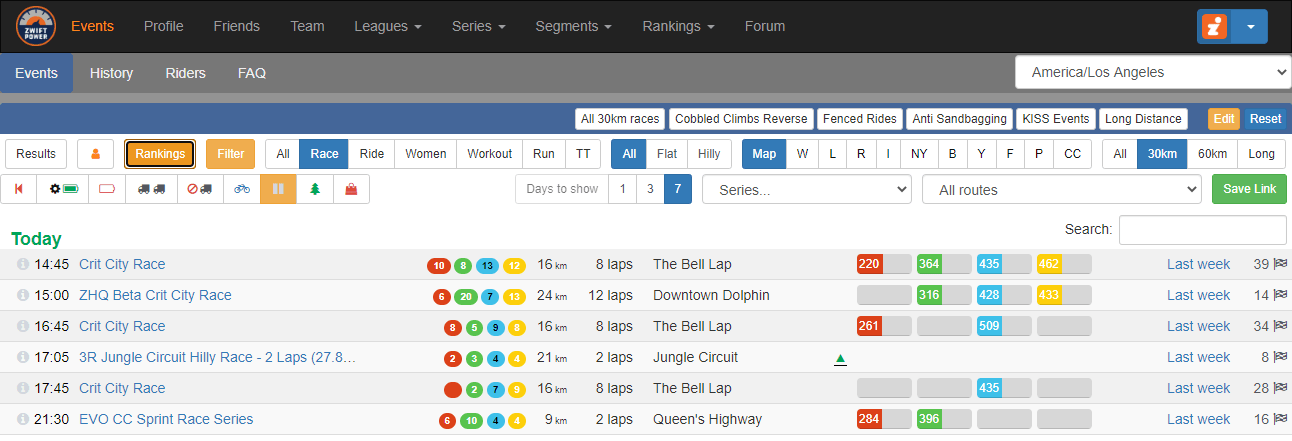
Log into zwiftpower.com and click the “Rankings” button to enable the event rankings charts. You will see the quality stats next to each event – a different number for each category in the event:
The lower the number, the higher the race quality. (This is because event ranking scores are based on the individual rankings of riders in the signup list, and the lower a rider’s score, the higher their ZwiftPower rank.)
So if you want to find a high-quality race, just scan the ranking number for your category, and find the lowest one on the list. You may also want to click “Filter” so you can shorten the list of events – to only display races, for example. Here are the results of a filter showing the rankings of upcoming races under 30km long with staggered category starts:
Based on this list, a B racer should enter the ZHQ Beta Crit City Race if looking for the most competitive B race.
Gotchas
ZwiftPower’s event rankings aren’t a perfect system, of course. Nothing is! One reason is last-minute signups – the ranking charts are based on current signups, and a good percentage of racers don’t sign up until minutes before the event.
And if you mouse over one of the ranking numbers, it will display something like “Estimated Race Quality – 48% of upcoming events”. Here’s the thing: that percentage, as well as the actual ranking number… nobody seems to know how those are calculated. The percentage isn’t terribly helpful (we would go so far as to say it’s not even accurate, on many occasions). And the actual ranking number doesn’t tell you something useful, such as the points result earned for taking first place.
So don’t take the numbers too seriously; instead, simply use them as a relative judgment of the comparative quality of upcoming races.
One Giant Leap
The numbers clearly show something Rick Wenger wrote about in his popular “How to Become a Top 20 Category B Racer” post. If you’re consistently performing well in your category, then the way to really boost your ranking is to race up a category. This is because you stand to improve your ranking more when competing against higher-ranked riders than those in your current category.
Whether you’re looking for a more competitive race experience or want to boost your overall rider ranking, ZwiftPower’s race ranking charts can help you choose the best race. Good luck!
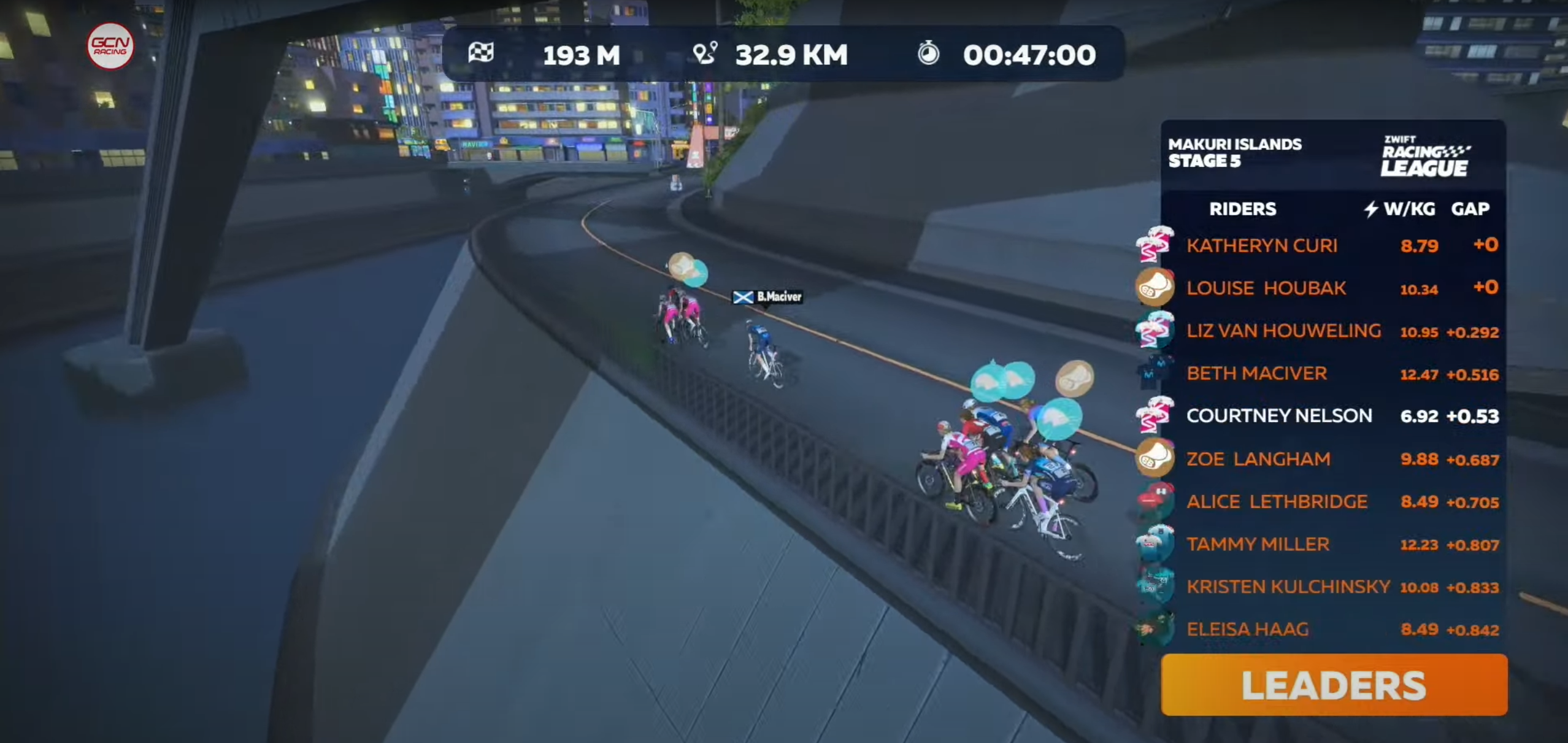
The fifth race of Zwift Racing League 2021/22 Round 2 happens Tuesday, February 8th and it’s the first “climbing race” of the season. With three KOM segments and zero sprint intermediates, this week is all about watts per kilo… and smart racing.
Let’s dig into the race, including tips for bike choice, bike swapping, powerups, strategic options, and crucial segments:
Looking at the Route: Makuri Islands’ Temples and Towers
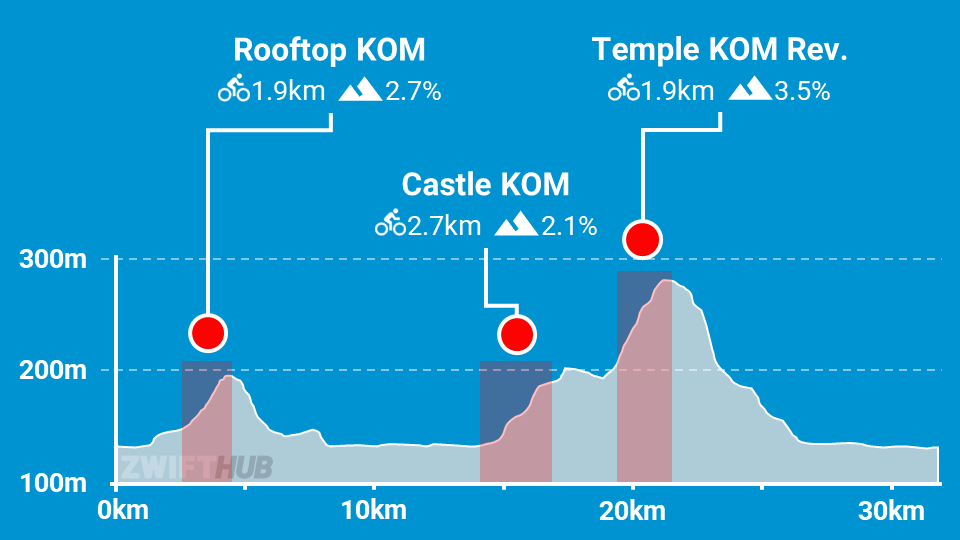
Makuri Islands’ Temples and Towers hits all three KOMs on the map, covering a total distance of 32.6km with 280m of elevation. All categories will be racing the same course, which is just one lap of the route.
Rather than taking you through a turn-by-turn, let’s just discuss the three KOMs, since that’s where the action will happen. We’ll also talk about the finish a bit…
First, the Rooftop KOM. At 1.87km and 2.7%, this is the “easiest” of the three KOMs. It’s a very draftable climb, especially on the first half, which is a series of steps.
The first selection of the race will happen here, but it won’t be a huge selection. There will still be a sizeable front pack by the time we hit the flat roads at the bottom.
Second, the Castle KOM. At 2.67km and 2.1%, this climb comes in two parts. The first, flatter half is draftable, and the pack typically stays together. The second half, especially after the hairpin left into the Castle area, is where things string out.
Expect a second selection here.
Third, the Temple KOM. This is the big one! 2.5km at 3.6%, this climb is all dirt and thus will take around twice as long to complete as the Castle KOM. ZRL riders will be familiar with this climb, since we raced it last season on the Countryside Tour route.
Strong climbers will put in their biggest attacks here, in a bid to shrink the front pack’s size substantially and grab some segment points.
The finish is set in a custom location for these ZRL events, so it comes before the typical finish if you were to ride the route for one full lap. When you exit the roundabout after the tunnel, you’ll have less than 600m left to go. Watch your distance to go, watch the pack, and sprint smart.
The finish arch just coming into view as the Premier League ladies sprint for the line
The finish banner only comes into sight with around 200m to go!
Riders will be awarded powerups through each segment banner, meaning we’ll get 5 powerups during the race (one at the top of each KOM, one through the Railway sprint banner, plus one more as you go through the Castle KOM banner on your way home).
Three powerups will be randomly given out at each banner:
Aero Boost (helmet): makes you more aerodynamic (reduces your CdA by 25%) for 15 seconds. Best used when you’re going fastest and air resistance is highest. Very handy in sprints and attacks off the front.
Burrito: turns off draft effect for riders within a 2.5m radius for 10 seconds. Use when attacking off the front so opponents have to work harder to follow you, or use it in the group to make nearby riders work harder for a bit.Be careful to avoid suicide by burrito!
Steamroller: reduces Crr for 30 seconds so you roll as fast as a road tire on pavement regardless of wheels or road surface. If you’re on a road bike, use this when you hit a dirt patch. (It also provides an advantage on cobbles, bricks, ice/snow, etc.) Most advantageous on the final KOM of the race, since it’s dirt.
Bike Frame + Wheel Choice
An all-arounder setup is your best bet here, since you want something decently fast for the flats and descents, but light enough that it won’t hurt you much on the key climbs.
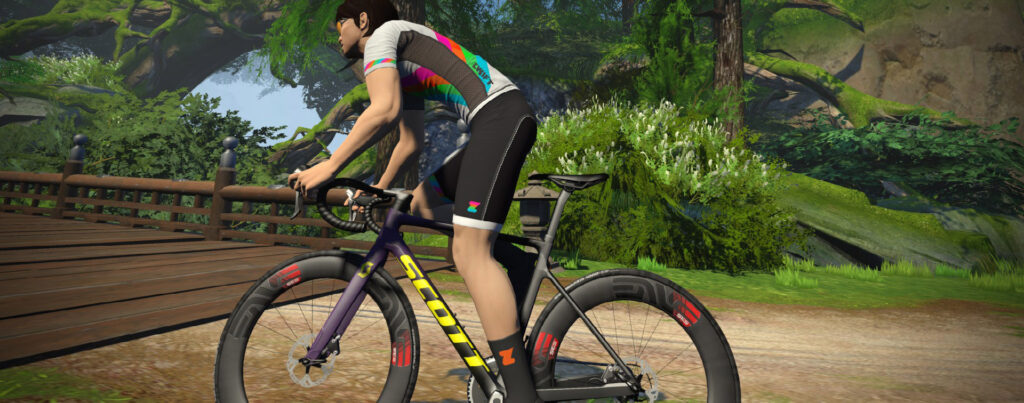
The Tron bike is a good all-arounder. We also like the Scott Addict RC + ENVE 7.8 wheels – a combo which climbs slightly (less than 1s) faster than the Tron on this route’s KOMs. See our Tron vs Top Performers chart for details on the performance of various top frames and wheels.
The most aero setup in game (Specialized Venge S-Works plus DT Swiss disc combo) loses 2.5s to the 2.5s to the Scott+Enve combo on the Temple KOM, so we wouldn’t recommend going pure aero.
To Swap, Or Not To Swap?
This is the question many are asking. If it’s not worth riding a gravel bike from the start, is it worth swapping to the gravel bike before the Temple KOM, to take advantage of its speed on the dirt? And if so, should you swap back to a road bike… and when?
The answer is… it depends. Let’s run through three likely scenarios…
Scenario 1: Starting the KOM in a large pack (10+ riders), and you are a strong enough climber to possibly get FTS points. Swapping may work, but it’s a big maybe. It would only make sense to swap if you were to stop before the KOM start line, swap, then chase back onto your pack and finish at least 10s ahead of them at the top, so you can swap back to a road bike after the KOM banner and get back into the group. If you can do all this from the front group (and that’s a big if!), you’ll earn FTS and FAL points, still be in the pack you started with, and on a road bike that lets you contest the finishing sprint.
Scenario 2: Starting the KOM in a large pack (10+ riders), and you are not a strong enough climber to get FTS points. If you’re just praying to remain with your group over the top, don’t swap. Because even if you match the power of others in your pack, you’ll probably still be dropped due to the time cost of swapping off the gravel bike. Put another way: the best that can happen if you swap is to “break even” and finish the climb in the same pack you started with. Better to keep it simple and work to hold your position in the pack.
Scenario 3: Starting the KOM alone or in a very small group (less than 10 riders), and you are not in the front group. If you’re in this position, your drafting on the climb will be minimal and you probably aren’t strong enough get FTS points on this KOM anyway. Don’t worry about swapping. Just work to maximize your finish position.
More Route Recon
Many events are now being planned each weekend on the upcoming ZRL route. If you’re not familiar with this course, jump into one of these events and do some recon! Here’s a list of upcoming Temples and Towers events.
Looking for a video recon, with lovely British commentary to boot? Check out Si and Sherpa’s recons below:
Si Bradeley
Sherpa Dave
Strategic Options
Points Distribution, Week 5
The maximum points a team of 6 could earn in this race.
As you can see from the chart above, KOM points make up a large majority of the overall points. Winning teams will be those whose riders climb well in the 2.5-7.5 minute range.
So what strategies will riders employ in race 5? Here’s what we predict:
Smash-n-Ease First Two KOMs: riders strong enough to chase KOM FAL and FTS points will attack the second half of the first two KOMs, but not work to stay away from the pack afterward. It’s not worth the effort to stay away when they know they’ll drop weaker climbers on the final KOM anyway.
Hanging ’til the Finish: riders who aren’t strong climbers will be doing all they can to hang with the front pack over the KOMs in order to find themselves in the front group on the flat lead-in to the finish. If sprinters can make it over the top with the front group, they should be able to grab high finishing points.
A Strategic Final 11km: once we finish the final KOM, we expect to see a small group of climbers off the front, with a group of “flatlanders” chasing. Whether those groups come together or not in the final 11km will be a question of teamwork and strategy. Is it smart for a sprinter in the chase group to work to bridge up to the front if he has teammates in that group? What if you aren’t a sprinter? What if you don’t have teammates in front? Lots to consider.
Destroy the Gravel Riders: if a strong competitor begins the race on a gravel bike, it would be smart to push the pace on the pavement, particularly on the climbs, in order to drop that rider before the Temple KOM. (This gets extra-interesting when you consider that Zwift caches other riders’ bike selections, so what you see on screen may not be entirely accurate…)
Smart PowerUp Usage: riders will be hoping for a steamroller powerup before the dirt Temple KOM, as it gives you a huge advantage for 30s. In a perfect world, riders would get an aero boost atop the Temple KOM, for use in the final sprint.
Watch the Premier Division Race
Zwift’s top racers will go head to head in the Premier Division the day before the community races. Watch it on GCN Racing’s Youtube channel.
Your Thoughts
Any insights or further thoughts on this race? Share below!
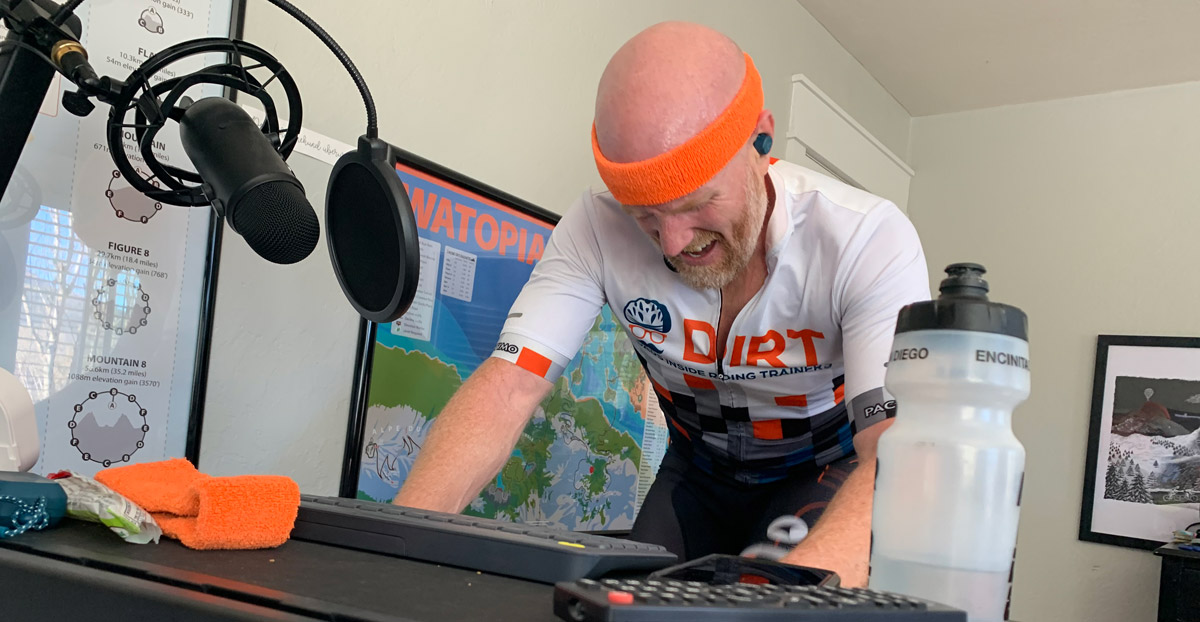
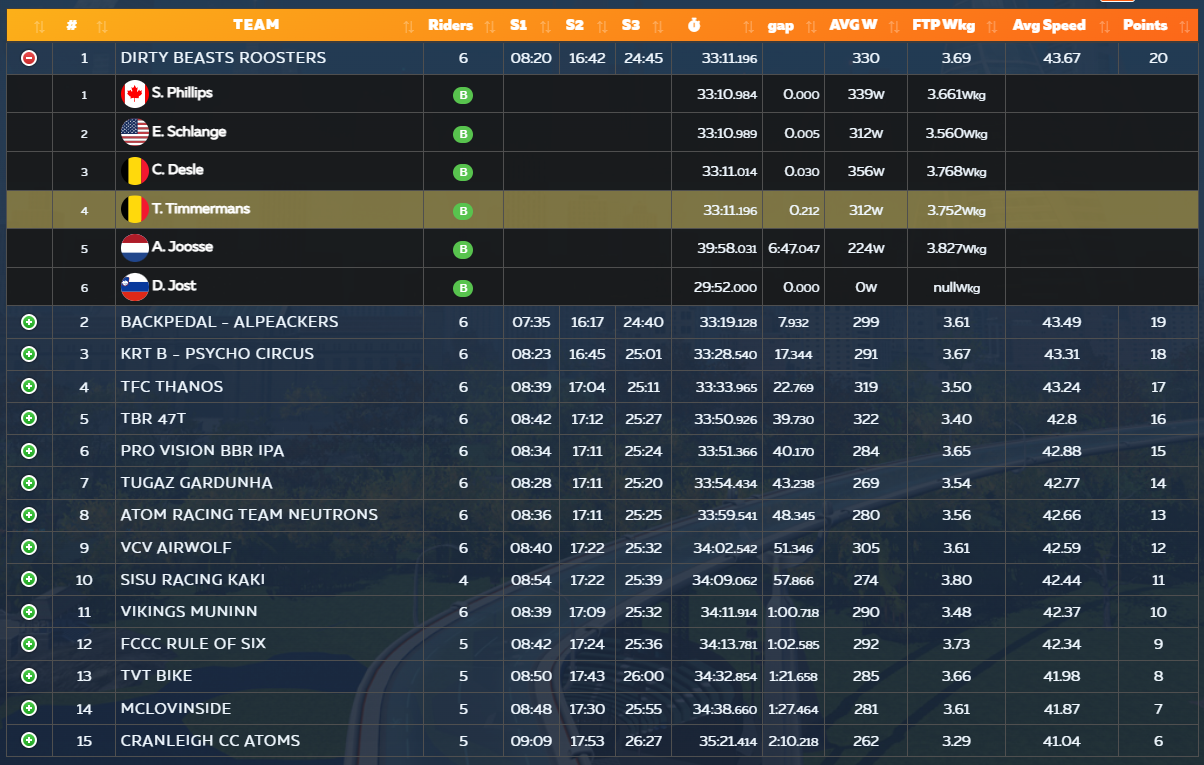
Yesterday’s team time trial on France’s Douce France route was the first of the ZRL season. My team (the DIRT Roosters) was in first place in our EMEA W B2 division, but that didn’t give us much confidence because everyone knows the teams who win scratch races often don’t win TTTs.
They are two very different beasts. Scratch races reward smart sprinters, punchy climbers, and (occasionally) those with a high FTP w/kg. TTTs reward good planning, teamwork, and (usually) pure watts.
The Warmup
Changing my in-game name to include my pull order and team
This being a TTT, and this being ZRL, I knew I’d be pushed to the limit. So I tried to go into it with fresh legs (only partially succeeded), and of course I followed my typical pre-race routine:
A clean, carby oatmeal breakfast
Beet juice two hours before the race
Caffeine gum – two pieces, one hour before the race.
PR lotion on my legs about 45 minutes before the race. More bicarb=less burning.
A nice 30-minute warmup with the C. Cadence crew, including a few spinups to get the heart rate up
I even waxed my chain the night before, ensuring ultimate drivetrain efficiency.
In the days before we had worked out our pull order and power targets via Discord chat. Now I was signed into voice chat, and it was time to join the start pen and see how we stacked up against our division. Let’s go!
The Start
For the first time that I can recall, WTRL started teams with the top-ranked team going first, next ranked going second, etc. This is the opposite of what they’ve done in the past, when they’ve done the start order similar to what you’d see outdoor in a stage race, with the top-ranked team going last.
We’re currently #1 in our division, so we were off first, after a 1-minute wait. Teams were also spaced by 1 minute instead of the usual 30 seconds, meaning very few (if any) teams would get overtaken in today’s race.
TTT Formations
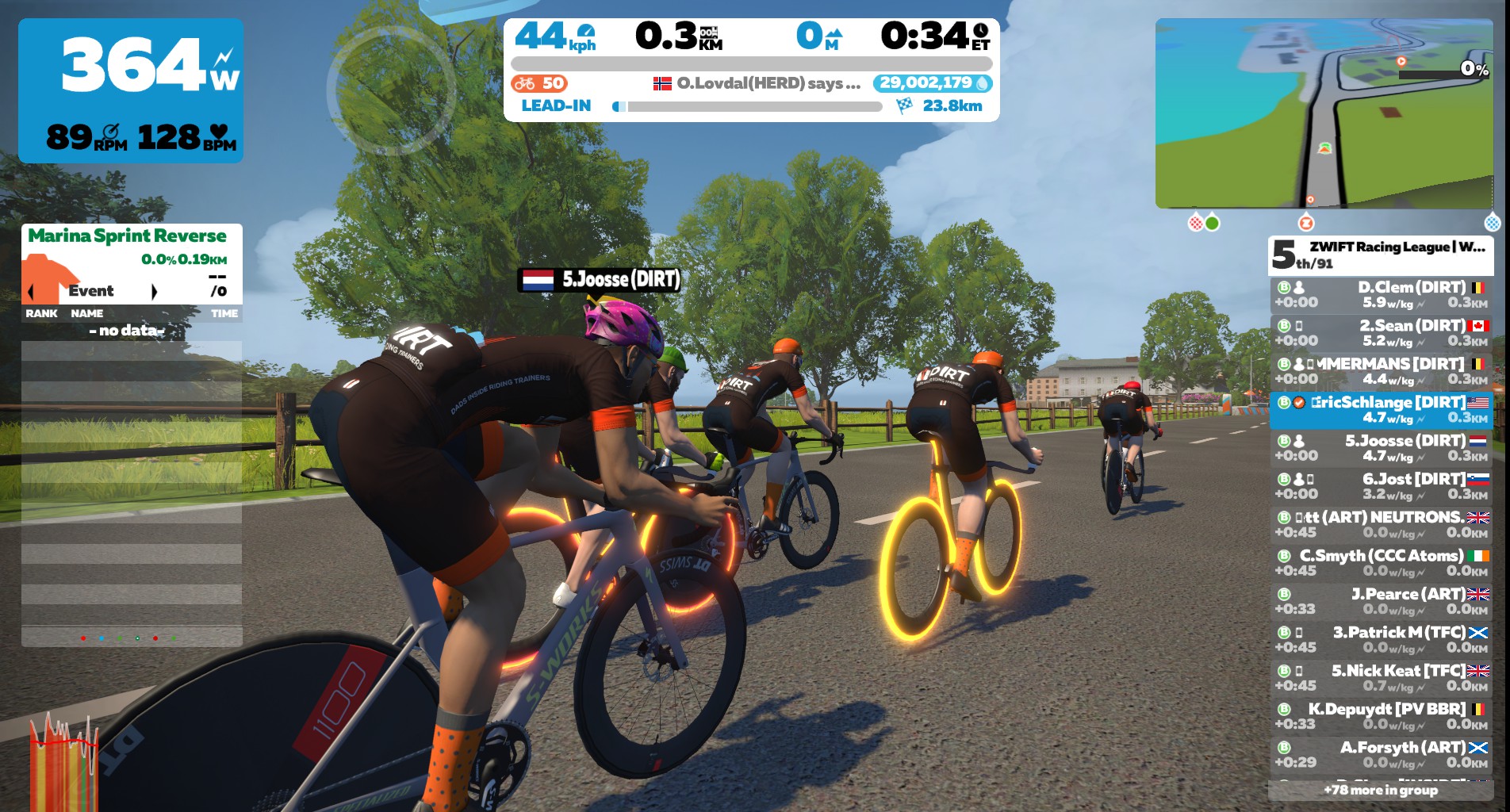
The Roosters had a smooth start, hammering out of the pens and getting up to our target speed of 44-45kph quickly. On the twisty, rolling Les Intestins section we had one designated pulling rider rotating every 30s, but everyone else just tried to stay in the draft and ride efficiently.
Then it was into our “ugly paceline” formation once things got flatter and straighter. That meant the designated puller, the on-deck rider, and the third rider tried to ride single file, while everyone else just stayed in the draft behind. It’s uglier and slightly less efficient than a perfect paceline, but it’s also much easier to do.
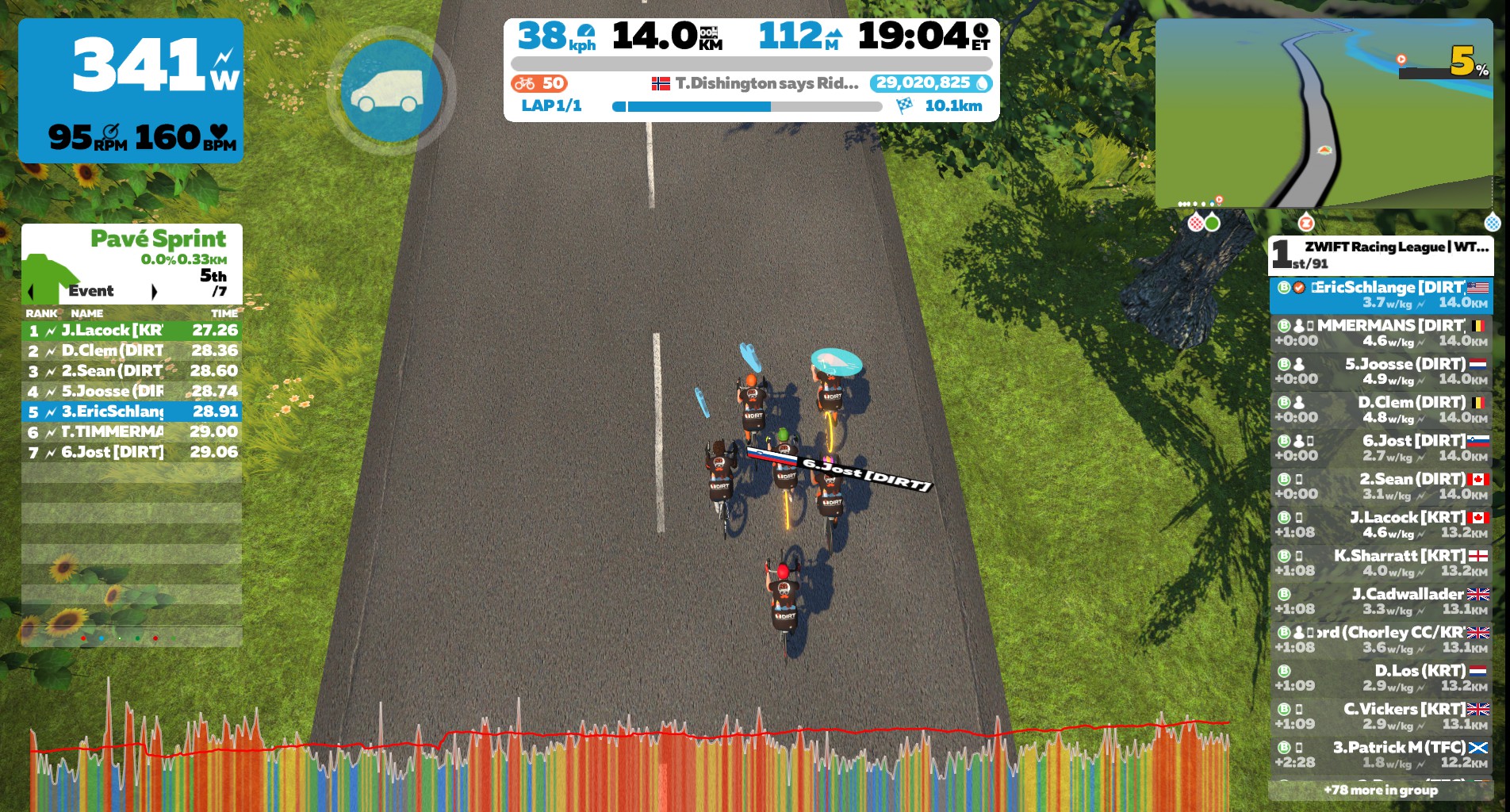
Up the Aqueduc KOM it was every rider for himself, just going hard to keep our speed up while staying together. I used my feather powerup (powerups in a TTT?!), then we went through the KOM banner, got another powerup (van), and recovered on the descent.
Bunched up on the Aqueduc KOM
Steady, Steady
Now we were on the back half of the route. The flat half. Here it was about holding our ugly paceline formation, keeping our speed steady and our power on target.
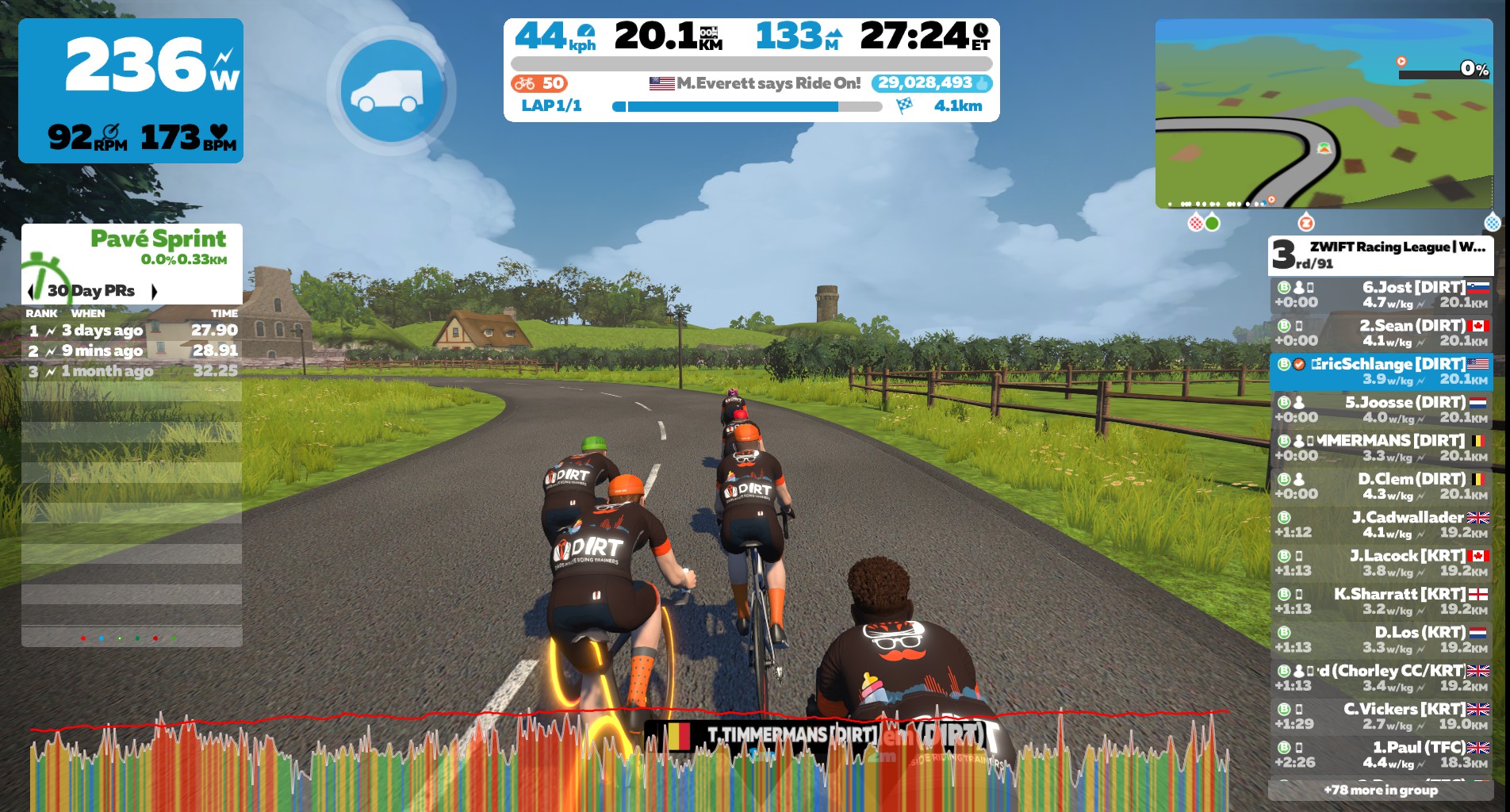
Glancing at the rider list on the right, I could see we were around 10 seconds ahead of the KRT squad who had started second, and maybe 15 seconds ahead of TFC who had started third. That was a good sign, but we also knew there might be other strong TTT teams who were off our radar. We couldn’t let up.
We had one rider struggling (Dejan). With team captain Antoine not riding but acting as DS, Dejan was instructed to rest up in the draft, then take one final suicide pull.
The idea with a suicide pull is to put in one last hard effort, as long as you can go, then blow up and drop off. Since your team’s time is taken off the 4th rider, often you’ll have one or two riders who are struggling and won’t make it to the finish. Once they’re unable to take turns on the front, the best thing they can do for the team is one final suicide pull.
Dejan doesn’t talk much on Discord, and he didn’t warn us about his suicide pull either! Instead, as we whizzed past the Carnac stones of France’s Brittany area, he rocketed through the group, activating his aero powerup and gapping us off the front.
Dejan takes his final pull
Fortunately teammate Sean chased him down, with me just behind, and we were still able to benefit from Dejan’s work.
Not long after Dejan’s suicide pull, Arjen managed to smack his ANT+ cable with his phone, disconnecting his power readings and dropping hard. That quickly took us from 6 riders to 4. There was no room for mistakes now!
The Finish
The final kilometers of a TTT are always brutal. This is where everyone is struggling to hit their power targets, the pull rotation gets messy, and the brain is low on glycogen. But you’ve got to give everything you’ve got!
And that’s what we did. With 2km to go it was just a matter of going hard on the front if you had the legs, or sitting in the draft if you didn’t. I put in one final pull then eased off, digging deep to gut out the final 500m.
Sorry, no race video this week. My PC was acting up with poor framerates whenever OBS was running, so I binned it and concentrated on the race.
Putting in one final pull…
Team Result
Based on the time gaps we’d seen during the race, we figured our time was good enough for a podium spot. When the final results were posted, we were super stoked to see our name at the top of the list!
Takeaways
Although my legs were a bit sore from previous days’ efforts (including an ill-advised hike), I was able to hit my power targets for this event. I think I may just be fully recuperated from my (admittedly light) Covid infection. Fingers crossed.
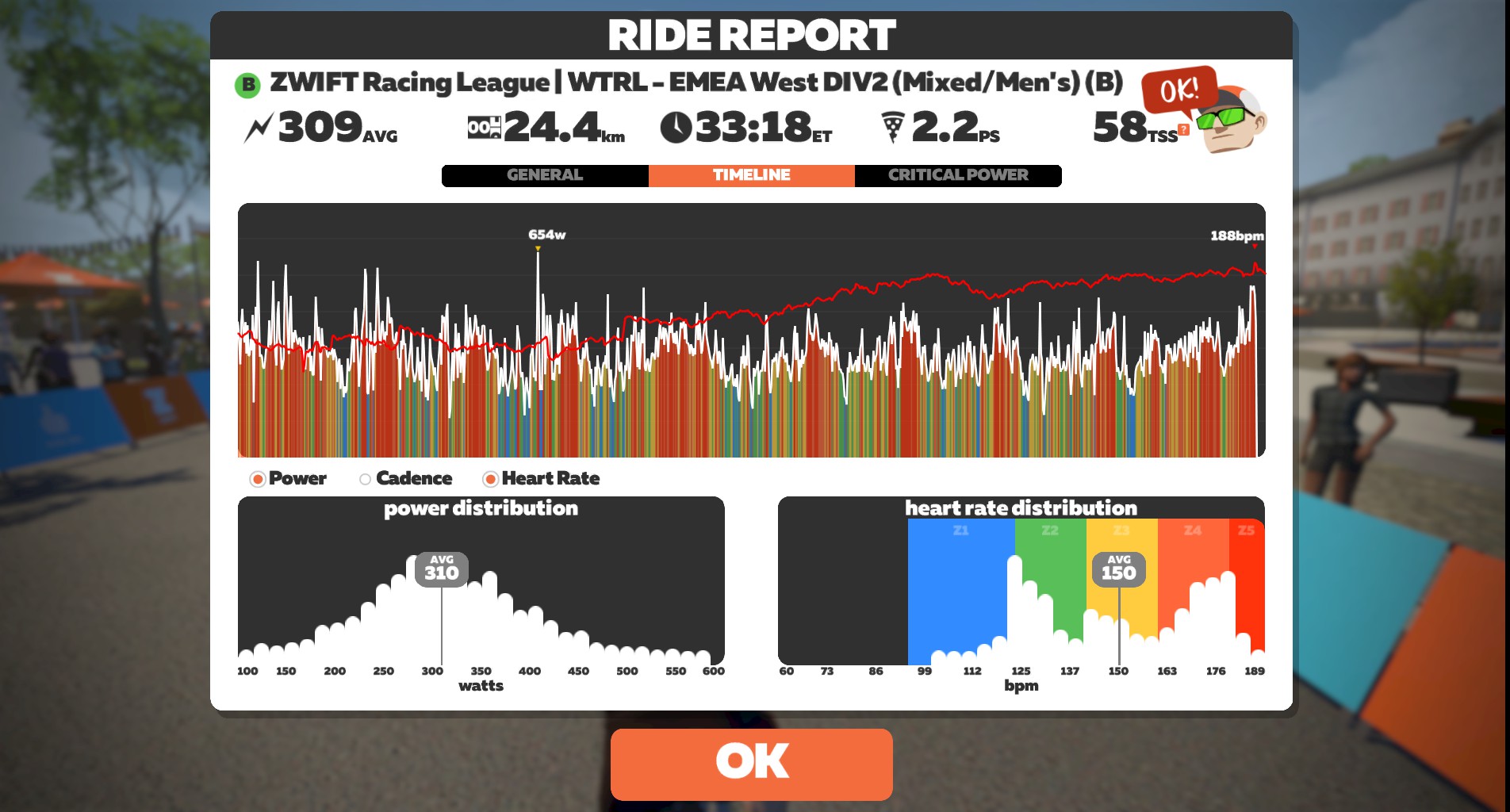
See where I took my pulls? New 6-week power PBs from 14 minutes on…
The Roosters rode well together, with new teammate Sean Phillips slotting right in, taking strong pulls just ahead of me, covering gaps, and overall riding a really heads-up race. Sean recently upgraded from a C to a B, and he crossed the finish line first in our team. Since we were the fastest team on the day, does that mean he won his first B race? I think it does!
There are still places where we could improve as a TTT unit, and the next TTT of the season (on Richmond UCI Reverse) will be a challenge for everyone with its multiple climbs. TTT is a challenging format, with riders expected to stay together but also put in max efforts. It’s a constant give and take of recovering then going hard, and it’s never perfect. But this week, it was good enough. Go Roosters!
Your Thoughts
How did your ZRL TTT go? Got questions or comments? Post below!
Zwift’s 2022 zFondo series is three months long (January-March), with a weekend each month dedicated to fondo events. This weekend is February’s fondo weekend, so don’t miss your chance to join thousands of Zwifters working together to put in big efforts.
Along the way you’ll unlock an exclusive jersey and build your fitness in ways only long rides can. Allez allez!
February Fondo Schedule
February’s set of Zwift Fondo events kicks off at 12am Friday, February 3, which is 7pm EST/4pm PST February 2.
Events repeat every 5 hours until February 6th at 10pm GMT/5pm EST/2pm PST. There are a total of 15 events currently scheduled.
This is a 3-month series, and each month’s fondo has its own unique kit unlock. These kits are exclusive, meaning they will never be available anywhere else in game. A true badge of honor! Here’s a shot of all three kits:
From left to right: March, January, and February kits.
Routes
Zwift Fondo events have three categories (A, B, and C) which are open to all riders. These categories don’t refer to rider strength or speed – they determine which route you will ride.
And this year Zwift has created a fresh set of fondo routes! Here they are (click for route details):
A: 2022 Gran Fondo - 94km (58.4 miles), 1,141m (3,743′)
B: 2022 Medio Fondo - 77.2km (48 miles), 924m (3,031′)
C: 2022 Bambino Fondo - 52.3km (32.5 miles), 400m (1,312′)
Is this a Race?
Officially, no. But hundreds (possibly thousands) of riders will turn out for each of these popular “fun race” events, and the front of each category will certainly be filled with strong riders going all out.
As Zwift says, in the end “This is not a race, but some will choose to ride it like one. Do what’s comfortable, and go at your own pace.”
These events have double draft mode enabled, so be sure to work with others when possible, since this conserves energy.
Upcoming Fondo Dates
March’s Zwift Fondos will happen on March 4-6, 2022.
Fondo Training
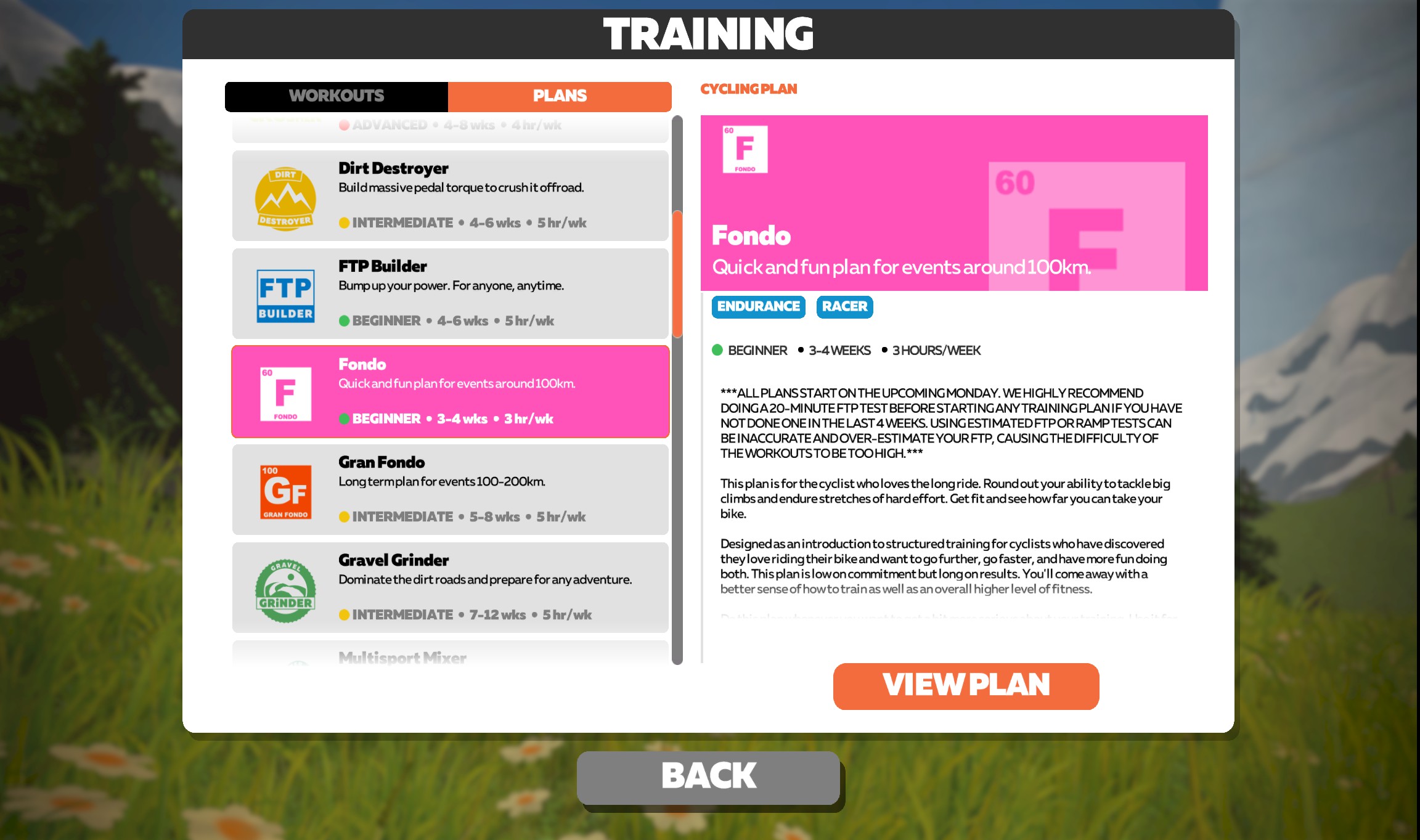
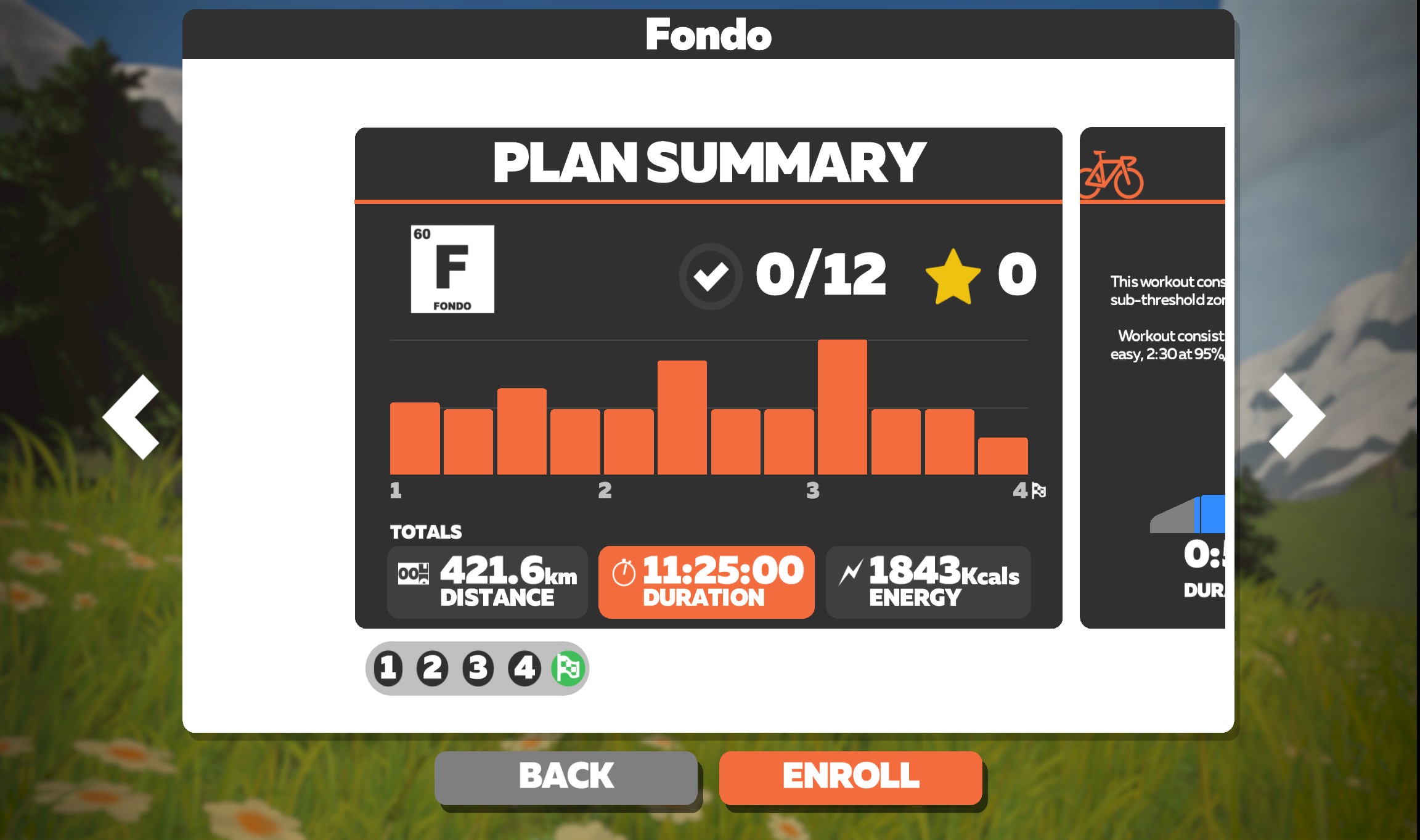
Want to take on a Zwift Fondo, but you’ve never done such a long ride? Check out the Fondo Training Plan in Zwift. It’s 3-4 weeks long, 3 hours/week of work, and will get you prepped to take on your first fondo: