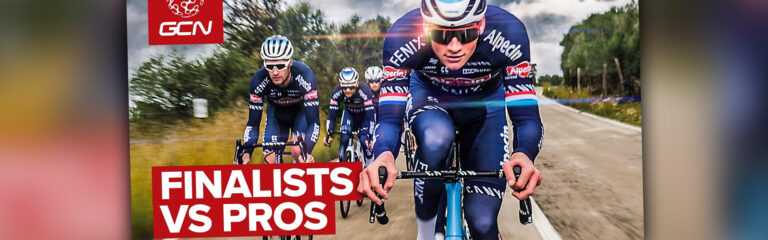
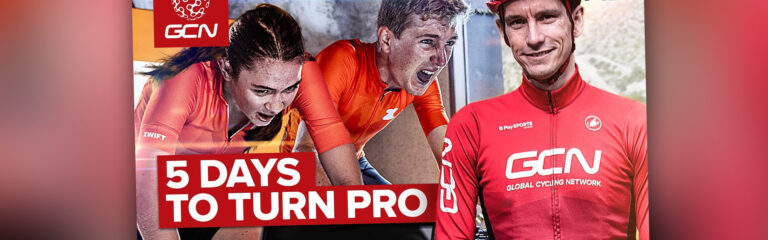
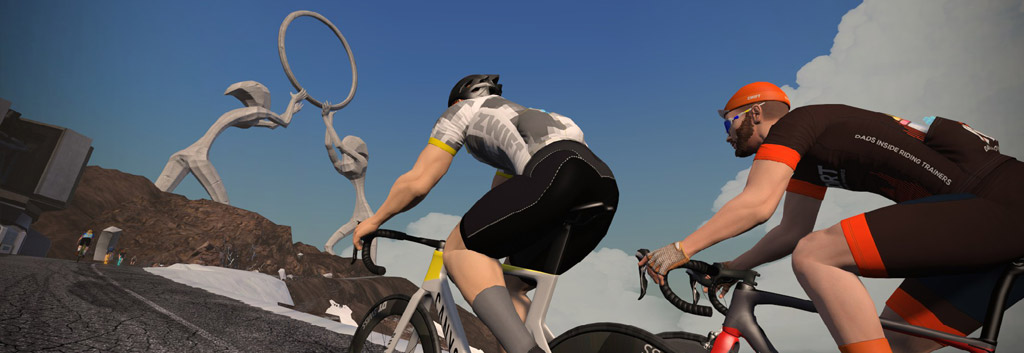
This year, for the first time ever, both groups of finalists arrived in Mallorca to stay at the Zwift Academy Beach House and battle it out in the Zwift Academy finals. It’s like Survivor, but on bikes. And we get to follow them through a 5-episode video series from GCN. Today episode 2 arrived…
On Day 2, coaches scrutinized the riders’ bike handling abilities as well as their pack riding smarts in the groups’ first outdoor ride. In a four-hour effort, the finalists undertook race pace drills, sprint leadouts, and a grueling hill climb.
Male finalists went head-to-head against 5 Alpecin Fenix riders in the sprint leadout. Could they best sprint specialist Tim Merlier, being led out by Mathieu van der Poel?
The men’s hill climb featured separate starts, TT-style. The women’s hill climb is wholly different as all the ladies start together, but with their shifter batteries removed so they must climb in a fixed gear!
Test Results
Men’s Hill Climb Results
1
Sam Hill
3:16
2
Mads Rahbek
3:19
3
Cooper Sayers
3:24
4
Byron Munton
3:28
5
Alex Bogna
3:28
Women’s Hill Climb Results
1
Maud Oudeman
4:04
2
Caitlin Conyers
4:08
3
Rachael Wales
4:25
4
Imogen Alton
4:34
5
Willemijn Prins
4:42
Riders of the Day
At the end of each day, the judges are being asked to elect a rider of the day. Here are the riders for day 2:
Caitlin Conyers
Cooper Sayers (also yesterday’s winner!)
Watch Episode 2
Next Up
Competition heats up in tomorrow’s episode, when the finalists go head to head in a Zwift race. The stakes are high, as two riders will be sent home at the end of the day.
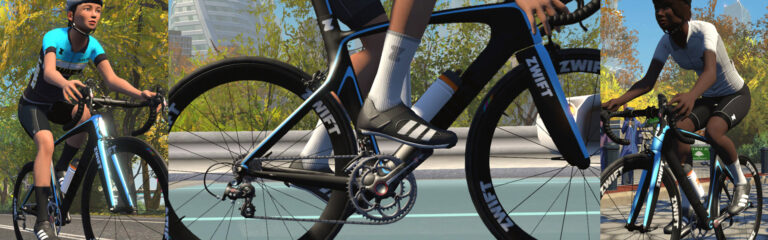
Zwift has partnered with Adidas for running events in the past, but this month sees the first-ever cycling-related partnership. Adidas is celebrating the launch of the Indoor Cycling Shoes with a 4-day event. Details below!
About the Shoe
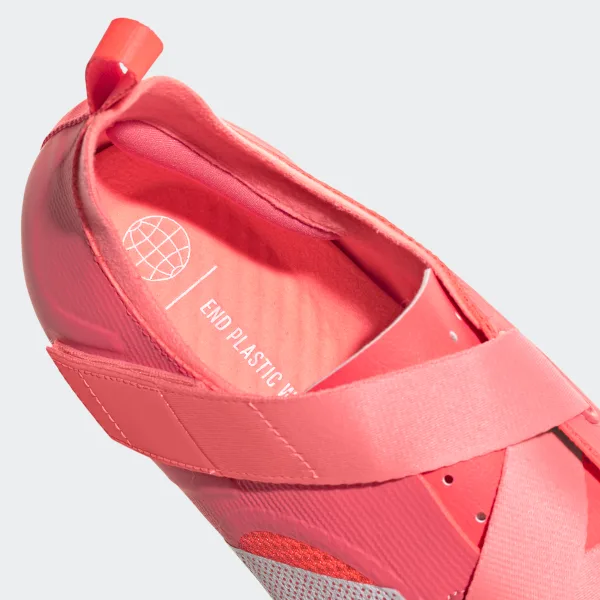
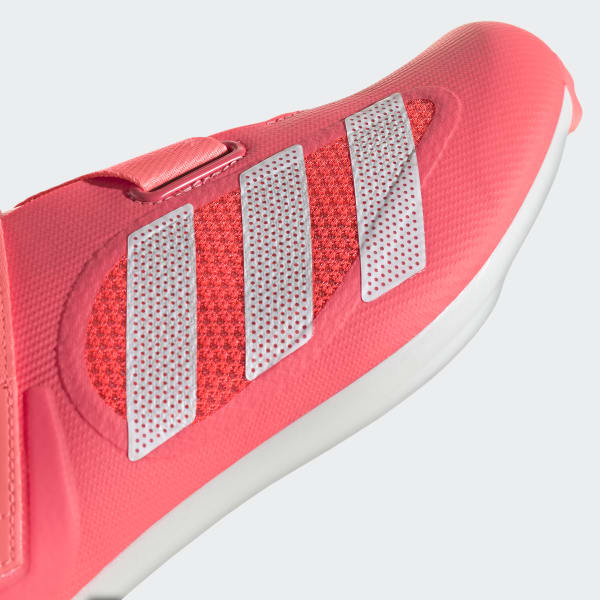
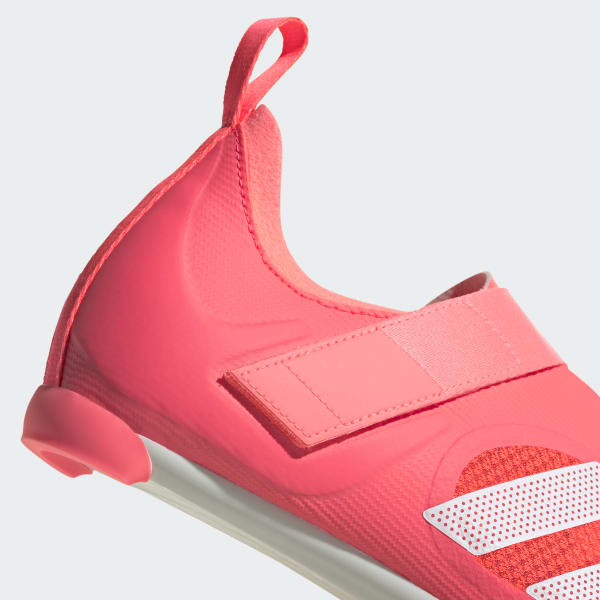
Launched IRL December 15, 2021, the Adidas Indoor Cycling Shoes are lightweight, breathable, and made from at least 50% recycled content to help reduce plastic waste. They’re available in three colors: Turbo, Cloud White, and Acid Red (shown).
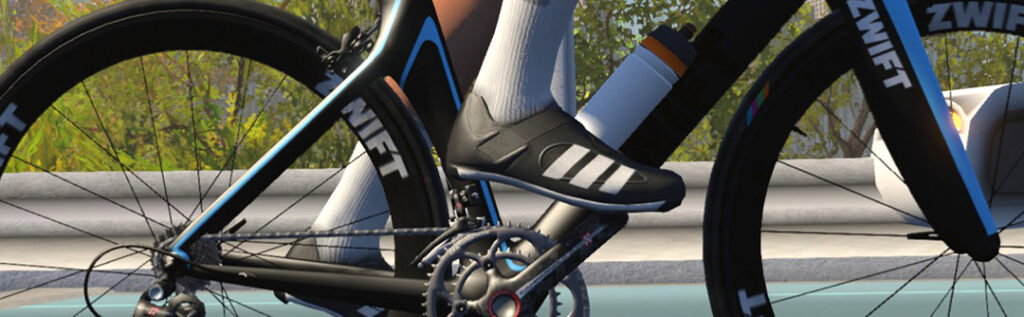
Riders participating in Adidas Global Cycling Series events will be given virtual Adidas Indoor Cycling Shoes to wear during the event, and will unlock the shoes upon completing the event.
Routes and Schedule
All rides are 45 minutes long, and some will be led by Adidas ambassadors including Jessie Zapo, Alea James, Lottie Bildirici, and Garrett Gooch. Expect participants to ride at a range of paces. Find a bunch riding at your pace and enjoy the camaraderie!
Finish any ride in the series and you’ll unlock the Adidas Indoor Cycling Shoes in game. You’ll also earn your entry for a chance to win a real pair!
(To enter the giveaway, you must complete any ride, be part of the Adidas membership program, and be an active Zwift user. Limit one entry per person. Subject to eligible countries: US, AUS, NZ, DE, UK, FR, NL and ESP.)
Socks4Watts Traditional British Hill Climb Announced
Fridays, 6:45PM UTC/1:45pm EST/10:45am PST
Are you familiar with a traditional British hill climb? It involves months of dedicated training for a few minutes of pain, as you try to set your best possible time up a short (but steep) hill.
Now you can Join Socks4Watts for a virtual take on the classic.
Hill climb events typically (but not always) take place on a short climb with a steep gradient, with the effort range between 1 minute and 10 minutes in a time trial format. The first UK hill climb recorded took place in 1880, some 23 years before the first Tour de France.
One of the most unique aspects of hill climbing is the relentless pursuit of weight savings – competitors will go for the lightest possible setups, which sees some riders using a fixed gear so that they can forgo a rear brake, or take a saw to the handlebar drops to save a few grams!
British national hill climb championships have been won by big-name riders such as Chris Boardman and Malcolm Elliott. The Rake Hill Climb in Lancashire in the North of England is the self-titled richest race in cycling, with its 12% average (max 23%) over only 900 metres paying out some big prizes (reward versus distance traveled!)
For the Socks4Watts Traditional British Hill Climbs on Zwift, drafting is turned off, so select your lightest bike and wheel combination (no sawing off your drops). Use the route until the climb as your warm up, and finish the route after the climb as you cool down. Only the time up the KOM counts on the final leaderboard.
Our first climb is the iconic Leith Hill on the Greatest London Loop circuit. The KOM is 1.95km at an average gradient of 6.9%.
Note that the route must be completed for your KOM time to count.
Results will be available on ZwiftPower shortly after the race. This format takes a bit of jiggery-pokery on ZwiftPower, so the event for now is a trial. If successful, we will look to host a full series of hill climbs.
About Socks4Watts
Socks4Watts is a small UK-based business selling aero socks with attitude. During lockdown, our TTT ladies team set record after record in our unicorn kit, and the team has expanded to now be an even mix of men and women taking part in most of the major Zwift racing series.
Check us out on Facebook or ZwiftPower if you would like to join, or for all of your aero socks needs, check out Socks4Watts.com.
This year, for the first time ever, both groups of finalists arrived in Mallorca to stay at the Zwift Academy Beach House and battle it out in the Zwift Academy finals. It’s like Survivor, but on bikes. And we get to follow them through a 5-episode video series from GCN, which launches today!
The riders had 5 days to impress the judges. Who are the judges? Canyon//SRAM’s Director Sportiff Beth Duryea and Performance Director Lars Teutenberg, and Alpecin-Fenix’s Director Sportiff Christoph Roodhooft and Performance Manager Kristoff De Kegel.
After meeting the 10 finalists, we get to watch the riders complete an indoor fitness test where they hit maximal efforts across a range of time intervals. This delivers crucial data to the judges, as shown below.
Fitness Test Results: Women
Functional Threshold Power
1
Maud Oudeman
256W
4.5 w/kg
2
Imogen Alton
246W
4.2 w/kg
3
Rachael Wales
214W
4.1 w/kg
4
Caitlin Conyers
230W
4.0 w/kg
5
Willemijn Prins
234W
3.9 w/kg
VLamax
1
Caitlin Conyers
0.63 mmol/l/s
452W
2
Imogen Alton
0.53 mmol/l/s
394W
3
Maud Oudeman
0.54 mmol/l/s
389W
4
Willemijn Prins
0.51 mmol/l/s
389W
5
Rachael Wales
0.45 mmol/l/s
293W
Fitness Test Results: Men
Functional Threshold Power
1
Sam Hill
395W
5.5 w/kg
2
Byron Munton
327W
5.4 w/kg
3
Mads Rahbek
335W
5.3 w/kg
4
Alex Bogna
335W
5.1 w/kg
5
Cooper Sayers
332W
5.0 w/kg
VLamax
1
Cooper Sayers
0.66 mmol/l/s
576W
2
Alex Bogna
0.63 mmol/l/s
545W
3
Sam Hill
0.49 mmol/l/s
461W
4
Mads Rahbek
0.46 mmol/l/s
383W
5
Byron Munton
0.48 mmol/l/s
381W
After the tests, GCN’s Daniel Lloyd discusses the women’s results with the Canyon/SRAM judges, while Si Richardson discusses the men’s results with the Alpecin-Fenix judges.
Riders of the Day
At the end of each day, the judges are being asked to elect a rider of the day. Here are the riders for day 1:
Cooper Sayers
Maud Oudeman
Watch Episode 1
Next Up
In tomorrow’s episode, the finalists head outdoors. They’ll take on a heartbreaking hill climb and go against the pros in a sprint leadout!
How the Race Was Lost: A Swarm of B’s at the L39ION Crit
The L39ION of LA Crit Series has seen crazy numbers of racers. Some are just there to grab the Neokyo Crit Course route badge, but most are in it to win it, resulting in field sizes of 300+ in some categories and time slots. Lunacy!
I couldn’t make it to every race in the series, but I wanted to make it to at least one so I could experience the new course and see what it was like racing 300+ B riders. I wasn’t disappointed! Here’s how it all unfolded from my point of view…
Warmup
My race was at 11am, so around 10am I started the pre-race ritual. Two pieces of caffeine gum. Slap some PR lotion on the legs and kit up. Then I went to Neokyo for a warmup, knocking out the “Sleepless City” route badge while I spun the legs up from resting to race mode.
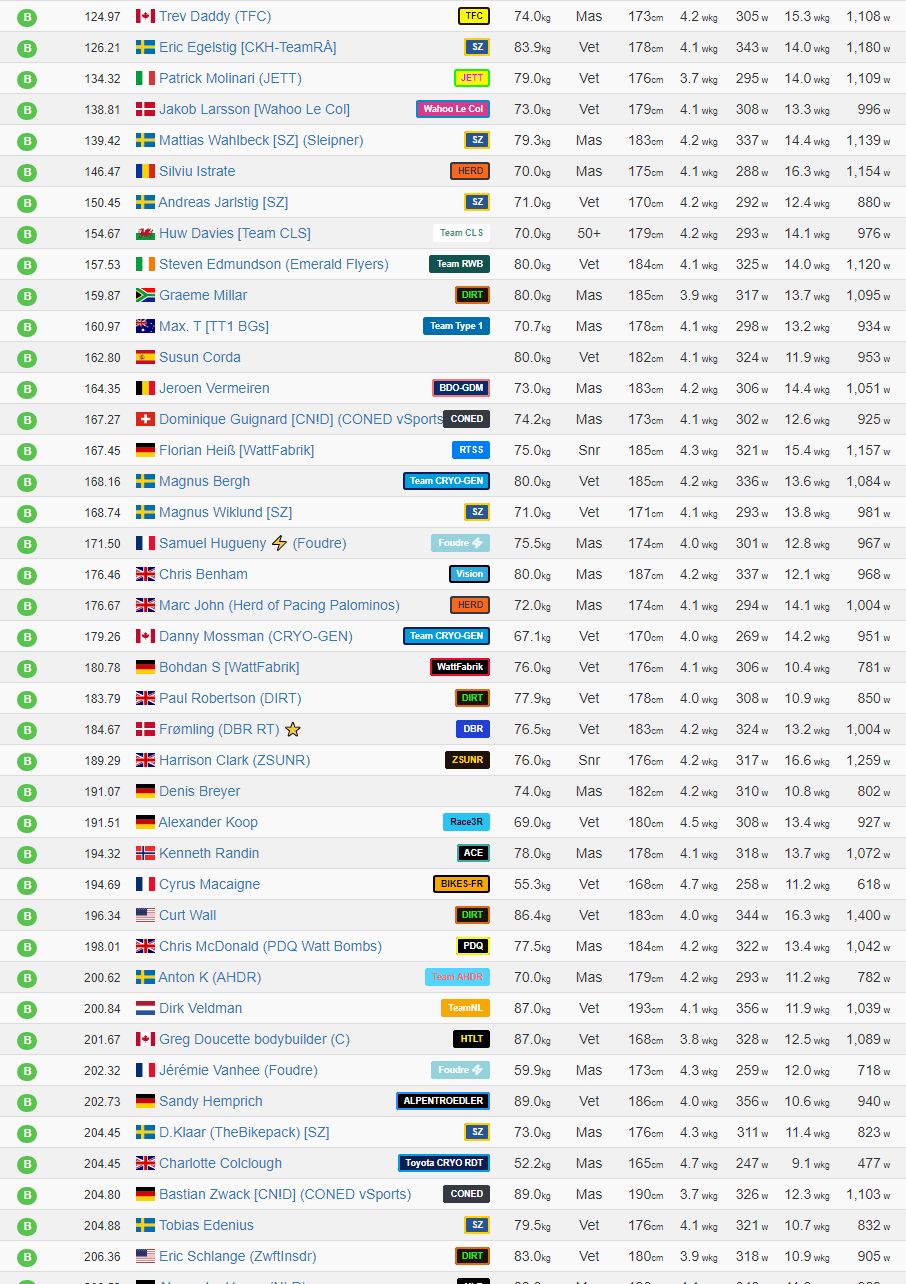
I pulled up the signup list in ZwiftPower while I was warming up (see it here). It was slightly frightening to see the firepower signed up in the B race! When I sorted the signup list by rank, I didn’t even make the first screen. No, I had to scroll down to 41st place to see my name listed.
It’s been a long time since I entered a B race against that many higher-ranked riders. Winning today was clearly a long shot at best.
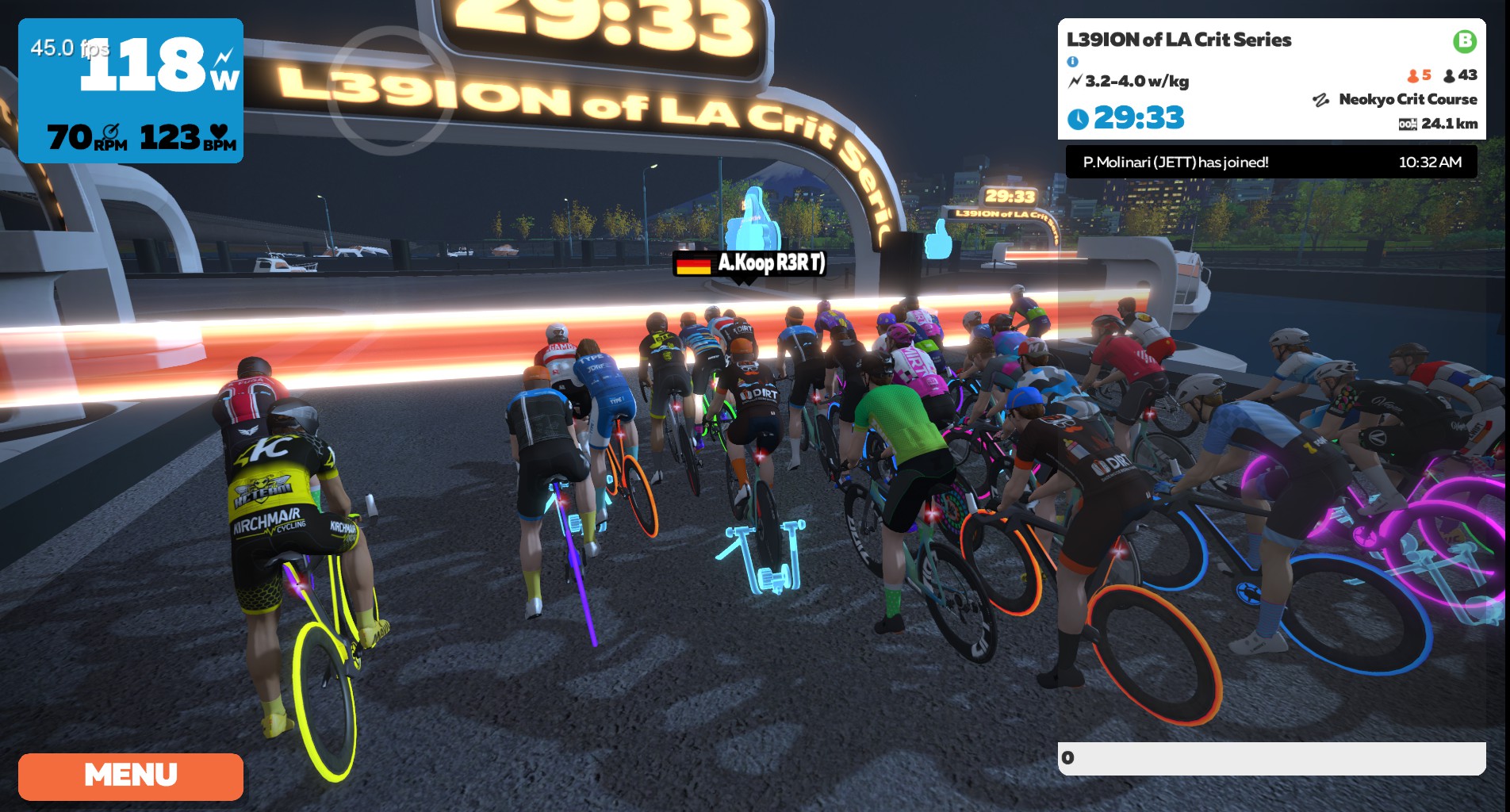
A few hard efforts got the heart rate up to 160bpm, then it was time to join the pens for a second time (because of course I joined the pens 30 minutes before the race began, to hold my spot near the front. This isn’t my first rodeo!)
Saving my spot near the front of the pens
The Start
The clock hit zero and we jumped out of the pens, quickly ramping up to 48-50 kph. We soon settled into a steady pace, eating through the kilometers as we made our way through the Shopping District and into Castle Park.
I modulated my power to hold a position at least a few bike lengths from the front, but not so far back that I couldn’t see the front of the race. (Or what I hoped was the front of the race…)
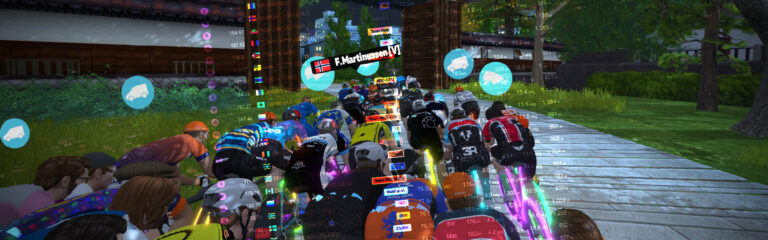
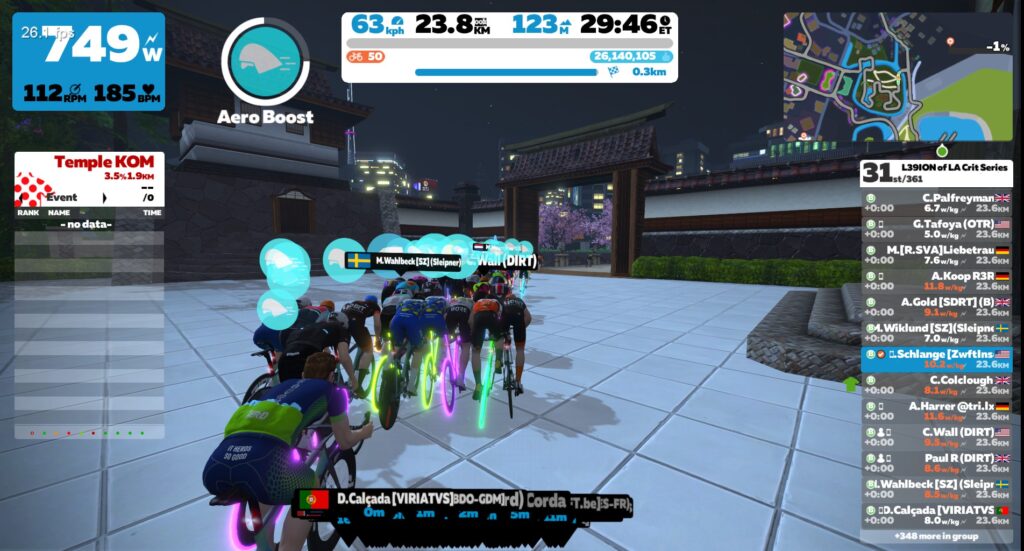
A packed field!
Big Group Wackiness
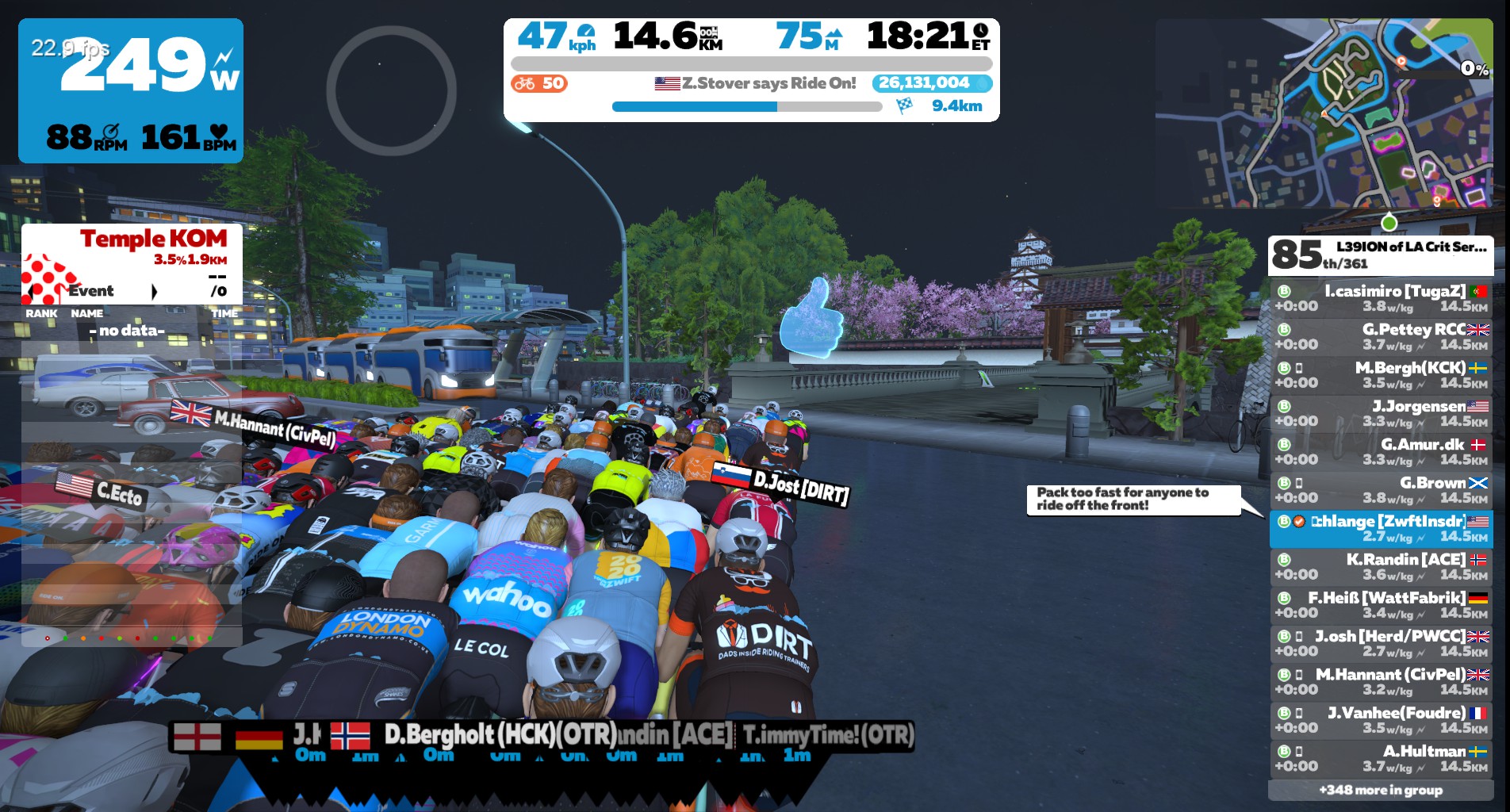
There were 361 riders in the B peloton, but Zwift only renders the 100 nearest riders on your screen – which can really screw you up in a big race!
It can lead to very strange situations, two of which are:
Incorrectly thinking you’re in the lead pack because you see no riders up the road – even though a pack of riders has broken off the front and ridden away from your group.
Not knowing there are hundreds of riders just behind, or even a small group dropping off the back. This is because in large, tightly-packed groups, the game seems to have a bias for rendering riders ahead of you rather than behind.
I found myself looking at my ranking in the rider list, which was bouncing between ~50 and ~150. Then I would look at the mass of riders ahead of me and think, “That looks like around 50 riders. I must be in the front group.”
I hoped I was right.
Settling In
The group quickly settled into a rhythm: ramp it up a bit when the incline hit 2-3% for short stretches. Ease a bit on slight downhills. Chug along at 47-48kph, finishing each of the six laps in under 5 minutes.
The pack speed was so high that nobody attacked. Or if they did, I didn’t see it! I know for myself, I can hold 47-48kph for maybe 30-60 seconds solo, having done so in some race breakaways and TTT efforts. So I knew there was no way I could attack this pack and stay away. And I think plenty of others were thinking the same thing.
This was, in fact, very much like IRL pro crits against the L39ION of LA team. L39ION’s very effective strategy is to put their workhorses on the front to chase back attacks and keep the speed high while their sprinters sit in and wait for the final leadout.
With two powerups given per lap, there were always powerups flying. (Happily, there weren’t any burritos being handed out. Because they’re the worst.)
The Finish
We didn’t have a lap counter in the HUD, because ZwiftHQ had changed these events over the weekend to be distance-based, since the lap-based method had resulted in an invisible finish line in the first races. (That’s fun!)
But it was easy to figure out which lap of six we were on. And as we started our final lap, the pack definitely got a little nervous.
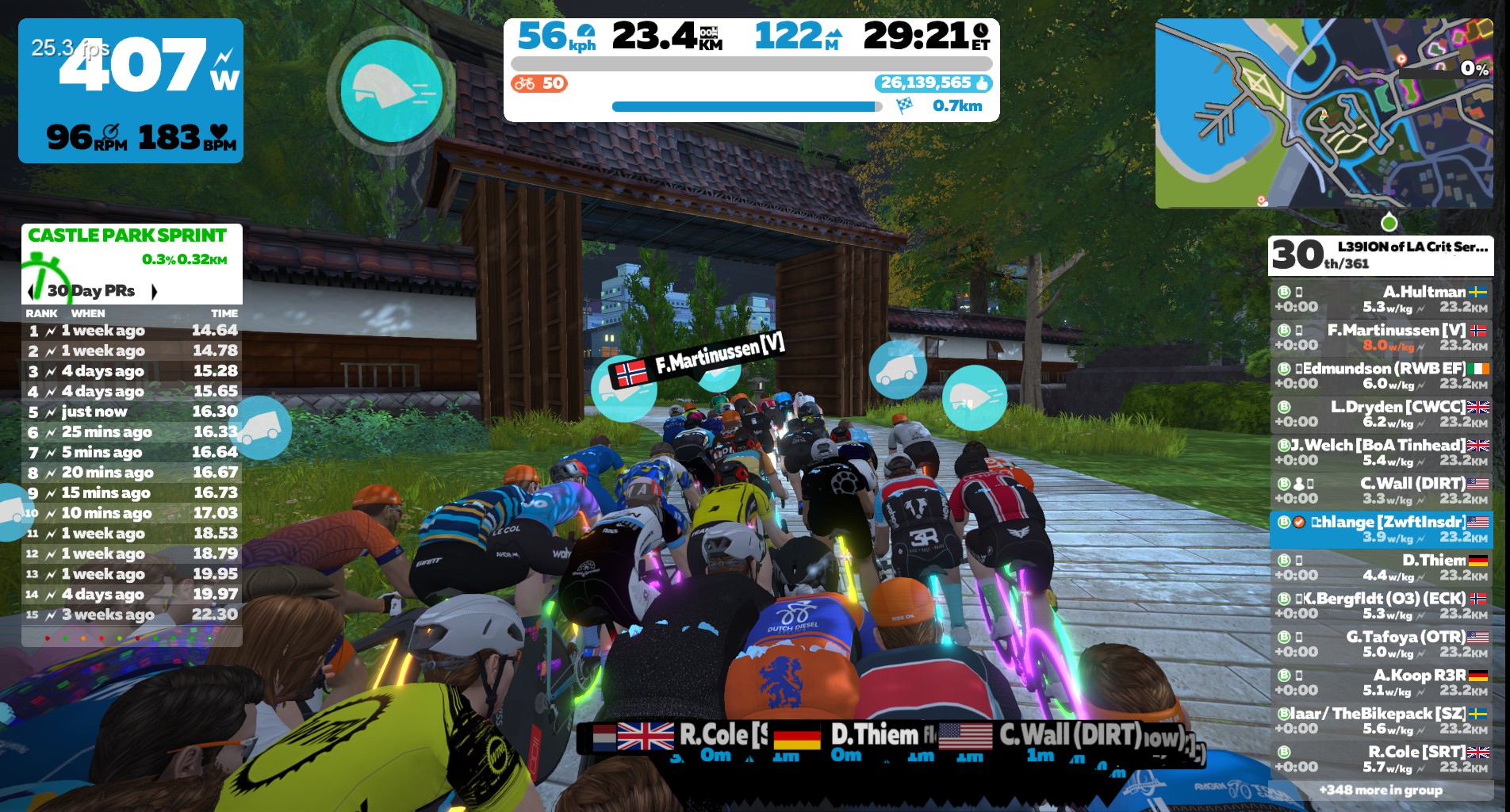
The pace ramped up as we hit the false flat after the Castle Sprint arch. I was holding an aero powerup, just trying to figure out the best time to use it.
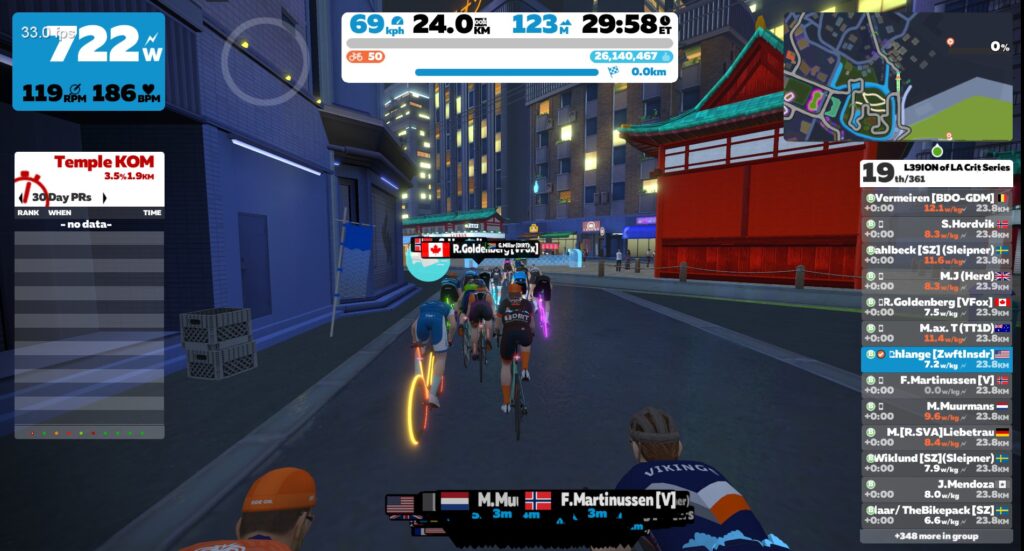
The pack began to stretch out with 1.5km to go, as riders started attacking off the front. It all came down to this final 90 seconds! Who could hold high power to hang with the stretching front, then put in a big sprint to finish?
The front of the pack was slipping away from me, so I activated my aero powerup probably 30s before the finish line, hammering my way past anyone I could catch.
Things start getting hectic
So many powerups!
Approaching the virtual finish line
The downside of making this a distance-based race was that nobody knew where the finish line was. Sure, we knew approximately where it would be. But the virtual finish line didn’t show up until we were actually approaching it for the final time! So I was looking at the distance to go number in my HUD. At 400 meters riders began really sprinting, and I did my best to follow them.
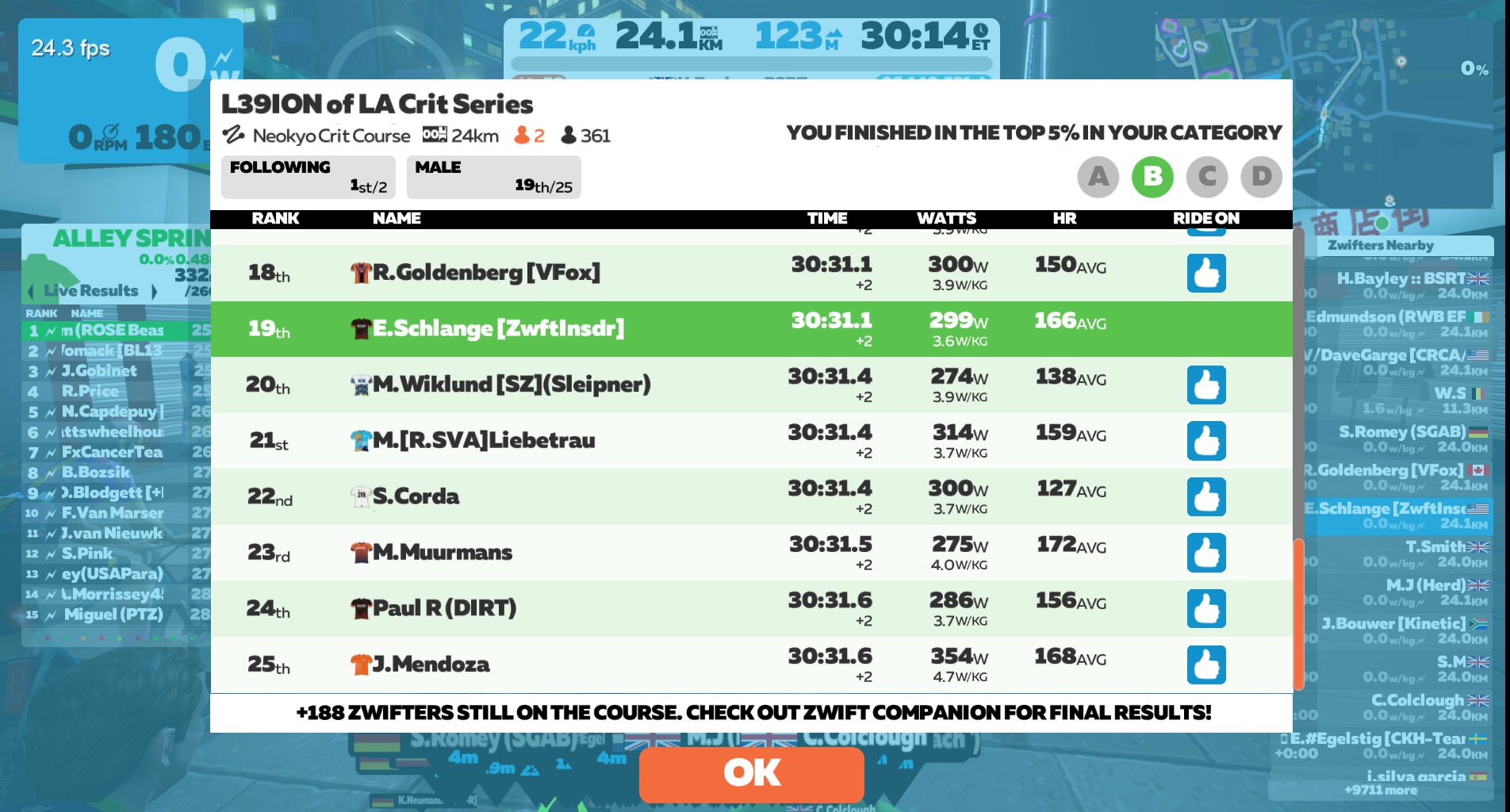
But I was clearly outgunned. I gave it all I had, crossing the line in 19th according to the game… which somehow became 20th on ZwiftPower. (The first time I’ve ever had my finishing position get worse in ZwiftPower’s results!)
I didn’t record my race video this time around, as I was concerned that doing so would impact my framerate too much. Neokyo is very CPU-intensive, and adding in a mass of nearby riders makes it even more so.
In hindsight, it looks like I made the right call. My framerates during the race were around ~25 fps, which is not ideal but acceptable to my eye. Recording the race would have dropped it to ~15 fps, which isn’t fun at all.
Takeaways
Finishing 20th resulted in a ranking points improvement of -11.35, which is a big jump for me. That’s the beauty of facing off against stronger riders!
This race reinforced my growing belief that your ability to deliver strong 1-2 minute power is probably the #1 determiner of Zwift race success. The first 28.5 minutes of the race were actually quite easy, as evidenced by the fact that some 120 riders finished in the front group.
But it was that final 90 seconds where the important work happened. Those who could hold high 1-minute power moved to the front of the pack as it stretched out. And those who could sprint on top of that 1-minute effort put themselves into contention for the win.
What did it take to win? I don’t know precise power numbers in those final seconds, but I can tell you that all of the top 5 finishers have 15-second power above 1000 watts and 13 w/kg according to ZwiftPower. Most over 1100 watts and 14 w/kg.
Me? My much weaker sprint was never going to beat the big boys. But an aero powerup, decent 1-minute power, and a good sense of timing landed me a much higher finish than predicted. And in those final meters, I set a new 6-week PR for 90-second power. So I’m happy with that, and happy with a points upgrade.
Making It Interesting
This race effort was remarkably steady. The exact opposite of what an IRL crit would be like on this course! Check out my power graph:
It was essentially a steady TT-style effort just below threshold, with a 90-second attack/sprint at the end. And that’s fine, if that’s what you’re looking for.
But what I’d really like to see (and I’ve mentioned this in the context of Crit City races in the past) is auto-braking on certain corners, which would force riders to attack out of the corners like an outdoor crit.
Couple that with next-level intelligent features like allowing a small group or single rider to go through corners faster than a large group and you’ve got all the ingredients for a much more animated race.
Your Thoughts
Have you raced any of the L39ION series? How did the race unfold for you? Share below!
Thanks to Covid lockdowns, 2020 became the first year that virtual miles were allowed to count toward the challenge. They’re also being allowed this year, and Zwift+Rapha have jumped in with both feet to make this fun challenge a blast for riders on the platform.
The Challenge
Your task is to ride 500 kilometers (310.7 miles) in eight days, from December 24-31, 2021. Outdoor bike and handcycle rides count toward the total, and so do virtual rides, as long as you upload them to Strava.
This is all tracked through Strava, so you’ll need to sign up for the Strava Challenge and upload your rides to Strava if you want to be considered an official finisher.
Zwift Rides
All Zwift miles will count toward the challenge, but if you want some extra Festive 500 fellowship, Zwift has organized a set of group rides led by guest leaders who are also Rapha ambassadors – see the full list here.
These are all 60-minute rides, each held on a different Zwift route.
Pace Partners
Looking for more company during your indoor Festive 500 efforts? Jump in with a Pace Partner group, available at four different effort levels.
A drawing will be held using the list of Strava challenge participants who complete the challenge and submit their name, email address, and Strava ID. Rapha hasn’t yet stated what the prize will be, saying, “The prize is not yet available but will be revealed before the start of the Festive500 challenge on 24th December 2021.”
RuhrRiders Festive 500 Race Series
Here’s a twist: can you complete the Festive 500 in a series of daily races?
The RuhrRiders team has organized just such an event, friendly to European timezones. The series begins on Sunday, December 26th, with daily events until December 30th that total up to over 500km.
Why take eight days to complete the challenge, when you could do it in one? Once again this year, a group of Zwifters is organizing the WBR500 during the Festive 500.
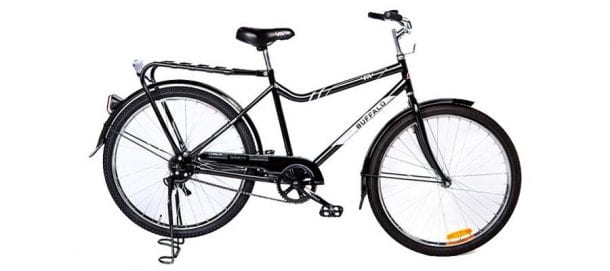
What is the WBR500? A one-day effort to ride all or part of 500km to raise funds to buy WBR Buffalo Bikes and mobilize people through the power of bicycles.
We’ll publish a post about this series of events soon, but until then, here’s last year’s post.
Questions or Comments?
Are you up for the challenge? I know I’m in, just like last year. Share below!
The hardest climb on Zwift is certainly Ven-Top, Zwift’s GPS-accurate virtual Mount Ventoux. It’s long and unrelenting, with an average completion time of 1:33:28 according to ZwiftPower. (That is 28 minutes longer than the population average time to complete Alpe du Zwift!)
When I was creating my Midweek Mountain Massif TT, my original plan was to have the event the exact same distance (12.1km) as my two other events, Monday’s Mountain Massif – TT and Friday’s Mountain Massif – Powered by Muc-Off. However, when I raced 12.1km flat-out on the Ven-Top, it was far too difficult and the fun factor disappeared. So I shortened the route to 10.1km, making it roughly match the others in duration.
I haven’t raced the complete length of the Ven-Top course very often because it is so difficult. It was whilst I was creating the Midweek Mountain Massif TT that I raced the Zwift team Greece Climbing TT, back in October. To my surprise, I completed the climb in 60.39.3. I was absolutely delighted but equally exhausted. Once I had recovered, I started wondering if I could go it under an hour. It would mean holding 5 w/kg for an hour… a mammoth effort by any consideration.
I quickly shelved that idea and began training with Rowe & King. Over the next 2 months, through structured training, my form and fitness reached a new level. And thus, once again I started thinking about the possibility of tackling the mighty Ven-Top and trying to do it in under an hour.
The Norseman Holiday Quest seemed the appropriate event to attempt this challenge.
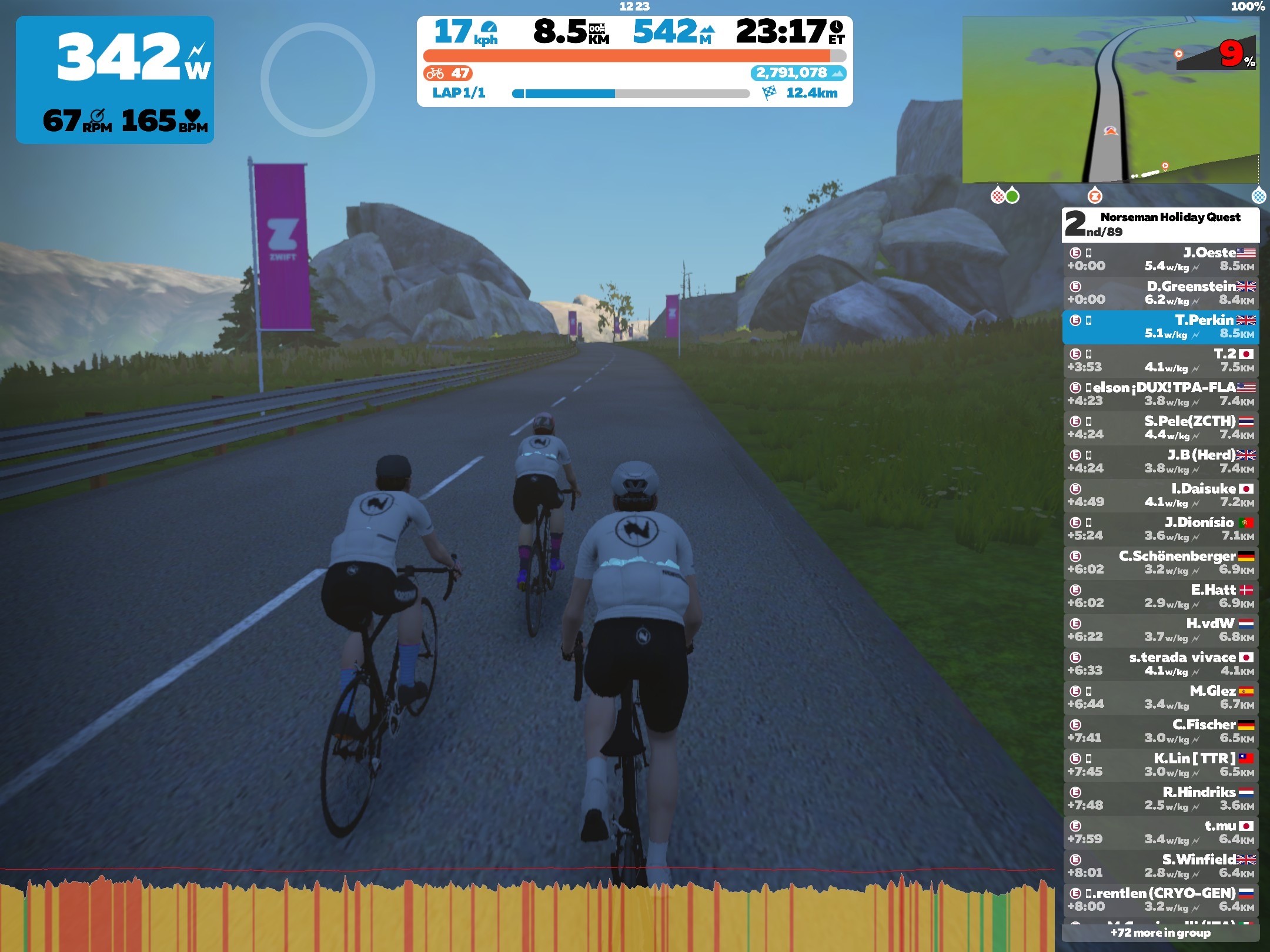
I lined up at the start and the field consisted of roughly 100 people. My plan was simple: break the race into three parts. Part one was the initial 10.1km, where my Mountain Massif event finishes. Secondly was up to Chalet Reynard. And finally, the 6km moonscape third section to the finish.
Part 1 – The Lower Slopes
As we started, I quickly got into my rhythm. I was disappointed that the event had pre-selected a bike, which meant I wasn’t on the most optimum climbing setup for the challenge. I did, however, ensure I had the Lightweight Meilenstein wheels.
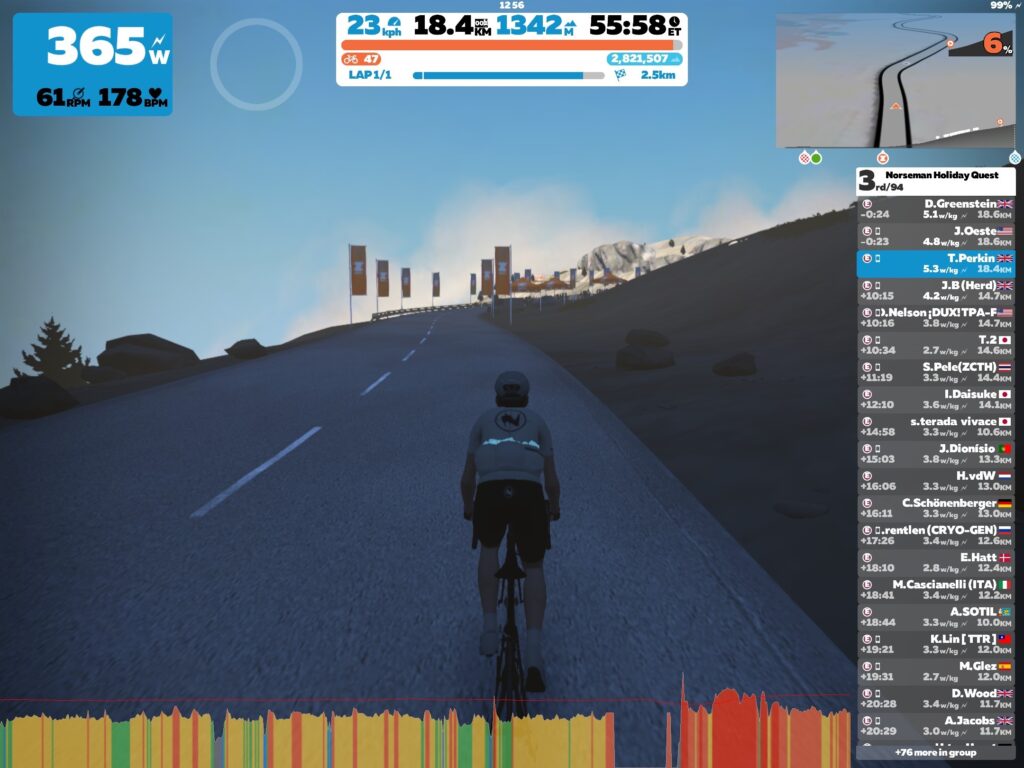
Within a few minutes I was out front with two others, Juan Oeste and Daniel Greenstein. This was going to be a long ride as these two excellent riders were matching me “pedal stroke for pedal stroke,” so I decided to announce my plan of trying for a sub-60 minute ascent. I explained I wasn’t interested in crossing the finish line first, just getting there under 60 minutes. Juan replied that he was also up for the challenge, so we decided to work together as best we could, climbing 1500 meters at just below threshold.
Daniel didn’t respond, but this was the theme throughout the ride. I assumed his continued presence meant that he was up for the challenge too.
We noted the minute we crossed the line to signify the start of the climb, 3:37, give or take a second. Before we were steadily ticking off the kilometres.
The lower slopes of the climb are relentless. The lack of hairpins and straight roads means there is never a chance to recover. The conversation I was having with Juan ensured the challenging first section was covered without incident and we kept pacing to reach our goal.
Soon we had passed where my Midweek Mountain Massif TT event would finish. 30 minutes in and I was feeling in control and making sure I stayed hydrated by drinking plenty of water and GU Energy drink.
Part 2 – To Chalet Reynard
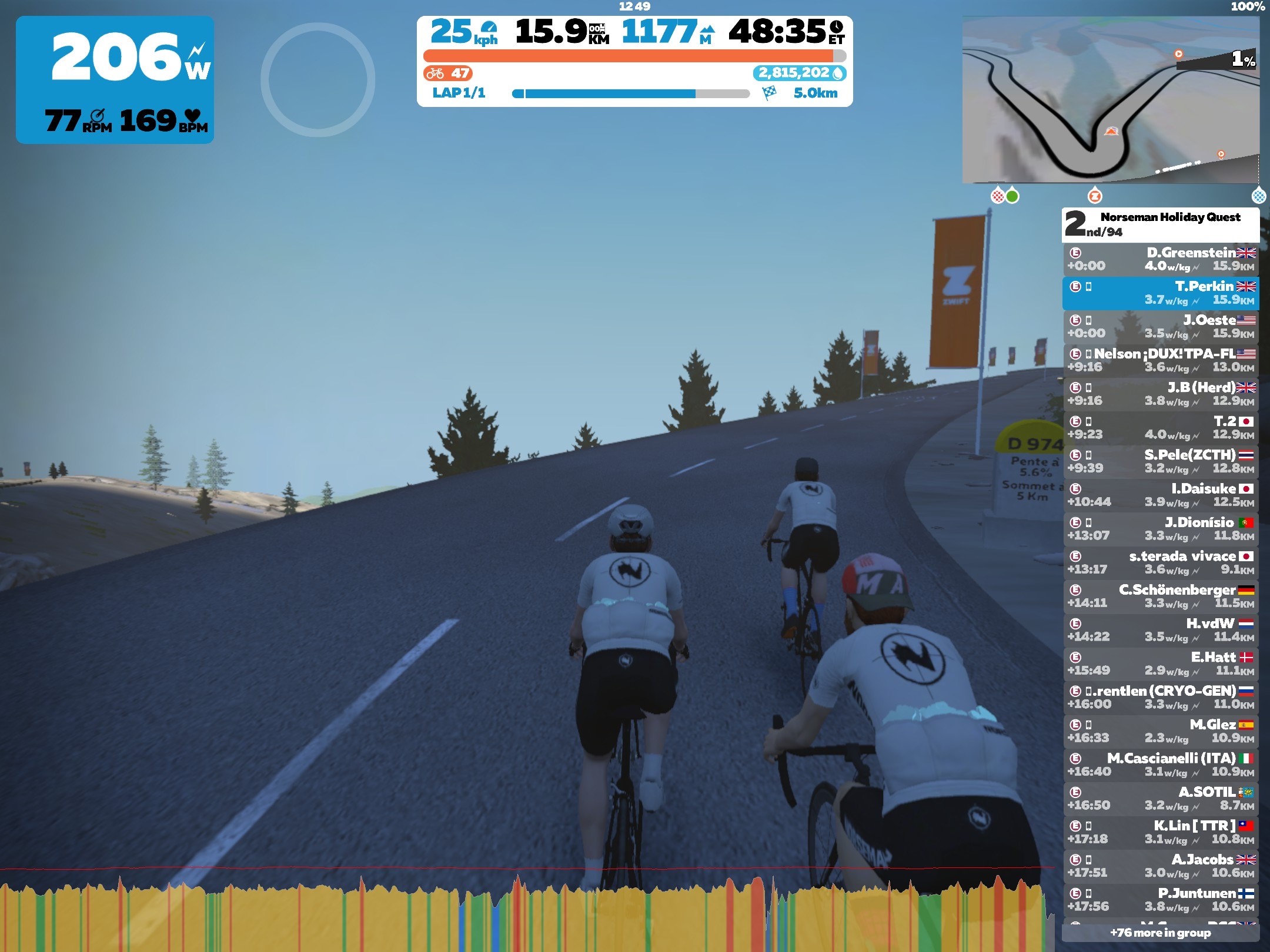
This is where we had our first concern. Daniel starting dropping back, at one point 6 seconds behind Juan and I. We both started frantically messaging him, to check if he was in trouble. At this stage, we didn’t know each other’s first name so we were using the surnames we could see on the screen and because we were frantic, “Greenfield” got shortened to “Green”.
(Little things like not being able to type were the first indicators that things were heating up.)
Fortunately, Daniel came back to the group and went straight to the front. Whether it was a lapse of concentration, I will never know but Daniel did not message us and so the three of us continue onward and upward, over the stone bridge.
Part 3 – Summit Assault
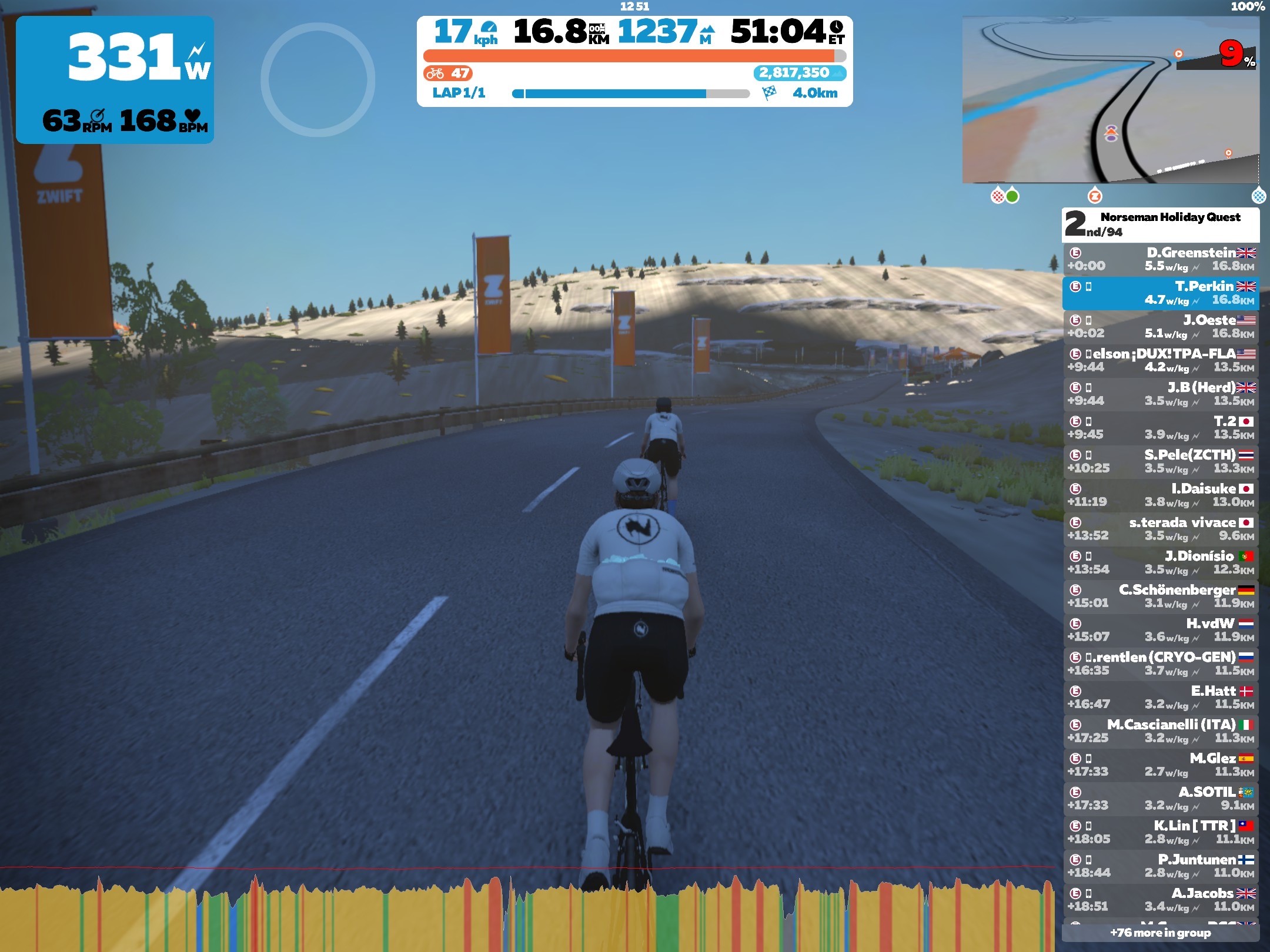
I can’t remember exactly when we came out of the forest, but it was nice to see the end of the climb in the distance. After nearly 50 minutes of climbing I was getting tired and started getting a pain in my side. I was relieved when Juan said the same as there is comfort in knowing that we were both equally suffering.
Again, nothing from Danie, but he was looking strong.
As the kilometres went by, and we kept holding our pace, I was beginning to feel confident. This monumental undertaking was looking achievable! But this is me and nothing is ever straightforward, so with 3km to the summit I suffered a mechanical.
I had a Bluetooth drop-out. I didn’t panic at first. I jumped off the bike, hopped over to the iPad and went into the pairing screen. I kept getting the “NO SIGNAL” warning. So I pulled the power out of the trainer and waited. It finally connected after what felt like an age, and now I was 40 seconds behind Daniel and Juan.
The great chase began.
I messaged them to explain what happened. Well, it wasn’t a cohesive message – it read more like “Power drip our” instead of the “Power drop out” – I opted for the use of word “Power” as I could not write “Bluetooth.”
My thinking was that they would have held a steady pace and if I could just bridge to them, then “no harm done.”
With a mixture of panic and adrenalin flowing, I was able to put down over 500 watts for a brief period, and was able to close the gap to 23 seconds. My heart rate during that period spiked to 177 bpm, which was high for me as I had been keeping it under 170 bpm.
I could see Daniel accelerating away from Juan and with 0.6km to go and under 2 minutes to do it, I knew it was going to be close. When climbing, I work on the notion that I can do 500 meters in 2 minutes, so I was going to come up short.
So, I channelled my inner Thomas Voeckler. Over the years, I have witnessed many incredible cycling moments but one that stays with me was stage 13 of the 2004 Tour de France. Thomas Voeckler, who was leading the race, put in a monumental climbing effort to retain the yellow jersey, pulling some of the most iconic cycling pain faces along the way (view this clip). It was in the last 600 meters that I was pulling the same faces.
I was in a world of pain, my vision was blurred, and I was wrestling with the handlebars trying to summon the last bit of strength from my failing body. My face contorted as I gasped for air, and I was now in the final 250 meters. The distance was counting down quickly, but so was the time!
Juan had just finished and was cheering me on, I could see he had finished in 59.40.3. It was getting close, the finish line, the time, I was at max effort, was this ever going to end…
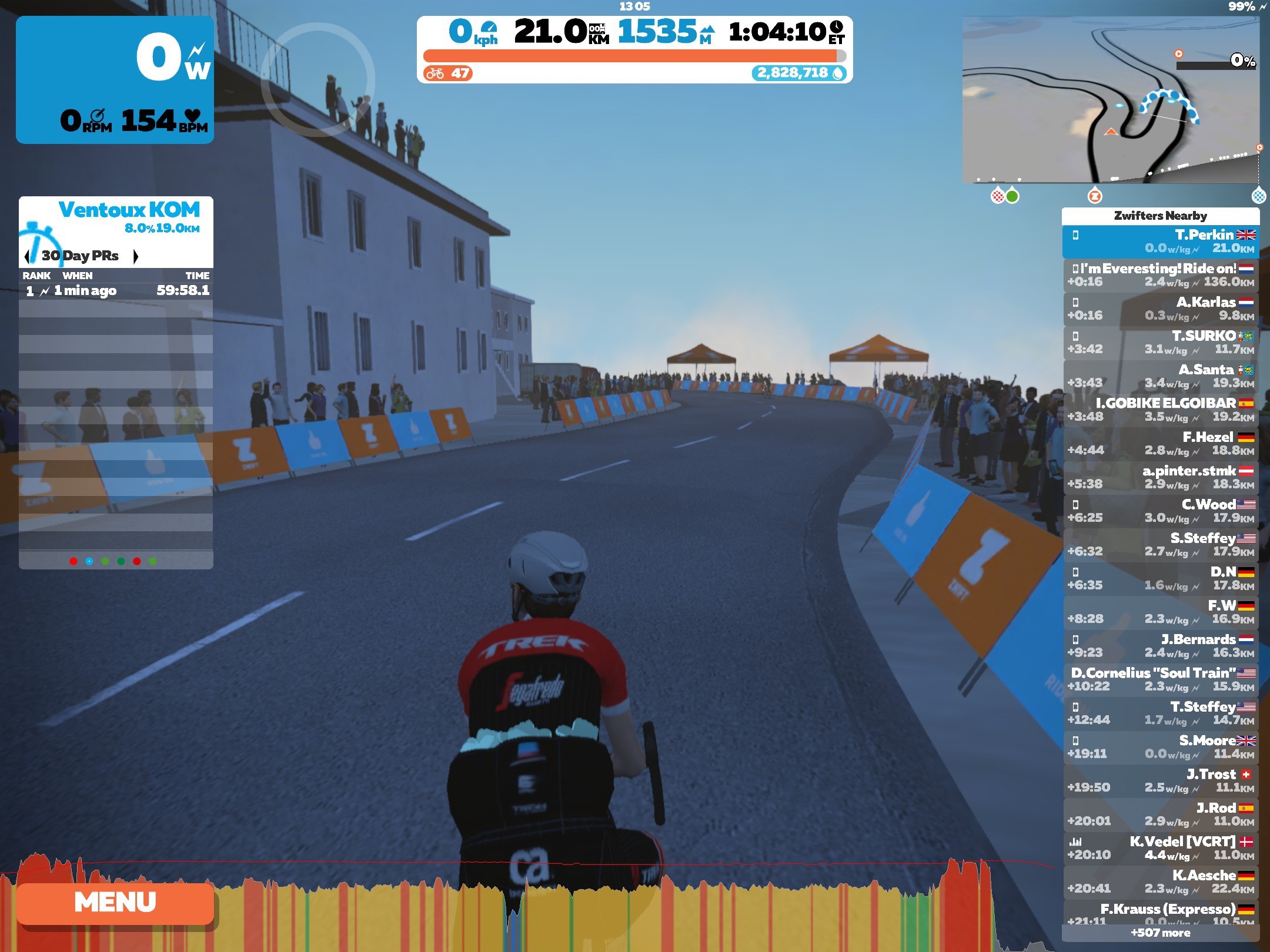
I sneaked over the line. I looked to the left of the screen to see my time. 59:58:1.
Summing Up
I was as much relieved as I was happy. Mission accomplished, by 2 seconds. In this case, every second did count!
Juan and I swapped battle stories as we both recovered from our mammoth effort.
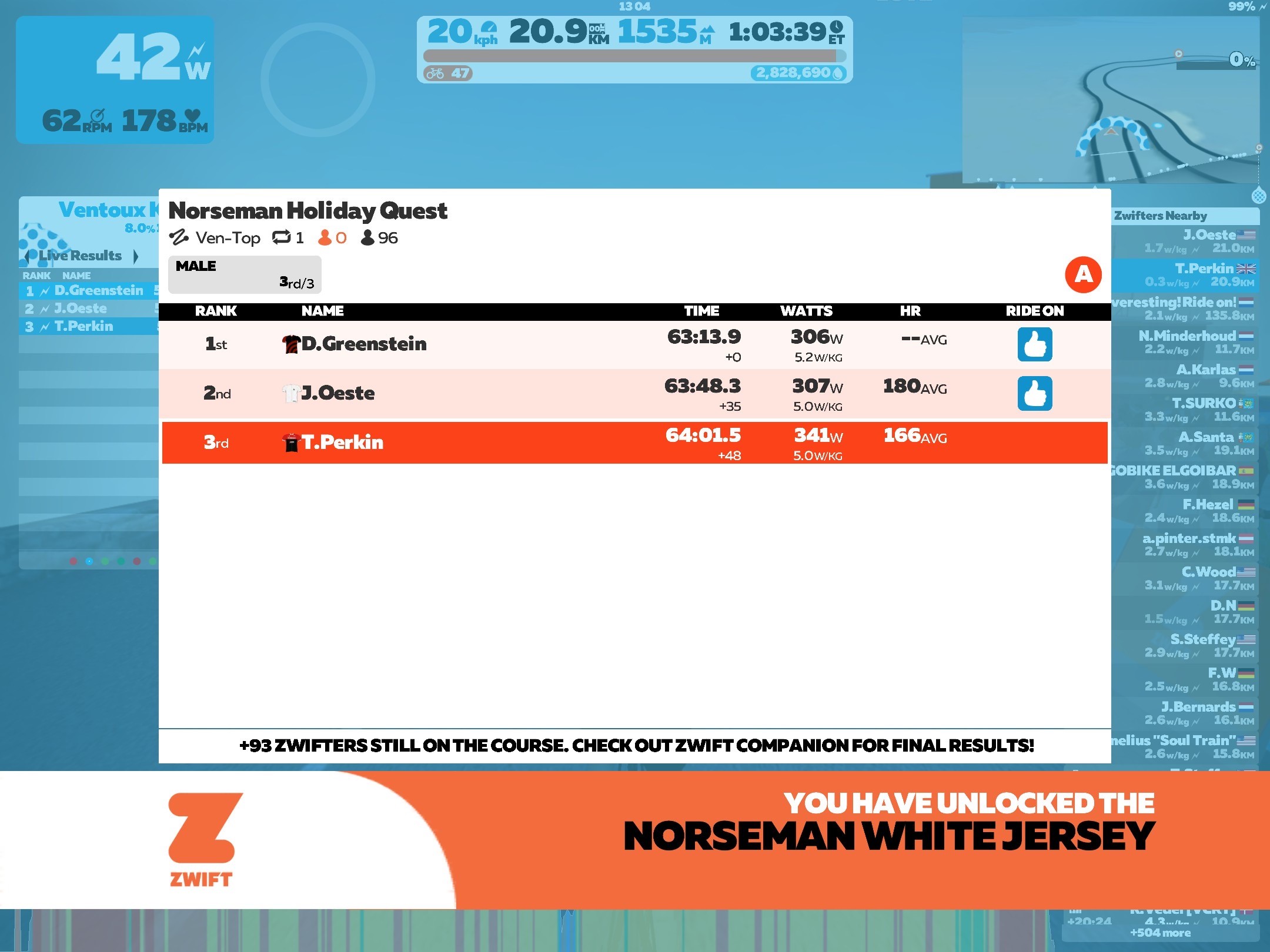
This put me 128th on the all-time ZwiftPower standings, with Juan’s 59:40 giving him 112th position and Daniel’s 59:09 putting him in 101st. It was nice that we all achieved our target. (Well Juan and I did. We never did hear from Daniel if this was also his goal, although I left message on the event to congratulate him and he responded noting he was pleased for us all.)
So how does that stack up with the times up the real Mount Ventoux?
Well, the answer is still some ways off.
The fastest time recorded up Ventoux from the Bedouin side was by Iban Mayo in the 2004 Dauphiné Libéré in 55:51.
Chris Froome put in one of the fastest ascents of the mountain during the 2013 Tour de France, climbing in 59 minutes while Andy Schleck and Alberto Contador completed it in 58.46, during the 2009 Tour de France.
I’ll have another go, but it won’t be anytime soon. The key takeaway advice from me is that if you find yourself in good form, be sure to tackle all the challenges you thought were out of reach. Like me, you may surprise yourself.
Your Thoughts
Have you ever set a Ven-Top goal and beat it? Share your story below!
Powerups have been a part of Zwift since early days, but they’ve evolved over the years as Zwift fine-tunes their usage and expands the list of powerups.
While many riders are still trying to figure out how to use all the powerups properly (see our Misused Powerups series), we thought it might be helpful to explain all the ways a powerup can be activated. Because what good is a powerup if you can’t use it?
#1: Spacebar
Long a favorite keyboard shortcut for Zwifters, the spacebar is one big powerup trigger. Just tap it and go.
If you’ve got a powerup, it will show up on the home screen of your phone’s Zwift Companion app. Just tap it whenever you’d like to use it.
Watch out that you don’t let a drop of sweat or errant finger trigger the powerup accidentally. That mistake could really hurt if you’re holding an anvil!
#3: Play Button on AppleTV Remote
Here’s a little-known powerup activation method: the play button on the much-hated AppleTV remote! That’s right. If you’re holding a powerup and hit “Play” it will be immediately triggered.
And you thought that remote was good for nothing!
#4: Mouse Click
On a Mac or PC, but don’t have a keyboard nearby? You can click the powerup icon on screen to activate it.
#5: Tapping Your Screen
Zwifting from a touchscreen device like a phone or tablet? Tapping the screen will activate the powerup, just like a mouse click.
#6: Wahoo KICKR Bike Button
Wahoo KICKR Bike riders have a super-sweet powerup shortcut built into their handlebars. That’s right: if you ride a Wahoo KICKR Bike, the top-right hood button activates your powerup!
In order for this to work, you have to have the bike paired via Bluetooth in the “Controllable” box of the pairing screen.
Join Us for The Über Pretzel at Saturday’s Z Badge Hunt Event
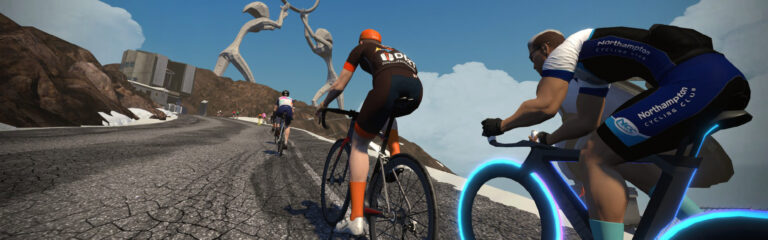
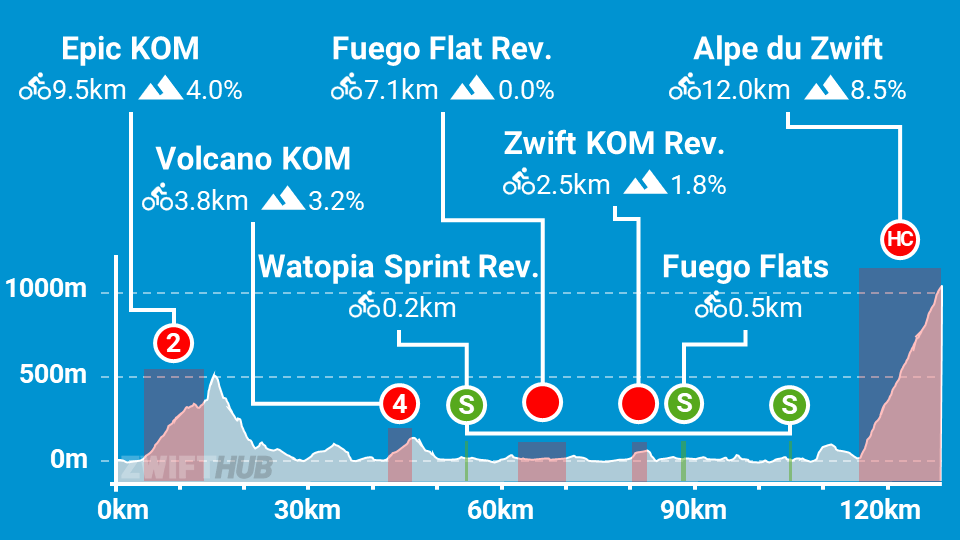
Many Zwifters consider The Über Pretzel to be Zwift’s toughest route since it finishes with the leg-sapping Alpe du Zwift climb after 115km of riding. This explains why so many Zwifters haven’t yet earned the Über Pretzel route badge!
The Über Pretzel covers almost every bit of road in Watopia, missing only Titans Grove and the short additions added in December 2020. At 128.3 km (79.7 miles) long with 2335 meters (7,661‘) of climbing it’s the second-longest (and second-climbiest) route in all of Zwift, behind London’s PRL Full.
But Zwifters who have ridden both often say The Über Pretzel is tougher than the PRL Full. While the PRL Full is just one mind-numbing lap after another, at least it lets you get into a rhythm. The Über Pretzel, on the other hand, has no rhythm.. and just when you’re feeling like it’s time for the ride to end, you arrive at the base of Alpe du Zwift!
There are just two categories for this event: an open category, and one for ladies only.
More Ride Specifics
Show up on time, because there is no late join for this ride. Why? Because if you late joined more than a minute or so into the event, you wouldn’t unlock the route badge! And we don’t want that on our conscience.
This will be a double draft ride, so sit in with others on the flats in order to conserve your energy.
Steering is enabled, to make it more engaging and fun!
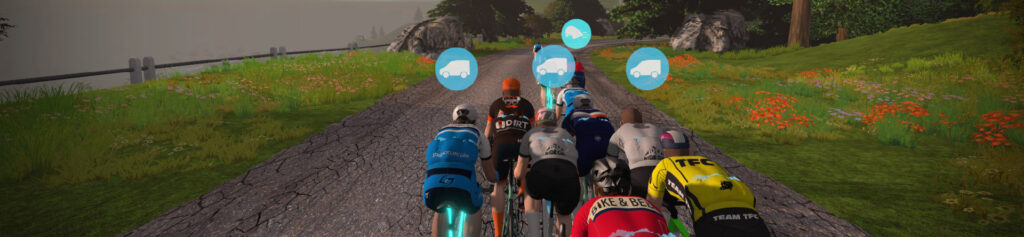
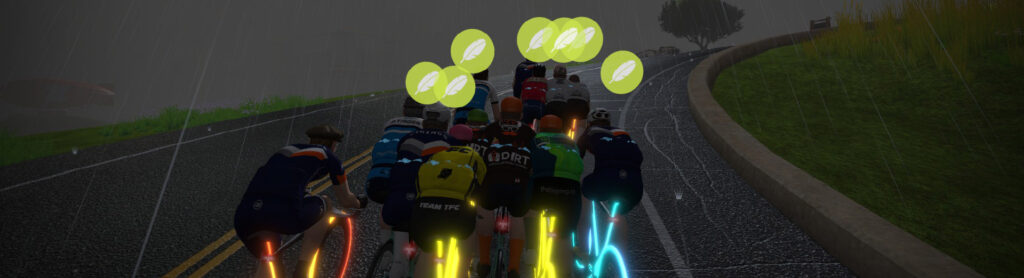
We’re serving up a custom mix of only useful powerups, evenly split between the Feather, Van, and Helmet. Use them for a bit of relief.
This is not a race – it’s a group ride. You can treat it as a race if you’d like, of course, but the ride will break up naturally into pace groups. Find riders working at your target pace and work together.
Based on the VeloViewer Leaderboard we can see that top riders crush The Über Pretzel in under 4 hours. But most mortals require 5-6 hours, with plenty taking even longer. You do you. Be sure to plan accordingly.
Discord
Zwift Insider’s Discord server will be used for voice chat during the ride. This really helps pass the time, so we highly encourage joining in, even if it’s just to listen!
If this ride’s start time doesn’t fit your schedule, there are additional (not Zwift Insider-hosted) Z Badge Hunt PRL Full events happening this weekend at these times:
The Top 5 Zwift Videos this week include two looks at the new Neokyo section of Makuri Islands, which joins Yumezi on the expanded map. Also on the list is a guide to creating a dream Zwift desk for $100, a tour of a triathlete’s pain cave, and a time-saving workout that packs a punch.
ZWIFT Expands Makuri Islands: Neokyo // November 2021 Update
It’s Zwift’s biggest update this year, and of course, Shane Miller (GPLama) is here to show us what’s in it – including Neokyo, the new expansion to the Makuri Islands world.
First Ride and Ultimate PRE Race Workout!
Erik Lee (Don’t Get Dropped Cycling) takes his first look at Neokyo while demonstrating an effective pre-race workout offered by Zwift.
$100 ULTIMATE Dream Zwift Desk Setup DIY
You don’t have to break the bank for a premium-quality Zwift desk. Taren (formerly Triathlon Taren, now of “Taren’s MōTTIV Method”) demonstrates step-by-step how to make one yourself.
Zwift Cribs: Triathlete Pain Cave Tour: How I Stay Fit At Home
Triathlete Mabel Demavivas shows off her Zwift training space and how she works out at home.
Brutal Interval Session on Zwift // Setup, Ride… and Pain
Zwift’s “Step by Step” workout is a condensed dose of hard work, and Jourdain Coleman is ready to dig in.
Got a Great Zwift Video?
Share the link below and we may feature it in an upcoming post!