Zwift is rolling out a fresh mission for October, and it’s all about workouts.
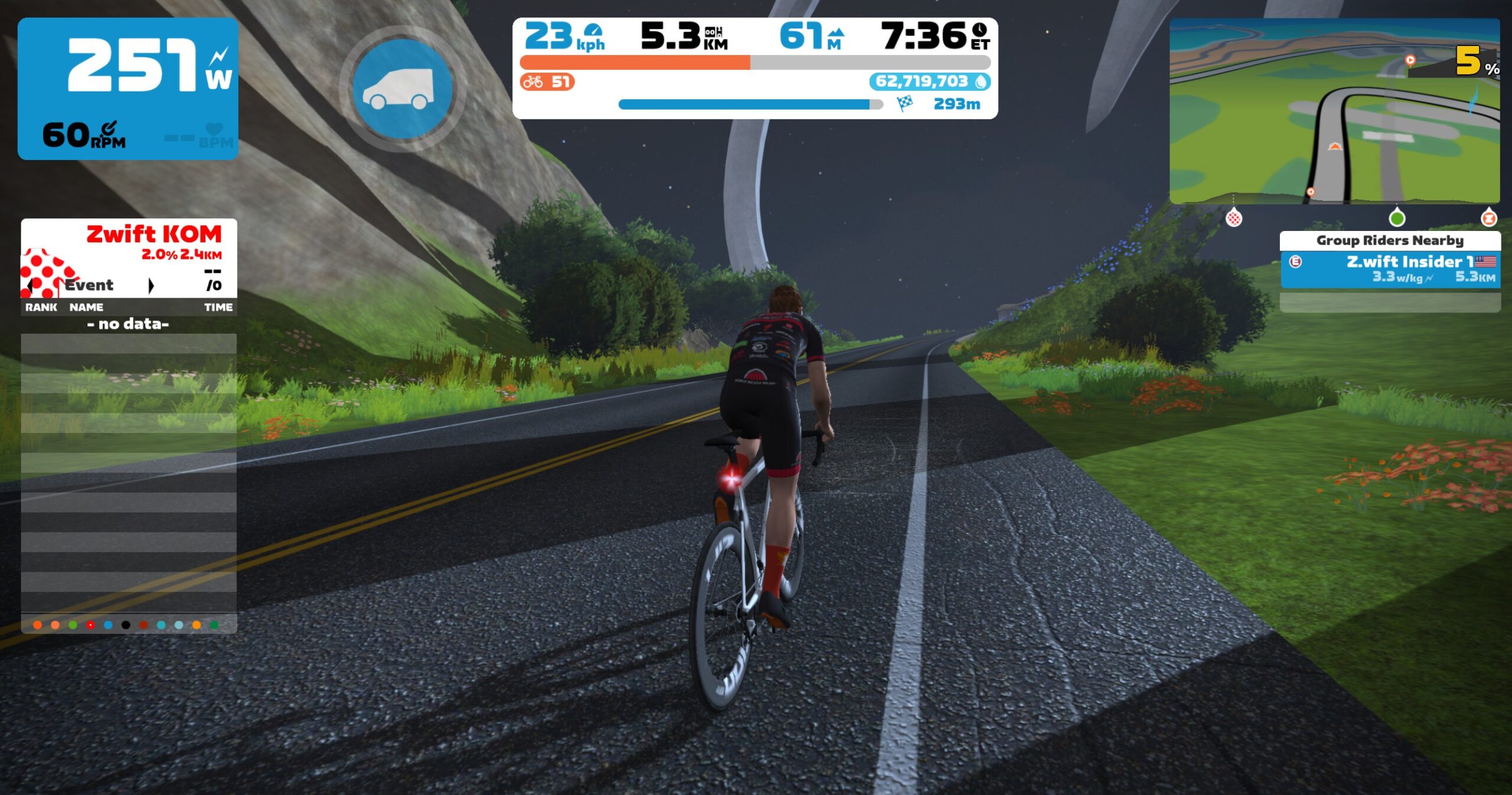
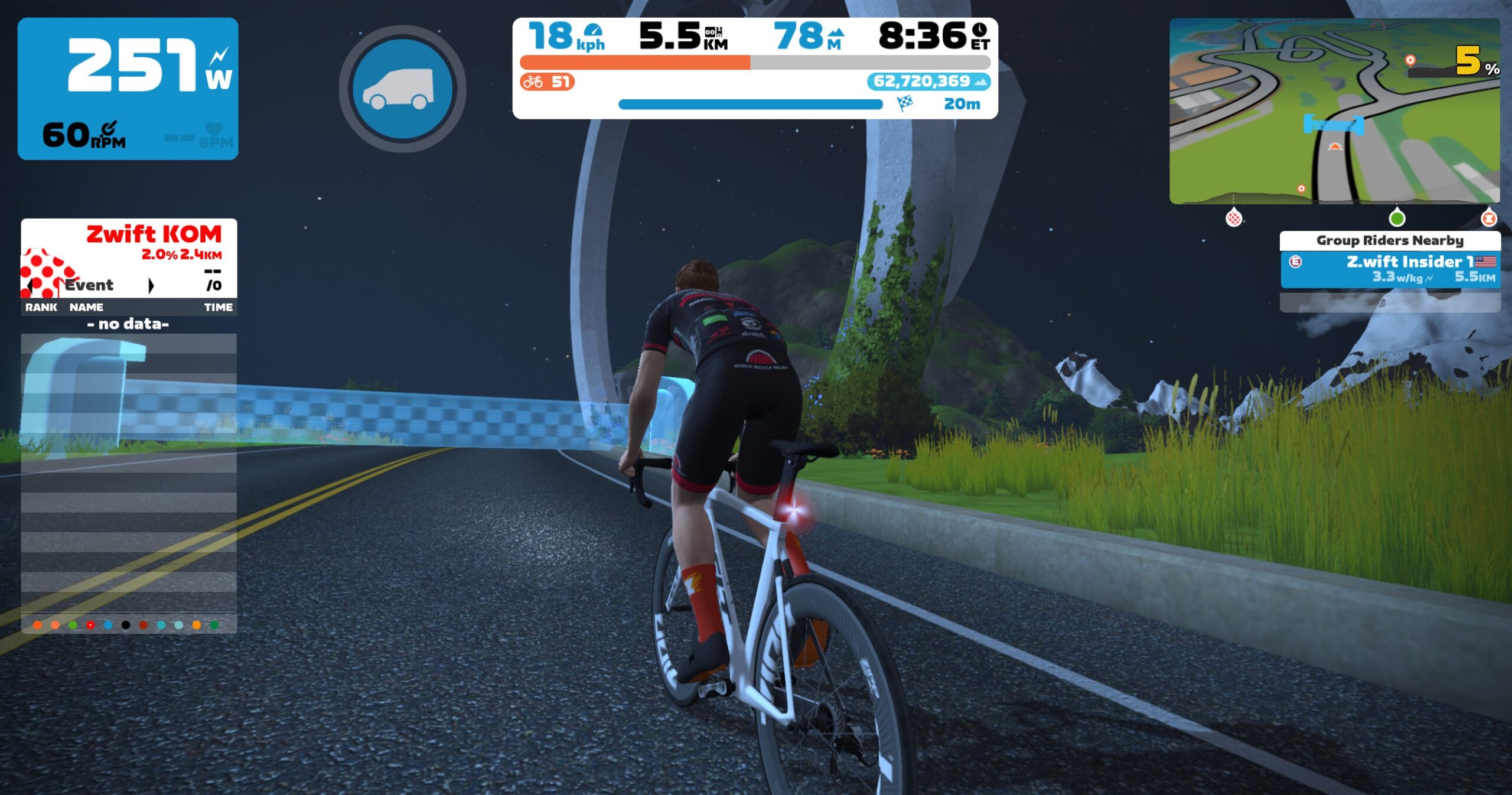
The Tune-Up Mission runs from October 3-31. How do you complete it and earn the mission badge?
Completion is simple – but not easy. You need to finish 4 workouts to finish the Tune-Up Mission. These can be group workout events, or solo workouts from your on-demand list in game.
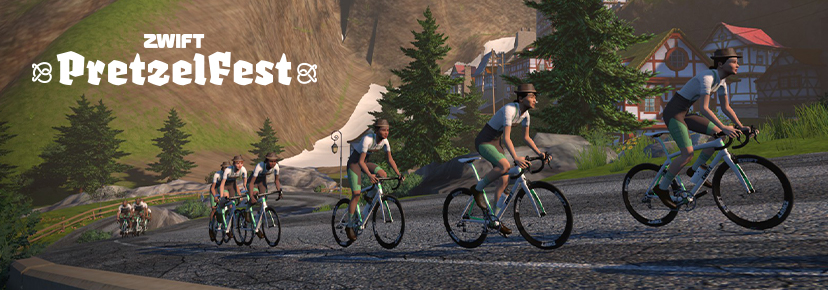
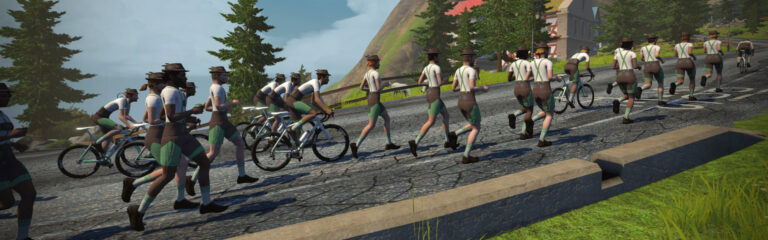
It’s nice to see Zwift hosting some longer rides including varying terrain. The inaugural PretzelFest looks like a lot of fun, with the added incentive of some new kit unlocks as reward for our efforts!
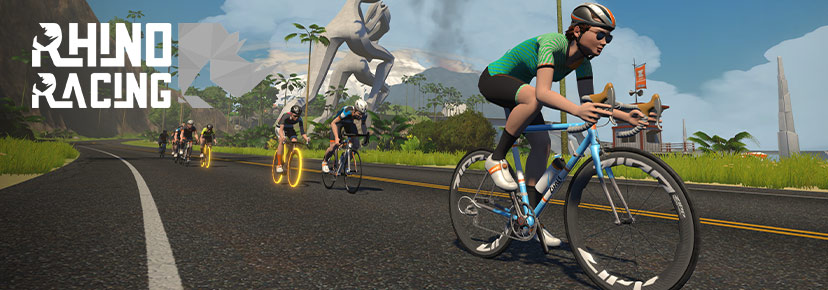
Shorter races have been gaining popularity on Zwift, but a new race series from Rhino Racing launches this weekend featuring extra long routes!
This weekend features the 2022 Medio Fondo route, with A/B categories riding the full route (79.3km) and C/D/E categories riding a shortened (60km) version. Categories are enforced so sandbagging will be minimized.
If you haven’t tackled one of the Zwift Academy Workouts, it is certainly worth doing, especially as they have multiple options to try! There are both long and short versions, as well as events for Women only. I really like this approach because it caters to all. If you are daunted by the prospect of suffering for nearly and hour, the short session means you still get training benefits as well as helping build your confidence to potentially tackle longer workouts in future.
This workout focuses on improving your aerobic power and finishes with a testing 7-minute block.
If you’re racing Zwift Racing League, or just want a fun Saturday race, check out the Wahoo Le Col Saturday Series. Each event in the 6-race series uses the same course as the next week’s ZRL race, so these serve as recon events for many riders.
Personally, I think it’s nice to see an increase in the number of short races on Zwift. I find them the most fun because they are so frantic! The fact that you don’t have time to think means you end up racing on instinct.
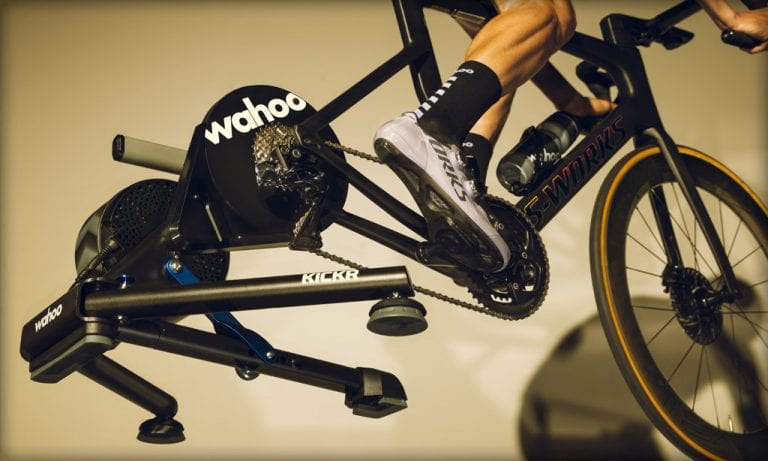
In this Zwift Hub edition of our Top 5 Zwift Videos, learn all about this upcoming smart trainer. Why is Zwift making this move now? How might it affect the indoor training industry? And what is it like to ride one? These questions are asked, answered, and discussed in the videos below.
Zwift $499 Smart Trainer is Great! But…
Charles Ouimet shares his thoughts on the Zwift Hub announcement. Is this a good thing for Zwifters and indoor cycling as a whole? He says there are upsides and downsides.
Zwift Hub Smart Trainer: Hands-On After A Few Rides/Full Details
For hands-on experience with new cycling technology, DC Rainmaker is a go-to resource. Here are his impressions of the Zwift Hub smart trainer.
Zwift Launches a $499 Direct Drive Smart Trainer! Zwift:HUB Details & First Look
Of course, this list wouldn’t be complete without hearing from cycling tech expert Shane Miller (GPLama) on Zwift’s upcoming trainer.
Zwift Hub: details and first ride on the $499 direct-drive smart trainer
The Ride with Ben Delaney gives some background on the Zwift Hub as a business decision and then talks about his experience actually riding it.
Zwift Launches Its First Smart Bike Trainer: Zwift HUB
Tariq Ali with SMART Bike Trainers also got the chance to ride Zwift’s upcoming smart trainer. Hear his thoughts on it here.
Got a Great Zwift Video?
Share the link below and we may feature it in an upcoming post!
There are still plenty of new KICKR V5 trainers for sale
There are still lots of used KICKR V5 trainers in the marketplace thanks to “Covid buying”
After extensive reviews and hundreds of hours of riding, we believe the KICKR V5 is one of the best trainers ever made, and in fact rated it as the #1 trainer over $900
Wahoo’s KICKR is the most popular trainer on Zwift for good reason, and we believe the V5 is worthy of a bit more review coverage before being overtaken by the V6. I hope you find this review useful…
Origins of the KICKR
The Wahoo KICKR V5 is the fifth generation of Wahoo’s flagship smart trainer. The first version launched in 2014, and it has since undergone revisions every year or two. The V5 was released in August 2020, and just this month Wahoo announced the release of its successor.
The KICKR’s development and Wahoo’s growth as a company is all rather impressive, given that founder Chip Hawkins only started the business in 2009. Wahoo now has a range of hardware including ELEMNT GPS Cycling Computers and sport watches, TICKR Heart Rate Monitors, SPEEDPLAY Road Pedals, smart trainers, and indoor accessories including the KICKR Climb and Headwind. In addition, they sponsor many of the leading teams in Men’s and Women’s pro cycling, including Trek-Segafredo.
Design Notes
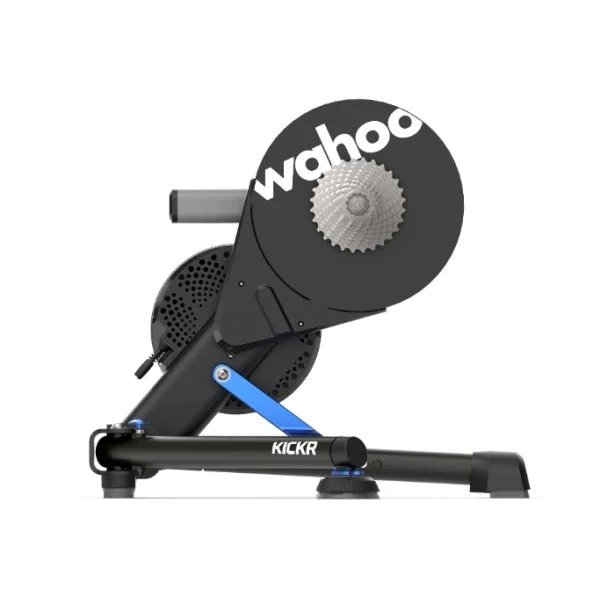
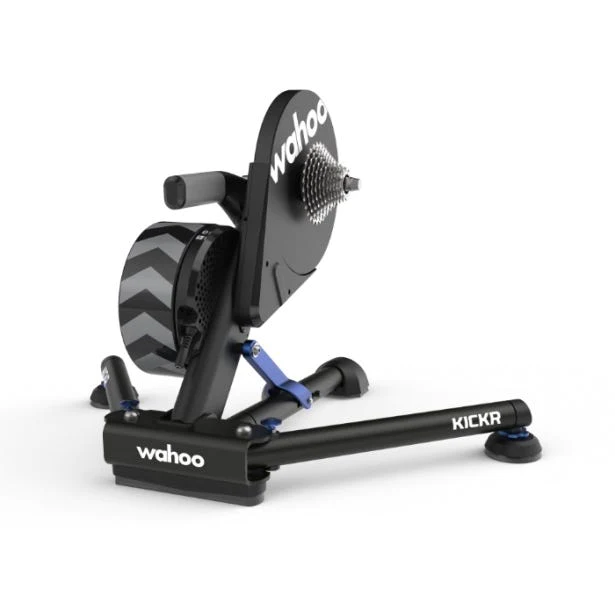
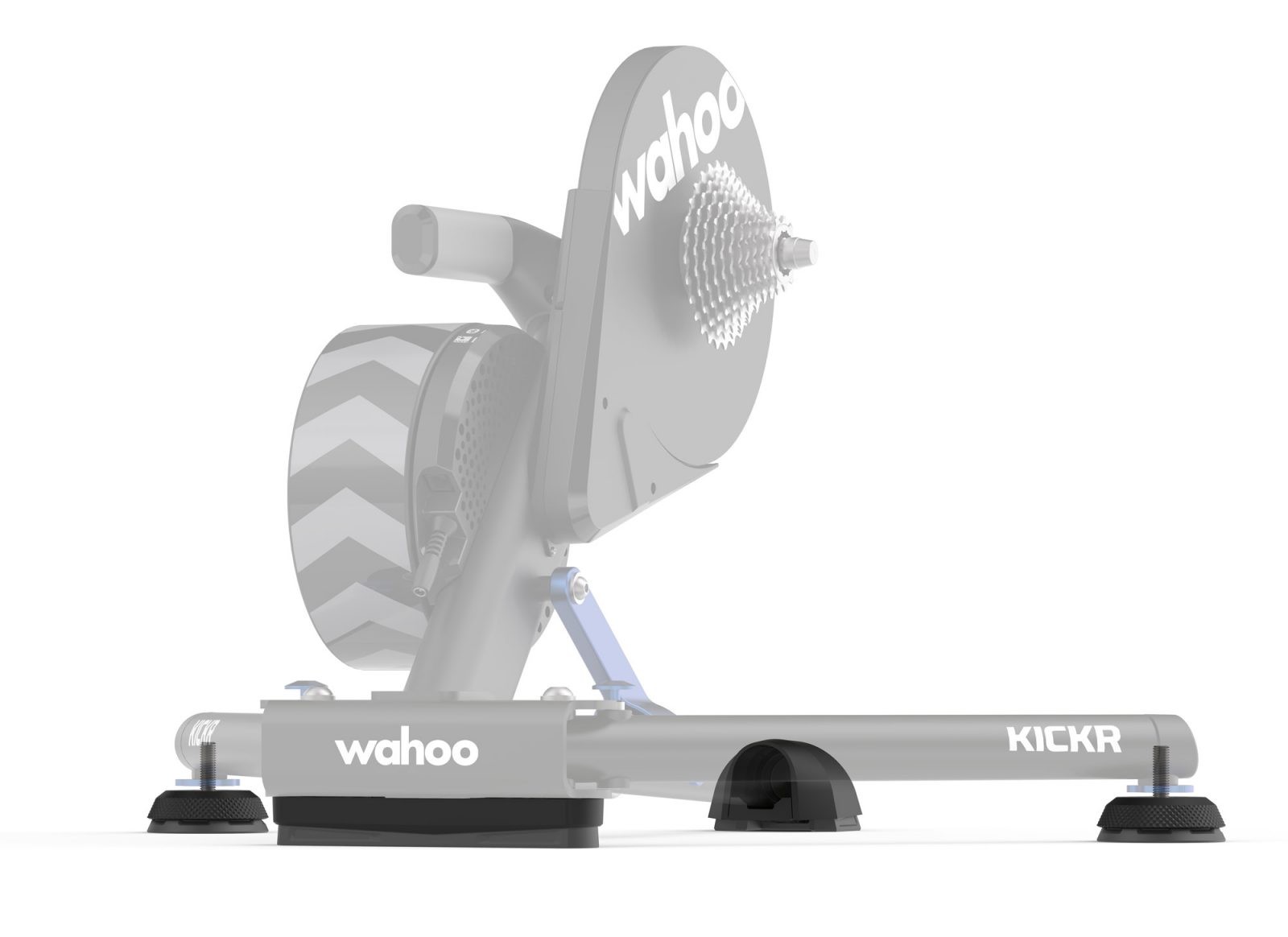
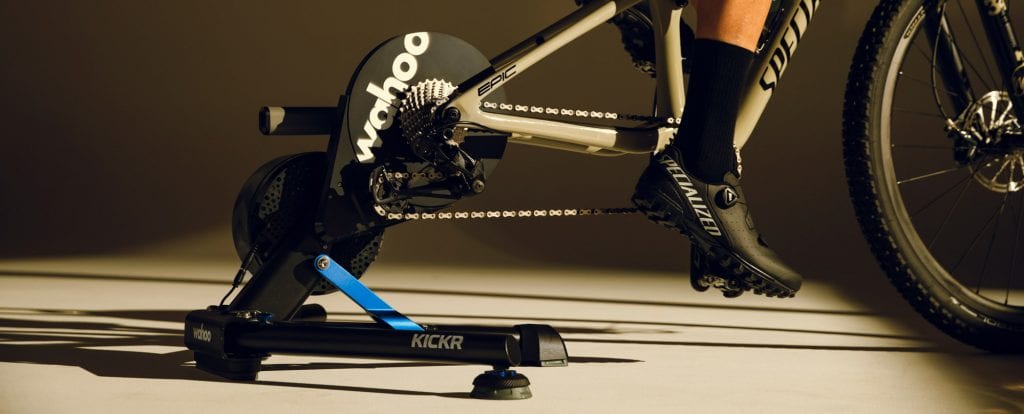
The first point to notice is that the trainer is very minimal in its construction, with an ergonomically designed handle to enable you to position the trainer into place and an exposed belt and pulley giving it an “industrial” feel. This look is further enhanced by its robust steel construction, as seen with its matte black legs and polished blue centre support, which ensures the KICKR stays firm and stands up to thousands of hours of heavy use while you crank out the watts.
Due to the minimalistic design, it takes up less space than many other trainers. The lack of plastic used in its construction is noticeable and its footprint is 51cm by 71 cm.
Overall, it appears and feels like every part of the design has been very refined.
Technical Specifications
The trainer offers high specifications, notably with its maximum power output of 2200 Watts, which far exceeds anything the majority of people will be able to generate. Details include:
Weight: 47 lb // 22 kg
Product Dimensions: 20x28x17 in // 51x71x44 cm – Legs open configuration
Hub Types: 130/135mm QR, 12×142, and 12×148 Thru Axle
KICKR CLIMB: Compatible
Disc Brake Clearance: Yes
Setup
Setting up the Wahoo KICKR V5 is easy as it comes fully assembled. There is a detailed instruction manual to assist, but it is very straightforward.
Simply take the trainer out of the box and move it to your desired location and position as required. While the trainer is hefty thanks to its all-steel construction, moving it is easy thanks to the integrated handle.
Next, fold out the legs, which clip into place, and adjust the height of the trainer, depending on the size and type of the bike you are going to use. This simple feature, not available on any other smart trainer that I know of, lets you optimise the position/tilt of your bike, depending on what you use and prefer.
Once you have selected the height, be sure to lock it in position with the screw.
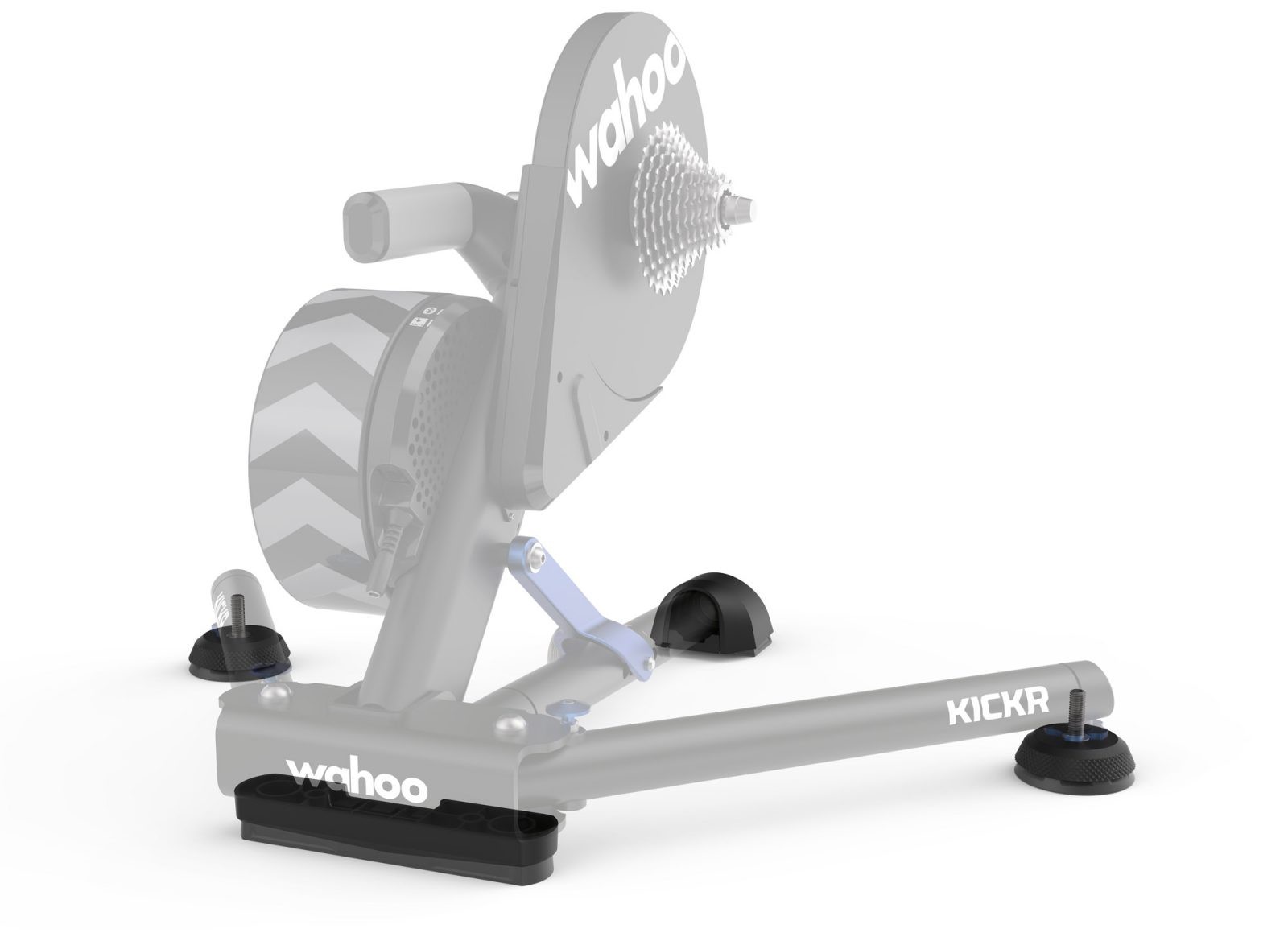
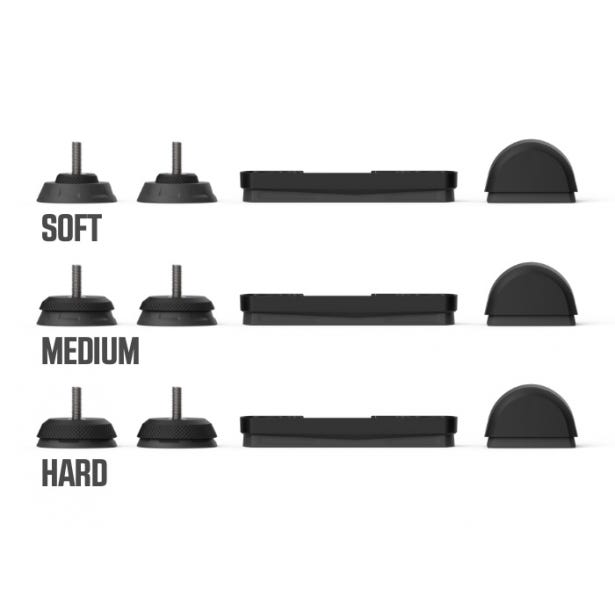
Now you need to adjust the feet to ensure the trainer is level, which is only really required if you are cycling on an uneven surface. The integrated AXIS feet can be removed and replaced with larger or smaller feet, depending on your weight. (The middle, default-sized feet are installed and cater to riders that weigh between 63-81kg.) The feet are designed with some “give” to let the trainer move a bit and give you the most comfortable ride.
It comes with a 11-speed cassette installed, so if you pedal an 11-speed bike, no adjustment is required. Otherwise, it’s easy to swap out if you have the proper tools.
The final two steps involve selecting the relevant adapter to mount your bike and connecting your bike. A standard quick release skewer is included.
Plug in the power and away you go because no configuration is required.
It’s all rather simple.
Ride Experience
How does the trainer feel?
The feel of the trainer is smooth. Really smooth. Whether you are on the flat or going uphill, the resistance of the trainer smoothly adjusts accordingly and you can pedal your required power or cadence. One of the noticeable features of the trainer is that when you change your cadence or apply power, the trainer responds. This has given me confidence when racing on Zwift because I know, if I respond to a certain move, the trainer will react. The limiting factor is now my own ability. In my opinion, this is one of the most responsive trainers that I have ridden, and I have extensively ridden a number of different ones including the main ones from their competitors such as the Tacx Neo 2T, Tacx Flux Smart S, Elite Justo, Elite Direto-XR, and Wattbike Atom.
Talking of resistance, when starting your ride, there isn’t a big effort required to start moving the flywheel, despite its 7.3kg weight. I attribute this to the pulley which is smaller than some competitors’. It’s easy to get up to the required speed and cadence.
When cycling on Zwift, appropriate resistance is applied. For example when climbing on the Volcano, the trainer increases and decreases the resistance as the gradients change, ensuring that the climb is smooth. This is also noticeable on undulating courses, in fact, this trainer is one that I feel mimics closely the resistance of cycling outside. The trainer can imitate gradients of up to 20% and can handle any climb on Zwift.
Couple this with the KICKR’s AXIS feet, which allow you to customise your ride feel. According to Wahoo, these feet “offer a more realistic training experience” which means not only a smooth ride, but a comfortable one since they allow for a slight 5° of movement from side to side. This also makes the ride feel more natural.
Reliability
How reliable is the trainer? Very, is the short response. I’ve not experienced any issues with connectivity, and a considerable number of hours have now been logged using it. Once connected to Zwift on my iPad, via Bluetooth, it stays paired and I have not experienced a single technical glitch. This has been noticeable and, in an age where we have become increasingly impatient with resolving tech issues, this is most welcome.
If you are concerned about experiencing wireless ANT+ or Bluetooth dropouts, Wahoo have released the KICKR Direct Connect which allows you to connect the trainer directly into your internet router, via its RJ11 socket situated in the rear of trainer, above the power lead. This is only compatible with the new KICKR V5 and V6 smart trainers.
Accuracy
I used my Garmin Vector 2S pedal to compare the accuracy of the trainer. The difference in readings is minimal. Given I used only single sided power pedals, I would think that the trainer is more accurate when reading power. As you can see from the data table, the average power percentage difference between the two is minimal (around 1%) and over a race and 20-minute period we are talking the difference of 3 watts. It’s worth noting that the maximum wattage output of the trainer is 2200, and so my 806 watts never go close to reaching its maximum capability.
During a Zwift race, this breakdown of the data shows the comparison between the Wahoo KICKR V5 and the Garmin Vector 2S pedals.
Wahoo KICKR V5
Garmin Vector 2S Pedals
Difference
1 Second
450 watts
447 watts
-0.67%
5 Seconds
412 watts
417 watts
1.20%
15 Seconds
397 watts
402 watts
1.24%
30 Seconds
393 watts
394 watts
0.25%
1 Minute
382 watts
386 watts
1.04%
5 Minutes
355 watts
360 watts
1.39%
10 Minutes
333 watts
338 watts
1.48%
20 Minutes
323 watts
326 watts
0.92%
If you’d like to dig into my dual recording test data, here are the ZwiftPower links:
I was able to post a time of 7:12 on the Volcano climb, which feels right for the effort that I expended based on my current fitness levels.
The only noticeable difference in data was when sprinting. The Garmin Vector 2S pedals had me generating a difference of 30 watts on the positive. However, sprinting is not my strength and would therefore consider the readings from the Wahoo KICKR V5 to be a more accurate reflection.
(This is further supported by the fact that when I undertook the same test using the Tacx Flux Smart S trainer, the trainer recorded 630 watts compared to 656 watts of the pedals, a variance of +3.96% in comparison to +4.06% of the Wahoo KICKR V5, leading to the conclusion that it is my Garmin Vector 2S pedals that are the limiting factor in this sprint test. However, to make any firm conclusions, additional pedals/power meters would need to be used and compared against the trainer.)
Noise Levels
This trainer is quiet, one of the quietest I have tried. In fact, more noise comes from my drivetrain than the flywheel and pulley actually turning, and this really does highlight the need to maintain your drivetrain to a good standard!
You can easily have a conversation whilst using the trainer, without being drowned out. If you are using a fan, I can assure you any fan is louder than the KICKR V5.
Erg Mode
Erg mode is consistent and reliable as the trainer itself. The resistance changes in accordance with the effort that is required and the change in resistance is smooth, easing on and easing off when appropriate. It just feels natural and I have not experienced any issues in Erg mode.
Cost
As Wahoo’s leading direct drive smart trainer, the V5 was priced at £999.99 / $1,199 / €1,199.99 / AU$1,799.95. However, the new V6 has been announced, and Wahoo and their distributors have been selling off V5 stock at discounted prices.
Having used the Wahoo KICKR V5 trainer extensively, it is clear why this was selected as the “go-to” trainer for the UCI Esports World Championships. The KICKR simply delivers one of the best, if not the best “all-around” experiences of any smart trainer on the market today.
The trainer is a stable and comfortable platform, it is quiet and is extremely responsive. When I increase my effort, this is instantly reflected in the increase in wattage, similarly, when I increase my cadence, the trainer responds.
In terms of resistance, it has what I consider to be appropriate levels of resistance and inertial feel. This is evident both and flats and when climbing. It’s as close to recreating the outside riding experience I have encountered.
The minimal design, ease of setup, reliable connectivity, and overall performance means this is certainly a trainer to seriously consider if you are looking at upgrading.
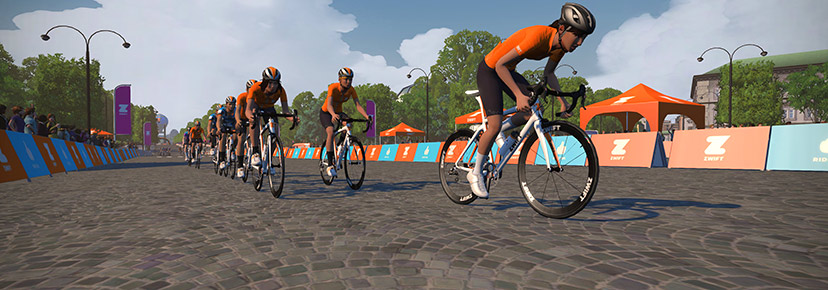
The fourth race of Zwift Racing League 2022/23 Round 1 happens Tuesday, October 4th. We’re in Paris on the iconic Champs-Élysées, the finishing roads of each year’s Tour de France.
Let’s dig into the race, including tips for bike choice, powerups, strategy, and crucial segments.
Looking at the Route: Champs-Élysées
Watching Tour de France pros race these cobbles each year may have given you the mistaken impression that it’s a flat route. But it really isn’t!
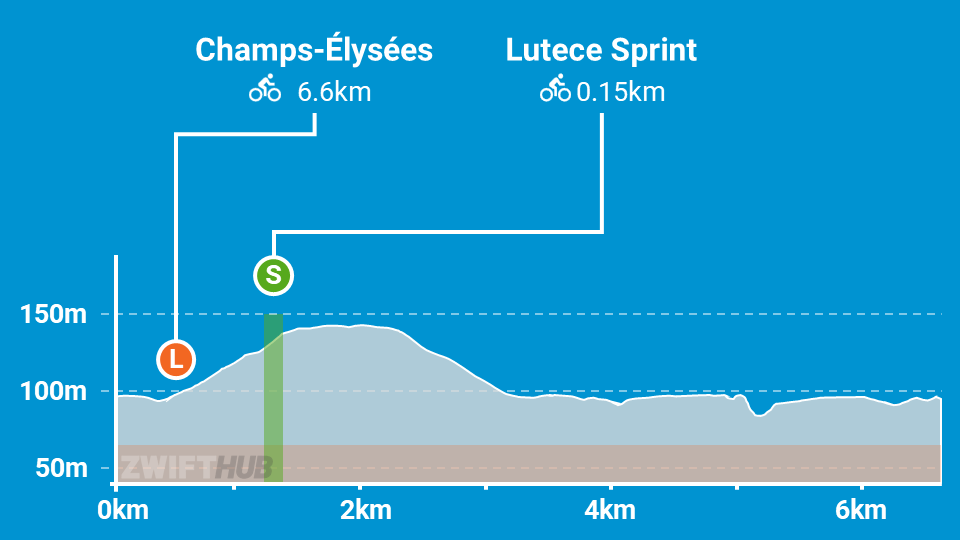
As you can see from the Veloviewer profile above (and the ZwiftHub profile below), the road climbs up to the Arc de Triomphe. This little 1.3km climb even has a name – the Montée des Champs Élysées!
It’s not a steep climb, averaging just 2.1%. But this is where the big efforts happen each lap, especially because we’ve got an intermediate sprint near the top of the climb.
The only other bump worth mentioning is the dip down and up as you round the back of Jardin des Tuileries, with the Louvre on your right. In this direction, though, the rise is much less noticeable – so just mind your pack position, and possibly use it to launch a final long attack with 1.3km to the finish line on your last lap!
Per-Category Race Lengths
Each lap is 6.6km, and you’ve got a 3.2km lead-in from the start pens. This week each category will be riding a different number of laps, which is something we don’t see much in ZRL. A riders will race 7 laps (49.5km, 289m), B will race 6 (42.9km, 250m), C will race 5 (36.3km, 210m) and D will race 4 (29.7km, 171m).
About the Lutece Sprint
The sprint segment here will be the most animated section of the race (apart from the finish) since it’s on an incline and riders can earn intermediate sprint points each lap. A few key bits of info on the Lutece Sprint:
It’s short – only ~150 meters long. Expect times in the 10-15s range. Time your powerups appropriately.
It’s also long. Expect the hard effort to begin well before the sprint start line, since you’ll be on an incline for approximately 1 kilometer before the sprint starts.
The start line is nearly impossible to see. If you’re chasing fastest-through-segment points, we recommend pre-riding the route so you know where the sprint begins, because in a large peloton it’s hard to spot.
The hill continues after the sprint. Don’t just sit up after the sprint banner! Expect attacking riders to keep the power on through the banner until the road levels out, as this is the most logical place to attack and force a selection.
Riders will be awarded powerups through the start/finish banner as well as the sprint banner, meaning we’ll get 2 powerup chances per lap. Three powerups will be given out at each banner:
Aero Boost (helmet) (50%): makes you more aerodynamic (reduces your CdA by 25%) for 15 seconds. Use this if you’re contesting the sprint intermediate, sprinting for the finish, attempting an attack at high speed, or just trying to catch a breather in the peloton on flat or descending road.
Steamroller (25%): reduces Crr for 30 seconds so you roll as fast as a road tire on pavement regardless of wheels or road surface. Since this entire route is cobbled, you can use the steamroller to save watts wherever you’d like. The faster you’re going, the more watts you’ll save. See note below for more…
Burrito (25%): turns off draft effect for riders within a 2.5m radius for 10 seconds. Use it when attacking off the front so opponents have to work harder to follow you, or use it in the group to make everyone work harder for a bit.
The steamroller has a huge effect when riding on dirt, but what sort of effect will it have on cobbles? To understand this, you might first want to check out our post all about Zwift Crr.
Using some basic physics calculations, we can figure out what sort of wattage savings the steamroller delivers at a given speed for a particular weight rider. Here are some “race pace” numbers you may find interesting:
At 50kph, a 75kg rider saves 25W using the steamroller on cobbles
At 50kph, a 75kg rider saves 214W using the steamroller on dirt
At 40kph, an 85kg rider saves 23W using the steamroller on cobbles
At 40kph, an 85kg rider saves 195W using the steamroller on dirt
So you can see the steamroller’s effect on cobbles is much smaller than on dirt. But it’s still there, and it lasts for 30 seconds. The smartest place to use this may be at the start of the Lutece Sprint, since it will give you a bit of a boost during the sprint and help you carry speed through to the flat.
Bike Frame + Wheel Choice
Bike Frame + Wheel Choice
Venge + DiscTron bike
While this route has a bit of an incline each lap, it’s very draftable. Aero wins the day, hands down.
Many events are now being planned each weekend on the upcoming ZRL route. If you’re not familiar with this course, jump into an event and do some recon! Here’s a list of upcoming Champs-Élysées events.
Looking for a video recon, with lovely British commentary to boot? Check out Si’s recon below:
Si Bradeley
Oli Chi
Strategic Options
Points Distribution, Champs-Élysées
A Category (7 Laps)
B Category (6 Laps)
C Category (5 Laps)
D Category (4 Laps)
These charts show the maximum points a team of 6 could earn in each race.
What strategies will riders employ in race 4? Here’s what we predict:
Breaking Up + Reuniting: The peloton will largely string out through the sprint banner each lap, but reform on the descent and flat that follows. Small numbers of riders will be shelled off the back each lap.
FTS Battle: Fastest Through Segment top 10 times could be set on any lap, because the peloton will stay sizeable and the sprint is both short and draftable. With that said, powerups will dictate which riders attack which laps, with earlier laps generally seeing faster times because of fresher legs.
FAL Bonanza: as you can see from the charts above, sprint FAL points account for a huge portion of overall race points. Teams with a smart FAL strategy will win the day, especially in the higher categories. Watch for teams to send solo riders off the front early as decoys. You may also see brave groups of teammates go off the front a bit early and attempt to grab FAL points on particular laps.
Painful Powerups: the burrito powerup will be deployed on the sprint up the Montée des Champs Élysées, making this painful bit hurt even more.
Going Long: Some riders will try to go long thanks to course features like the kicker on the backside of the Jardins, and the fact that the finish banner is visible from far off. This will force the finishing effort to be even higher (longer) than usual.
Your Thoughts
Any insights or further thoughts on this race? Share below!
Zwift PretzelFest 2022 Rides/Runs Announced for October 1-21
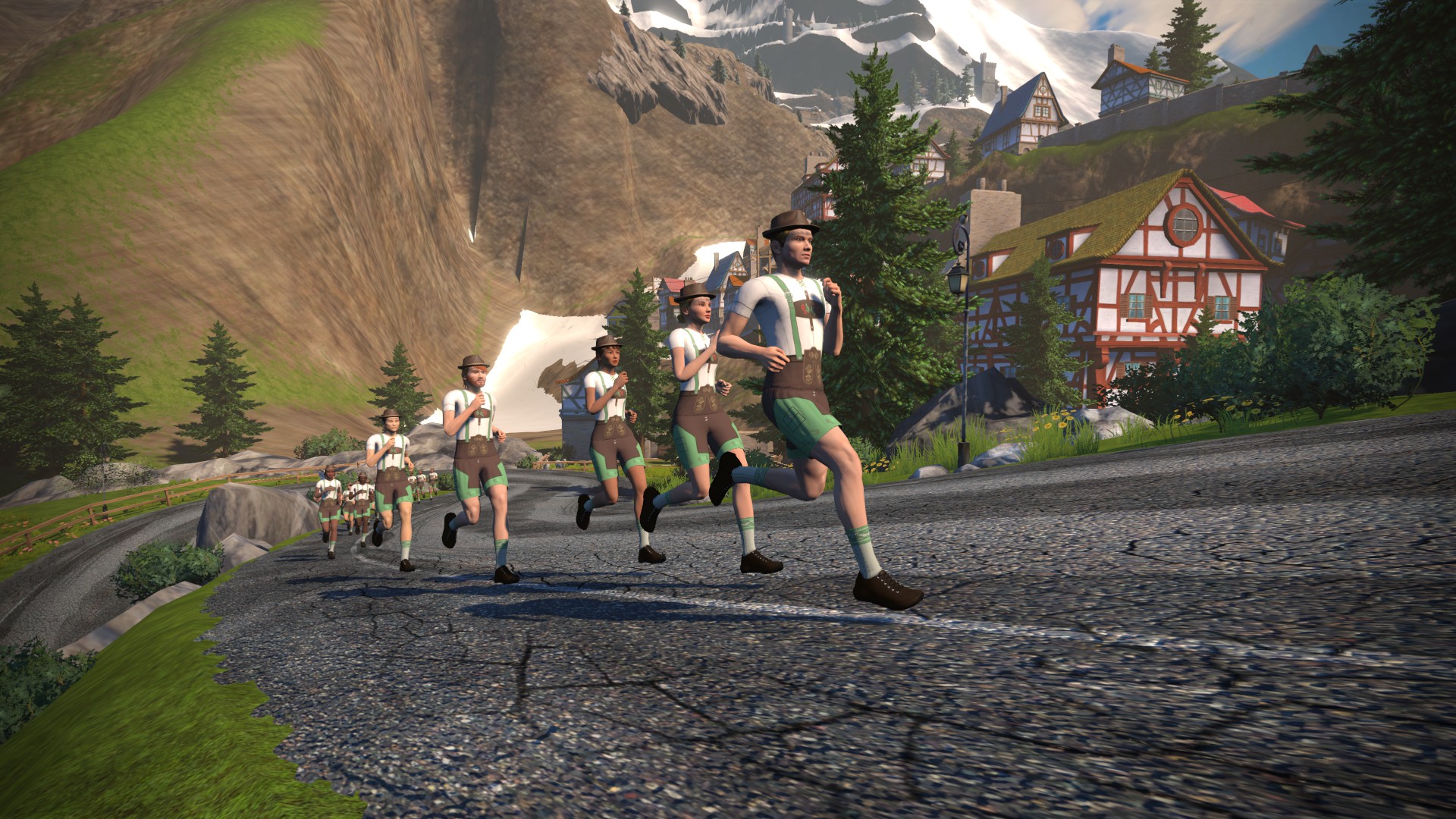
Grab your lederhose, fill your stein with electrolytes, and stuff pretzels into your jersey pockets. Zwift inaugural PretzelFest is almost here!
The event series consists of three stages across three weeks from October 1-21. Rides and runs are scheduled, and best of all, completing any event unlocks the new in-game lederhose kit!
Route and Schedule Details
Each stage has a long and short ride option (category A and B respectively) plus separate run events with just one length option.
The real news here is the Lederhose kit! Completing any event in the series to unlock it. Specific stage completions will unlock additional kit items:
Complete Stage 1: Unlock the Alpine Socks + Kit
Complete Stage 2: Unlock the Alpine Shoes + Kit
Complete Stage 3: Unlock the Alpine Hat + Kit
Is it a race?
These events are officially not races. That said, anytime Zwift holds leaderless group events with open pacing, some people will treat the events as races while others treat them as social events.
You do you! Ride your ride, run your run. Just enjoy working toward your fitness goals!
Tiny Race Series – October 1 Route Details and Last Week’s Results
Last Saturday’s Tiny Races were all based on the “Fast Finishes” theme, and they were fun to watch (and race)! World Tour pro Lawson Craddock showed up for the zone 1 timeslot and seemed to enjoy ripping legs off with some hard attacks. (He finished 3rd overall in the As, but we assume he was just venting a bit after unfortunately missing the World Road Championships in Wollongong due to visa approval issues.)
Want to see what the Tiny Race experience is like? Watch the stream below (best cover art ever!) from Ben Pitt, who finished 4th in the same timeslot as Lawson, including taking the win in race 1:
A: none B: none C: Leanne Dalley (CrushPod) D: Kim Johnson (Herd)
This Week’s Routes: a Fresh Mix
We’ve got four fresh routes this week, never raced before in our Tiny Race Series. It’s a mix, too, with finishes on dragging climbs, flat sprints, and proper climbs.
Here are photos so you can see the precise location of the custom finish line for race 1:
Race 1: Hilly Route Reverse(5.6km, ends atop first bit of the Hilly KQOM Reverse)
This twisty route will take riders through the Esses, over the reverse sprint and the cobbles of the Italian Villas, then over the rollers that follow. Catch a quick breath if you can, because it ends just up the road a few hundred meters after the start of the Hilly KQOM Reverse!
This one’s for the punchy climbers. Begin on NYC’s paved roads then quickly transition to the glass roads and attack the NYC KQOM Reverse. First person to the top wins!
Powerup: Burrito
Race 3: Countryside Tour (5.261km, ends at Country Sprint banner)
The flattest race of the week, this one starts with a slight downhill, then it’s essentially pan-flat to the finish. Who will wait for a pack sprint, and who will attack early?
Powerup: Aero Boost
Race 4: Champs-Élysées (4.52km, ends at Lutece Sprint banner)
Our first-ever Tiny Race in Paris, we won’t even complete a full lap in this effort. Just the lead-in around Jardin des Tuileries, then it’s gonna be a hard drag up Montée des Champs Elysées to the sprint banner for the finish.
Zwift displays preliminary race results in game when you cross the line, but points are computed after all four races finish, with final results on ZwiftPower. (We have to press a ZwiftPower button to compute results manually, so if your rankings don’t show up right away, just be patient.)
Riders will earn points based on finish position in each of the 4 Tiny Races. The category winner of each week’s series is the rider with the most points across their timezone’s 4 races. Here are the links for each timezone’s results on ZwiftPower:
Immediately following each hour’s racing, we’ve scheduled 30-minute “Chat & Chill” events where riders from all categories can spin out their legs together and have some fun chatting about how it all went down. Find them at zwift.com/events/tag/tinyraces.
The transformed Premier League has turned into the Zwift Grand Prix. There are 6 rounds that run from September 23rd to January 20th, with Men and Women racing a week apart in an equal distance, equal payout, equal time coverage series.
As a quasi-contributor to Zwift Insider and a rider/director of a league team, I wanted to give an unfiltered behind-the-scenes look at the action. Look for a recap after each round of the Grand Prix.
Elite Zwift (or “esports”) racing is evolving. Starting as individual-based special events, to a team-based series, the next generation of racing is getting very creative with race formats. Races started as standard scratch races, then evolved to points-based races that still heavily favored finish points.
The ZRL format in the community league led the charge at making bike racing on Zwift unique by adding fastest timed segments and points along the way that overshadowed the finish. The last season of the Premier League took these evolutions and made the racing even more aggressive and exciting.
For 2022-23 Zwift has pushed this further to embrace the creative ways Zwift can present bike racing. The new Zwift Grand Prix has invited the best teams on Zwift and created new styles of racing that could only happen in esports. This comes with new equipment rules and a team of people paid to ensure the racing is as fair as possible. Also, it isn’t just for bragging rights: teams are fighting for almost $30,000 in total prize money. The six-round series starts in September and runs until January.
Men’s Round One Coverage
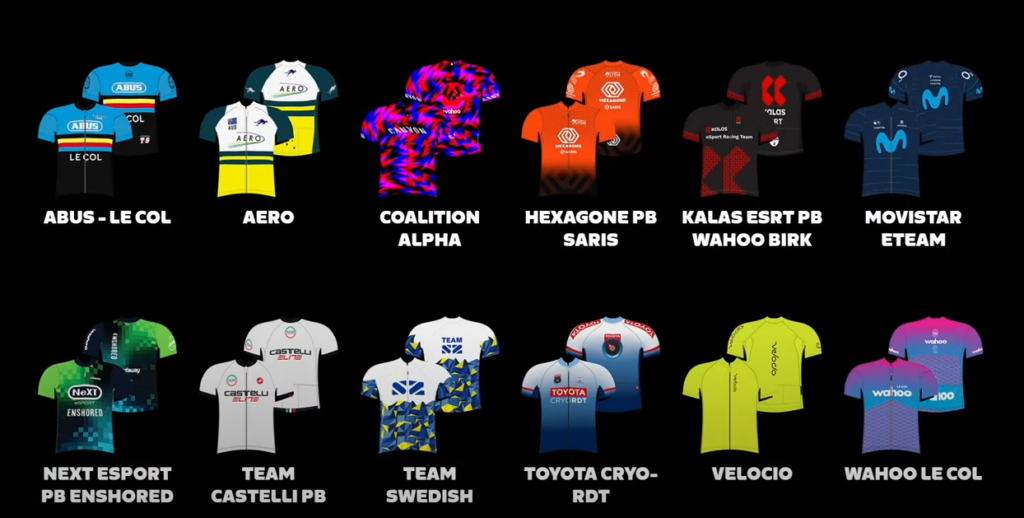
The Men’s Teams
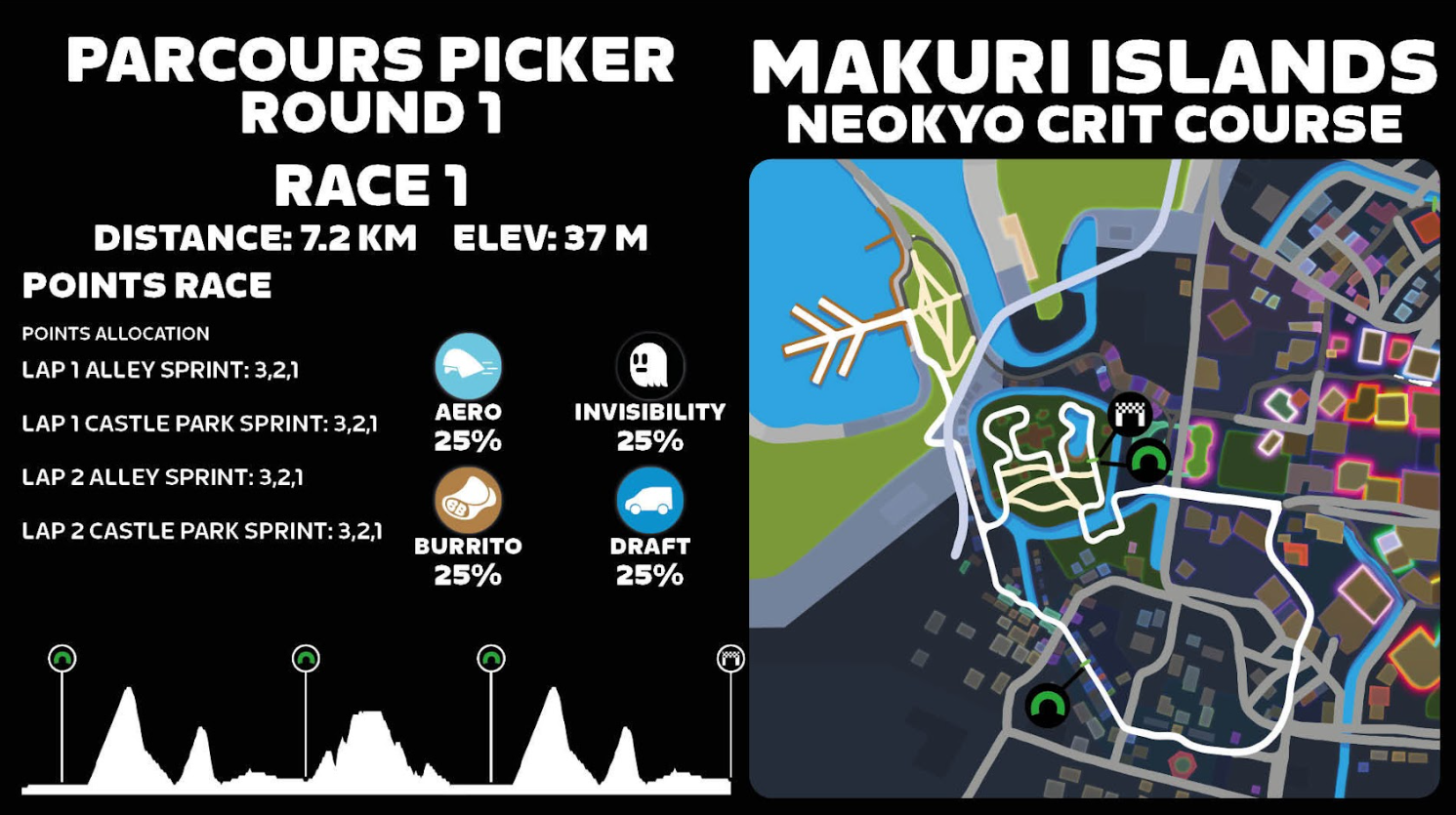
Round one is called Parcours Picker. This version of racing is a 5-race series. Each of the 12 teams gets 5 riders and they must split up to put one person in each race. This creates a small 12-person race experience. The 5 races are also quite different. Race 1 is a points race on the Neokyo Crit Course. Race 2 is a 4km gravel hill climb. Race 3 is a hilly points race. Race 4 is a time trial. Race 5 is a very condensed points race on Downtown Dolphin. Teams need to score as many points as they can in each race and the totals determine the final team placings.
You can watch the race here with the always great Nathan and David:
Race 1
The first race had the least points on offer but it also had some of the hardest points to get. The top three at each sprint point got points and just four spots to earn them. This was also the first time we have seen 12-person racing at this level.
The new format, on a rarely used course, saw Ben Hill (AERO) hit off first, sprinting for the lap banner. The only problem was, there were no points available there. The real sprint followed and Ben almost got dropped. Seggebruch (Canyon) opened the season with top points in a devastating sprint. What looked like what was going to be a slow race with timing-heavy sprints quickly turned into a tactical race as the pack slowed and attacks flew.
Polley (Toyota Cryo RDT) hit out hard and got over 7 seconds on the group. In the pack no one wanted to work. Without teammates it was a game of chicken for the riders in the pack, hoping someone’s patience would break and start to pull. Once the field opened their sprint the gap closed but Polley held on for top points.
What immediately followed changed the rest of the race.
The last kilometer view of the remaining pack eyeing the break.
Bruhn (NeXT pb ENSH) countered and Mading (Wahoo Le Col) bridged up. They wasted no time working together and behind, the pack was again looking at each other. Bruhn and Mading got a great gap and easily took the third set of sprint points. Eventually the pack had to start sprinting for the final point available which helped close the gap but it didn’t close it all the way.
With a kilometer to go guys started jumping and sprinting. People sat up, people countered. Riders got across only to have the aggressive break riders go again. The race finished strung out and was a great preview of what the Zwift Grand Prix can be. Chaos and unpredictable. Fortune Favors the Brave.
Zpower Results
Points Scored
Race 2
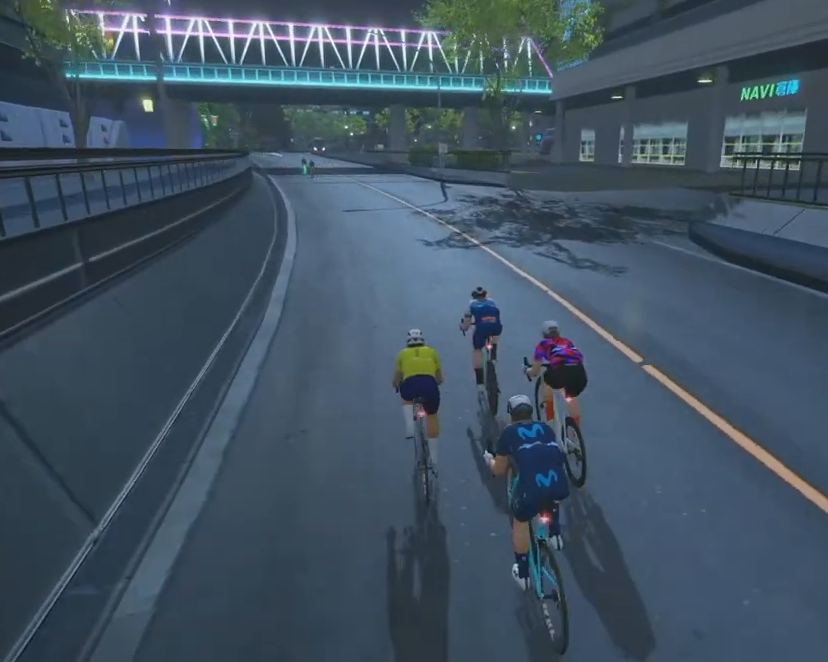
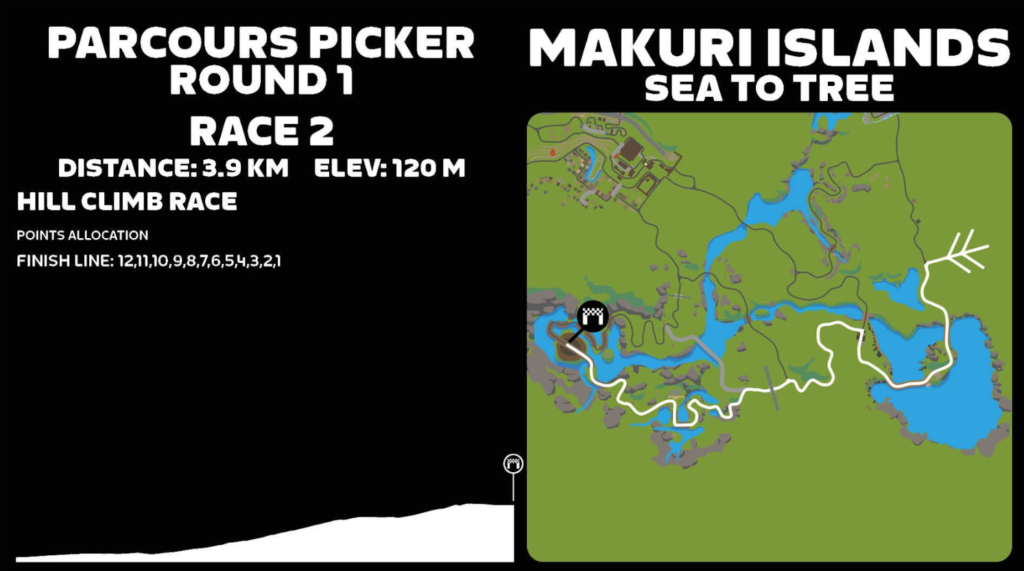
Race two was a gravel hill climb in Makuri Islands. Probably one of the most notorious climbs on Zwift, the ZRL has made many trips here. Often bike choice is a big consideration as a gravel bike rides much faster up it. Zwift even has gravel climbing wheels available that are even faster!
For this race, however, all equipment was neutralized. Just in case, I used the Crux with the gravel climbing wheels, which is what I ride IRL. (Bike choice did in fact make no difference however.)
1km to go
If there was ever a Vo2 max test for a race it was Sea to Tree. The race was 4km in total length and the first kilometer was flat. We all waited until the actual climb because, I for one, misjudged how long the lead-in was, but I was also absolutely terrified of how hard the race would be. I wasn’t wrong, and the hillclimb turned into a group version of a ramp test.
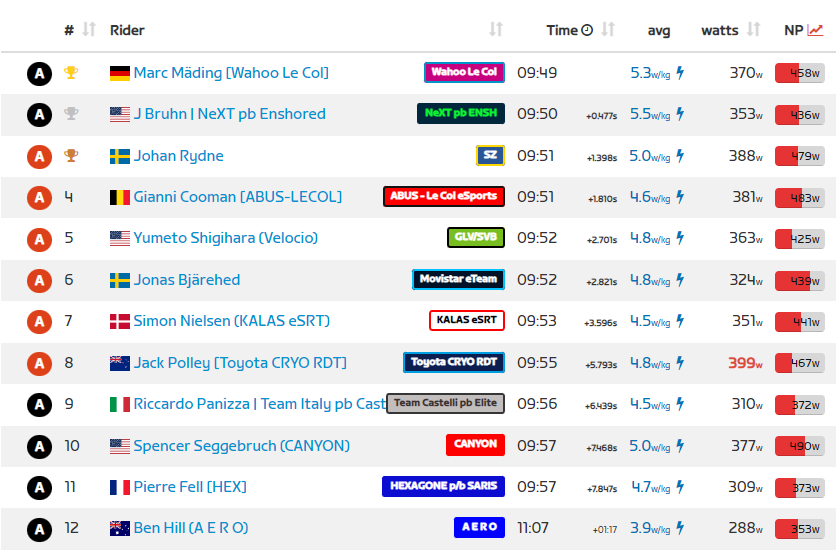
Teugels (ABUS), the favorite, put the pressure on and hit the wind and pulled away with raw force. Brannlund (Movistar) was able to get across and with a kilometer to go they traded blows while the pack chased 3 seconds back. On the wooden bridge to the finish arch, Teugels had one more devastating kick and pulled away. Behind we all sprinted with whatever was left. 10 guys within 7 seconds after a 4 minute all-out effort. Ouch.
Good for 5th
Zpower Results
Race 3
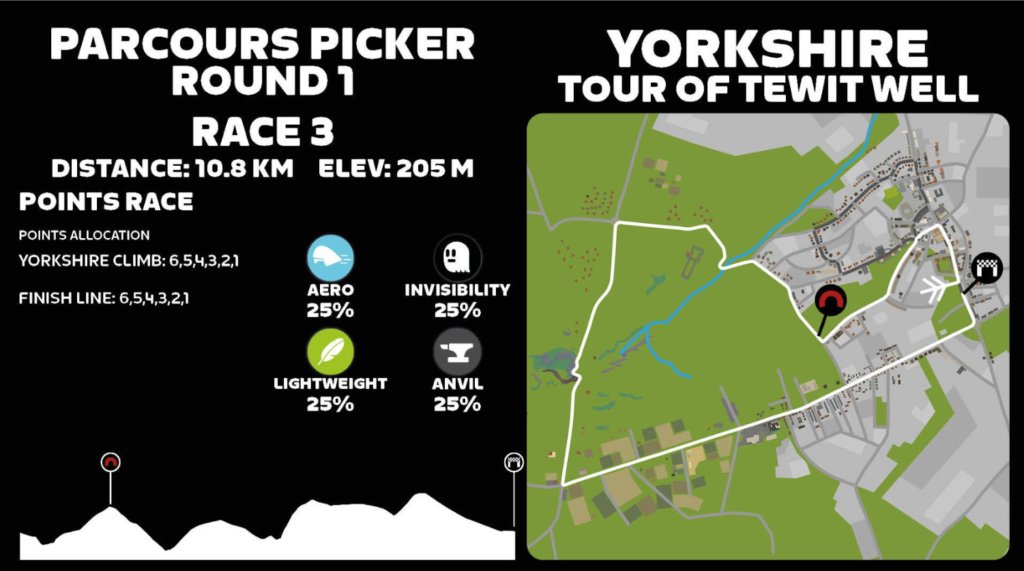
Tour of Tewit Well is a deceptively hard course. The first sprint points are at the top of a tactical uphill section and the roads after are undulating. One particularly tough kicker on course is probably one of the steepest sections of road on all of Zwift. Points for this race were on the finish and the Yorkshire climb. Six deep for each. Power-ups included the newly-buffed Anvil.
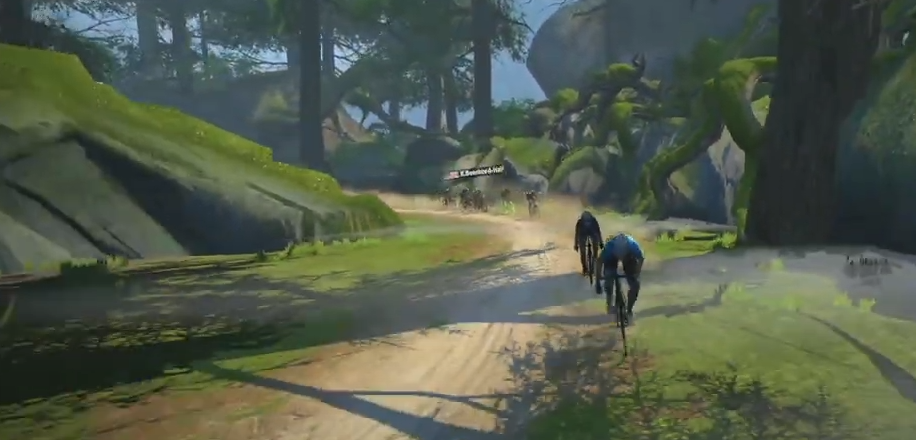
The race started with Eddy Hoole (Toyota Cryo RDT) jumping to the front, spinning an uncharacteristically steady cadence. He pushed the pace while the pack saved for the effort up the Yorkshire climb. The pace got higher and higher and Pim van Diemen (Movistar) jumped first, exploding off the front. Duffy Jr (NeXT ENSH) caught his wheel and showed perfect execution to come by Pim’s incredibly powerful jump.
What happened next was the fear of all Zwifters: falling off the draft and getting blown out the back on a descent. Three riders missed the pack over the top and were left trying to chase as singles down the hill. My teammate Charles (Velocio) and Eddy, still feeling his starting effort, were left stranded. It is rumored they are still on course.
Sam Hill (AERO) also missed the sprint and found himself off the back, but unlike Eddy and Charles he had the Anvil. If you raced last week in the ZRL you know how powerful it is now. He dropped the hammer, er anvil, or hammer on the anvil, forging weight and watts to close the gap. Unfortunately, there is no rest on this course and the next big climb saw the field going all orange up the exceptionally steep roller.
Anvils doing WORK
The pack flew up the climb but eased over the top as everyone was praying for a break in the pace. Luca Zanasca (Castelli pb Elite) felt the weakness perfectly and attacked, finding the hardest part of the race and making everyone really question their life choices as he surged away.
His gap swelled as everyone chose to rest over chasing. With one roller to go, the pack slowed while Luca pressed on. Jo Pirotte (ABUS) attacked on the last roller, and despite the obvious point of attack, his speed split the field. From there it was all downhill to the finish. He expertly used an anvil of his own to press his gap. Behind, Duffy and Havot (Hexagone) also had anvils and used them to drop the pack and chase Jo. Duffy did most of the work to pull Pirotte back and Havot was patient and able to spring off them to come in second behind Zanasca, whose 30 second gap turned into less than 5 sec because of the power of the Anvils.
Zpower Results
Points Scored
Race 4
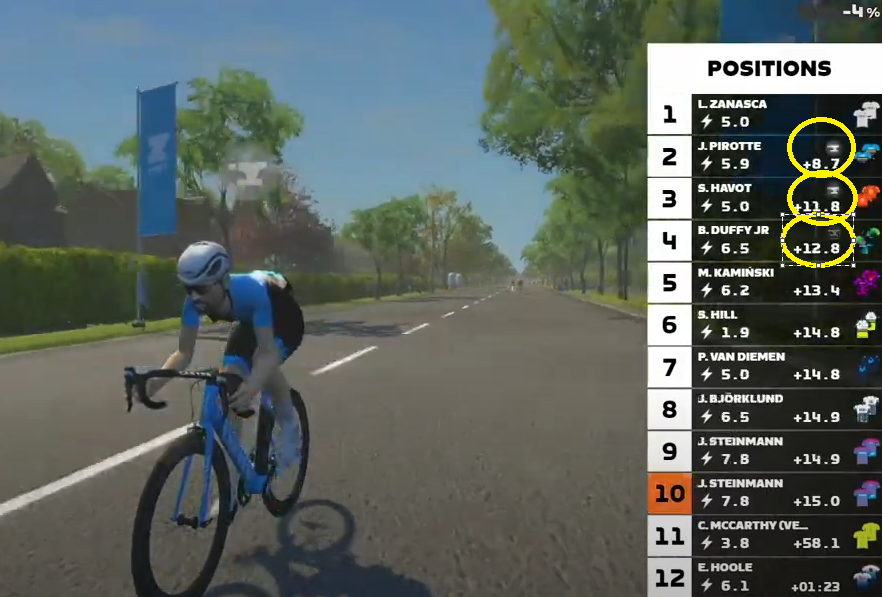
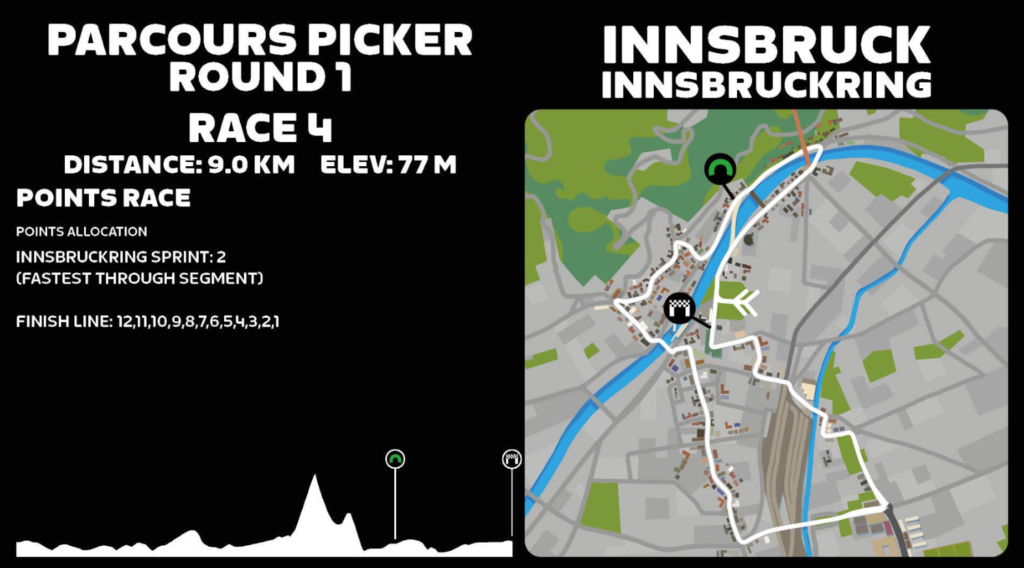
Race 4 was a standard TT. What makes this better to watch on Zwift than outside, is everyone starts together but drafting is off. So you get to see the gaps in real time. Unfortunately, it’s still not the most exciting thing to watch.
There was one interesting bit that added a fastest-timed segment on the sprint point in the second half of the race. What AERO did was give up on higher finish points and have their rider Squillari (AERO) ride steady then nuke the sprint. Scored them 3 points without needing a rider with World Tour power, because that is what it took to win this event.
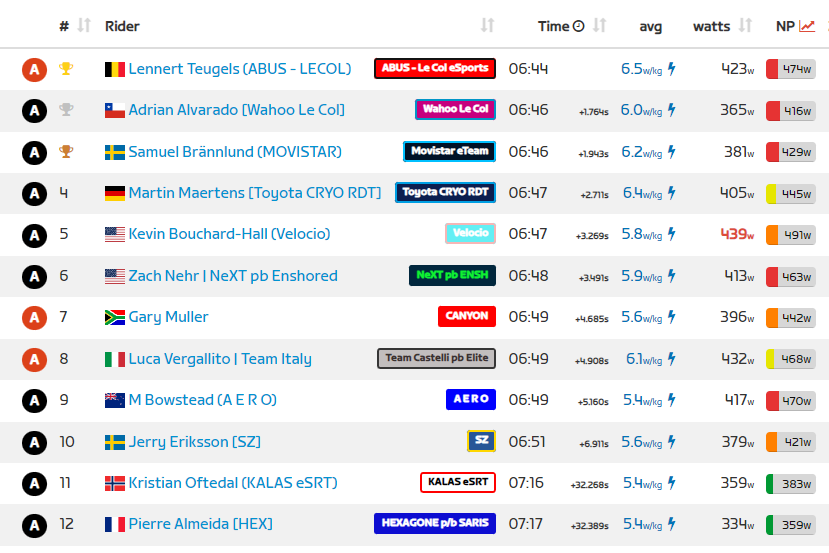
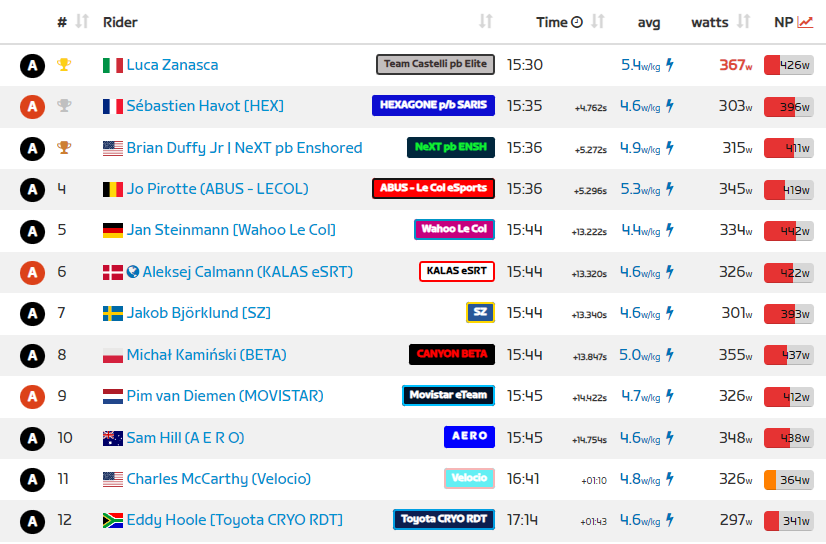
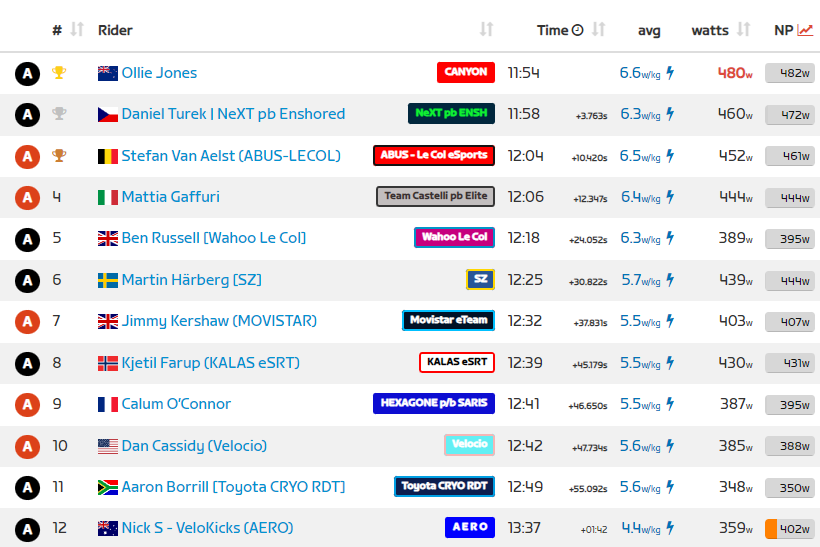
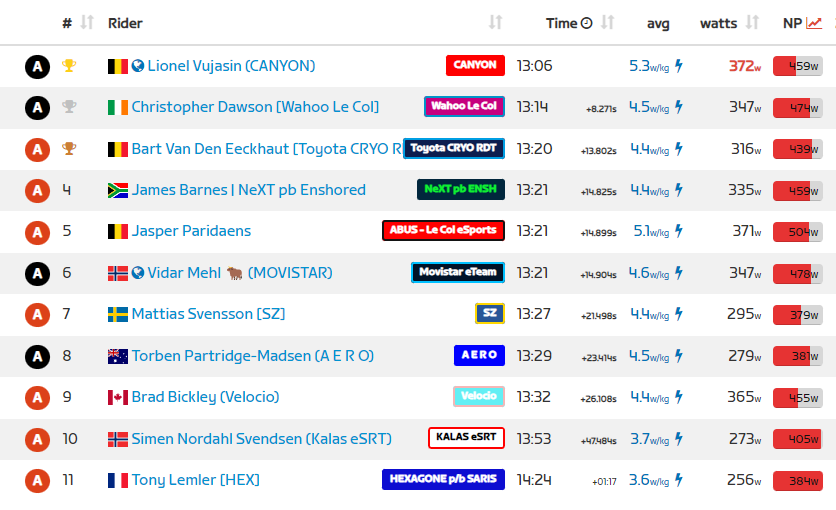
Ollie Jones (Canyon) put in an incredible ride at 6.6 W/kg for 12 minutes to win the TT. Take a look at this result board. When 5.6 W/kg scores you 11th, the level is high.
Zpower Results
Race 5
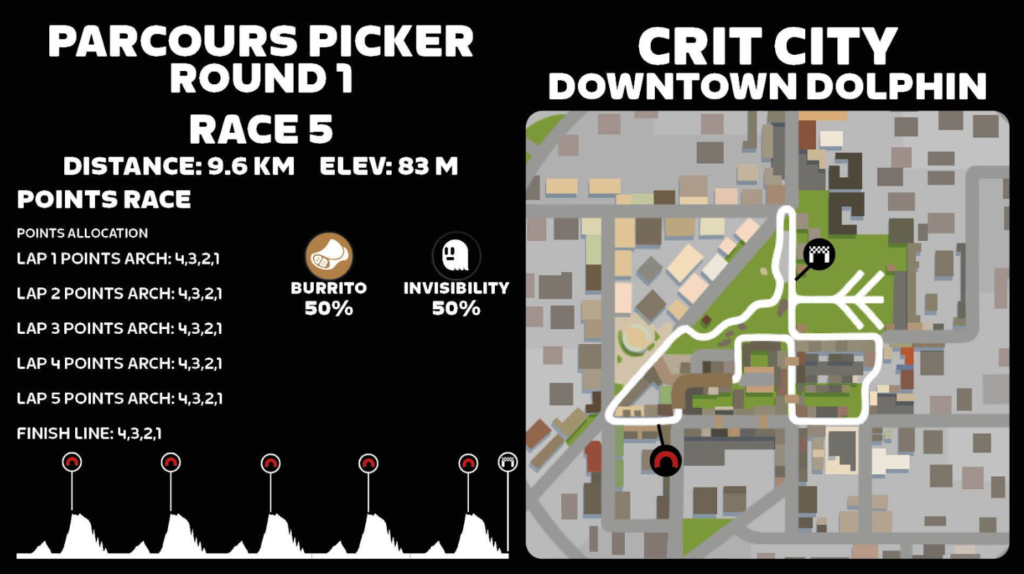
The final race of the Parcour Pickers was a 5 lap race at Crit City with points four riders deep at the sprint banner each lap and then one more set of points at the finish. This race had double the points of the previous races.
The race started slow and tactically like the first race of the series. Sprint one and two were a game of watts and execution. On the third lap things got more spicy and Dawson (Wahoo Le Col) jumped early with a burrito and used a good slingshot and an undraftable avatar to take top points. It is hard to use the burrito in a positive way and he really showed us how it’s done.
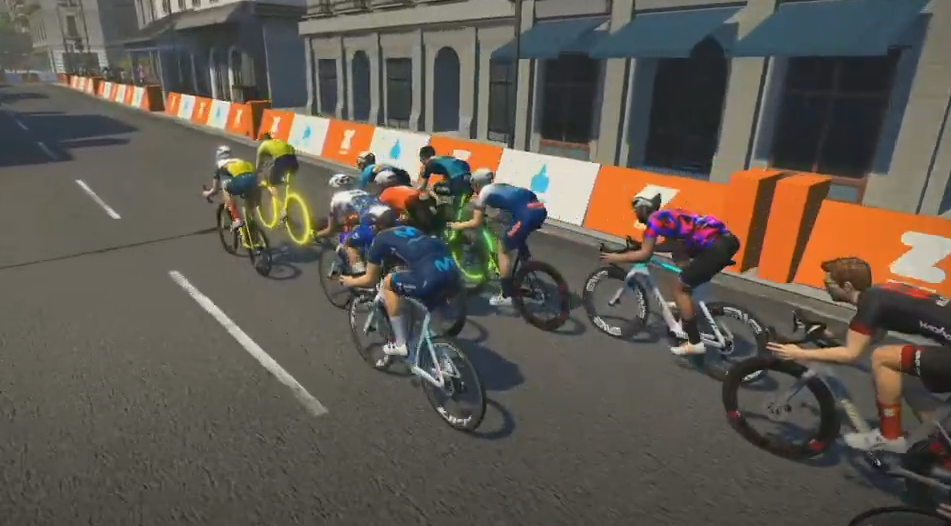
Vujasin in the pack before his winning move
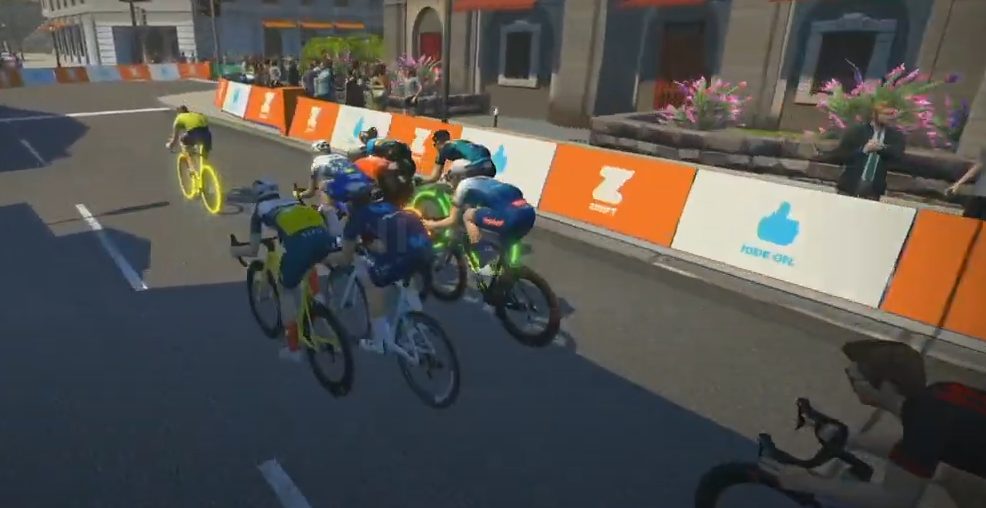
The next lap was the beginning of a master class. Several turns before the sprint point Vujasin (Canyon) executed a perfectly timed Ghost to shoot out of the pack and catch everyone off guard. Lionel held on for top points but didn’t stop. He stayed on it and pushed his gap out. Behind the pack couldn’t stay organized and Vujasin had the power to be uncatchable. A brave move executed with absolute perfection. Taking top points for lap 4 and 5 and as well as the finish.
Vujasin Ghosted and set up his massive win.Zpower Results
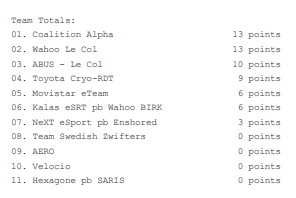
Points Scored
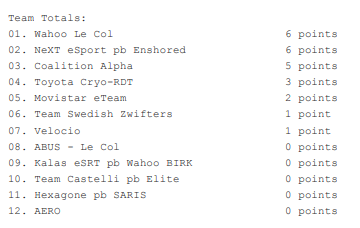
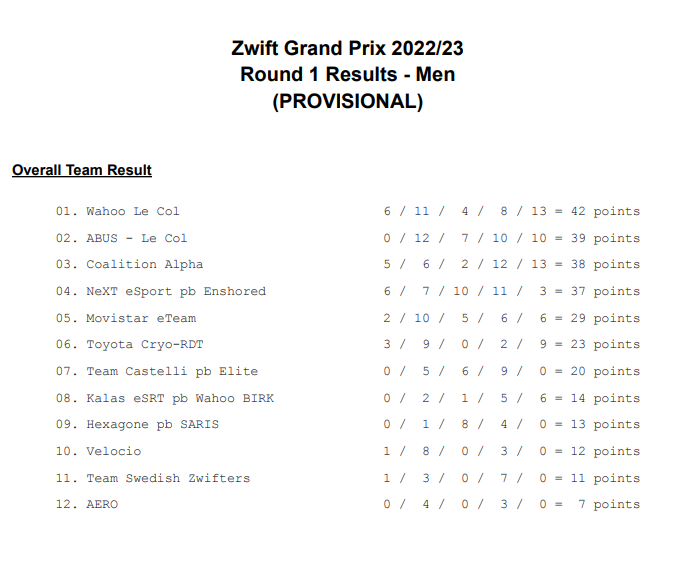
Final Results
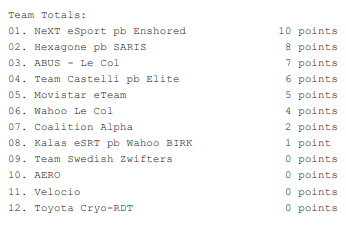
Four teams have clearly separated themselves from the pack, showing how much depth they have. The bottom 5 teams, including my own Velocio team, will have to get creative to score points and stay out of the bottom.
Total points scored and team placings
What’s next?
The Women’s race is on September 30th at 2pm EDT. Watch it below:
“Race Like a Champ” ZRacing October 2022 Series Details
September’s Get Rolling ZRacing Series has proved very popular, and Zwift just published the details of October’s ZRacing Series, named “Race Like a Champ”. Let’s dive in!
Series Structure
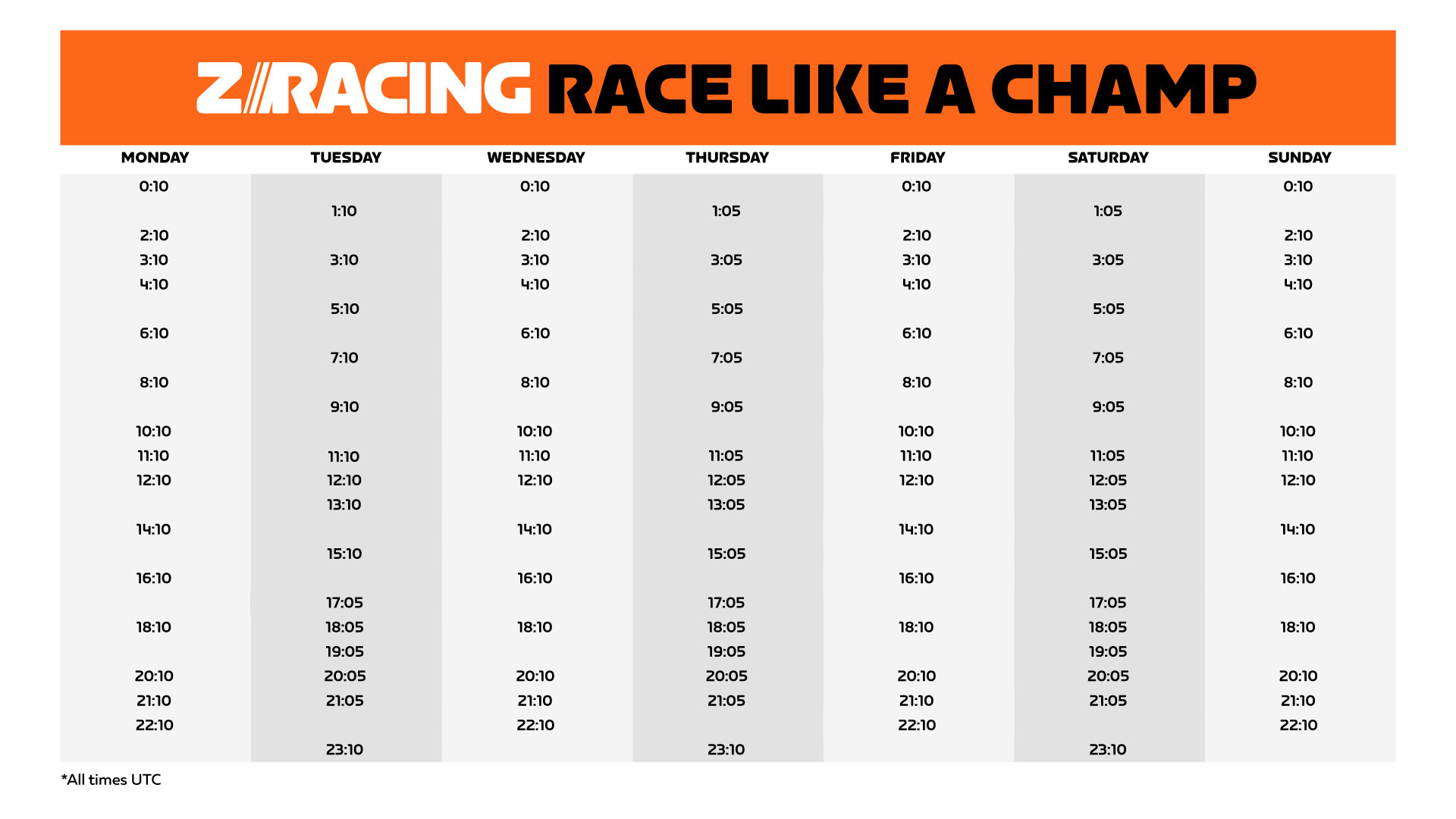
The ZRacing series consists of monthly sets of weekly races. Each race is on the schedule for seven days (beginning 12:10am UTC on Monday and running through to the next Sunday). Timeslots are consistent week to week and month to month.
Races are scheduled ~15 times each day, so there are plenty of available times to find a race:
October’s routes match the “Race Like a Champ” theme, as each course is based on an IRL UCI World Championship route, or has been used in a UCI Cycling Esports World Championship competition.
Stage 4 (Oct 24-30):stage 4 is actually two back-to-back races, and you must complete both to compete in the monthly GC and earn your badge for October! The second race is scheduled 20 minutes after the first.
Select special events in October will allow participants to qualify for a spot in the UCI World Championship Continental Qualifiers. More info can be found here, but basically, you need to race specific special timeslots of stages 1, 2, and 3 in October and jump through a few more hoops in order to race in the big Continental Qualifiers event, assuming you haven’t already qualified in another way.
These events will only be available on Fridays (Oct 7, 14, and 21st) in four different timeslots: 00:00, 03:00, 10:00, and 18:00 UTC. It’s worth noting that your finishing place in these events doesn’t matter: you just have to finish them (and dual record with a HRM on ZwiftPower) as part of getting into the UCI Continental Qualifier.
Each monthly set of races has a time-based GC (general classification) which tracks riders’ best finishing times for each week’s race. The overall winners in each category for the month will be the riders with the lowest overall time for that month’s set of races.
With over 100 weekly timeslots available, riders can race each week’s event multiple times and try to better their finishing time.
Note: you must use a heart rate monitor and be on a smart trainer, smart bike, or power meter in order to show up in ZwiftPower results for this series.
Each series will have a theme, and you can unlock an achievement badge by finishing each week’s race for the month.
One and Done
Zwift has planned these events around the idea of a solid 1-hour workout. So each race should only take around 1 hour to complete, including your warmup and cooldown.
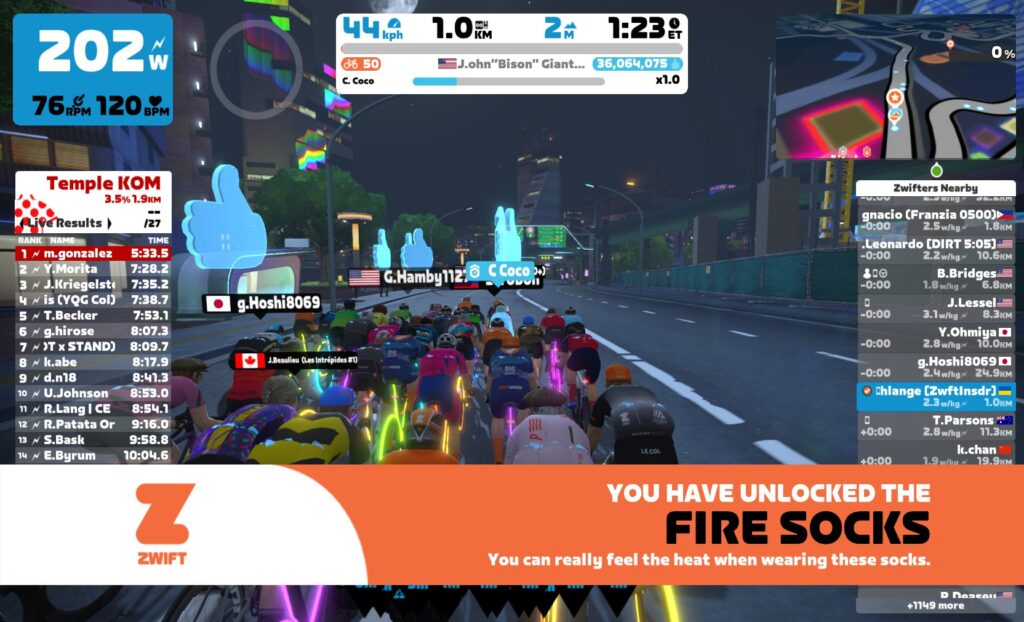
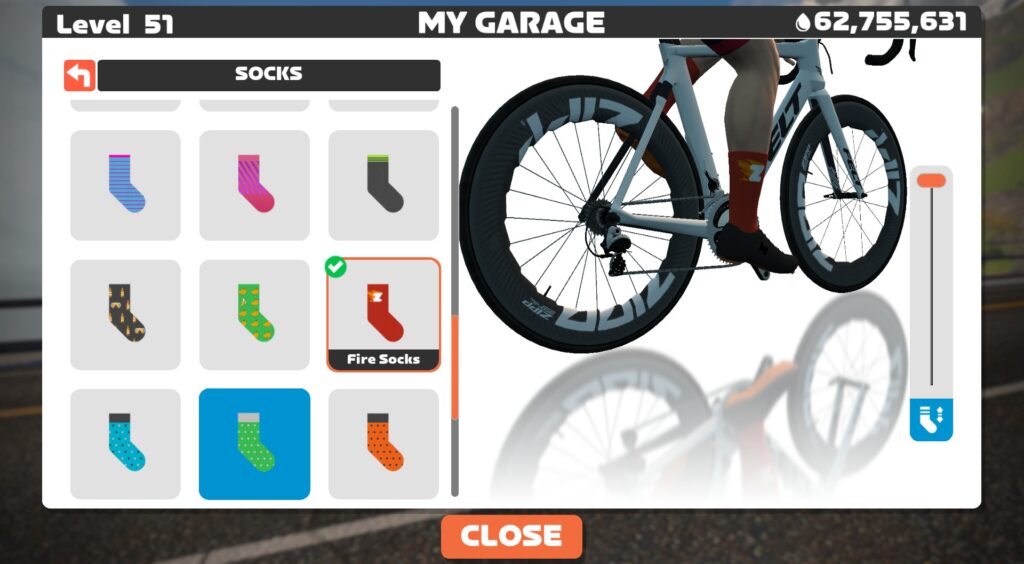
Level 50 Zwifters who signed in after last week’s big Zwift update were quickly treated to a banner informing them of a fresh unlock: Fire Socks! “You can really feel the heat when wearing these socks,” Zwift says.
These socks aren’t just for current level 50 riders, either. Along with the Level 50 kit, fire socks will be unlocked by any Zwifter who hits level 50 in the future. Read all about Zwift XP and unlocks >
Even though the socks are unlocked and added to your garage at level 50, you still have to select them so your avatar can show them off:
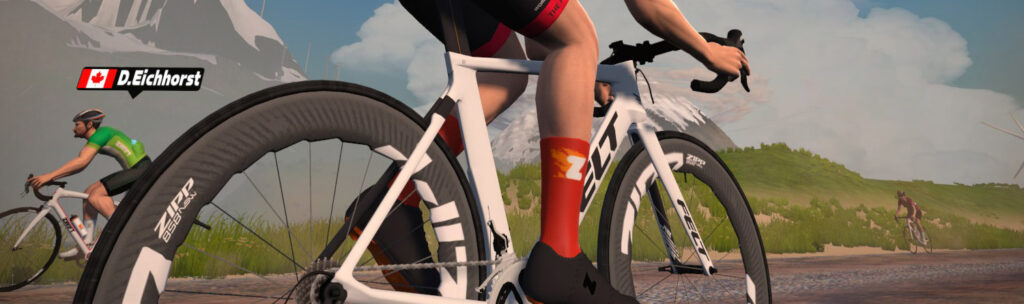
Here’s how they look in the wild:
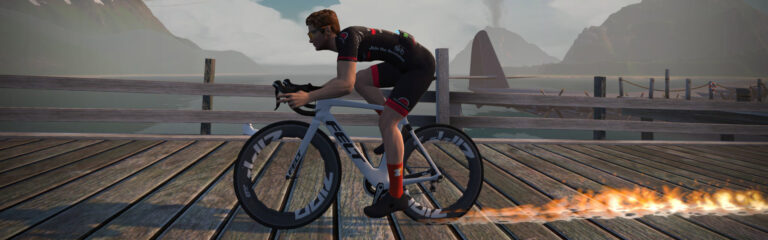
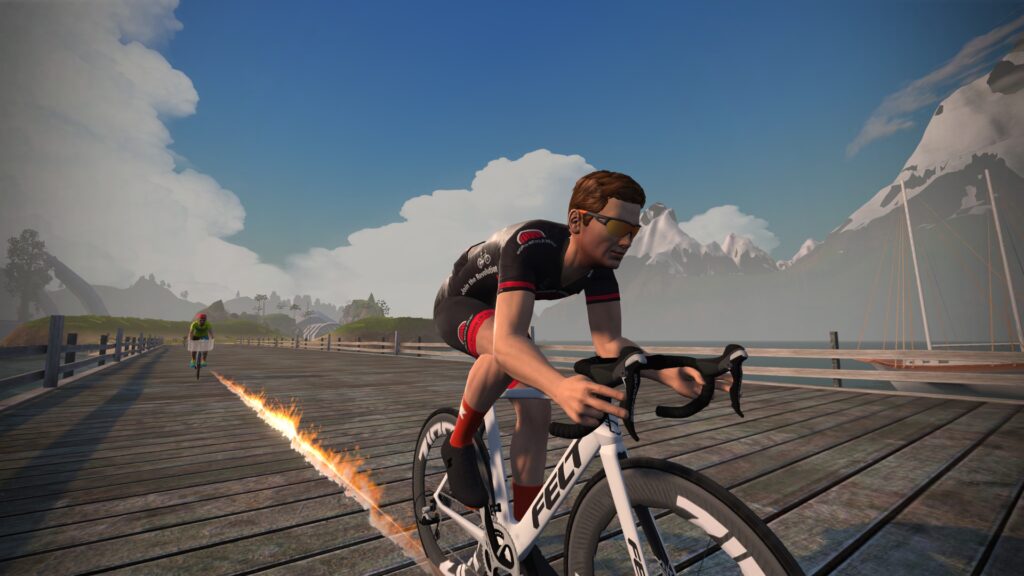
But what’s really wild about the fire socks is the flames they leave behind sprinting avatars!
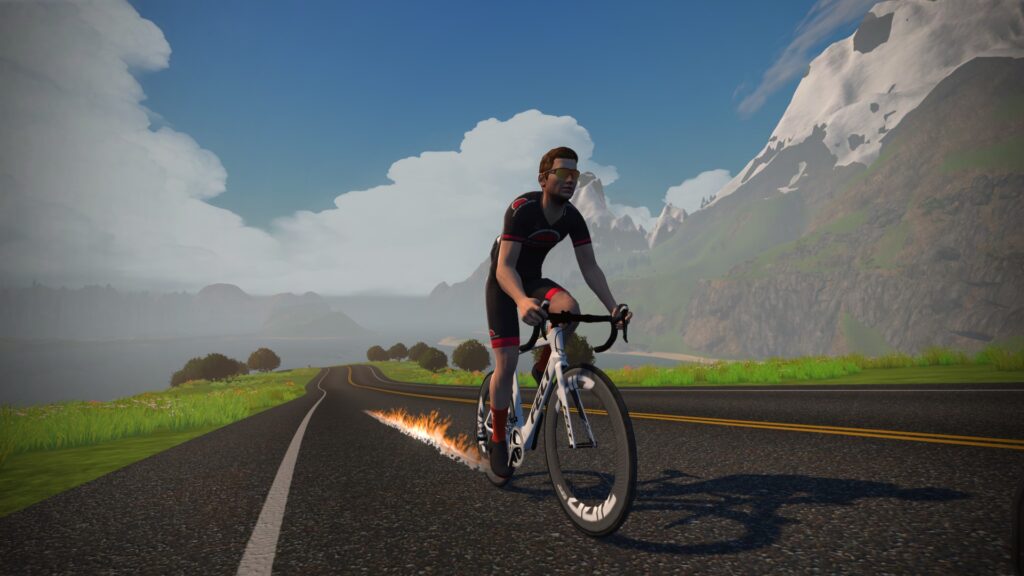
You can even burn rubber out of the saddle on climbs:
The flame effect has been in game since April Fools Day 2019, when we all got to lay down flames for a day.
In releasing levels 51-60, Zwift wanted to create an Easter Egg for riders who had been at level 50 for a while. So they made some fresh socks, slapped the flame effect on, and gave it sensible parameters.
How They Work
If you’re wearing the fire socks, your rider will lay down a flame trail for up to 12 seconds, as long as you are putting out at least 150% of your FTP watts.
After 12 seconds the flames will stop, but you can drop your power for a few seconds then power up again to lay another flame trail.
Racing with Fire
They’re especially fun in races, where your flame trail is much like shooting a flare into the sky and saying “I’m attacking now!”
Some Zwifters might be cagey and swap their fire socks for something a bit more understated before a race, but we think it shows true bravado to take your fire socks into the pens and really light things up.
Your Thoughts
What do you think of the fire socks? Have you got yours set? Share below!