The fourth race of Zwift Racing League 2024/25 Round 3 happens Tuesday, February 4, and we’re in Makuri Islands for a rather straightforward TTT course.
Let’s dig into crucial route sections, bike choice, and more.
Looking at the Route: Wandering Flats
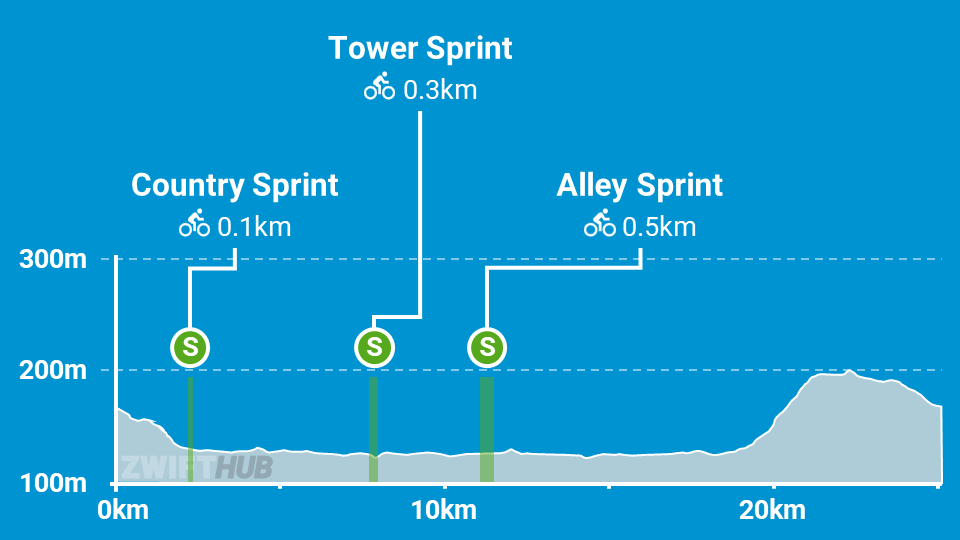
The Wandering Flats route in Makuri Islands begins in the Yumezi countryside at the start pens near Village Onsen, descending down to the Countryside Sprint then heading over for a flat lap around Neokyo before coming back through the tunnel into Yumezi, up into the Castle area and back to the start/finish banner:
All categories will be racing 1 lap for a total distance of 25.2km with 146m of climbing.
This is one of the easiest routes on Zwift for team time trials, as it is almost entirely flat. The road may look twisty, but it’s the pitch changes that really determine the technicality of a TTT.
Apart from figuring out your pacing in the flats, your team will need a plan heading into the one climb on this route, which happens around the 19.2km mark. This climb up into the Castle area is 2km long, averaging 3.2%. That means it’s very draftable and will take most teams 4-5 minutes to complete.
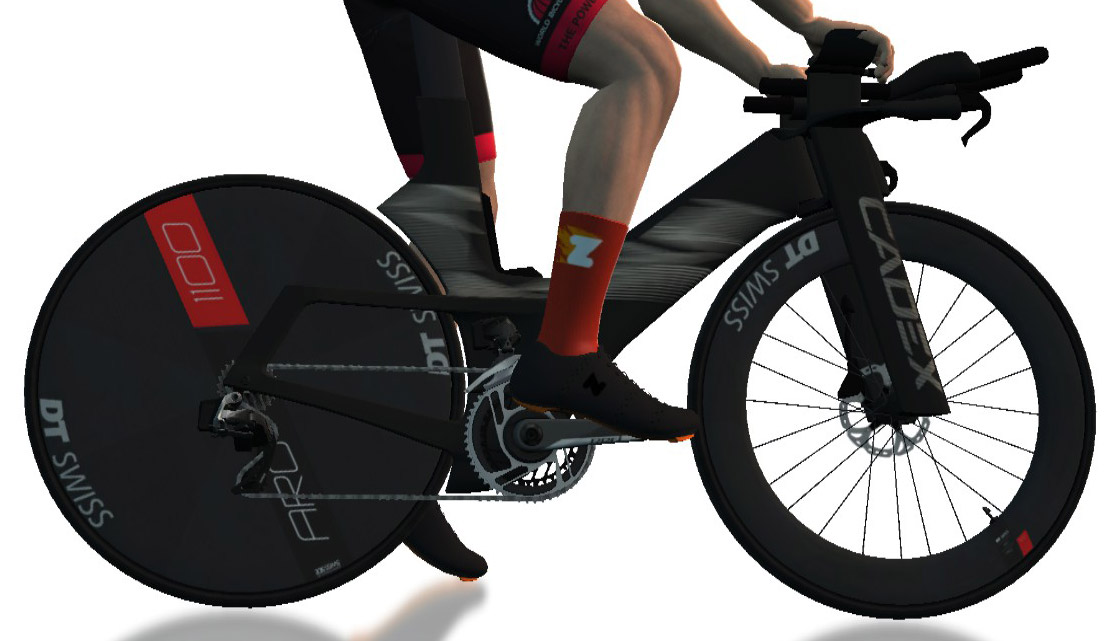
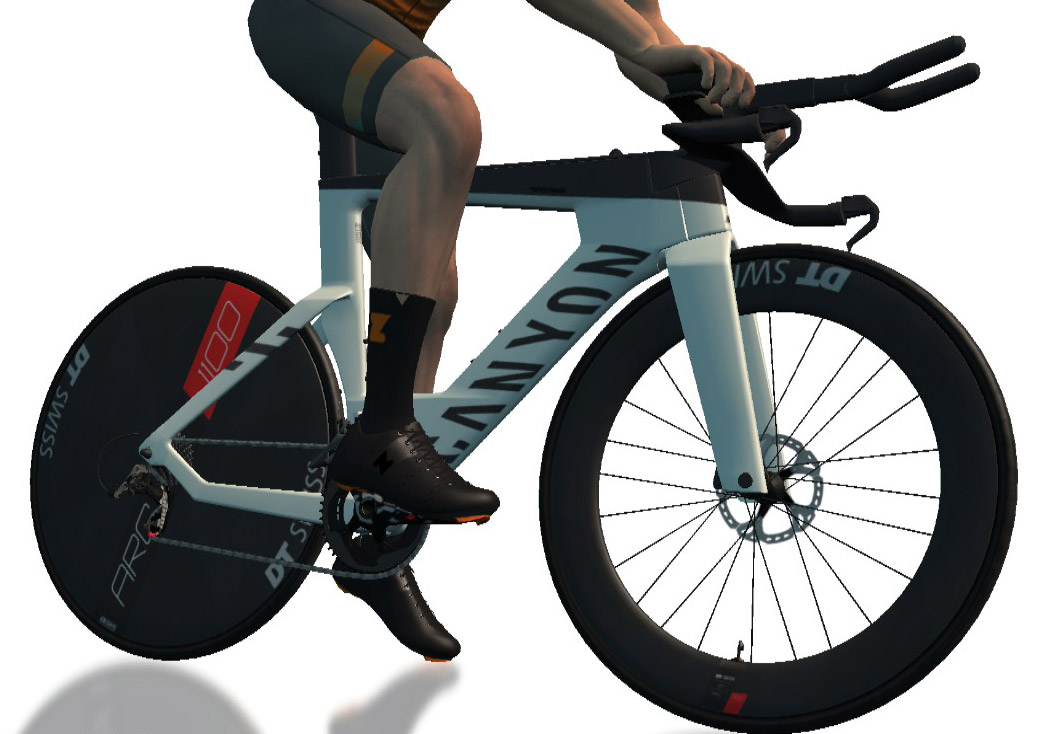
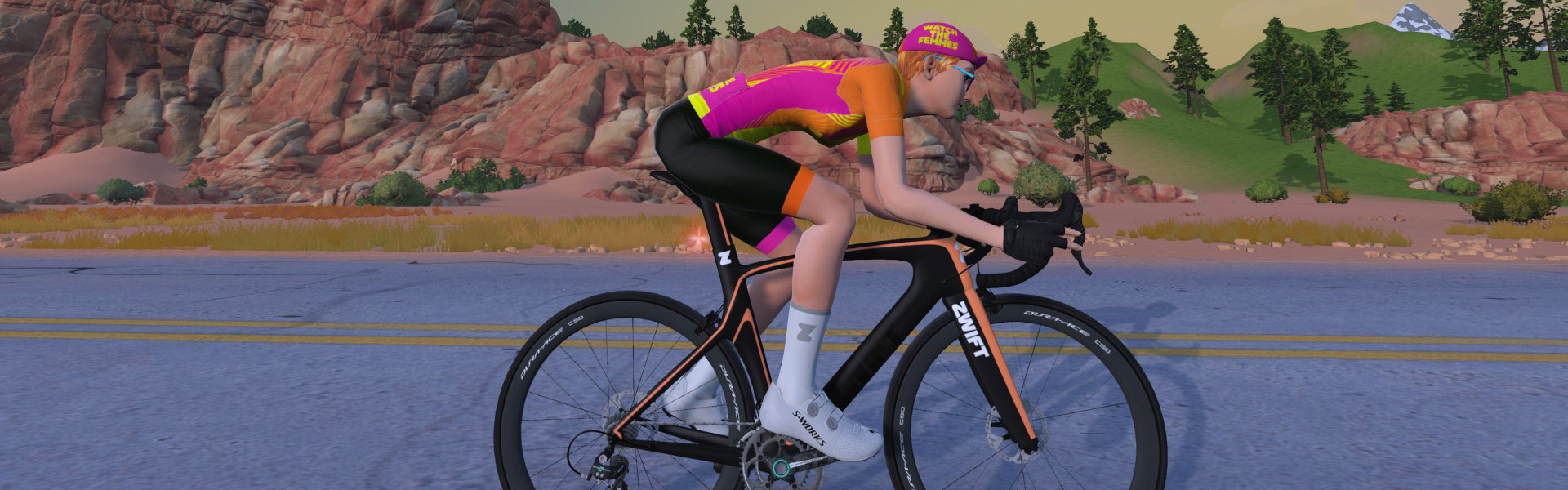
This week, bike choice is easy: grab your most aero TT setup! The CADEX Tri is the fastest frame in game, and the DT Swiss disc wheels are the fastest wheels. If you don’t have access to that setup (level 40+) then see this post to determine the fastest TT setup available at your level.
CADEX TriCanyon Speedmax Disc
Whatever you do, do not use a road frame. Even a “slow” TT frame is faster than a road frame, so now that we’re able to use TT frames and get a draft in TTT events, you’ll want to take advantage of that!
More Route Recons
Lots of recon events are scheduled on upcoming ZRL routes, led by various teams. See upcoming ZRL recons for this race at zwift.com/events/tag/zrlrecon.
Flatter courses like this week give valuable seconds to teams who can keep their speeds high over false flats and short rises. If you typically run your trainer difficulty setting pretty low, we advise you to raise your Trainer Difficulty high enough that you can feel false flats and automatically increase power to keep your speeds high.
Your goal in a ZRL TTT is to get four riders across the line in the shortest time possible. That means every team’s pace plan will differ based on the abilities of each rider. We highly recommend having an experienced DS on Discord directing your team, especially if your team contains some inexperienced TTT riders.
If you really want to go down the TTT rabbit hole, check out Paul Fitzpatrick’s zwift-ds.com site. We also highly recommend using Dave Edmond’s Zwift TTT Calculator tool.
Your Thoughts
Any insights or further thoughts on this race? Share below!
“Shimano Find Your Fast” ZRacing Series Details (February 2025)
Zwift’s “ZRacing” is the platform’s most popular ongoing race series, with over 60,000 riders participating in January 2025’s races!
In February the series takes on some punchier routes to help racers prepare for the Zwift Games in March. Zwift is partnering with Shimano for the “Find Your Fast” series which includes in-game unlocks and an IRL wheelset giveaway.
Read on for details about this month’s race routes, the prize giveaway, and much more!
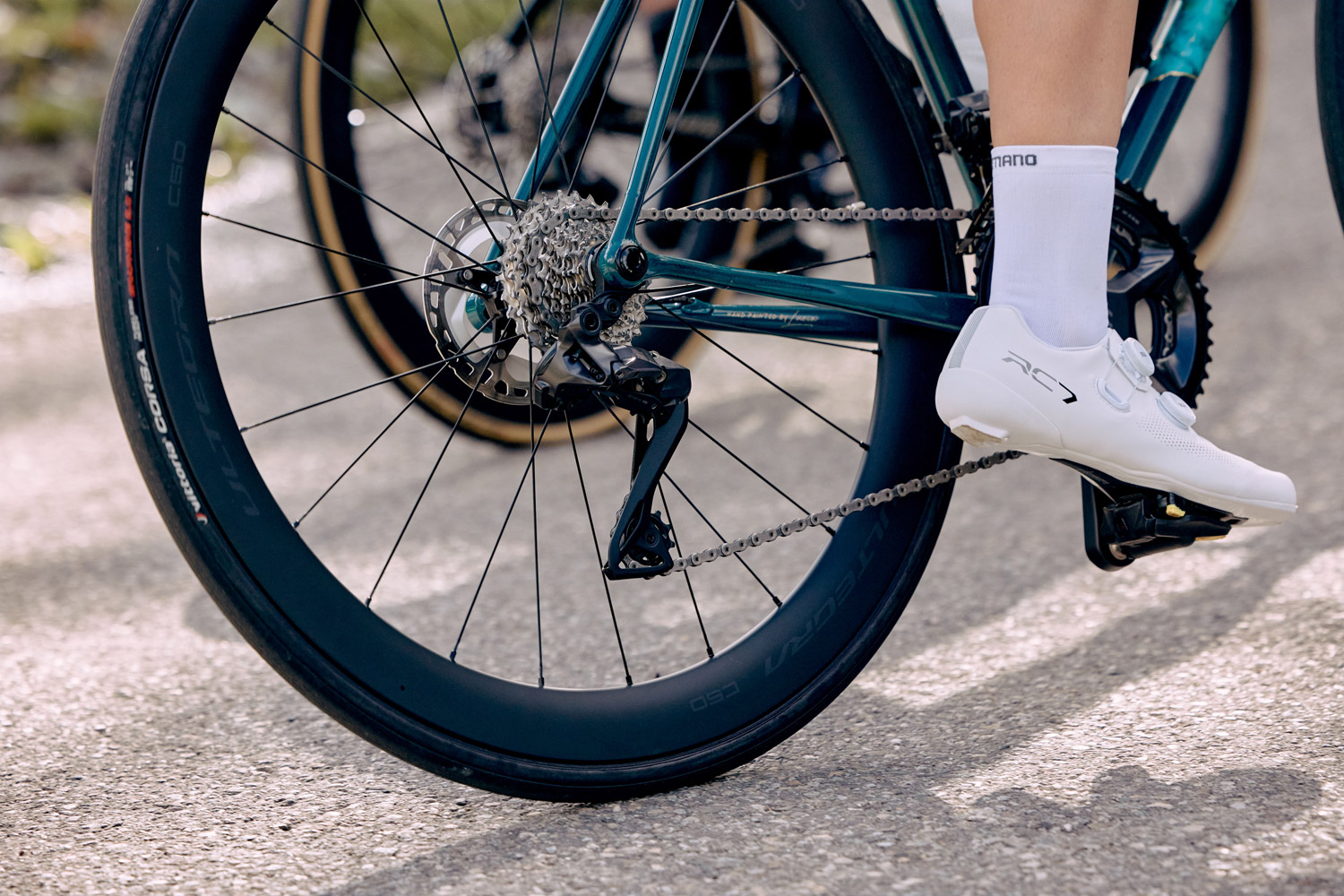
Complete all four Shimano Find Your Fast stages to unlock the upgraded Shimano Dura-Ace C50 wheelset in game. Read about this updated wheelset >
Additionally, everyone who finishes at least one Shimano Find Your Fast stage will have a chance to win one of three IRL Ultegra C50 wheelsets! Eligible riders will be emailed entry instructions once the series has concluded on March 3.
Category Reminder
In January 2025, Zwift implemented major changes to the category ranges used in ZRacing events. Tose changes will stay in effect for February. This includes “Advanced Category” races for riders with a Zwift Racing Score of 650+ and an alternating set of tighter category ranges (“Range 1” and “Range 2”) for riders with scores of 700 and below.
Advanced races occur at the following times:
08:15 UTC/3:15 ET/00:15 PT
10:15 UTC/05:15 ET/02:15 PT
12:15 UTC/07:15 ET/04:15 PT
17:15 UTC/12:15 ET/09:15 PT
18:15 UTC/13:15 ET/10:15 PT
19:15 UTC/14:15 ET/11:15 PT
00:15 UTC/19:15 ET/16:15 PT
Range 1 and 2 races alternate hourly around the clock.
Monthly GC
Each month’s series includes a time-based GC (general classification) on ZwiftPower tracking riders’ best finishing times for each week’s race. Just like a Tour de France-style stage race, the rider with the fastest combined time across the month’s stages wins!
To be included in the final ZwiftPower results, you must use a heart rate monitor as well as a smart trainer, smart bike, or power meter.
You can race each stage multiple times to improve your finishing time.
Get the Badge
Each month’s ZRacing series has a unique achievement badge, which you can unlock by finishing every stage for the month. There are no makeup events, so if you miss a stage, you miss out on the badge and competing in the GC.
One and Done
Zwift has planned these events to deliver a solid 1-hour workout, so each race should only take around 1 hour to complete, including your warmup and cooldown.
How the Race Was Lost: DIRT Hors Categorie on Outer Scotland (5 Laps)
It was Saturday, which meant I wanted to get a few hours of riding in, including some hard efforts. So my plan was to do a longer warmup with Robopacers, then jump into a longer race – the second race of the DIRT Hors Categorie series – before getting in a few more kilometers in a cooldown.
The race was on the newish Outer Scotland route (a former Rebel Route and one I had raced in a Tour de Zwift event just days prior. The TdZ race, though, was only two laps long (22.4km). Today was 5 laps (55.7km)! Additionally, the Hors Categorie series is a points race series, meaning you earn points for performance on designated segments during the race, as well as your position across the finish line.
So while this was the same route I’d raced previously, it would be a different race altogether. I would need to pace myself for a ~90-minute effort, but also go hard on the three Clyde Kicker primes in order to grab points. It was going to get spicy. Let’s race!
I joined the start pens with less than 4 minutes to go. There were just 11 riders in the pens, but that number grew to 20 by the time we blasted off. Let’s race!
Lap 1: Don’t Miss the Break
I was running Sauce for Zwift so I could get a good view of the number of riders in each group, plus time gaps. Sauce showed that our 20 starters were quickly whittled down to 15 within 2 minutes of the race kickoff.
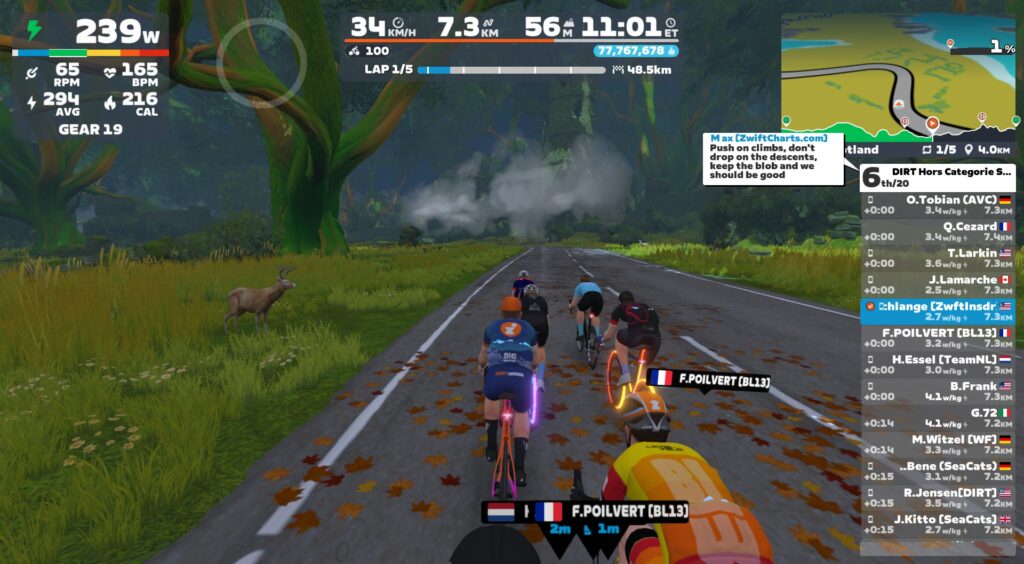
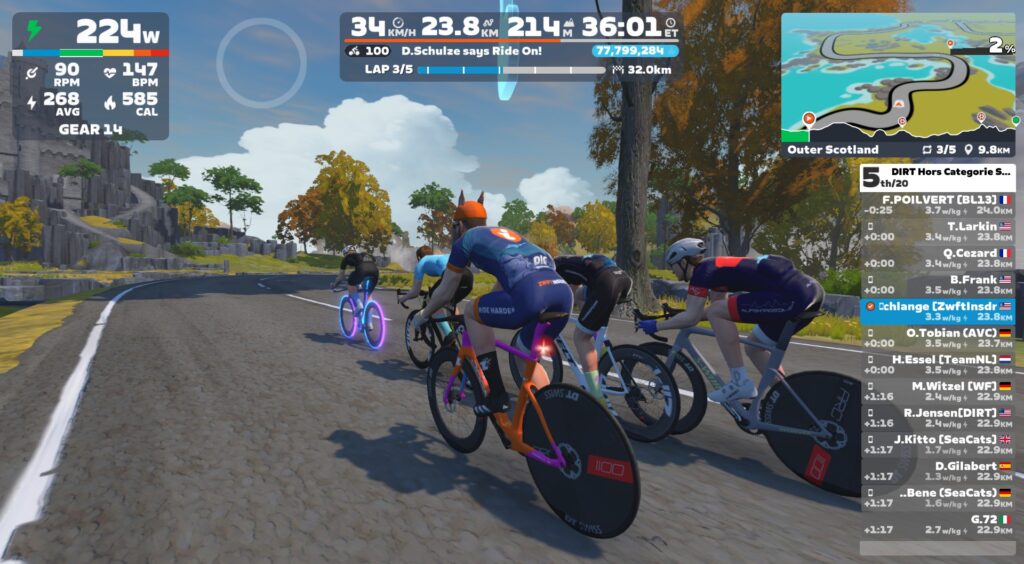
The strong riders began to show themselves early as we wound our way up the slack climb through The Cliffs section of Scotland. Essel, Cezard, and Poilvert were pushing hard and stretching out the pack, and as we neared the top of The Cliffs, just before the lap banner, Cezard put in another dig over the top. This pattern would repeat itself every lap.
Heading into the Corkscrew Castle climb, there were two groups of three off the front, 6 and 8 seconds ahead respectively. They had sort of snuck away without me noticing, and this meant there were only 8 in my group. Alarm bells began sounding…
Those 6 are probably the stronger riders in this race. My 8 may not be able to get them back!
As we started the Breakaway Brae Reverse climb, I made the fateful decision to bridge up to what had coalesced into a front group of 6. It took 542 watts for 30 seconds, but I caught them!
This would prove to be the right call, as the chasing group would never see the front group again. That was the move.
Poilvert attacked on the Clyde Kicker, even though there were no points given for this segment on this lap. We would eventually pull him back, but this was a foreshadowing of things to come.
Lap 2 + FAL
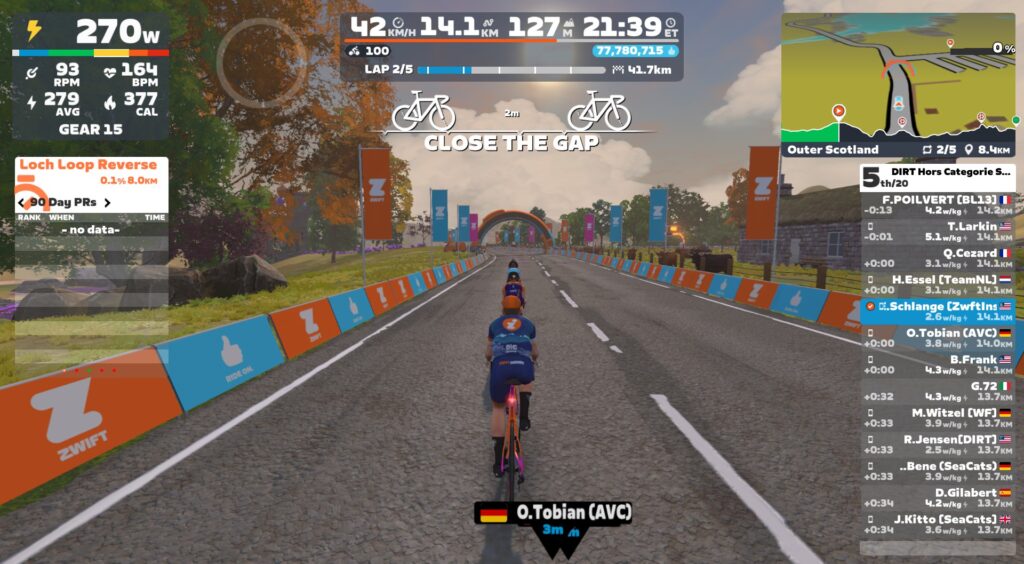
We began lap 2 with Poilvert 9 seconds ahead of the front group of 6: Larkin, Tobian, Cezard, Essel, Frank, and myself.
(One thing I like about longer races with smaller groups is that you begin to get to know each rider. You learn where they like to push the pace, and where they like to position themselves in the pack. You can even click around in Sauce to do a bit of spying to learn their zFTP and other metrics.)
The pace definitely felt like too much for me to sustain for another 60+ minutes, but I held out hope that the same was true for everyone else and that the pace would calm down as the race progressed.
Riders pushed hard up Breakaway Brae, and we caught Poilvert on the descent. Back to a front group of 7. But only for a moment: Poilvert attacked hard again, and got away.
Either he would blow up, or we were thoroughly outclassed. Time would tell.
This was a points race, and our first points segment was on this lap’s Clyde Kicker. It was an FAL segment, meaning points were given based on who crossed the finish line first. Poilvert got 1st place points, and I sprinted for 3rd, getting beat by Tobian’s strong effort. 12 points!
The pace dropped considerably in lap 3, and Poilvert quickly put more time into us, pushing the gap out to 30+ seconds. I’m not sure what everyone else was thinking, but my thought was, “He’s either so strong that he’d beat me even if I bridged up to him, or he’s going to blow up early, stranding me if I bridge up to him.”
(Also, I was about 60% sure Poilvert was the rider last week who rode off the front for most of the race, then quit early. Turns out that was a different rider. Do your research, kids!)
Lap 3 was an FTS competition on the Clyde Kicker, which meant a different approach than the previous lap’s FAL effort. I started in the back of the group this time, because when you do that, you can then sit in the other riders’ drafts for most of the segment, finish tied with them, and you’ll have a faster time!
I think I executed it fairly well, but Tobian beat my time. I came in 6th overall, though, because 4 riders from the chase group clocked faster times! (They must have sprinted together on less-tired legs.)
Lap 3 would prove to be my easiest lap, with an average power of 249W.
Lap 4 (another FAL)
At lap 4 began, I noticed Sauce showed our pack of 6 was now a pack of 7. That was odd, since the rider list on the right only showed 6 riders. But I did in fact see a 7th rider in our pack. Clicking around in Sauce, I figured out it was one “Nathan Hakken” who was riding in the higher B category. The Hors Categorie races are set up so you see riders from all categories, which can make for interesting dynamics when you catch riders from other groups.
Poilvert was still off the front by 40+ seconds, and this would stretch to over a minute by the time we finished lap 4. Barring disaster, the race was his.
The final points segment of the race was an FAL competition on Clyde Kicker. With no powerups or steering in the race, it came down to timing and pure power. I managed to outsprint my pack of 6 to take 2nd place in FAL, earning me 13 points. Woohoo!
Lap 5 + Finish
Everyone had kept their powder dry on the previous lap, and now the question was, what sort of attacks would we see from the strongest riders in our group? Poilvert was over a minute away, and it was a foregone conclusion that he would cross the finish line first.
The attacks began right at the start of the lap, with Cezard attacking up The Cliffs. I sat in the wheels, not wanting to give chase and blow my chances at a strong finish. While the pace was solid in our group, nobody else wanted to bury themselves to pull back Cezard, either. His gap went to 10 seconds, then 15. The race for third place would be between the 4 riders in my group: Tobian, Larkin, Frank, and myself.
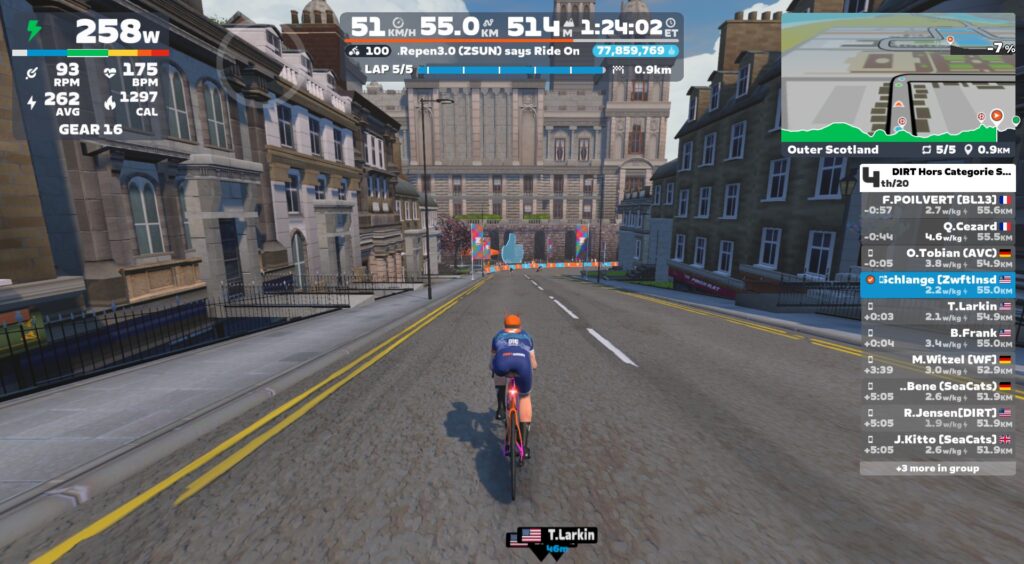
Tobian attacked hard up the Clyde Kicker, and I pushed to grab his wheel. But he just kept pushing over the top, and I couldn’t pull him back! In the final minute of the race I could see I wasn’t catching Tobian, and the riders behind weren’t catching me. I crossed the line in 4th.
My 137 points for race 2 put me in 5th place overall for DIRT’s Hors Categorie series, and in 2nd place behind Tobian for the C (450-575) group.
Poilvert, it turns out, won the race by less than 6 seconds as Cezard closed the gap in the final minutes. Poilvert held 4.1 w/kg for 84+ minutes, an effort that earned him a score of 594. This means he’ll have to race in a higher category if he decides to take on next week’s Hors Category event. Which is exactly what should happen. +1 for results-based race categories!
Overall, I was pleased with my performance in this race. I got 4th in points as well as across the finish line, I bridged up to the winning move, and I had near-top placings on the points segments. I also set some 6-week power PRs in the 40-84 minute range.
I’m really enjoying these longer races, and I plan to show up for more.
Your Thoughts
Have you tried racing longer events on Zwift? How did it go? Share your thoughts below…
If you’re new to cycling training, you’ve probably never taken an FTP test. Heck, you probably have no idea what an FTP test evenis! Let’s cover the basics of FTP, and options for testing it on Zwift.
What is FTP?
FTP is short for Functional Threshold Power. It’s the most commonly used metric of fitness for cyclists and measures the maximum power you can hold for longer durations (approximately 1 hour).
Going above your FTP will result in blood lactate levels increasing until you “blow up,” but if you’re fresh and well-fueled you should be able to ride at FTP for anywhere from 40-70 minutes.
Getting a bit more precise: while FTP is often described as the maximum power you can average for 60 minutes, that is not how it was actually defined by those who pioneered its use. Andrew Coggan defined it as, “The highest power that a rider can sustain in a quasi-steady state without fatiguing.” A sports testing lab would define it as the amount of power that can be put out at maximal lactate steady state (MLSS). MLSS is the highest exercise intensity you can hold where your blood lactate level remains constant over time.
Why Test Your FTP?
On Zwift, knowing your FTP is important because that figure determines the power requirements for intervals in structured workouts. If your FTP is set too low, you won’t get an adequate workout. If it’s set too high you won’t be able to hit your power targets.
Overall, FTP is the most popular metric for tracking fitness. Even if you don’t do structured workouts on Zwift, FTP is a single, simple metric that measures your capability as a rider.
How To Test Your FTP
Here’s the simple 4-step process used by most Zwifters:
Kit up, boot up
Pick a test from the workout options under Training>FTP Tests
Follow the instructions on screen, destroying yourself in the process
If your FTP increases, share it on Zwift Riders. If it does not, never mention this test to anyone. 🙂
Let’s take a closer look at the FTP test options Zwift provides.
3 FTP Tests on Zwift
FTP Test (Standard)
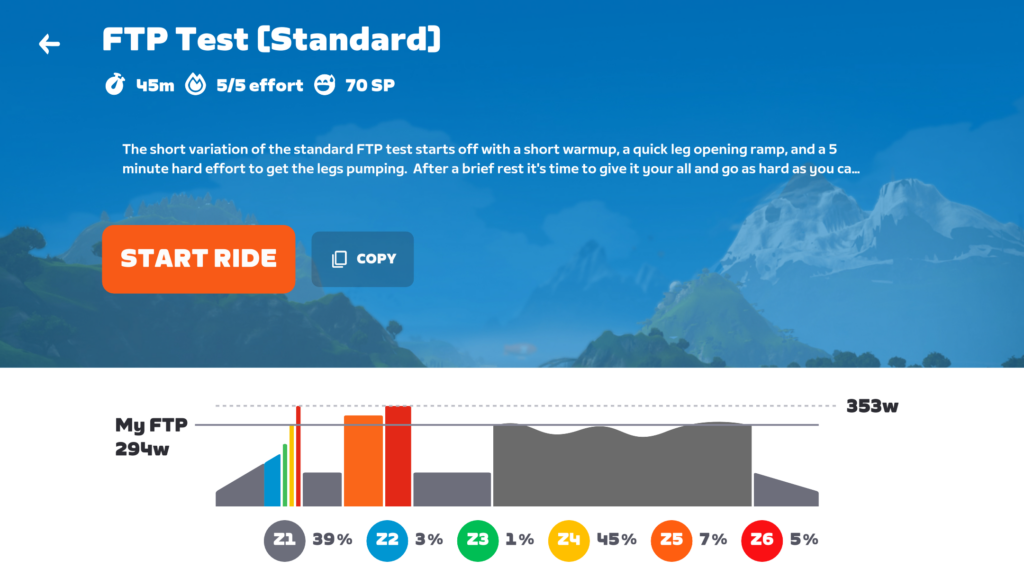
The standard FTP test is also the longest, at 45 minutes. It begins with a warmup that includes 2 blocks (3 minutes at 110% of FTP into 2 minutes at 120% of FTP) meant to take the snap out of your legs so your 20-minute test uses less anaerobic power and more aerobic power.
In this workout, the 20-minute test is all that matters. Your FTP result will be computed as 95% of the power you average during the 20-minute free ride interval.
One common question people have is how Erg mode works during the 20-minute test portion of this workout, because of course you wouldn’t want your trainer enforcing a particular wattage target during the test. And at the same time, you don’t want to feel gradient changes in Zwift, which would through off your pacing!
So it works like this: the 20-minute section is a “free ride” block, which in Zwift workouts means your trainer delivers steady resistance like you’re on flat ground, regardless of in-game terrain. So shift to whatever gear you’d like, where you can hold a comfortable cadence and hit the power numbers you’re trying to hit.
Once the 20-minute block finishes, the game will put you into a cooldown block, forcing you to hit the target wattage again like Erg mode normally does.
Watch Me Do An Older Version of the 20-Minute FTP Test:
Ramp Test
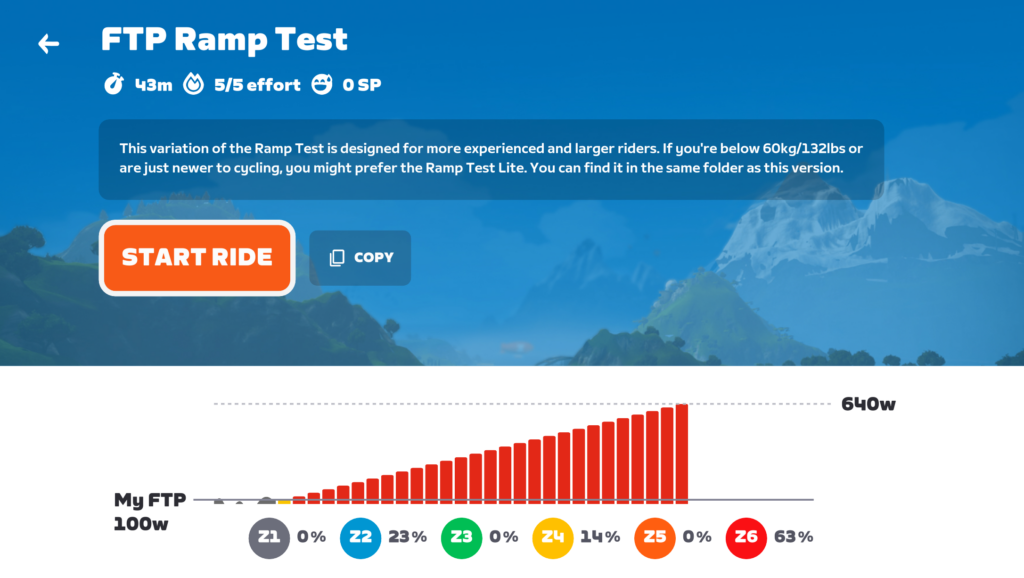
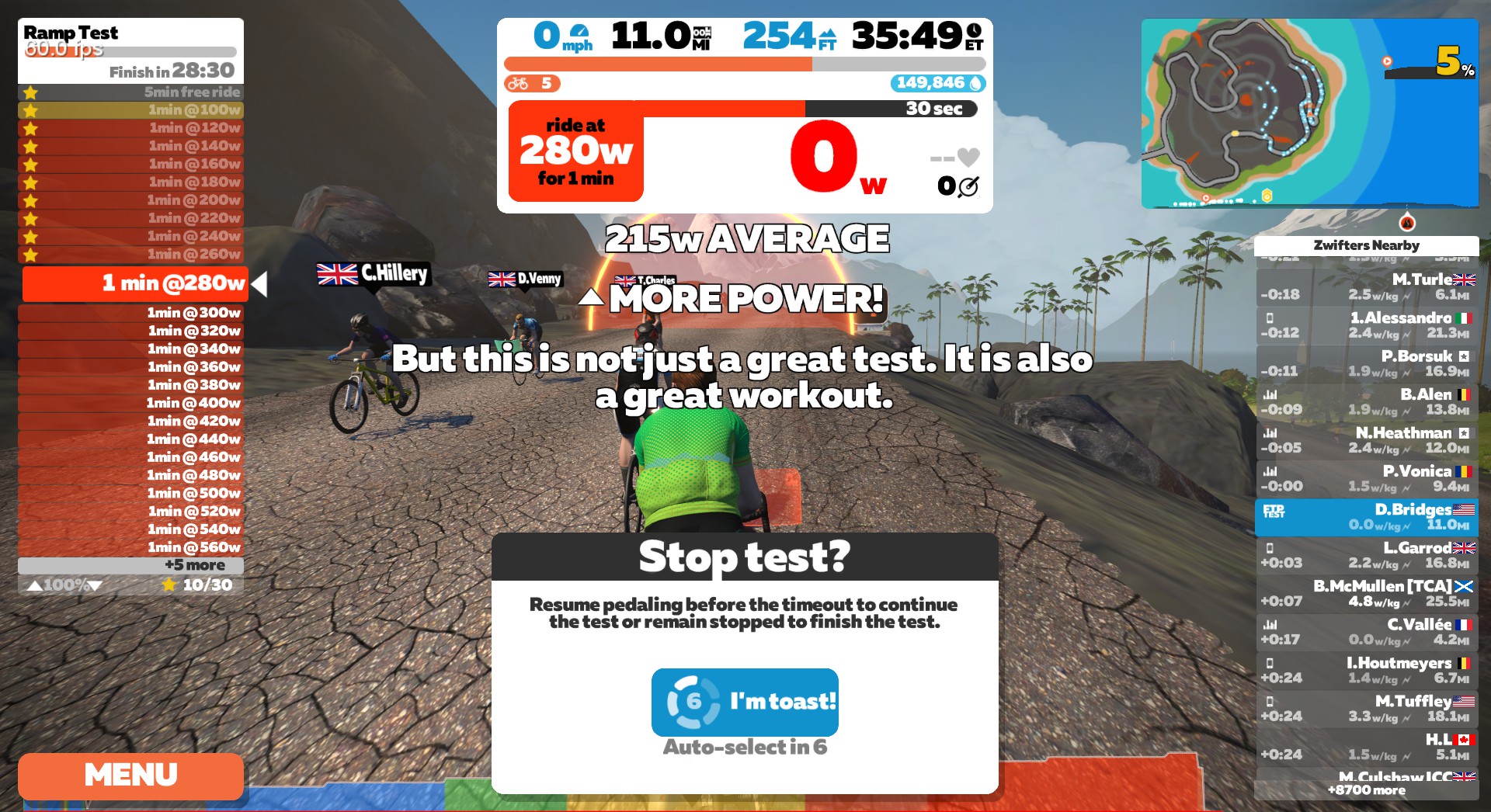
The ramp test starts easy, then simply increases your wattage by 20W every minute until you can’t pedal anymore. The nice thing about the ramp test is that you don’t have to worry about pacing yourself for a 20-minute effort. Just stay seated and pedal for all you’re worth, until you can’t pedal anymore! Typically the ramp test feels very easy at the start, but gets really difficult in the last 5 minutes.
Zwift will calculate your FTP once you stop pedaling. Your FTP Is calculated as 75% of the highest 1-minute power averaged during the test. If your new FTP is higher than your old one you’ll get a popup that says “New FTP set!” along with your new FTP value.
Watch Me to the Ramp Test:
Ramp Test Lite
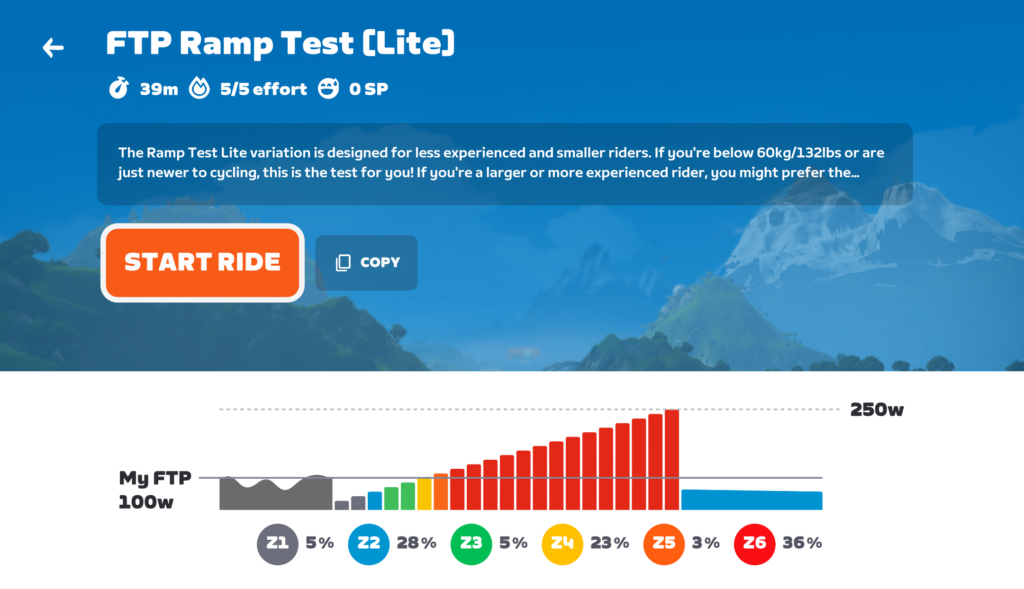
If you don’t know your FTP but weigh less than 60kg/132lbs, or if you know your FTP and it is below 175 watts, you’ll want to take the “Ramp Test Lite” instead of the standard ramp test. This test starts at a lower wattage and increases by only 10W per minute, providing more accurate results for riders with a lower FTP.
Which Test is Best?
Everything about the ramp test is easier than the standard FTP test, but the downside is ramp tests can be less accurate, depending on your physiology. Specifically, riders with a higher anaerobic to aerobic power balance may have their FTP overstated by a ramp test.
On the other hand, the standard FTP test with its 20-minute all-out effort is very challenging, both mentally and physically. Additionally, newer riders will struggle to properly pace a 20-minute effort (they often blow up early).
Both styles of tests have their pros and cons, but generally speaking if you are a beginning cyclist and/or you want a quicker, easier test, go with a ramp format. If you want higher accuracy, and have the experience to pace yourself properly, go with the 20-minute format.
If you’ve never taken an FTP test, we recommend using the ramp test first. This will give you a fairly accurate FTP number, which you can use to pace yourself for the 20-minute test next time.
FTP Auto-Detection
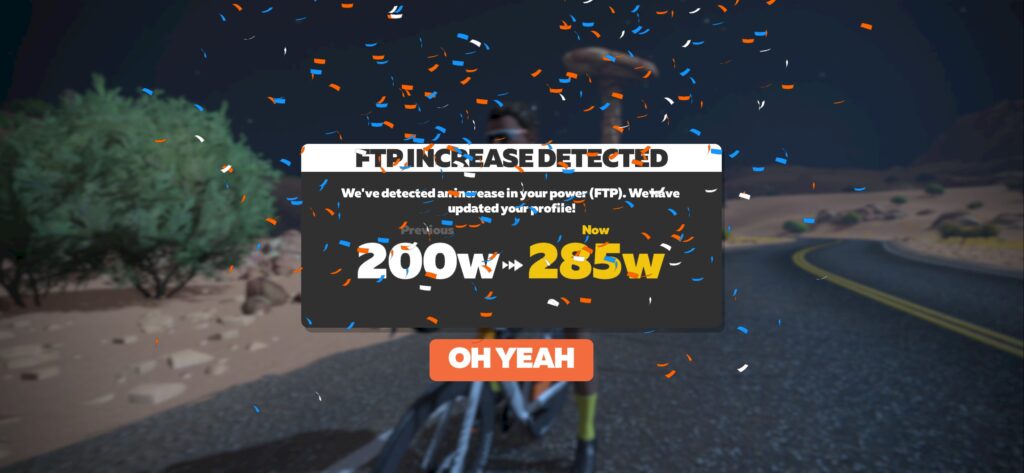
For nearly 10 years, Zwift automatically detected your FTP in game by measuring your 20-minute power average as you rode, taking 95% of that value as your FTP. If it detected an FTP increase, you would get this screen:
But since December 2024, Zwift has been using an updated FTP detection algorithm that works for efforts 8-60 minutes in length. Read about how it works in these update notes if you’d like, but the important thing is to understand that Zwift automatically detects your FTP as you ride, and you’ll get a notification if it detects an increase. If you want your FTP detected accurately, simply do an all-out effort anywhere from 8 to 60 minutes in length.
Simple. But not easy.
Apart from Zwift, most cycling data platforms also compute an estimated FTP based on your ride data, even if you never take an FTP test. These calculated FTP figures are arguably more accurate than an FTP test, but it depends on how they’re calculated and what sort of efforts you’re feeding into their algorithms. Some of these platforms are free, while others may carry fees. Popular platforms include TrainerRoad, intervals.icu, XERT, and WK05 software.
While we can’t all climb at the caliber of Tadej Pogacar, we can certainly still try. In this week’s top video, hear from an experienced Zwifter as he breaks down all of his top tips for getting better at climbing on Zwift.
We’ve also decided to feature videos about Zwift racing, Tour de Zwift, FTP tests on The Grade, and the Zwift Ride.
Conquer the Climbs! 7 Tips to Master Zwift Climbing
Get tips from David of Zwift Analysis Network on how you can improve your climbing abilities on Zwift.
Is this my best-ever Zwift race? Can I win?
If you need some inspiration to get on the trainer and race on Zwift, Ryan Condon’s recent video delivers just that. Watch as Ryan overcomes a power dropout and fights his back way into contention.
Breaking away from 400 riders at the Tour de Zwift, then this happens…
Ed Laverack races stage 2 of the Tour de Zwift and encounters some questionable racing tactics as he attempts to break away from the massive group of 400+ riders.
What Happens If You Do A Fitness Test Every Day For 7 Days?
Conor from GCN climbs The Grade every day for 7 days. Can he manage to improve his FTP with each climb?
Zwift Race | Tour de Zwift – Stage 1
Daaaanjj tackles another Zwift race, this time riding stage 1 of the Tour de Zwift.
+1000km review of the new Zwift Ride Indoor Trainer Setup
Volker Voit recently received the Zwift Ride for testing. After riding this smart frame for the last few months (including a ride where he completed the entirety of the Rapha 500 in one ride), Volker provides a review of the Zwift Ride.
Got a Great Zwift Video?
Share the link below and we may feature it in an upcoming post!
As someone who has led (literally) hundreds of Zwift rides over the years, I’ve learned a lot about what works and what doesn’t. In fact, we’ve published some posts to help ride leaders do an amazing job:
Lately, I’ve been thinking about how Zwift could improve the experience for ride leaders and, by extension, improve the overall “product” these leaders create. Here are my top 7 ideas…
#1: More Event Customization Options
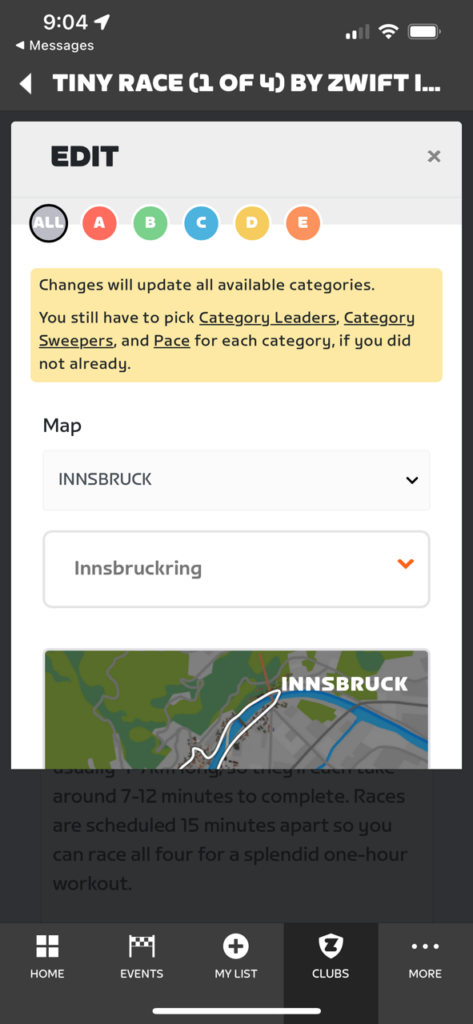
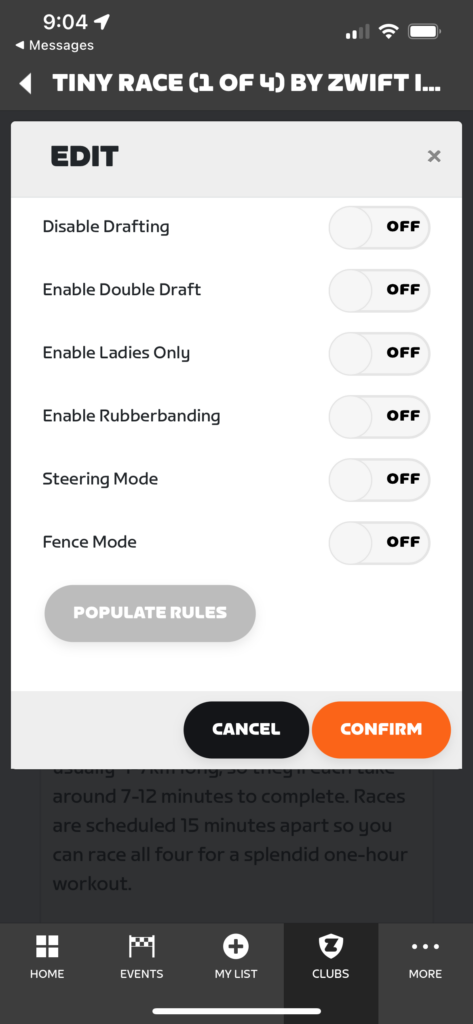
Today, event organizers are quite limited in what they can directly modify when setting up their events. You can’t change the title or description text, for example. You can’t create an actual race that uses Zwift Racing Score and/or shows up on ZwiftPower. You can’t modify your event banner, the mix of powerups, place riders on a particular bike or wheelset or in a particular kit… and the list goes on.
Yes, you can email Zwift’s events team or submit a change request to get these changes done. But that just introduces delays into the process, thus reducing creativity on the platform.
I get it: Zwift doesn’t want to let just anyone upload their own event banner or change their event title to something naughty. But certainly Zwift could build a process to handle this safely and efficiently.
#2: Improved Route Picker/Customizer
Zwift does let event organizers choose from a long list of routes, and set their event length based on total distance, total time, or number of laps.
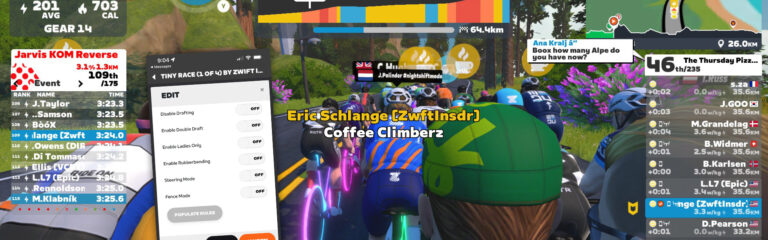
The route-picking tools could be improved, though. For example, they don’t tell me how much climbing you’ll be doing if you set up a 100km ride on Waisted 8 like I did last week for the Thursday Pizza Burner.
They also don’t show where the finish line will be if you set a custom distance on any particular route, which is what I do for almost every Tiny Race. Right now, I have to test-ride routes in order to figure out what event distance to key in so the finish banner is located at the right place.
One last little niggle when it comes to precise event lengths – and I know I’m getting into the weeds here. If I input a 2 or 3-digit distance, which I often do for Tiny Races, that distance gets saved into the system, but the system rounds it to 1 decimal place if I go back to edit the race. Annoying. Round it on the frontend, that’s fine. But please don’t confuse me further when editing!
#3: Beacons Always In Rider List
The longer a ride is, and the more hilly the route, the more chance there is that the group will get spread out. Anything Zwift can do to help riders find a group would be welcome.
It would be really nice if the rider list always showed the location of the yellow and red beacons. Show the time gaps to these riders, too. This would let participants see if they should work to re-catch the beacon or ease up and rejoin a beacon group, giving everyone much better visibility of the location of key groups in the ride.
First, I’d love to see fewer blank messages on Zwift (see image above). As far as I can tell, these happen when people send emojis via the Companion app, or message in a non-English character set (Japanese was used above). It seems like adding emojis would be an easy win for Zwift. As for other languages – certainly we could show non-English characters? Or (this would be amazing) – auto-translate messages into each rider’s native language. How cool would that be?
Next, let’s talk about who sees which messages in group rides. Rider leaders have it pretty good: they get to see all riders’ messages, and everyone in the event can see the leaders’ messages as well.
It’s easy to forget, as a ride leader, that this isn’t everyone else’s experience. Event chat is actually proximity-based for everyone else in the ride, meaning you only see other riders’ messages if you’re nearby. So as the ride spreads out, you end up with weird situations where, for example, someone asks the leader a question, but only a portion of the group sees the question. Then the leader messages the answer, and everyone on the ride sees that!
It’s not ideal. It’s confusing and reduces the amount of conversation and connection happening on community rides.
I’d love to see all riders able to see all chat, with proximity-based messaging perhaps automatically enabled for rare, massive events of 500 riders or more.
(Zwift could even get really fancy and enable some sort of smart proximity-based messaging happening if the number of messages gets too high. Maybe the game monitors the rate of messages, and if it’s more than, say, 1 per second for 10+ seconds, the game switches to proximity-based chat mode until the rate comes down. A simple indicator in the message composer could indicate whether you’re in proximity-based mode or not.)
#5: Post-Ride Stats
As the ride leader, I’d love to get some stats once my event finishes:
Count of riders who joined the event
Count of riders who finished the event
Finish rate (Joined/Finished)
Number of Ride Ons received in event
Number of chat messages sent
Total distance covered by all participants
Total elevation climbed by all participants
I’d love to get these stats via an automated email, but they could also be made available, much like race results, in the Companion app and at zwift.com, so there’s a historical record of each event’s stats.
I’d love it if Zwift would pop up a simple survey at the end of each group ride, inviting riders to give feedback to the ride organizers. Maybe just a 1-5 star rating, with a space for comments?
A simple survey, perhaps different from a finisher’s survey, could even pop up for people who decide to duck out early. Maybe it just has a few options so Zwift and the ride organizer can understand why you left early?
Ride is harder than expected
My schedule doesn’t leave me enough time to finish
Pace not as advertised
Other
Like the event stats idea above, I’d love to see all this feedback in an email, along with access via Companion and the web.
An additional benefit from these survey results is that they could be used to help Zwifters pick events in the future, as repeating events could build up a reputation with their star ratings or other feedback. Zwift could summarize this feedback in game and Companion, and could even create special lists of top-rated events. For example, rides rated in the top 10% of all group rides could be on their own list and receive a simple visual indicator so they stand out from the crowd and get more participation.
#7: Encourage Repeat Signups
Speaking of building a reputation and encouraging signups, I’d love it if Zwift would make it easier for people to sign up for next week’s edition of an event immediately after they finish this week’s.
Right now, weekly events are re-created automatically via a nightly process that runs once every 24 hours. So after you complete a weekly event, doesn’t yet exist on the calendar. You have to wait until the following day to sign up.
What if instead, next week’s event was created 30 minutes after this week’s event began?
What if people could click to “subscribe” to an event and be automatically signed up for it each week?
Or what if, when you finish the event, a simple UI popped up asking if you want to sign up for next week’s event right now?
Your Thoughts
Those are my top ideas as a ride leader. But I’m sure other ride leaders will have other great ideas. Do you have any to add to my list? Share below!
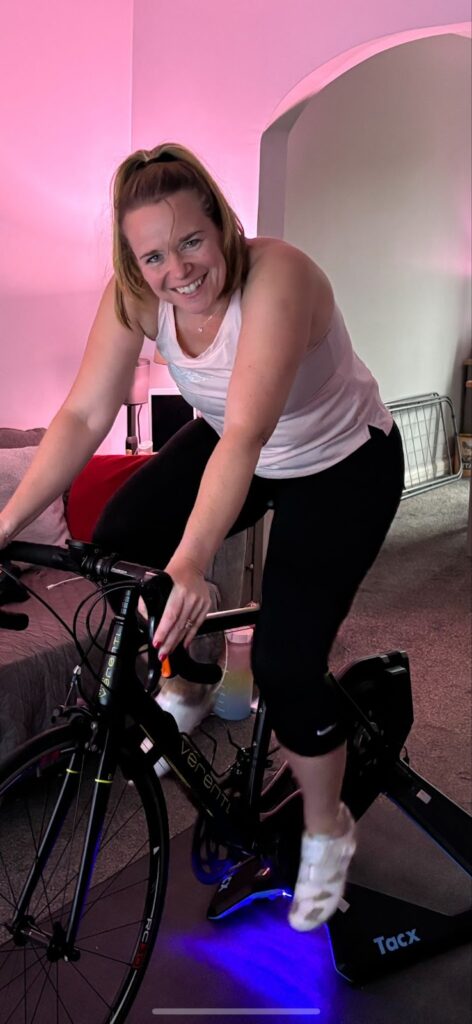
How did you get into cycling? I got into cycling many years ago after my hypermobility got too bad to run anymore. I still wanted to do high-intensity cardio but most activities hurt my knees. I thought cycling would too and so avoided it for a long time until a friend gave me her bike to try, and it was a revelation!
I soon got my own bike and haven’t stopped cycling since. That was maybe ten years ago but I’ve been indoors only for the past five years after a very close call with a UPS van. With enough to keep me more than occupied on Zwift, plus Scottish weather, potholes, and awful drivers outside, I only cycle indoors now.
How many years have you been racing on Zwift? I have been racing on Zwift since last November, so a bit more than a year.
Are you part of a Virtual team? Yes virtual team Coalition, Ourea and Desire when in ZRL.
What do you love most about racing? I am not competitive in any part of my life except Zwift. I cannot state a favourite part of racing because it’s really tough going at times, but I think the overall achievement is what’s important at this point. For me, it’s looking at the little gains I make in my performance every single time I race, and watching myself (virtually) achieve things I couldn’t do the week before or the month before.
What is your favourite style of race (e.g. points, scratch, iTT, TTT, Chase, duathlon)? I love the TTT because I’m a sociable rider and even though we are honing our technique as a team, we have a great laugh too,. It makes the time go so much faster and the effort feel less hard.
What is your favourite Zwift women’s race series? My favourite racing series for women is Tour de Zwift. I love it! About three years ago I was in a TdZ race, all female but all ages too, with 78 other women and I came third. This was a massive achievement and it was me at peak fitness, since then I have had some setbacks with my fitness and hypermobility. But joining the Coalition last November has been a game changer for my riding.
What is your most memorable racing experience, inside or outside or BOTH? My favourite type of race is TTT, I joined Ourea last November (2023) and joined a bunch of strangers who already knew each other and were used to riding together and I’m not going to lie, I didn’t enjoy it at first. I wasn’t fit enough, I was falling behind, I didn’t understand how to control my speed and would shoot forward or lag behind and one thing I hate is being a hindrance. I considered quitting and finding something easier but that’s not me, so I worked at it. My fitness picked up naturally over the weeks and months and my technique improved too, and now nine months on, as I mentioned, I look at the small improvements. I now have the ability to not only keep up but to lead the team on my turns and buddy up with strong riders who still challenge me to go harder, longer and faster.
What is your favourite food to eat post race? Greek yogurt and raisins!
What advice would you give to a woman entering her first Zwift race? My advice to anyone wanting to get into racing for the first time is absolutely do that, don’t give up and don’t be intimidated by those in front of you leaving you behind, one day soon you’ll be able to stay in the pack! Work hard, take guidance, persevere and you will improve, you will see your worth in a team and you will love it!
Any upcoming race you are looking forward to? I totally look forward to my Thursday TTT with my team every week, even when the route is hard, because I have the support and encouragement from my team!
Tour de Zwift continues to headline our weekend event picks due to crazy popularity levels. But we’ve also included three popular group rides and Tiny Races with adjusted categories!
Tour de Zwift, the biggest ride series on the platform, is underway, and hundreds of riders have been turning out for each event! Stage 3 is available through the end of the weekend, with these route options:
Are these races? Not officially, but the front of each ride will surely be spicey. Read about me racing stage 2’s short ride, then ride it at whatever pace you’d like!
The popular Doddie Aid rides are back January 5-February 2, raising funds and awareness for the “My Name5 Doddie Foundation,” which aims to find effective treatments for the currently incurable MND/ALS. Join Sir Chris Hoy and friends on a Sunday social ride every week, and you can donate here.
This week we’re on Watopia’s Coast Crusher for 50km.
This event is popular every weekend, and thus earns a regular spot on this list! The BMTR Flat 100 consistently gets big turnouts because it offers multiple pace groups on flatter, distance-friendly routes.
This week riders are on the France Classic Fondo, Douce France, and R.G.V. routes based on which pace option you choose. Be sure to read the event description for details!
✅ Popular Event ✅ Endurance Challenge ✅ Kit Unlock
The Vätternrundan group ride series is back for another year, and it’s getting lots of signups! The premise of the series is simple: rides increase in duration from January 12 to March 2, with the goal of preparing you to handle many hours on the bike when the IRL race day arrives in June.
The Vätternrundan Group Ride Series is part of Vätternrundan’s official training program.
✅ V02 Workout ✅ Popular Race ✅ C and B Group Changes
Our popular Tiny Races happen each Saturday: 4 back-to-back races within an hour that will push your fitness to the max!
This week features slightly modified Zwift Racing Score bands to better balance group sizes. The 400-540 “C” group is now 380-540, and the 540-680 “B” group is now 540-700.
We’re revisiting our National Train Day routes this weekend, with four courses all featuring trains. Choo chooooo!
We choose each weekend’s Notable Events based on a variety of factors including:
Is the event unique/innovative in some way?
Are celebrities (pro riders, etc) attending/leading?
Are signup counts already high, meaning the event is extra-popular?
Does the ride include desirable unlocks or prizes?
Does the event appeal to ladies on Zwift? (We like to support this under-represented group!)
Is it for a good cause?
Is it just plain crazy (extra long races, world record attempts, etc)?
Is it a long-running, popular weekly event with a dedicated leader who deserves a shout out?
In the end, we want to call attention to events that are extra-special and therefore extra-appealing to Zwifters. If you think your event qualifies, comment below with a link/details and we may just include it in an upcoming post!
All About Shimano’s Updated Dura-Ace Wheelsets on Zwift
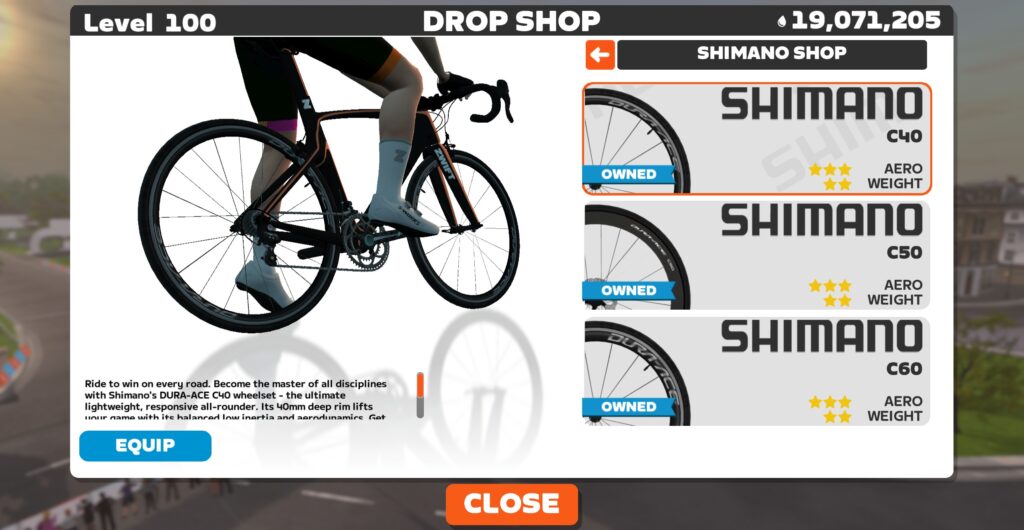
Zwift recently upgraded the performance of the three Shimano Dura-Ace wheelsets available in game: the C40, C50, and C60. Drop Shop prices also increased, as did the levels at which each wheelset was unlocked. Here is a summary showing the before and after specs for the three wheelsets:
Shimano Dura-Ace Wheelset Details (Version 1.80 and earlier)
Price
Level
Aero Test
Climb Test
C40
35,900
4
51:13
49:31.5
C50
34,600
4
51:11
49:35.5
C60
41,100
10
51:02
49:39
Shimano Dura-Ace Wheelset Details (Version 1.81 and later)
Price
Level
Aero Test
Climb Test
C40
85,300
6
51:13
49:29
C50
165,000
10
51:04
49:26
C60
187,000
12
50:58
49:28
The star ratings for the C50 and C60 wheels also changed in the update. Zwift’s star ratings, as you may know, are based on the invisible CdA and weight settings for the wheels. (If a wheelset falls within a particular CdA range, it will receive 3 stars for aero performance, for example.) The more stars, the better.
Both the C50 and C60 improved from a single-star weight rating to a two-star rating, making all three wheelsets have 3-star aero/2-star weight ratings:
We already spilled the tea and shared the test results of the updated wheels above. But read on below to get these results in context, as well as other takeaways!
Aero (Flat/Rolling) Performance
Aero performance has improved for the C50 and C60 wheels, while remaining unchanging for the C40. The C50 improved by 7 seconds in our tests, while the C60 improved by 4 seconds.
That means the C50 moved up the leaderboard past 5 wheelsets in terms of aero performance, including the level 6 Mavic Cosmic Ultimate UST. It now essentially matches the aero performance of the level 8 Mavic Cosmic CXR60c, while outclimbing these wheels. This means the C50 is the best aero performer available at levels 10-11.
The C60 moves past 4 wheelsets, meanwhile, including (crucially) the level 13 Mavic Comete Pro Carbon SL UST. So the C60 is the best aero performer of any wheel up from level 12-14.
It’s not entirely “fair” to compare these low-level unlock wheels to the best, high-level wheels in game. That said, it’s another way to gauge their relative performance. The C40 remains 48 seconds slower than the current fastest road wheels (DT Swiss ARC 1100 DICUT DISC, level 39) on our test course, which is two laps of Tempus Fugit totaling 34.6km. The C50 is now 46 seconds slower, and the C60 is now 37 seconds slower.
Climb Performance
Climb test performance improved for all three Shimano wheelsets with Zwift’s 1.81 update. The C40 is 2.5 seconds faster up our Alpe du Zwift test course, while the C50 gets to the top 9.5 seconds faster and the C60 shaves off 11 seconds.
The overall ranking of Shimano’s wheels in terms of climbing performance improves substantially with these changes. While the C40 moves past just 1 wheelset in the rankings, the C50 moves past 12 wheelsets, and the C60 moves past 13 wheelsets!
The fastest overall climbers in the game (Lightweight Meilensteins and Roval Alpinist CLX) complete the test 15 seconds faster than the C40, 12 seconds faster than the C50, and 14 seconds faster than the C60. While the performance of Shimano’s three Dura-Ace wheelsets doesn’t stand out from the full crowd of Zwift wheelsets, when compared to lower-level wheelsets, they may now be the best available option. More on that below…
Note: all test results above are from a 75kg, 183cm rider holding 300W steady using the Zwift Aero frame.
Conclusions
Shimano’s Dura-Ace wheels are now the fastest racing wheels available between levels 10-14. While the C40 is not a standout performer, the C50 and C60 show strong aero and climb performance for their unlock levels, making them a go-to choice for newer Zwifters racing flat and rolling routes.
February 2025’s ZRacing series is titled “Shimano Find Your Fast”, so we’re guessing this wheel update was done in anticipation of this partner event. (Watch this space next week for details on February’s ZRacing, including courses, unlocks, and a prize drawing.)
The updated Shimano Dura-Ace wheels can be found on our Master Zwift Wheels List, and we’ll be updating the following posts to reflect Zwift’s recent changes:
Important note: this post contains speed test results for Zwift frames or wheels. These results may change over time, and a bike's performance relative to others may also change. We don't always revise posts when performance rankings change, but we do keep current, master versions of our speed test results which are always available. See the frame charts, wheel charts, and Tron vs Top Performers for current performance data.