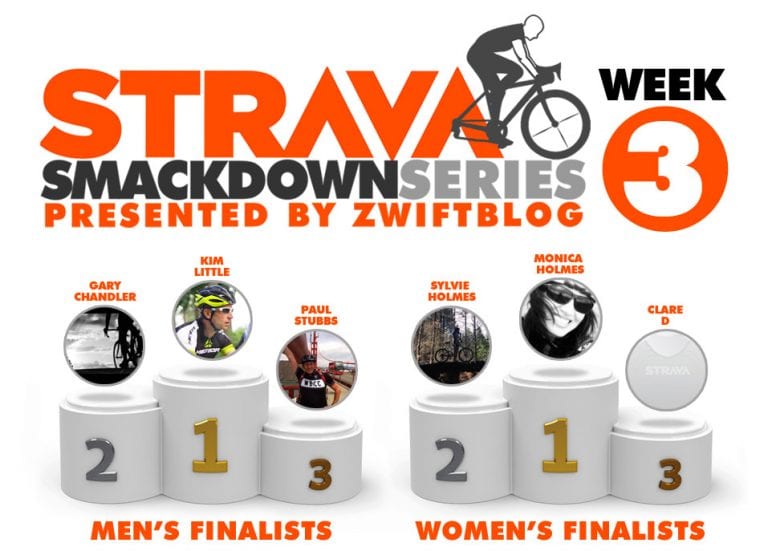
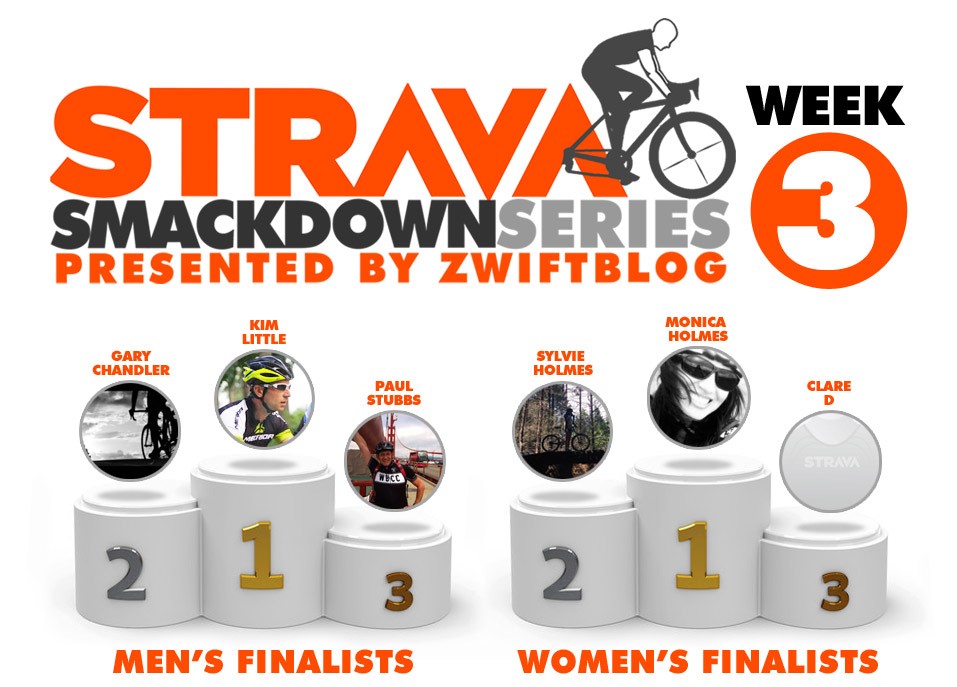
Along with Wahoo Fitness swag bag prizes for our first place finishers, three random entrants will also get a water bottle from ZwiftHQ. Those three winners are:
Since we have no way of directly contacting entrants, prize winners must email [email protected] by March 14th with their full name and mailing address so we can get your prizes shipped out.
Interview with TGIF ride leaders Eric Grant and Wes Salmon
A note from Eric: I recently published a post about the best slow group rides on Zwift. The TGIF ride is one of the oldest and most loved slow group ride on the list, so I decided to interview ride leaders Wes Salmon and Eric Grant and learn more about themselves and the ride.
First, a little about yourself. Where are you from, and how would you describe yourself as a cyclist?
From Eric: I live in Austin, TX, but I started riding about 10 years ago when I lived in Maryland. I’m a fair weather rider which pretty much means year-round in Austin. I got into cycling to commute to work when Hurricane Katrina hit and the gas prices sky rocketed but I’ve stuck with it more to stay healthy. I’m a Clydesdale and probably will always be but in the last 5 years I’ve lost ~120lbs, mostly from cycling and ~75lbs of that after starting Zwift in August of 2015.
Tell me about the slow ride you lead. When does it happen, how long is the ride, what sort of pace do you hold, etc.
From Eric: TGIF is every Friday night. It started as a North American Ride but we do see some Australian riders join on their Saturday morning. In London the ride is 5 laps Classique (20.4miles) plus After party (~6-10 miles). Our ride lasts about an hour for the 2w/kg event part and maybe 1hr 20min if you stick around for the After party. As the rider with the leader beacon I hold 2w/kg in Erg mode through my trainer app. Since I’m a heavier rider I also adjust my weight for the ride so that it’s a more average 160w/170lbs. If flyers ride off the front we let them go, but if riders get dropped we do all that we can to bring them back to the group.
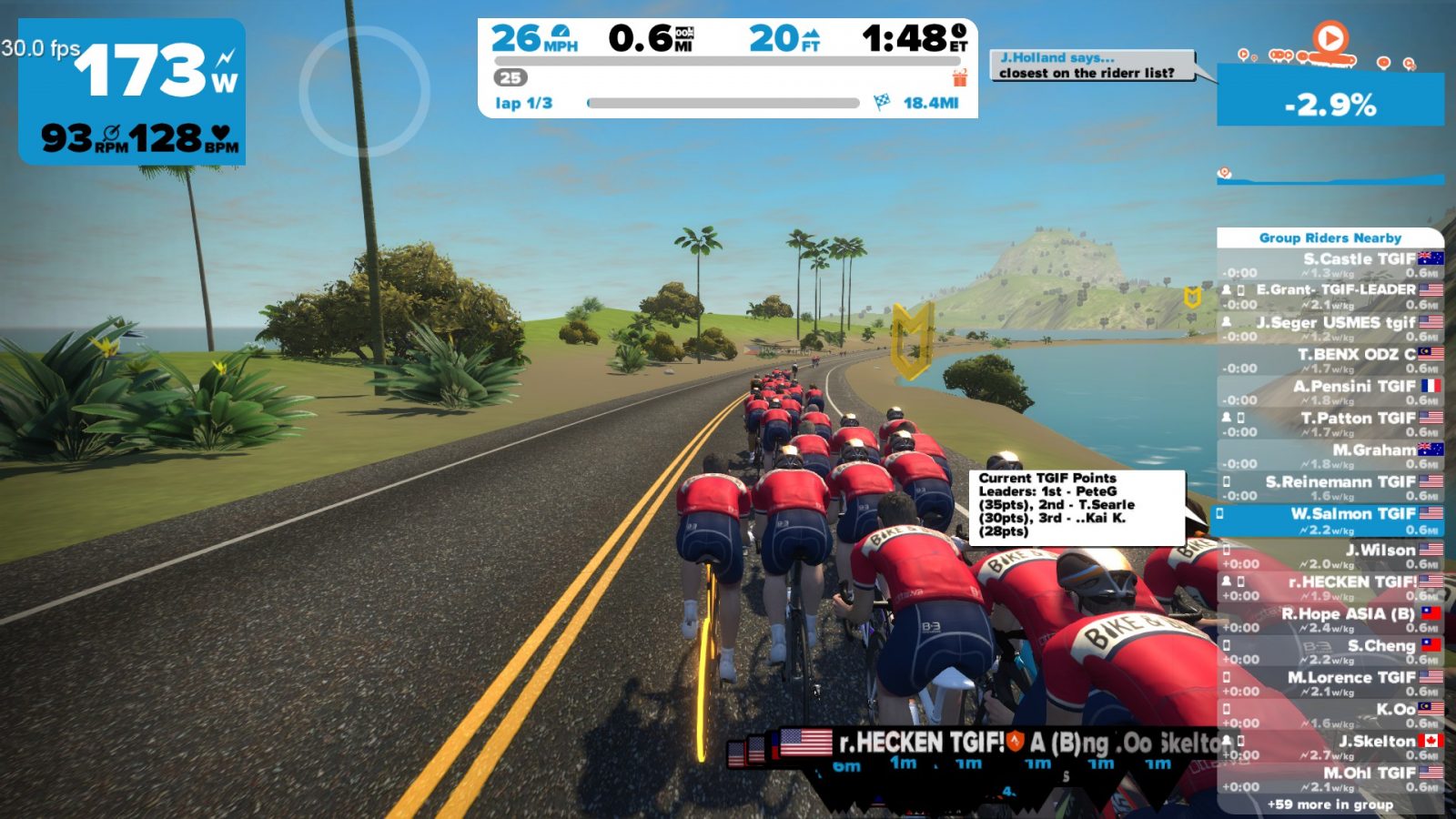
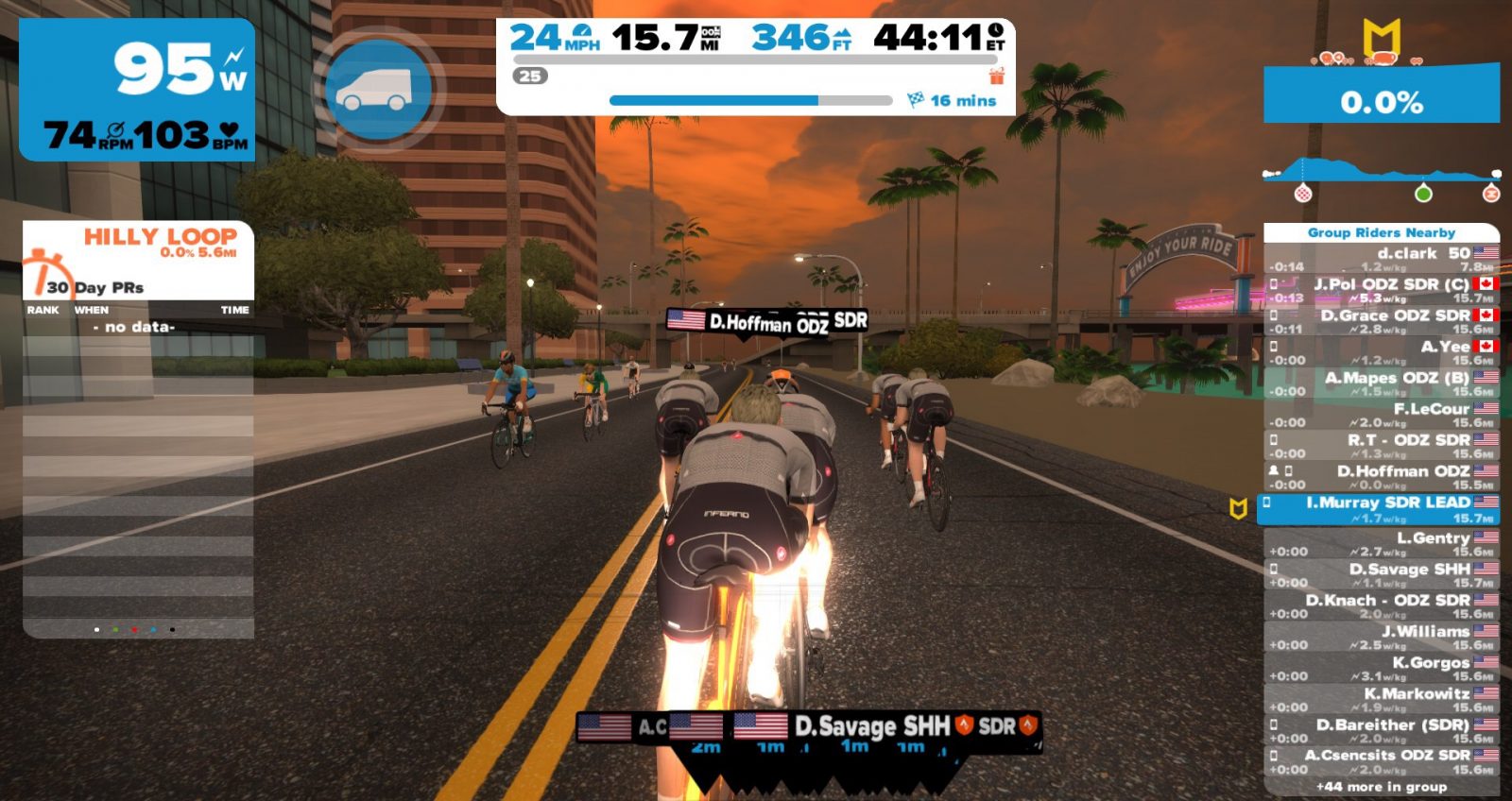
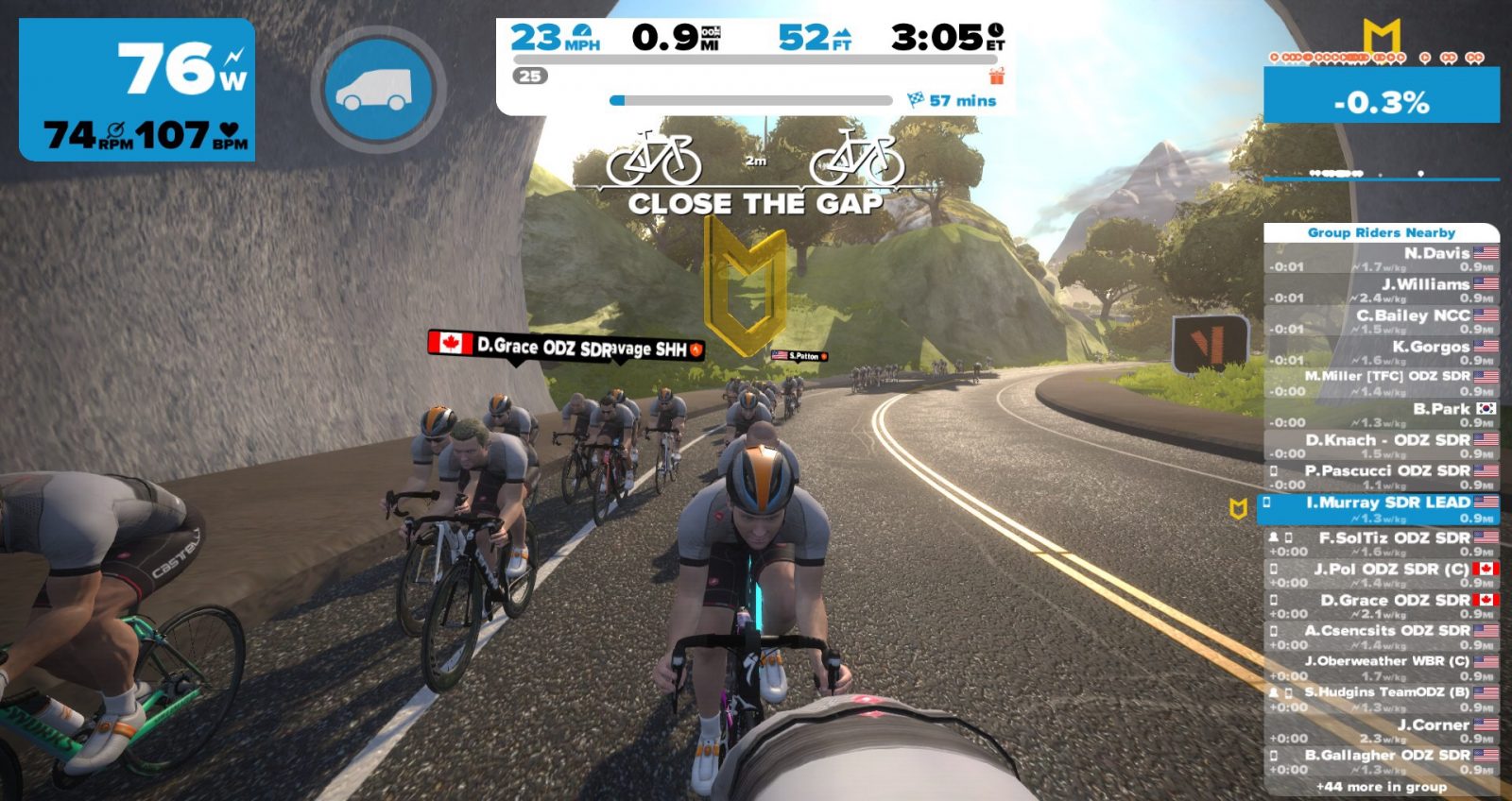
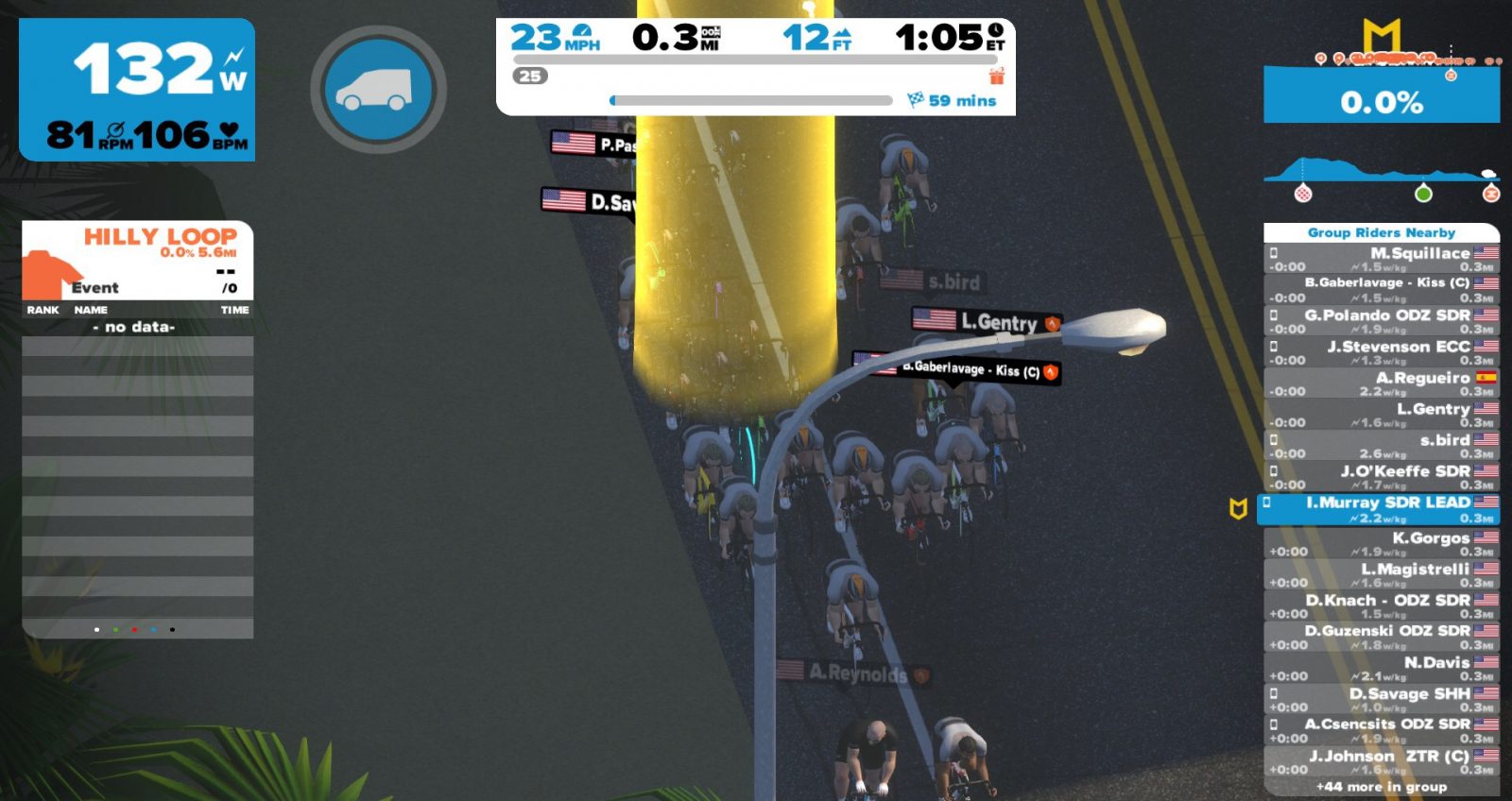
The two events that make TGIF special are the Points System and the After Party. The points system is basically a fun game we play during the ride to hold the group together. Every 10 minutes we take a screenshot and the closer you are to the Leader, the more points you get. It sounds easy, but only 16 out of 150+ riders gets points every 10 minutes. Some of the riders even try to add a twist to it by trying to get captured in the screenshot with either orange w/kg or 0.0 w/kg. At the end of the season there are random prizes awarded and those with higher points have a higher chance of winning.
The After Party is similar to what some other rides do, where after the main 2w/kg ride is over a smaller group goes a little harder. We change this up every week and we vote on it in our Facebook group. If we are in London, our choices are usually 2 laps Classique @2.5w/kg and we go for the sprint point, 1 lap Classique race, Fox Hill or Box Hill. The sprints are very popular because with a large group they can really open it up, but the climbs are a good change from time to time. The voting stays open until the end of the 4th lap so it becomes a running tally as people ride and log into Facebook to vote. The After Party is a pure old school Zwift group ride with no leader beacon because it’s decided during the ride.
How many riders have you been seeing on your ride lately?
From Eric: Our Max was 206 riders on 1/7/2017, partially due to the January group ride prize. At 200+ it was pretty unmanageable since many of the riders couldn’t see the Leader Beacon. Last week we had 138 and this week 157. We grew considerably when winter hit, from 40-65 to over 100. Some group rides on Zwift have been around for quite a while, while others are relatively new. How long has your ride being going? What was the inspiration behind starting it?
From Wes: The ride was originally created by Chris Ryder and William Kwan back in the Fall of 2015. The inspiration was to create a ride that focused on socializing at a recovery ride pace at the end of a long week. At that time in Zwift, most of the group rides were more performance focused and TGIF was one of the first 2w/kg or lower targeted rides.
I joined the first TGIF ride with Chris and William on Sept 18th, 2015.
After a few months of TGIFs, Chris had to take a break due to an injury and I offered to step up and lead the ride while he recovered. The result was that I became the defacto leader of TGIF through May 2016.
From Eric: I think TGIF was the first group ride I ever did and I guess I missed the first week but I was there for the 2nd. I helped out by calling out landmarks before we had the Leader Beacon so everyone could find the Leader. Shortly after the Leader Beacon first came out we didn’t have a set leader so TGIF fell off the sponsored event list. People still showed up for the ride, and after one frustrating ride around June I decided to contact Chris Ryder and Zwift to take over the Leader position and turn TGIF back into a sponsored Zwift event. We’ve just grown since then, but many of our riders have been with us since the beginning.
Many group rides are run by a team–sweepers helping those off the back, different leaders rotating responsibilities, even others helping to advertise the ride, etc. Who helps make your ride happen?
From Wes: We have been really lucky to have some amazing people step up over the years and we have never really used sweepers or rotating leaders. The key thing we did early on before Teamspeak became popular was to have someone in the ride texting out leader location as we passed known landmarks. This helped keep unintentional flyers in check.
We never really went looking for sweepers but we’ve always been a social ride so people look out for each other, so a few of the regulars usually help sweep. I’m not really a social butterfly but it seems that we have a vocal group, so often when the conversation comes about 2w/kg rides someone speaks up and that’s how most of our advertising comes from word of mouth.
In all honesty the group makes this ride happen. Someone suggest to have a bot set at 2w/kg instead of the leader and I’m all for that because we are more about the social aspect of the ride instead of holding a specific wattage. The conversation and the good times is what keeps bringing people back.
Do you have problems with “flyers” zooming off the front of your rides? How do you handle that situation?
From Wes: Sadly we do have flyers and as the ride continued to grow, it became more common for the group to be split up due to a fast front pack not sticking with the leader. In an attempt to fix that, we created a game within the game to encourage people to stick with the leader (see “Points System explained above).
The result is that those who want to fly off the front still do and the group who wants to stay with the leader really doesn’t care. Some even say they are glad the flyers leave us behind, it makes it easier for them to get points.
From Eric: Wes is the brains behind the points system and it’s amazing to see how tight the group gets every 10 minutes hunting for those points. It makes me feel popular when everyone is trying to hug my wheel. I just ignore the flyers and let them go their way.
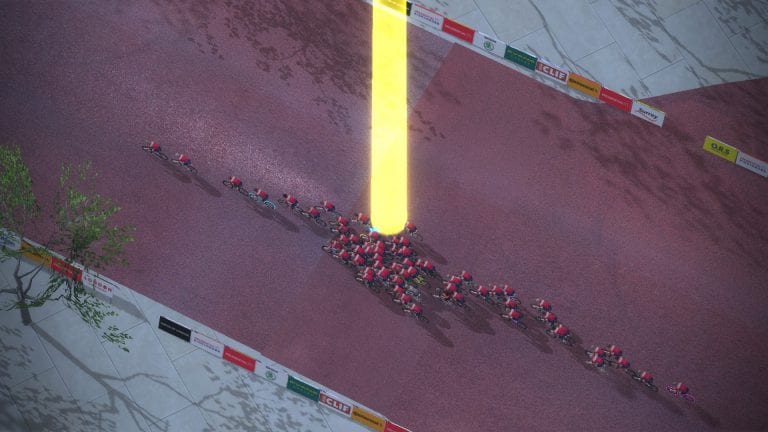
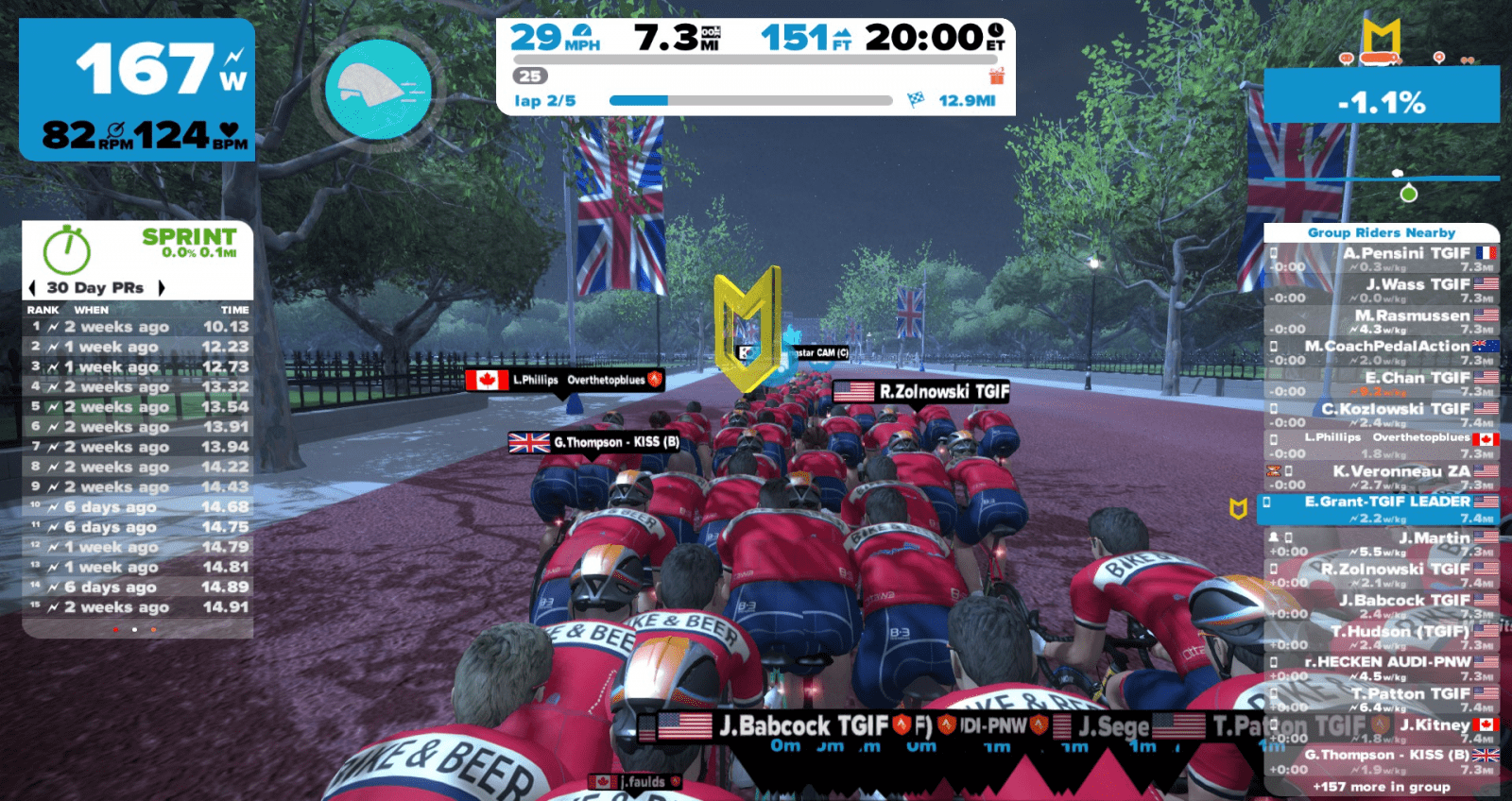
Here is a screen shot from one of our points checkpoints and you can see how tight the group is in the elevation profile, even at 157 riders. We do spread out between checkpoints but they seem to manage to come back together to get those virtual points.
Does your ride use Discord for audio communication? If so, how can folks get in on that?
From Wes:Yep, we switched from Teamspeak to Discord after the new year and it’s been really great for the points game. We can post real-time screenshots at every 10 minute mark so riders know if they got points that round.
We have over 175 members of our Discord server and it grows every week.
As you know, we’ve got lots of new folks joining the Zwift community. What would you recommend to anyone who wants to try your ride, but has never done a Zwift group ride before?
From Wes: A few things:
Get on the Discord server, lots of verbal help happens there before and during the rides
Learn the camera hot keys so you can find the leader beacon, it’s the most important part of the ride
Practice the draft. Even though we’re a 2w/kg ride, we go FAST when you have 150+ riders in a group. Falling out of the draft even by a few seconds can mean you never catch up
Ask for help, the core group of TGIFers are super helpful
Follow the Leader Beacon, not the front rider. Unlike real world rides you can’t ride to the front and slow the group down, that just speeds up the group.
Use the elevation profile to see if you are ahead or behind the leader beacon.
Zwift has come a long way in the last year with the event module, leader beacon, etc. What other upgrades could Zwift roll out to make your group rides even better?
From Wes: I think they could focus more on discouraging bad behavior for specific rides like a social recovery ride. There have been some ideas thrown around about auto kicking flyers out of the group and I think those types of things make sense but I’d also like to see well-behaved riders get bonuses as well. Integrating something like the points proximity game into a group ride would be great.
From Eric: I know Zwift has talked about it but integrating something like Discord into Zwift should be a priority. We have a good group on Discord but a large majority of the ride is missing out on that conversation. I know there are some difficulties getting the mics setup, but just being able to listen to the chat would be a major step in improving the social aspect. Many people already just listen and respond in Zwift chat.
There are many things that Zwift could do to give the Leaders more control (or any control) but I think we get by with what we have and it’s working. There are other things I would prefer Zwift to work on.
Wes wanted to make sure Eric got the credit he deserves, and sent me this additional note:
When I quit Zwifting for the Summer in 2016, Eric was the reason TGIF continued being a great ride. He took it over and kept things running smoothly while the group continued to grow. Without that, I suspect there would be no TGIF right now. He is an amazing ride leader and the entire TGIF group owes him a debt of gratitude for his leadership.
Small group sprint finishes (Skillz and Drillz – February 29)
Last week we discussed chasing as a group, so today we covered how to finish off your race from the small group. Sprinting from a small group is a different animal than sprinting from a large field with the help of teammates. In the small group, the smarter or more situationally-aware rider can sometimes outwit the stronger rider. At the end of the day, though, your legs have to still put out the power to get to the line first.
As usual, we started with our 1.5 W/kg warm-up and practiced moving around the bunch. After about ten minutes we got into class. Like I stated earlier, sprinting from a small group is different than a field sprint. In general, there are three types of moves that you can make in the final sprint: the cagey sprint, the high speed sprint, and the sprint from the front. During the class, we executed each two times to make sure everyone got the feel for the effort.
Cagey Sprint
This is something everyone has watched in a small group, breakaway finish. The cagey sprint occurs when you put another rider on the front and use his or her slipstream to slingshot you around for your sprint. It is a surprisingly simple tactic, but everyone knows it is coming. To execute the cagey sprint, you have to keep working into the last kilometer or so. At that point, you have to make a concentrated effort to slow your effort rapidly, forcing the riders behind you to take the lead position, giving you an aerodynamic advantage. The difficult part will be staying off of the front as the riders on the front will not want to be there. That’s where the caginess comes into play. As the pace starts to wane, you have to make the determination of when to launch your sprint based on your fatigue, the terrain, and the wind. However, you have to be in the gear you desire to open your sprint. Otherwise, you could fall victim to the sprint off the front technique (we’ll cover that later). As you approach your identified launch point, let a small gap of a couple of meters open between you and the rider in front of you. Once the gap opens a bit, start the sprint and slingshot around the riders in front of you. Be careful to not launch to early because the other riders are sure to respond, and the advantage of surprise will be lost.
This type of sprint can be a bit longer than some, but you shouldn’t go from much more than 400 meters, or you risk fading in the last 50. I will caution you that this is an easier tactic to pull off on the road than on Zwift. Other riders can see your W/kg without putting themselves in danger, so the element of surprise is not as powerful of a tool. On the road, you have more options. You can go when all riders are looking forward or to the side away from where they look most often (most people have a preferred side). If they look right and you go left, you may be able to get an extra bike length or two before they process what just happened.
High Speed Sprint
Basically, you execute this sprint when the group you are in does not have a big enough gap for games. Thus, nobody can afford to let off the gas to try to put someone on the front, usually because the main field is charging up behind them. You see this periodically in rolling sprint stages at the Grand Tours towards the latter part of the three weeks. To execute this technique, you need to be in the first four wheels. Third wheel is preferred. Any further back than that, you will burn your max power just getting to the front and likely won’t have enough to hold off your group. From third or fourth wheel, let a small gap of two to three meters open, but no more. Shift up a gear or two if you can, dropping the cadence to the high 60s or low 70s. Use the small gap to build to max power. You need to be at max power as you come around the wheel in front of you, or you will not be able to break the draft. You will simply lead out the riders you just passed. Due to the speed that the group is already riding, you need to delay the sprint aslong as possible to take advantage of your ten second power and hold off the group as the riders respond.
Fortunately, the group will probably shatter almost immediately under your attack, and there will likely not be any collaboration between individuals unless they are teammates. This technique is much easier to pull off in Zwift than in IRL racing. Jumping out into the headwind can just crush your motivation, and you will be too hypoxic and delirious from lactic acid to have a good understanding of how your competitors have reacted.
Sprint from the Front
Of all three, this is the least likely to succeed unless you are simply way stronger than those behind you or have a teammate on your wheel who will let the gap open. There is no reason to want to do this technique unless you get put on the front and can’t get off of it. Try and try again to slow the pace and put someone else on the front. As you do so, watch the reactions of the other riders. If you can lull them into a pattern, they will start paying attention to those behind them and not to you. Be mindful that you need to start this process early, preferably well before the 1km to go banner. That way, you have a chance to get off the front or get them to think about other riders.
In live road racing, you can look at what the other riders are doing, and that will cue you in to how they might react. In Zwift racing, you can only watch their w/kg data and look to see if they stop pedaling when you slow down. If they do, that’s when you time your launch. Same goes for IRL racing. If the riders begin looking around, look back and ease off the pedals like you have done five or six times already. The key is to look back first. As soon as the second wheel turns his or her head, you go, and you go hard. In Zwift, you watch for that w/kg to begin to drop, then you go. If you do this from about 1km to go, you might get the group to hesitate, as it will have missed the opportunity to respond immediately. That hesitation is all you need. Settle into your one minute power and crush the last kilometer.
Conclusion
Now, these techniques are not fool-proof ways to win a race. Sometimes, you just get out-powered. Other riders also know these same techniques, so think of it as chess or poker. Try not to give away what you are doing, and always have a Plan B ready if the situation changes on you. Next time you find yourself in a small group at a race or group ride with the county line sprint, give one or more of these techniques a shot and let me know how it worked out for you.
Next week, we’ll be on Watopia Flat, and we’ll work on bridging. Expect some good strong but short efforts. Until then, RideOn!
Interview with Zwift distance record holder Jasmijn Muller
Recently, Jasmijn Muller broke the record for longest Zwift ride. I wanted to learn more about Jasmijn: her background, motivations, future plans, etc so I reached out to her and she was kind enough to answer my questions via email. The result is an extensive interview, and you can read it all below!
Please tell us a bit about yourself. Where you’re from, job, family, and the like.
I am Dutch, but have lived in the UK now for ten years. I met my British husband many years ago when we were both still living a barefoot scuba diving life in South East Asia. I try to combine my cycling with a full-time job in management consulting, specializing in business planning and strategic advice to the tourism, leisure and cultural sectors. I’m very passionate about my work, but it is also project-based and deadline-driven, which at times can become a bit challenging.
What’s your cycling journey been like?
I only took up cycling as a hobby in 2010 when I started working in London. Up until then, I had mostly used my bicycle for transport, simply to get from A to B, riding to school, to ballet, to the shops and to friends. In September that year one of our work clients sent out an invite to join him on a 100-mile ride in the North West of England, from Penrith to Warrington, to raise funds for Cancer Research UK. I dusted off my old Alan from 1982 (with down tube shifters, Shimano 600 and all), fitted some modern pedals and joined the group for the longest ride I had ever done. It was slightly daunting climbing up Shap with my limited gears and to a Dutch girl used to little elevation the descent off Shap was possibly even more unnerving.
That charity ride was a very special ride in many ways. It marked the beginning of cycling becoming a real hobby and passion for me. Shortly after this ride I invested in my first modern bike (through the cycle to work scheme) which had a triple chainset, modern brakes and pedals and took me on ever-longer cycling adventures. It was also my first exposure to cycling as a force for good. Collectively we raised over £10,000 for Cancer Research UK. It was emotional as the guy who had organized the ride had just recovered from esophagus cancer, using cycling as part of his strategy to regain fitness. That day he was easily the strongest out of all of us. It was very inspiring. Three months later we learned the cancer had come back, hitting him hard in the brain this time. In January 2011 he passed away.
Having bought my modern bike shortly after (a white (!) entry level Eddy Merckx), I then started riding cyclo sportives all around the UK. It was a good way to see the country without having to do the planning or fear getting lost. I slowly increased the distance and by that summer I was riding distances up to 160 miles. In the spring of that year I also set out on a solo cycling touring adventure, riding the Lon las Cymru, a 250+ mile long-distance cycling route down the whole length of Wales from Holyhead to Chepstow or Cardiff. It is one of the toughest of all the long-distance routes on the National Cycle Network. I have since tackled some of those tough sections without any problems, but back then I wasn’t such a strong cyclist (even with the excuse of carrying my luggage) and frequently had to get off my bike and walk up the steep sections. It was a great adventure though and I loved every minute of it.
In the summer of 2011 I joined my local cycling club, Kingston Wheelers. On my first ride out with them I joined in with a 90-mile ride, thinking I would be OK as I enjoyed long rides and had done quite a few longer sportives. But I wasn’t quite used to riding at club speed. After 10 miles I had to apologize and joined a shorter, slower ride instead. The men and women in the club were very welcoming and slowly showed me how to hold a wheel, how to behave in a group, how to pace myself and soon I gained confidence to join faster or longer rides. In 2012 and 2013 I even dabbled in crit and road racing. I broke a spoke in my first race and broke my hand in my second race. I guess it is fair to say that I wasn’t a very safe racer, didn’t have too much of a clue about tactics, couldn’t hold my nerve very well in a large peloton and only earned the points I did (up to cat 2) because of my time trialing abilities: riding fast in a straight line and just keeping going.
By 2013 I had realized that whilst I had to fight hard to stay on the wheels of the faster boys and girls in the club on the shorter rides, it often was towards the second half of longer rides that I would come into my element. I seemed to be a bit of a diesel. I then decided to test my endurance abilities by entering the Le Mans 24-hour race, which could also be combined with a nice holiday in France and seeing my mum. In preparation for the 24-hour race I decided to enter a 12-hour time trial and did surprisingly well, riding 252 miles on my road bike (only 4 miles short of the male club record) without a dedicated support crew, just stopping in with the helpers from the local club to get new bottles, have a chat and eat these wonderful pots of Ambrosia rice pudding they were giving me. I won the Le Mans 24-hour solo women’s category that year, having even set down for 2 hours or so as the organizer told me that I had effectively already won because the nearest woman couldn’t catch me anymore. That was pretty cool and I rewarded myself by buying a time trial bike to explore how far I could take that time trialing talent I seemed to have.
By the end of 2014, having started the year too afraid to ride the TT bike (which handles somewhat differently from a road bike), I saw myself winning the British Best All-Rounder competition (fastest average speed over 25, 50, and 100 miles in the country). That was quite a feat, given I am Dutch! The highlight of 2015 was winning the National 12-hour TT championships, in a fun and very close fought battle with Jill Wilkinson (a difference of just 192 meters in 12 hours!) My 2016 season was unfortunately wiped out by Deep Vein Thrombosis, but I have big plans for 2017 and it is great to start it with this Zwift Distance Record.
Why did you decide to take on breaking the record for longest indoor ride?
At the end of 2015/early 2016 I set myself the goal of trying to beat the women’s solo Lands End to John o Groats (LEJOG) record and then keep going for the 1000 mile record. LEJOG is an 843 mile ride along the length of the UK, from the most southwestern tip of Cornwall up to the very northeast corner of Scotland. Back in the 1950s when point to point record breaking still had a lot more profile, LEJOG was the blue ribbon distance among long distance record-breaking in the UK. In 1954, Eileen Sheridan set a new LEJOG record of 2 days, 11 hours and 7 minutes, that stood for decades. In 2013, I had the pleasure to hear Eileen speak about her records at a local event in Isleworth. Ever since that event, a signed picture of Eileen has been firmly positioned on the wall in my ‘turbo room’ to inspire me to train hard and help me achieve my own long distance cycling goals. Eileen is now well into her 90s, but I dream of breaking the current record whilst she is still alive.
The current record for LEJOG is 52 hours and 45 minutes and is held by my inspiring Born to Bike RT team mate Lynne Biddulph. It has stood unchallenged since 2002 as has her 1,000 miles record which stands at 64 hours and 38 minutes: a distance and time on the bike most people wouldn’t even dream of covering by car…
In preparation for this outdoor distance record attempt in September 2017 (which will be observed by the UK Road Records Association and if successful also endorsed as a Guinness World Record), I wanted to undertake an indoor challenge to test how my body and particularly my mind would respond beyond 24 hours to things like sleep deprivation, nutrition, etc all within a safe indoor environment. When I heard about Chris Hopkinson’s Zwift Distance Record attempt in December 2016 (and also read about Derek Boocock the previous record holder), this just seemed to be the perfect opportunity for my indoor test. Derek and Chris had covered 1009 and 1010 miles respectively in c. 71 and 72 hours. My 1000 mile record on the road will need to be done within 64 hours, so time and distance wise there seemed to be a good match. Of course I understand that record setting outside on the road is a very different business, and I have a fair few other longer test events lined up to help me prepare, but this indoor record attempt seemed like a good early stock take and, if successful, a great confidence boost for what is ahead.
The other great thing about the Zwift distance record is that it presented an opportunity for other people to actually ride with me. Quite a few people have asked how they can help me with my LEJOG record attempt, but I had to disappoint them as for that record I am not allowed any group riding or any drafting. It would be awesome to have people supporting along the side of the road and cheering me on, but it still isn’t the same as actually being able to ride with me in Zwift. Zwift also presented a great opportunity to spread greater awareness about my record attempt to a wider audience. And finally, having raised money for Cancer Research UK in 2010 with the 100-mile ride and in 2013 with my Le Mans 24-hour ride, this Zwift Distance Record attempt also was a perfect opportunity to fundraise once more, for an even larger, bigger, and more insane feat of endurance.
What gave me additional motivation was the fact that there only appeared to be one Zwift distance record and not two separate categories for men and women. As such, it was the perfect opportunity to test how close women could get to men when it comes to ultra endurance challenges and I am very proud to have proven that women can be just as good, and sometimes better!
How did you prepare for this effort?
I’m not sure I had the best preparation for this. I have a good endurance base I can rely on, but work has been somewhat busy in the weeks leading up to this challenge. I have had one spell where I worked for 64 hours straight without any sleep (and certainly no time to fit in any training). Strange as it may sound, that may in fact have helped me fighting sleep deprivation, but it goes without saying that it isn’t healthy and certainly does not form part of my training plan! In the week leading up to the challenge I also had to skip sleep on Thursday night still trying to meet all sorts of work deadlines, again, not great preparation. I only got a smart turbo trainer 2 weeks before the record attempt, so mostly spent the last 2 weeks getting comfortable on the Wahoo Kickr, which Wahoo Fitness so kindly gave me on loan for the attempt, and trying to figure out how Zwift works and how I could earn those faster bikes and wheels. One of my crew members, Rob Lee, was particularly helpful as were the women in the Zwift Ladies Only group.
Other preparation for the Zwift distance record were more about the logistics. This involved: Getting the support crew organized, having a rota in place so 2 people could be with me at all times to look after me and give me food and drink; making a long shopping list for all sorts of things I would need as well as food for the helpers; preparing a record schedule with a target average speed, frequency and length of breaks, sleep breaks etc (needless to say that that plan went out of the window as I went a lot faster and took a lot less breaks than anticipated); getting one of my crew members to prepare press releases ahead of the record attempt; organizing the fundraiser and, with the help of a few great sponsors, setting up cool prizes as additional incentives; getting one of my crew members to prepare a doodle/rota for riders from all over the world to ride with me for a bit (this was particularly useful during the first day when people still had to use the worldtag hack to ride in Watopia).
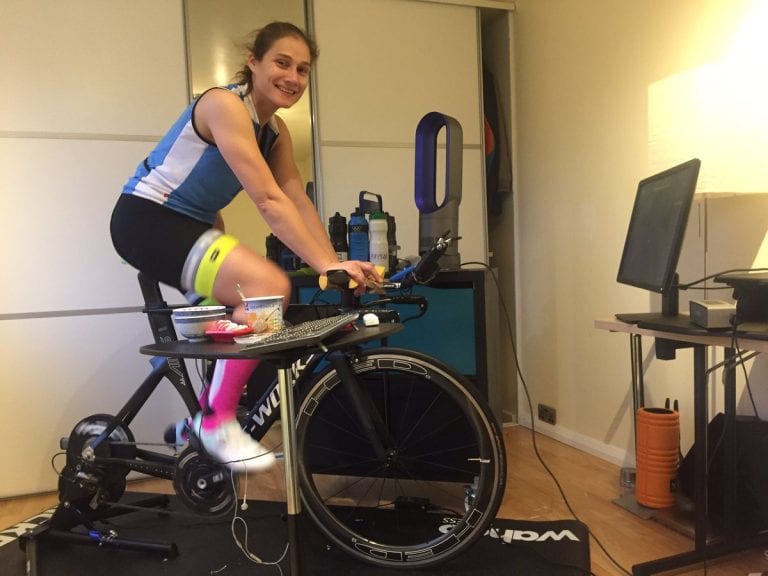
I had initially tried to get the organizers of the London Bike Show to agree for me to do the attempt there, but the additional overnight security costs were way out of my league. On hindsight, I am actually very relieved I did it at my own flat in London, where toilet, kitchen and bed are all only meters away.
Photo credit Natalie Starr
I read that you had a crew. Tell me about them and what their jobs were.
For the Zwift distance record I had a crew of 7 in total, with 6 helping out at my house and 1 from distance. Although, because of the rota, everyone tended to help out with everything and anything required, with a few distinct roles:
Josephine Perry: sports psychologist, mental support
Emily Chappell: social media /PR support (I can’t tell you how stressful it can be if people ask you for interviews shortly before or during an attempt; it really is great to have someone like Emily who can liaise with me for the answers and then can be trusted to get it all sorted)
Sonja Whatson: official photographer, the photos should be available shortly.
Shu Pillinger: Crew Chief, heart and soul of the support crew who knew exactly what help was required, how to hit the right tone with me and also how to turn the whole record attempt into a lot of fun
Holly Seear: general crew: riding with me in Zwift but also helping out at my house as part of the support crew, feeding me, cheering me and, as I found out, just the right size in case you need a pillar to lean onto when the saddle sores become a bit too painful.
Rob Lee: organizer of Zwift support riders rota, helping out from distance, organizing people from all around the world to ride with me for a bit, keeping an eye on me in Zwift and telling me off when I was riding a bit too hard
Rob Gardner: general crew: helping my husband Chris to get everything set up ahead of the record attempt and putting his timekeeper skills to good use by helping to make sure the record schedule sheet was functioning as it should.
Chris Chalder: general crew: my poor husband who was there for the 70 hours straight, helping out with the build-up, shopping, cooking and cleaning up after the party and taking the brunt of my bad mood if I went through a bad spell.
I may be the new record holder, but really it is ‘our’ record. I couldn’t have done it without my support crew.
How often did you take breaks, and for how long?
I took breaks every 6 hours for circa 10 minutes, to have a toilet stop, have a quick wash, apply new chamois cream and change into fresh clothes. Later on my stops became a bit more frequent. Partly because my effort dropped off and I was sweating less but still drinking the same, so needing the toilet more. Later again, the stops became more frequent because the saddle sore pains became more unbearable. I took my first sleep break, of just 25 minutes, after c. 33-34 hours of pedalling. I took a second sleep break of c. 10 minutes on the Monday afternoon after a bad spell between 3pm and 6pm and the caffeine not being able to kick me out of it. The 10 minutes wasn’t quite enough, so I lengthened it with another 25 minutes of sleep. My final sleep break was for 90 minutes after I had broken the previous record at c. 10:30-11pm on the Monday night.
What was your nutrition intake like?
My nutrition was and remains a learning curve. At first I had a couple of bottles of OTE Sports energy drink, vanilla flavored, which I normally quite enjoy, but this became a bit too sweet and didn’t fall well on my tummy. I also had a few Ambrosia Rice Pudding tins whizzed up in the kitchen machine and diluted with water. I think the nutrition that worked best was either the Fresubin 200 ml (a sort of meal replacement drink) diluted with water or real food. The kind of real food that worked well were things like sweet potato and pumpkin soup, but also Nutella pancakes and nice fresh yellow bell pepper, cucumber, grapes and bits of my favorite cheese (Etorki).
Throughout it I also drank a lot of Precision Hydration electrolytes to stave off the cramp (I didn’t have any cramp), some fresh water (as a change to all the sweet stuff) and some flat coke (a treat). Brushing my teeth also was a welcome treat. I didn’t take on many gels, but stuck with caffeine pills instead, but only during my dozy spells, which occurred about 3 times. In total I had about 450mg of caffeine over the whole record attempt, which is about 4.5 cups of espresso, not a vast amount, but enough for someone like me who doesn’t regularly drink coffee.
Were there any point(s) in which you wanted to give up?
No – there wasn’t a single moment where I wanted to give up. I only gave up when I did (after 62 hours of pedalling and 70 hours total time), because the saddle sore pains just became too much to bite my teeth through. My legs and head were still fine. I would have continued if it wasn’t for the saddle sores.
What would you have done differently, now that you finished? (maybe you won’t want to answer this so your competition won’t know your secrets!) And what’s the purpose of wearing your shorts inside-out?
I would have ridden on Zwift a bit more often in advance so that I didn’t feel the pressure of having to unlock faster bikes and wheels and so that I was a bit more skilled at drafting in Zwift, because that takes a little practice. I would have adopted the double bibshorts trick (with the second pad inside-out) from the start. Now I only started that from about 24-hours into the ride, when the saddle sores started to get bad. Having a second pair inside out can help to reduce the chafing and just gives a bit more comfort. But it is also more hot, so definitely requires a good fan. Other than that, I don’t think I would have changed much.
It is a very personal thing though. What works for me, may not be that important for someone else. I welcome anyone to have a go at this record. I know that, if you have the stamina to handle the sleep deprivation and use the right kind of tricks to avoid saddle sores, the record can still be improved by rather a lot. But that person won’t be me. I did this for a specific reason and that mission has been achieved. It was never about the Zwift distance record for the record’s sake.
How long have you been riding on Zwift? How much of your weekly training is on Zwift as opposed to outdoors?
I had only been riding on Zwift for 2 weeks prior to the attempt. I hadn’t even unlocked the 100-mile achievement yet! I literally threw myself in at the deep end. That said, I have done longer turbo sessions (but never longer than 6 hours) on a dumb trainer before. It is winter here now in the UK, so I tend to do a bit more of my training indoors (I don’t like risking falling on black ice and because of my Raynauds my hands suffer quite badly in the cold). Normally I do about 3 shorter turbo sessions during the week and then 2 longer rides outside during the weekend.
I saw on your website that you were also raising money for cancer research. Was there a personal reason for that? And how much were you able to raise?
Yes – see above for my history with raising money for Cancer Research. Since that first fundraising attempt I have unfortunately seen other people losing their lives to cancer, including some very inspirational people still living for their passions up until the very last moment. All our lives are touched by cancer, whether this is something that affects you personally (I narrowly escaped cervical cancer after a CIN 3 diagnosis) or you are trying to support a loved one with cancer as well as you can. I really hope cures for cancer are found soon and every little bit of money I can raise helps.
What are your cycling plans now that you’ve accomplished such an enormous goal?
For me this was an important stepping stone towards an even bigger goal (the LEJOG and 1000 mile record attempt on the road in September this year). But I am afraid that each goal unlocks another… someone just offered me a copy of ‘there and back’ about the LEJOGLE record (Lands End to John o Groats and then back to Lands End again)… it is a slippery slope… I apologize to my husband… I have no idea where this ultra-endurance malarkey will take me!
Is there anything else you’d like to add?
I would like to finish by thanking Zwifters all over the world for riding with me, cheering me on and stuffing my virtual jersey pockets with “Ride-Ons.” I hadn’t anticipated the power of Zwift before, but it is truly unique to be able to connect with riders from around the world in this way. Zwift is a beautiful and very fun training tool and a great way to make indoor and outdoor training go hand in hand. I also would like to say a particular thanks to all the female Zwifters who joined me. It was very touching and inspiring to see that so many of the people who were riding with me as part of the record breaking ride were women. You were awesome. I hope my ride gives you confidence to go for your own goals (no matter how small or large), and don’t let anyone stop you. Dream Big. Set Goals. Take Action.
March 3rd’s TFC race was the first one sponsored by Primal, set over 4 laps of the hilly course. In the A race, Jernst Tempelaar (Race WBR)won a nail-bitting rush to the line. Brett Boniface (ODZ) came in 2nd, and Njal Eivind Kleiven (BRT)took 3rd.
Right from the gun, Boniface (ODZ) went up the hill faster than anyone else (1’33”), but was ultimately caught by a small group. At the bottom of the descent, the lead group of seven was: Boniface (ODZ), Ford aka “Le Monstre”, Kleiven (BRT), Tempelaar (RaceWBR), Lafaye (Vision), Timmisand Brenden. In a huge effort, Andy Webb came back but wasn’t able to hang on in the second climb. Per Brenden wasn’t able to keep up with the front group as well, letting it go in the hill.
Coming into the final esses, Brett Boniface (ODZ) was the one leading the group with Tempelaar (RaceWBR), Ford, Kleiven (BRT), Lafaye (Vision) and Timmis. The Canadian rider, despite his monstrous climbing efforts which awarded him the q/l Report-Combativity Award of the day, couldn’t break that group appart… or did he really want to ? “I have to work on my sprint these days,” says Boniface. “I need to get away from the FTP efforts a little bit, and focus on these short efforts, which require a lot of work.” In the final 2000 meters, Vision’s Frenchman tried his luck, but was ultimately caught in the final hundred meters. Jernst Tempelaar (RaceWBR)took the win over Brett Boniface (ODZ) and Njal Eivind Kleiven (BRT).
In the B category, Rick Barbera (KissRT) outsprinted Timothy Termont (BRT) and Mika Övermark (FK Team). For the Cs, Nick Dickinson (Team TFC) took the win over his teammates Andrew Block and David Winsper. Finally, in the D category, Dave Boudreau (Team TFC) came in 1st, with Andrew Robinson (Type 1)coming in 2nd and Mark Hadeler taking a 3rd.
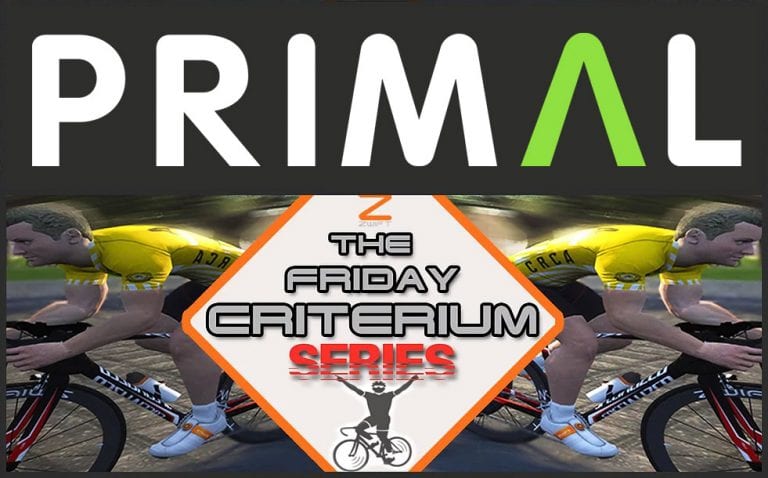
The Friday Criterium Series is rebranding as the “Primal-Europe Friday Crit Series” after agreeing to a partnership deal with the Primal Europe, a popular cycling clothing company. Primal will be offering a variety of prizes and discounts for race participants.
Two TFC races happen each Friday: at 7PM UTC (Europe version) and 7:30PM EST (Americas version).
Prizes
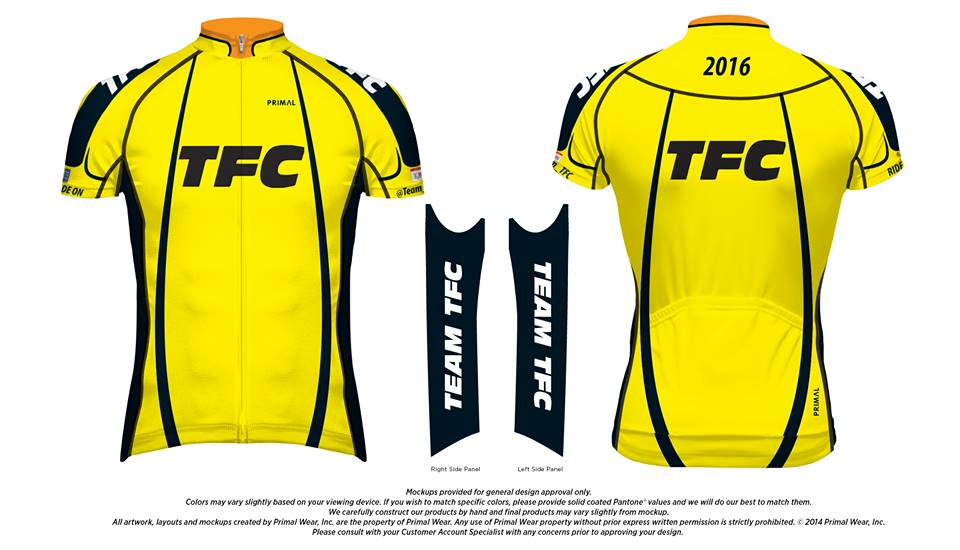
One random racer this week receives the Primal TFC jersey, in race fit Evo trim (£65 value)
£20 Primal voucher for the Cat A winner each week (overall winner between the two races)
A pair of Primal cycling socks for each of the four category winners each week (overall winners between the two races)
A 20% off discount voucher for ALL race entrants
* above prizes only apply to racers who do not get disqualified per the race rules. Make sure you race the correct category!
Part 3 of our Zwift Insider interview with Jody Cundy OBE about turbo training and using Zwift as a training tool (here are parts 1 and 2). Here are the topics we hit on:
How Zwift can be a useful tool for people with disabilities
A cracking story about Adam Duggleby (and setting up a support page for him to get a smart trainer!)
What Jody has planned next (and it will not disappoint!)
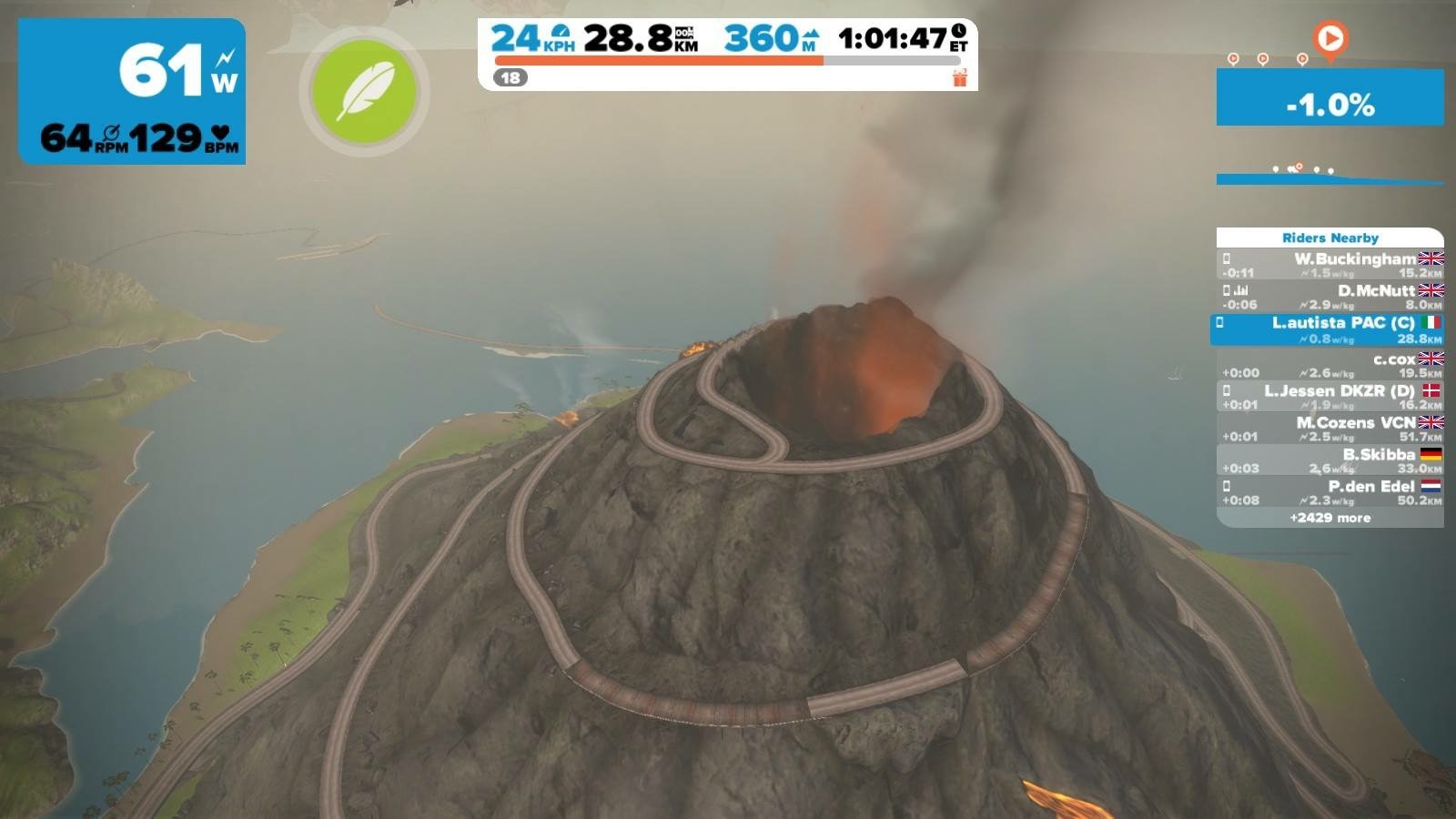
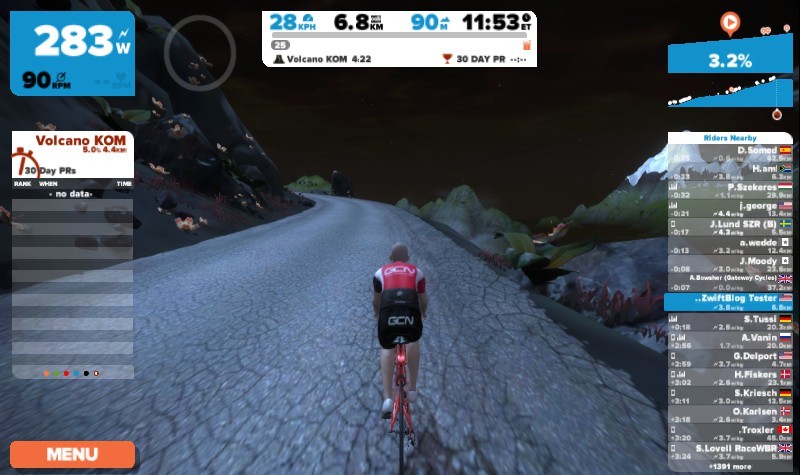
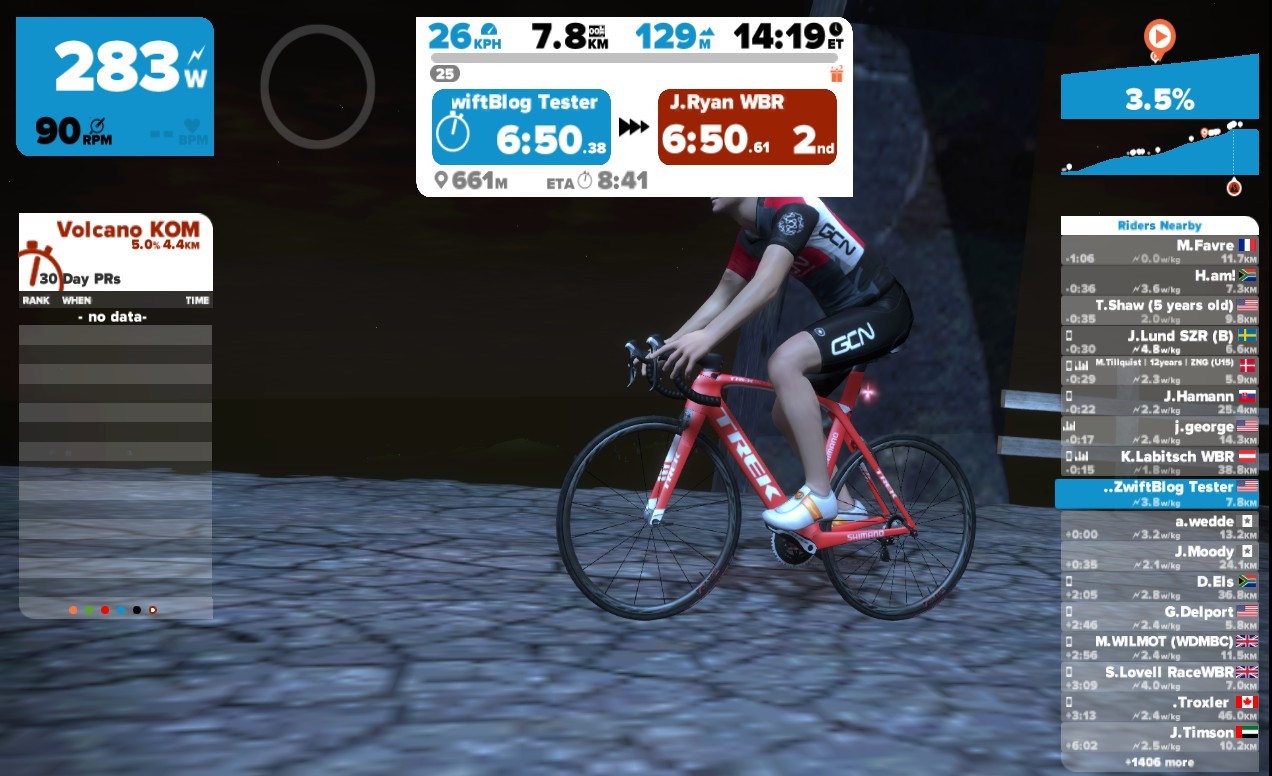
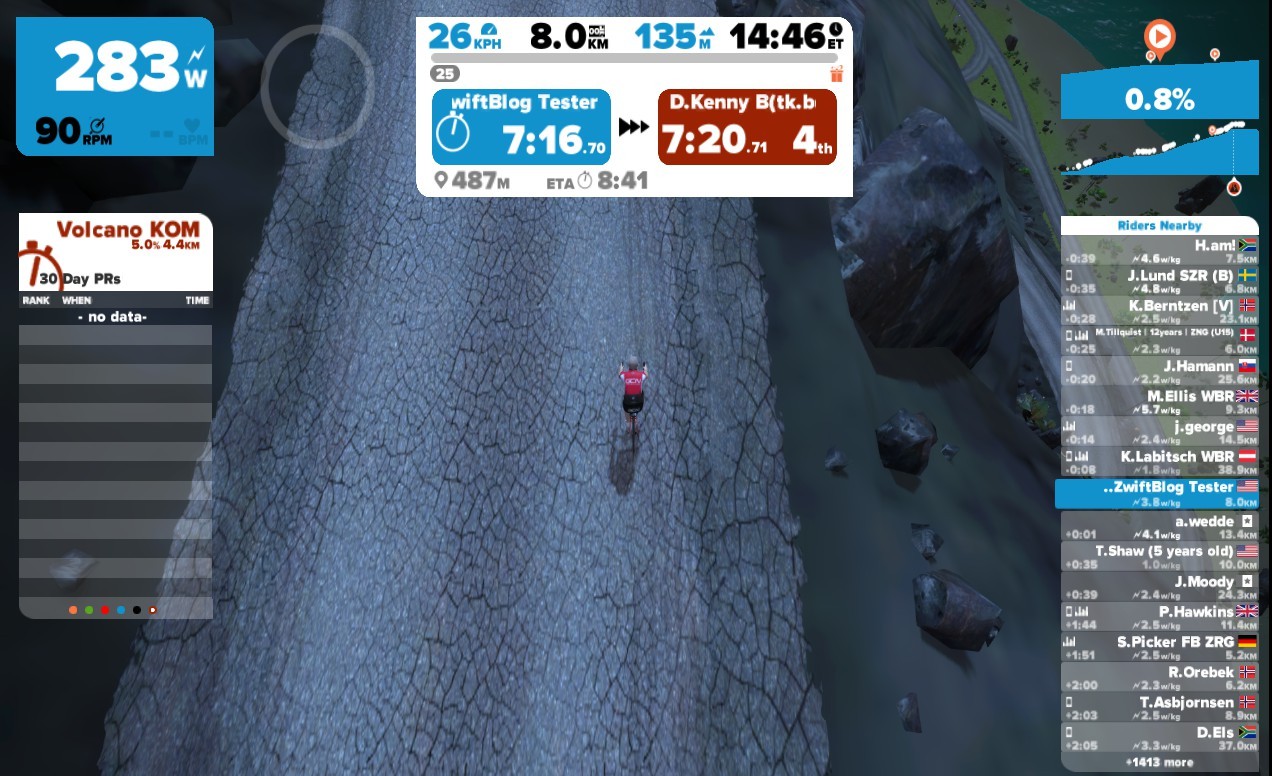
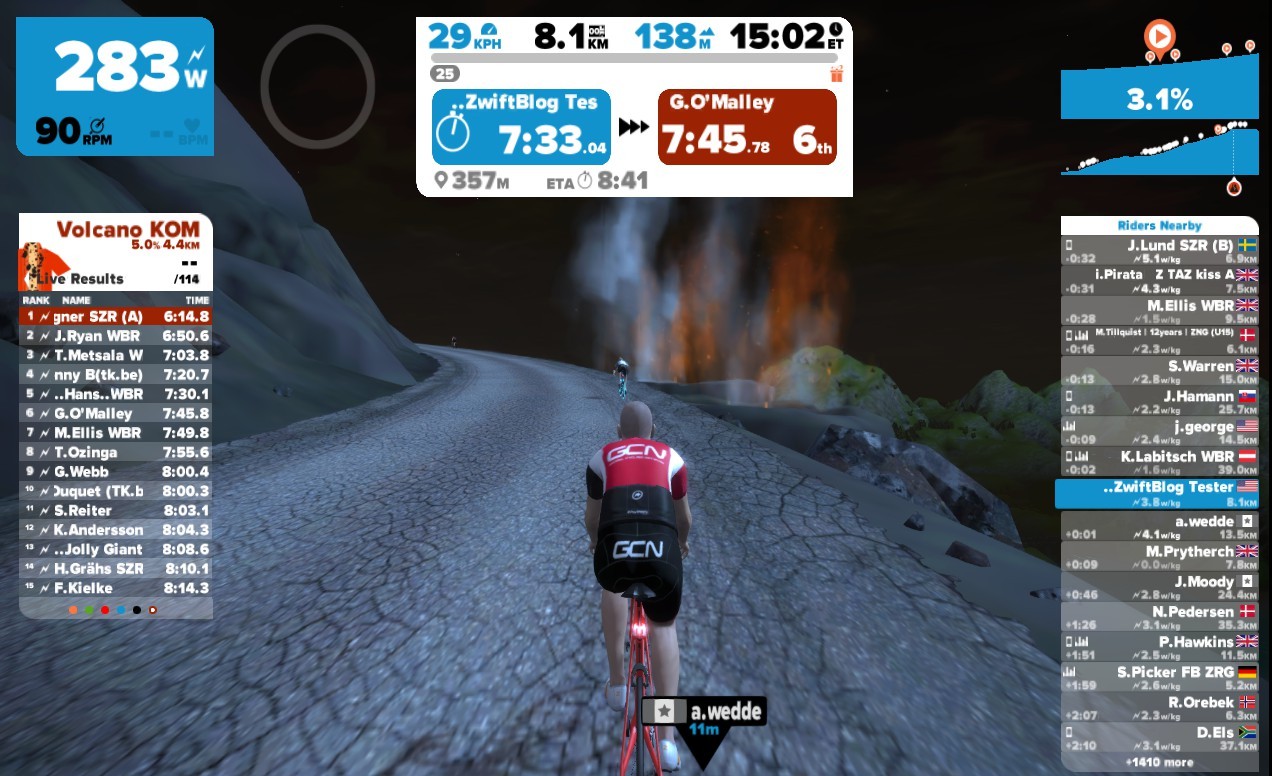
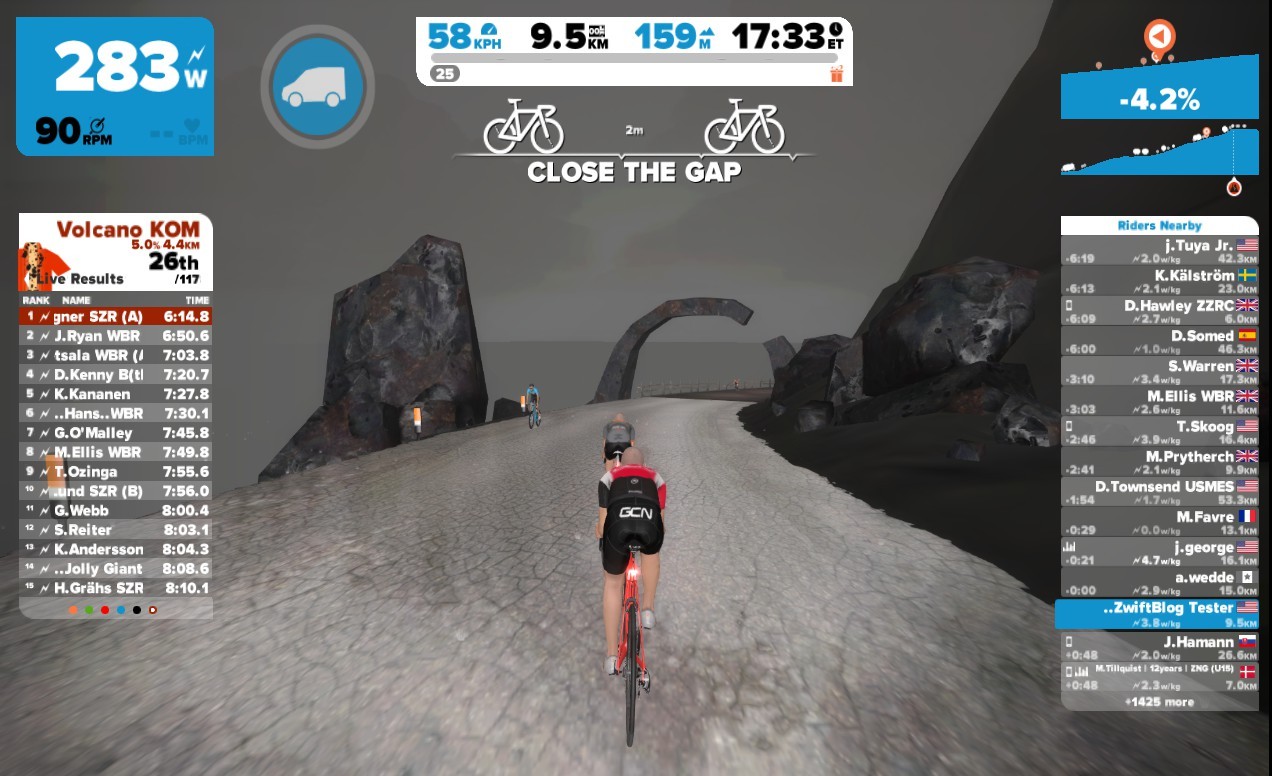
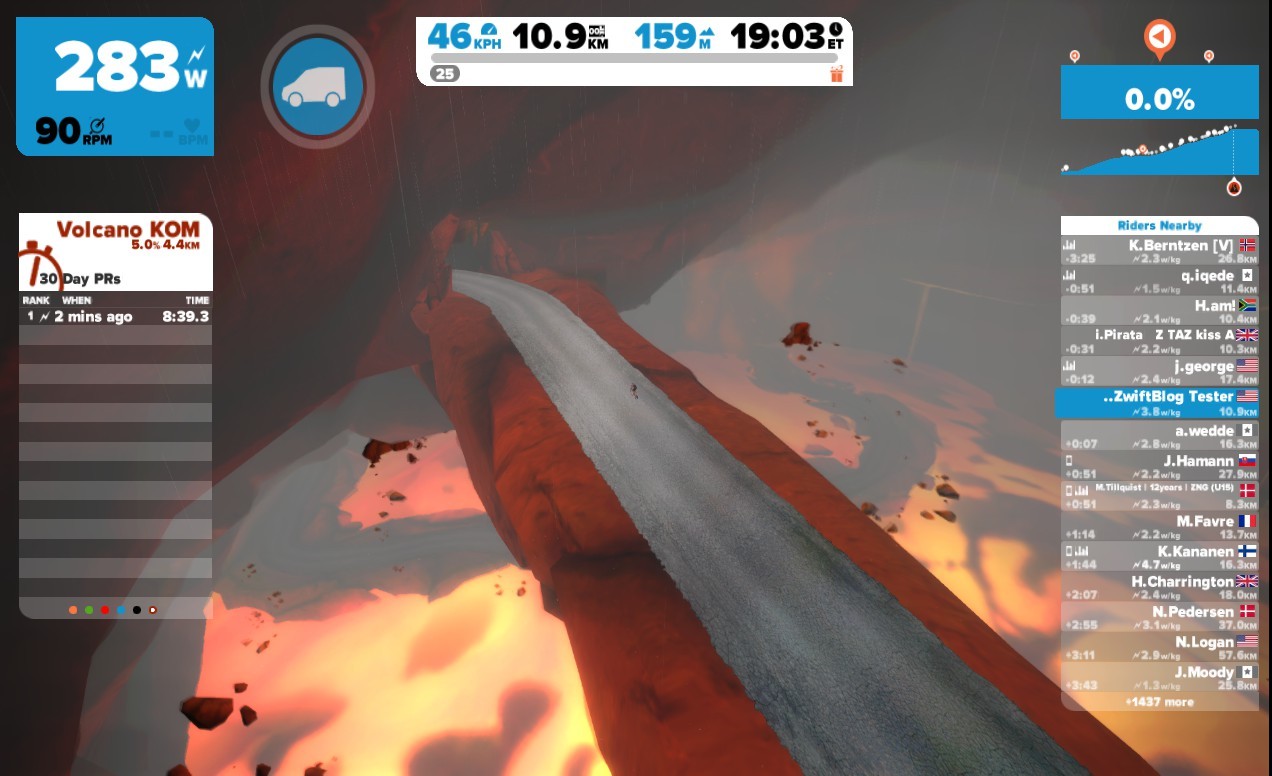
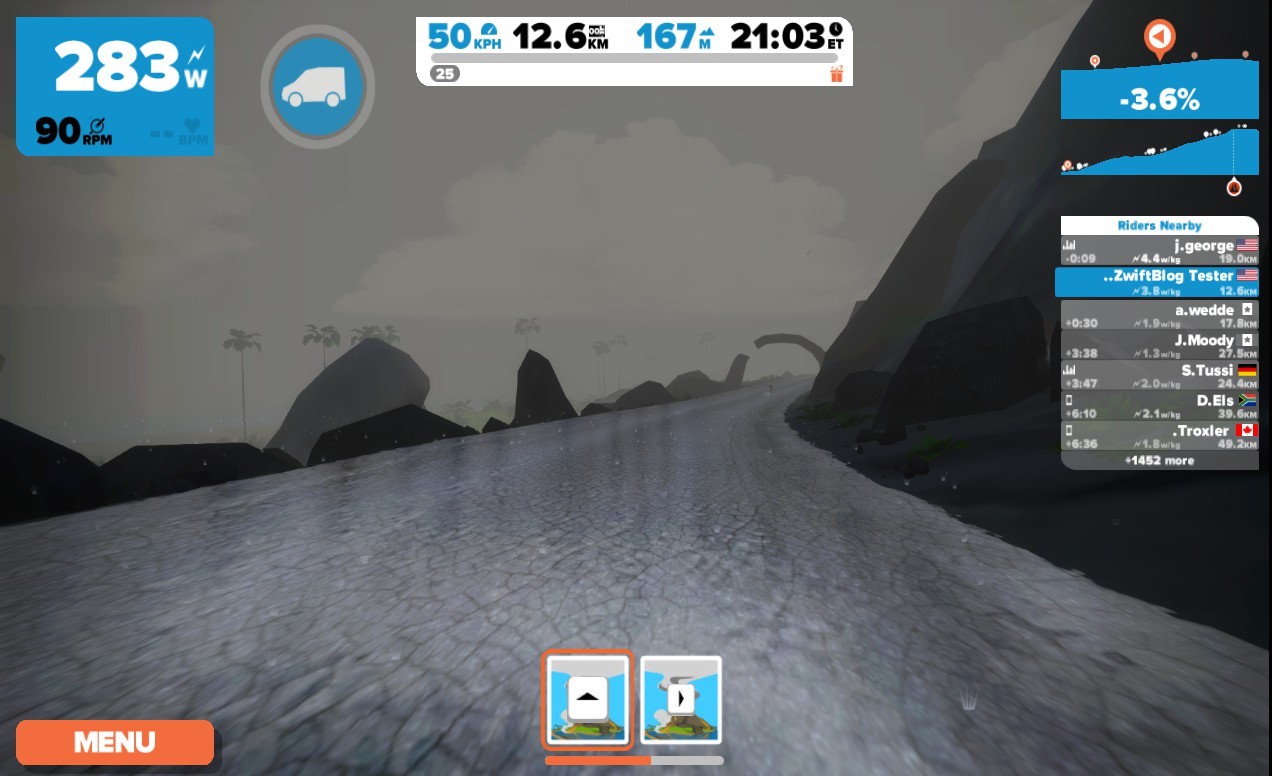
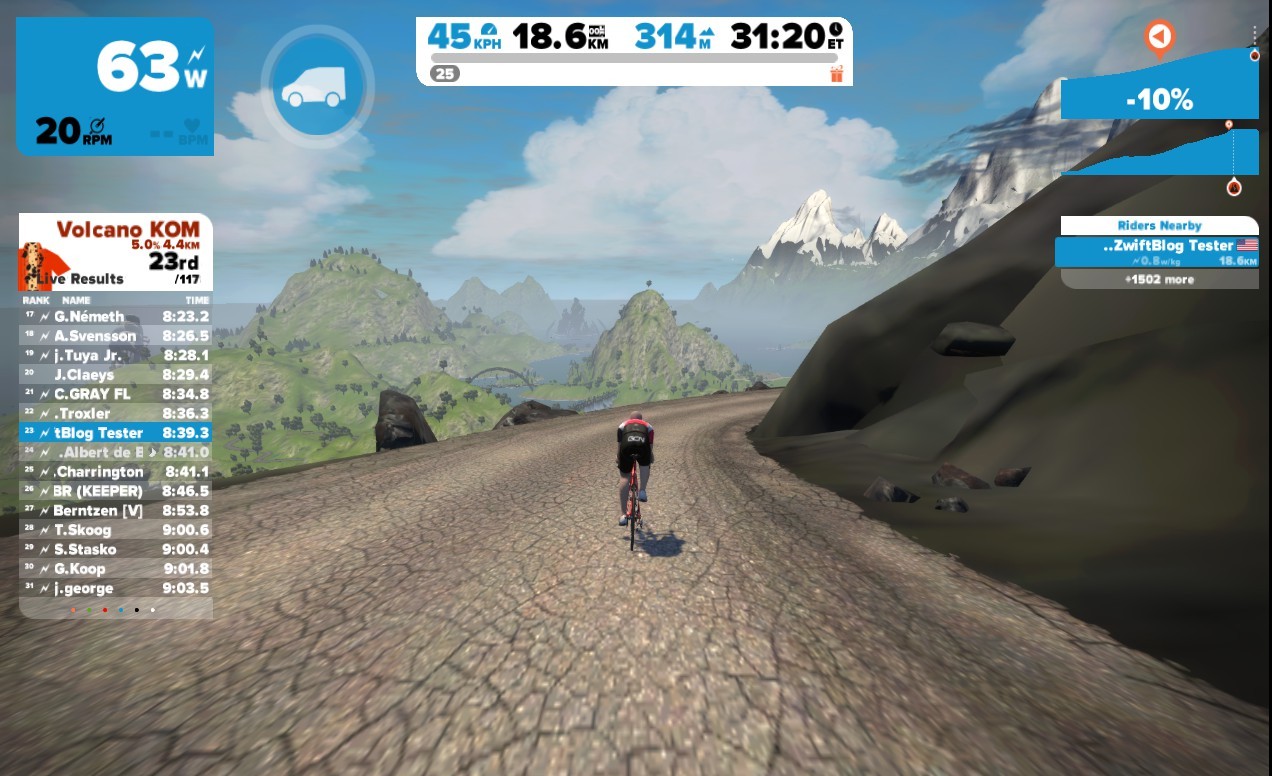
Early this morning ZwiftHQ released the new Watopia Volcano Climb we wrote about just a few days ago. The new climb corkscrews up the volcano on a road which is mostly dirt but also partly sketchy wooden platform. It also goes inside the volcano.
There is currently no route option you can select to take you up to the climb; instead, you must choose to turn onto the climb while riding one of the volcano routes.
UPDATE: since this post was originally written, Zwift released the Volcano Climb and other routes which take you up the climb.
Riders must manually turn onto the new climb
Quickest way to get on the Volcano climb:
Choose “Volcano Circuit CCW” from route menu
On the third turn option that pops up you will see an erupting volcano if you turn left–choose that option.
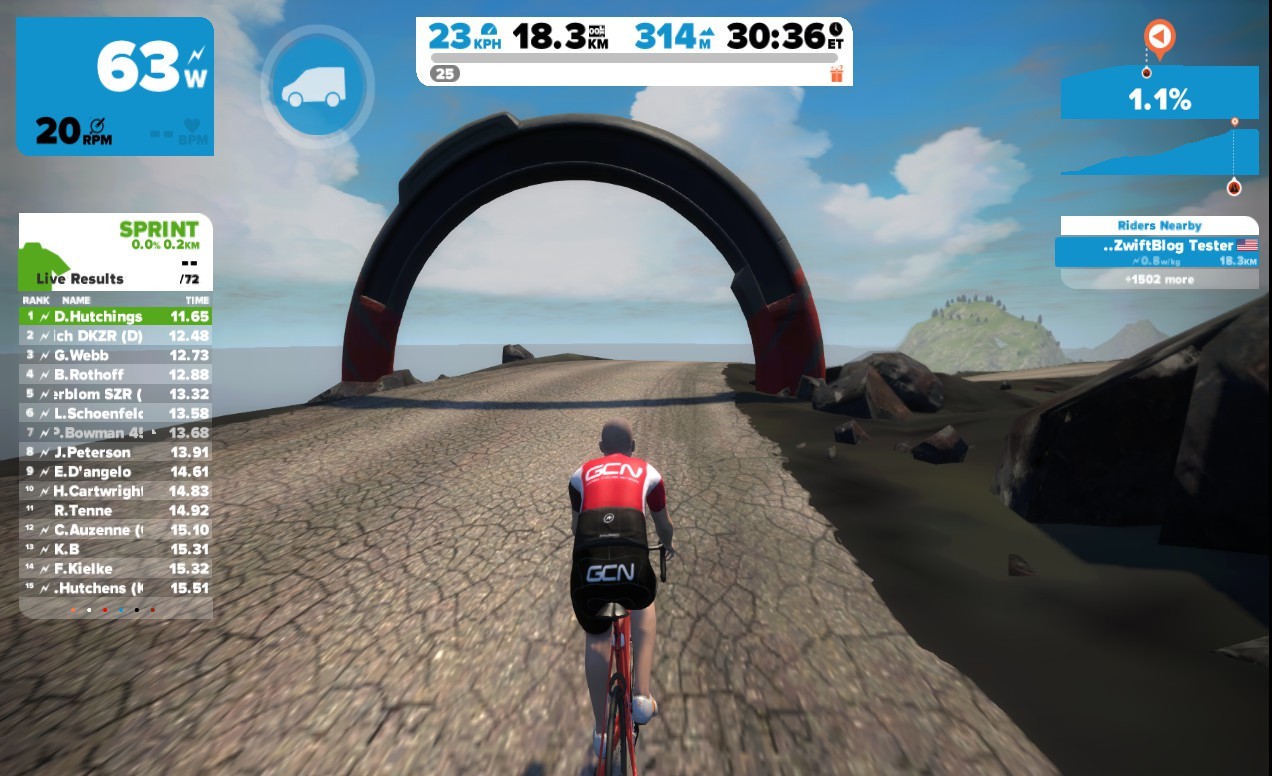
Once you cross the KOM arch at the top you loop around and join the same path you climbed up, descending down the mountain on the other side of the road.
The Volcano KOM jersey which was previously awarded to the fastest volcano circuit rider on course is now being awarded to the fastest Volcano KOM climber. Also, the actual timed KOM does not begin at the stone arch near the beginning of the climb, but a short distance afterward. (The Zwift Insider verified Strava segment begins where the timed KOM begins.)
ZwiftHQ pushed out an update for both PC/Mac (version 1.0.16739) and iOS (version 1.0.16724) early this morning. Here are the most notable changes you’ll see in game:
Ride leader messages now show large and centered on screen even in the event holding area, in addition to still showing in the event chat box (PC/Mac only).
RideOn button is now next to the players name on the right, rather than at the top of the screen
Bug fixes and new graphics profiles for GTX 1050, 1050Ti and Titan X (Pascal) cards
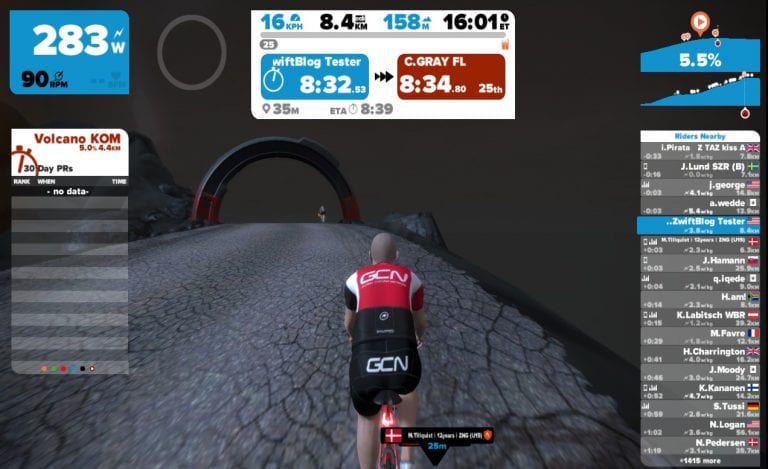
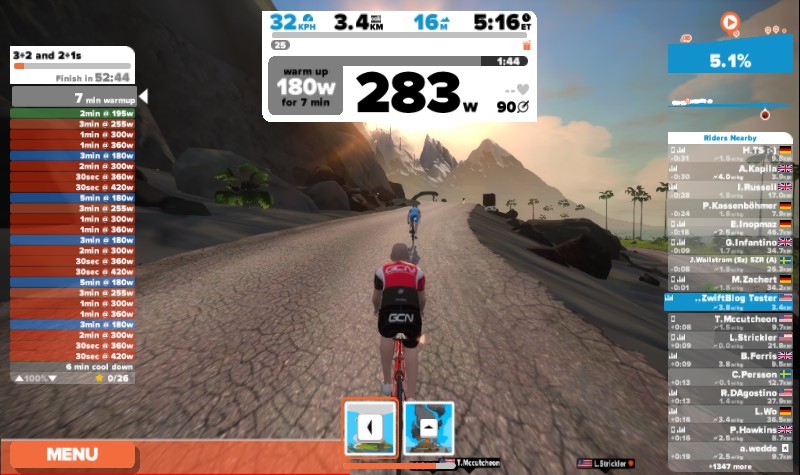
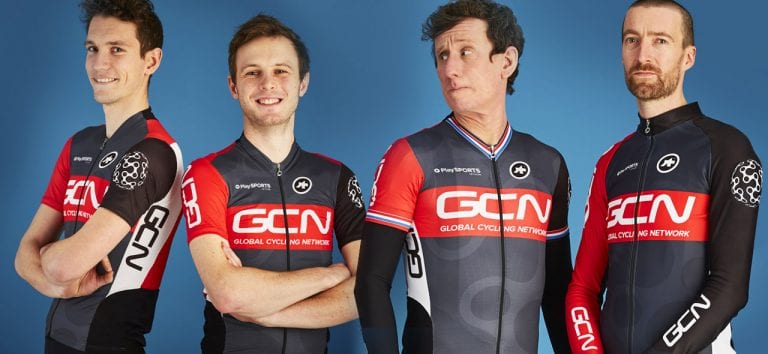
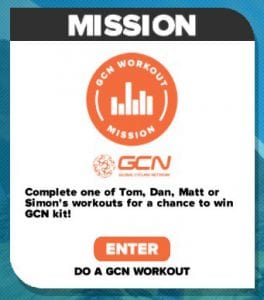
ZwiftHQ has rolled out a new mission for March: the GCN Workout Mission. Sponsored by our hilarious and helpful friends at Global Cycling Network.
How to Enter
Click “Enter” for the GCN Workout Mission on the game startup screen, then choose one of the GCN workouts to complete. Complete any GCN workout to enter. Multiple workouts will not increase your odds, and successful entry is acknowledged by an email to your Zwift account address.





 ZwiftHQ has rolled out a new mission for March: the GCN Workout Mission. Sponsored by our hilarious and helpful friends at