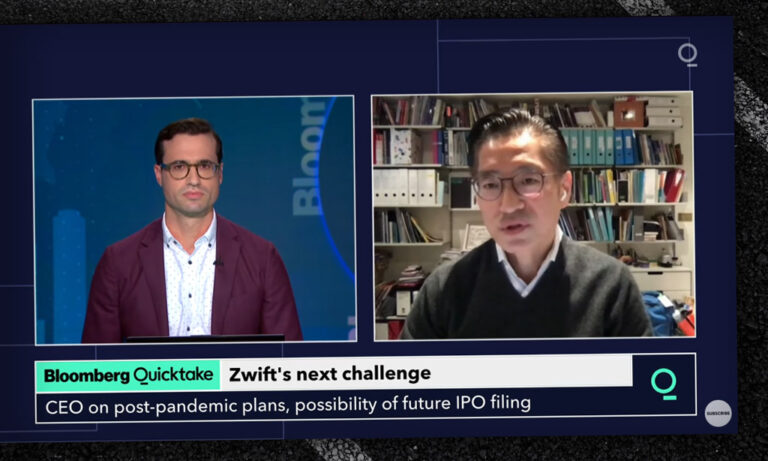
If you’re interested in hearing what the future of Zwift looks like from the lips of CEO Eric Min, check out this brand-new quick interview with Bloomberg Quicktake anchor Tim Stenovec.
Some interesting bits of info from the interview:
Zwift has seen a 263% increase in subscribers since April
More and more people are coming to the platform in order to feel more connected socially. “Think Fortnite for fitness,” Eric says.
A big part of Zwift’s latest $450 million investment round is about making Zwift easier to buy, easier to be onboarded, easier to use. Zwift’s investment into hardware is part of that bigger strategy.
Zwift’s hardware division is focused on developing a smart bike. No ETA given at this time.
Does Zwift have plans to IPO? “We have those ambitions,” Eric says. But for now Zwift is focused on growth and long-term stability.
Eric doesn’t see Peloton as a competitor, but as a complementary service.
Only 25% of Zwift’s customers come from the US, and Europe represents about 50% of their customer base.
Cheating in Zwift races: “There are things today that are very manual that we need to automate.”
Your Thoughts
What do you think about what Eric had to say? Share below!
I’m a big fan of rocker plates–those platforms you place beneath your trainer which allow your bike and trainer to tilt side to side. I’ve used various plates for over four years now, logging over 20,000 Zwift miles atop a rocking platform of some kind.
But there’s one thing that really bugs me about some (or even most) rocker plate setups I see, and it’s time to get it off my chest.
This issue isn’t confined to the DIY rocker plate crowd, although I’ve seen it there. And it’s not just a problem for cycling newbies–I’ve watched many expert cyclists make the same mistake.
So what’s the problem? The rocker plates are too tight, often leading to poor rocking form.
What does that mean, exactly? Well, “tightness” in this context refers to how much force it takes to move your bike from side to side. Next time you ride outside, pay attention to how easy and far your handlebars swing when you’re out of the saddle climbing or sprinting. Chances are they’re moving 4-6 inches side to side, without much effort.
Now watch this CyclingTips video where James is trying out the Saris MP1 rocker plate. (I’ve started the video at 6:24, where James is using the MP1):
Notice how small the range of motion is? That’s because the MP1’s leveling springs are very tight.
Tight vs Loose
Are tight springs always worse than loose springs? Not necessarily–there are plusses and minuses for each setup. I chatted with rocker plate wizard Chad McNeese about this, and we came up with a list of pros and cons for tight vs loose springs:
Tight Springs
Pro: feels more stable, which is nice for new users
Pro: more comfortable than a typical rigid trainer setup (even a bit of movement makes a big difference)
Pro: reduces frame stress created by typical rigid trainer setup
Con: usually results in incorrect bike lean/pedal timing (more on this below)
Loose Springs
Pro: increased range of motion allows a more realistic feel
Pro: more comfortable than a typical rigid trainer setup
Pro: reduces frame stress even more than a tight spring setup
Con: less stable, requiring more body engagement/rider attention
In summary: new rocker plate users will probably feel more comfortable on a tighter setup, because that little bit of movement takes some getting used to when you’ve been training on a rigid setup. But once you’re used to the motion, chances are you will want to loosen it so you can get full, natural motion out of the saddle.
Bass Ackwards
By far the biggest problem with an overly-tight setup is that it leads riders to adopt terribly incorrect out of the saddle form.
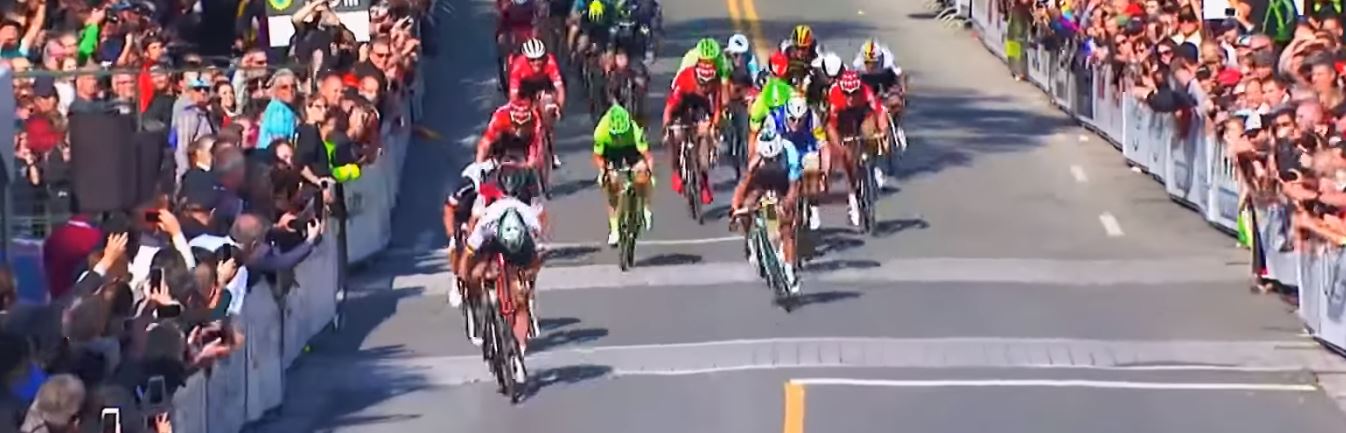
Look at this shot of Peter Sagan winning the 2017 Grand Prix Cycliste de Québec. Note the out of the saddle sprint form of all these pro riders: specifically, that the bike is leaning away from the leg that has the pedal down.
This is proper, natural pedaling form– pulling on the handlebars and leaning the bike add power to the downstroke, as the lean is effectively pulling the pedal up while your leg is pushing the pedal down. And as you lean the bike one way, your body counteracts that lean with its weight in the other direction so you stay balanced.
In fact, it can’t work any other way outside–if the bike was leaning in the same direction as your body and down leg, you would fall over!
GPLama Shane Miller talks about this very problem is his “Round 2 Rockit Launcher” video (below). Around the 2:50 mark he says, “Every video we’ve seen of people out of the saddle on a rocker plate looks like this.” And he’s not wrong–I’ve seen so many bad videos.
But it is possible to have proper out of the saddle form indoors. Here’s a quick demo video I shot which demonstrates basic, proper form out of the saddle on a rocker plate–both climbing and sprinting:
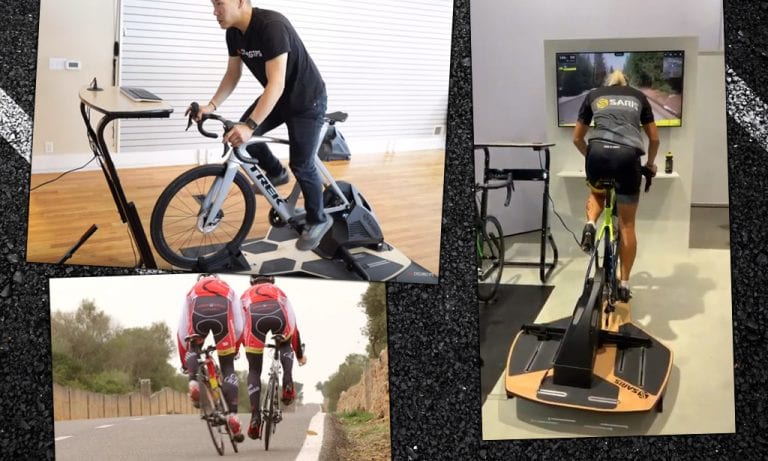
Now compare my form to what I saw at the Saris booth during Eurobike 2019. (Keep in mind this was an experienced, paid rider–and the other booth rider was exhibiting the same form!)
Saris isn’t the only one who can’t seem to market their own product well. Even SBR, whose rocker plate I really love, displays a demo video on their homepage showing this backward form:
Tight rocker plates lend themselves to this poor form because the rider is forced to use their own body weight to lean the bike over.
Proper technique has the bike swinging side to side quite freely while the body stays upright, counterbalancing the tilting bike. But a tight plate requires the body to lean right in order to tilt the bike right, then lean left to tilt the bike left.
Best of Both Worlds
So what’s the solution to this rocking quandary?
Adjustable tightness, and awareness of proper form. That’s it!
Most rocker plates use some form of adjustable spring: the SBR ROCKR uses inflatable rubber balls (less air for a looser feel), as does the CoPlate. Chad McNeese’s DIY Rockit Launcher uses foam blocks that can be swapped out to vary the tightness.
Some very simple “single platform” rocker plate designs such as the Axxion Rocker Plate aren’t adjustable since they have no “moving parts”. And the most notable exception to the adjustable norm is the Saris MP1, which costs around twice as much as the SBR ROCKR and CoPlate without allowing adjustment. Ouch.
(I don’t want to bag on Saris too much: the MP1’s build quality is rock solid, and it allows significant fore-aft movement, which the other rocker plates do not. But the spring’s tightness combined with a lack of adjustability is a deal killer for me.)
Embrace the Process
Once you have a plate with variable tightness, set it where you’re comfortable, while being careful to maintain proper out of the saddle form.
Note that if you’ve done a lot of riding on a rigid indoor setup, it may take some hours of riding to adjust your form before you feel comfortable on a rocker plate. This isn’t a bad thing – you’re unlearning unnatural indoor habits and returning to more natural motion.
If you can’t lean your bike to one side without also leaning your body to that side, your setup is too tight. Loosen it up, get used to the feeling of having your core more engaged and your bike a little more free-floating… and enjoy it!
Rock on.
Your Thoughts
Are rocker plates inherently flawed? Just a passing fancy? Or perhaps victims of their own poor marketing? Share your thoughts below!
This season especially, a lot of the athletes I coach have turned to Zwift to get their racing fix. More often than not they will start off saying something like, “Well there aren’t any tactics are there? It’s just a time trial with a sprint at the end right?” That is exactly what I thought when I started poking around the early racing scene on Zwift in 2016. Right out of the starting pen I was on the back foot, clamoring for a draft that didn’t seem to be there and desperately trying to stay at the front of the group holding 5-6 w/kg. There was no relief – at least none that I could find. That first foray ended quickly!
The following indoor season, I came back to Zwift racing. I figured out the requisite “hard start” and saved myself a lot of agony moving up the pack but I still didn’t really get it. I thought that to stay in the action, I needed to be in the top 5-10 riders like in real life (IRL) road races. I would ride hard the whole way to ensure that and then a bit harder on the climbs to try to break free.
It was great training but I wasn’t racking up any results. I’m sure I would have learned more but after that my road career started picking up speed. I began spending winters in Arizona instead of on the trainer, so Zwift racing faded into the background.
Into the Deep End
In 2020, Zwift racing roared back to the forefront. The Echelon Series stage races in May and June were a big opportunity to race against our usual professional competition and some top e-sport teams and gain bright exposure in a season of static.
I read all I could about how to actually compete on the platform and watched big races regularly on Zwift Community Live. As a team, we did practice races and gradually the tactical nuances came into focus. I started to understand the timing of attacks and response and how to dial in the minimum effective power to stay in the draft. Looking back, I still barely knew what I was doing and good legs saved me from more embarrassment as the real Zwift racers surgically attacked the courses. But I kept watching and racing and gradually came up to speed.
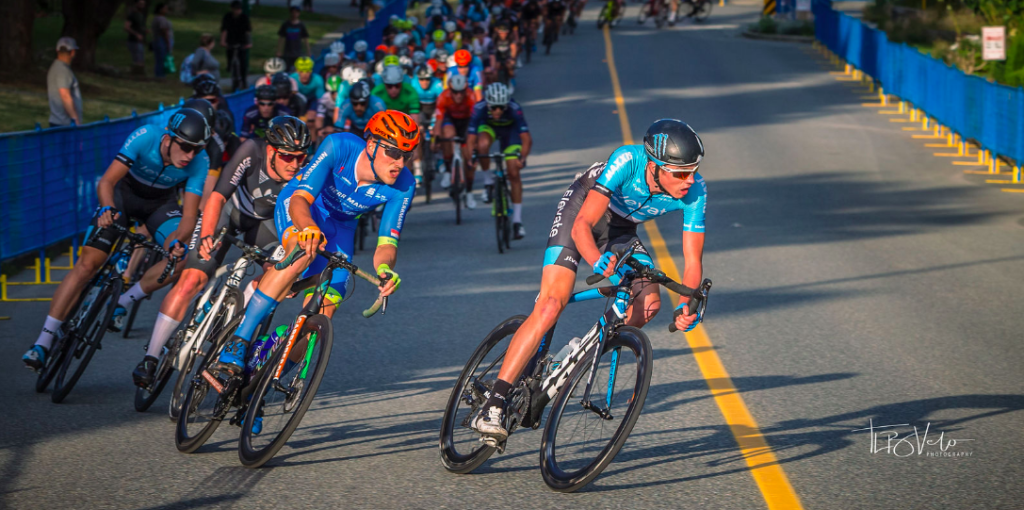
Working as a team to attack an IRL crit (Photo credit TLB Velo)
Pinch Points and the Psychological Battle
No one would argue that racing on Zwift is the same as racing on the road. You can tell instantly the difference between an IRL race power file and a Zwift race file. The drafting dynamics make the difference.
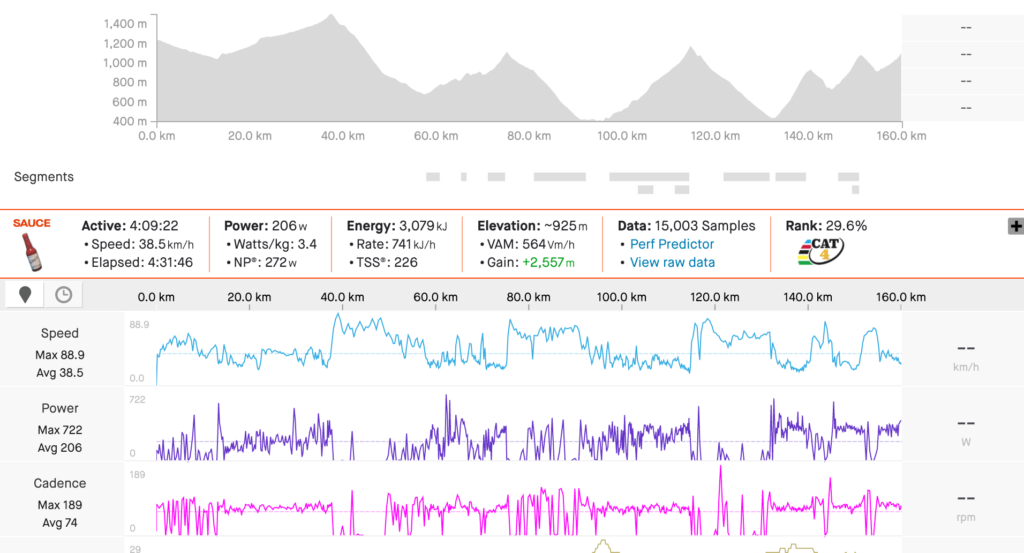
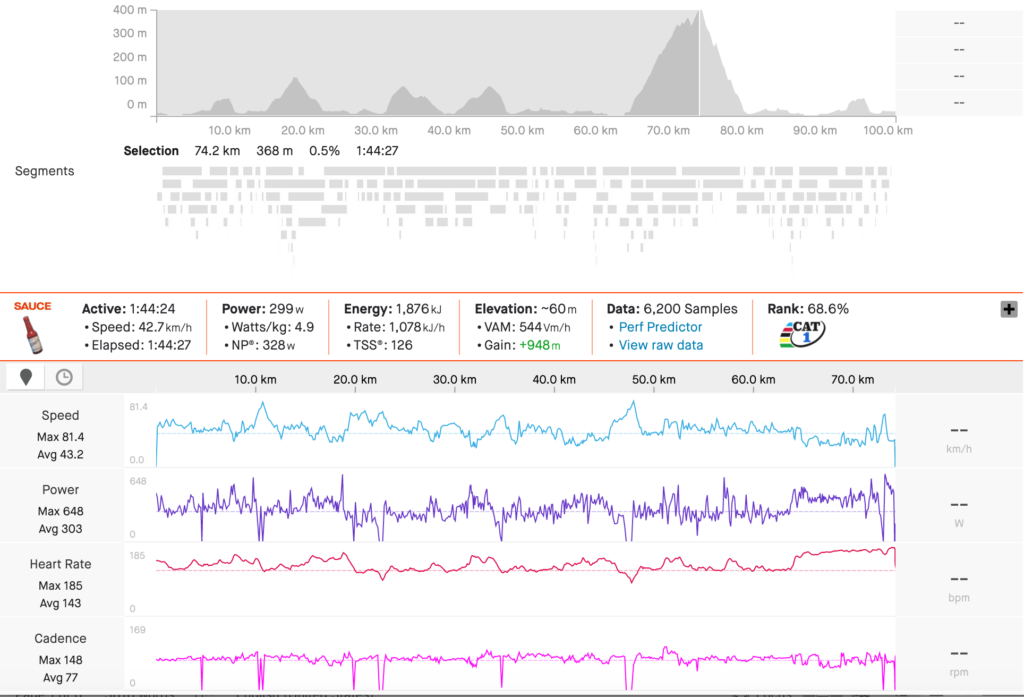
On Zwift, it is harder to ride in the draft – on the flat at 45kph you might need to do 200-225w on the road but 250-275w on Zwift. It is also is much harder to ride away solo, since the power of the pack is bizarrely cumulative and 50 riders all pedaling at 250w will likely keep pace with an attacker doing 350w. That changes everything from start to finish, promoting a defensive grind rather than the start/stop frenzy you see on the road.
Power data from an IRL mountain stage win (206w average).png
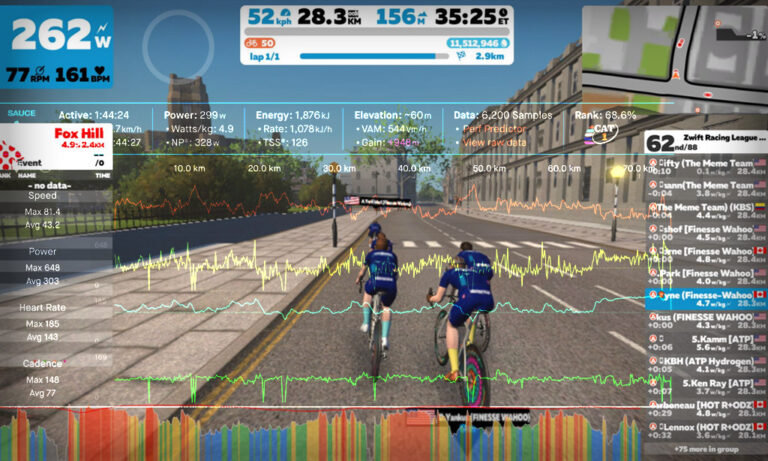
Power data from Zwift Mountain Stage (303w average!)
Still, you can attack and break a race apart. There are actually similarities to IRL racing when it comes to making that happen. There are pinch points: climbs, turns, dirt sections, and undulations where things happen in Zwift just as they do on the road. Their importance is magnified in the Zwift peloton. If you hit certain points in certain ways and employ the strength of your team you can gain a big advantage. You can also get spat out rapidly here and left for dead if you aren’t anticipating the movements! If you want to make an impact, studying these parts of the course is paramount.
Additionally, there is a psychological similarity between attacking on the road and on your laptop. An experienced pack knows the pinch points and sometimes you still can’t find daylight with smart riders on alert. One of the only backup strategies for a rider like me (lacking a decisive 10-30s attacking punch) is to play on the mental and physical fatigue of the field.
As a time trial type rider who can manage sustained pressure, I am usually better in the hardest parts of a race. Still, even a tired group of 20 drenched in lactic acid can bring back an attack from me or almost anyone on the flat if they want to. So I have found it is important to find the moments that they don’t want to. If it has been full-on for 45 minutes, teams have lost riders, and sprinters are doubting themselves – it is a good time to go. It’s no guarantee for success, but it’s probably the tactical similarity to road racing that makes me enjoy Zwift racing the most.
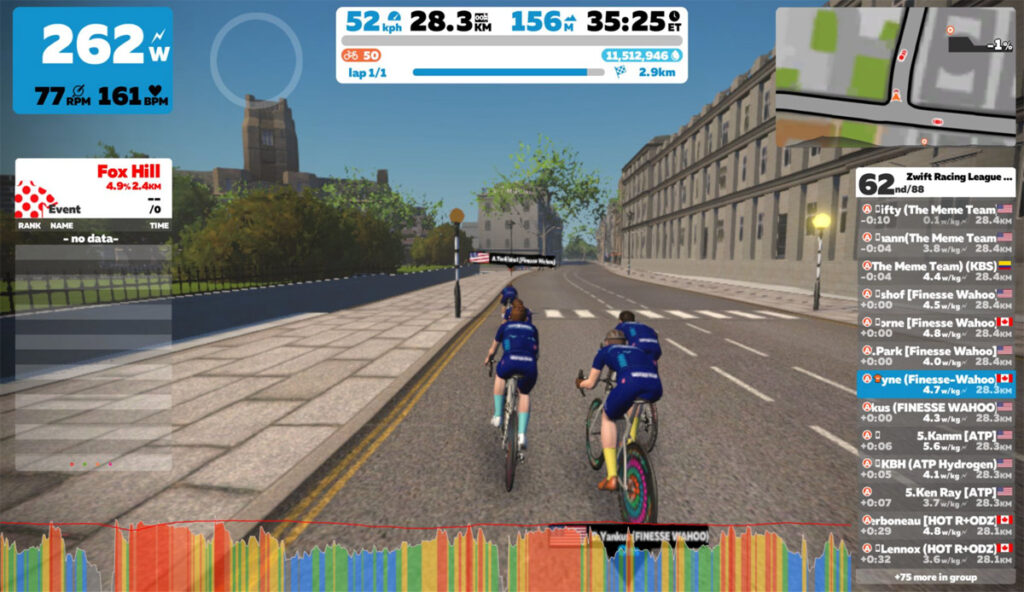
Finesse Wahoo about to catch the competition in ZRL TTT
Figuring it out with Finesse-Wahoo
When I came to Finesse-Wahoo this fall they already had a reputation as an aggressive, entertaining team willing to try multiple moves in any race. In my first real event with the team, we made the popular and usually sprinter-friendly Austin Driveway hard from the start and ended up winning out of a breakaway. That worked for me.
I have started to find my best role in forcing moves away and backing up the attacks of my teammates with sustained pressure. That worked perfectly in week 5 of the Zwift Racing League race on the NYC Everything Bagel course. I pushed hard up the last KOM with around 10km to go and we escaped with 3 riders out of 6. I stayed on the gas, pressed our numbers advantage, and the guys crushed it at the end for a 1, 2, 5 result.
A successful effort in NYC, repeated attacks and counters and then driving the group away
We are all still learning, though. This game moves too fast and has too many variables for anyone to gain complete mastery. This is poker, not chess – the human element can cast your “20-moves in advance” strategy into shambles at any moment.
Unfortunately, that was the case in our latest ZRL outing in France in week 7. We had an ambitious plan based on careful analysis but we outmaneuvered ourselves into our first scratch race loss of the ZRL season. Tactics rely on fluidity and communication just as they do on the road. It stung but I learned more about my own racing and the game itself than I have all season.
Next time we will be that much smoother in our execution. It’s all going in the bank and I’m hoping I can make the right moves at the right time in the UCI Esports World Championships on December 9th.
Heading into race #7 of the Zwift Racing League, I knew three things for sure:
My competition can outclimb me on anything semi-steep and over ~60 seconds long
I can sprint decently well
I don’t get dropped on the flat parts
These facts would inform my strategic decisions as we took on a modified 47km version of France’s Petit Boucle route. Unfortunately, it’s what I didn’t know that would hurt me in the end…
A Messy Warmup
As usual, I chewed some caffeine gum before the race – about 90 minutes before our 10:20am start time. I was working on a pile of Zwift Insider stuff, though, and the time slipped away from me! One minute it was 7am, and the next minute it was 9:30 and I was running late for my warmup!
So I quickly zipped downstairs, applied PR lotion on the legs, kitted up, and got on the bike. I really dressed up for this race, too – wearing a Nopinz Subzero jersey. I’ve decided you all probably don’t need to see more of my flesh than absolutely necessary, and since the office stays quite cool in this fall weather I figured overheating wouldn’t be an issue.
This morning was a mess – my most poorly-orchestrated warmup in recent memory! My plan had been to get onto the France map to do some recon of a few key areas: the Petit KOM backside climb, the descent (testing my supertuck!) and the sprints for timing. Unfortunately, my computer took forever to boot into Zwift (not uncommon after an update) so I had to do a long reboot. Then I wanted to save a good spot in the starting line, so I had to join the event then exit in order to ride free again. By the time I was back on course I only had time to partially make it up the climb before it was time to head to the start pens.
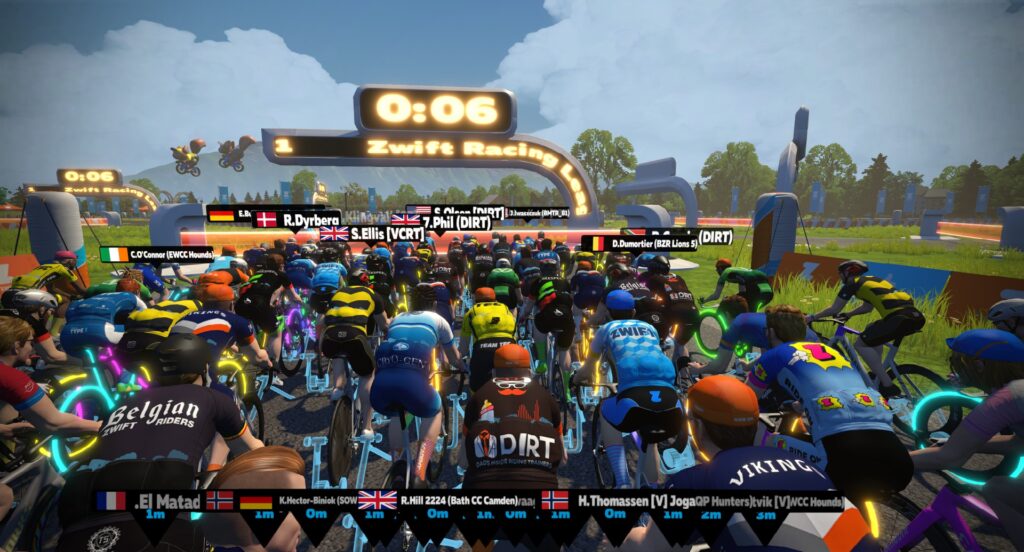
In the start pen
Before the Climb
I broke this race into three major sections mentally: before the climb. The climb. And after the climb. Before the climb we had the race start, followed by the Pavé Sprint Reverse, the Aqueduc KOM Reverse, and the Ballon Sprint Reverse.
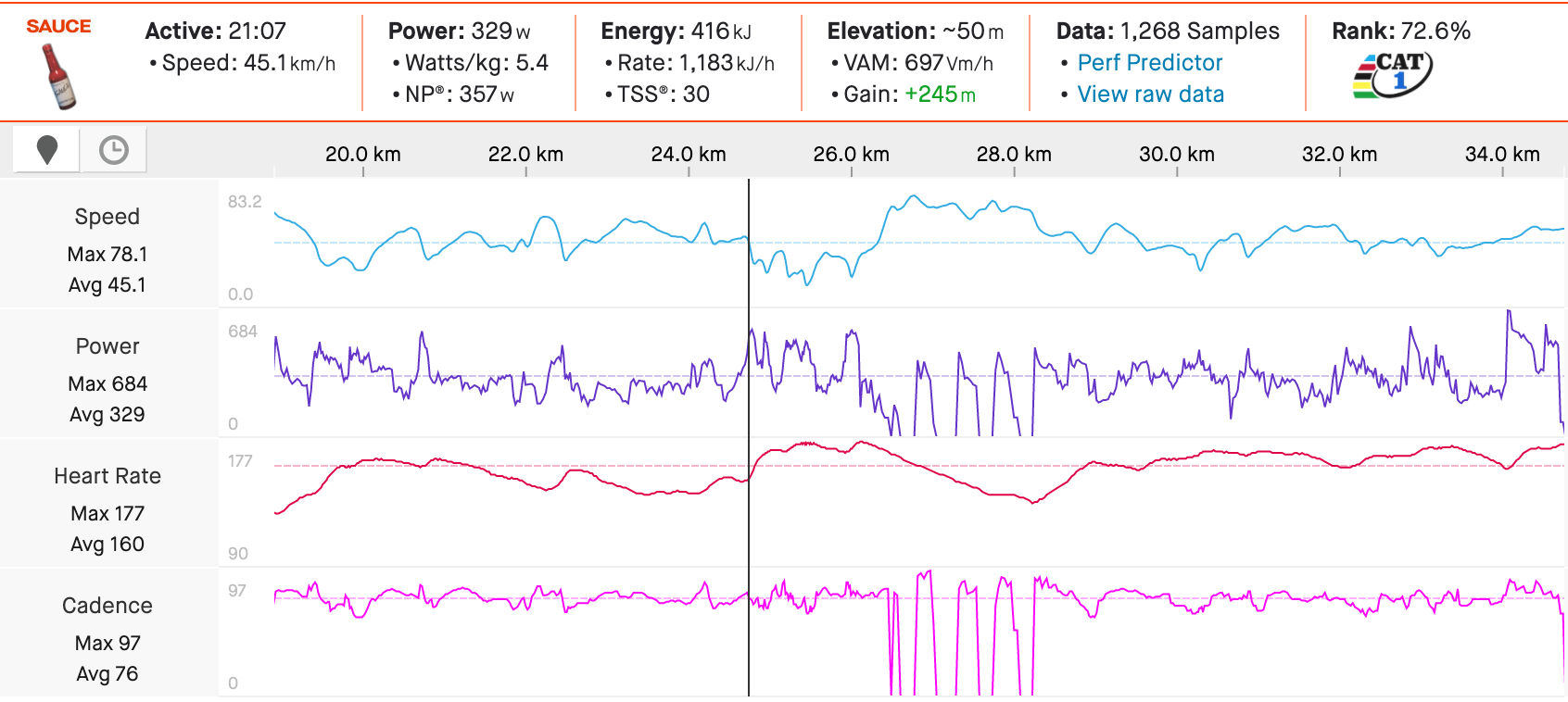
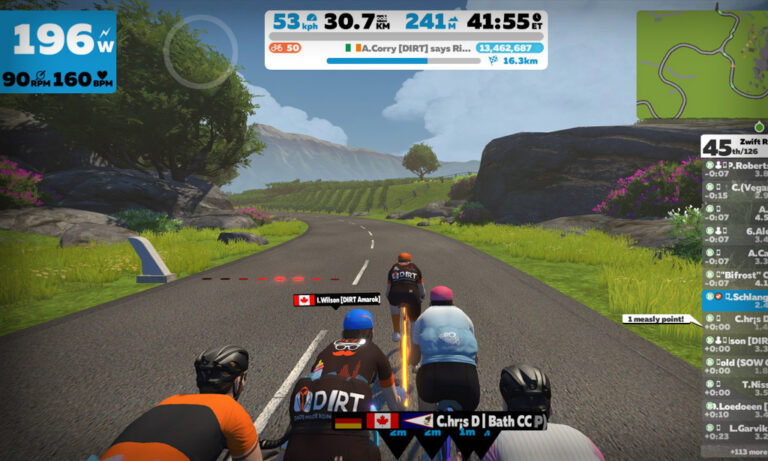
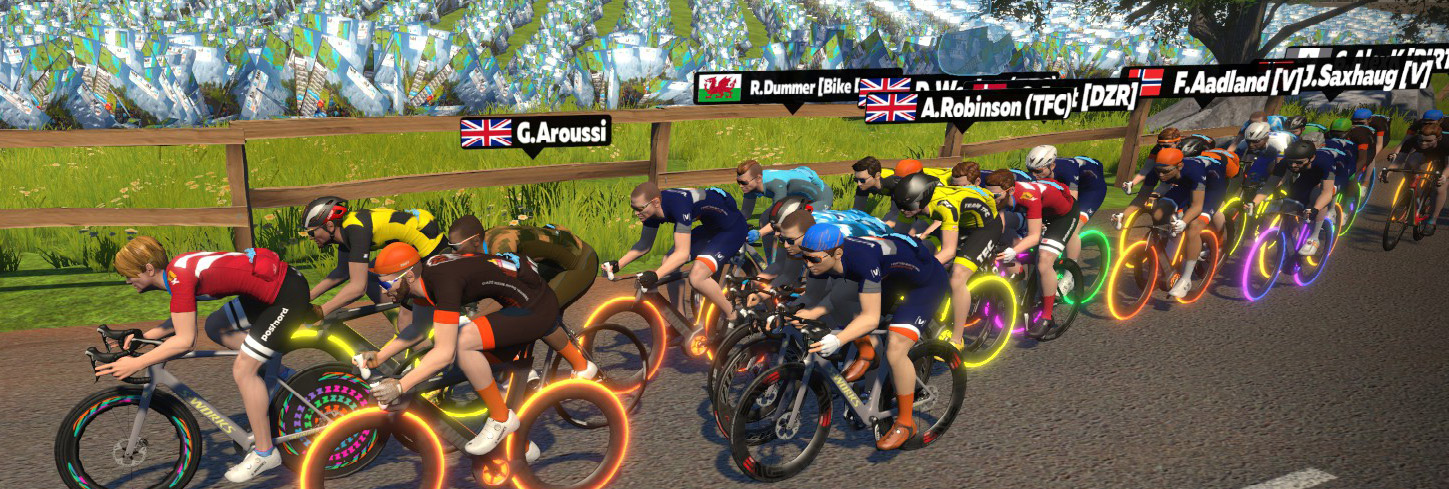
The race began sedately enough, with 126 riders who were experienced and smart enough to know that big attacks early on would have little effect. Plenty of places for those later on! 317W kept me near the front of the pack for the first 3 minutes.
Going for the Sprints
Figuring I probably wouldn’t make it over the climb in the top 30, I had decided I would go for the two sprints in an effort to get some extra points for my team. Unfortunately, my recon plans hadn’t panned out. I knew the location and rough length of each sprint, but I hadn’t done enough sprinting on France to know where I need to start putting the power down, how long the sprints are, and precisely where they start and finish.
As we approached the Pavé Sprint Reverse, one rider went early, and I got a late jump. I started the sprint, but seeing that I wasn’t going to get into the top three I eased up to save my legs. The Aqueduc KOM Reverse was coming just 2 minutes down the road, and I wanted to make sure I didn’t get dropped!
Giving up on the Pavé Sprint Reverse
Aqueduc KOM Reverse
The Aqueduc KOM is interesting, because it’s really more of a forced sprint than a climb. There’s a bit of a false flat leading into it, but the actual timed section is only ~40 seconds long and not terribly steep. So it’s all about staying in the draft and keeping the power high up and over the top, then grabbing a wheel on the way down.
Check out the wacky bug in what’s supposed to be French lavendar plants! It’s showing screenshots instead?!
And that’s exactly what I did. This effort was surprisingly easy – the most “surprisingly easy” part of the race for me, in fact. I’m no climber, but short little kickers I can handle, since I can carry a lot of momentum in and keep my speed up over the top.
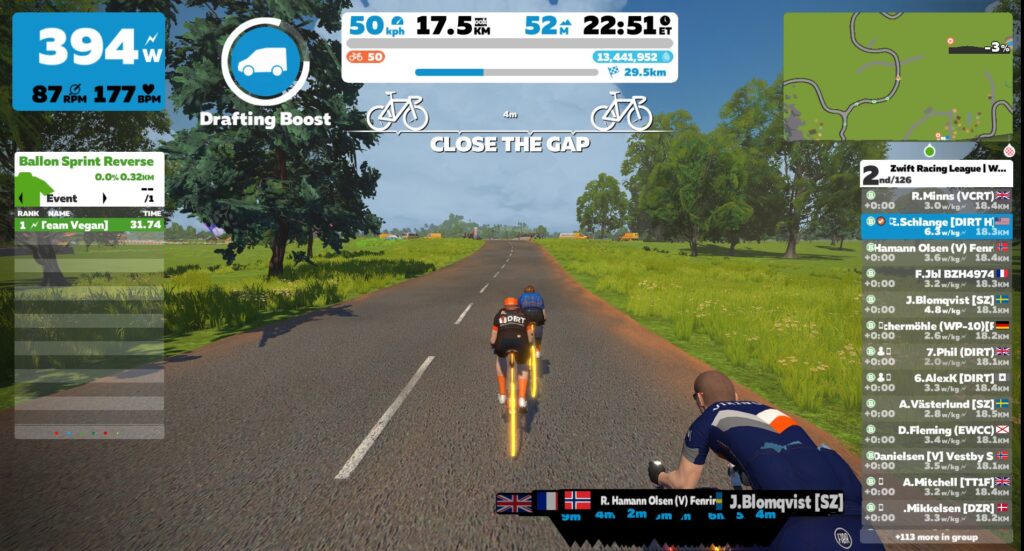
Ballon Sprint Reverse
After the Aqueduc it was time to spin the legs out and determine how to do better on the Ballon Sprint Reverse up the road. This was probably my last chance for extra points, after all! I remembered the sprint being fairly short, but wasn’t sure exactly where it began. Cursing slow-booting Zwift under my breath, I kept a wary eye on the minimap then strained my eyes to see the start line up the road as we neared the sprint.
One rider jumped off the front and I bumped up the power to stay on his wheel, figuring I may get a good slingshot into the sprint. He eased off the power though, just as I saw the start line up ahead – so I rolled through, shifted, stood up, and went for it! Two SZ riders zoomed up from behind, but I was able to stay ahead. I might be able to win this! Push, push push!
But how long was this friggin’ sprint? I was flagging, and in the last 5 meters of the sprint I went from the front slot to… 5th, according to the leaderboard! Nooooo! That sprint was much longer than I remembered. I’d burnt another match, with nothing to show for it!
Going much too early
The Climb
Licking my wounds, I tried to set my mind on the battle of staying with the pack on the twisty, rolling section I like to call Les Intestins. But my legs were feeling that sprint effort, and I couldn’t shake the sinking feeling that any chance of staying with the front group over the upcoming climb had evaporated with that last sprint attempt.
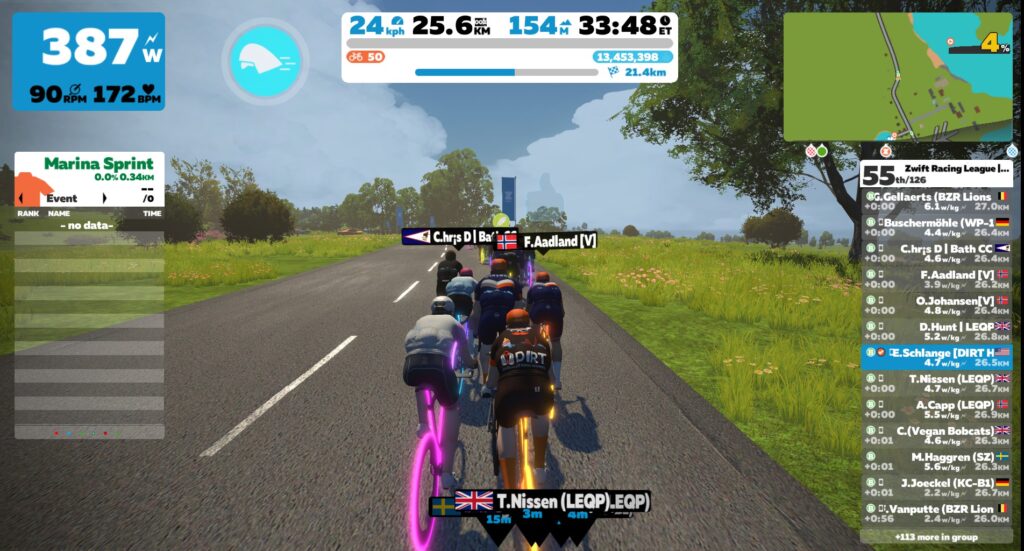
With Les Intestins safely behind, I made a mistake before the big climb even began, letting myself drift back so I began the climb in ~50th place, probably 15 bike lengths from the front. Starting at the front would have given me the chance to drift back while staying in touch with the front group, but now I was barely hanging onto the front group!
The beginning of the end – start of the Petit KOM backside climb
As the climb began in earnest I hammered to hold the wheels, but I just didn’t have the w/kg to hang with them. As the front group rode away I tried to settle into a rhythm I could hold for ~6 minutes.
Coming over the top in 49th, four riders were just seconds ahead, and the front group so far down the descent that I gave up hope of reeling them in.
But I could catch these riders up the road! So I hammered up to speed then dropped into a supertuck, hoping I wouldn’t pop out of the tuck on the corners for too long. It took a bit of doing, but I eventually caught the four riders near the bottom of the descent. Now we were faced with a decision…
After the Climb
With extra points only going down to 30th place, our 45th place group wasn’t going to be getting any extra points. So should we sit up and take it easy, cruising in gruppetto-style? No. There were too many riders just up the road – we had to chase! So we took some turns pulling, then got caught by a group from behind. With increased numbers and some strong riders, our group of nine began gaining on the pack just 15s ahead.
Just how large is that pack? If they have 15+ riders, that means extra points are within each if we can bridge up…
We kept chasing, seeing our time gap slowly coming down. And sometime before crossing the bridge into the Brittany sector, we caught the group! I drifted to the front to discover that the front of the group was 30th place. Ha! You can’t make this stuff up. Exactly one rider from this group was going to get a single extra point. The other 23 would get nothing!
Correction: after looking closer at results and WTRL’s rules, 30th place doesn’t get an extra point. Only 29th+ does!
Bridging up to the chase group
We had a pile of DIRT riders in this group, since there are two DIRT teams in this division and no one from my team had made it into the front pack. Team manager Snowy messaged me to ask if I wanted to go for a long attack with him – why not? So at 1.5km we put the hammer down. Unfortunately, my legs didn’t have much hammer left! We weren’t able to break the elastic, but we certainly stretched the pack out.
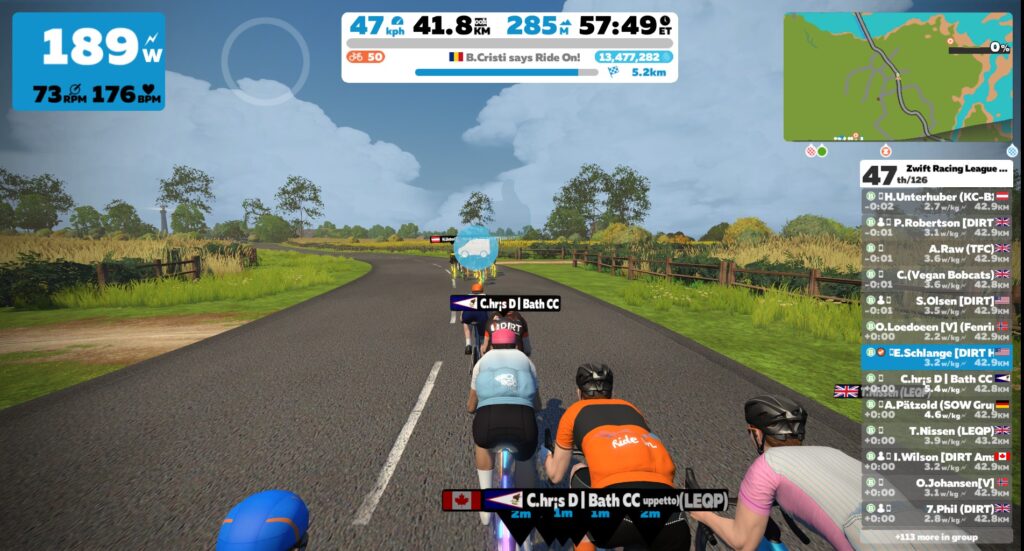
Riders sat in the wheels then sprinted in the final meters, but I had nothing left, finishing 47th in the back of the sprinter pack from our chase group. A rider from the Vikings team landed the 30th place extra point from our group. The front pack finished as a unit, 90 seconds ahead of us.
Watch my race video (including my camera falling off the table)
Team Result
The DIRT Hellhounds didn’t do well this time around. Five of us finished in that same chase group, and the sixth rider (who’s nursing an injured back) finished further back.
The one bright spot (for me): I got an extra point! Although the game showed me coming in 5th, ZwiftPower says I got 3rd on the Ballon Sprint Reverse. So one extra point. Unfortunately, most of the other teams got at least one rider into that front group, so we placed 19th out of 23 teams.
Takeaways
My first takeaway from this race is that a proper recon is crucial, especially if you’re going after intermediate sprint points! Most routes on Zwift I know really really well, but I should have been more conscientious about getting a good recon ride in on this route beforehand.
Secondly, I was surprised that I was able to go from alone in 49th place to having a shot at 30th, without a lot of extra work. This reminds me that I shouldn’t give up, even when it seems pointless.
Did I make the right call burning matches in sprints, at the cost of having less for the big climb? I’m still not sure. In a less competitive B field I know I could have hung with the front up that climb. But we’ve got a strong bunch of punchy climbers in our division, and I’m in no way convinced that I could have held their wheels even if I’d conserved as much as possible beforehand.
It’s really interesting to look at the 5-minute power numbers in ZwiftPower for this event. The main climb up the backside of the Petite KOM is right around 5 minutes, and everyone in the front group had a 5-minute power of 4.7w/kg or more. Almost all of those riders are 4.7-4.8w/kg, with a few higher and just two riders at 4.6w/kg.
In contrast, my group’s 5-minute power was mostly 4.4-4.5w/kg. (My ZwiftPower max is 4.5w/kg.)
So there you have it – that’s the difference between being in the points or being in the chase for the EMEA East 1 B1 division!
Your Thoughts
How did your first ZRL scratch race in France go? Share below!
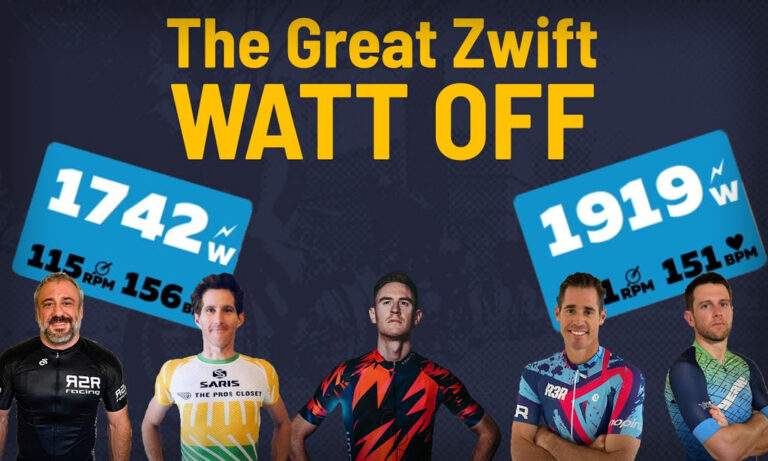
Have you ever seen the best sprinters in the game and wondered “How many watts can they really put out?” Here at No Breakaways we have, so we figured we should have a competition to find out!
We pulled together 5 of the biggest wattage Zwifters in the game to see who could throw down the biggest numbers:
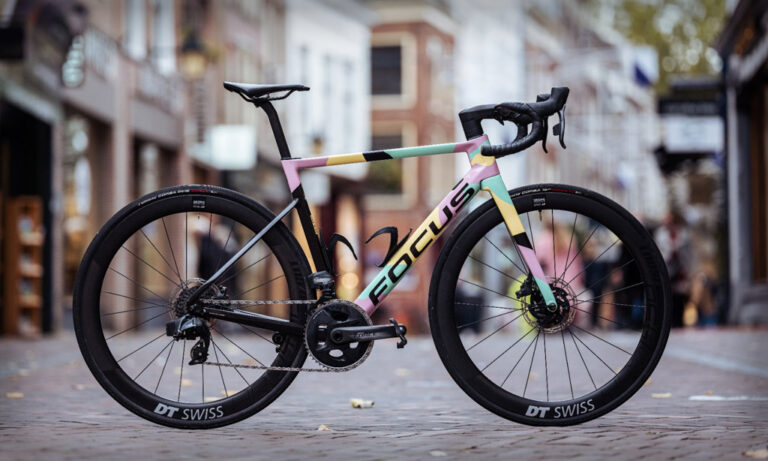
Zwift has just announced a three-day tour celebrating the Izalco Max PARI Edition from Focus Bikes. Each stage represents one of the colors of the bike, and there are prizes and giveaways for stage finishers! Here are the details…
Stage Details
Each stage has a long and short option, so the group you join determines your ride length.
These rides are tagged as races, but everyone will ride together regardless of ability. With over 1000 riders already signed up for some of the events, expect them to quickly string out and naturally break into groups based on rider ability.
Finish any stage and unlock the new Focus Izalco Max 2020 frame, as well as the PARI skin for the frame. That frame is worth 426,000 Drops, so unlocking it with one ride is a pretty sweet deal!
Riders who complete all three stages will be entered to win 1 of 2 real-life PARI edition Izalco Max bikes (approximately retail value $7,769 each)! Be sure you read the terms and conditions for details on how the sweepstakes works – specifically, “Once all three (3) stages have been completed, an email will be sent to the Entrant’s email address associated with their Zwift account directing them to access and complete the online registration form as instructed.”
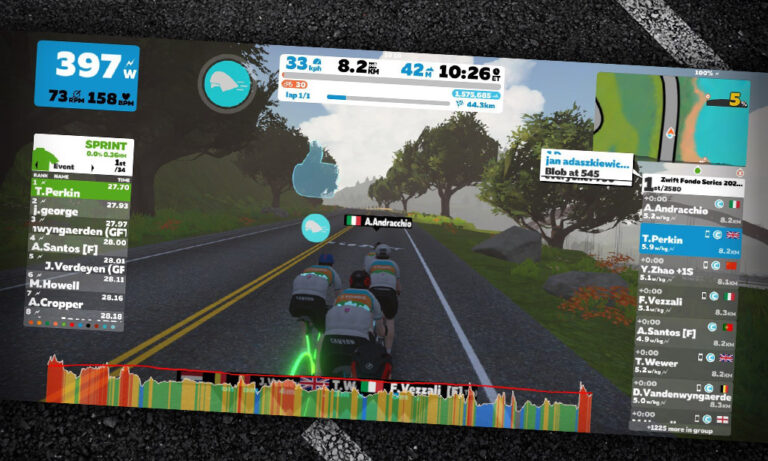
Being new to Zwift, I have undertaken long rides in the quest to tick off the different route badges but had not participated in one of the exclusive “one day only” Zwift Fondo events. So when I saw them promoted on Zwift Insider, I signed up!
I debated which of three distances to partake in before finally settling on the shortest, the “Bambino” – I say shortest, it’s still over 50km so a substantial ride by anyone’s standard. But not quite the 90km epic of the Gran Fondo.
Race Prep
Sunday morning, “Race Day” – I had ensured I had a good solid breakfast and had my bottles of water lined up on the small camping table next to my bike, used to hold all required items for a session of Zwifting such as the Bluetooth speaker, sweets (a mid-ride necessity when energy is low), and a battery charger for my iPhone, which is used with the companion app.
I was sure to arrive early to the start line to bag a position at the front. I had read that with mass participation events, if you are not near the front of the race from the start, it is virtually impossible to get into the front group. So I sat, patiently warming up on the trainer for 20 minutes. Editor’s note: there are other ways to save your spot at the front of the start pens…
The Fun(do) Begins
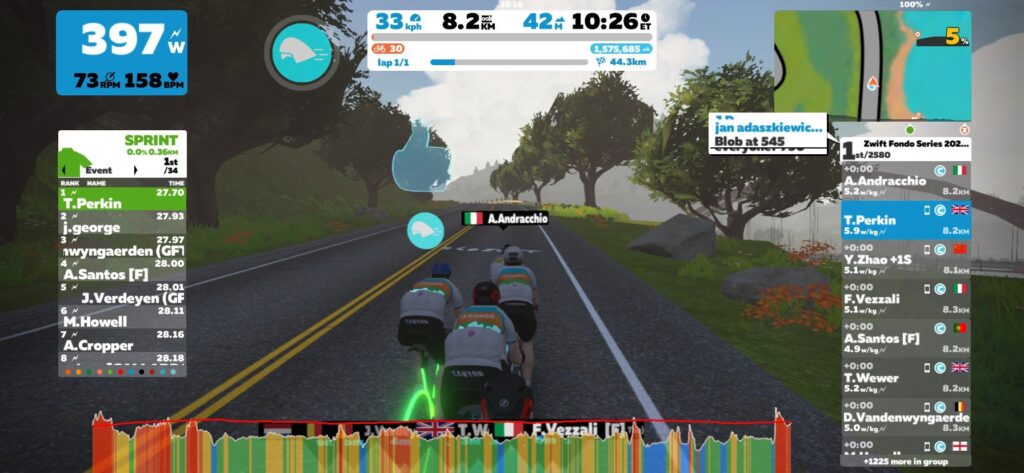
As the blue clock ticked to 0, there was the mass explosion! I was out of the blocks pushing 350 watts as the pack started to swarm and form. The number of people was easily the most I had experienced, with the counter showing 1200+.
At the front of the mass start
I couldn’t quite see the last digits and despite having my iPad connected to a large 32” TV, I’ve noticed that my eyesight seems to be failing me as I struggle to make out the small text. (Perhaps it’s not my eyesight but in the “heat of the battle” it is difficult to focus on all of the data that Zwift displays.) My eyes dart from the power stats to my heart rate then across to my RPM. I’m always conscious of trying to put the right amount of power in without exerting myself too much, to avoid the inevitable “blow-up” that occurs when we think we can hold watts that are above our capability.
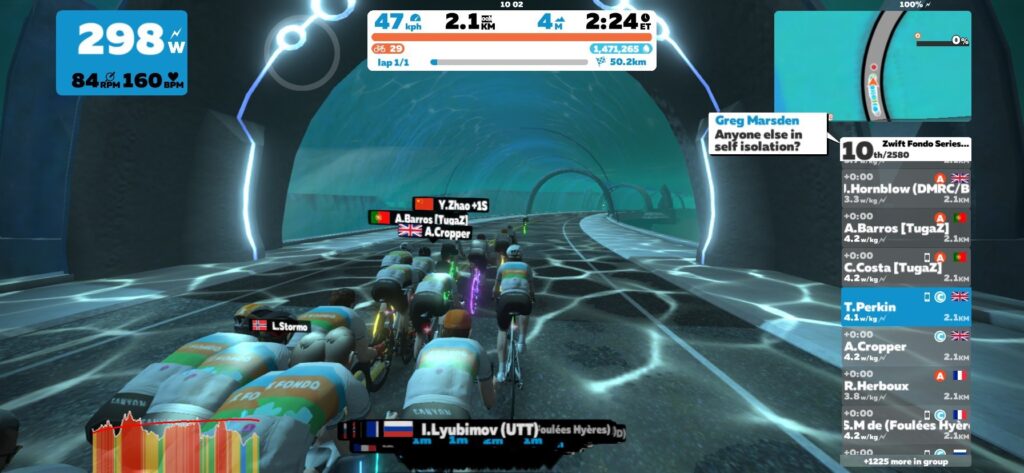
The first few minutes of the race were frantic, but it appeared I made the top group, which was huge. Easily 100 riders and the pace wasn’t slowing. We weaved our way around Watopia for ~10 minutes, before this big pack suddenly split apart. What I hadn’t realised is that the entire Fondo started together and rode en masse for the first several kilometres, before suddenly and without warning we turned left and the rest of the bunch went right. Each distance had their own route around Watopia. This top group instantly divided into 3, with our group being probably only 20 riders. This was good, as now I could see who I was riding with. At one point I was 1st out of 1200 and was desperately trying to capture this image with my IPhone for posterity… but fumbled and failed.
The front of the Bambino group… for now!
Gapped
20 minutes into the ride, the pace was still high and we approached the Hilly KOM. I knew this to be a short but tough, punchy climb, so I got to the front of the group and tried to keep my nose ahead. We passed the banner in 1:56, which is probably one of the fastest climbs I’ve had. Despite this, I was near the back of the group and as we descended, the pace upped and I started separating from the group and sprinted to get back on. But I couldn’t get back in touch.
Sprinting downhill, the bunch was pulling away and there was nothing I could do. My legs spinning like windmills in a hurricane, I was having no impact. I could feel the race slipping away after only 20 minutes. One lapse of concentration, one bit of bad positioning and I was shelled from the front group.
Working Together
The descent took us down some rolling hills and I could see the bunch turn right in the distance as they ascended. More riders were shelled. Fortunately, as I raced to catch on, two of these fellow riders latched onto my wheel and we had a mini bunch. (I say mini bunch, it was just 3 of us!)
In desperation, the 3 of us grouped up and trying to save the race. I typed, “Let’s do a Team Time Trial” – naively thinking that if we could form up and do 1-minute turns on the front at a high wattage, we would make some gains into the group ahead. Who was I kidding, our attempt at the Team Time Trial lasted only 1 turn each and the gap to the front group grew from 10 seconds to 40 seconds.
By this time we were approaching the junction where you go right into the Jungle. Our little trio was looking around for help and coming up quickly behind us was a rider called “Berchtold” – his numbers were impressive, 5 watts per kilo and by the looks of it, he had bagged the previous KOM jersey. He was flying, so we desperately tried engaging him on chat, willing him to form part of our group. He certainly was flying, he flew right by us at 5.2 watts. So, the trio pushed on until the Jungle.
Suddenly our trio was down to a duo. At this stage, I knew the game was up, the front group was several minutes ahead and there was a rear group 1 minute back, with one rider bridging the gap – we were in “no man’s land” and so we sat up. It gave me a rare opportunity in race to engage in a bit of chat with my follow rider. A Dutch rider, Michael.
The rider bridging caught us as we sat up and like the previous rider, blew right on by. I asked Michael if he wanted to chase his “fellow countryman,” only for him to point out that the rider was French. Again, from the distance of my bike to the TV, I can only make out blues, whites, and red and could not see the difference in the flag as I only see the colours. I apologised to Michael for my oversight and our attention was quickly on the fast-approaching group from behind.
The Group Grows
Now, the danger when waiting for a group to come is that if you are not careful, the group can swamp you and you are left trailing in their slipstream. Careful to avoid this, we upped our speed and as the first rider came, full sprint mode was engaged to ensure I caught the draft.
As we exited the Jungle, the pace upped and I was at the back of the group – panic and a sense of déjà vu entailed but armed with the feather powerup I lightened my load for a few seconds and within a few pedal turns, was at the front of the group.
We sat in the group and meandered our way through the Italian Villas and out towards the Volcano, the scene of the final showdown on the Volcano climb.
Volcano Finish
The Volcano climb is actually quite a tricky one. It’s short but the sections where it levels off and descends give riders chance to bridge across any gains that you have made by attacking too soon, so the tactic was to pick your moment to attack. My tactic was to get to the front of the group to raise the pace, to ensure that any of the weaker climbers were distanced. This worked as I could see individual time gaps start to appear on the riders near me. I waited to attack until just after the wooden bridge, moving to the front and grinding. I got a message from my fellow ride Michael in capitals “GO GO GO!” so I took it that I was doing well. So I kept pushing!
No one was with me, I could see the finish line but could see one rider bridging my gap. The finish was approaching, and I was 11th. Right about now, the feather powerup that I had used earlier would have been handy to have, but having already used it already, I was down to sheer effort. Just as the hill crested and the finish line appeared, I was passed.
I trundled over the line in 12th position*. 1 hr 23 mins 27 seconds.
For my first foray into a Fondo, it was a positive experience, but I was left wondering what might have been had I made the front group. But the beauty of Zwift is there is always and another race… and so there was, the Zwift Hill Climb, the following day! More on that later…
*Note my position was upgraded on ZwiftPower to 11th.
Your Comments
Did you participate in November’s Zwift Fondo? If so, how did it go? Share below!
In the build-up to December 9th’s 2020 UCI Cycling Esports World Championships, Zwift + WTRL have announced the “Zwift Nations Challenge” – a country-based race unlike anything seen before! Here are the details…
The Big Idea
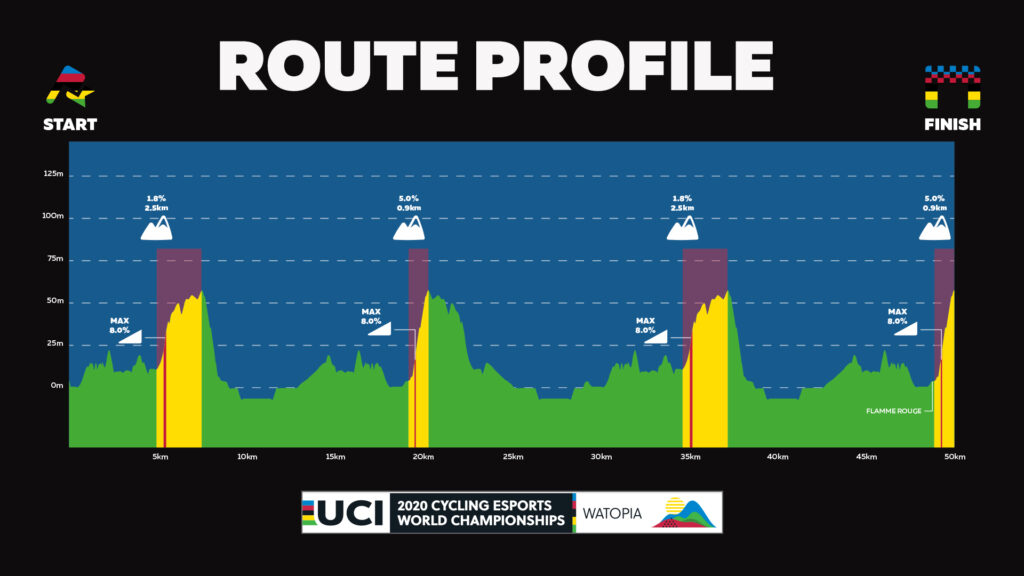
Zwifters race the 50km/31 miles 2020 UCI Cycling Esports World Championships course (Figure 8 Reverse) finishing at the Watopia KOM, with the aim of completing the race in the shortest time. Nations will then be ranked on an aggregate time to determine the top three nations.
How Will It Work?
Zwift has selected the top 22 countries by Zwift subscription count (see list below). Each of these countries will have 2 events in which riders can participate. (An additional 2 events for the Rest of The World will also take place.)
For most countries, events will take place on December 5th and 6th at 11am and 6pm local time, unless of course your country spans multiple time zones. See event schedule at zwift.com/events/tag/nationschallenge
The fastest 10% and slowest 10% of times will be discounted and the average time for your country calculated. So riders should work together in their events to achieve the fastest possible times!
Results will be announced Tuesday, December 8.
Country List
The following countries will have dedicated events in this competition:
Australia
Austria
Belgium
Canada
Colombia
Denmark
France
Germany
Ireland
Italy
Japan
New Zealand
Norway
Poland
Portugal
South Africa
Spain
Sweden
Switzerland
The Netherlands
United Kingdom
United States
There will also be two events for the rest of the world, so riders who are not in one of the countries above can still participate.
Choosing Your Country
You must set your nationality in your Zwift Profile before participating in the corresponding event. Any riders racing an event not associated with their profile setting will not contribute to the results, unless it’s one of the “Rest of the world” events. (Of course, your presence in the event may boost the draft effect for others – but your time will not be used in calculating the national average.)
Riders can take part in multiple events! Perhaps you are a Brit living in the USA, or a South African living in France. You can ride in two or more events – just make sure you change your profile’s nationality setting before jumping into the event.
Set your Nationality within your Zwift Profile to reflect the country you would like to represent
Enter one or both of your country’s events on either the 5th or 6th December
At least 100 riders must take part per country for the time to count
The fastest 10% and slowest 10% of times will be discounted from the average time calculation
This is not a race by ability or gender. It will be a mass start and you should aim to help your fellow country men and women – the bigger the peloton the faster it moves
Riders flaunting the rules, exhibiting poor sportsmanship, or riding unrealistically will be removed from the race results and will not contribute to their country’s results directly
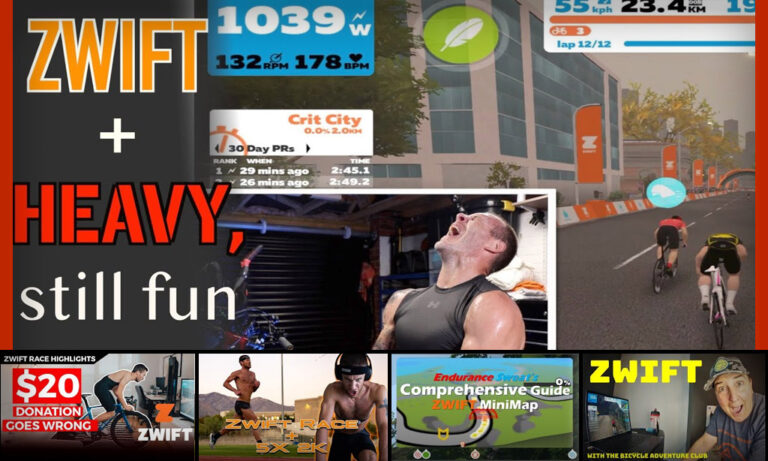
This week in the best of Zwift videos watch a new Zwifter as racing finally “clicks” for him, a useful guide to Zwift’s mini-map, and an introduction to Zwift. There’s also a video of pro triathlete Lionel Sanders jumping into a Z Pro Tri race. And see what happens when a streamer promises to attack in a race for a donation!
Hooked On Zwift At Over 230lbs
It took three tries, but new Zwifter Mark Lewis is hooked! He explains the early racing mistakes that left him discouraged, and he shares some helpful comments and advice from his viewers. Then Mark applies the lessons he’s learned in another race. The emotion near the end says it all!
Zwift Streamer Gets $20 Donation to Attack the Field
Charles Ouimet’s energy is infectious in these highlights of a livestreamed race. He promises the audience that he will attack the peloton for $20, and then when he gets the donation, he has to follow through!
ZWIFT & Wahoo Kickr with the Bicycle Adventure Club
The Bicycle Adventure Club introduce their followers to the world of Zwift, explaining why their adventures now include exploring the world of Watopia.
Last Second Zwift Race + 5X2K Repeats
Professional triathlete Lionel Sanders makes a last-minute entry into Race #1 of the latest Zwift Pro Tri series. Watch him fight for the podium, and then see how it affects his run workout!
Zwift MiniMap Comprehensive Guide
Ken Jobba, or “Endurance Sweat,” gives a clear, thorough guide to Zwift’s mini-map and how to use it.
Got a Great Zwift Video?
Share the link below and we may feature it in an upcoming post!
Like the last few updates, this release doesn’t contain much by way of new features. But it does include a new bike (always fun)! Let’s dig into the details…
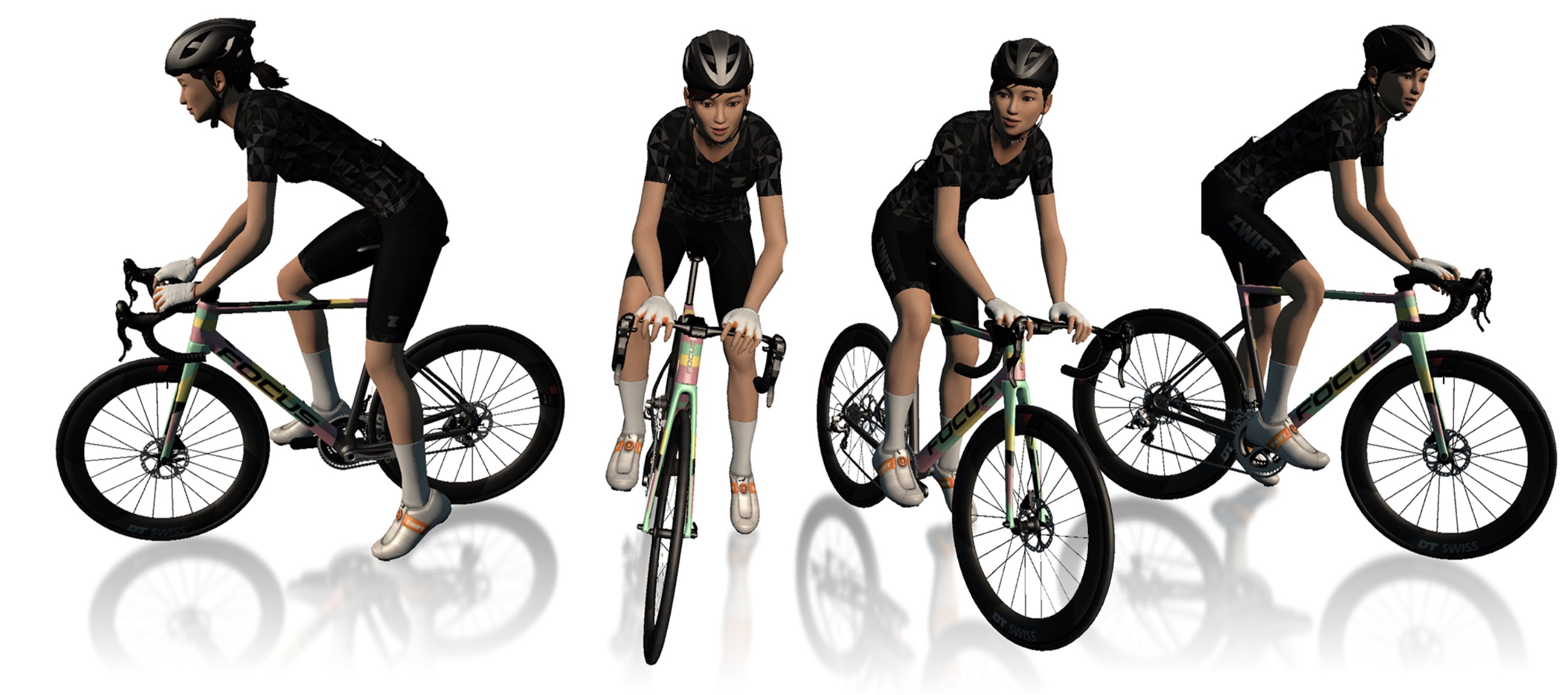
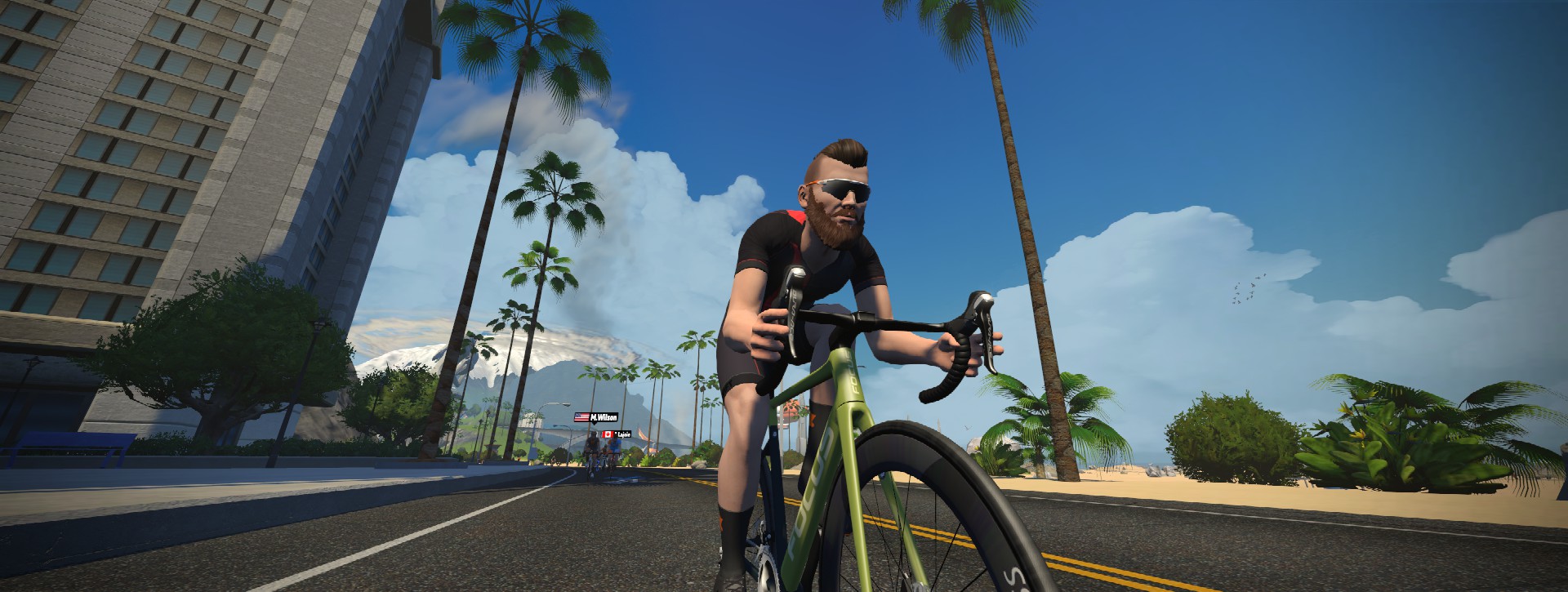
New Bike Day: Focus Izalco Max 2020
The Drop Shop now includes a frame from Focus Bikes – their Izalco Max Disc road race machine! Like all aero frames nowadays, the Izalco is billed as being both super lightweight and aero. Rated 3 stars for aero and weight, it’s available to level 8+ Zwifters for 426,000 Drops. The question is… how does it perform on Zwift?
The answer is: it’s a decent frame, but nothing special in terms of performance compared to what’s already available. In our flat test it turned in the same time as the Giant Propel Advanced SL Disc and Pinarello Dogma F12, meaning it’s about 3 seconds too slow over our ~50-minute test to make it onto our list of fastest frames. But it does make #2 on our list of fastest beginner frames, being just a bit lighter and more aero than the Specialized Allez Sprint!
Its climbing performance is less impressive, finding it in the middle of the field with frames like the Pinarello Dogma F12 or Cervelo S5.
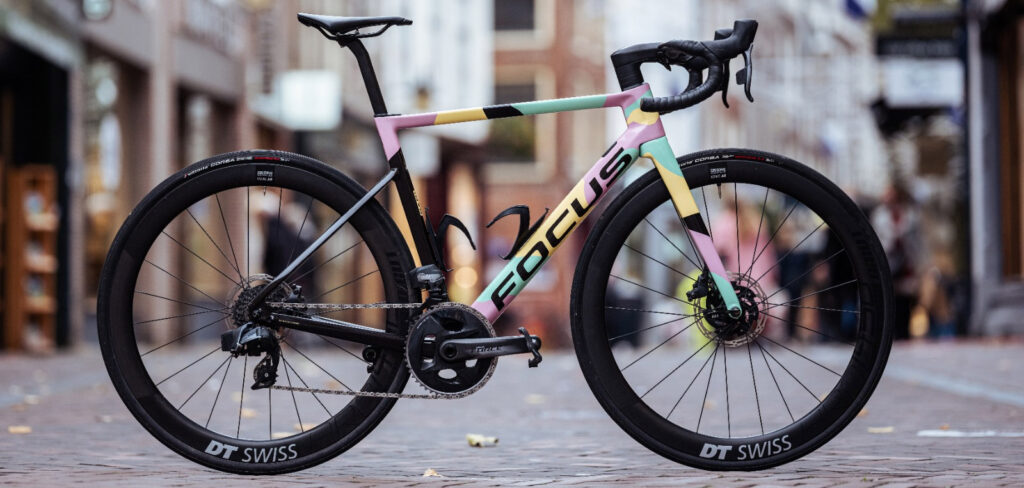
This frame was released into the game to make way for the upcoming Focus: Colours of Pari 3-day tour (Nov 26-28). We’ll publish a post about this fun event series tomorrow, but for the time being, just know that completing any stage of the tour unlocks an eye-popping Izalco Max Pari skin for the bike. (You’ll still need to purchase it from the Drop Shop). And two winners (one woman, one man) will receive a complete Izalco Max Pari bike (you have to complete all three stages to be entered into the drawing!)
Izalco Max Pari paint scheme
Workout Improvements
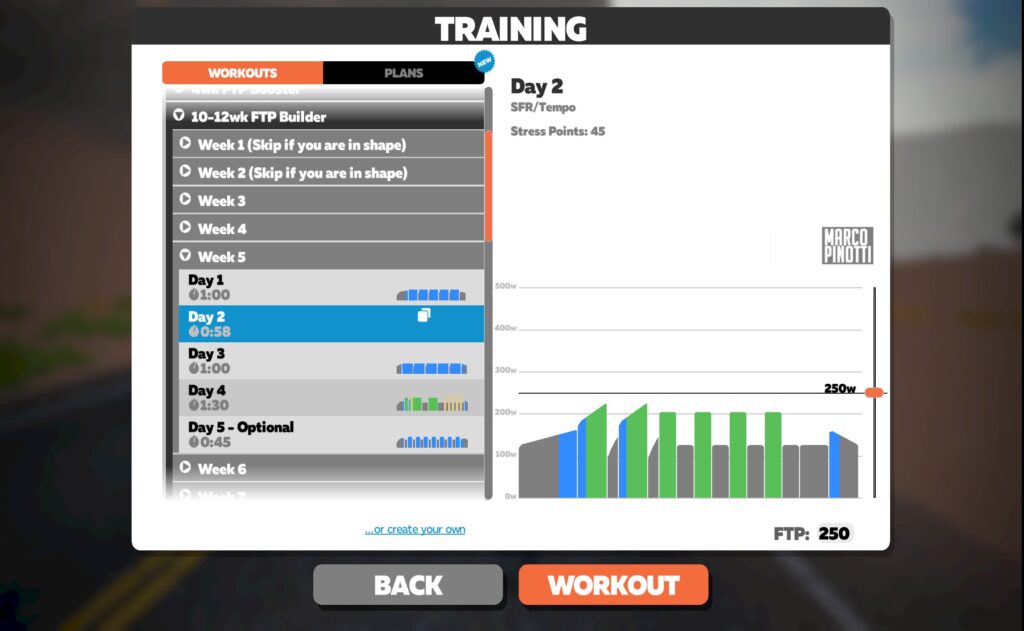
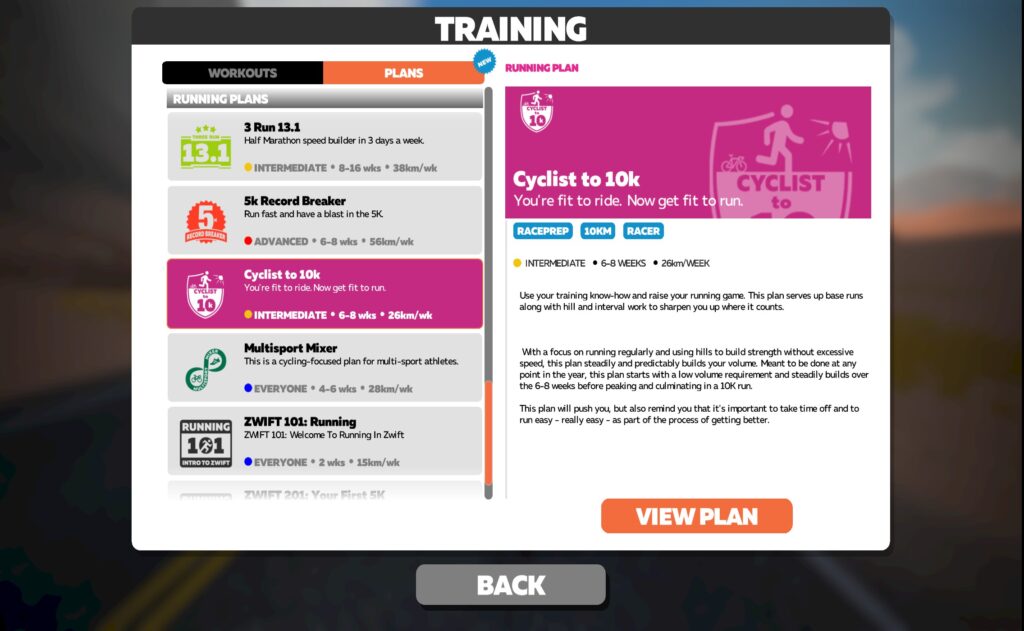
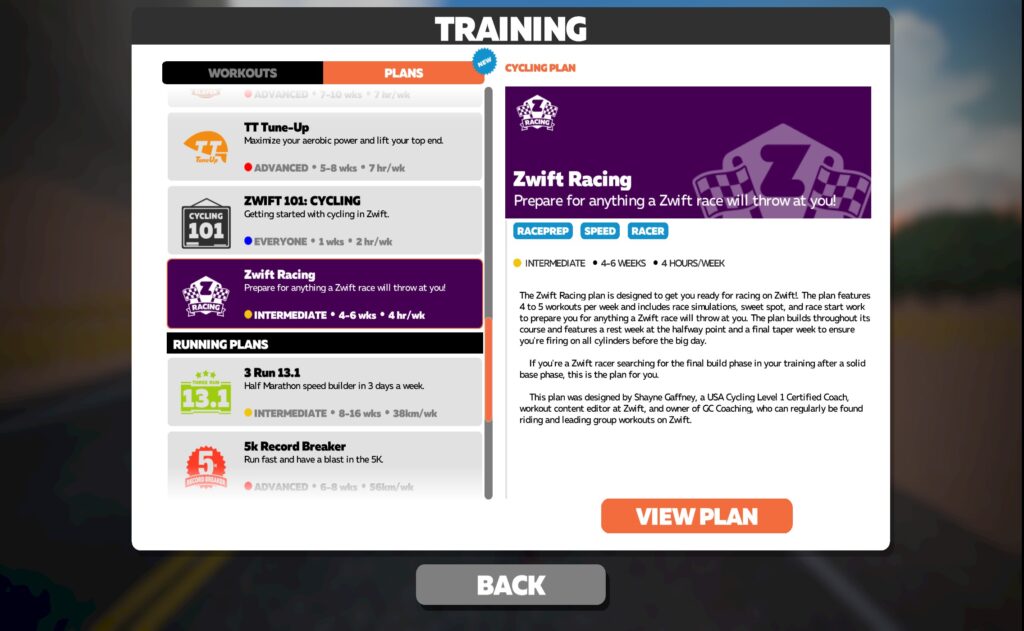
Lots of text improvements have been made to various workouts and workout plans, including the Zwift Racing training plan, the 10-12wk FTP Builder, and the Cyclist to 10k training plan.
Steering Changes
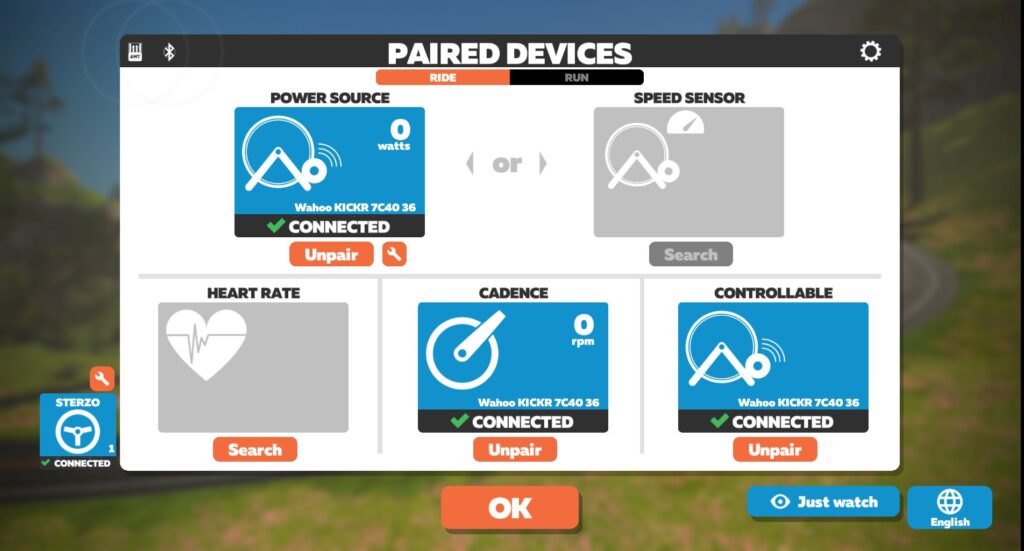
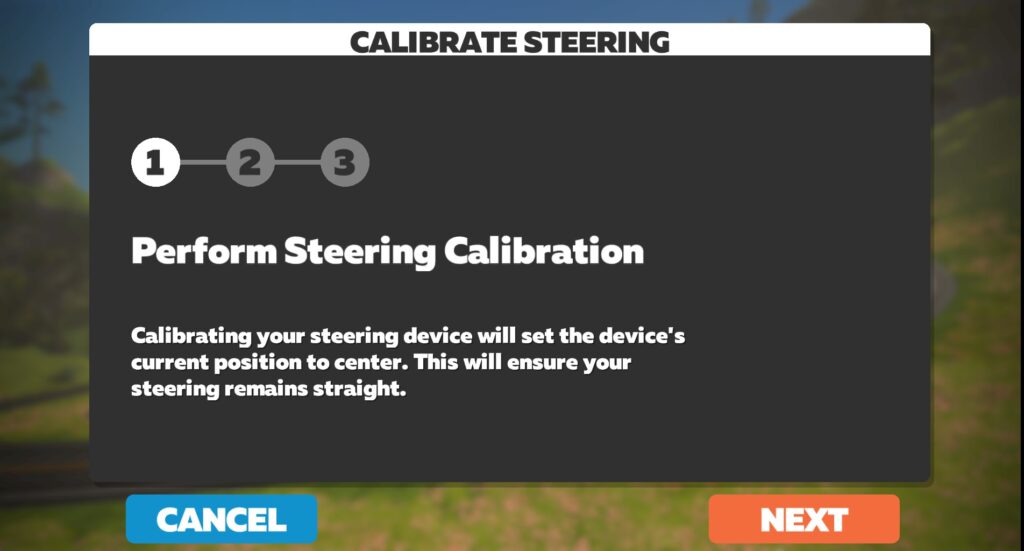
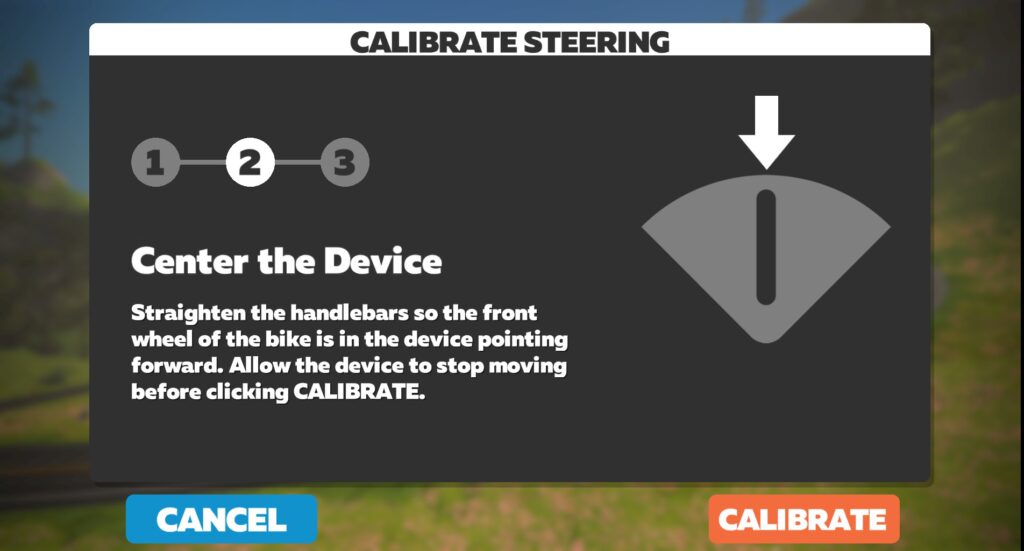
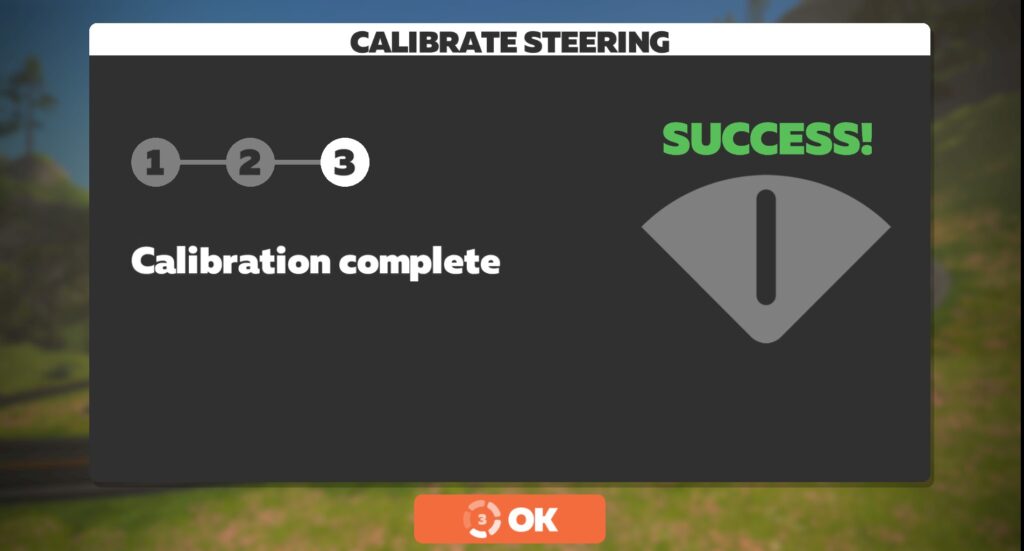
Two small improvements have been added to enhance our in-game steering experience. First, Zwift added in-game steering calibration for the Elite Sterzo Smart. This is for users who find that their Sterzo isn’t quite steering straight in the game when at the center position. The new calibration feature can be reached from the pairing screen buy clicking the wrench just above the Sterzo box.
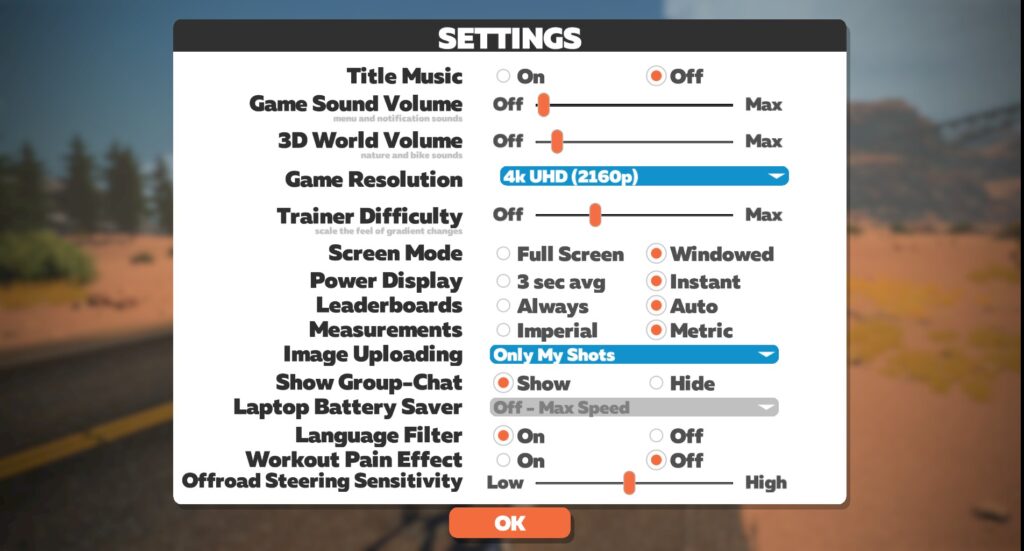
Here’s something we haven’t seen in a long time – a change to the settings menu! “Offroad Steering Sensitivity” (which seems to only apply to Repack Ridge) is now available in the settings menu:
This is a minor but welcome change – many Zwifters found that turning the steering sensitivity up on Repack Ridge made it much easier to navigate the sharp singletrack corners.
Wrapping It Up
Once again, this month’s update is pretty light in terms of new features. Perhaps this is warranted: our sources inside Zwift tell us there’s a lot going on in the background (paying off that “tech debt” Eric Min has talked about in the past) and of course ZHQ is also working hard to support big events like Zwift Racing League and the upcoming UCI Esports Worlds.
Still… we’d love to see some new tarmac. Especially more Watopian singletrack or gravel!