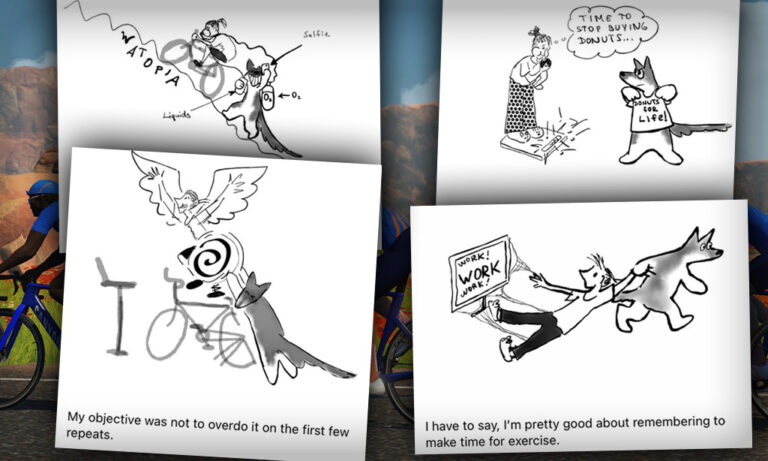
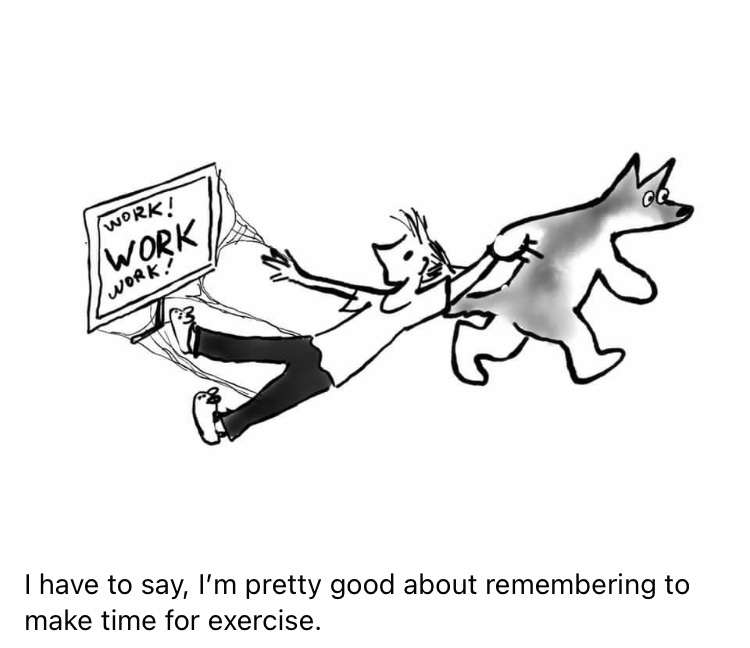
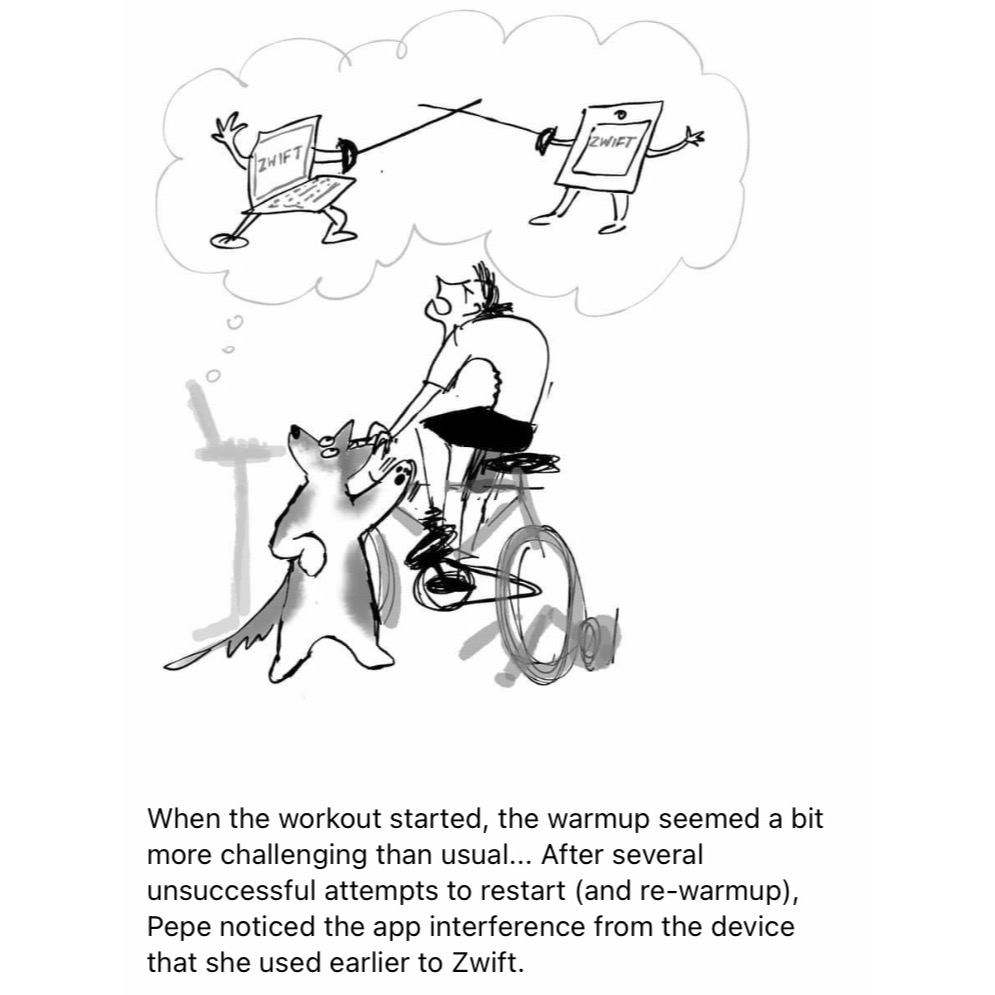
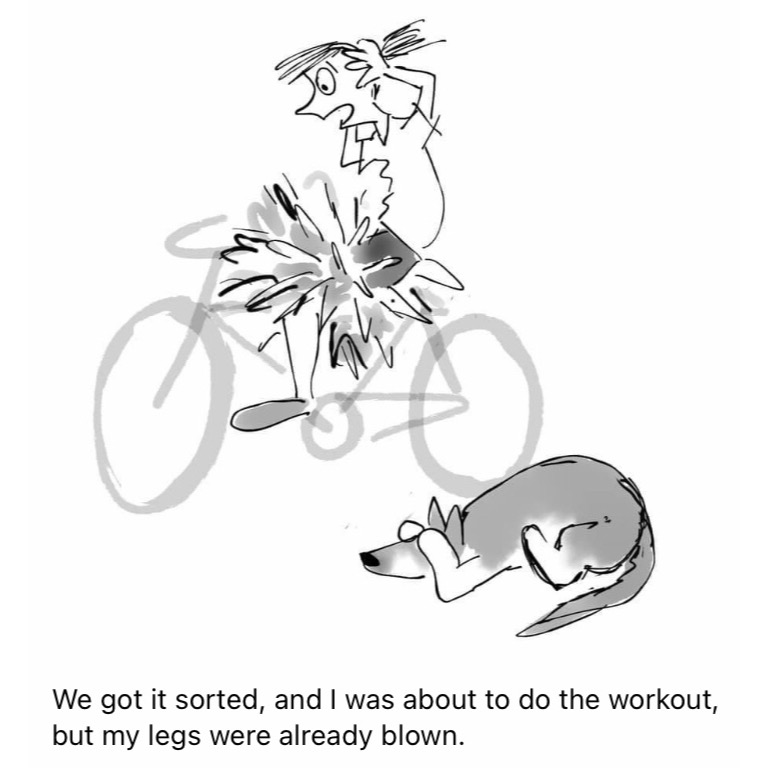
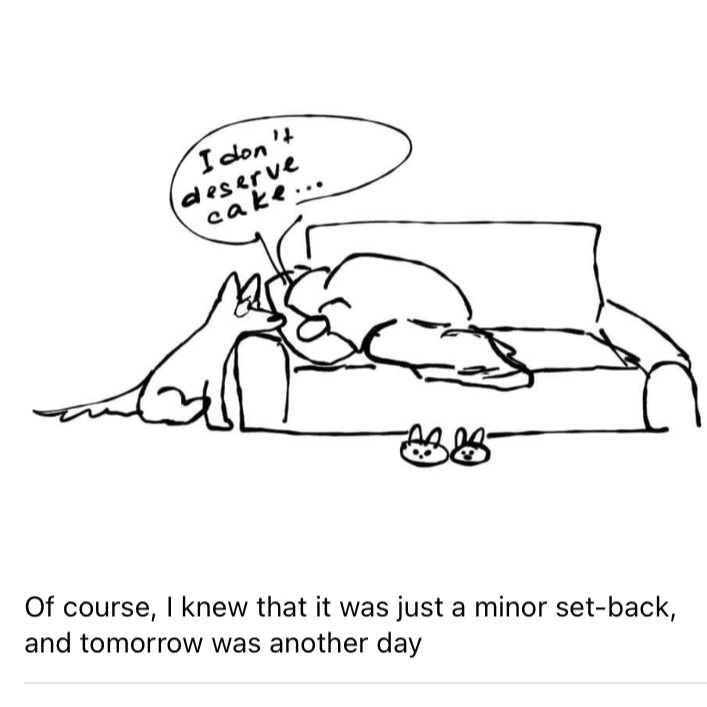
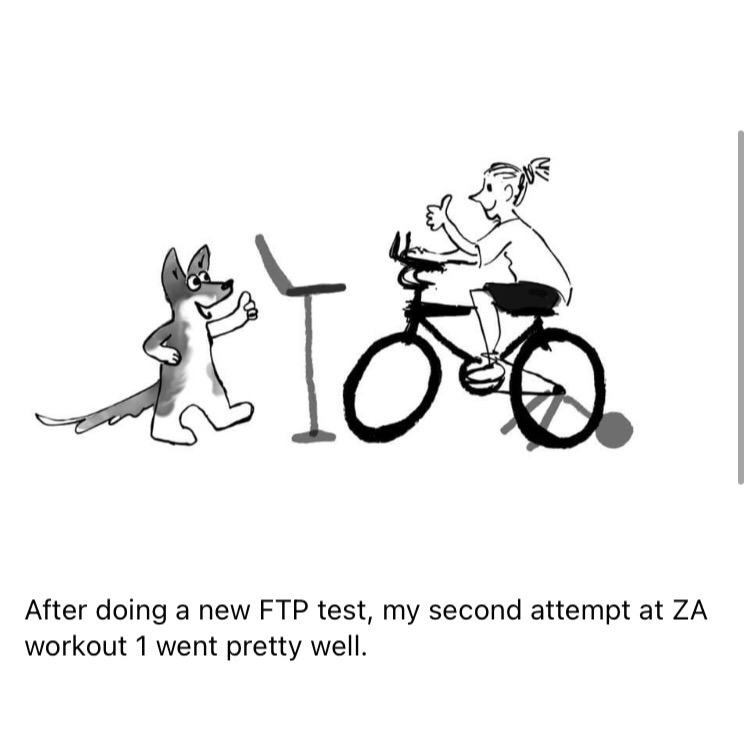
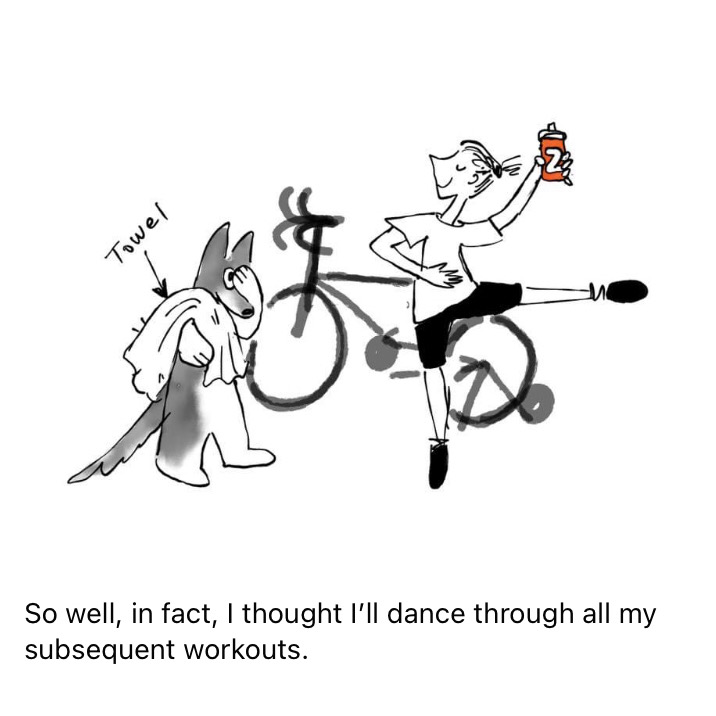
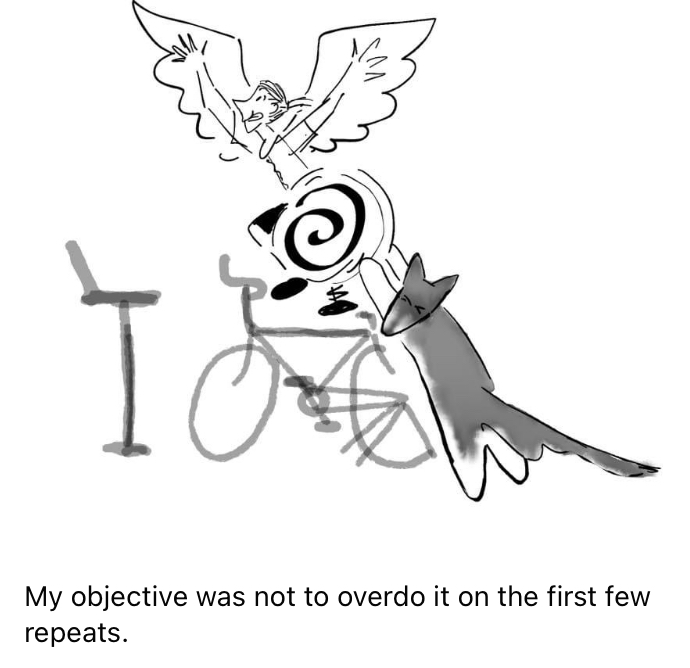
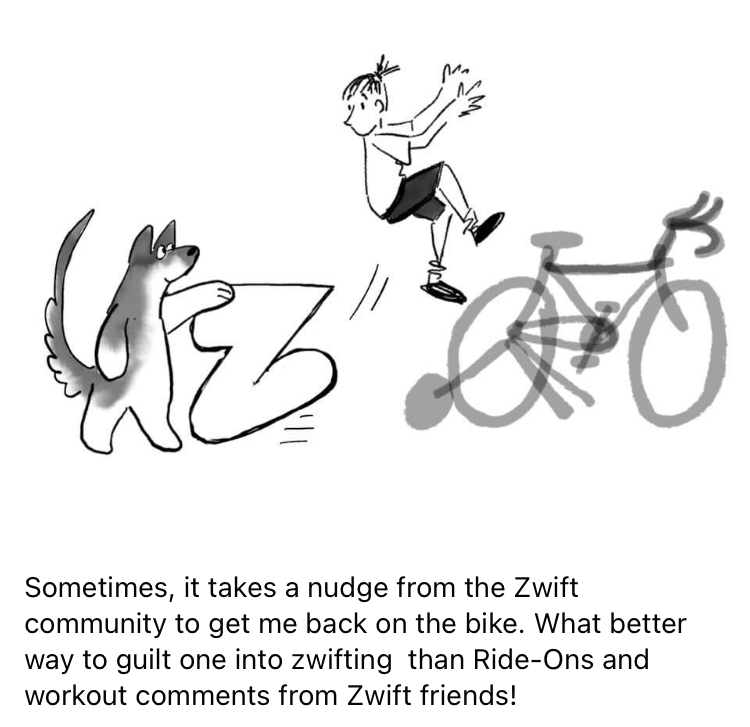
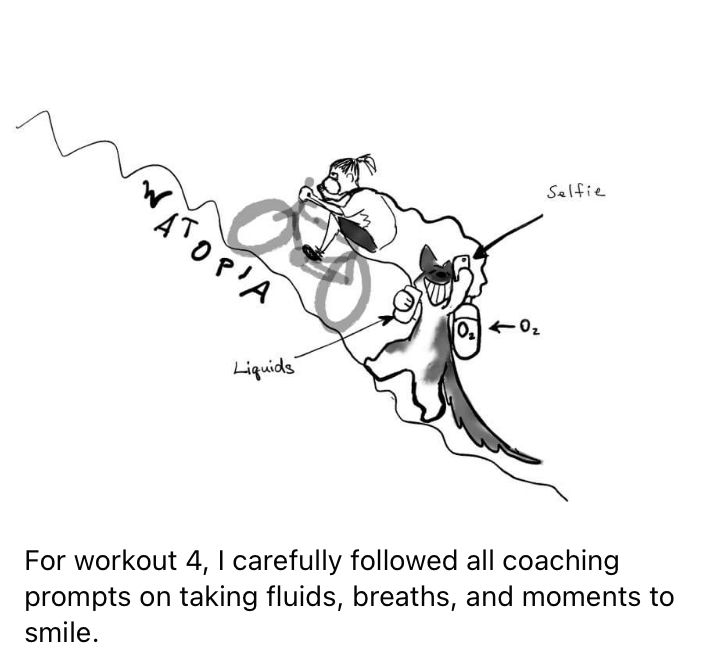
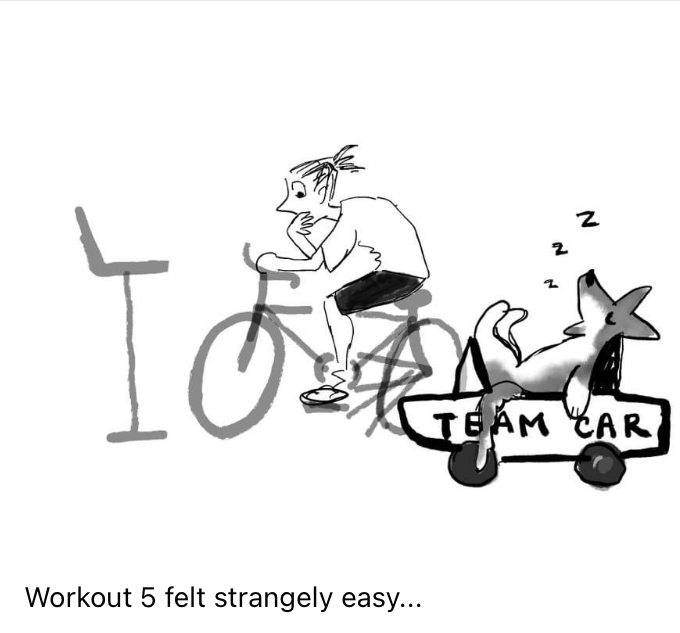
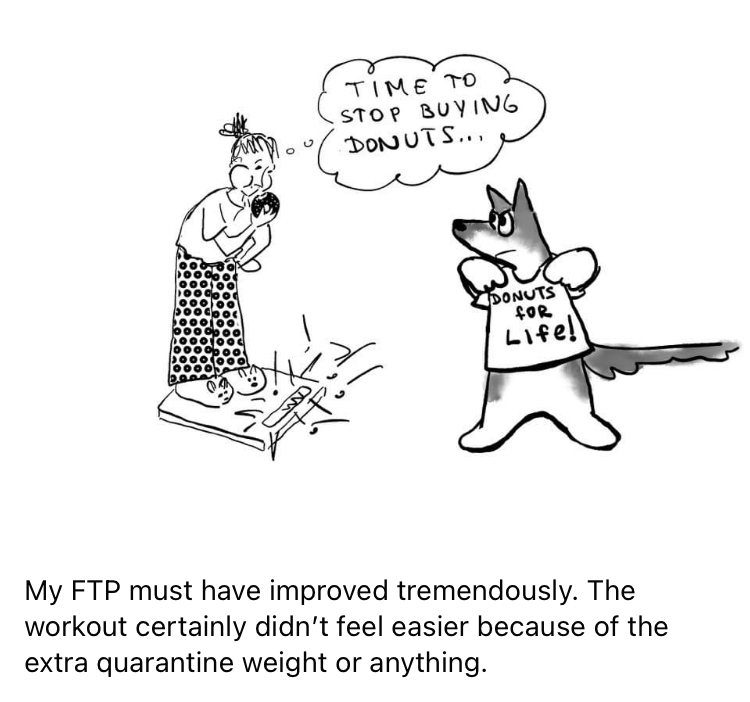
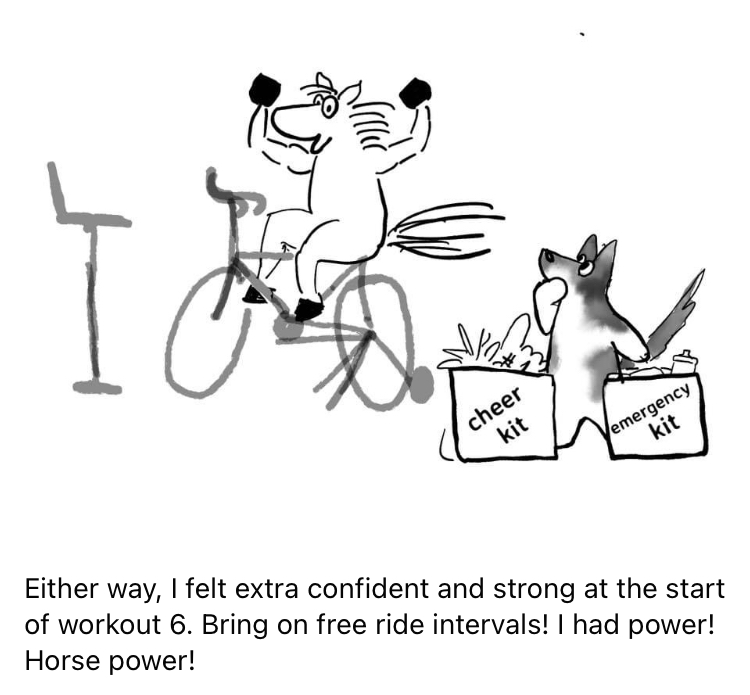
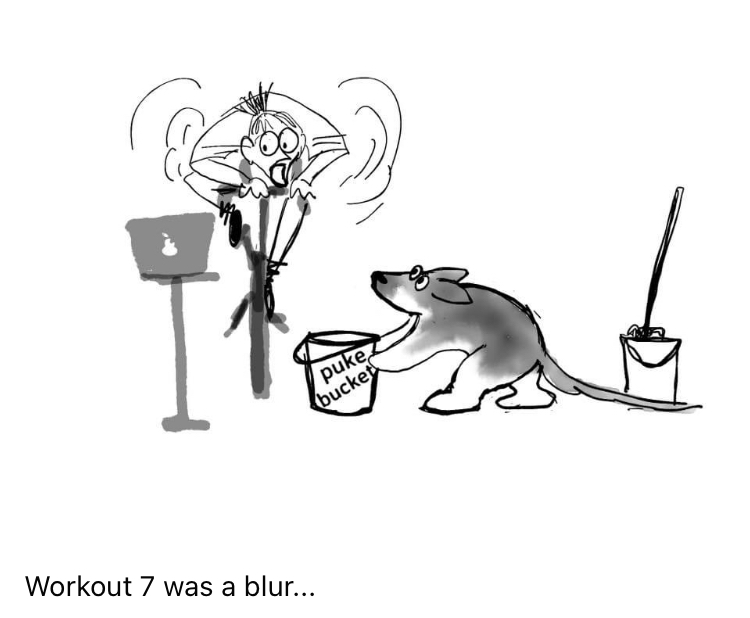
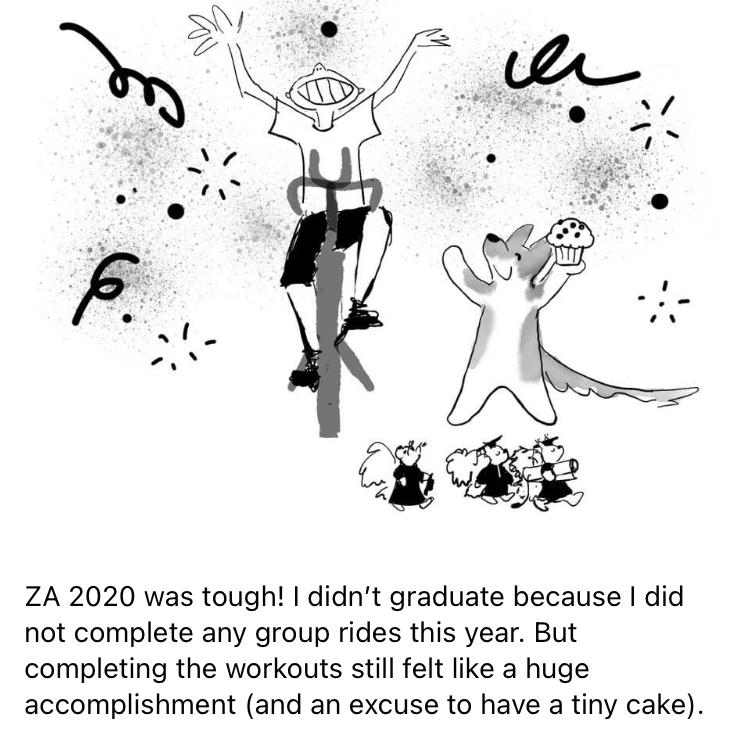
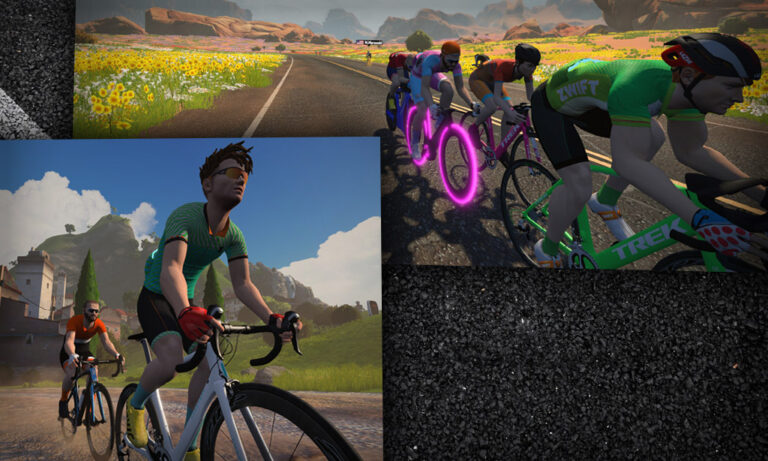
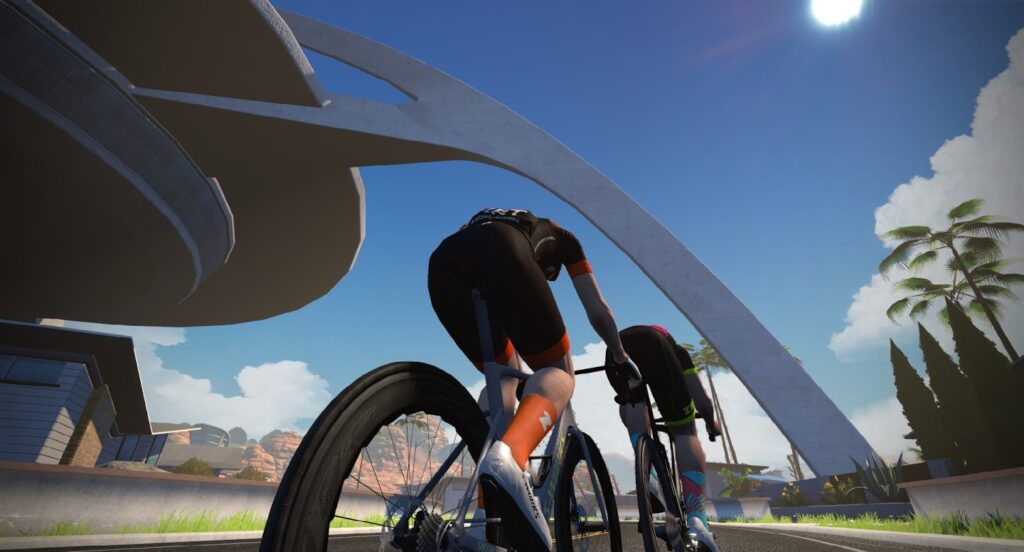
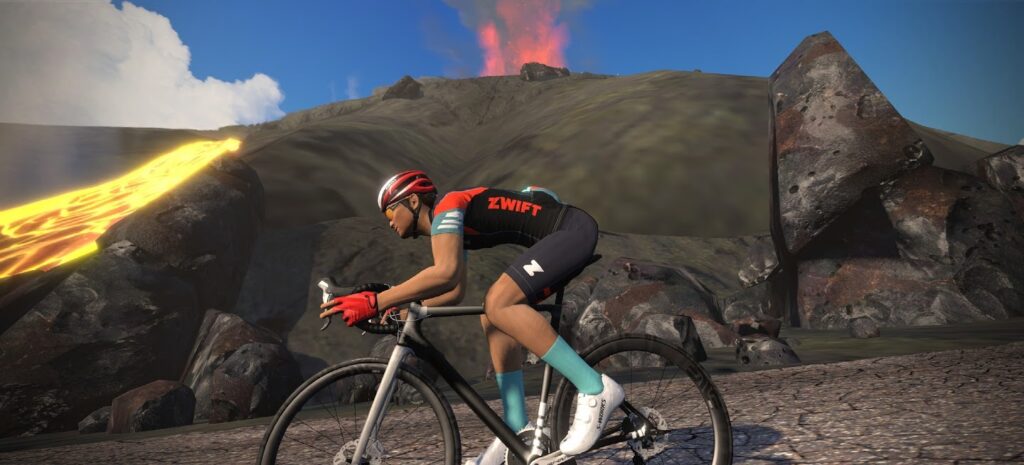
Olya Perevalova Cohen is a keen Zwifter and artist who delights our community with illustrations of her Zwift experiences. We previously featured her illustrations from several big Zwift events, and today we’re publishing her lovely visual chronicle of eight Zwift Academy Road workouts. Enjoy!
UPDATE Nov 22 2020: this post has been updated to include the latest intermediate information, since the Aqueduc KOM was added after publishing, and points have been reduced from top 5 to top 3.
The seventh week of Zwift Racing League is upon us, and it’s going to be a battle between the wattage workhorses and the punchy climbers as we tackle custom lengths of France’s Petit Boucle.Let’s dig into the course, including some tips for bike choice, Strava segments for the custom routes, and more…
Looking At the Route: France Petit Boucle
Here’s a route preview from Rick over at No Breakaways:
Route Breakdown
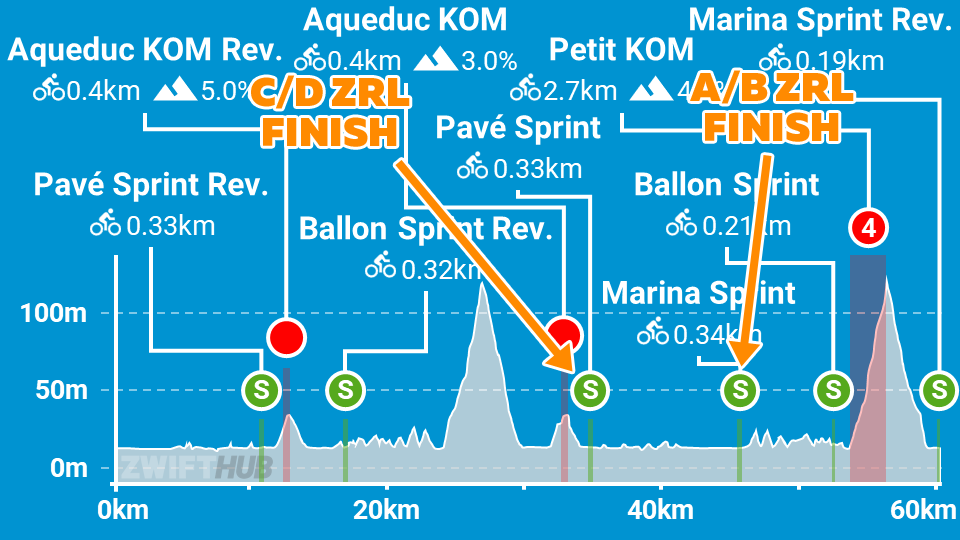
This route is super flat, except for a few sections. Here’s the profile map – keep in mind this shows the entire route, but for ZRL we are only racing part of the route. We’ve pointed out the finish lines for each group below.
The Pavé Sprint Reverse is an intermediate for points, so timing it well will be key if you’re going for points. But keep in mind only the top THREE get points on intermediates this week.
Then we hit out first bit of climb, the Aqueduc KOM Reverse. This is really a sprint climb, but it’s for intermediate points, so expect an all-out push to the line!
Another sprint is just up the road, the Ballon Sprint Reverse. This is the last intermediate point option before the big climb which may see many of the top sprinters dropped.
Next we hit the twisties (“Les Intestins”) – no big climbs, but lots of little ups and downs, so be careful to maintain a good position in the pack.
Then it’s a left turn and up the big climb of the day – the backside of the Petit KOM. At around 2.9km and 3.7% average grade, this climb is comparable to London’s Box Hill and the Watopia’s Volcano KOM (both of which are a bit longer):
Unless teams are riding aggressively, chances are good that the front pack in your race will still be quite large when you reach the base of this climb. This is where the stronger climbers will put in massive efforts to try to drop sprinters so they can break away and score more intermediate points (A/B groups) or win (C/D groups) on the upcoming Pavé Sprint.
But before that sprint there’s the Aquaduc KOM Reverse – the final change for extra points for C/D, and another chance for extra points for A/B.
The Pavé Sprint line is the finish for C and D groups, just over 36km long. A and B groups will continue on for another flat 11km, finishing at the Marina Sprint with just over 47km.
We haven’t done test laps of this route, so we don’t have hard numbers to show you this week. With only a small portion of this course being uphill, an aero setup is going to save you the most energy over the full route. But will a slightly lighter-weight setup help you just a bit on the crucial climb up the Petit KOM’s backside? And is that bit of advantage worth the hit you’ll take on the flats?
That’s a question you’ll have to answer for yourself this week.
Strategic Options
There are 5 intermediates on Petit Boucle, each awarding extra points for the first three over the line (3, 2, and 1 points). They come in this order:
Pavé Sprint Reverse
Aqueduc Q/KOM Reverse
Ballon Sprint Reverse
Aqueduc Q/KOM
Pavé Sprint (Premier/A/B only)
Sprinters, rejoice! There are definitely some opportunities here for you to earn some points for your team. Even if you get dropped on the big climb, you can contend for the points in the two flat sprints before that.
It will be fun to see what happens after the big climb. If a reduced group of stronger climbers is up the road, will the pure power riders behind them be able to work together to pull them back?
And before that big climb, will the pure power riders be pushing the pace in order to drop (or at least tire out) the climbers?
The Petit Boucle backside isn’t terribly steep, so there will probably be a decent number of smart non-climbers who make it over the top in the front group. These “Peter Sagans” will be the riders to watch for in the final moments of the race.
Lastly, powerups: there will be five opportunities for a powerup on this route (4 for C/D riders). Make sure you know how each powerup works, and use them wisely!
Your Thoughts
Care to share your thoughts about Tuesday’s big race? Comment below!
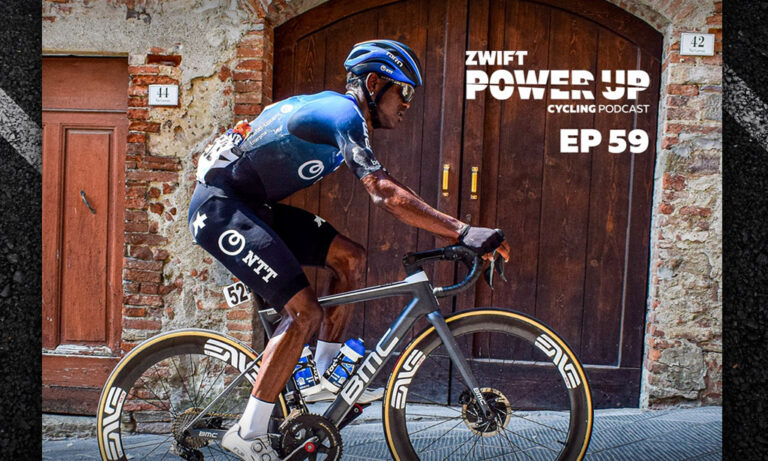
Matt talks with NTT Pro Cycling’s Nicholas Dlamini about his incredible journey from a South African Township to a career in professional cycling. Nic opens up on family life, why he waits until lunchtime to train, the infamous ‘arm breaking incident’ in 2019, plus more!
About the Podcast
The Zwift PowerUp Cycling Podcast features training tips from host Matt Rowe (Rowe & King), with regular guest hosts Greg Henderson, Dani Rowe, and Kristin Armstrong.
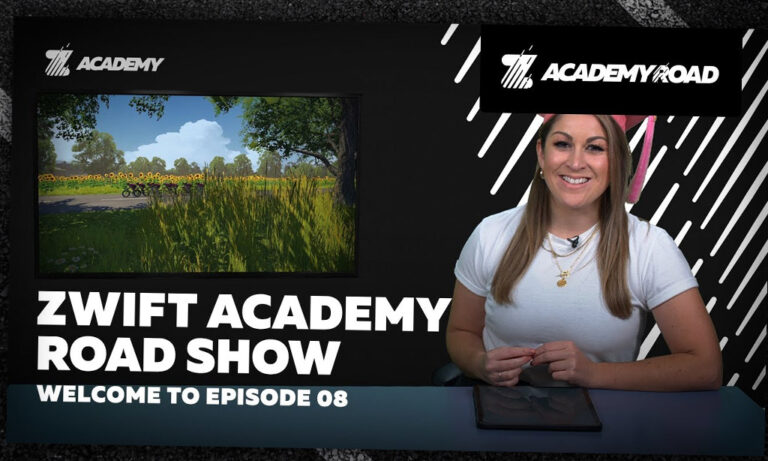
It’s graduation time on the Zwift Academy Roadshow. This week we’ll be chatting to Matt Stephens about the upcoming finals, we dive into workout eight with coaches Dan and Stephen, and Leah’s back to answer those final questions from the ZA community.
Since March I have become obsessed with the weekly Team Time Trial… so I asked Eric if I could share my obsession with you all, in weekly doses.
Each week on a Friday I will give you a profile of the upcoming route, guidance on bike choice and some target times if you want to aim for the Premiere League (top-10 in each coffee class get to be in a special race televised on YouTube).
If you can’t ride, or even if you can ride, but want more action! Don’t forget to tune in to the live TV show on Zwift Community Live’s YouTube Channel at 6:15 (UK time).
For those outside the good ole US of A it’s just another Thursday… for those inside it is the biggest holiday that isn’t in July… it’s Thanksgiving! I have been here 20 years and I still don’t understand it… but hey… treat it like practice for Christmas dinner, and what can go wrong? The question is how many of the riders on this side of the pond will be weighed down by Turkey, cranberry sauce, and sweet potato (with marshmallow topping)?
But…. it’s not just Thanksgiving… this is the Nopinz World TTT Tournament event. All the work you’ve put in on TTTs this year is for nothing except training because THIS IS THE EVENT THAT COUNTS!
Review of TTT #83 Watopia Hilly
Watopia Hilly might be the oldest ride in Zwift, but it isn’t a big hitter on the WTRL TTT calender. Its last showing was in December, and there were less than 100 teams… so nothing really to work with in terms of time. Luckily Hilly Reverse was ridden a few weeks back so at least I could work from that. Sill… here are the times and the results from WTRL #83
Category
My prediction
#83 PL
Position
Vienna
42:30
41:28
16th
Espresso
36:57
36:32
19th
Frappe
38:45
38:39
15th
Latte
42:00
41:55
13th
Mocha
48:30
48:36
11th
So how did I do on the day? Well, unfortunately last Saturday disaster struck and I had a catastrophic failure with my Turbo/Ergo/Smart Trainer. Despite desperate messages to various outlets, friends, and other contacts in the area I couldn’t get a loaner for Thursday.
What that did mean is that I got to be DS from the “team car” twice this week – once on Greatest London Flat for the ZRL, and then on the WTRL TTT on Hilly.
My experience this week as DS was something of a revelation to be honest. The team only had six – me down with a dead trainer, another rider in hospital with a raging infection… but our time through the course was faster than targeted and the watts were higher than usual. Did the Magnificent Six just have a good day, or was there a tangible benefit from having someone who knew them and knew the course calling the plays?
I know I really enjoyed being the eye in the sky and would definitely do so again if I could. It’s an experience I’d recommend to everyone.
That said, the UPS man has just arrived with a reconditioned 2018 Wahoo Kickr, and my trusty old Kestrel Talon is all ready to be set up. This weekend I intend to have a crack at the 1 hour Alpe. Ride on, and see you on Magnificent 8!
Magnificent 8 Course
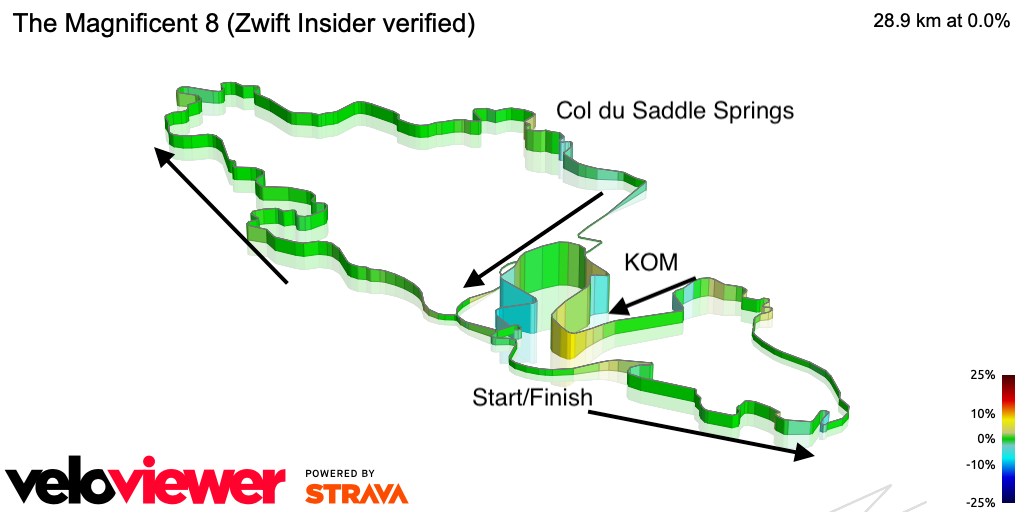
Next Tuesday we have a 28.8km ride in a rough figure-8 route around Watopia. The Watopia Magnificent 8 course is one of those “mostly flat, but…” courses. Here the “but” comes in the form of Hilly KOM Reverse which has the potential to rip the team apart if you aren’t careful. Luckily the KOM comes close to the start of the ride so your legs will be fresh. Here’s the always great VeloViewer view of the course:
We start in the downtown Watopia pens and head through the start/finish gate… from there it’s across the bridge, around the Volcano and head towards the Italian Villas over the land bridge. The tricky segment starts here – the surface turns to dirt and then you head up the hill past the waterfall. Brief respite from tricky terrain for a short while (a km of downhill and mostly flat), before hitting the KOM.
Up and over the KOM, hang a right and head into the desert, and it’s 11km of flat. Up the Col du Saddle Springs, down the other side, and into the tunnels. After that, it’s back to downtown Watopia and through the start/finish and, as the saying goes, Bob’s your uncle.
Curiously, if not totally relevant, I do actually have an Uncle Bob.
Ahead of ZRL #4, a Team Time Trial, the guys over at No Breakaways have created a fantastic route profile on YouTube (I have a good face for text which is why i’m writing this not presenting it…). The only difference in the ZRL and the WTRL Thursday TTT is the format of the teams/classes so this is well worth the 8-minute investment to watch!
What to ride?
Bike recommendation on this route is pretty straightforward. Despite the bump over Reverse Hilly KOM Reverse, aero rules the day. At the top-end of equipment the question is does Tron’s performance on the hill outweigh S-Works Venge with the pretty Super-9 disc wheels. Not for me… I will be on S-Works Venge with the 858/Super9s.
Here are some recommendations on equipment at various levels:
Come out of the pens and through the start / finish gate. It’s not flat to start with but it is a steady rise – work on your formation and you have nothing to worry about. At the top of the rise turn right, head across the bridge, around the volcano and across the land-bridge towards the Italian Villas.
Part 2 – Through the Italian Villas and over the KOM
This is definitely the trickiest section of the ride. Once you are across the landbridge the road surface changes to dirt, then it starts to rise. Once you get to the Villas the surface turns to cobbles then tarmac, and rises up past the waterfall. There is a brief respite (down/flat) before hitting the KOM itself.
The challenge with the dirt section is the drag dirt has – it will slow your team down, and will also reduce visibility. Discord is your friend here. The road hits 3% which on the dirt will feel like 5%. It doesn’t take long though, and soon enough you’ll be at the Italian Villas.
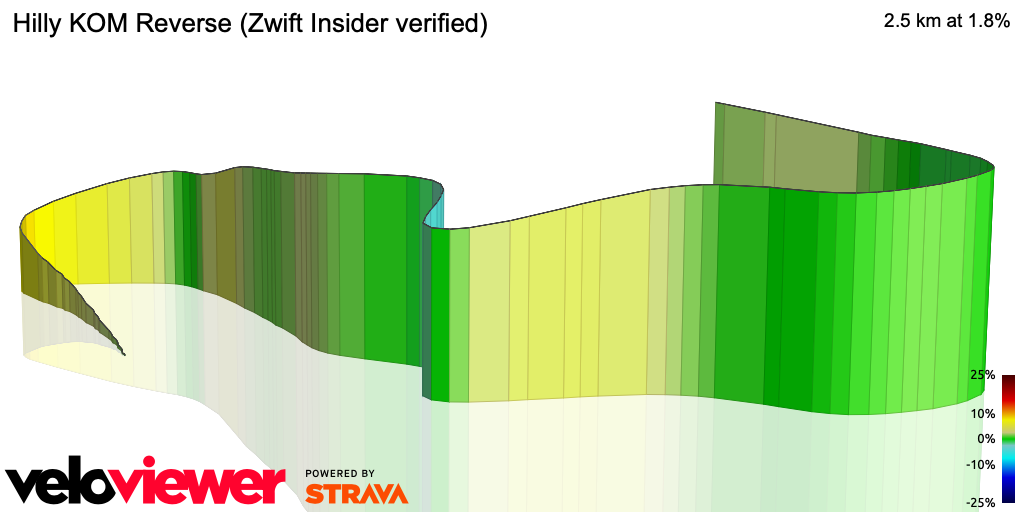
At around 7.4km you hit the reverse KOM. This one is your real danger area for holding the team together.
By the numbers this hill barely exists… it’s 1.8% for 2.5k. A false-flat, right? Well, the truth is we have four ramps separated by easier segments and even some downhill. Why is this a problem? In a large group race you have a big group to hide in, and as the groups split up you still have plenty of protection. In a TTT you have only have (up to) to 6 team members to hold together – when the hill bites each team member will be impacted differently.
What to look out for here?
Stronger members leaving the team behind. This is not a time for a solo break.
Weaker team members getting dropped or left behind. Particularly after the first ramp – at over 10% someone will crack if you go at race-pace, or they will burn matches getting over the ramp then back off and get left.
If you come over the top together you’re in luck – gather momentum on the descent and there is an opportunity to supertuck to get a micro-rest… just look out for the flatter section around the bend where your supertuck might break. Stay together here and power down.
Part 3 – Across the desert
There is a slight rise into the desert itself, but mostly this is a flat, fast 11km. Get your heads down, stay in formation and ride like the wind.
Part 4 – Col du Saddle Springs and home
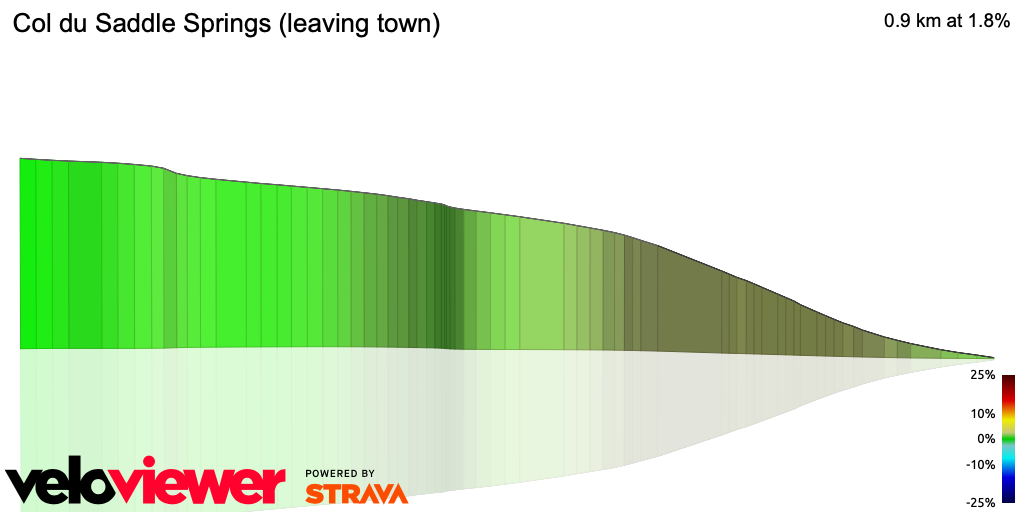
You exit the township of Saddle Springs at around 24km. The col is a small rise that comes right after the futuristic building you pass on your left (it’s a copy of the LAX Control Tower). After the long flat this is a perfect opportunity for your lighter, stronger climbers to jump ahead and create a split! Rein in those riders and keep everyone together. This little hill averages just 2% for 900m before you head back down and into the undersea tunnels.
After that it’s pretty plain sailing – exiting the tunnel system has a short bump up – but by this time you can make your own decisions on whether to jettison slower riders based on how many of you are left. Just a short sprint back to Downtown!
Target times
This route was last run at peak-Zwift – 25th June (#62), and before that, on 21st May (#57)… and then on 6th February (#42). It’s a very popular route – and of course it featured as a ZRL Team Time Trial as well.
The results show an interesting progression. The ladies Coffee Class, Vienna gets faster and faster – as does the C/D mixed class, Mocha. However the Espresso, Frappe, and Latte teams peaked in May and got a little slower in June.
So what do I think will happen this week? Well… I think times will be faster than June, but much faster than February… somewhere around May’s times. Here we go:
Category
#42
#57
#62
My prediction
Vienna
56:24 (9th)
43:27
43:12
43:05
Espresso
42:47
37:40
37:55
37:30
Frappe
41:16
39:52
40:13
39:50
Latte
44:08
43:16
43:30
43:20
Mocha
53:18 (9th)
49:35
49:06
49:00
#46 was my first ride out with the R&K Hyenas – we did 46:52 and ended in a sprint finish. For me it was a grudge ride… I was still smarting from being dropped by my CICC brethren on Reverse Hilly a few weeks prior – in my defense, I was in the Frappe team that week, but it always hurts. If we go out with a full team for #84 I am aiming for a sub-46 minute ride. We have a nice mix of climbers and… those more suited to the flats. I think we can pull out something special. Besides, I’ve been sitting around for a week without a trainer and I have something to prove!
Wrap up
This ride features frequently in the WTRL schedule – and for good reason. It’s a perfect TTT route. It is mostly flat with enough technical bits to keep you on your toes.
The Reverse Hilly KOM is the defining feature for the route. Because it figures very early in the ride, it’s not so much how fast you get over, but whether you can get all your bigger riders over together. Immediately following the KOM are 11 kilometers of flat desert where you will want every watt and horsepower a team of eight can deliver.
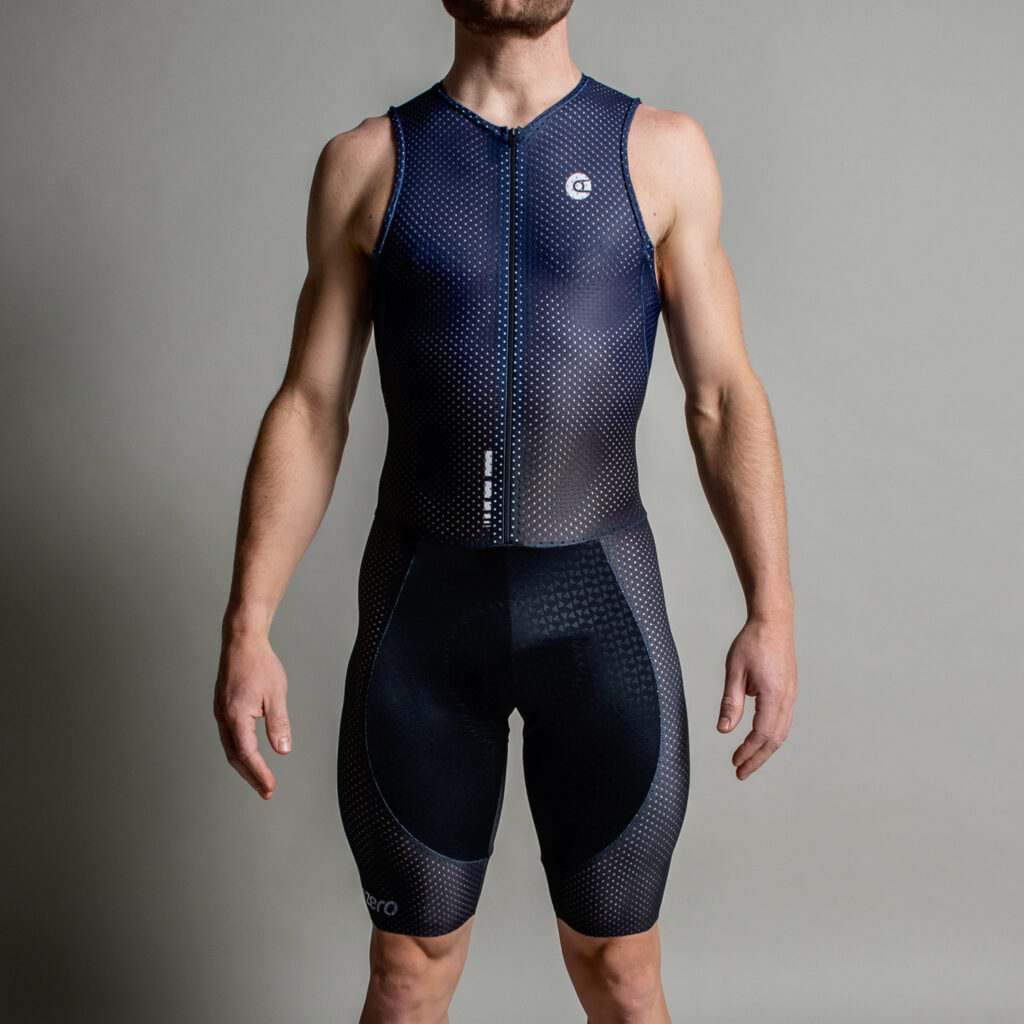
UK-based cycle racewear brand Nopinz announced their SubZero Turbo range back on October 1st. I’ve had both the bibshort and suit versions of their kit since a few weeks prior to that rollout, and I’ve been putting the kit through its paces in Zwift races each week. Here’s my review…
The Big Idea
While some may scoff at the thought of “indoor-specific cycling kit”, there is no denying that indoor riding does put demands on your kit which aren’t seen outdoors. Namely, sweat is a much bigger issue inside due to reduced airflow, and saddle discomfort is common due to reduced bike movement on a static trainer setup.
Clothing companies have recognized these demands, beginning with Castelli’s Insider line then followed by Rapha and Le Col + Wahoo (read my review of these three kits). So Nopinz isn’t the first to come out with indoor-specific kit, but they are one of only a few offering it, and their line has something the others don’t: swappable frozen gel packs to help you stay cool.
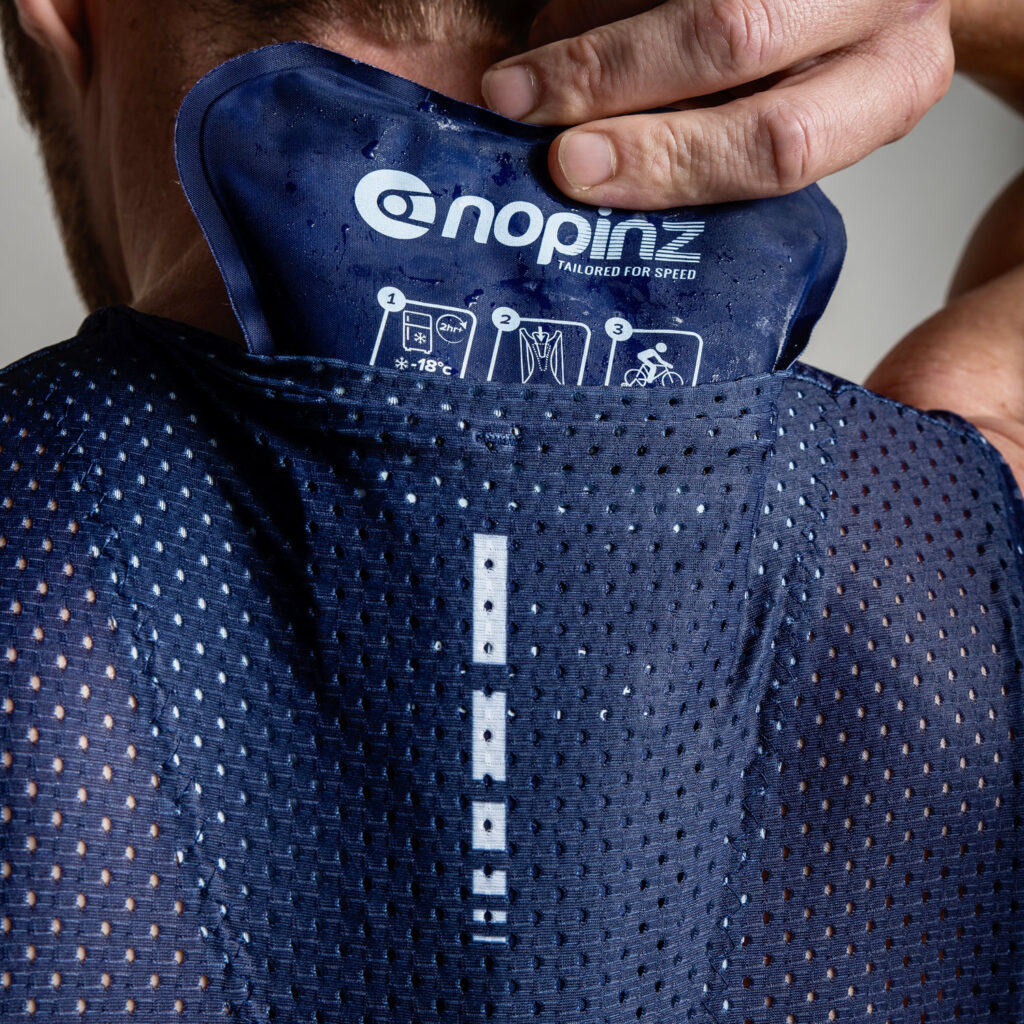
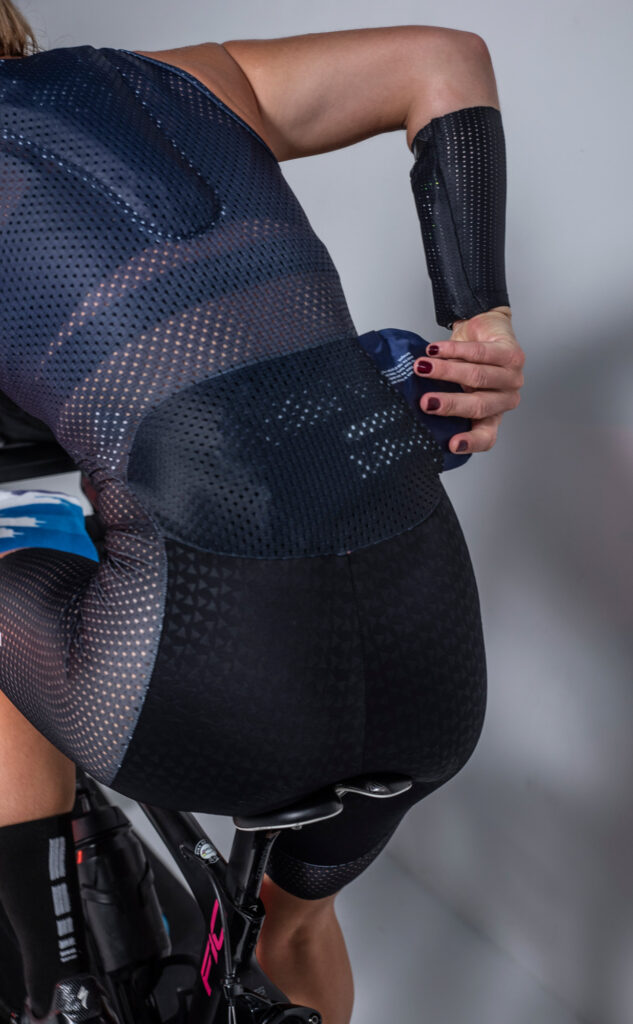
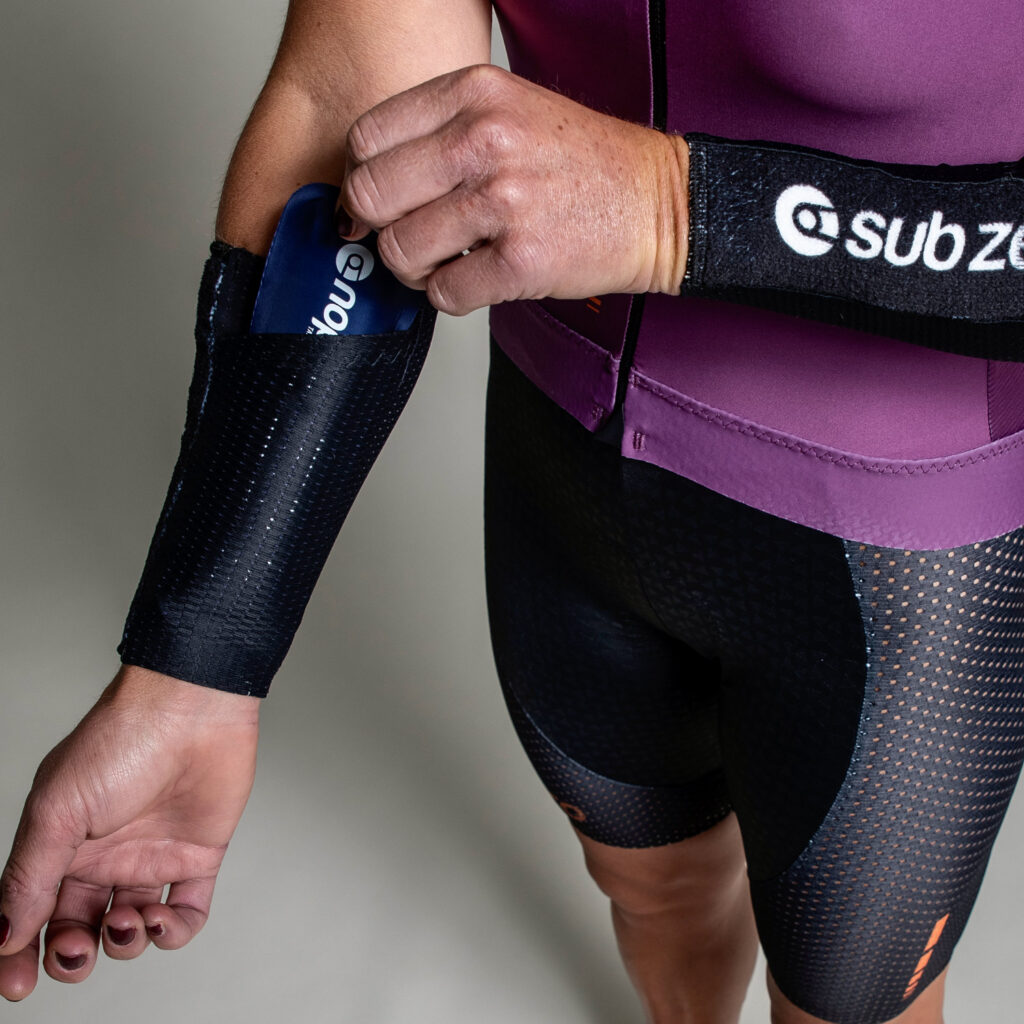
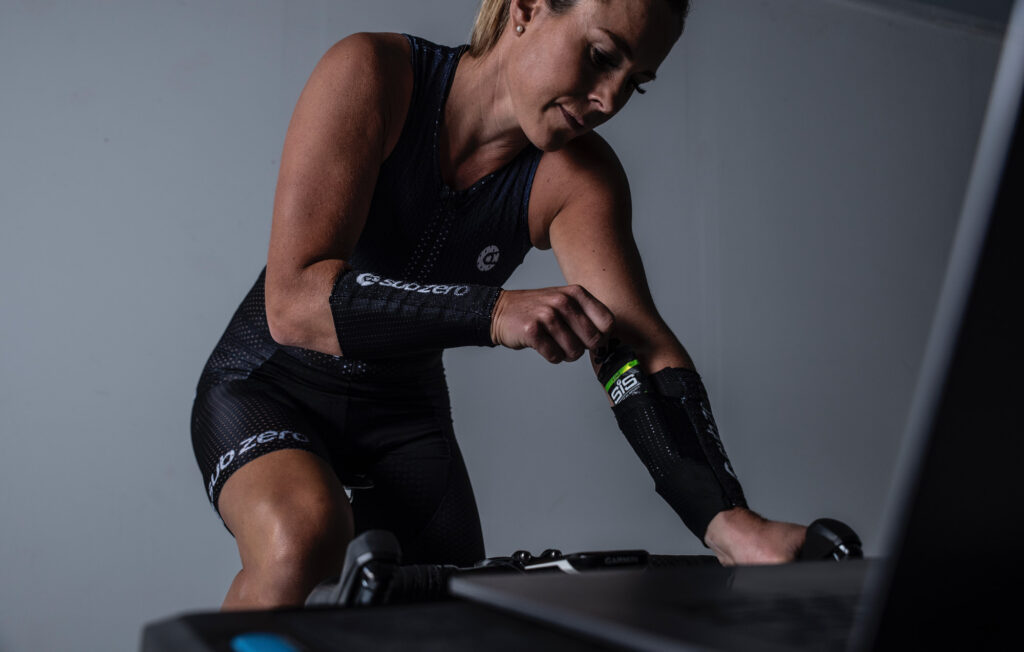
One gel pack goes just below the nape of your neckAnother on your lower backAnd optional wristband packs
Features
The key feature of the Subzero range is the inclusion of sewn-in pockets to hold frozen gel packs. But after spending some time chatting with Nopinz CEO and founder Blake Pond (a keen Zwift racer himself), it’s clear he put much more thought into this kit than just the freezer pocket idea! Indeed, the kit without the pockets is probably the best indoor kit I’ve worn, combining the strengths of the competition’s indoor kits while avoiding the weaknesses.
Here are some of the additional indoor-specific features:
Chamois pad optimized for indoor riding for improved moisture management. The pad isn’t overly-thick, and has thousands of tiny perforations, allowing for increased air flow, evaporation, coolness, and dryness. In talking with Blake, he explained how Nopinz tested many different pads for this line, using both male and female testers, before finally arriving at their pad of choice.
Men’s and women’s versions: some of my favorite indoor kits (looking at you, Castelli!) only come in a men’s version. It’s nice to see some gender parity from Nopinz.
Mesh material used everywhere except around the groin, allowing for maximal cooling. The material is similar to what Le Col + Wahoo uses, but even lighter weight. It feels like it stays drier, too. Nopinz clearly wanted to maximize cooling here, opting to use the mesh material at the bottom of the legs where other indoor lines put traditional wide elastic bands.
Wristbands: Nopinz is the only line that includes wristbands (with freezer pockets), giving you a handy sweat-wiping surface and additional cooling.
Extra freezer packs: the bibshorts, suit, and wristbands all optionally ship with two sets of freezer packs, because one set lasts around 20 minutes in the heat of a race. The shorts and suit include a freezer bag to store your gel packs as well, which is super handy for keeping the packs in one place, and keeping them cool when you’re in a race and plan to swap to a new set partway through.
Is It Cool?
This is the question everyone is asking, of course. Do the freezer packs work? How do they feel?
I racked my brain trying to come up with some sort of test to show the efficacy of the freezer packs – but without a real lab that’s pretty hard to do. So all I have to go on is my own anecdotal evidence, gathered from over 20 races in the Subzero bibshorts or suit.
Here’s what I can say: I keep picking the Subzero bibshorts from my closet when it’s time to race. I definitely feel cooler when I have a fresh pack in, and when I swap to a new set in the final 15-20 minutes of a race, it feels great.
It’s worth mentioning that I’m a guy who gets hot easily, and I sweat quite a bit. When I race, I typically have my Wahoo Headwind going full-bore, and sometimes I’ll also have the air conditioning on. Some riders don’t seem to need the same level of cooling that I do – but if you’re like me, I think you’ll appreciate the added coolness of the Subzero kit.
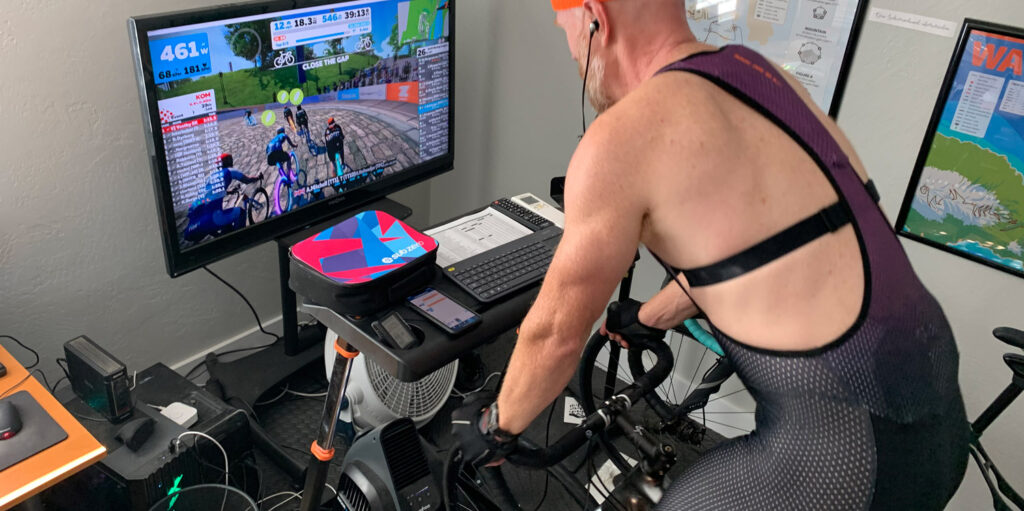
Me putting the kit through its paces in a recent ZRL race. Note the nicely-branded insulated freezer bag on my desk, for holding the frozen gel packs!
Fit
A few notes on kit fit, since that is always a question:
The bib shorts and suit fit similarly to other kits I’ve tried (and I’ve tried a lot). I wear large shorts in all of the big brands (Le Col, Assos, Castelli, Zwift/Giordana) and the large Nopinz shorts fit great. I will note that the legs are quite long on these shorts – perhaps the longest of any shorts I own. This is one place where Nopinz could perhaps go a bit shorter to provide for even more cooling.
The sweatbands fit quite tightly – they’re a bit of a chore to pull on, and swapping the freezer pack out of them is more work than swapping it out of your bib shorts. Because of this, I find myself skipping the sweatbands altogether in some races.
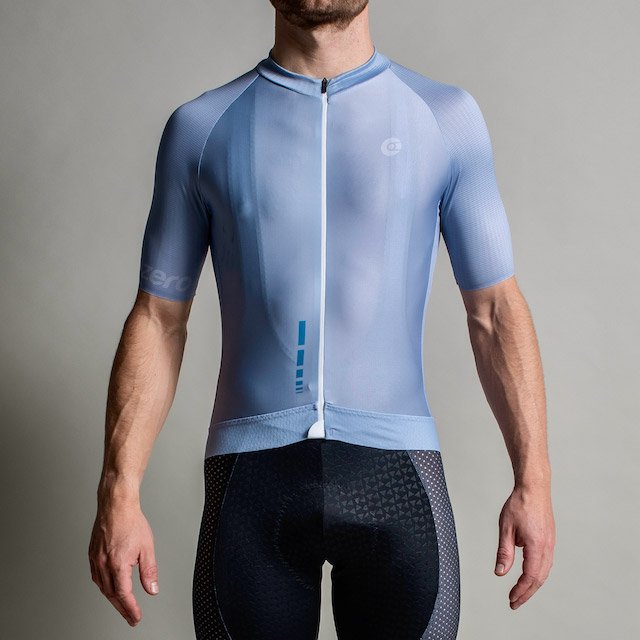
The jersey fits very snugly. I typically wear a medium in most major brands, and I like my jerseys to fit like a snug “race fit”. I got a large from Nopinz, and it fits more snugly than most of the medium jerseys I have.
The Subzero line’s Turbo Training Towel is an affordable addition to the line, but at 39×20″ I found it’s a bit large for my taste. On the plus side, with two options cool sayings on the towels (“Champions Train/Losers Complain” or “Turn Pain Into Power”) you could hang them on your wall for a nice decoration!
Shorts fit true to standard sizing, with plenty of leg lengthMy large sweatbands fit quite snuglyJersey is super snug – check the sizing chart!
Durability
One reason I’ve delayed this review for several weeks is so I could wear the kits quite a bit and put them through a lot of wash cycles.
I always wash my bib shorts on the washer’s “delicate” setting, then hang them to air dry. The Nopinz kit has held up well so far, with no issues to report. It seems to be a bit sturdier than Castelli’s Insider shorts, which I love but which I’ve popped the seams on while pulling them on or off.
Price/Performance
At £109.99, the bibshorts are quite affordable. They’re the same price as Castelli’s Insider bibshort, and much cheaper than Le Col’s £150 price point. Keep in mind, though, that adding the freezer packs (and cool bag) to your bibshorts will increase the price by £30.
The jersey is also well-priced at £79.99 compared to Le Col’s £120, even though Castelli’s is a bit more affordable at £75.
Wrapping It Up
The Subzero kit from Nopinz is the most well thought-out indoor kit I’ve used to date, and that attention to detail clearly shines through in the bibshorts and suit. Blake is a strong A racer on Zwift, and Nopinz sponsors some of the top community racing in Zwift. This intimate involvement with our rapidly-evolving discipline shows in their products.
I have no reservations highly recommending the Subzero line to any Zwifter looking to stay a bit cooler during hard rides. I would recommend the bibshorts first, although the full suit is a nice option if you’re looking for a bit more modesty. The jersey isn’t really necessary unless you like to wear jerseys indoors and/or you’re live streaming and want to look pro but stay cool. The towel is just a cool inspirational add-on, and the sweatbands may be great for some folks, although I haven’t found them particularly useful.
Zwift has just announced sanctions against two riders, giving each a six month ban from Zwift Cycling Esports events after it was determined they fabricated or modified their racing data, “bringing the sport into disrepute.”
The notice of sanctions can be found here, which links to detailed PDFs explaining the Zwift Performance Verification Board’s (ZPVB) decision in both cases:
“The smart trainer or smart bike must be the primary power data source…” and
“Riders must record a second source of power data“
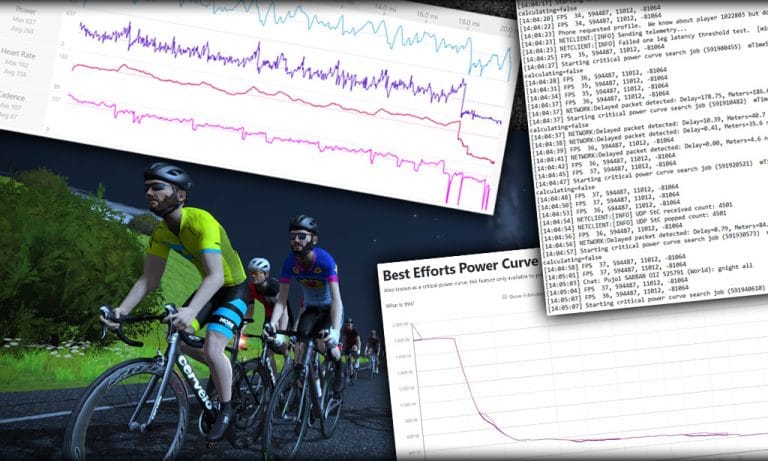
So two sources of power data are required, the power numbers sent to Zwift have to come from the riders’ smart trainer/smart bike, and not their second power source (typically a pedal or crank-based power meter). But in both cases, the ZPVB determined that riders supplied intentionally-modified power data and/or log files.
According to the detailed document for Berger, her supplied secondary power fit file showed a variance of “approx. 0%” when compared to her primary power file. This isn’t what you typically see when you record power from two different sources – but it is what you’d see if you record power from the same source, but in two places. So ZPVB judged that Berger likely connected both Zwift and her bike computer to the same power source.
And that could have been an honest mistake. But the document details how, over the course of the next days, Berger supplied a Zwift log.txt file from Berger’s Zwift device which didn’t match the corresponding file saved on Zwift’s cloud. Namely, the device list on Berger’s supplied log file had been modified to indicate that she had paired a smart trainer as her power source, instead of her Stages power meter as indicated in Zwift’s cloud version.
The document details other reasons for ZPVB’s findings in Berger’s case, but to summarize they judged that she:
Paired her Stages power meter instead of her smart trainer as the power source in Zwift
Recorded only the power from this power meter as both her primary and secondary power file
Attempted to modify the log.txt file to show that she had paired her smart trainer as the power source in Zwift
According to the detailed sanction document for Duncombe, she originally provided a backup power file which did not include her race, but only the first 90 seconds of her warmup. Again – this could be a perfectly honest mistake. But she later uploaded a different secondary power file to ZwiftPower, and this file showed values approximately 1% lower than the values from her trainer sent to Zwift.
An acceptable margin, except that this new secondary power file appeared to have been manipulated to look like it came from her Garmin, when in fact it appears to have come from Zwift itself.
The document details other reasons for ZPVB’s findings in Berger’s case, but to summarize they judged that she:
Did not properly record a secondary source of power from her power meter for the race
Attempted to supply a modified Zwift power file in the place of this secondary power file
What Are They Banned From?
Both riders will still be able to use Zwift whenever they’d like, and even race in “unofficial” Zwift races. They are banned (for 6 months) from taking part in official Zwift Cycling Esports events, which are typically invitation-only events for top-tier teams/riders.
Berger’s suspension has been back-dated to the point when the edited file was submitted to Zwift, and therefore runs from 18 August 2020 to 17 February 2021.
Duncombe’s suspension has been back-dated to the point when her edited file was submitted to Zwift, and therefore runs from 20 September 2020 to 19 March 2021.
Conclusion
Both of these cases give us a look into the sort of analysis Zwift’s Performance Verification Board does for its top-tier races. It’s no small job! But based on the evidence presented in the documents, it appears the sanctions are warranted.
As news of the sanctions has filtered into the Zwift racing community, one common response has been (as one Zwifter put it), “That’s all good, but I wish Zwift would put this kind of effort into policing community races.” And that’s a fair response, given how rampant sandbagging is in the category D, C, and B races happening every day.
While we should never expect Zwift to put manpower into manually checking power files for everyday community races, they could get rid of many of the sandbagging problems by implementing just a few controls in-game, such as forcing riders to join a particular category based on their historic power numbers. Perhaps opening up the (still beta) anti-sandbagging controls so race organizers can use them in events would also be a good step. Hopefully we’ll see progress here soon!
About Zwift’s Performance Verification Board
You can find the details of Zwift’s Cycling Esports Rules here, which explains that the Zwift Performance Verification Board is “responsible for ensuring the integrity of results of Zwift Cycling Esports events and series.” As such, it has “the power to update the results of events, and apply further sanctions to riders.”
The board is made up of a chair appointed by the head of Zwift Cycling Esports, a legal representative from Zwift, and a technical representative from Zwift. Zwift doesn’t disclose everyone who occupies these positions, but the sanction detail documents are signed by the chair, Dr. George Gilbert.
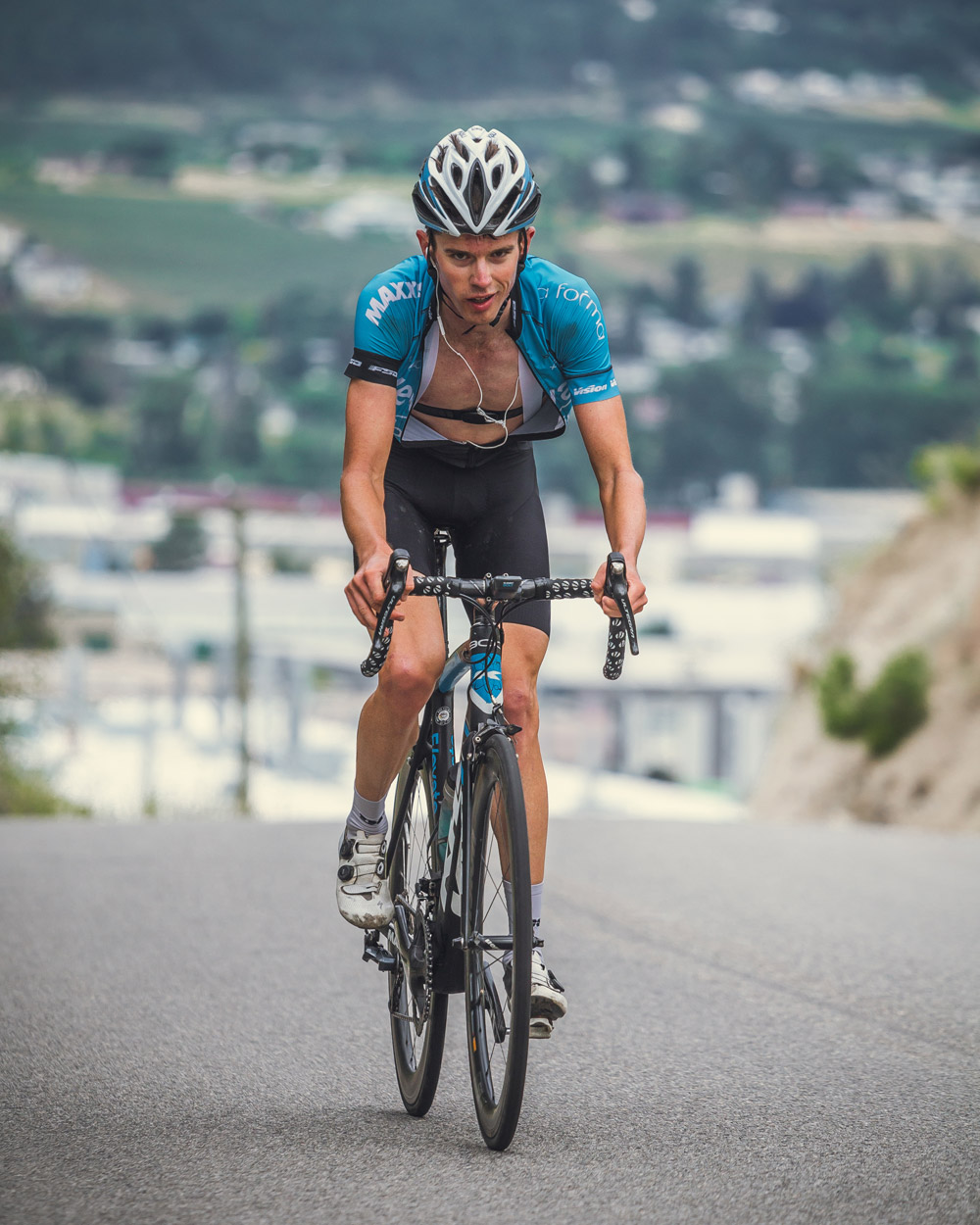
I raced exactly one day on the road in 2020. I was about six weeks out of the hospital following a career threatening training crash and rehab and I pinned on a number for the Tour of Murrieta crit in Southern California. It was exactly what I was looking for: uneventful. I felt capable and comfortable in the pack again and that was enough.
Maybe I would have raced harder knowing it was also the last race of the season as well as the first.
Finding Myself in an Empty Year
After my wife Emily, my dog Knox and I settled back in at home in Canada a couple weeks later I spent most of my time searching for something that wasn’t there. I needed to find something to work on and apply myself to. I thought about trying to get back into some of the menial but satisfying construction work I had done in past off seasons. I thought about going full time with my coaching business and engaging some of my post-retirement plans ahead of time. But I knew I couldn’t go down those roads.
The combination of my accident and the pandemic served to scrape away a layer of uncertainty about my identity and my career as an athlete. After my crash, I was in and out of the hospital three times over six weeks inDecember and January. Each time I got on the trainer as soon as they would let me and started pedalling. We were in mandatory isolation with six feet of snow piled up on the ground and no racing in sight and I was back in the garage putting in the work on Zwift the second day. I knew that I couldn’t lock my cycling career down for the year. I had to find competition and ambition somewhere.
Racing Nowhere Fast
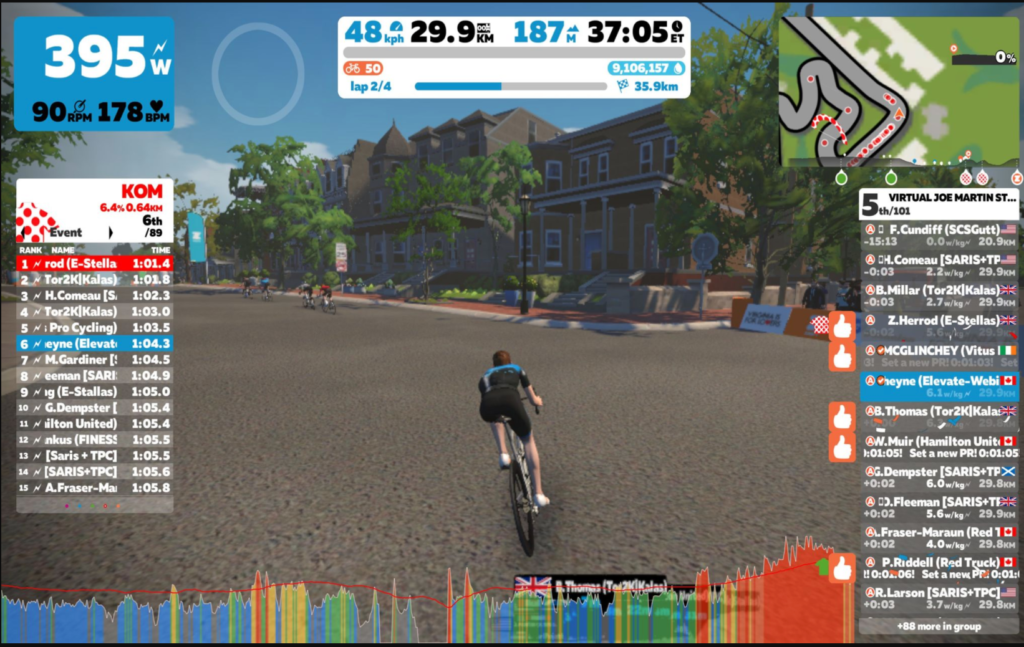
In April our Elevate-KHS team was invited to race a Zwift series of stage races hosted by the Project Echelon team. The races would loosely replicate national racing calendar mainstays like Tour of the Gila and Joe Martin Stage Race. It was a process, but we rallied the troops and learned the basics of team time trialing, Zwift draft dynamics, and strategy. Even for me, a Zwifter since Jarvis Island, it was a steep learning curve since I hadn’t raced on the platform since 2017.
Against steep odds, we rose to the challenge and I ended up second on the Gila queen stage and the team backed me to overall victory in the Joe Martin event. It took everything I had to compete with top-level Zwift teams like Saris-TPC and Vitus and that was exactly what I needed.
That run didn’t last very long. The Echelon series petered out as outdoor riding weather bloomed in the early summer and the finality of our scrubbed 2020 pro calendar set in. So, I asked around with some of the top e-racing teams: “How can I progress into the top Zwift Invitational events and series?” There was no good answer, the top teams were full and the e-racing season doesn’t often make stops to let new riders aboard.
I struggled against that but eventually relented and moved on to different challenges. I did some epic rides with my riding buddy Deon, doing my first 300k and riding in stunning new places. I Everested and broke the Canadian Record in a delightful low-key sufferfest. I paced a couple of talented young local riders to take some ridiculous KOMs. It all kept me going until summer faded into fall and all the big rides and searing climbs had been ridden.
Better Late than Never
I almost came to terms with begrudgingly stepping away from the bike for the year. Usually by late September my mind is so exhausted from the pressure cooker of the season I look forward to that step. Not this year, I still felt like something was missing and I kept looking for those puzzle pieces so I could call it a year well ridden.
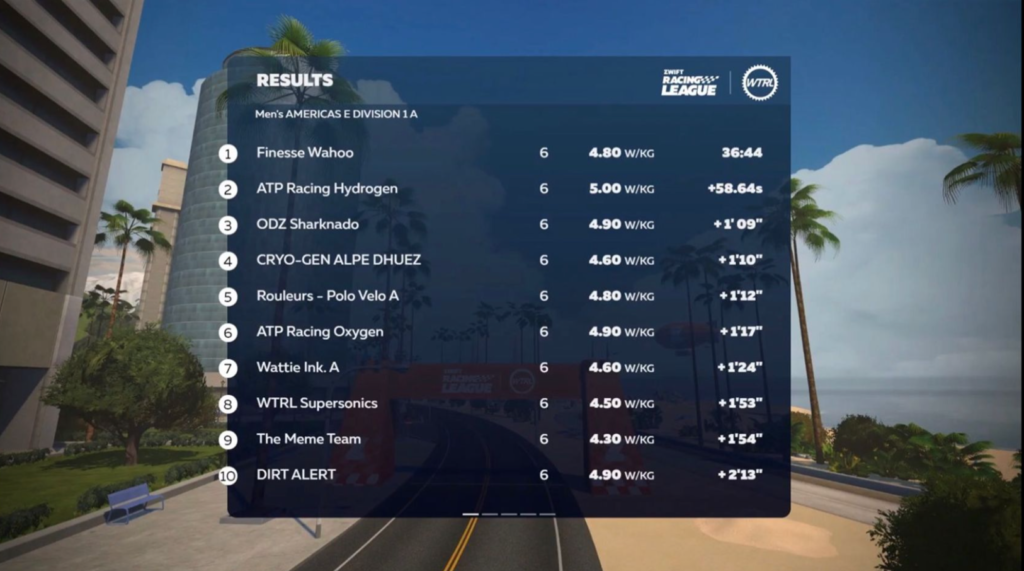
I had been in contact with the Finesse-Wahoo e-racing team through the summer trying to find more racing and suddenly there was a big opportunity. The new Zwift Racing League (ZRL) was starting, offering weekly top-level races in a team scoring format and the chance to move up into the coveted Premiere League if the team won its division. Teamwork, competition, and progression – it was all there, the ingredients to my motivation as an athlete. I fired up the Wahoo KICKR and joined the team formally for the season.
Just days after the first event, which Finesse Wahoo dominated in a landslide win, I got an email from Cycling Canada confirming my selection to the inaugural Zwift UCI Cycling ESports World Championships in December. It was another big chance to work and perform at my best level. Finally, the 2020 season was on.
Taking It On
I have to be honest, I wasn’t ready for either of these big challenges to begin with. The Worlds course and most of the ZRL races are full of punchy and anaerobic efforts and that doesn’t suit my natural strength as a climber and TT rider. I have spent the last 5 weeks training myself to be sharper than ever and learning the subtleties of high-level Zwift competition so that I can actually make a difference with my strength in races.
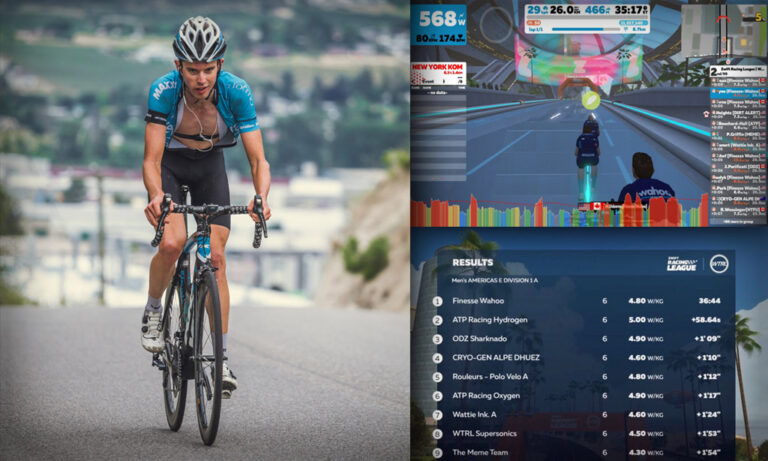
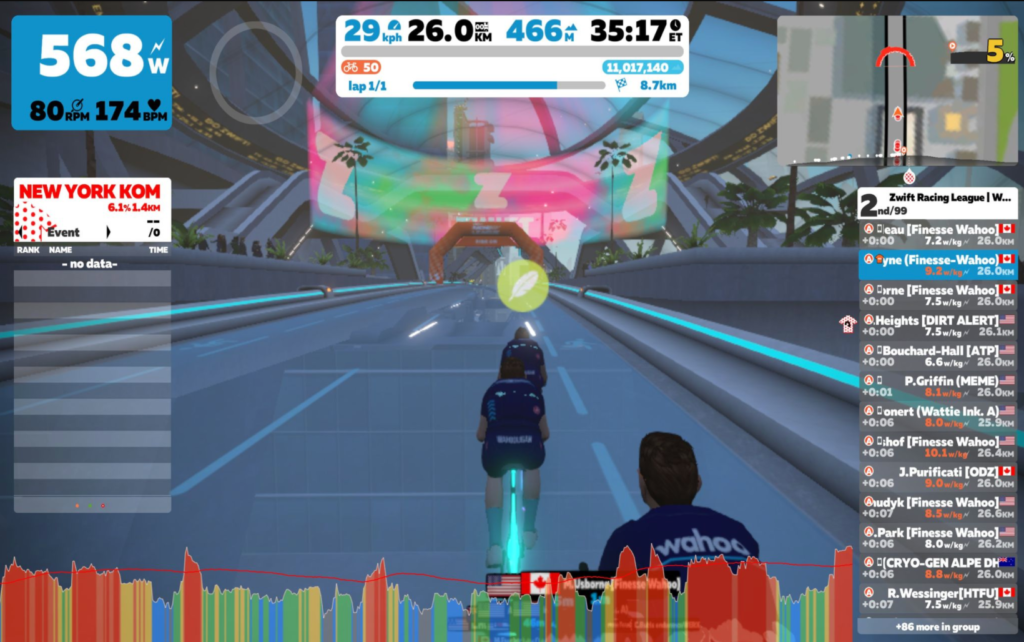
The Finesse-Wahoo team has been tremendously helpful and it as an added bonus we have been winning big. We pulled off the rare breakaway win in last week’s ZRL race in New York and won the last TTT by almost a minute. Commentators are beginning to call Finesse “America’s Team” and I’m proud to be apart of that.
Finesse-Wahoo driving the big move in ZRL week 5
Winning Big in the TTT with Finesse-Wahoo
I am going to start writing regularly about my dive into the deep end of Zwift Racing as it unfolds. Everything from my specific training, to Worlds practice events, to our team’s ascension in the Zwift racing ranks is moving quickly. For now, I am happy to be back where I belong in this sport: pushing the limit and building to something bigger.
Questions or Comments?
Got questions for Jordan, or comments to share? Post below!
Join Zwift CEO and co-founderEric Min + special guests next Thursday for the 6th annual Thanksgiving Day Ride!
Eric’s Thanksgiving morning ride has become an annual tradition on Zwift. It’s a fun way to pre-burn some calories before the feasting begins. Here’s more info…
HEAR FROM THE BIG MAN
Typically these rides have been a place where Mr. Min gives us a glimpse of what’s coming up next for Zwift. If you want to hear from the CEO himself on a variety of Zwifty topics, this is a fun way to do it!
RIDE DETAILS
Date and Time: 7AM PST / 10AM EST / 3PM GMT Thursday, November 26th
Pace: past Thanksgiving Day rides have been loosely-controlled affairs, with Eric Min averaging around ~2.6-2.8w/kg (190-200 watts). This ride will not be using the leader fence, so expect it to be strung out, with some riders going harder on the front. It’s a social ride, so go at your pace and enjoy the massive group!
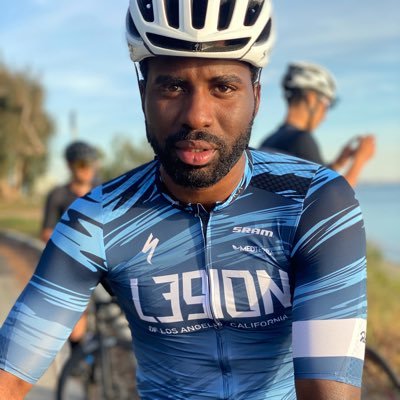
Justin Williams
SPECIAL GUESTS
Eric will ride along with special guest multiple US National Champion in track, road, and crit—Justin Williams of L39ION of Los Angeles.
Expect many leaders from the Zwift community as well as ZwiftHQ employees to be in attendance as well.
SIGNING UP
Sign up via Zwift Companion, in game, or on the web.