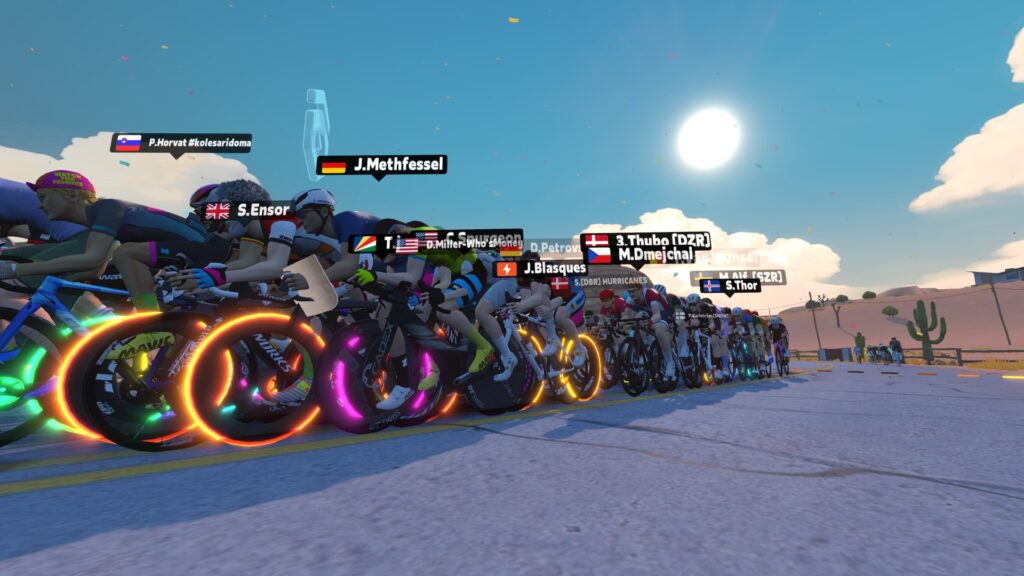
Tiny Race Series – January 18 Routes and Last Week’s Results
See zwiftinsider.com/tiny for current Tiny Race details.
See zwiftinsider.com/tiny for current Tiny Race details.
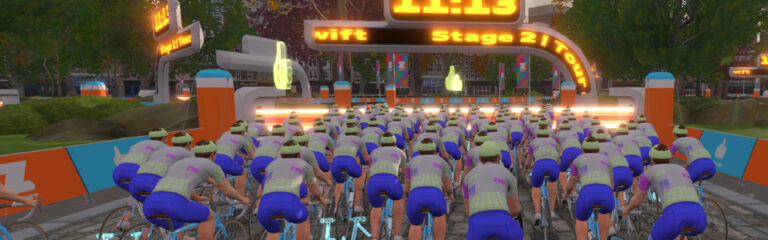
This all started by accident. I was looking for a race on a Tuesday afternoon, scrolling through events in the Companion app, and managed to sign up for a ZRacing event on Wednesday at 3:10am thinking it was Tuesday at 3:10pm.
I didn’t notice my mistake until I signed in around 2:40pm on Tuesday, and there really weren’t any compelling races coming up in the next half hour. So I decided to race the “short” route of Tour de Zwift Stage 2, on two laps of the “Outer Scotland” route.
This event looked like a fun one for three reasons:
If you aren’t familiar with Outer Scotland, the concept is pretty straightforward and easy to visualize if you know Zwift’s Scotland map. You start from the Glasgow Pens and travel in a clockwise direction, sticking to the outermost roads on the map:
I didn’t get much of a warmup in because I got on the bike a bit late plus my scheduling snafu meant my race was starting 10 minutes earlier than planned.
I knew I needed to get into the start pens as early as possible to avoid having to blast through hundreds of riders at the start, so I popped into the pens about 15 minutes before go time and spun my legs to get the blood flowing.
Let’s get this out of the way early: I realize Tour de Zwift is officially a group ride, not a race. In fact, I’ve already ridden 4 other TdZ 2025 events (going for the Ultimate Challenge!), and I treated all of them as zone 2 or tempo-paced rides.
This is what’s fun about Tour de Zwift, though. The groups are so big that you can always find people at your pace to ride with! If you’re a strong enough rider who wants a harder effort, you’ll find yourself in or near the front pack. If you don’t want to push very hard, you’ll find a group further back.
It reminds me of a chart I made a while back:
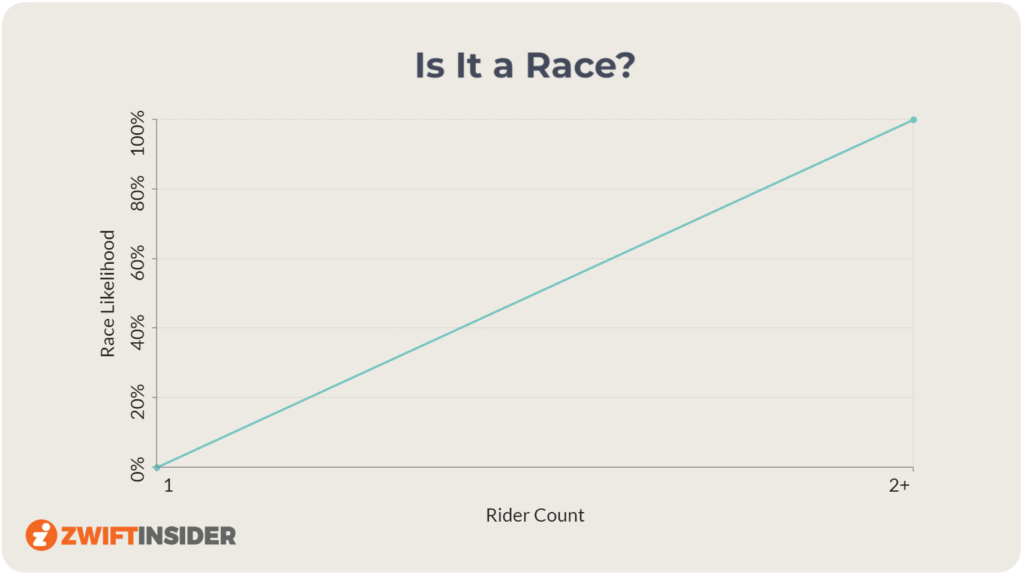
The truth is, on Zwift everyone is riding their own ride, and nobody is too fussed about what others are doing. Usually.
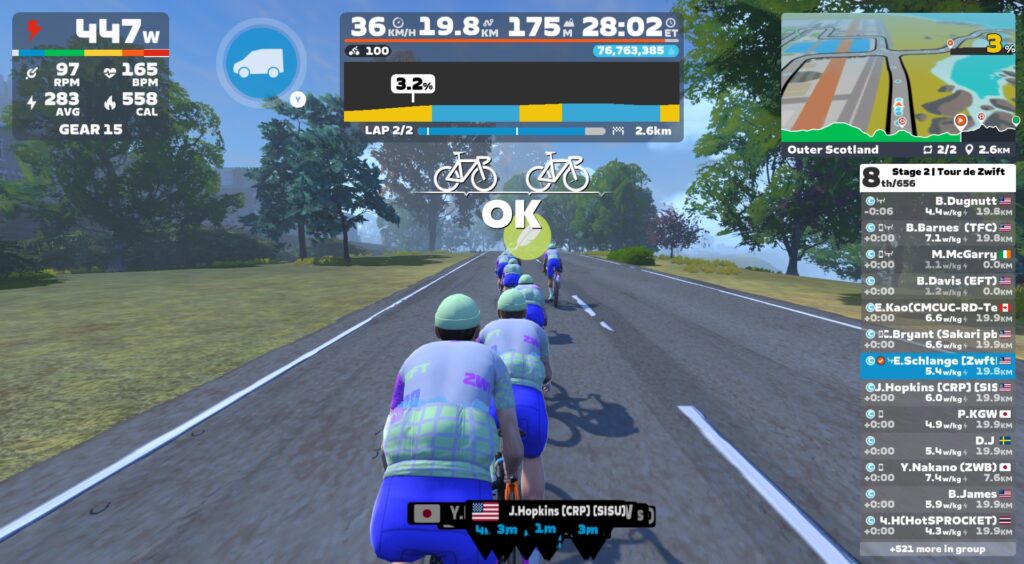
We blasted out of the pens with around 450 riders in the pack, and I hit the pedals hard to make sure I could get to the front of the group. With Zwift only rendering the nearest 100 riders, you can’t always rely on the avatars you’re seeing on screen.
For example: you may be sitting in the middle of a long line of 500 riders, but it looks like the front of the group is just ahead because Zwift is only rendering the closest 100 riders.
So it’s smart to look at your current position at the top of the rider list on the right. This shows where you’re ranked, and also shows the total number of riders who have joined the event.
I got to the front of the group quicker than anticipated, and as we began climbing up the draggy Cliffs section of the course, gaps began to form in the line of riders behind.
One surprising thing I noticed, which I don’t remember happening as often in past rides, was the number of late riders dropping in. Every few seconds, it seemed, a new rider would appear in our group. It was a bit annoying, to be honest, but I also realized that most of these riders were quickly dropping from the front group.
Before we hit the 3km mark the elastic had snapped and I found myself in the front group of 46 riders. That group quickly dropped to 35 as we hit the Corkscrew Castle climb followed by Breakaway Brae Reverse, with many in our group making smart use of the powerups afforded at each arch.
As we made our way toward Glasgow, I had a strange steering malfunction that I hadn’t had before in Zwift: the game steered me hard right to the center line, and I wasn’t able to steer back into the pack for a few seconds odd. (See this in the video below at the 13:35 mark). This happened a few more times on the ride, but hasn’t happened since.
I used my aero powerup at the top of the Clyde Kicker, just before going through the arch, then quickly used my fresh feather powerup on the short climb that followed. I knew another powerup was waiting just up the road, and I wanted to use each powerup to maximum effectiveness.
We finished the first lap with 22 riders in our front group, and I earned my Outer Scotland route badge. Time for another lap!
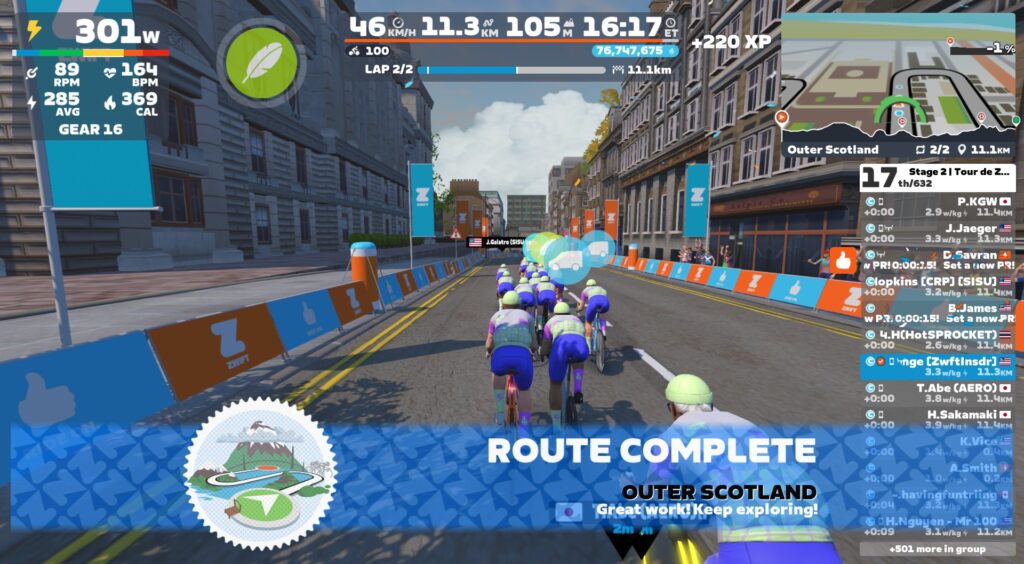
Things got spicy on the Cliffs this time around, but I stayed in the wheels, letting others pull back attacks. Jadon Jaeger, a high-ranked A+ racer (5-time and reigning USA Masters TT Champ), was off the front for a bit, as was Bobson Dugnutt, an A racer who kept attacking the front group.
(The problem was, I had no idea who Jadon Jaeger was. Or that he has a legit FTP of at least 411 watts.)
Popping my feather powerup on the Corkscrew Castle climb, I found myself just off the front of our group, chasing Jaeger. We both had steering capabilities, and Jadon got cagey, weaving back and forth to avoid giving me a draft. I knew I didn’t have the legs to stay off the front, so I just sat up and let everyone else catch.
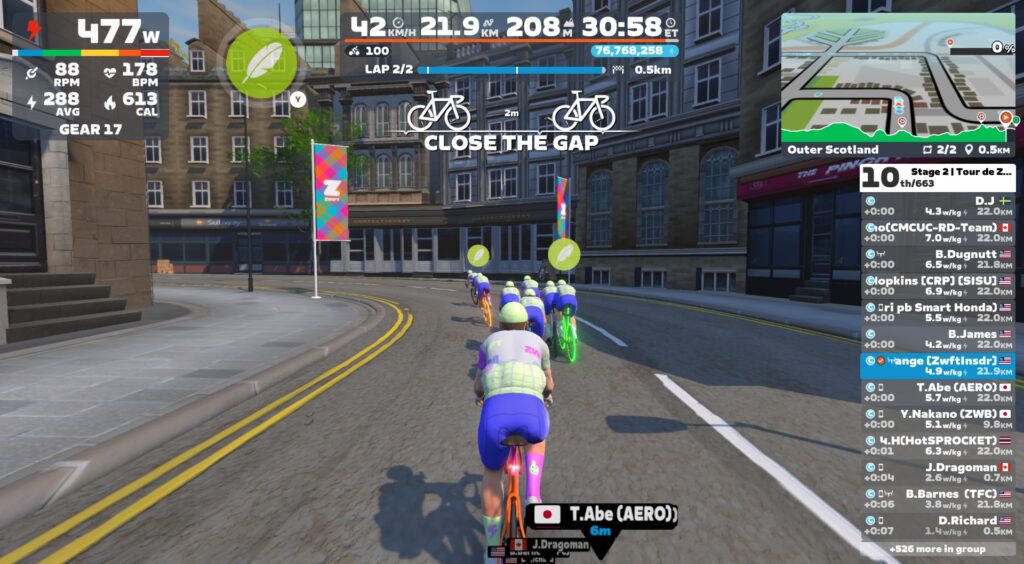
It wasn’t easy to see what was happening at the front of our ride/race, to be honest. This is one of those things I wish Zwift would improve. Even with Sauce for Zwift running, I wasn’t sure if the riders shown up ahead were being lapped by our fast group, or were attacking off the front. The rider list on the right doesn’t help, since it only shows who’s ahead of your group if you put down the watts and move to the front of your pack.
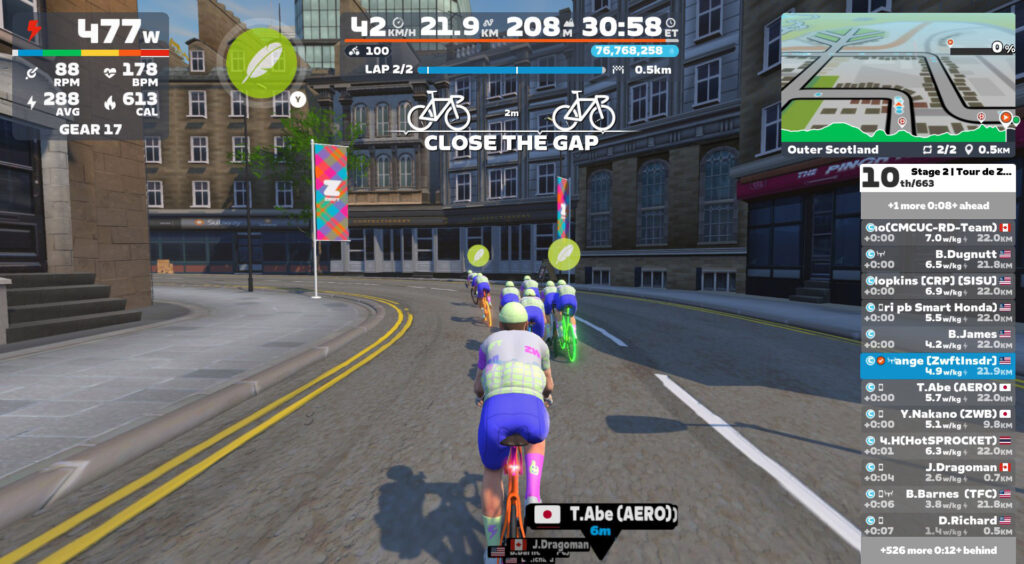
All that to say, with 3km to go we were nearing Glasgow, and I thought Dugnutt was the only rider off the front, 8 seconds away. It wasn’t until I watched the video replay that I saw Jaeger was well ahead of him!
Not that it mattered for me personally – I wouldn’t have put in the chase on Jaeger anyway. But maybe someone else would have, and I could have followed their wheel?
We caught Dugnutt on the Clyde Kicker, and I thought everything had come together at that point. I triggered my draft boost up the Clyde Kicker, then got a rather useless feather for my final powerup.
The pace was high as we descended from the Clyde Kicker with just 1km to go, and I wasn’t sure if I’d even get back onto the wheels of the front group as the line stretched out. But they all seemed to sit up a bit to catch their breath, and I put in a well-timed dig on the last little rise to get back in touch:
There were just 11 of us left. I triggered my feather before the final left-hand turn, then downshifted and got out of the saddle for the final sprint. To my surprise, I saw myself passing rider after rider, eventually crossing the line in what I thought was 2nd position!
Turns out, Jaeger was 8 seconds off the front in 1st, which meant I got 3rd on the day. I’ll take it!
See my activity on Strava >
See event details on ZwiftPower >
A total of 663 riders joined this event, and while at least 130 of those dropped out early and countless more weren’t treating the event like a race, I was still pretty stoked with my result.
A few noteworthy takeaways from this ride:
Have you tried racing any of the Tour de Zwift events this year? How did it go? Share your thoughts below…
The second race of Zwift Racing League 2024/25 Round 3 happens Tuesday, January 21, and we’ll be in France on the Douce France loop, a ZRL TTT favorite.
But it’s not a TTT this time around! We’re here for a points race, which means it’s all about your sprinting abilities on this flat, fast route. There’s much to discuss, including the route’s key sections, powerup details, strategic options, and bike choice. Let’s go!
France’s Douce France route is 24.2km long with 133m of elevation gain and 4 intermediate point segments. We’ve raced this route multiple times in ZRL as a TTT – most recently in September 2024 for round 1. But it’s a points race this time around, which changes everything!
All categories will be racing a single lap of this flat, short loop.
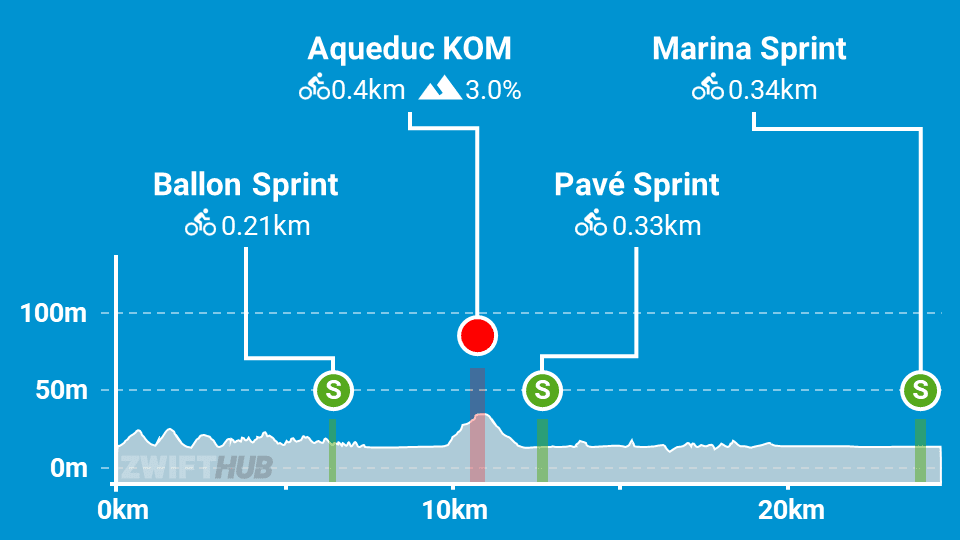
Here are the key sections of the route from a points race perspective:
Les Intestins (0.6-3.4km): After a flat lead-in of approximately 500m you will turn right and begin the twistiest section of the course, which we nicknamed Les Intestins. This section is a bit pitchy as well, with three distinct up/down sections, but none of the climbs are steep or long. Unless you’re a strong rider who can put in real attacks to fatigue others you’ll want to mind your pack position and save your legs for the points segments up the road.
Ballon Sprint @6.8km (210m, 0%) FAL+FTS: this short sprint averages 0% gradient, but it actually starts with an uphill, which changes into a downhill, then back into an uphill. You’ll be entering this at a high speed thanks to a downhill lead-in. Don’t be scared to go all-in, because you’ve got a flat ~3.5km immediately following!
Aqueduc KOM @10.9km (420m, 0.9%) FAL+FTS: This short climb is the biggest uphill on the route, but it’s not a big climb by any means. While the actual timed Aqueduc KOM segment begins at 10.9km and is more like an uphill sprint, the climbing begins before the start line at around 10.2km. This is a very draftable climb, so stay on the wheels if you aren’t attacking. Be ready for the biggest attacks of the race to happen in this section.
Pavé Sprint @12.9km (0.33km, 0%) FAL+FTS: significantly longer than the Ballon Sprint, the Pavé Sprint is flat and cobbled, with a start line that’s hard to pick out from the surrounding scenery. Watch for the road to turn left and go through an arch entering town – that’s your start line.
From the Pavé Sprint to the final sprint you’ll cover ~10.7km of essentially flat road with no sprint or KOM segments. While some attacks will doubtless occur, it’s rare for such attacks to succeed on this course.
Marina Sprint @23.9km (340m, 0%) FAL+FTS: the final meters of the race are also a points segment, making the last minutes of your race very tactical indeed. Expect the pace to pick up early as riders chase that precious combo of FAL and FIN points.
Read more about the Douce France route >
Riders will receive one of three powerups at each arch, and there are three arches on this route. Here are details of the three powerups, including the probability that you’ll receive each at an arch:

Aero Boost (helmet) – 50%: makes you more aerodynamic (reduces your CdA by 25%) for 15 seconds.
Use at higher speeds (flats and descents), especially when no draft is available (although it is still useful when drafting.) If you’re chasing sprint points, this is the powerup for you.

Draft Boost (van) – 40%: increases the draft effect you are experiencing for 40 seconds.
Use at higher speeds (flats and descents) when you are already drafting off another rider (since this powerup only helps when you are drafting.) Very effective when chasing FTS sprint points, where you begin from the back of the pack and sprint through the riders.

Cloaking (ghost) – 10%: makes you invisible to other riders for 15 seconds. Disabled within 400m of the finish line.
Use when you want to get away from one or more riders. Deploy then hammer, in hopes that you will create enough of a gap that your opponents can’t grab your wheel.
Sometimes you need to use a powerup to chase back on or avoid getting dropped. But let’s get real: for most riders, the ghost will prove useless and the aero boost or draft boost powerups will be saved for timed segments.
This route features three flat sprint segments (including the finish), one timed KOM that is more like a short uphill sprint, and lots of flat road. In short: you’ll want the most aero bike you’ve got.
An aero bike will maximize your sprint speeds and let you sit in most easily on the flats, rollers, and descents that make up the vast majority of your overall mileage. The climbs aren’t very steep, meaning they are fast and draftable, so a pure climbing bike won’t give you any advantage.
The S-Works Venge+DT Swiss Disc is the most aero setup available (although the Felt AR frame performs exactly the same as the S-Works Venge, if you prefer white).
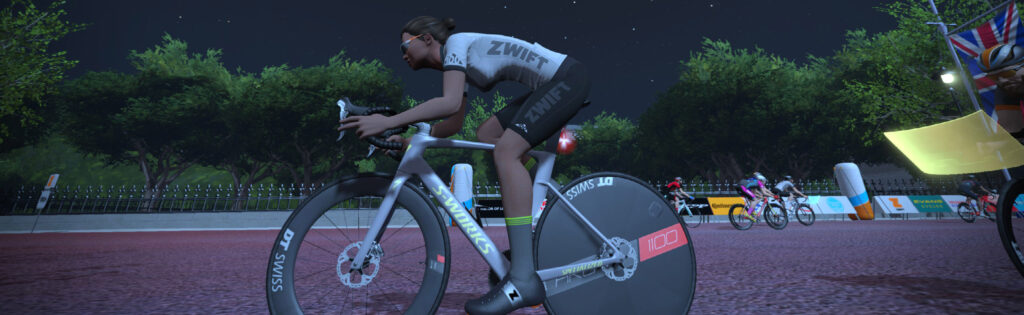
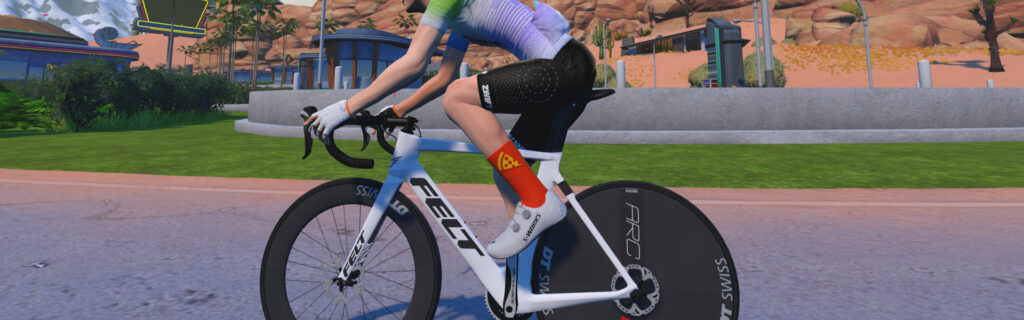
See Speed Tests: Tron Bike vs Top Performers (Scatter Plot) for more nerd-level detail on frame and wheel performance, and check out Fastest Bike Frames and Wheels at Each Zwift Level to determine the fastest setup available to you.
Lots of recon events are scheduled on upcoming ZRL routes, led by various teams. See upcoming ZRL recons for this race at zwift.com/events/tag/zrlrecon.
This chart shows the maximum points a team of 6 could earn in a race with 60 participants. Because the Marina Sprint is also the finish line, we’ve allocated that segment’s FAL points to the Finish points.
With FAL and finish points making up 75% of the race’s total points, the message is clear: you want to do everything you can to stay in the front group, because big points are on offer for riders who can turn in a well-timed sprint, especially on the final Marina Sprint!
Here are some predictions of strategies we’ll see on Tuesday:
Any insights or further thoughts on this race? Share below!
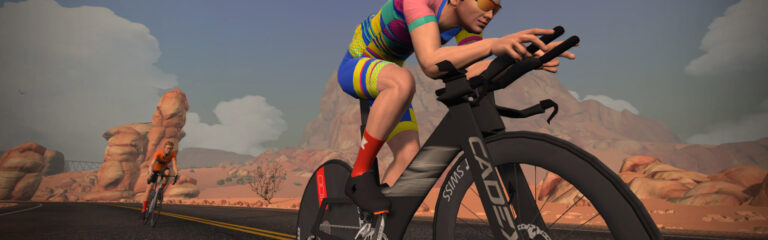
Update July 8, 2025: the community has developed an on-demand TT solution! Read all about it here.
Credit where credit is due: this article began with someone else’s great idea. Back in December, reader “Gordon” posted this comment on my Zwift Announces Race Calendar Cleanup post:
It would be a shame if TT events were culled heavily as they are very much a solo effort. As much as I hate them myself I know others like them.
What I’d like to see with TT is having something a bit different. Some way to choose a course/route of the week yourself, signup and ride it at any time then have a global/team leaderboard.
This is where Zwift is missing out, constrained by Zwift events and ZwiftPower scoring formats.
(His comment, by the way, received 32 likes as of the writing of this article on January 14. That’s a lot of likes for a comment.)
Gordon’s idea got me thinking. Could Zwift create a sort of “on demand time trial” competition? And would it be compelling?
As I began to ruminate on this idea, a feeling of familiarity hit me. Why did this on-demand TT idea seem so obvious? And then I remembered: I had created a small local competition here in Lake County, California around 10 years ago. I even made a logo:

The big idea was this: each week for a month, local road riders were invited to turn in their best possible time on a chosen Strava segment. The rules were simple: it had to be a solo effort.
Whoever turned in the best time each week won a prize. We had gift certificates from local restaurants, and of course prizes from the LBS. It was all a lot of fun, and riders were watching wind forecasts and putting in multiple attempts to get their best possible time.
This on-demand TT idea is, in many ways, a Zwifty version of my Solo Strava Smackdown Series.
The basic idea for on-demand time trialing in Zwift would be this: Zwift would designate a course of the week (or month), and if you complete that course within the designated time window (say, Monday through Sunday) on a TT bike you are automatically added to a global leaderboard.
Let’s unpack the basics above and dig further into this idea.
One fun aspect of this approach to time trials would be the opportunity to mix up routes so they cater to different rider strengths. One week may feature Tempus Fugit, the flattest route on Zwift, tailor-made for riders with big watts. The next week might feature Bologna’s rarely-used Time Trial Lap, which ends in a punishing climb for the w/kg workhorses.
We could also mix up distances. One week’s TT could be on a single lap of the Volcano Circuit for a total of 7.7km, while another week might see riders taking on something like the Mountain Route which could be completed in around an hour at 3 w/kg.
This is a solo race against the clock, so drafting would need to be disabled for an activity to count. Rather than having people “accidentally” enter if they complete the chosen route on a TT bike, it may make the most sense for Zwift to add a card to the homescreen for the on-demand TT. If you want to participate, you have to click the card.
This would pop up details of the featured route, a simple explanation of the competition, and a button you can click to proceed to the start pen.
Clicking to ride would drop you into the start pen, where you could configure your TT bike for maximum speed. And as soon as you start pedaling the timer begins. Go go go!
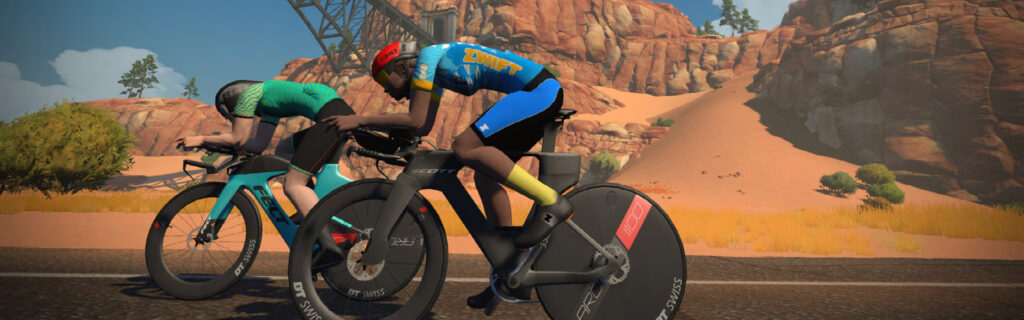
What about seeing other riders on course? Sure, you aren’t able to draft, but still, seeing other riders has a psychological effect. I see a few options here:
Of these three options, I like #2 the most. I don’t want to ride through a sea of non-competing riders, but I like the idea of having a few riders up the road, and some riders chasing behind. I think that would be motivating.
A leaderboard would be essential if Zwift wants to inspire participation in these on-demand TTs. A simple leaderboard would be sufficient for the initial launch of a minimum viable product. Zwifters could see the leaderboard via the Companion app or log in to see leaderboards at zwift.com. The result page would show their name and rank at the top, with a scrollable list of all results below, along with simple power and other metrics and a link to view the rider’s activity.
Of course, the leaderboards could become much more interesting. Let us filter results by age, gender, country, or weight class. Let me view only riders who are in the same Club as me. And of course, let me view past weeks’ results as well as the current week.
Making the leaderboard available in the Companion app would also be nice.
Many riders are motivated by prizes, which is why I lined up local restaurants for my Solo Strava Smackdown Series. Zwift could easily line up prize giveaways with partners to inspire more participation in the on-demand TTs.
I wouldn’t recommend giving prizes based on overall rankings, but rather, giving them to random finishers. A pair of Oakleys, a new pair of shoes, a sweet new speed suit, a set of Ceramic Speed jockey wheels. The possibilities are endless!
The icing on the cake: if you finish in the top 1% by gender for the week, you get access to the leader’s jersey which you can wear if you so choose for the following week. It doesn’t last long, but it’s fun while it lasts!
Why do I love this idea so much? Let me count the ways…
An MVP version of this idea could be created with very little work on Zwift’s part. Here’s what would need to happen:
That would be a very basic implementation, though. To really do it as I’ve described above, Zwift would need to do some additional work:
What do you think – does the on-demand TT competition model appeal to you? Are there any great ideas you would add to it? Share your thoughts below!
Can a very mid bike racer complete the famed 30 for 30 workout plan? Our very average host and editor shares his experiences surviving 30 straight days of Zwift races and hard Peloton rides. Mike also reports on concerning news about the future of the Gong Show, and Kevin shares the many accomplishments now on his Zwift Power profile.
Nowhere Fast is a member of the Wide Angle Podium network. To support this podcast and help pay for Kevin’s gold-plated ankle weights, head to wideanglepodium.com and contribute to our advanced virtual racing research.
To keep up to date on all our real coverage of fake bike racing, subscribe via Apple Podcasts or Spotify.
In the past few months, riders have been observing some changes in Zwift’s pack dynamics (PD), particularly in Watopia during free rides. The current game-wide version of PD is referred to as 4.1, and the new PD is being referred to as version 5.
In this post, I look at what changes Zwift is looking to implement with PD5, and what some riders are observing in PD5, including a few observations by myself.
Let’s begin with a long forum reply from Jon Mayfield himself, Zwift’s co-founder. This was posted just last week as a reply in a long thread regarding the 1.80 game release.
Quite a few comments about pack dynamics in here! I can share a bit of information about it.
The latest batch of tuning (which some call pack dynamics 5) has a few goals:
As for how we’ve been testing it:
So this is where we’re at today. We didn’t announce these changes as we’ve found with pack dynamics we often get lots of false positives when we announce we’ve changed anything, and we were actively changing and improving (and often disabling) the code throughout the fall. The plan was to announce and get more specific feedback once it comes time to start trying it in public races, which is where we’re getting to soon.
Next changes coming later in January:
Beyond:
The tuning of our pack dynamics is a much more continuous thing than I think people realize…and I’m sure will continue for years to come. Sometimes we specifically test with a smaller group of Zwifters, sometimes we just want to start with robopacer groups and general riders in the world, and sometimes we’ll reach out to a race organizer to see if they’re up for testing something with us. Apologies for having it enabled in the TTT’s before we’d announced it – that was definitely not intentional.
This very thorough reply from Jon does a good job of outlining Zwift’s goals for PD5, clarifying how Zwift has been testing PD5 (and their reasons for approaching testing the way they did), and looking ahead to what changes will be coming to PD in the future.
PD5 is currently enabled for all non-event riding in Watopia and Makuri Islands. So free rides, individual workouts, Meetups, and RoboPacer rides in both Watopia and Makuri Islands will display PD5 behavior.
While a few community voices have been quite loud on the forums regarding their dislike of PD5, I think it’s safe to say the vast majority of Zwifts haven’t noticed the change, are ambivalent about changes they observed, or actually prefer PD5 over PD4.1.
I’m a part of the latter group. Overall, I think PD5 in its current state is better than PD4.1. The positives I’m seeing are:
That’s not to say PD5 is perfect, though.
“Titanium Ben” Pitt has been publishing some top-notch Zwift nerd videos lately, and just posted one displaying some of the notable behavior he’s noticed with PD5. I won’t detail everything he observes, but there are definitely a few oddities Zwift will want to tune up:
One notable oddity is the “sluggish steering” behavior Ben notes here:
Another thing I want to call out is the tendency for steering-enabled riders to get pushed to the outside of the lane in large groups, even after purposely steering to the center line. This is a complaint I’ve seen from other steering riders, and I’ve seen it myself.
I made a quick video showing this behavior in the Coco group, and at the end, I show how it could negatively impact race performance when riders are moved to a position with decreased draft:
And while this isn’t a PD5-specific issue – rather, it’s a UI issue that has existed for years – can I just observe once more that the number of rider name plates needs to be reduced in large groups? In my video above, you can see how the name tags along the bottom are stacked several names deep, and the names of riders ahead are obscuring my view of the pack.
I’m not sure how Zwift’s logic works for displaying name tags, but I think it lacks a hard limit, something like “Display no more than 3 rider names at a time from behind, and 2 names up ahead.” Seems like a simple UI improvement Zwift could make, so I’m tagging it onto this post.
And with that, I’ll wrap this up. Ride on, everyone!
What do you think of PD5? Share your likes and/or dislikes below…
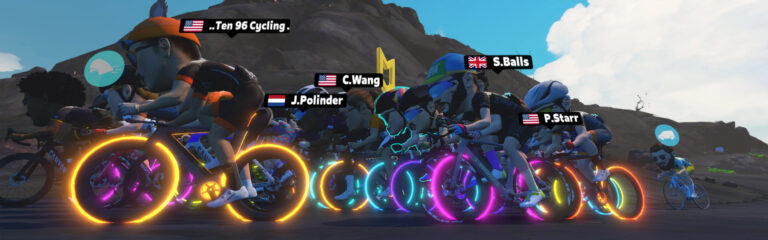
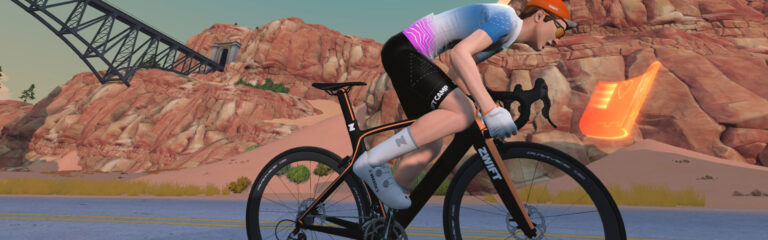
Last week Zwift HQ’s James Bailey and I hosted the first-ever Thursday Pizza Burner, a new weekly 100-kilometer ride. Lots of riders showed up and put in solid endurance efforts, so I wanted to write up a ride review to share the experience in case you missed it but want to hop in on future weeks. Read on!

“The Thursday Pizza Burner 🔥🍕 with James and Eric” is a 100-kilometer multi-paced ride happening each Thursday at 1:05pm UTC/8:05am ET/5:05am PT.
I say “multi-paced” because James and I both have yellow leader beacons, but he targets a pace of 1.8 w/kg while I target 2.5 w/kg. You are free to ride with either of us. You can even be somewhere in between, off the back, or (worst of all) a Zinner off the front winning the group ride. ☺️
Sign up for the next Pizza Burner ride (Jan 16) >
Want to see how the first Pizza Burner unfolded from my perspective? Here’s my recording, complete with Discord chatter:
We left the pens with 164 riders grouped up. Thanks to late joiners (you can join any group ride up to 30 minutes into the event) a total of 180 riders would eventually participate. Our goal? 25 Volcano Circuit laps for a total of 105.3km.
We stayed together for the first Volcano Circuit lap, getting our legs warmed up, inviting folks to join the Discord voice chat, and generally getting everyone on the same page. Once we began the second lap, I ramped up my pace to the target 2.5 w/kg, and my group split off from James’.
Soon enough the name-calling began. Well, the positive name-calling, that is. James started it when he messaged, “The ‘best group’ is currently around position 124” 38 minutes into the ride.
I couldn’t let that go unanswered, so I explained that the “more best” group was at 24.6km. James quickly countered by “calling besterest x infinity.” This, I sense, may turn into a repeated ride theme…
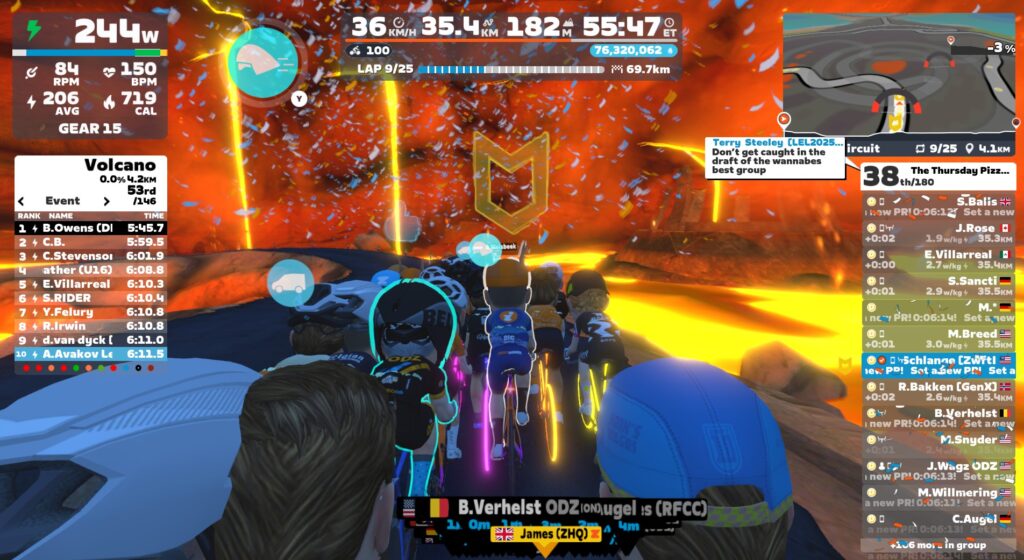
The Coffee Stop is a controversial feature in Zwift, but James set the tone early on by explaining that he would be taking any and all coffee stops available. He was true to his word, announcing “COFFEE SHOP OPEN” just past the 30-minute mark. Soon enough, the cups were flying:
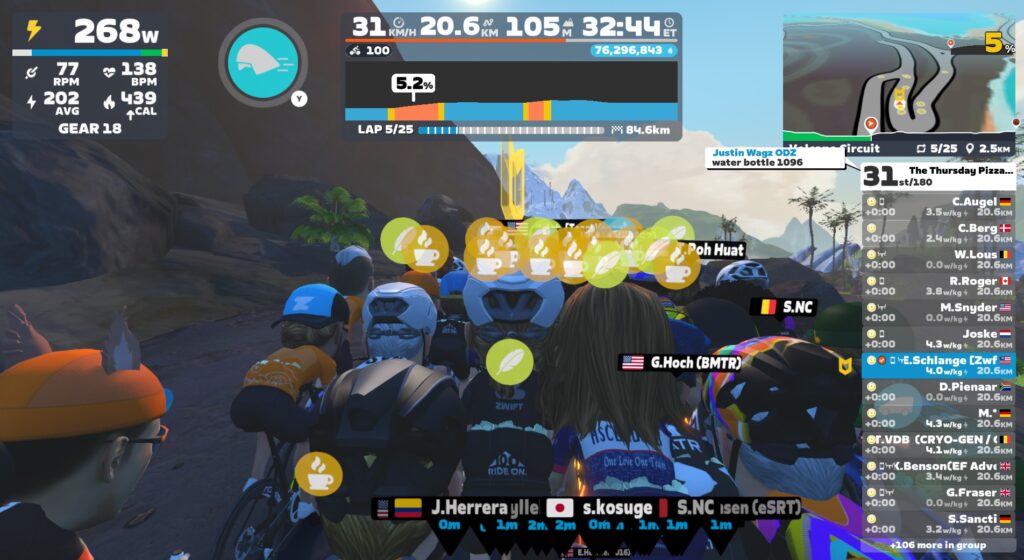
This, too, will surely turn into a theme on the Pizza Burner ride. Perhaps we should have named the ride something like “James’ Coffee Stop Metric”.
Discord filled up nicely (we used Zwift Insider’s server, available at discord.gg/zwiftinsider) and you can hear that chatter in my video above. It was great to have Justin “Wagz” Wagner join us, because he was, in many ways, the inspiration behind this ride! I rode in Justin’s 3-hour “Wagner’s Wagon” Thursday morning rides which he hosted weekly for years, and always appreciated how his witty banter on Discord made the time pass.
(Justin didn’t finish this ride, but we were all able to tease him enough so he held on past his initial 60km target and went to 64+ instead. He’ll be back…)
One rider, “10 96 Cycling”, made things hilarious and confusing by listening in on Discord but only replying to voice chat via in-game messages. (He said his mic wasn’t working, but I think he just enjoyed being an agent of chaos.)
At the top of the hour we held an impromptu dad joke competition: tell your joke, and everyone else replies with a 1-10 rating. I started it off:
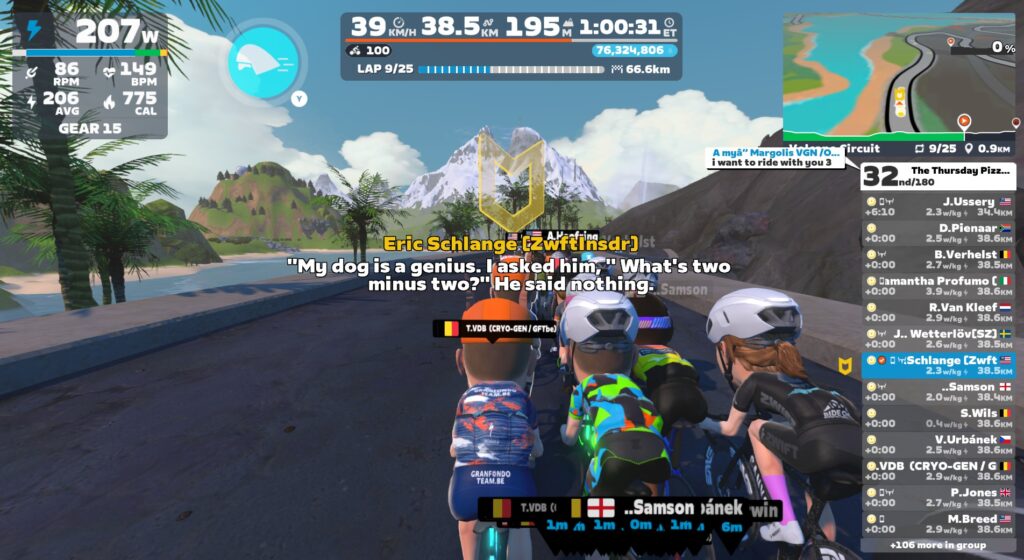
10 meant the joke was good, but as Wagz pointed out near the end of the competition, these were dad jokes, which meant, perhaps, that the lowest-rated jokes were actually the real winners.
Ross Irwin gets an honorable mention for his repeated requests to hear top-secret Zwifty info from James and I. (We shared a few tidbits, but nothing that would get James fired.) Keep digging, Ross. Hopefully in future weeks we’ll have more to share!
As the kilometers ticked over, my front group of ~70 shrunk to 60, then 50, then 40. Pretty standard for long rides on Zwift. Some folks sign on knowing they have to pull the plug at two hours. Others just want to see how far they can ride. Other had to ease up and finish at a slower pace. It’s all good. These rides can turn into a mental battle, but that’s one of the beautiful things about longer bike rides – they train your mental muscle!
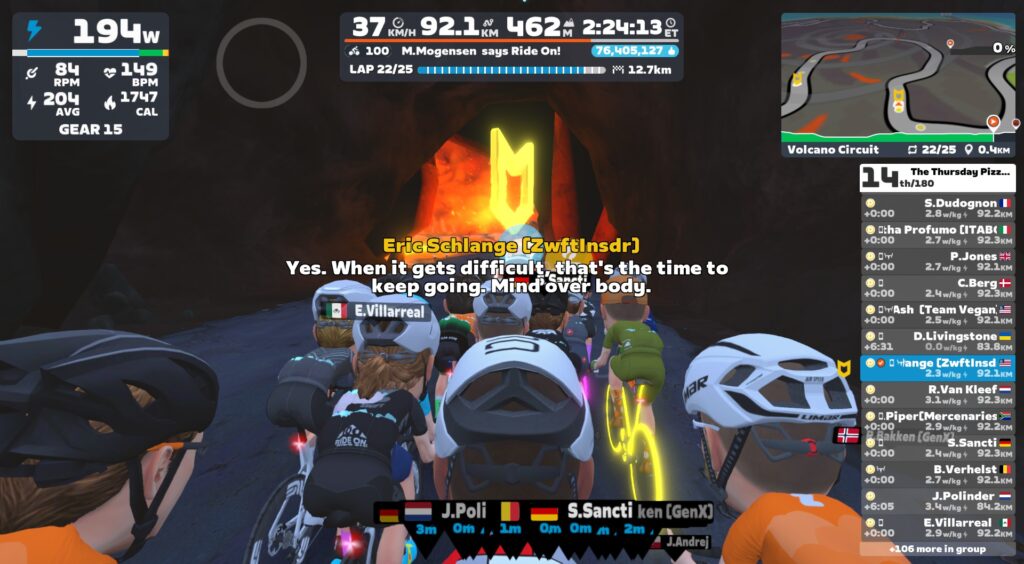
Heading into the penultimate lap, I asked my group if they were up for a challenge. Could we work together, using powerups wisely, to make our 25th and final lap our fastest on the day? We decided we’d shoot for a sub-6-minute pace, since all of our laps had been over 6 minutes. There was some groaning, but eventually it felt like everyone got on board, especially after I agreed to do an extra slow 24th lap!
We all saved our aero powerups:
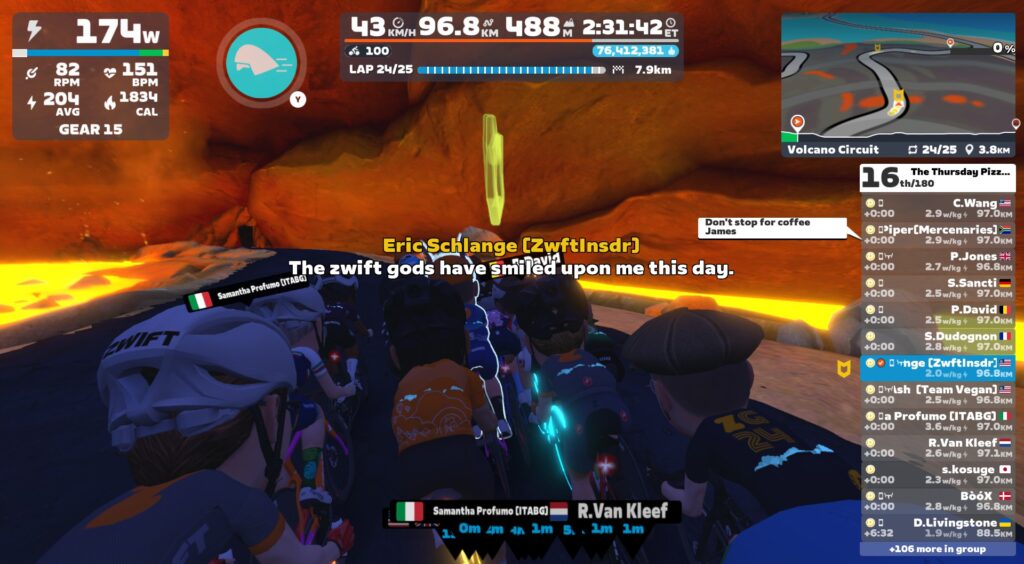
Then went for it as the final lap began. We were supposed to target 300 watts on the front, but I think things got a bit spicier than that. At some point, a group of riders broke away from my pack. I and others in my group put in a couple of digs, but we weren’t quite able to pull them back. No matter, though – my final lap time was 5 minutes, 50.8 seconds, and I was happy with that.
According to the event results, 66 riders went on to complete the full 25-lap ride (105.3km). I finished my ride in 2h43 with an average wattage of 207 (so 2.46 w/kg), while James and his group finished in 3h08. James averaged 162 watts (bang on 1.8 w/kg)… and used 5 coffee stops.
This is the Pizza Burner, after all, so finishers unlock the coveted Pizza Socks, which have only been unlocked through a handful of Zwift events in the past. Congrats to all the new Pizza Sock owners.
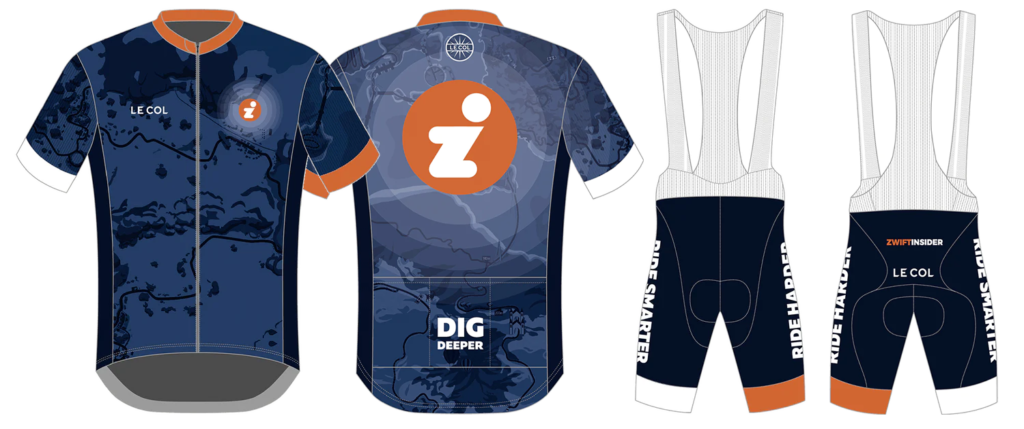
Next week’s Pizza Burner (January 16) will feature the following unlocks:
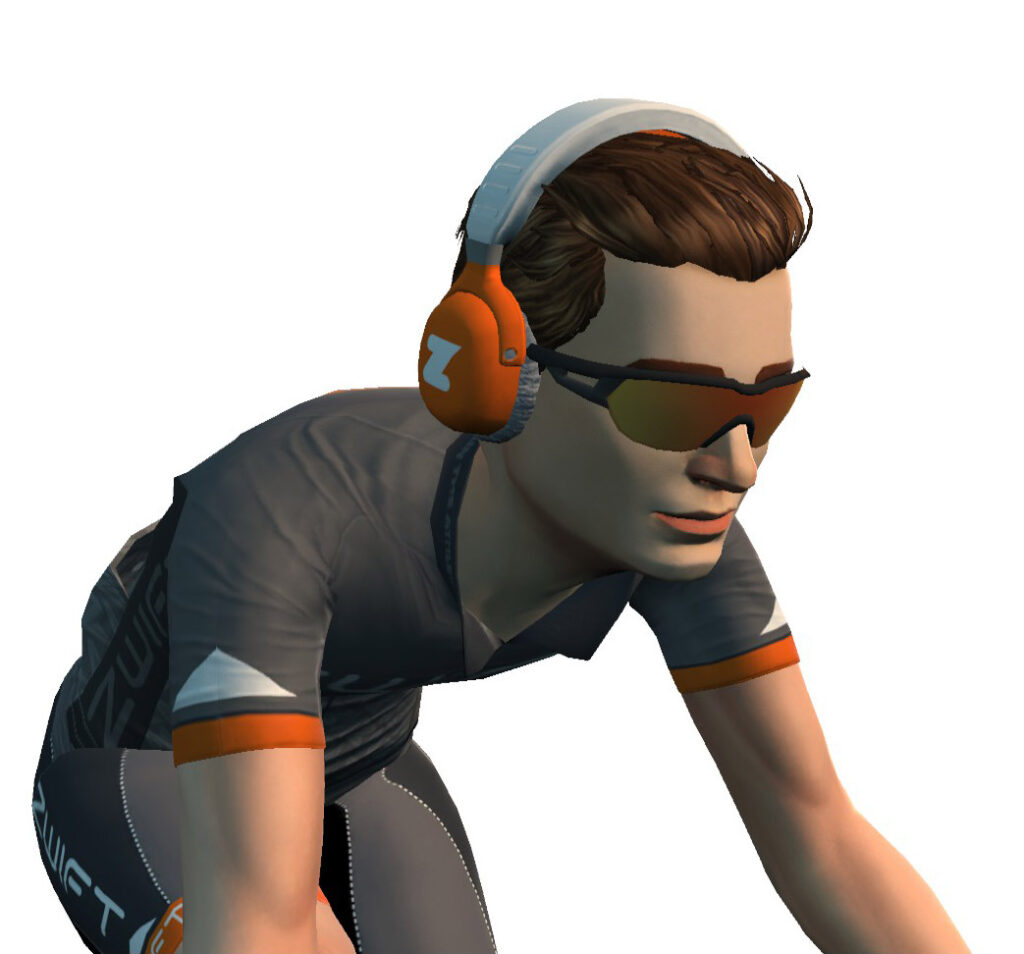
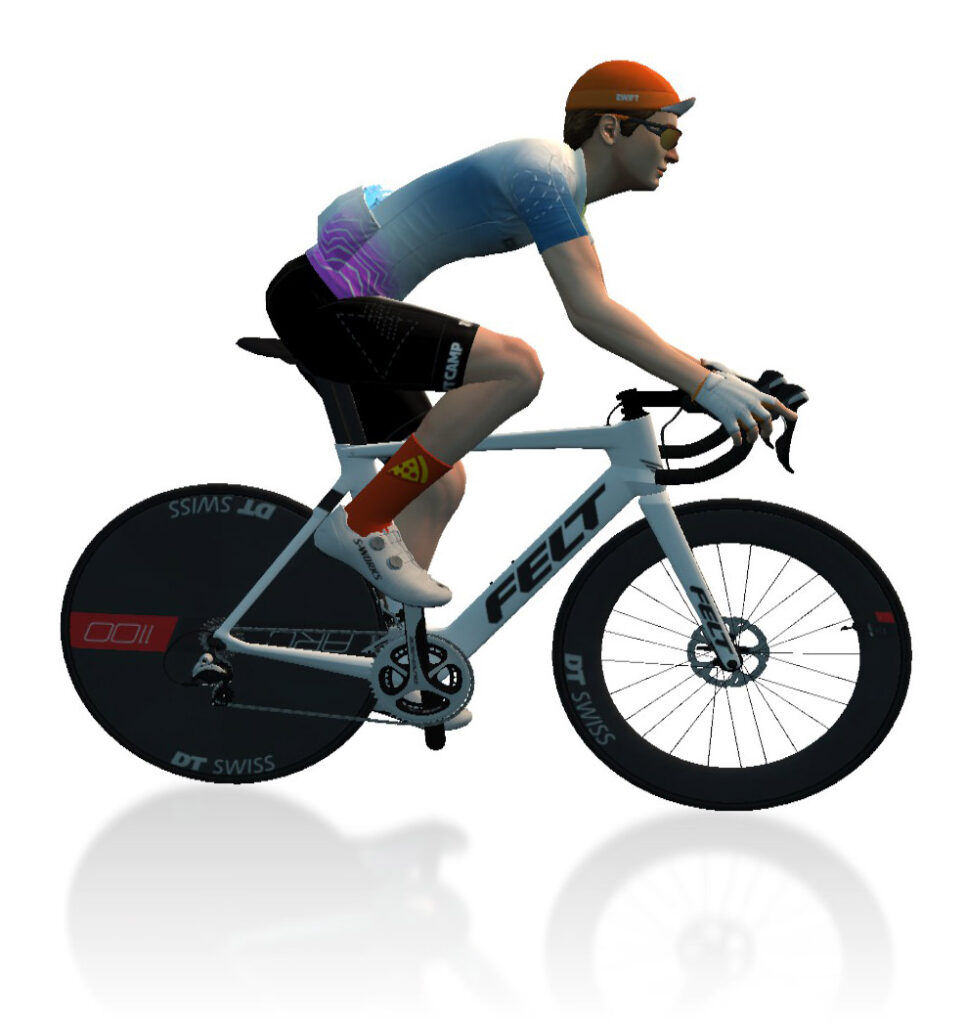
You may not want to ride a long Thursday Pizza Burner, but don’t let that stop you. (James doesn’t want to do it, either, and he’s leading it!) Misery loves company:
This week’s ride is 100km long, on Watopia’s Waistband. No big head avatars this week, but we will be riding Big Wheels!
Sign up for the next Pizza Burner ride (Jan 16) >
Many Zwift users rely on pre-built workouts that use percentages of Functional Threshold Power (FTP) to structure intervals. While this approach works to some extent, it often falls short, especially when training in anaerobic zones (above threshold). The problem? FTP-based intervals don’t account for individual differences in short-duration power output, which can lead to suboptimal training.
For example, when doing a 1-minute interval, one rider might max out at 120% of FTP, while another could hold 140%. If both follow a workout that prescribes 130% of FTP, the first rider might struggle to complete the interval, while the second isn’t pushing hard enough to get the desired benefit. This one-size-fits-all approach limits your potential to build real cycling strength in short, intense efforts.
At ProCyclingCoaching, we take a personalized, data-driven approach that you can apply to your own Zwift workouts. Instead of sticking to generic workouts from the Zwift library, try this method: focus on your maximum power for specific durations you want to improve, rather than a fixed FTP percentage.
By using this method, your Zwift workouts become highly personalized and effective, helping you train at the right intensity for your goals. Whether you’re preparing for a race or simply want to crush that next sprint segment, this approach ensures your training adapts to you, not the other way around.
To create your custom workout, go to Workouts>Custom from the Zwift homescreen and click “Create Workout”. Change the “display” setting to “Watts” instead of the default (“% of FTP”), and use the “Intervals” block to easily create a set of repeating intervals:
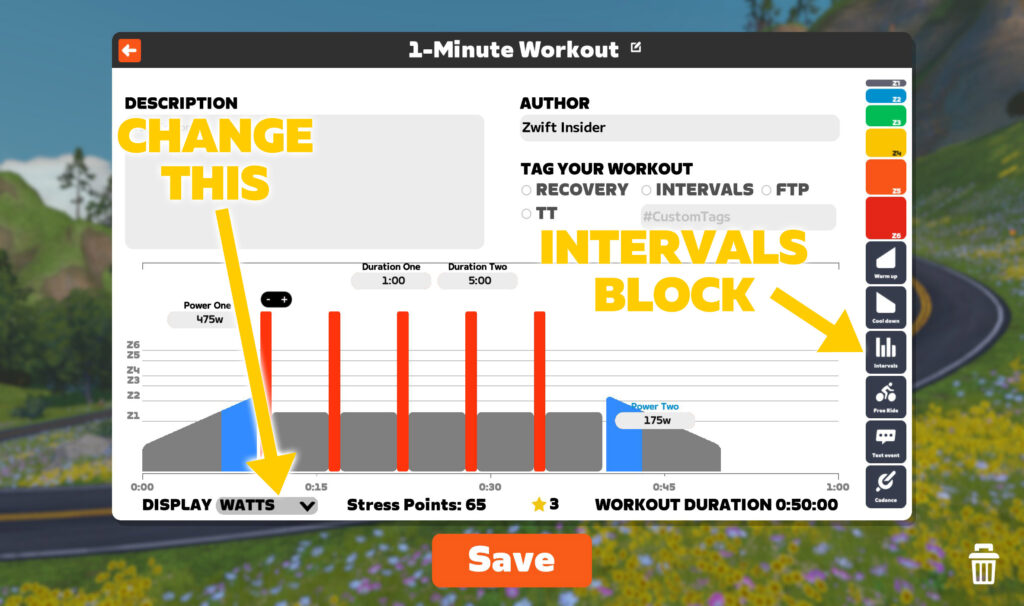
One caveat: while displaying watts lets you set a particular watt target for your custom workout’s intervals, if your profile FTP setting changes, your power targets in the workout will change as well. This is because Zwift saves intervals as a percentage of your FTP, not as a simple wattage number, regardless of what you have the “display” option set to.
While this article focuses on the limitations of FTP-based training for anaerobic intervals, it’s important to recognize that FTP still plays a crucial role in cycling training, especially for endurance and threshold work. FTP represents the highest power you can maintain over a long period (usually an hour) without fatigue overwhelming you. As such, FTP-based training is most effective for:
While personalized power-duration intervals are ideal for improving short-duration efforts and anaerobic capacity, combining them with FTP-based work ensures well-rounded fitness. This balanced approach helps cyclists perform better in all aspects of racing and riding, whether on Zwift or in real-world events.
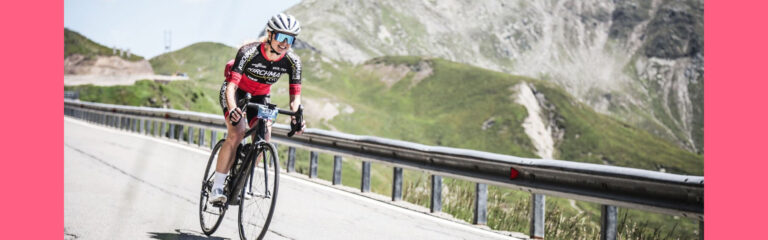
Name: Astrid Bontzek
Hometown: Munich, Bavaria
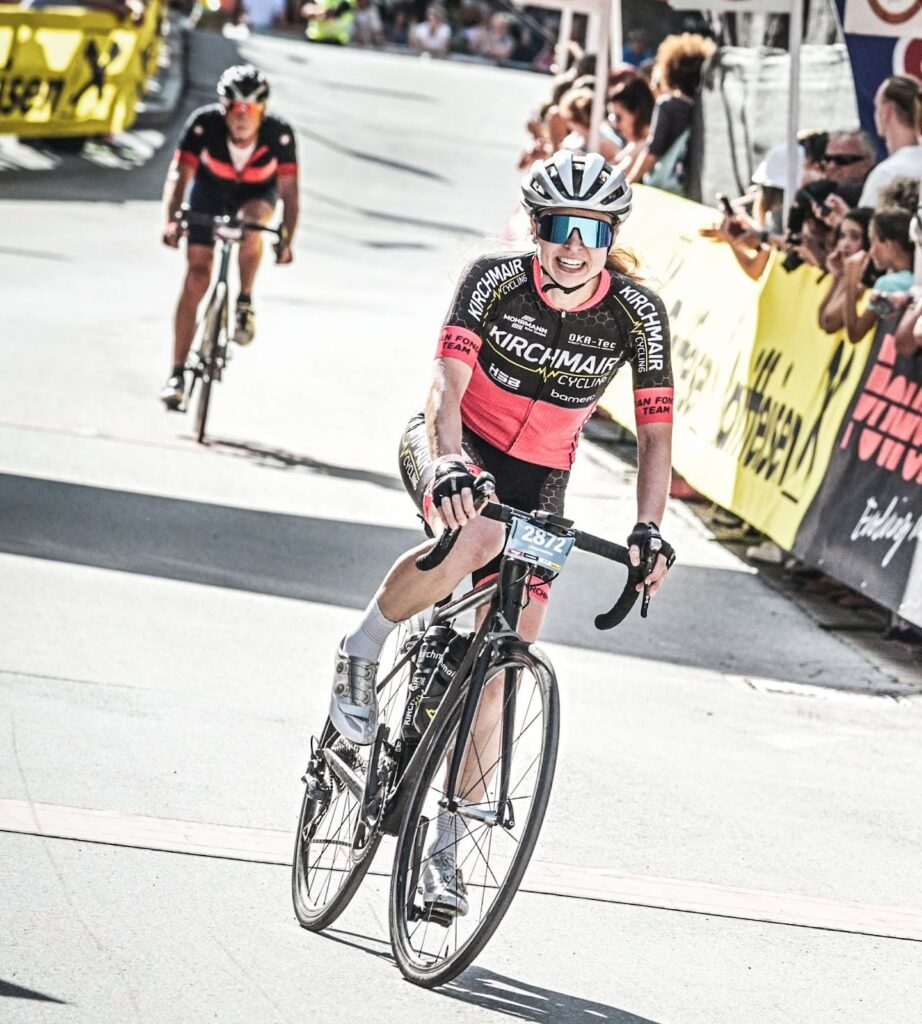
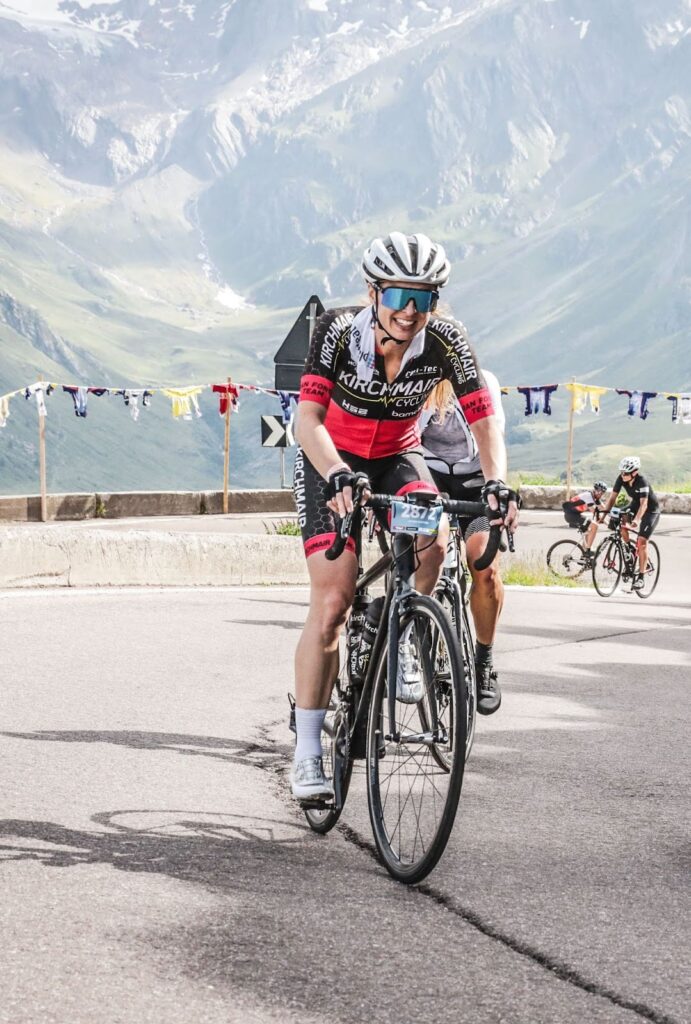
How did you get into cycling? I’ve been participating in smaller triathlons for fitness for many years. In 2021, I joined Team Kirchmair Cycling through a partnership centered on indoor racing with the Facebook group “Fräulein Triathlon”, and that’s when my passion for indoor races and road cycling, especially in the Alps and taking part in Gran Fondo events, really took off. Thanks to the friendships I’ve built within the team, and learning from leader and coach Stefan Kirchmair (GF World and European Champion – and winner of many Gran Fondos and Zwift Races), cycling has become a major part of my life.
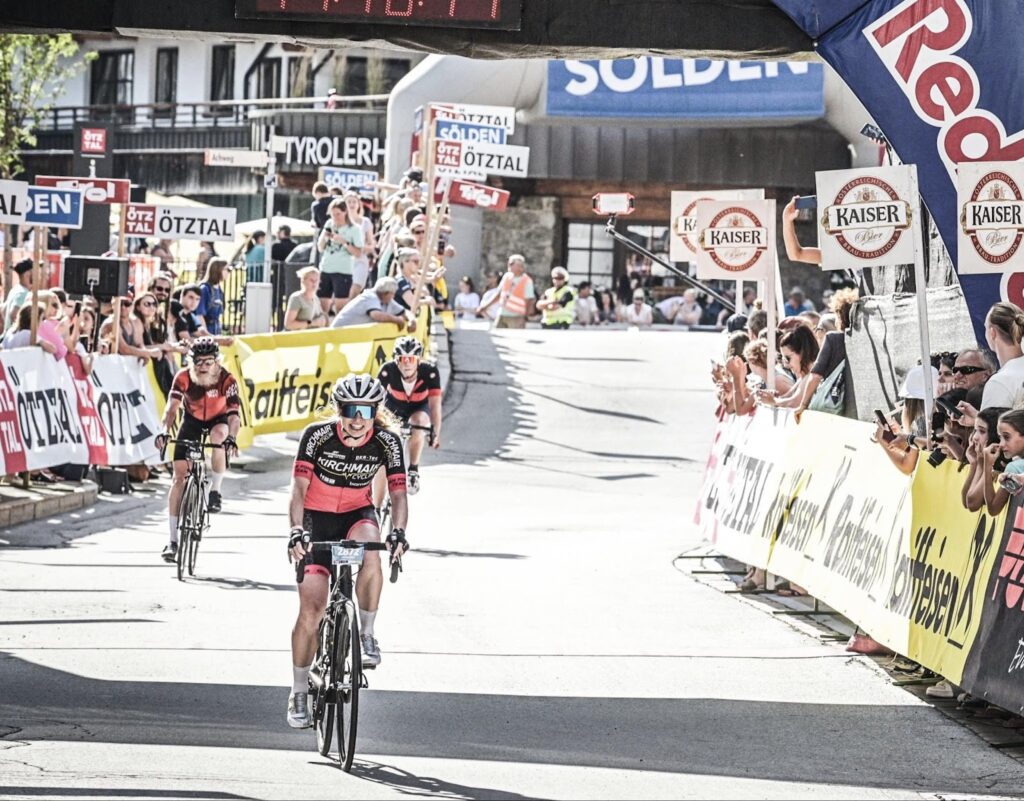
How many years have you been racing on Zwift? I have been racing on Zwift for almost 4 years now, and I’m absolutely hooked on it!
Are you part of a Virtual team? Yes, I’m a proud member of Team Kirchmair e-Cycling. We have a wide range of teams across all performance levels, especially for women, so you’re always well-supported, no matter your skill level. I’ve had the chance to meet and ride with some incredible athletes, and the camaraderie within the team is truly inspiring. In addition to racing, I also love leading group rides for Kirchmair Cycling when I have the time and opportunity. It’s a lot of fun and a great way to connect with other cyclists in the community.
Join the Kirchmair Club to see their upcoming events >
What do you love most about racing? What I love most is being part of an amazing team. The support and encouragement from my teammates really motivate me to push beyond my limits. I also appreciate learning from Stefan Kirchmair’s expertise and contributing to the team’s improvement as we support each other’s growth. It’s not just about the competition but also about the team spirit and personal development.
What is your favourite style of race (e.g. points, scratch, iTT, TTT, Chase, duathlon)? My absolute favourites are Team Time Trials (TTTs) and Points Races. Both formats require not only individual strength but also strategic teamwork, which makes them so exciting!
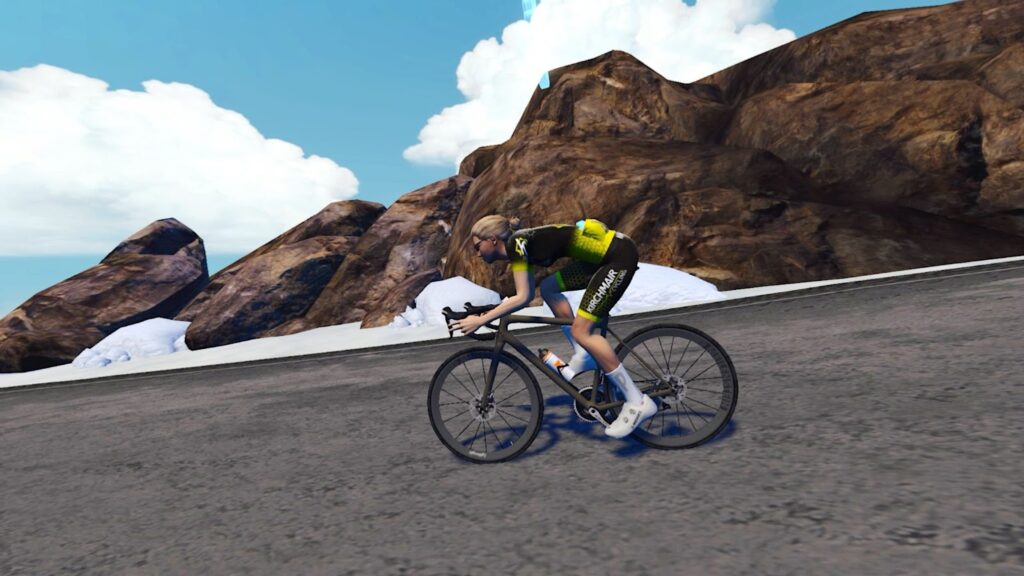
What is your favourite Zwift women’s race series? I really enjoy the Iceni Race Series by Warrior Games. A huge THX to the organizing teams for creating such fantastic women-only race events!
What is your most memorable racing experience, inside or outside or BOTH? Indoors, I’ll never forget our victory with the “KIRCHMAIR Team Bees” at the WTRL TTT World Tournament 2022 in the Coffee Class Vienna (Mocha)! Outdoors, my most memorable experience was definitely the 2023 Ötztaler Radmarathon. It was a massive challenge, but crossing that finish line felt amazing and is one of the highlights of my cycling journey.
What is your favourite food to eat post race? After a short, intense indoor race, I usually go for a protein and carb shake – I don’t feel that hungry right away. But after a long outdoor marathon, I love having pasta or pizza for dinner!
What advice would you give to a woman entering her first Zwift race?
Any upcoming race you are looking forward to? I’m really looking forward to the next seasons of the Zwift Racing League, where I’ll be racing with “my girls” again!
Where can people follow your racing adventures? You can follow me directly on Zwift through my rider profile: zwift.com/eu/athlete/3126361