Home Blog Page 501

Coach profile: Noel Bonk, BonkWerx

0

Coach profile: Noel Bonk, BonkWerx

Based in Brewerton, NY, Noel Bonk of BonkWerx is a coach who cares about making you into a balanced, well-rounded athlete. A Zwift user since the beta days, he uses it personally to overcome the challanges of New York’s snowy winters, and uses it with his clients as well.

Noel has also lived the life of the “time-crunched cyclist” and now as a coach works to help his clients maximize their time efficiency. Read below to learn more about him and his coaching philosophy.


Coach Noel riding cross

Tell me about your cycling background. What sort of riding have you done, for how long, etc?
My interest in cycling goes back to when I was just a kid racing BMX and Freestyle. I got into road racing and cyclo-cross a bit late (in my twenties) after suffering a weight lifting injury. Fast forward the last 17 years and I’ve done just about every event you can do on the bike, ranging from stage races to grand fondos. I do mostly focus on criterium racing though, as they play well into my strengths on the bike. My background additionally extends into 10 years of race directing and amateur race team management.

When and why did you begin coaching?
Prior to coaching I spent the last 15 years running several start-up companies while trying to balance family time and training time. I definitely lived the life of the “time crunched cyclist!” Coaching has always been a part of who I am, and started as a way to give back and grow the sport I love. Unofficially I started over a decade ago by coaching and mentoring friends and teammates new to racing. Officially however, I started my coaching business a year ago and I am currently a USAC Level 2 and Training Peaks Certified Coach. Every day I feel fortunate for being able to do what I love and help cyclists reach and exceed their goals.

Every coach has particular philosophies which define their methods. How would you describe yours?
I believe in creating a balanced well-rounded athlete. This means training my clients to work on all aspects of performance including sport-specific energy systems, bike skills, tactics, strength and mental training.

I like to say I coach with both an art and science approach, using a combination of open communication and feedback as well as analytical data tools. This helps me understand the athlete not only based on their numbers but on an individual level. I use that information to design training that is personal and structured but also maintains flexibility throughout a season.

Do you use Zwift personally, and if so what for?
I was on Zwift as a beta user, but really started to get into it regularly last winter. I live in Central New York which sees a substantial amount of snow and cold in the winter. For me, Zwift has become the perfect partner in helping to beat back the boredom that sometimes occurs when doing longer indoor rides. Based on my schedule I do mostly ride it solo, but I like to jump into group rides and races when training allows.

Also, locally here in NY we are using Zwift to bring our community of cyclists together for some “friendly” winter rides and races. In just a months time we’ve grown our group, comprised mainly of riders from Buffalo, Rochester and Syracuse to 400+ members.

Noel racing

How is Zwift a useful tool from a coach’s perspective?
Zwift for coaching opens up all sorts of interesting training opportunities. It’s an excellent tool for keeping athletes motivated and engaged during the winter season or when they don’t have time to fit in a group ride or race. Creating structured workouts on Zwift is also a great way to help athletes stay on track with the proper efforts while maximizing time efficiency.

If you had just one piece of advice you could share with all Zwifters, what would it be?
Plan a weekly ride with friends! Cycling has a huge social element to it, but you can’t always find the time to ride and chat with others – so Zwift is great alternative to stay connected!

Learn more at bonkwerx.com >

Testimonials

“I have been very pleased with the services offered and the personal attention that I have received from Noel. In the past I have had experience working with other professional trainers. I prefer Noel’s approach to coaching as it has been more tailored to my specific needs and cycling objectives and have also found it to be more challenging. He offers core training, strength training and a considerable amount of feedback with weekly Skype sessions and daily personalized reminders via smartphone.”
~Dan Rivers

“This is my fourth season riding under the guidance of Noel Bonk having met when I was virtually a beginner. As I gain knowhow, skill, and fitness Noel understands with knowledge and intuition just what is needed to bring me to that next step. He is a highly organized and prepared “numbers” guy who demonstrates that he can look through the data in the middle of a race or intense training ride to guide his students on the fly. With that said, his training programs are well planned, specific, understandable, and effective. With any question about training, racing, or equipment I know I can count on Coach Bonk.”
~Dan Pone

“As a father or two young children, my time available to dedicate to training is very limited. Bonkwerx developed a custom training plan that considered my strengths, fitness level, goals, and schedule. I’ve noticed considerable improvements in my performance since my training has started and I’m eager for the racing season to begin.”
~Ben Freer


“Watts Up with Power” training ride announced

0

“Watts Up with Power” training ride announced

Riding on Zwift is all about watts, and that can be a bit confusing for cyclists who haven’t wrapped their head around riding with power. 

There are already so many numbers we can pay attention to: heart rate, cadence, speed… what is special about power, and how can we use those numbers in our training?

TeamODZ has announced a new training ride, “Watts Up with Power,” whose focus is learning the concepts behind power-based training. The ride will take place each Wednesday at 6:30AM Pacific, and group will stay together with the leader who will be riding at a pace of 1.5-1.8 w/kg.

The learning will come from the ride leader who will be on Discord (audio chat) providing instruction to everyone present. Instructions for getting setup on Discord can be found here.

Each week new concepts will be covered, and attendees are encouraged to ask questions. Topics covered will be based on the concepts taught in the book “Training and Racing with a Power Meter” by Hunter Allen and Andrew Coggan, PhD.

Learn more on the TeamODZ site >


What is the heads up display/screen I see front of some riders?

What is the heads up display/screen I see front of some riders?

This is a question I’ve seen asked by many new Zwifters. What is the little screen floating in from of some riders?

The answer is simple: that screen indicates the rider is currently performing a structured workout as opposed to a typical “free ride.” Riders with this screen will also have a bar graph next to their name in the rider list.

The heads up display shows interesting info about the rider, including current wattage and heart rate. It even changes color depending on which power zone the rider is in:

  • Zone 1: grey
  • Zone 2: blue
  • Zone 3: green
  • Zone 4: yellow
  • Zone 5: red

About Zwift Workouts

Workouts in Zwift are powerful training tool, with various workout plans offered as well as the ability to create custom workouts. Zwifters find these workouts valuable because they force you to hit particular targets so you can train more efficiently and effectively.

Looking for a list of of Zwift workouts?
Check out the library at whatsonzwift.com >

You can peek over the shoulder of other riders to see their current wattage and zone.


How to Find Your Zwift ID in iOS

1

How to Find Your Zwift ID in iOS

First, an Introduction to ZwiftPower

If you want to race on Zwift, you’ve got to get familiar with ZwiftPower.com (ZP). This is a powerful, community-driven site created by James Hodges which tracks race results in Zwift.

ZP uses your ZwiftID to track you on course, so you must enter your ZwiftID into your ZP account.

You must also opt-in to share your ride data with ZP, or you will not be included in race results. Log into your account at https://my.zwift.com/, click Profile>Connections, and click to enable sharing with ZP.

Finding your Zwift ID in iOS

Your Zwift ID can be found in the desktop version of Zwift by going to Documents->Zwift->CP. The sub-folder user**** contains your ID.

Zwift for iOS presents a challenge because you cannot simply browse your iOS device’s file system to find that ID. The ever-helpful Christian Wiedmann has discovered a solution, though: he created a simple lookup tool for finding your Zwift ID using your Zwift login. See it here >


Castelli Ride Series SkillZ and DrillZ, December 21

0

Castelli Ride Series SkillZ and DrillZ, December 21

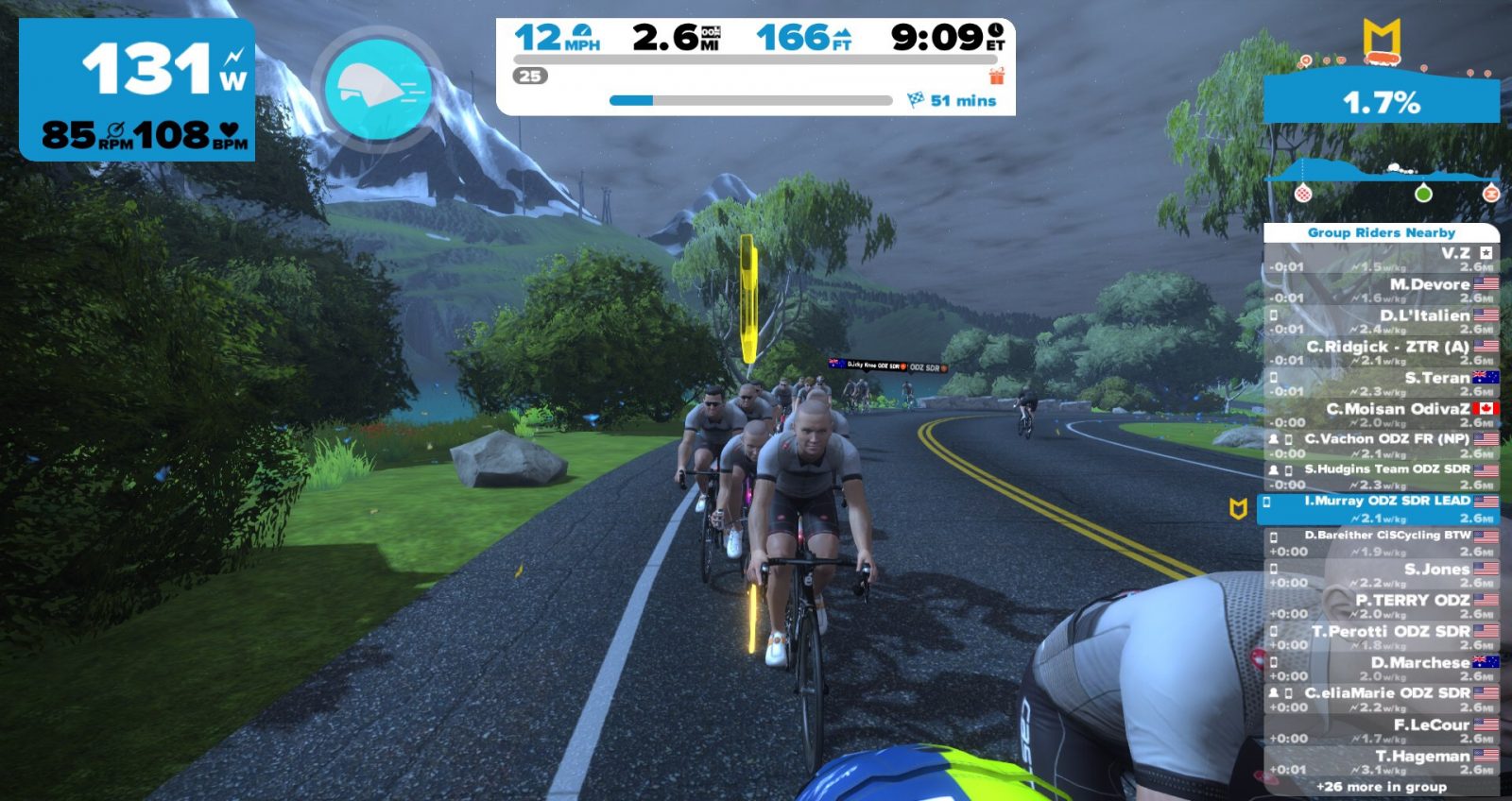
Today closed the books on another great SkillZ and DrillZ and the last one of the year.  Building on last week’s session focused on choosing and working through the proper gearing for the sprint, this week we focused on proper climbing techniques.  We also spent a little more time on selecting a cadence, just to make sure that we don’t blow out our legs.

Here’s a replay of the ride:

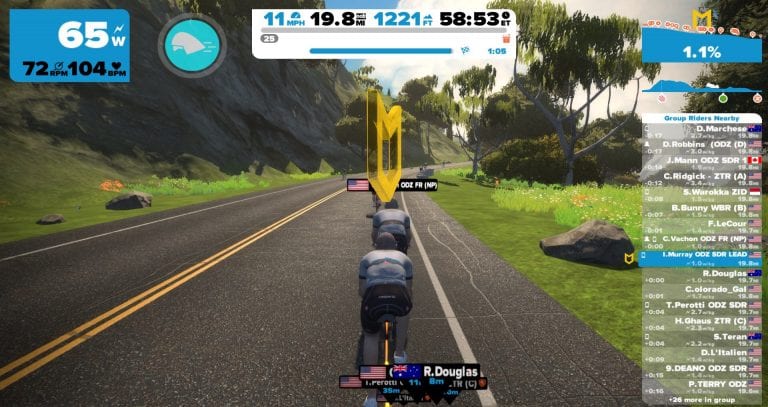
Like normal, we started out by working on our group dynamics at a 1.5 watts per kilogram (w/kg) pace.  The focus, like every week, is trying to “feel” the draft.  Unfortunately, Zwift hasn’t figured out the VR technology yet for us to actually feel the difference when we are in a good pocket or bumped out.  So, we have to practice moving around the bunch.

Today, the goal was really to stay in the front third of the pack.  The reasoning behind that positioning is different than IRL riding.  In a live peloton, most of the crashes happen after the front third, as people fight for wheels or have a lapse in concentration.  We try to avoid those at all costs.  Crashes hurt and can be expensive.  Fortunately, Zwift has eliminated that concern (well, maybe, depending on if you saw the GCN visit to Zwift HQ), so we don’t have to worry about crashes disrupting the peloton.  However, you still need to be in the front third to be able to react to any attacks or splits in the field.  One moment of inattentiveness very early on can cost you the race, no matter how strong or prepared you entered the event.

After our warm-up and group dynamics period, we got right into our climbing work.  One of the most important aspects of climbing is gear management.  Too often people choose gears that make no sense, way too low or way too high.  Fortunately, way too low or easy of a gear often takes care of itself quickly.  With too little resistance due to gearing the bike will naturally slow due to gravity to a point where cadence will even out.  Of course it is a waste of time and energy, but the problem solves itself.  Other than highlighting that a rider’s ability to respond is compromised by pedaling too light of a gear at too high of a cadence, there is not much more about which we can discuss.  The harder gears, however, serve a purpose on the climbs but can also lead to problems.

The first thing we did was drop into a gear that allowed for 60-65 RPMs at 1.5 w/kg.  I chose that range for a few very specific reasons, all of which we would experience during the ride.  First off, that is the lower end of the cadence range where I have found cyclists to be able to maintain efficiency and a good position.  Any lower, most cyclists tend to start rocking their hips, and sometimes the whole body, from side to side to compensate for the extra load.  That can lead to bio-mechanical issues as you change the angles in which you apply power which can lead to knee, hip, and back pain down the road.

Do we all rock back and forth from time to time during a hard part of the race?  Sure.  But, many triathletes also pee themselves rather than stop on the bike, and you don’t see them doing that in training or in daily life.  Well, at least I hope you don’t.  The point is that we shouldn’t practice or emulate the bad form that sometimes happens during the throes of a really hard race after hours of fatigue have eroded our mind’s ability to control our body.  So, I think everyone gets the point.  Don’t ride too low of a cadence to avoid unnecessarily risking injury, and do stop to use the bathroom during training rather than peeing on yourself.

As we moved through the first 30 minutes of the ride, we maintained the lower RPMs to make even the flat roads feel like we were going uphill. ( I’m not going to lie.  There was a bit of fun in the torture for me.)  Anyway, we then got to the nitty gritty of climbing.  Do we stay seated, or do we stand?  Ah, that is the question for the ages.  In general, I recommend staying seated and climbing at a tolerable cadence between 75 and 90 RPMs trying to maintain steady power.  If you need to stretch or plan on attacking, then get out of the saddle.  Climbing out of the saddle can be very taxing and is not the most efficient way to get up the road.  As Dr. Haskell pointed out, “But I have seen Contador at the tour out of the saddle and dancing on the pedals!”  That is true.  I have also seen Lebron James jump over a grown man and slam a ball through a hoop.  I can’t do that.  In fact, I probably couldn’t do that with a trampoline.  So, why would I think that I can do the same thing as Alberto Contador?

To demonstrate the effort of standing climbing, we shifted up a few gears, raising out of the saddle at about 75 RPMs, still holding 1.5-2.0 w/kg.  Despite the fact that we really weren’t putting out much more effort, virtually everyone’s heart rate shot up ten beats per minute.  That’s because it takes more energy to hold yourself up and balance while riding out of the saddle.  All of that being said, accelerating and attacking while out of the saddle can be very effective.  As we came up to the ramp heading out of the tunnels, I instructed everyone to rise out of the saddle and begin accelerating up the short climb.  That very short climb combined with the accelerations blew the group to bits, forcing us to spend the next two kilometers trying to regroup.  Everyone paid a price, though.  To a rider, everyone was out of breath.  That very short stretch of road, less than 400 meters, took a match from everybody and multiple matches from a number of folks.  Now, that effort hurt, but were it done on a short climb at a tactically significant point in the race, a rider could bridge a gap or jump away from a group with that kind of savage effort.  So, it’s not that climbing while standing is something we shouldn’t do.  It’s just more like one of the “dark arts” that we really need to understand before we put it into play.

Through the Esses, we practiced more repeated efforts out of the saddle.  During any upticks in the slope, we got out of the saddle, and we sat back down for any flats or downhills.  The repeated jumps showed both how much an advantage you can get but also the high cost of doing so.  On our last lap, we executed a different drill coming up the ramp out of the tunnel.  Whereas we sprinted up the ramp, standing, on lap two, this time we went at it seated.  However, I made everyone get to the lower end of our RPM spectrum, as close to 60 RPMs as possible at the base of the climb.  When we hit the base of the ramp, I instructed everyone to start speeding up, trying to bring the RPMs up to 85 RPMs only by increasing power to the pedals, no shifting of gears.  That was a struggle.  It was a great way to highlight the inability of a rider pedaling at low cadences to respond to any change in the race.  On the previous lap, we hit the base of the ramp at higher RPMs and were able to motor up it much quicker and with a sharp acceleration.  From a seated position with low starting RPMs, we showed that the likelihood of being gapped was pretty significant.  Moving on toward the Esses, we did that same drill as on the previous lap, but I encouraged everyone to keep a steady effort through the switchbacks and the Esses.  Yes, there would be a higher power output while standing due to the added pressure of bodyweight, but the idea was to control the body to avoid wild power or effort swings, needlessly throwing the body into the red zone.  Almost everyone rode the last climb much better.

After that, it was a quick cool-down and review of the day’s materials.  It is important to remember that climbing is as much of a skill as any other part of cycling.  Yes, lighter riders don’t suffer as much from the effects of gravity as the bigger folks, but smart riding and sound tactics can tilt the odds back in your favor.  Like we have talked about during the previous few weeks, it’s all about riding smarter, not harder, than your opponents.  Sure, on a straight-up drag race with all things being equal, the lighter rider will win a climb almost every time.  However, if you practice your gearing and know for how long you can ride hard out of the saddle, you may be able to surprise the climbers and steal a victory from them.

SkillZ and DrillZ will be off next week due to holiday travels, but we will be back on 4 January with another addition.  We hope to se see you there, and as always, Ride On!


Training Peaks connection issues fixed

Training Peaks connection issues fixed

Many Zwifters who use TrainingPeaks to track and analyze their workouts have noticed Zwift ride data not being sent to TP automatically in the past week or two.

As of today this issue appears to have been repaired. According to Game Master Jon Mayfield the issue wasn’t in the Zwift software itself, but with Zwift’s web backend which integrates with the TrainingPeaks site.

Important: you may need to sign into your account on www.zwift.com and click “Connect” under TrainingPeaks on the right in order to re-connect your account.

Now go forth and track that TSS!


Zwift update version 1.0.15654 released

0

Zwift update version 1.0.15654 released

ZwiftHQ has released one final update for 2016. Zwifters were hoping this last update would include the new “volcano route” we’ve seen teasers for, but that’s going to have to wait until next month. Game Master Jon Mayfield writes:

We’ll first be taking a little time off to spend with friends and family over the holidays. Once we’re back we’ll put the finishing touches on the expansion and release it.

Notable fixes/changes in this release include:

  • “Ride with” feature improved. No longer does it simply drop you near the rider you selected (only to see them blow past you). It will now bring you up to speed next to them and give you 5 seconds to bring your power up to match.
  • Changes to help keep riders in their lane, on the road, and improve rider routing in various situations
  • Fix for event progress bars on certain routes

Jon made lots of additional comments on his post in the Zwift Riders Facebook group, including these:

This one is for PC and Mac users only, but the changes will make it to iOS soon after we’re happy with the results.

…we’ll have a lot of people at ZwiftHQ watching events over the next 24 hours to monitor the steering and course transition changes we’ve made to make sure it’s good to go. Let us know if you see something funky going on with the new version. Nothing beats an actual peloton of networked riders for testing this steering stuff. Often strange behaviors only show up once we ship it out to all the users.

(re: allowing reverse courses for group rides): testing begins on that in 8 hours. The new course expansion is easily accessible if you go backwards from the start pier on Watopia, so we’re finally going to support reverse events.

Thanks, Jon and crew, for all the good work you’ve done to make Zwift even better in 2016. We’re all looking forward to what you have in store for us next year!

Want to catch a glimpse of the upcoming “volcano route?” Watch this recent GCN video (the whole video is great, but check around the 5:00 mark to see the volcano route):

Read detailed release notes here >


Zwiftcast Episode 17

0

Zwiftcast Episode 17

Episode 17 of Zwiftcast has been released. Here’s the full episode description:


Simon, Shane and Nathan wrap up the year with a look at the new stuff on Zwift.

Before the boys get going there’s an interview with Leah Thorvilson, done just a few hours after she learned she was the winner of the Zwift Academy scheme. It’s a revealing and candid reaction.

With iOS finally out, and the expected influx of new users to the platform, the trio debate the one big surprise – the inclusion of running as a secret, and unsupported, feature on the app.

While we welcome runners, the trio are less enthusiastic about signs of tension in the community between experienced and new users, and Simon, Shane and Nathan discuss the best way to overcome it.

The new trainer from Tacx, the eagerly-awaited Flux, seems to be having a difficult birth and Simon and Shane discuss how hard it can be to get the internet to forget.

Simon has two reports from Italy – and his visit to Elite’s headquarters. The trainer manufacturer has introduced new standards for accuracy, and Simon finds out how it’s done.

The mysteries of the draft on Zwift are many – and one user, Andrew Williams, a lighter rider, thinks he’s falling victim to lighter riders getting the rough end of the deal after recent changes. Simon explores the matter with Andrew and long-time Zwifter Christian Wiedemann.

The lads sum up the discussion with a unanimous request to Zwift to discuss and consult with the community about the draft.

Simon’s second report from Elite looks at the critical issue of quality control for trainer manufacturers. The report is followed up with a discussion on how important accuracy is at the moment for the different types of Zwift users.

Finally the boys discuss how likely it will be that they get to ride their bikes on Christmas Day.


Review: 4iiii Viiiiva Heart Rate Monitor, ANT+ Bridge and more

Review: 4iiii Viiiiva Heart Rate Monitor, ANT+ Bridge and more

The $80 Viiiiva (pronounced “viva”) heart rate monitor is a quality HRM and much more. With the launch of Zwift for iOS Viiiiva’s ability to function as an ANT+ bridge has thrust into the spotlight.

After getting my hands on a Viiiiva for personal testing, I must say I’m quite impressed with the device for multiple reasons. Read below for the full details…

Small Company with a Big History

It’s important to note that 4iiii (pronounced “four eye”), the company behind Viiiiva, is not new to the fitness tech space. While they are smaller and lesser-known than some of the big industry players, 4iiii’s CEO Kip Fyfe and his team invented the ANT+ protocol while working under the Dynastream name (that company was later sold to Garmin).

Located in Alberta, Canada, 4iiii also pioneered footpod tech for runners (which was later sold to Nike), and their super-accurate crank-based power meters were used last year by the Etixx-Quickstep pro team.

First Look

The Viiiiva looks like your typical HRM, shipping in a simple box with a strap, the monitor “head unit” and a small product guide. Simple enough–you can have it unboxed, strapped on and broadcasting heart rate in 30 seconds or less.

While a HRM may seem simple, there are definitely ways to get it wrong. For instance, my Garmin HRM requires you to unscrew four microscopic screws in order to change the standard CR 2032 battery.

Thank you, 4iiii, for keeping battery swaps simple.

On top of the hassle of needing a tiny screwdriver to change a simple batter, these screws are so tiny and wimpy that I stripped one’s head, even with a correctly-sized screwdriver!

I was happy to see the Viiiiva uses a standard “coin slot” on its battery cover, making a battery swap easy.

Apart from this, the strap and actual monitor seem well-built and on-par with other HRMs I’ve used.

Pairing my ANT+ only Garmin Vector 2S pedals to the Viiiiva

Capabilities

Viiiiva’s list of capabilities is impressive considering its price point. Below I’ve detailed the key capabilities I tested–a full feature list can be found on the Viiiiva homepage.

ANT+ Sensor Bridge

This is the big feature for Zwift iOS users. Using 4iiii’s smart phone app (available on Android and iPhone) you can pair your ANT+ sensors to the Viiiiva, and the Viiiiva will rebroadcast that sensor data via Bluetooth.

This allows Zwift for iOS, which is Bluetooth only, to consume your ANT+ sensor data. It’s worth noting that, apart from Zwift, Viiiiva can also rebroadcast your ANT+ signals via Bluetooth to other apps such as Strava or MapMyFittness.

Step by step instructions for using Viiiiva with Zwift for iOS >

All paired up and ready to go!

Keep in mind this ANT+ bridging is essentially “one way,” so if your smart trainer is ANT+ only (such as some BKOOL trainers) the Viiiiva will not make it so Zwift for iOS can control trainer resistance. Viiiiva consumes ANT+ and outputs ANT+/Bluetooth. It will not consume Zwift’s Bluetooth instructions and output ANT+ control instructions (known as ANT+ FE-C) to your trainer.

Advanced Beat to Beat Measurement

Viiiiva is extremely accurate, measuring the time between each heartbeat precisely enough to allow Viiiiva to be used in gauging heart rate variability.

Heart rate variability is a big topic it itself, but essentially it’s a way to gauge your level of fatigue by measuring how the time between each heart beat fluctuates while at rest. More variability generally means you are more rested and can take on a harder workout. Free or cheap apps are available which can connect to a capable HRM such as the Viiiiva to help gauge your level of fatigue and better plan your workouts.

While some monitors (including Wahoo’s Tickr) support a similar level of precision, many HRMs (such as my Garmin) do not.

Activity Logging

Up to 65 hours of data is automatically saved on Viiiiva and can be easily transferred via the app to another device or application (in industry-standard fit file format).

This means you can go for a run wearing the Viiiiva and your heart rate data will be saved. If you pair the Viiiiva with other ANT+ devices the data from those devices will be saved as well. If nothing else, it’s nice knowing you have a data backup in case your Garmin batteries die or Zwift crashes!

Dual-Band Connectivity

Viiiiva broadcasts on both ANT+ and Bluetooth, meaning it has the maximum level of connectivity you can get from an HRM today. Got an app that only supports Bluetooth, such as Zwift for iOS? Viiiiva works. Got a device that only supports ANT+, such as a Garmin head unit? Viiiiva works.

Conclusion

I’m thoroughly impressed by the Viiiiva. The folks at 4iiii have developed a product with an incredible list of capabilities at a very affordable price.

Learn more/purchase at 4iiii.com >

Buy on Amazon >


Castelli Ride Series SkillZ and DrillZ – December 14

0

Castelli Ride Series SkillZ and DrillZ – December 14

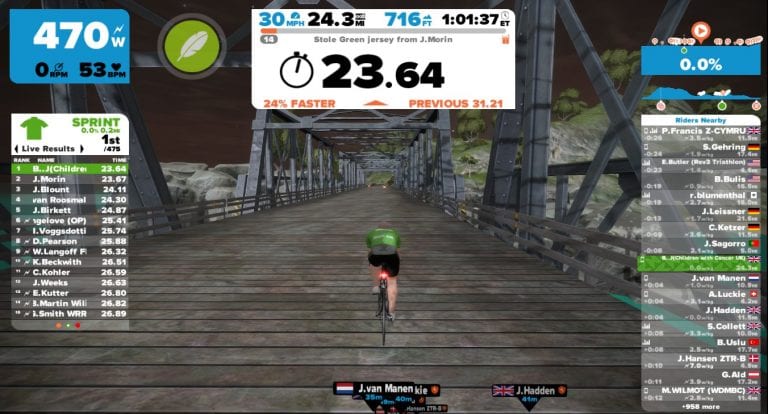
Wow, what a ride.  A little over 70 riders joined us for today’s SDR, with a good portion of them jumping on Discord.  It made for an entertaining evening rather than just a bit of suffering while sprinting.  As a quick caveat, our sprinting class today was focused on sprinting to beat an opponent not to get a green jersey from taking a Zwift banner.  The two do not necessarily correlate.

Like usual, we left the pen at 1.5 watts per kilogram with the goal of staying bunched up to practice working in the draft.  We strung out a little more than usual, as many of the newcomers were still learning the format of the SDR.  After a few minutes of riding the streets of Richmond, we were able to get the group more-or-less together, and I proceeded to go through the focus of today’s ride, mastering the sprint.  Now, we covered sprinting a few weeks earlier, but the focus of that class was really just about timing.  Today, I elected to target the actual mechanics of sprinting from the point of gear management.  Too often, people start in too big of a gear, making the “wind-up” a slow, inefficient process, or start in too small of a gear, leading to a premature spin-out.  Neither are optimal, and can lead to a disappointing finish.

For our first iteration, I talked through the concept and directed everyone to get in a fairly easy gear, pushing 80 RPMs +/-.  The point of the first iteration was not to have a great sprint, but to work through the gears in a methodical fashion.  The concept we would use is the “rev and shift” concept.  Basically, the rider “revs” the gear, raising the cadence to low-to-mid 90s, shifting to a harder gear, and repeating.  We did this through three shifts.  I explained that realistically a sprint with a lead-out would only allow you to have one or possibly two shifts, but it is just as likely to not have any shifts if the lead-out train did its job.  The real point of the exercise was to demonstrate a method of gear utilization that can help set up a strong sprint.

Going into a little depth of gear choice, that sweet spot of the low-to-mid 80s cadence while putting out a good effort, allows enough resistance to create a burst while not spinning out too quick.  Trying to open a sprint with a bigger (think smaller cog on the rear cassette) gear and a lower cadence may allow for a higher starting power, but the rider’s ability to quickly increase that power relative to other riders is likely going to be low.  Think of it like a diesel engine in a tractor trailer.  Sure, it can hit high speeds like your Honda Civic, but it takes significantly longer to get to those speeds.  Likewise, pedaling at a higher cadence is not conducive to an effective sprint.  Yes, you will be able to respond quicker, but gear management will become an issue.  Due to the lighter resistance, it is not likely that the rider will be able to get out of the saddle and put max pressure into the pedals right away.  Instead, the rider will have to make two or three rapid shifts while keeping tension on the pedals, increasing the chance of a dropped chain.  Additionally, power output and power transfer efficiency tends to be lower at higher RPMs than at RPMs in the 80s to low 90s.

We did a few of these iterations, going through the one or two shifts at higher power outputs and at a much faster pace.  Once everyone had the concept, we moved to sprinting from out of the saddle vs from a seated position.  I explained that you could do either, but sprinting from out of the saddle would allow for a higher power output.  It does have a big downside, though: you can’t sprint from an out of saddle position for a very long time.  Thus, you better time it right, or you run the risk of getting overtaken just before the line.  Like from the seated position, we did a similar drill, but using harder gears.  Ideally, you will only have one shift while standing, as you only have about 15 seconds of sprint time before your legs give out.  So, I usually make my shift at the end of my “wind-up” or a few seconds into the sprint to keep the build going.  This point led in to a good discussion about the time to reach peak power and the time one can hold it.  Since I don’t have physiological data on every Zwift rider, in general I would put forth that most riders should get to their peak sprint power within five seconds and should try to hold it for an additional five seconds.  Any longer than that is gravy in my book.

After finishing up with the different sprinting styles, we played a few games, including Match Sprint, Lead Out, and Max Power.  Match Sprint is simply a one-on-one sprint.  Because not everyone was on Discord, I couldn’t do complete pairings, but we selected a few riders as the designated opponents who would initiate the sprint.  Everyone else had to pick which rider he/she wanted to sprint against and get positioned to respond.  Think of Match Sprint like the sprint event on the track or the final kilometer of a road race when the breakaway riders are trying to time the sprint and almost come to a standstill.  I will have to say that it was a challenge to execute, but we did a few iterations of it.  By the final one, it went rather well.  The initiators launched at various times, meaning that the sprints varied from 100 to 400 meters, just like in real life.  Following Match Sprint, we switched to Lead Out.

Lead Out is just how it sounds.  Riders partnered up, with one partner as the lead-out and the other as the sprinter.  The lead-out rider performed the “wind-up,” and the sprinter did his/her thing.  Now, I’ve mentioned the “wind-up” a couple of times but never explained it.  The “wind-up” is simple.  Riders in front of the sprinter progressively lift the pace, going faster and faster, until they are spent, leaving the sprinter left to finish the job.  The point is to allow the sprinter to launch from a higher speed without having to expend the copious amounts of energy to get to those speeds.  Physics laws state that accelerating a body is the greatest expenditure of energy, therefore using a team to make the sprinter’s acceleration easier means that he/she will have more energy for the final burst.  If the sprinter has to burn off the matches in the book just to get to the launch point, nothing will remain in the tank.  Thus, during the Lead Out game, we had one partner serve as the final rider in the sprint train, also known as the “lead-out” rider.  It allowed the sprinters to go faster at the same power output.  To see this in action, check out the video below at the 2:46:20 mark.  You will see how Justin Wagner used his lead-out men effectively to set a best time for the sprint during the Zwift Team Worlds race.

Lastly, we played the Max Power game.  Again, it’s just like it sounds.  We went for 5-second power, one at a time.  Most people did a pretty strong ramp-up or “rev,” and quite a few people broke 10 w/kg.  It was not a scientific study by any stretch of the imagination, but it was fun just to see what we could individually do.  Once we finished up with our individual effort, we did one more iteration but at much higher RPMs just to show the ineffectiveness of that technique.  Within a few seconds, everyone quickly got that, as there were many complaints of being sloppy and bouncy.  Exactly.  That’s why we don’t do that.  Anyway, we wrapped up at that point with a couple of minutes of cool-down spinning and reviewing today’s lesson.

Thanks to all who joined in, and I look forward to the next SDR where we will go over climbing techniques in a very controlled environment.