Home Blog Page 500

Zwift coach profile: Shayne Gaffney, GC Coaching

Zwift coach profile: Shayne Gaffney, GC Coaching

Based in Woburn, Massachusetts, Shayne Gaffney is a USA Cycling Level II coach who is also a licensed Physical Therapy Assistant holding a degree in biology. (It’s always assuring to know your coach has the background to understand how training effects the body… check out Shayne’s blog for useful tips like core workouts which apply to every cyclist.)

Like other Zwift Insider sponsoring coaches, Shayne uses Zwift (he’s been on since the early beta days), and he couples that with the coaching expertise needed to get you to your peak fitness and beyond. Read below to learn more about Shayne.


Shayne in a post-race interview

Tell me about your cycling background. What sort of riding have you done, for how long, etc?
I started cycling in 2006 when I got into triathlons after being burnt out from middle and long distance competitive running.  I have done road, cross, TTs, and mountain biking, but my forte and passion lie with road.

When and why did you begin coaching?
I began coaching in 2012 after a friend said she needed help running a Computrainer Program and thought I would be a great match from my background (and she would pay for the license and testing fees!  SCORE!  ?).  So, I took her up on the offer and have truly enjoyed every minute since.

Every coach has particular philosophies which define their methods. How would you describe yours?
My philosophy is quite simple: Fitness = Consistency over Time, or, F=C/T.  Nothing changes without a consistent stimulus!

Do you use Zwift personally, and if so what for?
I do use Zwift personally and have been using it since the Beta testing phase!  I use it for a myriad of things like training, racing, social riding, and satisfying the competitive aspect of my brain via the various jerseys.

How is Zwift a useful tool from a coach’s perspective?
In three ways:

  1. It is visually, socially, and competitively stimulating, keeping the athlete engaged longer
  2. The workout creator is better than any other, bar none
  3. It gives the athlete the ability to receive the greatest benefit from their time invested in their training, especially with the smart trainer becoming more widely used.  You can literally change, swing your leg over the top tube, and be doing structured workouts in 5 minutes!

If you had just one piece of advice you could share with all Zwifters, what would it be?
Whatever you do, do it consistently!  It is far better to ride shorter multiple times a week than to ride longer a couple of times a week.

Testimonials

Mike Heck from Hutchinson, KS

For several years I have had the desire to complete a multi day long distance ride.  I have always felt that my interests were more towards endurance riding than racing.  After some health setbacks in the last couple of years, the stars finally aligned and I picked a ride.  This ride was no small goal for me, it included about 400 miles and almost 30,000 feet of climbing at altitude over 6 days.

I talked with Coach Shayne about helping me prepare for this event. He had some great ideas and so we worked together to get prepared for the big week.  My goal was to not just finish, but finish strong.

Coach Shayne’s workout plans, encouragement, and an appropriate amount of pushing was instrumental in my completion of the ride.  He tailored the workouts to meet my schedule and he was always available to provide advice and the encouragement that is needed when things seem to not be going well.  I would not hesitate to recommend him to anyone, especially, someone that is just looking to get started or has a specific event in mind.  I was very impressed with his knowledge and ability to help me meet my goals.


Dan Shinnick from Rowley, MA

– The A group, the fast ones on the Saturday ride.

– A sub 5 hour century.     

These were my goals and they had eluded me for years because, I now see, I didn’t really have a plan for achieving them.  I began working with Coach Shayne Gaffney in January of 2015 through his Pure Power (P2) classes looking to finally crack them.  I came away from the P2 class seeing a remarkable increase in both my power and confidence.  Recognizing the clear benefits structured training had for me, I asked Coach Shayne to coach me through the rest of the 2015 season and I began to consider racing.  Having never raced before I was incredibly nervous.  But working with Coach Shayne only continued to improve those two facets and as I approached the first race of the season at Mt. Blue, I knew I was ready.  Through the season as my confidence and ability grew, each race became more fun than the last.

Thanks to Coach Shayne being so generous with his time and knowledge, I achieved my original goals, grew to set new ones and achieved those as well.


Zwiftcast Episode 18

Zwiftcast Episode 18

Episode 18 of the Zwiftcast has been released, complete with a new look and theme tune. Here’s the full episode description:


The Zwiftcast has a new theme tune! Simon, Shane and Nathan hope you like it.

The Zwiftcast trio kick off by rattling through a whole series of info-bombs related to the Zwift platform, including the news that a Virtual Bike Shop will soon be open, allowing users to spend XP points; the decision to include ANT+ on the iOS platform after all and the impact of the big new January influx of users on the platform – could Zwift now be feeling a bit crowded at times?

The main feature is a substantial interview with Ed Baker, a former Facebook exec, now with Uber, who is also one of the new private investors in Zwift. Ed is hugely experienced in helping digital businesses to grow and Zwifters will find his thoughts on this subject truly fascinating.

After analysing Ed’s interview (Mark Zuckerberg rides a Kickr – who knew!) Simon, Shane and Nathan knock around the idea that you may not need to own a big, expensive piece of hardware like a trainer to Zwift in future – what might it all mean?

The next feature is the concluding part of Simon’s visit to the trainer manufacturer Elite – with some interesting thoughts about Smart Bikes and the direction of trainer prices. Which leads the chaps on to talk about the continuing difficulties some users are experiencing with the Tacx Flux trainer.

Simon’s review of the Flux includes sound tests at various wattage levels, but did he get the problems others, including Shane have experienced? And when is Round Three of Shane Vs the Flux – and how might it be covered? Shane is threatening a live stream with Nathan commentating. . . .

This episode of the podcast concludes with some incredibly valuable advice from pro rider coach Kevin Poulton on how to use Zwift to lose weight. Kevin, who coached popular Zwifter Matt Hayman to victory in Paris Roubaix, gives tips on which workouts will be most effective and explains some of the science behind his advice.

The boys conclude with a light-hearted discussion on changing your weight – or even failing to do so (!) – in Zwift.


Sneak peak: Watopia’s new “Volcano Route”

Sneak peak: Watopia’s new “Volcano Route”

UPDATE: ZwiftHQ has published the route details for this expansion here. It appears there will be two new routes added to Watopia’s list:

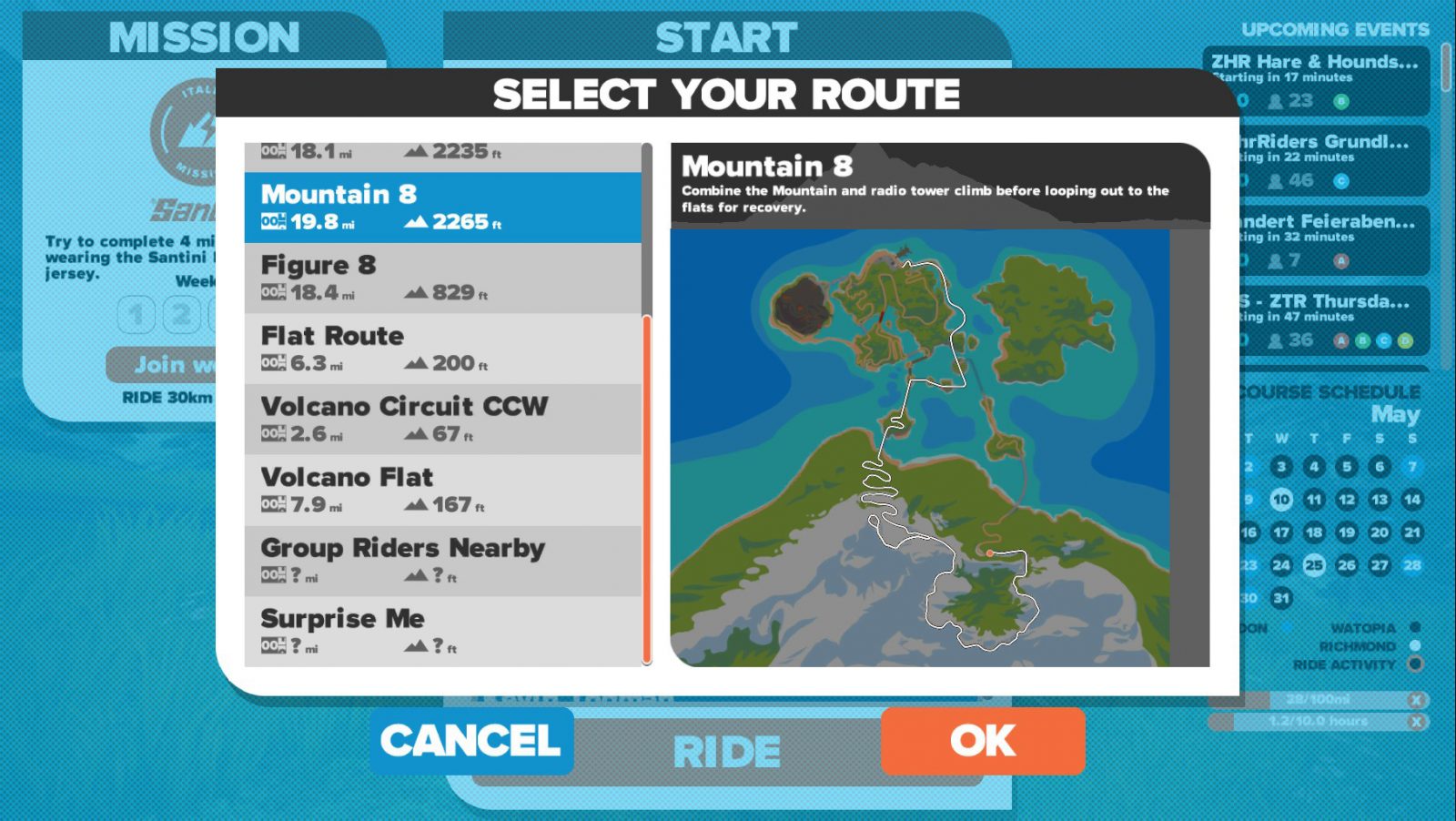
  • Volcano Flat
    Distance: 12.4 km (7.7 mi)
    Elevation gain: 50.9 m (167 ft)
  • Volcano Criterium
    Distance (per lap): 4.3 km (2.7 mi)
    Elevation (per lap): 20.4 m (67 ft)

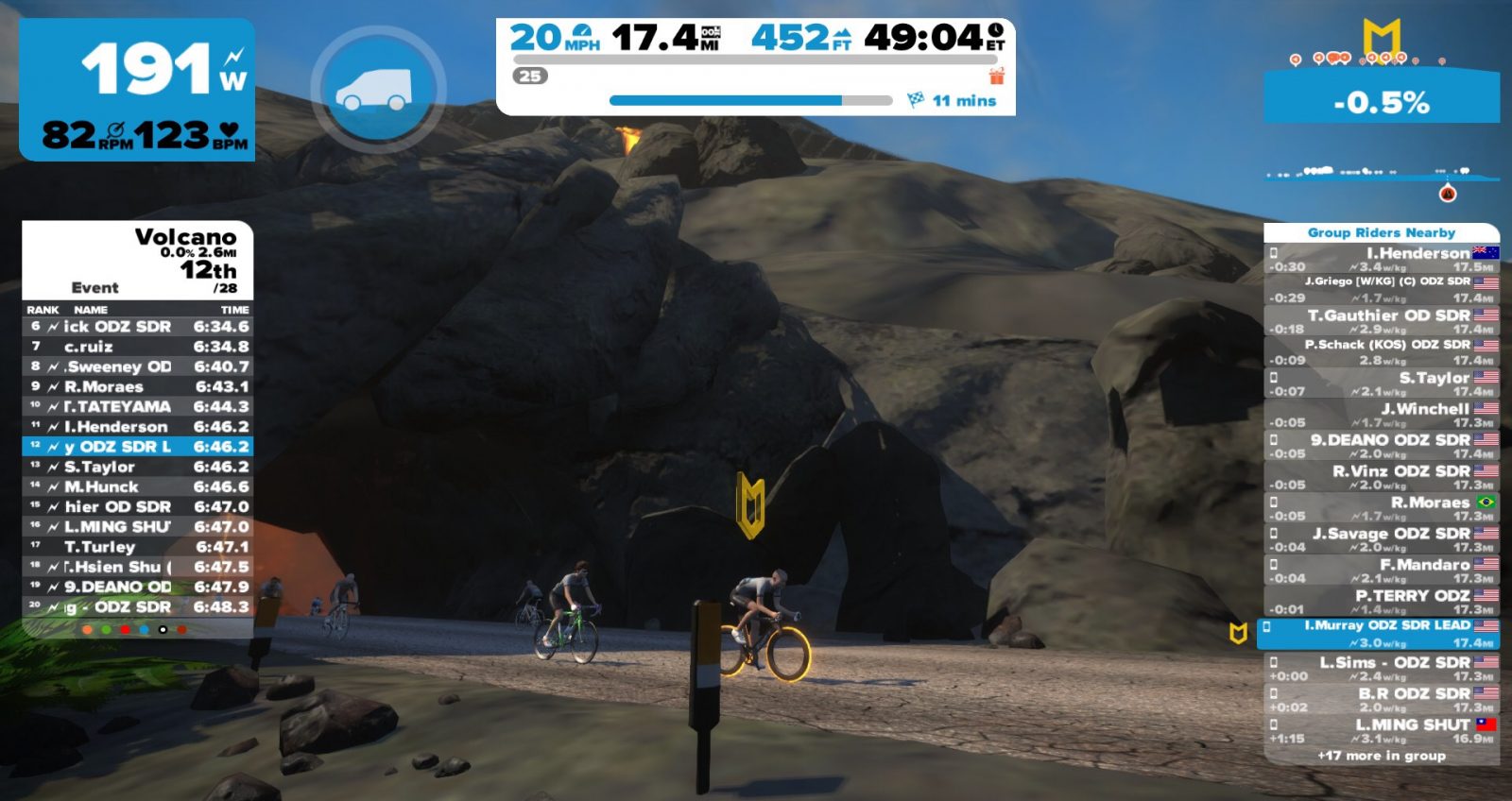
Early this morning Zwift CEO Eric Min posted a ride to Strava which includes the much-anticipated “Volcano Route” expansion of Watopia.

Route Details

Since this the first Strava post showing the new extension, we can extract quite a few details with some basic analysis:

  • It connects to the existing Watopia roads in two places: the middle of the Italian Village, and 1.5 miles later at the end of the Esses, before the tunnel which leads to the downhill and the start/finish banner.
  • The course is very flat, alternating between 1-49′ above sea level.
  • The main portion of the course can be ridden as a loop approximately 2.5 miles (4km) long.
  • The loop has its own start/finish banner (see it in the background of Eric Min’s snapshot), so it can be used for lap races. With its short, flat loops it looks to be just right for criterium racing–perhaps a “Sulfur Series” of crit races is in order?
  • Part of the loop is inside of the volcano (see Eric’s screenshot, which I believe is taken where the loop narrows in the map below).
  • This doesn’t appear to be the entire new route, based on a screenshot from the GCN Zwift tour video (see below). My guess is the new route will include a climb to the top of the volcano–if it does not, then that is a planned route for the future.

Hopefully the new route release will also include the ability to go in reverse direction from the starting pier, so we can quickly get to the volcano loop.

This map shows the new route (red) and where it connects to existing routes (black).

When Can I Ride It?

ZwiftHQ never gives hard dates for new route releases, but my guess would be by the 17th of January. It may even arrive this week! They almost released it at the end of December, but had some fine-tuning to do and decided to push it off a bit.

More

You can see a short glimpse of the new route in the GCN video below (the whole video is fun if you want to look around Zwift’s headquarters, but check around the 5:00 mark to see the new route).

Based on the screenshot below it appears there is a climb up the volcano which is not included in Eric Min’s Strava ride. Exciting stuff!

Here is the intersection from the Italian Village to the new route:

Here’s a screenshot from Zwift’s VP of Partnerships, Mike McCarthy… running inside the volcano.


What to do now to prepare for races later (Advice from Coaches)

What to do now to prepare for races later (Advice from Coaches)

Editor’s note: this is the first in a series of articles focused on training advice for Zwifters. Each post will feature a single question answered by coaches who use Zwift with their clients. Here’s our first question:

It’s early January. If you could give every racer on Zwift just one piece of advice to help them meet their racing goals this year, what would it be?


Paulo Stroud-Baranda,  BIKEDNA 

If I gave only one piece of advice to all Zwifters this January, it would be to know precisely what it is that you wish to accomplish this year. Put your plan into action! Decide all races or events now. Using Zwift is a fantastic way to achieve cycling fitness as it allows you to work with smart data and in a consistent way no matter what the weather – which is so important to achieve success in cycling! Start training specifically for your goals and focus your training around that event. Is your goal to finish the race or do you have a time goal for that race? That means no more junk miles! Every ride should serve a purpose.

Of course, a coach could take your training to the next level and help you develop a solid plan, provide motivation when you need it and get you past any injuries that might occur during the year. If you have never used a cycling coach, now is a perfect time to give one a try – take the guesswork out of the equation!”


David Lipscomb, CIS Training Systems 

My advice to those looking to meet their 2017 racing goals would be to ensure that the training you are doing mimics the racing that you are looking to compete in.

Threshold workouts are great, but there are other skills needed to ensure that you come to the table with all the tools you need. One of the skills needed would be cadence development from 50 to 125+ RPM to cover all demands of racing.


Rob Manning, Tailwind Coaching

Remember that racing isn’t always about who is the strongest or has the highest FTP.  Winning a race is about being the most cunning and the most efficient.  If you have matches left to burn at the end of a race, you’ll be much more likely to win than the guy who’s been burning matches on the front all race.

If you want to be more efficient, work on the neuromuscular link between your brain and your muscles.  Working on high cadence drills (think 130 RPM and over) and low cadence drills (70 RPM and below) while staying smooth and supple will help you build neuromuscular conditioning.

The better your neuromuscular conditioning, the more efficient you’ll be.
The more efficient you are, the more energy you have left at the end of a race.
The more you have left at the end of a race, the better chance you can win.

Don’t ignore those cadence drills and the pedal stroke work.  It might be the difference between crossing the line with your arms aloft and crossing with your head hanging.


Troy Delfs, Momentum Cycling

First of all, prioritize your races.  Unless your name is Eddy Merckx, you can’t win them all.  Look at the race calendar for 2017 and determine what you top priority or A Races are.  There should only be 2 or 3 of these per season and these are the races that you base your whole Annual Training Plan around and taper for.  Next come the B Races, which you hope to do well in, may have a short taper for but are still secondary to your A Races.  3rd are the C Races which quite simply are used to build race fitness, practice you skills, strategies and tactics and to test our your bike and equipment.  Although you shouldn’t expect great results in C Races they are still very important to help you prepare for the A and B Races.

I belive that the numerous races offered on Zwift provide a multitude of opportunities to build fitness and fine tune your tactics, pacing and to help you push your limits.  My suggestion is to use the Zwift races as your C Level Races.  In the off-season, I would not suggest doing more than one race (Zwift or real world) every week or two as they can be very fatiguing and should only be done if they would compliment the current phase of your training plan (i.e. don’t race during a recovery week).  Consider doing a Zwift race as an alternative to a hard FTP or interval session.  You may wish to simply compete in the first third or half of the race, to get in the high intensity, threshold work and then change course and spend the rest of your ride working on base endurance. A few great things about Zwift races is that they are free to enter, readily available and nobody really ever notices if you just happen to turn off course after you have reached your limit.


Noel Bonk, Bonk Werx

If your goal includes racing outdoors in the spring, my advice would be to use Zwift as a way to either add to or supplement longer structured training rides. The weather this time of the year in many parts of the US is cold, wet and snowy so this can prohibit getting in those longer rides outside. On the other hand, the idea of spending 2-3+ hours sitting in one spot on the trainer for many athletes is pretty daunting, so Zwift is an especially great way to balance that and combat the boredom.

By using Zwift as a training tool, racers can get in that saddle time when needed either through one of the many regularly scheduled rides, through the workout builder or just riding along. Based on the fact that it’s January and most road races are months away, consider targeting those longer rides in zones that build aerobic endurance, aerobic power or functional threshold power first. Add these Zwift rides/workouts to your training schedule so it becomes part of your weekly routine. Just remember since fitness is not created in a silo, don’t be afraid of challenging yourself on occasion!


KISS EU – “Spinners are winners”

0

KISS EU – “Spinners are winners”

The first classique race of the year saw some close finishes for the KISS EU of January 5th. In the A category, Tim Cartwright (KissRT) took the win after a long breakaway, whereas in the Bs, Sebastian Sternefalk (Vision) won the final bunch sprint.

Known for its fast pace, the London Classique Course was the ideal place for a new two-man breakaway featuring Tim Cartwright (KissRT) and David Allonby. Managing to stay up front, the English duo saw its advantage cut down to 6 seconds at the beginning of the race’s last hill. In an ultimate sprint effort, Cartwright managed to keep a few seconds over the pack, and took the win over Brett Boniface (Team ODZ) and David Allonby.

In the B category, the finish came down to a bunch sprint, despite the several attacks from Julien Beijer (Team X) in the uphills. The Dutch rider from Team Experimental, in addition to a 2nd place, won the first q/l Report – Combativity Award of 2017. In the final sprint, Sebastian Sternefalk (Vision) took the win over Julien Beijer (Team X) and Morten Austestad. “I wasn’t sure to ride today, after a rough New Year’s eve” says Sternefalk. “In the last lap, I had some gear problems, but I managed to get back and do my sprint. In that kind of sprint, you got to have a small gear to spin fast… I guess you can say that spinners are winners!

Time to duel for the Cs

For the Cs, Scott Gallagher (BRTeam) won the two-man sprint against Jeff Edwards (Team TFC). A few seconds later, Stephen Hall took 3rd by winning the bunch sprint. Finally, in the D category, Berit Sundquist (Team X) took the win over Ian Martin and Thomas Vestergaard. Of course, all those results await to be official and are still provisional.


Here is the race commentary from Nathan Guerra.
Check it out on his Twitch.tv channel >


KISS EU – Jan. 5th/Provisional Results:
A Category:
1- T.Cartwright (GBR-KissRT)
2- B.Boniface (CAN-Team ODZ)
3- D.Allonby (GBR-U/A)
B Category:
1- S.Sternefalk (NOR-Vision)
2- J.Beijer (NED-Team X)
3- M.Austestad (NOR-U/A)
C Category:
1- S.Gallagher (GBR-BRTeam)
2- J.Edwards (GBR-Team TFC)
3- S.Hall (GBR-U/A)
D Category:
1- B.Sundqvist (NOR-Team X)
2- I.Martin (GBR-U/A)
3- T.Vestergaard (DAN-U/A)
q/l Report Combativity: J.Beijer (NED-Team X)

-the q/l Report-


Zwift coach profile: Ric Stern, RST Sport

Zwift coach profile: Ric Stern, RST Sport

While based in London, Ric Stern of RST Sport is coaches clients all over the world, including Australian Michael Frieberg who won the Omnium event in the 2011 World Track Cycling Championships.

Ric and his team of coaches work with all types of cyclists and triathletes, achieving no small level of success on the national and world championship levels.

Like other Zwift Insider sponsoring coaches, Ric and his team love and use Zwift, but also have the coaching expertise to help you get to the next level. Read below to learn more about Ric and his team.


Ric racing

Tell me about your cycling background. What sort of riding have you done, for how long, etc?
I started racing in 1984 as a junior and have been racing since then. I began with time trials which, at the time, was the way most people started in bike races in the UK, and I’ve TTed over most standard UK distances (and a few non-standard distances) to include short hill climbs, 10, 25, 30, 50, 75, 100 mile TTs as well as a few 12 hour TTs.

I’ve road raced, done criteriums, ridden the track, and taken part in sportives too! On top of that I’ve raced in France, and rode most of the Tour de France route in front of the riders.

When and why did you begin coaching?
I began coaching my friends in the 1980s (not that I really knew it was called coaching then), and started properly in the 1990s.

I began collecting power meter data in 1993, and wanted to bring an empirical, scientific approach to coaching, which I felt was lacking. I had this burning desire to help people (my friends at first) to get better and ride faster. There seemed to be all these old wives tales, which didn’t make any sense to me. So I was very much driven by the science of how the body worked both from a physical and mental perspective.

In 1995 I started (and eventually finished) a degree in Sports Science, which I felt would help me understand the science and be able to better understand how to help people achieve their goals.

Every coach has particular philosophies which define their methods. How would you describe yours?
My philosophy revolves around the science and using both peer-reviewed evidence as well as my own experiences of applying those data in a real world setting. That’s not to say my coaching doesn’t have any fun sessions (because it does), and it’s not all highly structured intervals (because most people don’t like, want, or need anything that rigid).

Do you use Zwift personally, and if so what for?
Yes, I use Zwift. I used it through beta although I must say I generally stop using it when the weather is really good. I do use it to help me schedule in both endurance sessions and structured intervals or blocks of work.

How is Zwift a useful tool from a coach’s perspective?
Because you can get athletes to ride without too many distractions (e.g. cars, junctions!) and you can have a feel of what the rider is doing in terms of the ‘environment’ where they’re riding. At RST Sport we coach riders all over the world, and work with these athletes remotely. I can’t always see where they’re riding so knowing they’re riding a route I’ve done on Zwift allows me to see how they classify it, which allows me to understand how they classify other routes.

If you had just one piece of advice you could share with all Zwifters, what would it be?
I think my favorite piece of advice, for virtually all riders is, don’t start too hard. Most people overcook things at the start of either races or training, where a more measured effort is nearly always better! (exceptions are events that last less then ~60-secs). Oh! and enjoy it!

Testimonials

Ric with client Michael Frieberg (Australia), winner of Omnium event at 2011 World Track Cycling Championships.

Michael Frieberg  (Australia) said this about RST Sport after winning the 2011 World Track Championships:

To me the RST Sport team is my Formula One pit crew, ready to squeeze every ounce of performance from my body. Whether it be in aerodynamics, nutrition, training, testing, racing, pursuiting or sprinting, every facet of my performance is recorded, measured, calculated and analysed finding improvements in speed, efficiency and recovery. RST is my personal sports institute devoted to making me faster.

Selene Yeager (USA, editor of bicycling.com) said:

Coaching is as much about art as it is science. Anyone with working knowledge of physiology and the sport can cobble together a training plan. That’s the science. The art is knowing your athlete, digging in a little deeper on what makes them tick, and fine tuning the plan and your training approach for that specific athlete to meed that specific athlete’s need. That’s the art. And to that end, Neil Kent is an artist. I was already doing well when I started working with Neil, but he saw where I needed improvement (aka threshold tolerance on the flats) and the areas of racing in which I felt less confident (aka NERVES). He designed programs that systematically dissolved those weaknesses. I went into the biggest race of my life Brasil Ride with multi time national champion Rebecca Rusch with the most confidence I’ve ever had; raced stronger and smarter than I ever have, and emerged with a stage race sweep and overall win. Through it all, he always encouraged me to enjoy the ride; checked in regularly to be sure I was on point and feeling happy; and was as much a friend as a coach. I’d recommend his services to anyone.


Richmond “2015 UCI Worlds Course” Route Details

0

Richmond “2015 UCI Worlds Course” Route Details

The Richmond UCI Worlds route is a replica of the 2015 UCI Road World Championships course in Richmond, Virginia, USA. It was at this race where Peter Sagan famously attacked on 23rd Street to eventually win his first World Champs jersey.

It’s a wonderful race course, with the first half very flat, then a nice mix of attackable climbs on the back half.

The Richmond refresh of February 6, 2020 added the ability to u-turn on Richmond, while also adding the reverse version of the 2015 UCI Worlds course as an event-only route.

Distance: 16.3km (10.1 miles)
Elevation Gain: 142m (467′)

Strava Forward 1 Lap Strava Reverse 1 Lap


Virtual Power Basics for Zwifters

7

Zwift only needs to know your wattage in order to get you moving in game (read how your speed is calculated in Zwift), and supports several methods for transferring your efforts into avatar momentum. The most accurate method (and also the most expensive) is to use a smart trainer and/or power meter. But Zwift also supports most non-smart (aka “classic” or “dumb”) trainers when coupled with a speed sensor (a simple device which counts your wheel rotations).

You can tell what sort of power calculation method Zwifters are using by looking at their w/kg in the rider list in-game. A lightning bolt next to the number means their wattage is being read from a smart trainer or power meter. No lightning bolt? Their power numbers are being computed by Zwift based on wheel speed and a virtual power curve.

Cyclops Fluid Power Curve

Virtual Power: How it Works

The good folks at ZwiftHQ put many hours into testing an entire room full of classic trainers back in Zwift’s early days (trust me, I’ve seen the room!) They rode these trainers at various speeds using power meter-equipped bikes so they could create a “power curve” for each trainer.

A power curve is basically a data lookup table which says “if the wheel is spinning at speed Y, the rider is putting out X watts.” See the CycleOps graph to the right as an example.

Of course, virtual power isn’t as accurate as “real” power due to many variables in tires, trainers, and setup. But the calculated power curves deliver reasonably accurate numbers when set up properly. 

Virtual Power Possibilities in Zwift

CycleOps fluid trainer – zPower supported

If you have a classic trainer and no power meter, here are your Zwift options:

  1. zPower Classic Trainer and speed sensor: Zwift has calculated a specific “power curve with acceleration” for a very short list of higher-end classic trainers. Capped at 1200 watts, as long as your trainer is set up properly (see below) your numbers should be fairly accurate even when changing speeds. (While the term “zPower” is often used by Zwifters to refer to all virtual power numbers, only a small set of trainers use zPower.)
  2. Virtual Power Classic Trainer and speed sensor: also capped at 1200 watts, this is larger list of classic trainers for which Zwift has calculated a specific power curve. As long as your trainer is set up properly (see below) your numbers should be fairly accurate when holding a particular wheel speed, but wattage during accelerations will be less accurate than zPower trainers.
  3. Unsupported Trainer and speed sensor: this is Zwift’s “last ditch” option. If your trainer isn’t on any of the previous lists you can choose this option and hope for the best. You will be capped at 400 watts.

Here is Zwift’s list of supported classic trainers >

Tips for Proper Setup

Basic Checklist

Keep in mind Zwift’s calculated virtual power curves were tested and developed under a specific set of conditions, and if your equipment does not match those conditions your numbers will be off. Specifically, Zwift’s virtual power curves assume:

  1. a fully-inflated tire (typically 100 PSI)
  2. a road bike tire size of 700c x 23mm.
  3. a properly-tightened trainer tension knob (per manufacturer recommendations)
  4. correct resistance setting, if applicable (Zwift may recommend a particular setting on variable-tension trainers)

Select the Right Trainer

If your trainer is not on the zPower or Virtual Power list, please do not select a different trainer and hope for the best. This can result in wildly inaccurate power numbers and you may get flagged as a “flier” in game.

Trust and Verify

ZwiftHQ did a good job computing their virtual power curves, but it doesn’t hurt to verify your numbers by comparing them to your real-world performance. One easy way to do this is to choose a flat route for a ride in Zwift. Go out and do a good hard ride, then compare your average speed to a similar outdoor ride. Strava is a great tool for comparing indoor and outdoor rides.

Here are some numbers you can use to verify your power accuracy

Many classic trainer riders find their in-game speeds are much too fast, and the problem can be traced to having their trainer tension knob too loose. Try tightening it and testing until your in-game speed is closer to outdoor speeds for similar levels of exertion. Due to differences between riding in Zwift and riding outdoors, I would say if your Zwift speed is around 1mph faster than your outdoor speed you’re probably set up decently well.

January 2017 Zwift course schedule

0

January 2017 Zwift course schedule

[et_pb_section admin_label=”section”]
[et_pb_row admin_label=”row”]
[et_pb_column type=”4_4″]
[et_pb_text admin_label=”Text”]
January’s course schedule is now available. This schedule basically matches November and December’s, with Watopia featured Sunday-Wednesday and London Thursday-Saturday, the exceptions being two Richmond Wednesdays.

Keep in mind the course changeover happens at 21:00 Los Angeles time (PST) or UTC-8 hrs.


[/et_pb_text]
[/et_pb_column]
[/et_pb_row]
[/et_pb_section]


Why your Bkool Pro won’t work on Zwift iOS (and what to do about it)

5

Why your Bkool Pro won’t work on Zwift iOS (and what to do about it)

Bkool trainer owners enjoy full smart trainer functionality via ANT+ on Zwift for PC and Mac, but Zwift for iOS is currently unable to control Bkool trainers. Why is this, and what can you do about it?

Bkool trainers can be controlled (after a firmware update) using ANT+, but as you probably know Zwift for iOS only supports Bluetooth at this time. (Related news: Zwift has announced they will support ANT+ for iOS in the next version of the Zwift app, coming in the next ~30 days.)

Bkool trainers can also be controlled via Bluetooth, but Bkool uses their own secret, proprietary Bluetooth protocol to accomplish this, with the result that their trainers currently only work via Bluetooth with Bkool’s own simulator software.

Jon Mayfield, Game Master at ZwiftHQ, made it clear where Zwift stands on this in a recent Facebook post:

If they send us their Bluetooth protocol I’ll add it. We don’t really have open communications though as we’re essentially competitors.

He also added:

We’ve also reached out to them again this week to see if they’ll share the Bluetooth info. I wouldn’t blame them for not sharing, but it’d be nice for their hardware customers.

So what can Bkool owners do? Contact Bkool and ask them to release their Bluetooth protocol to ZwiftHQ. Hit them up on their website, via Facebook, Twitter, etc (links at bottom of this page.) The squeaky wheel gets the grease, folks. Get on it!