Home Blog Page 414

How the Race Was Lost – Auto-Braking Dreams and New FTPs

32

How the Race Was Lost – Auto-Braking Dreams and New FTPs

Last Thursday’s Crit City race was a fun one, mostly because I finally got to race with a local buddy. Sure, I still lost. Sort of. But there’s something special about riding on Zwift with someone you’ve accompanied for thousands of IRL miles. Sure, it’s virtual–but thanks to Zwift and Discord, it’s also very real.

Warmup

After missing my usual early-morning Zwift session the workday had gotten away from me. Now it was two in the afternoon and I just wanted to get a hard effort in so I wouldn’t go stir-crazy. So I messaged a few local riding buddies to see if anyone wanted to tackle a Zwift race with me, and my friend Zane came back with an affirmative. We quickly chose an event: Crit City. Bell Lap. 4:45PM. See you then!
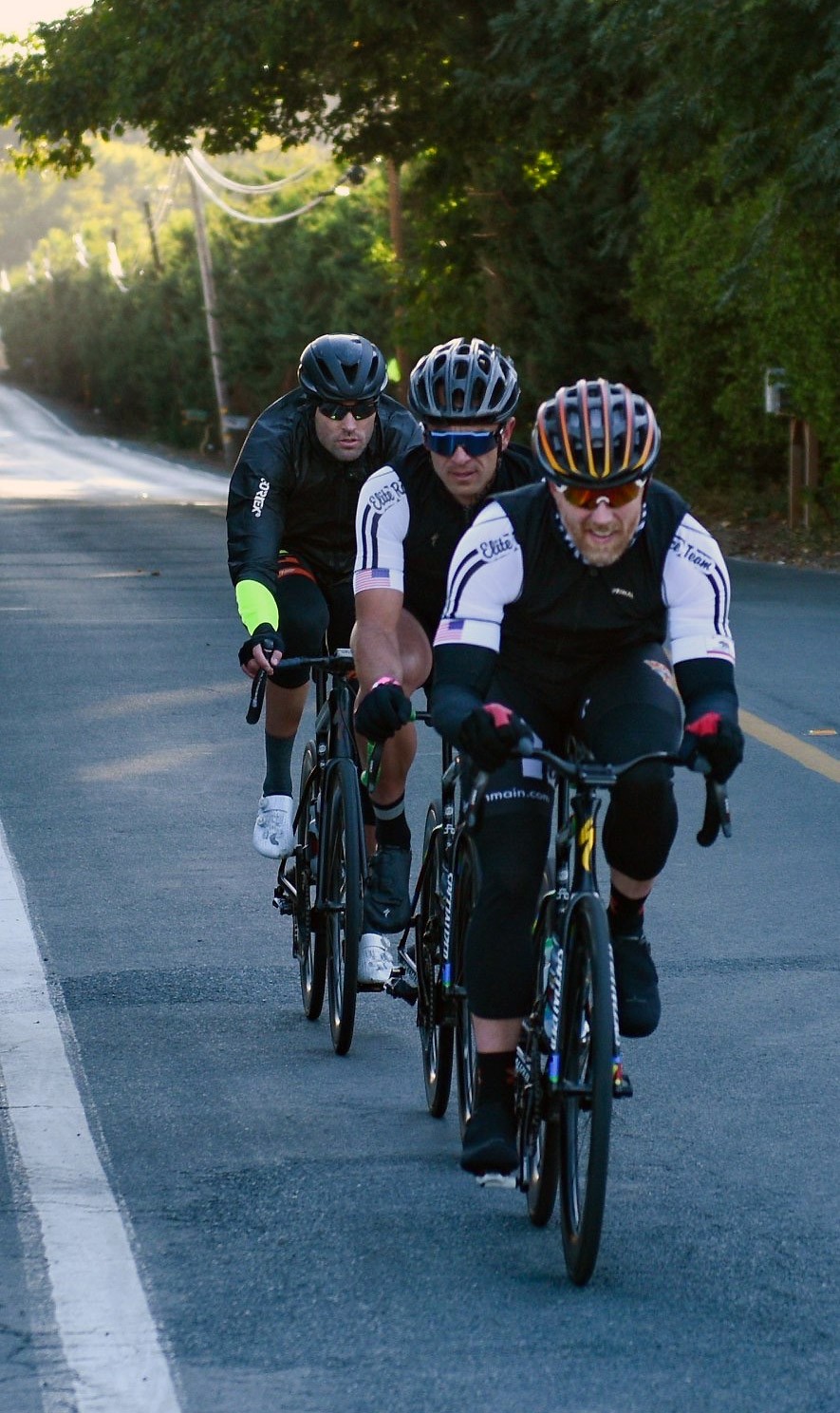
Front to back: me, Zane, and another friend riding our local Konocti Challenge imperial last October

Two Riders, One Mission

You have to understand, this was a rare occurrence: Zane and I ride together on Zwift quite a bit, but hardly ever race together since he prefers racing in the A’s. He’s a glutton for punishment, preferring to get shelled by the top riders so he’s better prepared when the outdoor season begins and he’s taking on the P/1/2 field here in Northern California.

Me, most of my races are done because I know I have a shot at the B podium. Sure, some races are purely for training – but I’m much more motivated to go hard if I think I can finish in the front pack.

Zane and I are good friends, but we’re opposites in many ways. He’s the guy you’ll see attacking repeatedly off the front–I’m the guy sitting in and trying to survive. He rides by feel, I love all the data. He is a naturally gifted athlete–and I’m far from that! His FTP puts him right near the top of the B category (325 watts, around 3.9w/kg), while mine is closer 300 watts, around 3.6w/kg.

But that’s one reason we enjoy each other’s company: we learn from watching the other guy, and riding together pushes us to try strategies and workouts we wouldn’t have attempted solo.

Our goal for this race was simple enough: try an attack to see if we can split the group and get away with a small breakaway bunch. (I’ve been wanting to be a part of such a breakaway ever since my first Crit City race, but I have yet to see it work). If we couldn’t get in a break, we would simply stay near the front on the crazy final lap, then go all-in for the sprint finish.

The Start

I tried convincing Zane to attack with me on the first lap up the twisty climb, but he wasn’t into that idea. So we just surfed the wheels near the front as the race began. As we pulled out of the start gate I realized I’d forgotten to switch back to my Tron bike, and was riding the S-Works Venge with Zipp 858 wheels. Not the absolute fastest option, but no time to change now.

There were some strong riders pushing the pace at the front, and our group of 26 was reduced to 14 before the first lap was even finished. That group would basically stay intact for the remainder of the race.
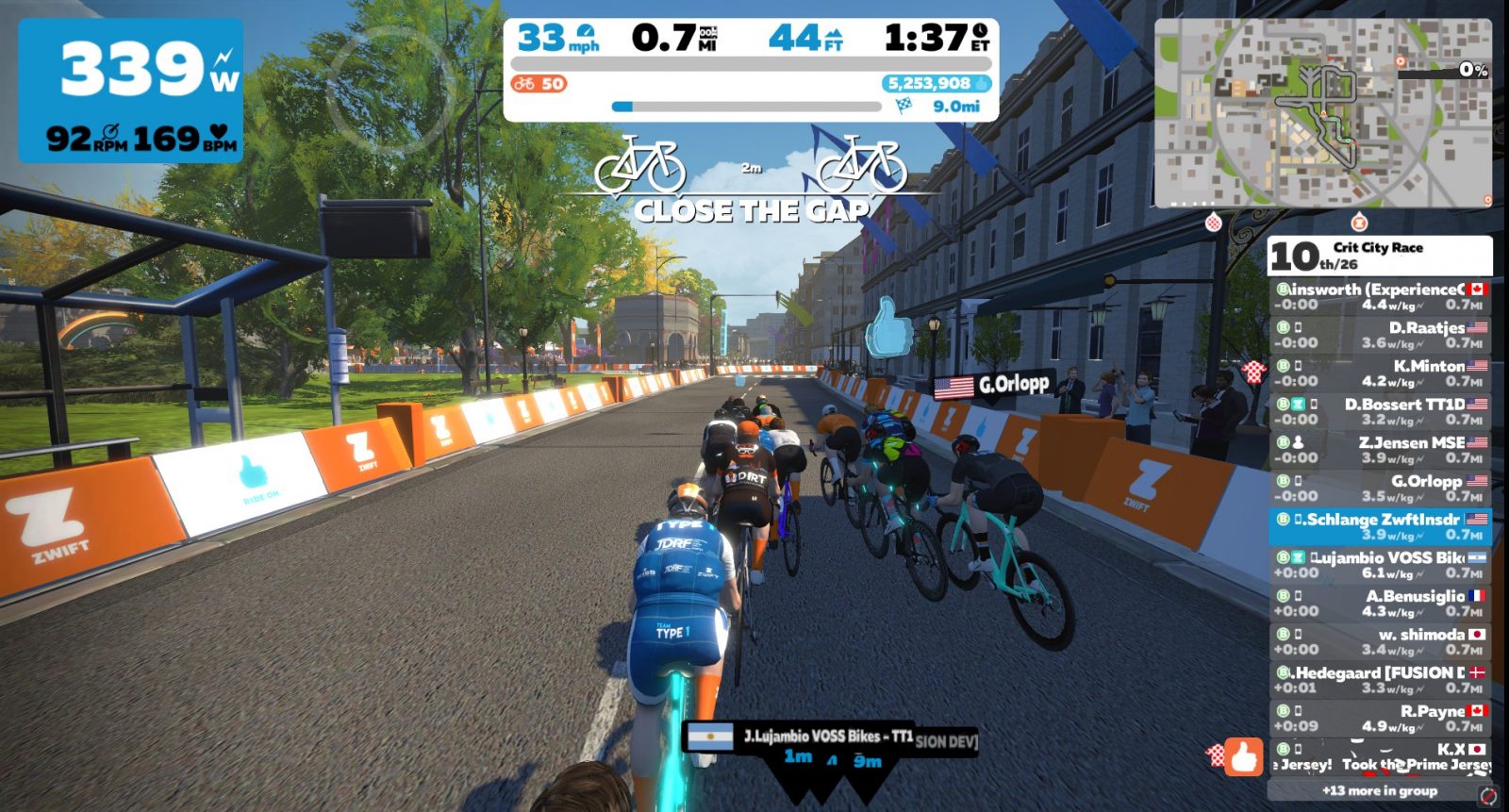
The pack shrunk quickly from 26 to 14

After a couple laps, I was pretty sure we had two riders in the front of our group who would 1) finish the race well over the category limits or 2) blow up within another lap or two. They were constantly throwing down some big wattage on the front, but it was OK because we could sit on their wheels and let them work.

Were they sandbaggers, or just really strong? You really can’t think too much about that in a race situation. Just ride smart. Ride to win!

The Middle

We hit the twisty climb at the start of the third lap and Zane yelled in Discord, “I’m going for a break!”

I would have followed, except he caught me sleeping near the back of the pack. So I let him go. He managed a gap of 4-5 seconds, but good ol’ Hemstad towed us back to him.
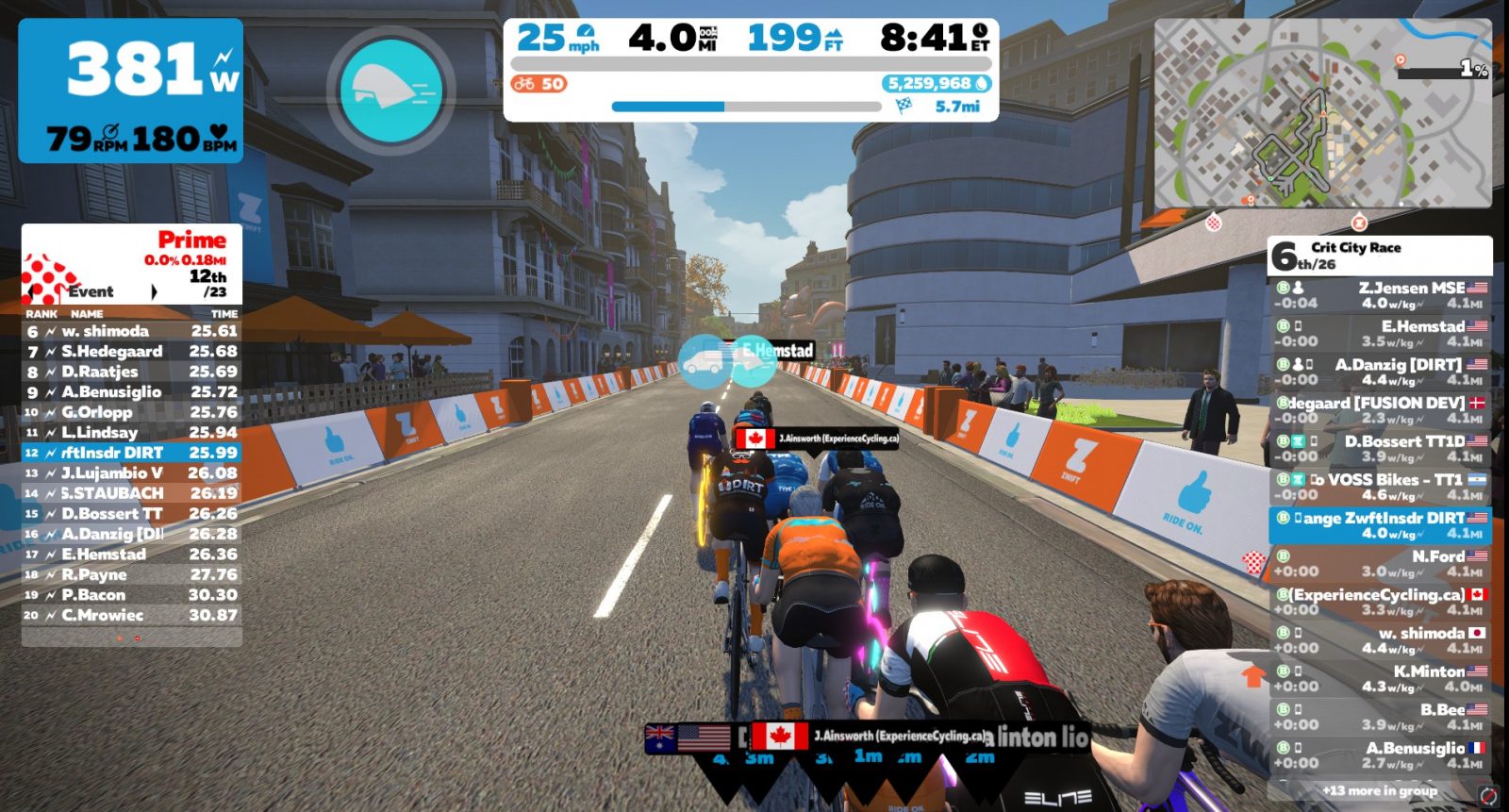
Zane a few seconds off the front

Give Breaks (Brakes) a Chance

As we caught Zane I was reminded that breakaways need some help on Crit City–it’s just way too hard to get away, and this makes the races less exciting. Let’s go down a side road for a bit…

Here’s what I would love to see Zwift add to the Crit City course: position-based auto-braking. In a crit, pack position is huge. If you’re at the back of a pack going through tight corners you’ll have to put in a lot more work as the group slows to a crawl then you sprint back up to speed, over and over again. Conversely, if you’re in a 3-man breakaway off the front you can take that corner much more quickly. And this is a good thing, because it’s just about the only advantage the breakaway has on the chasing peloton.

We don’t have auto-braking on Crit City, though. Not yet. But it could be done! Riders could simply be slowed to a maximum speed (say, 20mph) on the two sharpest corners of the course. This would make the races more dynamic and crit-like.

But what if Zwift took it to the next level? What if the amount of auto-braking was based on your pack position? So the rider at the front of a pack would only get 20% of the auto-brake effect, while the riders at the back would get 100% of it.

I remember a little piece of software from a Zwifter years back that showed the percentage of draft effect Zwift was currently applying to your rider. So yes: Zwift already has a drafting “level” in play. What if that number was used to determine how much auto-braking was done? If you’re getting 0 draft, then 20% auto-brake. 100% draft? 100% auto-brake. And everything in between.

This would give the breakaway more of a chance, and reward those who are putting in the work on the front of the peloton.
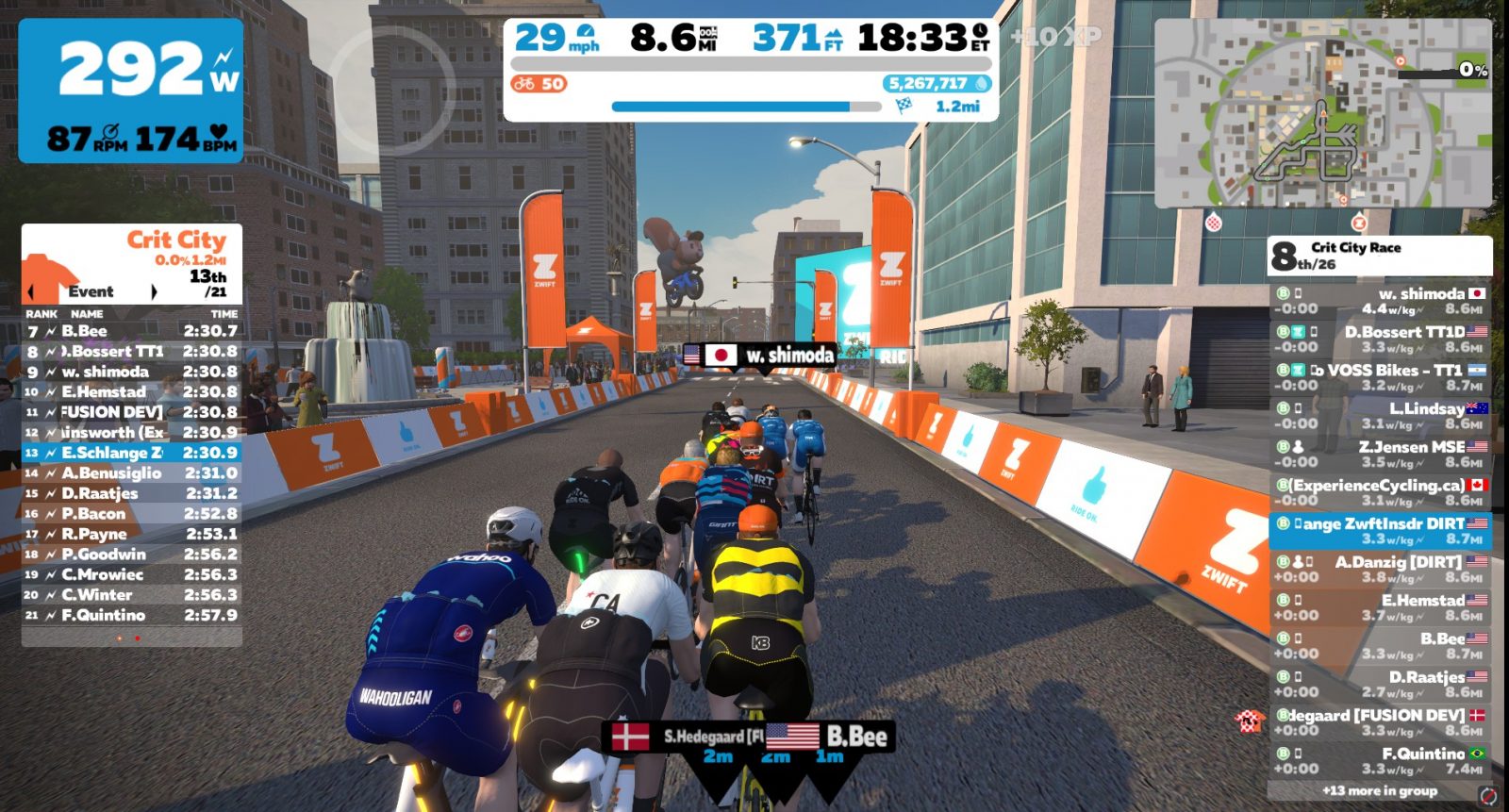
Last lap: no powerup (again!)

The Finish

The remaining laps were fairly uneventful, and heading into the final lap I had received just 3 powerups in 7 chances through the arch. The powerup gods must be angry, because the ratios weren’t working in my favor! Hoping for something useful as we rode beneath the arch for the final lap, the spinner once again landed on the 10XP bonus. Boooo!

As always, the pace picked up when we hit the uphill twisties for the last time. I was out of the saddle happily hammering along, just doing my best to ride the wheels and conserve before the final sprint. Zane was right on my tail as we descended the bricks, making us 4th and 5th wheel as the pack stretched out thanks to Minton pushing hard on the front. I kept my eye on the riders ahead and the list to the right, ready to jump and grab a wheel if any strong riders looked like they may get away.

As we flew through the penultimate turn it was time to go all-in. No Tron bike? Can’t think about that now. No powerup? Oh well! My lovely wife had come up to the Lab and was yelling “GO GO GO!” and I was out of the saddle, head down, giving it all I had.

I wasn’t even sure if Zane was ahead or behind me. I was too busy putting everything I had into the pedals for those final 15 seconds.

I crossed the line, looked up, and was delighted to see these results on the screen:
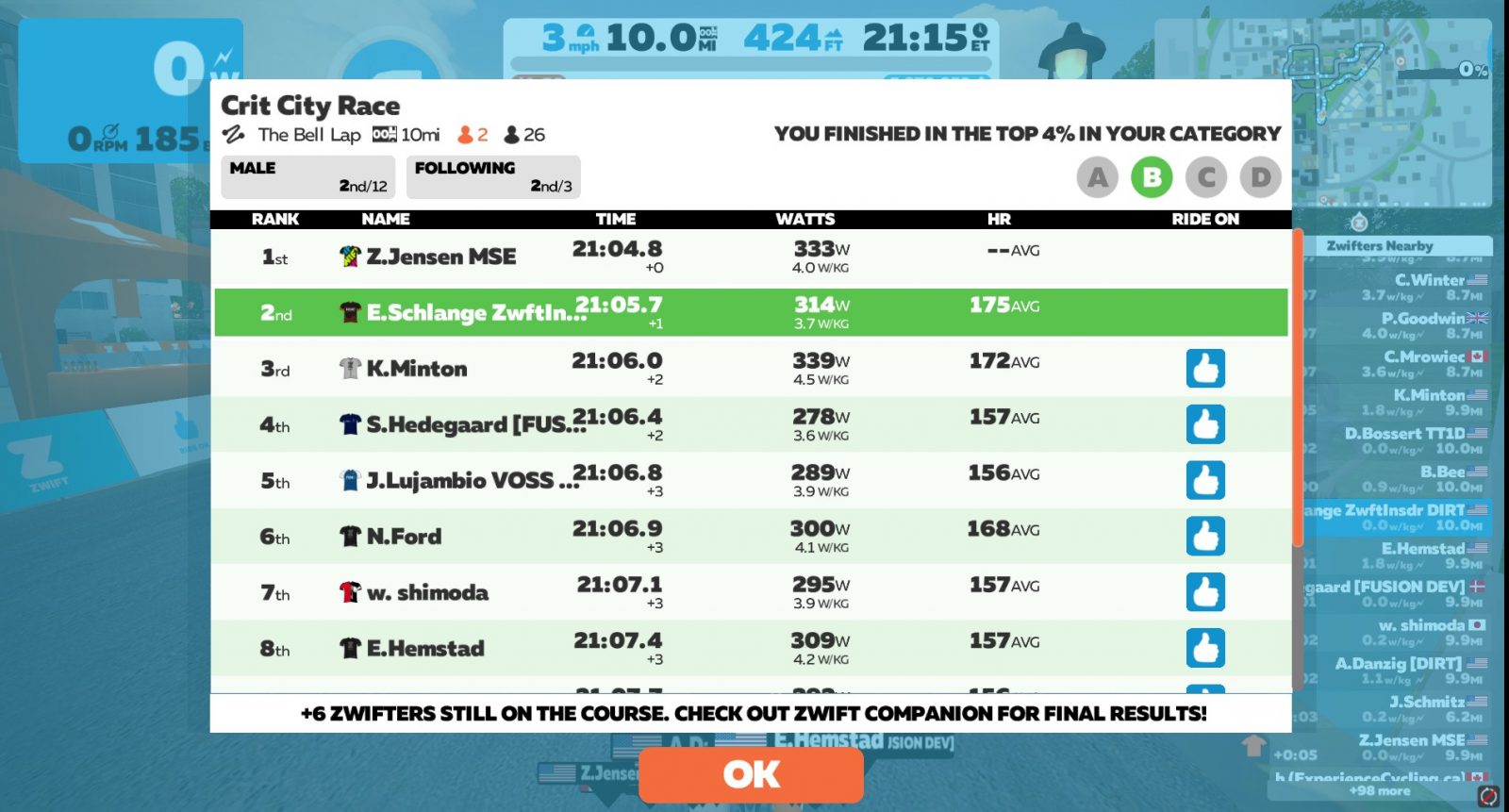
1-2, baby! I started singing “Weeeee are the champions” into Discord for Zane to hear, but I was so out of breath I only got the “We” out. NorCal boys take the podium!

See my Strava activity >
See this race on ZwiftPower >

Grading on a Curve

Zane is a perfect example of how the current “final race results are on ZwiftPower” idea is broken. Why? Because he’s not on ZwiftPower.

Totally legit racer. Accurate power. But he’s not in the “final” results because there are too many hoops for him to jump through.

Oh yes, I’ve tried to get him to sign up. Repeatedly. But it’s just too much hassle for him. He just wants to ride. He’s never worn a heart rate monitor and doesn’t like hassling with tech. Since he doesn’t really care whether his Zwift race results are “final,” he’s not motivated to sign up.

For this race, that means: I won! Well, sort of. Except Zane beat me. But I DID get this:
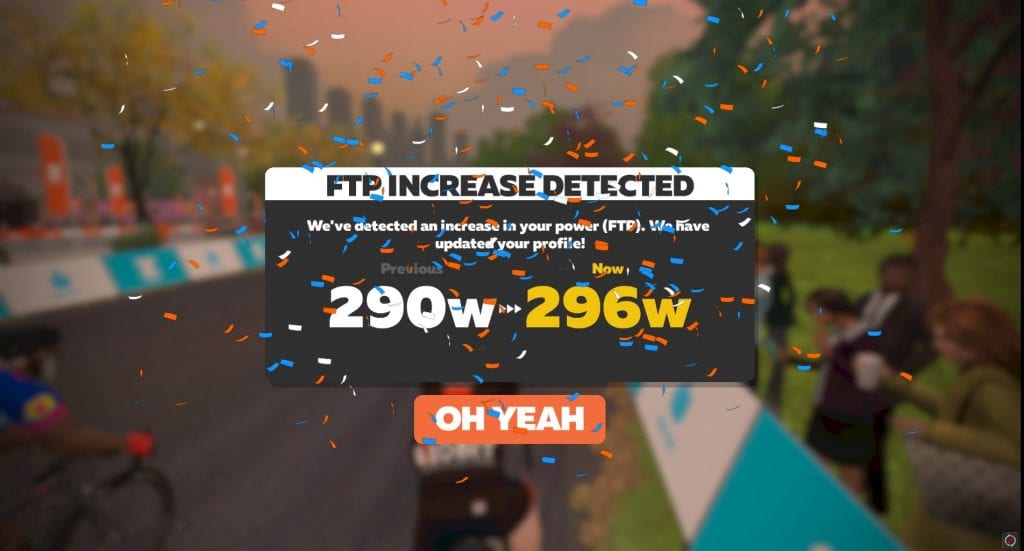
Takeaways

Here are my takeaways from this race:

  • Racing with friends is fun. Even better if you’re on Discord.
  • Forgetting your Tron bike isn’t the end of the world. Neither is a lack of powerups.
  • A real-life cheering section always helps.

Your Thoughts

What do you think of my “positional auto-braking” idea? And does this count as a win for me? Please say it does. Chime in below!
Video: 10 Zwift Apple TV Tips And Tricks

Video: 10 Zwift Apple TV Tips And Tricks

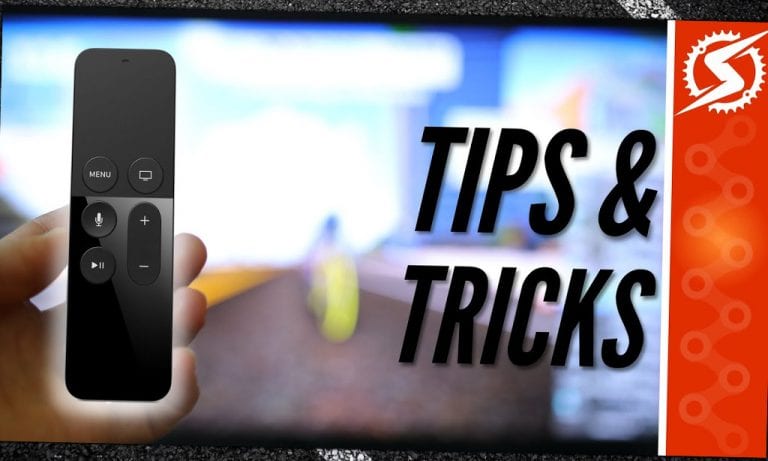
With Apple TV, you can get high-quality Zwift performance at a reasonable price. You don’t need to shop for an expensive gaming computer or worry about whether it’s compatible.

But the platform and its remote do have their own quirks. In this video, Tariq from SMARTBikeTrainers gives Zwifters a list of handy Apple TV tips to make things a little easier. Don’t miss #10!

10 Zwift Apple TV Tips And Tricks You Should Know

Learn something useful?

Did you learn something handy from the video? Share it below!


Are your power numbers accurate? Take a quick test.

Are your power numbers accurate? Take a quick test.

For many cyclists, Zwift is their first experience of riding “with power”–that is, seeing a wattage reading for their effort. And they have no idea if what they’re seeing is way off or absolutely accurate, and if that number means they are super strong or very weak.

We feel your pain, and we’re here to help!

Today’s Accuracy Outlook

Smart trainers and power meters are improving in terms of accuracy and reliability as the technology matures, and I think the vast majority of Zwifters enjoy acceptably accurate power numbers today.

But we still see riders on “classic” (or “dumb”) trainers which use Zwift’s virtual power algorithms to calculate power numbers–and those numbers may be inaccurate due to simple mistakes like under-tightening the roller or having low tire pressure. Additionally, other riders may be using uncalibrated trainers or trainers with known accuracy issues.

How to Test

The only way to test the accuracy of your power numbers precisely is to compare them with a power meter you know is completely accurate. This article doesn’t cover this sort of testing.

Instead, let’s discuss two simple ways you can learn if your power numbers are at least in the neighborhood of being accurate.

Test #1: The Outdoor Speed Test

The easiest way to approximate your FTP is to look at your solo outdoor efforts on a flat stretch of paved road. Ideally, you would do a one-hour out and back effort on the flattest roads possible with as little wind as possible. Flat roads are essential for this because when the road is flat, your weight doesn’t affect your speed much once you’ve accelerated to “cruising speed.”

Sidenote: I actually enjoy doing these rides a few times each year, I call them my “one-hour challenge” rides, and it’s a fun test to see how much stronger I’ve become since my last attempt. Here’s one I did July 2018 targetting 24 miles in the hour, and I made it by just two seconds according to my trusty Wahoo Elemnt.

Even if you can’t do an all-out solo hour on flat roads, you should know by now what kind of speed you can hold by yourself outside on a flat road with no major winds for a longer stretch of time (20+ minutes).

Here are rough estimates of the power needed for a solo road cyclist to hold various speeds:

  • 25kph (15 mph) – 92 watts
  • 30kph (18-19 mph) – 143 watts
  • 35kph (21-22 mph) – 212 watts
  • 37.5kph (23-24 mph) – 254 watts
  • 40kph (24-25 mph) – 301 watts
  • 45kph (28 mph) – 415 watts

So if you’re unsure if your power numbers are accurate in Zwift, just find the speed above that you can hold outdoors on a flat ride going all-out for 20+ minutes. Then see if that wattage matches what you see in Zwift when you’re riding alone and giving it everything you’ve got for that same amount of time.

Disclaimer on the Numbers

  • Of course, the numbers above assume you aren’t extremely lightweight or overweight, or extremely short (or tall). They will be most accurate for a person in the 60-80kg range, and of average height.
  • If you’re sitting in the draft on Zwift, your speed will be much higher than if you’re riding alone. Best to test while riding outside of the Zwift draft.
  • The numbers above are an average from several bike speed calculators to check for accuracy. Each calculator computes speed a bit differently, but if you want to calculate numbers for your own weight/height, we recommend giving kreuzotter.de a try.
  • Speeds can vary greatly if you are in a more or less aero position. The numbers above were done assuming riding in the drops on a standard road bike setup (not TT).

Test #2: The Sniff Test

The sniff test is much simpler than the outdoor speed test. But it’s also less scientific.

If you aren’t a trained athlete (let’s say you’re in your first year or two of serious cycling) and you are of average size, chances are very slim that your FTP is anywhere above 300 (for males). Chances are it’s close to 200, and maybe 250 if you have good genes or have been training for several months. Many riders will be significantly lower than 200 at this phase, especially if you are an older rider. And that’s OK too!

The important thing to understand is that you certainly won’t have an FTP above ~325 at this phase in your training, which is why any time a newbie rider posts about such an FTP increase in on Facebook, folks laugh it off.

It doesn’t pass the sniff test.

Pro male riders often have FTPs in the mid to high 300s, but these are genetically-gifted experts who have been training hard for hours per day, for years on end. If you’ve only been riding a year or two and you weren’t a serious endurance athlete beforehand, it will take you at least a few years to get into anything touching pro territory. (And even then, once you get there you’ll realize you’ve got a long way to go.)

Got Problems? Here are the solutions.

If you believe your power numbers are inaccurate, there are several ways to get them fixed:

  • If you are on a classic trainer, make sure you’re following the manufacturer’s setup instructions regarding how tight the roller should be against your wheel. This is essential, since Zwift’s calculated power numbers assume you are following these instructions.
  • If you are on a smart trainer, make sure your trainer is properly calibrated. Using the manufacturer’s suggested calibration procedure (usually via a simple phone app) is the way to go.
  • Consider an upgrade! Today’s direct-drive smart trainers bring a high-quality Zwift experience within reach of more riders than ever before. See our Top-Ranked Turbo Trainers >

Conclusion

That’s it–two ways to quickly see if your numbers are at least somewhat accurate. I hope this helps some folks out!

Comment below if you have questions, or if this post has helped you figure out your power situation.


Video: How to Make your Smart Trainer Quieter

10

Video: How to Make your Smart Trainer Quieter

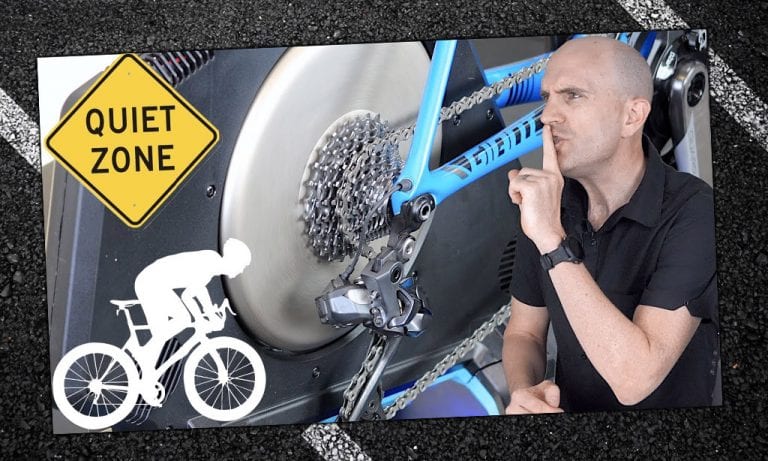
Direct drive smart trainers are making less and less noise these days. But there is a way to reduce it even more!

Do you notice loud buzzing, humming, or clicking when you stop pedaling? That’s a noisy freehub. Shane Miller’s video shows you how to bring that sound down on the popular Tacx Neo 2T, Wahoo KICKR ’18, and Saris H3 direct-drive smart trainers. Got a different direct-drive trainer? Shanes explanation will still be helpful.

This only makes your trainer quieter while coasting, not pedaling, but the difference can be quite dramatic!

How to Make your Smart Trainer QUIETER!

Your Tips

Got other tips for quieting down a trainer? Share them below!


Tour De Zwift 2020 Open Race Series Details

58

Tour De Zwift 2020 Open Race Series Details

As you may already know, Tour de Zwift 2020 includes two types of cycling events that anyone can enter: group rides and races. The races will bring a high level of competition to the TdZ, since there are four categories of riders all vying for the podium across multiple events.

Here’s what you need to know in order to race Tour de Zwift 2020!

Short and Sweet

So far, stage 1 and 2’s races are only around ~11 miles (~18km) in length, meaning they will be finished in ~30 minutes by most riders.

Some Zwifters are asking why the race events are so short, but this is being done for a reason. One source at Zwift HQ tells us they are “meant to be short and fun nothing too serious, so that many Zwifters can experience the race.“

Signing Up

Sign up for TdZ at https://www.zwift.com/tdzride

Once you’re signed up, you will need to choose which event(s) to ride for each stage as well.

Important Note re: Companion and Filtering

TdZ races will not show up in the Companion app if you’re filtering to only show “Races”. They are tagged as group rides, so make sure your filters include that!

Categories

Categories are based on your FTP watts/kilogram:

Men’s Race Categories

  • A: 4-5 w/kg
  • B: 3.2-3.9 w/kg
  • C: 2.5-3.1 w/kg
  • D: 1-2.4 w/kg

Women’s Race Categories

  • A: 3.7-5 w/kg
  • B: 3.2-3.69 w/kg
  • C: 2.5-3.19 w/kg
  • D: 1-2.49 w/kg

While the limits aren’t enforced by Zwift, they will be enforced by ZwiftPower via DQs after each race. Since ZwiftPower is where the racing community goes for official race results, you’ll want to race in the proper category!

A circular logo with an orange outline, showing a speedometer with a needle pointing up, and the words ZWIFT POWER in bold white letters on a dark blue background.

Using ZwiftPower

James Hodges at ZwiftPower has set up a race league with points for TdZ races, so if you want to compete for the overall Tour win, you’ll need to be signed up for ZwiftPower and racing in the proper category.

Signing up for ZwiftPower requires opting in at https://my.zwift.com/ >Edit Profile>Connections to share data with ZwiftPower. Then you must also create your ZwiftPower account and follow the instructions there to activate it.

Points will be awarded to the top 100 finishers of each race events: so 1st place gets 100, 2nd place gets 99, etc.

You can race each stage multiple times if you’d like–your best result on each stage will be taken for your overall league points.

Make sure you start in the correct category, because if you have to upgrade partway through, any points accumulated in the other category won’t count toward your total!

To see current race league results, visit ZwiftPower.com and click Leagues>Tour de Zwift (Open Race) or Leagues>Tour de Zwift (Women’s Race)

Stage Details

Get a Fast Bike

If you’re new to Zwift racing, one thing you’ll want to do is get yourself set up with the fastest in-game bike frame and wheelset for the race route. Races with big climbs are best done on a lighter setup, while flatter races are best done on a very aero setup.

Stage 1 is very flat, so you’ll want to use one of the fastest frames coupled with one of the fastest wheelsets.

New to Zwift racing? Read “How to Race On Zwift (Setup, Strategy, and More)”.

Pro-Am Invitational

Don’t forget, there’s a Pro-Am Invitational race series also happening, where top pros and amateurs will square off against each other the day before the open races begin. Watch the live stream, get a preview of the race routes, and see how top riders attack it! Learn more here >

Questions or Comments?

Share below!


AHDR Australian Bush Fire Zwiftathon Begins Today

0

AHDR Australian Bush Fire Zwiftathon Begins Today

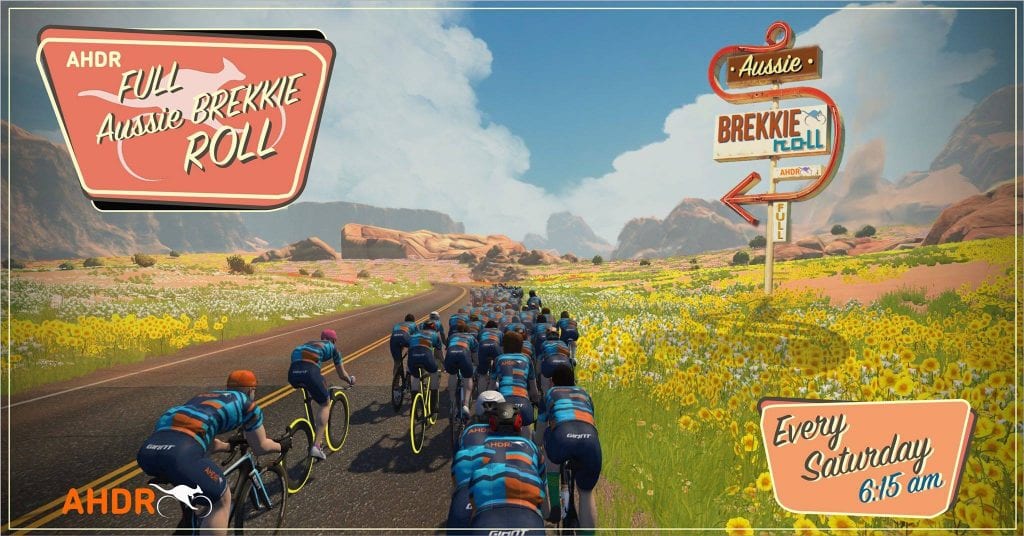
AHDR began as the “Aussie Hump Day Ride” and quickly grew to be the most popular weekly ride on Zwift. Today, AHDR’s selfless group of leaders facilitates several rides each week.

But today is the start of an important and special ride effort. AHDR is calling it the “Australian Bush Fire Appeal”. Here’s what leader Tim Searle told me about the Zwiftathon:

Having seen the impact the current Bush Fire Crisis is having on Australia firsthand for the three months leading up to Christmas I was hoping that the situation would ease and the fires would not spread. Unfortunately this has not proved to be the case.

Our country is on fire, with every State and Territory now impacted by bushfires. We rely on volunteer firefighters through these events, some of whom have been out day after day for months.

The bushfires not only impact humans though, the toll on our wildlife has been catastrophic, and again we rely on volunteers to care for the injured.

We as cyclists have a natural affinity to help people whenever we can. I felt that we could do something to help, and what better way than a Zwiftathon ride to help raise some much-needed funds for the Rural Fire Service that are fighting so hard to protect us, and to the RSPCA who are doing what they can for our decimated wildlife.

Join us this Saturday 11/1 from 6.15AM AEDT for a day of fundraising to help support some of these volunteers.

Schedule

This is a 12-hour Zwiftathon which begins with the “AHDR Fab Roll” event starting 6:15am AEDT Saturday, Jan 11. (In other time zones that is 11:15am PST/7:15pm GMT Friday, Jan 10th). This is a 2-hour ride rolling at 2.5-3w/kg on Watopia’s “Out and Back Again” route.

The AHDR Fab Roll ends at 8:15am AEDT, then the main Australian Brush Fire Appeal ride begins 30 minutes later. Join this on the Volcano Circuit CCW and ride as long as you’d like!

Donations

The idea here is that riders will reach out to their networks of family and friends, seeking donations as the riders put in long ride efforts. You may also simply donate funds yourself.

AHDR’s goal is to raise $50k in this effort. That’s $25k for the Royal Society for the Prevention of Cruelty to Animals (RSPCA) and $25k for Rural Fire Service (RFS).

Want to donate directly? Visit gofundme.com/f/bushfire-rural-fire-service-and-rspca

Even if you can’t donate funds or seek donations, the leaders at AHDR invite you come out and join the ride to support the cause!


Tour de Zwift 2020 Pro-Am Invitational Race Series Details

18

Tour de Zwift 2020 Pro-Am Invitational Race Series Details

Tour de Zwift 2020 is shaping up to be the biggest, most exciting series of Zwift events in history. The group rides will be gigantic and fun as always, but the biggest news of this tour is Zwift is running races alongside the typical TdZ group rides.

And it’s not just open, categorized community races being held. Zwift has also organized a Pro-Am Invitational Race Series where each stage’s world will be raced by top pros and amateurs the day before the stage opens for the rest of the Zwift community.

Schedule

The Pro-Am Series races will happen at 11am PST/7pm GMT the day before each new stage begins. There will men’s races and women’s races alternatively between each stage.

Here’s the full 7-stage schedule:

  • Stage 1 (London): 11am PST/7pm GMT Jan 11 – women’s race
  • Stage 2 (Innsbruck): 11am PST/7pm GMT Jan 15 – men’s race
  • Stage 3 (Watopia): 11am PST/7pm GMT Jan 19 – women’s race
  • Stage 4 (Bologna): 11am PST/7pm GMT Jan 23 – men’s race
  • Stage 5 (New York): 11am PST/7pm GMT Jan 27 – women’s race
  • Stage 6 (Richmond): 11am PST/7pm GMT Jan 31 – men’s race
  • Stage 7 (Yorkshire): 11am PST/7pm GMT Feb 4 – women’s AND men’s races

Where to Watch

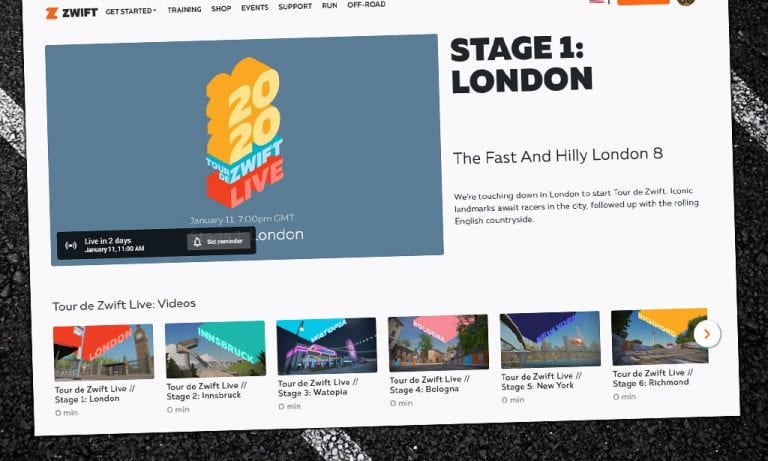
Zwift has created a page where the live streams of each race will be available – see it at zwift.com/video/tour-de-zwift-live.

Races will also be broadcast on Facebook via the Zwift Live.

Here are the recorded streams of completed races:

View Race Results >

View Race Results >

View Race Results >

View Race Results >

View Race Results >

View Race Results >

View Men’s Race Results >
View Women’s Race Results >

Rules

Here are the rules in the event description for the first race of the series:


NAME FORMAT

Racer’s team name must be placed in square brackets after the racer’s last name and can be entered into the last name field in-game. For instance, Mary Wilkinson racing for Team Turbo may use the name M. Wilkinson [TRBO] or Mary Wilkinson [TRBO]. Riders who do not use this format will be disqualified.

TEAM KIT

  • It is mandatory to race in your team kit. Failure to do so will result in disqualification.
  • Zwift National Champion kits are not allowed. All riders must race in their team kit.
  • Time trial helmets are not allowed. Disqualification for using a Time Trial helmet.

BICYCLES // WHEELS

  • Zwift concept bicycles (aka “Tron” bicycle) are not allowed. Disqualification for using a Zwift concept bicycle.
  • Time Trial bicycles are not allowed. Disqualification for using a Time Trial bicycle.
  • Disc wheels are not allowed. Disqualification for using a disc wheel.

Zwift Insider’s Comments about the Rules

The most interesting rules in the list above are those restricting the use of certain bikes, wheels, and helmets. Most of those rules simply prevent riders from using equipment normally seen only in TT events: disc wheels, TT helmets, and TT frames.

The TT helmets, in our tests, haven’t impacted speed at all. But the disc wheels certainly do, with the Zipp 858/Super9 wheelset being the fastest wheelset on Zwift for flat/rolling routes, and the Zipp 808/Super9 being the second-fastest.

The TT frames, likewise, are more aero than standard road frames, and thus faster in a solo effort. But they don’t let you draft, so winning in a Pro-Am race with a TT frame is going to be challenging.

It’s possible some of these rules (the TT helmet rule especially) are because of the optics: that is, it just looks silly to have someone wearing a TT helmet (or using a disc wheel, or riding on TT bars) in a road race.

Eliminating the Tron makes sense as well, since the only way to keep pace with a Tron bike on flat races is with one of the fastest frames coupled with a disc wheelset.

The net effect of these rules is to level the playing field significantly in terms of virtual equipment. The fastest setups available for flat races under these rules will use one of these frames:

  • Specialized Venge S-Works (level 33+)
  • Felt AR (level 34+)
  • Cervelo S5 (level 25+)
  • Trek Madone (level 20+)

Coupled with one of the fastest wheelsets:

  • Zipp 858 (level 37+)
  • ENVE SES 7.8 (level 39+)
  • ENVE SES 8.9 (level 31+)
  • Zipp 808 (level 13+)

The 4 frames listed turn in essentially the same times on our flat tests. The 4 wheelsets listed are separated by only 4 seconds on a ~50 minute flat test.

Any Zwift racer worth their chamois should be at a high enough level (20+) to access a fast setup, so no racers will be at a significant disadvantage due to their virtual bike.

Scoring

The Pro-Am Series isn’t just about who crosses the finish line first. It includes a points-based team and individual competition which includes sprint and K/QOM arches.

Here’s how the scoring works:

  • First 20 riders score points at the finish. Points are awarded as follows: 20-19-18-17-16-15-14-13-12-11-10-9-8-7-6-5-4-3-2-1
  • First 10 riders score points at each K/QOM and Sprint arch. Points are awarded as follows: 10-9-8-7-6-5-4-3-2-1

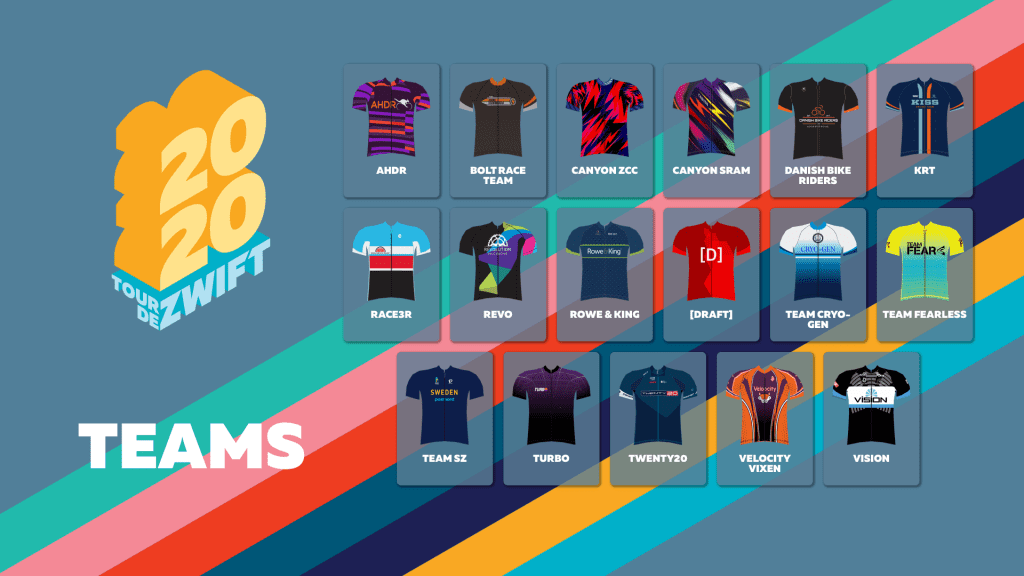
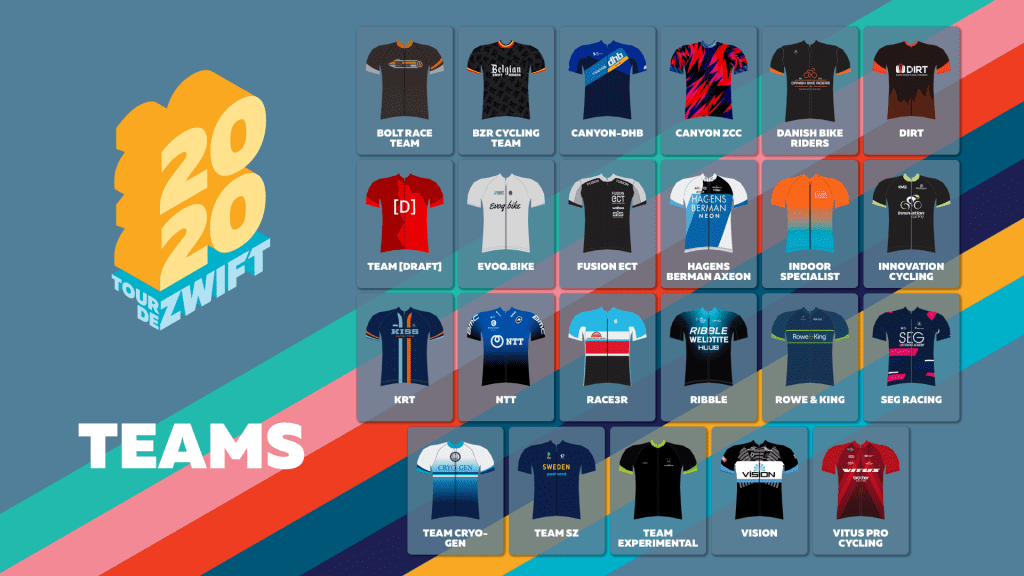
Teams

This is an invitation-only race, so Zwift has reached out to amateur and pro teams. Here are the women’s teams who participated in the Jan 19th race:

And the men’s teams, for the Jan 23rd race:


All About Zwift’s Ribble Endurance Bike Frame

20

All About Zwift’s Ribble Endurance Bike Frame

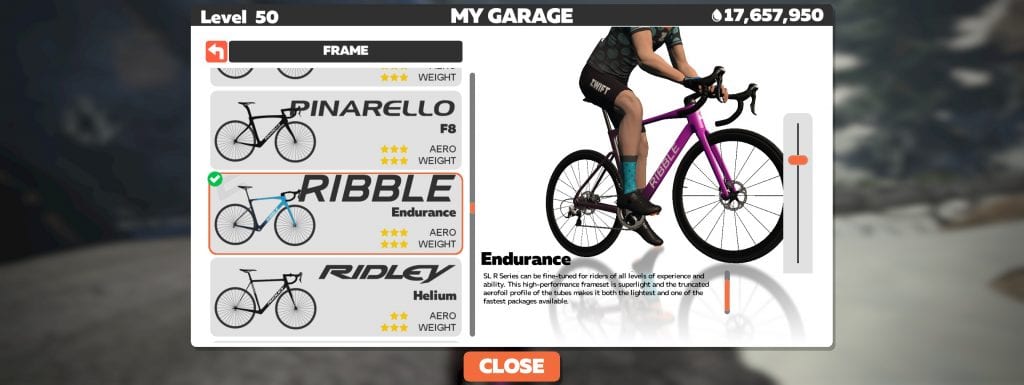
Zwift’s latest update included a new bike frame: the “Ribble Endurance”. Here’s how it’s described in the Drop Shop:

With its impeccable performance and versatility, the Ribble Endurance SL R series can be fine-tuned for riders of all levels of experience and ability. This high-performance frameset is superlight and the truncated aerofoil profile of the tubes makes it both the lightest and one of the fastest packages available.

Sounds pretty snazzy. And at a cost of 390,500 Drops it’s one of the more affordable frames in the Shop, plus it’s available at level 7+ so it’s quite accessible. But how does it perform?

Performance

The Ribble Endurance is rated 3 stars for weight and 3 stars for aero by Zwift, meaning it’s not going to be a top performer on the flats or the climbs.

That said, it performs quite well where aero matters: on flat/rolling courses.

Comparisons

The Ribble Endurance turns in times within 1-2 seconds of the Zwift Aero frame on our climb and flat tests. To be specific, the Endurance is 2 seconds faster up the Alpe, and 1 second slower on the flat test.

The Zwift Aero frame is a bit cheaper (319,500) and unlocked at level 6.

Zwift Aero taking on the Alpe

Newbies, Take Note

While it won’t make our shortlist of fastest frames for flat races, the Endurance is only 5 seconds behind the last bike on that list, which is great considering you can get it as a level 7 Zwifter.

If you’re just getting started on Zwift and want a zippy racing rig for flat/hilly routes, the Ribble Endurance or Zwift Aero are your two best options until you get to level 13 where you can buy the Cervelo S3D, or level 14 with the Specialized Allez Sprint.

Custom Colors

The Endurance also includes a color slider, which not all frames in the Drop Shop support. This lets you dial in the look to just what you want.

Your Thoughts

Have you tried the Ribble Endurance yet, indoors or out? What did you think? Share your thoughts below!

Important note: this post contains speed test results for Zwift frames or wheels. These results may change over time, and a bike's performance relative to others may also change. We don't always revise posts when performance rankings change, but we do keep current, master versions of our speed test results which are always available. See the frame charts, wheel charts, and Tron vs Top Performers for current performance data.


How the Race Was Lost: Beating a WorldTour Pro

26

How the Race Was Lost: Beating a WorldTour Pro

With 284 Zwift races under my belt, you could say I’m pretty experienced. What has all that experience taught me? Quite a bit, really. Mostly the same things over and over again. I’m not a climber. I’ve got a decent sprint, but can’t attack and stay away to save my life. I can dig deeper than my mind says.

But today I want to talk about one race that stands out as a wholly unique experience against the background of my other 283 races: the DADurday Chase Race of November 23, 2019.

DADurday: an Introduction

The DIRT DADurday Chase Race is one of Zwift’s most popular weekly handicap races. (Not sure what a “handicap race” is? Read the beginning of this post.) Held on Saturdays in two different time slots, these events have become legendary for pushing riders to their limit as they work with their category for most of the race, then go all-in for the finish.

See upcoming DADurday Chase Races >

Warming Up

It was Saturday, which is my long ride day, so my goal was to get a hard race effort in, followed by some additional miles on tired legs to really push the fatigue.

So I began with my typical pre-race ritual: a piece of caffeine gum and some PR lotion on the legs. Hopped on early and put in ~8 miles to warm up, then headed over to NYC for the 6:45am DADurday. Seven laps of NYC’s LaGuardia Loop–this was going to be a short race!

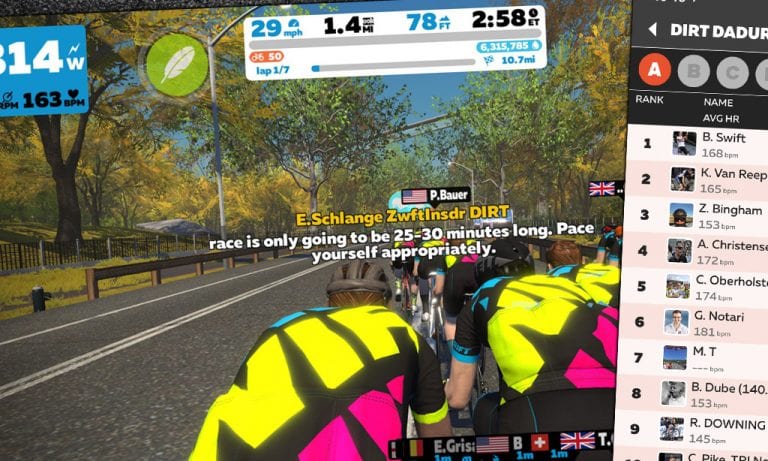
I checked the rider list in Zwift Companion before the race began, and noticed one name I recognized in the A group: Ben Swift. British National Road Race champion. Team Ineos rider. Yes, that Ben Swift.

We were going to have our work cut out for us in the B’s…

The Undeserving Beacon

Months ago I’d been asked by DIRT organizers if I could be a leader for the DADurday B’s on the weeks I showed up. I said yes–and promptly neglected to show up. (The problem is, I really enjoy the P Race, which begins 15 minutes after DADurday…)

I’m still on the leader list even though I’ve only raced a few DADurdays–so when I popped into the start pin, there was the leader beacon above my head. It screamed “Follow me, I’ll lead you to glory!” when in fact I had no idea if I’d even be able to hang with the front group, let alone wisely direct the group on its optimal pacing.

Oh well–it is what it is! Let’s race.

The Start

Early in every chase race, someone always asks, “What’s our target pace?”

I never know how to answer. Our goal is simple: to catch the C’s and D’s ahead of us, and stay away from the A’s behind. But the pace? I have no idea what pace is required in order to achieve that goal. Nobody does!

So I usually say something like, “4 w/kg+ if you’re on the front. Then sit in the pack to recover.” But really what that means is, go as hard as you can. Get on the front and hammer to pull the group along, then recover in the draft a bit, then hammer again. And if you really want to be a team player, use your aero powerup off the front to pull the group extra fast!

Unlike a typical Zwift race, chase races start more gently, since everyone knows the group has to stay together to stand a chance at winning. So that’s how we started–a tame but solid ramp up to race speed (~28mph), where we would sit for the rest of the event.

The Middle

Here’s the tricky thing about chase races: it’s hard to keep tabs on the other groups from within Zwift. I already talked about pacing a bit above, but here’s my more detailed pacing strategy for chase races: give only what is required to catch the riders ahead, while staying away from the chasers. Because you’ll need everything you’ve got left for the final sprint if you make it to the front pack.

With this strategy in mind, it becomes obvious that knowing the positions of the other categories is really helpful. But the only way to do that reliably is by having ZwiftPower’s Live event results up on another screen–and I hadn’t done that.

I told you I was a bad beacon!

So this is where things got messy. On a long route it’s easier to spot groups on the map and see who’s ahead and by how far. But on a 1.7 mile LaGuardia loop, things get confusing really quickly. I was leading the B riders, and while we could see some clusters of D and C riders ahead, it was hard to figure out where the front of the race was. Was that the front group? Or maybe it’s that one?

And the A’s were gaining ground, but it was hard to figure out just how quickly. I imagined Ben Swift on the front of the peloton, just smashing it.

The Case of the Missing A’s

As we entered the final lap, we passed what I thought was the leading C group. Then we passed what I thought was the lead D group.

Behind us I could see some A’s chasing. Very close. Or was it just one A? Hard to tell, but just when I thought we’d get caught by the A riders, they seemed to slow down and hang with the group behind my hard-charging B squad.

That was odd. Typically at this point in the race, the B’s are tired and the A’s have the stamina to blow through the pack and keep charging.

To this day, I’m still not sure what happened to those A riders. But I have a theory: I think Ben was pulling a small group of A’s, but he didn’t want to contend for the overall win. That’s a non-uncommon pro move in low-level Zwift and outdoor races, because a pro rider basically has two options in these situations:

  1. Fight for the win and possibly lose. Losing looks really bad if you’re the only pro on course. And sometimes, winning against a bunch of amateurs looks worse!
  2. Sit up at the end and let others fight it out. You get a good workout, and everyone knows you weren’t really trying to win, so your reputation doesn’t suffer in any way.

It’s also possible that he and/or some of the other A’s, unlike myself, realized the A’s didn’t stand a chance of being in the mix for the overall podium, so they all sat up.

The Finish

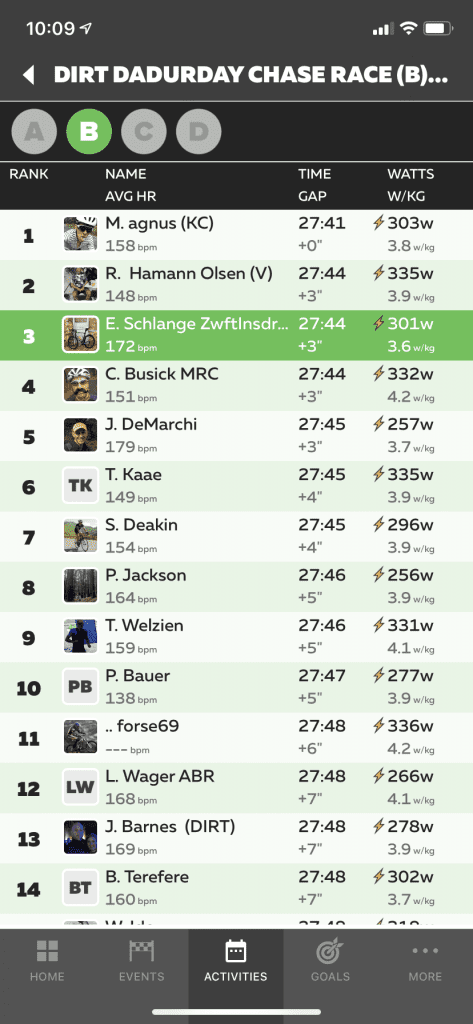
Whatever the reason, in the end it was my pack of 18 B’s (we started with 49) going all-out up the final kicker and into the downhill sprint finish. Every man for himself!

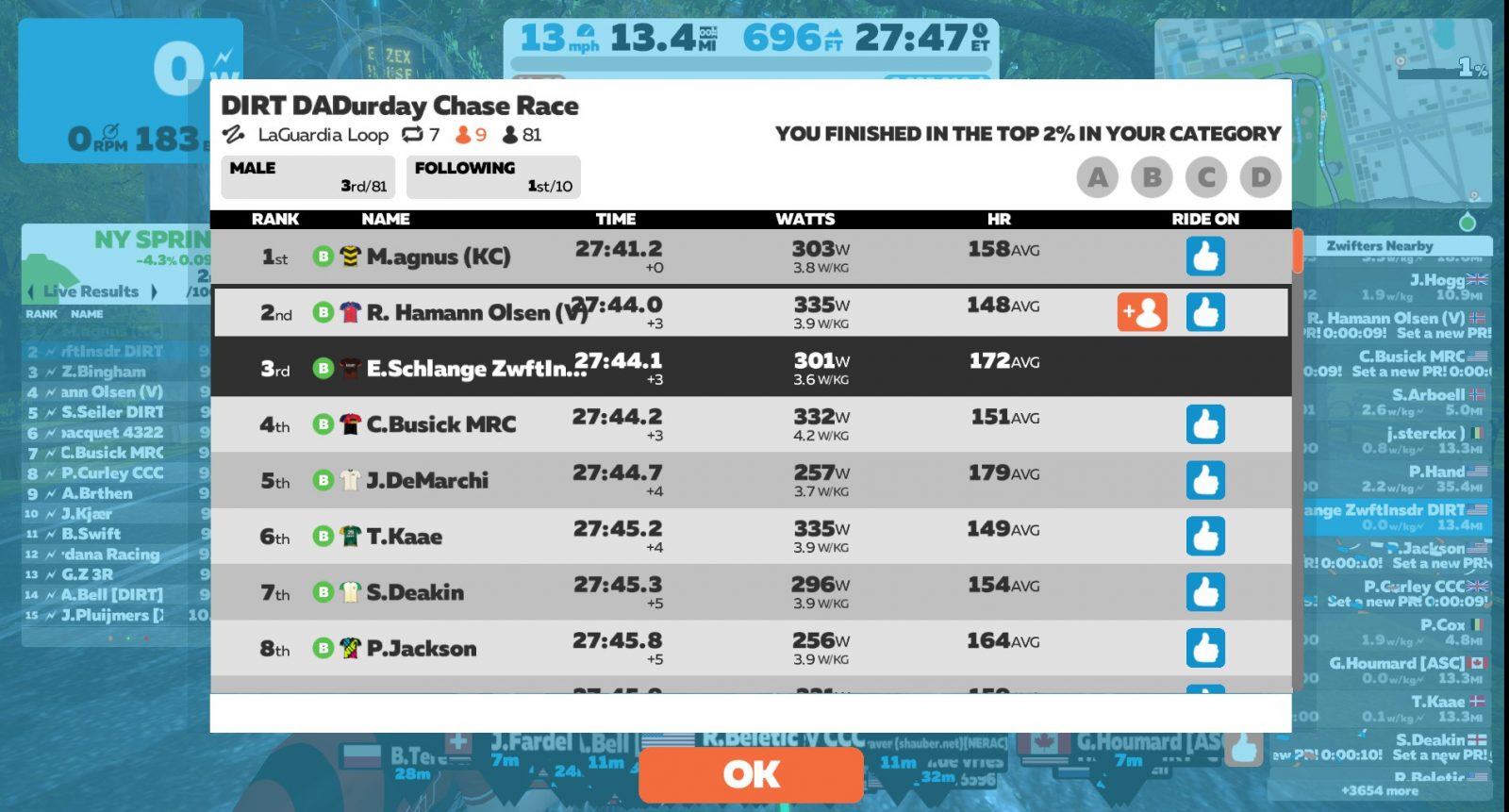
The powerup gods had smiled upon me with an aero helmet, so I popped that and gave it all I had. Which wasn’t much. But it was enough for 3rd place in the B’s:

The Hammer Drops

I headed over to ZwiftPower to check results, and that’s where I got the bad news: we never caught the front of the race.

Oops. Who gave this guy the leader beacon, anyway?

Yes, according to ZwiftPower, 12 D’s and 7 C’s had finished ahead of our B group. Well ahead, in fact: David Ramsey, a D who took the overall first place, finished 3 minutes and 37 seconds ahead!

See results on ZwiftPower >

Sandbagging Handicaps

Without attacking anyone personally, I want to discuss how this race perfectly spotlights the way sandbaggers (riders who race in a lower category than they should) have made a shambles of chase race results on Zwift.

For chase races to work, categories must be separated by time gaps which allow the categories to come together near the very end of the race, so everyone is sprinting together for the win. It doesn’t always work out perfectly (setting those gaps can be a challenge!), but experienced race organizers have it figured out pretty well at this point.

In our case, the B’s started 8 minutes behind the D group and 3 minutes behind the C group. In the end, ZwiftPower shows the front D’s finishing 3:37 ahead of us, while the front C’s finished 1:17 ahead.

But ZwiftPower doesn’t tell the whole story.

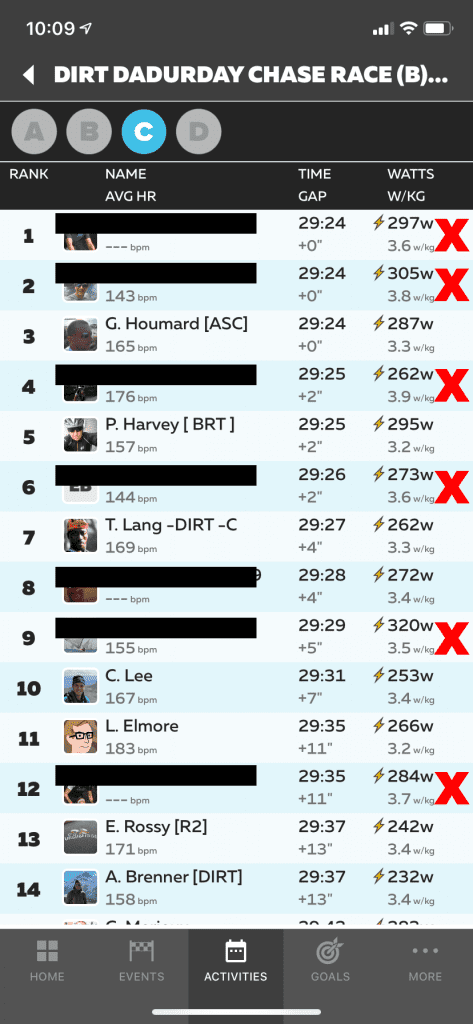
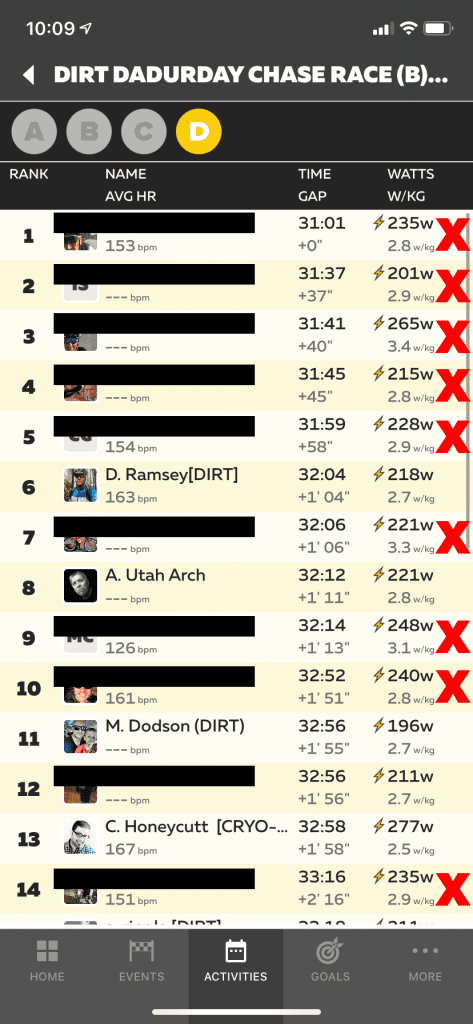
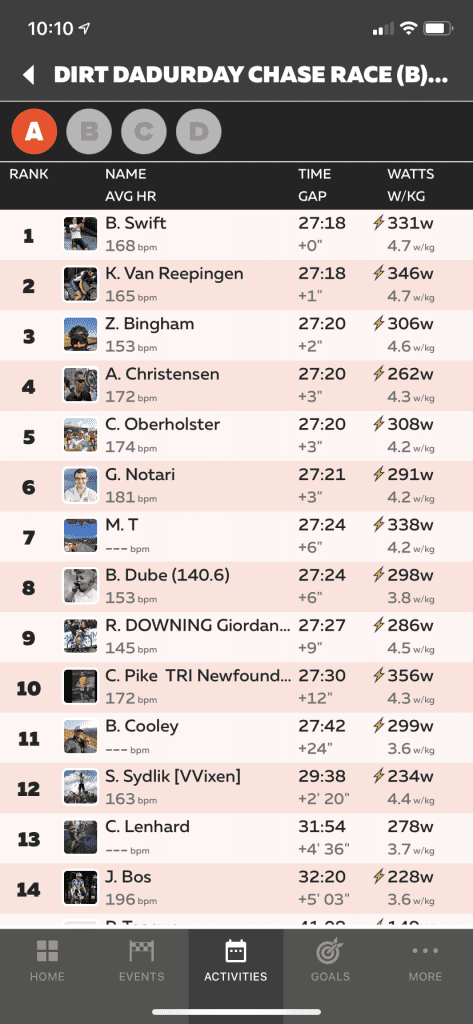
A look at the results in Zwift Companion shows that the C and D groups were stuffed full of sandbaggers. Here are screenshots of the top finishers in each category, with names crossed out if the rider was DQ’d or not signed up for ZwiftPower (remember, I said no personal attacks).

(The red X denotes obvious sandbaggers–those who exceeded category limits by 0.3w/kg or more.)

Crazy, right? 5 of the top 10 C’s were sandbagging. And 8 of the top 10 D’s!

What this means is, the C and D groups were pulled along at much higher speeds than they should have been, because riders in those groups were putting out efforts above C and D levels. This basically made it impossible for the B and A riders to catch the front of the race.

The solution to this problem is for Zwift to figure out a workable system that places riders in the correct category when signing up. I’ve written more about this in my “Enforcing Race Categories” series.

Obviously this doesn’t diminish the results of the legit C’s and D’s who took the win. I say chapeau to them! Again, I just think it’s worth highlighting how sandbagging affects chase races.

Interestingly, the B’s had no obvious sandbaggers in the group. And the A’s? Well… look who took the win:

Nice work, Mr. Swift! In the end, Ben completed the race 26 seconds faster than me. But since the A’s started 1 minute after the B’s, we finished ahead of him.

So that’s a win, right? 😉

See my ride on Strava >

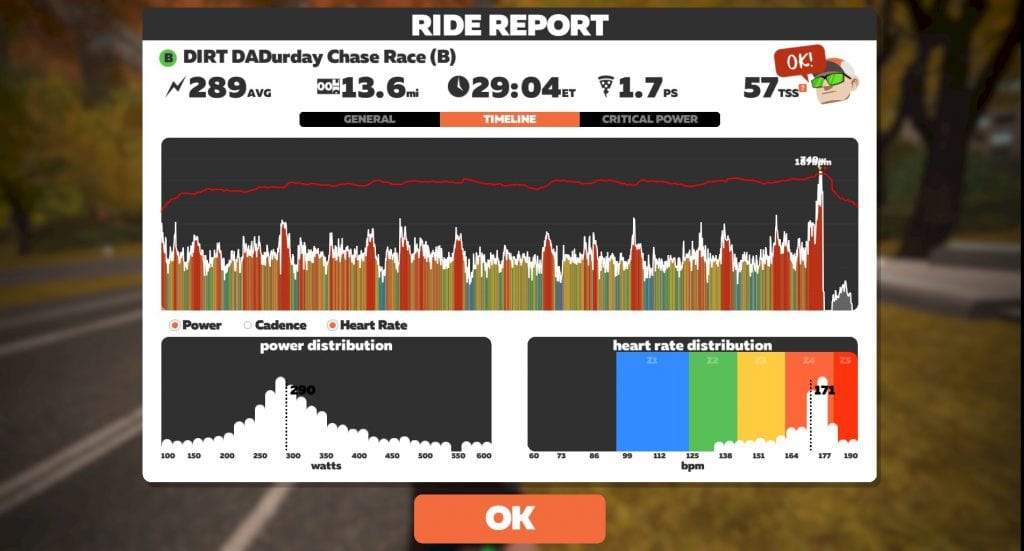
Whenever the road tilts up, my graph turns red

Takeaways

My main takeaway for this race is simply that I need to use ZwiftPower’s live feed in future chase races, especially those on smaller loops, and especially DADurday races where I’ve got the leader beacon.

This will let me easily see where the other categories are in relation to mine, so I can decide if I want to go faster, or conserve energy for the finish.

Your Thoughts

Ever beat a pro in a Zwift race? Enjoyed a solid DADurday, ZHR, or Lamb Chop chase effort? Share your thoughts below!


New “Peak Zwift” Achieved: 14,812

12

New “Peak Zwift” Achieved: 14,812

Last year on January 8th, 2019 Zwift recorded a new personal best: 13,064 active Zwifters. The previous year’s record was somewhere in the 8,500 range.

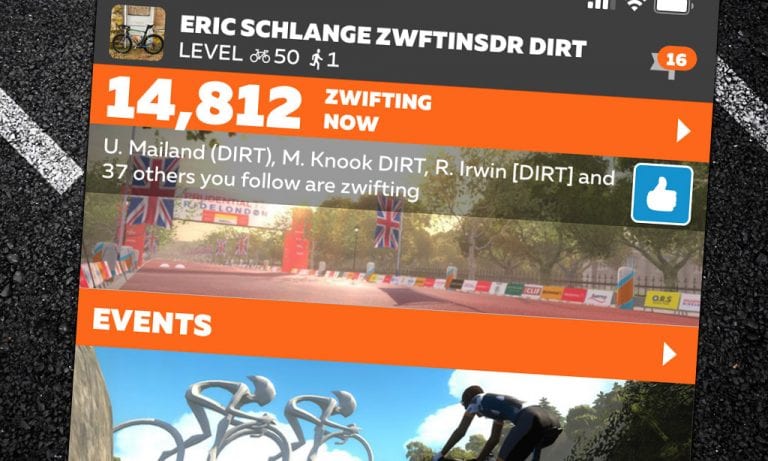
Today we hit a new high, just confirmed by Zwift HQ: 14,812 concurrent users on Zwift!

Typically the weekly high traffic points are on Tuesdays around 11am PST, and that’s exactly when we saw today’s traffic spike. Of course, this is also the busiest time of Zwift’s year, with much of the northern hemisphere dealing with cold temperatures, poor weather, and shortened daylight hours.

But next week kicks off Tour de Zwift, where we’ll see thousands of riders signing up for each event. Our guess is next week’s number will blow away this week’s.

Care to Make a Bet?

Zwiftcast hosts Simon, Nathan, and Shane have been wagering on what the winter season’s high point will be, and they’ve invited some guests to place their bets as well. What do you think? What will be this season’s “peak Zwift”? Here are the current guesses:

  • DC Rainmaker: 21,000
  • Nathan Guerra: 20,000
  • Eric Schlange: 18,289
  • Simon Schofield: 18,000
  • Shane Miller: 16,666

More Numbers

Obviously, there are better stats to track Zwift’s growth than “Peak Zwift”. We would love to see some numbers like:

  • Total number of Zwifting hours over a specific period
  • Number of unique Zwifters who were active over a specific period
  • Number of active subscribers

And of course, Zwift has all this data. But we’re not sure they would want it publicized! We’ll reach out and see if we can get more numbers, though.