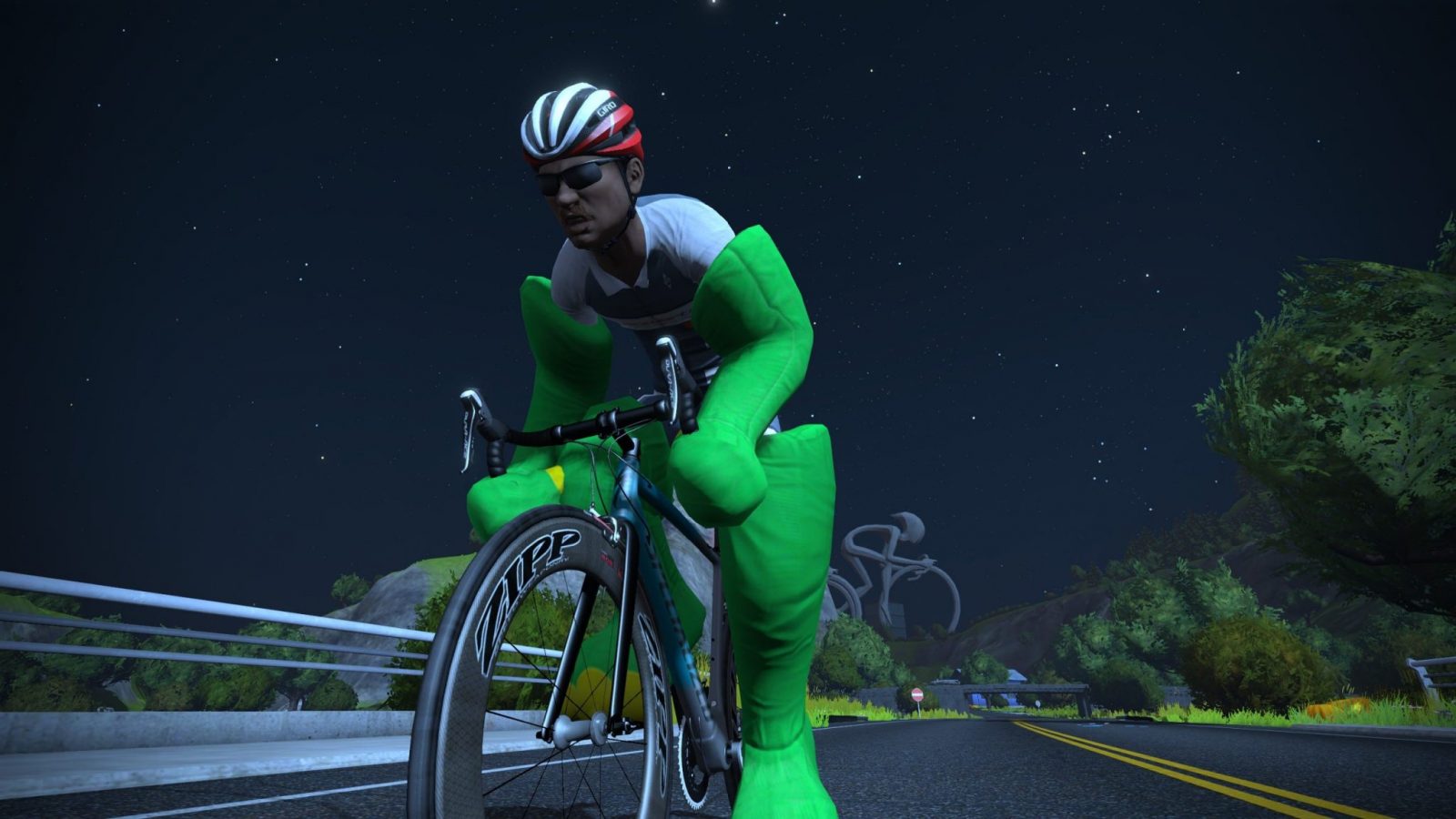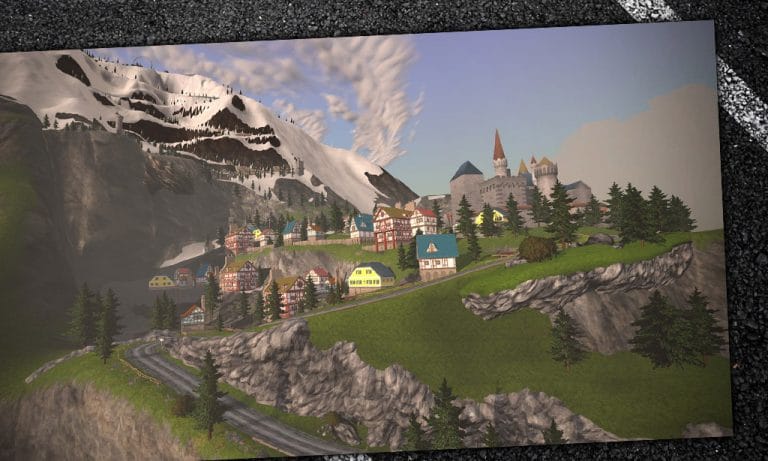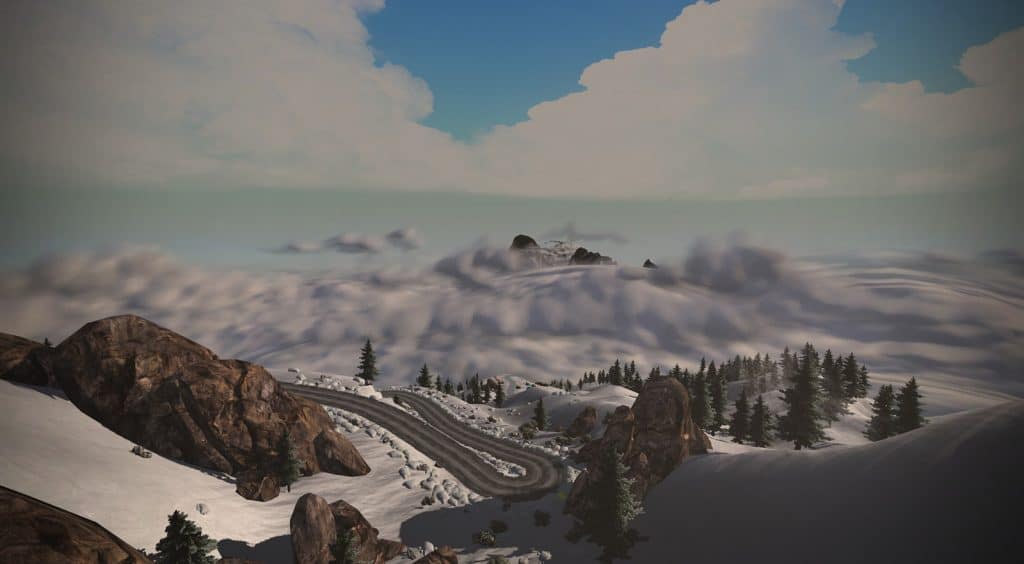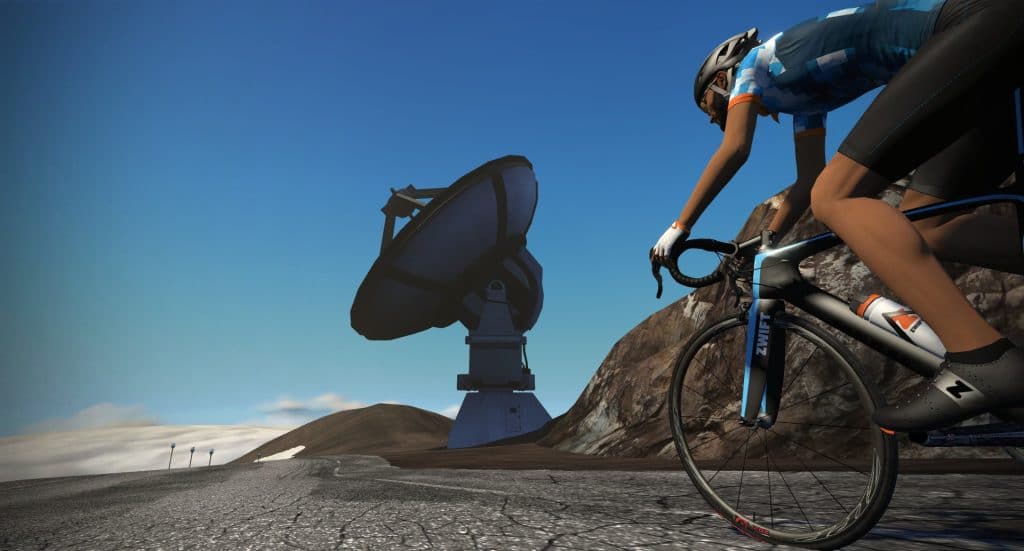
The Medio Fondo is one of three fondo routes Zwift unveiled in January 2019 for its Zwift fondo series. Currently these are event-only routes, meaning they are only available for use in events and cannot be ridden on a freeride or individual workout.
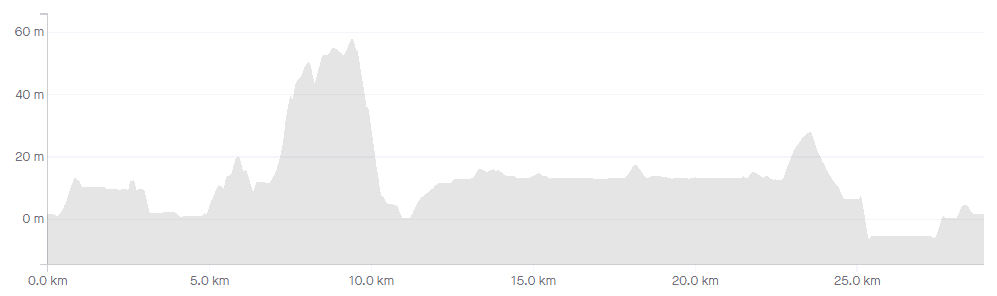
We begin by taking Ocean Boulevard around to the reverse Hilly KOM, which is the first half of the Figure 8 route. Then it’s over to the Volcano and up to the top before descending down and heading to the Italian Villas then the Mayan Jungle for a reverse loop of the circuit.
After climbing out of the jungle, we descend back to sea level, hit The Esses and spin a quick lap around the Volcano Circuit. Then it’s through downtown Watopia and out Ocean Boulevard once more to the forward Epic KOM. Our route finishes at the KOM banner–wave hello the ibex, if you’ve got any strength left!
The Bambino Fondo is one of three fondo routes Zwift unveiled in January 2019 for its Zwift fondo series. Currently these are event-only routes, meaning they are only available for use in events and cannot be ridden on a freeride or individual workout.
We begin with a forward lap of the Flat Route, followed by a forward lap of the Hilly Route. Then we take Ocean Boulevard again, hanging a left at the windmills and climbing then descending into the Mayan Jungle.
Once around the jungle loop, then we climb back out, descend to sea level, and hang a left at the Italian Villas fountain to make our way toward the Volcano. Then it’s up to the top of the volcano, with our route ending at the KOM banner.
Mark Allen on Judging Performances Over the Years (Zwift PowerUp Tri Podcast #7)
How do we judge athletes over time? Are “World Records” the best way? Maybe the most wins?
We asked one of the greatest of all time, Mark Allen, to explore the topic. With 6 Kona wins, multiple World Championship titles over various distances, and a record-setting 21-race winning streak—he knows what it takes to be the best.
Plus: Jordan and Matt talk shop with Mark about triathlon and see what makes him tick.
About the Podcast:
The Zwift PowerUp Tri Podcast is hosted by former pro triathletes Matt Lieto and Jordan Rapp, lending their in-depth knowledge of the multisport to the Zwift Tri audience.
Travel: Good for the Soul, Bad for the Training Plan
March was a tough month for my structured training, as I had two weeks of traveling with workouts in between.
The first was Zwift Week in Long Beach, and while I got in a decent amount of outdoor riding with other Zwifters, it was on a rental bike with no power or heart rate metrics.
The second week was the beginning of my family’s two week trip to Europe, where I would do very little riding. (If it was possible to build fitness by eating French pastries, I could have joined a World Tour team by the end of that trip.)
Because of this, my gains this month were minimal, and April would involve a lot of “rebuilding” to get me back up to previous training levels (more on that next post).
It can be discouraging seeing your metrics fall off due to travel, injury, etc. But the worst thing you can do is let that keep you off your bike once you’re in a position to start riding again! So I was eager to jump back into it quickly, and my coach laid out a solid plan to get me back up to speed without overdoing it.
So here’s my report for March, my second month of training with Shayne Gaffney of GC Coaching. Note: if you’re interested in reading more of my structured training story you may want to start at my introductory post, then proceed to my summary of February 2019.
The Workouts
A lot of my workouts in this block resembled what you see below, where I would start with a short, hard effort then follow it with a sustained effort at around 90% FTP.
This is solid training for Zwift races, where you have to hit it hard for short intervals then keep the watts coming. And this is a weakness of mine–I’m not good at responding to repeated attacks while maintaining race pace.
Here’s the last workout I did before heading to Europe–it was a solid one! Over/unders got me fatigued, then I had 7 1-minute VO2 intervals. Did it fasted, just to see if I could!
The Results
Here’s my Performance Management Chart (PMC) from day 1 of structured training to the end of March.
You can see my CTL (the blue line) continued to trend upwards until my week down south at Zwift HQ. Part of this dip is artificial–I did some decent rides, but didn’t have power or heart rate data. But the training also wasn’t on the same level as I’d been doing.
The bigger dip, though, begins on March 23rd when I flew to Europe for the start of our vacation, where I did very little riding. That dip would continue for another week in April, after which point the training would begin again in earnest.
Despite two weeks of poor training, we still saw a 5-watt bump in my modeled FTP, up to 295 for March.
And we saw FRC (the dotted red line) rise:
FRC (functional reserve capacity) is an interesting metric. This is defined as “the total amount of work you can do during continuous exercise above your FTP before fatigue occurs.”
FRC is my anaerobic capacity. The bigger it is, the less effect burning matches and attacking has on my overall gas tank, and the more likely I am to recharge it in between. Riders with high FRC are the ones who can pull off long finishing sprints, drive strong break efforts, be a good lead-out man, hit shorter climbs with high power, etc. With a high FRC, you are a more versatile racer with more options in your toolbelt.
My FRC was ~15 kJ in February, but it increased to ~18 kJ in March. That’s a ~17% improvement, which is good! But I’m just “average” now based on this chart from TrainingPeaks…
Credit: Dr. Andrew Coggan
If you aren’t familiar with kilojoules as a metric, here’s how they work: 1 kilojoule is 1000 joules. 1 watt is 1 joule per second, so if I ride at 300 watts I’ll be using 300 joules per second. If I do that for a minute, I would produce 300*60=18000 joules (or 18 kJ).
Does an FRC of 18 mean I can do 300 watts over my FTP for a minute? Not exactly… there are other factors at play. But it does give me an indicator that I’m improving in an area of definite weakness, which is the ability to do repeated efforts over threshold.
Read coach Shayne’s post Ramp Testing: Yea or Nay? for more insight into FRC and how it can contribute to inaccurate FTP ramp test results.
Here are a few more metrics, comparing February to March. You can see my VO2 Max and power at VO2 Max also improved, while I maintained FTP as a % VO2.
Coach Shayne says,
…all in all, a very good month with improvements noted across all aspects of performance.
And I’ll take that, given all the traveling I did.
Marginal Gains, Wind Direction, and More (Zwift PowerUp Cycling Podcast #28)
What are marginal gains?
These are those slight adjustments you make to your training that add up, giving you that extra boost. The precise diet. The course recon.
The constant hand-washing.
Joshua Poertner, CEO of Silca Velo and previous technical director of Zipp, visits the crew in Episode 28 to discuss where the concept of marginal gains came from as well as how wind direction can impact optimum tire pressure. Plus the usual Q&A where Matt explains the terms “Allez” and “Ho.”
Zwift has announced a new monthly series of foot races. Each month’s events will feature a different racecourse and include in-game unlocks specific for that month’s race.
May’s Race: Hilltop Hustle
May’s races happen on the 18th-19th. Held on the new Bologna TT course, these races have two different groups based on your incline setting. Keeping your treadmill steady? Choose group A. Going to increase your incline to match the course’s tough final pitch? Choose group B.
…unlike in normal Group Workouts and some previous races, the group splits are NOT related to your pace.
You can join either group regardless of your usual pace. The split is to do with incline. If you join Group A you can run the Bologna course flat the whole way. However, if you join Group B you MUST use incline for the hill at the end at the race.
So Group A is FLAT running, Group B use incline. This leaves the question of what percentage to set incline. At certain points, the climb gets to 16% and more. My treadmill only goes to 12%! So just match it as best you can.
London’s “Leith Hill After Party” is an event-only route, meaning it is only available for group events. Very similar in profile to London’s “Keith Hill After Party” route, the Leith Hill version has an extra 5km of flat road before the finishing climb.
Route Profile
This mostly flat route begins in the city with a lap of Greater London Flat in the reverse direction, which diverts onto a nearly-complete reverse lap of the Classique route. We do this again (Greater London into Classique), then hit Greater London Flat for a third time, but before we reach the Classique we hang a right to cross the Thames.
Once across the Thames we head through the Underground tunnel, then hit the final climb, Leith Hill.
The route ends at the KOM banner, so more than half the overall elevation gain is in the final 5km!
This is big news for racers who choose events which include powerUps, as the duration of this powerful powerUp greatly determines when you trigger it in a final sprint.
Hi all, so nestled in with the *BIG* update of the new Giro course was a small change that we made in response to a lot of collected feedback about what I heard to referred to by at least one user as “The Tyranny of the Aero Power-Up.”
I heard directly from many of the riders in the KISS Super League that they felt, “if you don’t have an Aero, you can’t win…” And that really didn’t seem right. So, along with the prior change of making it so you can’t carry power ups into the paddock (to prevent people feeling like they NEEDED to “farm” an Aero power up), in this latest release, we also have shortened the duration of the Aero power-up from 30sec down to 15sec (same as the Feather).
This is just a trial. We’re hoping it makes the racing more fun and that not getting an aero power-up will be less critical. Power-ups are an area where we’re putting a lot of focus in the next couple months, so look for more stuff coming down the power-up pipeline… But for now, hopefully those of you that may have turned power-ups off for this reason might turn them back on. And those that have kept them on will hopefully feel they are a bit more balanced…
Feedback, as always, is welcome. Thanks!
I welcome the change, as the aero helmet was too powerful, essentially deciding who would win or lose in a group sprint. So it’s good to see Zwift modifying the powerUp setup, including creating an event setting (used in stage 2 of the Tour of Watopia) which only awards certain powerUps at arches.
Hopefully, we’ll see even more improvements to the powerUp setup, and perhaps even some new powerUps?
Your Thoughts
What do you think of the change? Do you wish all powerUps would go away? Did you like them just how they were? Or do you think this is a nice change?
The supertuck has long been used by Zwifters as a way to grab a quick recovery on descents during hard efforts. Zwift’s update in early May included a modification to the supertuck algorithm which should make it more useful in races. Here are the details, with some insights from Zwift’s Jordan Rapp.
Downhill Braking
There are many physics tweaks Zwift has built into the game to improve our experience which Zwifters don’t even notice consciously. One of those things is Zwift applying a slight braking force when going downhill without pedaling. Why? Well, one reason is: we don’t have brakes! In a situation where you are riding with a group and you go off the front, then want to rejoin the group, the slight braking force allows you to be caught by the group behind who is pedaling harder or supertucking.
Prior to May’s update, supertucking seemed to improve your aerodynamics because it removed that slight braking force. As Jordan puts it:
In the supertuck, your aerodynamics weren’t actually improved, they just weren’t penalized so it seemed faster as a result.
Decent Descent Dynamics, Documented
Today, the supertuck continues to function as described above for all rides except races. In races, the following changes have been made:
The braking force when descending has been entirely removed. So racers are now faster when coasting downhill, even if they are not supertucking.
With the removal of that braking, Zwift needed to actually “bump up” the supertuck to make it properly more aero. Zwift isn’t sharing the exact numbers, but Jordan says the supertuck’s aero advantage is similar to the aero powerup (which reduces your CdA by 25%).
Jordan notes:
And, yes, it can be stacked, so supertuck+aero power up will be REALLY slippery.
The changes only apply to races and not group rides or free-riding because, Jordan says,
… Zwift remains, fundamentally, a way to get a great workout indoors and in a short period of time. We didn’t want to disincentivize people to pedal on the trainer. Just sitting on a trainer not pedaling feels pretty weird (and isn’t super comfortable), so we didn’t want to make people feel like doing that was the fastest way to get down a hill.
Of course, in races it is totally normal to sit in and rest on descents, so it makes sense to treat races differently. These changes should help make race descents a bit more variable and tactical, which sounds like a good thing to us. Ride on!
Although we haven’t seen an official announcement yet from Zwift, it appears they have taken their Android version out of free beta as of last weekend.
As of a few days ago, Android users have reported being set to 25km trial mode, requiring them to pay the standard monthly fee if they continue to Zwift after their first 25km.
Supported Devices
The universe of Android devices is astronomically more diverse than iOS, and many of those devices are woefully underpowered when it comes to Zwift’s intensive graphics requirements.
Since the game cannot run on all Android devices, Zwift Support has compiled a list of supported devices, breaking it into two categories: Zwift Recommended and “Runs OK”.
According to Zwift Support, Zwift runs on over 2400 Android devices. Chances are, if you can see Zwift in the Play Store, you can download and run the app.