About the Secret Konami Code Hidden on the Zwift Ride
Our favorite Aussie Lama Shane Miller recently shared a fun little video publicizing a Zwift Ride Easter egg:
Video Summary
The Zwift Ride smart frame has an Easter egg printed on the sticker near its bottom bracket:
If you look closely at the bottom, you’ll see the Konami code printed… something anyone who ever played Contra will still remember by heart. (I still remember keying it in at the start of every Contra session back in the late 80’s: up-up-down-down-left-right-left-right-B-A-Select-Start.)
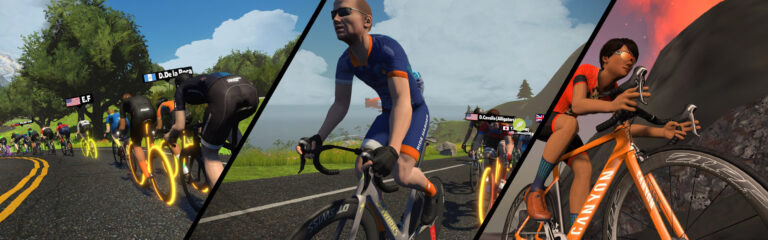
Once you’re riding in game with the Zwift Ride’s controllers or Zwift Play controllers paired, just enter this sequence (which ends with a Z to make it Zwifty) on the controllers, and everyone’s heads will become huge.
Enter it again and heads return to normal size.
It’s worth noting that this “big heads view” is on your screen only, as your Konami code entry only affects your view of the game. It also doesn’t affect in-game physics. Starting a new Zwift activity will also return heads to normal size.
What Else?
This isn’t the first time we’ve seen big heads on Zwift. It first showed up in Zwift on April Fool’s Day 2017, and they brought it back in 2022.
Since this Easter egg is in the game itself, Zwift’s developers could, in theory, change it to do anything they’d like. Perhaps they’ll change it to put us in dino suits, send us to 1989, or let us enter Paperboy mode…?
Your Ideas
What could the Zwift Konami code do that hasn’t already been done in game? Comment with your ideas!
The pretzel theme from last weekend has continued, with Zwift’s PretzelFest rides seeing lots of early signups. We’re also featuring a new race series, two group rides on fresh routes, and our own Tiny Races with prize and live stream news!
By far the most popular event this weekend, Zwift’s 3rd annual PretzelFest is taking riders over the newest long route in Zwift! This year, all PretzelFest events are on just one route: the new Makuri Pretzel (78.7km, 621m) in the Makuri Islands.
LEQP’s badge hunter series is a regular feature here, as they were one of the first series to tackle less-popular routes, helping Zwifters earn badges that are tough to earn solo!
This Saturday’s ride features Watopia’s new Navig8 route (66.2km, 423m). Two pace options are available: a C group at 2.5-3.2w/kg, and a D group at 2.2-2.5w/kg.
As indoor season ramps up, Tiny Race packs are growing! We have two bits of fun news for our popular race series. First: ZMS Esports Studio has been broadcasting the Zone 3 A category races each week, providing a fun bit of commentary and live scoring for these racers. Watch this week’s stream here.
Secondly, we’ve got a prize sponsor in PERC Coffee. One random USA-based rider who finishes all four races will be chosen each Saturday to win a free bag of PERC!
Grab some elevation toward your Tron bike challenge with this “keep-together” group ride on one of Watopia’s newest routes: Radio Rendezvous! At 23.5km with 736m of elevation, this route is (almost) nothing but climbing. Fear not, though: you’ll be accompanied by friends from the Phoenix Rising team, and as long as you keep pedaling, you’ll stay in the pack, no matter how hard you push.
HISP has set up a new 4-stage race series that’s a bit different from what everyone else is doing. This weekend is the first stage!
The rules are straightforward: four stages across Zwift Worlds, no categories, no points – just the finish line and cumulative times. League standings are on ZwiftPower here.
This weekend racers will tackle Watopia’s Sugar Cookie, which is 39.2km long, with 260m of climbing.
We choose each weekend’s Notable Events based on a variety of factors including:
Is the event unique/innovative in some way?
Are celebrities (pro riders, etc) attending/leading?
Are signup counts already high, meaning the event is extra-popular?
Does the ride include desirable unlocks or prizes?
Does the event appeal to ladies on Zwift? (We like to support this under-represented group!)
Is it for a good cause?
Is it just plain crazy (extra long races, world record attempts, etc)?
Is it a long-running, popular weekly event with a dedicated leader who deserves a shout out?
In the end, we want to call attention to events that are extra-special and therefore extra-appealing to Zwifters. If you think your event qualifies, comment below with a link/details and we may just include it in an upcoming post!
Zwift Big Birthday Bash Rides Announced for Oct 3-6
Zwift is turning 10 years old this autumn (tempus fugit, right?) and they’ve organized a slate of events and initiatives to celebrate with the community. The big cornerstone event is Zwift’s Big Birthday Bash weekend, which lands on the first weekend of October. Come ride at your pace to celebrate with community teams and big names in cycling world!
Schedule and Route Details
Rides are (for the most part) scheduled every two hours beginning October 3 at 4am UTC and running through October 7 at 2am.
Ride titles explain who is leading the ride. Some are led by community teams, while others are led by big-name Zwifters. Here are some stars we spotted (click for event details):
All rides are 45 minutes long and rubberbanded so riders will stay together regardless of effort level. Rides are rotating through four different flattish Watopia routes:
How the (Team) Race Was Won: Sugar Cookie Sprints in ZRL Race #2
Watopia’s Sugar Cookie is a great race route. You’ve got a sort of neutral downhill lead-in, sprint segments for points races, a key climb, and just enough road to chase back gaps created by that climb.
So I was excited to take it on as a Zwift Racing League points race. Things were feeling fresh: I was with my new team, the Thundercats, one of many DIRT squads participating in ZRL. And I was riding the new Pinarello Dogma F 2024 with DT Swiss Disc wheels so I could compete on the sprints without losing much on the key climb.
In the end, I turned in one of the better race performances of my long and storied Zwift B-cat career. But I’m getting ahead of myself… let’s start at the beginning.
The Warmup
I jumped on early for a longer warmup, for two reasons:
I like longer warmups. 30-45 minutes seems ideal for me.
I wanted to recon the four sprints along Watopia’s southern coast road.
As I spun my way along the Sugar Cookie route, I refreshed my memory of these roads, hoping this knowledge would help me tighten my race-time execution. That meant looking closely at the finishing 500 meters of the race, as well as each of the four sprints.
I also hit the watts hard a few times to blow off the cobwebs and get my heart rate up.
Before that, of course, I applied PR Lotion and grabbed a couple of pieces of caffeinated gum. (Related note: I’ve always said I’m not a coffee guy, but we recently bought an espresso machine and I’ve gone far down the rabbit hole of all things ‘spro. So I already had some caffeine coursing through my veins!)
Slight Detour: Bumped to B2 and B-Cat Drift
Before I tell the story of the race, I should mention that my team began this round in B1. To be precise, we were in the horrifically named “Open EMEA-W Southern (North) Division 1.” But after race 1, WTRL reshuffled the deck, and now we were in B2. Or to be more precise: Open EMEA-W Southern (West) Division 2.
I’m not ashamed to admit I was super stoked to move to B2. Why? Because B1 is a meat grinder where I simply can’t compete… and I’ve been there for (literally) years. Seven straight ZRL rounds, to be exact.
It’s not that I’ve gotten weaker in the past few years. If anything, I’m a bit stronger and certainly smarter. But here’s what DID happen: Zwift changed its categorization scheme. Zwift (and thus ZRL) now uses category enforcement to determine our pace groups, and those categories are based on your detected zFTP and zMAP. For me, at least, my zFTP is well below my actual FTP: my zFTP is currently 272w, while TrainerRoad and Zwift’s own “The Grade” test both put my FTP right around 315w.
That’s a difference of over 15%. And I can only assume that many other riders have a much lower detected zFTP than their actual FTP.
On top of that, the FTP cutoff for B category was increased from 4W/kg to 4.2W/kg.
Do you see how this is a double gut punch for B riders in my situation? Not only is Zwift detecting FTP lower than it used to, it has also raised the FTP limit for B category. So the top of B races are now filled with riders who were easily in A range in the old category scheme.
(Here’s a bit of fun math: if everyone has a zFTP as understated as I do, that means the range of actual FTPs who are racing in B has shifted up by 15%, making it 3.68-4.85W/kg. That would put my actual FTP of 3.75W/kg near the bottom of the B category.)
Don’t get me wrong: I’m not saying the categorization scheme should be changed to accommodate me. Category range changes aren’t inherently bad. Sometimes those shifts will put you near the top of the category, and sometimes they’ll put you near the bottom. I’m just saying it isn’t much fun racing for scraps week after week, so I was happy to be placed in B2 where I could hopefully be at the pointy end of some races.
Detour from the Detour: ZRL’s Confusing Naming Scheme
Try as I might, I can never remember what race league/division/locality/whatever I race in for ZRL. This happens every season. With names like “Open EMEA-W Southern (North) Division 1,”I’m not sure I could come up with a more confusing naming structure if I tried.
I have two proposals for better naming schemes:
The Boring Scheme: ditch the localities (EMEA, etc) and compass points (West, etc). Nobody knows what they mean. Just give each vertical grouping a number (1-50?) followed by their division (B2, A1, etc). “Division 45 B2” is easier to remember than “Open EMEA-W Southern (North) Division 1.”
The Fun Scheme: give each vertical a unique name along a ZRL-wide theme. Perhaps desserts. Because I never forget a dessert! “I race in Jelly Donut B2! Last year was Strawberry Shortcake B1, and this is sooo much easier….”
The Start
We had just 43 B riders in the pens as the race began. My team figured out as we left the pens that we only had 5 riders, since one had cancelled at the last minute. That wasn’t ideal! But there was nothing we could do about it now.
The group spun its dusty way down through the Jungle at a pace that was quite tame, as expected. The work would begin soon enough.
Sprint 1 (Stoneway)
As we neared the first sprint (FAL only), I honestly wasn’t sure if I was going to attack or not. Since this was our first race against these teams, we didn’t know how strong the other sprinters were! So I stayed near the front, watched how the pace picked up, and decided on the fly to go for it.
This indecision meant my jump was delayed, which surely cost me a few places. But I finished 9th and more importantly realized I could compete against these riders in the sprints. Game on!
(Teammate Dave took 2nd on this sprint, with Alex 3rd.)
Sprint 2 (Acropolis)
The next sprint was the only one awarding FTS on the day, and I had planned to go for it. Sure, in the new ZRL scheme FTS only awards 10 points for 1st place (vs 20 points for 1st in FAL), but I also figured that:
Fewer riders would contest this sprint, since it was giving lower points
My course knowledge and sense of timing helps me perform well in FTS efforts
I sat just off the back of the pack of 39 as we headed into the sprint, then as soon as we crossed the line I ramped up my power and easily rode through the pack. I actually eased up at that point, because I didn’t want to be in the wind for the whole sprint! I knew that, since I had started behind everyone, even finishing in the pack would mean I was faster than the pack.
As the pace picked up, I activated my aero powerup and went all-in to try to catch the handful of riders just ahead. Teammate Dave (a wattage bazooka) came around me near the end, but let up early, and I slingshotted around a competitor just a few meters from the finish, crossing the line first (and fastest) in the group. Dave got 2nd.
First across the line AND fastest through the segment!
Sprint 3 (Sasquatch)
After winning the second sprint, I began to think about the big climb up the road. This was the next crucial segment, because I knew if I could stay with the front group over that climb, I had a shot at the podium.
So now it was time to do all I could to conserve power. I stayed in the draft, and when the Sasquatch Sprint arrived, I used my aero powerup and increased my watts as little as possible while still staying in touch:
Aero powerups flying on the Sasquatch Sprint
My teammates were working, though. Alex took 2nd on this sprint, with Dave 3rd and Paul 4th. Chapeau, boys!
Sprint 4 (Woodland)
Heading into the final sprint, we had four Thundercats in the front pack (Dave, Paul, Alex, and myself) with Campbell chasing from behind. I had originally pondered going after FAL on this sprint, since it had a downhill start that suited me well. But it was also the longest sprint of the day (500 meters) and I decided to save my legs for the climb.
With only 35 riders in the front pack, though, I found myself in the top 20 midway through the sprint, even though I was just trying to conserve and stay in touch! So I gave it a bit of a go near the end, grabbing another 5 points with 16th place.
“Better than a kick in the pants,” my father would say.
Alex took 1st in this sprint, Paul 5th, and Dave 9th. That’s 20+16+12+5=53 points we grabbed on this sprint alone.
The Climb
The climb up from the base of the Epic KOM to the end of the bridge is the bit that made me most nervous in this race. I’d been dropped here before.
But I had a feather, and a plan. Moreover, I could just feel that I wasn’t thoroughly outclassed in this pack of racers. While I was far from 100% confident, the race so far had shifted me to around 70% confidence that I could hang with the front over the climb.
Moving to the front heading into the climb
I moved near the front of the group as the climb began – a classic “big boy trick” to give me some sagging space to help make up for lackluster watts per kilo. And I saved my feather, knowing I would need it later in the climb.
At the first hairpin I found myself near the front and feeling good. A couple of riders had gapped us off the front, but I knew two riders couldn’t stay away for 10+ km. So I sat on the wheels, then triggered my feather as the road tilted upward again heading into the right-hand hairpin.
The real suffering begins…
The real suffering began as we hit the second portion of the climb: the bridge with its steady 3% slope. Other riders in the group were keeping the pressure on, and while I wasn’t quite at my limit, I was definitely over threshold and hurting! But my Sauce 4 Zwift overlay told me there were just 11 riders in the front pack now.
I couldn’t get dropped now. I had to stay with this group.
And stay with them I did. Once we turned off the bridge, the climb ended. It was time to sit in and recover. My goal? Work as little as possible while staying in touch for the final sprint.
It was just Paul and I in the front group now, since Alex and Dave had been dropped on the climb. While not ideal, two riders in a front group of eleven was a decent ratio.
The Finish
One rider attacked with 1.3km to go. I upped my watts, too, letting myself get pulled along by a handful of other riders who responded. As we entered the cave with 700 meters to go, I found myself in a front group of 6 who had slightly gapped the other 5 behind.
Now it came down to power and timing. I kept my eye on the rider list, watching for early jumpers. Someone went just a bit earlier than I would have, so I jumped too, but only enough to stay on their wheel. I was in virtual gear 21 out of 24, having decided to stand for this sprint.
Glancing up, I saw it was just me and Vrancken, a strong rider who I’d been marking all race. I was gaining on him in the final meters, but he was just too far away.
This was my best result in 5 months of Zwift racing, and what made it even better was that my team, the Thundercats, took the team win on the day. Thundercats, Ho!
It’s worth noting that our finish points would have landed us in just 5th place, but our FAL sprint points put us well ahead of the other teams:
Once again, it pays to think strategically when it comes to ZRL points races. It also pays to have some strong sprinters!
Your Comments
How as ZRL race #2 for you and your team? Got any great ideas for a simpler league naming scheme? Share your thoughts below!
The third race of Zwift Racing League 2024/25 Round 1 happens Tuesday, September 24, and we’ll be in Makuri Islands for our first-ever ZRL event on the Country to Coastal route.
There’s much to discuss, including crucial course segments, tricky bike decisions, and strategic options. Let’s go!
Looking at the Route: Country to Coastal
The Country to Coastal route in Makuri Islands has never been raced in ZRL. It debuts as a scratch race, and all riders will be racing a single lap of the route for a total of 33.5km with 284m of climbing.
Let’s discuss the key parts of this route, beginning just after we blast out of the start pen:
Uphill Start (0-1.4km): we begin with a quick climb from the start pens up to the Village Sprint. While the slope only averages 3.5%, it’ll make the first few minutes especially tough. Make sure you come into the pens warmed up! Once the race begins, mind your pack position, watch for gaps, hold onto those wheels, and know that recovery is just up the road as the next 13.5km are mostly downhill!
Powerup at Village Sprint arch @1.7km
Powerup at Country Sprint arch @7.4km
Climb to Shisa Sprint (18.6-20.1km): the next pinch point begins at 18.6km when you cross a bridge onto the sandy, uphill corkscrew road taking you to the Shisa Sprint. Again, this isn’t a steep climb – it averages 3.3%. But climbers and punchers will push the w/kg here in an effort to thin the herd. If you aren’t attacking, you’ll want to hold onto a wheel to save energy in the draft.
Powerup at Shisa Sprint arch @20.7km
Powerup at Tidepool Sprint arch @25.8km
Slot Canyon climb (26.7-29.2km): our last real climb (apart from the uphill finish) takes us up through the Slot Canyon we descended earlier. At just 2.4%, this is the slackest of our three climbs. But since it comes near the end of the race, you know it’s going to hurt! Pro tips: watch for riders attacking when the road turns right off the pavement and onto sand around 28.2km.
Finish at Virtual Arch (@33.5km): after a flat lead-in from the Slot Canyon climb, you’ll get to slug it out in an uphill finish that is around 700 meters long, averaging 3.5%. Any powerup will help you here, and you’ll get another one as you pass under the lap arch with 400 meters to go. Time them wisely!
Three powerups will be randomly given at each arch: the feather, the draft boost, and the aero boost. You have an equal chance of getting all three at each arch. There are five arches, so five powerup opportunities as noted above: the Village, Country, Shisa, and Tidepool Sprints plus the lap arch near the end of the race.
Aero Boost (helmet): makes you more aerodynamic (reduces your CdA by 25%) for 15 seconds. Use at higher speeds (flats and descents), especially when no draft is available (although it is still useful when drafting.)
Lightweight (feather): reduces your weight by 10% for 30 seconds. Use on climbs, when weight matters the most.This is a handy powerup for the uphill finish.
Draft Boost (van): increases the draft effect you are experiencing for 40 seconds. Use at higher speeds (flats and descents) when you are already drafting off another rider (since this powerup only helps when you are drafting.)
Apart from the notes above, there are simply too many permutations to discuss optimal powerup usage thoroughly for this race. Knowing the route will go a long way toward helping you make smart powerup decisions on the fly!
Bike Frame + Wheel Choice
This route’s three key climbs plus an uphill finish may entice you toward a climb-friendly bike. But it’s important to look at the pitch of the climbs, and not just their length.
As noted above, the climbs only average 2.4-3.5%, which means they are quite draftable, and your bike’s aero performance will be more important than its weight, especially as speeds increase in higher categories.
Given the strong performance of the new Pinarello Dogma F 2024, it’s hard not to recommend it as the best pick here, coupled with the DT Swiss disc wheel. This setup loses very little (2 seconds in our ~50-minute test) to the traditional Venge+Disc combo, while gaining 11 seconds in our ~50-minute climb test.
That said, there are several options that will all perform well on this route. The Venge+Disc is the most aero setup available, and the Tron bike is still a strong all-arounder.
Lots of recon events are scheduled on upcoming ZRL routes, led by various teams. See upcoming ZRL recons for this race at zwift.com/events/tag/zrlrecon.
This route as a scratch race has all the makings of a classic attritional Zwift battle. Make no mistake: riders will fall off the back on each of the three key climbs as strong climbers and puncheurs push hard to drop whoever they can!
But does it always make sense to push on the climbs in a team event? Smart teams will look at the makeup of their squad beforehand to determine whether it makes more sense to attack or sit in at key pinch points. Riders will want to communicate well mid-race, too, so teams can make smart, on-the-fly decisions that maximize the team’s overall result.
Your Thoughts
Any insights or further thoughts on this race? Share below!
Elite Goes “Zwift Ready”: Direto-XR with Zwift Cog and Click Announced
Elite has announced the upcoming release of their first “Zwift Ready” trainer, officially named the “Direto XR with Zwift Cog and Click”. Let’s dive into specs, pricing, and what this (hopefully) means for existing Direto-XR owners…
Trainer Specs
This version of the Direto has the same specs as the Direto-XR (and XR-T, which is just a Direto-XR sold without a cassette). It’s the same trainer, but with updated firmware and a Zwift Cog installed. Key specs include:
Gradient simulation: 24%
Flywheel: 5.1kg
Max wattage: 2300W
Power accuracy: +/- 1.5%
The one difference? It ships with the Cog and Click, along with updated firmware so the trainer supports virtual shifting on Zwift!
Pricing and Availability
Elite isn’t giving firm ship dates yet for the new Direto, but they told us, “It’s looking like October here in Europe/UK and November for overseas markets.” The trainer’s homepage confirms this, stating, “The Direto XR with Zwift Cog and Click is an Elite collaboration for the Zwift Ready program, available at the best bike shops, both offline and online, starting in November.”
Elite says the Direto-XR with Cog and Click will retail for €649, and that includes a coupon for 2 months of Zwift.
As far as we can tell, Elite has not stated planned pricing for US and UK markets. Current exchange rates would put the equivalent US dollar price at around $720, and £550 for Zwifters in the UK. But with the Direto-XR currently selling on Amazon for $559, and the Direto-XR-T selling for $528, we expect US pricing to come in closer to $600-$650US, since you could simply buy the Direto-XR-T on Amazon plus the Cog and Click for around $608 today and have a Direto-XR with Zwift Cog and Click once the firmware update is released (more on that below).
Good News for Current Direto-XR and XR-T Owners
Since the Direto-XR with Zwift Cog and Click has the same internals as the XR and XR-T, you would think that releasing a firmware upgrade for current Direto-XR owners (thus bringing virtual shifting capabilities to their trainers) would be a simple matter. It seems that it is not, though, and current Direto XR owners will need to wait a bit to get virtual shifting support.
Elite has confirmed that “We have a firmware update for the Direto XR / XR-Ts on our schedule, aiming to make them Zwift Ready by the end of the year.” Why the delay? Priorities. Elite tells us, “We launched 5 new winter products this year and have many more in the pipe-line and we are fully dedicated to those projects to make sure everything runs smoothly.”
Once the firmware update is released, anyone with a virtual shifting controller (Zwift Play or Click) will be able to enjoy virtual shifting using their existing cassette and Direto-XR trainer. If you want to move to the single-cog setup, though, you’ll need to purchase the Cog and Click upgrade kit from Zwift. Elite says you’ll want to buy the upgrade kit without a freehub, so the Cog will mount directly on your trainer’s existing freehub.
And yes: if you install the Zwift Cog on your Direto, you’ll be able to use the Zwift Ride smart frame on your trainer. Bellissimo!
Wrapping It Up
It’s always nice when a company upgrades current hardware without requiring another purchase. Doing so earns customer loyalty in big, big ways. Hopefully current Direto XR owners will get an early Christmas present of fresh firmware.
US/UK pricing is one big question here. The Direto-XR has higher specs than the Wahoo KICKR Core Zwift One and JetBlack Victory, boasting slightly better power accuracy (1.5% vs 2%), higher maximum wattage (2400W vs 1800W), and thus higher max incline (24% vs 16%). So it would make sense for Elite to price the new Direto-XR with Zwift Cog and Click slightly higher than the Core (€499) or Victory (€449). It’ll be interesting to see where pricing lands.
It’ll also be interesting to see if we hear any Zwift Ready news from Garmin/Tacx now that Wahoo and Elite have released products. So far, the silence has been deafening…
Questions or Comments?
Thoughts on Elite’s first Zwift Ready announcement? Questions? Anything other than complaints about Wahoo not rolling out virtual shifting to the KICKR v5 and v4? 😉 Share below!
Zwift version 1.74 begins its phased rollout today. This is a minor update with some visual changes and various bug fixes. See details below…
New Look, Same Dirt
Zwift has been refreshing road surface visuals in recent updates, and this week’s update delivers a new look for dirt. Zwift notes, “There is no change to the performance characteristics of roadways as part of this change.”
Level Locks Removed
To give new Zwifters even more routes to explore, the level-lock gate has been lifted from:
Some trainers support a 10Hz “race mode”, but the new HUD was only updating power data every 1 second. This has been fixed, so if you have power display set to “Instant” you’ll see the power number changing as often as Zwift receives new data from your trainer (approximately 10 times per second for most race mode trainers).
In a related update, Zwift says, “The HUD power distribution bar now respects the Power Display setting (Instantaneous or 3-second average).”
No More Empty Paint Cans
This one has bugged us for a while. Various frames in the the Drop Shop, including the hot new Pinarello Dogma F 2024, have been showing a custom color paint slider. But moving the slider does nothing!
Today’s update fixes this bug on several frames – not by making the color slide functional, but by removing it. We’re still campaigning for the chance to use our Drops to buy unique, customizable bike paint schemes!
More Release Notes
Zwift provided notes on additional tweaks and bug fixes in this update:
Various icons have been refreshed throughout the game to improve consistency.
Improved the appearance of tabs in the Settings menu for non-English languages.
Fixed an issue in Climb Portal that could cause PR information to be difficult to read for Zwifters with long names.
Fixed an issue in the post-ride Streaks screen that could display lower XP than expected after earning a ride streak bonus and clicking the Continue button. Note: This was a visual issue; the proper amount of XP was still granted.
Fixed an issue that could potentially cause Zwifters to go off-route on the Loop de Loop route in Watopia.
Fixed an issue where the Zwifter level shown in the HUD could disappear after receiving a Ride On.
When viewing another Zwifter, calorie are no longer shown in the HUD.
Fixed an issue that could cause power and cadence fields to appear in the HUD when viewing a Zwift runner.
Ride the Makuri Pretzel This Weekend for PretzelFest 2024
Zwift’s 3rd annual PretzelFest happens this weekend, and it’s much shorter than past years, with events only scheduled over a single 48-hour period. And all events are being held on just one route: the new Makuri Pretzel on Makuri Islands!
About the Route: Makuri Pretzel
Far and away the longest Makuri Islands route, the new Makuri Pretzel covers key roads in each of the Makuri Islands’ three areas: Yumezi, Neokyo, and Urukazi. And it covers them in both directions, which means you hit four different sprint arches in both directions for a total of eight sprint opportunities.
While this route is far from flat, it avoids all Makuri Islands KOM segments. Keep your eyes open in a race, though, as there are plenty of sneaky, draggy climbs that provide ample opportunity for attacks.
(Are PretzelFest rides races? Not officially. Treat them as a casual group ride if you’d like, but you can rest assured there will be riders pushing the pace on the front as well.)
Complete the full route (78.7km with 621m of elevation) to unlock the route achievement badge, a 1550XP bonus, and the Lederhose kit (see below).
Events are scheduled every two hours beginning Saturday, September 21 at 2am UTC (Friday 11pm EST/8pm PST) and ending 48 hours later, for a total of 24 timeslots. Click below to sign up: