Zwift Academy 2019 has entered its next phase with men’s and women’s semi-finalists being selected. Ten men and ten women will complete a mix of indoor workouts on the Tacx Neo 2 and outdoor workouts–an important step in the validation process.
Three finalists will then be chosen from each group to travel to the Zwift Academy Finals in Spain for a week-long camp to ride and complete structured drills to win a professional contract. One man and one woman will be chosen for a pro contract for the 2020 cycling season.
Here’s a little more about our semi-finalists…
Men’s Semi-Finalists
Drew Christensen (New Zealand): an experienced cyclist, Drew’s 5-minute power of 6.55 w/kg is impressive and shows he’s able to take on punchy climbs. ZwiftPower Profile
Drake Deuel (USA): an elite-level rower who recently moved to bike racing, Drake’s 5.72 w/kg 20-minute power impressive. ZwiftPower Profile
Kees Duyvesteyn (New Zealand): 2nd at New Zealand U23 National Road Race 2019 and took 3rd in the Time Trial, Kees has the real-world results to back up his Zwift performance. ProCyclingStats Profile
Luuk van Gestel (Netherlands): rode for the U19 national team last year, and has 10 years of racing experience on cross, gravel, and road. ProCyclingStats Profile
Brad Gouveris (South Africa): the most experienced Zwift racer of the group, Brad was a ZA semi-finalist last year as well. His 1-minute power of 9.96 w/kg makes him a powerful puncheur. He’s won multiple titles in track cycling, as well as this year’s KISS Super League Grand Finale race. ZwiftPower Profile
Filip Kvasina (Croatia): 2nd place in this year’s national U23 ITT, Filip is definitely a powerful rider. ProCyclingStats Profile
Mathijs Loman (Netherlands): one of the less-experienced of the bunch, Mathijs is going to have to prove himself in the coming weeks. ProCyclingStats Profile
Campbell Pithie (New Zealand): with outdoor titles on the road and track and a strong power profile, Campbell is an aggressive rider with big aspirations. ZwiftPower Profile
Rhys Robotham (Australia): an outdoor racer who finishes in the front pack consistently. ProCyclingStats Profile
Ryan Rudderham (Canada): solid 20-minute power and a strong mind to back up his legs. ZwiftPower Profile
Olivia Baril (Canada): a former competitive swimmer, Olivia took this year’s U23 National titles in both the time trial and road race. ProCyclingStats Profile
Catherine Colyn (South Africa): 2018 U23 National road race winner, Catherine is a strong climber with solid race intuition. ZwiftPower Profile
Imogen Cotter (Ireland): a former runner with national titles, Imogen has competed in track cycling and won 2nd at Irish Road Nationals. ZwiftPower Profile
Nathalie Eklund (Sweden): a ZA semi-finalist in 2018, Nathalie has stood on two Swedish National Podiums, is an Ironman Champion, and certainly is out to prove she’s worthy of a spot in the finals. ZwiftPower Profile
Veronica Ewers (USA): though not a very experienced cyclist, Veronica has the power numbers to be successful in the game. Road-Results.com Profile
Emily Gass (USA): a former competitive rower, Emily has the cardio engine to put down big efforts on long climbs. Road-Results.com Profile
Ione Johnson (New Zealand): a finalist in last year’s Zwift Academy, Ione is obviously a strong rider who knows how to compete at the top. ZwiftPower Profile
Mary Kate McCarthy (New Zealand): with more ZwiftPower races under her belt than almost any other semi-finalist, Mary Kate has the experience to perform well indoors. ZwiftPower Profile
Jessica Pratt (Australia): U19 National road race winner, Jessica has done a fair amount of outdoor racing including a 2017 European tour with an Australian development team. ProCyclingStats Profile
Samara Sheppard (New Zealand): a multi-time National and Oceania MTB champion with more plenty of Zwift races under her belt, Samara’s power profile show she’s a force to be reckoned with. ZwiftPower Profile ProCyclingStats Profile
Zwiftcast Episode 70 – the Jeffers controversy, MTB hits Zwift and art for Zwift’s sake
The 2019/20 indoor seasons has started with a bang, or should that be a ban? The Zwift community has been convulsed by Jeffers-gate: the fining, banning and stripping of the first officially-sanctioned national e-championship from Zwifter Cameron Jeffers by British Cycling.
Jeffers’ account was shown to have gained a Tron bike with the use of an ANT+ emulator… and the news of the ban has polarised opinion. As the dust settles on a huge row for Zwift and eSports, a row which has garnered international attention, Simon, Shane, and Nathan give their positions and debate what it means for regulation and enforcement in the new world of eSports on the platform.
Elsewhere, the arrival of Mountain Biking and steering on Zwift has seen a plethora of DIY hacks for smooth movement of the front wheel… which has caught the Zwiftcasters’ eyes and what do they make of steering?
Plus a change to the code in the game has made the Jungle Circuit heavier going… if we dare mention it, the choice of bike and wheels has become even more important.
And finally news of a very ambitious artistic project which captures the visual richness of Watopia in a whole new way.
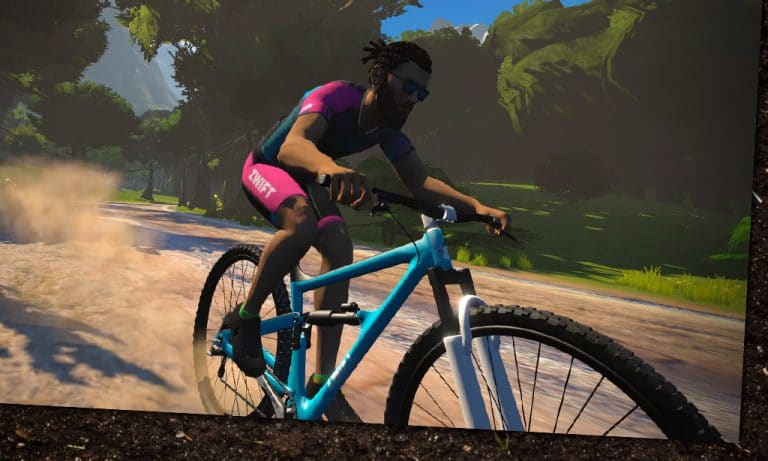
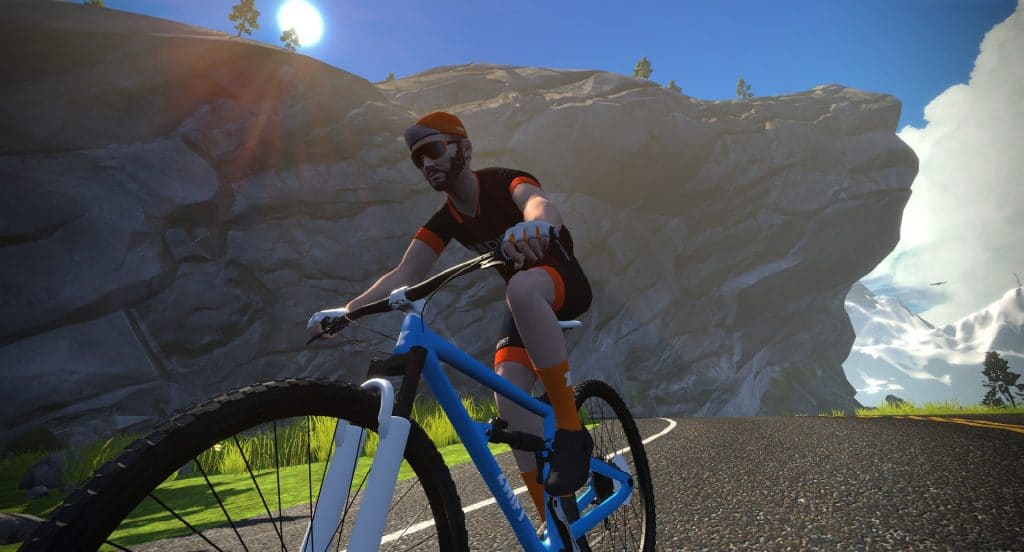
Meet the New King of the Jungle: the Zwift Mountain Bike
We’ve already discussed how Zwift has increased the rolling resistance of dirt portions of Watopia for certain tires/wheels. But we haven’t yet talked about the one bike in game which is set up to roll faster in the dirt: the new Zwift Mountain bike!
According to my sources inside Zwift, every wheelset except the new mountain bike wheels is using the same rolling resistance right now, meaning all the road bike wheels are going to roll pretty slow on dirt.
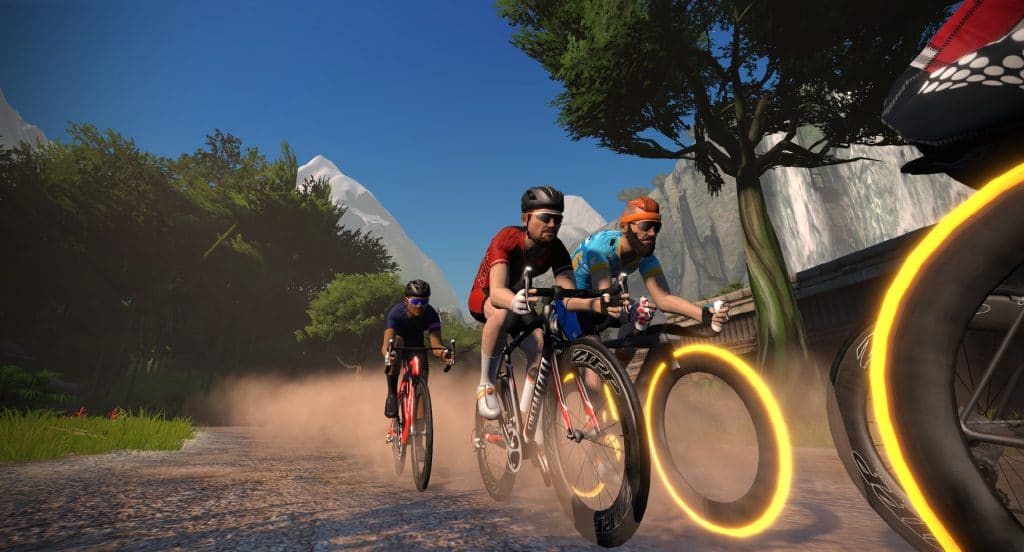
This isn’t immediately obvious unless you ride a long stretch of dirt, like the all-dirt Jungle Circuit. Here, riders are finding their speeds with road wheels to be 6-8km/hr slower than tarmac speeds.
So we did some test laps with various road setups, as well as the Zwift Mountain bike, to find out if the mountain bike was really faster in the dirt, and if so, by how much.
The Results
At 300 watts steady (4w/kg) the Zwift Mountain bike turned in a Jungle Circuit time of 13:47.
The Tron bike (and other fast bikes) come in right around 15 minutes flat at the same power levels.
No bike/wheelset combination comes close to the Zwift Mountain setup when riding the Jungle Circuit… at least not right now. Of course, Zwift will be releasing more wheels that roll better in virtual dirt. Then things will get interesting!
But for now, if you’re heading to a race on the Jungle Circuit, you’re going to want to try the Zwift Mountain bike! Here’s how to unlock it.
How Does It Perform on Tarmac?
The mountain bike doesn’t perform well on tarmac–it’s by far the slowest bike on pavement, turning in a lap time of 38:34 on a single lap of our Volcano Climb test route (at 300 watts, 4w/kg steady).
For comparison, the fastest road setups finish this route in 35 minutes flat, while the slowest finish it in just under 36 minutes.
Thoughts On Dirt Strategy
This sets up an interesting race situation in which riders may choose a fast road bike setup for racing the Jungle Circuit in hopes of dropping the mountain bike riders before hitting the dirt circuit.
Will that strategy work? Possibly, depending on how many Jungle Circuit laps the race includes. Most races involve 1.5-2.5 laps around the Jungle Circuit. With only ~5 miles of tarmac leading into the Jungle dirt, road riders will have to push hard from the start to drop mountain bikers and create a big gap before hitting the dirt circuit. Then it will be up to the mountain bike riders to reel in the roadies on the dirt. It’ll be a battle!
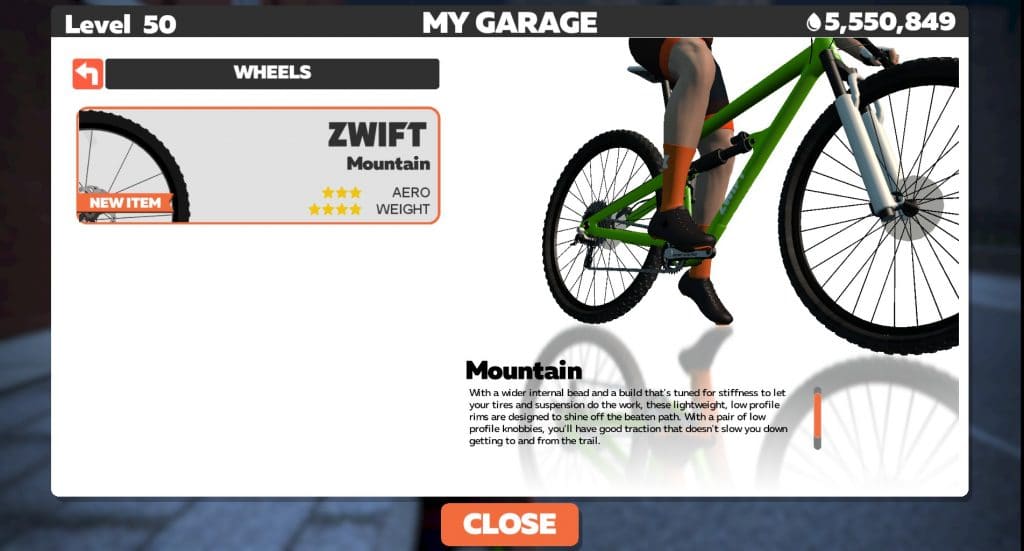
UPDATE: with Zwift’s December 6th 2019 update, all Zwifters were given the Zwift Mountain Bike in their garage (you don’t have to perform well on Repack Ridge to unlock it.) If you don’t have the bike, you can purchase it once you reach level 2. But there are better mountain bikes!
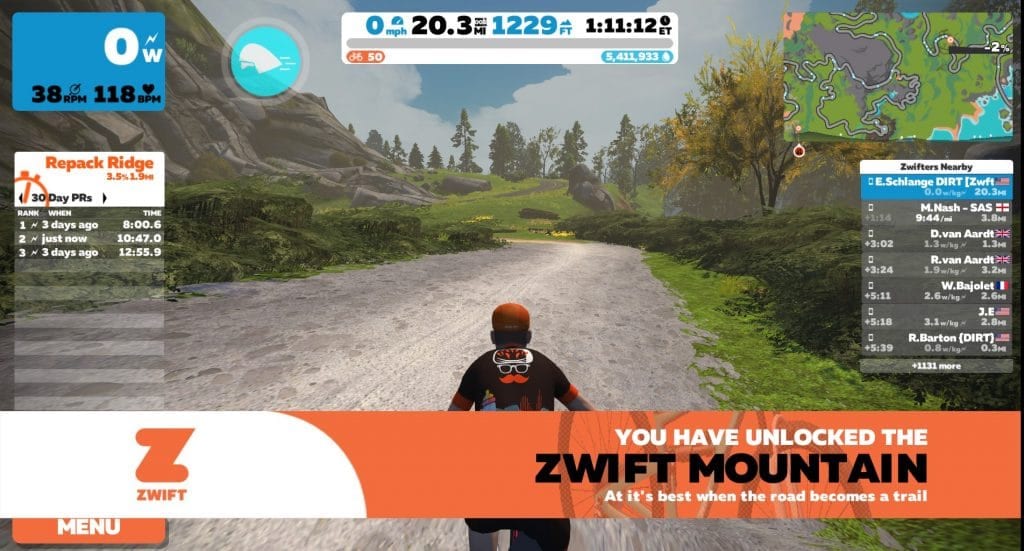
Zwift launched its new mountain bike course two weeks ago (here’s how to find it) and with it the opportunity to unlock the first-ever Zwift mountain bike frame and wheelset.
While this is surely only the first in-game mountain bike of many to come, and serious Zwifter should want it in their garage. So how do you unlock it?
First: Find Repack Ridge
You must ride the new Repack Ridge steering trail in order to unlock the mountain bike.
As you pedal (and steer!) your way over Repack Ridge, the game is tracking your performance in two ways:
Your overall time on the trail (shown at the top of the screen)
The number of stars you get by steering the right line (also at the top of the screen)
Aim for the blue!
There are 10 sections of the trail which include either blue arrows and red X’s, or a single blue line. Steer your way onto the blue, keep of the X’s, and you’ll get a full star for each section.
To unlock the Zwift mountain bike, you must complete the trail in under 12 minutes, 30 seconds AND get at least 9 out of 10 stars.
What Do You Unlock?
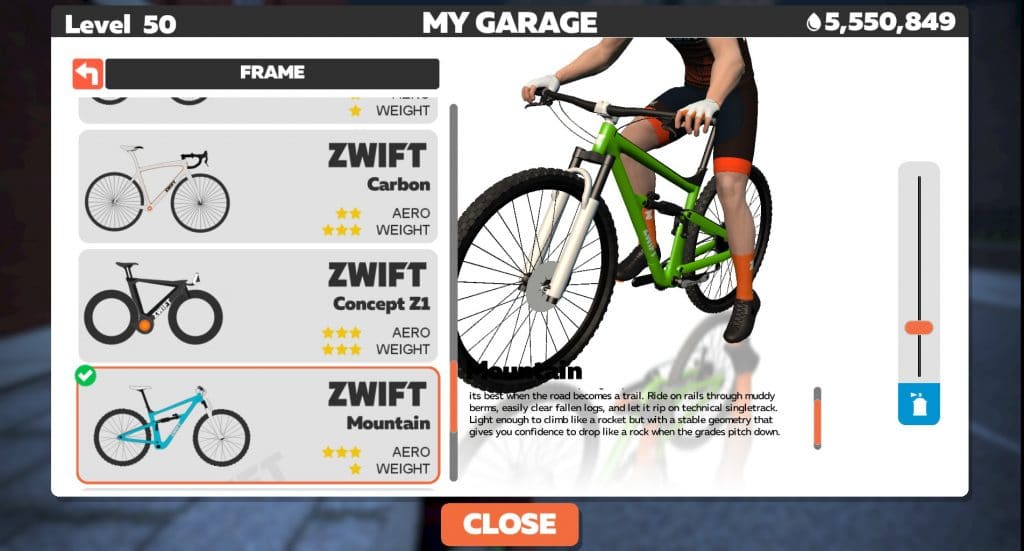
Hit your targets and you’ll unlock both the Zwift Mountain frame and wheels.
While they aren’t particularly fast on tarmac, they’re faster than any other bike available when it comes to riding the Jungle Circuit‘s dirt, thanks to Zwift’s new rolling resistance changes.
And the frame has a color slider, so you can customize the look a bit!
Various wheels and tires now have different rolling resistance based on the surface they are rolling on. IE, a mountain bike or gravel tire may be the best on the Jungle circuit, while a road/TT bike is fastest on the tarmac. More to come here in a future update.
This weekend’s update to version 1.041097 seems to have rolling resistance working the way Zwift intends, so we’ve started running tests to see how different wheels perform on the course with updated rolling resistance values.
First: About Crr
The change in Zwift’s latest update means the game is now setting a value for the Coefficient of Rolling Resistance (Crr) based on the wheels you are using in game and the type of surface you are currently riding.
Crr is simply a number which quantifies how much friction your tires are creating against the road surface. A fast-rolling tire has a lower Crr, while a slower tire has a higher Crr.
Our educated guess is that, before this update, Crr was a constant on Zwift, not changing based on road surface or wheel type. But now, every time the road surface changes, Zwift checks the Crr for your particular wheel for that particular surface, and uses that value to help determine your in-game speed. Zwift also sends that value to your smart trainer, where it affects the resistance you are feeling in standard Sim mode.
Here’s a snippet from the ANT+ spec showing how rolling resistance is calculated, then used to determine the resistance your smart trainer gives you:
(section 8.10.2)… the standard calculation for rolling resistance. Rolling Resistance [N] = (Bicycle Mass + Cyclist Mass) x Coefficient of Rolling Resistance x 9.8
Calculating Total Resistance (Simulation) The total resistance applied by the fitness equipment is a sum of the wind resistance, rolling resistance and the gravitational resistance as shown in Equation 8-15: Total resistance [N] = Gravitational Resistance + Rolling Resistance + Wind Resistance
Speed Comparison: Road Bike
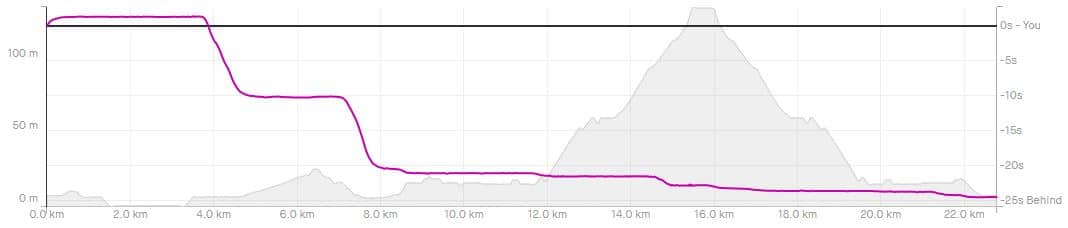
We used Strava’s Effort Comparison tool to compare the speeds of an identical bike setup before and after Zwift’s Crr updates.
The frame used is the Specialized S-Works Venge, with Zipp 858/Super 9 Wheelset. One of the fastest setups in-game. Click here to access the Strava Effort Comparison, or simply watch the quick video below:
As you can see, our test bike definitely slows down in the dirt sections compared to past performances.
Speed Comparison: Road Bike vs Mountain Bike
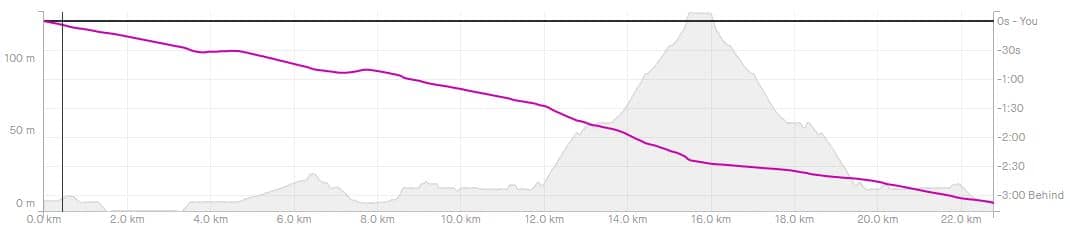
Here’s a comparison of the same road bike above and Zwift’s new mountain bike, which is supposed to perform better than the road bikes on dirt.
While the mountain bike steadily loses ground to the road bike on most of the course, it keeps up with the road bike (and even gains a little time) on the dirt sections. (More on MTB performance in dirt coming soon!)
What Does It All Mean?
There are a few key takeaways here:
All dirt sections are slower with road tires, not just the Jungle Circuit (where it’s most noticeable because it’s a long stretch of dirt). The lava dirt around the volcano appears to roll at the same speed as before.
Soon, dirt performance will be a factor in wheel choice. Currently, all road tires perform the same in dirt, and only the mountain bike (with its MTB tires) performs differently. This will change when Zwift begins releasing more wheelsets, and they may even change the Crr values of some existing wheelsets.
Expect more dirt attacks. Racers already like to attack in the dirt, where dust clouds mean poor visibility. But the increased resistance on road tires in the dirt means power numbers will bump up even more in these sections.
Your Thoughts
What do you think of Zwift’s Crr changes? Chime in below!
It’s Kona week! Matt catches up with Levi Hauwert, Yvonne Timewell, and team mentor Tim Don of the Specialized Zwift Academy Triathlon team. We learn about their experience on the team and expectations going into race day. Tim and Matt make their rapid-fire picks for Saturday, followed up with Jordan’s analysis of these picks.
About the Podcast:
The Zwift PowerUp Tri Podcast is hosted by former pro triathletes Matt Lieto and Jordan Rapp, lending their in-depth knowledge of the multisport to the Zwift Tri audience.
Zwift released a minor update last night, worth mentioning only because there’s been a lot of confusion recently due to changes made to the rolling resistance of some dirt portions of Watopia.
Various wheels and tires now have different rolling resistance based on the surface they are rolling on. IE, a mountain bike or gravel tire may be the best on the Jungle circuit, while a road/TT bike is fastest on the tarmac. More to come here in a future update.
I love the concept here. That Zwift is adding another strategic element to their “game” so those who pick the right equipment for the course get a performance edge over those who do not.
Just like the real world. If I’m racing on gravel, I need to have the right bike for it. And that bike won’t be the same one I use for a crit, or a mountain bike downhill.
Not Quite There
So far, though, this new feature of Zwift’s hasn’t rolled out well. It began with complaints that group rides on the Jungle Circuit were splintering apart, with riders flying off the front holding less power than those struggling to catch on.
Group leaders were going crazy trying to figure out the issue until they began comparing game version numbers. Guess what? Zwifters who hadn’t updated to the latest version were rolling fast through the Jungle, while Zwifters on the latest version moved much slower. At 300 watts (4 w/kg) it was a difference of about 5km/hr. No small difference!
On top of that, the Zwift Mountain bike which was rolled out in last week’s update was supposed to perform pretty well in the dirt. Details are scarce, but the big idea was that the mountain bike would be a poor choice for a race on tarmac, while being a useful option in the jungle.
But that hasn’t materialized either. Thus far some bugs have made it so the mountain bike doesn’t perform well… anywhere, really! (It’s probably a bit faster than it should be on tarmac, but significantly slower than, say, the Tron bike on the Jungle Circuit.)
Today’s Jungle Update: Faster Dirt
With today’s update, the Jungle is rolling much faster. Since we hadn’t done a lot of testing on the Jungle Circuit prior to last week’s update, we can’t really tell if the speeds are different now than they were, say, 1 month ago. But they’re pretty close, and much faster than they were after last week’s update.
As for the mountain bike: it still isn’t performing particularly well on any surface. But that should change soon (and it seems plenty fast on Repack Ridge!)
Squishing Bugs/Riding Gravel
Zwift will get these bugs fixed soon enough. Then we’ll test various setups and help you get a virtual gravel/dirt setup just in time for the winter season.
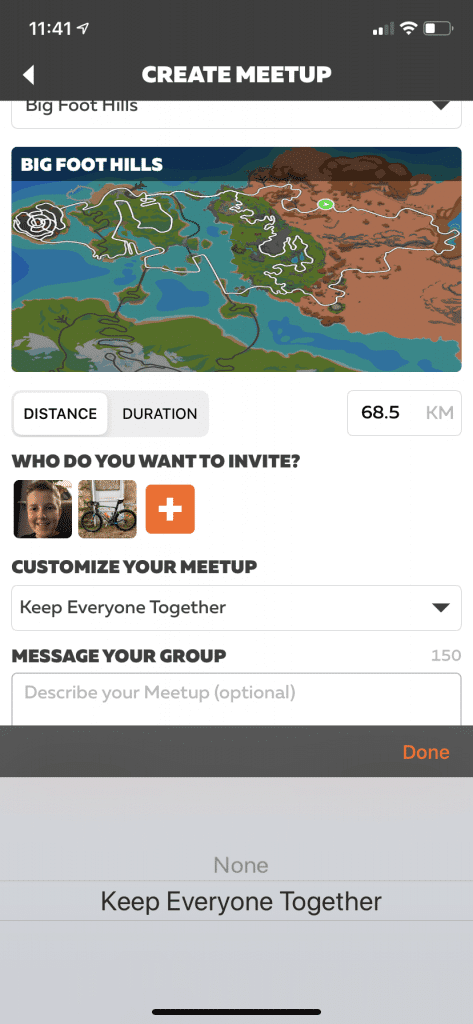
New Meetup feature! There is now an option available for cycling meetups that will keep everyone in the meetup together when you ride.
So we got to work testing the new “Keep Everyone Together” option. Here’s how it works…
Setting Up the Meetup
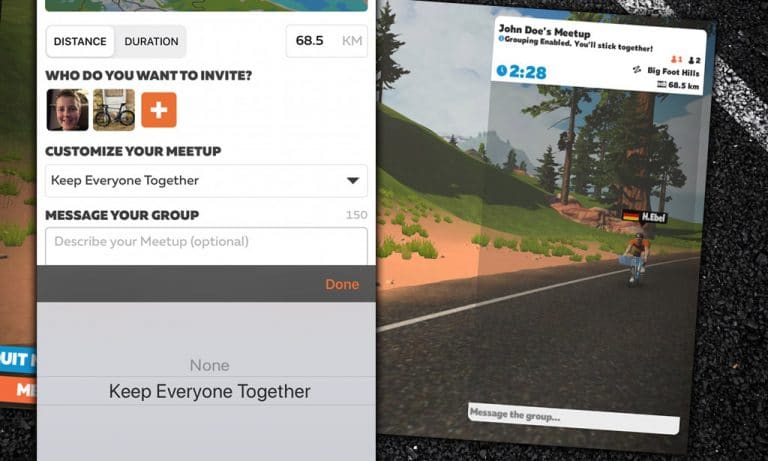
Meetups can only be created via Zwift Companion. The “Keep Everyone Together” option is available under “Customize Your Meetup” on the meetup creation screen. It is turned off by default.
Setting the option
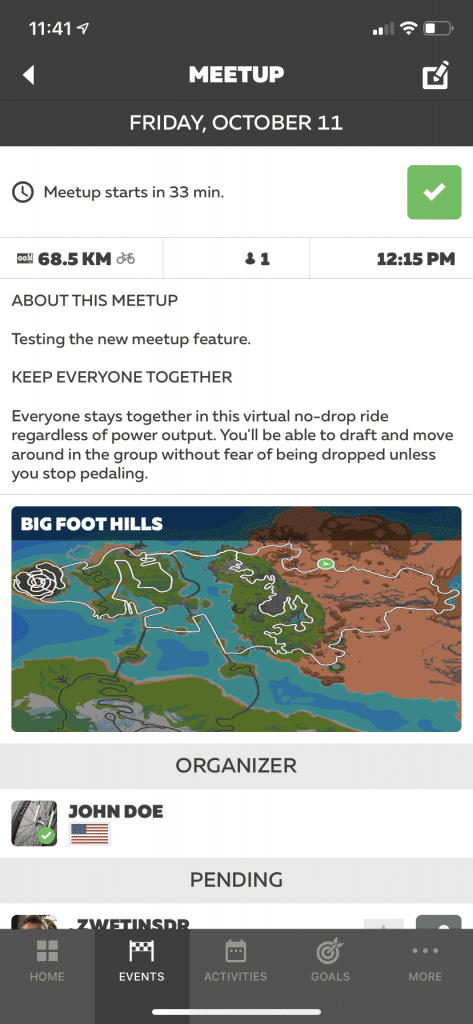
After creating the meetup, a description of the “Keep Everyone Together” option is automatically visible for meetup attendees.
The description of the “Keep Everyone Together” feature which is added to your meetup clearly states how it works:
Everyone stays together in this virtual no-drop ride regardless of power output. You’ll be able to draft and move around in the group without fear of being dropped unless you stop pedaling.
Seems clear enough. How does it work in practice?
Testing the New Feature
Our test meetup featured just two riders. We kept them on flat ground in order to answer the main question in our minds: how fast will the group travel?
This was our big question because the only other “keep everyone together” group rides are group workouts, and those groups travel unrealistically slow. We were hoping Zwift had kept speeds more realistic for the Meetup option.
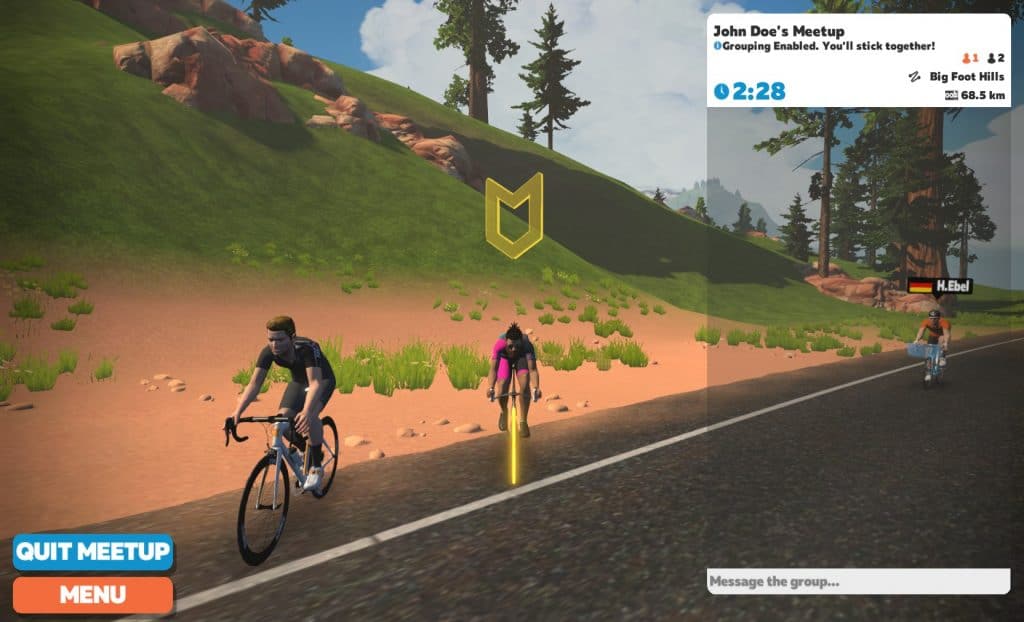
When the Meetup begins, a message indicates “Grouping Enabled. You’ll stick together!”
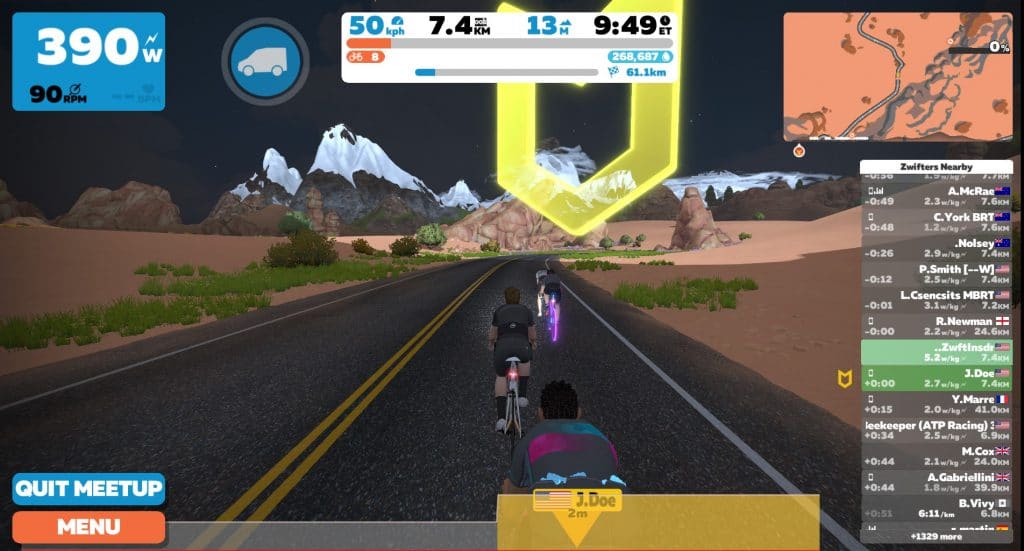
Here we have one rider at ~400 watts, and the other rider at ~200 watts. We stayed together! Never more than a 1-second gap.
Trying to sprint and break up the group didn’t work, either.
We did what we could to split up the group, but it couldn’t be done. So that feature definitely works.
But what about the group speed?
Here are some of the speeds we saw with our two-rider test:
45kph when both riders held ~200 watts
55kph when both riders held ~400 watts
50kph with one rider at ~200 watts and the other at ~400 watts
30kph with one rider at ~20 watts and the other at ~400 watts
Compare these speeds to a simple test we ran outside of the meetup:
40kph when both riders held ~200 watts
47kph when both riders held ~400 watts
Interesting. So Meetup riders are actually faster with the “Keep Everyone Together” option, at least in our simple tests.
We did note one small glitch in our test Meetup: the distance meter at the top-middle kept flashing in and out. Reported to Zwift support!
Note: Zwift slowed these meetup speeds in a subsequent update, so the numbers above no longer apply.
A Useful Feature?
So the feature works, even if speeds are a bit wonky. Will zwifters use it? I think so, for those “no-drop” rides where riders of varying abilities want to ride together.
The new feature lets stronger riders push hard if they’d like, without dropping weaker riders. It’s a simple, seamless way to make this happen, and a perfect example of how indoor riding can actually improve upon the outdoor experience. We’ve all been on the group ride where a very weak or strong rider keeps messing up the group mojo–but this feature negates that!
And it works without slowing the group speed to a crawl, which can be a real annoyance to stronger riders in a group.
What’s Next?
What other improvements are coming to meetups? We know Team/Club functionality is coming soon to Zwift, and perhaps that will include some of the features we’d like to see in Meetups. But still, we’ve got a list of Meetup Features we’d would love to see, including:
Hiding all non-meetup riders (makes it much easier to track participants in impromptu races or group rides)
Race leaderboards
Invite more than just those who follow you
Group workout capabilities
Choose any Zwift route on any course, not just Watopia + the scheduled guest course
Allow late join
Audio chat
Your Thoughts
Is this a useful feature for you? What additional Meetup features would you like to see?
Heart Rate Variability (HRV) and Exercise Options for Family Vacations (Never Going Pro Podcast #6)
In this episode, Shayne, Ken, and Chris chat about heart rate variability: What is it? How does it work? Is this a helpful tool for cyclists?
They also touch on exercise options for family vacations when you don’t have your bike.
Our special guest this week is Jone Gravdal from the Indoor Specialist team. He is a high-level Zwift racer and has recently started incorporating HRV training as an extra tool in his training toolkit. While not completely dependent on it, it was interesting to hear how he uses his HRV score along with his physical sensations to make training decisions. Our apologies as his audio quality is not the best!
Show Notes
Heart rate variability (HRV) is the physiological phenomenon of variation in the time interval between heartbeats. It is measured by the variation in the beat-to-beat interval.
HRV is affected via the autonomic nervous system (ANS), and more specifically the sympathetic nervous system (SNS) – “Fight or flight” – and the parasympathetic nervous system (PNS) – “Rest and digest”. The SNS is responsible for shortening the beat-to-beat interval at rest, versus the PNS which will lengthen it at rest. Said another way, an athlete who is relaxed will have a higher HRV score, and an athlete who is stressed will have a lower HRV score.
High HRV = Good
Low HRV = Bad
Measurement of HRV
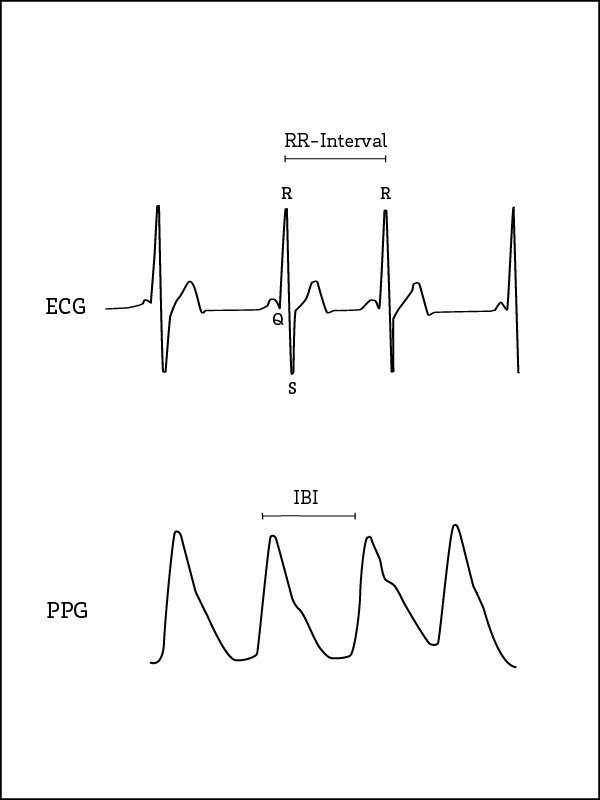
The gold standard to measure HRV is via an electrocardiogram (ECG) and measure the time between “R” waves (shown below), however current monitors in the market employ an optical sensor which utilizes photoplethysmography (PPG) and measures the steepest increase in the signal prior to the peak, which marks a heartbeat. The latter is still under scrutiny for its accuracy which is why I, personally, take this data with a grain of salt and do not base my, nor my athletes, readiness to train solely off of HRV data.
As you can see from above, the ECG data provides superior beat-to-beat variability, via RR-interval measurements, and more accurate data overall as opposed to PPG.
So, in a nutshell, HRV is a useful tool for cyclists to recognize patterns, and change behaviors. Example: going to bed late and/or drinking alcohol lowers my HRV, but meditation raises it. BUT, basing your training off of it entirely will result in a likely fitness plateau since you’re never providing enough stress to the system to create an overloading stimulus. Remember, not all stress is bad, and you need stress to become fitter and more resilient to the same stressor that once fatigued you (like building a callus). So, using HRV to create better behavior is great, but basing training off of a likely inaccurate number is not my recommendation at this time.
DIRTY October KOM Challenge
Sign up here, ride, and repeat on or around October 30th!
Show Transcript
Ken: Hey, do you guys want to hear a dad joke?
Shayne: More than anything.
Ken: Fantastic. Have you heard of the dyslexic, agnostic insomniac?
Shayne: No.
Chris: No.
Ken: He stayed up wondering … Here, let me start that … I’m going to do that over again.
Shayne: I don’t think we should ever [inaudible 00:00:19].
Ken: Hey, do you guys want to hear a dad joke?
Chris: Yep.
Shayne: I do.
Ken: Have you heard of the dyslexic, agnostic insomniac?
Chris: Named Ken Nowell?
Shayne: No.
Ken: He stayed up all night wondering if there was a dog.
Chris: Silence. Dog. Get it?
Ken: Yeah, dog, instead of God?
Chris: Oh.
Ken: Man, y’all are stupid. Everybody else got that joke.
Shayne: I don’t think my college education is high enough for that joke.
Chris: Well, all two people who are still listening to this after that joke both got it.
Ken: All right, well, welcome everybody to the Never Going Pro podcast by Dad’s Inside Riding Trainers, where the jokes suck. We’re featuring GC Coaching. This is a podcast about riding bikes and parenthood and trying really, really hard at both. I’m your host, Ken ‘the badger’ Nowell. And with me, is Shayne Gaffney, owner of GC Coaching.
Shayne: Hello.
Ken: And Chris Gorney, fellow DIRT teammate, passionate cyclist and outstanding dad.
Chris: How’s it going everybody?
Ken: So let’s take a few minutes to catch up. How’s everybody doing this week?
Chris: Well, my family moved to California in the last ten days, so, I’m sitting in a garage surrounded by a boxed up grill, my bike on a trainer, and thirty-two hundred diapers. It’s probably the best soundproofing room I’ve ever had for a podcast.
Ken: That’s pretty good.
Chris: Yeah, but other than that, we’re doing really well. Turns out I can bike commute to my job here pretty easily, and that has made the transition pretty fun, so we’re doing great.
Ken: Very cool. Now you’re near Zwift Headquarters now, right?
Shayne: Right, that’s what I was going to say.
Chris: Yeah. I’m just a spy. That is my goal. I’m four blocks from Zwift Headquarters, and I’m just going to slowly work my way in. We’re going to get all the inside scoop.
Ken: Fantastic. How about Shayne? He said he’s getting a new driveway put in in his house.
Shayne: I am, yeah. Driveway’s thirty years old, and it’s New Hampshire winter, so, it has many, many frost heaves and bumps and looks pretty jagged, so we’re getting a new one today, which is great. You may hear some machinery and equipment on my end, but I’ll do my best to edit it out in post.
Chris: Is your driveway an anthropomorphism for you? Who you are?
Shayne: Yes.
Chris: Many New Hampshire winters [crosstalk 00:02:49]
Shayne: It’s about thirty years old, a lot of jagged edges, a lot of cracks. Yep.
Ken: Not so much frost- Frost heaving been replaced with dry-heaving.
Shayne: Not so much frost heaving, yeah. That’s pretty soon though.
Chris: Frost heaving? Frost heaving is a great band name, by the way. Frost heaving?
Shayne: That is a great band name.
Chris: I would listen to that.
Ken: It would be. And you know what? A lot of southerners don’t even know what it is. It’s basically when the ground freezes underneath concrete and lifts it up, and drops it back down, but usually not evenly, and it cracks it.
Chris: Nope. All gross.
Shayne: [crosstalk 00:03:25] So yeah man, Yep. Getting ready for winter up here.
Chris: Moving out here to California. So, I grew up in the prairies. So, I feel like I was raised to be this tough, hearty man with weather and all these things. And I’m moving out here to California, and it’s 75 degrees and people are walking around in sweatshirts. And, I have this deep fear that I’m going to become one of them.
Ken: Yeah, you’ll get softer for sure.
Chris: That’s what I’m saying, man. I was on a ride the other day, and it was 68 degrees, and I saw people in full tights and like a face mask.
Ken: Soft.
Chris: I know. I’m really afraid. I’m going to have to figure out how to step into the freezer or something, or punish myself. So, anyway, that’s full confession.
Shayne: You have to move to Belgium.
Chris: I know. Well, I just both full-confessed a fear and insulted all of southern California at the same time.
Shayne: It’s okay. It’s a pretty small cycling community down there, so, I’m sure nobody’s listening, you know, it’s [crosstalk 00:04:16]
Chris: Yeah, we should be fine.
Chris: Yesterday, we were on a walk, and I know no one to bike with here, and we’re half a block from our house, and it’s dark out, and I see this guy, who again, hopefully doesn’t listen to this, and he is working on a bike on a bike rack in his garage. I look at my wife, and I go, “Oh my God, there’s my people. He’s one of us,” and I said, “I’m going to go over there and talk to him.” My wife goes, “No, don’t do it, leave him alone.” I just charged into his garage and say, “Hey, can we talk about biking?”
Chris: Turns out, he’s an awesome guy. He’s a part of the cycling community. He had 30 kits on a rack in his garage and like six bikes. It was clear his garage was for bikes and not cars, and so I think I found my entrance into the community.
Chris: It just shows you, bike people are good people. You can walk right onto their property.
Ken: I’ll tell you, man. Got a California bromance already. That’s fantastic.
Chris: Yeah, I’d tell you his name, but it’s still pretty new and special to me, so I don’t want anyone else to know.
Ken: Well, so far my week has been pretty good. I had my big A event of the year about a week ago. The Beaver Dam New Light Challenge. 22 miles of single track, 11 miles of road, and it was awesome. It was really hard, it was really hot, and I hit all of my goals. Things are good there.
Chris: Congrats.
Ken: Yeah.
Chris: Good job.
Ken: So, tomorrow, if you are one of the DIRT team members or not, we are starting our epic KOM challenge, where we’re going to be racing up the epic KOM, recording your time, spending the month of October getting fitter, and then we’re going to come back and do it again on Tuesday, October 29th to get a retest time. So if you want to join us, please do. That should be a lot of fun.
Chris: But only if you’re in the Eastern Time Zone, correct?
Ken: Yeah, there are people that are pretty upset about us only having a 5:30 AM Eastern Time.
Chris: I meant to say that a lot meaner, but it came off too nice.
Ken: Well we created a spreadsheet, so you can do it on your own. Put your time into the spreadsheet and still participate. We’ve got a work-around there.
Shayne: What time are you going for, or aiming at?
Ken: I don’t know.
Shayne: Do you know yet?
Ken: I’m thinking around the 20-minute mark. It’s going to be different because drafting is going to be turned off, so, that’s going to have an effect. Every other time I’ve done it, it was like in a race, so, yeah. It’ll be a lot of fun.
Shayne: [crosstalk 00:06:45] be using the same bike too? The same frame?
Ken: [crosstalk 00:06:48] Since we’re not doing any sort of prize for the best, this is more like an individual effort, but we’re doing them together, so, I’m just going to keep my tron bike, I believe and retest on the tron bike.
Shayne: Yeah, I think as long as you use the same frame.
Chris: So cheating is what you’re saying. You’re cheating.
Ken: Cheating. Hey, I earned that bike.
Shayne: Well, the tron bike is actually not going to be the fastest. It’s going to be…
Chris: That’s true, you want a climbers bike.
Shayne: … really helium with the lightweight meilenstein. That’s probably going to be the quickest.
Ken: The what bike?
Shayne: Zero aerodynamics. I think it’s the helium. I can’t remember. I think it’s a Ridley. I think it’s a helium, yeah. But, it’s whatever bike is super, super light, because when climbing, you want a light bike, you don’t want an aerodynamic one. So, tron bike is the best of all worlds, but there’s faster bikes that are aerodynamically better, and there’s also faster bikes that are climbing.
Chris: I love when people say the phrase, “I earned the tron bike”, because in my mind I just see their wives shaking their heads, going, “I miss my husband.”
Ken: My favorite post ever on Zwift riders, the Facebook group, is when people complete the Everest challenge, but they’re only at 10 percent. “Oh, I got to the top of the mountain, where’s the tron bike?” And they have no idea that it’s not there. A million plus elevation more.
Shayne: Yeah, I had to have that conversation with a buddy. He was so excited. He was like, “Hey, I’ve climbed 36,000 feet, I’m going to get the tron bike.” Nope. Keep going. Keep going for another six months.
Chris: I gave up on that a long time ago, just because especially because again, not trying to say anything bad, but since I use trainer road a lot as well with Zwift, it’s not as conducive as going for the tron bike.
Ken: No, no, no I’m going to disagree with you there.
Chris: Am I just being wrong?
Ken: That’s how you get the tron bike, yes. So, in other words, make sure you’re signed up for the concept bike challenge, and then when you do all of your trainer road workouts, make sure you’re doing them up one of the big climbs, and you’ll just rack up tons and tons of points. Make sure you save your ride at the end of your Zwift session, and if you end up getting both your Zwift and your trainer road ride ship populating [inaudible 00:09:22], just delete one of them. That’s it. There you go.
Chris: So now I feel like I’ve not been cheating, and I’ve been wasting a ton of time. So, that’s better somehow.
Ken: Cool. Well, you’ve got all winter to get that bike.
Chris: I don’t. I don’t have all winter. That’s what I was talking about. I don’t have winter anymore.
Ken: Oh well, good for you.
Chris: It’s like 65 degrees all the time. I know, I’m complaining. This is a really weird complaint. But, I’m still going to be on Zwift, because I have a daughter. Anyway, let’s move on.
Ken: Let’s move on. We’ve got a couple of topics today. One is heart rate variability, what is it? How does it work? And is it a helpful tool for cyclists? And topic two is exercise, options for family vacations when you don’t have your bike. So, I’m going to turn this over to Shayne to start talking about exactly what heart rate variability is. For those of you that are just hearing about this for the first time, you may have heard of a device called Whoop, which is really popular. That’s probably the biggest heart rate variability monitoring app out there right now.
Chris: Shayne, would you say that’s where it is?
Shayne: For terms of Whoop being the biggest market share?
Chris: No, that was maybe a worse joke than the one we started out with. And I’m really sad I’m the only one who got it.
Shayne: Oh, like whoop there it is.
Chris: Although, to be fair, I think it’s wop there it is.
Shayne: You’re way ahead of me.
Chris: I know.
Shayne: No, its whoop, there it is.
Chris: That was the song my daughter was born to. That’s a different conversation, and podcast.
Shayne: Wait, you guys were in the hospital and Whoop, There It Is was on?
Chris: I made a playlist of things coming out of other things. Baby, Push It.
Ken: God, you’re weird, man.
Chris: I know it was strange but all the nurses were dancing. She was born to Whoop There It Is. Anyway, moving on.
Ken: She was probably conceived to it too.
Chris: It’s the only song we play. That and Chumba Wumba. That is the only two songs we play. Anyway. So, variable heart rates, Shayne.
Shayne: Anyway, yeah. So, heart rate variability is also called HRV. You might hear or see that in literature. But it’s essentially the variation of time between each heartbeat and the variation of each heartbeat is controlled by the autonomic nervous system. So, the autonomic nervous system, or the ANS is something you don’t really have control over. And you divide the ANS into sympathetic and also parasympathetic nervous systems. So, you might have heard fight or flight response. That is the sympathetic nervous system and you also may have heard of rest and digest, which is the parasympathetic nervous system. So far so good?
Ken: So far so good. But, I guess the question is, you are saying, it’s the time between heartbeats, so this differs from heart rate. So, can you explain the difference between heart rate variability and heart rate?
Shayne: So, heart rate is beats per minute. I’m going to put something in the show notes, which is a PQRST wave. So, a PQRST wave is what you get over an ECG or an electrocardiogram. The difference is in the R wave is what the heart rate variability is. So, they measure that in milliseconds. So R wave to R wave is what your HRV is. Versus a pulse rate is just when your vein throbs, that’s just 1 beat 2 beats 3 beats.
Ken: Now that makes sense.
Chris: And I’d like to throw in a qualifier that none of us are medical professionals and please do not use this for anything real in life that may or may not save your life.
Ken: Right.
Chris: Disclaimer. Not doctors.
Shayne: So high HRV is good, and that means your parasympathetic nervous system is turned up relative to the sympathetic, which means you have less heart beats per minute or per second. And that means you have wider space between R waves. And then vice versa, low HRV is sometimes called a bad thing, and that means your sympathetic nervous system is turned up or you’re just more stressed than usual. Which means the R wave is going to be more narrow between beats.
Chris: All that being true, I suppose the next question is: Is learning how to increase the essentially healthy R wave distance something that can help my training, and if that’s true, how do I do that? What’s the effect on my time in my garage here?
Shayne: So before we do that, let’s talk about the measurement. So we’ve talked about Whoops already. So Whoop uses an optical sensor to measure HRV. So the ECG or electrocardiogram is 6 or 12 leads, and that’s the gold standard to measure HRV. Obviously that’s very expensive, you have to have medical training to know how to use it. So if you’re trying to see the distances between R waves on a PQRST waveform and you’re using an optical sensor, I don’t believe it’s accurate enough to actually give you a true accurate HRV number. Which is where the scrutiny still is with these companies, they may give you data, but is that data actually accurate and reliable enough for you to make decisions based of?
Chris: So what you’re saying is there’s some lower market alternatives to this that people could try to do themselves, but it’s not necessarily helpful data to actually make life decisions on.
Shayne: Right, I think it’s helpful data to recognize patterns and to change behaviors, but I don’t think it’s at the point yet to base your entire training block or all your training stress off of. So as an example, if you go to bed late or you drink alcohol or whatever you’re going to usually see a lower HRV or you’ll see those R waves become closer together which is a bad sign. And then vice versa, meditation or taking a walk in a park, or something that makes you feel good and less stressed, that’s going to result in your HRV being higher, or again, those R waves being more spaced apart.
Shayne: The problem is, when you’re training you’re inducing stress onto your body, because that stress is what causes the overload stimulus to occur and then hopefully the adaptation to occur when you allow it to rest. So if you’re causing stress to the organism, you’re causing stress to your body, that’s going to lower your HRV. The problem is if you keep on measuring HRV inaccurately, at least in my opinion with an optical sensor, you’re never going to truly cause enough of an overload to create that actual stimulus to adapt your body to it. So you’re going to get into the point where you’re almost plateaued, because whenever you see you have a low HRV you won’t train, and then vice versa if you have a high HRV you’ll train. So I don’t think it’s a good way to kind of base all your training off of.
Ken: Later on in the podcast you’ll hear an interview that we did with indoor specialist pro Jone Gravdal, and he was saying that he uses heart rate variability, but even if he’s showing a high HRV score which is indicating he should get some rest, if he’s doing a training block, he pushes forward with his training anyway, even though it’s saying technically he shouldn’t be. So I found that that was interesting use of how he uses the device.
Chris: Yeah, and I think that’s going to be a helpful perspective, Ken. Because where I, after I was reading all this research that Shayne posted on slack, and we were going through it, my thought is: how does this actually help me make decisions? Because is seems kind of like a black hole. If I’m really hyper focused on potentially inaccurate HRV data, then I’m going to say, “well maybe I shouldn’t have this glass of wine when my friends are over because I’ve got to wake up and get on the trainer.” But if there’s a possibility of looking at what’s my heart rate, what’s my watt output-age, and then of course just the relative perceived effort, how do I feel… It seems like there’s maybe some more variability in there. So I don’t have to hyper focus, unless I’m really going at it with a professional coach and trainer like Shayne. Would you say that’s pretty accurate?
Shayne: Yeah and even then still, I think HRV is good if you have access to an ECG. But if you’re using it to base training off of, I just honestly wouldn’t use it to base your training off of. Use it to base off of patterns, if you notice your HRV is lower and you feel like you’re getting a sore throat maybe back off at that point. You might be getting sick. Or if you have an issue with going to bed late, or whatever, use that to go to bed earlier, or meditate more, just take care of yourself more, to change your behaviors.
Shayne: To put this in a nutshell, my point here was the accuracy of what’s out there right now is okay, but it’s not great, because again, it uses an optical sensor as opposed to a 6 or 12 lead ECG. And then I’ll link the two different examples in the show notes. And if you’re basing training off of HRV then you’re never going to create enough of a stress to overload your body and create [inaudible 00:19:04] you need to adapt to it. So you need to have some stress to become fit and more resilient, and I equate it to building a callus. The more you do something the harder that skin is going to get. And the same thing with your training, the more you train and the more you overload, the better resiliency you can have and the fitter you’re going to become.
Ken: I think that some good information especially is these companies that are coming out there may be promising a lot, but just go into it with a little bit of skepticism. And now we’re going to move on to topic 2 which is exercise options for family vacations when you don’t have your bike. As we get into this I want to share a little bit of an anecdote. One of our founders, Jason Stern, he was a college runner. And during his vacation, he had not been running, and he ran about 40 miles that week. From all his cycling fitness, he could easily carry that, but he also injured himself. His hip or his leg muscle, something got tweaked. So this is something that cyclists need to be really careful about as they can push really hard, but it might not necessarily be a good idea.
Chris: Well and I know Shayne’s going to immediately say, “Stop running”. Because he and I had this whole text conversation a few weeks ago when my wife and I were visiting my family, and I texted him and was like: “Look man, I went for a run!” And he was like: “Stop it! Don’t run. If you want to be purely a cyclist,” I think your exact phrase was like: “If you want to have sport-specific fitness, running is both physically and metabolically very very tough on a cyclists body”
Shayne: Yeah, I would never say, “Never run” to anybody, but if you’re training for a specific event, or you’re very close to the event is, then changing your training drastically, and especially doing a 40 mile week, when you haven’t ran in months and months probably isn’t the best idea, just because A, it’s going to make you crazy sore because of those eccentric load to your muscles that running exhibits on them. So I don’t think it’s just the best use of the time if you have an event very soon. But for the off season or the preparation season I think it’s great.
Chris: I felt so terrible the next day. I mean I ran, I felt fit. I was making jokes. My wife was not laughing at my jokes…
Shayne: We don’t laugh at your jokes either.
Chris: That’s fair. That’s fair, so we’re basically married. So, the next day I got up and I was just like, “Oh god, I can’t move”. And I used to compete in triathlons. I used to run all the time.
Shayne: If you run all the time you can run all the time, but if you cycle all the time you can’t run for beans. And then, like you said, you’re going to have one great day and then have 5 days of lost training because of soreness.
Chris: So here’s how I’d answer that question with less joking: Vacations for me are probably less of a topic as much as traveling for work. We haven’t been on a vacation in probably a year or so, just with moving and live stage and things like that. But I do travel for work quite a bit and so when I’m traveling, clearly I’m not bringing a bike. And kind of the two things I do, not saying this is the thing to do, but it’s three things I do. But this is what I do.
Chris: I walk as much as I can. A lot of times when I travel I’m going to bigger cities so I avoid taking Ubers or taxis. I walk as much as I can, I take the stairs as much as I can, so if my hotel room is on the tenth floor I try to take the stairs most the time up and down. And then I try to get like- It also helps with just life rhythms. I get up in the morning and I’ll go to the gym at the hotel or a park or something nearby and I’ll try to do some sort of conditioning work out that isn’t super taxing.
Chris: But something just to kind of get my heart rate up. And kind of get endorphins going and make me feel like I actually did something. So yeah I might not be on the bike but I kind of try to take those seasons, even if it’s just a three day trip or a five day trip, similar to vacation, as an opportunity to rest my legs, rest my back, and work on a little bit of core strength. So, that’s what I do. I don’t know that it’s been wildly successful, but it definitely hasn’t hurt me.
Ken: So what’s your advice, Shayne?
Shayne: I guess it depends on where the athlete is in terms of their season. So if the athlete is at the end of their season and they need a mental break, then I’ll give them- you know like we talked last week, kind of those no garmin, no rules kind of rides, or athlete-choice rides where I’ll say “You know what? Enjoy the week. Do what you want to do, and then talk to me when you get back.” And the vice versa, if they’re having vacation when they’re two months or so out from their target event, then I’ll probably have them bring their bike and their trainer, and then kind of business as usual. Depending again on how mentally fresh they are or burnt out they are. So it kind of depends on a few things what I require- not require but what I have them do. And the biggest thing for me is just mentally how they feel. And then physically what they need to do to get themselves ready for their event.
Ken: That makes sense.
Shayne: Politician response, but…
Ken: Well here’s one thing that-
Chris: That’s what I want to know, what you do when you travel.
Shayne: I don’t take vacation much, at least not the past five years. [crosstalk 00:24:31] So step one would be take vacation. But I think it’s the same thing. Before if I was training for something, then I would bring my bike and my trainer and just be business as usual. Or pick a location that has decent infrastructure for cycling. And then vice versa, if I just needed time, just to relax and chill out then I’ll leave my bike at home and just go for a walk or a hike or something like that. Typically not a lot of impacts, because the stuff we talked about before, just because if you do impact you’ll be sore for days afterwards. So kind of hiking or just enjoying it, swimming, kayaking, whatever I want to do. More of a mental refresher than anything else.
Ken: So one thing that you had talked about was the importance of planning out your year. And usually these vacation things are not off the cuff, they’re planned out months in advance, so what I do is I try to really load up my training stress the week before. Go a little bit deeper into fatigue, and then I still usually get to take my bike down to the beach, but I mean my focus is on my family.
Ken: And that’s one thing that I think is really, really important to point out is, let it go and be there with your kids, splashing around at the beach. Take your wife on a date, drink an extra glass of wine, eat some extra hotdogs, and go and have fun. You can load up a little bit before, maybe have a little harder week when you get back. And just make sure that you’re getting out of your vacation what you need to get out of it. Because one thing that I’ve seen on our DIRT social media pages is these guys almost not panicking but getting stressed out about going on vacation and losing gains, and from our previous podcast, what you pointed out is you really don’t lose very much fitness in one week.
Shayne: No. And like you said, if you need the mental break then that’s more important than keeping physically to the plan.
Ken: So I think that that is really good advice for you guys out there, and ladies that are looking to go on a vacation. Don’t panic. Your fitness isn’t going to tank. You might come back a little bit stronger. If you come back a few pounds heavier, just dial it in when you get home. And have fun.
Chris: Well, it’s fuel to burn on your next ride.
Ken: There you go. Like Joe Rogan would point out, it gives him a project to work on when he gets back.
Chris: Right. I agree with all that. Plus this is getting into family-ethos questions, but my family when we vacation we really enjoy active vacations. So my wife and I on our honeymoon we went hiking. We went to a bunch of places we could go hiking, and pretty much every one of our vacations is going somewhere remote, beautiful, where we can kind of be active. And you’ve never seen someone so tough and impressive as a 6-month pregnant woman hiking up to a fire watch tower. So we’ve done some very fun weeks here and there around the US where we actually came back feeling mentally refreshed. And my wife, I’ve mentioned on previous podcasts runs marathons, so she’s always kind of on a training plan too. [inaudible 00:27:58] just spent a week doing something different. It kind of made our bodies feel rested, and our minds feel rested, and we had fun, and we kind of came back and started even feeling better on the run and on the bike.
Ken: That’s awesome.
Chris: I think the mental aspect is huge. Plus, now knowing that I’ve got two weeks to just be lazy before I start losing fitness is huge.
Ken: Yeah there you go.
Chris: That’s how I heard that podcast by the way. Oh I’ve got two weeks to be lazy, perfect.
Ken: Yeah just train one week on, two weeks off, and you’ll keep building. And yeah, make sure you keep track of your Whoop score.
Chris: Hey Shayne, that’s going to be your book. That’s going to be your four hour work week thing. “One Out of Three” can be the book title. One week on, two weeks off. And that’s how you train.
Shayne: You have to do something crazy epic every day of that week, but you could probably do it at some point.
Chris: Talking about that, as we’re segueing, have either of you watched the 50 iron men in 50 days thing on Netflix?
Ken: I have not. That sounds stupid.
Chris: Okay great. I’m going to reserve my narcissistic and cynical commentary on it. But you should both watch it, and everyone listening should both watch it- both watch it? Both two people listening to this podcast- both of you guys, should watch it and we should talk about it next podcast.
Ken: Alright, that sounds good, so we’ve got a homework assignment, everybody.
Chris: And I get a cut of proceeds now if our huge audience goes and listens to this.
Ken: Alright, so I want to take a minute to introduce our guest. To tell you a little about this guy, I’m slaughtering his name, his name is Jone Gravdal. And he is one the racers on the indoor specialists race roster. If you don’t know who indoor specialist is, the current US national champion Holden Comeau, that is the team that he races on, and there’s a bunch of fantastic riders. Well I reached out to Jone, and he is a high level Zwift racer as mentioned, and he recently started incorporating HRV training as an extra tool into his training toolkit. While not completely dependent on it, it was interesting to hear how he uses HRV score along with his physical sensations training decisions. So enjoy the interview, and here we go:
Ken: Jone, thanks for joining us today on the Never Going Pro Podcast. So I understand that you are on the indoor specialist race team. Perhaps you can start with a better introduction of yourself, your first and last name, and how you got linked up with indoor specialist.
Jone: Yeah thanks. Glad to be here. My name is Jone Gravdal. [inaudible 00:31:02] It started a long time ago, it was a coincidence. I was racing for a team called PNC. We were racing CBR world cup league. And one morning we did a race in London and we were two teammates up front and the third one who was outnumbered was really persistent and strong, it turns out his names Matt Gardner. Think it’s maybe 3 years ago or something. So we won, me and my teammate [inaudible 00:31:57] and he was outnumbered. But after that race he was [inaudible 00:32:06] I sent him a message, and we start chatting, and we got to be friends. We were never on the same team, but we started cooperating in the CBR world cup league, and the first season it turned out we both had a shot at winning our time zone. But I could go to final, and it was really tight.
Jone: [inaudible 00:32:44] [inaudible 00:32:44] We decided anyway that we were going to be a team, even though we weren’t teammates. So, that’s kind of how our relationship started. [inaudible 00:32:59] [inaudible 00:32:59] So to know that I got to be at the [inaudible 00:33:15] [inaudible 00:33:15] CBR world cup live event in LA. And then it turned out like magic that I got to go to the event in Vancouver afterwards, and he was kind of helping me out. And then I got in contact with [inaudible 00:33:32] and [inaudible 00:33:34] guys so I joined the [inaudible 00:33:37] together with Matt. We were I think starting our own team but that’s not the [inaudible 00:33:47] we’re on the same team and we forget. So we’re happy riding [inaudible 00:33:53] A lot of things happened last year.[inaudible 00:34:02][inaudible 00:34:23] We went from a top team to specialists.
Ken: Fantastic. And so we love the indoor specialist guys, they’re sort of… we’re all linked up dads inside riding trainers, and indoor specialists more or less being the professional end of the pointy end of things with Zwift racing. I understand you are also a dad inside riding a trainer, so you’ve got a couple of kids yourself?
Jone: Yeah. I’ve got two daughters, 10 and 6 years old. The oldest one, her name’s [inaudible 00:35:05] and the young one just started school now. [inaudible 00:35:10] It’s a bit of change now because now both go to school and the youngest one I’m sure…. It’s always things changing everyday so you have to kind of adjust training and everything around that.
Ken: Sure, well that sort of brings me to why I invited you to join us on the podcast today. One of the topics of the week that we’re talking about is something that’s pretty new in the cycling training and endurance training world, and really the fitness world at large is heart rate variability training. So I imagine you know, you’ve been a high level cyclist for quite a few years, and you’re trying to balance family, work and riding your bike. How did you first hear about heart rate variability training and what platform do you use for tracking it?
Jone: I’m not quite sure. I’m kind of always prepared for, I listen to a lot of podcasts and I love training studies and papers and everything around training, all the theory. I really like to read and listen to everything about it. So, I think it was [inaudible 00:36:44] podcast, but some podcast they mentioned it and then I started searching around for more information, and I ended up at the elite HRB page, they have a lot of webinars and information they have a free app. And they’ve been kind of, I’m not sure, but I understand it like I have been at the forefront of pushing this out more like to the masses. Speaking about a lot of different ways to use HRB. [inaudible 00:37:27] In relation to pain. So I figured I’d try it. Then I stumbled across a couple of challenges, because it’s not all heart rate monitors that use the [inaudible 00:37:52]. I got a new heart rate monitor, and I thought I’d give it a shot. I tried to get all the information I could, [inaudible 00:38:07] [inaudible 00:38:13] I just went into it, to see if there’s something to it.
Ken: Sure now, so have you discovered when you are feeling run down that the heart rate variability score is predictive of when you’re going to be over tired or predictive of when you’ll be performing well?
Jone: Yeah. I use it more like its relation to how I feel or if something unexpected is going on or something. I don’t know how to say it, but my life’s been pretty hard the last year. I lost [inaudible 00:39:12]
Ken: I’m sorry to hear that.
Jone: She had a brain tumor, so I wasn’t… my body’s feedback wasn’t like it used to be, and I was really run down, there’s a lot of external stress. Basically what it boils down to is you have to establish something like a true baseline. Of course if you start HRB training when you’re at the end of a hard training, I think that if that is your baseline, then everything will be skewed.
Ken: Oh okay, that does make sense. Right, you’re starting at a place where maybe it recognizes… it may think that you’re in a recovered state when actually you’re highly fatigued.
Jone: Yeah or your parasympathetic nervous system [inaudible 00:40:35] [inaudible 00:40:35] I think that will kind of create a baseline and when you recover take some time for it to adjust. I think if you’re starting with it, it’s best to start when you’re feeling normal. I think that that’s kind of what happened to me in this period. Nothing was normal and I kind of used it but I didn’t kind of apply [inaudible 00:41:19] information. But some periods seem to correlate more with how I felt, but how I used the information. When you’re training usually you have like three weeks of loading racing, training load and then you have a rest week. So it’s kind of like your HRV will go down, so it’s kind of like it’s planned. Then I would typically ignore it because I know that okay, I only have two days left of hard training so I will have one rest week and then you kind of get…
Ken: So you’re not necessarily… you’re still following your training program, even if the app, the HRV app is telling you it’s time to rest, if you find you can still hit your numbers during your training, you’ll just go ahead and push through for the last few days?
Jone: Yeah, it’s expected that it will be harder for a week if you’re ramping up the training load, and preparing to take a rest week. Then things usually are harder to achieve, and you plan training around this… [inaudible 00:43:05] So then you recover, and you start a new block. So those are kind of like predicted, but I can see that if I did a really hard workout Tuesday then my HRV score is low Wednesday, and my resting heart rate also is higher. So it’s almost like using resting heart rate in the morning, but you get kind of additional information.
Ken: Right, around the clock information.
Jone: I just use it like a morning reading and it gets me a score. Typically what we’ll do is that if I know kind of the reason, if I had a bad night sleep, or the previous day was really exhausting, then I know okay, this score is low, but it’s because of yesterday. So maybe I would just push through the training anyway because I know that that’s the reason. But maybe if it gives me a really low score or something unexpected result in the reading, then I will think through… it kind of gives you a reminder that you need rest. And if I don’t have a good reason for why I get that reading that morning then I will typically jump on a bike, and I will sit a couple days [inaudible 00:45:14] So I kind of use the information to back up my decision in a way, but it doesn’t judge. It’s not like okay, today is 4 which is a low score, then I decide okay, I’ll go easy. Do you know what I mean?
Ken: Well I definitely appreciate you sharing your insight. And I hope that our audience can get something out of that, and so just to summarize what I’m hearing is that it is a great additional tool. It doesn’t necessarily dictate how you’re going to train on any particular day, but it also is just one more tool in your arsenal to maximize your training, especially as a time-crunched athlete.
Jone: Yeah, and I think maybe the most interesting thing about it is that it kind of binds your sympathetic or parasympathetic [crosstalk 00:46:22] is activated. And I think that has made an impact on how I plan my day, because I may try to do some training, but if for instance you get indication that your parasympathetic nervous system is really activated, then there’s also a lot of techniques you can use to activate to recover. Maybe if you take a walk, breathing methods, maybe napping, sleeping. So you can use kind of additional exercise [inaudible 00:47:12] enhance recovery when needed. So there’s really a lot of information.
Ken: Well thank you very much for sharing that, and we’re going to go ahead and get back to the podcast here. Jone thank you for joining us today, and we hope you have a great weekend. And if you haven’t joined any of the live-streams for indoor specialists, check them out. It’s great fun watching Zwift racing with these guys. Ride on, and have a great day, Jone.
Jone: Thank you so much for having me. Have a nice week.
Ken: I hope you enjoyed the interview, and thanks again to Jone Gravdal for taking the time be on NPR… shoot.
Chris: NPR?
Ken: Yeah.
Chris: Now we’re NPR. This is good, this is the closing that should be on.
Ken: Right. 3…2….1… and…. I hope you enjoyed the interview, and thanks again to Jone Gravdal for taking the time to be on Never Going Pro. Chris and Shayne, thanks again, and great catching up with you as well.
Chris: Thanks everybody.
Shayne: Bye, guys. Thank you.
Ken: Thank you everyone for listening to Never Going Pro. Ride on and I will see you in Watopia.
About the Podcast
Never Going Pro is a new podcast about riding bikes, being parents… and trying super hard at both. Hosted by Shayne Gaffney, Ken Nowell, and Chris Gorney. See all episodes on Soundcloud. Also available on Sticher and iTunes.
Yesterday I was feeling handy, and decided to build a device to place beneath my front wheel so I could steer smoothly while riding Zwift’s FutureWorks:Steering course.
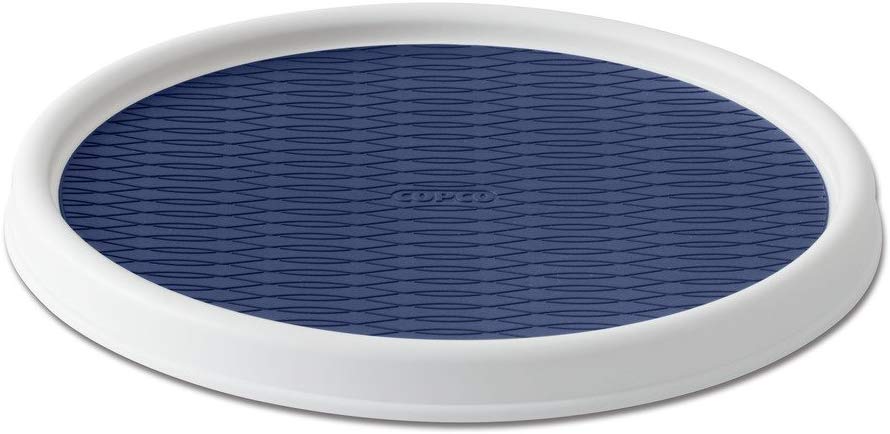
Luckily I’m in the middle of a home remodel, so I’ve got construction scraps and various tools sitting around just begging to be used. I only purchased one item for this project: the turntable.
For less than $7 shipped to my door (thanks Amazon Prime), it was a smoking deal.
The most challenging part of these steering devices is getting the angle right. You can simply place the turntable on the floor under your front wheel, but the results won’t be ideal. You will see your trainer’s legs wanting to “walk” forward as you steer, making it obvious that your steering is putting a lot of stress on your frame.
Your bike behaves this way because your front wheel does not pivot where it contacts the ground. Instead, it pivots at a point several inches ahead of that contact point–where your forks would hit your wheel if they kept extending out.
So your turntable needs to be centered on that pivot point. And although it doesn’t have to be perfect, the closer you get the less frame stress/trainer “walking” you’ll see.
The Build
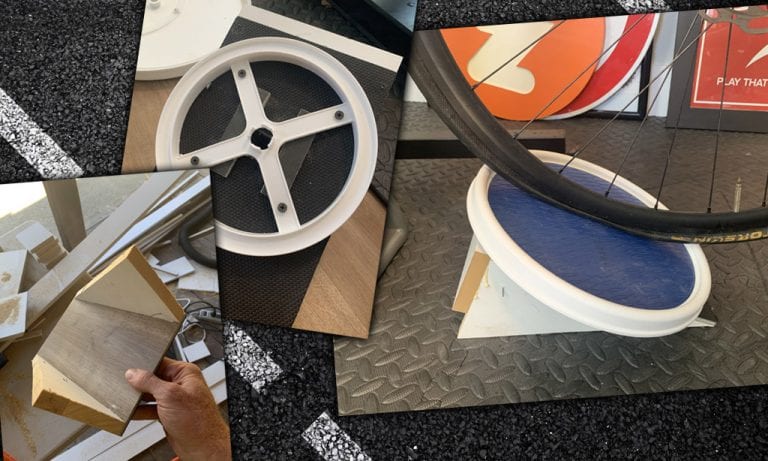
So I started by measuring my fork angle with my iPhone’s “Measure” app. It said 25 degrees–easy enough. So my steering platform would need to be tipped up at a 25 degree angle.
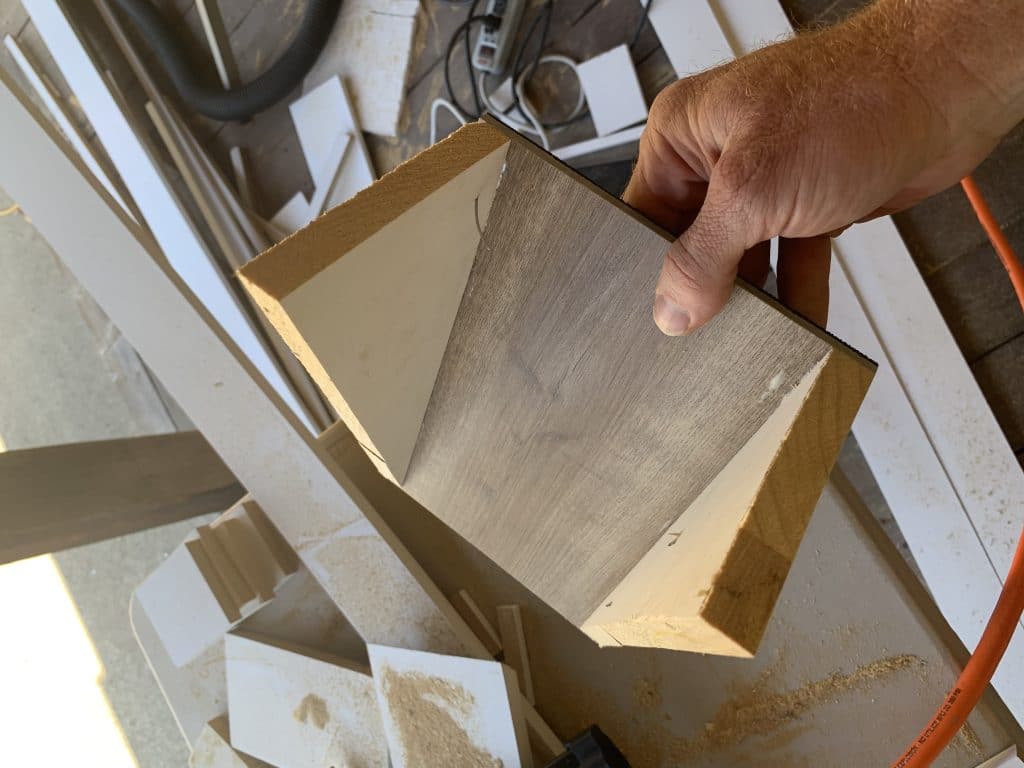
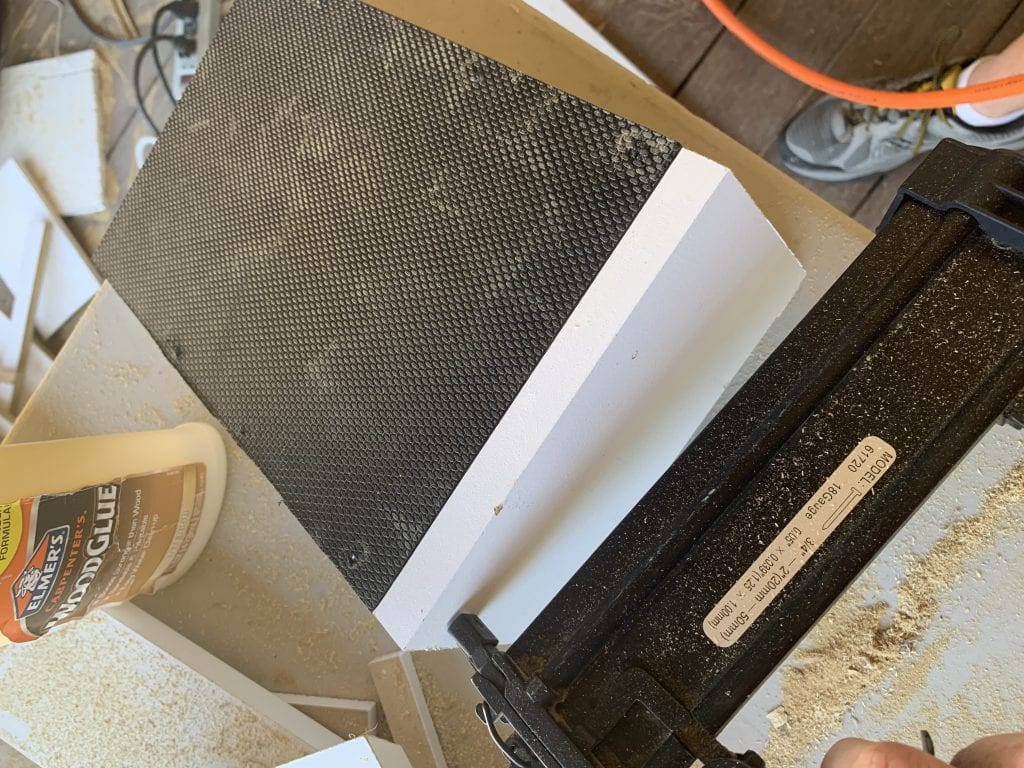
Then I went outside to figure out how I’d build it. Quickly enough I devised a rough plan–use some stiff, thin leftover laminate flooring for the platform, cut angled boards for the sides so it’s tilted at the correct angle, then attach my turntable to the platform.
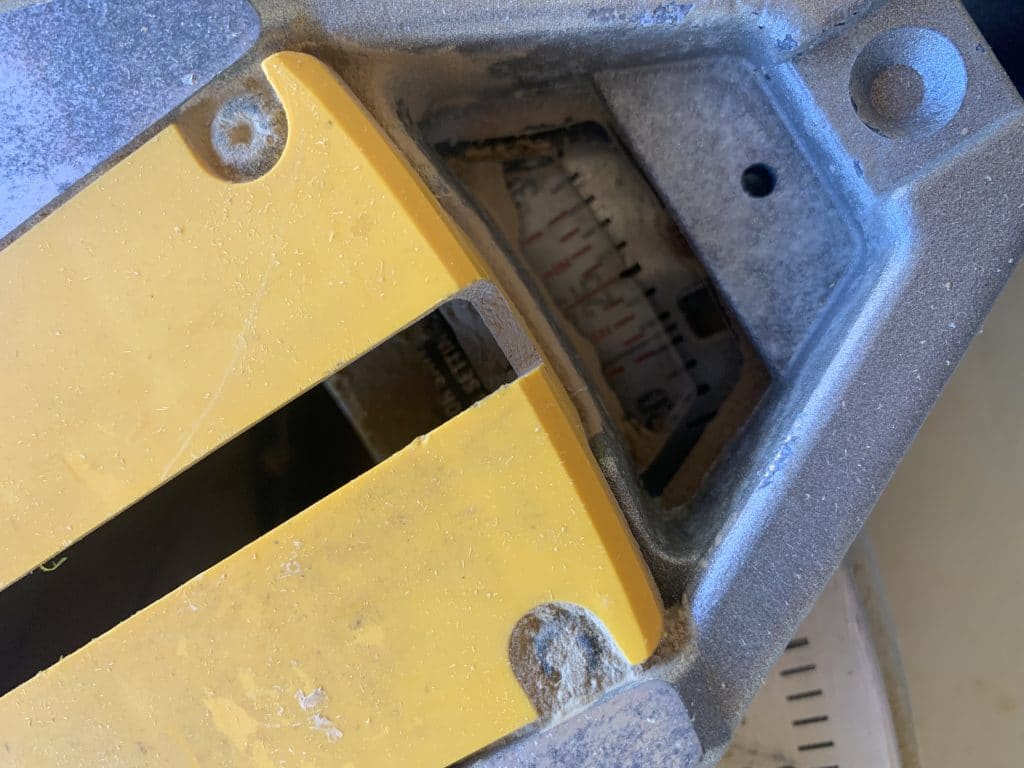
Setting the miter saw to the correct angle
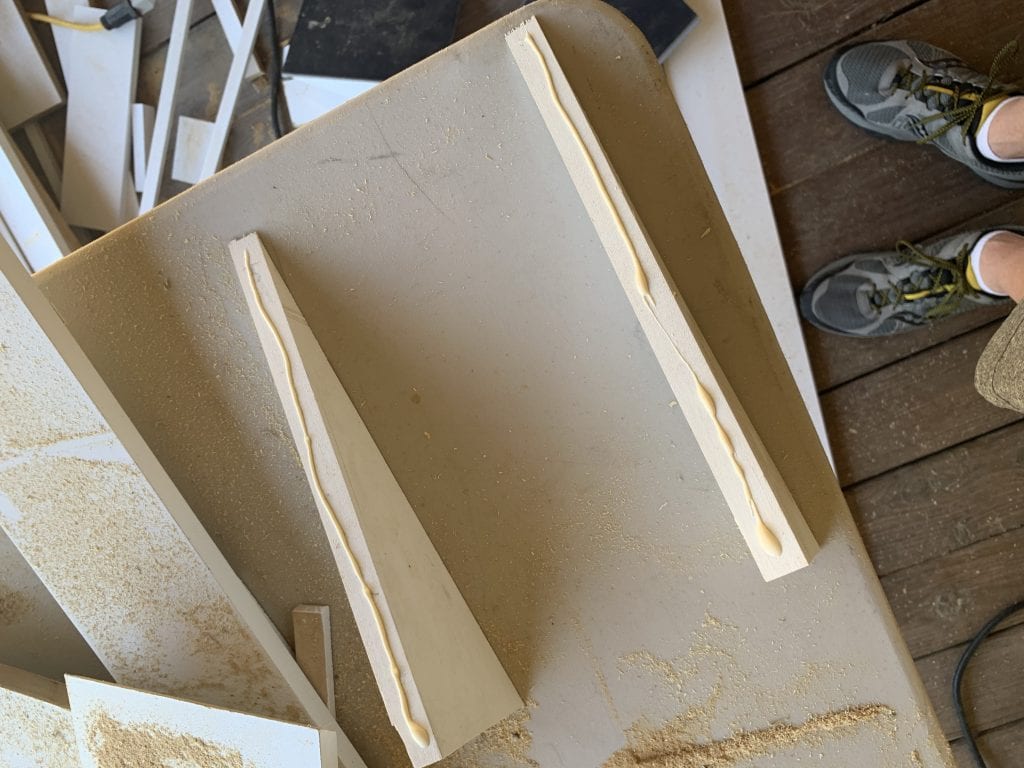
Sides, ready to be nailed to the laminate
Some of those nails went a bit wonky. But it’ll work for now.
Added a piece on the front for stability. Solid as a rock!
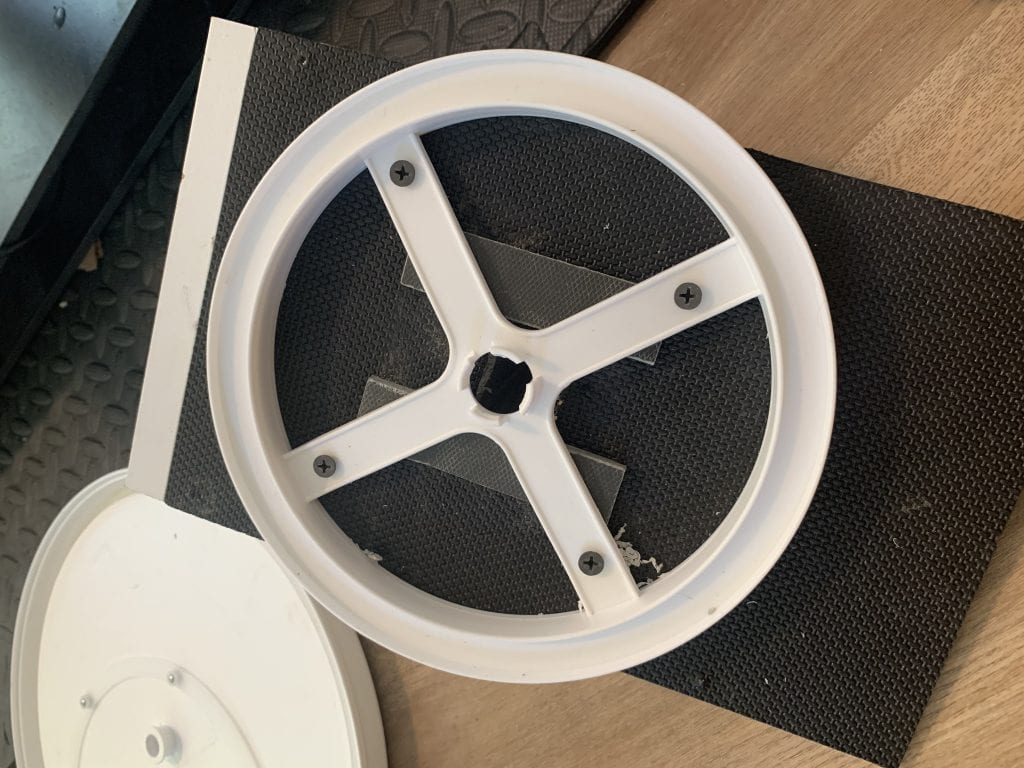
Once I got to work it took all of 20 minutes to piece together. I added an extra scrap to the end for stability, glued it all together, and the end result (before putting the top of the turntable on) looked like this:
Ugly, but functional.
Those extra scraps of laminate flooring are there to shim the turntable’s arms so they didn’t bend (and perhaps break) when screwed into the platform. I also cut a hole in the middle of the laminate so I could remove the turntable in the future without destroying it.
You’ll have to figure out how to best attach whatever turntable you purchase.
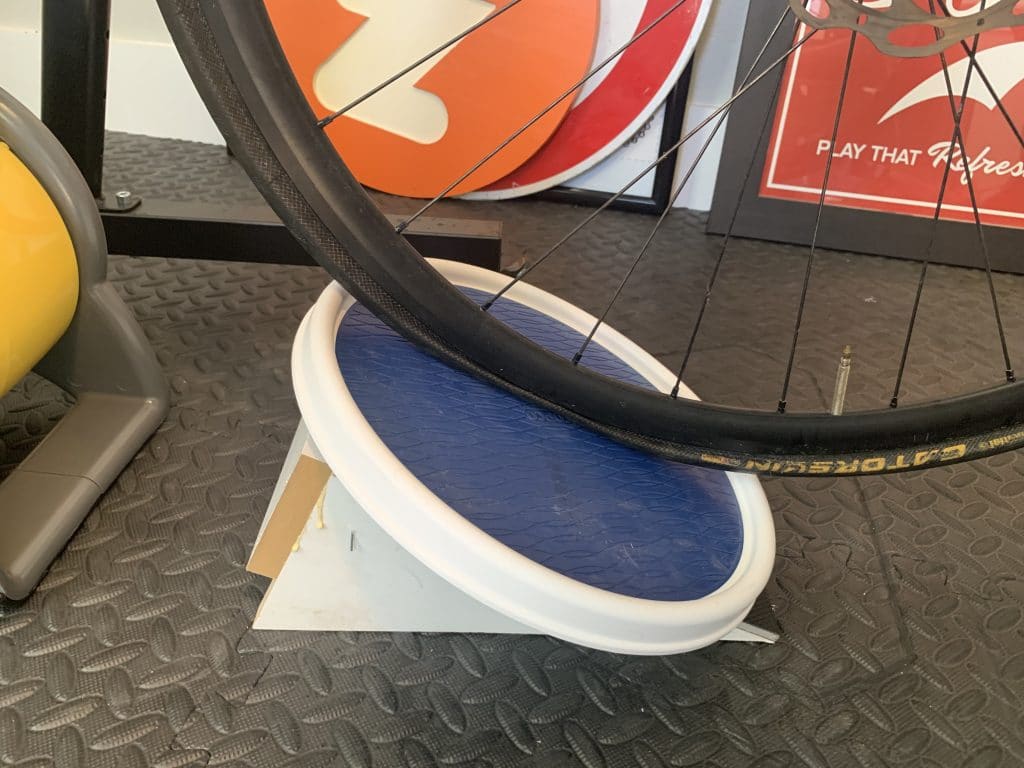
Here’s the finished product in my under-construction office/pain cave. (And yes, I know my tire is flat…)
I was curious whether there would be an issue with the platform sliding forward as I applied downward pressure, but so far it has stayed put. And the steering feels great!
Thanks for Reading
Hope this helps you out if you’re looking to build a simple steering platform.
Got other ideas for how this could be done? Share them below!