Home Blog Page 375

Absa Cape Epic 2020 Race Week Announced

5

The grueling Absa Cape Epic 2020 has been canceled, but Zwift has organized Absa Cape Epic Race week – a series of events focused on “bringing the Absa Cape Epic experience to Zwift!” Of course, these events are nothing like the Cape Epic rides in terms of duration or difficulty – Zwift calls them “Cape Epic-inspired events.” They’ll be as difficult as you make them! And everyone will be riding the Scott Spark mountain bike.

Are These Races?

Here’s the official line from Zwift:

Nope. This is all about celebrating the Cape Epic with the Zwift community. But be warned: some will go full tilt. If you’re into a challenge, you may find yourself riding just as hard as you would in a race. In the end, the choice is yours.

Stages and Schedule

Mar 15-16: TT Prologue - Tempus Fugit, 1 Lap

Mar 17 + 19: Race Week Ride - Jungle Circuit, 2 Laps

Mar 18 + 20: Race Week Ride - Road to Sky, 1 Lap

Mar 21-22: Race Week Ride - Road to Ruins, 1 Lap

See event details and sign up at Zwift.com >


Kit Unlock

Complete any of the events to unlock the zebra-inspired Cape Epic kit.

Complete Your Mission!

Remember, the Absa Cape Epic Mission is currently running on Zwift, where you need to climb 2,850m on the Scott Spark MTB to complete the mission and unlock the zebra-inspired Cape Epic paint scheme. Why not use these events to get your MTB climbing done?

Lessons From the Herd: My First Group Ride

60

Lessons From the Herd: My First Group Ride

For health reasons, I joined Zwift in November 2019 so I could keep cycling year-round. In those beginning days, I could barely do 5 miles. I remember the day I did 10 miles. I thought that was a big deal! I was happy with my progress. At least I was able to ride and I loved the game aspect of Zwift, so it was fun.

One of my local cycling friends who is also on Zwift suggested I should look for group rides because they were a great way to get stronger. I was still trying to learn about Zwift; how things worked, and all the lingo and terminology, so I wasn’t too sure I would do that. But I told her I would consider it.

Not long after that, I was on Facebook, reading posts in some group I had joined called The Herd Cycling. Cute name, I thought. I was looking at their page and it said something about a 1-hour group ride that was between 1.0 and 1.2 watts per kilo. I didn’t know what that meant and I had no idea really what a group ride meant except it wasn’t a race. I had never seen any of my numbers go over 0.8 so I figured it had something to do with that since it was decimals. I thought to myself, what do I have to lose? The worst that’ll happen is that I get dropped. So I went on Companion and clicked to join the ride.

I remember that morning I got up earlier than usual to make sure I was all ready for my first big group ride. I had laid out my cycling clothes the night before. I made sure I had coffee and an extra water bottle. I put a box of tissues and a towel by my bike. I was going to be as ready as I could be for this ride, doggone it.

As I clicked to join the ride, my heart was pounding. I was really nervous. I kept telling myself to relax. You’re going to get dropped anyway. Just ride. It’s not like you’re gonna get lost!

The timer ticked down to zero, the red gate disappeared, and suddenly there was such a flurry of riders that flew past me, I could almost feel the wind from my screen. I felt like I was standing still. I summarily ended up at the back of the pack, and despite all my efforts to hang on for dear life, got dropped in less than a minute.

At that time I was very bad on hills. I’m certainly not great now by any stretch, but I’m a little better than I was then. I didn’t know about spinning. So on the first hill, I was just grinding as hard as I could. I got to the top of that huge 3% hill and was very happy to see far ahead that the rest of the group was flying down a hill instead of climbing another hill around a bend. I just kept going at my own pace because at least I was seeing a new part of the course and it was fun.

I continued down the hill and saw there was a single rider ahead in the far distance. “Wow,” I said to myself, “it would really be cool if I could catch him.” I pedaled like my life depended on it and sure enough, it seemed like I was getting closer. I saw the seconds between us were getting smaller and smaller very quickly. “Damn, I might catch him,” I thought. Sure enough, I caught his wheel, and I was elated. I guessed he was just trying to catch his breath at the bottom of the hill.

“Gee, apparently I’m not as weak as I think I am,” I proudly decided. “This poor guy. He must be really tired. As soon as I can actually breathe again myself, I’ll pull for him.”

Once I reached the rider, I rode in front of him. That lasted a hot 5 seconds until he pulled in front of me. I repeatedly tried to take my turn at the front, but every time he would just go by me to the front. I said to myself, “Aha, the poor guy, he must be embarrassed! He probably feels like he has to pull because here we are, the last two people in this ride, and the guy must be trying to save his pride.” So I most graciously allowed him to stay in front. 

I clicked on his name and saw that he was somewhere around level 30. I thought, “That’s odd. I would think somebody at level 30 would be a little stronger of a rider than I am, but apparently that may not be the case.”

Every time we reached a hill, I got dropped. I pushed up the hills as quickly as I could with my 2 mph massive speed, and every time I reached the top, I could see this guy at the bottom of the hill. I thought to myself, “Wow, he must not be very good at going down hills.” So I would speed up to catch him at the bottom of every hill, and would you believe it, I caught him every single time!

This went on throughout the whole ride. I was very happy about my generosity with allowing this gentleman to feel better about himself, because it surely showed that I was not acting with pride or ego. 

During all this, the chat was very active. I could not type anything into the chat due to a connectivity glitch of some kind on my end, but I could read everything. Suddenly something caught my eye in the chat. Someone said something about going to the back of the pack to act as a sweep. I asked myself, “How the heck do you sweep a virtual road that has no actual debris?” Then someone else said the sweeps are the heroes because they sacrifice their ride to stay with the dropped riders.

Enter epiphany.

I shook my head in self disgust. “YOU MORON!” I yelled out loud at myself. “You didn’t catch him! He was waiting for you every time to ride with you! He’s a sweep, you dingbat!”

I thought to myself, “This poor guy. He could have had a great ride, but instead, he chose to stay at the back of the pack to pull me around, and here I am, thinking I’m all that and a Di2 groupset.” I was ashamed that I had been so pompous and supposedly magnanimous. I was filled with a tremendous amount of respect for this rider. I made sure to remember his name. I was so frustrated that I could not type into the chat to thank this guy. I figured he must have thought that I was totally ungrateful. By that time, I was not feeling very good about myself at all and I was pretty mortified, and glad no one could read my prideful mind through the computer.

As soon as the ride was done I got on my computer and got on the Herd page. I wrote, “If anyone knows K. Kondo, please tell him that my chat wasn’t working but I want to thank him so much for waiting for me throughout the whole ride! He was great!” 

I got immediate responses. Oh that’s Kuni, he’s wonderful. Yes Kuni is a great guy. Kuni is the best. And then I saw somebody named Kuni Kondo comment, “It was my pleasure.” I was so happy to be able to thank him personally! If I could have hugged him through the computer, I would have. 

As a result of this ride, I knew that I wanted to be a part of The Herd. These people truly embodied the spirit of cycling as a group, with no cyclist left behind. I knew this was the group for me. These days, every group ride I’m in, I am very happy to moooo in the chat at the start.

One day I hope to be strong enough to be able to go to the back of the pack and be a sweep, just like Kuni. 

But for now, if you see me at the bottom of a hill, I’m probably just trying to catch my breath.


Zwift Power Zone Colors Explained

Zwift Power Zone Colors Explained

Power Zones are used all over bike training: you’ll see them on head units, training software (like Zwift) and analysis software (like TrainingPeaks, Strava, etc). Typically these zones are colored, giving you an easy visual indication of your effort: beginning at grey or blue for easier efforts and progressing up through green, yellow, orange, and red.

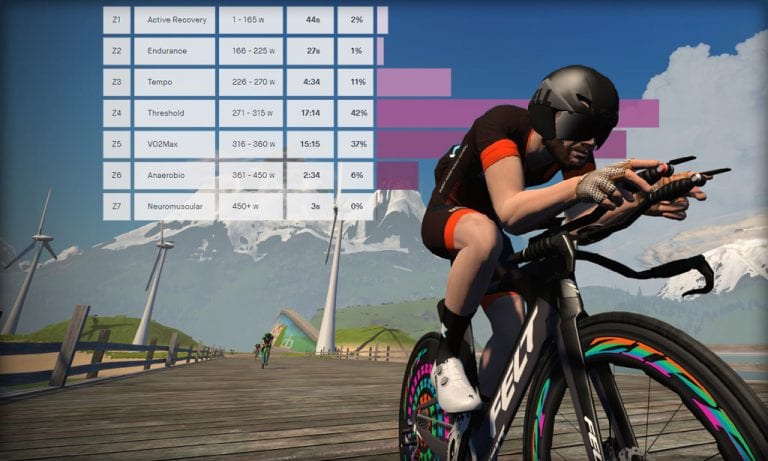
Power zones are calculated as a percentage of your FTP. Here are Zwift’s zones:

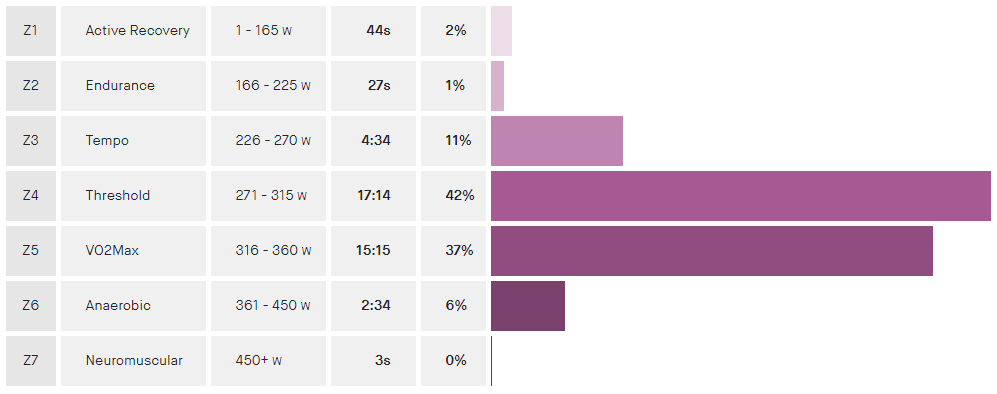
  • Zone 1 (Grey, Recovery): below 60%
  • Zone 2 (Blue, Endurance): 60-75%
  • Zone 3 (Green, Tempo): 76-89%
  • Zone 4 (Yellow, Threshold): 90-104%
  • Zone 5 (Orange, VO2 Max): 105-118%
  • Zone 6 (Red, Anaerobic): above 118%

Watch Shane’s video for a review of these zones, and an explanation of where they show up in game:

Comparison to Coggan Zones

Dr. Andrew Coggan has done so much pioneering work when it comes to training with power on a bike, and his power zones are sort of the “industry standard”. How do Coggan’s zones compare to Zwift’s?

Side note: Coggan prefers to refer to the zones as “levels” since there are not clear breakpoints or switches which move a rider from training at threshold to training at VO2 max, etc. Our bodies operate on a continuum, with different energy systems contributing differing amounts at differing levels.

Training and Racing with a Power Meter, 3rd Edition

Here are Coggan’s levels:

  • Zone 1 (Active Recovery): below 55%
  • Zone 2 (Endurance): 56-75%
  • Zone 3 (Tempo): 76-90%
  • Zone 4 (Lactate Threshold): 91-105%
  • Zone 5 (VO2 Max): 106-120%
  • Zone 6 (Anaerobic Capacity): 121-150%
  • Zone 6 (Neuromuscular): n/a

You can see Zwift’s levels are close to Coggan’s, but not quite the same.

If you’re looking to really dig into training with power, we highly recommend the Training and Racing with a Power Meter book by Hunter Allen, Andrew Coggan, and Stephen McGregor.


How the Race Was Lost: Tour of Watopia, Stage 2

31

How the Race Was Lost: Tour of Watopia, Stage 2

Do you ever have those days where you’re warming up for a race and thinking, “This is going to suck. Bad. My legs are no good today!”

That was me this morning. I had decided to string three events together into a sort of Saturday long ride, aiming for around 3 hours/60 miles of riding on Zwift. My first event was one I’d never done: SMITE (Saturday Morning Interval Training Exercise). It seemed like a decent way to warm up the legs for a race: 60 minutes at recovery pace, with 4-5 intervals in between. It began at 5:55am, meaning it would end 15 minutes before my next event: the Tour of Watopia, Stage 2 race.

I did my usual pre-race prep, chewing a piece of caffeine gum and putting some PR lotion on the legs. Also ate a Clif bar, because I wanted to make sure I stayed fueled up for today’s longer session.

Once the SMITE ride began, I quickly noticed I was not at my best. Whenever we did an interval, everyone rode away from me! And just spinning along my body wanted to cruise at ~150 watts, instead of closer to 200 where I’m normally at. My heart rate didn’t want to come up either, which is never a good sign.

On the plus side, the SMITE ride leaders and crew were hilarious. So that brightened my morning.

I wrapped up SMITE, hopped off to refill bottles and grab a Clif bar, then jumped into the Stage 2 race start pens. Let’s race!

The Start

The start pen was nice and chatty this morning, which was fun

Stage 2 is one lap of the Sand and Sequoias route, just over 14 miles long. Sand and Sequoias is a fun race route because it begins with a lot flat section through Fuego Flats, then takes you onto the rollercoaster that is Titans Grove. This is where the race breaks up, then you’re back onto Fuego Flats for the final flat finish.

I knew my big challenge would be Titans Grove: specifically the KOM section. Based on the SMITE ride, I honestly thought I’d get dropped from the front at that point – possibly sooner.

The race began with a hard effort, but thankfully it was short. I averaged ~370 watts for the first 70 seconds, then we settled into a more sustainable pace, flying along at 28-29mph through the desert. Our starting group of 76 was whittled down to 57 quickly, but nobody was trying any attacks – everyone knew the action would happen in Titans Grove.

Titans Grove

Soon enough we found ourselves climbing up to the redwoods of Titans Grove. This is the most twisty, rolly section of roads on Zwift – in a race you need to stay very attentive if you want to surf the wheels efficiently without getting dropped from the pack. It requires a constant modulation of your power levels to maintain a good position! And that’s all I concerned myself with as we zipped up, down, and around the redwoods – just stay in that front pack.

When the KOM began, one rider put in a hard dig and gapped the group. But no one attempted to chase him down, which was fine with me – that meant our group pace could stay more event, and I was quite sure we’d catch that rider up the road anyway. (We did, on the KOM descent.)

The Titans Grove KOM is an interesting one, because the starting line really isn’t where the climb begins. (Check out the Strava segment.) The road feels basically flat for the first 1/2 mile, then it ramps up in to a steady grade of only 3-4%. It’s a low-grade climb, and that’s important because the pack speeds will still be high, meaning drafting still plays a big part!

We averaged 21.4mph up the climb portion of the KOM, and when we arrived at the top I was amazed to see I was still with the front group which had been whittled down to just 17 riders. Excellent! As a decent sprinter, this was very good news for me.

Besides the KOM, there’s one other little climb you have to watch out for in Titans Grove – it comes just after the descent from the KOM. It’s steep and around 30 seconds long. If you’re not wanting to attack of the front, just plan to go hard here, staying out of the wind but well-positioned in the pack. That’s all I did, and the group was surprisingly tame.

The Finish

We turned onto the desert road, settling into an even pace and recovering for the final effort. And I had a decision to make. I was holding my first-ever ghost powerup, and I had to decide if and when to use it!

The ghost makes you invisible for 15 seconds, so it’s really only useful if you want to attack off the front without others following. The problem was, I knew I couldn’t attack off the front early and stay away from this fast group. So I decided I would use the ghost when I made my final sprint jump. I would begin my sprint well within the pack, without going into red numbers so as not to draw attention to myself. I would pick up speed through the pack, and activate the ghost when I hit the front of the pack so I could invisibly shoot off the front to glory.

All went according to plan, until my legs ran out of juice on that ridiculously long final sprint section. This happens on every race here – someone jumps too soon, then gets swallowed up by the pack. That someone was me today.

I finished 6th in Zwift’s results, 4th on ZwiftPower.

See my race on Strava >
See my race on Zwift.com >
See race results on ZwiftPower >

Takeaways

Two important takeaways for me today:

  1. Don’t let powerups dictate my race strategy. If I’d had an aero helmet or van or no powerup at all I would have waited to open up my sprint. The ghost pushed me to go early, and that was a mistake.
  2. I can have a good result even if my legs don’t feel great beforehand. I’m not sure what was going on during the SMITE ride, but in the race as well as the ToW group ride I did right afterward, my legs felt good. Maybe they just needed a long warmup. Between the three events I did and a bit of riding in between I ended my morning with 58 miles, feeling great.

What About You?

Have you raced stage 2 yet? How did it go? Share below!

The Fence: Where It Went, When It Will Return, and Why It’s Needed

150

The Fence: Where It Went, When It Will Return, and Why It’s Needed

If you participate in group rides on Zwift, you’ve probably noticed that the fence hasn’t been in use for the past few weeks. What happened, and is the fence returning? We reached out to Zwift HQ for answers!

Intro to the Fence

The fence’s functionality is quite simple from an end-user’s perspective. The ride leader is able to set how far ahead of themselves the fence appears (default options are 2 seconds, 5 seconds, or 10 seconds). They can also turn the fence off.

If you are far enough behind the fence you won’t see it at all, but if you get close enough you’ll see the red “wall.” Ride through the fence and a countdown warning pops up telling you to return to the group within 1 minute.

If you don’t return to the group within a minute you are automatically booted from the ride.

The Broken Fence

On February 20th, 2020, ride leaders were informed that Zwift was disabling the fence immediately. Here is what Zwift said about the reasons for disabling the fence:

Why did we turn off the fence?
In certain situations and conditions, a non-trivial number of users were being removed from events, even though they were well behind the fence or the leader. In other words, even though some users were riding well, they were still getting removed. Since this is not a good experience for those users, we temporarily removed the fence feature from group rides.

Any Zwifters who regularly participate in group rides can confirm the truth of what Zwift said – there were definitely riders getting booted by the fence even though they were staying behind it. And nobody wants that!

The fence still exists in-game, it’s just disabled for all events. A few events, in fact, have accidentally had the fence enabled in recent days! But this isn’t Zwift testing anything – it’s just an event that wasn’t quite set up properly.

When Will the Fence Return?

This is the question many Zwifters and especially ride leaders are asking. Here’s what Zwift told us yesterday:

We have tracked down a few issues that we feel were impacting event fences and fixed those issues. We’ve also added telemetry specifically for fenced events to get more data if new issues arise. We will be turning the fence back on for select rides with the upcoming game release scheduled for the end of March.

ZHQ will be actively monitoring the rides to evaluate the fixes we’ve put in place. Once we are confident that we’ve solved the issues, the fence will be made available to all rides that wish to use it.

So that’s good news: Zwift has obviously prioritized fixing the fence, and it looks like we’ll see it when the next update arrives at the end of this month.

Do We Need the Fence?

The fence being turned off has led to discussions within the community about whether or not the fence is needed. Some riders like the “freedom” of no fences, while others like the more controlled groups created by the fence. Who’s right? Do we need a fence?

To be sure, some group rides don’t need a fence: long events like Zwift centuries, for example, typically work better if groups are allowed to form naturally. And a small number of group rides use categories as pace groups, allowing riders to select the pace they want to ride.

That said, group ride leaders are overwhelmingly in favor of bringing the fence back. Why? Because without it, group rides get strung out, gaps form, and someone will inevitably complain that the pace is too high even though they’re riding off the front well ahead of the leader’s group.

Here’s a screenshot of me leading this morning’s Pacific Sprintapalooza ride. As you can see, our group was rather small (64 riders), and it routinely split, with half the group riding several seconds ahead. This isn’t what we want for a ride like Sprintapalooza, where the intent is to spin together between group sprint efforts.

In this morning’s ride, the front group was pretty good about returning to the beacon group when I messaged and asked them to ease up and join us. But that’s not always the case, and I would much rather have the group just stay together without constant messaging. (Ride leaders prefer to use their messages to provide encouragement and banter, not to corral those off the front.)

With the fence enabled, group rides stay together as a pack. With it turned off, group rides split into multiple pace groups. For some rides that’s ok – for others it is not. Simple as that!

Your Thoughts

Have you missed the fence, or are you happy it’s gone? How can ride leaders best control their rides in the absence of a fence? Please share your thoughts below!

Couch to Route Hero, Week 8 Done

Couch to Route Hero, Week 8 Done

Editor’s note: Monica is undertaking the “Couch to Route Hero” challenge of riding all 67 “free-ridable” Zwift routes (and getting all the badges) in 11 weeks. Each week she shares her story of the previous week’s struggles and accomplishments. Follow along on her journey, take the challenge yourself, and be sure to give her a Ride On if you see her on course!


After taking a rest week it sure was amazing to get back into the challenge! Even more amazing were the messages you all have been sending me as I ride or after I post about a ride. I hope you’re all messaging others in the community to spur them on too, because it’s so motivating to receive encouragement from others! Like I keep saying, “We’re stronger together!”

The Week Lined Up

Because I rode 1 route during my rest week I only added 4 new badges this week, But that brings me to a total of 52 badges! There’s only 15 more, which I can’t believe! (We won’t discuss the fact that I have many very difficult routes left!)

I rode 84.82 miles, with 9,807’ of climb which took me 8 hours and 21 minutes. 

Routes completed: 

Lots of people headed up the mountain in Innsbruck, which was fun! I got 944th out of 951 people. I guess staying in Zone 2 isn’t the way to beat everyone else up the climb!

Tour of Fire & Ice

Tour of Fire & Ice starts in the volcano and ends at the top of the Alpe. It’s not too horribly bad compared to some rides, although I am getting a little tired of that Alpe! I believe with the routes I have left I’ll only have to go up it 2 more times… of course those are both 5+ bidon routes. (I should NOT have researched that info!) 

When the wheel at the top of the Alpe spun I thought SURELY it was time for me to get the Meilenstein Wheels. Alas, I got another helmet (and 250XP for getting a helmet a second time)!

I also noticed some people were climbing the Alpe on mountain bikes. Come to find out, they were working on their Absa Cape Epic Mission. Heavens! I’m slow up the Alpe even with my sweet Specialized Tarmac Pro with Enve SES 3.4 wheels. I can’t imagine how slow I’d be if I was climbing with a mountain bike. Kudos to them!

London’s Surrey Hills

I actually didn’t mind Surrey Hills too much. You just have to know ahead of time that the lead-in is a trip up Fox Hill (which happens to be my favorite hill in London). Just count your climbs as you ride. A total of five. No big deal! 

If lead-ins throw you off, here’s my one tip: pay special attention when you first click on the route in Zwift. It’ll animate on the map what direction you’ll go. The blue parts are the lead-in, with the white being the rest of the route. 

Next Week 

This will be a big week for me as both The Mega Pretzel and Four Horsemen are scheduled. Honestly though, with all this Coronavirus talk all over the world I may have to throw in extra rest days in the last 3 weeks of this challenge. I don’t want to deplete my immune system just so I can write an article about it. I’ll take it one ride at a time and watch what happens with the virus in our part of the world and go from there!

How about you?

What did you ride this week? What are your plans for next week? And has the Coronavirus affected your riding in any way?


Zwift Ranked #6 “Most Innovative Gaming Company” by Fast Company

4

Zwift Ranked #6 “Most Innovative Gaming Company” by Fast Company

Fast Company has released it’s top 10 list of most innovative gaming companies, and Zwift came in at #6! Here’s what Fast Company had to say about Zwift:

For turning the stationary bike into a video-game controller, with users collectively peddling 1.5 million miles daily

Where Peloton devotees essentially participate in online spin classes, Zwift users compete against one another in massive online races that combine real-world team cycling tactics with bonuses and power-ups. Users, who pay $15 a month to use the service, can attempt to out-pedal one another in races that take place everywhere from the Italian Alps to the streets of London to the game’s made-up city, Watopia. The company boasts that a third of the participants in the real Tour de France use the game to train.

Notably, Fast Company’s writeup focuses entirely on the esports side of Zwift, which is just a small part of what Zwifters actually do on the platform. But this makes some sense, since it’s the ability to ride with others that really sets Zwift apart from other platforms.

Riders can use any number of tools to get their training done indoors, even in a beautiful virtual world. But training with thousands of others? You’ll need Zwift for that!

Additional companies listed include Roblox, Apple, Microsoft, Level Ex, Two Bit Circus, Epic Games, 100 Thieves, Exploding Kittens, and Nerd Street Gamers. Read Fast Company’s full article >

Congrats to everyone at Zwift HQ!

Note: in 2019, Fast Company ranked Zwift #5 on its list of most innovative companies in the Sports sector.


Mitchelton-Scott Announces “Where the World Rides” Series Schedule

3

Mitchelton-Scott Announces “Where the World Rides” Series Schedule

On the heels of Sunday’s successful “Homage Gravel Ride” (watch Shane Miller’s ride video) which saw over 1300 Zwifters hit the Jungle with 30 of Mitchelton-SCOTT’s pro men and women, the team has announced a slate of 16 more events.

The Bike Exchange “Where the World Rides” series is being organized by Mitchelton-SCOTT because the team has pulled out of upcoming races due to COVID-19 concerns. The series “is aimed at keeping riders and team staff stimulated during the non-racing period, as well as providing a unique opportunity for cycling fans to ride and interact with their favourite stars.”

The events haven’t yet been added to Zwift’s official calendar, but we expect them to show up soon! Here’s the schedule:

Event Details

Wondering what each event above entails? Here’s what Mitchelton-SCOTT says about each type of event (which isn’t much). We may update this page as more info becomes available, but you will want to read the details of each event once they’re available on Zwift’s calendar.

A number of the events will be streamed live by Zwift and on the Mitchelton-SCOTT Facebook page.

Pace and Race

2018 Vuelta a Espana winner Simon Yates and double New Zealand time trial champion Georgia Williams will lead two ‘pace and race’ specific rides.

Pro Workout

Fans will have the chance to join in a ‘Pro Workout’ as they train alongside the pros in workouts designed by the team’s coaches. 

Mountain Goat Challenge

Australian road race champion Amanda Spratt and recent Vuelta a Andalucia stage winner Jack Haig will lead these rides.

Exclusive Fan Race

Zwifters will have the unique opportunity to win an entry to race in teams with the pros in an exclusive competition. 


Reverse Weight Doping, Efficiency, and Race Categories on Zwift

122

Reverse Weight Doping, Efficiency, and Race Categories on Zwift

Lowest w/kg in the bunch!

Am I super-efficient, or just heavy?

That was my first thought when a fellow Zwifter commented on my recent race, “Somehow you always get your w/kg down. Great drafting skills!”

Here’s the thing: I probably am a fairly efficient racer, when I want to be. I’ve done multiple races where my main goal was to keep the watts as low as possible while hanging with the front group. I did this because I had a particular effort level planned for my workout that day, and didn’t want to exceed it. But I also did it because I knew it was great practice! Conserving energy is a key part of successful bike racing. (It’s not the only part, of course! Knowing when to go hard and having the fitness to do so are also vital skills.)

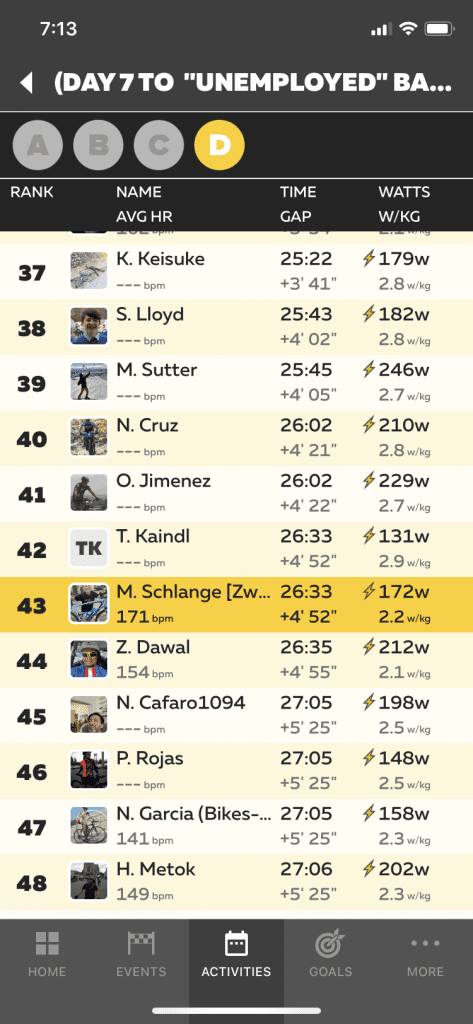
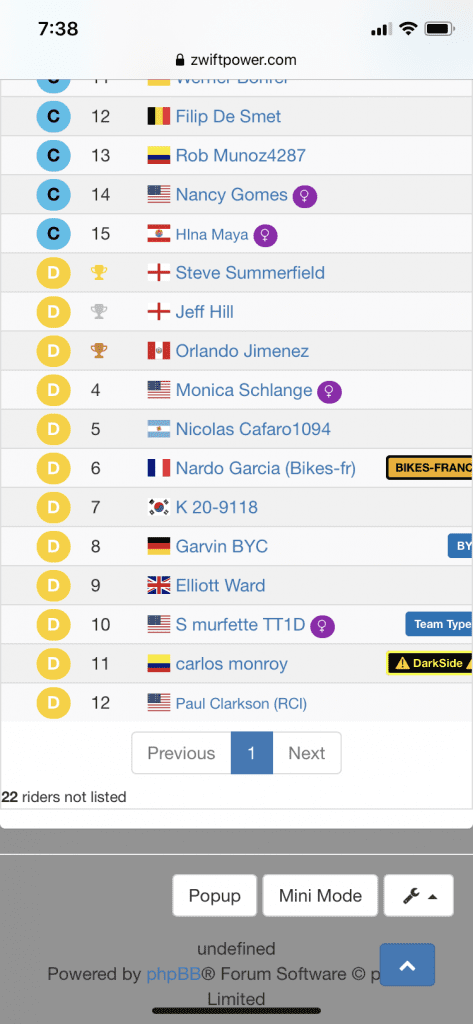
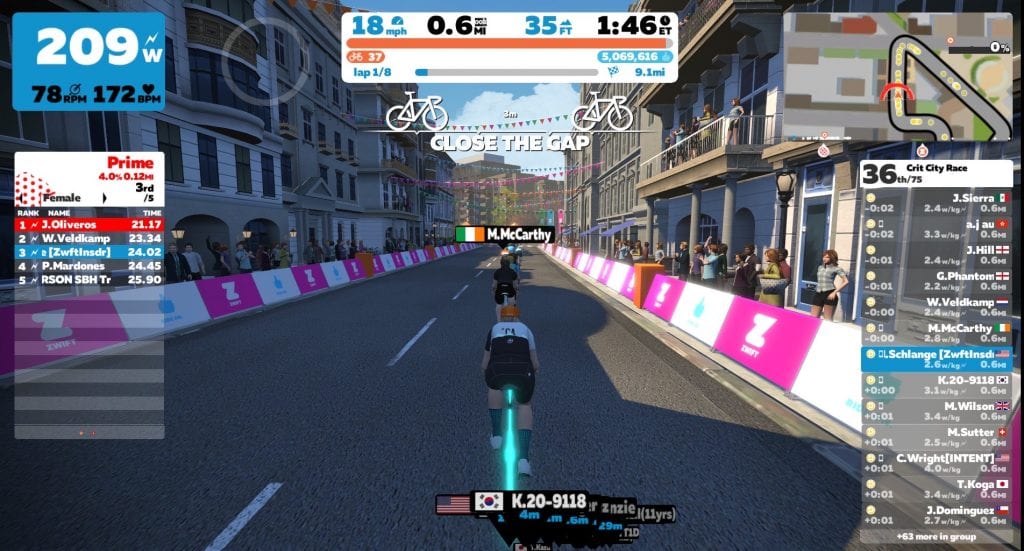
My best race results as a Zwift B are on flatter routes, and I find my watts per kilo are consistently lower than most of the riders around me. A recent Crit City A Race is a very good example of this: I finished in the front pack, sprinting it out for 9th place. My 3.9w/kg (a new PR!) was the lowest of top 15 riders. In fact, the only riders at or below my w/kg were minutes off the back.

So am I a super-drafter, the king of indoor efficiency? I don’t think so. I think I’m just heavier than my competition. Case in point: in the A race I mentioned, only one rider was heavier than my 85kg dad bod.

Which brings me to today’s topic: reverse weight doping.

Weight Doping: an Introduction

On Zwift, “weight dopers” seek to gain an advantage by entering a lower-than-life weight into their Zwift profile. Since we know that lighter weight=higher virtual speed, this is a very easy way to cheat the system on Zwift.

Weight doping is a key challenge for cycling esports to overcome, and it’s one reason why many “big” races (e.g., those with prize money) require riders to show up and weigh in on-location in a supervised environment. It’s also why the Zwift Transparency Facebook group was created, where racers post videos of themselves weighing in using a particular protocol which makes it difficult to fake your numbers.

Some weight dopers are obvious and blatant – other times it’s much less egregious. Example: have you ever purposely avoided weighing yourself (especially you who have a Withings scale that automatically updates your Zwift weight) because you know you’ve put on a few pounds over the weekend? I know I’ve done it!

Some Zwifters go so far as to social-stalk other riders, comparing their photos to their Zwift weight and calling them out for weight doping. (I don’t recommend this approach, but it proves the point that weight doping is an issue that concerns many Zwift racers.)

Reverse Weight Doping

So what is “reverse” weight doping? Well, it’s adding weight to gain an advantage. “How does being heavier help a cyclist?” you may ask. Good question. It all has to do with the way Zwift’s racing categories work. The categories currently used in most Zwift events are based on your FTP watts per kilo–that is, your FTP in watts, divided by your weight in kilograms. (Example: if your FTP is 300 watts and you weigh 75kg, your FTP w/kg would be 300/75, or 4 w/kg.)

The race categories end up looking something like this (taken from the current Tour of Watopia race events):

  • A: 4-5 w/kg
  • B: 3.2-3.9 w/kg
  • C: 2.5-3.1 w/kg
  • D: 1-2.4 w/kg

ZwiftPower, home of official race results for community races, adds some pure wattage breakpoints to the above list to help lightweight riders stay competitive. But for most riders watts per kilo rules the day, determining which category you race in Zwift. And this is why reverse weight doping is a thing.

How does it work? Well, imagine you’re a strong C racer. You weigh 80kg and have an FTP of 248 watts, which works out to 3.1 w/kg. But you’re training and racing and getting stronger, and eventually your FTP improves to 260 watts, which is 3.25 w/kg. Nice work! But there’s one problem: this puts you into the B category, and you don’t want to race the B’s. You’re having fun winning (or nearly winning) C races!

What’s the cheater’s solution? Gain a few (virtual) pounds. Bump your Zwift weight up to 84kg and even with your new and improved 260-watt FTP you’re only at 3.1 w/kg! You’ll move a little slower with the added virtual weight, but you’ll be able to hang with the front of the C’s instead of getting shelled off the back of the B’s.

Scale of the Problem

How big of a problem is reverse weight doping? I have no idea. I’m sure it happens, but I would guess it’s pretty rare – certainly less of a problem than “normal” weight doping.

But it highlights a bigger problem, and that is the fundamental flaw of using watts per kilo for race categorization. When a rider can change categories by modifying their virtual body weight, that’s an issue. It points to the need for a results-based categorization system, which I discussed a month ago in the final post of my race category series.

When It’s NOT a Problem

I should mention: many Zwifters have “lied” about their in-game weight for perfectly acceptable reasons. If it’s not done during a competitive Zwift event, I don’t see it as a problem. You do you. I once made myself much heavier so I could compete against my 11-year-old son in a head to head Zwift climbing race. He had fun laughing at fat dad, but I pipped him at the line!

If you’re a 300-pound dude who wants to go a little faster uphill as a virtual 200 pounder, have at it. I wouldn’t personally do it since it throws off training metrics and just… isn’t true. But you’re not affecting anyone else’s experience. Weight doping is only a serious issue when it’s done in competition.

Your Thoughts

Are you efficient, or just heavy? Do you believe weight doping (reverse or otherwise) is a big problem in Zwift racing, and if so, what can be done about it? Share your thoughts below!

Video: Elite Sterzo Indoor Bike Steering Device

Video: Elite Sterzo Indoor Bike Steering Device

We knew it was only a matter of time before someone produced a decent, affordable steering device. Elite has done it!

Our favorite Lama recently posted a review of the Elite Sterzo, a device that goes under your Zwift setup’s front tire so you can safely move the handlebars when using Zwift’s FutureWorks steering capabilities.

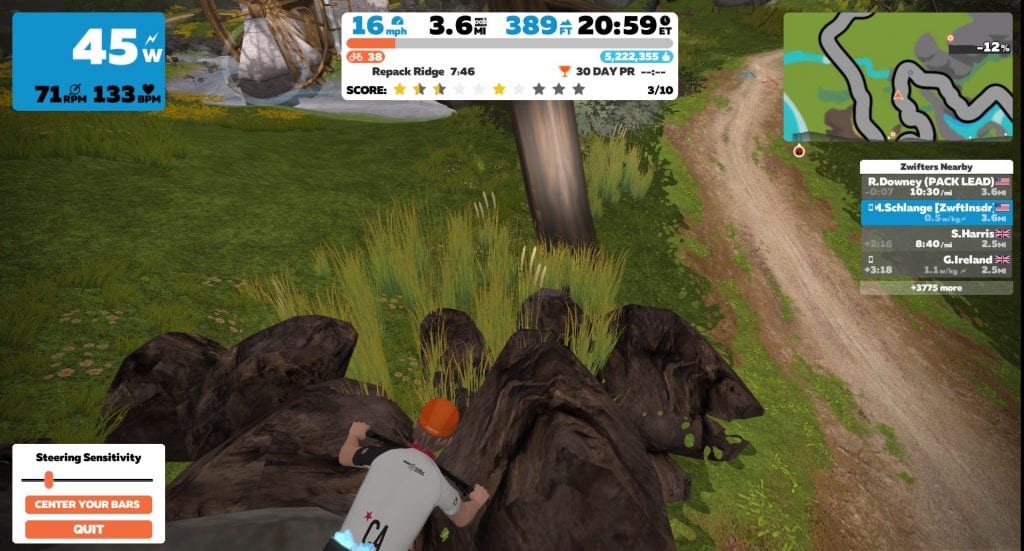
Watch Shane put the Sterzo through its paces on Watopia’s Repack Ridge course:

Initial pricing from Elite for the Sterzo (mechanical version as shown here): Europe: €39.99, UK: £34.99. (It is just now coming onto the market, so pricing/availability isn’t entirely clear.)