Kristin Armstrong talks with TWENTY20 General Manager Nicola Cranmer. With 16+ years at the helm of women’s pro cycling teams, we count 4 Olympic medalists and 17 World Champions with her backing… and more trophies on the way.
Her show-stopping women of TWENTY20 are regular Zwift users, smashing max power limits and honing their mental game. Nicola also looks into her crystal ball and offers predictions for the future of bike racing.
Zwift released a minor update to its Companion app yesterday. Here’s a quick video from our favorite Aussie Lama summarizing the changes:
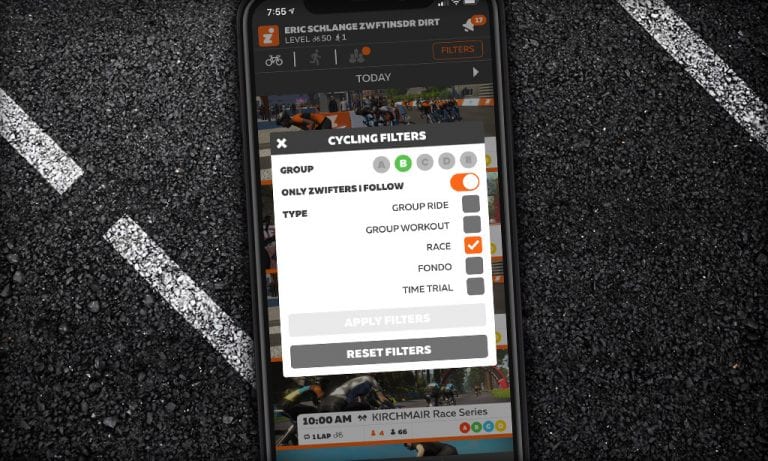
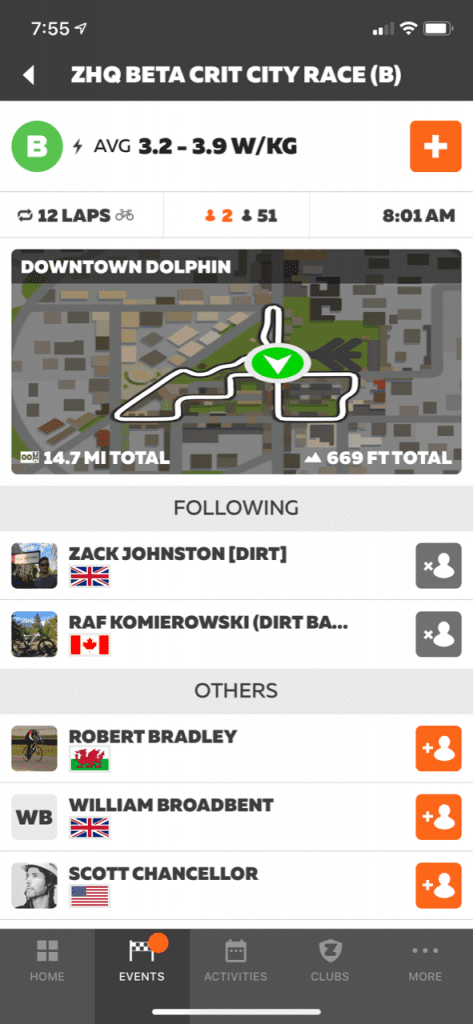
“Only Zwifters I Follow” Event Filter
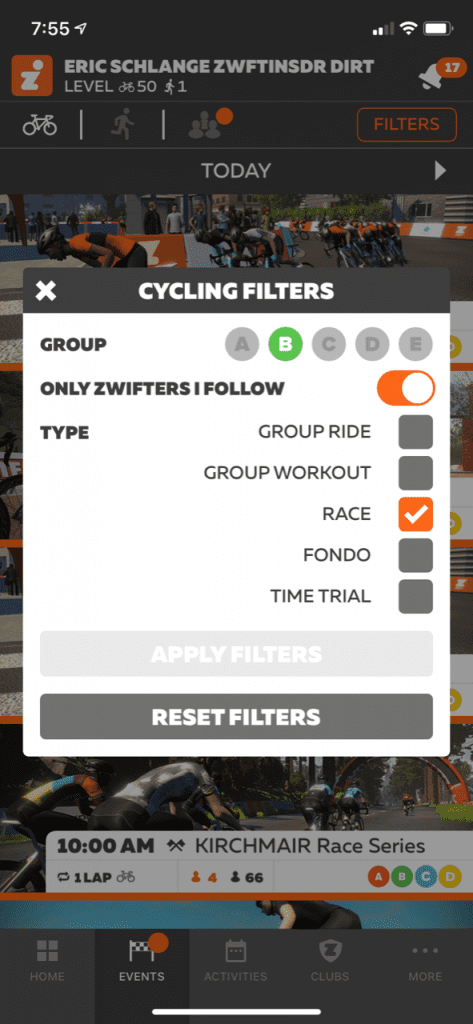
When the new “Only Zwifters I Follow” filter is enabled, events will only show up if one or more Zwifters you follow are signed up for the event. This makes it easier to join friends on upcoming races or group rides!
Filtering for B races
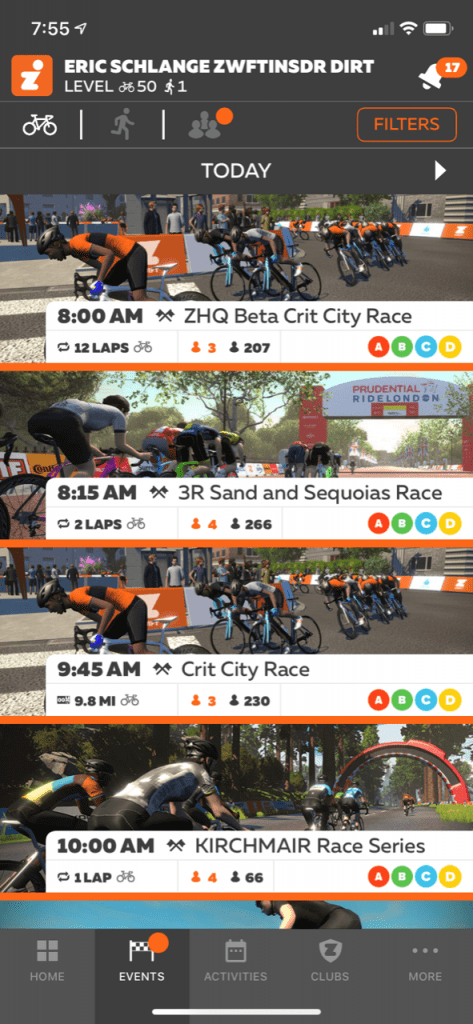
Filtered results
Two friends are signed up!
Add Events to Android Calendar
You can now add Events and Meetups to your device calendar on Android. Great news for the Android crowd!
iOS Version Note
It’s worth noting that Zwift Companion version 3.15 (and 3.14, actually) on iPhone/iPad require iOS 11 and newer. If you are on iOS 9 or 10, you will only be able to go up to Companion version 3.11.1.
Opportunities to challenge oneself are always abounding on Zwift. There are big Zwift events, as well as unofficial events and solo challenges. Here are 5 events this weekend you may want to check out.
Special thanks to Jesper at ZwiftHacks with his Events app which provides powerful event filtering tools that help us create this list each week.
Haute Route Dolomites Challenge
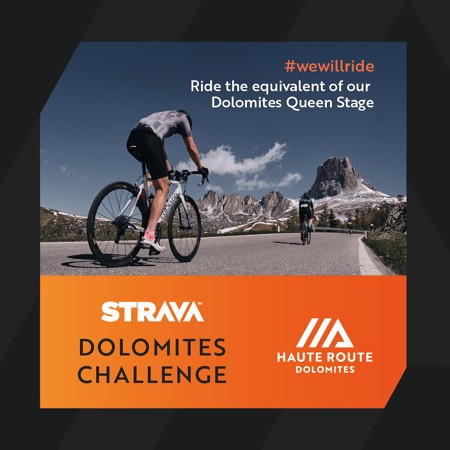
This is an individual challenge, not an official Zwift group event. The challenge? Climb 3300m in a single ride between 12:00am Friday 12th June and 11:59pm Sunday 14th June in your local timezone.
To mimic the elevation of the Queen Stage for Haute Route’s canceled 2020 Dolomites event, riders must climb 3300 meters (10,826′) in a single ride in order to complete this challenge. The challenge only runs from Friday-Sunday in your local time, too, so you’ve got to plan accordingly.
What does 3300 meters look like on Zwift? Well, you could ride:
3x up Alpe du Zwift, plus another 194m
Almost 8x up the Epic KOM forward (or almost 6x if you include the Radio Tower “bonus climb”)
More than 24x up London’s Box Hill
66x up Watopia’s first climb, the Hilly KOM!
If you complete the challenge (and jump through the hoops of filling out a form or two) you will be entered into a drawing for a 3-day Haute Route event in 2021, plus prize packs from Precision Hydration. Be sure to visit the link below for details, so you can get registered properly.
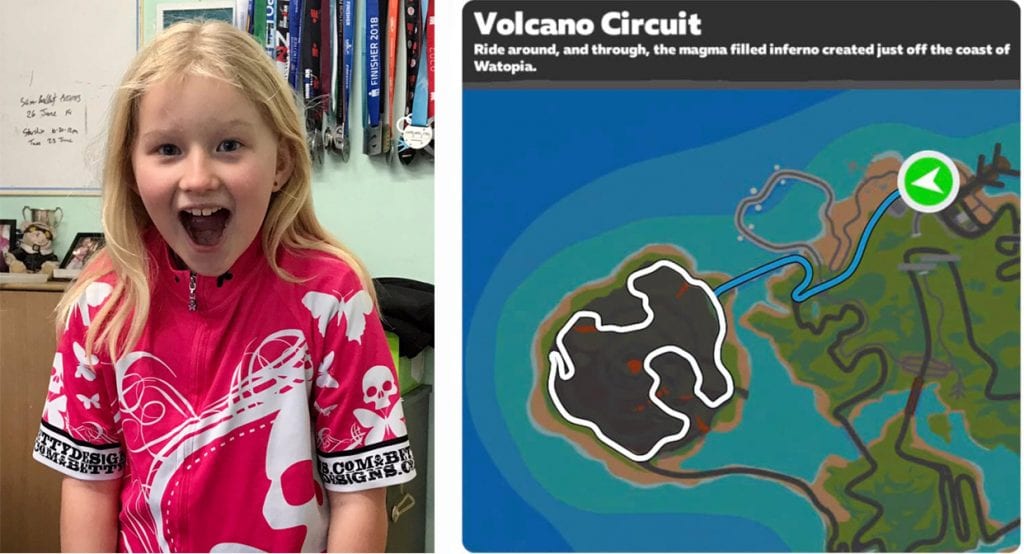
You may remember 8 year old Samantha Frost from her Tour of Fire and Ice ride last month. She is cycling to battle arthritis in her knees and back, and this weekend she’s taking on the challenge of riding 25 Volcano Circuit laps. That is a full distance of 102.5km or 65 miles!
Zwifters are invited to join and support her. This is a great time to earn that “On Fire” badge, too! (Join Samantha by looking up “Samantha Frost (age 8) on the Companion app and sending a follow request.)
Ride organizes say, “We are also asking people to sponsor her for each lap she completes. As much or as little as you like. The only thing we ask is that the money she raises is sent to your own local arthritis association of Your choice in her name or the Everyday Hero page below.”
This is not an official Zwift event. Sammy begins at 7:30am New Zealand standard time, which is Saturday 8:30pm BST/3:30pm EDT/12:30pm PDT. Learn More >
Catrina’s Ladies Only Century
Ladies, join ride leader Catrina Weiss for a 100-mile ride on Watopia’s Waistband! Catrina says, “This is NOT a NO DROP ride. With that said we do try in my rides to keep the pace steady and drop back if we know early enough to bring back dropped riders. We encourage all women who have done 59+ miles on Zwift or IRL to join this ride as it will be super fun.”
Jonathan Parker and Matt Bottrill are undertaking a 6 hour non-stop Zwift challenge to raise £2,000 for Cyclists Fighting Cancer. Support this effort by making a donation and/or joining Jonathan and Matt for some or all of the 6 hours of pedaling!
Jonathan Parker holds the official world record for the fastest solo cycle ride from London to Paris (12 hours and 31 minutes). Matt is a multiple National Time Trial champion who has set some of the fastest times ever ridden in the UK.
Hot tip: they’ll be riding London’s PRL Full Route, so if you complete the route you’ll only have another ~800 meters of climbing left to complete the Haute Route Dolomites Challenge (see above)!
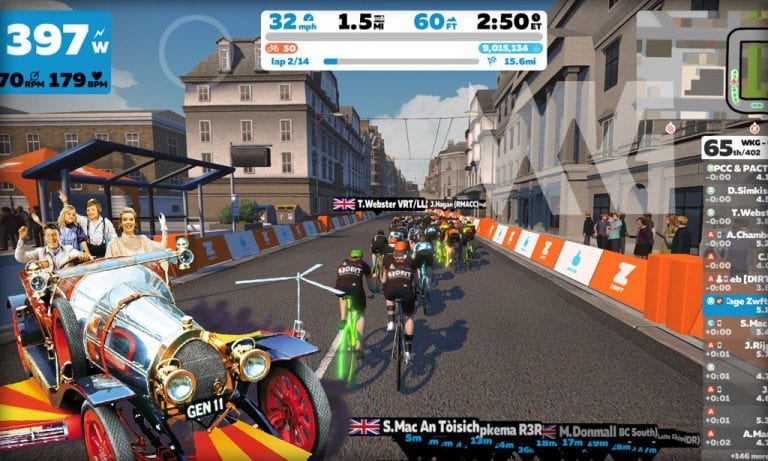
I’m a sucker for slick design. I’m also a sucker for wordplay. So when I first saw the branding behind the WKG events, I thought, “I should try those out. They look pro.” Then I saw the race named “Critty Critty Bang Bang” and I knew it was only a matter of time before I found myself in those start pens!
This was the day. And it was going to be a crazy race. There were hundreds of riders signed up for 14 laps of Downtown Dolphin, and all categories would be visible, which meant I’d be pushing to my max to try to hang with the stronger A’s as long as possible. Let the suffering begin. For PR’s! For glory!
The Warmup
This was a mid-morning event for me, which meant I was able to eat breakfast and get a decent warmup instead of rushing around a dark house at 5am. Refreshing!
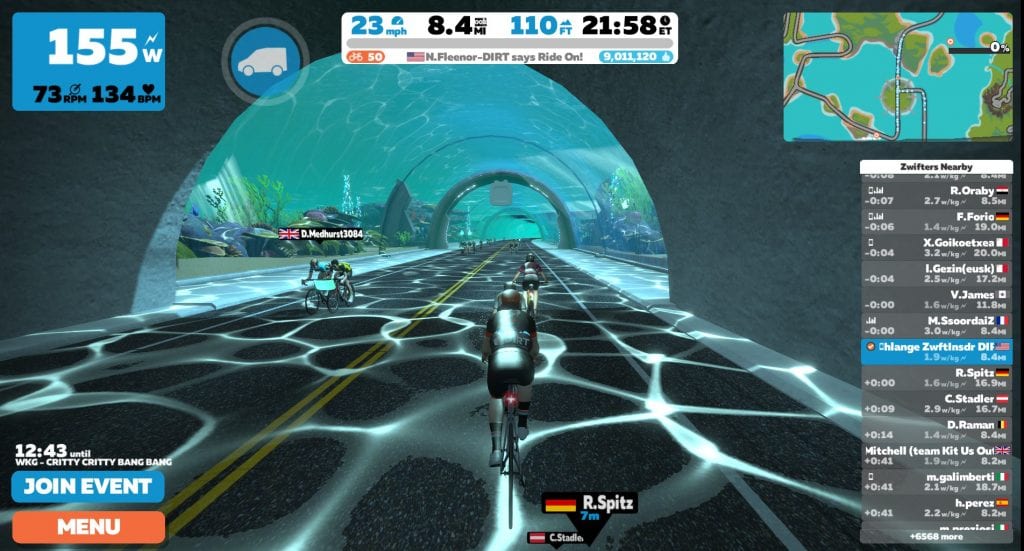
As usual, I chewed two pieces of caffeine gum and rubbed some PR lotion into my legs. Then it was off to Tick Tock for a 30-minute warmup. But as I rode through Fuego Flats I started looking at the signup list for this event, and realized that there were a lot of riderssigned up. Over 100 B’s, nearly 100 A’s, and that didn’t include those who would just show up last-minute without signing up.
This was a combined-category race, meaning we would be able to see all riders from all categories, but we would be scored in ZwiftPower based on our category. That meant the B podium would probably belong to the riders who were able to hang with the faster A’s longer than the other B’s. With a big and strong A field I didn’t think I’d be able to hang with the front for the entire race, but I decided I would push until I blew up in order to hang with the front as long as possible. Because you don’t know your limits until you truly push through them.
“Damn the torpedoes! Full speed ahead!”
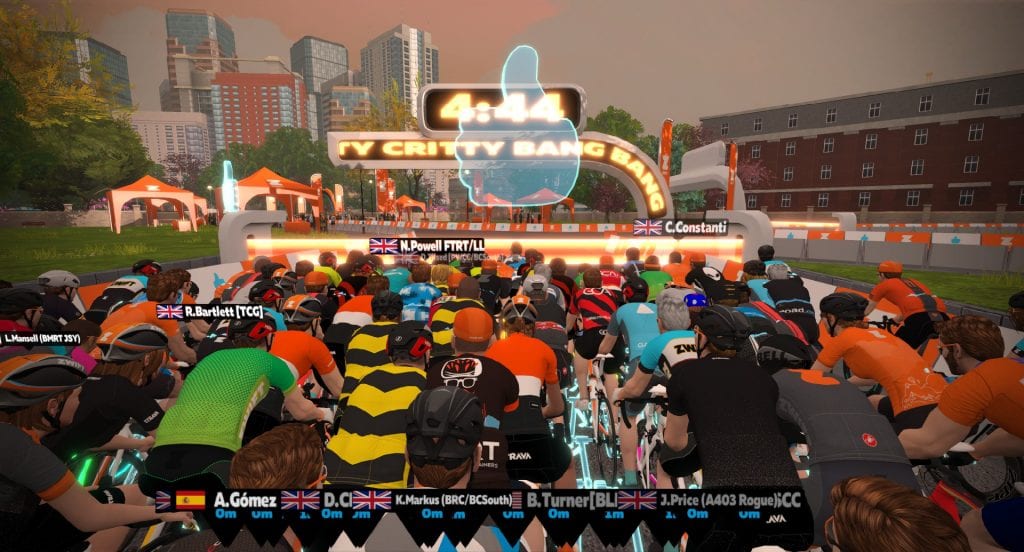
I decided to head to the start pens early, since riders are placed further and further back the later you join. I wanted to make sure I didn’t have to ride through any more riders than necessary at the start as I tried to make the initial selection.
The B pen, 12 minutes before race start. Crowded!
Even though I jumped into the B pen with more 12 minutes to go, things were already crowded. That meant I would have to push even harder to make that first selection of A’s, B’s, and suspicious C’s and D’s. So be it. Let’s race!
The Start
The clock hit zero, and it was hammer time. I set a segment PR on my first lap, averaging 386 watts. I hung in for the second lap as well, but just barely… 349 watts for that. And as we hit the false flat after the lap banner, I couldn’t hold on any longer, and on the third lap, a group of ~80 rode away.
Where Am I?
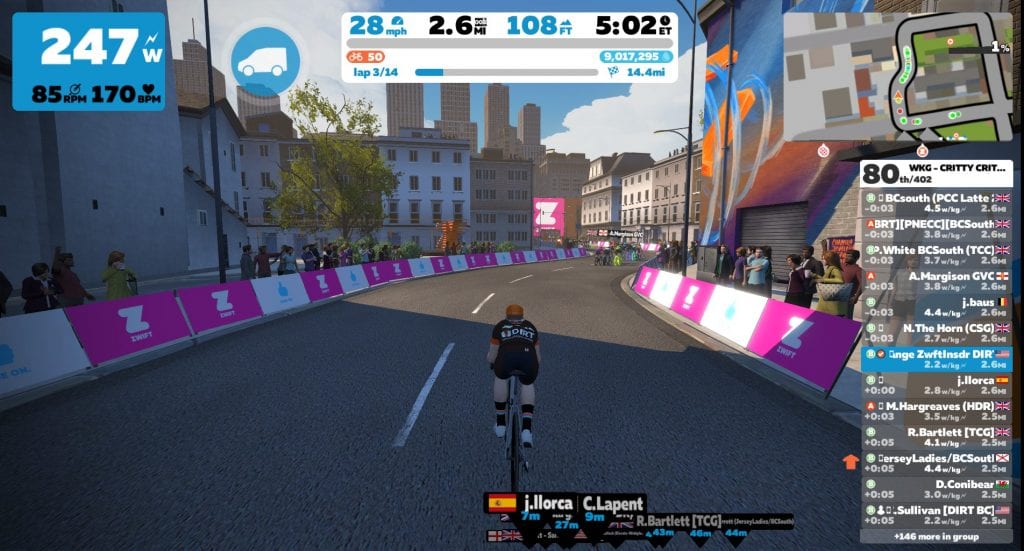
My screen showed me in 80th out of 402. But that was 402 riders total, from all categories. This is something that annoys me about mixed-category races – the fact that there’s no easy way to know where I’m at in relation to all the other B’s. I could see from the minimap that there were plenty of B’s in the group that just dropped me. But how many? 79? 10? I knew around 70 A’s had signed up… did that mean there were around 10 B’s up ahead?
The only ways to find this information out by yourself are:
Pulling up ZwiftPower’s live view of the event, or
Clicking through the rider list on your screen to get the perspective of riders up ahead.
But both of those solutions are far from ideal, as they force you to take focus off of what’s actually happening. Anyone want to play DS for all my races?
The Middle
So there I was, on the 3rd lap of 14, with the leading group up ahead and some stragglers grouping up behind who would surely sweep me up soon. I eased my power, knowing I wasn’t going to bridge up to the front group or stay away from the larger group behind.
Where did I stand now? I knew we would be seeing some of the B’s in the front group get dropped and join our chase group – there was no way so many B’s could maintain that frenetic pace. But how many would we sweep up, and how many would remain out of reach?
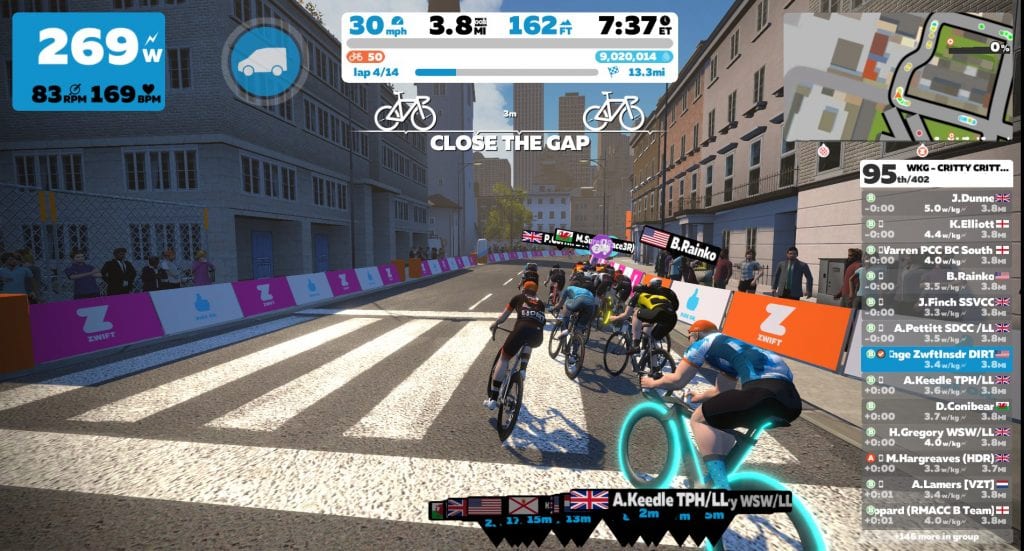
On my 4th lap the group of A’s and B’s that had been swelling behind me came through, so I grabbed their wheels. This group seemed to be ~15-20 riders in size, but to be perfectly honest, it was already getting hard to tell who was where! With over 400 riders moving at different speeds around a small 1.2-mile circuit, there was a nearly constant stream of riders ahead and behind, and my only indication of standing was the overall placing number, which (again) didn’t tell me where I was actually ranked against the B’s.
I started paying attention to some of the stronger riders staying near the front of our group, so I could track them as we moved through packs of slower riders. I didn’t want to get gapped in all this mayhem and dropped from this chase group, especially since it was possible that a B podium winner or two might come from our group.
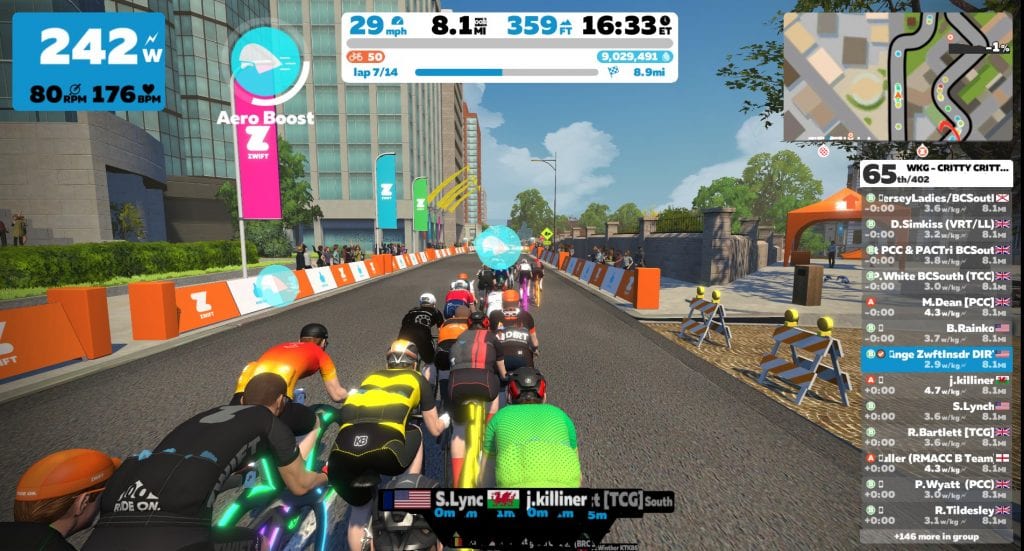
Happily, the pace was doable, although certainly not easy. I was getting useful powerups, conserving as much energy in the draft as possible, and watching as we slowly caught B riders getting dropped from the hard-charging A group. We were making progress, catching single riders and small groups as our group continued to swell in size. The front of our chase group went from ~85th to ~50th between laps 4 and 7, and my conviction grew that a B podium was within our grasp.
The Finish
By the time we hit the final lap, our group had swelled to 30+ riders. The powerup gods had given me only bonus points for the past three laps, and they begrudgingly gifted me a feather for the final lap. Not what I was looking for, but I used it on the prime climb to save a little energy while I tried to stay within a few wheels of the front of our group.
A strong rider or two always seems to go hard from the top of the bricks, and this race was no different. I didn’t chase them, though, preferring to sit in the draft and let others catch those off the front. Soon enough we were down the twisty descent and it was time to shift, stand, and hammer out the final sprint. I gave it all I had, which admittedly wasn’t much after such a hard start and the longer race. I crossed the line in 47th overall, 10th in the B’s. Three B’s from my chase group had outsprinted me, but at least two of the B’s ahead were well over category limits, so I knew I had at least 8th place. What would ZwiftPower say? Final answer: 6th place.
I was pleased with my power numbers for this event, having set a new PB for 2020 in the ~3 to ~5 minute range. Like I said earlier, I joined this race because I knew that mixing it up with the A’s would push me extra hard. It worked!
Takeaways
I’m still not a fan of mixed-cat racing. But I will admit that it’s useful if you’re a rider like myself who is strong enough to hang with the front of a B-only race without being completely on the limit. If that’s you, and you want to improve, then you have a few race training options, as I see it:
Race inefficiently. Decide that you’re going to ride on the front of the B group in the wind, and/or make lots of attacks during the race, just to push yourself to the max and get that extra training stress.
Race your weaknesses. For me, that means signing up for races with climbs, so I’m forced to push myself to the edge just to hang with the front of the race.
Race against stronger riders. Mixed-category events are great for this, because when you get dropped from that front group, you’ll find riders behind to work with. If all you do is race up a category in a category-separated event, you may get dropped and be alone for the rest of the race, since no slower categories are visible on course.
I’ve been using all of these strategies lately in various races, and I know it’s making me a stronger racer.
You’ve started zwifting… first of all, welcome! One of the first things you are going to notice as you speed around Watopia is that the name of the game is power. Everything in this virtual world runs off of those precious watts that you are able to generate as you turn the pedals. If you aren’t lucky enough to have your hands on a power meter, the kind engineers of Zwift have come up with a solution for all of us! That solution is zPower.
zPower is a calculated power value based on the speed of your bike and the resistance of the trainer you are riding on. Editor’s note: although the terms are used interchangeably by Zwifters, there is a slight difference between zPower and virtual power on Zwift. Jaden is technically using virtual power, but he uses the term zPower throughout this post. For more on this, read “Virtual Power Basics for Zwifters“.)
When I started on Zwift, I did all my training and racing using zPower, and one of the first questions that I asked myself was: “Is the power value anywhere near my true power?” The more I trained the more I wanted to be able to compare my numbers with my friends and see how I would stack up in group rides and races. I wanted to know whether the numbers I was getting for FTP, training zones, etc. were close enough to my actual power to be useful.
I am basing this article on a video I created, if you’re interested in getting the information in video format, check it out and don’t hesitate to subscribe to the channel:
Hope you enjoy the video, but in case you’re more interested in the text version of the story, here it is:
The Test
The first thing I needed to do was compare two different power data charts in the same time frame. To do that, I ran Zwift as I normally would, sending speed, cadence, and heart rate to the AppleTV to run my avatar. Separately, I used the new power meter on my bike (4iiii Precision) sending data directly to my Wahoo Bolt. After I finished the test, I was able to use ZwiftPower to compare two different power graphs based on data from Zwift (downloaded from Strava) and from my Wahoo Bolt head unit, downloaded from the Wahoo app.
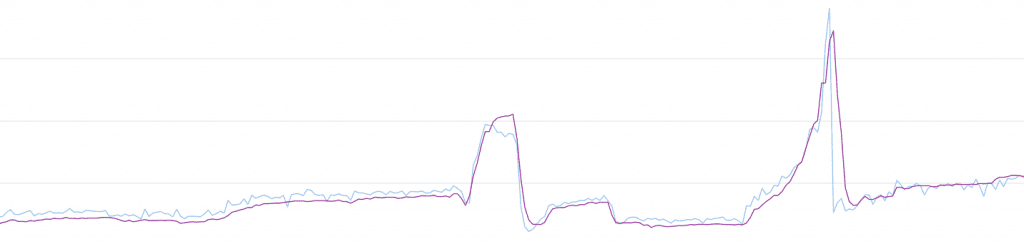
When you add both of these data files into ZwiftPower’s analysis tool, you get some cool comparative information. The first thing you see is this graph (the purple line is zPower, and the light blue line is the 4iiii Power Meter):
We will get to the specific sections in the graph more closely soon, but before we get to that there are some other elements of the analysis that I wanted to highlight.
For an average power, I was very impressed with Zwift! A difference of only 6.1 watts (4.26%) averaged over the whole test was actually quite impressive, so kudos to the team for working hard and making something great. I won’t talk much about normalized power, but as you can tell in the graph it is also within about 4% as well, which I would consider very accurate for an estimation.
Maximum power is definitely a key point here, with an almost 10% discrepancy. The actual power meter read a significantly higher max power, which from what I can tell is due to the ability of a rider to push significant power into the pedals instantly, but the resulting wheel speed (what zPower is actually based on) does not increase quite as fast. If your sprint lasts for a long time, you may see the zPower number climb up to match that maximum, but if the power peaks and then drops, as mine does in this sprint test, your zPower numbers will not be able to catch up, and will not spike as high a power meter can.
To review the actual data, I divided the overall test into three segments that told three different stories about the difference between Zwift zPower and an actual power meter. Here are the three main test sections that I looked closely at:
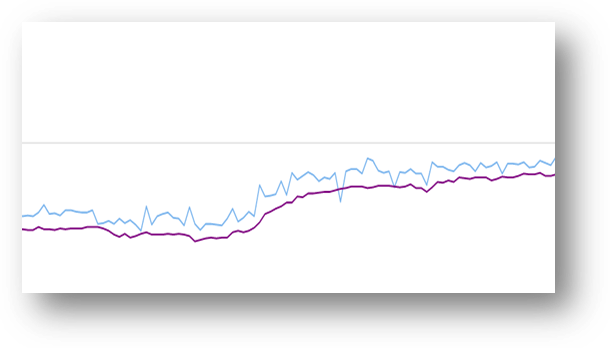
Steady State
Most of the test was run as an (attempted) steady state ride, hovering around 200W. My intention here was to see what zPower could do if the speed was constant. As you can see on the graph, both of the values are tracking pretty closely together, with the zPower consistently lower, and the difference there was by about 10-25 watts. This may seem significant, especially on the higher end of that range, but the fact that it was tracking closely even though it was low helps me know that at least for workouts you will still feel the difference between hard and easy.
The other thing to notice on the steady state portion of the test was that my actual power data is quite jumpy. I’m fairly new to this power meter data, but from what I have learned from others with much more experience is that this is normal. When you first start measuring power, it’s reasonable that your natural pedal stroke will create slight variances in power even when riding at a steady state. The reason that the Zwift value is able to be so consistent, is because they are basing theirs off of wheel speed, which is more constant.
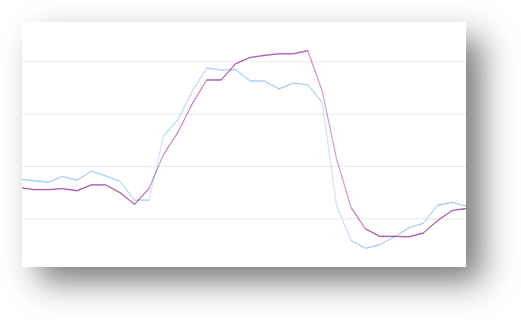
Intervals
I did some really quick interval work during the test, so I could see what the zPower readings would look like when you ramp up power, stay at that level for some period of time, and then bring it back down again. I think this result is interesting because it is the only meaningful time that the zPower value is higher than my actual power meter.
The difference in the graph partially represents a slight lag, so my power increases as soon as I put more pressure into the pedals, which makes sense, but my speed will only increase gradually, thus increasing the zPower. The interesting thing to note is that my continued high-power effort increased my speed fairly significantly, and even though I was holding a consistent power, I was still accelerating. That is why for a few seconds, my zPower will continue to rise past the top of my actual power numbers. The same small lag is noticed on the tail end of the interval, as I ramp the power back down again.
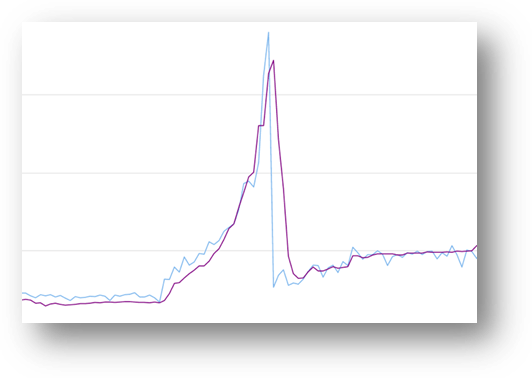
Sprinting
The most significant difference between the values that I saw was when I tried a sprint. I only ramped my power up to around 800 watts, but it was quick enough to see how zPower would react to the changes. As expected, since my speed increases slower than the effort I’m putting in, my real power increase is very sharp. The zPower is much more gradual.
Since I spent so little time at the power peak, it is reasonable that Zwift wouldn’t reach the same value, but the difference was about 70 watts, which represented an almost 10% difference. In a significant race-ending sprint, that wattage difference could be a big deal. Another interesting piece to note is that the decrease is much more gradual on the zPower side. When I stop putting in effort, my watts will instantly go to zero. However, and depending on your specific trainer, the flywheel you have will keep some of your momentum in the trainer and your wheel will continue to spin for some amount of time as your speed decreases.
Conclusion
After running this test, I was honestly very surprised at the accuracy that Zwift is able to achieve through a data-based estimation. It’s actually very impressive! I know the same accuracy results will likely not be the same for everyone (see the ‘Recommendations’ for tips on how to improve zPower accuracy) but from my testing I can say that I was impressed.
Knowing how power meters work, and how the calculations are made by zPower, can be a great tool to have when you are training on Zwift and are curious as to why you can’t put out huge wattage in a sprint as quickly as your fellow racers, or why you are able to keep a much smoother and consistent power curve than those with direct power meters are. I very much enjoyed diving into this data, and if you are interested in checking out my actual data set, I have made it public on ZwiftPower! Just keep in mind that I am still in training, so the power numbers are still those of an amateur cycling enthusiast.
Recommendations
There are likely a few people reading who are curious whether the results that I got are going to be similar to the results that you see. Since quite a few variables are involved, I’ll share three things that you can do to help your trainer give the most accurate zPower numbers possible (see Zwift Support for more information)
Use a compatible trainer. The Zwift website has a list of the trainers (non-smart) that they have done extensive testing with. That data is the reason that Zwift is able to calculate an accurate power. I personally use the Giant Cyclotron Mag trainer. If you use a magnetic trainer (or any trainer with a variable resistance) Zwift will tell you which resistance value to use. Make sure to use it!
Keep the trainer tight. When you tighten the trainer to the wheel, you want to be sure that it will not slip during the workout, because that will create inconsistent speed ratings. I do this by turning the wheel directly as a test to see if you can hear any slip. If turning the wheel manually causes that skid sound, it’s a good idea to give it another quarter-turn until it’s solid. If your wheel is slipping, Zwift will usually catch it and put a pop up in-game to alert you, and it could kill your power until you tighten it (it’s the worst if you’re in the middle of a race… so best to just make it’s tight from the beginning).
Pump the tires to a normal PSI. This part isn’t tricky, but it is easily forgotten. Just as you would before an outdoor ride, check the PSI in your tires and make sure it is at a normal value, similar to what you would ride outside.
Ride on!
What About You?
Have you ever compared Zwift’s zPower estimates with a power meter? What did you conclude? Share below!
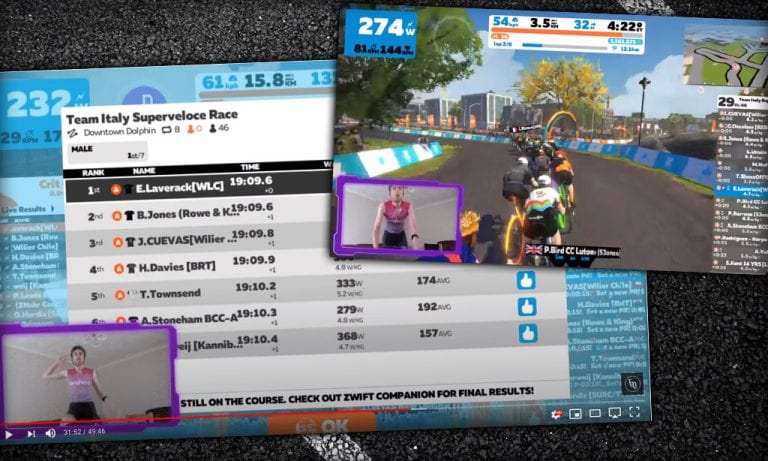
This is not the typical “rub some PR lotion on the legs and chew some caffeine gum” story. This is not even a story about my own race. This is a story about how I watched Ed Laverack win a race in a sprint after weeks of preparation.
Like most people during these last few months, I needed to find a way to spend my time during the lockdown. One thing I did watch Zwift races. Because it’s far easier than participating myself!
Intro to Ed
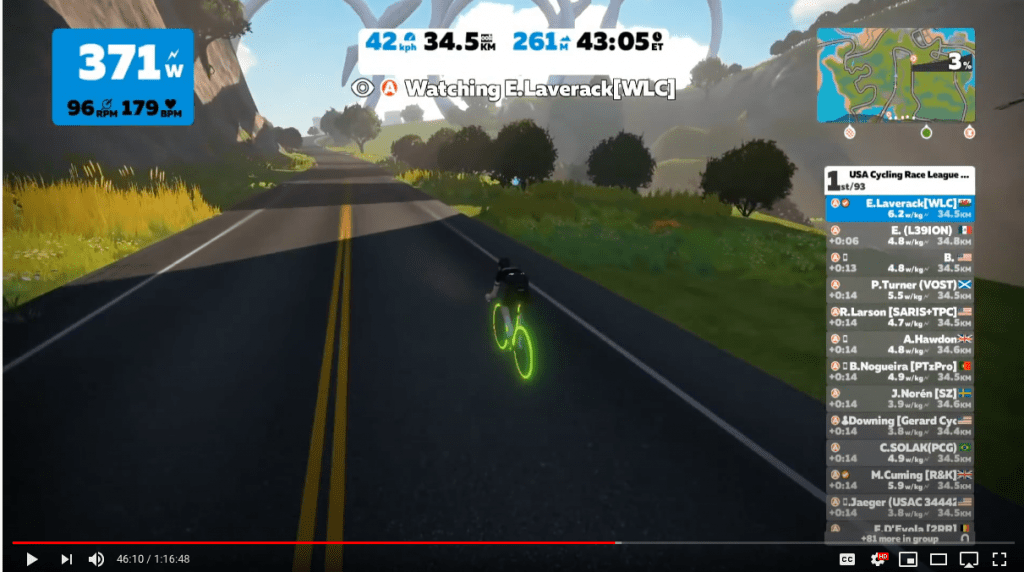
One of the riders that stood out from those races was the current British hill climbing champion Ed Laverack. The guy weighs less than my left leg, yet somehow manages to produce more power than the average 90kg rider. The result is a rider who can ride at almost 7 W/kg for 20 minutes. Combine that with a willingness to attack in almost every race and you have a recipe for an attractive racer. Deadly on the hills, but able to keep a chasing pack behind him for quite some time even in a flat race.
It’s something that Zwift Community Live commentators Nathan Guerra and Dave Towle have noticed as well. They even introduced a new verb – “laveracking a group” – attacking so hard that the whole group splits apart and only the strongest survive.
Now that in itself is not so unique. What makes Ed interesting are his live streams, and more particularly his interaction with viewers. He is really good at explaining why he races like he does (for example, attacking in impossible places) and after each race, he does a post-race analysis where he goes over the numbers and answers questions popping up in the chat.
Planning to Sprint
A few weeks ago, after yet another race full of attacks only to get beaten in the sprint, he started with a plan. He would work on his sprint with dedicated training sessions and races that suited him less but were almost certain to end in a sprint. The training sessions or workouts had the goal of improving his 5-10-15 second power, the races were needed to get the timing and sprint tactics right.
Session after session his followers could see him working on his sprint, going together over the power numbers and seeing the improvements. The chat during the races is filled with people who race on Zwift, and we all shared tips and experiences on how to do a good sprint on Zwift on that particular finish. A perfect example how both sides (the streamer and the audience) could learn from each other.
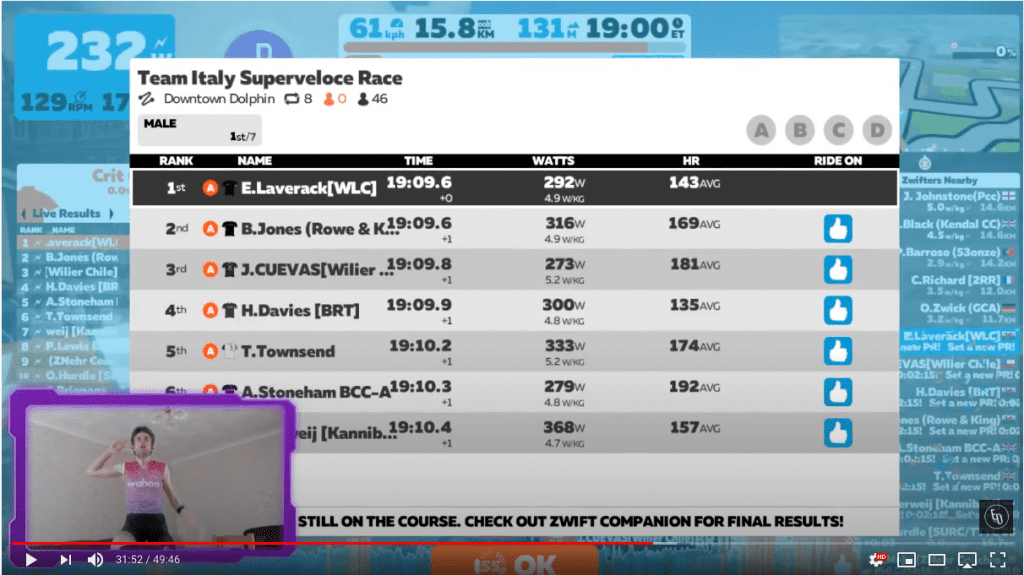
And this week the training paid off. Ed entered a Crit City, 8-lap race. A short 20-minute race on an almost pan flat course. Totally not his kind of race (normally he uses the first 20 minutes as warm-up). After a race of sitting in, keeping in touch with the front of the group and making sure he had an aero power-up it was time for the sprint.
And what a glorious sprint it was. The timing was near perfect. Waiting long enough to go yet staying in close contact with the front. Activating his aero power-up so that it would last until the finish, but not a second longer. And high power to finish it all off. (Watch the race in the video above.)
It was a close finish, with the top 3 finishing within 0.2 seconds of each other. But Ed Laverack came out as the winner. In the last second before the line, his aero powerup made the difference and he went from 3rd position to 1st. The climber who almost never wins a climbing race on Zwift had won a crit race in a sprint! If he can do similar sprints after a hilly (outdoor) race, he will win many more races this season.
So, if you’re bored or don’t know what to do, I strongly suggest to go to his Youtube channel to watch some of his races or training sessions and learn from his approach to training on Zwift. Depending on which videos you watch, you might also get some nutrition advice or simply witness the suffering behind his Zwift attacks first hand.
Disclaimer: I don’t know Ed personally, nor did he ask me to write this. It’s just my way of saying thank you for a fair number of hours of entertainment he provided to me during these past few months.
Some people ride to relieve stress – and we’ve all had plenty of that this year. Others do it to lose weight. And still others are following specific training plans, even though their racing goals this season are murky at best.
Me? I ride because I love the results. Cycling brings me much-needed fitness, healthy competition, and fun with friends. It also lets me see my surroundings in a fresh light: there’s simply no better way to experience the world.
This Year vs Last
It’s been a strange year, hasn’t it? Here we are in early June, and I’m still spending ~80% of my riding time on Zwift. This isn’t normal. In past years I would be riding ~80% of my miles outside by now. But shelter-in-place (SiP) combined with a shrinking set of local riding buddies and so many fun Zwift events has resulted in this odd situation.
It’s also resulted in me being fitter than ever before.
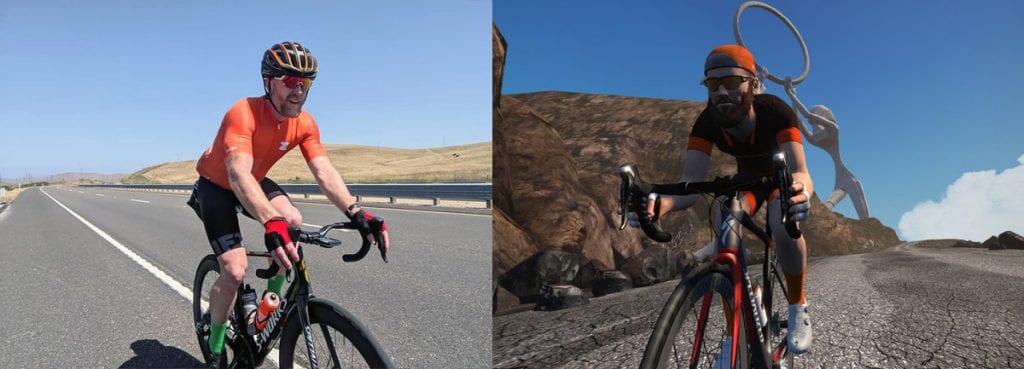
Recent shots of IRL me (somewhere on the Pacific Coast Highway) and Zwift me (descending the Alpe)
Tracking Fitness
How do you track fitness? There are, of course, a variety of ways to do so. Tracking methods are largely driven by which sport(s) and goals you’ve chosen. Swimmers and cyclists have different fitness metrics. Racers look at different numbers than the casual athlete seeking to shed 20 pounds.
The important thing is to find metrics that work for you. Here are the numbers I keep a close eye on:
My fitness score in TrainingPeaks
My FTP
My weight
My body fat percentage
None of these is a perfect measure of cycling fitness. But they are easy to track and combined give me a solid picture of where I’m at. And you know what? I’m in a really good place right now.
My FTP is as high as its ever been – somewhere in the 305-315 watts range, depending on how I test it. My weight has been down around 180 pounds (~82kg) for the last two months, which is the longest I’ve ever stayed so light. And my body fat percentage and watts per kilo numbers are happily reflecting this combination of low weight and high strength!
What I’m really excited about, though, is my fitness score in TrainingPeaks.
How TrainingPeaks “Fitness” Works
TrainingPeaks uses a metric called TSS to assign a Training Stress Score to each workout. TSS is based on the duration and intensity of your workout so for example, a full-gas 1-hour effort may have the same TSS as a 3-hour ride at social pace.
That TSS metric is then used to chart your daily level of fatigue, fitness, and freshness:
Fatigue: how tired is your body from recent training? This is an exponentially weighted average of your past 7 days worth of TSS.
Fitness: how strong is your body, thanks to all the recent training? This is an exponentially weighted average of your past 42 days worth of TSS.
Form: how good will you feel on today’s ride? Subtract yesterday’s fatigue from yesterday’s fitness and you have today’s form.
The TrainingPeaks app combines these metrics into a Performance Management Chart (PMC). The PMC can be used to easily see how your overall fitness is changing, as well as where you stand in terms of form.
My Current Fitness
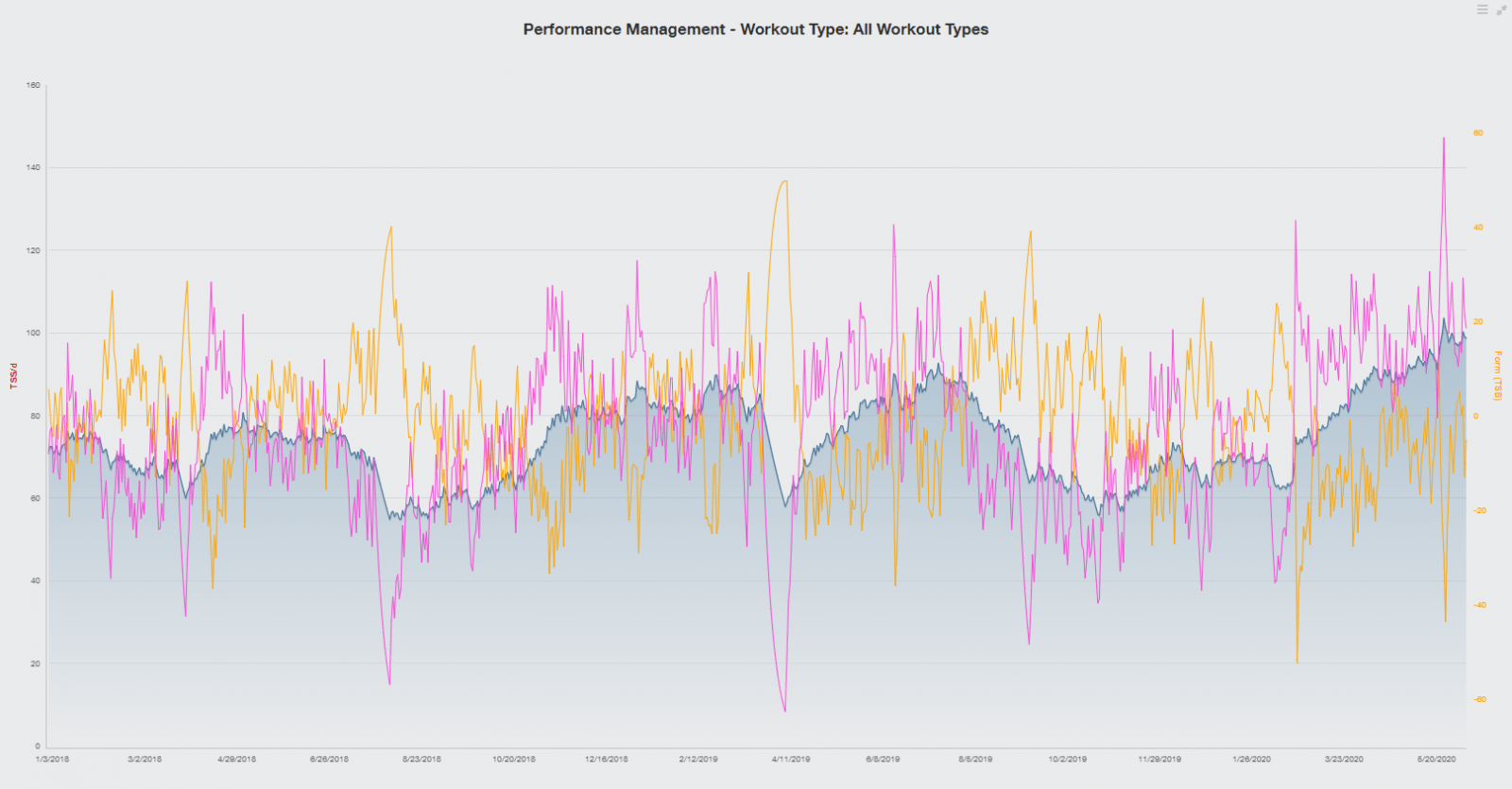
Here is my PMC from January 2018 to present:
Pink = fatigue, orange = freshness, blue = fitness
As you can see, I’m currently in the high 90’s, and even hit a high of 104 a couple weeks ago! My previous annual highs were 93 (July 2019) and 81 (May 2018).
(That high of 104, and the big pink fatigue spike you see in the chart from a couple weeks ago, is the result of a 4-day, 426-mile IRL bike trip my brother and I took down California’s Pacific Coast Highway. A rather spur of the moment adventure which I didn’t train for at all! More on those epic rides in another post.)
My Week
So how did I arrive at the best shape of my life? Am I sticking religiously to a perfectly-structured training plan?
Well, that’s the crazy part. I’m not! I’ve certainly done structured training before – for months at a time. And I can vouch for its effectiveness. The problem for me is, I don’t enjoy it. And it’s important for me to look forward to riding my bike.
So instead, what I’ve done since late February 2020 is essentially this:
Monday: medium length, medium-easy pace. This means mostly Zone 2 HR over 90-120 minutes.
Tuesday: race day. Races vary from 20-75 minutes in length, and my overall ride time with warmup and the actual race will be 90-120 minutes.
Wednesday: easy day. 60-90 minutes, Zone 1-2 HR.
Thursday: race day. Races vary from 20-75 minutes in length, and my overall ride time with warmup and the race will be 90-120 minutes.
Friday: lead my Sprintapalooza ride, then hang out for another 30 minutes or so, not pushing hard. 75-90 minutes.
Saturday: long and hard. I’ll cobble together group rides and races into a session 2.5-3 hours long, sometimes more. This usually looks like a long warmup followed by a longish race (75 minutes or more), then additional steady riding to build endurance by putting more fatigue into the already-tired race legs.
Sunday: easy day. Usually 60-90 minutes of easy riding, often outdoors on the MTB up a local climb, just enjoying the scenery.
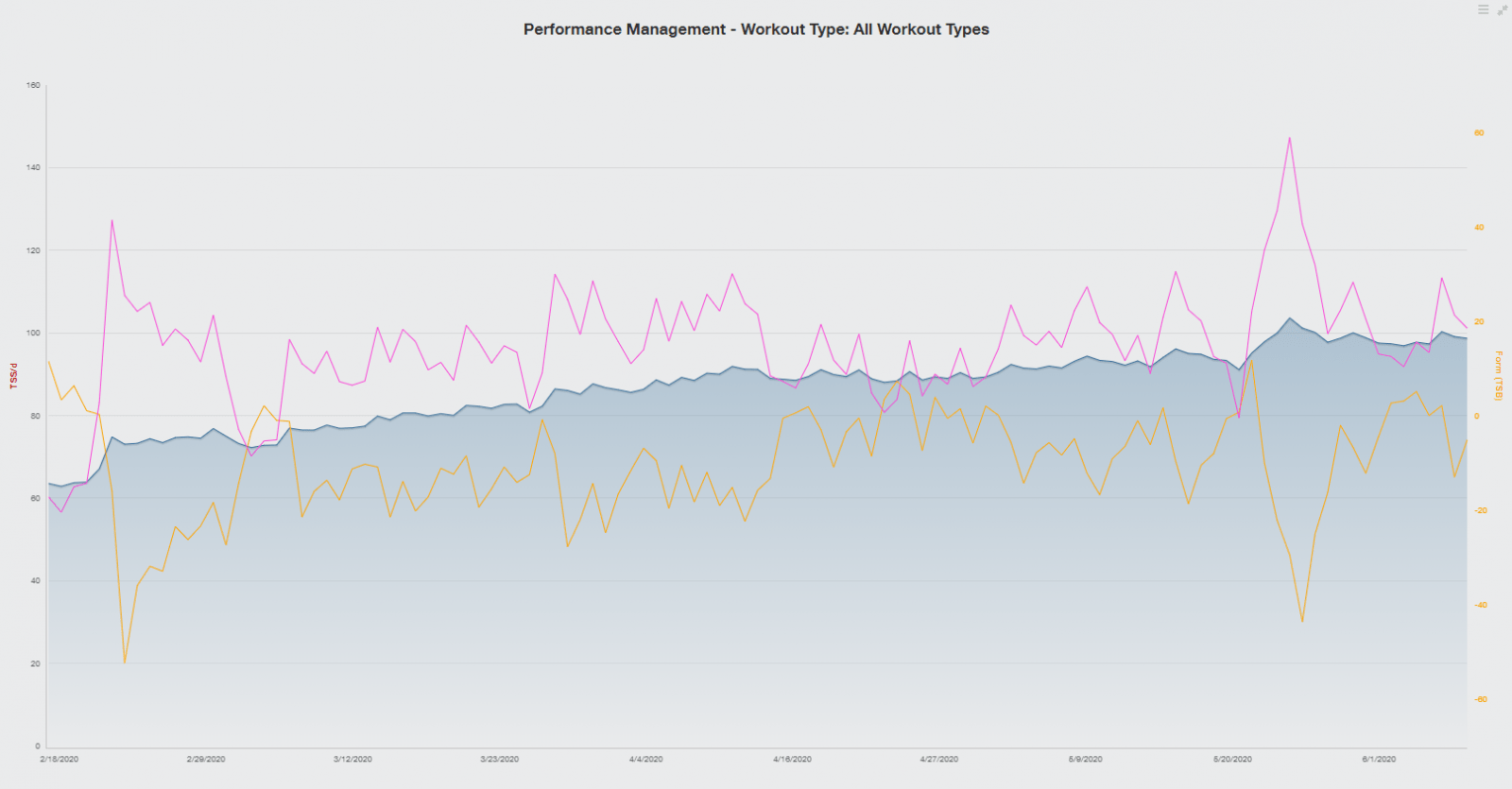
Every week is a bit different, and every 5 weeks or so I take a rest week where I avoid sustained hard efforts and let my body rest and rebuild. But overall, I’ve basically stayed within this framework for the past few months. And almost all of my riding has been in Zwift events: group rides for easier days, races for race days.
This has led to steady progress in my fitness numbers. Here’s a chart from mid-February 2020 to present:
Indoor vs Outdoor Efficiency
I typically ride 12-14 hours total each week. Could my training be made more efficient? Absolutely. Following a structured training plan would let me reduce the hours put in, for the same training benefit.
But would I enjoy it? Nope.
So regardless of whether I ride outdoors or indoors, I won’t be doing a structured training plan. And here’s what I know is true for me: I consistently pack more solid training into an hour on Zwift than I do outside.
Outside ride time includes getting to the place where I can begin my workout. It also includes stoplights, traffic, weather, and all those fun outdoor niggles. Taking TSS as an objective metric, I would estimate that my TSS per hour is reduced by 10-20% when I ride outside, compared to when I ride on Zwift. That means if I moved all my training time outdoors, my fitness score would eventually drop by 10-20%.
That’s what has happened in past years. But not this year.
A decrease of 10-20% seems crazy. But it makes sense. And it explains the true stories of pros like Mathew Hayman who recuperated on Zwift then returned and won Paris-Roubaix. Or the more recent example of Ashleigh Moolman-Pasio, who spent several solid weeks under SiP “house arrest” on Zwift in Spain only to destroy her Rocacorba PR the moment she was allowed to get outside again.
Bottom line: riding on Zwift lets you pack a lot of TSS into your training time. And I’ve been doing a lot of riding on Zwift.
TSS Caveat
I’ll mention this now, before someone does it in the comments: coaches and experienced cyclists will say that there’s more to fitness than TSS. And they’re correct: a high fitness number doesn’t tell me how well-trained I am for a particular race.
As an example: I could rack up a lot of TSS doing long, slow rides, but if my races require high sprint power, I’m not building the fitness needed to meet my goals.
But here’s the thing: I’m not training with my eye on one or two big events. The competition I enjoy happens every week, and it’s a part of my training! I’m riding Zwift races to train for Zwift races. And if our local cycling group ever gets revved up again, I’ll ride our Tuesday night hammerfest to train for next week’s Tuesday night hammerfest.
So the TSS I’m racking up is targeted quite nicely at the sort of intervals I want to train for, because that TSS is earned in those actual events, week after week!
Mileage
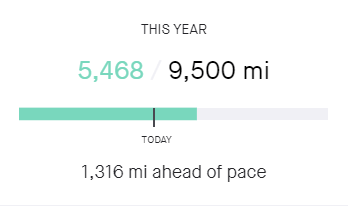
Distance really isn’t a great fitness metric, but it’s a fun one. So every year I set a distance goal in Strava. This year I was lazy, and simply set the same goal as last year: 9,500 miles. But thanks to all the indoor riding, I’m on pace to break 11,000 miles for the year – much more than I’ve ever done before.
What About You?
2020 has been a crazy year. But thanks to good health, SiP, and a keen fondness for Zwift cycling, I’ve been able to ride into the best shape of my life.
What about you? I’d love to hear what has this crazy year done to your fitness? Share below!
Ever since Strava’s April decision to open up its challenges to allow indoor miles, Zwifters have been unlocking badges at record levels! This month there are several appealing challenges for Zwift riders, including two special climbing challenges. Here are the details…
A Challenge by Kate Courtney
Climb 10,000 feet in 10 days (June 5-June 14)
Kate is a pro mountain biker who won the 2019 UCI World Cup overall title – the first American to do so in 17 years! She created this challenge as a call for the Strava community to fundraise for the World Health Organization COVID-19 Response Fund.
Create a fundraising page, join a team, and put in maximum elevation over 10 days. Any elevation/donation helps, but you must climb 10,000 feet by June 14th to complete the Strava challenge.
Climb 3300m in a single ride between 12:00am Friday 12th June and 11:59pm Sunday 14th June in your local timezone
The toughest challenge on the list – but what else should we expect from Haute Route? This is their first-ever Strava challenge, and it’s a doozy! To mimic the elevation of the Queen Stage for Haute Route’s canceled 2020 Dolomites event, riders must climb 3300 meters (10,826′) in a single ride in order to complete this challenge. The challenge only runs from Friday-Sunday in your local time, too, so you’ve got to plan accordingly.
What does 3300 meters look like on Zwift? Well, you could ride:
3x up Alpe du Zwift, plus another 194m
Almost 8x up the Epic KOM forward (or almost 6x if you include the Radio Tower “bonus climb”)
More than 24x up London’s Box Hill
66x up Watopia’s first climb, the Hilly KOM!
If you complete the challenge (and jump through the hoops of filling out a form or two) you will be entered into a drawing for a 3-day Haute Route event in 2021, plus prize packs from Precision Hydration.
Be sure to visit the link below for details, so you can get registered properly.
Strava’s standard monthly challenges are still allowing indoor miles to count, which is great news! Here are the details of each challenge – click for more info, and to sign up.
In The Catch Up Matt drops a line to some former guests and personalities in the sport for a short coffee-style catch up. This week he chats with Sarah True about her new interim teaching gig, how she’s adjusted her training in this time, and a fave past time of hers: baking!
About the Podcast:
The Zwift PowerUp Tri Podcast is hosted by former pro triathletes Matt Lieto and Jordan Rapp, lending their in-depth knowledge of the multisport to the Zwift Tri audience.
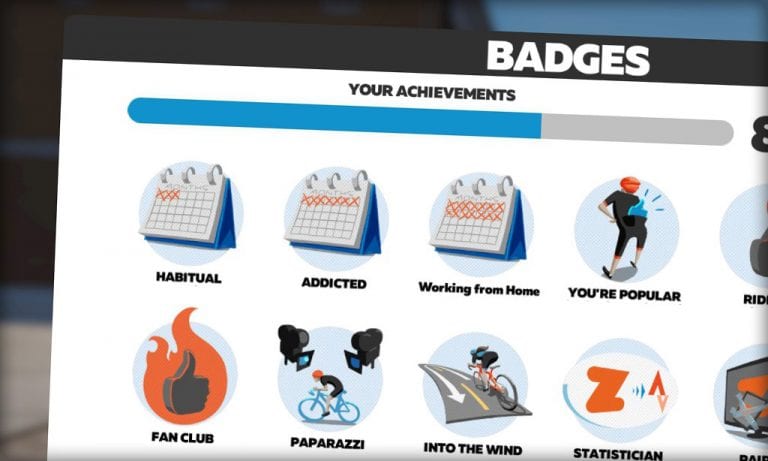
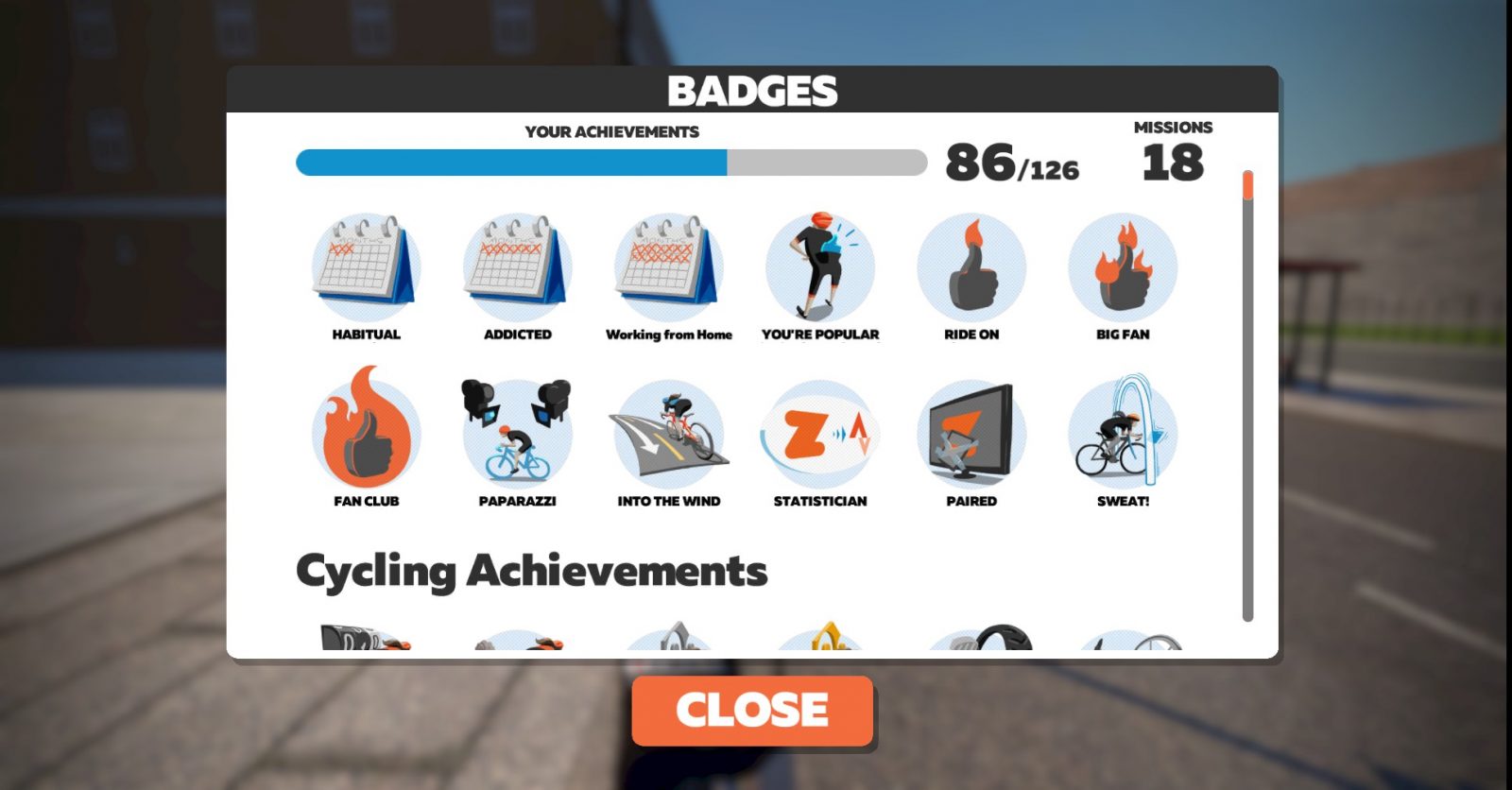
Zwift has officially renamed the “Unemployed” badge to “Working from Home”.
We’re not sure when this was updated, but we assume it happened in last week’s release.
This is just a small bit of news, of course. But it’s worth mentioning because it’s something the community first began asking for when the COVID-19 crisis hit, and SiP/WFH became well-known acronyms overnight. (The badge is given after 14 days in a row of riding or running at least 5km – learn more about it here.)
Kudos to Zwift for turning a negative-sounding badge into one that’s both positive and a lovely play on words.