We haven’t heard much from Zwift Co-Founder Jon Mayfield lately, as public interactions on game updates are now being handled by other members of the Game Team, including Wes Salmon.
But Jon and his team have been busy, working on various projects deep in the bowels of Zwift’s super-secret R&D lair. (Actually, thanks to Covid, I would guess they’re all working from their homes. But the lair sounds much cooler.)
One project recently pushed out to the live codebase is Pack Dynamics 3.0 (we’ll call it PD3 for short). I’ve had the opportunity to participate in a few test rides using PD3, and wanted to give you all a look at what’s coming. Because it’s exciting!
First: The Current Situation
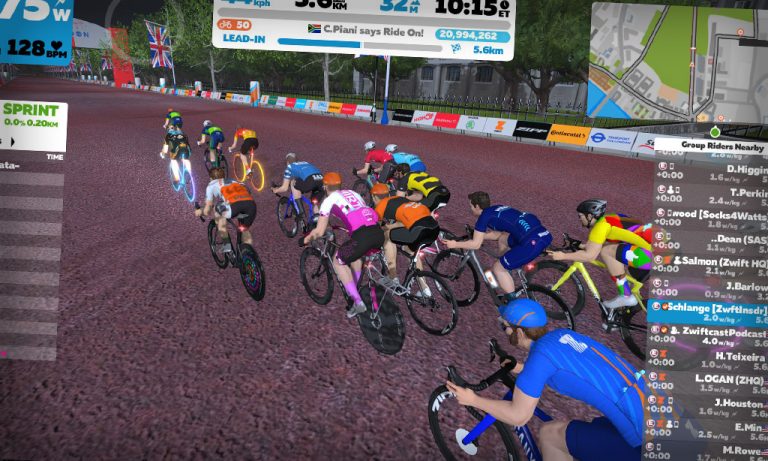
While most Zwifters have grown used to the game’s pack dynamics, the way our avatars move on the road lacks realism in various ways. Watch a snippet of a recent race and see how the pack looks to you:
See anything odd?
I see a lot of side-to-side movement within a tight pack, which isn’t something that happens IRL. Outdoors, riders hold their lines pretty well in a group, because there’s not much space to move right or left, and it’s a dangerous move if overlapping wheels are involved.
I also see the bodies of riders moving through other riders, which of course knocks the realism down a notch.
Lastly, I’d say the pack looks too tight. Even a pro peloton can’t fit that many riders into a tight space!
PD3 seems to address all of these issues quite nicely.
See Pack Dynamics 3.0 In Action
Zwiftcast creator Simon Schofield participated in the same two test rides as I did, and put together a quick video with his impressions of PD3. I think he sums it up quite nicely:
Less Lateral Movement
You’ll notice the jerky side-to-side movements visible in my race video are nearly non-existent in PD3. It feels and looks much more realistic… like the pack is a school of fishes rather than a scurry of squirrels.
Less Sticky Draft
While Zwifters generally recognize why the sticky draft exists, there’s also nearly universal disdain for it. We like sticky draft when it helps us hold a wheel, but we also hate feeling like it’s harder to get around another rider than it should be.
I found the draft to feel much more natural and not sticky at all in PD3. I could ride up behind a rider and hold my position on their back wheel by modulating my power. And if I wanted to go around them, bumping up my power moved me smoothly around, without feeling like I was wasting watts trying to power out of the sticky draft.
One caveat, though: both of the test rides I’ve done were at a rather low pace (2-2.5 w/kg). It may feel quite different at race pace.
More Realistic
Overall, the look of the pack, and the feel of moving forward and backward in it, is much more realistic with PD3. Riders hold their lines well, and, at least in the two test rides I’ve done, there is more space between riders.
Will the increased space making drafting more of a challenge, especially when it matters at high speeds in races? That remains to be seen because, again, we haven’t tested PD3 in a race situation.
Better Predictive Positioning
PD3 also includes an upgrade that isn’t apparent to the individual rider, but matters a lot when it comes to racing and broadcasting. That is much improved predictive positioning of other riders.
The positions of other riders on your screen are calculated using a combination of client-side predictive positioning (your Zwift software is predicting where each rider is going, and rendering their positions accordingly on your screen) and server-side adjustments, where rider positions are broadcast to a central server then your game client sees them and adjusts riders positions on your screen.
This means that one Zwifter’s view of the pack could be quite different from another Zwifter’s, especially if server connectivity was slow or poor. Most of the time this doesn’t really matter – but when it comes to racing, and especially pack sprints, it matters a lot!
In the past few years, Zwift has been tightening up how well this works, so rider positions have become more and more uniform between Zwifters. But PD3 tightens this up much more.
When Will It Be Released?
Zwift is being cautious in rolling out PD3, and will continue running test events before a global PD3 rollout. The current PD3 has a few bugs which will be fixed before any larger public release, and a lot more private testing will take place before public test events are available.
The broad release plan is:
Holding more private test events
Hold public test events
Enable PD3 on an entire map
Enable PD3 across the entire game
Zwift isn’t giving a PD3 release timeline, but it’s certainly not “just around the corner.” My best guess: sometime near the middle of Q4 2021.
Watch More
Want to see more PD3 in action? Here are the full recordings from my two test rides:
Test Ride 1, Makuri Islands
Test Ride 2, London
Your Thoughts
How does PD3 look to you? Share your thoughts below!
Zwift’s newest update includes a fresh bike frame from Swiss bike maker BMC: the Roadmachine.
Here’s how the Roadmachine is described in the Zwift Drop Shop:
“Meet the Roadmachine: the bike that truly does it all. Rooted in endurance, the frame has been revised to perfection and added more compliance-boosting attributes to make this bike your go-to choice for all-day adventures. As BMC’s highest performing all-arounder, it’s designed to go the distance with resolve. After all, what use is a road without the Roadmachine?”
The frame is rated 2 stars for aero and 3 for weight on Zwift, so even before testing it we knew it wouldn’t be a top aero or climbing bike. As it says in the Drop Shop, this is BMC’s all-arounder. You’ll have to be level 21+ to purchase it in game, at a price of 780,900 Drops.
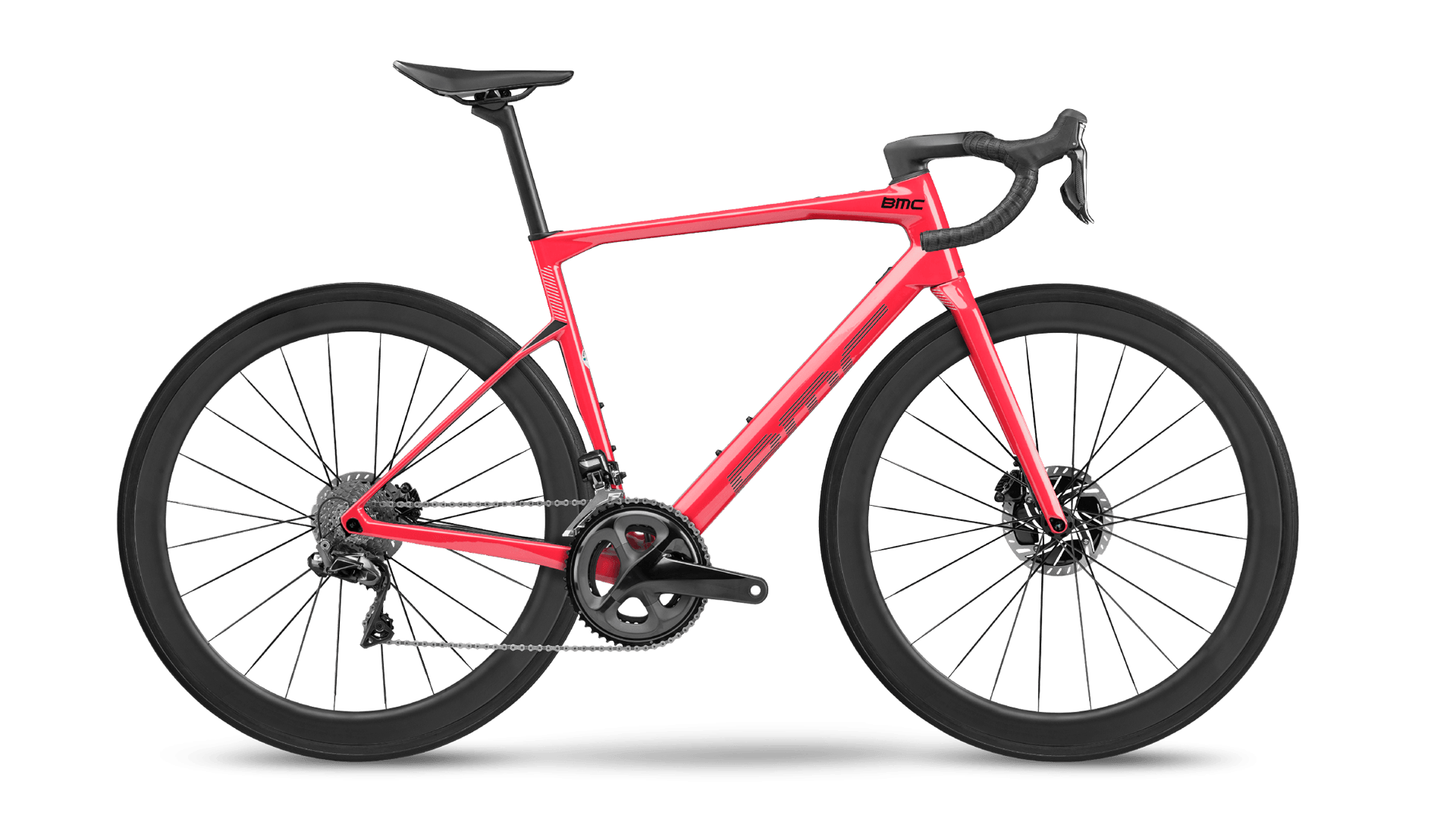
The BMC Roadmachine, IRL
We ran this frame through our standard tests to learn how it performs in game. Without further ado, here’s everything you need to know about the new BMC Roadmachine in Zwift.
Aero Performance
The Roadmachine turns in a flat test time matching the newly-released Van Rysel EDR CF frame. This places it near the bottom of the pile in terms of aero performance, with a flat test percentile ranking of 11%.
The BMC Roadmachine’s flat test time is 51:34.5. By comparison, the fastest frame in game (Cervelo S5 2020) turns in a time of 51:17.5, and the BMC SLR01 turns in a time of 51:33.5. (Our test course is two laps of Tempus Fugit, which totals 34.6km.)
Climb Performance
The Roadmachine climbs Alpe du Zwift in a time of 49:24, giving it a percentile ranking of 24%.
By comparison, the standard Zwift aero frame turns in a time of 49:31, and the Specialized Aethos completes the test is 48:49. (The older BMC SLR01 frame is 15 seconds faster than the Roadmachine, turning in a time of 49:09.)
Note: all test results above are from a 75kg, 183cm rider holding 300W steady using Zwift’s stock 32mm carbon wheelset.
Conclusions
While the BMC Roadmachine’s modern angular looks appeal to some riders, its performance on Zwift will not. Ranked at 11% on flats and 24% on climbs, we sincerely hope that this isn’t a reflection of the IRL frame’s abilities, since it ranks 57th out of the 63 road frames currently in game in terms of all-arounder performance.
The Roadmachine’s numbers can be found on the following posts, and we’ve added it to our Master Zwift Frames List:
Important note: this post contains speed test results for Zwift frames or wheels. These results may change over time, and a bike's performance relative to others may also change. We don't always revise posts when performance rankings change, but we do keep current, master versions of our speed test results which are always available. See the frame charts, wheel charts, and Tron vs Top Performers for current performance data.
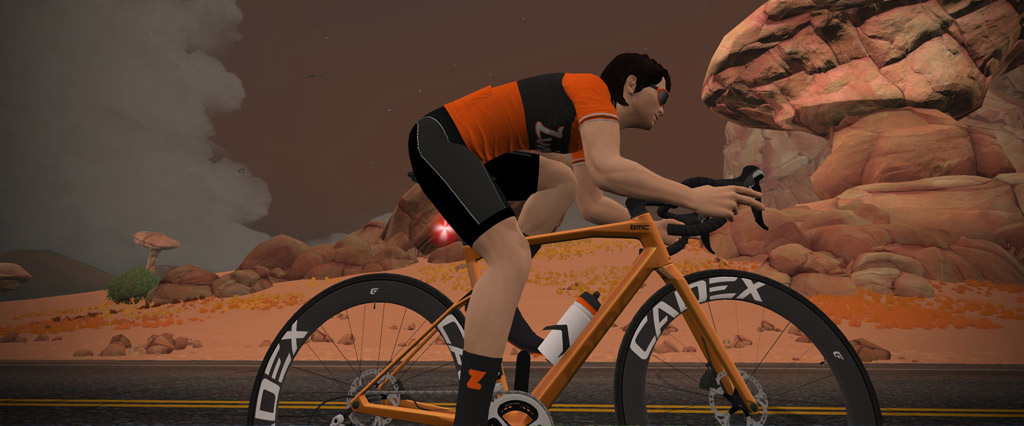
Zwift’s newest update includes a fresh bike frame from Canyon: the Ultimate CFR.
Canyon already has its “Ultimate” frame in game, which is probably based on the Ultimate CF SLX from a few years back. In terms of IRL comparisons, the Ultimate CFR comes in lighter than the current model of the CF SLX Disc, with a 10% improved stiffness-to-weight ratio. But it seems as though the latest Ultimate CFR (which is only available with disc brakes) weighs the same as the older rim-brake Ultimate CF SLX.
Here’s how the new Ultimate CFR is described in the Zwift Drop Shop:
“The Ultimate is the pinnacle of Canyon’s lightweight road bike engineering. Classic road racing performance in their lightest line-up ever. The Ultimate CFR is the epitome of modern cycling design and engineering. Complete with wireless electronic shifting, built-in power meter system and lightweight, aerodynamic frame, this bike is a thoroughbred racing machine.”
The frame is rated 2 stars for aero and 4 for weight on Zwift, so even before testing it we knew it should be a strong climber that isn’t particularly aero. You’ll have to be level 19+ to purchase it in game, at a price of 639,000 Drops.
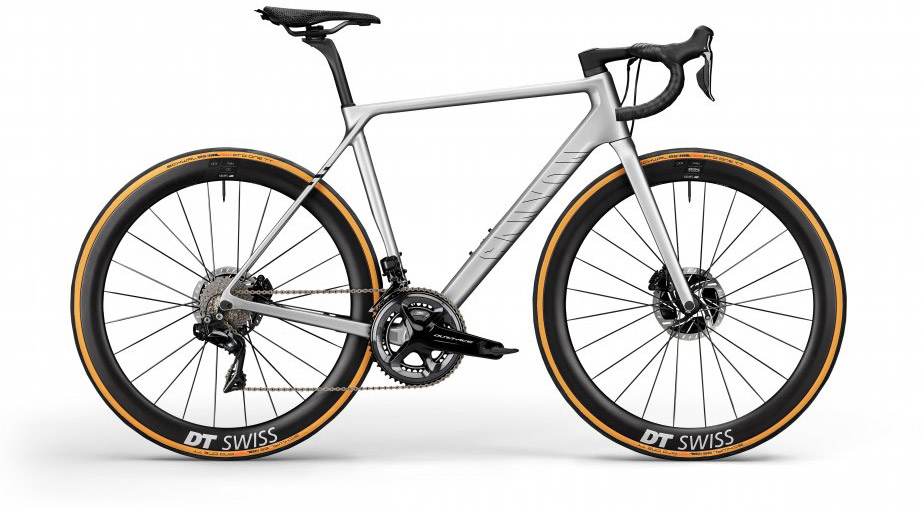
The Canyon Ultimate CFR, IRL
Based on IRL specs, the new Ultimate CFR in Zwift should clock in very similar times to the existing Ultimate. But IRL performance doesn’t always map directly to Zwift performance, so we ran this frame through our standard tests to learn how it performs in game.
Here’s everything you need to know about the new Canyon Ultimate CFR in Zwift.
Aero Performance
The Ultimate CFR turns in a flat test time 1 second faster than the existing Canyon Ultimate frame, which is expected given the frame’s IRL comparison to the older Ultimate frame. This places it squarely midfield in terms of aero performance vs. all other Zwift frames, with a flat test percentile ranking of 48%.
The Canyon Ultimate CFR’s flat test time is 51:32. By comparison, the fastest frame in game (Cervelo S5 2020) turns in a time of 51:17.5. (Our test course is two laps of Tempus Fugit, which totals 34.6km.)
Climb Performance
With a 4-star weight rating, we expected good things from the Canyon Ultimate CFR. It is, after all, Canyon’s flagship climbing racer, described on their website as “The lightest disc climbing bikes you’ll ever ride.”
The Ultimate CFR climbs Alpe du Zwift in a time of 48:55. By comparison, the standard Zwift aero frame turns in a time of 49:31, and the Specialized Aethos completes the test is 48:49. (The older Canyon Ultimate frame is 7 seconds behind the new Ultimate, turning in a time of 49:02.)
Note: all test results above are from a 75kg, 183cm rider holding 300W steady using Zwift’s stock 32mm carbon wheelset.
Conclusions
The Ultimate CFR is outperformed on the climbs by the Specialized Aethos, without really beating the Aethos on the flats. And the Ultimate CFR is tied with the new Scott Addict RC on the climbs, but gets dropped by the Addict on the flats.
So Canyon’s new Ultimate CFR isn’t the best climbing frame in game – but we’d put it in third place. And that’s not bad at all given its low level requirement (19+) and price (639,000 Drops)!
Thanks to this frame’s strong climbing performance we’ll be updating the following posts soon:
Important note: this post contains speed test results for Zwift frames or wheels. These results may change over time, and a bike's performance relative to others may also change. We don't always revise posts when performance rankings change, but we do keep current, master versions of our speed test results which are always available. See the frame charts, wheel charts, and Tron vs Top Performers for current performance data.
Muc-Off Review: Innovative Products to Clean, Protect, and Optimize Your Bike
I have always been meticulous when it comes to maintaining my bikes, in part because they are worth more than my car, but also because I spend so many hours in the saddle. It’s important for cyclists to make sure all components are well maintained so there are fewer unexpected mechanical issues when we are miles away from home. (Because even despite our best efforts, surprise mechanical issues will arise, like the gear cable failure I had when undertaking a Zwift Gran Fondo earlier this year.)
The reality is, when you cycle on Zwift you put a lot of stress on some components of the bike. After my experience finishing the Gran Fondo with just two gears, you can bet I have been paying closer attention to maintaining my bike and the components!
There are lots of cleaning products on the market, but I have been particularly impressed with the range of products offered by Muc-Off, and over the last 6 months have spent a small fortune using their products exclusively, to keep my bikes clean and happy.
It’s quite easy to spend a small fortune because Muc-Off is effectively a one-stop-shop for bike products that are designed to clean, protect and optimise your bike and components.
In today’s post I’ll highlight a few items that may be of benefit in the field of cleaning, protecting, and optimising your Zwifting bike.
However, before that, the history of Muc-Off makes for fascinating reading. It’s worth understanding the company’s background in cycling and how it has grown into the big brand it now is.
A History of Muc-Off
The origins of the company date back to 1991. In 1991 Rex and Marilyn Trimnell got things started with X-Lite UK, designing and manufacturing the world’s first twin crown bicycle fork and the world’s lightest bar ends. Rex was frustrated at the length of time it took to clean his bike so investigated surfactant technologies and created a perfectly pink cleaner to care for his kit.
Work continued on his product and in 1994 Muc-Off’s cleaning product was born. It was eco-friendly, highly effective, and didn’t damage delicate finishes or components. In summary, it was wholly unlike the other viable option at the time, which was washing up liquid that contained lots of salt, leading to corrosion of bike components.
By the start of the year 2000, when most people were worrying about the non-existent Y2K computer bug, Muc-Off was focussing on more pressing matters, like diversifying their MTB-centric business and branched out into motorcycles. In 2000 Muc-Off made its first range of motorcycle care products.
A car care range followed in 2003, and in 2008 a new biodegradable range of eco-friendly bike lubes was launched. Their evolution continued in 2010 when Muc-Off entered the world of Formula 1 by becoming an official supplier to Sahara Force India.
2014 was an important year for the company when they became the official supplier to Team Sky. This marked the beginning of a very exciting partnership and saw the birth of the Hydrodynamic Chain Lube (more on that later in the article).
Ensuring the company didn’t stray too far from their MTB heritage, in 2015 Muc-Off became the official cleaning partner to Atherton racing, one of the biggest teams in the downhill series.
Muc-Off supported Sir Bradley Wiggins in his attempt at the hour record. Muc-Off started by speed grading over 40 Shimano Dura-Ace chains on specialist Muc-Off lab equipment. They were able to select the very fastest, most efficient chains to then be deep cleaned and treated with a groundbreaking new formula. This state-of-the-art formula and treatment process pushed the boundaries of chain lube innovation and was designed specifically to keep friction to an absolute bare minimum. A highly advanced new military-grade additive, along with some cutting edge extreme pressure additives were added to create an incredibly fast chain lube treatment. Armed with this new advancement, Sir Bradley Wiggins rode a distance of 54.526km (33.88 miles), setting a new World Record.
In 2015 Muc-Off won their first Tour de France with Team Sky using their Hydrodynamic Chain Lube, which was followed up in 2016, 2017, and 2018.
With the evolution of e-bikes, Muc-Off developed a range to suit and in 2018 launched the world’s first eBike-specific range of products including a tyre sealant that became their most successful launch.
Most recently, in response to COVID, Muc-Off pivoted to create a full antibacterial range to help combat the pandemic.
Cleaning Products
Nano Tech Bike Cleaner
As I found out through my experience, it’s more important to regularly maintain your bike when using it for Zwift. The salt generated from the intense sessions can corrode the components without you realising, until it’s too late. I experienced this with my headset bearings rusting, which was as a result of sweat from the handlebars seeping into the bearings. I now clean my bike on a regular basis to avoid costly repairs and apply Muc-Off’s Sweat Protect product (more on that later).
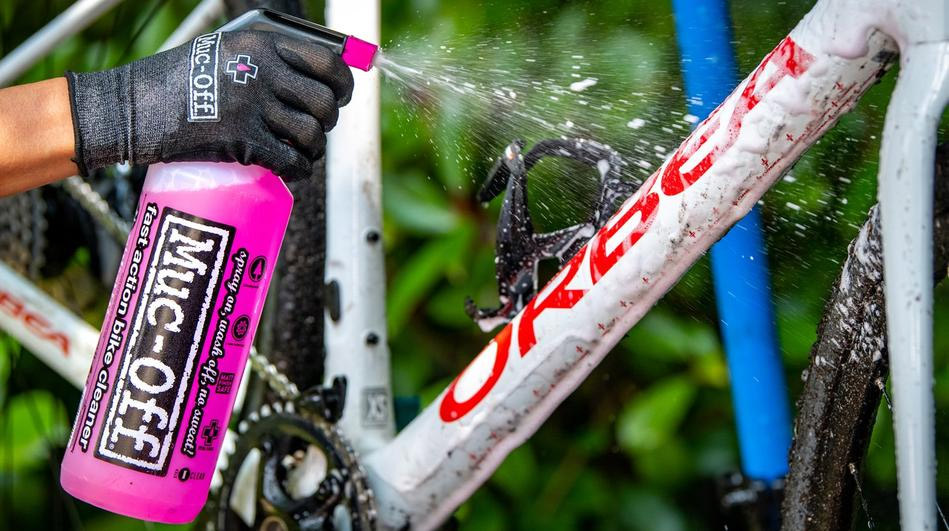
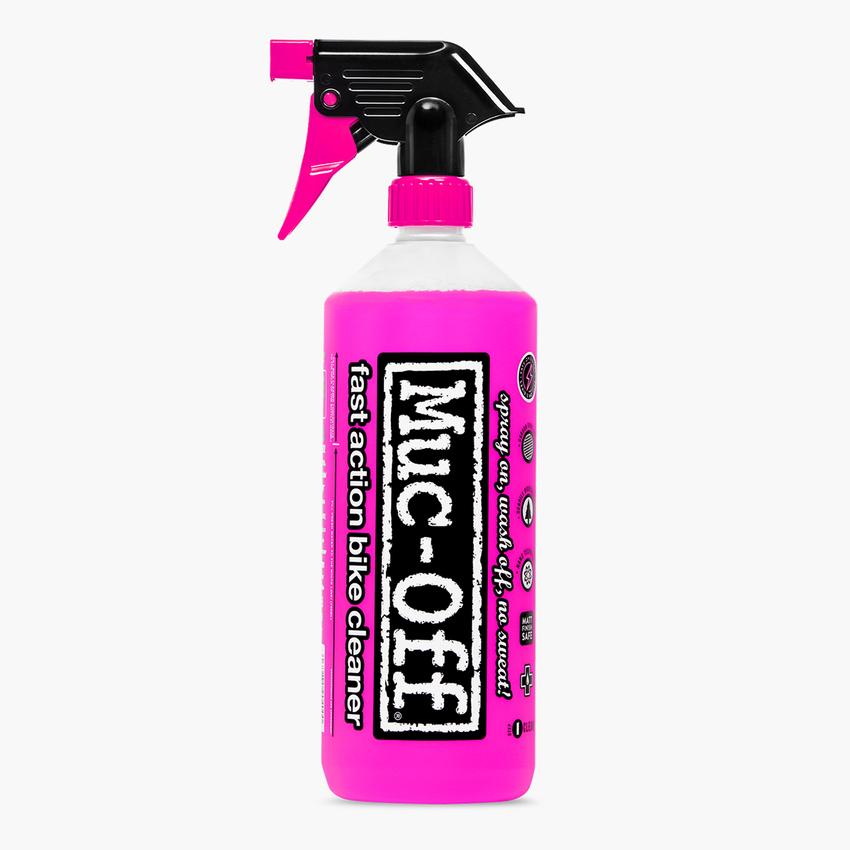
To clean my bike, I opt for the Nano Tech Bike Cleaner. The Nano Technology breaks down dirt and grime at a molecular level so it is easier to clean. You can literally see the grime dissolve in front of your eyes! As Muc-Off states, “It’s the most effective cleaner out there, and it doesn’t even need any of those nasty, dangerous acids or chemicals. In fact, our perfectly pink cleaner is biodegradable, free from acids, CFC’s and solvents, and it’s alkaline based so you can clean away with a guilt-free conscience. It’s safe on all surfaces, and it’s even disc brake rotor and pad friendly.”
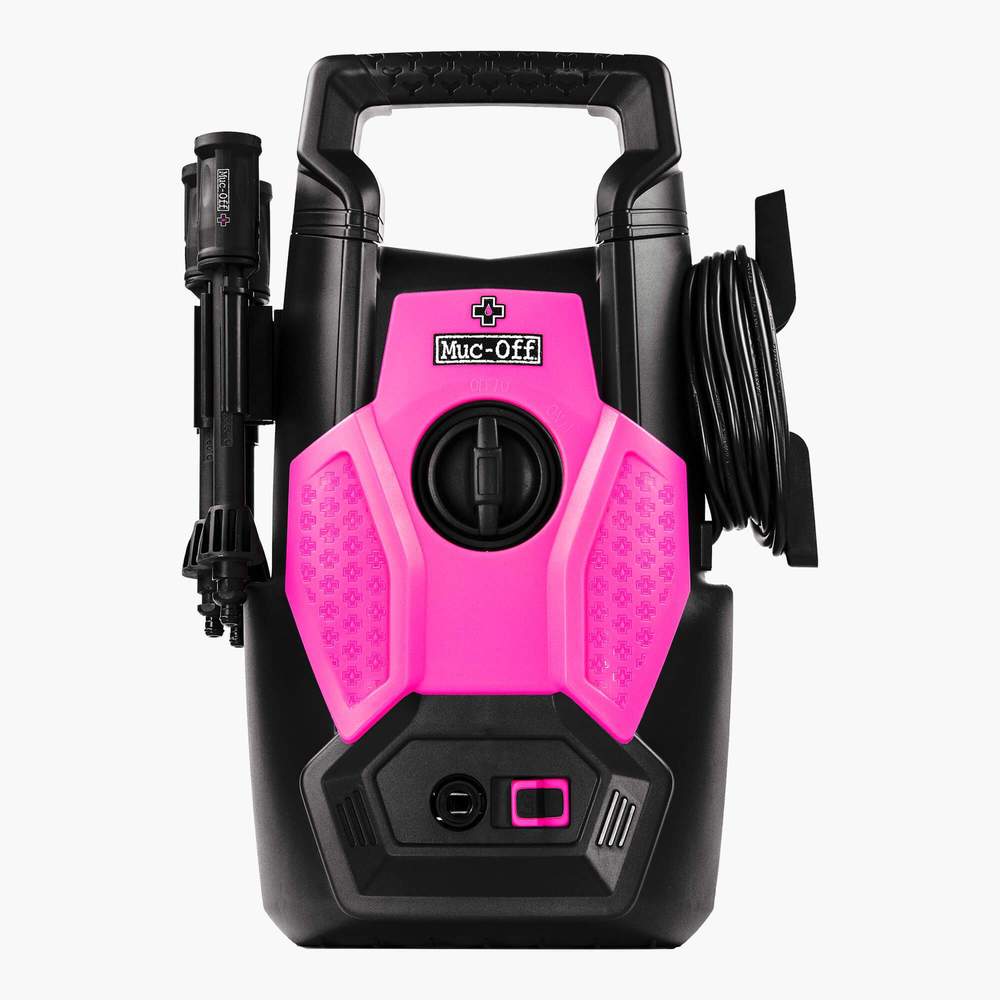
To speed up the process of cleaning your bike, if you aren’t interested in using the old technique of a “bucket and sponge”, Muc-Off offer a bike-specific Pressure Washer range where the Nano Tech Bike Cleaner can be sprayed directly on the bike using a specially-designed pressure washer. I’ve not used one of these but I caught up with Muc-Off’s Steve Fearn who explained in more detail…
Pressure Washer
Muc-Off designed a specific cleaning attachment, referred to as a lance, which has been designed to be bearing and suspension friendly. In their own words “The lance creates a wider fan of water than a typical pressure washer lance. This means that there’s less likelihood of causing any damage to delicate bearings, suspension components and paint finishes.”
There is an adjustable Snow Foam Lance allows you to apply Muc-Off Bike Cleaner, Concentrate, or Snow Foam onto the surface of the bike by simple screwing any of these three bottles directly onto the Snow Foam Lance. There’s no need to mix with any additional water. The pressure washer will mix water and detergent automatically to the desired dilution you’ve set by adjusting the dial.
Basically, if you are thinking of buying a pressure washer to clean your bike, get one of these because the cleaning lances have a softer touch that prevents any likelihood of damaging your bike. Bonus: they’re 30% off this weekend!
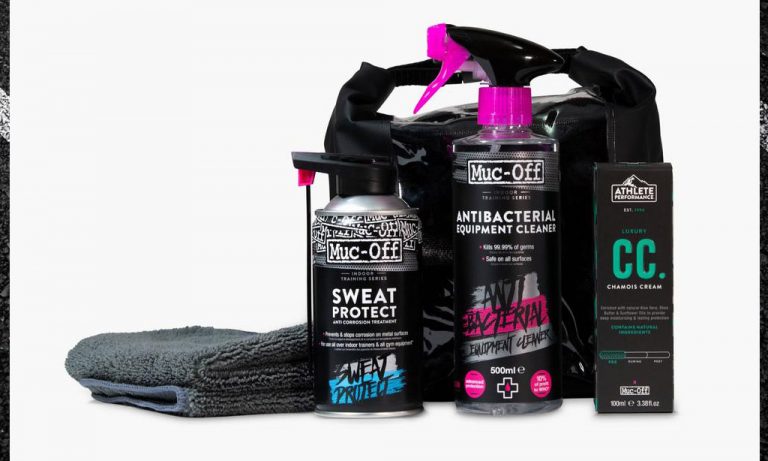
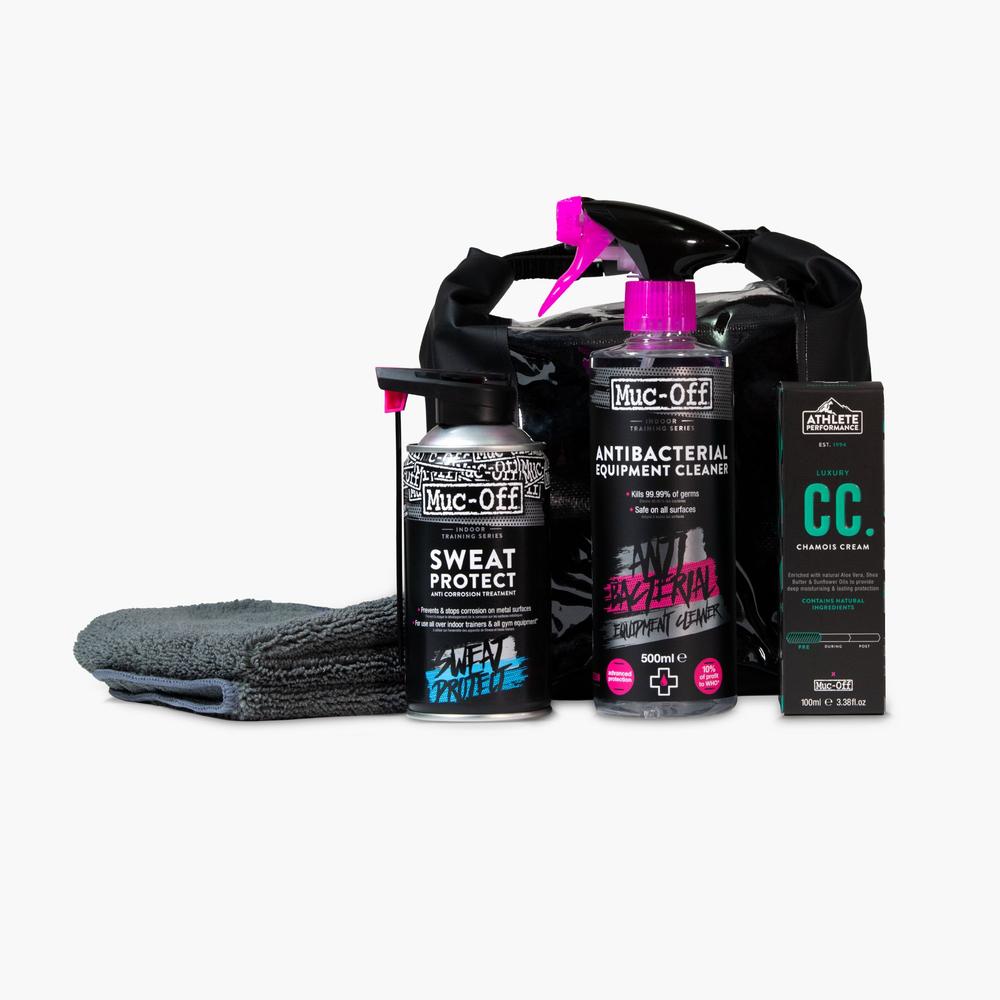
As you can imagine, Muc-Off offer a full range of appropriate brushes to clean your bike and specific components, including the drivetrain, in addition, they offer appropriate microfiber cleaning cloths. The most cost effective way is to purchase them in a kit, such as the Bike Care Essential Kit. They also sell a specific Indoor Training Kit which contains their Antibacterial Cleaner that kills 99.99% of germs and Sweat Protect to stop rust and corrosion.
Protection Products
Bike Protect
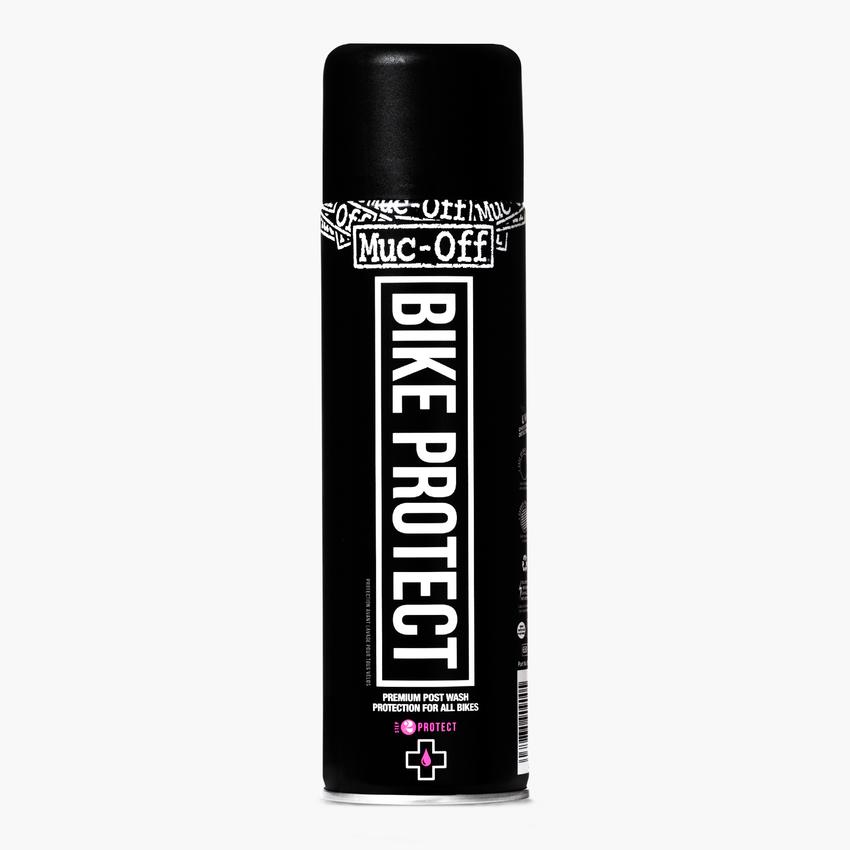
Muc-Off’s second area of expertise is in the field of protecting the bike, because it’s simply not enough just to clean your bike. To protect your bike Muc-Off have created Bike Protect, which is badged as “ultimate liquid bicycle protection.” This spray, which is applied after cleaning your bike, is designed to be applied on your drivetrain to disperse moisture before applying lubrication to the chain. Furthermore, it leaves a non-sticky protective layer on your frame, drive chain, metal parts, and paintwork which is designed to prevent dirt adhesion.
For the ultimate protection, Muc-Off have got a product called Miracle Shine, which is applied immediately after cleaning your bike. This is a high quality polish and protectant that provides a shine to your frame. It contains Carnauba Wax which will make the water bead and disperse, it also removes imperfections and fills minor scratches. If you are wanting to give your bike a complete overhaul, then you can’t go far wrong with applying Miracle Shine and giving it that “new bike look.”
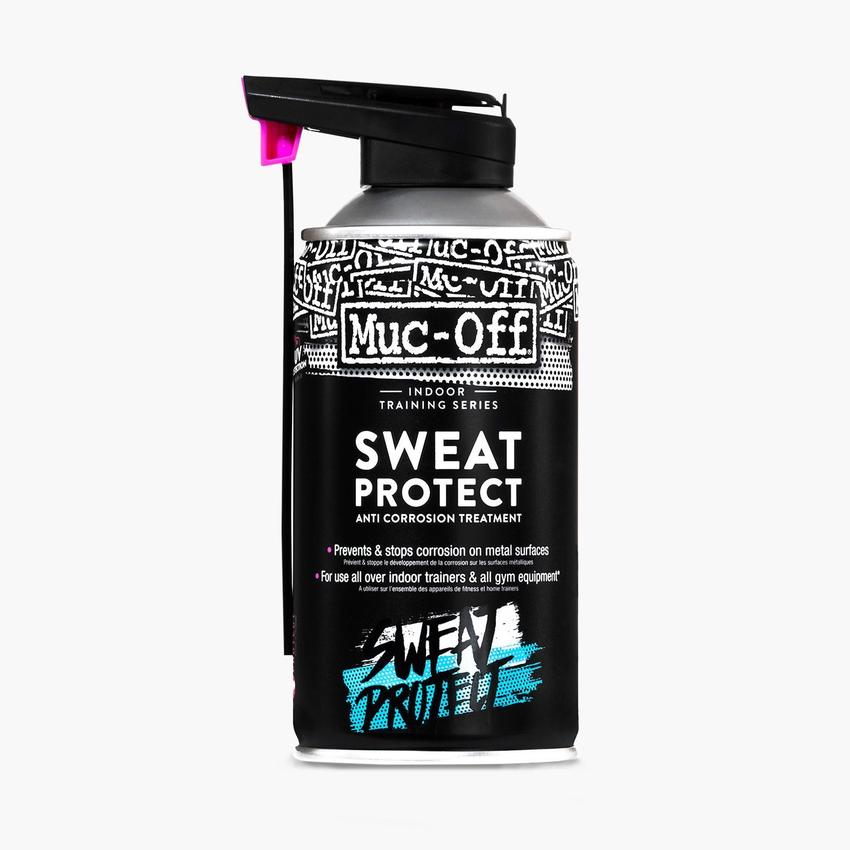
Sweat Protect
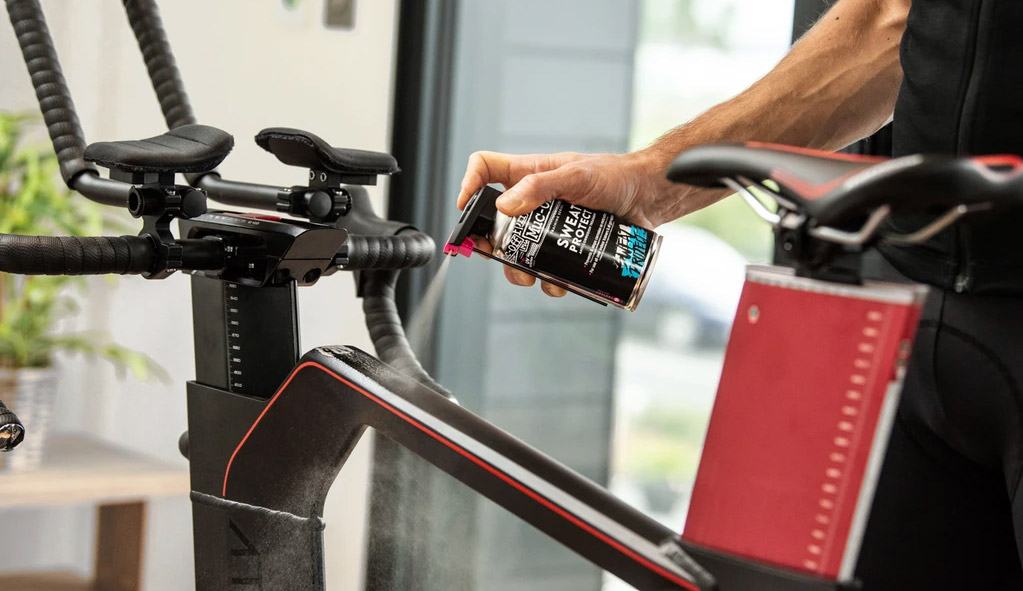
With the increase in indoor cycling, Muc-Off realised the need to protect the components from heavy salt corrosion from sweat. As a result they developed Sweat Protect. This product “uses anti-corrosion additives to protect your bike against rust, driving out the moisture.” I apply this spray frequently, directly after cleaning my bike. This is done to prevent having to replace my headset bearings, which proved quite costly.
The key features of this product are:
For use on all indoor trainers and all gym equipment
Prevents and stops corrosion on metal surfaces
Penetrates and protects
Non-drying film
Rust preventing/anti corrosion
Dissolves rust
Protection lasts up to 3 months
What I have learned is that it is simply not enough just to clean your bike. You have to undertake a level of aftercare to ensure that the components are protected, because the salt from your workout causes rust and the salty crust can make removing components more challenging. In my case, when removing the cable guide for the rear brake, some of the paint flaked away from my carbon frame, resulting in a costly repair – hence why I now use the Sweat Protect spray.
Optimisation
The key insight which I want to share that I gained from talking to Steve was that optimisation of your components, particularly your chain, is vital for those marginal gains we are all seeking.
Steve explained that they have devised a chain called the NTC Nanotube Chain, which has savings of over 10 watts against Ceramic Speed’s Shimano Dura-Ace UFO Chain. In performance terms, this means that the NTC will give you a gain of 3 miles over a 112- mile Ironman bike stage, calculated using the average time of 6 hours and 25 minutes!
However, the downside is that comes at a price: £109 to be exact. The science behind the chain is worthy of a read in itself, via Muc-Off’s own brochure.
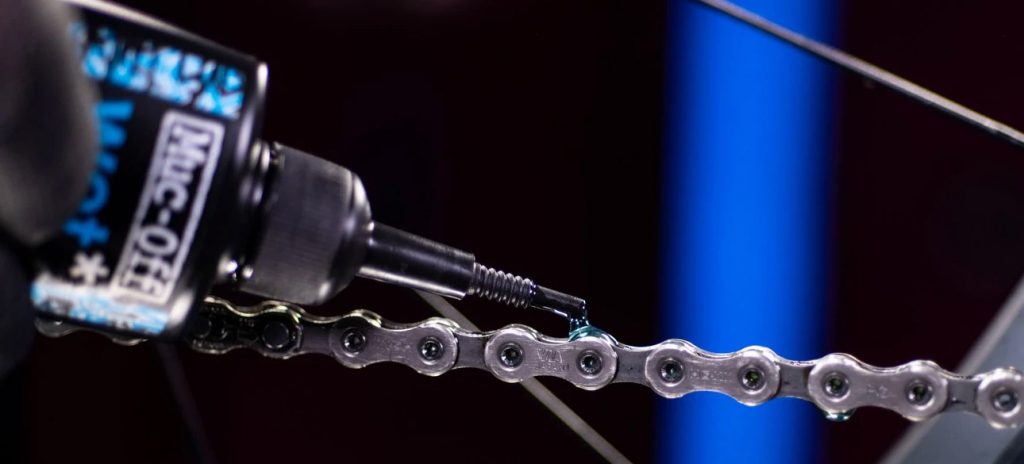
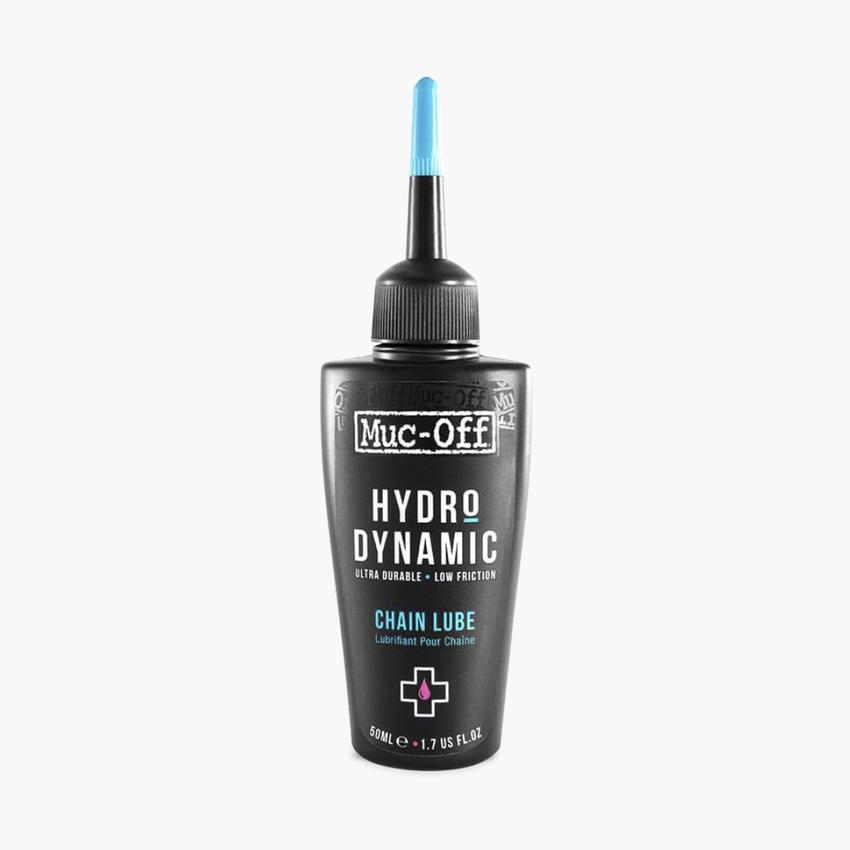
You don’t have to spend big money to achieve some marginal gains. Muc-Off’s popular Hydrodynamic Chain Lube was created by their research team in collaboration with Team Sky (former professional cycling team). This is a highly advanced bicycle chain lubricant. It also doesn’t pick up dirt, dust and debris. What this means is “it is a high strength film forming lubricant which prevents metal to metal contact to ensure peak performance, even under the most extreme workloads.” Basically, it makes your chain smoother, so you can go faster.
Hydrodynamic Chain Lube is used on Zwift by the Canyon eSports Team, which consistently place at the head of the field in the top-tier Zwift Racing League. In fact, Muc-Off realised the growth potential of Zwift and support the Canyon eSports team with the products that I have outlined.
Summing up
Muc-Off are my “go-to” product for cleaning and protecting my bike. They offer a complete range of items, at varying price points. You can spend as little, or as much as you want. But the clear message is that you have to clean your bike and take extra care if you don’t want to incur big expenditure after excessive use.
My rationale with purchasing these products is that, as I learnt the hard way, it is better to pay for quality cleaning products than to replace failed components. Ultimately if it’s good enough for Canyon eSports and Team Sky, it’s good enough for me.
A Note About Links In This Post
After reaching out to Muc-Off about putting together this article, they set up Zwift Insider with an affiliate agreement so the site receives a small commission on any sales through links in this post.
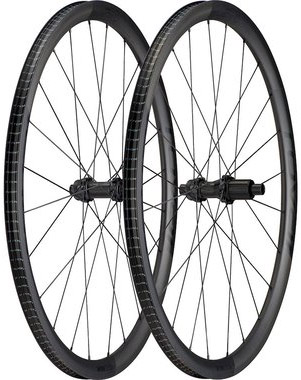
Zwift’s newest update includes a fresh wheelset from Roval: the Alpinist CLX. This is Roval’s third wheelset in game, coming hot on the heels of their Rapide CLX release in May.
The IRL Alpinist CLX wheelset came out in 2020 and received some very positive reviews. Specialized says they are “the lightest road clincher wheelset we have ever made.” And they sure are light, weighing in at 1248 grams. Compare that to Zipp’s (recently launched in game) 353 NSW’s which are Zipp’s lightest tubeless wheels ever at 1255 grams!
The Alpinist wheels are available for 135,300 Drops on Zwift, for level 32+ Zwifters. They are rated 3 stars for aero, 4 stars for weight. Here’s how they’re described in the Drop Shop:
“A pure climber’s dream, the new Alpinist CLX is the lightest road clincher wheelset Roval has ever made. When climbing, mass is the enemy of performance, so Roval pared the Alpinist CLX down to the absolute minimum to capitalize on every precious watt of energy without sacrificing any of the strength, ride quality and durability that are crucial to long term performance and satisfaction.”
Sounds like these wheels should be great climbers. But experienced Zwifters know that real-world performance doesn’t necessarily translate to Zwift performance, so at Zwift Insider we run frames and wheelsets through a battery of tests to learn just how well they perform in Zwift’s virtual world.
Here’s everything you need to know about the new Roval Alpinist CLX wheels in Zwift…
Aero Performance
The Roval Alpinist CLX wheels turn in a flat test time that places them in approximately the 25th percentile for aero performance. This isn’t surprising, given that this is a pure climbing wheelset.
The Alpinist CLX wheels turned in a time of 51:12 on our test course (two laps of Tempus Fugit). By comparison, the fastest wheels in game (DT Swiss disc) turned in a time of 50:25.5, and the Lightweight Meilenstein wheels turn in a time of 51:11.5. (All of these test times were done with the Zwift Aero frame.)
Climb Performance
The Alpinist CLX wheels are rated at 4 stars for weight, and we figured they would out-climb most of the wheels in the game, given their super-low IRL weight.
The Roval Alpinist CLX wheels turned in an Alpe du Zwift time of 49:12. That’s precisely the same time as the Lightweight Meilensteins which have been the best pure climbing wheels ever since they were introduced to the game in March 2018!
By comparison, the new Zipp 353 wheels turn in a time of 49:20. These wheelsets may be separated by only 7 grams IRL, but on Zwift, the Alpinists outclimb the 353’s handily. (It’s worth noting that the 353’s outperform the Alpinists by 14 seconds in our flat tests.)
Conclusions
The “King of the Hill” spot is now shared between the new Roval Alpinist CLX wheelset and the Lightweight Meilensteins, since both wheelsets turn in nearly identical times in our flat and climb tests.
While neither is the best choice for flat or rolling Zwift races due to poor aero performance, if you’re purely focused on climbing, these are the wheels you want in your garage.
Given the standout performance of the Alpinist CLX wheels, we’ll be updating the following posts soon:
Important note: this post contains speed test results for Zwift frames or wheels. These results may change over time, and a bike's performance relative to others may also change. We don't always revise posts when performance rankings change, but we do keep current, master versions of our speed test results which are always available. See the frame charts, wheel charts, and Tron vs Top Performers for current performance data.
Zwift Academy Road is back! Having completed the events during the week, I can say with confidence that the events are good. If you haven’t tried any yet, you still can! Events are varied with something for everyone, as I will highlight below. Let’s get after it!
The Zwift Academy Baseline ride is a different event from the norm. The point of the ride is to set a Baseline set of times over three particular segments, resting between those segments on course so you can hit the next segment hard.
You will then complete the same event at the end of the Academy and compare your results, to see your progress.
The segments test your sprinting ability, your short power (anaerobic) endurance, and your longer power (aerobic) endurance. You have two course options: “Advanced” on the new Climber’s Gambit route, or “Standard” on the new Legends and Lava route. The big difference between the two is the length of the segment used for the final aerobic effort. (The Advanced Ride climbs the Epic KOM Reverse, while the Standard Ride climbs the Volcano KOM.)
The key thing is to attack the segments and recover in between. When I tackled the route, I didn’t take the opportunity to read the description of the event beforehand, or read the Zwift Insider Baseline Ride FAQ. So I blasted from the start line and kept going, like it was a 30km TT. It was brutally hard and I did enjoy it, but it wasn’t undertaken correctly, so I will need to repeat the exercise and do it properly to get a correct set of results.
All in all, a great event because it is different… and required for Zwift Academy graduation!
This is a tough workout. You work over your FTP for a period of 2 minutes, then under your FTP for 1 minute, then over for another minute, then under for two minutes. And repeat that three times! It’s a “leg zapper” for sure, so only do this if you haven’t got any rides planned as it will certainly leave you with “jelly legs” for the rest of the day.
The purpose of the workout is to improve your VO2 Max, enabling you to increase time spent at moderate and high intensity.
To qualify for the Zwift Academy Road pro contract competition, you need to jump through a few extra hoops, including completing this event. It’s a climb up Alpe Du Zwift, which if you’re a climber like myself, it’s something to look forward to! (Chances are I will be trying this several times.) The official blurb from Zwift says:
“This is a mass-start event using TT bikes. Drafting benefits will be disabled. It all goes down on Road to Sky, featuring the iconic Alpe du Zwift climb. In total, the distance is 10.7 mi // 17.3 km with the actual climb clocking in at 7.5 mi // 12.2 km with an 8.0% grade incline and 3,428 ft // 1,045m elevation gain. The Route begins in the jungle, where you’ll have 3.1 mi // 5.1 km to warm up the legs before the climb starts in earnest. The focus here is on the climb, so take it easy and take advantage of this time to get yourself ready for what’s to come.
We’re looking for high-sustained efforts here, so pacing properly is key. Don’t fire off too hard. Settle into a good rhythm as soon as possible.”
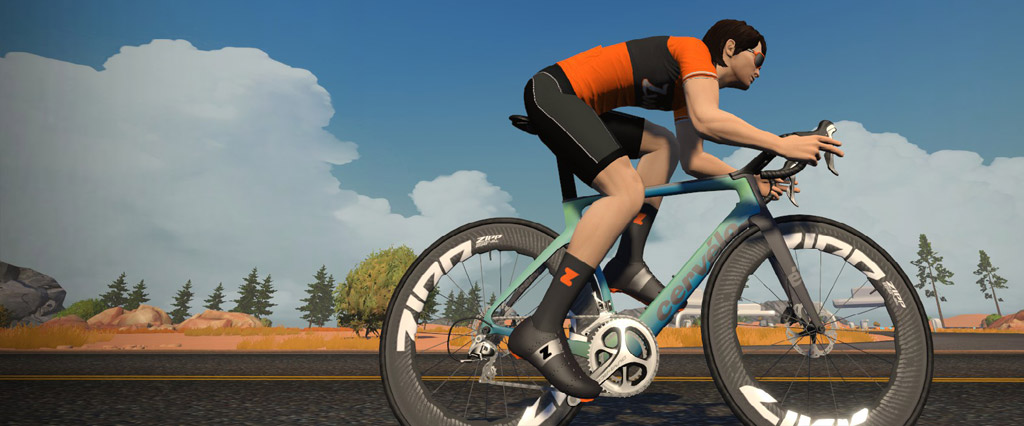
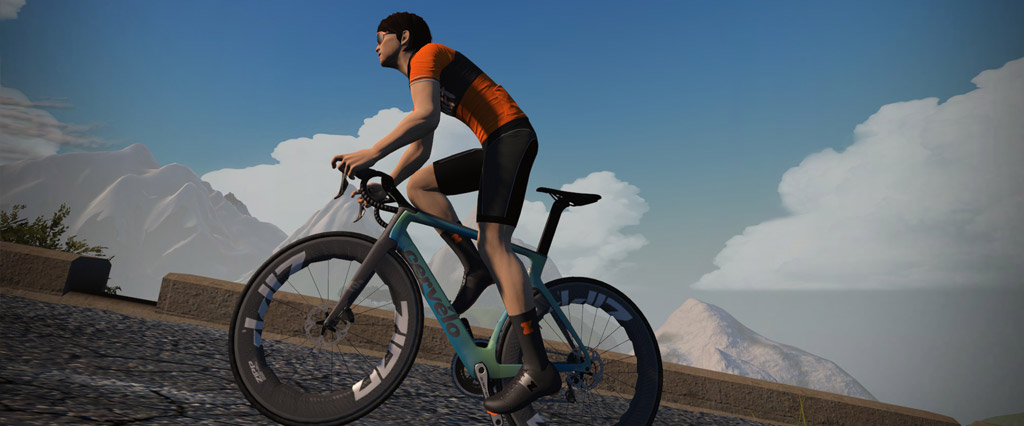
Zwift’s August 2021 update included a new bike frame: the S5 2020 from Cervelo.
The original Cervelo S5 has been in the game since beta days, and is still a favorite among Zwifters because it’s fast. So we were anxious to test the updated S5! But we had to wait a few days after its release, because a bug in the bike’s setup caused it to not be as aero as intended. Once Zwift released their minor update, the aero rating on this frame went from 2 stars to 3, and we were ready to test.
Here’s how the frame is described in the Zwift Drop Shop:
“The S5 prioritizes aerodynamic performance and stiffness, making it a platform preferred by the fastest sprinters in the world. Don’t think it’s a one-trick pony, though – despite the lateral stiffness, the S5 delivers an incredibly comfortable ride. You’ve no doubt noticed the now-iconic V-Stem. Cervelo has optimized that shape to deliver the best possible performance in the wind, hiding cables inside, and making enough bar/stem/stack options to fit just about anyone.”
The frame is rated 3 stars for aero, 3 for weight – the same as other top racing frames in Zwift. (Only TT frames get a 4-star aero rating.) You’ll have to be level 27+ to purchase it in game, at a price of 852,000 Drops.
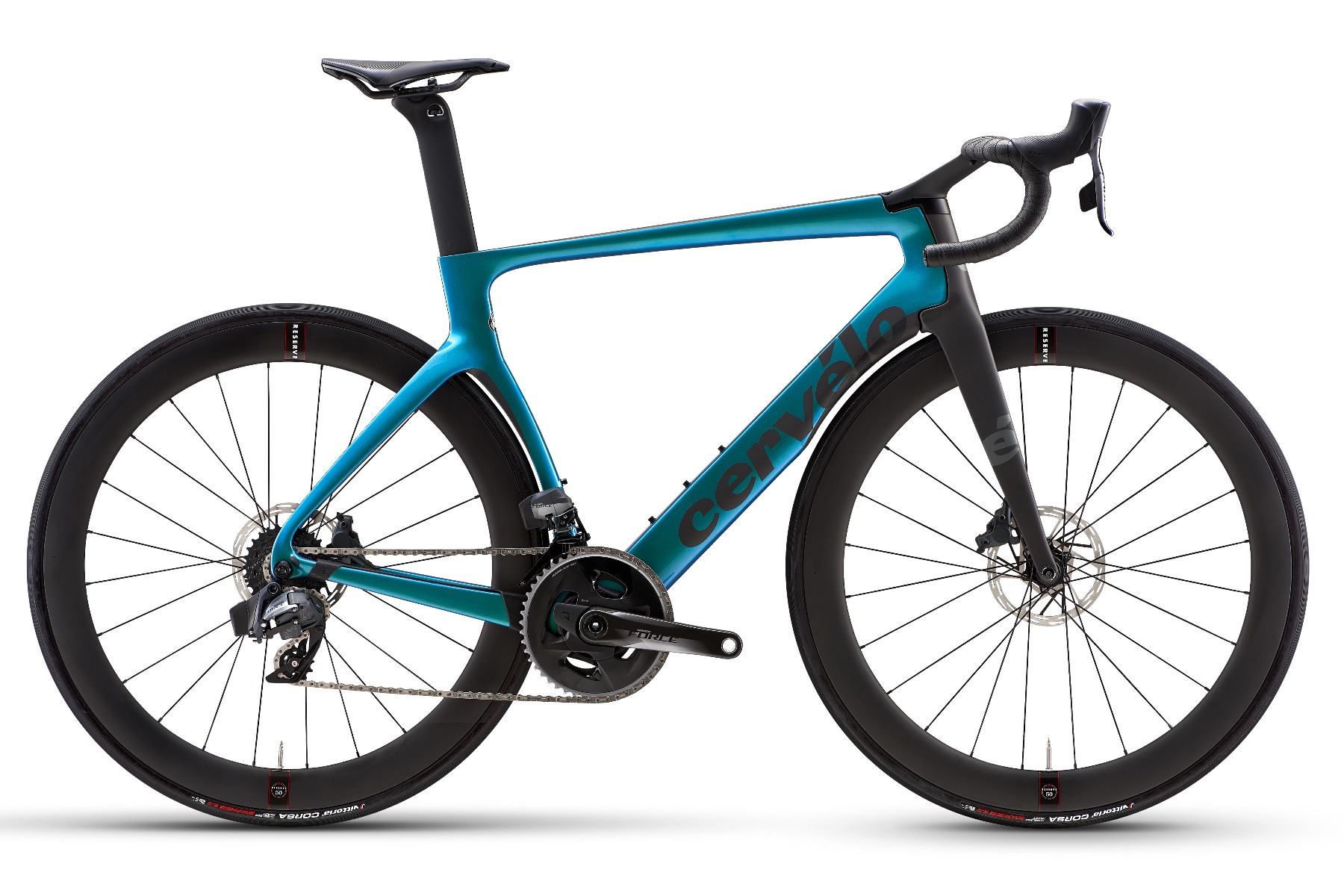
The Cervelo S5 2020, IRL
Cervelo is known for unique and fast frame designs, and we know the reviews say the IRL (in real life) bike is zippy. But IRL performance doesn’t always map directly to Zwift performance, so we ran this frame through our standard tests to learn how it performs in Zwift. And the results are something racers will want to see!
Here’s everything you need to know about the new Cervelo S5 2020 in Zwift…
Aero Performance
The S5 2020 turns in a faster flat test time than any existing road frame on Zwift, beating the Specialized Venge S-Works by 1 second in our ~50-minute test. The only frames faster on Zwift at this time are TT frames.
The Cervelo S5 2020 is also 1.5 seconds faster than the original Cervelo S5.
The S5 2020 turns in a time of 51:17.5 on our test course (two laps of Tempus Fugit). By comparison, the Zwift Aero frame turns in a time of 51:25.
Climb Performance
Rated at 3 stars for weight, we knew the S5 2020 wasn’t going to perform like a lightweight climber. But Zwift’s star rating system isn’t very granular – two bikes can be rated at 3 stars but have significant time gaps between them. So we had to find out just where this bike sits among the aero frames in terms of climbing performance.
Our tests show that the Cervelo S5 2020 climbs at precisely the same speed as the Specialized Venge S-Works. This means it climbs the Alpe 3 seconds faster than the original S5 frame.
The S5 2020 turns in an Alpe du Zwift time of 49:08. By comparison, the current fastest climbing frame (Specialized Aethos) turns in a time of 48:49.
Note: all test results above are from a 75kg, 183cm rider holding 300W steady using Zwift’s stock 32mm carbon wheelset.
Conclusions
When originally released, this frame’s performance was so outstanding that it almost forced racers to choose it. Then Zwift released the minor version 1.16.2 update which nerfed the frame a bit – and we think that’s a good thing.
Having it be just 1 second faster than the former faster frames means racers can select from a wider variety of frames without feeling like they’re giving themselves a major disadvantage.
Still, it big news that the Cervelo S5 2020 is the new king of the aero hill on Zwift! We’re sure many riders will be using it to maximum advantage any time they ride flat or rolling races (routes like Crit City, Watopia Hilly or flat, Volcano Circuit, Sand and Sequoias, Classique, most of France, etc.)
Due to this frame’s incredible aero performance we’ll be updating the following posts:
Important note: this post contains speed test results for Zwift frames or wheels. These results may change over time, and a bike's performance relative to others may also change. We don't always revise posts when performance rankings change, but we do keep current, master versions of our speed test results which are always available. See the frame charts, wheel charts, and Tron vs Top Performers for current performance data.
This week, 3 of the Top 5 Zwift Videos give you different perspectives on the same race. After watching the YouTubers go head to head, you can get some advice for climbing Alpe du Zwift and see a demonstration sending pre-set Zwift messages using voice commands.
ZWIFT – Pro Bodybuilder vs Pro Eater || Erik The Electric || Vegan Cyclist
Bodybuilder Greg Doucette and his producer Steve challenged fellow YouTubers ErikTheElectric (a powerlifter and competitive eater) and The Vegan Cyclist to a short Zwift race. See how they did on one lap of the Innsbruckring course and hear Greg’s sharp analysis of the race.
ErikTheElectric vs. Coach Greg Doucette in a Bike Race!
ErikTheElectric (Erik Lamkin) shares his perspective of the race against Greg Doucette and The Vegan Cyclist (Tyler Pearce).
YouTubers Zwift Race | Coach Greg, The Vegan Cyclist and Erik The Electric
Finally, another YouTuber decided to jump in the competition to see if he could beat any of the others. Mark Lewis gives a little background on the headline racers and explains his own strategy as he replays his race.
Sub-Hour Alpe Du Zwift Climb with Commentary and Tips
Best Side Cycling climbs the Alpe du Zwift and gives advice that you can use to make your next attempt your best one.
Zwift Message Using Voice Attack (Full Version) to work with Macro Deck (Free Version)
Regular Zwift group ride leaders often send repeated messages about things like the pace of their ride, especially if it changes throughout an event. Taicho Cyclist makes it easier by using the applications Voice Attack and Macro Deck to send these messages with short voice commands.
Got a Great Zwift Video?
Share the link below and we may feature it in an upcoming post!
Based on the response to yesterday’s post about my Zwift Academy (ZA) Baseline Ride experience, lots of Zwifters are asking similar questions about how these rides work.
So here’s a list of Baseline and Finish Line Ride frequently asked questions, with (hopefully) helpful answers.
What is the purpose of Zwift Academy Baseline and Finish Line Rides?
These events were created to measure how you perform within the three different energy systems:
Sprint (tested over a short segment)
Anaerobic (tested over a medium-length segment)
Aerobic (tested over a longer segment)
By the end of Zwift Academy, you’ll have completed both a Baseline and Finish Line ride. You should then be able to determine what type of cyclist you are based on what energy system you excel in.
How do the rides work?
The rides function like any other Zwift group ride – everyone starts from the pens, then rides the prescribed route at their own pace. The category you select at signup determines which of two routes you ride. Each route has three target segments which you want to hit at maximum effort in order to measure how you perform in the three energy systems.
There are three things that set these rides apart from a typical group ride:
Drafting is turned off. This is done so your segment timings aren’t affected by drafting other riders.
The entire goal of the ride is to hit the three segments at maximum effort. In between those segments you should be riding at a very easy pace and recovering, so you’re as fresh as possible for the next segment.
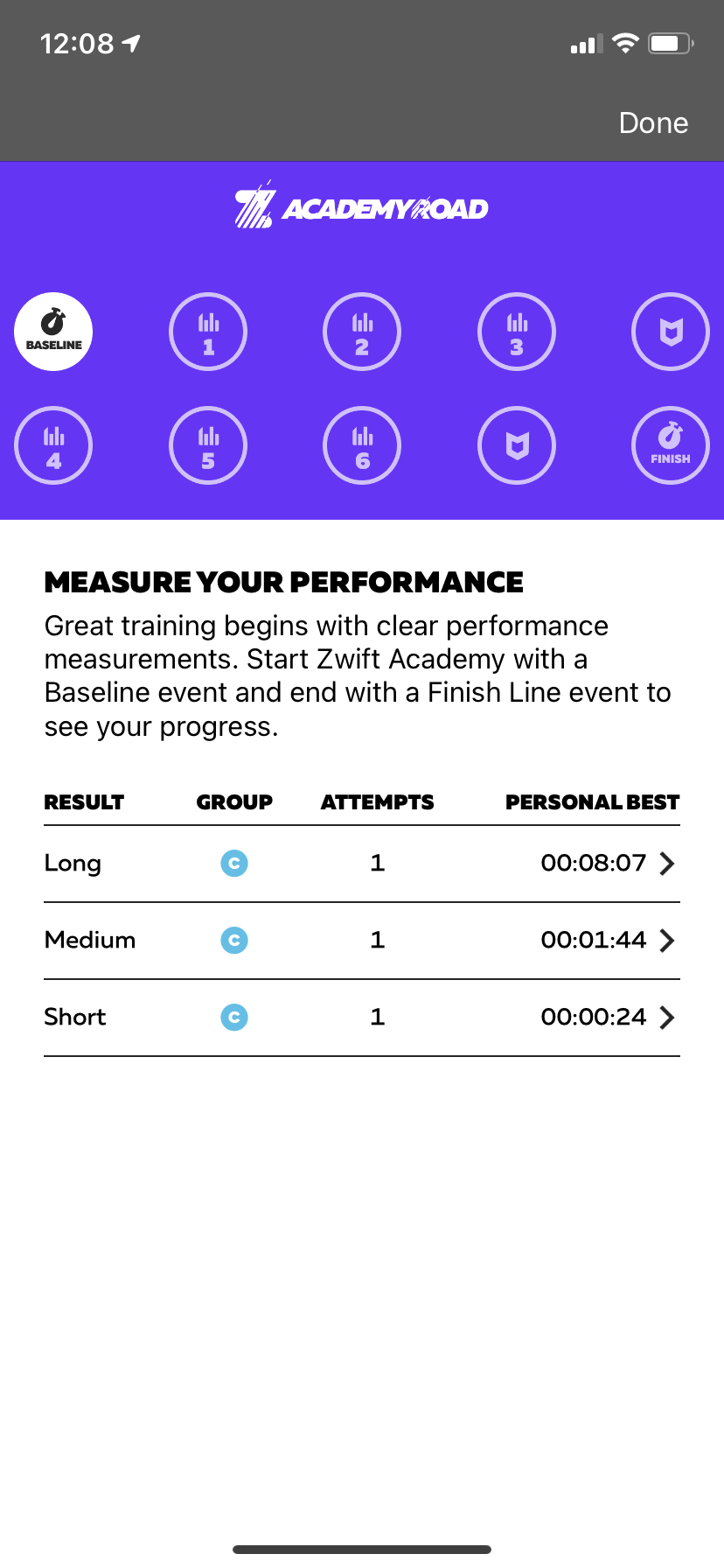
Your three segment times are saved and viewable in the Companion app to track progress.
What routes do the Baseline and Finish Line Rides use?
If you choose the Advanced Baseline Ride (category A for men, B for women) you will ride Watopia’s new Climber’s Gambit route.
If you choose the Standard Baseline Ride (category C for men, D for women) you will ride Watopia’s new Legends and Lava route.
Should I sign up for the Advanced ride, or the Standard one?
The big difference between the two is the length of the segment used for the final aerobic effort. The Advanced Ride climbs the Epic KOM Reverse, while the Standard Ride climbs the Volcano KOM.
Most riders will finish the Volcano KOM in 8-14 minutes. The Epic KOM takes approximately three times longer to complete.
If you are a pro contract contender, you are required to complete the Advanced Baseline Ride. Additionally, if you are a very experienced/fit rider, the Advanced ride may provide a better test of aerobic endurance than the shorter Standard ride.
Just remember: whatever option you choose for the Baseline Ride, will need to be chosen again for the Finish Line Ride so you can track your progress!
Where do the timed segments start/end?
Experienced Zwifters may know the maps well enough to know where the segments begin. But what about the rest of us?
If you are riding the Advanced Baseline ride, you will arrive at the segments at this point during the ride (click segment name for Strava segment details):
If you are riding the Standard Baseline ride, you will arrive at the segments at this point during the ride (click segment name for Strava segment details):
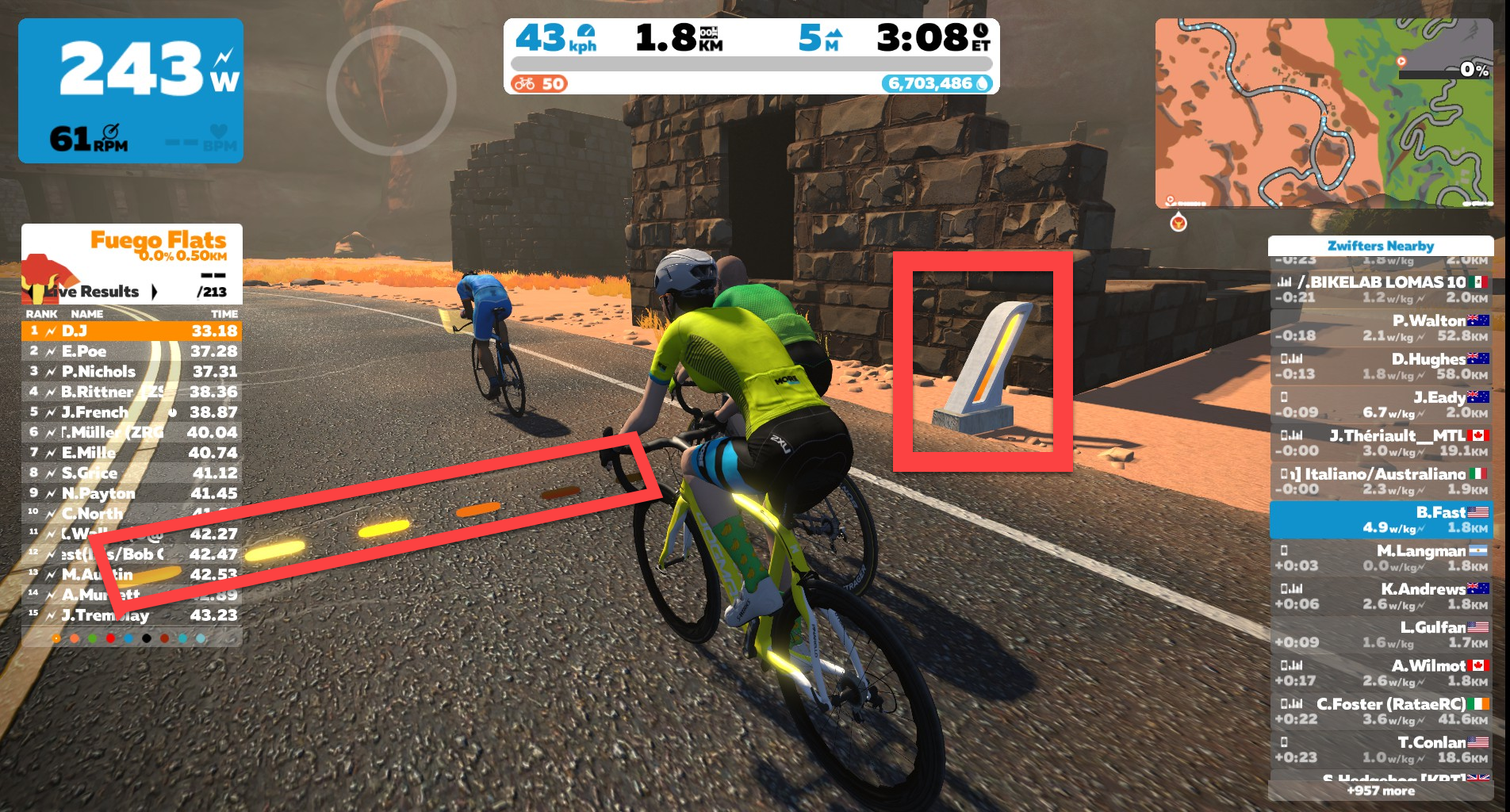
Along with noting the starting distances above, it’s also helpful to recognize the visual indicators used to show that a segment is beginning.
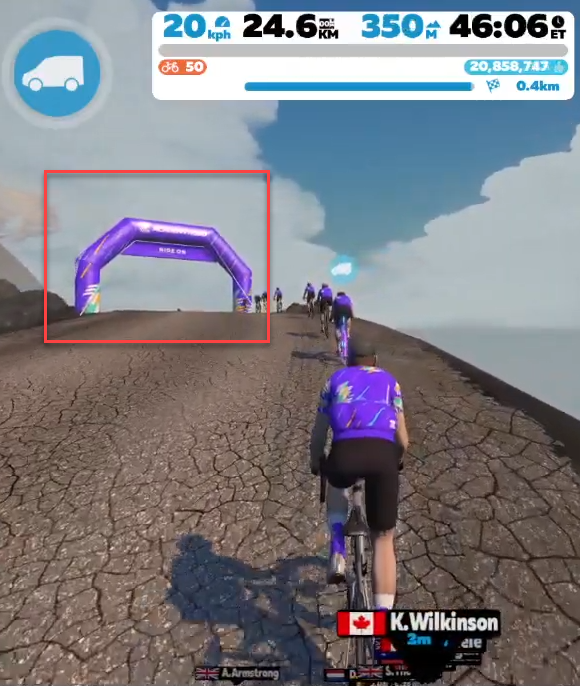
Here’s what segment start and finish lines look like:
Start line has a stanchion with lights across the road
Finish line has a big purple arch
Does the ride end at an arch? How do I know when I’m done?
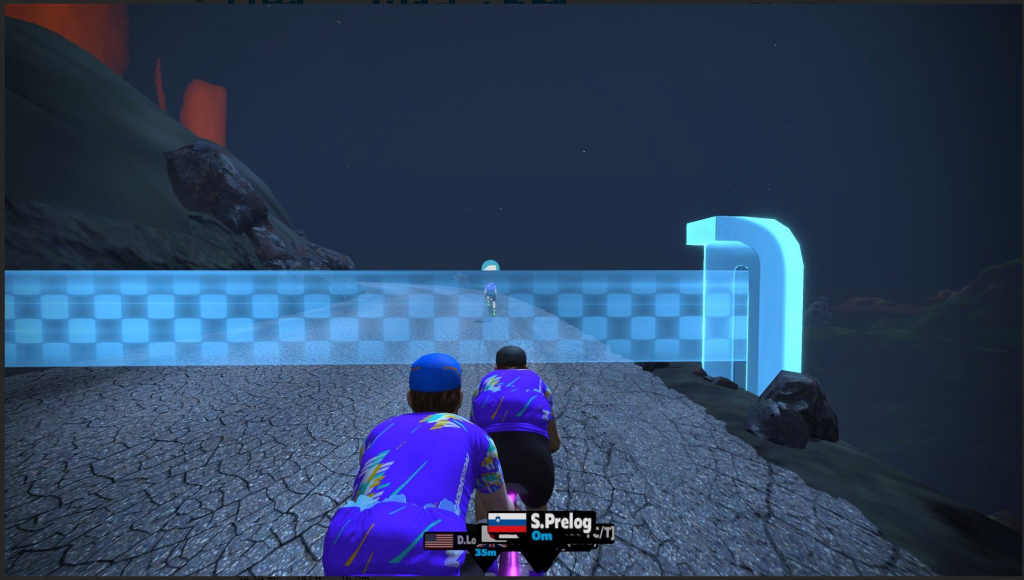
The ride will continue just a bit after the finish arch of the final segment. Just spin those pedals and catch your breath – you’ll see the finish line soon enough! It looks like this:
Which bike should I use? Is there an assigned bike?
There is no assigned bike or wheels for these events. Since you want to be able to compare your segment times between your Baseline Ride (at the start of ZA) and Finish Line Ride (at the end of ZA), you should simply plan to use the same bike frame and wheelset for both events.
Doing this means your times won’t be impacted by the virtual equipment you use, since different wheelsets and frames can be more or less aero and weigh more or less than others.
How can I tell what my strengths or weaknesses are based on my Baseline Ride results?
Strengths and weaknesses (we like to call them “opportunities for improvement”) cannot be determined by Baseline Rides alone. Zwift will be sharing a blog post, probably near the end of ZA, which will go into greater detail about what to do next based on your Baseline + Finish Line results.
If you can’t wait until then, or just love digging into your data, there are third-party apps available to give you more insight into your performance numbers and even rank you against others. The Breakaway app we recently reviewed just received a Zwift integration update and gives you fancy charts ranking you based on power numbers. ZwiftPower also profiles your power to help you understand your strengths and weaknesses.
Is this a race?
No. The entire goal is to put in your best effort over the three segments. Recover at whatever pace you’d like in between those segments, so you can put everything you’ve got into the timed sections.
Is Late Join turned on?
No. Most group rides on Zwift have Late Join enabled so you can join the group up to 30 minutes late. But if you did that on a Baseline Ride, you may join the group after they’ve already completed a segment or two! So you have to show up on time to make it work.
Should I do the Baseline Ride in Erg mode?
No. These aren’t workouts – they’re free rides.
I can do better. Can I do my Baseline Ride over again?
Absolutely! Just sign up for another one and give it a go! They’re scheduled through September 27.
Is drafting turned on for Baseline Rides?
No. Drafting is turned off so you have consistent environmental factors for both the Baseline and Finish Line rides in order to get more accurate results.
Do I need to stay with the group? What if I get dropped?
There’s no need at all to stay with the group. In fact, with drafting turned off, saying bunched up is next to impossible! Just ride at your pace.
Where can I see the results of my Baseline Ride?
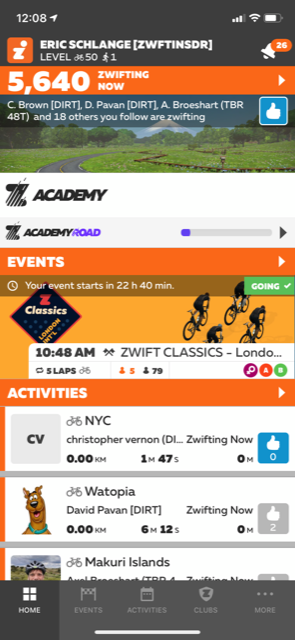
In the Zwift Companion app (available for iOS or Android). Just click the Zwift Academy Road section near the center of the home screen:
Progress!
Does the Baseline Ride function as an FTP test, or do I need to do one of those first?
The Baseline Rides does not function as an FTP test. If you’ve never done an FTP test, we recommend doing one so your FTP is accurately set before you jump into a ZA Workout, since the power levels of the workouts are based on your FTP.
The quickest/easiest way to do an FTP test is to take a ramp test.
How does the Baseline Ride impact the rest of my ZA Workouts?
Short answer: it doesn’t. The goal of Baseline Rides is to gauge your current fitness level at the start of ZA so you have a comparison point for your Finish Line ride at the end of ZA.
Watch me complete a Baseline Ride
Curious what the actual ride experience is like? Here’s a full video of me completing the Standard Baseline Ride:
Still got questions?
Feel free to share them below. We highly recommend checking out the very thorough ZA Road FAQ forum post from Zwift, since it appears to address nearly all questions related to ZA Road 2021.