Home Blog Page 508

KISS EU – “Spinners are winners”

0

KISS EU – “Spinners are winners”

The first classique race of the year saw some close finishes for the KISS EU of January 5th. In the A category, Tim Cartwright (KissRT) took the win after a long breakaway, whereas in the Bs, Sebastian Sternefalk (Vision) won the final bunch sprint.

Known for its fast pace, the London Classique Course was the ideal place for a new two-man breakaway featuring Tim Cartwright (KissRT) and David Allonby. Managing to stay up front, the English duo saw its advantage cut down to 6 seconds at the beginning of the race’s last hill. In an ultimate sprint effort, Cartwright managed to keep a few seconds over the pack, and took the win over Brett Boniface (Team ODZ) and David Allonby.

In the B category, the finish came down to a bunch sprint, despite the several attacks from Julien Beijer (Team X) in the uphills. The Dutch rider from Team Experimental, in addition to a 2nd place, won the first q/l Report – Combativity Award of 2017. In the final sprint, Sebastian Sternefalk (Vision) took the win over Julien Beijer (Team X) and Morten Austestad. “I wasn’t sure to ride today, after a rough New Year’s eve” says Sternefalk. “In the last lap, I had some gear problems, but I managed to get back and do my sprint. In that kind of sprint, you got to have a small gear to spin fast… I guess you can say that spinners are winners!

Time to duel for the Cs

For the Cs, Scott Gallagher (BRTeam) won the two-man sprint against Jeff Edwards (Team TFC). A few seconds later, Stephen Hall took 3rd by winning the bunch sprint. Finally, in the D category, Berit Sundquist (Team X) took the win over Ian Martin and Thomas Vestergaard. Of course, all those results await to be official and are still provisional.


Here is the race commentary from Nathan Guerra.
Check it out on his Twitch.tv channel >


KISS EU – Jan. 5th/Provisional Results:
A Category:
1- T.Cartwright (GBR-KissRT)
2- B.Boniface (CAN-Team ODZ)
3- D.Allonby (GBR-U/A)
B Category:
1- S.Sternefalk (NOR-Vision)
2- J.Beijer (NED-Team X)
3- M.Austestad (NOR-U/A)
C Category:
1- S.Gallagher (GBR-BRTeam)
2- J.Edwards (GBR-Team TFC)
3- S.Hall (GBR-U/A)
D Category:
1- B.Sundqvist (NOR-Team X)
2- I.Martin (GBR-U/A)
3- T.Vestergaard (DAN-U/A)
q/l Report Combativity: J.Beijer (NED-Team X)

-the q/l Report-


Zwift coach profile: Ric Stern, RST Sport

Zwift coach profile: Ric Stern, RST Sport

While based in London, Ric Stern of RST Sport is coaches clients all over the world, including Australian Michael Frieberg who won the Omnium event in the 2011 World Track Cycling Championships.

Ric and his team of coaches work with all types of cyclists and triathletes, achieving no small level of success on the national and world championship levels.

Like other Zwift Insider sponsoring coaches, Ric and his team love and use Zwift, but also have the coaching expertise to help you get to the next level. Read below to learn more about Ric and his team.


Ric racing

Tell me about your cycling background. What sort of riding have you done, for how long, etc?
I started racing in 1984 as a junior and have been racing since then. I began with time trials which, at the time, was the way most people started in bike races in the UK, and I’ve TTed over most standard UK distances (and a few non-standard distances) to include short hill climbs, 10, 25, 30, 50, 75, 100 mile TTs as well as a few 12 hour TTs.

I’ve road raced, done criteriums, ridden the track, and taken part in sportives too! On top of that I’ve raced in France, and rode most of the Tour de France route in front of the riders.

When and why did you begin coaching?
I began coaching my friends in the 1980s (not that I really knew it was called coaching then), and started properly in the 1990s.

I began collecting power meter data in 1993, and wanted to bring an empirical, scientific approach to coaching, which I felt was lacking. I had this burning desire to help people (my friends at first) to get better and ride faster. There seemed to be all these old wives tales, which didn’t make any sense to me. So I was very much driven by the science of how the body worked both from a physical and mental perspective.

In 1995 I started (and eventually finished) a degree in Sports Science, which I felt would help me understand the science and be able to better understand how to help people achieve their goals.

Every coach has particular philosophies which define their methods. How would you describe yours?
My philosophy revolves around the science and using both peer-reviewed evidence as well as my own experiences of applying those data in a real world setting. That’s not to say my coaching doesn’t have any fun sessions (because it does), and it’s not all highly structured intervals (because most people don’t like, want, or need anything that rigid).

Do you use Zwift personally, and if so what for?
Yes, I use Zwift. I used it through beta although I must say I generally stop using it when the weather is really good. I do use it to help me schedule in both endurance sessions and structured intervals or blocks of work.

How is Zwift a useful tool from a coach’s perspective?
Because you can get athletes to ride without too many distractions (e.g. cars, junctions!) and you can have a feel of what the rider is doing in terms of the ‘environment’ where they’re riding. At RST Sport we coach riders all over the world, and work with these athletes remotely. I can’t always see where they’re riding so knowing they’re riding a route I’ve done on Zwift allows me to see how they classify it, which allows me to understand how they classify other routes.

If you had just one piece of advice you could share with all Zwifters, what would it be?
I think my favorite piece of advice, for virtually all riders is, don’t start too hard. Most people overcook things at the start of either races or training, where a more measured effort is nearly always better! (exceptions are events that last less then ~60-secs). Oh! and enjoy it!

Testimonials

Ric with client Michael Frieberg (Australia), winner of Omnium event at 2011 World Track Cycling Championships.

Michael Frieberg  (Australia) said this about RST Sport after winning the 2011 World Track Championships:

To me the RST Sport team is my Formula One pit crew, ready to squeeze every ounce of performance from my body. Whether it be in aerodynamics, nutrition, training, testing, racing, pursuiting or sprinting, every facet of my performance is recorded, measured, calculated and analysed finding improvements in speed, efficiency and recovery. RST is my personal sports institute devoted to making me faster.

Selene Yeager (USA, editor of bicycling.com) said:

Coaching is as much about art as it is science. Anyone with working knowledge of physiology and the sport can cobble together a training plan. That’s the science. The art is knowing your athlete, digging in a little deeper on what makes them tick, and fine tuning the plan and your training approach for that specific athlete to meed that specific athlete’s need. That’s the art. And to that end, Neil Kent is an artist. I was already doing well when I started working with Neil, but he saw where I needed improvement (aka threshold tolerance on the flats) and the areas of racing in which I felt less confident (aka NERVES). He designed programs that systematically dissolved those weaknesses. I went into the biggest race of my life Brasil Ride with multi time national champion Rebecca Rusch with the most confidence I’ve ever had; raced stronger and smarter than I ever have, and emerged with a stage race sweep and overall win. Through it all, he always encouraged me to enjoy the ride; checked in regularly to be sure I was on point and feeling happy; and was as much a friend as a coach. I’d recommend his services to anyone.


Richmond “2015 UCI Worlds Course” Route Details

0

Richmond “2015 UCI Worlds Course” Route Details

The Richmond UCI Worlds route is a replica of the 2015 UCI Road World Championships course in Richmond, Virginia, USA. It was at this race where Peter Sagan famously attacked on 23rd Street to eventually win his first World Champs jersey.

It’s a wonderful race course, with the first half very flat, then a nice mix of attackable climbs on the back half.

The Richmond refresh of February 6, 2020 added the ability to u-turn on Richmond, while also adding the reverse version of the 2015 UCI Worlds course as an event-only route.

Distance: 16.3km (10.1 miles)
Elevation Gain: 142m (467′)

Strava Forward 1 Lap Strava Reverse 1 Lap


Virtual Power Basics for Zwifters

7

Zwift only needs to know your wattage in order to get you moving in game (read how your speed is calculated in Zwift), and supports several methods for transferring your efforts into avatar momentum. The most accurate method (and also the most expensive) is to use a smart trainer and/or power meter. But Zwift also supports most non-smart (aka “classic” or “dumb”) trainers when coupled with a speed sensor (a simple device which counts your wheel rotations).

You can tell what sort of power calculation method Zwifters are using by looking at their w/kg in the rider list in-game. A lightning bolt next to the number means their wattage is being read from a smart trainer or power meter. No lightning bolt? Their power numbers are being computed by Zwift based on wheel speed and a virtual power curve.

Cyclops Fluid Power Curve

Virtual Power: How it Works

The good folks at ZwiftHQ put many hours into testing an entire room full of classic trainers back in Zwift’s early days (trust me, I’ve seen the room!) They rode these trainers at various speeds using power meter-equipped bikes so they could create a “power curve” for each trainer.

A power curve is basically a data lookup table which says “if the wheel is spinning at speed Y, the rider is putting out X watts.” See the CycleOps graph to the right as an example.

Of course, virtual power isn’t as accurate as “real” power due to many variables in tires, trainers, and setup. But the calculated power curves deliver reasonably accurate numbers when set up properly. 

Virtual Power Possibilities in Zwift

CycleOps fluid trainer – zPower supported

If you have a classic trainer and no power meter, here are your Zwift options:

  1. zPower Classic Trainer and speed sensor: Zwift has calculated a specific “power curve with acceleration” for a very short list of higher-end classic trainers. Capped at 1200 watts, as long as your trainer is set up properly (see below) your numbers should be fairly accurate even when changing speeds. (While the term “zPower” is often used by Zwifters to refer to all virtual power numbers, only a small set of trainers use zPower.)
  2. Virtual Power Classic Trainer and speed sensor: also capped at 1200 watts, this is larger list of classic trainers for which Zwift has calculated a specific power curve. As long as your trainer is set up properly (see below) your numbers should be fairly accurate when holding a particular wheel speed, but wattage during accelerations will be less accurate than zPower trainers.
  3. Unsupported Trainer and speed sensor: this is Zwift’s “last ditch” option. If your trainer isn’t on any of the previous lists you can choose this option and hope for the best. You will be capped at 400 watts.

Here is Zwift’s list of supported classic trainers >

Tips for Proper Setup

Basic Checklist

Keep in mind Zwift’s calculated virtual power curves were tested and developed under a specific set of conditions, and if your equipment does not match those conditions your numbers will be off. Specifically, Zwift’s virtual power curves assume:

  1. a fully-inflated tire (typically 100 PSI)
  2. a road bike tire size of 700c x 23mm.
  3. a properly-tightened trainer tension knob (per manufacturer recommendations)
  4. correct resistance setting, if applicable (Zwift may recommend a particular setting on variable-tension trainers)

Select the Right Trainer

If your trainer is not on the zPower or Virtual Power list, please do not select a different trainer and hope for the best. This can result in wildly inaccurate power numbers and you may get flagged as a “flier” in game.

Trust and Verify

ZwiftHQ did a good job computing their virtual power curves, but it doesn’t hurt to verify your numbers by comparing them to your real-world performance. One easy way to do this is to choose a flat route for a ride in Zwift. Go out and do a good hard ride, then compare your average speed to a similar outdoor ride. Strava is a great tool for comparing indoor and outdoor rides.

Here are some numbers you can use to verify your power accuracy

Many classic trainer riders find their in-game speeds are much too fast, and the problem can be traced to having their trainer tension knob too loose. Try tightening it and testing until your in-game speed is closer to outdoor speeds for similar levels of exertion. Due to differences between riding in Zwift and riding outdoors, I would say if your Zwift speed is around 1mph faster than your outdoor speed you’re probably set up decently well.

January 2017 Zwift course schedule

0

January 2017 Zwift course schedule

[et_pb_section admin_label=”section”]
[et_pb_row admin_label=”row”]
[et_pb_column type=”4_4″]
[et_pb_text admin_label=”Text”]
January’s course schedule is now available. This schedule basically matches November and December’s, with Watopia featured Sunday-Wednesday and London Thursday-Saturday, the exceptions being two Richmond Wednesdays.

Keep in mind the course changeover happens at 21:00 Los Angeles time (PST) or UTC-8 hrs.


[/et_pb_text]
[/et_pb_column]
[/et_pb_row]
[/et_pb_section]


Why your Bkool Pro won’t work on Zwift iOS (and what to do about it)

5

Why your Bkool Pro won’t work on Zwift iOS (and what to do about it)

Bkool trainer owners enjoy full smart trainer functionality via ANT+ on Zwift for PC and Mac, but Zwift for iOS is currently unable to control Bkool trainers. Why is this, and what can you do about it?

Bkool trainers can be controlled (after a firmware update) using ANT+, but as you probably know Zwift for iOS only supports Bluetooth at this time. (Related news: Zwift has announced they will support ANT+ for iOS in the next version of the Zwift app, coming in the next ~30 days.)

Bkool trainers can also be controlled via Bluetooth, but Bkool uses their own secret, proprietary Bluetooth protocol to accomplish this, with the result that their trainers currently only work via Bluetooth with Bkool’s own simulator software.

Jon Mayfield, Game Master at ZwiftHQ, made it clear where Zwift stands on this in a recent Facebook post:

If they send us their Bluetooth protocol I’ll add it. We don’t really have open communications though as we’re essentially competitors.

He also added:

We’ve also reached out to them again this week to see if they’ll share the Bluetooth info. I wouldn’t blame them for not sharing, but it’d be nice for their hardware customers.

So what can Bkool owners do? Contact Bkool and ask them to release their Bluetooth protocol to ZwiftHQ. Hit them up on their website, via Facebook, Twitter, etc (links at bottom of this page.) The squeaky wheel gets the grease, folks. Get on it!


Coach profile: Noel Bonk, BonkWerx

0

Coach profile: Noel Bonk, BonkWerx

Based in Brewerton, NY, Noel Bonk of BonkWerx is a coach who cares about making you into a balanced, well-rounded athlete. A Zwift user since the beta days, he uses it personally to overcome the challanges of New York’s snowy winters, and uses it with his clients as well.

Noel has also lived the life of the “time-crunched cyclist” and now as a coach works to help his clients maximize their time efficiency. Read below to learn more about him and his coaching philosophy.


Coach Noel riding cross

Tell me about your cycling background. What sort of riding have you done, for how long, etc?
My interest in cycling goes back to when I was just a kid racing BMX and Freestyle. I got into road racing and cyclo-cross a bit late (in my twenties) after suffering a weight lifting injury. Fast forward the last 17 years and I’ve done just about every event you can do on the bike, ranging from stage races to grand fondos. I do mostly focus on criterium racing though, as they play well into my strengths on the bike. My background additionally extends into 10 years of race directing and amateur race team management.

When and why did you begin coaching?
Prior to coaching I spent the last 15 years running several start-up companies while trying to balance family time and training time. I definitely lived the life of the “time crunched cyclist!” Coaching has always been a part of who I am, and started as a way to give back and grow the sport I love. Unofficially I started over a decade ago by coaching and mentoring friends and teammates new to racing. Officially however, I started my coaching business a year ago and I am currently a USAC Level 2 and Training Peaks Certified Coach. Every day I feel fortunate for being able to do what I love and help cyclists reach and exceed their goals.

Every coach has particular philosophies which define their methods. How would you describe yours?
I believe in creating a balanced well-rounded athlete. This means training my clients to work on all aspects of performance including sport-specific energy systems, bike skills, tactics, strength and mental training.

I like to say I coach with both an art and science approach, using a combination of open communication and feedback as well as analytical data tools. This helps me understand the athlete not only based on their numbers but on an individual level. I use that information to design training that is personal and structured but also maintains flexibility throughout a season.

Do you use Zwift personally, and if so what for?
I was on Zwift as a beta user, but really started to get into it regularly last winter. I live in Central New York which sees a substantial amount of snow and cold in the winter. For me, Zwift has become the perfect partner in helping to beat back the boredom that sometimes occurs when doing longer indoor rides. Based on my schedule I do mostly ride it solo, but I like to jump into group rides and races when training allows.

Also, locally here in NY we are using Zwift to bring our community of cyclists together for some “friendly” winter rides and races. In just a months time we’ve grown our group, comprised mainly of riders from Buffalo, Rochester and Syracuse to 400+ members.

Noel racing

How is Zwift a useful tool from a coach’s perspective?
Zwift for coaching opens up all sorts of interesting training opportunities. It’s an excellent tool for keeping athletes motivated and engaged during the winter season or when they don’t have time to fit in a group ride or race. Creating structured workouts on Zwift is also a great way to help athletes stay on track with the proper efforts while maximizing time efficiency.

If you had just one piece of advice you could share with all Zwifters, what would it be?
Plan a weekly ride with friends! Cycling has a huge social element to it, but you can’t always find the time to ride and chat with others – so Zwift is great alternative to stay connected!

Learn more at bonkwerx.com >

Testimonials

“I have been very pleased with the services offered and the personal attention that I have received from Noel. In the past I have had experience working with other professional trainers. I prefer Noel’s approach to coaching as it has been more tailored to my specific needs and cycling objectives and have also found it to be more challenging. He offers core training, strength training and a considerable amount of feedback with weekly Skype sessions and daily personalized reminders via smartphone.”
~Dan Rivers

“This is my fourth season riding under the guidance of Noel Bonk having met when I was virtually a beginner. As I gain knowhow, skill, and fitness Noel understands with knowledge and intuition just what is needed to bring me to that next step. He is a highly organized and prepared “numbers” guy who demonstrates that he can look through the data in the middle of a race or intense training ride to guide his students on the fly. With that said, his training programs are well planned, specific, understandable, and effective. With any question about training, racing, or equipment I know I can count on Coach Bonk.”
~Dan Pone

“As a father or two young children, my time available to dedicate to training is very limited. Bonkwerx developed a custom training plan that considered my strengths, fitness level, goals, and schedule. I’ve noticed considerable improvements in my performance since my training has started and I’m eager for the racing season to begin.”
~Ben Freer


“Watts Up with Power” training ride announced

0

“Watts Up with Power” training ride announced

Riding on Zwift is all about watts, and that can be a bit confusing for cyclists who haven’t wrapped their head around riding with power. 

There are already so many numbers we can pay attention to: heart rate, cadence, speed… what is special about power, and how can we use those numbers in our training?

TeamODZ has announced a new training ride, “Watts Up with Power,” whose focus is learning the concepts behind power-based training. The ride will take place each Wednesday at 6:30AM Pacific, and group will stay together with the leader who will be riding at a pace of 1.5-1.8 w/kg.

The learning will come from the ride leader who will be on Discord (audio chat) providing instruction to everyone present. Instructions for getting setup on Discord can be found here.

Each week new concepts will be covered, and attendees are encouraged to ask questions. Topics covered will be based on the concepts taught in the book “Training and Racing with a Power Meter” by Hunter Allen and Andrew Coggan, PhD.

Learn more on the TeamODZ site >


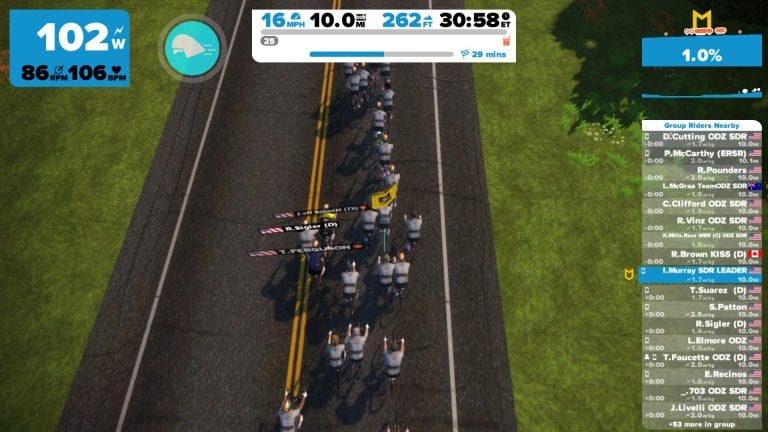
What is the heads up display/screen I see front of some riders?

What is the heads up display/screen I see front of some riders?

This is a question I’ve seen asked by many new Zwifters. What is the little screen floating in from of some riders?

The answer is simple: that screen indicates the rider is currently performing a structured workout as opposed to a typical “free ride.” Riders with this screen will also have a bar graph next to their name in the rider list.

The heads up display shows interesting info about the rider, including current wattage and heart rate. It even changes color depending on which power zone the rider is in:

  • Zone 1: grey
  • Zone 2: blue
  • Zone 3: green
  • Zone 4: yellow
  • Zone 5: red

About Zwift Workouts

Workouts in Zwift are powerful training tool, with various workout plans offered as well as the ability to create custom workouts. Zwifters find these workouts valuable because they force you to hit particular targets so you can train more efficiently and effectively.

Looking for a list of of Zwift workouts?
Check out the library at whatsonzwift.com >

You can peek over the shoulder of other riders to see their current wattage and zone.


How to Find Your Zwift ID in iOS

1

How to Find Your Zwift ID in iOS

First, an Introduction to ZwiftPower

If you want to race on Zwift, you’ve got to get familiar with ZwiftPower.com (ZP). This is a powerful, community-driven site created by James Hodges which tracks race results in Zwift.

ZP uses your ZwiftID to track you on course, so you must enter your ZwiftID into your ZP account.

You must also opt-in to share your ride data with ZP, or you will not be included in race results. Log into your account at https://my.zwift.com/, click Profile>Connections, and click to enable sharing with ZP.

Finding your Zwift ID in iOS

Your Zwift ID can be found in the desktop version of Zwift by going to Documents->Zwift->CP. The sub-folder user**** contains your ID.

Zwift for iOS presents a challenge because you cannot simply browse your iOS device’s file system to find that ID. The ever-helpful Christian Wiedmann has discovered a solution, though: he created a simple lookup tool for finding your Zwift ID using your Zwift login. See it here >