How the Race Was Lost: My First Ocean Lava Cliffside Loop – No HUD
It was Tuesday, and I had a hankering for a Zwift race. Scrolling through Zwift Companion, I was looking for races with a decent number of signups. In the past month or so race numbers have dropped considerably since:
Many riders are spending more of their time outdoors
The number of events hasn’t changed on Zwift
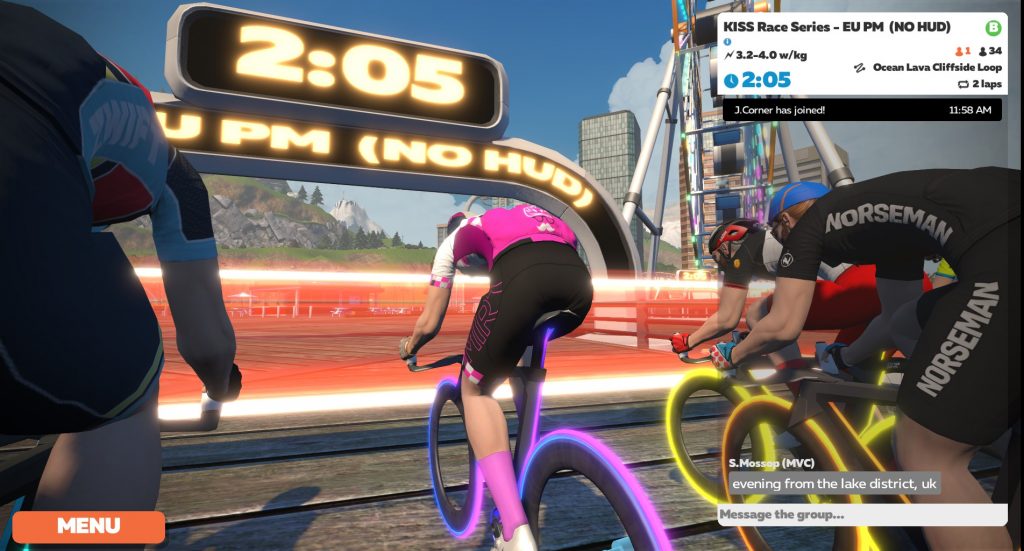
I found a KISS EU PM race with decent B field of ~30 riders signed up. As a bonus, it was on the newish Ocean Lava Cliffside Loop, which I hadn’t yet raced. And just to make things interesting – it was HUDless! Nothing like racing a new route with no HUD. Let’s do this!
Watch the Race Summary Video
The Warmup
I ran through my normal warmup routine – two pieces of caffeine gum and hour before the race, some PR lotion on the legs around 30 minutes before, then a spin with C Cadence and her roadies in the desert.
This included a few 30-second efforts to get my heart rate up around 160bpm. Then it was time to head for the start pens!
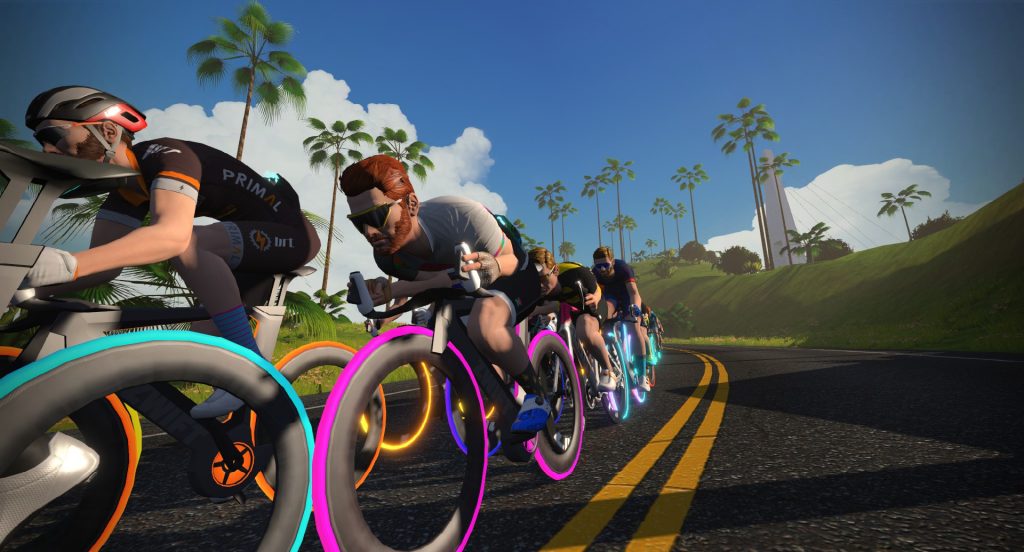
Ready to rock in my new MIRT kit with matching Tron bike!
The Start
The race began as expected – a bit of an effort for the first couple of minutes as we got up to speed and headed up the ramp toward the Volcano. But nothing crazy enough to push me over the edge. We all knew the harder efforts would happen on the Dirty Sorpreza and the start of the Epic KOM reverse.
We arrived at the Dirty Sorpreza soon enough, and I was well-positioned near the front just in case it turned into a hammerfest and I moved backward a bit. But it wasn’t too bad (nothing like the steamroller-powered ZRL race from season 3) and I maintained my position throughout the climb, putting out 367W for just over a minute.
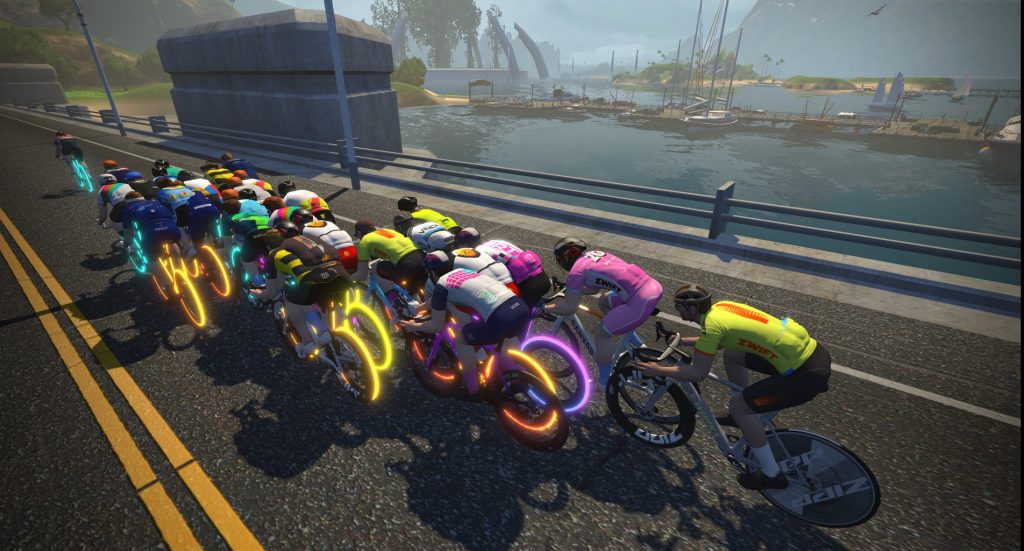
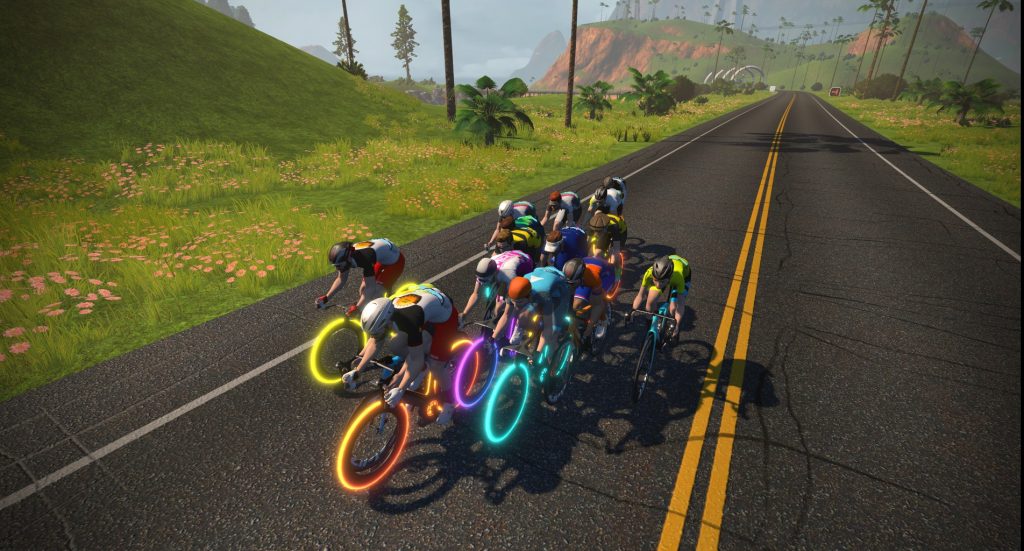
The pack settles in before the first go at the Epic KOM Reverse segment
This climb may not look like much, but it gets me. Every. Time. I went into it with fear and trepidation, because as far as I can recall, I’ve never been able to hang with the front group on this section. Ever.
I tried to position myself near the front going into the climb, but that took some effort before even crossing the KOM line – because everyone else had the same idea! Out of the saddle hammering early, I was hanging with the front… until I wasn’t. The group of riders ahead began to slowly ease away from me, then a few riders from behind came around me.
This is never a good sign.
As the climb flattened a bit at the halfway point, I kept hammering out of the saddle, knowing this was where the race would be lost if I didn’t catch onto the wheels. Happily, I was able to ease into the back of the group, and hang in with them for the rest of the climb! 373W for just over 3 minutes kept me in touch.
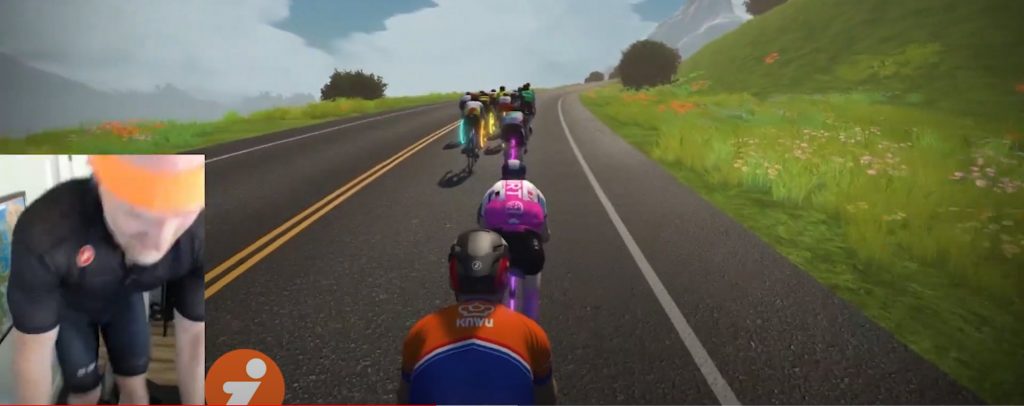
Epic KOM Reverse, lap 1. Where the race is won or lost!
One down, one to go.
Wash, Rinse, Repeat
The rest of the lap after the Epic KOM climb is rather unremarkable in terms of effort. The Epic KOM bypass road, while beautiful, is fairly flat, and no big moves are made here since everyone is gassed from the climb. Then you hit the bridge on the other side and descend for a while, getting in a nice supertuck + recovery.
Supertucking the descent on lap 1
Then it’s a flat run-in to downtown Watopia and the start/finish banner.
Our starting group of around 30 had been reduced to 20 or so by the time we hit the base of the Epic KOM on the second lap. This time it didn’t hurt quite as bad – no gap opened up for me to close. I was stoked! I had survived the climb not just once, but twice. Which meant I’d be in the mix for the final sprint!
Interestingly, my average wattage for the Epic KOM climb on the second lap was slightly higher than the first: 378W. But on both laps, my segment times were identical: 3 minutes, 5 seconds.
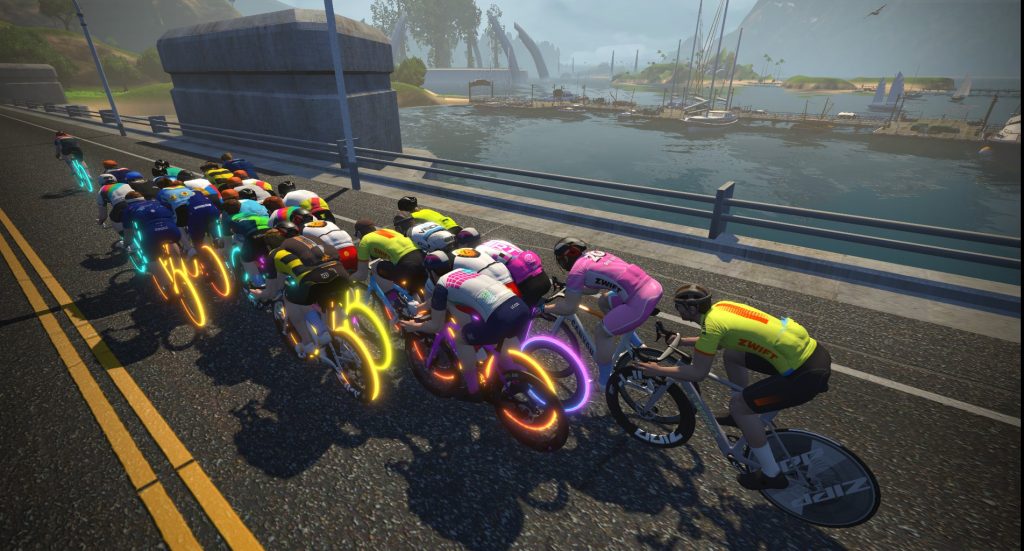
The reduced front pack heads into the Ocean Boulevard tunnel for the last time
The Finish
I tried to sit in and keep the legs fresh for the final effort, knowing it would come down to a hard sprint. It always does, in this direction. You’ve got a bit of an effort up out of the Ocean Boulevard tunnel and up the false flat, then you turn right toward downtown Watopia and all bets are off.
No powerups for this event, so there was no hiding or blaming the random number generator. This was legs versus legs. As we turned toward downtown, I watched for riders to jump. And when they did, I stood up and started hammering, just trying to hold their wheels initially. Then it was time to go all-in! I gave it everything I had… which wasn’t much.
My avatar was bouncing between sitting and out of the saddle sprinting, meaning I was doing just barely twice my FTP – not an impressive sprint by any stretch. And yet, I was in front! Then another rider zoomed past me, and I crossed the line a few seconds later in what looked like 3rd place. But the results popped up and had me in 2nd. I’ll take it!
I love the idea of HUDless mode, but I think it’s more fun when you have a small number of riders – perhaps 10-15. More than that and it becomes hard to track who is who, since all you have to go on is their kit and bike. Running the Companion app was definitely a big help, as the map told me exactly where I was at, and it also showed me my wattage and heart rate.
My final sprint was a big disappointment. My metrics showed that the legs were fresh, so I can’t use that excuse. In those final seconds I felt like I just couldn’t generate the wattage, but in hindsight, I think I just went too early My wattage was pretty steady for the final 30s, where I averaged 626W. (My best this year is 678W for 30s, so I wasn’t far off.)
What I should have done is sat in the wheels longer, then gone hard for the final 15s. That’s what the eventual winner did. Perfectly executed, Luiperd (ZSUN)!
Your Thoughts
Have you raced the Ocean Lava Cliffside Loop? What did you think? Share below!
Hey Zwifters! I wanted to share a really special episode of Outside the Draft with you al. We were lucky enough to have 2nd place finisher in the 2020 eSports Cycling World Championship and 2021 Tokyo Olympics qualifier Sarah Gigante (Tibco-Silicon Valley Bank) join Jordan, Jaquie, and I on the show this weekend!
We talked about all sorts of stuff including:
How Sarah got into cycling when she was 8
When she broke her collarbone, elbow, and fibula in a race… then chased back onto the peloton
How we can get more pro cycling teams racing on Zwift
Recovering from big injuries
Her 3 biggest cycling goof ups
Watch the Episode
We also have a podcast version on Apple, Spotify, Google and any of the other major podcasting apps. We hope you enjoy the show and Ride On!
Recently I joined the crew at No Breakaways for an “Outside the Draft” vodcast where we talked about all things Zwift racing (watch it here). During that chat, host Rick Wenger asked me a question: does bike choice really matter in Zwift? What you see below is the written version of my answer to Rick.
First, the Basics
Zwift uses several factors to determine your speed in its virtual world. Your weight, height, and wattage output are three “personal” factors. But the virtual world also affects your speed – so you’ll go slower up a virtual climb, faster when you’re drafting, slower on certain road surfaces, etc.
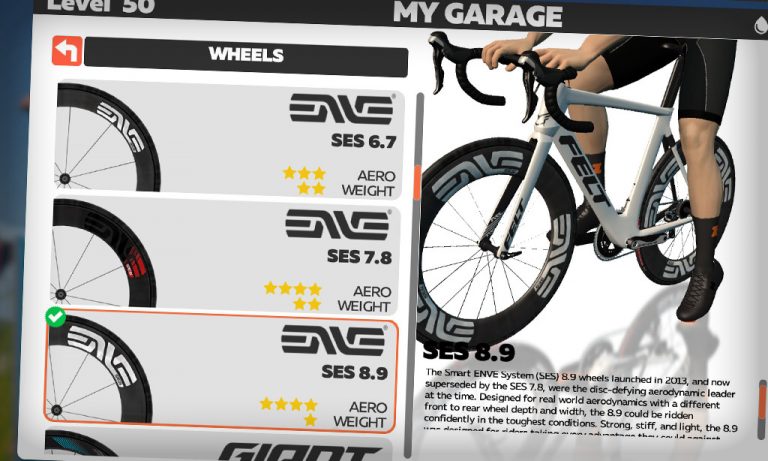
The final factor is the virtual bike you select. At the time of this post, Zwift has 80+ bike frames and 30+ wheelsets available. Each frame and wheelset has its own weight and CdA setting in game, and these affect your in-game speed just like they would outside. A lighter setup will climb faster than a heavier rig, and a more aero (low CdA) setup will go faster at higher speeds than one less aero.
Some bike frames and wheelsets are unlocked via in-game events or challenges, but most need to be purchased from the Drop Shop in order to be used.
I should say, this article is written in the context of Zwift racing. If you’re on Zwift free riding, doing workouts, exploring new maps, or enjoying social rides, having the fastest bike really isn’t a big deal. Just like riding outside – you may take your comfortable “endurance bike” out for a long easy ride with friends, then ride your aero race bike in the crit.
Three Groups of Riders
Now, to the question at hand: does bike choice really matter in Zwift? This question is best answered by breaking Zwift racers into three cohorts and giving each their own answer:
Zwift Newbies: riders at lower XP levels who aren’t Zwift experts
It seems that every time I line up for a Zwift race, someone in the start pen is on the stock Zwift Carbon frame and 32mm wheels. Our speed tests show (at 300W steady, 75kg weight, 183cm height) this stock Zwift setup takes 51:36 to complete our flat test course.
By comparison, a fairly accessible setup (Canyon Aeroad 2021 frame + Zipp 808 wheels) turns in a flat test time of 50:38 (58s faster). A bit of fancy math and physics shows us that this difference is roughly equivalent to a 15W average power savings across an hour-long race. That’s a significant, noticeable difference – one that will get you dropped when the going gets tough.
What about climbing? The stock Zwift setup completed our Alpe du Zwift test in 49:48.
By comparison, the easily attainable Specialized Tarmac Pro or Cannondale EVO frames could be paired with the low-level unlocked ENVE 3.4 or DT Swiss ARC 62 wheels to turn in a time of 48:49 (59s faster). This works out to approximately 7W saved – less significant than the flat test, but probably noticeable if you’re on the rivet. (And you will be, racing up the Alpe!)
Conclusion: newer Zwifters should upgrade from the stock frame and wheels to a decent entry-level race setup. It will save you significant wattage, especially in flat/rolling races.
Experienced Zwifters: It’s Mostly Mental
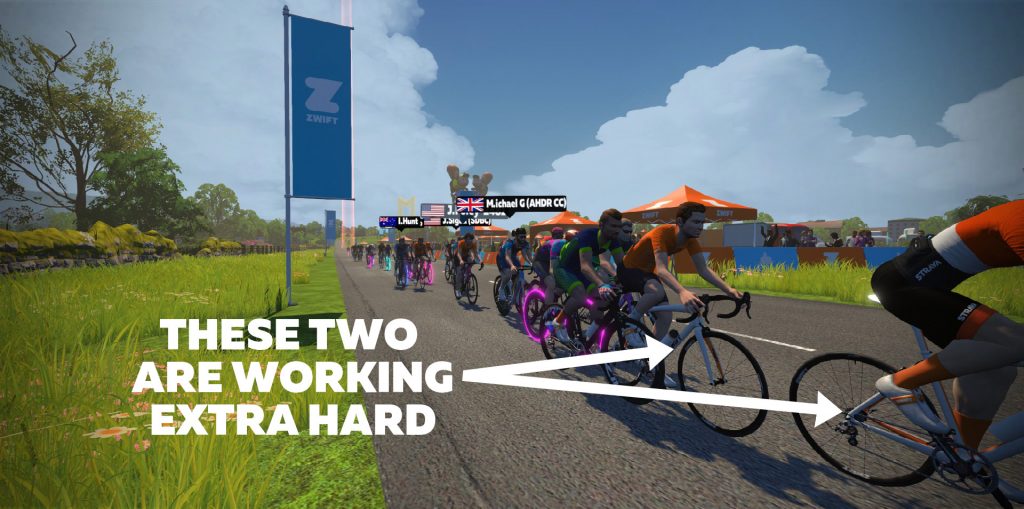
A pack of fast bikes at the front of a recent B race
Zwifters who have been around for years earn the luxury of a garage full of fast bikes. Having all these nice rigs at our disposal, though, can make bike selection even more confusing, because differences between setups are so minor.
For example: the 8 frames on our fastest frames list are separated by just 3 seconds in our ~50-minute flat test. And the 6 wheels on our fastest wheelsets list are separated by just 10 seconds.
Do the math, and the difference between the slowest and fastest setups pulled from our fastest frames and wheels lists works out to just 3-4W. That won’t be noticeable by most, especially if you’re spending a good portion of your race sitting in the draft and not pushing to your very limit. When the time comes to push, 3-4W isn’t going to make or break your success.
For climbing rigs, the difference is even less remarkable. The 8 wheelsets on our fastest climbers list are separated by just 8 seconds, while the 7 frames on our fastest climbers list are separated by just 4 seconds. That 12-second difference works out to only 1-2 watts saved.
But here’s the caveat: for many racers (including myself), knowing you’re on a fast bike (even virtually) gives an important mental advantage. Even if your bike isn’t noticeably faster than the next option, if you think you’re on the fastest rig available, you don’t have that irksome “My bike is slowing me down” thought in the back of your mind.
Conclusion: experienced Zwifters with access to most or all of the fastest setups can rest assured that any of the fastest rigs will work just fine. If the mental game is important, then it’s probably worth doing a bit of research and picking the fastest frame for your course.
TT Racers: Leave Nothing On the Table
The time trial is called “the race of truth” for good reason: you don’t get to hide in the draft.
In a typical road race, many riders spend much of the time trying to conserve their energy so they can attack (or survive!) at key pinch points. The goal of a standard road race is to be the first over the line, and often that means winners sit in the draft and wait for the right time to attack near the end of the race.
In a TT, however, your goal is speed. And only you control your speed – there is no drafting. In this scenario, you should do everything you can to maximize your speed. That means pacing smartly, but it also means picking the fastest setup.
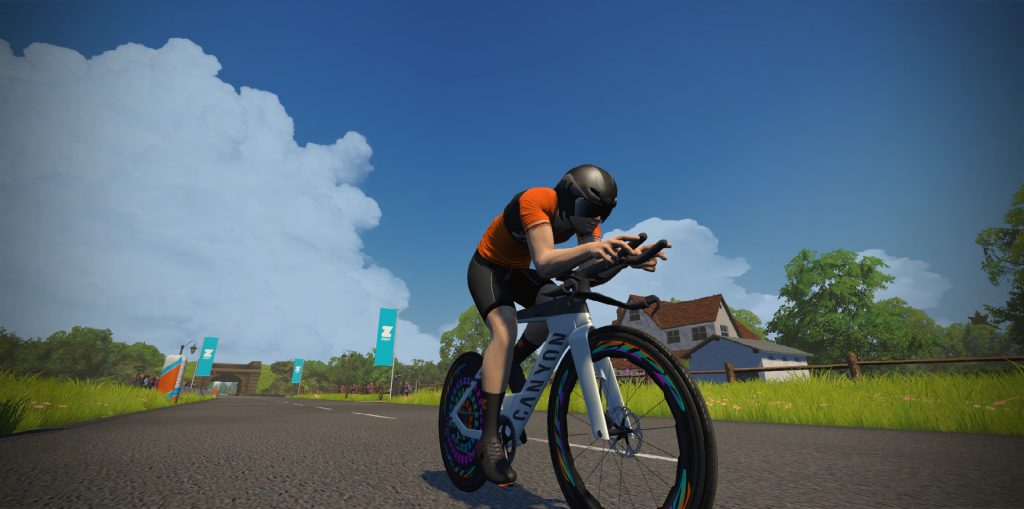
The Canyon Speedmax CF SLX Disc is the most aero TT frame currently in game
The 6 TT frames on our fastest TT frames list are separated by 13 seconds, while the 6 wheelsets on our fastest wheelsets list are separated by 10 seconds. That’s a 23-second difference between the slowest “fast” rig and the very fastest rig in a ~50-minute flat TT race. That’s a big difference!
TT races are often decided by just a few seconds. If a different wheelset or frame can slice anything off your time, why wouldn’t you use it?
The same principle holds true in a team time trial setting. When every team member is taking turns pulling on the front, each of their bike choices matters. Think of it like this: if every rider except one in a 4-man TTT squad had the fastest bike available, and that one rider choose a rig that was 10s slower over the course of the race, that rider would cost the squad 2.5 seconds in overall time if everyone took an equal number of pulls.
Conclusion: get the fastest rig available for time trials. Anything else and you’re handing places to the competition.
Wrapping It Up
While my answer to the “Does bike choice matter?” question isn’t a simple one, hopefully it is clear enough to help Zwifters of all stripes.
In the end, bike upgrading on Zwift is similar to what we see in outdoor riding: newbies will see noticeable improvements by upgrading to even a basic race rig, expert racers won’t see much improvement at all between different high-end setups, and TT riders are smart to obsess over getting the very fastest setup.
As part of the Olympic Virtual Series, Zwift is welcoming 4x 500m Time Trial World Champion Anna Meares to the podcast. With six Olympic medals, she’s the most decorated woman track cyclist of all time.
The Olympic Virtual Series is jam-packed with exciting events, serving up a month of action June 1–27. Join other Zwifters for Olympian-hosted podcasts and Olympian-inspired workouts with surprise guests, all leading to a 24-hour group ride as well as a broadcasted chase-style event with Olympians!
About the Podcast
The Zwift PowerUp Cycling Podcast features training tips from host Matt Rowe (Rowe & King), with regular co-hosts Greg Henderson, Rahsaan Bahati, Dani Rowe, and Kristin Armstrong.
As part of the Olympic Virtual Series, Zwift is welcoming 14x Paralympic Gold Medalist Dame Sarah Storey to the podcast. With 75 world records across both cycling and swimming, she’s a veritable multisport legend.
The Olympic Virtual Series is jam-packed with exciting events, serving up a month of action June 1–27. Join other Zwifters for Olympian-hosted podcasts and Olympian-inspired workouts with surprise guests, all leading to 24-hour group rides as well as a broadcasted chase-style event with Olympians!
About the Podcast
The Zwift PowerUp Cycling Podcast features training tips from host Matt Rowe (Rowe & King), with regular co-hosts Greg Henderson, Rahsaan Bahati, Dani Rowe, and Kristin Armstrong.
Tim “Bacon” Searle makes group ride leading look easy. Having now experienced first-hand the challenges faced by group leaders, I can tell you that leading a group takes a special set of skills!
On Sunday at 10:00am CEST, I was joined by 51 fellow climbing enthusiasts as I led my first group ride, the Monday Mountain Massif – Sunday Recce, on one lap of the Mountain 8 course. I couldn’t have picked a more challenging route.
Preparation
Prior to the event, I had done my best to promote it, which included all different social media forms from Twitter to Discord to even highlighting it in my weekly “Top Zwift Events for the Weekend” column, but with good weather now in the Northern Hemisphere, most people declined my invitation and opted for a ride outside. My 3R VEveresting Academy friends, who I had hoped would join me and nurse round some of the riders who may find it challenging, were still suffering aches and pains caused by their epic adventure and were not fit enough to ride with me.
Fortunately, I had a safe pair of helping hands in Tim Searle.
Prior to the event, I had done a lot of preparation, including researching the route. I had found out some interesting facts that I was planning to share with the group, such as statistics about the Epic KOM reverse, like gradients. For example, did you know that it has an average gradient of 5.9%, maxing out at 12.2%? The precise length of the climb is 3.8 miles (6.1km) with an elevation gain of 1303′ (397m).
I was taking this very seriously and had invested a lot of time in preparation, including calculating how long it would take to do certain segments of the route. For example, the first segment from the start to the base of the climb will take 11 minutes at a pace of 2-2.3 w/kg.
I had even written a script, to make sure I introduced the event properly.
Most importantly, I had studied the key points Tim had shared with me, particularly regarding communication:
Immediately prior to the event: enter the pen early before the start and get settled down. With a few minutes to go, briefly explain what the ride is about. If you write your message too early, those that join later will not see the message. You are effectively briefing everyone about how the ride will unfold.
Start of the event: at the very start, just as you are rolling en-masse, outline what the plan is so people are again very clear.
During the event: communicate throughout. Repeat the key messages. Encourage people. Keep the messages positive, support those who are finding it a challenge.
Immediately prior to the event
I had done a warm up, cycling to the base of the Epic KOM at 2 w/kg to “dial in the cadence” – I wanted to get a feel for the pace I would need to ride for the start, to ensure that I kept the group together. I entered the pen with 15 minutes to go and got myself settled. I watched the clock, counting each second, deciding when to deliver my introduction, which I had carefully written. With 4 minutes to go, I decided now was the time.
I decided that copying and pasting each section would be the best approach. In an earlier test, I noted that there was a character limit, so I could only copy a small section and paste it into the app, at one time. It is important to explain my setup: I’m using an iPad (fully charged, those that read my vEveresting article will know the battery dramas I faced) and my iPhone companion app.
The message I sent was as follows:
“Good morning, good afternoon and good evening.
Welcome to my first group led ride, where I am reporting on the challenges of being a leader.
We are going to roll out nice and easy pacing between 2-2.3 w/kg, taking about 10 minute (ish) to reach the base of the climb and there we all climb together (hopefully) around the 3.2-3.5 w/kg.
I would like to try and crest the Radio Tower and descend in a group and a nice relaxed pace to the finish.
Ultimately, a nice Sunday ride.”
Now, all this switching between apps to copy and paste the message had caused my trainer to disconnect, and when I pedaled there was no power. With 1 minute 30 seconds to go, I jumped off the trainer and pulled the plug out. The trainer had recently been having connectivity issues and I couldn’t afford that now.
I kept calm and repaired the unit and was back on my bike with 30 seconds to spare.
This was not the calm start I wanted.
The Start
As we rolled out, I again reiterated the plan, aware that within moments of the start, a few riders were already going well above the advertised starting pace of 2-2.3 w/kg. I didn’t let this distract or fluster me as I thought I would deploy the Fence. This is the red barrier to help keep people together. However, on my app, I could not see any functionality for the fence. I switched from the Chat screen to the map, but there was no additional functionality.
At this point Tim Searle messaged me, noting to deploy the Fence. I asked “How?” and it’s at this point we realised that the functionality had not been set up.
The Fence is a functionality that has to be requested. I had mentioned that I wanted to have the Fence, but it transpires that it had not been provided. Again, like the dropped connection, I had no time to worry and just had to keep the “Show on the Road” – there would be many examples throughout the ride where things would happen outside my control, and I just had to make a decision and make the best of the problem.
As you know, this was my first attempt at leading a group ride, but at no point have I seen any documentation from Zwift about leading a group ride. As far as I know, there are no pages on their website giving hints and tips, or even any “How to Guides” to help novices like myself. I was grateful that Tim was on hand to provide encouragement and support because I have to tell you, it’s quite daunting – especially when tools such as the Fence aren’t actually set up!
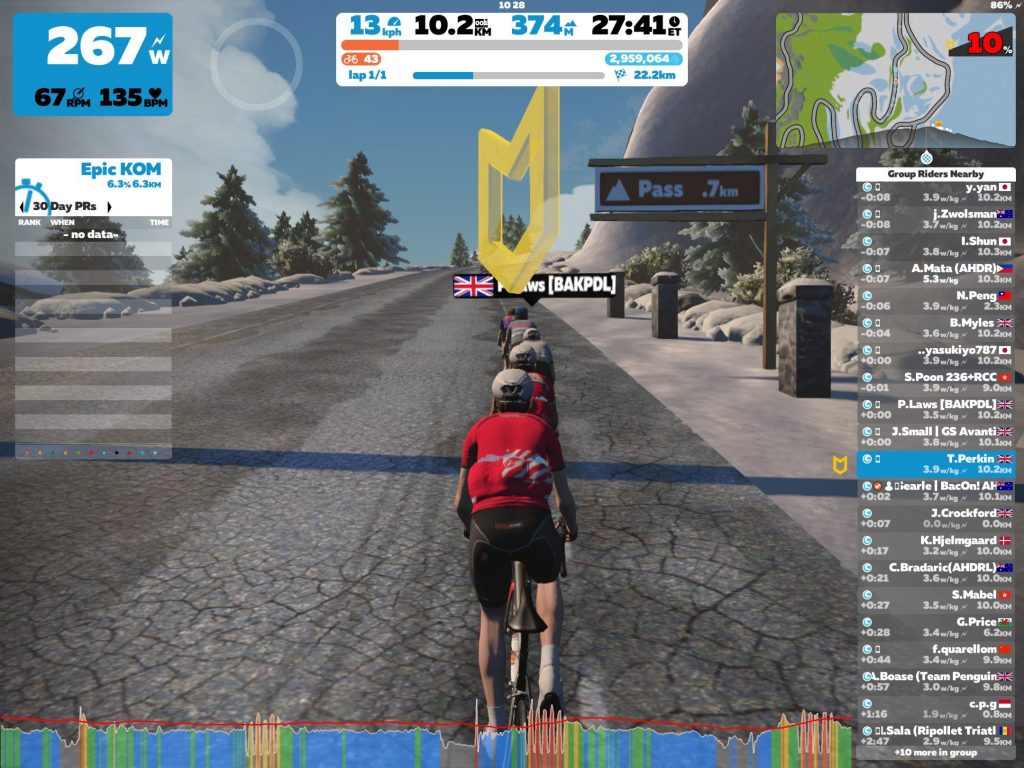
A few riders were now way out in front and we had only been going maybe 5 minutes. I was very conscious of maintaining a consistent pace and to that end, I had got my Garmin Edge 1030 and connected it up. I had set up a data field for AVG w/kg. And I had my pace pegged at 2.2 w/kg.
We were approaching the first challenge of the course, the little rise out of the aquatic underpass. I was sure to message the group about that. I was trying to highlight any pinch points, despite I am sure everyone knowing the route extremely well.
The Challenge Continues
The first 10 minutes of the group ride felt frantic, more than any race I had done, despite traveling at only 2.2 w/kg. This is because there is so much to think about:
How is the group doing?
Am I in the centre of the bunch?
How is my pace?
Have I sent a message explaining what we are doing?
Literally, it was intense and we hadn’t arrived at the hard part yet.
As we approached the climb, I had planned to deliver some facts that I had documented, I had even created a quiz wanting to get people to name the 7 climbs in Zwift, but the quiz didn’t happen. Before I had time to explain about the climb, we were on it.
I managed to get my message across about the climb but found it really hard to type a message at the same time as controlling the pace, going uphill AND check on the status of the group. It was clear that the quiz was off the table.
Within a few minutes, I could tell that my vision of a mass descent from the Radio Tower was not going to happen as the bunch started to string out. I was facing a real dilemma regarding the people at the back. I had communicated several times that the pace of the climb was going to be 3.2-3.5 w/kg and it was clear that they could not keep that tempo. I had even eased to 3 w/kg hoping that they might come back, but as we ascended, it was clear that this was not going to happen. I tried to give them encouragement, saying “Keep going, you can catch us on the descent” – I still hoped that they would be able to catch the group.
Up the Epic KOM Reverse
I was feeling tense, as I could sense that things were starting to get a bit out of control. I tried to encourage people by giving Ride Ons because up to that point, I had not given any. I simply had forgotten about it.
The way I can describe leading a group ride is that it is like learning to drive a car. When you first learn to drive, there is so much to think about steering, gears, mirrors, brakes, the road, and other drivers. There is a lot to think about. The same for leading a group ride: pacing, your position, instructions, encouragement, the route.
It’s at this point I had my first complaint. Someone stated that this was more like a B Category ride not the advertised C. The truth is, I had explained several times the pace of the climb, so there should have been no surprises and I was averaging slightly less than what I wanted, in an attempt to try and keep the group together. The rider had joined the group with target of getting the 100kph off the Radio Tower. So, wanting to keep positive and not let any negativity spread, I told them I would happily do a Meetup and ride with him and help him get the badge (incidentally, I noted afterward that he got the badge and then quit the ride).
This was my approach throughout. No matter what was happening, keep the message positive.
To make matters worse for me, I started experiencing ‘tire slip’ and my watts were not consistent. Fortunately, due to my Garmin, I just used that to maintain a consistent tempo. After experiencing massive technical issues with the trainer several weeks before on my VEveresting adventure, I had contacted Tacx who was going to replace the defective trainer, but with this ride already arranged, I had no option but to stick with it and hope it would last. But alas, it was back to its old tricks.
Explosion up the Radio Tower
It was the Radio Tower that did the damage. It always does. Riders were spread across the climb. It was all I could do to give some stats about the climb averaging 13.7% and maxing out at 17%. I told what was left of the group that we would regroup at the top, but I didn’t hold out much hope.
I noticed that the people behind me were now 2 minutes or more back, so my best hope of having a group was with the people ahead of me. So I pushed and got to the top of the climb where I waited (but not for long as the people ahead of me didn’t stop). I checked the map and there were only a few behind. I found myself in an impossible position. Do I wait for those behind or try and chase those who have just crested the summit and didn’t stop?
This is where I made my mistake. I did neither one nor the other with conviction. I said “Let’s regroup” and then maybe 10 seconds later (if that) I got going. So I then posted “OK, let’s roll!” – and I started descending. But no one was with me.
You know, it only takes split moments in races to define the event and although this wasn’t a race, this was a moment and I made the wrong choice and I knew it. It was confirmed when Tim messaged me that “a leader should never be on their own” and gave me the advice that I should sit up, which I had already done as I realised that the people I thought were behind me, were not.
Fortunately, Tim was with me and came past but as I went to pedal, I had no power. A dropped connection, again. Strangely, this helped because as I got off and fixed my problem by re-pairing, a rider came past me, so I chased back on, picked up Tim and we had a group of 3. Then we were joined by another AHDR rider, which was a huge relief, so I was in a small group.
It was at this point I was desperately trying to salvage the group ride by keeping the messaging positive and telling the people ahead of us that a group was coming.
A small group on the descent
The Final Few Kilometers
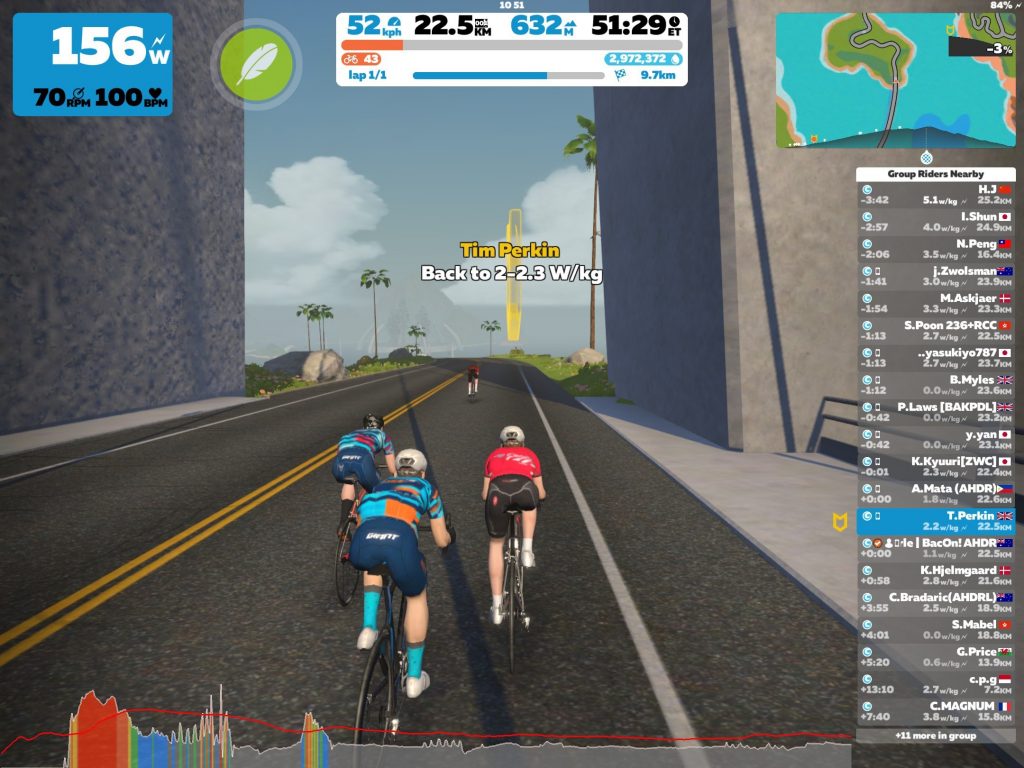
The last few kilometers were a relief. We were on the flat in a small group and through my messaging, a couple of riders ahead slowed and we picked them up.
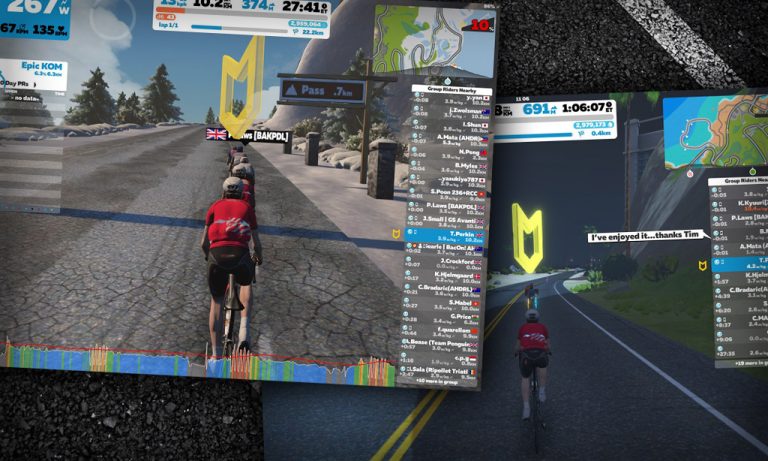
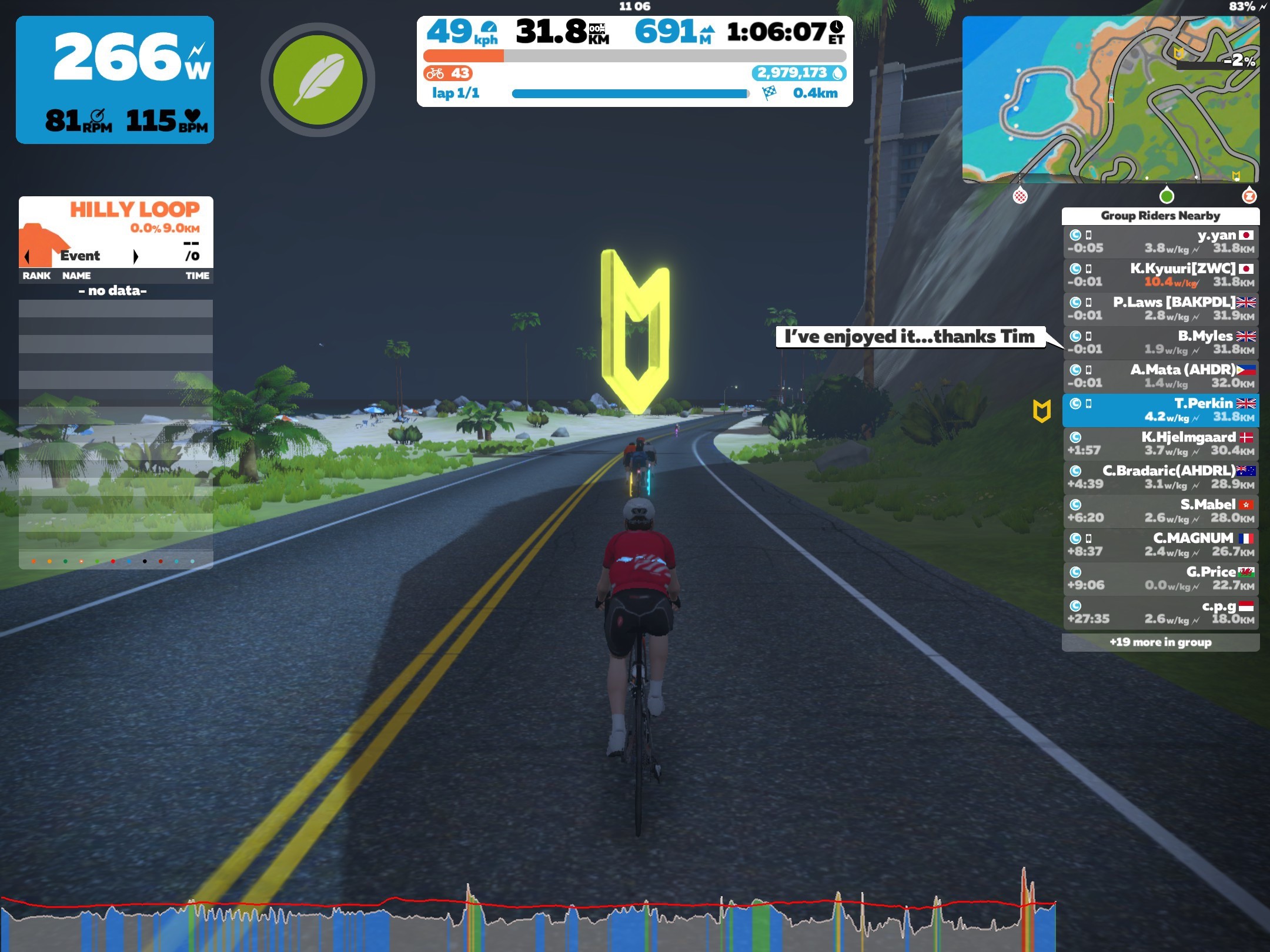
At this point, I explained how the ride was being used for this article. I was grateful to Ben Myles who said “I’ve enjoyed it…thanks Tim” – the ride wasn’t a complete disaster as at least one person had enjoyed it.
We finished in 1 hour 6 minutes and 41 seconds, which was 3 minutes quicker than what I had budgeted for.
One person liked it!
My thoughts
I think leading any group ride is a tough gig and the work that goes into it is completely underappreciated. In the immediate aftermath of the event, I was highly critical of my performance, noting all the mistakes such as not regrouping at the top of the climb. But then I started thinking about some of the core parts of a group ride and comparing myself to the key performance indicators:
Immediately prior to the event: Brief the riders
Yes – this was done. I did it with 4 minutes to go, was that too early? Possibly. Next time I would do it with 3 minutes to go.
Start of the event: at the very start, just as you are rolling en-masse, outline what the plan is so people are again very clear.
Yes – I started gently and briefed the riders. I was in a group to the base of the climb, I messaged everyone, I rode at the advertised pace. I was hindered by the lack of a fence to stop riders who were going faster than the advertised pace.
During the event: communicate throughout. Repeat the key messages. Encourage people. Keep the messages positive, support those who are finding it a challenge.
Yes – I explained about the climbs, albeit not in the detail I would have preferred. I encouraged people, including giving Ride Ons. I highlighted ‘pinch points’ during the event.
Pacing and position
This is where I would say I had the biggest trouble. The pacing, I thought was roughly about right, although I think I was hindered by not having any tools to support me, such as the fence. But I tried to compensate that by having clear messaging. Where I ultimately failed was the positioning.
The climb added a level of complexity that I wasn’t equipped to deal with. Having no experience leading a group ride, second guessing what I should do resulted in me not committing to one course of action. Perhaps I should have been very clear that at the top of the Radio Tower, we stop and wait. But the counter argument is that it breaks up the ride.
Ultimately, leading a group over a mountain route is tough and the experience gave me a unique insight into the moments that every group leader faces. It wasn’t the best group ride I have ever been on but it certainly wasn’t the worst.
If you look at it objectively, I met the brief, more or less, of what the group ride would do. I gave some interesting information about the route, I encouraged people and despite things not going as I wanted, I stayed resilient and made the best of the situation.
Bacon’s View
Talking to Tim Searle afterward, I was keen for his feedback on the event. He said the following:
“Overall, you got a lot right, and when things didn’t quite go to plan, you stayed calm. It was more circumstances that broke the group up, like not having the fence to deploy to keep riders together that is worth 10 people in the group alone. You also had one of the toughest courses to contend with and looking back on my Strava data, I have only ever led that route once, in maybe 1000 group leads. The Radio Tower was always going to be tough.
One point to note was that you didn’t actually ask people to ride with you. It’s always worthwhile politely asking people to ride with you. You could have asked the stronger riders to help those at the rear, using positive re-enforcement.
The pace was pretty good, but it became obvious halfway up the climb that front was going to do their own thing and perhaps at that point it would have been better to ease off and go with the rear of the group.
It was a good call to stop at the top of the Radio Tower, but then you started rolling. It would have been best just to stop. If you make a decision, stick with it and that was the only real mistake you made on the ride. One tactic you could have used would be to have let people go hard on the Radio Tower, but then ask them to stop at the top. You could have waited 3-4 minutes at the top, letting people regroup, then descended as a group. The research and information you had about the route, could have been used at a better time, for example, when waiting up the top of the Radio tower for people to regroup. It’s good to have ‘filler information’ to keep people entertained, but use it appropriately. You can use facts to get conversation going, to get people talking, which often facilitates them staying in the group. Use the information you have researched wisely as it can help make the events more entertaining.
The important thing to remember is to give people a good experience and although you didn’t have a really tight group, people had a good experience, so mission accomplished.”
Would I do it again?
Tim’s feedback was really valuable and positive. His thoughts highlighted several key areas which impacted my event. The first being the fence, the second was I actually failed to do the obvious which was to ask people to ride with me. When I did finally do that I was descending the mountain, and a few riders did sit up and wait for our group – so I should have reinforced that throughout the ride. The third point was the climb up the Radio Tower. In retrospect, I should have asked people to wait for the group at the top and I should have waited for the rear and at that point used the information about the climb, to keep people entertained, whilst the rear caught up. All valuable lessons and if I am honest, I was not put off by the experience, despite the challenges.
JG from 3R has offered me the opportunity to lead a group ride on a flat route. Perhaps that would make an interesting part 3 of this series. But this experience taught me that preparing to lead a group ride takes an awful lot of time. Particularly if you decide to work out timing of segments and do research on topics that you want to discuss! All of this takes time and to do it well requires a big commitment.
I am only grateful that there are people like Tim Searle who have the energy, desire, and resilience to lead groups. Leading 50 people was enough, but Tim regularly has ten times that amount, so chapeau. It was an absolute pleasure working with Tim on this project, a lot of fun and most importantly, I learned a lot from him – I’m already thinking of other potential projects we could do.
Personally speaking, I think there is a real opportunity for Zwift to link in with Tim and invite him to run a Leader’s School and help tutor future generations of ride leaders. It is a fine art, and one which Tim has perfected and is happy to share.
AI Training: What It Can Do Today, and What the Future May Hold
What Is the Perfect Training Plan?
When we look at training, what really differentiates a successful training block from an unsuccessful one? Did we improve a performance marker like FTP, did we achieve the Zwift race performance we’d been dreaming about?
And what are the most important variables in our training?
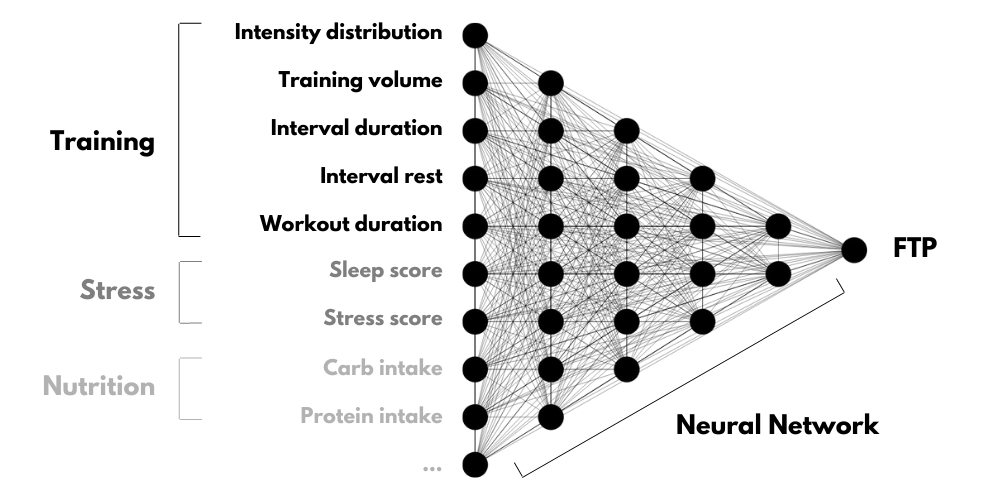
One is certainly the makeup of our actual training. This can include the number of training hours and rest days, whether we followed a threshold or polarized approach, how the intervals are structured, strength training routines, and so on. These variables alone already lead to a huge amount of possibilities in organizing our training. (For example, Zwift’s own workout library has more than 1000 workouts to choose from.)
Secondly, sleep and stress can be considered. If our body is stressed from training, work, or personal life, this can certainly influence our readiness to train. Similarly, attempting a hard workout after a night of terrible sleep is often counterproductive.
Thirdly, nutrition is definitely important. Most of us need to fuel properly and subscribe to a generally healthy diet in order to let our bodies adapt to training.
A perfect training plan combines these three areas into a formula that leads to a successful outcome for the athlete. And it does so in a personalized way. Should we expect there to be a simple or intuitive mathematical equation that works for everyone and tells us, “If you do a certain training input, this will be the outcome”? Most likely not. Human beings are complex and their response to training is individual, which you know if you’ve ever tried to copy the training plan of the superstar on your local group ride and felt like you were going to burn out in a week.
This makes finding a training plan a perfect problem for artificial intelligence (AI) and in particular machine learning. We also need plenty of good-quality data. Let’s examine this for three important areas of training:
Training data: check. Our power meters, smart trainers, watches, heart rate monitors, etc. are tracking our training pretty much every second and have seen widespread use for years. Furthermore, Zwift, Garmin, Strava etc. make the data available to export, import, and share.
Sleep and stress: getting there. There has definitely been some progress tracking recovery, sleep, and stress, such as via heart rate variability (HRV) or questionnaires that you have to fill out.
Nutrition: difficult but we’ll get there eventually. Probably very few people have the discipline to consistently fill out a questionnaire with exact quantities they eat on a daily basis, but this process will hopefully get to an acceptable level of automation eventually with improved image recognition, etc.
Right now, it is reasonable to expect to track someone’s training data over time and also their sleep and recovery metrics, albeit with less accuracy.
What can AI training do today?
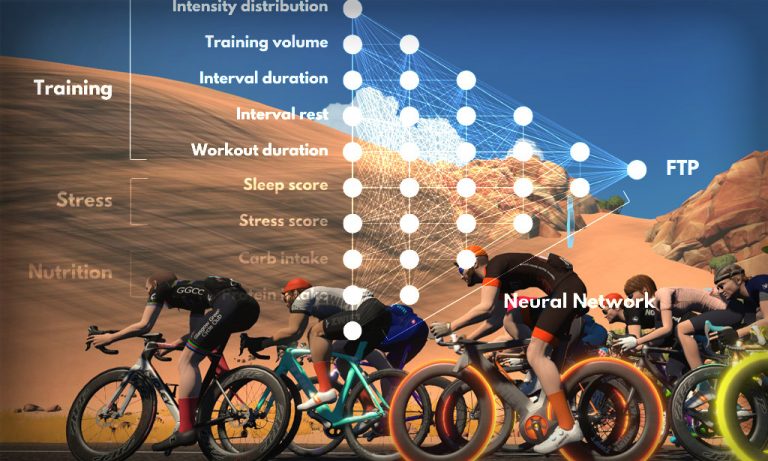
There are two main areas where AI is being used in endurance training right now: adaptive training and predictive training based on training data and recovery and sleep data.
In adaptive AI training, you start with a one-size-fits-all training plan (for example a Zwift training plan) based on best practices for endurance athletes as a whole such as polarized training. Then you adapt someone’s plan in real-time based on their recovery metrics and/or performance in the plan.
For instance, such a plan might automatically replace a hard workout scheduled for the current day with an easy recovery workout if your sleep stress score from the night before is very high. In another case, the AI might realize that certain interval durations are too long for you to successfully complete the workout based on your past attempts and sprinkle in more rest intervals so you would be able to achieve the desired training load.
In predictive AI training, the idea is to start with a training plan that is tailored to the athlete right from the get-go. As such it cannot be downloaded from a training plan library but has to be created by the AI for each athlete individually. A machine learning model – a digital twin – is trained on the athlete’s historical training data to correlate training outcomes (FTP test results, race performances, etc.) with training inputs. The model is thereby able to become predictive. It can answer the question: If I do X training plan, what will be the result in a performance metric?
The model is individual to each athlete and can hence account for the fact that different training routines will have different results for different people, which is the central aspect of personalization. Predictiveness is a powerful feature. It can be used to find the optimal training plan outcome in the desired area of improvement (e.g. FTP) on a particular date. Apart from being outcome-optimized, the predictive training plan is based on what you have done historically, i.e. something you can reasonably expect to be able to maintain.
Today, the metrics that are predictive at the +/- 5% level are power for cycling, gradient averaged pace (GAP), and most likely power for running. Heart rate data is generally too dependent on external factors to be a good predictor of performance.
What will AI training be able to do in the future?
In the short term, the advancements in adaptive and predictive AI training will be increasingly combined. Starting with a predictive and personalized plan, the AI will make more and more fine-grained adjustments. This includes adjusting details of your training plan while collecting more information as you proceed through the plan and adjusting to unexpected events such as sickness, work stress, etc.
The training community will come up with more and more ways to make use of the data we already have, improve model architectures, fine-tune routines and parameters, cover more edge cases, etc. AI training is still a very new field and the underlying fields, including machine learning, are undergoing very rapid development and improvement themselves.
Improved tracking of the athlete’s fitness state, such as non-invasively tracking athletes’ ventilatory thresholds via HRV data, are exciting prospects for predictive AI training. They can improve prediction errors and shorten feedback loops and ensure that training zones are set correctly and checked regularly.
In the mid to long-term future, fully capturing all relevant training metrics including nutrition is possible. It is easy to imagine other physiological or metabolic metrics – maybe some we are not even thinking about yet – becoming more widespread and accessible, providing additional valuable data inputs.
Other questions might be asked of our digital twins such as improved real-time advice on our pacing or race strategies that are based on algorithms processing information in real-time on our wearable devices, including our metabolic state, course profile, weather, and others. Form tracking devices can provide data to predict and reduce injuries and help with rehabilitation.
I believe we have a bright future ahead of ourselves: AI will increasingly assist us in many areas to give us access to personalized, affordable, predictive and customizable training options.
Questions or Comments
What experience have you had with AI-powered training… and what excites you most about its future? Share below!
These articles garnered a significant community response, and from these comments it felt like there was consensus amongst the community for the direction we would like to see things move. I contacted Zwift to see if I could share these ideas more directly, and in parallel a dialogue was opened up on the Zwift Forums with input from Zwift’s Head of Content and Programming, Mark Cote.
It’s great news that Zwift are now engaging with the community directly on this topic – speaking to Mark it is clear that this approach will help Zwift be more accurate as they develop a solution, as well as help us all understand what is feasible and some of the challenges the development team will face as they work through this.
So what are Zwift planning to do? What are the big challenges they will face, and what can we do as a community of racers to help?
Let’s start by looking at what has been shared on the forum thread to this point. Discussion has generally revolved around two development opportunities – a results-based ranking system with matchmaking is generally considered to be the ‘utopian’ ideal, but the more pressing issue seems to be category enforcement at race entry and improvements to better split the categories to disincentivize sandbagging.
We want fair competition, just like all of you.
Ultimately, we believe in an ELO style ranking system, like has been raised by many of you. This is not a simple add given our current infrastructure, but ultimately this is where we look to go.
If you were to make a power-based system for category recommendations or auto categorization: – What data would you use to establish a rider’s performance? – How would you categorize riders?
Mark Cote
This was a great question to get the community thinking. First of all it is clear that a rankings/matchmaking system is a significant development – an entire new backend management system and significant changes to the user experience would be needed, but this long term vision is shared by both Zwift and the community. The question then becomes one for the short-medium term: how can we improve the category system as it exists today?
Mark then went on to share some of the current thinking:
“Thanks all for the thoughtful feedback. Since you asked where our current work and thinking is. With ZwiftPower starting here:
1. Data to Establish Rider’s Performance
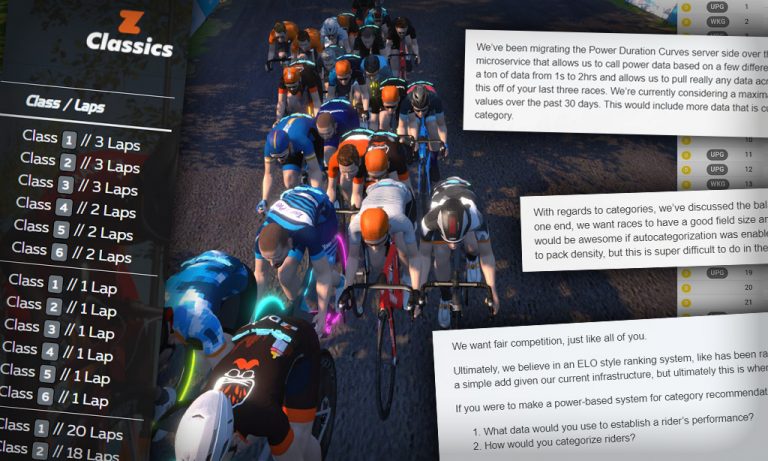
We’ve been migrating the Power Duration Curves server side over the past many months and building a microservice that allows us to call power data based on a few different attributes. The power curve has a ton of data from 1s to 2hrs and allows us to pull really any data across this array. ZwiftPower takes this off of your last three races. We’re currently considering a maximal aggregation of power curve array values over the past 30 days. This would include more data that is currently considered for your category.
2. How Would You Categorize Riders?
With regards to categories, we’ve discussed the balance of race density relative to power bands. On one end, we want races to have a good field size and we want that field to be fairly matched. i.e. It would be awesome if autocategorization was enabled for ALL events and there were infinite bands, tied to pack density, but this is super difficult to do in the short term.
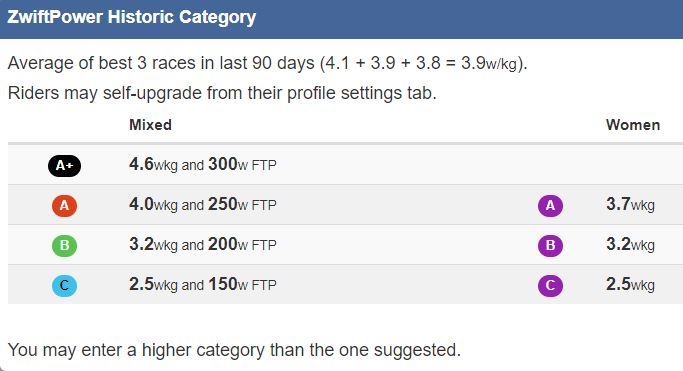
So right now, we have 4 categories (potentially +1 for A+). The feedback we’ve generally heard is that D’s could almost be split into three while C/B/A could each respectively be split. This might be too much, so your feedback on the 4 categories and the W/kg splits is what we’re asking for feedback on.“
This is some really interesting insight into the progress the Zwift team are making. Storing a rider’s power curve data allows for a much broader understanding of their strengths and weaknesses, which could allow for a more even splits across categories. Probably the biggest benefit of this approach is the impact on sandbagging – if the arbitrary line to separate categories becomes more dynamic, it becomes very difficult to manage your performance to deliberately stay in a lower category.
The key thing is that this category is enforced up front and from a UI perspective, a rider’s category is made clear in-game. This has also been confirmed as the preferred approach by Zwift:
“By auto categorization, we fix it on the front end, not penalize on the backend – this is generally preferred.
Following more interesting discussion from the community, Mark updated with further progress:
“We’re working on next steps right now. There are a few mega initiatives going on the software team right now that are in front of Competition Fairness so I can’t confirm timing. As this is looking to be in the near term queue, Flint and I have been engaging along with a few other PMs on calls with some of you on this forum to gather feedback and thoughts. There is active work on Power Curves and outlining the systems and rules for upcoming competition series, some by Zwift and some in partnership with WTRL. There is upcoming work on recommended and auto categorization, so this feedback will fuel those directions.
I hope this gives some clarity – I know we all want details and a launch date, but we do not have that yet.”
I caught up with Mark to discuss some further ideas and how the current work is progressing, and he was able to share the below. This is really exciting progress and I am sure you will agree with me that this dialogue with the community is a welcome change. I will hopefully be able to share more articles in the future with some insight from the Zwift development team.
“The team at Zwift is working hard to bring some of the most requested features to life, such as the recent release of route badge achievements tracking. Our forum conversations on fairness in competition shows how aligned we are with the vision of the community, but there are other priorities ahead of this work. Fortunately, with a great partner in WTRL, we are hoping to test some of these early ideas within upcoming events.“
WTRL released the Zwift Classics race schedule this week, and it appears that these races will use a 6-class system instead of the 4-category system used in the past. Is this WTRL testing some early auto-categorization ideas? We’ll get our answer soon, as the series begins July 13th.
Elite Sterzo Smart Firmware Update Required On Zwift
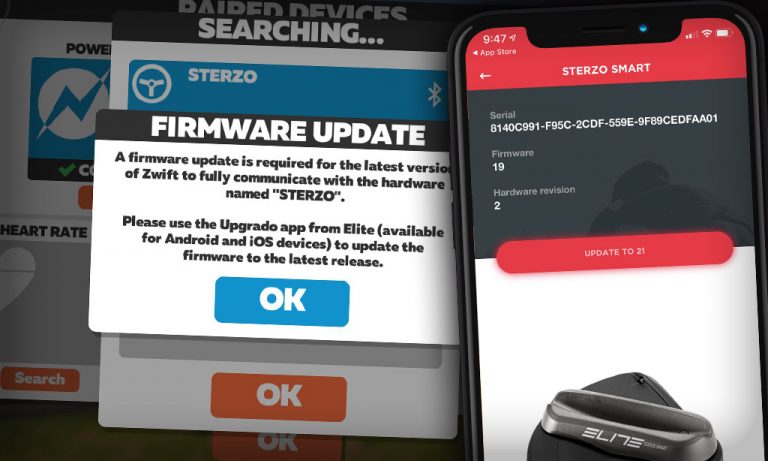
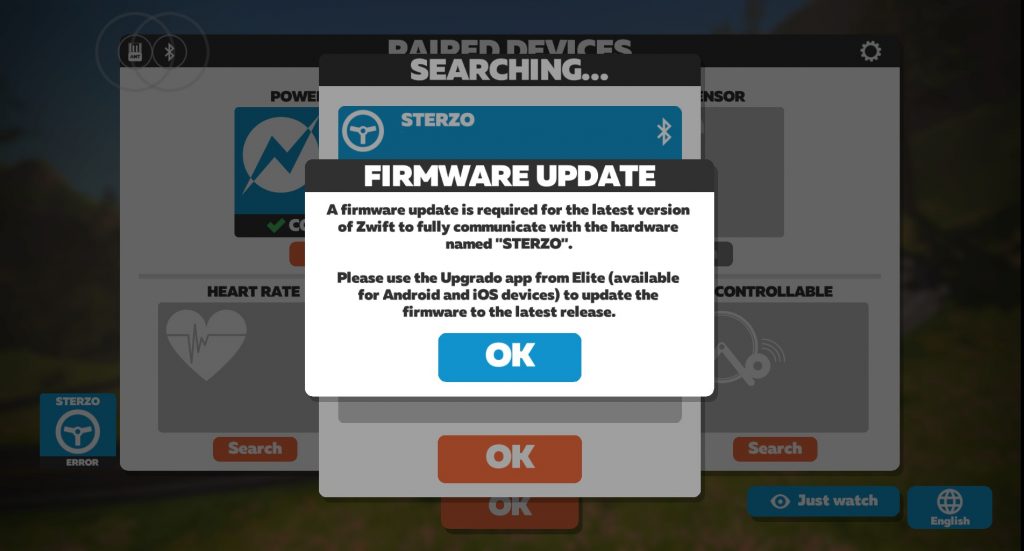
Zwift + Elite have released a required update for the Sterzo Smart steering device. Notice was posted in the Zwift forum on June 4th and now, once you’ve installed Zwift’s latest update (version 1.14.0) you’ll get the following warning if you try to pair a Sterzo to the game with the old firmware:
Why the Update?
According to Zwift’s forum posts, this update is being rolled out for two reasons:
It improves and simplifies the initial pairing procedure. It especially helps the reconnection process should the Sterzo Smart ever disconnect.
Security improvements were made to deter hacks to the Sterzo system. There were people hacking and selling fake Sterzos.
Installing the Upgrade
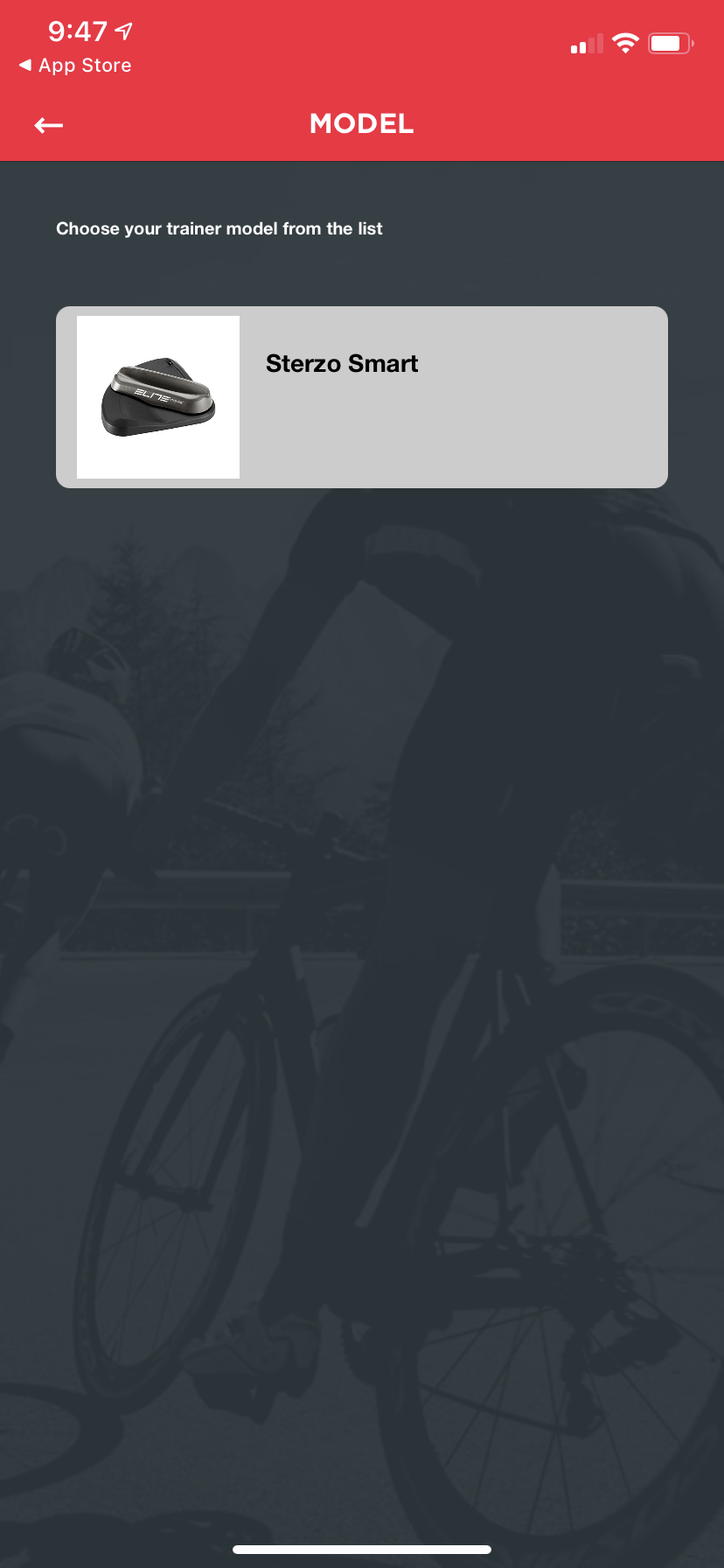
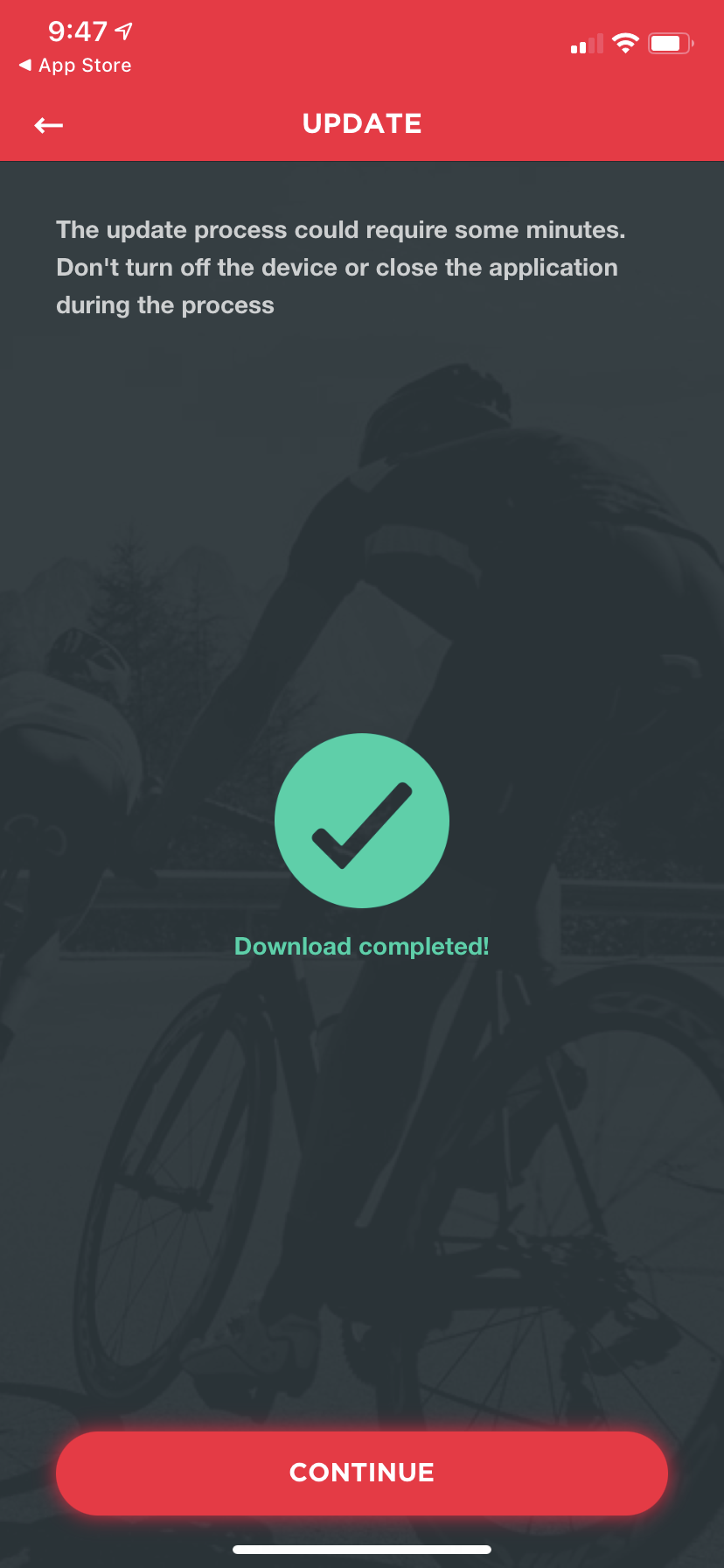
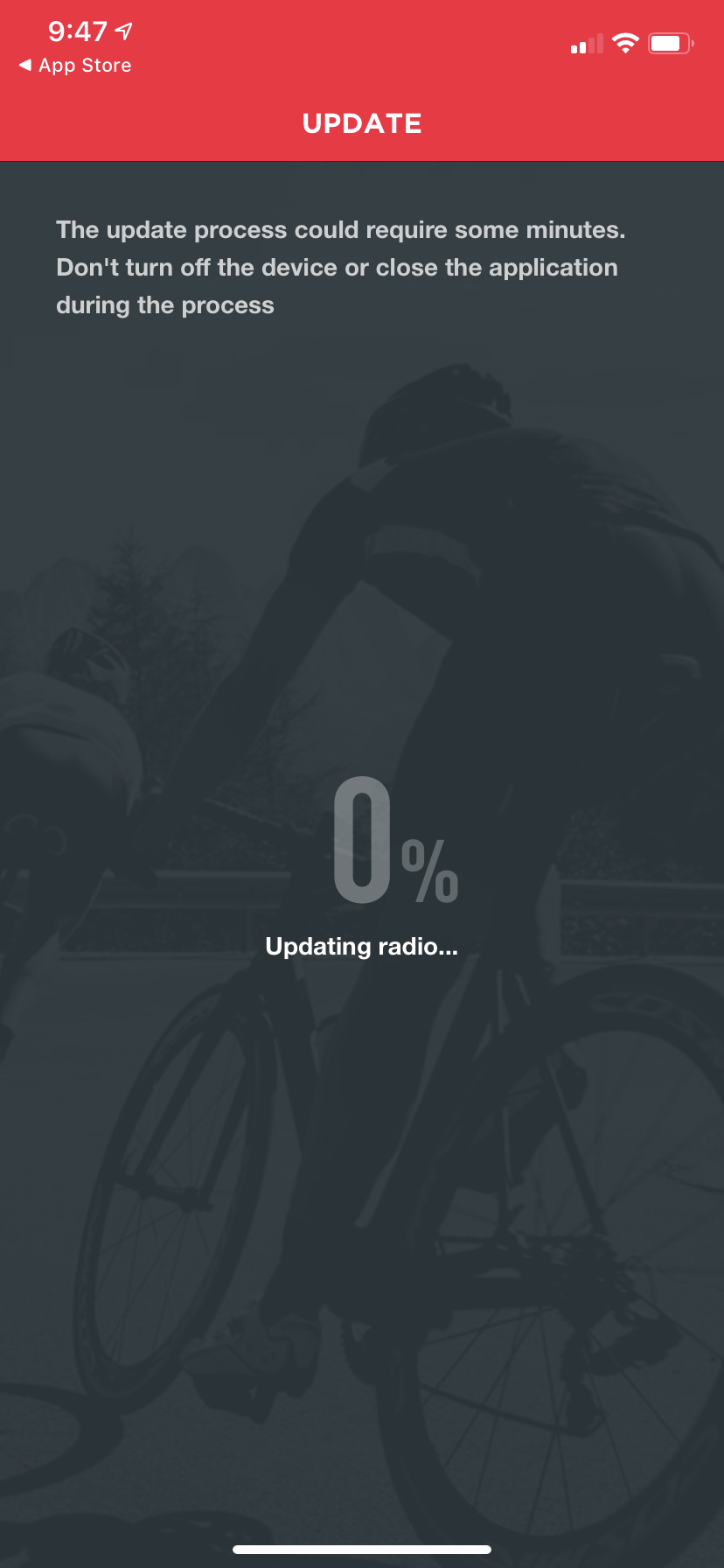
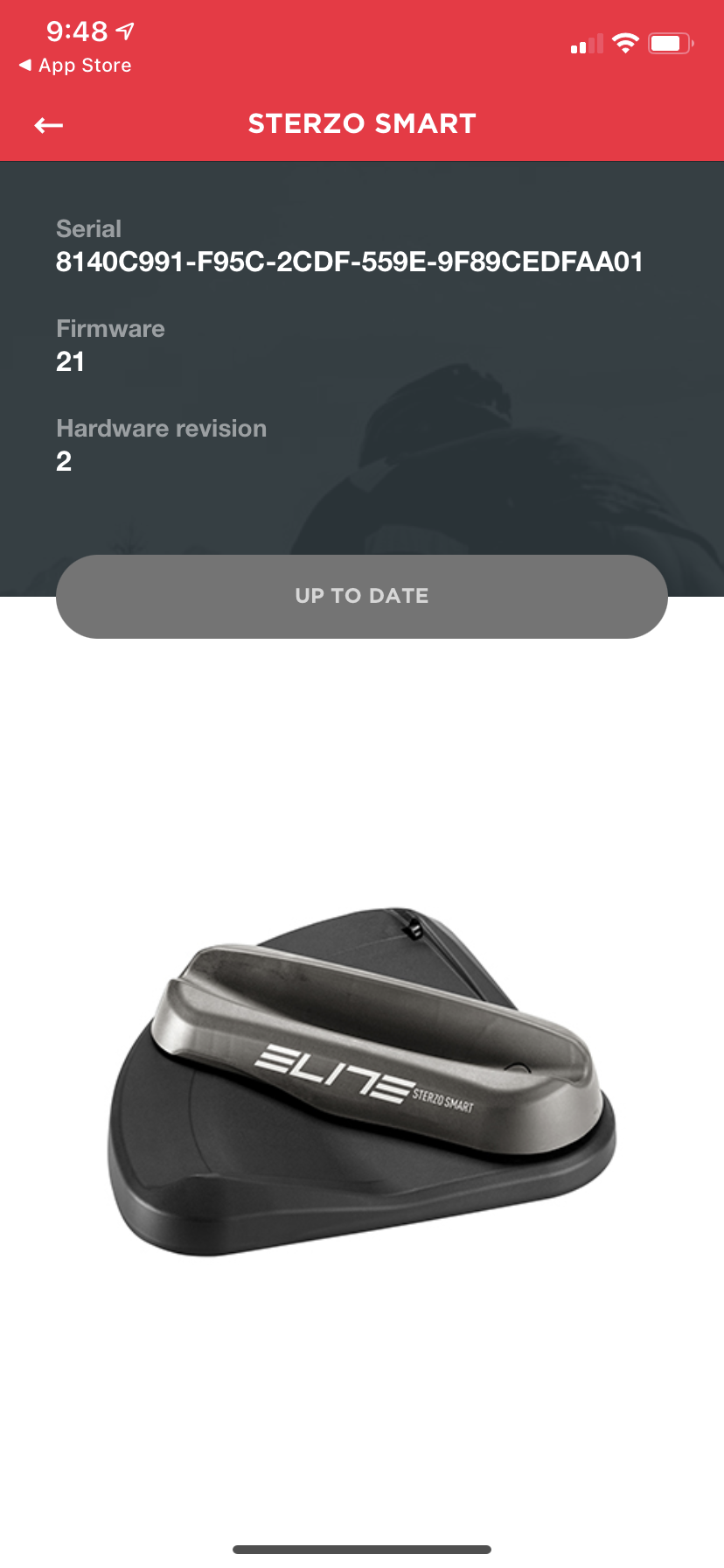
To upgrade your Sterzo’s firmware, you’ll need to install Elite’s “Upgrado” app (available on iOS and Android), create an account, connect to your Sterzo, and upgrade its firmware. Here are some screenshots of that process:
You must sign in or create an account
If the Sterzo doesn’t show up, unpair it from Zwift
Click on the Sterzo
This screen shows your current (outdated) firmware version
Downloading the update
Installing the update
All done!
Sterzo page confirms the new version 21 firmware
Here’s a video from our favorite Aussie lama explaining the upgrade process and sharing Shane’s views on this news and other thoughts Zwift steering related: