Nowhere Fast Episode 67 – Zwift Gone GRVL with Mike Morse
Episode 67 of Nowhere Fast welcomes Mike Morse for a chaotic dive into Zwift’s new gravel update, “Gone GRVL.” What starts as a discussion about virtual gravel quickly derails into the invention of “Fruit Racer,” a completely ridiculous Mario Kart-style version of Zwift featuring power-ups, banana peels, and tactical suffering. The crew also explores the Zwift subreddit and realizes competitive eracers may live in an entirely different universe than the average Zwifter just trying to finish a workout without accidentally joining a race.
Mike fits right into the show’s blend of cycling talk, internet culture, and self-inflicted nonsense, making Episode 67 feel like a group ride where someone replaced the water bottles with caffeine and bad ideas.
About the Podcast
Nowhere Fast is a member of the Wide Angle Podium network. To support this podcast, head to wideanglepodium.com to become a member and support stories that lead you to question everything you thought you knew about indoor bike racing.
To keep up to date on all our real coverage of fake bike racing, subscribe via Apple Podcasts or Spotify.
Yesterday was the first-ever running of Zwift Insider’s VO2sday Micro Races: 5 back-to-back mini time trials designed to give you a structured VO2 max workout hidden within the motivation and engagement of a race.
I jumped into the B category, so I could experience the races firsthand… and because I know I need to do more VO2 max work! Here’s how it unfolded for me…
Race 1: Overshooting
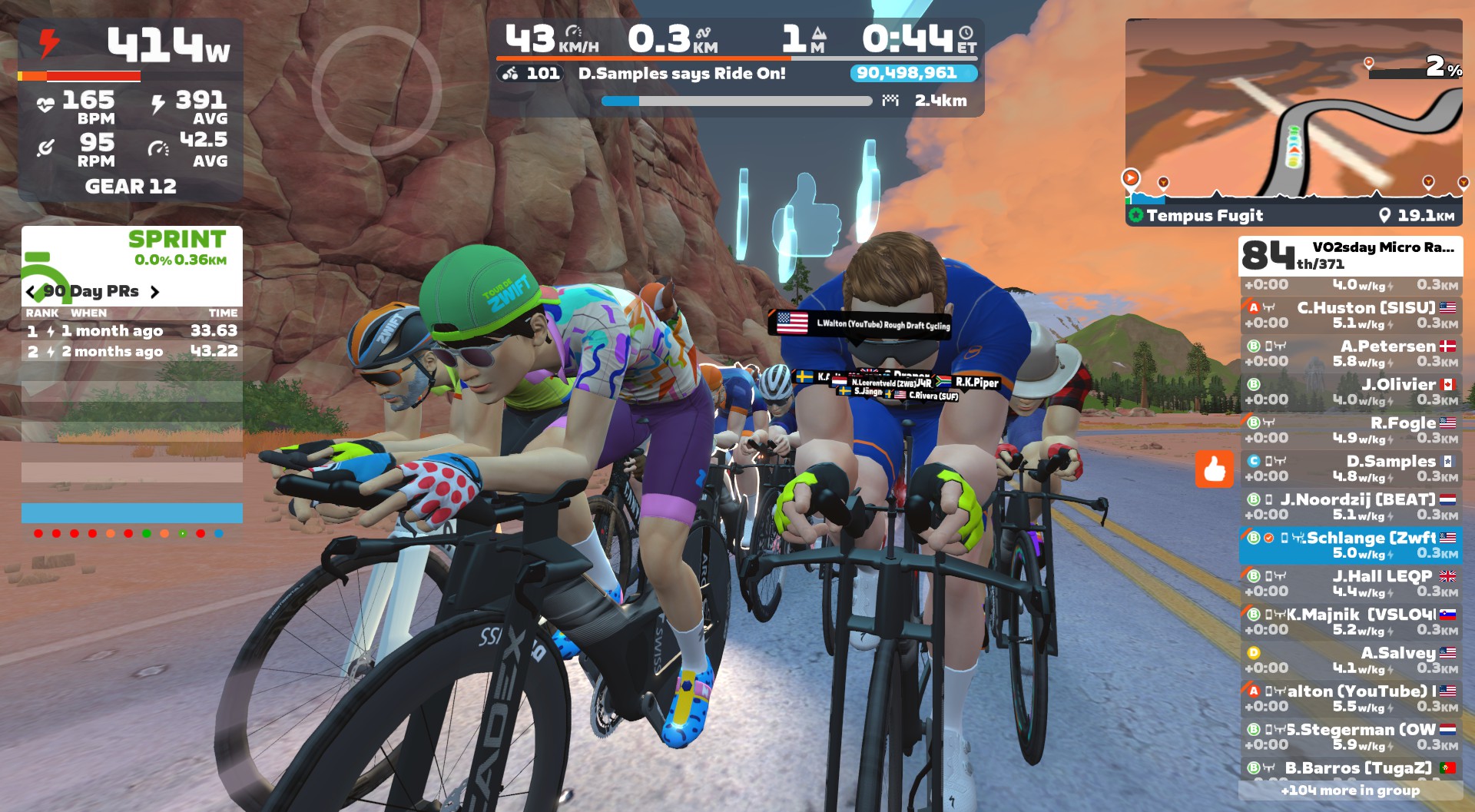
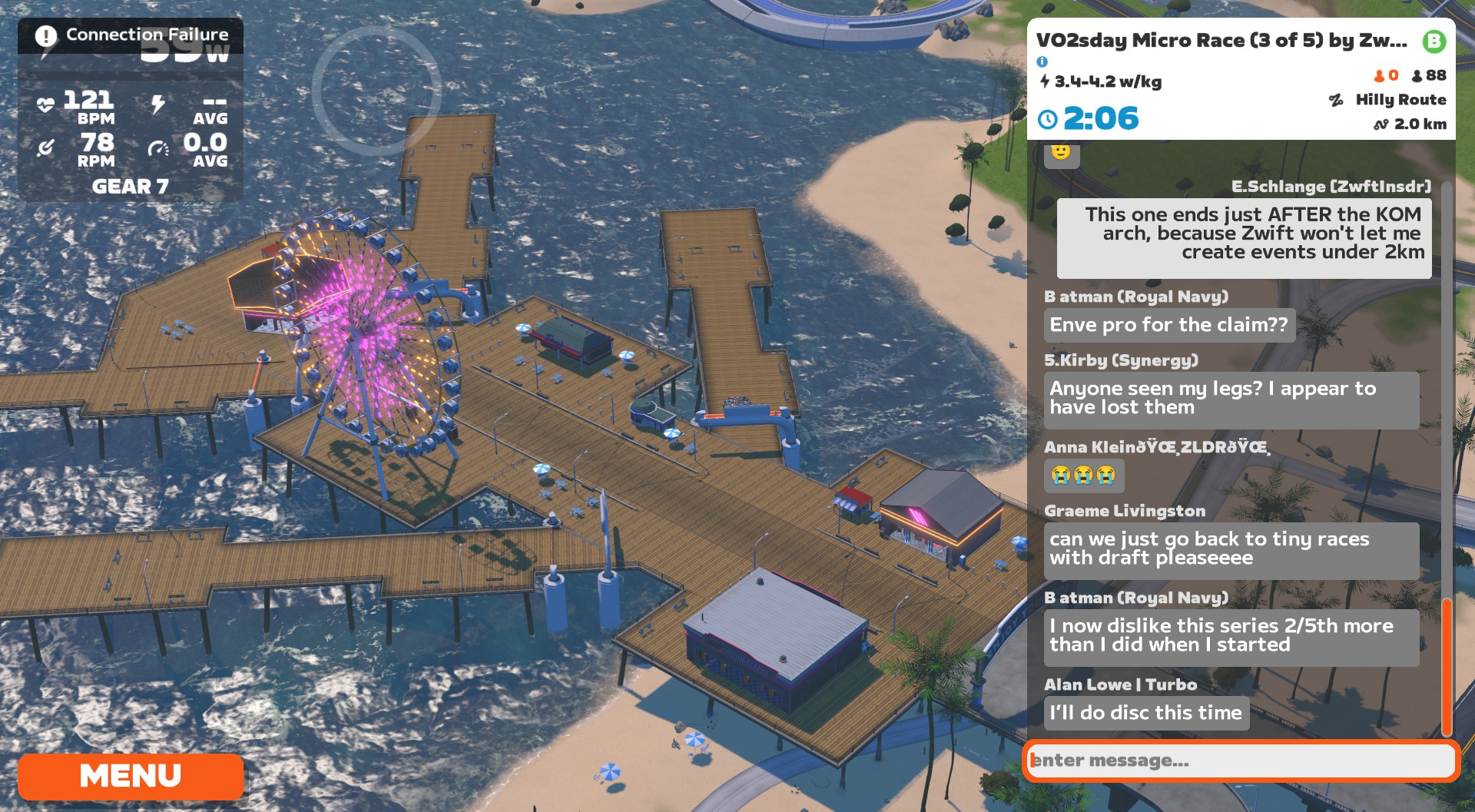
The first race was on 2.75km of Tempus Fugit, ending just after the rock arch marking the end of the “lead-in” section and the start of the official Tempus Fugit lap. 371 riders started that first race, even though, of course, the game only renders the nearest ~100…
With so much excitement in the air and adrenaline in the veins, I jumped hard out of the pens. Probably a bit too hard. After the first 60 seconds, my average power on screen showed 392W, so I purposely eased up a bit, knowing there was no way I could hold that power across 5 races!
I had decided beforehand to shoot for an average of 350W in each race. This felt like a tough but achievable target, since I’ve done it in past VO2 max sessions.
I could see on the minimap that I was sitting in a sea of green (B) riders, with blue (C) not far behind. I definitely wasn’t going to make it to the front of the group, but that was OK: for me, today was about trying to put in 5 big, steady efforts.
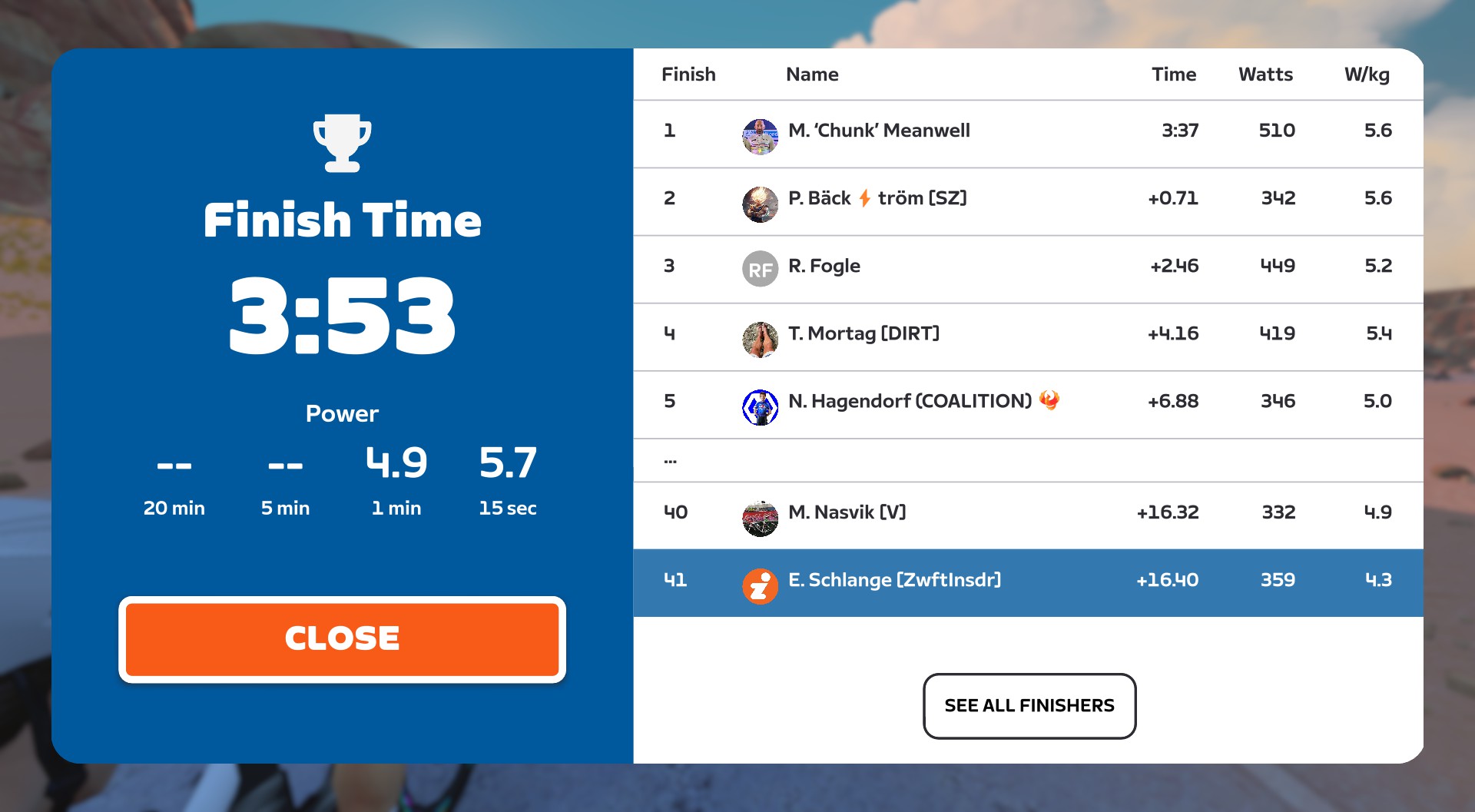
I crossed the line in 41st out of the B’s, at 359W average, HR at 173bpm. Let’s head to the race 2 pens!
Race 2: My Best Result
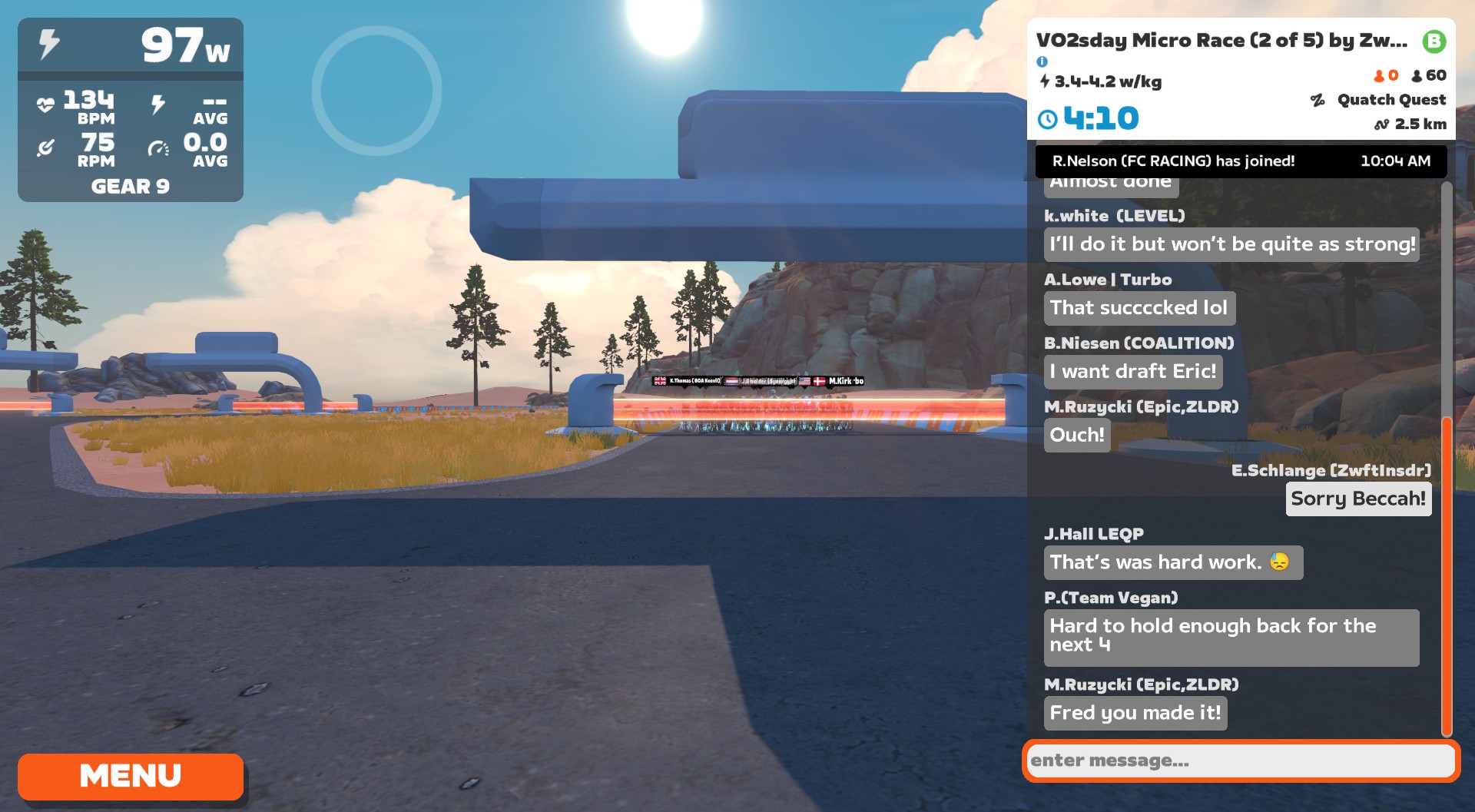
Everyone’s banter game had been strong from the start, but it would only get better as we all descended deeper into the VO2 max abyss.
I knew recovery would be vital if I wanted to put in good power numbers during these races, so I kept the legs spinning, at very low power, as we all caught our breath and chatted for ~5 minutes.
Race 2 was on the first 2.5km of Quatch Quest, ending somewhere on the rollercoaster climb of Titans Grove. I tempered my start a bit on this one, knowing the last bit would be uphill, and having more power to give on those climbs would improve my overall time.
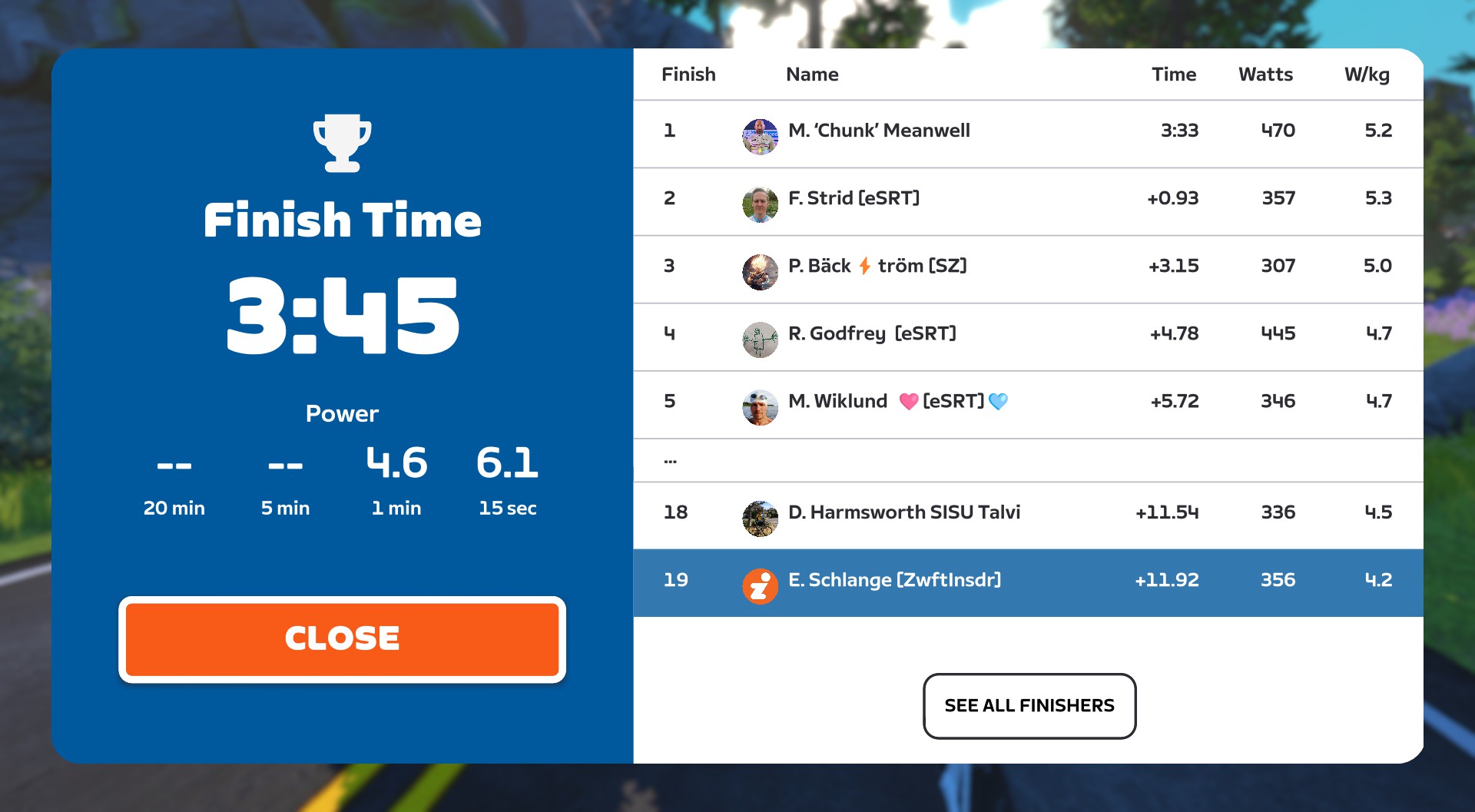
We hit the uphill rollers with 1.2km to go, and I tried to lift my power when I felt the resistance increase. A bit over VO2 max on the ascents, ease a bit on the descents. Wash, rinse, repeat. But it was working! I was moving up in the field, or at least holding position on a hilly bit. So I kept that pattern going, and crossed the line in 19th. (This would be my best finishing position of the day.)
Average power of 356W, finishing HR of 179bpm. Now to the race 3 pens to spin the legs and recover for just under 6 minutes.
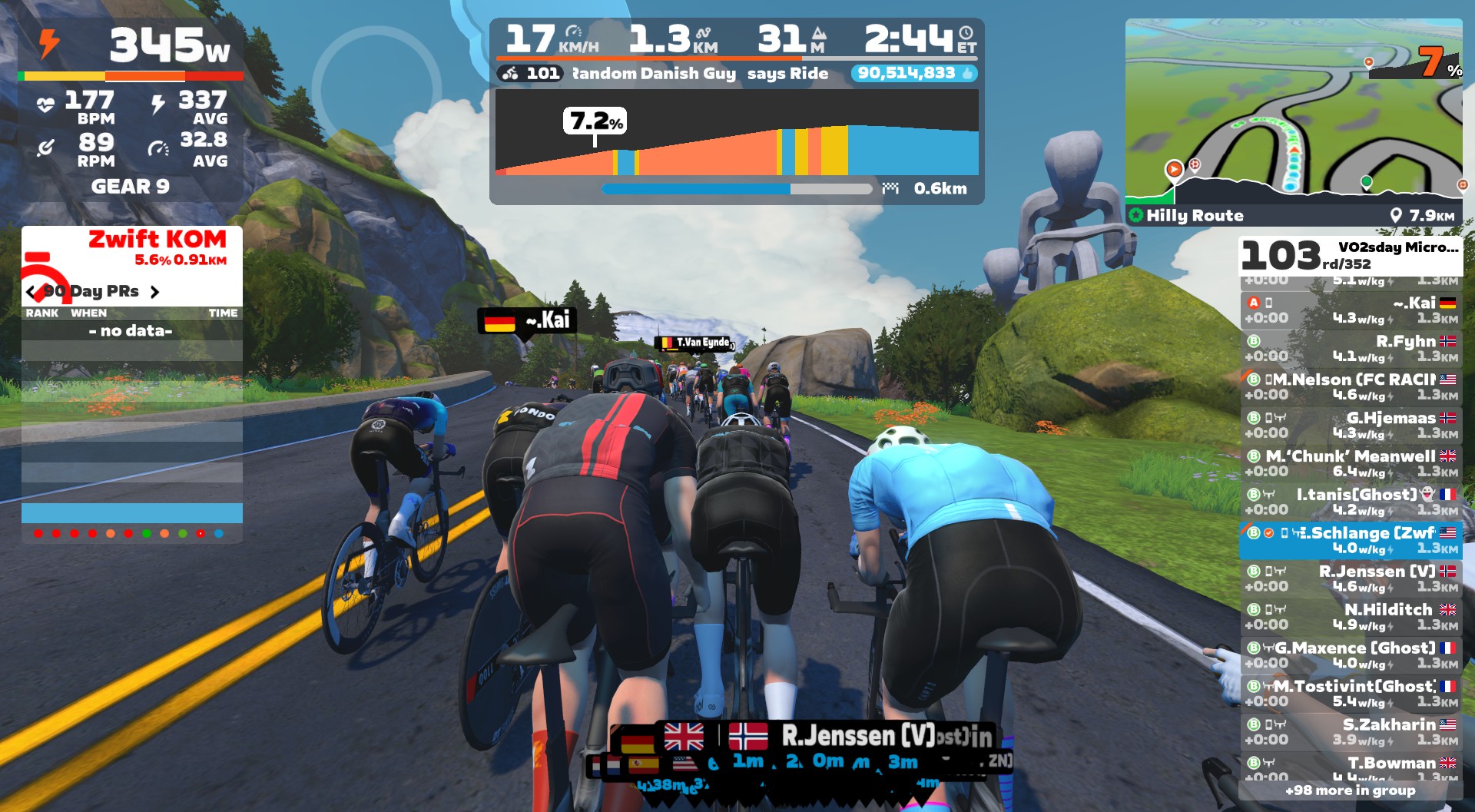
Race 3: the #%&@ Hilly KOM
The third race started in downtown Watopia and headed up the Hilly Route – the oldest route in Zwift! This was the climbiest of today’s 5 races, taking us up the Hilly KOM and ending just afterward on the downhill at 2km.
I didn’t anticipate doing particularly well in this race, given the climbing involved. But again, I had to remind myself that “doing well” today meant hitting my target power, putting in a maximal VO2 effort in each race.
Once again I conserved on the flat lead-in, knowing I’d want more power on the key climb. My average power was at 322W as we started the KOM, then I tried to ramp it up.
But ouch. I could tell the legs were feeling the two previous efforts. This was gonna get ugly.
I wasn’t paying attention to my pack position. I was just trying to keep the effort high. To push through the suffering. As we neared the top of the climb, I shifted up a few gears, getting out of the saddle to hammer a bit.
It didn’t help.
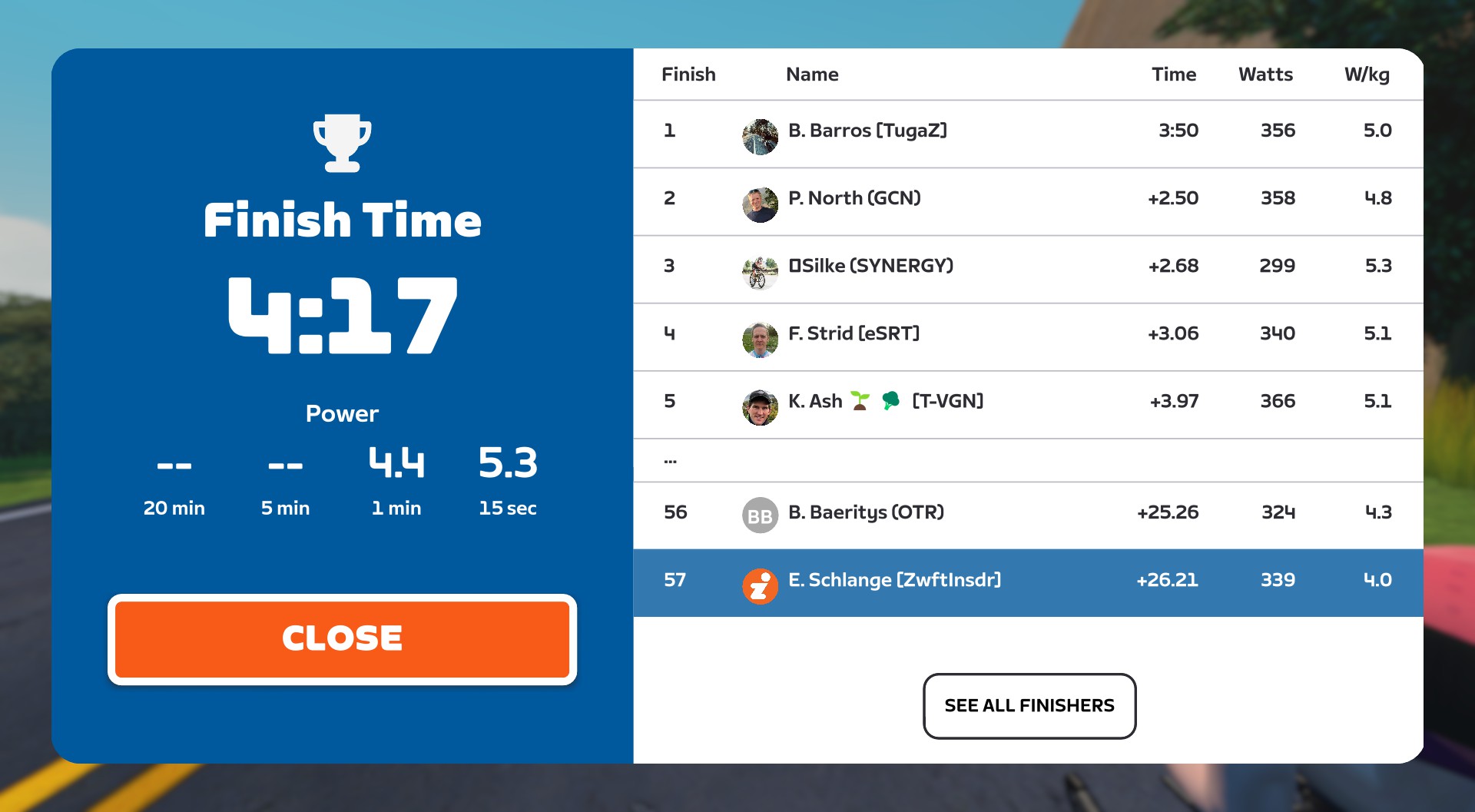
I sat back down and pushed to the line, finishing 57th, at 339W, with a HR of 180bpm.
Race 4: Implosion!
As I sat in the pens spinning my legs and questioning my life choices, it was heartening to see I wasn’t alone. There’s something really encouraging about knowing the people behind the avatars on your screen are also maxing out their legs and lungs.
This race was on 2.7km of Flat Route Reverse, ending on the JWB Bridge. We jumped out of the pens, began the climb up into The Esses, and it quickly became abundantly clear: I didn’t have 350W to give for this race.
But I wasn’t going to stop. I just dropped my power, holding around 300W, hoping this would let my legs recover a bit for the final race.
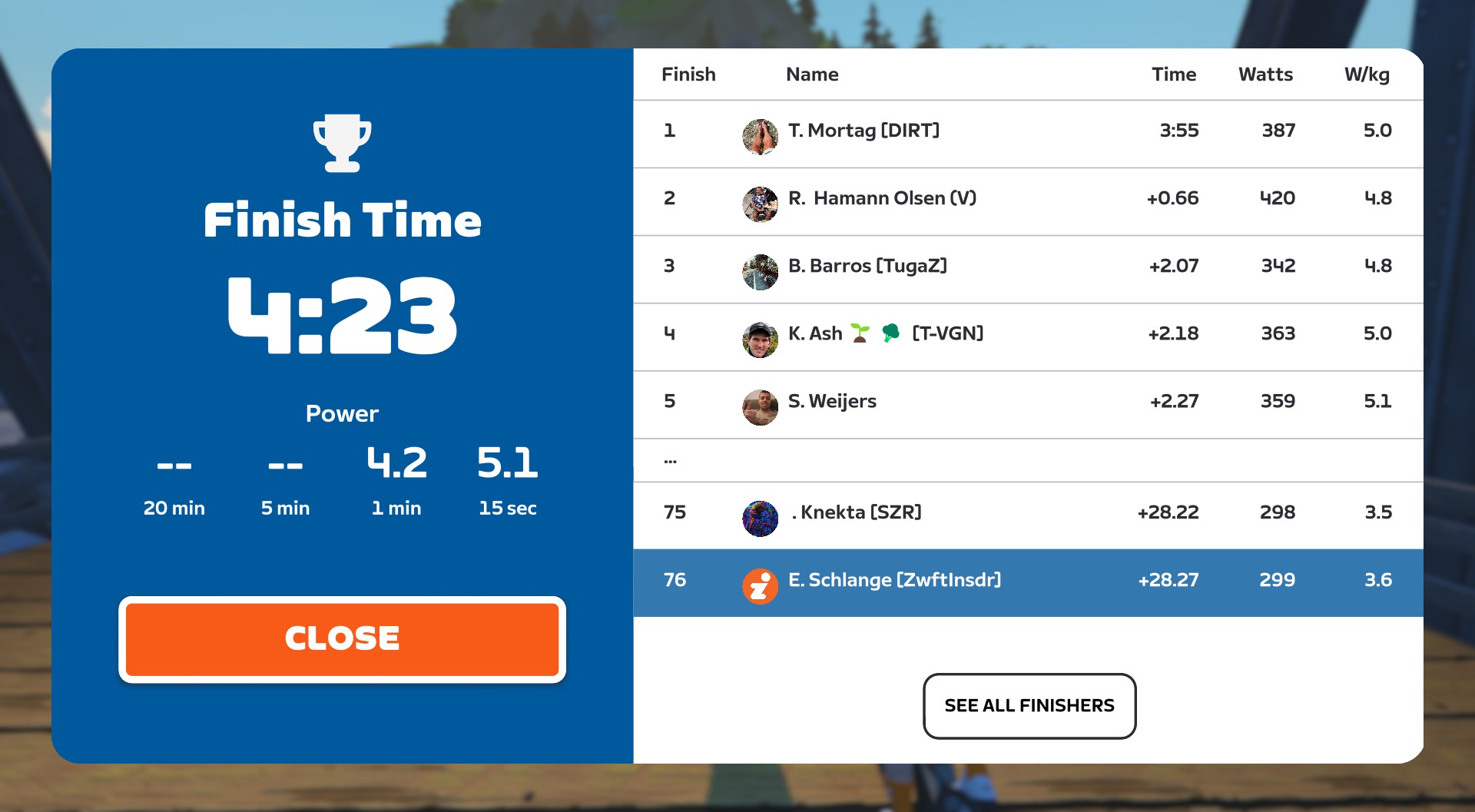
Unsurprisingly, this was my worst result yet: 76th place in the B’s, 299W average, 178bpm.
Race 5: the Downhill Comeback
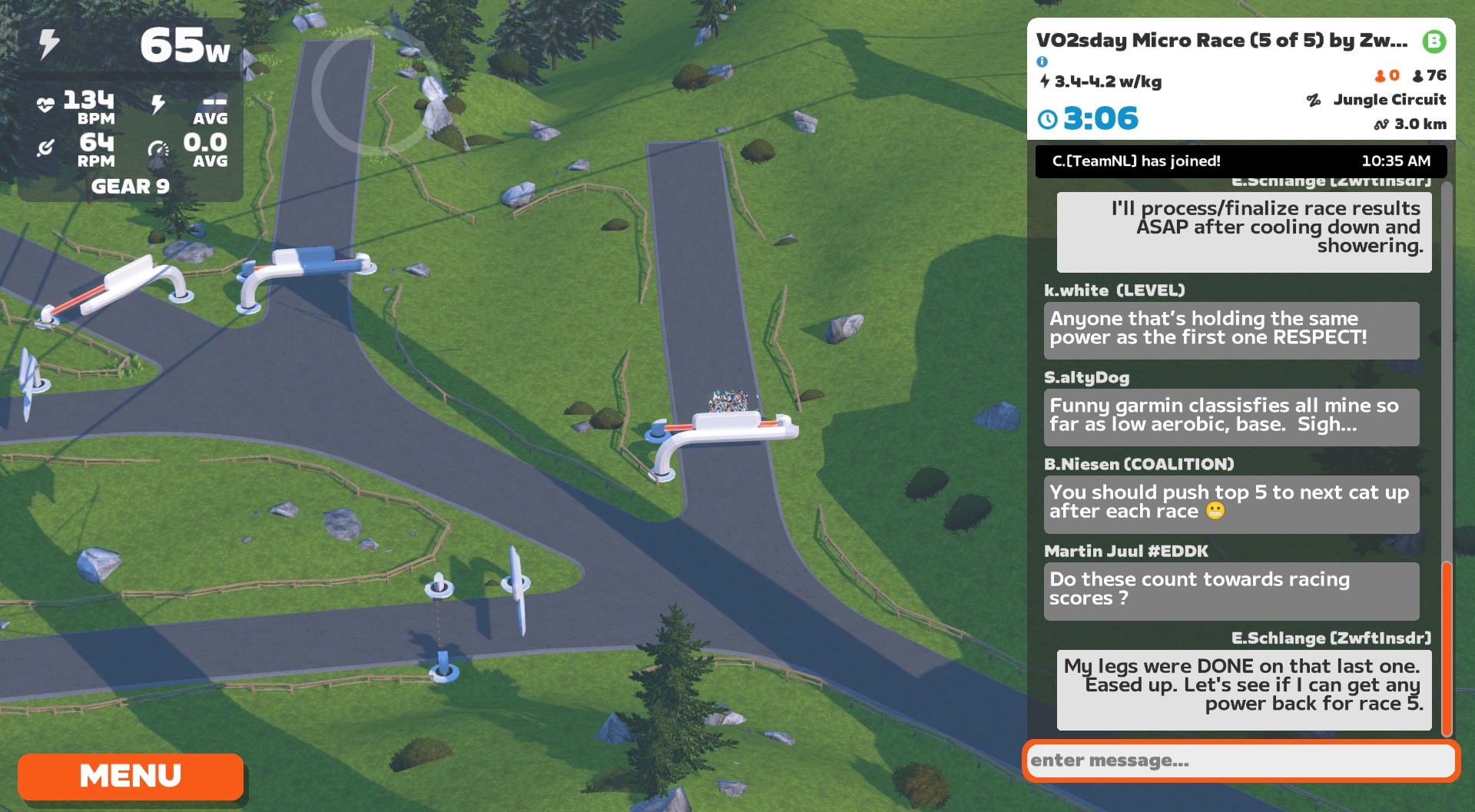
We made it! The last race was mostly downhill, a 3km effort on Jungle Circuit. Some riders were going with gravel bikes, but I stayed on my TT rig, betting that the aero and rolling advantage, particularly on the initial 1.3km paved portion, was worth whatever I’d lose to a gravel bike on the dirt portion.
Jumping out of the pens and beginning our descent to the Jungle, I could definitely feel that my legs had benefited from dogging it in the previous race. Still, I wasn’t able to hold my initial 350W target. So I just tried to keep it steady, knowing the suffering would be over in just anothe minute or two.
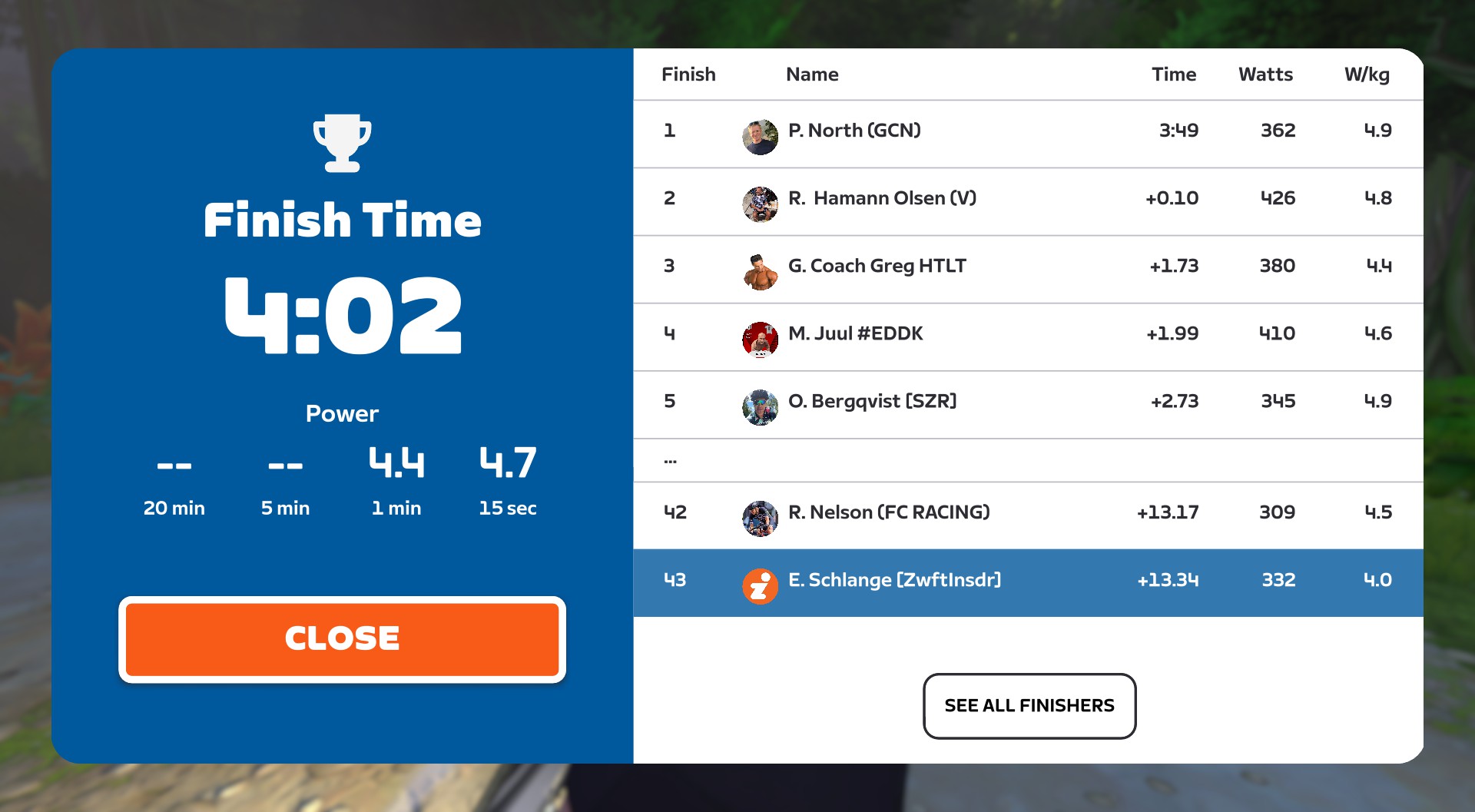
I finished in 43rd, 332W average, 181bpm.
Watch the Video
Takeaways
I was happy with how the first-ever VO2sday Micro Races went. We started with 371 riders in race 1, and finished with 340 in race 5. That’s a lower attrition rate (8.3%) than I would have predicted!
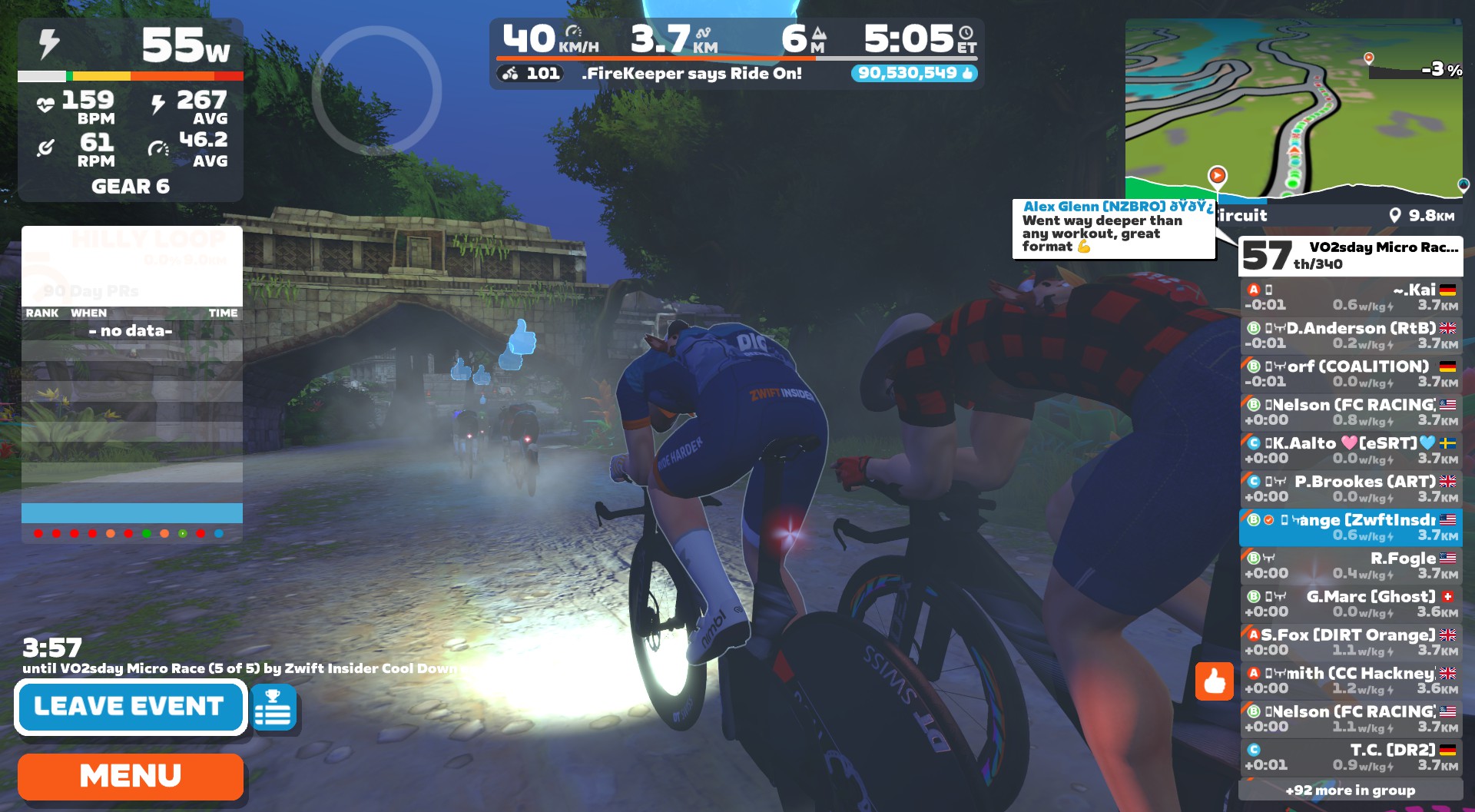
The comments in game were largely positive, if you don’t count the many “This is terrible Eric, you’re the worst” sort of messages. 😂 I loved seeing all the banter, the camaraderie, the messages like this one from Alex affirming that these races did what I’d hoped they would do:
In terms of my personal performance, I finished 41st out of the 89 B racers who completed all 5 events. Not my finest moment, but you know what? It was a great workout!
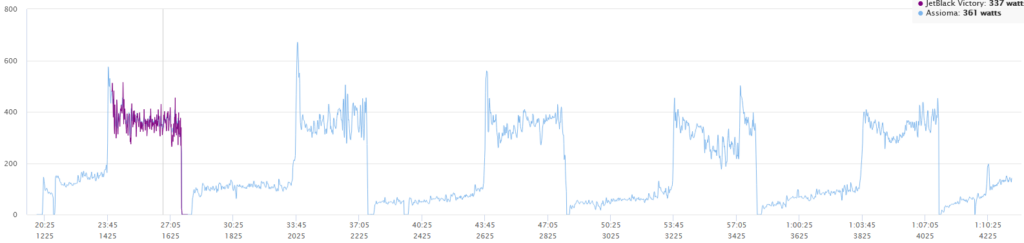
I recorded my whole session on my head unit, using my Favero Assioma pedals as the power source. Looking at the chart (see it on ZwiftPower), it looks like a solid VO2 max workout, even if the 4th race is a bit low:
One annoying thing is that the JetBlack Victory trainer I’ve been using for a few months likes to read low on occasion, and this was definitely one of those occasions. Every race I did had the trainer 10-15W lower than my pedals. Gah!
But that makes me feel a bit better about my effort on the day. Based on the pedal data, I basically just overshot my VO2 max target in the first two races and nearly hit it in races 3 and 5. I’ll take that.
What Next?
Several riders offered feedback before, during, and after these races on tweaks to dial in the experience. I’m curious what you all think of these ideas, so please comment below! In no particular order:
Have categories start separately, with slower groups leaving first, so it becomes a bit of a chase race. This would make it easier to see how you’re doing against the riders in your category, and reduce the processing load for people running Zwift on a potato.
Neutralize the bikes/wheels so nobody has an advantage. Or alternatively, put everyone on the same frame/wheels.
Disable steering, so those with steering don’t have an advantage.
Enable drafting, because racers are lazy and want to sit in (this one’s for you, Beccah! 😄)
As I spun around the Jungle Circuit for a cooldown, my glycogen-depleted brain also had the idea to make these time-based races instead of distance-based, so each race ends at (for example) 4 minutes. Then it’s a question of who rides furthest in the allotted time.
I really like this idea, because it would let us have precise “interval” lengths, and because it’s very different from typical Zwift races. There’s just one problem: I don’t think ZwiftPower can support it! But I’m looking into it.
I’m hoping to use Zwift’s Compound Score for categorization beginning next week. Working with the ever-helpful Tim Hanson of zwiftracing.app to make that happen!
Lastly, many of you have requested additional timeslots for this event, which is perfectly understandable. I do plan to add timeslots… I just have to figure out what they’ll be, and when to launch them. Stay tuned for news on that.
More VO2sday Videos
Here are a few more livestreams from the day’s racing. I bet we’ll see some nicely-edited highlight reels from other Zwifty YouTubers in the coming days as well! (Share your link below if that’s you, and I’ll share the video on this page.)
Manuel Essl
Justin van der Nest
Bill Henson
Luke Walton
Questions or Comments
What did you think of your VO2sday experience, and what do you think of the various ideas for tweaking the experience listed above? Share your thoughts below!
It’s been seven days since Zwift announced their acquisition of Rouvy, and since that time I’ve been pondering Zwift’s big move while reading community comments and talking to various leaders at ZHQ.
Today, let’s take a deeper dive into Zwift acquiring Rouvy. Why is Zwift making this move? How do users feel about it? What does it mean for the future of both platforms and indoor cycling as a whole?
Let’s dive in…
A Quick Comparison
Not familiar with Rouvy or perhaps Zwift? (Then how did you get here?) Seriously, though, here are two good videos from GCN that introduce you to the ins and outs of each platform:
A few more comparisons:
Locations: While both companies have multiple offices, Zwift’s official HQ is in Long Beach, California, while Rouvy is based in Prague, Czechia.
Subscribers: Zwift has around 1 million subscribers, while Rouvy has around 300,000
Employees: Zwift has around 325 employees, while Rouvy has around 125.
Core Business: Both companies see subscription income as their main source of income, but Zwift has the additional revenue stream from its hardware, most notably the Zwift Ride.
Core User Experience: Zwift is a video-game like virtual environment with strong social features, while Rouvy uses real-world videos of routes with augmented elements (rider avatars, etc) and an emphasis on realism.
Community Sentiment
Put your finger on the pulse of Zwift/Rouvy community sentiment by looking at comments on the videos below, and these links:
Official, less buggy Zwift hardware compatibility with Rouvy
Possibility of a combined subscription
More and shared resources between companies leading to faster development of core features
The Big “Why?”
Everyone’s speculating on exactly why Zwift made this move, and your take on it will be largely based on whether or not you trust the official messaging from Zwift and Rouvy. Here it is, from paragraph one of Zwift’s official press release:
The acquisition aims to accelerate growth in the indoor cycling category through strategic cooperation between the two companies, while maintaining their independent operations.
While Zwift and Rouvy are both saying this is a friendly acquisition made with the goal of growing indoor cycling while both companies remain independent, it’s clear that many in Zwift and Rouvy’s communities don’t believe what’s being said. And that’s a fair take, because it feels more common than not for corporations to say one thing in these touchy situations, yet eventually do another.
I chatted with Mark Cote, VP of Product at Zwift, who said, “It’s of course easier to say things will improve for both platforms from the inside than to be trusting from the outside – most Rouvy riders don’t know me or our leadership team.” Zwift CEO Eric Min had a similar tone when I chatted with him, acknowledging the community’s concerns without deviating from the message: this is about both companies working together to grow “the whole pie” while remaining independent.
Some users have been comparing Zwift buying Rouvy with Wahoo buying RGT four years ago, noting that Wahoo initially invested in RGT but eventually shuttered it a year and a half later. But is that a fair comparison?
I would submit that the Wahoo+RGT situation is nothing like Zwift+Rouvy. RGT was a very small platform, and nowhere near profitable. Wahoo is largely a hardware business, and they bought RGT as a strategic move to bolster their smaller software/subscription business. Zwift, on the other hand, is the leader in the indoor cycling space, and they’ve acquired Rouvy, a profitable company and the second-strongest in the space.
Perhaps a better comparison is Facebook’s acquisition of Instagram in 2012. While Insta users saw the move as anti-competitive when it happened, and many mourned the loss of their beloved platform before any changes were actually made, Facebook kept Instagram going as a separate app as promised. And grew it to a massive scale.
While longtime Insta users may argue that they prefer the Insta of old (fewer ads and commercialization), what’s undeniable is that the acquisition gave Insta access to a massive pool of engineering talent, global data centers, and growth expertise that led to Insta exploding from ~30 million users to billions today.
So, what happens next?
In the short term, let’s say the next 6-12 months, Zwifters and Rouvy users (Rouviers?) probably won’t see much change on their respective platforms as a result of this acquisition. Rouvy riders can now use Zwift hardware reliably in the game, which is a quick win for both companies. And I would bet we’ll see Rouvy activities begin to count toward Zwift Fitness Metrics soon, as that’s a fairly easy change and a no-brainer to encourage use of Zwift’s growing training ecosystem.
The bigger question, of course, is what happens long term? How does last week’s news change things in the indoor space 3, 5, or even 10 years from now?
Unfortunately for Zwift’s PR department, the potential for negative outcomes increases as the timeline is pushed out. It really boils down to three potential long-term negatives for customers:
Price Increases: Rouvy’s pricing is friendlier than Zwift’s, with family and duo plans much lower than Zwift’s single-user pricing model. With Zwift now benefiting from subscribers on either platform, there is less pressure to stay price-competitive. The logical eventual result? Increased subscription prices.
Reduced Options: Rouvy is a strong alternative to Zwift, with both platforms providing very different indoor environments on compatible hardware. But Zwift now owns Rouvy, and could choose to shut it down at any time.
Closed Standards: Rouvy had reverse-engineered connectivity to some of Zwift’s hardware, and the move was forcing Zwift to evaluate their proprietary approach with Zwift Protocol. That pressure to open up their hardware standard no longer exists, which means Zwift can continue to leverage hardware compatibility to drive subscriber growth, making it much harder for competitors to launch and grow in the indoor space.
I’m generally a Zwift optimist, though. I believe their leadership team genuinely wants to keep Rouvy healthy and running and growing, and to see Zwift do the same. To continue investing in making the hardware simple and affordable, while offering engaging indoor riding experiences. My take on the three potential negatives above is thus:
Price Increases: It wouldn’t surprise me to see Rouvy and Zwift increase their prices a few years from now, but that’s only because prices are increasing everywhere. I wouldn’t see this as a direct result of the acquisition, but the result of a myriad of market factors that drive subscription prices for every other app we use.
Reduced Options: Zwift has no plans to shut Rouvy down. It wouldn’t make sense. Rouvy is a sizeable, profitable business serving up an experience (real video rides) that subscribers clearly want. Zwift wants to keep it this way, and so do Zwift’s investors. (As DC Rainmaker commented, “If you disappear Rouvy, then you disappear those gained 300-500K+ users.”) In fact, I bet we’ll see Zwift refering people to Rouvy and vice-versa in the future as some sort of suggested alternative.
Closed Standards: I’d love to see Zwift “do the right thing” and open up their hardware standard to other platforms (Training Peak Virtual and MyWhoosh, for example). But that’s really a “community goodwill” move and not a “smart business” move at this point. Holding proprietary protocols is an advantage for Zwift today, so I think they’ll keep it that way.
Time will tell, of course. None of us has a crystal ball. But it’s not as simple as, “Less market competition is never good for customers” (a comment I’ve seen in various forms from hundreds of people in the past few days). Yes, this acquisition reduces competition for Zwift. But it can also lead to a sharing of knowledge and other valuable resources between the two companies, to broader hardware compatibility between the platforms. Perhaps the net result will actually be a positive for consumers? A few potential positives:
Hardware/Functionality Expansion
Rouvy now supports Zwift Ride and Zwift Click controllers (but not Zwift Play). Steering and braking aren’t yet supported, though, since Rouvy doesn’t have steering or braking in game. My guess is you’ll see those features arrive eventually, though. New game features driven directly by Zwift’s acquisition of Rouvy.
Subscription Changes
Yes, Zwift says subscription pricing won’t change on either platform any time soon. But wouldn’t it be great if it did? Zwift has never had a family plan, but they can now use Rouvy’s subscriber data to predict how a family plan might increase or decrease subscriber counts or revenue. That’s valuable information that’s hard to come by in this industry.
Shared Learnings
Zwift does a better job of creating a social environment, while Rouvy, by some accounts at least, does a better job of onboarding new users. The two teams could share this knowledge, helping both products improve in areas of weakness. Hardware teams could also collaborate to work on stubborn problems like connection reliability and simplifying device connections at startup.
Your Thoughts
Well, there you have it. Community opinions, Zwift’s messaging, and my own take on it all. Who is correct? Unfortunately, we’ll have to wait and see.
There are hundreds of rider levels in Zwift. Everyone begins at level 1, and you move to higher levels by accumulating XP (experience) points.
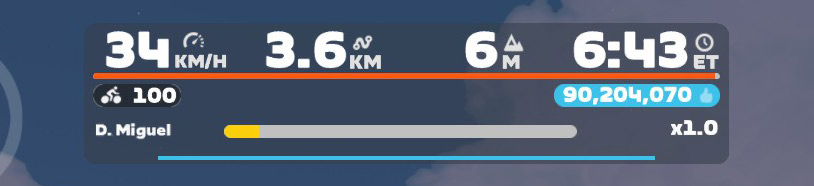
When riding, you can see your current level on the center HUD element, just below your speed. Between your speed and your level your level progress bar which fills up as you get close to leveling up.
In this snapshot, you can see I’m at level 100, and have almost finished leveling up!
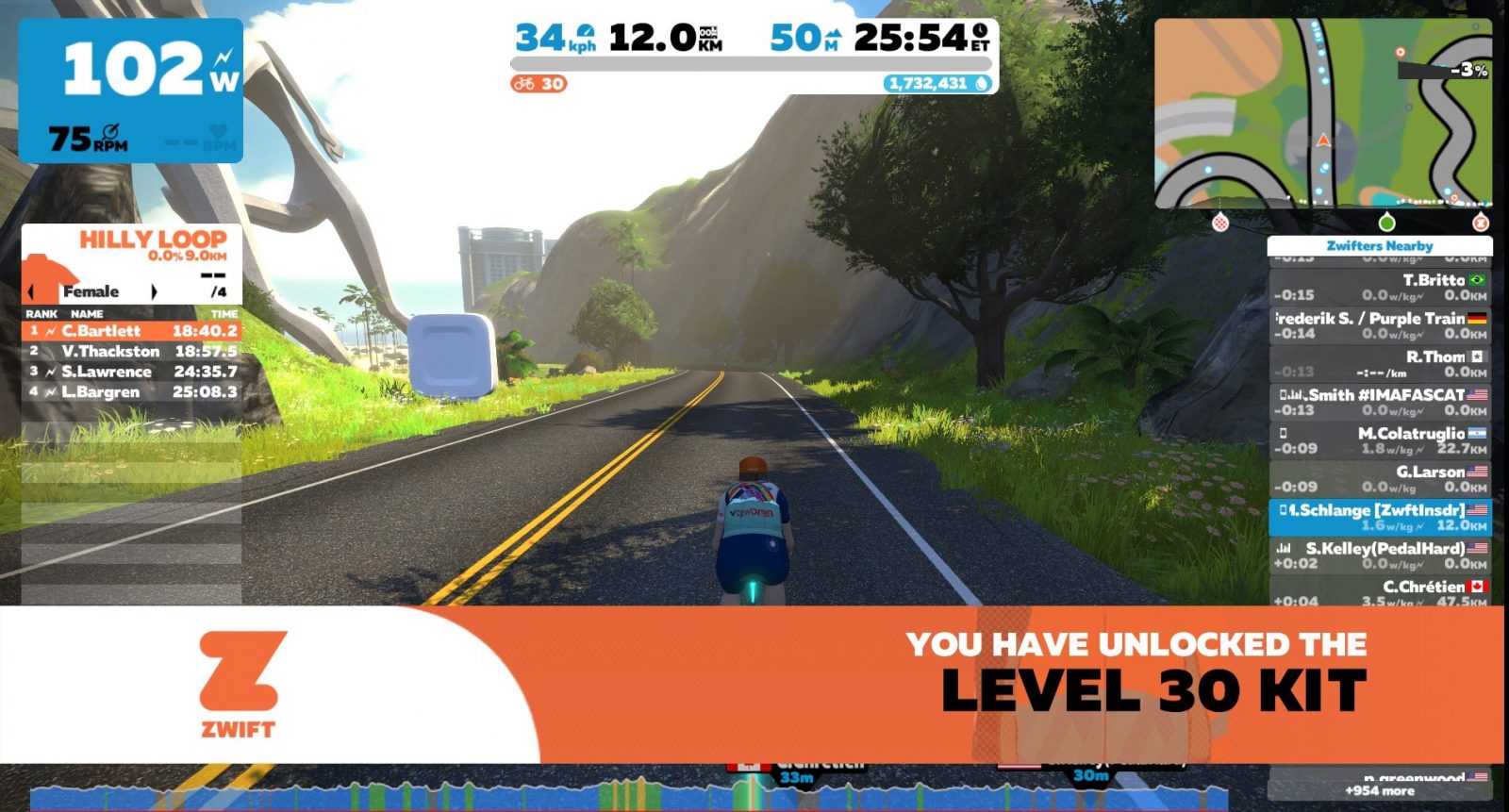
When you level up, you will receive a notice in-game of any unlocks, as well as a level-up animation above your avatar so others see your progress:
Why Level Up?
The higher your level, the higher your Zwift street cred. And if you reach level 100, you’ll get an orange “century stripe” next to your name in the rider list!
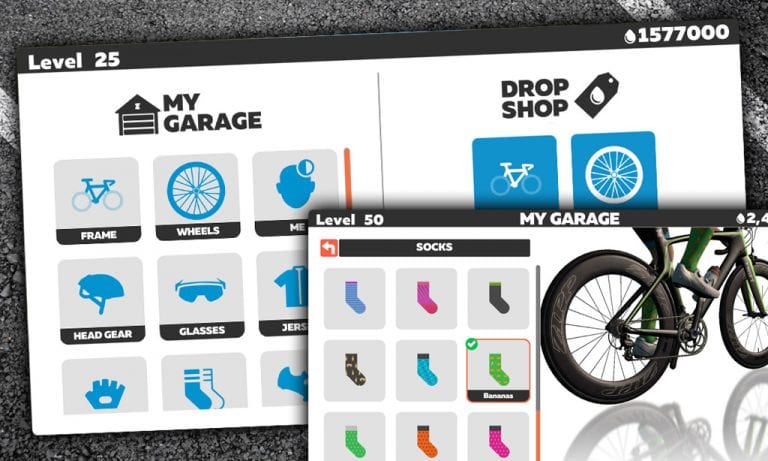
Also, most bike frames and wheelsets have level requirements, so if you want a fast or cool setup, you’ll want to level up:
After level 100, there are no unlocks given as you level up. The following XP is required per level:
Levels 101-199: 20,000 XP per level
Levels 200-299: 21,000 XP per level
Levels 300+: 22,000 XP per level
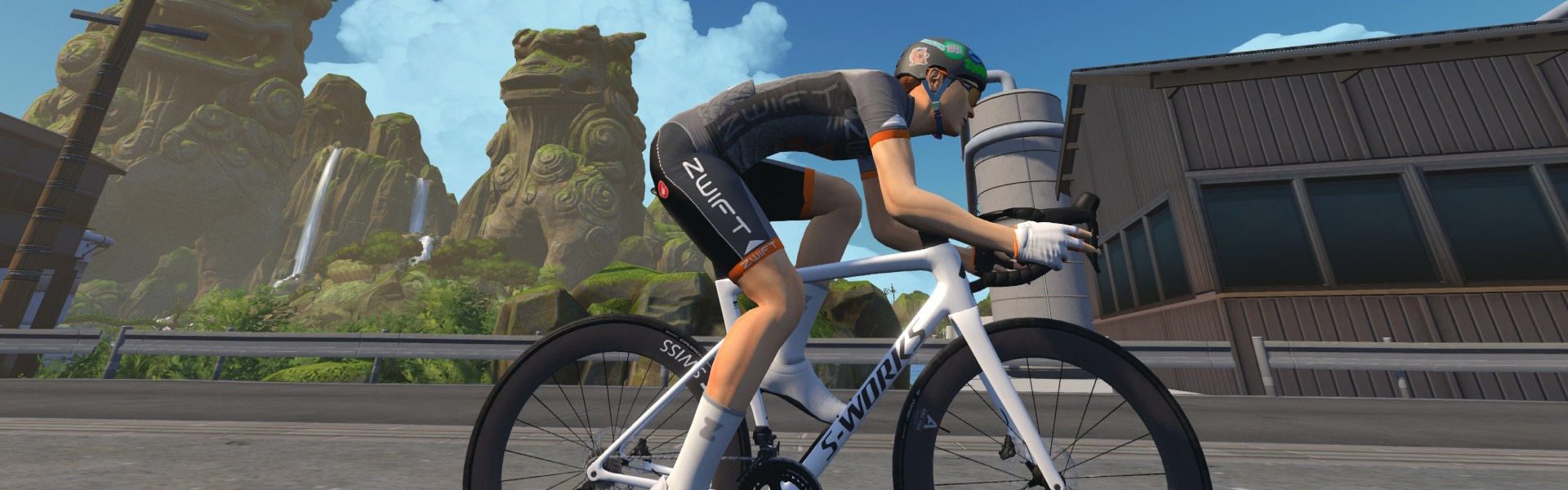
You can see previews of some of the kits mentioned above on our kits page.
Different bikes and wheelsets do affect your speed in-game. See our speed charts for frames and wheels for details.
How Do I Get XP (Points)?
Most of your XP will come from distance ridden or workout blocks completed.
Points are added for every km (20 XP) or mile (32 XP) you ride unless you are in workout mode, where points are based on interval type, length, and completion accuracy. (See How Zwift Calculates XP for Cycling Workouts for details.)
Outdoor miles count too – but you only get 5 XP per kilometer outdoors, and there’s a limit of 200KM/1000XP per ride.
Because Zwift has expanded levels four different times, implementing different acceleration schemes each time, and changed XP requirements for levels more than once, many riders are on a sort of “personalized leveling plan”. It can be quite confusing to figure out exactly how things are working for you, but fortunately it just works, and you can ride knowing you’ll level up eventually.
That said, if you’re below level 100 and want to dig into it, read this post to learn how accelerated leveling works for you.
On the other hand, if you were stuck at level 100 for a while before Zwift added new levels on April 29, 2026, you may want to read this post to learn how accelerated leveling works for you.
Drops are Zwift’s virtual currency, used to purchase equipment for your garage. They are totally different than XP, and are earned in different ways. Learn all about how they work >
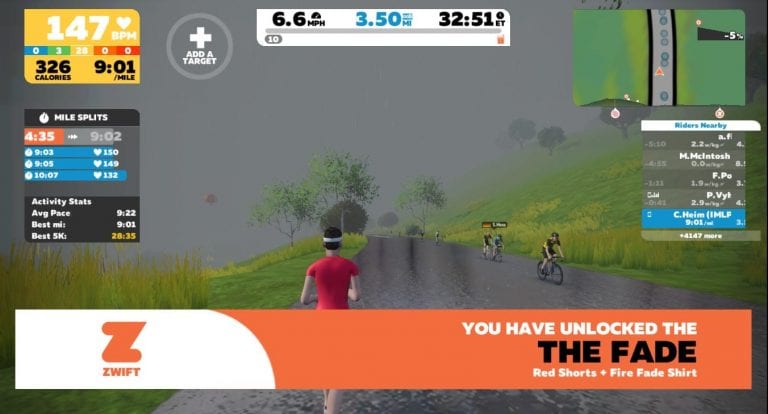
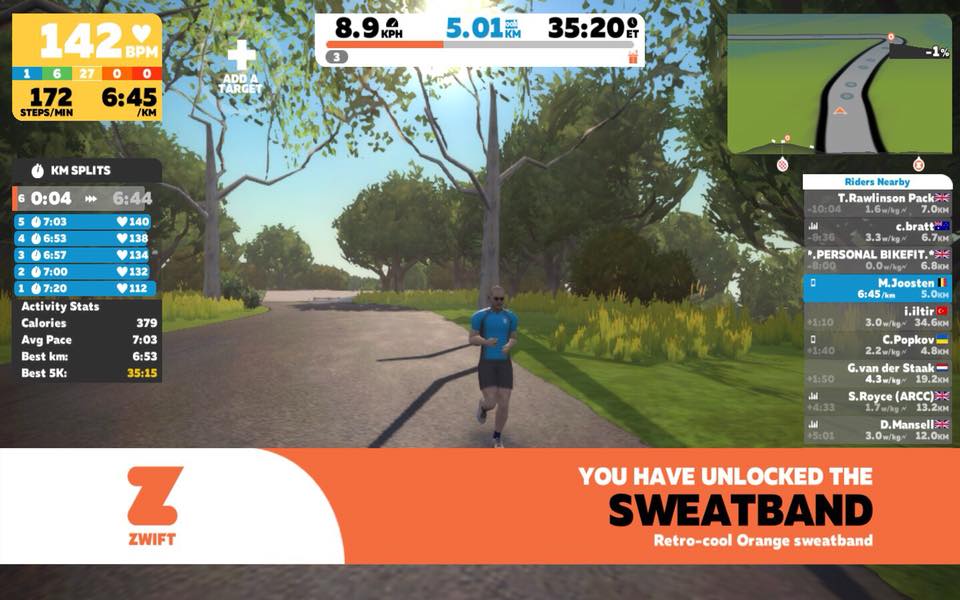
There are currently 50 runner levels in Zwift. Everyone begins at level 1, and you move to higher levels by accumulating XP (experience) points. You can see your current level while running just below your center console which shows speed, distance, run time. Below those numbers there is a progress bar with your current level on the left. When you level up you will receive a notice in game similar to the image above.
How Do I Get XP (Points)?
Points are added for every 1/4 km (10 XP) or 1/4 mile (15 XP) you run on Zwift. You will see a small alert to the right of your center console whenever points are added. Sorry, America: since a kilometer is equal to .621 miles, you will accumulate XP slightly faster if you ride in metric units. (10km=400 XP, while the equivalent mileage, 6.213=372 XP.)
Outdoor runs also earn in-game XP. Outdoor runs earn 8 XP/km, which is 1/5 the rate of XP earned for Zwift runs (40 XP/km).
You also earn 5 XP for every 100 calories burned.
Level Unlocks
Here is what you unlock at each level, and the number of accumulated XP points needed to level up.
(0 XP) Default Orange Zwift / Blue Zwift Running Shirt
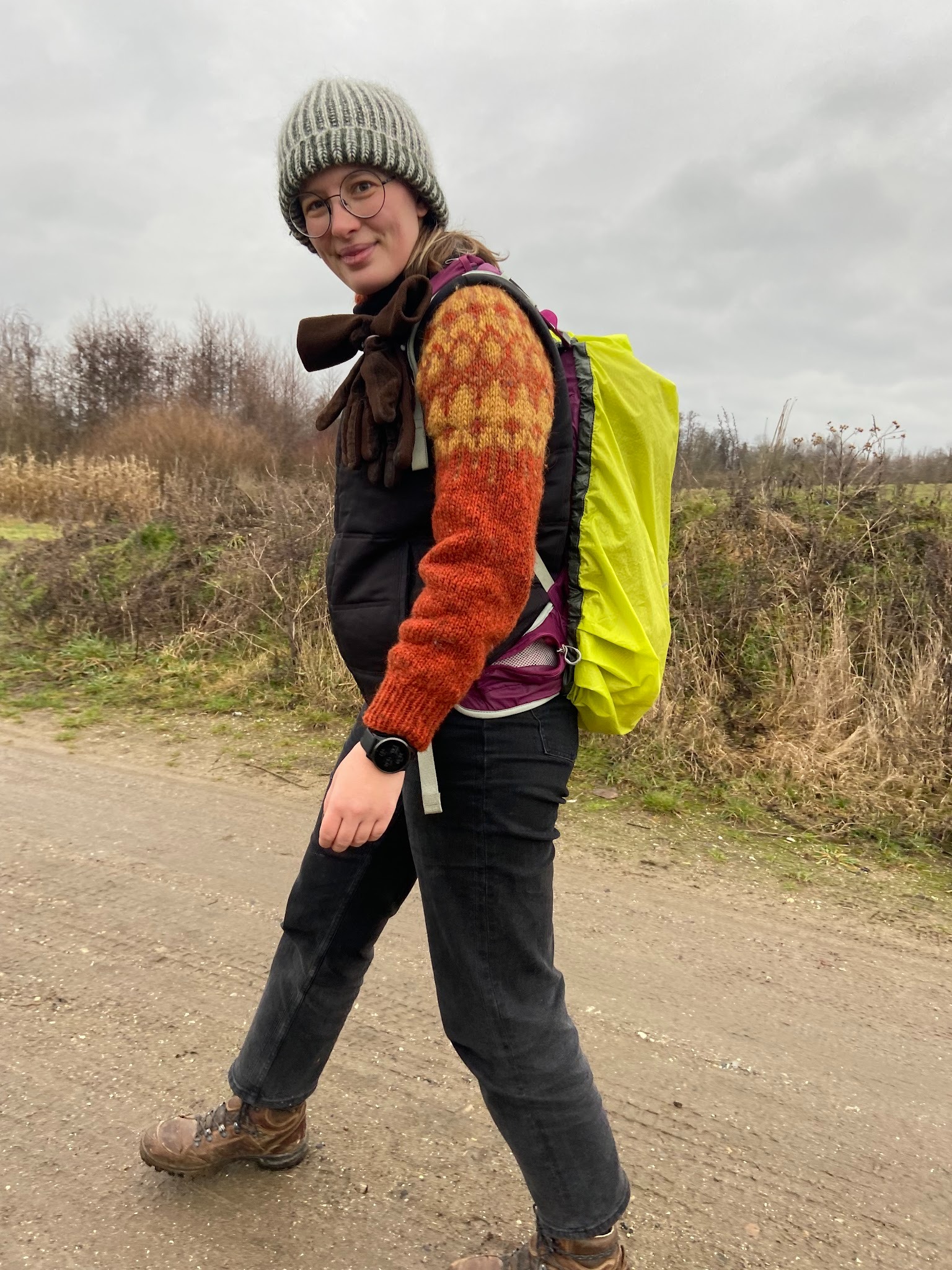
In February of 2022, Michelle Knappmann, after swimming with a friend, stepped out of her car and couldn’t stand up. She was in severe pain. The next day, she could stand, but the pain in her back and left leg persisted.
Just a month before this, she had completed her training as a Danish sign language interpreter and was preparing to start her first job. Her routine included regular strength training at the gym and an active social life with friends and family.
Michelle previously had a prolapsed disc at L5/S1 in 2019, which required surgery in early 2020. Diagnosing this new issue was challenging—public healthcare didn’t confirm a new prolapse, but private care diagnosed one in September 2022. She had surgery two weeks later, but it didn’t resolve the pain. A degenerative disc was discovered, leading to fusion surgery in February 2023. While the back pain was eliminated, the nerve damage and leg pain became permanent.
Making Adjustments
From March to May 2022, she reduced her work hours from 20 to 9 per week. She lost her job in January 2023 due to the number of sick days she needed. “My employer was incredibly supportive throughout my injury and surgeries, but the uncertainty about when—or if—I could return to interpreting full-time made it unsustainable for them to keep me on. It was a fair decision, and I’m grateful for the kindness and support they showed me during that time.”
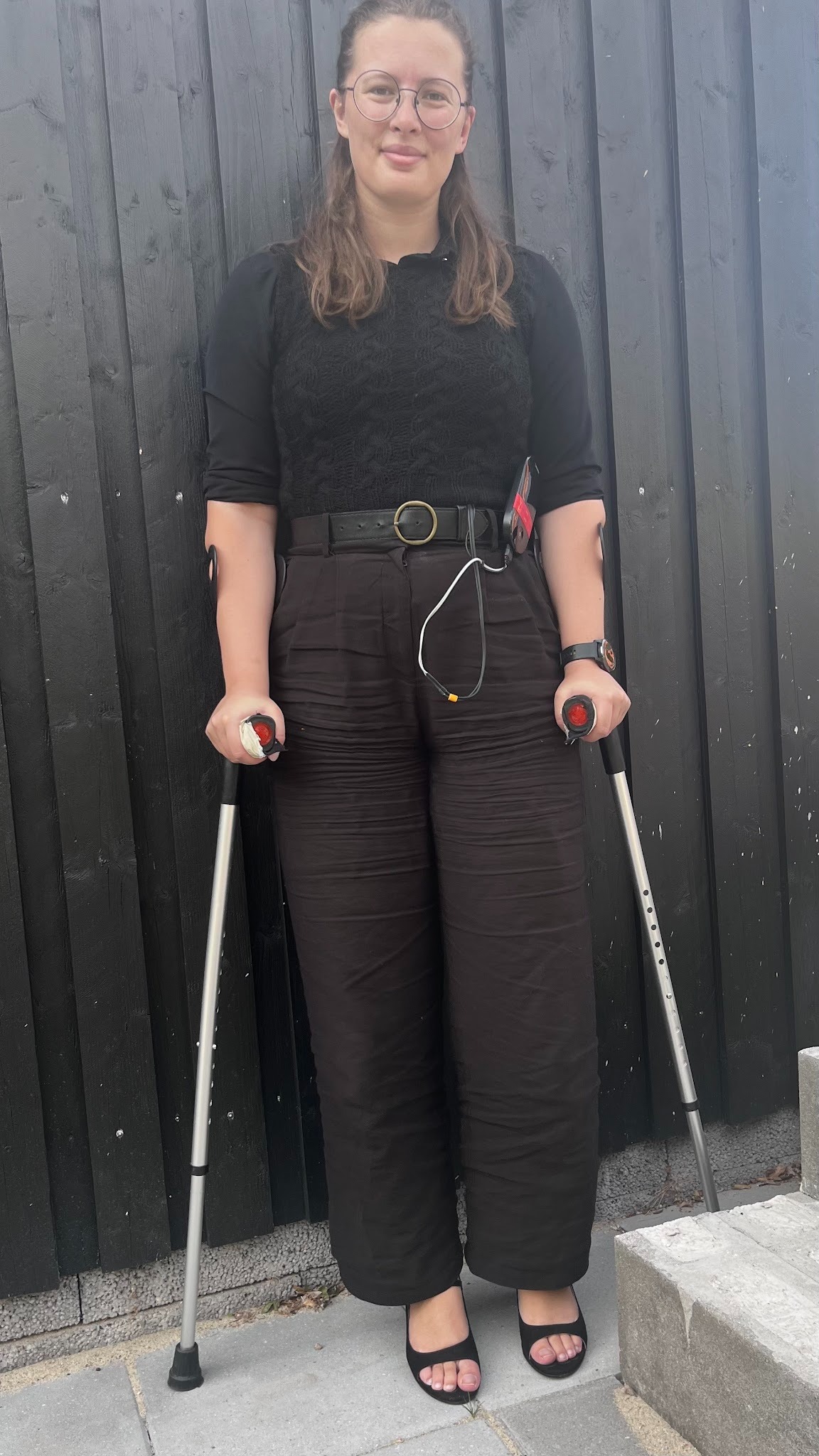
Walking became difficult; she used crutches outside and could only walk 100–200 meters before needing to rest.
Adapting To a New Normal
Today, she’s an ambulatory wheelchair user—she walks around at home but uses her wheelchair when she’s out in the world for grocery shopping, going to the gym, or other activities.
She gradually returned to the gym, but traditional cardio was no longer an option. “Before my injury, I’d enjoyed activities like jump roping, rollerblading, and cycling, but those were no longer feasible.”
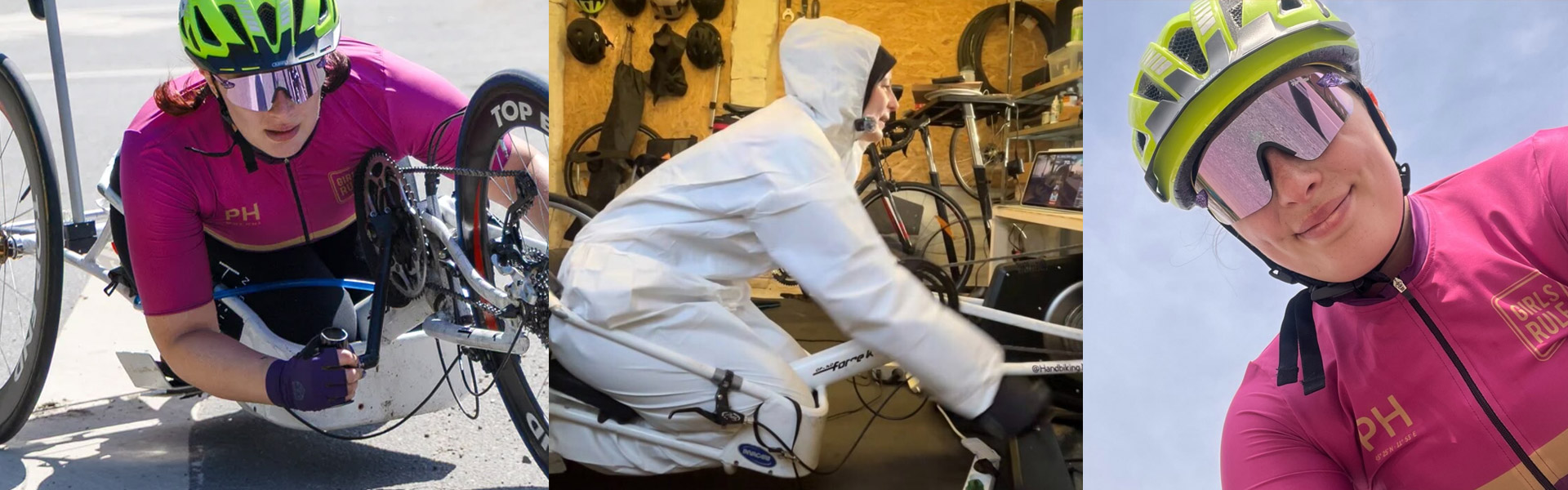
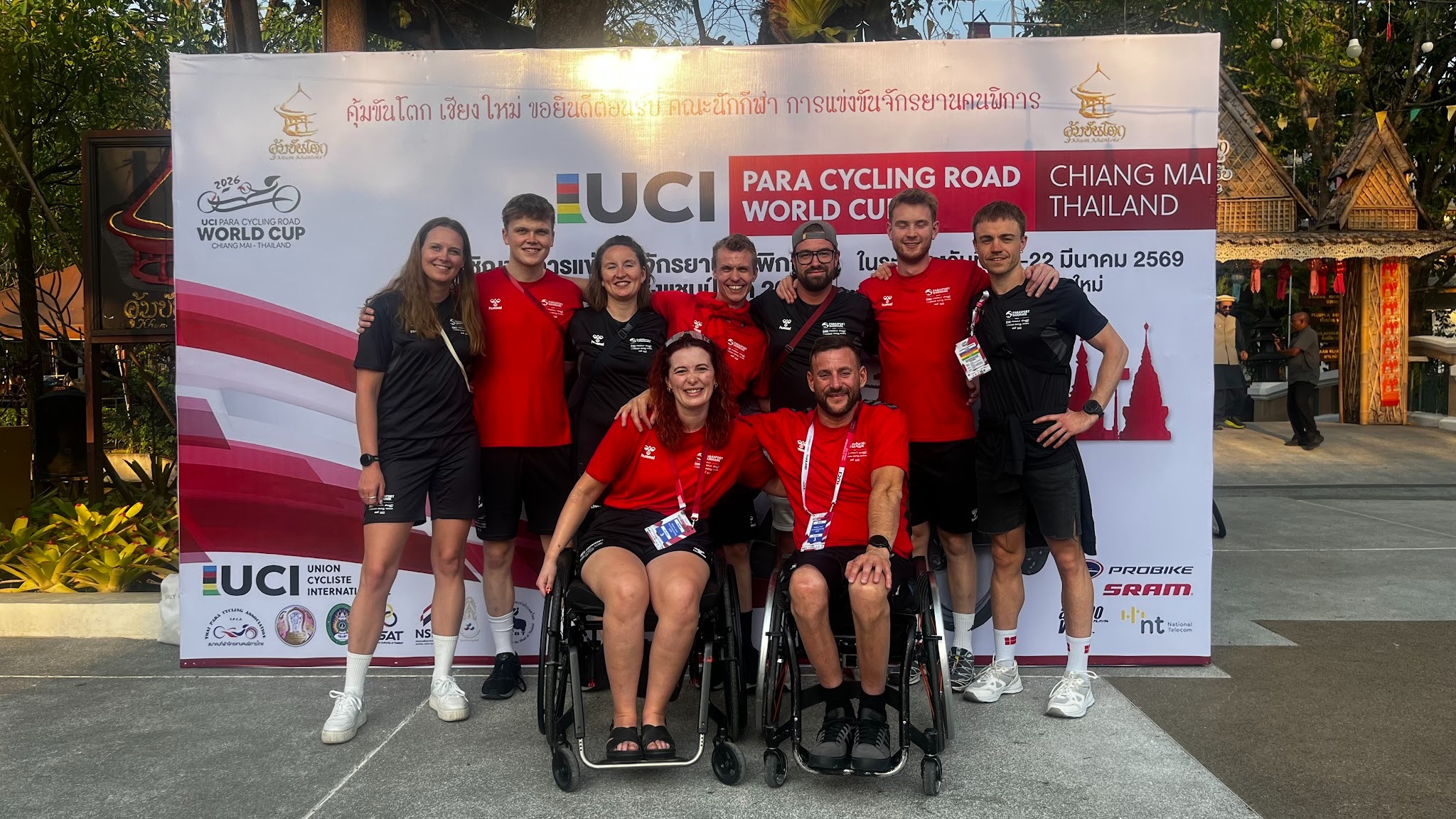
Joining the Danish National Paracycling Team
In the summer of 2024, she remembered seeing information about handcycling and contacted the Danish Handbike Association. Two weeks later, she tried a recumbent handbike. In February 2025, she joined a training trip to Lanzarote with the association. “The national team coach, Amalie Winther Olsen, introduced me to the kneeling handbike (H5 class), which better suited my remaining core and leg strength. I’ve been part of the national team since then.”
“Paracycling provided a way forward. It allowed me to rebuild strength and endurance without worsening my condition.”
Zwifting with Paracycling Denmark
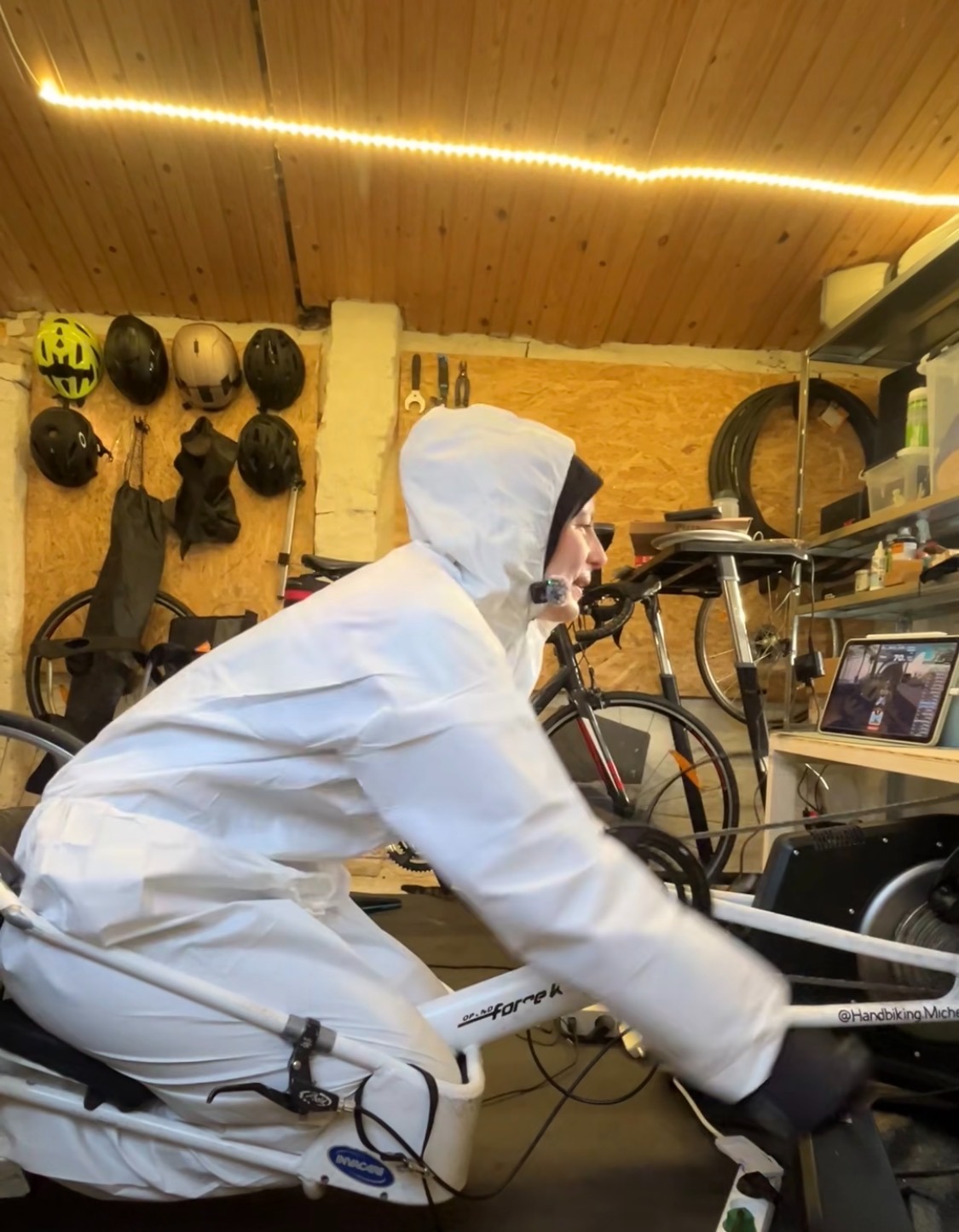
Michelle started Zwifting in late 2025 to train with Paracycling Denmark. She trains 5–7 times a week on the bike and 1–3 times for strength. The focus is on progress and consistency.
Zwift allows her to maintain consistent training, especially during winter when outdoor cycling isn’t possible. Zwift has been both a training tool and a community, as she’s connected with others from across Denmark and around the world. It also lets her train alongside her partner on equal terms, which isn’t possible outdoors.
One of the major events Michelle was training hard for was the UCI Para Cycling Road World Cup event in Thailand in March. She aimed to be classified as an H5. (H5 is a handcycling classification for athletes with the lowest level of physical impairment among handcyclists.)
Unfortunately, it was not achievable because she didn’t meet the UCI’s minimum impairment criteria for H5 classification, even though clinical tests confirm that her muscles don’t connect properly with her nerves and brain.
“The abilities I have with my left leg mean I don’t meet the minimum impairment criteria as of now. Depending on if and how much worse my disability gets, I’ll might be able to classify later in life,” Michelle says. “Para sports and classes will never be completely fair, but I believe they’ll need tweaking and I’ll keep being a voice for that.”
For now, she’s working hard with her coach to identify new races and goals – and looking to raise funds for a new handbike.
Help Michelle Get a New, Modern Handbike
Michelle really needs a new, more modern handbike. “I’m currently using a second-hand bike that doesn’t fit me properly, which is why I’m seeking a new one. To get a good bike that truly fits me, it’s actually best to have it custom-built.”
It was over 3.5 years ago when we launched the Tiny Races – innovative events designed to give you a solid VO2 max workout across 4 back-to-back races. They were an instant hit, and we fine-tuned the setup by modifying category setups, disqualifying “snipers” who didn’t race all 4 events, and using a variety of courses.
But over time, we realized that Tiny Races weren’t actually delivering a very “pure” VO2 max workout. Instead, most riders ride below VO2 max for the first several minutes, followed by a sprint finish.
A good workout, to be sure, when repeated 4x. But could we do better? Could we structure races so riders can accomplish a true VO2 max training effort, with extra motivation from the race environment?
The Big Idea: A True VO2 Max Workout Disguised as a Race
Garmin says, “Improvements in VO2 max typically arrive in the form of increased stroke volume (the amount of blood pumped with each heartbeat), increases in blood supply, and adaptations in your muscles at a cellular level that help you store and transfer energy more efficiently.”
But how do you improve your VO2 max?
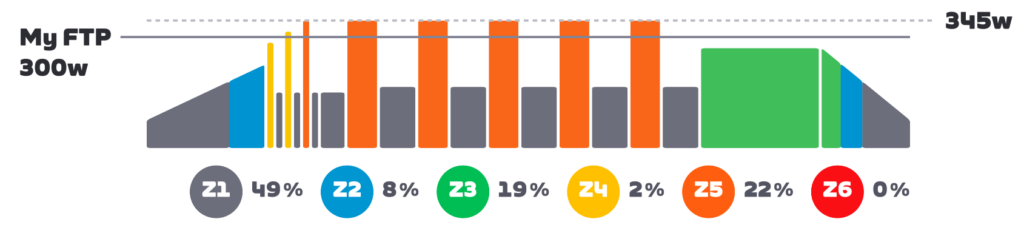
The simplest traditional VO2 max workout looks something like this: 3-5 intervals at 110-120% of FTP, each 3-5 minutes long, and each followed by an easy rest of the same length as the interval. Something like the “15.9” workout in Zwift – a straightforward VO2 max session, named for the atomic mass of Oxygen:
So a rider with a 300W FTP might do these intervals for a V02 max session:
345W (115% of FTP) for 5 minutes
5-minute rest (50% of FTP)
Repeat above 5x
I’ve structured the VO2sday Micro Races to replicate this traditional VO2 max workout in a motivating race setting, complete with a time-based GC. Sign up at zwift.com/events/tag/vo2sday/.
Structured Workout Racing
The VO2sday Micro Races are nothing like your typical Zwift scratch race. Here’s how these races are distinctly structured to be engaging and fun while delivering a proper VO2 max session:
5 races in less than an hour – that’s 5 hard VO2 max intervals
Very short efforts: Each race is very short, with a target completion time of 3-5 minutes, just like a good VO2 max interval
Recovery time: Races are 10 minutes apart, so a 5-minute race leaves you with 5 minutes of recovery before the next interval
Mix of courses: Each week’s race courses feature a mix of flat, climb, rolling, and even downhill parcours. Riders with lots of pure watts have the advantage in some races, while riders with strong w/kg have the advantage in others.
Compound Score categories: Since results will be driven by your power numbers, riders will be categorized (A/B/C/D) based on compound score, not Zwift Racing Score. This takes into account your zMAP and body weight. (May 5’s races are categorized based on zFTP, while we work out the proper compound score setup…)
Mass start: While riders are broken into categories, these are mass start events with all categories starting together, so everyone has riders ahead to chase. (Remember, the goal is to push as hard as you can for the duration of the race, not to sit in the pack and conserve so you can sprint to victory in the last 15 seconds!)
Drafting is disabled, so these are effectively time trials. (Yes, you’ll want a fast TT setup.) Hopefully this forces you out of the “sit in then sprint” mindset, and into “hold steady high power for the duration” mode.
GC-Based Final results: overall rankings are based on your cumulative time across the 5 races (see link below).
May 5 Race Details and Signup
Here are the courses for our kickoff races:
Tempus Fugit (flat): 2.75km, ends 450m after the lead-in finishes
Quatch Quest (rolling): 2.5km, ends on rollercoaster climb in Titans Grove
Hilly Route (climb): 2km, ends just after KOM arch because we can’t create events under 2km in length
If this concept proves popular, I plan to make this into a weekly race series. But I need to hear from you! I’d love to hear your feedback after you complete the first batch of Micros on Tuesday. Share it below, along with any questions or comments you’ve got before the races.
This weekend’s picks include the rematch of a unique team vs team race, plus two rides for a cause and two climbing challenges. See all the details below…
YouTubers Adam (Road to A), Liam (LiamShawLevelsUp), and Steven (Bike Bonk Biff) are back for a rematch in their innovative community vs. community Zwift race! This is a novel event on several levels and has more signups than any other event this weekend.
Riders choose which team they’re on by changing their in-game name. Then it’s all about earning points for your team based on your finishing position and power numbers. Be sure to read the event description for all the details!
The race is on one lap of New York’s Empire Elevation route (26km, 266m).
Lots of signups for this memorial ride for Zwifter Terri Woodlee, a regular on the Herd team and other rides. “We ride as one in memory of our dear friend and teammate Terri Woodlee who always sought to never leave anyone behind.”
The side is D-paced (1.5-2 W/kg) on 60 minutes of France’s R.G.V. route.
On the first Saturday of every month, Wobble Cycle Club holds the Alpe du Zwift challenge. As they say, “This event isn’t about crossing the line before the person next to you, it’s about being better than you were last month.”
This is the first event in a new series from Cycle Nation, where we take on a big Zwift route as a charity fundraiser ride. This isn’t a race – it’s a banded ride, so everyone stays together as long as you keep pedaling! You can donate at www.justgiving.com/page/cyclenation
This first ride is on Watopia’s Four Horsemen (89.9km, 2111m), and has two time slots on Saturday.
We choose each weekend’s Notable Events based on a variety of factors including:
Is the event unique/innovative in some way?
Are celebrities (pro riders, etc) attending/leading?
Are signup counts already high, meaning the event is extra-popular?
Does the ride include desirable unlocks or prizes?
Does the event appeal to ladies on Zwift? (We like to support this under-represented group!)
Is it for a good cause?
Is it just plain crazy (extra long races, world record attempts, etc)?
Is it a long-running, popular weekly event with a dedicated leader who deserves a shout out?
In the end, we want to call attention to events that are extra-special and therefore extra-appealing to Zwifters. If you think your event qualifies, comment below with a link/details and we may just include it in an upcoming post!
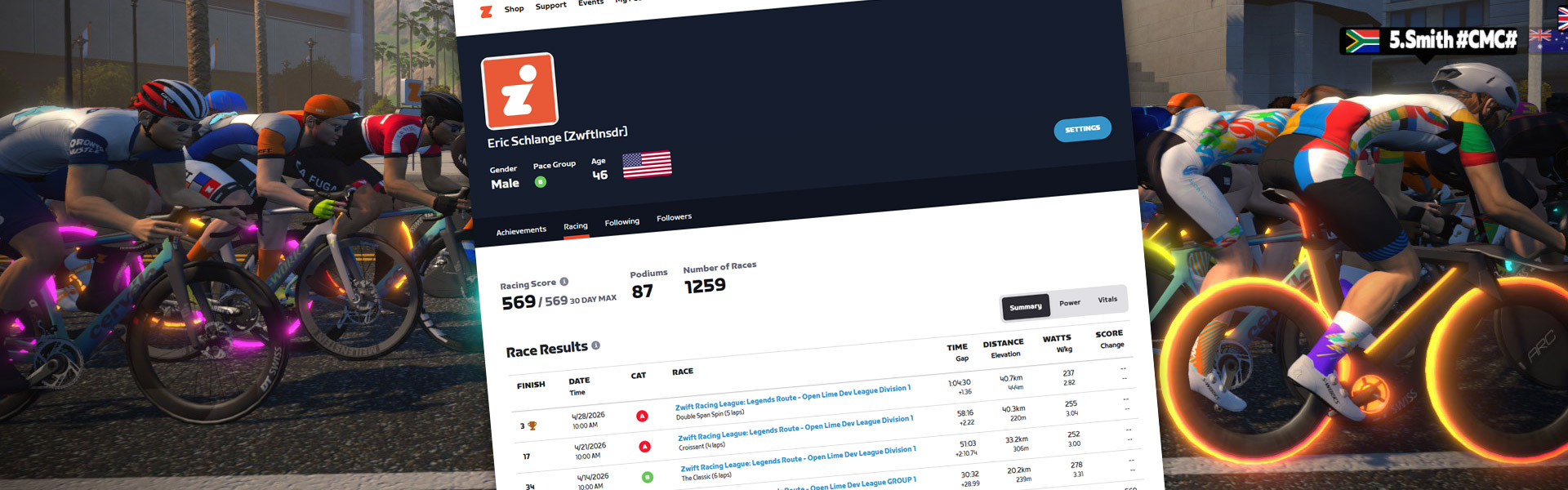
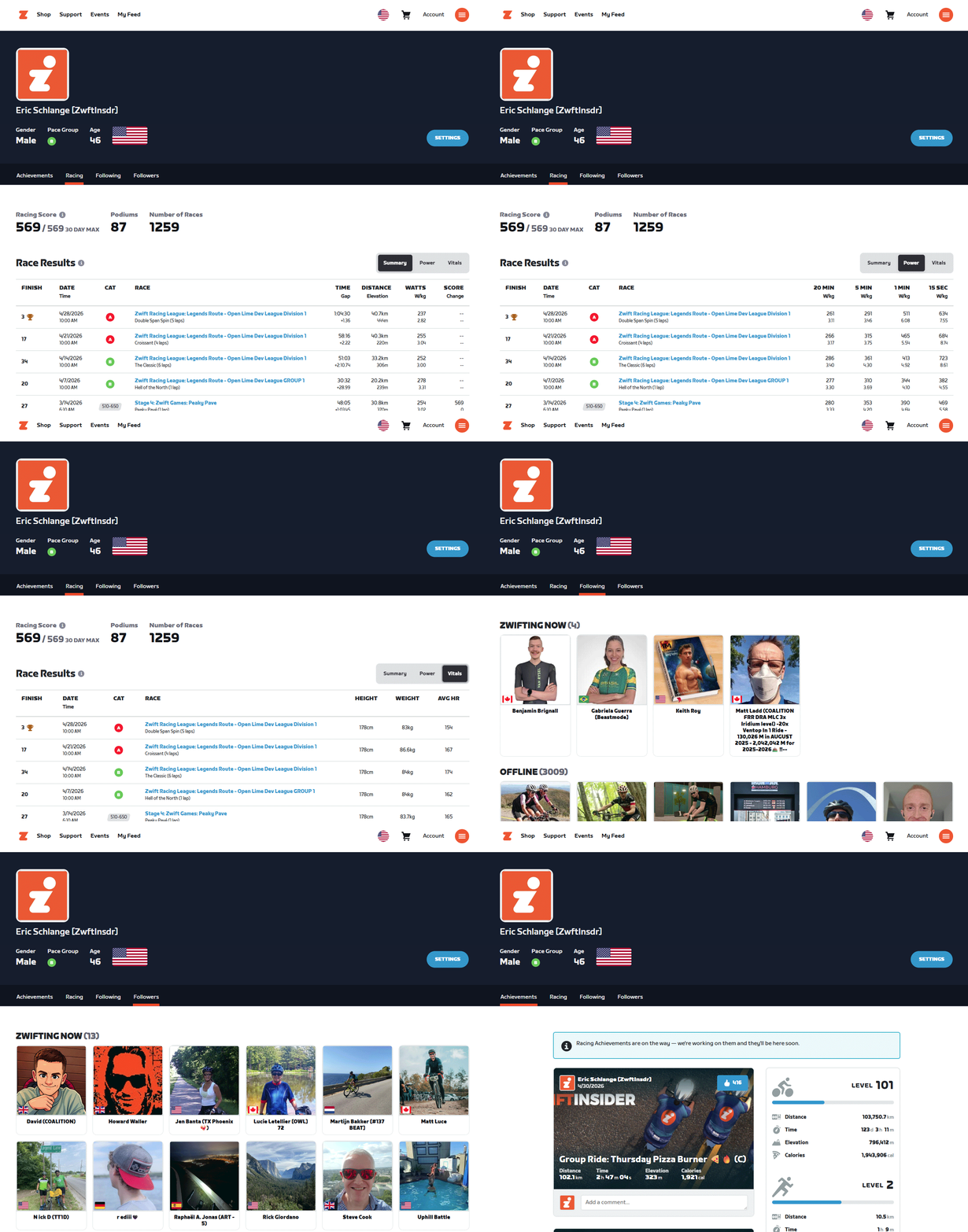
Today, Zwift launched an updated profile page at zwift.com/athlete/me/racingthat includes a new Racing Profile and other upgrades. Here’s a quick animation showing what our profile pages currently contain:
New “Racing” Tab
The most interesting tab on the profile page (if you race, at least), the Racing tab shows, among other things:
A list of all races you’ve completed (click the event name for results). Each race includes your finishing position, category, time gap, average watts and W/kg, more power data under the “Power” view, and event height/weight/HR under the “Vitals” view.
Your current racing score and 30 day max
Number of podiums you’ve achieved
Number of races you’ve completed
Following and Followers
These pages haven’t changed much, except you can now click on a Zwifter to be taken to their profile page.
“Achievements” – Coming Soon
This tab has a message at the top: “Racing Achievements are on the way — we’re working on them and they’ll be here soon.” What does Zwift have planned? I’m not sure. But what I’d love here is a filterable, sortable list of my:
Race podiums
Course PRs
Segment PRs
Power PRs (even outside of races)
Achievement badges earned
Level ups
All of the above would be tagged with the date and a link to the Zwift activity in which they occurred.
Suggestions
There are a few bugs still being worked out, but I’ll leave that for the official thread in Zwift’s forum.
But what else could Zwift add to this page to make it even more useful to Zwifters, particularly racers? One simple upgrade would be to make rider names in event results on zwift.com clickable, so you can easily click to view a competitor’s profile after a race.
Here are a few more ideas:
Show more results. 10 per page isn’t enough.
Let us quick-filter results by typing an event title or route name into a search field.
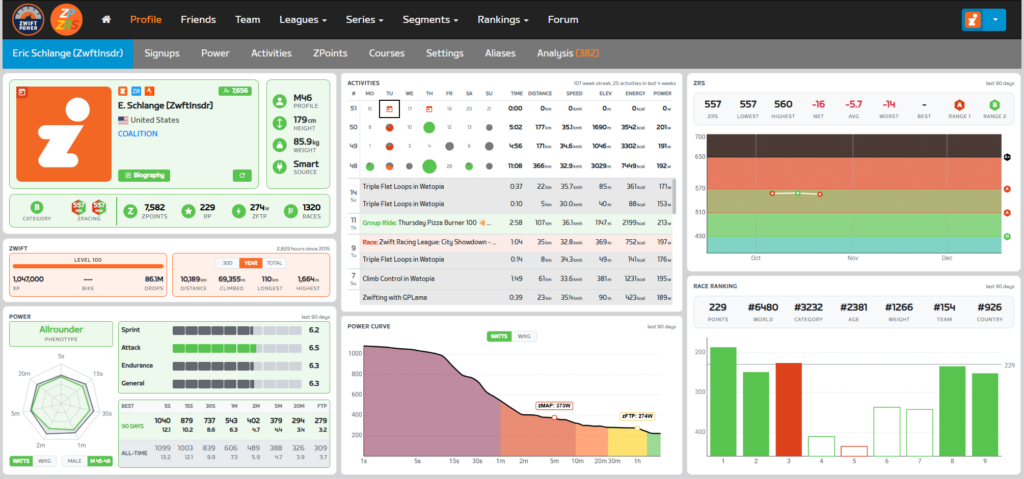
Display some of the fun data found in our ZwiftPower profiles, including:
Power charts for 15s, 1-minute, 5-minute, 20-minute in watts and W/kg
Our power curve, and a way to compare that curve to the curve from a specific race
More career stats, including XP, Drops, distance, elevation, etc
Phenotype detection and snazzier power charts
1v1 Head-to-Head profile where you can compare yourself to another Zwifter
Historic chart of your ZRS (a long-time request from Zwifters!)
Race rankings which use your ZRS compared to others in your age bracket, weight bracket, country, etc
More Thoughts
Lots of projects could be undertaken to improve the racing experience on Zwift, and having a useful racing profile on zwift.com is one of them. So I’m glad Zwift chose to build this out, and that they’re looking to keep improving it.
We know Zwift isn’t looking to invest much into further development of ZwiftPower, and that’s understandable. But if that’s the case, they need to continue building out their web-based event info/racing results/rider profiles to replace it. This new Racing Profile is just one step in that direction.
But what do you think of the new Racing Profile page? Got ideas for improvements, or other feedback you’d like Zwift to see? Share it below… they’re watching! (You can also chime in on the official Zwift Forum thread.)