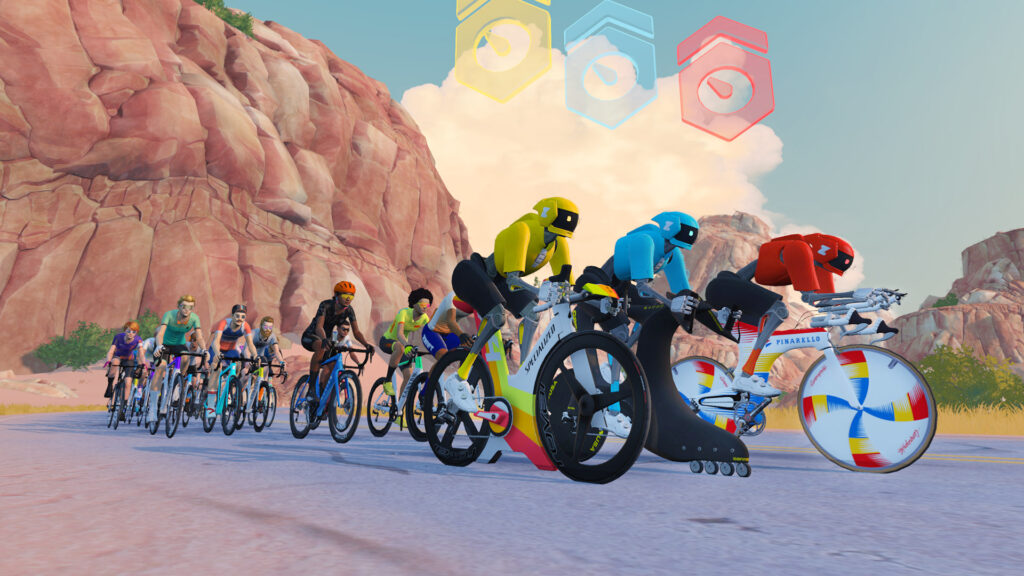
In March of 2025, Zwift added a new, highly prestigious type of bike to the game: the Halo Bike! These super unique bikes take a lot of work to unlock, a ton of Drops to purchase, and oodles more work and Drops to fully upgrade.
There are currently four available:
- Cervélo Baracchi
- Pinarello Espada
- Specialized Project ’74
- Cannondale R4000 Roller Blade
- Zwift Concept Z1
Let’s dive into some details about how Halo Bikes work, then look at what makes each of these bikes special, including the results of our performance tests.
Table of Contents
Unlocking Halo Bikes
Halo Bikes can be seen as brand loyalty rewards, because unlocking a brand’s Halo Bike requires you to fully upgrade three frames from that brand.
Example: fully upgrade (all 5 stages) the Pinarello Dogma F 2024, Pinarello Bolide TT, and Pinarello Dogma F10 to unlock the ability to purchase the Pinarello Espada.
Simply unlocking a Halo Bike doesn’t mean you own it, though. You still have to purchase the bike (which includes a wheelset that cannot be changed), at a hefty price of 10 million Drops. Yes, you read that right: 10. Million. Drops.
Upgrading Halo Bikes
Halo Bikes can be upgraded in 5 stages, just like every other bike in Zwift. But the work required to unlock each upgrade, and the Drops cost to purchase those upgrades, is around 5x more than even the best non-Halo Bikes. Wow!
That means it will cost you another 10 million Drops to fully upgrade a Halo Bike, on top of all the riding just to unlock each upgrade stage.
When it comes to performance at each upgrade stage, bikes of the same type will basically gain the same performance increases at each stage. (You can see this by comparing the pattern of dots on the scatterplots of the Project 74, R4000, and Concept Z1 below.) So, for example, a stage 3 Pinarello Dogma F 2024 frame will have gained the same boosts as a stage 4 Specialized Project 74 Halo Bike, since both are classified as road racing frames.
Below, we’ve listed the details of each upgrade stage for each bike.
Cervélo Baracchi
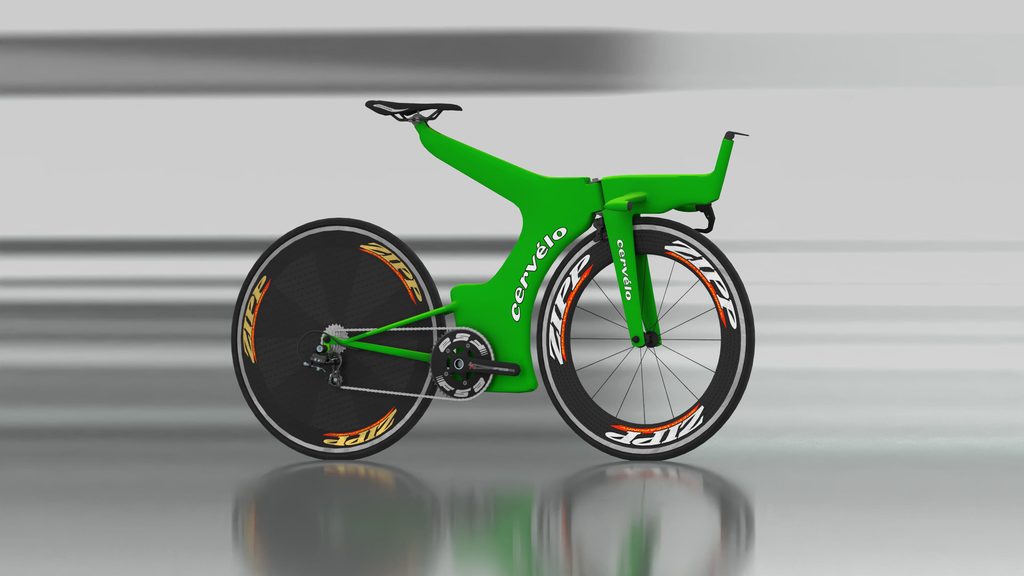
The first “pro” bike ever created by Cervélo co-founders Gerard Vroomen and Phil White, the Baracchi was made in 1995 for Italian pro Gianni Bugno, who simply wanted the fastest bike possible. The bike was radical for the time, and still turns heads with its unique cockpit. Bugno loved it, but sadly his team sponsors didn’t see a future for carbon, because the “best bikes” were made from Italian steel.
Phil White said, “The idea was to make riders faster and not be constrained by current thinking. So we used an evidence-based scientific approach. The Baracchi is a two-man time trial, so our goal was to make the bike as fast as two people. That’s where the name came from. We didn’t approach it from the standpoint of engineering a better bike, but of how you would make the rider faster.”
Like all frames in Zwift, the Baracchi can be upgraded in five stages. It uses the Duration, Halo upgrading scheme, giving it the following characteristics:
Performance At Each Upgrade Stage
This chart shows how many seconds this frame will save across 1 hour of riding compared to our stage 0 baseline frames (Zwift Carbon or TT). This is based on a 75kg rider, 183cm tall, at 300 watts, riding on tarmac.
Upgrade Stages (Duration, Halo)
- 20 hrs: Aero Upgrade for 400k Drops
- 30 hrs: Weight Upgrade for 800k Drops
- 40 hrs: Drivetrain Upgrade for 1.2M Drops
- 50 hrs: Weight Upgrade for 2.6M Drops
- 60 hrs: Aero Upgrade for 5M Drops
The Baracchi, it could be said, performs like a top-quality TT frame from the 1995. It loses ~30 seconds to the fastest TT frames in game across an hour, so you won’t want to use this for TT racing.
It’s also a heavy bike. It loses to nearly every TT frame when it comes to climbing, even at 4 W/kg, where its stellar aero performance still factors in significantly. It loses over 35 seconds in an hour of climbing compared to the best TT climbing frames.
Pinarello Espada
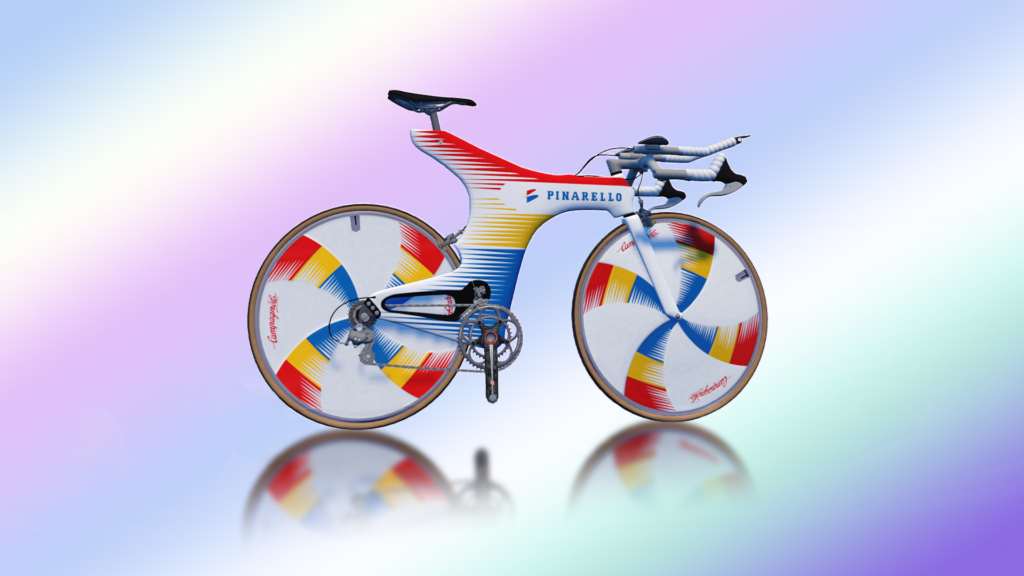
In 1994, Miguel “Big Mig” Induráin set a new hour record, breaking the 53-kilometer mark for the first time in history with a distance of 53.040 kilometers in Bordeaux. And he did it atop the Pinarello Espada, a bike which quickly became legendary itself!
This bike was introduced to the game in April 2024 for the Pinarello Espada Challenge, and it has the distinction of being the only Halo Bike classified as a TT frame.
Designed by Fausto Beroglio, the carbon-framed, Campagnolo-equipped bike weighed in at 7.5 kilograms and was custom-molded to fit Big Mig. Only four versions of the bike were ever created, and Induráin won both of the long time trials at the 1995 Tour de France on a version modified to allow shifting.
Like all frames in Zwift, the Espada can be upgraded in five stages. It uses the Duration, Halo upgrading scheme, giving it the following characteristics:
Performance At Each Upgrade Stage
This chart shows how many seconds this frame will save across 1 hour of riding compared to our stage 0 baseline frames (Zwift Carbon or TT). This is based on a 75kg rider, 183cm tall, at 300 watts, riding on tarmac.
Upgrade Stages (Duration, Halo)
- 20 hrs: Aero Upgrade for 400k Drops
- 30 hrs: Weight Upgrade for 800k Drops
- 40 hrs: Drivetrain Upgrade for 1.2M Drops
- 50 hrs: Weight Upgrade for 2.6M Drops
- 60 hrs: Aero Upgrade for 5M Drops
The Espada, like the Baracchi (above), performs like a top-quality TT frame from the 1990’s. That means it loses significant time to the modern TT rigs in Zwift, so you won’t want to use this bike in TT races.
Specialized Project ’74
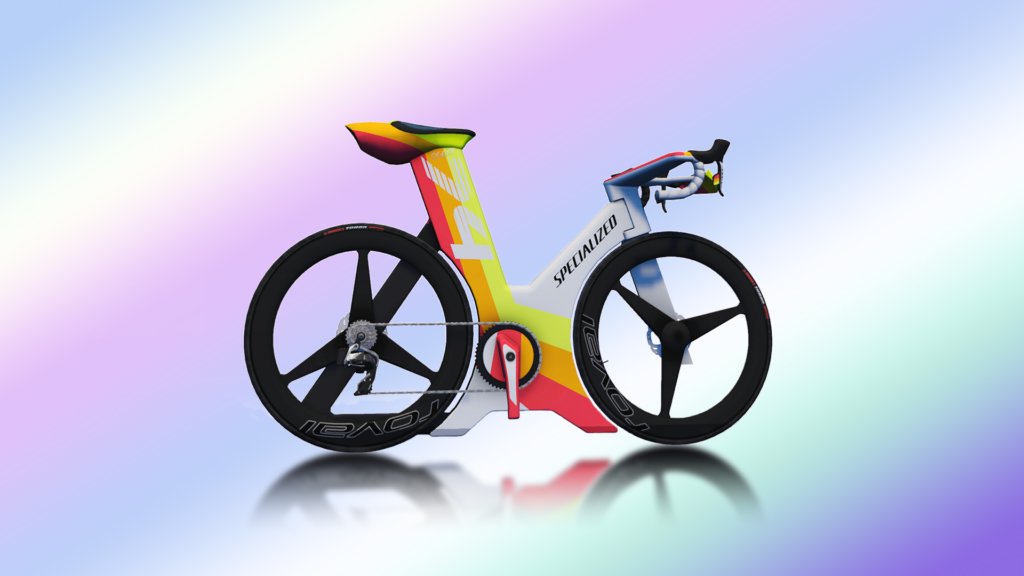
The Project 74 bike from Specialized was conceived by Robert Egger to honor the founding of Specialized in 1974. Forged by the desire to “Innovate or Die”, this bike was Egger’s answer to the challenge of thinking outside the UCI box and beyond the double triangle.
Like all frames in Zwift, the Project 74 can be upgraded in five stages. It uses the Distance, Halo upgrading scheme, giving it the following characteristics:
Performance At Each Upgrade Stage
This chart shows how many seconds this frame will save across 1 hour of riding compared to our stage 0 baseline frames (Zwift Carbon or TT). This is based on a 75kg rider, 183cm tall, at 300 watts, riding on tarmac.
Upgrade Stages (Distance, Halo)
- 550km: Aero Upgrade for 400k Drops
- 1,050km: Weight Upgrade for 800k Drops
- 1,600km: Drivetrain Upgrade for 1.2M Drops
- 2,150km: Aero Upgrade for 2.6M Drops
- 2,650km: Weight Upgrade for 5M Drops
On flat roads, the Project 74 outperforms the best aero road setups in game, beating even the Tron bike by ~10 seconds across an hour. It’s the most aero road bike available in Zwift today. Take that, UCI!
On climbs, though, it’s a different story. This bike is actually the worst climber of the non-TT Halo Bikes, losing ~75 seconds to the best climbing bikes over an hour.
Cannondale R4000 Roller Blade
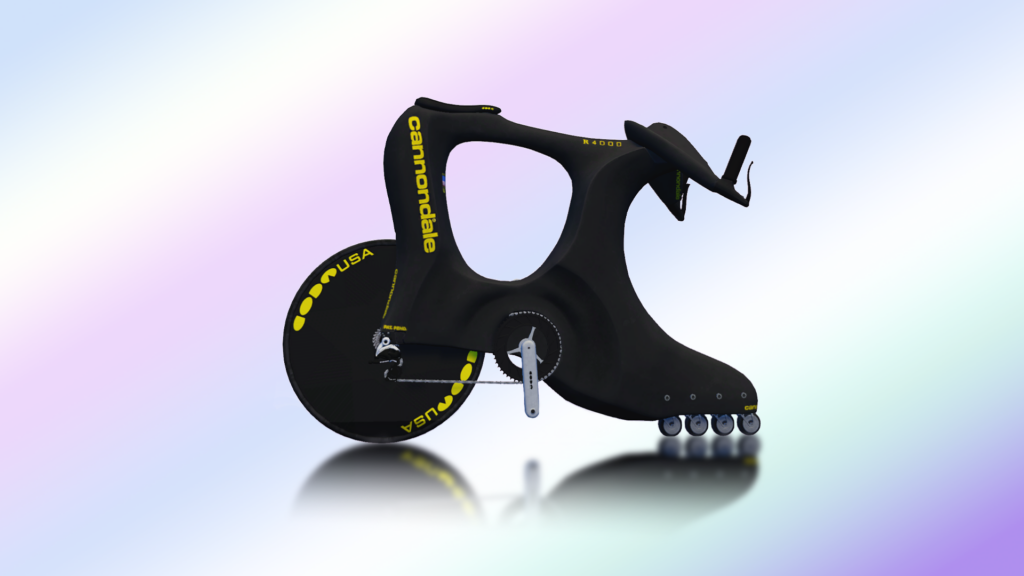
The Cannondale R4000 Roller Blade is a visionary concept bike from the mid 1990s featuring four inline skate wheels instead of a regular front wheel.
Like all frames in Zwift, the R4000 Roller Blade can be upgraded in five stages. It uses the Distance, Halo upgrading scheme, giving it the following characteristics:
Performance At Each Upgrade Stage
This chart shows how many seconds this frame will save across 1 hour of riding compared to our stage 0 baseline frames (Zwift Carbon or TT). This is based on a 75kg rider, 183cm tall, at 300 watts, riding on tarmac.
Upgrade Stages (Distance, Halo)
- 550km: Aero Upgrade for 400k Drops
- 1,050km: Weight Upgrade for 800k Drops
- 1,600km: Drivetrain Upgrade for 1.2M Drops
- 2,150km: Aero Upgrade for 2.6M Drops
- 2,650km: Weight Upgrade for 5M Drops
The R4000 is faster than the Concept Z1 on flat ground, but just a few seconds behind the Project 74. It beats the Tron bike by ~6 seconds across an hour, which means it beats all of the best “production” bike/wheel combos in game when it comes to flat performance.
On climbs, the R4000 is, like the Project 74, not a great performer (but anyone looking at this bike would assume this). It outclimbs the Project 74 by several seconds, but is handily beaten by production climbing bikes, losing ~67 seconds over an hour to the best climbers.
Zwift Concept Z1 (Tron Bike)
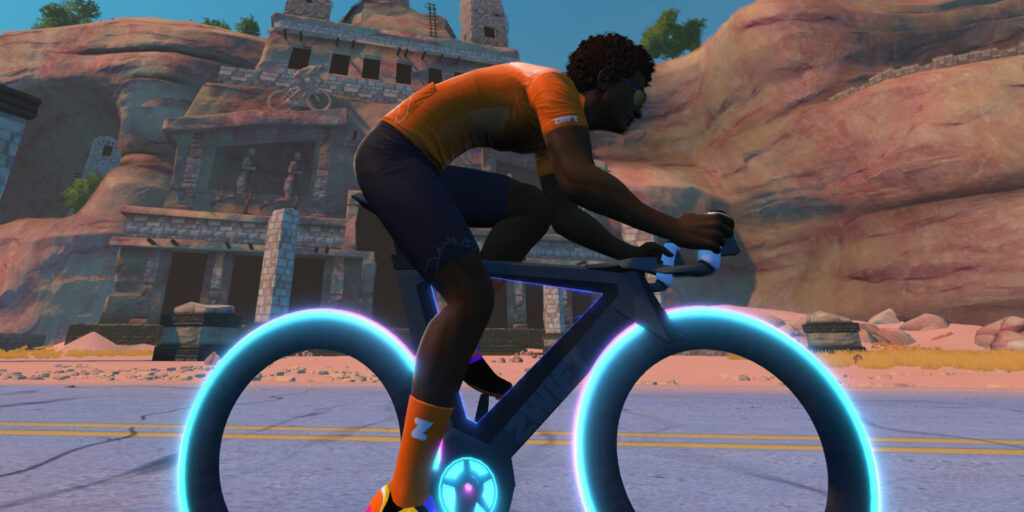
Zwift’s Concept Z1, aka “The Tron Bike”, has been in game since early days, and as such was the first “Halo Bike” in Zwift. Unlike the other bikes above, the only way to get the Tron is to finish the Climb Mt. Everest Challenge (including the extra bit).
This bike has some unique features, including rider posture idiosyncrasies and wheels that light up differently based on power output. (Dial in your slider just right and you’ll find some cool dual-tone lights!)
Like all frames in Zwift, the Concept 1 (Tron) can be upgraded in five stages. It uses the Distance, Halo upgrading scheme, giving it the following characteristics:
Performance At Each Upgrade Stage
This chart shows how many seconds this frame will save across 1 hour of riding compared to our stage 0 baseline frames (Zwift Carbon or TT). This is based on a 75kg rider, 183cm tall, at 300 watts, riding on tarmac.
Upgrade Stages (Distance, Halo)
- 550km: Aero Upgrade for 400k Drops
- 1,050km: Weight Upgrade for 800k Drops
- 1,600km: Drivetrain Upgrade for 1.2M Drops
- 2,150km: Aero Upgrade for 2.6M Drops
- 2,650km: Weight Upgrade for 5M Drops
The Concept Z1 is the fastest aero performer you can get with a reasonable amount of work in game, since the Project 74 and R4000 bikes will take significantly more time and effort! That said, the Concept Z1 just barely edges out the top aero performers, gaining ~1 second across an hour of flat riding.
Those top aero performers, though, handily beat the Concept Z1 on climbs, which means you may not want to use the Concept Z1 in a race that has any significant hills. Learn more about how the Concept Z1 compares to other top-performing road frame+wheel combos by checking out our “Speed Tests: Concept Z1 (Tron) Bike vs Top Performers” post.
Questions or comments?
What do you think of Zwift’s nHalo Bike concept? Which one are you working to unlock, and why? Share below!