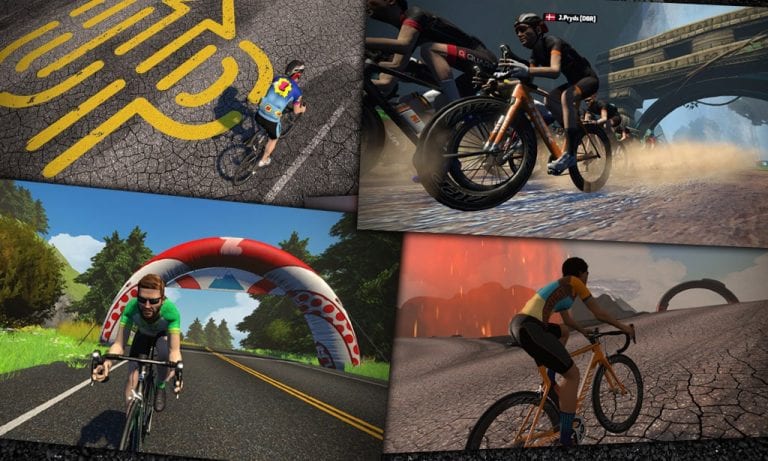
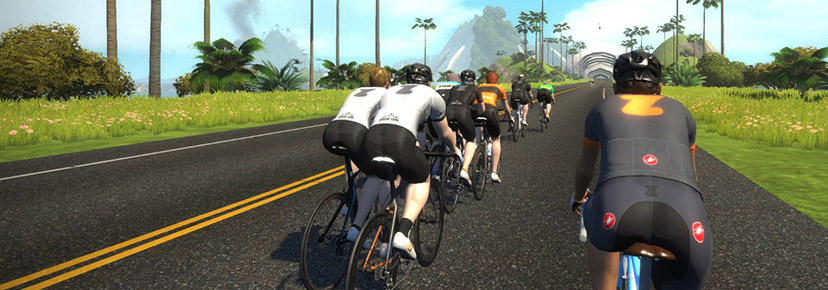
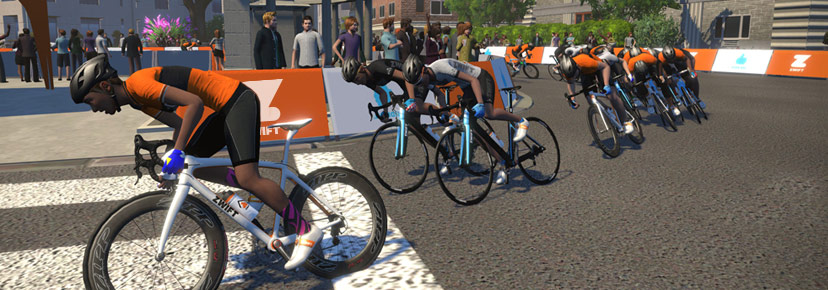
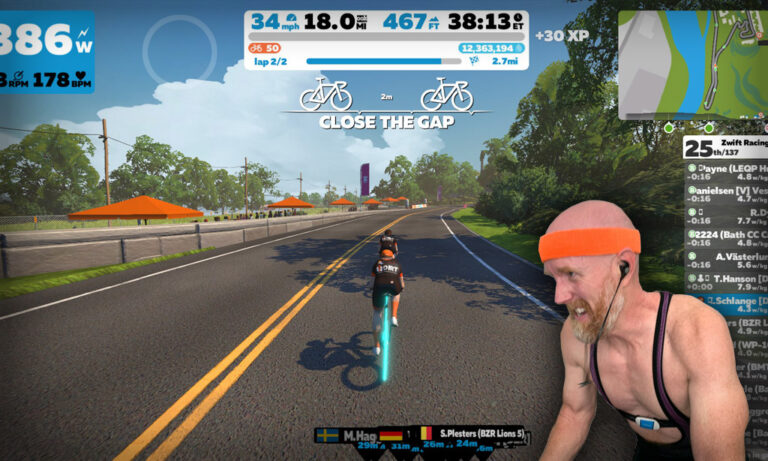
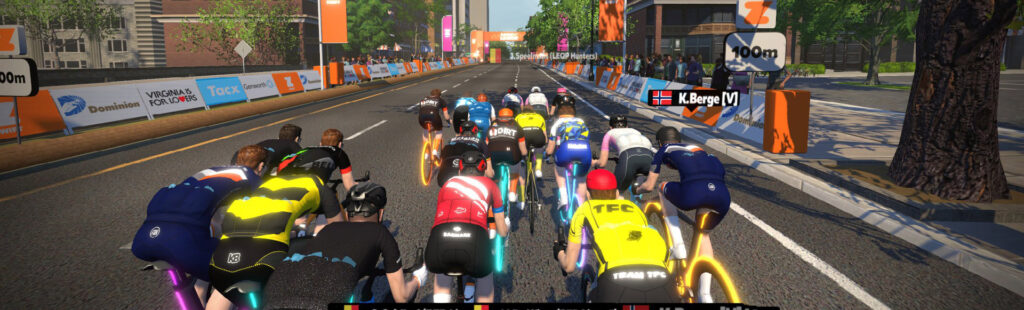
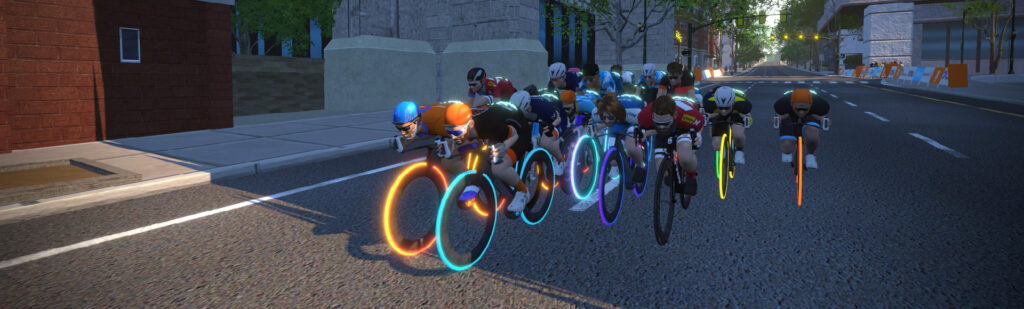
Official Zwift fondo events are always a blast, with hundreds of riders taking part. Like an outdoor fondo, they feature challenging routes with varying length options. Riders can race the event, or just push to do their best and finish a challenging effort.
The first events of a Zwift’s new monthly series have just been posted, and it all kicks off next weekend, November 8th!
Zwift Fondo events have three categories (A, B, and C) which are open to all riders. These categories don’t refer to rider strength or speed–they refer to route length.
For November the routes are (click for details):
A: Gran Fondo - 97.2km (60.4 miles), 1148m (3766′)
B: Medio Fondo - 72.6km (45.1 miles), 981m (3219′)
C: Bambino Fondo - 52.1km (32.4 miles), 553m (1814′)
Side note: we would really like to see Zwift expand the fondo routes to something that hasn’t been used in past fondos. Maybe it’s time for an Uber Pretzel fondo option?
Kit Unlocks
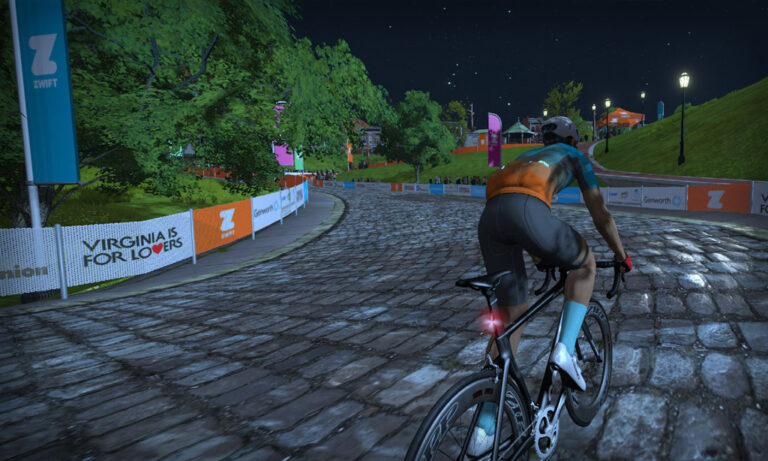
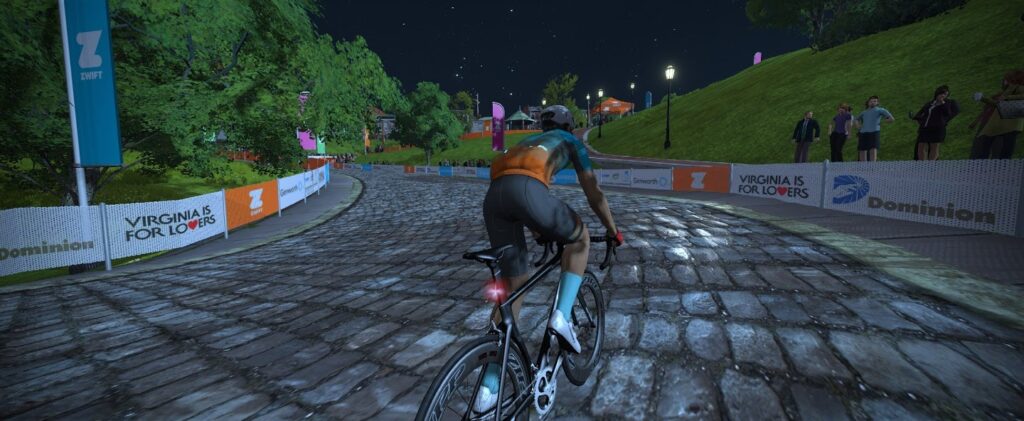
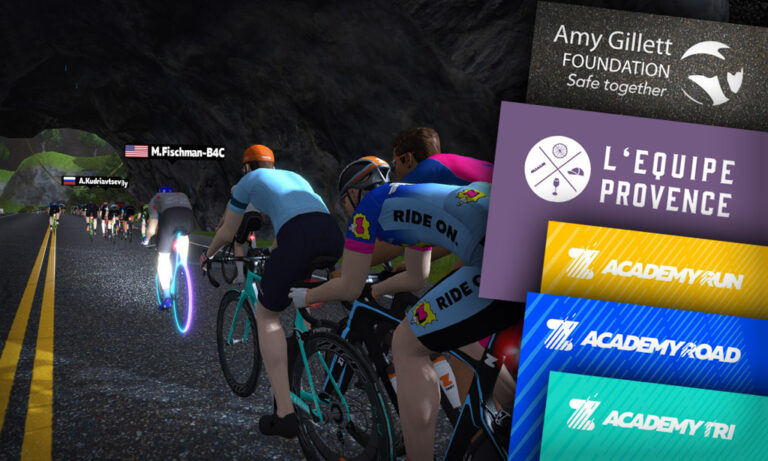
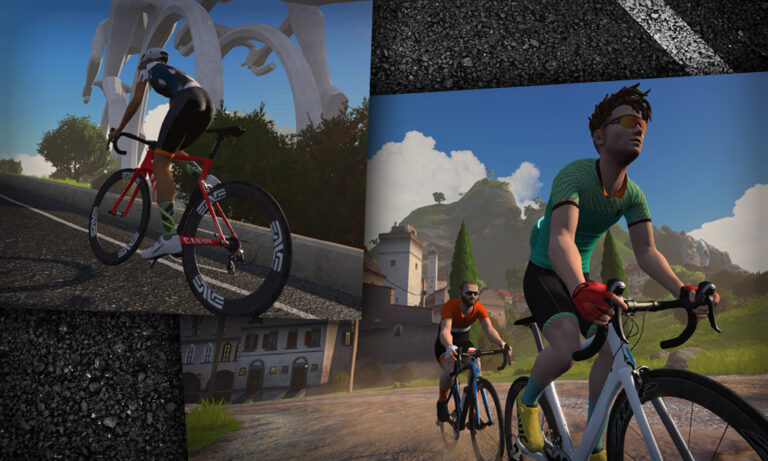
This is a 5-month series, and each month’s fondo has its own unique kit unlock. These kits are exclusive, meaning they will never be available anywhere else in game. A true badge of honor! Here’s a shot of November’s kit:
Upcoming Dates
This monthly series runs through March. Here are the upcoming fondo dates:
8 Nov
13 Dec
3 Jan
7 Feb
7 Mar
Is this a Race?
Officially, no. But thousands of riders will turn out for these popular “fun race” events, and the front of each category will certainly be filled with strong riders going all out. And that’s perfectly fine!
As Zwift says, in the end “It’s all about doing your best and trying to finish the toughest routes in Watopia.”
Since March I have become obsessed with the weekly Team Time Trial… so I asked Eric if I could share my obsession with you all, in weekly doses.
Each week on a Friday I will give you a profile of the upcoming route, guidance on bike choice and some target times if you want to aim for the Premiere League (top-10 in each coffee class get to be in a special race televised on YouTube).
If you can’t ride, or even if you can ride, but want more action! Don’t forget to tune in to the live TV show on Zwift Community Live’s YouTube Channel at 6:15 (UK time).
Review of TTT #80 Watopia’s Waistband
After a week in Austria we headed back to Watopia for a single lap of Watopia’s Waistband, a flat, fast 30km. I thought we had a flying lap in the Hyenas, but turns out we didn’t do as well in-class as I would hope. Never mind… there’s always next week. Anyway…
Category
#35
#46
My prediction
#80 PL
My position
Vienna
44:44
49:10
44:20
39:44
36th
Espresso
37:07
38:57
34:30
35:31
4th
Frappe
39:34
39:01
38:15
37:08
50th
Latte
43:07
41:44
39:30
40:03
7th
Mocha
52:13
52:45
50:00
44:28
49th
I am hanging my head in shame… my virtual teams were awful… I have no words here.
Thursday 5th November – Two laps of UCI Richmond
Richmond has seen a lot of action lately. Not least, the ZRL #3 scratch race was there last. As I’m sure everyone knows by now, this is the route Sagan immortalized in his 2015 rainbow jersey win… but that was an individual break that would have netted nothing were it a TTT!
The route for the TTT isthe UCI circuit, which was last raced in the TTT format in WTRL TTT #47 in March. The course is two laps of 16.2km – if you include the lead-in that’s 32.9km total. The route is split into two segments… the first half is flat, and the second half has three very challenging bumps. It’s like Innsbruckring if there were three legbreakers!
Here’s the fantastic VeloViewer segment view along with a map. If you haven’t used VeloViewer I highly recommend it. It shows you all the obvious stats for the segment, and it also connects to your Strava account so you can look at how you performed.
What to ride?
Bike recommendations are “riders choice” to an extent. The route is split 50% flattish and 50% sharp, steep hills (up and down). On the flat aero rules the day, but the hilly segments are steep enough that all the weight costs dearly. The lap times for Tron versus Venge/Super-9 are identical – but for me, Tron wins the day because while it is a touch slower on the flat, it is much faster on the hills. For me, Tron will allow me to keep up with my lighter team-members when the road pitches up.
Level 45 get those 858/Super 9 wheels and pair them with the S-Works Venge
I know I say it every week but it is doubly important this week. Get the Tron! Someone on one of the Zwift Facebook groups asked “what is the one thing you wish you’d known at level 1.” The answer is I wish I’d know how important Tron was! So, I cannot stress highly enough that if you are racing you need to be working on Tron. It’ll take a while, but just set the Everest Challenge and forget about it for nine months… like having a baby. On this course, no bike beats the Tron.
Route Recon Rides
A few places to go for information – a race-focused recce from Zwift can be found here. If you want to read about how a certain Mr. Sagan handled things, here is a great profile piece.
There are races galore in the next week on Richmond UCI – one lap, two lap, Clydesdale laps, and more! As always, Zwifthacks has the up-to-date events listing – all you need to do is click here!.
For a gentle recce I like the look of ZHCC’s Sub-2 on Saturday which would be a perfect little spin!
If your team wants to do some paceline practice remember you can always set up a private group Meetup in Companion!
Race breakdown
Here’s how the ride breaks down for me:
8 ½ km flat
8 ½ km hills
Do them again!
8 ½ km flat
Not quite flat – but nothing over a percent or two. Get into your groove and go! It’s not flat like the desert of Watopia, but for an experienced TTT team you will just truck on.
8 ½ km hills
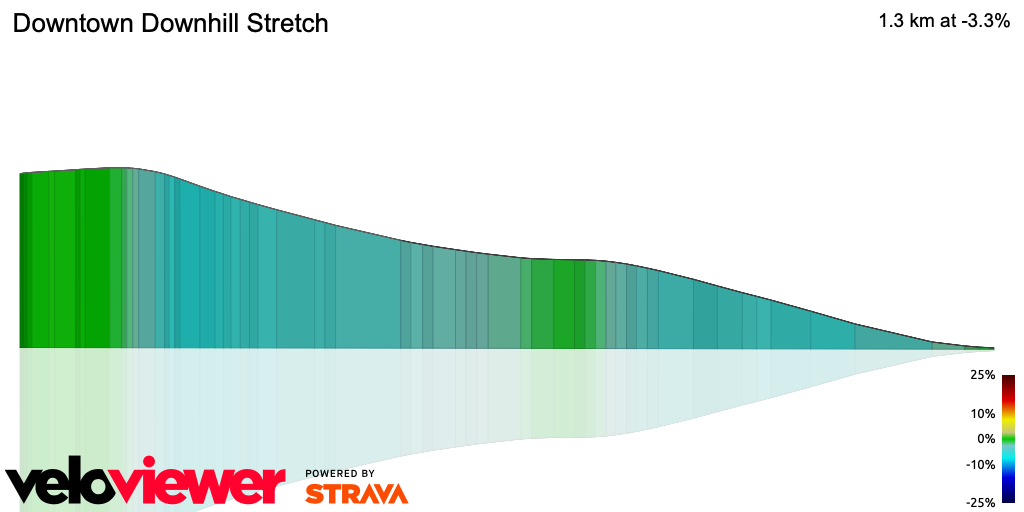
The second half of the route starts with a decent downhill. Just over a kilometer straight down E Main St. It averages 3.3%, but ignoring the false flat at the top and the bump in the middle it’s more like 5%. There is a possibility of supertuck, but watch where it flattens ⅔ of the way down. The downtown downhill Strava segment gives a nice view of this, and here is the Veloviewer profile view of the descent. The first time around it’ll be a nice respite from the flat-out flatness of the first 8 ½ km… second time around you will need a break before the trials of the last three hills!
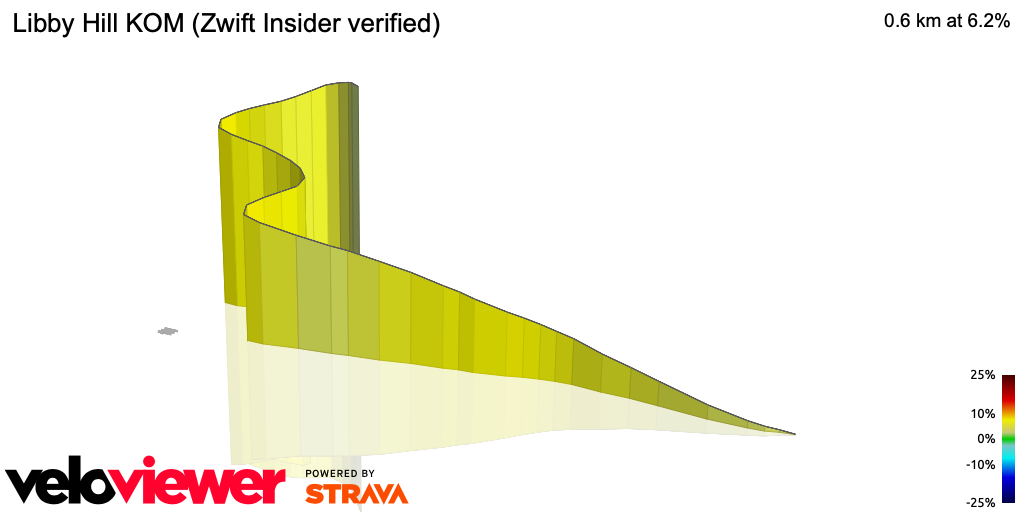
The terrain flattens again as you head straight down Dock Street, do a U-turn and then you’re back on E Main Street going the other way. The first big climb starts 12.5km into the lap – 630 meters averaging 6% as it winds its way up Libby Hill.
Libby Hill
Libby Hill is a grind, especially the second time around. It’s far enough from the finish that you’d rather not leave riders behind – but it is long enough (630 meters) to split your team, particularly when they have tired legs on the second time around. At the top, at least you have a little time to recover before 23rd Street.
From the top of Libby Hill the road flattens, giving you time to regroup. But those 400 meters will be gone in a flash, and then you head downward first on Franklin, then on 25th Street. The descent is 400 meters at around 5% – just enough to supertuck for a few seconds. Take care to stay together on the descent – you will need teamwork for the 23rd Street ascent.
23rd Street is short but it is steep – this is where Sagan made his move in 2015, and it will be decisive for you as well. Averaging 10% over its 250M, it pitches up over 12% in places. After Libby Hill this is a most unwelcome bump and heavier riders will really struggle here. Many teams will lose a member the first time around – but by the time you hit this on the second lap your decisions will be much easier. You’re near enough to the end that jettisoning slower members might make sense. Here is an interactive view of the KOM
Richmond UCI only has 2 KOMs but it has three significant climbs… which makes 6 climbs for you guys. The last climb of the lap is another long drag. After the 23rd Street KOM you head into a short descent before hitting the Governor Street climb which actually starts on East Main before turning on to Governor. It runs 500M at an average of 6%.
The hill proper ends as you turn onto East Broad St, but in reality it just softens to a false flat averaging 1.3% for 500M. A false flat like this wouldn’t matter in the grand scheme of things but after the tough hills don’t underestimate what this will feel like.
Wrap up
This race will be won or lost on how many riders you get through the first lap. If you can get your heavier riders through to the long flat on lap 2 you can gather momentum and speed for 8 ½ km of flat.
Do you have the team discipline to hold your lighter riders back? We will see in a few days.
This weekend we’ve got lots of Zwift Academy events, plus some fun long rides and short races. Please note that this time of year, event times can get a bit wacky as different parts of the world change their clocks on different dates. Best to double-check event times via the Companion app!
Special thanks to Jesper at ZwiftHacks with his Events app which provides powerful event filtering tools that help us create this list each week.
Zwift Academy – All of them!
For the first time ever, we’ve got a weekend which hosts events for all four Zwift Academies: Zwift Academy Road Women, Men, Zwift Academy Run, and Zwift Academy Tri. Jump into a workout or group event and get one step closer to graduation!
Multiple dates and times. Use links above to sign up and see events.
Zwift has begun labelling their FutureWorks races with the feature used in the race – so we can now easily choose between a FutureWorks race which uses Zwift’s Boost Mode or Anti-Sandbagging features.
Are you a C or D rider tired of having your races blown apart by sandbaggers? Try an anti-sandbagging event, and smile smugly as the cheaters get slowed with the green cone of shame. Looking for something a little different in your Crit City race? Try a Boost Mode event – it adds a strategic element that can make things really interesting!
For the past few months I have been putting together recce’s for the weekly Thursday Team Time Trial from WTRL. I race in a hungry mid-pack Latte (usually) team for Rowe and King – the Hyenas, and now I captain the R&K Ewoks on Tuesdays as well. Eric asked me to put together a similar recce for the Zwift Racing League TTTs every other Tuesday.
Review of ZRL #2 on R.G.V.
As predicted it was a fast lap. I was lucky enough to be working with a team I knew well – four of the riders were also Hyenas. We put in a spirited performance and came in 3rd in our division. On the way we lost one rider as we headed into the bumpy stuff and another on the third climb, very close to the end. The remaining four were wiped out so we didn’t manage a sprint finish, but we did all cross the line within a second of each other. A good result. I hope you all have a great story to tell about your TTT.
Magnificent 8 Course
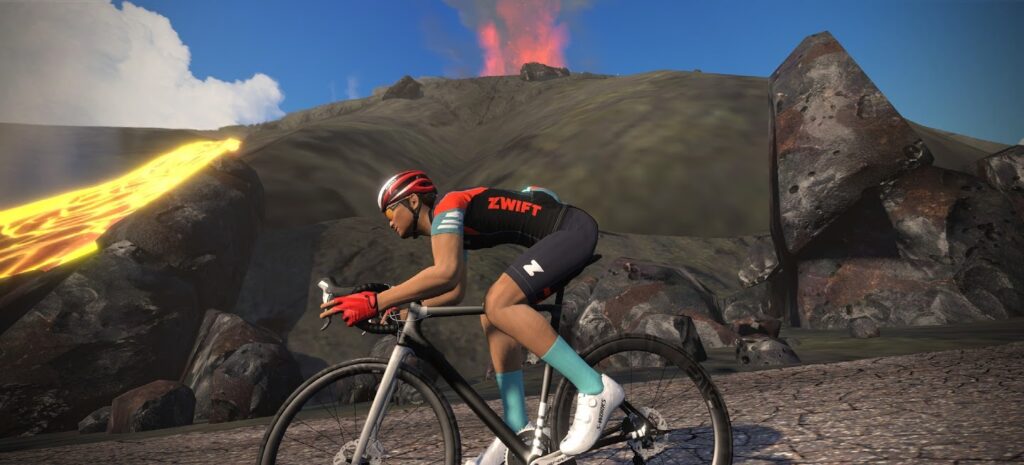
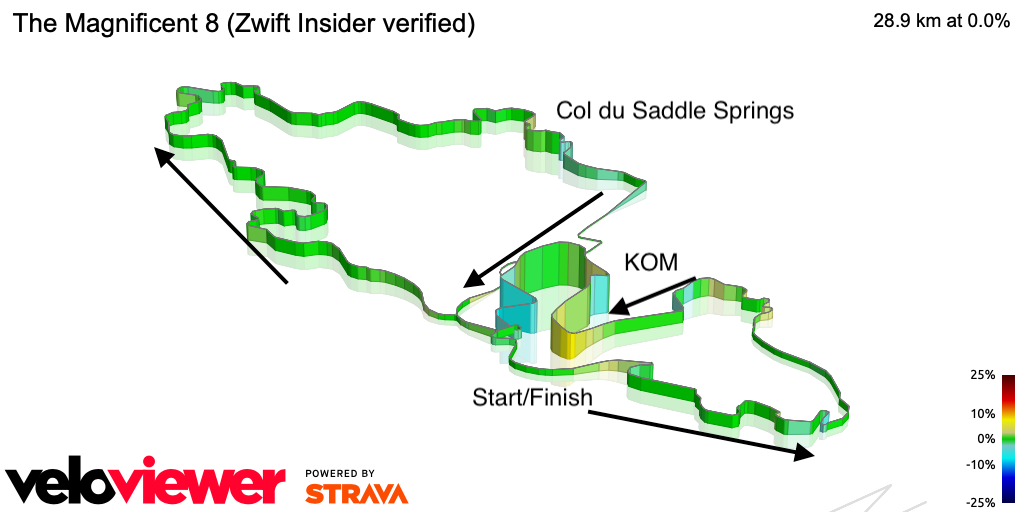
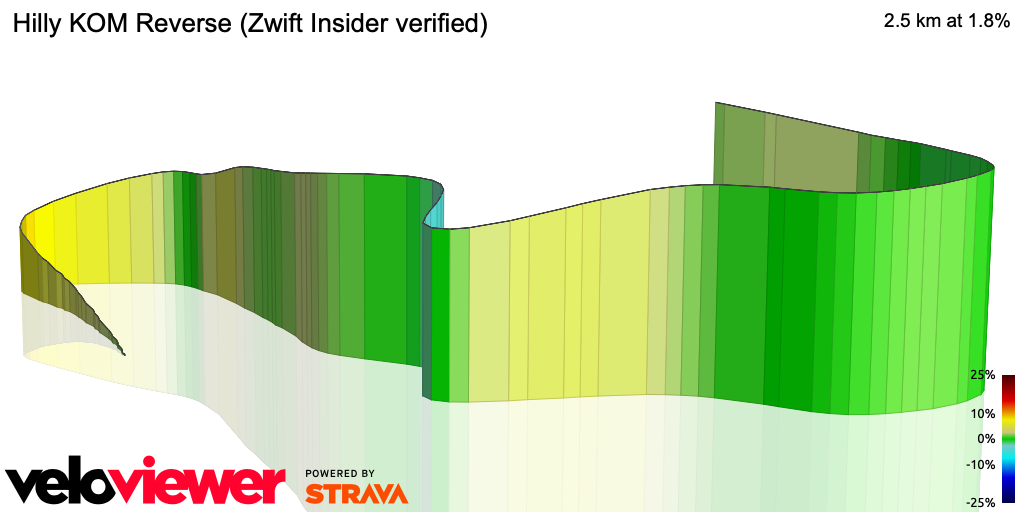
Next Tuesday we have a 28.8km ride in a roughly figure-8 route around Watopia. The Watopia Magnificent 8 course is one of those “mostly flat, but…” courses. Here the “but” comes in the form of Hilly KOM Reverse which has the potential to rip the team apart if you aren’t careful. Luckily the KOM comes close to the start of the ride so your legs will be fresh. Here’s the always great VeloViewer view of the course.
We start in the downtown Watopia pens and head through the start/finish gate. From there it’s across the bridge, around the Volcano, and head towards the Italian Villas over the land bridge. The tricky segment starts here – the surface turns to dirt and then you head up the hill past the waterfall. Grab a brief respite from tricky terrain for a short while (a km of downhill and mostly flat) before hitting the KOM.
Up and over the KOM, hang a right and head into the desert and it’s 11km of flat. Up the Col du Saddle Springs, down the other side, and into the tunnels. After that it’s back to downtown Watopia and through the start/finish.
The guys over at No Breakaways have created a fantastic route profile on YouTube (I have a good face for text which is why I’m writing this not presenting it…). Well worth the 8-minute investment to watch!
What to ride?
Bike recommendation on this route is pretty straightforward. Despite the bump over Hilly KOM Reverse aero rules the day. At the top-end of equipment the question is: does Tron’s performance on the hill outweigh the S-Works Venge with the pretty Super9 disc wheels? For me it does – and so I’ll be on Tron.
If you don’t have the Tron bike, what should you ride? Here are some suggestions at various levels.
Level 45 get those 858/Super 9 wheels and pair them with the S-Works Venge
You may ask why I’m not recommending the Speciailized Tarmac SL7 any more. While the SL7 is an excellent bike, and it’s available at a pretty low level, it is expensive, and most Level 5 Zwifters don’t have enough Drops. On balance it’s better to invest in the wheels for the Zwift Aero frame than buy a new frame.
ZSUN has a nice 60-mile training ride on Saturday – perfect for a gently paced recce – you can choose C or D paced groups depending on your energy level.
On Sunday, 3R are doing their regular 100km ride on Magnificent 8 – with B or C paced options.
If these don’t work for you there are 30 other rides between now and Sunday!
Race breakdown
I break this route into four sections:
Flat to the land bridge
Over the KOM
Desert flats
From Saddle Springs to the end of the line
Part 1 – Flat
Come out of the pens and through the start / finish gate. It’s not flat to start with but it is a steady rise – work on your formation and you have nothing to worry about. At the top of the rise turn right, head across the bridge, around the volcano and across the land-bridge towards the Italian Village.
Part 2 – Through the Italian Villas and over the KOM
This is definitely the trickiest section of the ride. Once you are across the landbridge the road surface changes to dirt, then it starts to rise. Once you get to the Villas the surface returns to tarmac and rises up past the waterfall. There is a brief respite (down/flat) before hitting the KOM itself.
The challenge with the dirt section is the drag dirt has – it will slow your team down, and will also reduce visibility. Discord is your friend here. The road hits 3% which on the dirt will feel like 5%. It doesn’t take long though, and soon enough you’ll be at the Italian Villas.
At around 7.4km you hit the reverse KOM. This one is your real danger area for holding the team together.
By the numbers this hill barely exists… it’s 1.8% for 2.5km. A false-flat, right? Well, the truth is we have four ramps separated by easier segments and even some downhill. Why is this a problem? In a large group race you have a big group to hide in, and as the groups split up you still have plenty of protection. In a TTT you have only have (up to) to 6 team members to hold together – when the hill bites each team member will be impacted differently.
What to look out for here?
Stronger members leaving the team behind. This is not a time for a solo break.
Weaker team members being left behind. Particularly on the first ramp – at over 10% someone will crack if you go at race-pace.
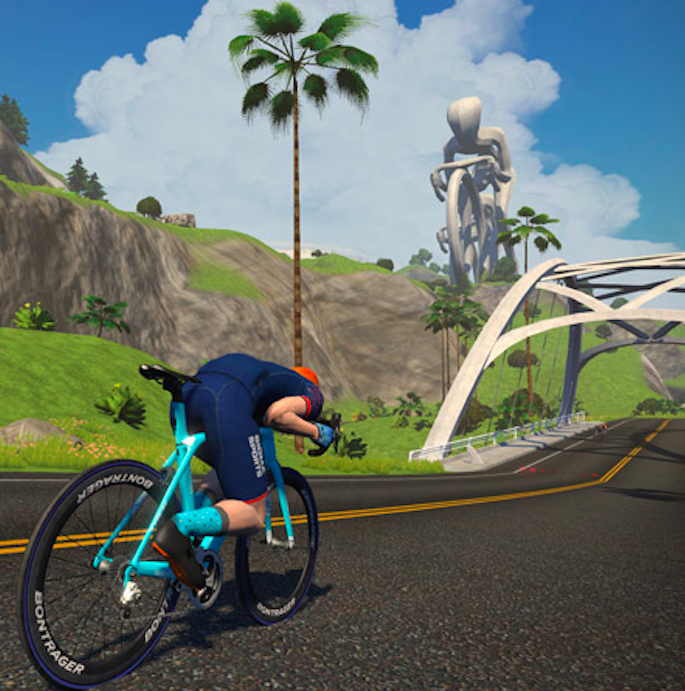
If you come over the top together you’re in luck – gather momentum on the descent and there is even an opportunity to supertuck – just look out for the flatter section around the bend where your supertuck might break. Stay together here and power down.
Part 3 – Across the desert
There is a slight rise into the desert itself, but mostly this is a flat, fast 11km. Heads down, get in formation and ride like the wind.
Part 4 – Col du Saddle Springs and home
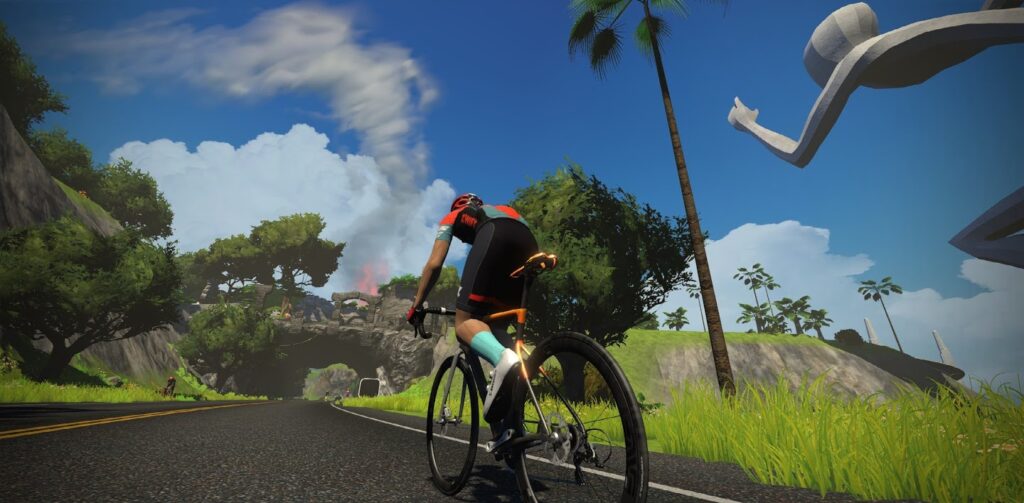
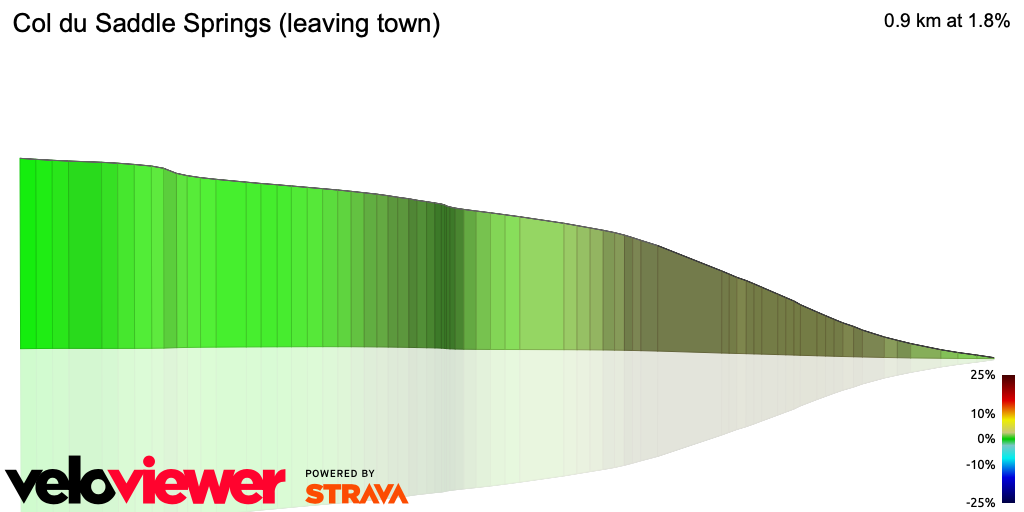
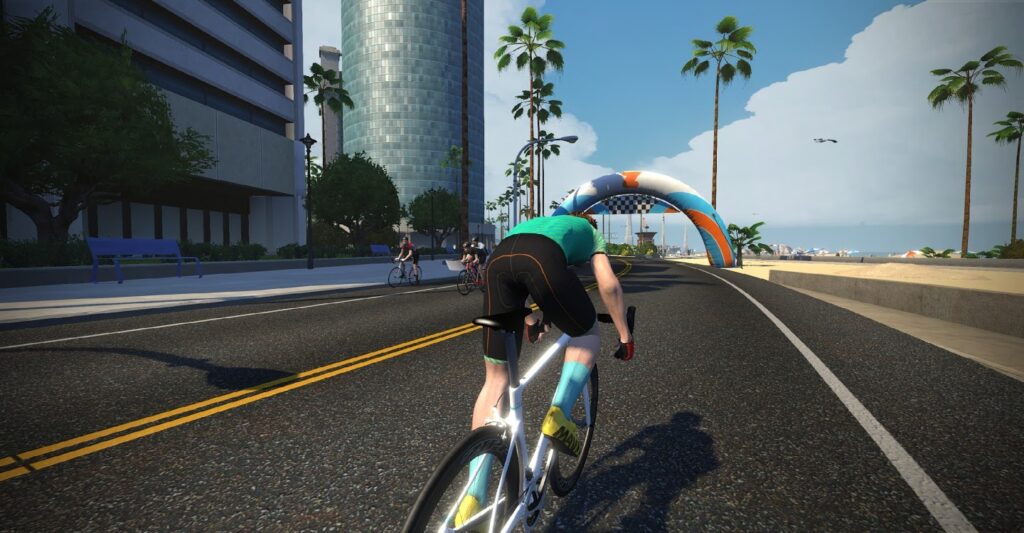
You exit Saddle Springs at around 24km. The col is small rise that comes right after the futuristic building you pass on your left (it’s a copy of the LAX Control Tower). After a lengthy flat this is a perfect opportunity for your lighter, stronger climbers to jump ahead and create a split! Rein in those riders and keep everyone together. This first little hill is just 2% for 900m before you head back down and into the undersea tunnels.
After that it’s pretty plain sailing – exiting the tunnel system has a short bump up – but by this time you can make your own decisions on whether to jettison slower riders based on how many of you are left! Just a short finish back to Downtown!
Wrap up
This is a great progression for the TTT. RGV wasn’t very technical (except for the end part). Here its largely flat again, and your race will be won or lost based on how you handle the KOM. Discord is your friend here.
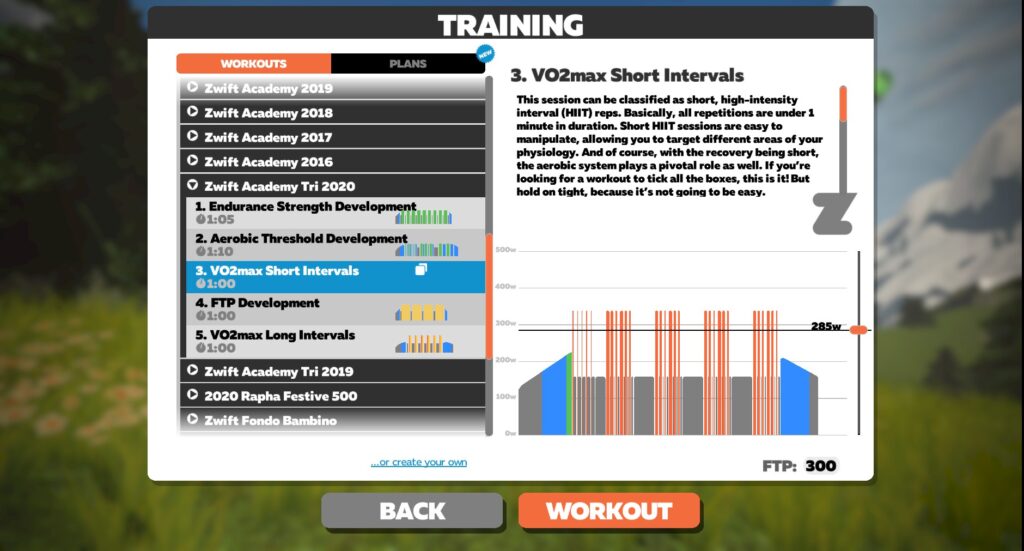
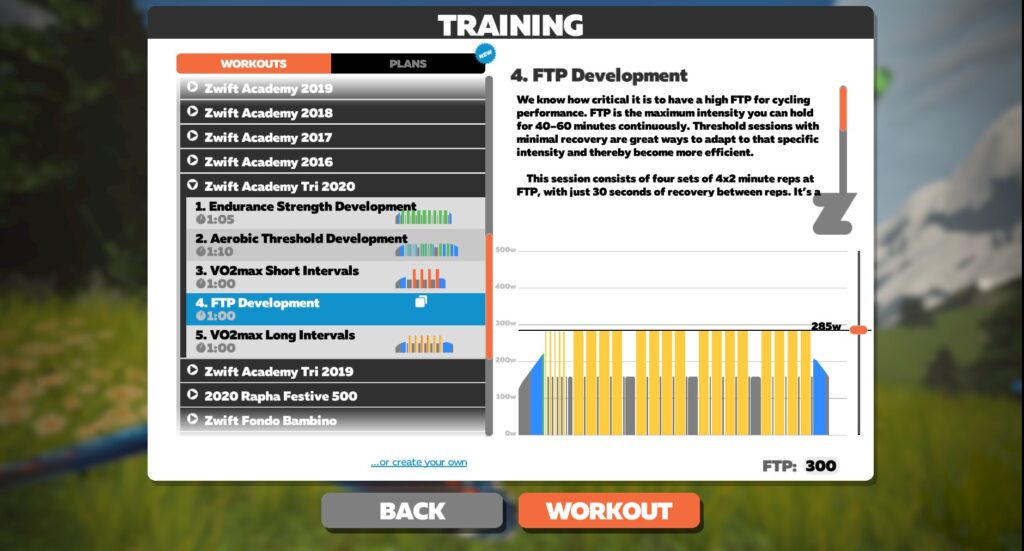
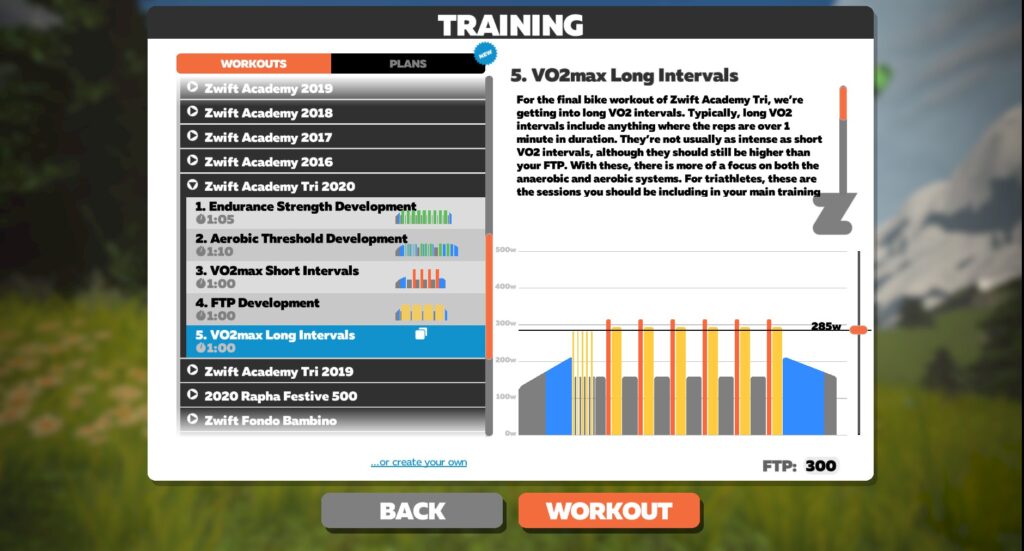
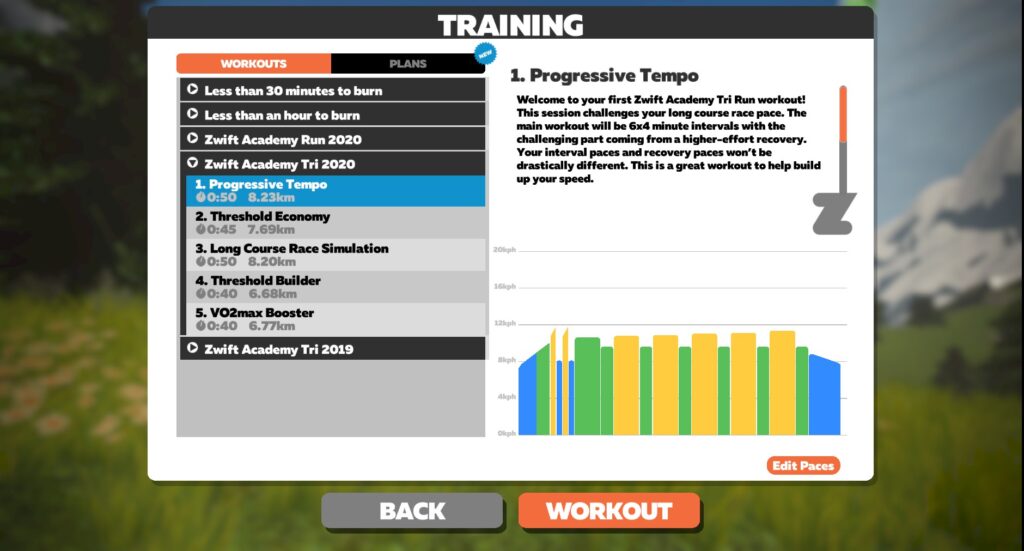
Zwift Academy Tri launches today, October 29th. Here are the details on what it takes to graduate, plus more information on workouts, group events, and unlocks/prizes!
Graduation Requirements
The following requirements must be met by December 23rd in order to complete Zwift Academy Tri:
Complete all 10 Workouts (5 cycling and 5 running works, can be completed individually or with a group)
Participants will progressively unlock in-game kit while making their way through the ZA Tri program:
ZA Tri Running Cap – 2 Run Workouts
ZA Tri Running Socks – 4 Run Workouts
ZA Tri Running Shirt – 5 Run Workouts + 1 Run Race
ZA Tri Cycling Socks – 2 Bike Workouts
ZA Tri Cycling Cap – 4 Bike Workouts
ZA Tri Cycling Kit – 5 Bike Workouts + 1 TT Race
Word is there’s a special surprise unlock for graduates in addition to what’s listed above!
Grand Prize
ZA Tri graduates can compete for a once in a lifetime experience as part of the Zwift Academy Triathlon Team with support from Zwift and other sponsors including Specialized, Roka, Wahoo, SiS, and Whoop.
The goal of the ZA Tri Team is qualify for and compete in the 2021 Ironman World Championships in Kona, Hawaii. Six team members will be selected!
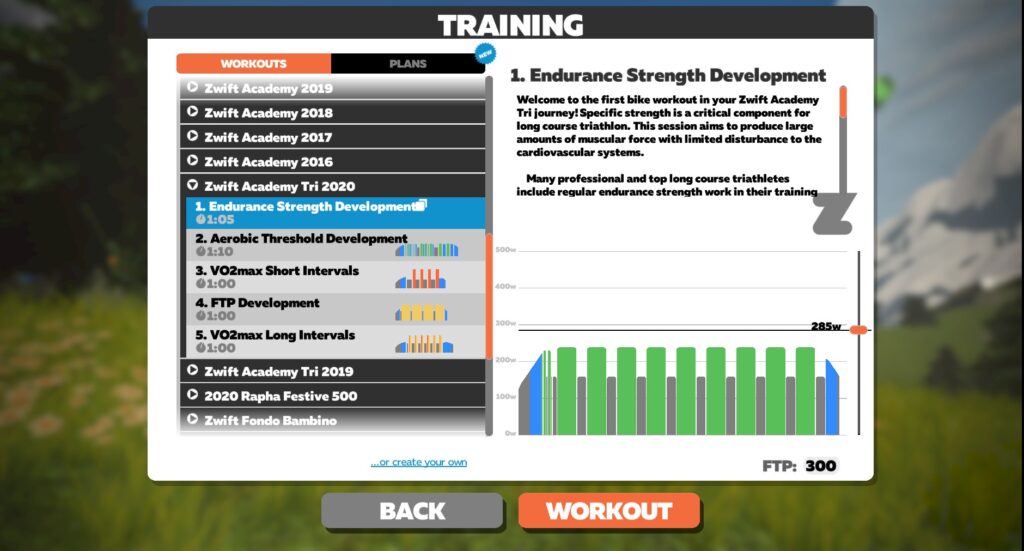
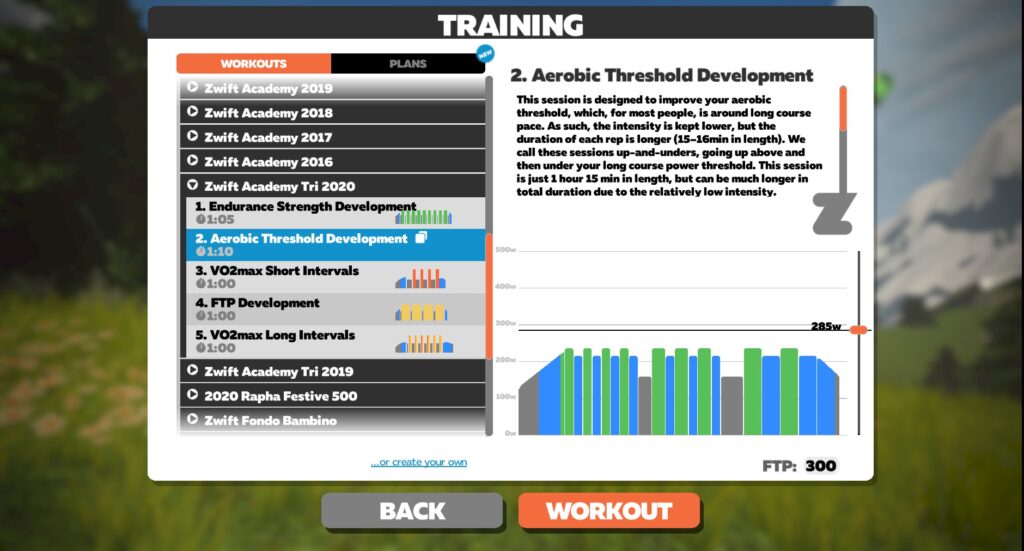
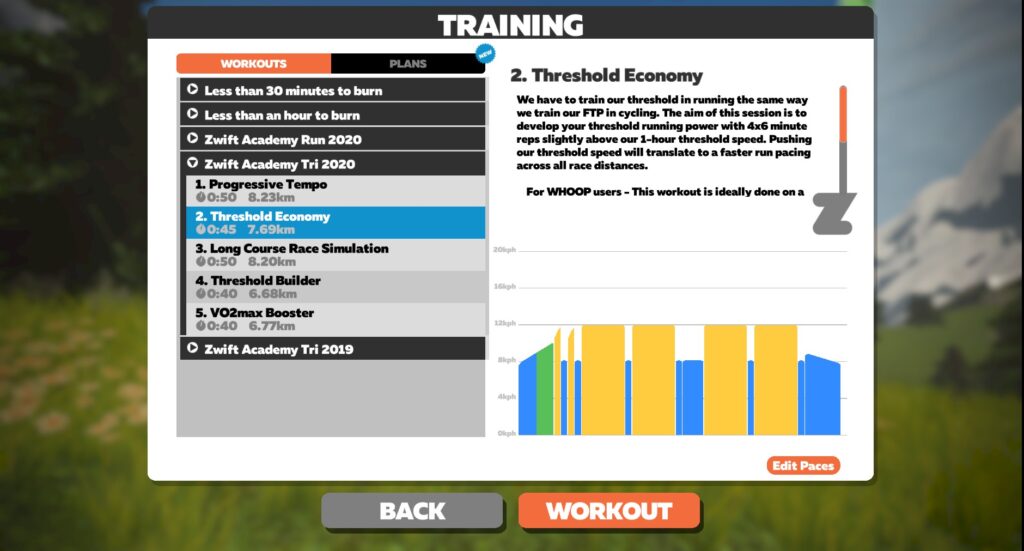
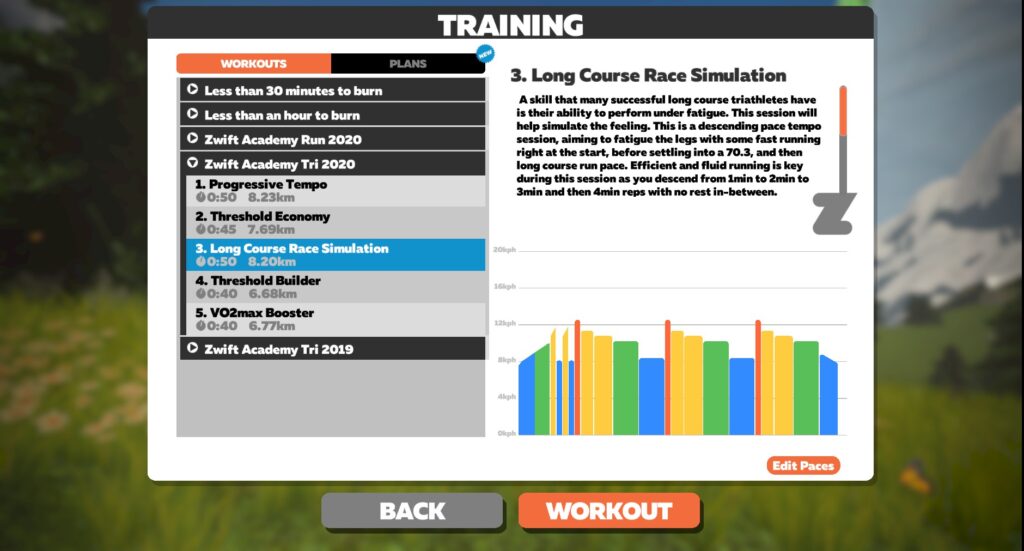
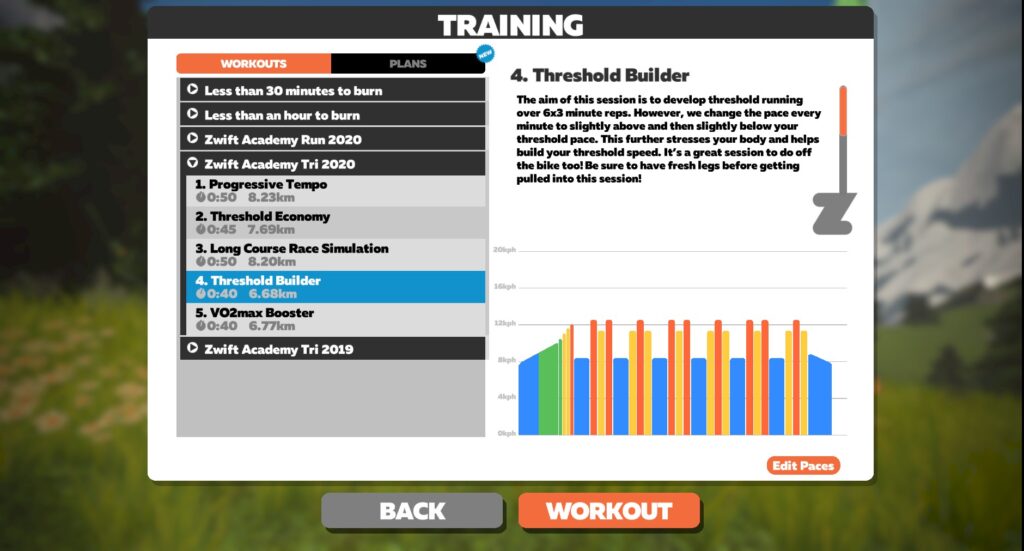
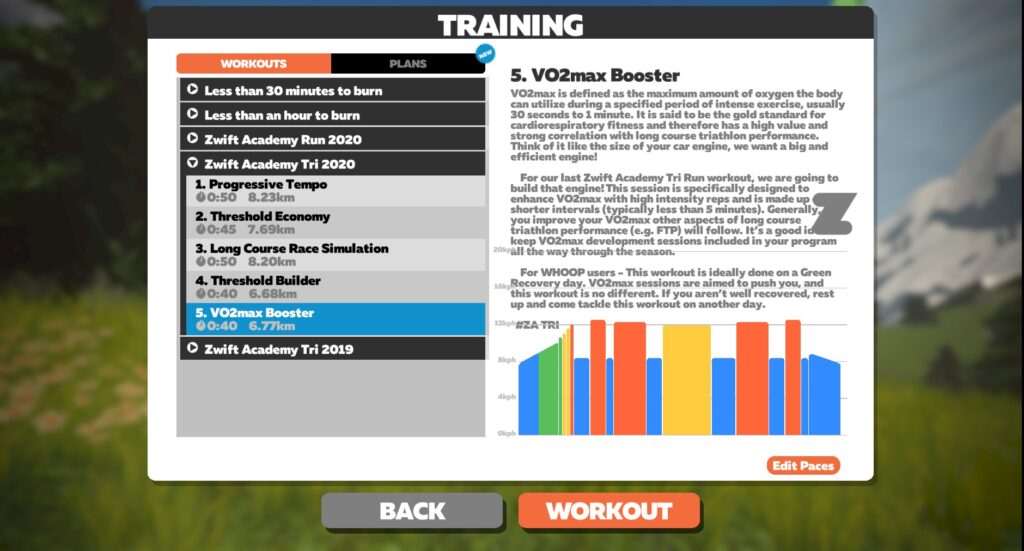
Structured workouts form the heart of Zwift Academy Tri, with each workout accomplishing specific training/testing goals and lasting 40-70 minutes.
You must complete all 10 Zwift Academy Tri 2020 workouts in order to complete the program.
These workouts can be completed individually by selecting the workout within Zwift. They can also be completed by participating in a group workout event. Lastly, if you want to do the workout with a few choice friends, you can organize a Meetup and have everyone select the same workout (more on that here).
Cycling Workouts
Running Workouts
Coach Dan has created short videos explaining each workout, which can be found here.
Set Your Paces
To ensure the best results from your structured training, you’ll want to start your ZA Tri running workouts with accurate pace settings. If you don’t know the run paces you’re capable of, take the Zwift 5k Test. Make sure you are rested before completing the test for best results!
The same goes for the cycling workouts – make sure you have an accurate FTP setting before starting the workouts. To quickly find your FTP, try taking the Ramp Test.
Race Details
Cycling races will be 40k and 20k TT efforts on Fuego Flats. Zwift says “All Zwifters competing for the ZA Tri Team must complete one Time Trial at either distance and use a heart rate monitor and a power gauge (smart trainer or power meter).”
Running races will be 10k and 5k efforts. Zwift says, “If you’re competing for a spot on the Zwift Academy Tri Team, you must complete at least one race. You can choose between 5km and 10 km. A heart rate monitor and cadence sensor is mandatory.”
Races aren’t currently scheduled, but should show up in the next week or so.
By my count I’ve ridden around 60 laps of Richmond’s 2015 UCI Worlds course in my storied Zwift racing B-cat career. It’s a route I know like the back of my hand, and one I love to race.
But it’s also a brutal course for me. Libby Hill puts me on the rivet. 23rd Street burns another match. Then the long slog up Governor Street drains whatever I’ve got left.
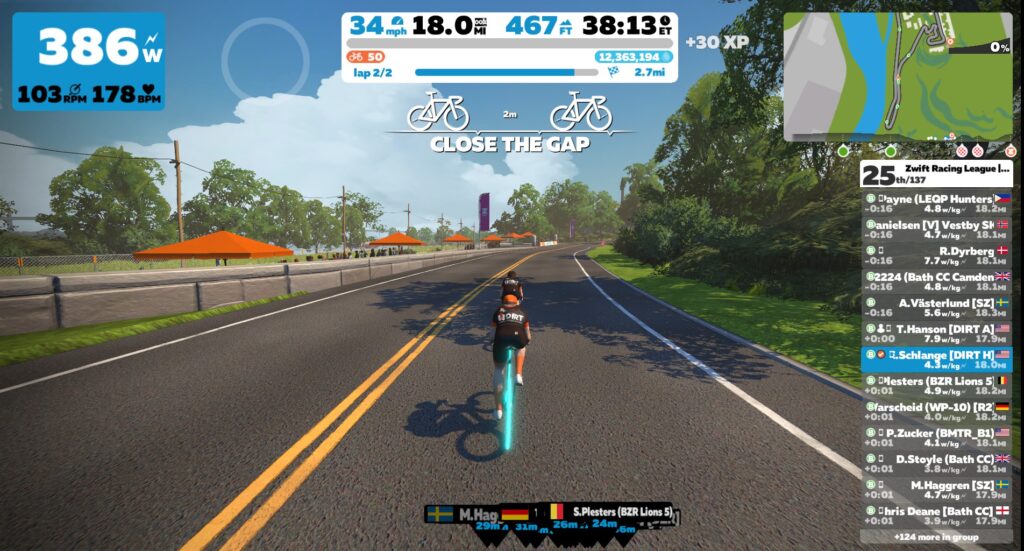
And this was the third week of Zwift Racing League – but really the first week, because the first two weeks had been used as qualifying heats to place us in competitive divisions heading into this third race. My team had done well in the qualifying heats, placing first in our division – so we got placed in one of the top divisions (EMEA E2 B1). Scouting the other teams, it was clear we were up against stronger riders than the previous weeks.
This was always going to hurt. I just didn’t realize how much.
Warmup
Our race kicked off at 11:20am, so I ate a good breakfast (oatmeal with blueberries), got a few hours of work done, then turned my attention to race prep.
Three pieces of caffeine gum got 300mg of elixir in my veins. PR lotion on the legs got the bicarb into the system. And I even drank a terrible cup of beet juice from a can of powder I found sitting around. Why not?
Then it was off to Tempus Fugit for a warmup. Where I ran into a bit of a hitch – the built-in Bluetooth on my Zwifting PC wasn’t working! I could connect up via ANT+, but I knew from past experience this was a bad idea – I’m pretty sure a nearby neighbor has their WiFi on a channel that interferes with ANT+.
So I rebooted. Viola! Bluetooth was back. Assioma Duo pedals connected via Bluetooth, along with heart rate and my KICKR 5 via ANT+. I clicked to join the event early, saving my spot near the front of the line. (It’s like a virtual call up, except you qualify by clicking fast instead of being fast.) Then I left the event and rode for a while, putting in a few short efforts to get my heart rate up. Soon enough, it was time to join the pens for real. Let’s race!
The Start
A casual start
Knowing we had a lot of strong riders in our group of 137 Bs, I stayed very alert near the front of the pack as the race began. I didn’t want to miss the big move if a strong team decided to force a split early.
But that didn’t happen. Not even close, in fact. I averaged just 318W in the first 2 minutes in order to stay near the front – lower than most races.
Through the first sprint, then the second, the pace picked up a bit – but not enough to make it a sufferfest. Clearly, riders were keeping their powder dry, waiting for the climbs on the back half of the first lap. The punchy climbers wanted to put in big digs on the climbs in order to drop the sprinters. And the sprinters (like myself) were trying to conserve as much as possible, know we’d need every bit of power we could muster in order to hang onto the front of the race.
The First Climbs
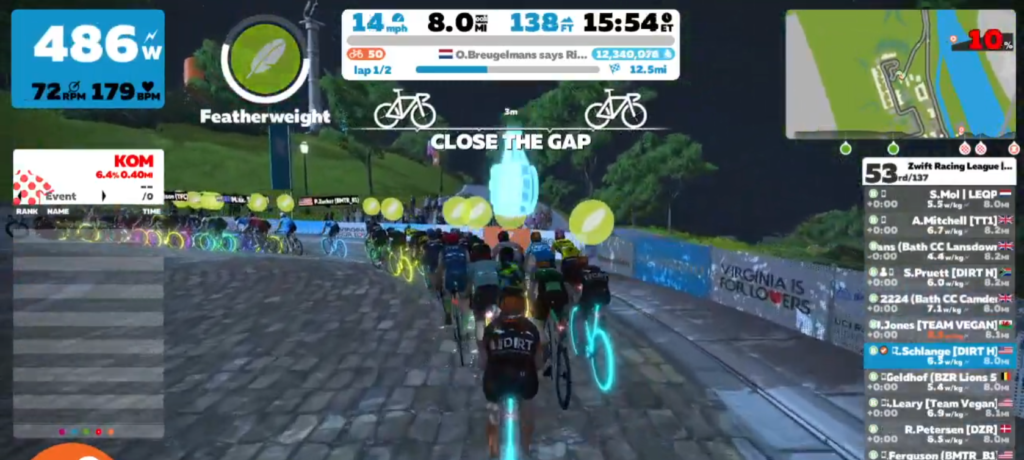
As we neared Libby’s cobbles, riders began to push for a position near the front of the pack. I slid into ~50th place, then activated my feather powerup (along with half the peloton) as we hit the cobbles:
Feathers! Feathers everywhere!
I hadn’t even reached the final turn when KOM times began popping up… 1:13. 1:14.
This was not a good sign. My previous best up Libby Hill was 1:27.
I kept hammering, knowing this was the move. Came over the top in 39th place, with riders strung out up the road. No powerup. %&#! I pushed the grab the wheels ahead, but I could see a front pack coalescing 10 seconds up the road. Hammer the descent. Sprint up 23rd Street, channeling my inner Sagan. The front group was just 3-4 seconds ahead, so close!
Then they crested the hill and flew away, and my heart and lungs gave up. That was it. I’d lost the front. I’d lost the race.
The Chase
Within a minute or two, a chase group of ~20 riders had formed behind the front pack of ~25. I couldn’t get a precise count, but I knew the front group didn’t quite have 30 riders in it, which meant a handful of riders from this chase group could still get extra points. (Zwift Racing League is entirely points-based, and you are awarded extra points for 1st through 30th place across the finish line. 31st and slower all receive just 1 point.)
It would have been easy to just say “I probably won’t finish higher than 30th. I’ll just sit in and get my extra point.” (And honestly, this is something I’d like to see changed in the way ZRL points are structured – awarding extra points down to 50 or more places might make things more interesting for riders who aren’t in the front group.) But I resolved myself to go all in and do everything I could to get extra points – to finish in the top 30.
First order of business… recover. On the flat half of the second lap, I took it easy. We all did, I think! I averaged just 258 watts for this portion. A welcome respite.
Supertucking with my chase group
The Finish
Heading into the second Libby climb, DIRT teammate Tim Hanson (who was riding for a separate DIRT team in this race) messaged me: would I want to follow his wheel as he put in a suicide attack heading into the climb?
Tim is a strong racer, but was convinced he didn’t have the legs to hang with our group over the final climbs of the race. So he wanted to put in a final dig to help a teammate.
At first I declined – I wasn’t sure how strong I’d be on these climbs, so putting in an extra attack seemed a bit foolish. But then I remembered that, when I get dropped from the front of B races, I’m typically able to finish at or near the front of my chase group. Maybe I was one of the stronger riders in this bunch, and a quick dig would thin out the pack?
I messaged Tim and told him I was in. Nothing ventured nothing gained, right?
Soon enough, he messaged “Go” and it was on! I activated my aero powerup, got on his wheel, and jumped away from the pack before the Libby KOM line began. The front pack was just 15 seconds ahead… so close, yet so far away. And my chase group was just 2 seconds behind, but closing fast.
Following Tim’s kamikaze attack
Tim dropped off, and I was in no-man’s land, in 24th place. As I hit the cobbles, the front of my chase group came around me. “Don’t get dropped now!” I told myself. My attack hadn’t shed a single rider, but it had certainly made them work harder heading into this tough climb. If I could keep pushing and hang with the front of my chase group, I would have a reduced pack to contend with for extra points in the final minutes.
Over the top of Libby we were strung out, with the front of my pack a few seconds ahead. Those were the extra points. If I didn’t catch them now, all the hard work would have been for nothing – I would earn just one team point, the same as if I’d finished in last place. I pushed hard, activating a draft boost to help me get back in touch. “YOU GOT THIS!!” Tim messaged from 17 seconds back. That’s a solid teammate right there, folks. “Don’t let Tim die in vain!” I told myself.
Up 23rd street, I was back in the group, which had been reduced to only 12 riders. Much better odds.
I used my last powerup, a feather, as we turned the steep right on Governor Street. Riders began to hammer off the front, but I knew we had a long way to the line. We turned left onto the finishing straight, and I was in 30th place, with other riders nearby. Extra points. So close…
I shifted down and stood up to hammer the final stretch, but I was so gassed that my form was terrible. I sat back down. Shift up. Tighten the core. High cadence. All in to the finish.
29th place. 28th. 27th. 26th. I was in a dark place, emptying the tank and then some. How was I still pedaling? Monica was yelling and jumping around, “Go go go! You’ve got this!” My 17-year-old daughter was watching from the doorway, no doubt horrified, wondering how anyone could work this hard at a video game.
Watching the video replay, I almost caught the next guy up the road… but just missed doing so as a rider from behind pipped me at the line. 27th place.
The progression of pain faces in the final minutes of the race
The race results are still being finalized by WTRL, but ZwiftPower currently shows me in 22nd place, with my teammate Scott Olsen finishing in the front pack in 17th place. We are the only two from our team of six who got extra points, which probably places us somewhere near the bottom of the top 1/3 for this race.
One of our strongest riders encountered a weird Zwift mechanical – he wasn’t getting any draft effect! He got spat out the back quite quickly. Bummer.
Takeaways
I’m not sure I could have played this race differently for a better result. That front group of riders was simply too strong for me to hang with, so it was really a question of who I could beat in our chase group. Did Tim’s kamikaze attack help me? I think it probably did, but it’s hard to say for sure – perhaps sitting in and conserving would have left me with a bit more in the finish.
That was the hardest final minute race minute of my life. I gave it all I had, and I’m still feeling the effort 2 days later! Looking at my power curve in Strava, the final 7-8 minutes of this race were a new power PB for me in 2020. 351W for 8 minutes – happy with that.
The more I race against top Bs on Zwift, the more I’m convinced that 1-3 minute power is the trick to doing well in most Zwift races. Sure, a high FTP is important, and you’ve got to have a decent sprint if you’re doing flatter races. But it’s that 1-3 minute power that lets you hang in on the short climbs that break up the pack and force the key selections. I’m going to do more training in that time window, since 1-3 minute power is not my strength.
Your Thoughts
Did you race on Tuesday? How’d it go? Share your story below!
In the below video, Shane Miller lists several reasons why he thinks the UCI and Zwift chose the Neo 2T:
Existing commercial arrangements with the UCI: Likely the biggest reason, according to Shane. Garmin Tacx already partners with the UCI for the Road World Championships.
Availability of direct-drive smart trainers: They needed a supplier that could handle the distribution of 200+ units to racers around the world in 2020.
The Neo 2T’s tech specs, including:
+/- 1% power accuracy
No spindown or calibration necessary (or even possible!)
Up to 25% gradient simulation
Maximum of 2200 watts, so it can handle pro-level sprints
Quick-release and through-axle compatibility
Compact shipping, especially compared to a smartbike
These are also the reasons he predicted that the Neo 2T would be chosen back in September. Good call, Shane!
UCI Cycling Esports World Championships: Official Smart Trainer Announced
The news is tucked into the General Information Bulletin in the UCI’s official documents about the event:
“Zwift are delighted to confirm that Garmin Tacx have been awarded the trainer sponsor category for the 2020 UCI Cycling Esports World Championships. The public announcement of this partnership will follow.
Garmin Tacx will be providing each rider in the event with a Tacx Neo 2T smart trainer and all of the associated accessories required to enable each athlete to compete on the same model of hardware, wherever they are in the world. Once National Federation squads have been confirmed on the 16th October, Garmin Tacx will begin the process of distributing the hardware to riders. Garmin Tacx will cover all costs associated with delivering and collecting the smart trainers from riders, subject to riders signing Garmin Tacx’s standard trainer acceptance form.”
In this ZA Roadshow episode, Leah tells us how to get the best out of Today’s Plan, coaches Dan and Stephen show what workout five is all about, and group ride leader Christina Hanson explains why she compares beer to each workout.
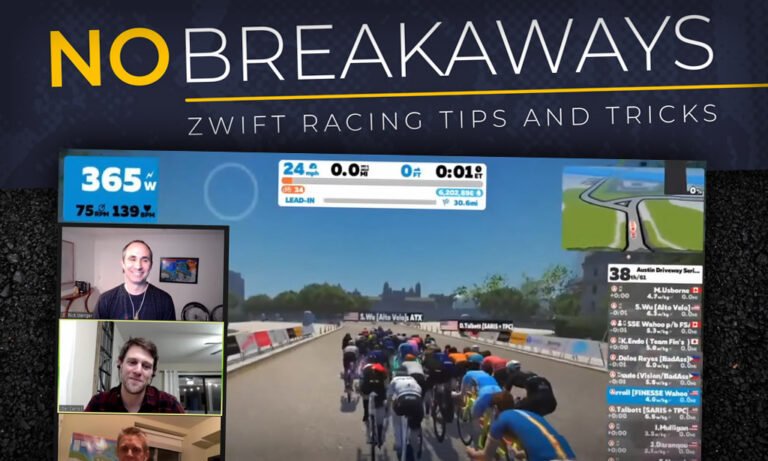
This week on our No Breakaways Race Breakdown we take a look at two races: our amateur Brandon Peterson racing the Dadurday Chase Race against 2019 US National Champion Holden Comeau on the Champs-Elysees and the leader of the Austin Driveway Series and top 50 ranked Zwifter Joel Carroll.
There are some top tips shared on how to win a chase race, and and a helpful breakdown of the team tactics that took Joel to a sprint victory in his race.
Brandon’s Race:
Joel’s Race:
We have been putting out a lot of content specifically geared towards making you a better Zwift racer and have a lot more planned. More live coaching is coming soon as well as some special events so stay tuned!
Every Thursday we are also releasing WTRL Course Previews for the following week.
Thanks to everyone who applied to be on a show! We are working through the responses and will be getting back to you all soon.
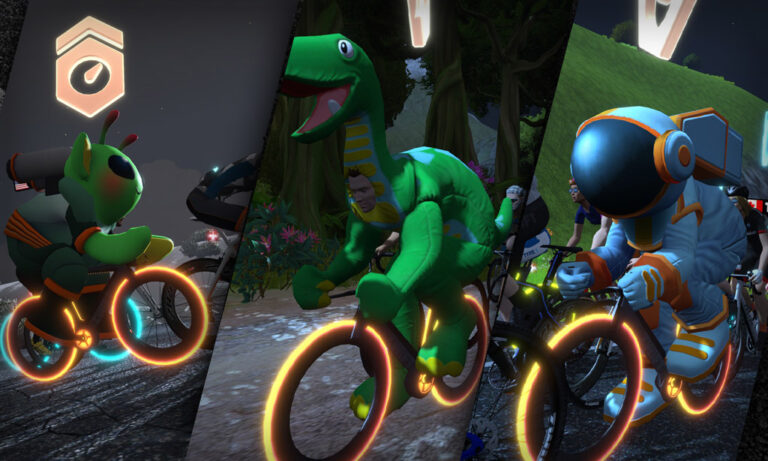
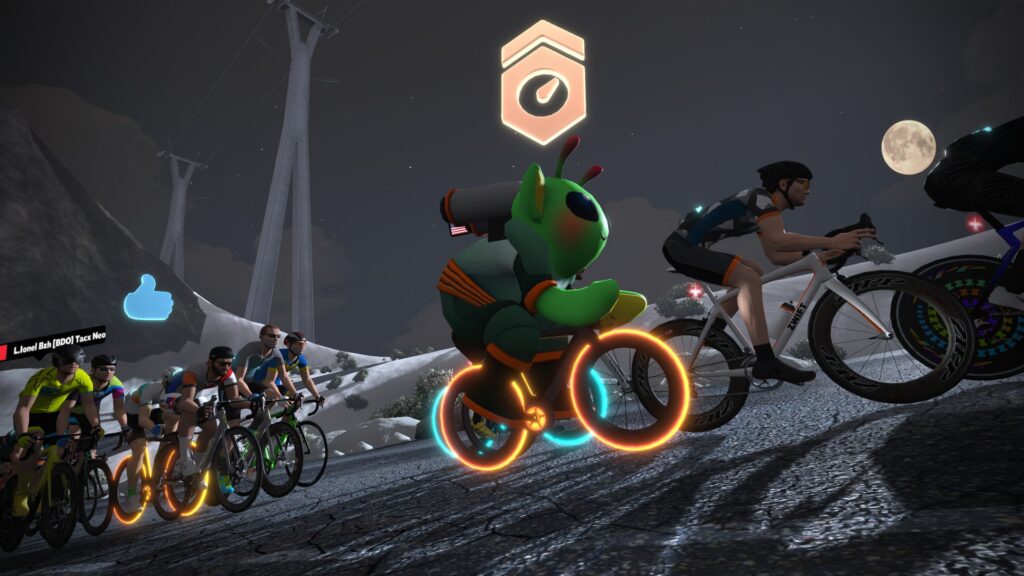
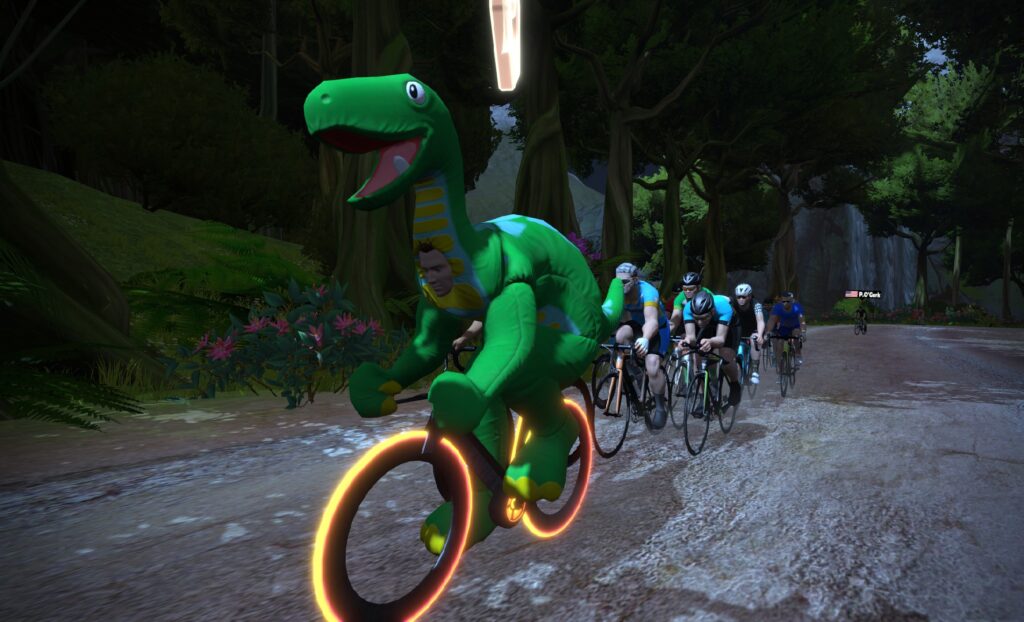
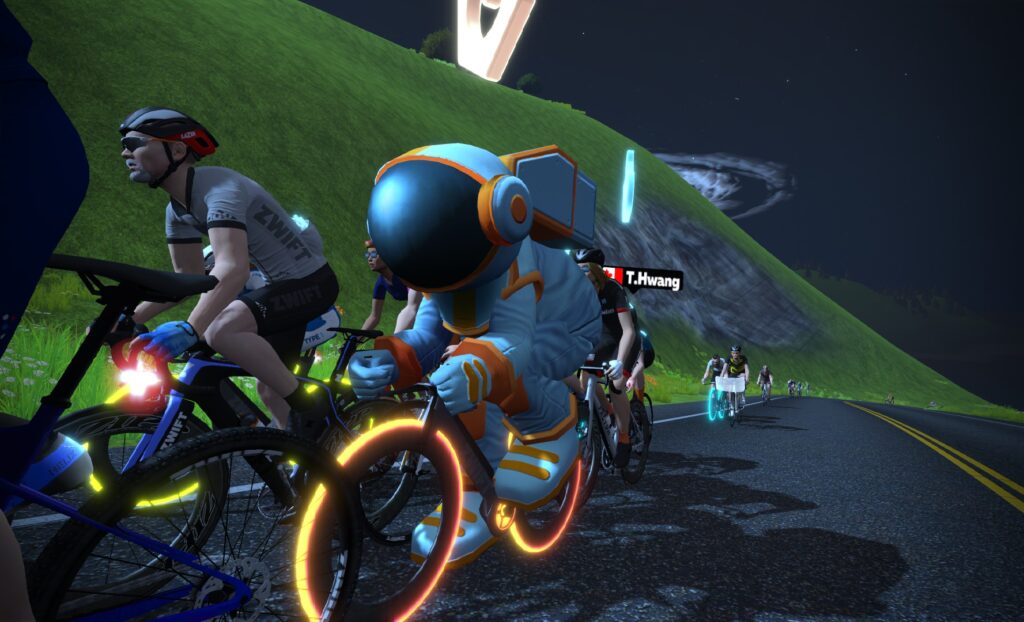
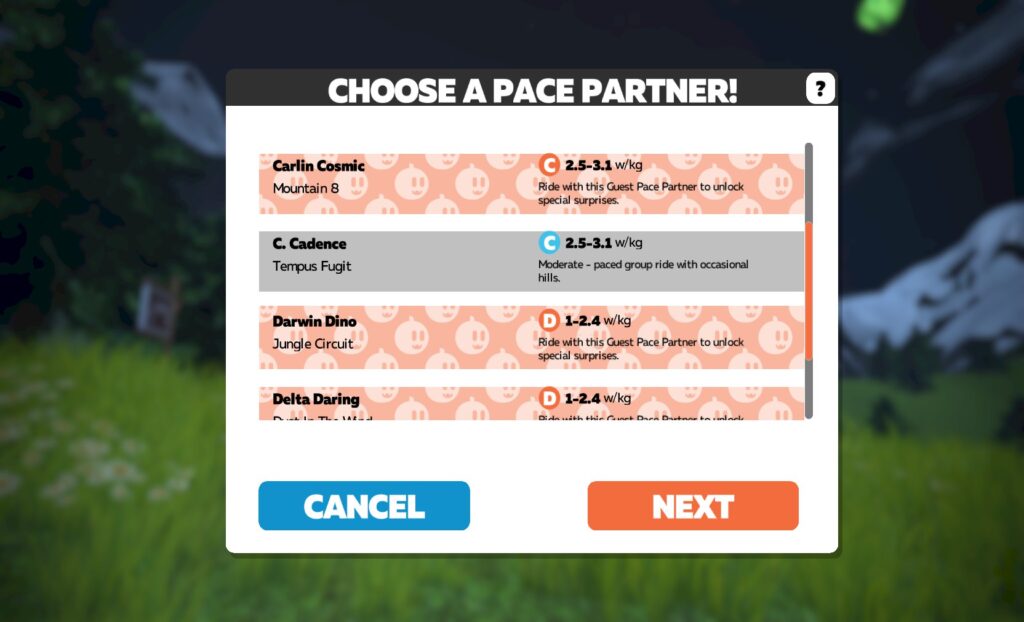
Last night some new Pace Partners went live as part of a little Halloween game. Carlin Cosmic, Darwin Dino, Delta Daring have arrived, and they’re handing out Halloween costumes!
Carlin Cosmic
Darwin Dino
Delta Daring
How It Works
Each of the three costumes comes in multiple pieces. To unlock each piece, ride near the Pace Partner in the same way you would the original Pace Partners in the Drops Multiplier game.
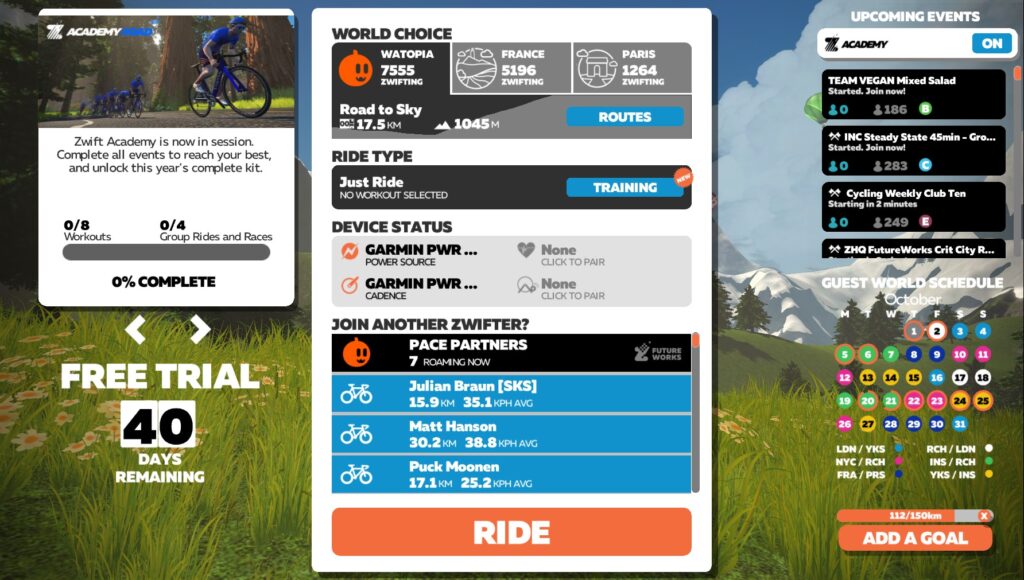
Click the Pace Partners box to see a list of available Pace Partners
Choose one of the Halloween-themed Partners
We’re told unlocked costume pieces will be remembered, so when you join that Pace Partner again on a separate ride you won’t be starting from zero.
Be warned – sticking with these Halloween Pace Partners isn’t easy! Their wattage is constantly fluctuating (a first for Pace Partners, see short clip below), and you’ll need to pay close attention to stay within 12m and continue accruing costume pieces.
Questions or Comments?
Did you unlock a full costume yet? It’s no easy task! Share your thoughts below…