Home Blog Page 138

Sprint-Coast/Microbursting Speed Tests: are Zwifters cheating by pedaling in spurts?

174

Sprint-Coast/Microbursting Speed Tests: are Zwifters cheating by pedaling in spurts?

There’s been a lot of talk in the Zwift Racing community recently regarding “microbursting”, aka “sprint-coasting.” Today I want to share some test results and open up a conversation about whether this riding style is cheating… or just odd. Let’s get to it!

What Is Microbursting?

There is no precise accepted definition for microbursting, but it can be described in very basic terms as short, repeated intervals modulating between sprinting (high power) and coasting (low or no power).

WTRL recently added a microbursting prohibition to the Zwift Racing League rulebook. Section 7.1.3 says:

The following is a list of behaviours that may result in investigation and penalty:

  • Utilizing techniques that exploit a networked game such as ‘Sprint-coast.’

WTRL further defined what they consider to be “illegal” sprint coasting in this Facebook post:

To provide clarity, the Sprint Coast technique is characterized as follows:

  • Cadence rises to >100rpm and power >500W for 2-4 seconds.
  • Cadence falls to <40rpm and power <100W for 2-4 seconds.
  • This pattern repeats at a rate of more than 4 times per minute and is sustained for multiple minutes.

Microburst Testing

Microbursting isn’t an easy thing to test. If you do it “manually” (with your legs) it’s hard to have the precision needed to prove whether or not the technique gives you an advantage. And if you automate it with a bot, there are only certain power/interval combinations you can accurately replicate due to the tools available.

There’s been some confusion in the comments on this post, so I’m adding a note to explain that my goal here wasn’t to test sticky watts, which clearly give riders an unfair advantage. Although associated with microbursting, sticky watts are not the same as microbursting. Because, while sticky watts are usually triggered via microbursts, plenty of trainers/power meters let you do microbursts without sticky watts!

My goal here is to test if microbursts themselves exploit Zwift physics and provide some sort of unrealistic speed advantage.

After attempting to test it with my legs, my conclusions were that 1) there didn’t seem to be any obvious advantage, but also 2) I couldn’t get the accuracy needed to prove this. So I devised several automated tests.

The basic idea of these tests is to compare a steady-state rider’s performance with microbursts that average out to the steady-state rider’s power. For example: if a rider holds 300W steady, will they go as fast as a rider who is alternating evenly between 150W and 450W? Both riders finish with the same average power, but their efforts look very different.

Here are the results of my tests…

Flat Solo Rider Tests

The first set of tests used a solo rider (our standard 75kg, 183cm tall bot on the Zwift Carbon bike with 32mm carbon wheels). I tested the rider on the Fuego Flats Reverse segment at steady 300W power, then at various microburst intervals. Here are the results:

  • 300W Steady: 10:36.23
  • 600W to 0W in 1-second intervals: 10:31.52
  • 500W to 100W in 3-second intervals: 10:31.46
  • 600W to 0W in 4-second intervals: 10:32.66
  • 550W to 50W in 2-second intervals: 10:31.01
  • 350W to 250W in 10-second intervals: 10:33.87*

Zwift’s Pack Dynamics v4 includes a CdA bonus for riders who are “attacking.” Specifically, if you are not drafting and your power is 20% higher than your last 10-second average power you get a 5% CdA reduction. This particular test was set up to attempt to exploit this feature.

Just to prove a couple of these times, and to show what it looked like, here are the bots finishing two of the tests:

300W Steady

500W to 100W

These test results are interesting: clearly there is a slight speed advantage to microbursting, as all of the microbursting schemes beat the steady bot by 4-5 seconds. But is 4-5 seconds a big enough improvement, considering you’d be riding short intervals for 10 minutes to get it?

Climbing Solo Rider Tests

Many stories I’ve heard about microbursting in races seem to involve climbs. To put it another way: riders seem to utilize this technique on uphills more than flats or descents.

So I figured I should test it on a climb. How about the Alpe? I put the bots to work. Here are the results:

  • 300W Steady: 49:30
  • 400W to 200W in 4-second intervals: 49:30
  • 500W to 100W in 4-second intervals: 49:39

As you can see, the best I could do was to get the microbursting bots to finish at the same speed as the steady-state bot.

RoboPacer Tests

My last set of tests involved riding in a pack with a RoboPacer. This test was done to observe how a microbursting rider would perform in a pack drafting off of others.

I placed a bot in the Yumi RoboPacer group. Yumi holds 240W on the flats, and if my bot was at 240W steady he sat in the group quite nicely. I tried various microbursting intervals that averaged out to 240W, including the 380W to 100W interval you see here:

None of the intervals saw my bot break away from the group, or even go to the front of the group – in fact, he struggled to even stay with the group and after a minute or two would inevitably get dropped.

Summarizing Test Results

The tests above clearly show that microbursting results in higher speeds than steady-state power on flat ground. But is the speed increase enough to conclusively say microbursting gives riders an unfair advantage?

I say no.

Modulating your power in microbursts increases the perceived difficulty of a ride, at least for most riders. The physical and mental “cost” of microbursting seems to far outweigh any speed advantage it delivers.

A Sticky Watt Hypothesis

Based on the test results above, I have a hypothesis about microbursting in Zwift racing: microbursting by itself does not give riders an unfair advantage. The unfair advantage comes when riders combine microbursts with sticky watts.

What are sticky watts? Read all about them here, but simply put, sticky watts are “free” watts riders get when they stop pedaling for short intervals using certain power meters. As shown in the chart below (click for details), if you combine a sticky power meter with sprint-coasting you can increase the average power Zwift sees by 20% above the “actual” power you’re putting out.

Someone with a lot of practice may be able to exploit sticky watts + microbursting even better than I did in the short test above. In fact, I believe there are Zwift racers doing precisely that.

Overall (Tentative) Conclusions

I’ll wrap up with four clear points:

  1. Sprint-coasting is not a “natural” pedaling technique, but that by itself shouldn’t make it “illegal.” Unless it can be shown to deliver an unfair advantage, it shouldn’t be outlawed.
  2. In all my testing (and there is much more than what I’ve summarized above) I have yet to find a method of microbursting that gives a significant advantage on Zwift.
  3. I’ve heard enough stories of racers using microbursting to win races they shouldn’t have won that I must conclude there is a method of microbursting that gives a significant advantage. I believe that method combines microbursts with sticky watts.
  4. I consider my conclusions above to be purely “provisional.” I realize my test methods and scope aren’t perfect, and there may be methods of microbursting (without sticky watts) that deliver a greater advantage than my test results show. If so, I would love to see hard evidence of such methods.

Your Thoughts

Do you agree with my conclusions? Got evidence to support or refute my provisional results? I’d love to hear your thoughts. Chime in below!


What’s Coming Next? Read “This Season On Zwift” Winter 2023/24 Press Release

72

What’s Coming Next? Read “This Season On Zwift” Winter 2023/24 Press Release

Zwift just sent a press release announcing key new features and content (events) for the next few months. Read that full press release below, apart from a few portions we removed that discussed features or events already announced:

Companion App Update: Ride and Route Queuing

Coming in January

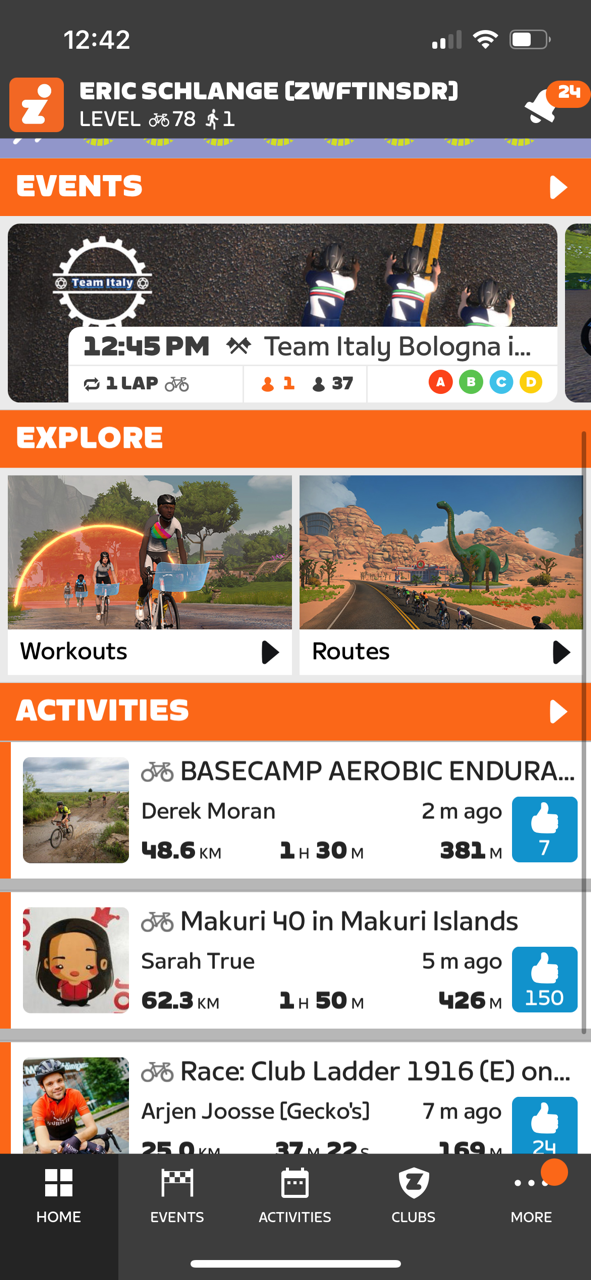
With this new update to the Zwift Companion app, it’s never been easier to plan your Zwift rides and workouts. Once live, this update will let Zwifters browse workouts and routes in the companion app and select the ones you want to do. Then, selections will be queued up on the Zwift home screen—no more searching through content options when it’s time to ride!

Avatars Get a New Look!

Coming in February!

Zwift avatars’ faces will be getting a whole new appearance in February. Our avatars haven’t been refreshed in a long time, and this change will give avatars a fresh new look.

Choose Any Avatar

Coming this Winter!

With Avatar Choice, you’ll be able to choose between all of Zwift’s available avatar types. Zwifters will no longer only see the avatars that correlate to the gender selected in your profile. Instead, cyclists can choose any avatar.

While we’re excited to let Zwifters choose any avatar they’d like, event categories will still match the gender of the rider’s profile for social events and racing, no matter which avatar is selected. Male profiles will only be able to enter male and open events. Female profiles will be able to enter female and open events, even if a woman chooses a male-presenting avatar.

Apple Watch Becomes a Heart Rate Monitor

Coming this Winter

The best heart rate monitor is the one you’re already wearing, so we’re adding Apple Watch heart rate compatibility to Zwift, making life easier for any Zwifter who already owns an Apple Watch. Pair Watch in the Zwift Companion app, as with any other heart rate monitor, and track your heart rate on-screen as you ride and run.

Zwift Games

Join the Games from February to March

Zwift is transforming cycling esports with the Zwift Games. This new event will be the largest event of its kind and is designed to give any member of the community a chance to enjoy fun and challenging racing. Elite racers can qualify to compete in championships events!

Community Racing: The Zwift Games will be Zwift’s biggest-ever community racing tour, featuring three Sprint stages, an Epic stage for endurance riders, and a Climb stage for the mountain goats. Zwifters can challenge themselves by completing all five races as a stage race, or pick and choose their preferred stages throughout the month of March.

With a number of specially designed new routes and some awesome Zwift Games unlocks available, there’s truly something for everyone.

Events will be available at multiple times every day throughout March, for all categories.

Elite Racing: During the first three weekends in March, the world’s best male and female Zwifters will take on the same courses as the community in a bid to be crowned the Zwift Games Elite Sprint, Epic, and Climb champions. The best performing female and male athlete across all three events will also earn the ultimate accolade of becoming the inaugural Zwift Games All Round Champion. The eight champions will earn a share of Zwift’s biggest ever prize purse and each unlock one of Zwift’s most recognisable icons, resplendent in gold.

All championship racers will be subject to pre- and post-race performance verification and all races will be broadcast all around the world.

Information on how any top level Zwifter can qualify for the elite championships will be shared by the 15th of December.

Rapha Festive 500

December

Join the annual Festive 500 challenge and complete 500 kilometers between Christmas and New Year’s! Both Zwift and outdoor rides count toward your total, so tick off the kilometers and earn an event badge and Festive 500 kit!

Fitness Jumpstart with Coach Kristin

January – February

Three-time Olympic Gold Medalist Kristin Armstrong is busy. She’s a successful coach, entrepreneur, and a mom who needs to be efficient when working out. Her new training series is approachable, efficient, effective, and fun—perfect for any busy cyclist and a great way to start the new year with a commitment to your fitness.

Starting in January, the eight-week Fitness Jumpstart with Coach Kristin invites all Zwifters to start the New Year right. Program workouts are available on-demand and live to fit any schedule. Kristen will lead select sessions. Each week of the program is designed around helping riders learn about a specific aspect of training.

Plus, you can stay motivated, make friends, and ask questions in the Zwift Women’s Training Club group chat on the Zwift Companion App.

Tour de Zwift and Rebel Routes

Start the tour in January

Ride routes that are inaccessible most of the year during one of the year’s largest Zwift events, the Tour de Zwift, and earn route badges that are not otherwise available!

This year, Zwifters who complete stages or the whole tour will also unlock a new in-game kit—including Zwift’s first-ever bucket hat! Zwifters can also buy a matching real-world kit from Le Col!

l’Etape du Tour

Start Training in February

Every year, L’Etape du Tour de France hosts and organizes the biggest amateur Gran Fondo in the world on one stage of the Tour de France. As an official partner of L’Etape du Tour de France this year, Zwift is bringing all the energy, enthusiasm, and excitement of the world’s hardest amateur race into Zwift.

Starting in February, there will be monthly two-stage Fondos over weekends in February, March, April, and July. Zwift will also introduce an eight-week training program for the L’Etape du Tour and add some of the famous climbs from the route to Zwift’s Climb Portal. These climbs are a great way to prepare for this challenging one-day cycling event or just get ready for a summer of tackling the most challenging climbs in your local area.

New March Event

Join in March!

In March, Zwift will reveal an all-new event and introduce a new way to earn rewards! Look for more information in February, and get ready to take a spin to earn Zwift rewards in a whole new way.

Your Thoughts

What do you think of Zwift’s plans for the winter? Share below!

How To (Almost) Kill Yourself On a Smart Trainer – Episode 2

Episode 2?  I had no idea that my original article was “Episode 1.”

Yes, I was delighted at how a stent to clear a coronary blockage instantly transformed my heart function and mostly restored my energy levels.  What Episode 1 didn’t say was that there were a few other partial coronary blockages of my left anterior artery that didn’t get fixed, either because they were too minor to meet the threshold for stenting or were too awkwardly located to safely stent – for instance, a lesion at a 90-degree intersection. 

The knowledge that I still had these unrepaired little time bombs – that‘s how I thought of them – proved to be a source of great anxiety.  This resulted in my first full-on panic attacks, complete with my wife, at great urging, driving me to emergency in the middle of the night.  I was annoyed at the behaviour of hospital staff who didn’t seem to understand the urgency of the situation – I was dying!  Or so I thought.  They knew better.  But since I was a recent cardiac patient, I did get a fairly complete medical workup to confirm everything was OK.  I’m embarrassed to say I put hospital staff through this routine several times.  Guess I’m just a slow learner… although I did learn that anxiety issues are as tenacious as they are unwelcome.

An Issue Hiding in Plain Sight

One aspect of the extensive diagnostic testing that preceded my stent in March of 2021 was an echocardiogram.  Virtually the same process as a prenatal ultrasound, except the technician was taking videos of my heart and valves rather than pictures of a baby in the womb.  “Fascinating to see my heart valves flapping away” I wrote in Episode One.  One of the things the technician noted was an atypical arrangement of my aortic valve.  “You have a bicuspid valve,” she said.  “Is that a problem?” I asked.  “Not necessarily,” she replied.  “It’s just something we need to keep an eye on with an annual check.”

And that’s what happened.  My wife and I made a joyous return to our beloved Tucson for eight weeks at the beginning of 2022; a lot of cycling each week seemed to confirm I was OK, although the 2021 stent repair wasn’t exactly transformational: in my estimation I still “sucked on hills.”  While I could almost keep up with the faster riders in the group, there was still that feeling in my chest that the engine just wasn’t putting out the power.  It wasn’t the sort of feeling that would have me going to emergency; rather, it was just the familiar sensation that something was holding me back.  With my heart having recently been repaired with the stent, I figured it was still a case of inadequate lung capacity.  An unpleasant reality that I would just have to live with; after all, it had been my companion for decades.

With our return to Canada in March I was booked for the annual echocardiogram.  Again, the assessment of the bicuspid valve was “moderate stenosis (narrowing).  Continue to monitor.”  Nothing to worry about.  I happily Zwifted while waiting for better riding weather.

Riding Back Home

One of the problems with belonging to a cycling club with a core of long-time, dedicated members is that over time, everyone gets fitter and faster.  It’s actually kind of annoying.  And with a trend toward winter trail riding, a larger percentage of club members have started riding year-round.  The obvious problem with that is you can’t rely on “winter hibernation fitness decline” for a lower Spring road ride pace.  And of course there’s Zwift, so no matter how miserable the winter, people who rode B1 in the Fall and Zwift throughout the winter are still ready to rock in Spring with at least a B1 (or B1+) pace. 

I had a fairly long history of hanging with the B1s, but the Spring and Summer of 2022 were tough.  I attributed my inability to stay with the group to the factors listed above.  While Tucson had been great, I also found myself performing there at a level below expectations.  Perhaps my expectations needed some adjustment?  That was hard to stomach, and it was mostly a matter of pride. And speaking of pride, my daughter had occasionally been Zwifting on my account (true confessions) which meant that my best recorded efforts on certain sprints and climbs were in fact her best efforts.  She is a strong rider and was consistently kicking my butt with average watt outputs besting mine by 50 or more.

And then around the end of August 2022, it was a case of déjà vu all over again.  Not only was my most energetic butt-busting effort on the trainer coming nowhere close to matching my daughter’s wattage on specific segments (the data-rich Zwift experience showed I was actually in decline), but I began to experience a familiar heaviness in the chest.  Oh man, I thought – I’ve seen this movie before.

A Short Drive to the Cardiac Unit – Again

In the movie to which I refer (see Episode 1) the protagonist drives to the hospital in the middle of the night, thinking he has pneumonia, only to find he has something far more serious.  Having learned that consulting with medical experts is a really good way of dealing with the unknown, it seemed a good idea to do that again. 

The admission routine at Royal Jubilee Hospital was efficient and cordial – again, arriving in the middle of the night and having the status of a former cardiac patient helped grease the wheels.   The familiar arterial hardware was inserted and the battery of tests began.  While the ECG tracing was not definitive, it did suggest something going on, and I was discharged with an appointment for a follow-up echocardiogram.  Knowing that my history revealed a bicuspid aortic valve, medical staff clearly thought that should be checked – even though the “echo” five months earlier had shown no cause for concern.

The echo in September of 2022 was a revelation – and not a happy one.  As a cycling friend who was a cardiac surgery nurse in a past career explained, “bicuspid valves generally work fine until they don’t.”  Meaning the transition from fine to seriously not fine can be a steep slope – and so it was in my case.  In the few months since my last echo my condition had gone from “moderate stenosis – continue to monitor” to “severe stenosis – urgent surgery.”  That got my full attention, and a place in the triage lineup for cardiac valve replacement.

What exactly is a bicuspid valve?

The aortic valve is THE valve regulating the flow of oxygenated blood from the heart to the rest of the body, including the heart itself.  A proper functioning valve has three triangular cusps, or flaps, which when closed resemble the Mercedes 3-pointed star (see the diagram below).  The “bi” in bicuspid indicates (bicyclists are likely to guess the answer to this) two flaps, typically the result of congenital malformation.  Those with an engineering bent will instantly see that the bicuspid arrangement results in less than complete opening of the arterial channel, meaning less blood flow, and importantly, less ability to hang with the group in situations requiring high cardiac output, such as sprints and climbs.

FUN FACT: 1 to 2% of the population are born with some variation of a bicuspid valve.  That’s 100 to 200 riders on a weekend morning with 10,000 Zwifters online!  Do I have your attention now?

The Main Event

After a couple of false starts, typically a result of being bumped due to genuine life-and-death emergencies taking precedence,  I was finally prepped and wheeled into the operating theatre on November 28, 2022.  Just as it was with my stent procedure, I was more fascinated than frightened. 

While every medical system has its merits and faults (the Canadian/American system debate continues, as it will for a long time to come), what is indisputable is the effectiveness of the Canadian triage-based system for allocating priority care to those with serious conditions.  As my deteriorating valve had allowed me to rise to the top of the triage ladder, I now got to enjoy the focused attention of an open-heart surgical team at the top of their game.  At least that’s the memory that was seared into my last moments of consciousness before it was “lights out” with the general anaesthetic.  A brief glimpse of gloved and caped superheroes playing their roles with practised precision amid gleaming towers of equipment.  Waiting off to the side was the new piece of kit ordered just for me:  an Inspiris bio-synthetic aortic valve replacement with plates crafted from bovine (yes, cow – hopefully specially-raised cows) pericardium.  For good measure I also got a single bypass arterial graft to ensure unrestricted flow to the left anterior artery where I had that potentially troublesome non-stentable restriction.

Minutes later (that’s how it seemed), I woke up in the cardiac recovery unit where, for at least the first 24 hours, it was one-on-one, round-the-clock attention from a team of highly experienced cardiac care nurses.  Again, it was fascinating to observe the system at work, and to watch close-knit professionals devoted to their craft handle every conceivable challenge with panache.  I learned that the staff turnover in this most demanding wing was almost zero; they love what they do.  As for me, I was pretty much a gratefully helpless recipient of their attention and had to admit the drugs they administered were great.  I gained new insight into the inspiration for some of the Beatles’ tunes from their Strawberry Fields Forever period.

Recovery

While the Cardiac Patient Manual – a comprehensive tome – said that I could resume all my normal activities without restriction after three months, a wise doc buddy said that was optimistic, especially for high-output sports like group road rides.  My wife and I did return happily to Tucson after three months, only for me to confront the reality that even though I had a new high-efficiency, full-flow valve, my heart muscle had still sustained a surgical trauma and would take time to heal back to its old self.  A cycling buddy who had been an elite-level competitive runner added some additional wisdom: don’t push it.  “Train Zone 2” for long hours was the mantra – both for cardiac recovery and for building base endurance capacity.  There are a ton of YouTube videos on the subject, and the GCN guys do as good a job as you could hope for.  It’s surprisingly hard to do as it requires solid, patient discipline and is almost impossible on group rides.

Here’s where Zwift came to the fore once again.  With the re-engineering of the user interface I found Zwift more fun and more useful than ever before.  The must-have feature for me was the 24/7 Group Rides (RoboPacers) organized by watts/kg. Now I could truly do Zone 2 for hours without having to constantly adjust or restrain myself – all I had to do was hang with robo-leader Taylor.  (I wonder if any of my friends knew I was riding with Taylor Zwift! DAD JOKE)

And my doc buddy was right:  it takes at least a year.  As I write this, it’s one week after the 1st anniversary of my valve replacement, and I’m starting to feel the results of a healing heart.  I’m back in Tucson, riding mostly with the “bigger dogs” and truly enjoying the occasional full-on climb. I’m confident (and grateful) that with consistent training my cardiac output will be what I’ve always hoped for.  We’ll see…

Lessons Learned

  • Pay attention when someone notes an anomaly in your physiology, such as “You have a bicuspid valve.”  While it may not be a big deal today, it could be one tomorrow – learn about it.  Bicuspid valves can also be genetically inherited, so if you have one, and have children, it’s a good idea to have your kids “echoed.”
  • If you have any cardiac symptoms at all (see Episode One!), keep your diagnostics up to date.  Have you had an echocardiogram?  It’s easy, painless, non-invasive, and (I’m guessing here, you’ll have to do your own research) reasonably priced, the biggest cost element being the interpretation of the videos by a cardiologist.

Big Thanks

Huge life-saving thanks to cardiac surgeon Dr. Kenny Kumar and his team at Royal Jubilee, and the terrific cardiac care nurses who manage the patient’s post-surgical entry into the real world.  And big thanks to all the people who responded to Episode One with detailed accounts of their own, validating the importance of listening to your body and not “pushing through the pain” as many athletes do either on command or instinctively.  The response I enjoyed most came from a fellow with an email address @zwift.com who said, “Your article is saving lives – probably mine!  It would look really bad if I died on the job…

Top 5 Zwift Videos: Zwift Racing, Top Trainers, and Annual Subscriptions

Zwift season is here! Watch videos about a Zwifter racing in the fastest race of the week, top smart trainer buys, a Zwifter rage quits a tough race, a Zwift Academy contender tackling workout 5, and details about Zwift’s new annual subscription.

Racing in the Fastest Category B Race

Watch as Oli Chi from ZRace Central provides commentary and analysis over his recent race in the ZRacing Neokyo Nights Stage 3. Can he hold on in the fastest race of the week?

Zwift Finally Adds Annual Subscriptions! Save 17%

Zwift has recently implemented annual subscriptions, which can help those of you year-long Zwifters. Watch to learn more about the change!

My 2023 Guide to the Best Smart Bike Trainers for Zwift

Indoor training season is here! For those looking to upgrade their setup, Tariq Ali from Smart Bike Trainers has a guide to the top smart trainers for Zwift. His list includes the top overall, budget, and smart bike.

I Rage Quit My Hardest Zwift Race Ever! – Cat D Zwift Racing

In the first race of the series, Benji Naesen ends up rage-quitting the race as he is dropped from the group pretty quickly. However, he continues to work hard and eventually finishes. Watch as he tackles these brutal Zwift races!

Zwift Academy Workout #5 – Steady State

Zach Nehr, an extremely strong Zwifter, is looking to be a finalist in Zwift Academy Road. Watch as he tackles Zwift Academy Workout #5. 

Got a Great Zwift Video?

Share the link below and we may feature it in an upcoming post!

Zwift Grand Prix: Round 5 Men’s Points Race Report

1

Zwift Grand Prix: Round 5 Men’s Points Race Report

This week, the 2023/2024 Zwift Grand Prix returned to its roots with a short and explosive points race on The Muckle Yin in Scotland. Round 5 of the Zwift Grand Prix saw the 16 men’s teams return for 23.7km on one of the toughest courses on Zwift. There were five intermediate sprint points along the route, each offering FAL (First Across the Line) points to the first ten riders, scored from 10 points down to 1 point. 

40 points were on offer to the first riders across the finish line, with a long list of points available for each position behind. Placing multiple riders in the Top 20 could propel a team to victory. But would it be a worthy strategy to forgo the intermediate sprint points and focus on the finish? We’d soon find out. 

Watch the Livestream

There were also power-ups available at each intermediate sprint, plus the banners in between. Each banner had a specific power-up on offer, which riders could choose to use or keep before the next banner. Some riders used their power-ups right away, while others held on for key moments of the race. In the final kilometers, the race winner played his cards – or should I say power-ups – perfectly. 

At the Breakaway Brae Reverse sprint, Holden Comeau (Saris | Nopinz) took the points ahead of Kjell Power (Movistar eTeam) and Bjoern Andreassen (Wahoo Le Col). Lennert Teguels (ABUS – Synergy) was 5th across the line, and that was just the beginning of his massive points haul. 

The next sprint (Sgurr Summit North) would break the peloton apart for the first time, and it was Martin Maertens (Toyota Elite ECycling) who led across the line ahead of Marc Mäding (Beastmode p/b Rose) and Lionel Vujasin (Coalition Alpha). Teugels finished 6th in the sprint, bringing ABUS – Synergy’s points total to 16 in a tie for the lead with Coalition Alpha. 

Chris Dawson (Wahoo Le Col) used his Anvil power-up to go clear of the peloton before the third intermediate sprint: Breakaway Brae. Power earned big points again with second across the line, with Teugels taking third.

Now at the halfway point of the race, the riders’ legs were starting to get tired. The next sprint would shatter the field into pieces, and it was Michał Kamiński (Coalition Alpha) who led out the sprint on Sgurr Summit South. The strongest riders were all showing themselves at the front of the race, and Teugels took the 10 points, with Mäding in second and Maertens in third.

Riders scrambled to deploy their Steamroller and Anvil power-ups on the descent of the Sgurr Summit, and by the time they reached the bottom, only 25 riders were left in the front group. Tired legs turned into exhausted legs as Josh Harris (BL13 p/b Level Velo) and N. Fryett (Restart) went all-in on the Clyde Kicker. The American took the points ahead of Harris and Andreassen, but the big move was coming up fast. 

Maertens, Teugels, and Andreassen had saved their Anvil power-ups for the descent off of the Clyde Kicker, and the trio went clear of the pack with 1.4km to go. Teugels was pushing the pace until 1.1km to go when Maertens went over the top of the Belgian and used his Aero power-up to gain speed on the descent. 

Just like that, Maertens had put on a Zwift power-up clinic, earning a five-second gap and soloing to the victory. The German took his second win of the Zwift Grand Prix season, while Mäding won the sprint for second, and Teugels crossed the line in third. 

Lennert Teugels scored at every intermediate sprint to help propel ABUS – Synergy to victory with 139 points. After trailing the entire race, NeXT eSports pb Enshored put two riders in the Top 10 and two more in the Top 25 to earn 121 points and 2nd place on the day. Coalition Alpha finished 3rd ahead of a tightly packed group that included Beastmode p/b Rose in 4th, and Toyota Elite ECycling in 5th. 

There was a big shake-up in the Zwift Grand Prix overall standings as Wahoo Le Col dropped off the podium after finishing 7th in Round 5. ABUS – Synergy continues to lead the series ahead of NeXT eSports pb Enshored, while Coalition Alpha moved onto the podium in third. 

Coming Up Next

The 2023/2024 Zwift Grand Prix continues next week with Round 5 – Women’s Team Time Trial on Triple Flat Loops. All 16 teams will start with five riders, with their time taken from their third riders across the line.

Round 6 of the 2023/2024 Zwift Grand Prix will return after the holiday break, on January 11th, 2024, with the men’s and women’s Epic Points Race. Both Zwift Grand Prix fields will take on the PRL Half course, completing four ascents of Box Hill before the iconic finish line in London.


A Vibrant Community

3

A Vibrant Community

As Stacy Sims says in her 2016 book Roar, “Women are not small men.”  Our racecraft is different, our power profiles are different, and our competition is… different.  For many of us, racing against women is uplifting in a way that mixed racing is not.  Women’s racing has developed the way many women’s communities do – out of a sense of togetherness rather than a need to distinguish oneself.  The racing can be as fierce as on the mixed side, but the training beforehand and the support afterward certainly isn’t.  Many of the best women’s racers on the platform with a penchant for teaching have stepped up to help those of us who want to learn and grow as riders.

For example, Gabi Guerra has started leading a weekly sprint training session where a group of women practices the technical side of racing – spinning your legs fast and jumping your power up to sprint pace. 

The group stays together and the ride is open to women of all ability levels and teams. Throughout the sessions, Gabi fields questions and gives advice based on her training and experience.  She also points out women in the group who are great sprinters so others can see the avatars’ acceleration.  This type of support helps women improve their cycling skills and feel more confident in their ability to race.  

Another prime example of women building up women racers is Alice Lethbridge, currently on The Coalition. Alice has spent immeasurable hours helping multiple women’s teams develop to their full potential by explaining race tactics, helping with the technical implementation of those tactics, developing individual riders to the best version of themselves, and DS’ing the ZGP women of The Coalition. 

If you ever raced against a team developed by Alice, you know just what that teaching added to the team. 

In a third prime example of women helping women, Karla, the co-founder of Aeonian, along with her core management team, spends time with each racer developing their virtual racing abilities and understanding of strategies used in Zwift racing. Additionally, the team equips them with terrain knowledge and tactical insights, ensuring readiness for various scenarios that may unfold during the race.

This expertise is often the difference between a podium finish and a back-of-the-pack finish.

Finally, the advocates for women’s racing are not limited to women racers.  James Bailey, formerly of Herd and now working for Zwift, has been a tireless advocate for women’s racing since he led the HERd SHEries in 2018.  He not only has a wealth of information on the logistical setup and participation rates of women’s series, but is always advocating, connecting, and supporting women organizers.  He was the first to point out to me, when I wanted to put on a women’s series, that there are, and have been, many great women’s series, but not enough racers to participate in all the races.  His support of women’s racing is impressive and highly valued by the women’s racing community. 

Racers like Gabi, Alice, and Karla, and supporters like James, make now an awesome time to jump into women’s racing.


A Brief History Of Women’s Racing on Zwift

6

A Brief History Of Women’s Racing on Zwift

Women’s racing on Zwift isn’t new – Karla Williams at Aeonian has been racing since the end of 2017 in women’s-only races.  A look back on ZwiftPower at that race shows some of the major players are still on the platform six years later, including Jenn Real.

While the fields started out very small, women-only racing has always attracted women who want something a little different than the average testosterone-filled mixed race.  Since 2017, many of the great Zwift teams have organized women’s series, including Fearless, Herd, Rocacorba, Team Swedish Zwifters, and SRAM. Many of these races are amazing and include a bit of… je ne sais quoi. Great racing, great camaraderie, great courses for women, and just a feeling like you are racing on a level playing field – like if you try to jump off the front you have a chance to get away, or if you fall from the front group you might not be doomed to iTT (solo ride) your way through the rest of the race. 

As fabulous as the race organization is, the field sizes in the women’s races have always struggled to match their mixed-division counterparts.  In short, women’s racing needs you, Zwifter woman, to make it better.  


A Complete Visual List of Zwift Level 61-100 Unlocks

A Complete Visual List of Zwift Level 61-100 Unlocks

Zwift released levels 61-100 this week, and with it lots of fun unlocks. Kits, shoes, socks, gloves, sunglasses, hats/helmets… there’s enough to fill a closet or two. Here’s a look at each and every unlock for Zwift’s new levels!

Level 61: Cool Tone Gloves (3 Pairs)

Level 62: Bike Packer Socks

Level 63: London Tube Kit

Level 64: Pop Art Shoes

Level 65: Tortoise & The Hare Sock Pack (2 Pairs)

Level 66: Bike Packer Kit

Level 67: Giro Aries Spherical Helmet

Level 68: Alpe du Knit Kit Pack (3 Kits)

Level 69: Bike Packer Cap

Level 70: Level 70 Kit

Level 71: Scotty Squirrel Cap

Level 72: Makuri Blossoms Kit

Level 73: Dino Power Cap & Socks

Level 74: Outfield Kit

Level 75: Rapha Pro Team Shoes

Level 76: Dino Power Kit

Level 77: Scotty Squirrel Socks

Level 78: Island Time Kit Pack (3 Kits)

Level 79: Dino Power Shoes

Level 80: Level 80 Kit

Level 81: Light Aero Helmet

Level 82: Wolf Power Kit

Level 83: Rapha Pro Team Full Frame Sunglasses

Level 84: Solid Color Kit Pack (3 Kits)

Level 85: Nimbl Feat Ultimate Shoes

Level 86: Kask Elemento Helmet

Level 87: Gravel Party Kit

Level 88: Party Sock Pack (3 Pairs)

Level 89: Giro Imperial Shoes

Level 90: Level 90 Kit

Level 91: Modern Kit

Level 92: Mirage Socks

Level 93: Out of This World Kit

Level 94: Mirage Cap

Level 95: Mirage Kit

Level 96: S-Works Evade 3 Helmet

Level 97: Out of This World Socks

Level 98: Mirage Shoes

Level 99: Mirage Helmet

Level 100: Level 100 Kit (and more?*)

*Sources within Zwift tell us they may be at work on an additional special unlock for level 100 which will be ready before the first Zwifter makes it to level 100.

What’s Your Favorite?

What do you think of the level 61-100 unlocks? What’s your favorite? Comment below!


Notable Zwift Events for the Weekend of December 9-10

4

After the announcement of the latest change to leveling up on Zwift, lots of you may want to complete longer rides to rack up that sweet, sweet XP. Because of this, we’ve selected a wide variety of endurance events!

🥇 KISS Racing – The 100

✅ Popular Event  ✅ Endurance Race   ✅ Highly Competitive

If you’re looking to race with some of the best of the best, or just simply want a challenging race, the KISS 100 is where it is at. Every week, this iconic 100-kilometer race draws some of the top riders in each category.

The race will be taking place over two laps of the Eastern Eight course in Watopia.

Two time slots this Saturday
Sign up on ZwiftHacks


🤝 Foudre Saturday Coffee Ride

✅ Popular Event  ✅ Sweet Unlock

Join Foudre for a social ride around the roads of Zwift. There will be a leader and sweeper present in this ride. Join Foudre on Discord in order to get in on all the fun and chatter. Note: the ride already has over 100 riders signed up, making it one of the top events this weekend.

As a bonus, completing this event will unlock Foudre’s epic lightning kit! The ride will take place on The Big Ring and will last 90 minutes.

Satuday, December 9th @ 8:30am UTC
Sign up at zwift.com/events/view/3987545


🤝 4Endurance Holidays League p/b VirtuSlo

✅ Popular Event  ✅ Highly Competitive

The VirtuSlo Holidays League is starting this Sunday. In the past few months, VirtuSlo’s races have attracted lots of riders! One of the elements that make these races so popular is that the gap between categories is smaller, making it easier to be competitive for those at the lower end of categories. The league is entirely based on finishing position, so there is no need to worry about points on segments.

The first race takes place on one lap of The Big Ring.

Sunday, December 10th @ 9:45am UTC/4:45am EST
Sign up at zwift.com/events/view/3990497


🤝 ENJOYYOURBIKE @ ZWIFT

✅ Popular Event  ✅ Sweet Unlock

The team at Enjoy Your Bike has decided to host a Zwift ride where riders can socialize and have a fun ride around the roads of Watopia. Completing this ride will unlock the all-new Enjoy Your Bike in-game cycling kit. With over 200 riders signed up for this event, it is the most popular event this weekend!

The group ride will be taking place over one lap of the Accelerate to Elevate course, which goes through the Southern Coast and up the Alpe.

Sunday, December 10th @ 2pm UTC/9am EST/6 am PST
Sign up at zwift.com/events/view/3943617


🤝 PACK 1.5 Sunday Supportive

✅ Popular Event  ✅ Legacy Leaders

Join the amazing leaders from PACK for a social group ride around the roads of Watopia. When looking at the event settings, it appears that PACK also has the event set to all Aero Boosts. If you intend to go for the sprints, be sure to regroup afterward.

The group ride will take place over 60 minutes on the Coast Crusher course in Watopia.

Sunday, December 10th @ 3:25pm UTC/10:25am EST/7:25 am PST
Sign up at zwift.com/events/view/3990586

How We Make Our Picks

We choose each weekend’s Notable Events based on a variety of factors including:

  • Is the event unique/innovative in some way?
  • Are celebrities (pro riders, etc) attending/leading?
  • Are signup counts already high, meaning the event is extra-popular?
  • Does the ride include desirable unlocks or prizes?
  • Does the event appeal to ladies on Zwift? (We like to support this under-represented group!)
  • Is it for a good cause?
  • Is it just plain crazy (extra long races, world record attempts, etc)?
  • Is it a long-running, popular weekly event with a dedicated leader who deserves a shout out?

In the end, we want to call attention to events that are extra-special and therefore extra-appealing to Zwifters. If you think your event qualifies, comment below with a link/details and we may just include it in an upcoming post!

Your Thoughts

Got other events that stand out this weekend? Share below in the comments!

Garmin Announces New Tacx NEO 3M Smart Trainer

13

Garmin Announces New Tacx NEO 3M Smart Trainer

Today Garmin announced the latest version of their flagship NEO smart trainer: the Tacx NEO 3M. Replacing the 4+ year old NEO 2T as Garmin’s top trainer, the 3M brings some notable improvements… and a hefty price tag. Let’s dive into the details!

New Features

The Tacx NEO line has long been considered the “gold standard” of smart trainers, especially in terms of power accuracy. Having evolved over the years, the NEO 2T already has many of the features you’ll find in top-tier trainers: 1% accuracy, auto-calibration, near-silent operation, and max wattage/incline that you’ll never exceed. Heck, it even had a sort of race-mode power broadcasting at 4Hz, before everyone else starting supporting 10Hz!

So what did Garmin upgrade to create the NEO 3M? Here are the biggest changes:

  • Built-in motion plates allow for a total of 5cm of fore-aft movement
  • WiFi and ethernet connectivity via an add-on accessory
  • 11-speed cassette pre-installed
  • Built-in handle
  • 2 concurrent Bluetooth connections supported

There are lots of “smaller” changes as well. Garmin also beefed up the resistance unit and internal cooling systems, so even though the max wattage/incline specs are the same as the NEO 2T, the 3M can handle heavier loads at lower speeds (like climbing steep hills on Zwift). Additionally, the power adapter “brick” has been moved internally for a cleaner plugin setup, various lights/buttons have been modified, and, according to early reviews, the 3M’s ERG capabilities have been improved substantially, making it perhaps the best ERG trainer on the market today.

Let’s dive a bit deeper into the key new features…

Motion Plates

Garmin has been selling motion plates for the NEO for a few years ($299USD), and the 3M’s plate have precisely the same movement ability. Garmin has added lockout knobs on the 3M in case you want to stop the fore-aft movement, but otherwise you’ll get around 2.5cm of backward movement and 2.5cm of forward movement.

It’s worth noting here in the “motion” section that the NEO has always allowed for a bit of side-to-side movement. Garmin has finally leaned into this a bit with the 3M, changing the unit’s design a bit to ensure that the side-to-side movement is even.

While 5cm of movement is better than nothing, it’s far from a full range of movement. (For comparison, the Wahoo KICKR Move has around 20cm of fore-aft movement.) In terms of side to side movement, both the NEO 3M and KICKR Move offer a bit of it, but again, it’s nothing like the natural full side-to-side movement you’ll get with a good rocker plate.

WiFi/Ethernet

The NEO 3M supports connections via WiFi or wired ethernet, but only if you buy the optional add-on accessory. (This unit isn’t yet listed on Garmin’s site, so we don’t know pricing.)

Like 3M’s motion abilities, Garmin’s implementation of WiFi/ethernet for the 3M are a welcome upgrade… but the implementation falls short. Why not build it into the unit, like Wahoo has done with their top-tier KICKR trainers and smart bike?

Pre-Installed Cassette

Considering the substantial price increase between the NEO 2T and the 3M, it’s a good thing Garmin has opted to start including a pre-installed cassette with this unit. If you’re on an 11-speed bike, this is a welcome addition.

But Zwift has made both Garmin and Wahoo look a bit silly here, since Zwift sells the Hub One with your choice of cassette. A pre-installed 11-speed cassette included on the NEO 3M and Wahoo’s top KICKR trainers is great if you have an 11-speed bike, but if you’re on a newer 12-speed, you’re effectively paying for a cassette you can’t use.

Built-In Handle

This may seem like a small thing, and that’s because it is. So why did it take so long? NEO owners have long hated moving their units because the NEO is heavy and famously awkward to pick up since it has no good handholds. Garmin finally adding a handle is a good move.

Two Concurrent Bluetooth Connections

Bluetooth’s one-to-one pairing has caught many riders out, so premium trainers have been offering the ability to support 2-3 concurrent connections. The NEO 3M is the first NEO model to offer more than one connection – a welcome upgrade.

Pricing and Availability

There’s no arguing that the Tacx NEO 3M is a substantial improvement over the previous model. And it’s been a long time coming!

But here’s the rub: that improvement comes at a price. The Tacx NEO 3M went on sale today for $1999USD, which is a $600 price hike from the MSRP of the previous model NEO 2T ($1399).

If that sounds a bit crazy… it gets crazier. Because the NEO 2T is available from Garmin for just $899 (also available on Amazon and from other retailers for the same price).

So if you’re looking to buy a NEO, you have to ask yourself: are the improvements/features of the 3M worth paying more than twice the price of the NEO 2T? On top of that, if you’re open to other trainer brands, is the NEO 3M a better buy than the Wahoo KICKR ($1299) or Wahoo KICKR Move ($1599)?

We like the NEO 3M as a worthy upgrade to Garmin’s flagship trainer, but we don’t like the price compared to the competition (namely, Wahoo). The hard truth for Garmin is, if they want to be competitive in this space they’ll probably need to reduce NEO 3M pricing to around $1599, with the WiFi/ethernet accessory included.

More Reviews/Announcement Videos

DC Rainmaker’s in-depth review is excellent, as always. Read it here, and watch his video below:

Your Thoughts

Share below!