

There’s been a lot of talk in the Zwift Racing community recently regarding “microbursting”, aka “sprint-coasting.” Today I want to share some test results and open up a conversation about whether this riding style is cheating… or just odd. Let’s get to it!
What Is Microbursting?
There is no precise accepted definition for microbursting, but it can be described in very basic terms as short, repeated intervals modulating between sprinting (high power) and coasting (low or no power).
WTRL recently added a microbursting prohibition to the Zwift Racing League rulebook. Section 7.1.3 says:
The following is a list of behaviours that may result in investigation and penalty:
- …
- Utilizing techniques that exploit a networked game such as ‘Sprint-coast.’
WTRL further defined what they consider to be “illegal” sprint coasting in this Facebook post:
To provide clarity, the Sprint Coast technique is characterized as follows:
- Cadence rises to >100rpm and power >500W for 2-4 seconds.
- Cadence falls to <40rpm and power <100W for 2-4 seconds.
- This pattern repeats at a rate of more than 4 times per minute and is sustained for multiple minutes.
Microburst Testing
Microbursting isn’t an easy thing to test. If you do it “manually” (with your legs) it’s hard to have the precision needed to prove whether or not the technique gives you an advantage. And if you automate it with a bot, there are only certain power/interval combinations you can accurately replicate due to the tools available.
There’s been some confusion in the comments on this post, so I’m adding a note to explain that my goal here wasn’t to test sticky watts, which clearly give riders an unfair advantage. Although associated with microbursting, sticky watts are not the same as microbursting. Because, while sticky watts are usually triggered via microbursts, plenty of trainers/power meters let you do microbursts without sticky watts!
My goal here is to test if microbursts themselves exploit Zwift physics and provide some sort of unrealistic speed advantage.
After attempting to test it with my legs, my conclusions were that 1) there didn’t seem to be any obvious advantage, but also 2) I couldn’t get the accuracy needed to prove this. So I devised several automated tests.
The basic idea of these tests is to compare a steady-state rider’s performance with microbursts that average out to the steady-state rider’s power. For example: if a rider holds 300W steady, will they go as fast as a rider who is alternating evenly between 150W and 450W? Both riders finish with the same average power, but their efforts look very different.
Here are the results of my tests…
Flat Solo Rider Tests
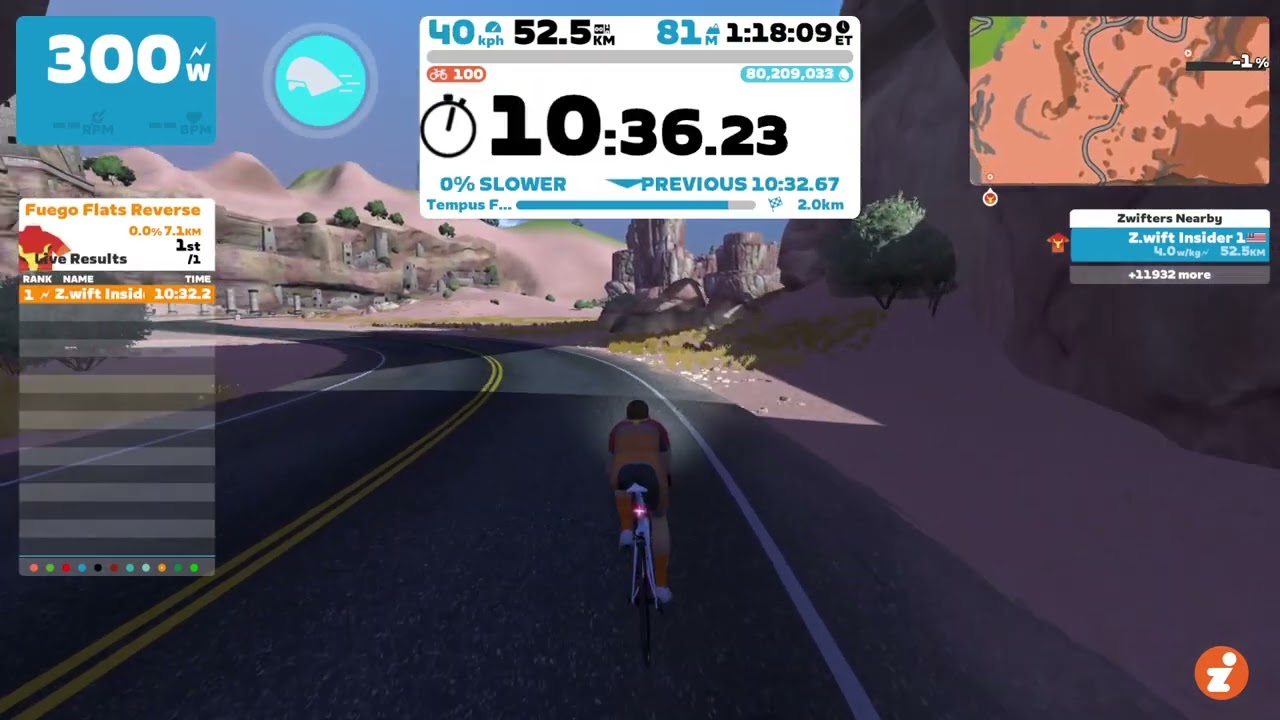
The first set of tests used a solo rider (our standard 75kg, 183cm tall bot on the Zwift Carbon bike with 32mm carbon wheels). I tested the rider on the Fuego Flats Reverse segment at steady 300W power, then at various microburst intervals. Here are the results:
- 300W Steady: 10:36.23
- 600W to 0W in 1-second intervals: 10:31.52
- 500W to 100W in 3-second intervals: 10:31.46
- 600W to 0W in 4-second intervals: 10:32.66
- 550W to 50W in 2-second intervals: 10:31.01
- 350W to 250W in 10-second intervals: 10:33.87*
Zwift’s Pack Dynamics v4 includes a CdA bonus for riders who are “attacking.” Specifically, if you are not drafting and your power is 20% higher than your last 10-second average power you get a 5% CdA reduction. This particular test was set up to attempt to exploit this feature.
Just to prove a couple of these times, and to show what it looked like, here are the bots finishing two of the tests:
300W Steady
500W to 100W
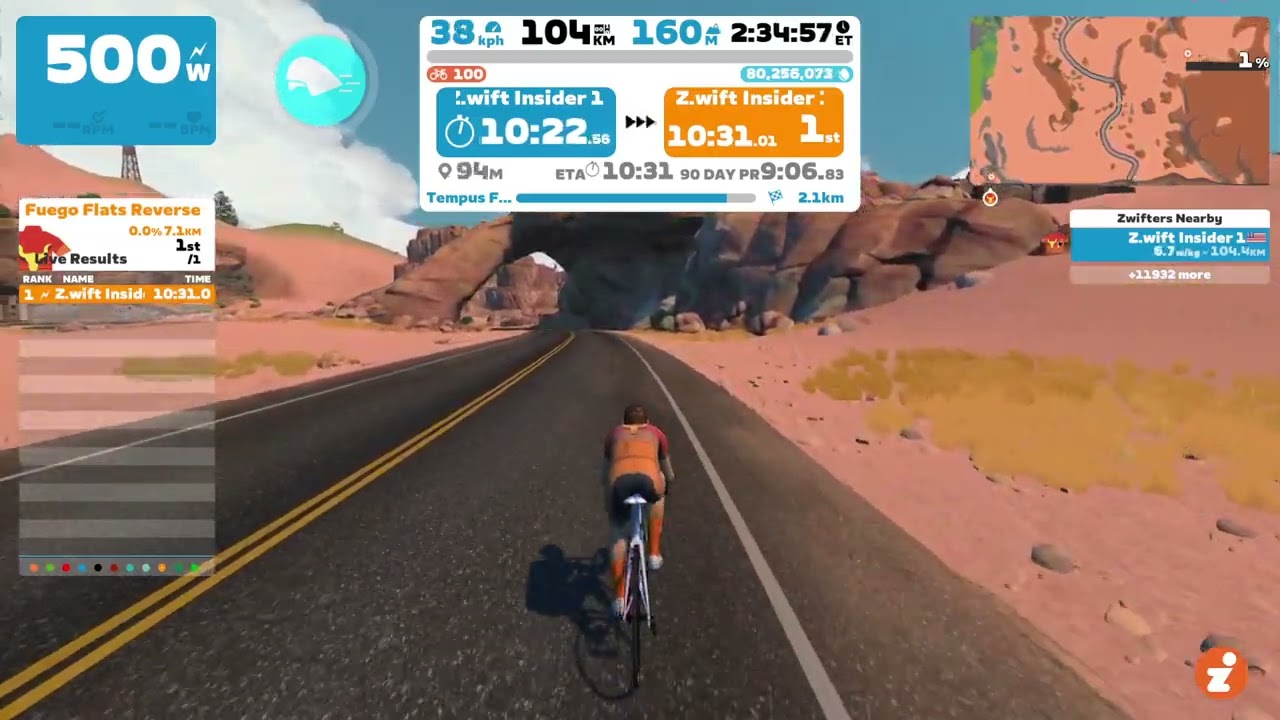
These test results are interesting: clearly there is a slight speed advantage to microbursting, as all of the microbursting schemes beat the steady bot by 4-5 seconds. But is 4-5 seconds a big enough improvement, considering you’d be riding short intervals for 10 minutes to get it?
Climbing Solo Rider Tests
Many stories I’ve heard about microbursting in races seem to involve climbs. To put it another way: riders seem to utilize this technique on uphills more than flats or descents.
So I figured I should test it on a climb. How about the Alpe? I put the bots to work. Here are the results:
- 300W Steady: 49:30
- 400W to 200W in 4-second intervals: 49:30
- 500W to 100W in 4-second intervals: 49:39
As you can see, the best I could do was to get the microbursting bots to finish at the same speed as the steady-state bot.
RoboPacer Tests
My last set of tests involved riding in a pack with a RoboPacer. This test was done to observe how a microbursting rider would perform in a pack drafting off of others.
I placed a bot in the Yumi RoboPacer group. Yumi holds 240W on the flats, and if my bot was at 240W steady he sat in the group quite nicely. I tried various microbursting intervals that averaged out to 240W, including the 380W to 100W interval you see here:
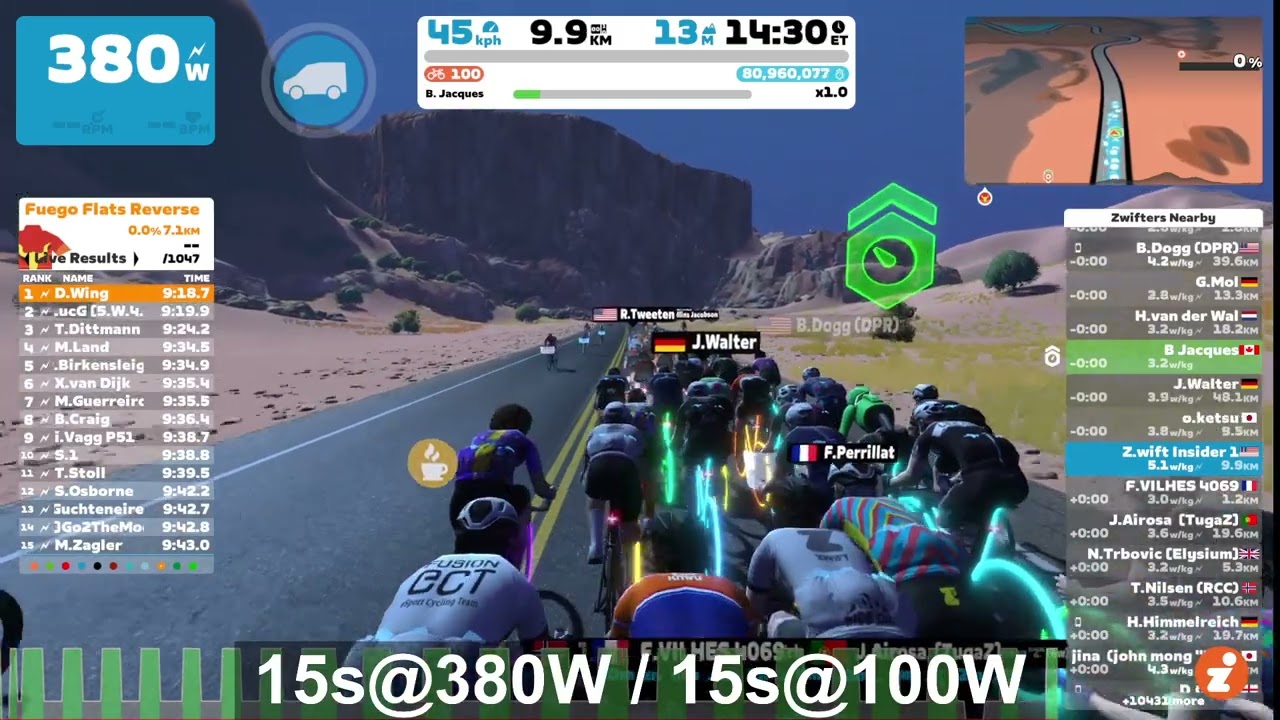
None of the intervals saw my bot break away from the group, or even go to the front of the group – in fact, he struggled to even stay with the group and after a minute or two would inevitably get dropped.
Summarizing Test Results
The tests above clearly show that microbursting results in higher speeds than steady-state power on flat ground. But is the speed increase enough to conclusively say microbursting gives riders an unfair advantage?
I say no.
Modulating your power in microbursts increases the perceived difficulty of a ride, at least for most riders. The physical and mental “cost” of microbursting seems to far outweigh any speed advantage it delivers.
A Sticky Watt Hypothesis
Based on the test results above, I have a hypothesis about microbursting in Zwift racing: microbursting by itself does not give riders an unfair advantage. The unfair advantage comes when riders combine microbursts with sticky watts.
What are sticky watts? Read all about them here, but simply put, sticky watts are “free” watts riders get when they stop pedaling for short intervals using certain power meters. As shown in the chart below (click for details), if you combine a sticky power meter with sprint-coasting you can increase the average power Zwift sees by 20% above the “actual” power you’re putting out.
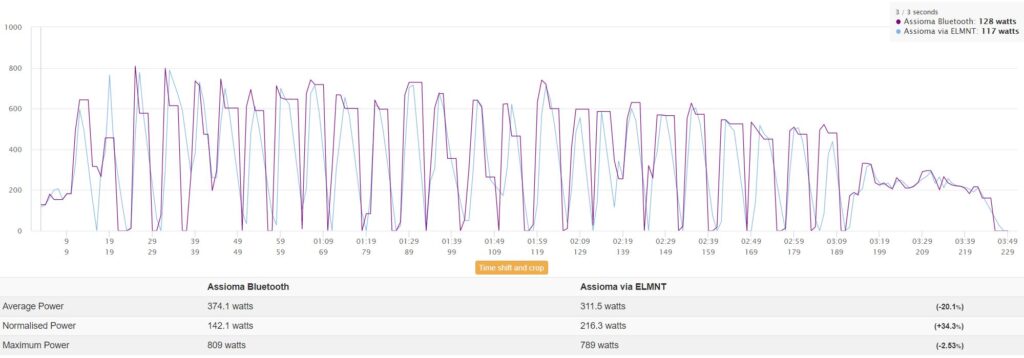
Someone with a lot of practice may be able to exploit sticky watts + microbursting even better than I did in the short test above. In fact, I believe there are Zwift racers doing precisely that.
Overall (Tentative) Conclusions
I’ll wrap up with four clear points:
- Sprint-coasting is not a “natural” pedaling technique, but that by itself shouldn’t make it “illegal.” Unless it can be shown to deliver an unfair advantage, it shouldn’t be outlawed.
- In all my testing (and there is much more than what I’ve summarized above) I have yet to find a method of microbursting that gives a significant advantage on Zwift.
- I’ve heard enough stories of racers using microbursting to win races they shouldn’t have won that I must conclude there is a method of microbursting that gives a significant advantage. I believe that method combines microbursts with sticky watts.
- I consider my conclusions above to be purely “provisional.” I realize my test methods and scope aren’t perfect, and there may be methods of microbursting (without sticky watts) that deliver a greater advantage than my test results show. If so, I would love to see hard evidence of such methods.
Your Thoughts
Do you agree with my conclusions? Got evidence to support or refute my provisional results? I’d love to hear your thoughts. Chime in below!


I suspect the main advantage with microbursting is that it’s not as tiring for a rider than doing steady state so trying to replicate this with a bot is impossible making it hard to quantiity the advantage.
and of course certain known trainers are slow to ramp down power is where the bursting can gain an advantage.
…which is sticky watts, which is common enough that microbursting simply has to be banned. The above article is really only for curiosity imho.
”Microbursting” is both less efficient metabolically than riding steady-state and more damaging to skeletal muscle. There’s basically no reason to do it in a real-life race of truth except when trying to get up to speed on a descent before coasting. Consequently this is where it helps the most in Zwift too.
Sounds like an unprovable hypothesis. Or myth.
yes very hard to prove and that aspect i admit could be wrong. There are number of factors at play here some that are 100% provable with the likes of certain elite trainers with slow power drop off that make microbursting a real thing and been shown by a number of people in tests.
The main thing is it’s a really weird style of pedalling so best if people avoid it then there is no problems.
Which people, other than DC Rainmaker?
It would be utterly bizarre to use this ‘slow power drop off‘ that one person once found in one model on one ride in conjuction with bursts of high watts, assuming it were present on other models/rides. I genuinely can’t think of a situation where you’d want to go from high power in game to not quite zero and uncontrollable for an extended period. Just like DC Rainmaker, I can’t think of one. Can you?
In a bizarre coincidence, I looked up this article after watching your co-host race(ZRL 24-25 S1 Race 2) (https://www.youtube.com/watch?v=VWX_BrFHYZI), great sprints Nathan. Best example I have seen of using it as an advantage because of the attack draft bonus cited in the article, he drops to the back then ramps up the get even more draft (doesn’t reach 500W because he is spent, but goes to 100 rpm and back down to 0-100 W with very low cadence (but the trainer seems to slow for us to see on screen, but you can just watch his legs). He then let’s the higher draft keep him in contact just long enough and repeats it way more than 4 times per minute. Nothing against Nate as a person, on the contrary, you both contribute greatly to the community. But this style of racing, and this is just my opinion of course, should be banned.
If there would be a physiological advantage of microbursting, people would do it outside. So it is rather a feature in the bike trainers way of calculating the power output and not the ‘real’ power.
Microbursting should be considered as cheating. It uses the technical limit of the trainer and the network. That’s not real watts.
Cuong for instance is riding with Italy team 10 in TTT and use this technic while on the other hand all other teams are struggling big time to do the job. That’s unfair. Not just lying to yourself but impacting the interest to battle for others.
I’m happy you start to give exposure to this growing pattern.
I didn’t think anyone rode like this outside, but earlier this year, I was following a guy in a 60 mile gravel race who was pedaling like this. He was on a single speed and used this technique the whole race. He finished 1st in single speed and beat 90% of the overall field.
I’ve had to do it in a TT once when I forgot my etap batteries. It’s the only choice really on a fixie. That in no way suggests it’s EVER more effectively than riding smoothly with gears available though.
Actually it can’t be done on a fixie because you can’t coast on a fixed gear. The second you try to coast, you will pitch yourself over the handlebars. It might work for a single speed (single cog freewheel/hub) though as witnessed by Mike G.
there’s nothing wrong with that. if your are able to pedal like that for that long, its valid.
I wasn’t suggesting it was wrong. I was just surprised to see the technique being used outside on the road. Just my ignorance of how to race on a single speed.
Interesting article.
I think its quite sad that people would consider doing this (if they are) just to try and gain an advantage.
Personally I use Zwift to increase my fitness over winter so that I can enjoy my outdoor rides in the warmer months and messing around with my pedal stroke like this seem detrimental to building “real” cycling fitness and technique.
I’m also curious when you performed your test if you found you had to spend more mental energy thinking about what you are doing compared to just pedaling normally, I suspect you did and as a result I don’t suppose you enjoyed your ride as much and if that the case it’s another reason why its sad people would do this in order to win at a game.
Surely you are not suggesting that some in the Zwifting community might have lost their sense of perspective and connection to reality? 😉
Thank you for giving this your blessing.
I’m sure now that it’s been proven to not be effective no one will use it.
I sense a hint of sarcasm in your comment, sir. 😉
TBH the tests aren’t just flawed, they’re barely relevant at all.
“The tests above clearly show that microbursting results in higher speeds than steady-state power on flat ground. But is the speed increase enough to conclusively say microbursting gives riders an unfair advantage?
I say no.”
If it’s faster, it’s a problem. IRL *anything* that isn’t steady state on a flat road is slower all other things being equal.
The main issue though is that everyone knows microbursting is not achievable across all trainers, just that it is effective in a different way to sticky watts. My hypothesis for this is that many trainers ‘release’ power slower than reality, so a sudden release of power ramps down slower than the actual power that is output.
I’ve attached an image that is an official comms from Elite regarding their top end trainers. There’s a power smoothing setting that lets you move away from accuracy to ‘smooth’ power. This is what we are up against.
With all of these variables, there is only one way to address the deliberate misuse of these to gain unfair advantage versus the reality of the watts that you are putting out, and that’s to ban techniques which are clearly not normally pedalling and not available to everyone.
Or, yunno. Just leave it and the concept of authentic racing on Zwift can continue to be a laughing stock.
Wouldn’t power smoothing such as Elite’s just average out your power…not add watts to it? Yes, it would “hold onto” high watts longer when you let off the power, but it would also hold onto low watts longer when you ramp it up. If it’s just averaging its power readings I don’t see where the advantage is.
Power is not linear. Sure over the course of an hour the average power will be roughly the same, but if you average 300w, holding on to 450w for longer than it should is not offset by holding on to 150w for longer than it should.
This is why TT / single rider tests are not at all relevant. It’s about power when it’s needed, with groups that you need to hold on to or break away from.
More practical example. When you are in a group the window of power you can put out and stay in roughly the same position is quite large, not only that, the physical toll difference between 210w and 240w (for me, Zone 2) is tiny. But the difference between 350w and 380w is huge… but there’s the same 30w difference.
Are you saying that it’s smooth power that demonstrates an unfair advantage, rather than spiky power?
Surely this smoothing would make the rider less effective. If I’m pottling in a group at 200W then I need to hit 600W for a small hill, the trainer will be averaging them between 200 to 600 (assuming it’s not predicting the future) then when they hit the descent and want stop pedalling they’ll be averaged down to zero, but these watts are wasted.
How so?
Using an Elite Direto, I like to do “banner to banner” intervals on the climb portal and I always have to think about ramping up power three seconds before the actual banner if I want to do a particular power over that span. At the finish, power stays high for the same three seconds, so it averages out no matter what.
You sure you’re not confusing Instant vs. 3s average when looking at your power output? Just because the gauge says 200 when you’re ramping up doesn’t mean you aren’t significantly above that at any given moment.
I think ruling out the trainers that ramp down to slow would end the discussion, i bet Cuong rides such a trainer!
Elite Direto XR-T according to their ZP page. I’d love to see a dual recording comparison of that technique (repeated bursts between 100W to 500W) to see if it’s a trainer problem.
@Eric Schlange you might want to add something at the end of your article there asking for people to privately message you with links to any particular race+rider combo where someone appeared to be exploiting it, so that you can look at the power graph and route (or specific section) where it was going on to see whether that aids you in fine-tuning any future testing, and/or (if the info happens to be there on their ZP profile) whether it points to particular trainers and/or power meters which specifically seem to exacerbate the ‘sticky watts’ side of the equation for them
Cheers for the testing though, it’s interesting to read, I’ve certainly seen a few riders who ‘seem’ to have gained advantages from micro-bursting, but I hate to ever call anyone out or report them as it’s such a murky area and they could just genuinely be “trying something different” etc
Find someone with a Wattbike Atom v2 – Even WTRL have raised it with Wattbike
Interesting, I wasn’t aware of any particular trainers/bikes/meters that were known issues.
As I understand it, many/most/all event-driven power meters allow for sticky watts, while many/most/all time-based power meters do not.
Event-based are things like power meter pedals. Time-based are things like smart trainers. See sticky watts post for more on that: https://zwiftinsider.com/sticky-watts
Wattbike Atom V2 Fit file cut – User won a race by 2 mins using sticky watts \ Micro bursting (hoping he image atttaches)
my first trainer prior to a kickr was a Bkool. this method was easy for me to ride in A races as a C rider using the Bkool.
At least they improved it over the v1. Countless tools out there believing the 30% odd boost it gives them on sprints is all them
watt bikes are crap IMO and should be banned like the muin was
I find this an odd article – Bold writing, there is no improvement, additional paragraph, this can provide 20% extra power and then no additional content or testing to expand on the previous summary.
Surely the summary should have been – Odd pedalling style(s) found to provide a 20% increase in power output and increases speed on the flat?
I fail to see how you have covered this sufficiently to put out an article that far to many zwifters will reference as being entirely accurate.
Sounds like you didn’t actually read the article.
Nope read it.
Then it seems you didn’t comprehend what I wrote.
There’s a difference between microbursting and sticky watts. My hypothesis, stated above, is “microbursting by itself does not give riders an unfair advantage. The unfair advantage comes when riders combine microbursts with sticky watts.”
I don’t think you were really testing “microbursting” as it happens in Zwift. The test alternated power instantaneously, which could happen with an external power meter (pedals) but could it happen with a smart trainer as required for races? The stickywatts on my Neo2T is obvious when I stop pedaling. Zwift continues to display power for ~2-3 seconds after I quit. When I pedal again, if I go hard, Zwift will dramatically overshoot my power for a second or two. My guess is it would be like shifting your entire power curve from 300-0-300-0 to an average more like 400-100-400-100 for the same effort.
@Kevin Lewis blades about to have a melt down as you said the neo isn’t perfect in every way and might lead to people using it for sticky watts
my thoughts are; its a pedalling technique… and not everyone can do it. its like a sprinter complaining about that diesel guy grinding the legs off everyone for the whole race, and he never lifts for the sprint… and then you are frustrated that he ripped everyone apart including himself, thinking WHY? i dont worry about what the next guy is doing… i just have my plan and try and stick to it however it works out.
Wooo – let’s get this party started. First up we should update the Zwift Power Terms and conditions to allow it, because it’s currently banned. Then get Zwift to take it out of esports rules and WTRL to do the same.
Do power scaling next! Everyone has access to it so we shouldn’t force people to play the game by other peoples rules.
Hi Eric, thank you for running with this and putting some testing together.
You can tell its an emotive subject.
It looks like the results are mixed, although 5s on the flat is pretty impressive and enough to make a difference.
I’ve seen it most often used on hills and based on your testing this would only give an advantage if sticky watts were in play too. This chap alternated between 200 and 650 watts and went on to get silver
This is likely because microburst is about exploiting trainer issues rather than something special about doing 500w then 0w as per the tests.
The problem is ALL turbo trainers were designed and built around the parameters of people mainly using them for essentially steady state endurance training – very few of them can accurately calculate watts for short periods of rapidly increasing RPMs, the lower the flywheel speed the worse it is – hence this is more pronounced on hills. If you can combine this with some degree of sticky watts (which are present on trainers AND power meters) then bingo, here is your massive incentive to microburst in races.
The lesson is maybe don’t take indoor racing so seriously – there is huge variation between turbo trainers and power meters, even within the same brand.
Issue here is that we can’t know if a person micro-bursting is taking advantage of sticky watts or now. Practically, the two are the same. As a result, many consider the pedaling technique to be cheating. It’s too bad there are no written rules on this though as it leaves open the speculation about whether or not something is actually cheating.
It is in some’s minds and it is not in others’s. But that’s just a road to toxic comments in internet chat rooms.
I wrote mote on this issue here: https://medium.com/@dblodgett-h2o/how-to-win-on-zwift-and-not-get-caught-e7042190cb16
I’m what way are they the same? One offers an unfair advantage and one does not.
I’m fairly certain that I’ve used micro bursting to my advantage along with sticky watts. I’ve a Direto X and in group scenarios to keep the pace I gave it some power then let off and over time this became normal. I then found myself using it outside of groups as it felt faster and I didn’t know it could be considering cheating.
I do my best to avoid it now but its hard when you just need a bit of power to keep in a group as its very easy to slip back into doing it. It doesn’t seem to work as well on hills probably because of the extra resistance making it hard to do a big burst.
I don’t race as much now because I’ve ended up in cat B during a flat race. It put my zftp at 263w but recent tests have it at 211w. It was my first race after a summer break and slipped into doing it.
I’ll replace the trainer when I can afford to but it sort of works for now and I’m not doing any serious racing.
Quite understandable. On IRL rides many of us do the same thing when desperately trying to hang on to the back of the group. It works in real life because drafting is, well, real. Nobody can fault you for doing it in real life if it works but in Zwift it is using a flaw in the system to achieve gains which are not equally available to everyone = “cheating”.
Agree. I’d say anybody using an event based power meter on Zwift will inadvertently cheat when sprinting to catch a group and resting.
On my Elite Suito, if I spin up really fast and spike the watts then let off 100%, the avatar will continue sprinting at the same peak RPM and watts for up to 5 seconds. Doesn’t happen every time but when I do sprint intervals it happens at least once per session and usually north of 1000. I imagine if you could optimize this behavior some heavier riders might be able to take advantage of this in races.
“then let off 100%, the avatar will continue sprinting at the same peak RPM and watts for up to 5 seconds” That’s the definition of sticky watts… interesting that a smart trainer would have those.
Maybe it has to do with the Hz that the trainer sends the next data packet to Zwift coupled with packet drops due to network micro-dropouts? In other words, if Zwift misses a packet for some reason they probably assume that the rider’s performance continued at the the same level until they receive the next packet (up to a predefined limit of misses). If a trainer is only sending packets at 1 Hz and a couple of packets are dropped, it could take a few seconds before the avatar changes performance.
Well, is it? Because that’s not what your sticky watt post says. It says that the game thinks it isn’t getting a signal any more and fills in the gaps with the last known power. That’s not what microbursting achieves. That is taking advantage of other things – game mechanics or slow power ramp down from the trainer.
Same peak RPM and watts for 5 seconds would indicate that the trainer isn’t sending this data – it’s Zwift filling in that data. Hence me calling it sticky watts.
I suppose it’s possible this is something on the trainer side, which you’re right, my sticky watts post doesn’t address. Trainers can certainly misreport power, and that can lead to similar results (inflated power triggered by microbursts) as sticky watts.
My Tacx neo 2t does the something similar, though it is offset by the slow ramp up. A 1/2 revolution pulse (just a stamp down) ramps up for a few seconds then ramps down for a few seconds. Somewhere someplace something is doing a 3-4 second average on power. This is visible in the fit file generated by zwift as well as the file generated by my Garmin.
A fair few power meters and turbo trainers will struggle to accurately measure quick accelerations and correctly calculate power. Imo the entire thing is bound up, trainer that boosts watts too high on a quick increase of rpm and sticky watts to some degree = much bigger incentive for those riders to exploit because it’s a much less taxing way to ride
Not sure testing with a bot is particularly helpful.
After a lot of chat on a forum I decided to test it for myself.
I have a kickr bike and with 3 second intervals the kickr is slow to let go of the watts, not full on sticky but free bonus watts and was a definite advantage (slightly sticky).
So I tried 3 strokes then 1 off, so really very little non pedalling. I did this behind constance on my own with just the RP, I did 5 mins steady state and just followed, then 5 mins 3/1 pedals. Both resulted in same speed and same average watts *BUT* the killer difference is micro-busrting had my HR 10 bpm lower, your tests won’t show the physiological advantages.
But don’t conflate sticky watts and microbursting. It sounds like you are getting sticky watts, which means of course your HR will be lower for the same average power, since you’re getting free watts.
I think the post above perfectly supports your test results.
Don’t microbursting and sticky watts go hand in hand though? It never occurred to me that someone would try microburst pedaling without a device that gave them sticky W as the whole point of that pedaling technique is to take advantage of sticky W.
It might be helpful to make it more clear in your article at the very top if you were to add a line saying that you wanted to test whether there was an advantage to microburst pedaling without the confounding factor of trainers that provide sticky W as we already know that they can provide an up to 20% advantage, so you tested with bots. That would tie in with your summary statement later where you say that without sticky W there doesn’t seem to be an advantage, so this technique only likely provides an advantage when the two things happen together.
I just added a note (in a grey box) near the top, Paul. I thought what I wrote was pretty clear, but there’s enough confusion in these comments that I guess I was wrong!
I’ve seen people get accused of microbursting (cheating) on livestreams, when all they’re doing is… well, microbursting. Without sticky watts or any sort of inaccurate trainer. So part of the reason for this post was to test if microbursting by itself gave people unrealistic speed boosts.
I tend to agree, though – I bet the vast majority of microbursters are doing so to exploit inaccurate power from their smart trainer/power meter.
Maybe I didn’t explain it properly. I can send you the .fit file as it’s interesting. With traditional microbusting the kickr does stick at about half the watts of what you were when you stopped pedalling. I don’t believe with the really high frequency I was getting sticky (break is so short it’s hard to tell). I would pedal the count 1,2,3 downstrokes 1.5 rotations, pause for 0.5 count 4, then continue. At 90 rpm this is pedal 2s pause 0.6s. What’s really interesting is the.fit file can’t even see that I stopped pedalling so not sure how WTRL etc will even notice someone doing it well?
In summation I got a benefit from pedalling this way, why is not 100% clear but is reason enough to ban the technique as every individuals outcome will vary and who with ride like this out of choice unless they felt it helped them in some way.
I used to ride with a fellow IRL (long before smart trainers were readily available) who pedaled like this “naturally”. He was a pain in the butt to follow in a paceline. He was always surging to the wheel ahead and coasting. I think he was a little smoother if he first rider in line, but not much. This discussion reminded me of him.
I understand the concern about “using” a flaw in the game/equipment, but ultimately, the goal should be to correct the flaws (or exempt the use of equipment that is flawed and can’t be corrected).
I agree with Jamie concerning the Wahoo Kickr Bike V1 (don’t know about the V2). All of them, I believe have a solid sticky watt issue and in conjunction with the microburst pedaling technique is good for a solid FTP advantage over riders without SW/MB. I believe it’s most effective in the 5 minute plus power and not so much in the sprinting and short bursts in races. If you get dropped more than a few seconds off an A race the SW/MB “cheat” will not get you back on. But for the more steady efforts, it is very effective on climbs as well as sitting in a big blob at high speed.
Eric, I think it would interesting if you could score WKB-V1 and a V2 and see if you can duplicate these efforts. While Zwift is a video game, having a “cheat code” can and should be viewed as what it is: Cheating.
Please list all the people you think are using sticky watts. Thx xoxo
Look at my zwiftpower profile. Everyone who ended higher then me in a race , was using microbursting, sticky watts. Or they were sandbagging. Or weight doped, or using an e-bike.
So what you are saying is that you really were better than everyone else?
I just suck at sprinting. I go too early sometimes or too late. The early times I have to rest because I blow up. That half second or full second of rest plus someone passing me always gives me a bit of a boost. I still come in 88th position but, I can see if someone was that desperate to figure all this out, they will. I will continue to give it my all. (That’s not much these days…. 🙂 )
So in other words ‘real’ numbers from expensive set ups are just as suspect and flawed as ZwiftPower riders. So the reason people want expensive sets up or want to justify them or want to cast out others has little to do with substance and more to do with how they perceive/define themselves and the superior group they decide they belong to.
The ‘Stanford Experiment’ continues
Thanks for writing this article, had no idea this was an issue until recently.
Question for those in the know. I usually use microbursts (4-6 seconds) as I’m about to crest a hill. My thinking is to increase my speed as I crest and begin my decent, then let gravity (and my 100kg) do their thing. I’ve definitely noticed it’s helped me pull away from others on the decent, but assumed it would also work IRL – making it a legit strategy as opposed to “gaming” the system.
As I don’t believe sticky watts are an issue with my bike (Stages SB20) is this a fair strategy?
IMHO, “goosing it” over the top of a climb is a legit IRL strategy and therefore a legit zwift strategy. I’m not a very good racer presently but I try to race my bike indoors as close to as I would IRL. All of that said, there’s no such thing as “sticky watts” IRL, only gained momentum vs lost momentum.
Yikes… I ride and sb20 and believe if connected to “stages bike” and not L PM, there are sticky watts. I caught myself and have had teammates call me out during TTT (“friendly“ callout, as I was messing with iut ttt train)
Didn’t know there were different ways to connect the SB20. How would I check to see if I’m connected to the “Stages Bike” or the power meters?
Thanks for letting me know!
When connecting in zwift I see three options, Stages Bike is one option. The other two are are the two power meters: one is right and one is left. You can find the same #s list in zwift and on the inside and end of each crank. Make sure you connect to Left as it is the only one that combine both outputs.
“Sticky watts” might be a problem , but remember , that a given “average watts” at a constant Power will be “cheaper” for your body than an effort based on “max” and “minimum” periods for the same average watts.
Yes if real output watts are recorded and used in-game. Which they’re not.
The problem with mythical creatures; Nessie, fairies at the bottom of the garden and micro-bursting being an unfair advantage in racing is that believers will always say they’ve gone elsewhere when you say you’ve looked where they were supposed to be. Great article, great try, but try looking at the bottom of your next door neighbour’s garden next time, the. The next, then the next…
There’s people here openly saying they have done it and got a massive advantage and now stopped, and yet you still think the earth is flat.
Sounds like it should be easy to get some proper evidence to discuss, rather than hearsay. Any zwiftpower races you can point use towards?
you seem very invested in this subject so I’m surprised you have not thought about your own rob? For someone that states in this thread it *has* to be less efficient to ride this way, its odd your race files look like this no? purposely trying to hobble yourself so the others have a chance?
My own rob? If my average speed for that segment is 46 and my max is 58 then I’m going downhill following some fast group, I assume. Coming on and off the power to follow them.
It’s not cheating, just stupid/bad Zwift algorithms. Those microbursts won’t help you in real life and will only tire you more.
His tests show that they don’t help in the game either.
Well they don’t, do they. They show they don’t do ‘much’ for a bot, which we all knew beforehand.
And here is the proof, in case you wondered if people would really misunderstand your article.
Where is the proof, sorry?
yes, I can see what you are saying, so its also like drafting and power ups, some one get unfair advantage.
This topic must have some level of merit for SO MANY digital cycling legends to get upset with it IN GAME.
The thing I find funny is the fact we are riding and racing on a game that pays “NO MONEY” and your finishes mean absolutely nothing to anyone other than yourself.
We all carry on as if the game is a direct representation of what happens in the REAL WORLD and it couldn’t be further from the truth.
I’m all for a level playing field in game but when I can buy a certain trainer, weigh a certain weight and register a certain height without ANY CHECKS (if I’m not in the top 10% of races) then I’m not sure why we are worrying about these types of things?
Let’s start moaning about corner speeds, cross winds, road temperatures, tyre pressures, actual bike and rider weights..etc etc I’m sure if we all moan for long enough we can eventually make this game one of the most boring games out there……🤷🏼♂️
eSports is becoming more and more popular. There’s a reason there is a UCI rainbow jersey up for grabs. Plus, the sponsorship money is there, too (just ask Zwift how that went down with the new virtual cycling platform in town).
Sure, what you said applies to the overwhelming majority of Zwift riders, but it’s just “a game”…which is about the laziest take there is re: Zwift racing…
In couldn’t agree more. Being great at Madden NFL doesn’t make you a Peyton Manning or Tom Brady. eSports is a real thing but its not real sports. There is so much to real cycling that zwift will never be able to match. Taking corners IRL takes skill and bike handling, and guts that you will never develop on a virtual platform. Tire pressure, tire width, road resistance, wind resistance, cross winds, etc are all factors that cannot be reproduced. Not to mention the energy you burn controlling your bike. On zwitt you can ride in any position you want with no effect on your performance. IRL standing increases your wind resistance, slowing you down.
If they really want to make this legitimate, they need to do an official weight in, check height, require a specific trainer etc. Or prove its worth. Take the fastest eSport rider and have them race against the fastest Pro rider. My guess is that pro rider will win 99% of the time.
As I said in another post, microbursting and sticky watts are a feature of the game/trainer. Taking advantage of that is part of the game strategy, like using a light weight bike, or tossing bottles before an IRL sprints.
Ask Ashleigh Moolman-Pasio or Jay Vine if the Madden comparison is apt. Of course there’s more to IRL cycling…who’s arguing that there isn’t? I’d also argue, though, that Zwift races are closer to IRL road races than IRL road races are to downhill mountain bike races. But who cares? I’m not sure why being virtual as the defining feature of Zwift automatically invalidates any competitive aspect of it, and why people shouldn’t get upset if other riders are cheating. My sore muscles…sweat on the mat…and wear and tear on bike/trainer say it matters and hundreds of other riders feel the same.
When you test the response of the simulation to different power inputs that are synthetic (bot generated) you are basically just demonstrating the response of the physics model to different power input signals. It is very much an expected result that different power input profiles having the same overall average will produce different responses in the simulation. The sense that you seem to be conveying: that you think the responses should be close to the same, and that sufficient differences might be evidence of something fishy going on is misguided.
StagesBike sb20 connected to “bike:” sticky watts. Connect to left crank PM which combines L and R PMs, less or no sticky watts. My 20 min power is 20-30 watts lower now that I connect to L PM instead of bike (microburst + stickywatts).
This falls into the category of “Get a grip, Zwift is a game, not real life”. Relax, enjoy the ride, use Zwift as a tool, but don’t forget IT’s A GAME!
How is racing on zwift any different from racing in real life? Effort, prestige, prizes, etc, its all there.
So if you take outside racing too seriously for my tastes, should I say “Relax, you are pedalling a little kids toy around”?
Yeah but what’s not there is real wind resistance (IRL the wind is never uniform) tire pressure, actual weight on the bike (water bottles, food), energy used to control the bike, body postural changes alter areodynamics. Not to mention turning IRL requires skill and guts. When was the last time you were worried about crashing on zwift? And a 96 kph downhill? Not IRL.
It there was no difference, then why arent the top e-racers on real cycling teams making real money, getting free bikes, etc?
Is it because about 10 million people have cycled online but 4 billion people have cycled irl, making it a much bigger market?
It’s been said that it’s the type of trainer that gives the real speed advantage when using the sprint/coast method. The Watt bike is certainly mentioned as one of them.
this isnt about speed comparisons its about if the technique is taxing on the muscular/energy systems vs riding at a steady state watts; totally pointless article!!! zwift is supposed to be a simulator; simulators simulate IRL; this technique is not used IRL. to add i know people that do this on zwift on so called decent turbos and are cat B/A IRL they couldnt take the skin off a rice pudding.
Would a separate cadence sensor mitigate the issue of sticky watts instead of using the built in cadence sensor from the trainer/power meter?
Sticky watts definitely gave me a huge advantage in the ZRL when riding on a crank power meter. I had no idea at the time I was cheating and just put it down to gamesmanship. I was able to compete and even win most races and segment points.
When my captain flagged it I was mortified and bought a zwift hub to give me a more realistic and fair gaming experience. Following this I lost all ability to compete in B races and my overall average power fell by 15-20 watts.
Everyone knows and acknowledges stickywatts give a huge advantage. This is about a different thing; microbursting. Whether varying ones power gives an unfair advantage in the game.
As I re-read the article and Eric’s comment, this article mostly states that Eric believes that combining the two is the advantage.
The way I see it now is that you micro-burst(just 20% more power than riders in front has a ”boost” in draft) from 5-7m behind the last rider of a small group, then let go and the speed that is higher than if you had not microbursted keeps you there for longer and allows a quick rest before you do it again. It seems pretty clear you can get free speed here and if that is true, I believe we all agree that would not be ok.
I know Eric states that on it’s own, his tests have not shown an advantage, but I believe we all understand that is not proof. More testing would have to be done to be able to state this. I’m not even sure how we can clearly show either theory in a valid, reliable and repeatable way. I’m sure someone smarter can come up with the methodology.
Forgetting the extremes (and Atom bikes) for a moment, but isn’t microbursting towards the end of a race common? Scenario: Going into the final 2-3km of a race, might be that no one wants to sit on the front and drag everyone else, group in the middle being push/pulled with the flow, a few hanging right at the back. Pack speed changes constantly as everyone conserves effort or re-positions until someone makes a break…? microbursts no? (And as for IRL. try an energetic commute through london or mountain biking. not a whole ride but could easily do what some would now consider microburst or sprint coast for a short period of time)
The sticky watts test and commentary should really be upfront and centre rather than an afterthought tagged on at the end of this article. The two issues have to be looked at in concert when evaluating anticompetitive behaviour.
No they don’t, they are different phenomena.
Eric sadly I think you testing is flawed. The real test would be:
Trying the microburst technique with several different trainers, and then comparing the output trainer power with a known good pedal/crank based power meter like a quarq/assioma/srm/Garmin Vector. If the normalized power of the trainer is significantly higher than of the reference power meter, it is cheating.
I wouldn’t say the testing is flawed… I was testing microbursting, not sticky watts.
Those are two different things.
And the results of my tests would seem to show that microbursting, in and of itself, doesn’t seem to be “cheating” in any way. Using sticky watts – well, that’s clearly cheating.
How were you able to maintain the watts using a bot?
You really need to stop making statements like this based on a flawed testing strategy.
If you want to help the situation, tell me more. How was my testing strategy flawed?
Your test only shows that micro-bursting is not a Zwift algorithm problem. The comments here indicate that it is a trainer problem.
For an analogy, it’s like testing sticky watts with a trainer that doesn’t produce sticky watts and then concluding that sticky watts doesn’t exist. We know that sticky watts is only able to be triggered by certain power sources which do not transmit zero watts.
It seems to be that micro-bursting is like sticky watts in that it only works with certain trainers (Elite Direto being one). The only useful test at this point would be to attempt micro-bursts on a trainer known for micro-bursting and compare it’s wattage output simultaneously with either a pedal or crank based power meter (ideally both).
This may well be a test that you are not equipped to perform. It is certainly not a test that can be performed by bots.
Fair enough, Ikuyo. I thought my previous sticky watts tests (and article) had clearly shown that certain trainers/power meters have a problem, and riders can exploit it. Not sure what’s left to test there, other than to test particular hardware and document which hardware is open to this exploit and which isn’t.
The goal of my tests here was to answer the exact question you stated: is microbursting a Zwift algo problem? That is, if you microburst (even if the power numbers are legit) do you get an unwarranted speed advantage due to how Zwift handles its physics?
The Zwift physics model is a differential equation of motion. It has terms for drag, rolling resistance, gravity, and inertia. The motion of the avatar caused by an arbitrary power input is governed by this equation. This differential equation is not an algorithm. It is the physics model at the heart of Zwift. It is also not an equation that can be solved in an algebraic sense by plugging in numbers and calculating a speed directly. The motion of the avatar is solved for by numerically integrating the equation of motion in time to calculate the next position of the avatar at the next time step under the influence of an arbitrary power input. This methodolgy insures that the entire time history of the power input and varying resistance from wind, rolling resistance, and gravity are accounted for.
If anything in Zwift can fairly be called an algorithm, it would be the numerical integration routine that solves the differential equation. Zwift, and the analytical mathematicians that developed the solver, will have gone to great lengths to insure that the solver is capable of converging to an accurate solution in the requisite time step, for an arbitrarily complex power input signal and arbitrarily complex variations in terrain, in a manner that will support a satisfying and sufficiently realistic simulation for the customers. There isn’t any way that you can test any of this as a user of the simulation. You have nothing to compare the result to. It is impossible to determine the expected speed and position of the avatar in response to a complex, arbitrarily varying power input by any means other than running the simulation.
BINGO! Thanks for looking into this. It’s a real issue. I have first hand experience with it… I’m 56, a heavy rider- 190 lbs. with muscular quads and lotsa fast-twitch fibers. I have never raced IRL. I’ve been racing on Zwift for 3 years. I have an ELITE DIRETO XR trainer. Started in Cat C and soon developed the habit of surging to keep up with the lead group. It felt natural for me, although I knew it was unorthodox. My power graph on the screen was only red spikes. My W/kg on the rider list was fluctuating much more than the others. Then as I got stronger I was often finishing on the podium. Eventually I was put in Cat B. My goal was to finish in the top half of the field and I usually made it. Last spring my FTP on Zwift was 330W. But THEN…
This fall Elite updated the firmware on the trainer to address the issue racers were having of taking too long to go into super tuck on descents. This was a dramatic change for me. No more sticky watts. Cadence and power now goes to zero within a second of not pedaling. Now if I finish a race, it’s usually dead last. I’m just waiting for Zwift Power to put me back in cat C. I’m now training myself to pedal more consistently. My Zwift FTP is currently 275 but I’m working through this adjustment period.
At least now my Zwift power numbers are closer to what I get IRL with my Stages L PM. I’ll be able to track my fitness more consistently without the huge differences in outside IRL vs. indoor Zwift riding (summer vs. winter).
I apologize to the other racers. I didn’t realize it was an unfair advantage until the Elite firmware update a few months ago. As far as the question goes- is it an advantage? I would say it depends on the rider’s physiological make up in combination with their trainer/firmware. Is it cheating? That depends on what did the racer know and when did they know it? Only the racer can answer that.
Eric, thanks again for covering this. I’ve looked all over for discussion of this anomaly, and was thrilled to find this article this morning. All the best!
It’s be interesting to see how this manifested itself in your power charts. Could you share your zwiftpower profile?
https://zwiftpower.com/profile.php?z=2274526&sid=fbb4e48c36fb63c5febc8af84ea2d62b
Thanks! Unfortunately, I don’t seem to be able to view any of your power charts from zwiftpower to see.
“Modulating your power in microbursts increases the perceived difficulty of a ride, at least for most riders.”
This isn’t case for all riders. Take the Dec 2nd ERL livestream. Some e-sport riders use their bike like a stepping machine. Studies have shown that it isn’t any less efficient or more taxing to get out of the saddle. Although out of the saddle riding suites higher power outputs. So, it might not be the bursts themselves, but how they are executing the bursts. And any pause is simply a rest period that comes naturally with that style of riding. IRL, this style of riding might make sense for a hill climb, but on a outside ride you are unlikely to spend 50% of your time out of the saddle while executing a breakaway with 10km left. Any advantage you get would be negated by wind resistance.
The microbursting on hills may be less of a technique but rather a reaction to being overtaken. You do your initial burst up the hill, but fade, you get caught, they pass you, you push to keep up and burst ahead again. Rinse and repeat. For some lighter riders that burst may propel them ahead substantially, especially if they time it correctly (using variations in slope). For younger rides, this may also be easier as they recover quicker. To an older, more steady state style of rider, this may seem like a rider has some advantage.
Agree.
It’s cheating when combined with the sticky Watts. Some power meters project power after activity stops in order to cover data drops and lags. Where that system exists it can be leveraged to unfair advantage as your study shows. The prohibition bans the activity because that is easier to detect. And as you point out, the activity is unnatural and difficult to execute. It only makes sense to persist if there is a benefit – ie the sticky Watts mechanism. The rule assumes this is the only reason to pedal in this way and there fore banning it removes this particular mode of cheating….
I dont think this is cheating anymore than riding a lightweight bike or dumping off water bottles before a sprint to reduce weight or drafting off another rider. IRL cyclists do alot of things to gain an advantage. With microbursting, they are utilizing the nuances of virtual cycling to gain an advantage. This isn’t like changing your weight on zwift before a race, you are changing your technique. Maybe some trainers lag when you stop pedaling and this gives you an advantage. This, to me, isnt any different that riding a bike that is lighter or more aero than an opponent.
For the example sticky watt graph above it is not indicated which of the power devices is the sticky one. The table below the graph shows differences in average power, normalized power, and maximum power which are different between the two power sources, but in different directions. The legend on the face of the graph has two different numbers on it labeled in watts and correlated to the two power sources, but the significance of those numbers, what wattage they represent, is not identified. Finally, this graph by itself shows nothing of any performance differences in the game that may or may not arise as a result of the differences in the power profiles. You have illustrated what you have said to be sticky watts, and you have alleged that the sticky watts could readily be exploited in the game to realize a performance increase, but you have made no attempt to show this. Have you or anyone else been able to take these two power signals and feed them into the game separately to definitively illustrate the performance affects of sticky watts? Have you ever thought to try and run the same test but feed the two different power signals into two different instances of Zwift with identical rider parameters and see what happens?
I have not. This whole issue was discussed much more in the original sticky watts post (https://zwiftinsider.com/sticky-watts/), while the post above is focused on microburst testing itself.
While testing sticky watts in the way you describe would make for fun content, I figured the huge different in average power was enough to show that sticky watts provide an unfair advantage.
I think a lot of people are down on this article and I don’t really understand why.
It’s all self-policed and I think kind of will always be anyways. For every person that’s admitted or been flagged by a teammate or now in retrospect figured out they were using it and regret it, there’s another that will gladly take it up, and another probably few or silent majority that will happily take any advantage they can and be wilfully ignorant or justify to themselves that everyone else is cheating in a different way or in a cooler climate or a better bike or a lower altitude or whatever anyways.
As to the IRL stuff — is this what Wout Van Aert has been up to??? Cheeky!
The post above was focused on microburst testing itself right up until it wasn’t. You brought up the sticky watts issue. Anyway, I don’t know enough about the data streams that generated that graph to know whether it is true or not that an average power difference in those plots should reflect a difference in the simulation performance. I don’t know enough about how the data was analyzed and the averages were computed to know if they are particularly relevant or correct. I don’t know whether those data streams represent the power going into zwift or the power coming out of it. Those graphs seem to reflect a one sample per second data stream. Is that what the power meters send out to Zwift or not? The data is post Zwift, correct? Not raw power data from the power meters. If the signals sent to Zwift contain power data that was collected from the trainer at a higher rate, and that is the data that drives the simulation, but the data stream that you are looking at only shows the power at the one second intervals that the simulation runs at and puts out after the fact, then the graphs do not make for a very meaningful comparison when you are trying to guess at what performance differences they might make. If you tested the performance difference directly, you wouldn’t have to guess.
Is that article still relevant? It’s been shown to be entirely inaccurate with the assumption that it mainly impacts power meters and not smart trainers or smart bikes. About time it was nuked or the very least updated.
For all the good this website does(which is great for the non technical stuff) it does pump out some inaccurate information that seems to be about driving hits over getting it right.
Its does not scream trustworthy source.
The answer to the question you set out to prove would be “fun content?” That right there is the definition of bad faith investigation. Your bike and wheel speed tests are super neato. Pretty much everything beyond that is crap.
There seems to have been made a baseline assumption, without any explanation, that “sprint/coast microbursting” is a weird, unnatural, odd and fundamentally wrong way to pedal a bike. Then testing has been done that does not even speak to whether the differences in performance observed for different power inputs are relevant to anything other than the normal and expected behavior of the simulation under different power inputs. Then, even though no performance difference of sufficient magnitude to satisfy an unspecified standard of “unfair advantage” has been uncovered (because it couldn’t be with the testing done), the pedaling method is still condemned as weird, unnatural, odd, wrong and suspicious at best. This is not a good story, and it is not told very well.
“My goal here is to test if microbursts themselves exploit Zwift physics and provide some sort of unrealistic speed advantage.”
Zwift physics is just regular physics. Zwift is a dynamic simulation. It numerically solves a differential equation of motion in the forward going direction in time for an arbitrary power input signal. It is a mathematical model of real physics. If Zwift physics could be exploited in some way, then real physics could be exploited in some way. This would imply a violation of conservation of energy. The numerical solution methods for systems such as this guarantee the satisfaction of all of the basic underlying fundamental physical principles (conservation of energy, conservation of momentum, equilibrium of forces, compatibility of displacements, etc.)
That’s not true. Real physics don’t need a numerical solver. And there are reasons why there are so many different types of numerical solvers out there: they all have different strengths and weaknesses. I assume zwift is using some kind of low computing Power needing Euler solvers. They are known to be inaccurate under high gradient conditions (which than would mean that smoothing by trainers decrease the problem). You can improve this behaviour by lowering the time step for the calculation but you won’t be able to change the transmission frequency of your trainer.
In my professional field (chemistry climate/weather models) that under some circumstances leads to creation of mass out of nowhere. Because the numerical solver can do this you are saying I also can do this in the real world? If someone needs gold just tell me.
You see, I don’t make the assumption that they are using a solver that wouldn’t work for what they are trying to do.
Such an unusually misrpresentative article Eric. If you prefaced this with the fact that this only explores Zwift’s interpretation of the data it receives from a turbo-trainer and NOT what the turbo-trainer itself does … then that would have at least been something.
You’ve completely missed the fact that Microbursting is trainer-specific in the advantages that it delivers.
Which is the absolutely worst situation possible because its frankly impossible to know whether a user genuinely DID or DIDN’T get a benefit.
But what worries WTRL and other race organisers who are all desperately seeking to create a fair and level playing field the best they can – is that they MIGHT.
And its a thankless task trying to find the right balance between that and being fair and inclusive to all. One made even harder by an article that misrepresents the whole story like this one does.
I have seen enough written that I feel it is feasible that with the right turbo-trainer, firmware version and/or settings … that some trainers could send way more watts to Zwift than the rider’s legs generate if the rider Microbursts.
I’d love you to apply your usual scientific process to this and get hold of an Elite Directo – and then test the following scenarios alongside power pedals as a dual record:
1) Latest firmware (higher than v80) and power smoothing set to lowest value
2) Latest firmware (higher than v80) and power smoothing set to highest value
3) Older firmware (less than v80) and power smoothing set to lowest value
4) Older firmware (less than v80) and power smoothing set to highest value
This is of course just a single trainer but it is one that I have seen most often quoted. Here below are the sources I’ve seen that lead to to worry that this trainer could be in a configuration where it does over-report when ridden in a microbursting manner.
Original DCRainmaker report on the Elite Directo…
https://www.dcrainmaker.com/2017/09/elite-direto-trainer-in-depth-review.html
But check out as I stop pedaling for 15-20 seconds what happens (below): There’s a very slight delay for the Direto to zero down the power, about 5 seconds longer than the others. This isn’t uncommon for trainers to see this kinda taper. While not ideal, I can’t think of many scenarios it’ll matter in real-life. If I stop pedaling entirely, I’m unlikely to complain about a slight taper of that power to 0w. Though to each their own.
Latest v80 firmware that is detailed by Elite to “swift-supertuck” … i.e. actually stop transmitting power when you stop pedalling. You may recognise this article:
https://zwiftinsider.com/elite-lowers-prices-upgrades-firmware/
Swift Supertuck quickly sets power data to 0 when you stop pedaling, so Zwift can instantly detect pedal inactivity and activate the supertuck position.
And then some feedback on users experience of v80 firmware on Elite’s forum.
http://forum.elite-it.com/viewtopic.php?t=3838
“Have installed the new firmware v80 – hate it!! It has destroyed the flywheel coasting effect. Seems that with the instant drop of power to 0 you now get when you stop pedalling, your speed instantly starts to slow too… I compared the new firmware and how it reacts to my bike power meter connected directly to Zwift, effectively cutting out the Direto flywheel coasting effect, and i couldn’t tell the difference between using the bike power meter with Zwift and the Direto power meter and flywheel!!”
There is surely enough there for any reasonable person to think that there MIGHT be an issue here. But being a Physicist by education, I am NOT going to misrepresent the above as “evidence” that it certainly does. The Zwift community need someone trusted to do that analysis for us.
If you could test this turbo trainer and prove that in all scenarios above that the turbo-trainer transmitting to Zwift delivered the same power numbers as a set of power pedals delivered to a headunit (well within 2-4% at least) … well then you would have some evidence that could genuinely support your belief that Microbursting can never deliver an unfair advantage.
And personally … I would LOVE that to be the case because then we can all get back on with just racing against each other and this toxic topic can be put to bed once and for all!
If there are some circumstances where microbursting MIGHT deliver an unfair advantage … which is where many people currently believe it is … then it is a philosphical question of:
A) Do you ban a technique to ensure no-one does gain an advantage, risking unfairly DQing those who didn’t gain an advantage but can’t prove it, OR
B) Do you allow the technique because you can’t 100% certainly prove whether someone did or didn’t gain an advantage.
And there are plenty of opinions on both sides of that fence.
But please let’s explore ALL the facts openly and honestly so that neither side of this argument gets misrepresented as we try to work out the right thing to do. 🙏
I had the direct XR-T 2 years ago. It’s full of bugs. You couldn’t use the Aero position because if you stopped pedaling the roller showed power (50 / 60E) until the flywheel turned. I have sold.
Does it work? It definitely works, just look at how many use this sticky watt trick. This saddens me a lot, adult people who use tricks in his room.
We want to talk about the kg that many are added to stay in the lower categories?
Eric, trying to draw some artificial distinction between sticky watts and microbursting is a silly distraction that serves only to mislead and derail the conversation. Both are the same intermittent pedalling behaviour and both (if and where they exist) artificially inflate speed by generating fake watts that the rider did not produce. OK with some equipment this is visually strikingly clear in the form of flat-topped power traces that keep going for several seconds after the pedalling has stopped, but other equipment seems to also generate fake power in a less visually clear manner, perhaps due to poor treatment of rapid changes in rider power or smoothing algorithms. Testing with a bot is obviously a complete waste of time if it’s an equipment problem. I know way back when the subject was first discussed there were some hypothesising that it was an issue with zwift’s physics but I’ve never seen a scrap of evidence for that and it always seemed far-fetched to me. (Your tests appear to show some minor inaccuracies in zwift’s calculations but nothing sufficient to really matter.)
PD4 also worked well with bots … after 3 days it is very praise it turned out that it didn’t work. It was enough to do a 10-minute race to understand it. But the bots said something else.
Amateur science. Not valid, not relevant, not convincing. If you want to establish that the Zwift simulation responds properly to different power input profiles that are legitimately input to it, what you are talking about demonstrating is that the simulation as a minumum exhibits conservation of energy. There are ways to do that. If you don’t know what I’m talking about, go ask the Zwift scientists and engineers. If you want to establish that trainers can produce kooky outputs depending on how you push the pedals, and further that these kooky outputs can affect the way the zwift simulation responds, that is another problem entirely. You have to prove the first before you even attempt to prove the latter. If you cannot establish that the simulation responds properly to acceptable inputs, what business do you have trying to establish that it responds improperly to inputs that you only believe to be improper. This is a mess. Drown it in the bathtub of bad science.
Maybe you could contribute some actual scientific info and scientific tests to move this conversation forward?
The brief outline is already there in my previous response, but I’ll take another whack. What is missing from the sprint-coast microbursting test is a coherent hypothesis. Mr. Schlange sets out to determine whether microbursting provides an “unfair advantage” without properly defining what would constitute an “unfair” advantage, vs. a “fair” advantage, all while he should not even be using the loaded term “advantage” in the first place. He should be seeking to establish that ENERGY is conserved in the Zwift simulation environment. In other words, that the integral of the power input over time (the total energy input to the simulation) is exactly offset by the kinetic and potential energy dissipated by the avatar moving through the Zwift environment. (By the way, I contend that this is guaranteed by the solution of the equation of motion, since it is derived on the basis of conservation of energy, but it still bears proving). But his methodology compares the speed response of the simulation under different power input profiles that have the same average power. He seems to be laboring under the misconception that the same average power should produce the same average speed, or something like that. He then finds a small difference produced in the flat road tests, but virtually no difference in the hill climbing tests. Then he argues that microbursting does give an “advantage” but not an “unfair” one. Or something like that. Then, not being satisfied with that answer, (because it is a bad answer, kudos to him for recognizing that) he opens the sticky watts can of worms and dumps it all over the vaguely framed microbursting investigation. Then he responds to legitimate criticism of his methodology and his own inclusion of the sticky watts mess into his article about microbursting by saying that he was talking only about microbursting. Furthermore, the sticky watts mess is the mess that it is because even though sticky watts seems to have been recognized and investigated as an artifact that appears in certain power profiles, it doesn’t seem to me to have been directly demonstrated that it has any adverse affect on the simulation. Again, conservation of energy, not visual comparison of power graphs of vague origin.
By the way, this is academic criticism, much like what would be leveled against a technical paper submitted for publication. I recognize that ZwiftInsider.com is not a technical publication, and that Mr. Schlange is not a practicing scientist. I also recognize that much of what Mr. Schlange publishes here is of great value to the cycling community. His bicycle speed tests are wonderful, proper, valid, useful, and all that jazz. I am not trying to be unkind. I am just pointing out that when good, well meaning non-scientists try to do science, it isn’t necessarily going to mean anything to people with a scientific background.
That’s a fascinating and wonderful response, Person. Thanks for taking the time to write out your thoughts from your perspective.
I don’t really want to continue talking to you, but I do want to pipe up support for Eric here. AFAIK there is no peer reviewed scientific research on zwift (there’s no incentive for that). People doing tests and trying to figure stuff out and explaining their methods is the best we can hope for. And I think that is what Eric has done here. And I welcome anyone else to perform more tests and explain what they did clearly so that others can decide what they want to think of the data.
Oh pooh. Eric is fine. I support Eric, too. Did you read to the end? That’s where all the compliments were. I love Zwift, and I love Zwift Insider. I just wish he wouldn’t throw around loaded terms like “cheating” and “unfair advantage” so wantonly, even when he’s trying to explain that the behavior doesn’t amount to that. It contributes negatively to the Zeitgeist. Think about how the Trainer Difficulty war has raged on all these years, with casualties mounting on all sides, and all it would take to make it all go away would be for somebody to say “Kinematic decoupling does not violate the guarantee of conservation of energy inherent in the simulation.” And then of course translate that into something resembling plain english.
I will just further add that I’m personally not comfortable conducting and revealing the results and methods of any testing that I have conducted with respect to Zwift because I am not an “Insider” and so I have no way to know how Zwift would feel about details of the inner workings of the game being revealed publically by some cranky old scientist. I don’t want to step on any toes. For example, I have developed a method to back out the values of drag coefficient for rider, bike and wheels, and weight of bikes and wheels. It’s not particularly complicated to do. I did it for my own enjoyment, and to study the way that Zwift is varying the drag coefficients of the rider with respect to height and weight. But I certainly don’t feel that it is my place to reveal those results in the wild, and I don’t think that I have any right (or responsibility) to do so. As far as I know, those represent Zwift proprietary information. The other side of this is that good science ain’t cheap. Everything I do for myself, I do on my own dime and my own time. I’m retired, and it brings me joy. If I were to start doing what I do for the betterment of the Zwift community, I’d have to be paid for it, as Eric presumably is.
Eric publishes unpaid by Zwift, I can almost certainly deduce without asking. As can you. He chose from the outset to try to help the community understand how best to use the game. As could you.
Pretty sure zwift insider is supported by Zwift.
Ah yes, it’s right at the bottom of every page:
“Zwift Insider is independent of Zwift corporate (www.zwift.com), although Zwift does provide funding to help defray site costs.”
I didn’t say anything about who might be paying Eric. A web site that starts out as a hobby turns into a business if it starts making money. My ad blocker is chugging like a locomotive on this particular site.
As far as Zwift customers being free to publish what they want to about Zwift, I have two words to say: Free Luciano!
Ah, the free Luciano movement which was started…here. Who else would be
Instead of knocking what’s being done by others with incomprehensible jargon, how about you try to help improve it. You know, like virtually everyone else. If you’re retired, then even moreso the reason to help. Or quit the knocking and boasting about how brilliant your work is, that you aren’t prepared to share with being handed some cash.
Boy, you’re a real joy machine. I wasn’t boasting about anything. Thanks for recognizing my brilliance, though. Did you also gather that I’m rich, handsome, and funny? It wouldn’t hurt my feelings if you said so. I don’t consider those insults, either. Anyway, my reasons for not sharing those results are not because I want to get money for them. I only brought that up to suggest that I wouldn’t be interested in taking on a role like Mr. Schlange does because I am a retired professional scientist and I am not looking for work. If somebody wanted to enlist the services of a professional scientist to look into dynamic cycling simulations, they would put up a job posting with a fair and reasonable salary offer and people with the appropriate qualifications would be free to apply for the job. To put this another way, if a brain surgeon ever offers to work on you for free, don’t let ’em.
The reason I don’t share any results of my little studies is exactly as I stated above. I’m not a Zwift Insider, and I don’t think I have a right to do that. I don’t know whether Zwift would appreciate a customer with a science background revealing things that they have discerned about the game by conducting science experiments in the game. I assume they wouldn’t because it is the ethical assumption for me to make with respect to Zwift’s interests. (Unlike Luciano did, by the way). My abilities are professional skills that I possess because of training and education and a professional career, for which I was paid. But as a professional who is NOT under the hire of Zwift corporation, I do not believe that I have any right to publish anything about what I am doing that goes beyond what Zwift says about itself. I do what I do within the game, and in accordance with the terms of service, for my own personal enrichment. Zwift is a magical world. It is a wonderful combination of artfulness with a rigorous scientific underpinning, as far as I can tell. I don’t want to harm that in any way. It is up to Zwift to decide what the Zwift customers need to know about the game in order to use and enjoy it. And it is UP TO ZWIFT TO DECIDE WHAT CONSTITUTES CHEATING IN THEIR GAME!!!!!!
As far as trying to help the community understand how best to use the game, that’s what I’m doing. Permit me to summarize. To the Zwift community: Stop worrying about, talking about, obsessing about cheating all the time. If a legitimate power signal representing the mechanical work done by a rider on a bicycle is fed into the game, the game responds in accordance with the laws of physics. There is no such thing as gaming physics by pedaling differently. If someone insists on trying to demonstrate that, do it right, by demonstrating conservation of energy, not by comparing travel times for different inputs.
Even amateur scientists wouldn’t tell people things and expect to be taken seriously. Show the experimental data.
Not all science is experimental. What I am doing here is analytical science, presenting the actual physical reasoning for what is going on in the Zwift simulation in accordance with the science. In other words, I am trying to explain what the data that Mr. Schlange already gathered actually means. I never said his data was not good. I said that his science was not good. In other words, his explanation for what the data means. The data that he gathered by feeding a synthetic power signal into the simulation doesn’t mean anything like what he says it means. It couldn’t possibly. Instead, it means what I am saying it means, that the simulation is responding just as it should in accordance with the physics. You cannot detect anomalies in the simulation from within the simulation. When you do testing like Mr. Schlange is doing, you are conducting demonstrations. There is no possibility to create a meaningful experimental control, and there is no need to. When he tests different bike/wheel combinations and determines their speed differences he is demonstrating that the simulation responds exactly as it is expected to for bikes of different weight and drag coefficient, and for wheels having different rolling resistance. This is very good and useful work, by the way. By the same token, the work that he did here demonstrates very clearly that different ways of putting power into the simulation results in different average speed outputs, more in the case of flat riding, less so in the case of climbing. The constant power case is not a control. It does not establish an expected result for what is supposed to happen with respect to average speed when you put in a certain average power. The testing as a whole clearly establishes that same average input power does not result in same average output speed. There is a relatively simple physical explanation for this based on conservation of energy and momentum. A fuller explanation of that physical reasoning has been presented in other on this thread.
All very good. Except no evidence of this is being presented. There’s no kinetic energy of an avatar. It’s massless. We assume that the simulation uses Newtonian mechanics, but we don’t know for sure. The entire hypothesis is that some unfair advantage is being gained compared to how one would outdoors by a given pedalling style. Showing that no advantage would be gained if there’s no deviation from Newtonian mechanics does nothing to dispell this. Evidence would.
We are not talking about the avatar. It’s an avatar. It is just pixels rendered on the screen to make the visual aspect of the simulation pleasing. The physics in the simulation is embodied in the equation of motion that defines how the avatar moves in repsonse to input power. The equation of motion is where the physical properties are defined. The basic physical properties of the avatar are defined by the user: height and weight (mass). The equation of motion, which is a law of physics, is numerically solved to compute speed and position of the avatar under an arbitrary time varying input power. We. Know. This. For. Sure. Zwift has described itself in this way since the very beginning. When I refer to the avatar as having kinetic energy, I am referring to the kinetic energy that comes out of the solution of the equation of motion. KE = 1/2 Mass x Velocity^2. The equation of motion is inherently an energy and momentum balance equation. Power is work (energy) per unit time. It is the rate of energy input into the system. The inertial term in the equation of motion (mass x acceleration) is the rate of change of momentum per unit time. The drag and rolling resistance terms in the equation are the rate of energy dissipation per unit time due to wind and rolling resistance. Solving the equation of motion guarantees that momentum and energy are conserved. Again: We. Know. This. For. Sure. All I am doing is offering the correct physical explanation for the small difference in average speed observed for different power inputs having the same average. The average power (if it is computed correctly) multiplied by the total ride time is the total energy input in watt-hours. The reason that you can get a higher average speed out of a power input signal that represents burst-coast pedaling behavior is because of conservation of energy and momentum, coupled with the way that energy dissipation to the wind varies with speed. By periodically increasing and decreasing input power, you can alternately store and recover energy in your momentum. That energy is recovered more efficiently during the times that you are moving below your average speed, and is stored more efficiently during the times you are traveling above your average speed. The testing that Mr. Schlange conducted here IS THE EVIDENCE. I’m just offering a correct physical explanation for it in terms of the physics law contained within the Zwift dynamic simulation.
Permit me to expand just a little bit more on what my basic complaints are with regard to the original post. Mr. Schlange states “The basic idea of these tests is to compare a steady-state rider’s performance with microbursts that average out to the steady-state rider’s power.”
This is the beginning of a scientific hypothesis, but it is incomplete. If he had gone on to say why he was doing that particular test, what he thought the result was going to be, and why he though that was going to be the result, it would have been a real scientific hypothesis and conclusions could be drawn against the results in the context of the hypothesis. For instance, he could have said: “I think that all of the test trials are going to produce the same average speed, because the conventional wisdom is that same average speed should result from same average power.” Alternatively, he could have said: “I think the burst-coast trials are going to all be slower than the steady-state trials because everybody knows that burst-coasting is harder than steady-state riding.” Alternatively, he could have said: “I don’t know what is going to happen here, but whatever does happen is going to demonstrate just exactly how the Zwift physics responds to different power inputs in terms of average speed output. It isn’t going to mean anything more or less than that. If the result goes against the intuition of myself or any other readers, we all must be intellectually honest enough to admit that we don’t fully understand the way that physics works and seek help in trying to understand the result.”
In the first two cases, his own results would have proven his initial hypothesis wrong and should have led him to the conclusion that conventional wisdom and community opinions are not correct in this case for some reason. In the third case, where his hypothesis is framed as a demonstration of the response of the simulation physics to different legitimate power input signals, he would have been forced to conclude that the physics is responsible for the speed difference, even if it doesn’t quite make sense to everybody.
What he seems to have done instead is chosen to frame the speed difference as an advantage, and then explain it away by deciding that it doesn’t represent an unfair advantage. But, and this is a very big but, in my opinion, he seems to be basing his conclusion that the speed difference doesn’t represent an unfair advantage because it is small. He seems to be saying its not unfair in his mind because its not unfair enough to matter very much.
Here are the relevant quotes:
“But is 4-5 seconds a big enough improvement, considering you’d be riding short intervals for 10 minutes to get it?”
and:
“But is the speed increase enough to conclusively say microbursting gives riders an unfair advantage?”
In short, he correctly concludes that his tests do not represent that an unfair speed advantage can be derived from burst/coast pedaling. But he reaches this conclusion in a subjective and erroneous way, implying that there is something funny going on that he cannot quite put his finger on, but that the difference is so small that nobody should really get that worked up about it.
Instead, his firm conclusion that burst-coast pedaling does not represent unfair advantage should stand on its own, regardless of the magnitude of the speed difference, if he had begun from the assumption that physics works and acknowledged up front that he was simply going to demonstrate that, whether or not he could explain it.
Adding full stops to the statement that you know this for sure doesn’t make it any more convincing. Evidence would.
The evidence is observational. We know how bikes behave in the real world in accordance with the laws of physics. If you ignore some higher order dynamics involving rotational momentum of the wheels and lean angles and turning dynamics and so forth, you can envision the bicycle and bicyclist as a point mass acted on by forces. The forces are traction, wind resistance, rolling resistance, gravitation, and inertia. The equation of motion for a point mass acted on by this system of forces is Sum(Forces) = Mass x Acceleration. For the specialized case of a bicyclist, with proper choice of coordinates, it is a single linear second order differential equation in a single positional coordinate and time.
If you want to build a dynamic simulation based on this real-world derived physical description of the bicyclist in motion, you can input this differential equation into a computer program by specifying the various coefficients and then solve it by numerically integrating in the forward direction in time by any of a number of available numerical methods for solving differential equations.
The required inputs needed to solve this equation over arbitrarily varying terrain are the mass of the bicycle and rider, the coefficient of rolling resistance of the tires on the ground (Crr), the drag coefficient and drag area of the bike, wheels, and rider (CdA), the local air density, the gravitational constant, the upward or downward slope of the road as a function of position along the road, and the traction force being input by the rider. The time varying traction force is directly related to the power being input by the rider through the pedals and transmitted to the road through the drivetrain.
It is my observation that these are exactly the parameters that Zwift requires the user to input (height, weight, power) or that Zwift assigns to the various assets in the game (bike and wheel weight and CdA) and then combines and solves to provide a reasonably accurate and pleasing user experience for the simulation of a bicycle rider moving across arbitrary terrain under the influence of the known forces of nature.
If you have some other idea of how the simulation works and the evidence for that conjecture, please share. Otherwise, accept what the simple observations I have outlined are telling you. Once you have been able to do that, you can begin to make conclusions about the behavior of the simulation in light of the physics, not in spite of the physics.
Done.
You keep stating, without evidence, that the physics of the game are that of a cyclist obeying Newtonian mechanics. Yet we know this not to be true. For instance we know that CdA is reduced, arbitrarily when attacking off the front. Maybe it’s reduced when varying power also?
In real life your CdA varies all the time, when you stand up, hunker down, sit up straight, get a new helmet, wear a loose shirt, shave your legs, etc. These are all real physical changes that affect your drag coefficient. The physics of the real universe still governs your motion. It’s the same in the game. Altering the COEFFICIENTS in the equation of motion (CdA, Crr, gravitational constant, air density, etc.) don’t change the fundamental nature of the equation of motion. In fact, altering the force coefficients within the equation of motion is the physically correct and proper way to alter rider performance while still acting within the game physics.
You’ve yet to present any evidence that the game uses a Newtonian mechanics to determine speed, beyond the intutition that we all feel. This whole article is about whether a factor (bursts of power) effect speed in the game, whether through effecting the coefficients or otherwise. All you’ve added to the discussion is irrelevant to that point.
It isn’t intuition, at least not for me. I’m a rocket scientist. I’m talking about something that I know and understand. I feel as if you are actively trying to misunderstand and misconstrue what I’m saying. Zwift is a dynamic simulation. We know this because it is driven by power only. Dynamic simulations run based on a physics model. There is only one kind of physics necessary and sufficient to model for a simulation such as Zwift. It is what you are referring to as Newtonian mechanics. The physics model for a simulation like this consists of a differential equation of motion. In the case of Zwift, they have included terms in the model relating to rolling resistance, aerodynamic drag, gravitation, and inertia. We know this because they themselves say this. They use weight, height, wheel and bike selection, etc. to establish the values of the coefficients for these terms in the equation of motion. Nobody seriously thinks they are doing anything different than that. Because there isn’t really anything different than that they could be doing. Newtonian mechanics is the expression of how things move in the universe absent quantum mechanical effects and relativistic effects. It is the mechanics that you model when you create a dynamic simulation meant to represent motion in the real world.
This whole article was not just about whether a factor affects speed in the game. If it HAD been just about that, there would have been no problem with it. As I have said repeatedly, the testing clearly established that the factor in question, microbursting, does affect speed in the game. That was the expected result. If it had ended there, and omitted all the stuff about fair outcomes vs. unfair outcomes, and not tried to bill itself as being about detection of cheating, then there would have been no problem.
My whole entire point has been that you can’t game physics, and you can’t game physics simulations, because you can’t game physics. All you can do is test for a response, document the response, and then explain it in terms of the underlying physics.
You keep saying this, but not providing ANY evidence. As it happens, I’ve spent a lot of time trying to show what you are saying. But saying so without any evidence, just assertions and appeals to expertise doesn’t get much traction. And rightly so.
I am surprised this is even a ‘thing’… as Eric says in his article, and as many have stated already, ‘micro-bursting’ – IRL or within Zwift – is notoriously inefficient. I’d be very surprised if any software-induced advantage outweighed the physiological inefficiency of riding in bursts vs riding steady…
Different average speeds for different power profiles having the same overall average is the expected result of your testing. Observing that difference, as you have done here, confirms that the simulation is working as expected. It is improper and impossible to suggest based on the observed differences in average speed that there is (or even might be) something funny going on with the physics. To further conclude that because the difference isn’t very large, that even though you think it is indicative of something funny in the physics, it shouldn’t be considered unfair is not meaningful in light of the fact that the results were to be expected in the first place. In truth, the result appears to show that the physics is working exactly as it is supposed to in response to varying power input profiles.
To explain a bit further, Zwift doesn’t respond to average power input, it responds to instantaneous power input. The simulation integrates the average power input over time to produce a time varying speed output. The reason one can say confidently that different average power input profiles will result in different average speeds is because the force of aerodynamic resistance varies greatly and nonlinearly with speed. In other words, it takes a lot less power to go just a little bit slower when you are riding on flat ground. Conversely, it takes a lot more power to go just a little bit faster. Modulating ones power output between lower and higher values should very much be expected to allow a rider to maintain average speed while reducing average power output, or similarly, to increase average speed by maintaining average power output and redistributing the power between lower and higher power intervals. This can be explained in terms of the physics by looking at the way that rider kinetic energy varies with speed (proportional to the square of velocity) versus the way that rider momentum varies with speed (directly proportional to velocity). The kinetic energy is what is being dissipated by the wind. The momentum is what provides the impulse to continue forward absent any power input. You get more bang for your momentum buck when you are traveling at slower speeds. Much more.
The lack of a sizeable difference between average speeds on the climbing tests is also just as expected because the speeds are so much slower and aerodynamic resistance is not so large. In fact, nearly negligible. Because of this, the speed on a climb responds almost linearly to increased power. In other words, the average speed on a climb can be estimated quite accurately by the average power input. That’s why it can be said fairly confidently that 3.2 watts/kg will get you up the Alpe in about an hour regardless of how you put that power into the simulation, steadily or not. By the same token, it is not possible to say with very much confidence how fast you will cover a given distance on flat terrain unless it is known that the power input and the speed are steady. In the steady case, we can solve the steady-state algebraic speed vs. power equation directly, in the manner that is done in many online cycling calculator apps.