Zwift Camp: Build is now underway. This is a 5-stage route-based workout series, with each stage lasting one week and focusing on developing power over a specific time interval.
My plan is to do each of the five workouts before their weeks begin, so I can write a post unpacking the workout and delivering some tips along the way. This post covers Stage 3’s workout on Watopia’s new Hot Laps route. Let’s roll!
Once again, I pulled the 7-Eleven bike out for this session…
Stage 3 Walkthrough: Chase Your Rival
The third stage of Zwift Camp: Build is focused on “Three 5-minute efforts” according to the event description. But it’s probably not laid out how you’d expect!
The stage is built around the new Hot Laps route in Watopia, which takes riders on 4 full laps of the Volcano Circuit, followed by a finish up the Jarvis KOM:
Follow the instructions on screen and you’ll use the first lap as a warmup and a bit of recon, learning where that little kicker is at, where you can recover a bit on descents, etc. The instructions have you begin your effort in earnest at the start of the second lap, and there are really two stated goals here:
Put in a hard, steady effort on laps 2, 3, and 4 while also
Negative splitting your lap times (that is, going faster each lap)
So you don’t want to start off with a maximal effort on lap 2, because you won’t be able to beat that effort the next lap!
My legs were tired from a metric century the day before, so I just targeted power numbers I knew I could hold:
Lap 2: 250W
Lap 3: 260W
Lap 4: 270W
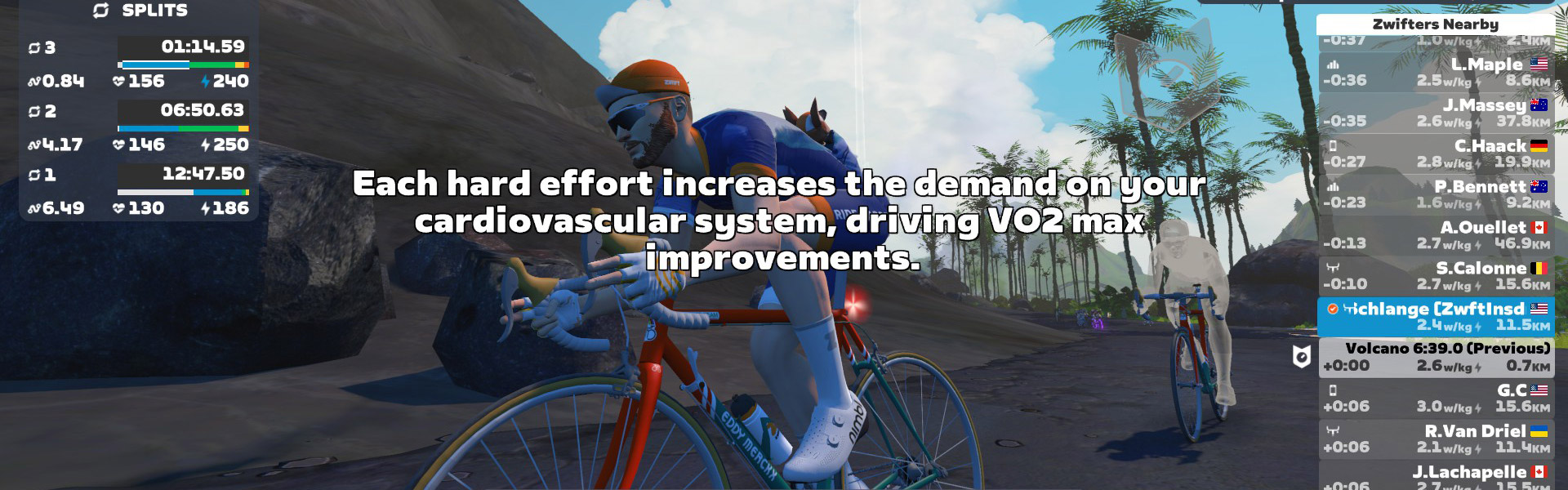
I also kept an eye on my previous effort HoloReplay, making sure I beat him each lap.
You might think it would be hard to manage your power well enough to precisely hit power targets, but thanks to the average power number on the Splits HUD, I found it pretty easy. I was bang on my target for laps 2 and 3, then pushed extra hard on lap 4 just because I could, coming in a few watts above my 270W target.
What power targets should you shoot for? You won’t be able to hold true VO2 max power for three continuous laps, but if your legs are fresh, you should be able to push at or just above your FTP for all three laps. Something like this should be doable with fresh legs:
Lap 2: 100% of FTP
Lap 3: 103% of FTP
Lap 4: 106% of FTP
Or you could skip trying to hit a power target, and simply try to stay away from your previous effort HoloReplay every lap. Put in a hard but not maximal effort on lap 2, then just make sure you beat your HoloReplay on laps 3 and 4!
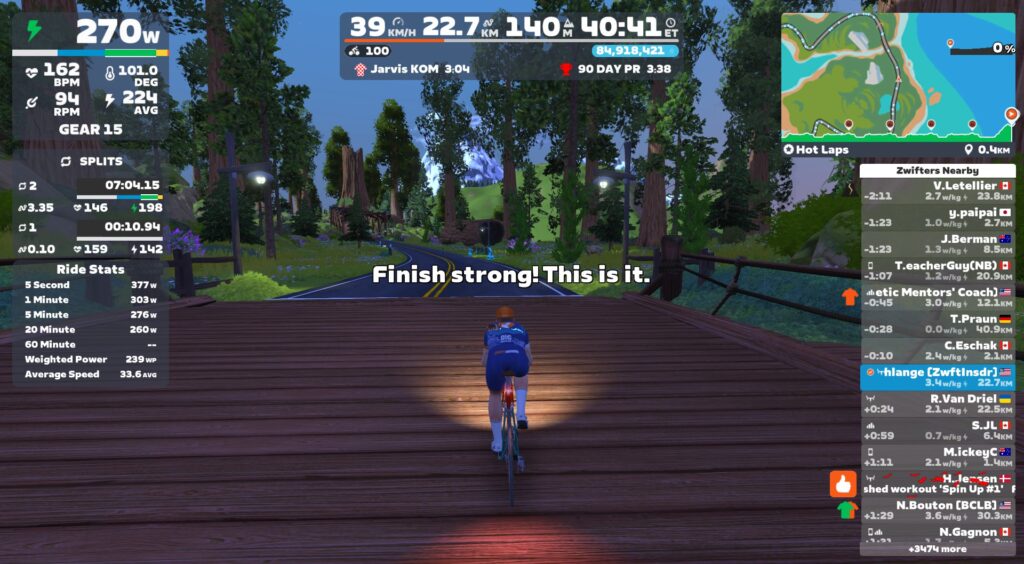
After finishing the fourth lap, the route takes you into Jarvis for a finishing effort up the Jarvis KOM. This short climb will take most riders 3.5-5 minutes to complete, so it’s actually a proper traditional VO2 max interval in terms of its length and the 5 minutes of recovery you get just before it begins. My advice? Just empty the tank. It’s the end of the workout, so put in a maximal effort up that KOM segment and see what you can do!
Overall, I found this the most fun Zwift Camp: Build stage yet. The challenge of pacing myself so I was both working hard but also negative splitting the laps kept me engaged, even if my tired legs didn’t let me ride anywhere near VO2 max targets. And while the HoloReplay bug persists (see below), my previous effort ghosts proved very motivating!
Drafting Note
Your previous effort ghost is an exact replay of your avatar from the previous lap, which means if you drafted on the previous lap, that ghost is moving at the speeds you attained while drafting.
This could make things difficult when you try to beat your ghost on the next lap, and you aren’t drafting.
It worked out fine for me in my on-demand workout, even though I was on a road bike, as I never drafted for a meaningful length of time. But basically, you’ll want to be either drafting most of the time, or not drafting most of the time. One simple way to make sure you don’t draft: ride a TT bike! It looks like they’re allowed in the events, and of course you can always use a TT bike in an on-demand ride.
What Is This Workout?
After Stage 1’s short neuromuscular sprint efforts, and Stage 2’s longer anaerobic sprints, you might expect stage 3 to focus on VO2 max power. And it does… sort of. Since the three laps are back-to-back-to-back, you won’t get the rest/recovery needed to execute traditional VO2 max intervals. Instead, you can work at pacing yourself at or just above FTP, finishing with a maximal effort on lap 4, then recovering a bit before doing one more hard VO2 max interval up the Jarvis KOM.
It’s not a traditional VO2 max workout, but it’s engaging and fun work. Plus, pacing the three Volcano Circuit laps for negative splits is good practice for Stage 4’s effort up The Grade. (Turning in your best effort on that climb really comes down to pacing it well, and starting a bit below your power target while finishing a bit above it is the best way to make that happen.)
Watch My Video
More On VO2 Max Power
VO2 max measures the maximal amount of oxygen your body can consume. It is a key measure of aerobic capacity and thus a key determinant of performance potential (read much more inthis TrainerRoad post). A few interesting things about VO2 max:
Genetics play a significant role in VO2 capacity, but untrained athletes can often improve by as much as 25%.
You might think that lung volume is what drives VO2 max, but in fact it’s largely determined by four factors: cardiac output (how much blood the heart can move), the oxygen-carrying capacity of that blood, the circulatory system itself, and muscular efficiency.
Strong anaerobic performance is particularly useful in “spiky” cycling disciplines like cyclocross, crits, and MTB racing
While world-class male cyclists have a VO2 max in the 75-90ml/kg/min range (recent studies are saying Tadej Pogačar may have the highest VO2 max of any winner in TdF history at 96ml/kg/min), mere mortals (good amateurs) are closer to 65-80ml/kg/min.
VO2 Max Training Tips
Traditional VO2 max training has you executing repeating intervals that are 2-6 minutes long, each 106-120% of your FTP, with very easy rest intervals in between roughly the same length as the VO2 max interval.
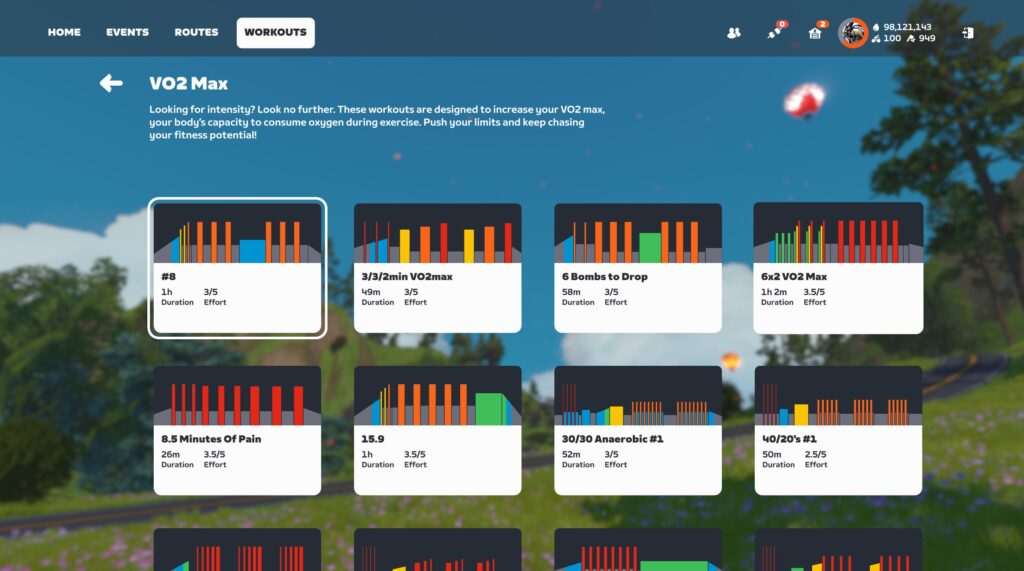
But there are other ways to do VO2 max work. Zwift has a “VO2 Max” folder in its workout directory, with 37 workouts to choose from at the time of this post:
Some of these workouts feature the more traditional, longer VO2 max intervals, while others have you doing high numbers of much shorter intervals (20-30 seconds). The important thing is accumulating time working at VO2 max levels.
You might also try Zwift Insider’s popular Saturday Tiny Races. This is a set of 4 short races completed in under an hour, making it basically a VO2 max workout disguised as a race.
Lastly, hill repeats are a classic outdoor VO2 max workout. Find a climb you can finish in 3-6 minutes, then hit it hard. Turn around at the top, taking your time coming down so you can recover nicely, then do it again. Aim for at least 4 repeats.
Suggestion Box
The third workout of Zwift Camp: Build was my favorite yet, even if my legs weren’t very fresh. Still, there were some things Zwift could change to improve the experience. Here are my suggestions:
Clean Up Lap Splits: Unlike stages 1 and 2, the Splits HUD was really useful for this workout. But there are two tweaks that would make it better: making sure splits finish right at the lap arch (the first few fire early, the last fires late), and keeping the Splits HUD up even after you finish the final volcano lap.
Fix HoloReplays: I set up my HoloReplay settings as suggested, to only show a single ghost from my previous effort. But it still showed two ghosts every time, from two different efforts, even though both were labeled “Previous.” Fix it, Zwift!
Improve the event description: I already mentioned this for earlier stages, but once again, a simple line or two in the event description would clarify what people are signing up for. The current description for this workout (“Target Effort: Three 5-minute efforts”) really isn’t accurate at all. It’s misleading at best.
As the days get shorter and colder, more and more riders are filling the roads of Zwift. As you ramp up your indoor training, gain tips and tricks from this week’s top videos to make your Zwift experience the best it can be.
We’re also highlighting a fun Zwift racing challenge, a tour of the Brompton bike factory, and a long-term review of the Zwift Ride.
8 Game-changing Zwift Indoor Cycling Tips
Lake District Cyclist shares 8 tips for having a more enjoyable experience riding indoors with Zwift.
If I Started Zwifting Today, This Is What I Would Do
If you’re looking to learn more about Zwift, this video is for you. Adam from Road to A shares 26 tips to help you become a better Zwifter.
I Raced Zwift A Category Until I Won
Watch as Jeff from Norcal Cycling races on Zwift over and over until he wins. How many tries will it take him to snag an A-category win?
Zwift x Brompton
In light of the Virtual Brompton World Championships, Thomas Martinez tours the Brompton factory with Zwift and rides a Brompton on the Wahoo KICKR.
What The Zwift Ride Is ACTUALLY Like
After riding the Zwift Ride for thousands of miles, Beijing Bonk shares a review.
Got a Great Zwift Video?
Share the link below and we may feature it in an upcoming post!
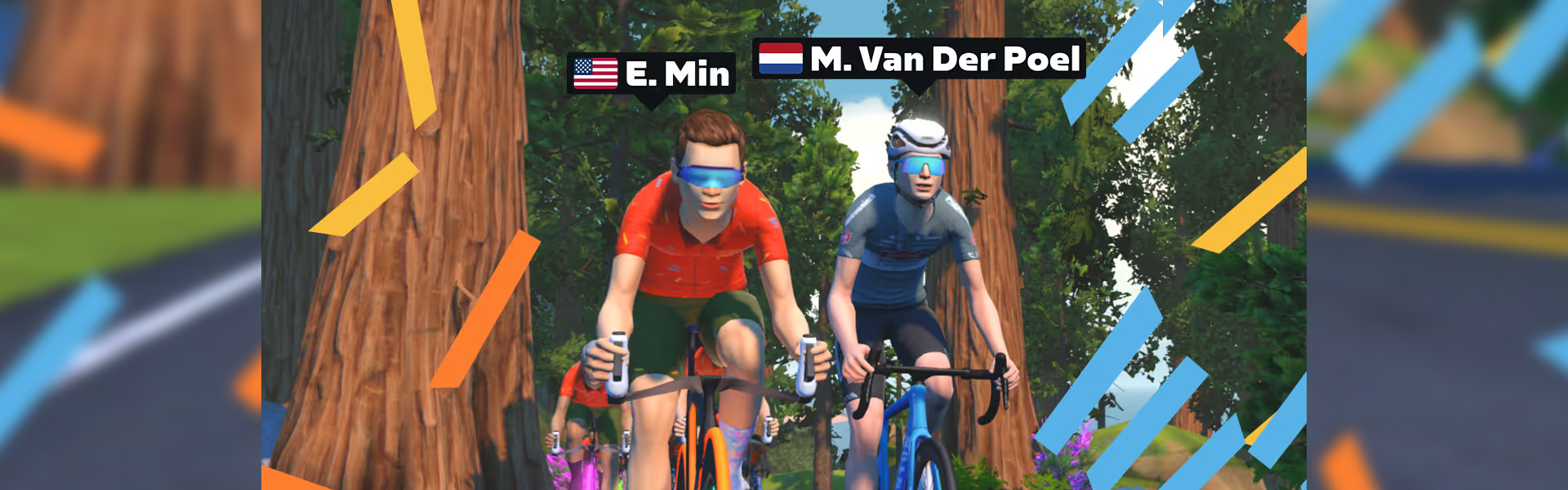
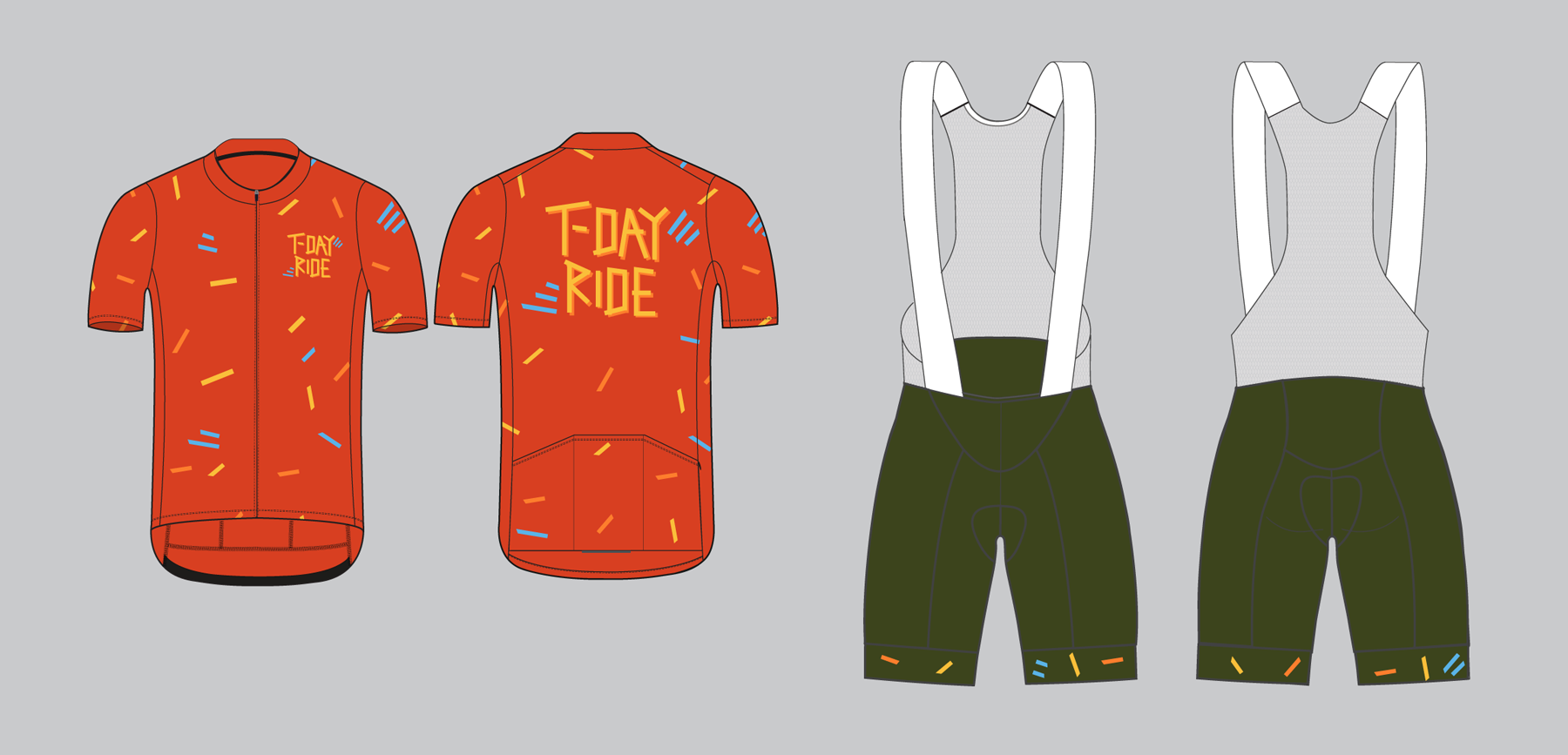
Eric Min Thanksgiving Day Ride 2025 Announced with Mathieu van der Poel
Zwift CEO and Co-Founder Eric Min has traditionally led a T-Day ride on Thanksgiving morning, inviting Zwifters to put in some early bike miles before spending time eating turkey and pumpkin pie with family and friends.
This ride is always popular, with thousands showing up. And often, Eric has a big-name guest on the ride as well! (Past guests have included Anna van der Breggen, Justin Williams, and Chloé Dygert.) This year’s special guest: Mathieu van der Poel!
See below for ride details…
Route and Schedule Details
Event start time is 4pm UTC/11am ET/8am PT on Thursday, November 27. This is an open-paced ride, so you can ride hard or easy. With lots of riders joining in, you’ll always have someone to ride with!
The ride is 60 minutes long and held on the new Spinfinity route in New York.
If this ride is too late in the day for you and/or you’re looking for a longer ride, check out BMTR’s traditional Thanksgiving 100, which begins at 1pm UTC/8am ET/5am PT. Riders will be on the Watopia’s Waistband for 100km, and there are three pace groups: D at 1.6-2 W/kg, C at 2.2-2.6 W/kg, and B at 2.8-3.2 W/kg.
Starting just 5 minutes after BMTR’s ride, my Thursday Pizza Burner 100km kicks off at 1:05pm UTC/8:05am ET/5:05am PT on Tick Tock in Watopia. Ride with me at ~2.5 W/kg, or join the zinners up the road! (My plan is to finish this ride, then head to Mr. Min’s ride to make it a 100-mile morning.)
Several months ago, Zwift Co-Founder Jon Mayfield and I were talking about training for upcoming events, and he mentioned the Death Valley Century. This was a ride Jon had done several times already, and he was signed up to do it in November. Would I be interested in coming along?
After giving it some thought, I decided to pull the trigger. Why not? It was a place I’d never ridden before, plus I needed to plan an event or two to inspire my training.
I signed up, then mentioned it while chatting on Discord during my Thursday Pizza Burner 100km ride. Two ride regulars, Casey Tucker and Justin “Wagz” Wagner, both said the ride sounded interesting. Then texted me within a few days to say they’d signed up!
And just like that, there were four of us heading to Death Valley National Park for an epic century.
At least, that was the plan…
The Prologue
In the weeks leading up to the ride, I’d been messaging Jon to find out what he was planning, while also chatting back and forth in a text group with Wagz and Casey.
Jon was going to bring his telescope and camera, because he dabbles in astrophotography and Death Valley is a Gold Tier designated dark sky area, meaning, “On clear, moonless nights, the Milky Way casts visible shadows, and thousands of stars typically washed out by light pollution become readily apparent.” Epic stargazing? I’m in.
Wagz was driving in from Salt Lake City, Casey from Bend, OR, and I from NorCal, meaning we were all driving 8 or more hours to arrive in Death Valley on Friday, for the ride on Saturday. We decided to stay Saturday night as well, and maybe get a ride in on Sunday before heading out. Casey started researching alternative rides, and found an epic 25-mile climb up to a lookout called Dante’s View. That was Sunday’s ride sorted.
Things began to unravel in September, though. A big storm came through, dumping 1.5″ of rain in a day. (This may not sound like much, but Death Valley averages 2.2″ of rain annually. If a good portion of that arrives in a short time, chaos ensues: flash floods, washed-out roads, etc. This will be important later on…)
Then the government shutdown began on October 1, meaning Planet Ultra could hardly even find anyone to talk to since Death Valley is a national park and those employees were off work until further notice. As the shutdown dragged on (43 days, the longest in history), we were notified that the route had been changed, then notified of further changes. By the time the shutdown ended, just a few days before the ride, Planet Ultra had settled on a metric century route for us to ride, with the option of removing our ride numbers and finishing out the full imperial century however we chose once we crossed the line.
So that was our Saturday ride plan.
But within a few days of the ride, the weather forecast, which had looked good for weeks, began changing. First it was rain on Sunday. Then a bit of rain on Saturday. We realized there would be no stargazing, as clouds would fill the sky all weekend. And by mid-day Friday, as we were all making our way to Death Valley, it showed 1″ of rain on Saturday.
An email arrived from Planet Ultra. Subject line: URGENT!!! Death Valley Ride: CANCELLED.
A flurry of texts and phone calls followed between the four of us, as we all received the notice while driving to Death Valley. The consensus was clear: we weren’t cancelling. The hotel was booked, we’d been granted our “Husband Passes,” and we were going to figure out a way to do something epic.
Even if it killed us.
Which was actually a distinct possibility.
Act 1: Night Riders
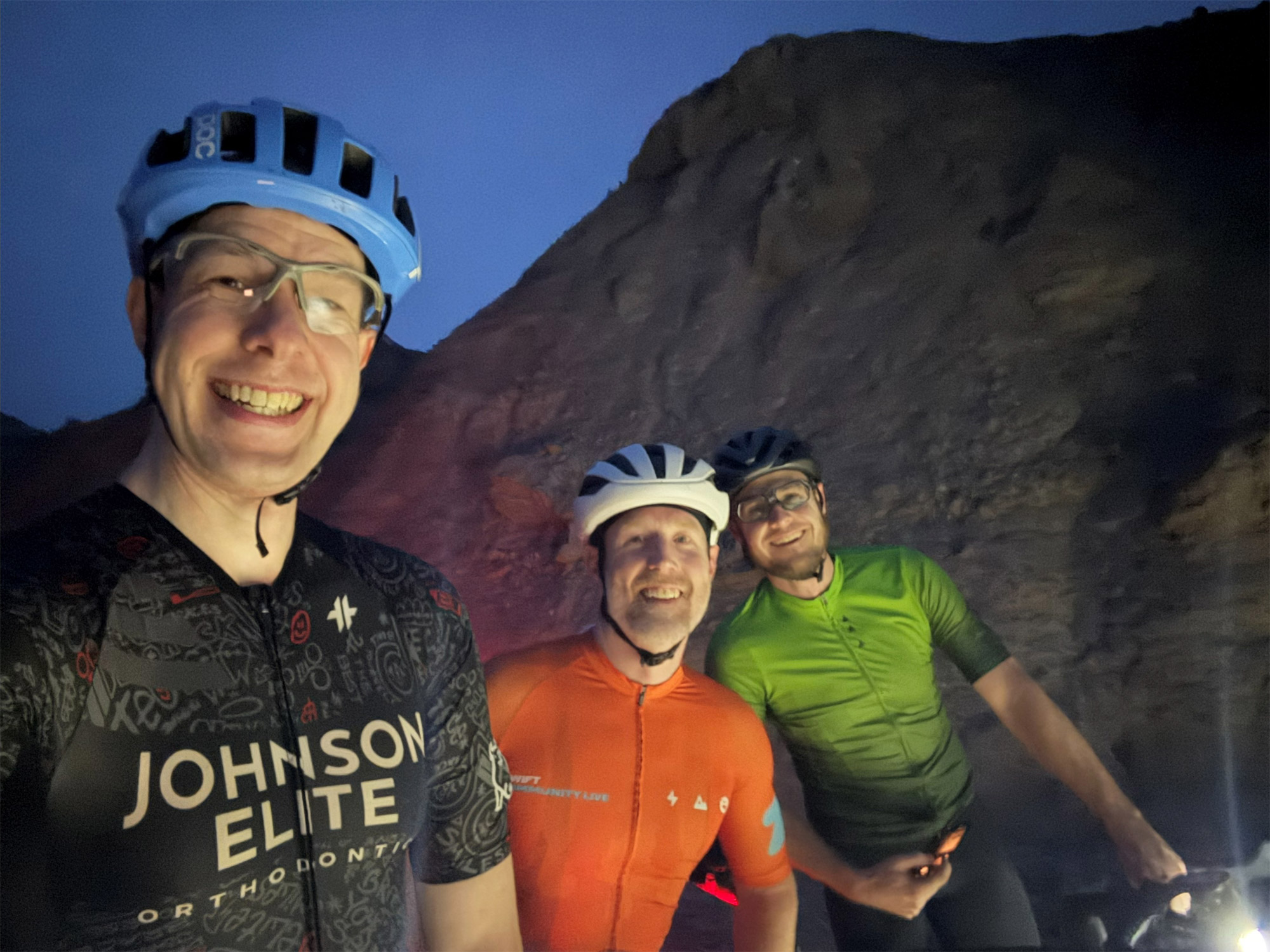
We were all targeting a 4pm Friday arrival, since that was the hotel’s check-in time. But Wagz and Casey arrived before I did, and decided we needed to do a shakeout ride. Knowing we didn’t have a lot of daylight, I kitted up in my car, pulled the bike out of the back, and headed out with Wagz and Casey.
It’s funny: I hadn’t yet met these two in real life. But we’ve spent so many hours riding together virtually while chatting on Discord that when I arrived, no introductions were necessary. We had just ridden 100km in Watopia the day before, so the inside jokes picked up right where we’d left them.
We headed out from Furnace Creek (Death Valley towns have great names) toward Badwater at 4:12pm. Casey and Wagz both had headlights, but I hadn’t brought one. Figuring we had about an hour of daylight, we decided we’d ride out around 15-20km, then turn around and come back.
15km out, Casey suggested we take a left and ride the Artist’s Drive road instead of just flipping a U-turn. “It’s a nice little loop,” he said. (It was closed to automobiles due to recent floods, but his research said there was just a bit of gravel washed across the road here and there.) We rode around the barrier, crossed the first bit of gravel, and decided to give it a go.
And that’s when our shakeout ride turned spicy.
Have you ever climbed with another cyclist, where neither of you talks about how you don’t want to let the other guy beat you? You know: the silent race. (Or better yet, the “Try to speak casually like you’re not on the limit” race.) That’s what this was. And none of us knew the climb well enough to know when it would end.
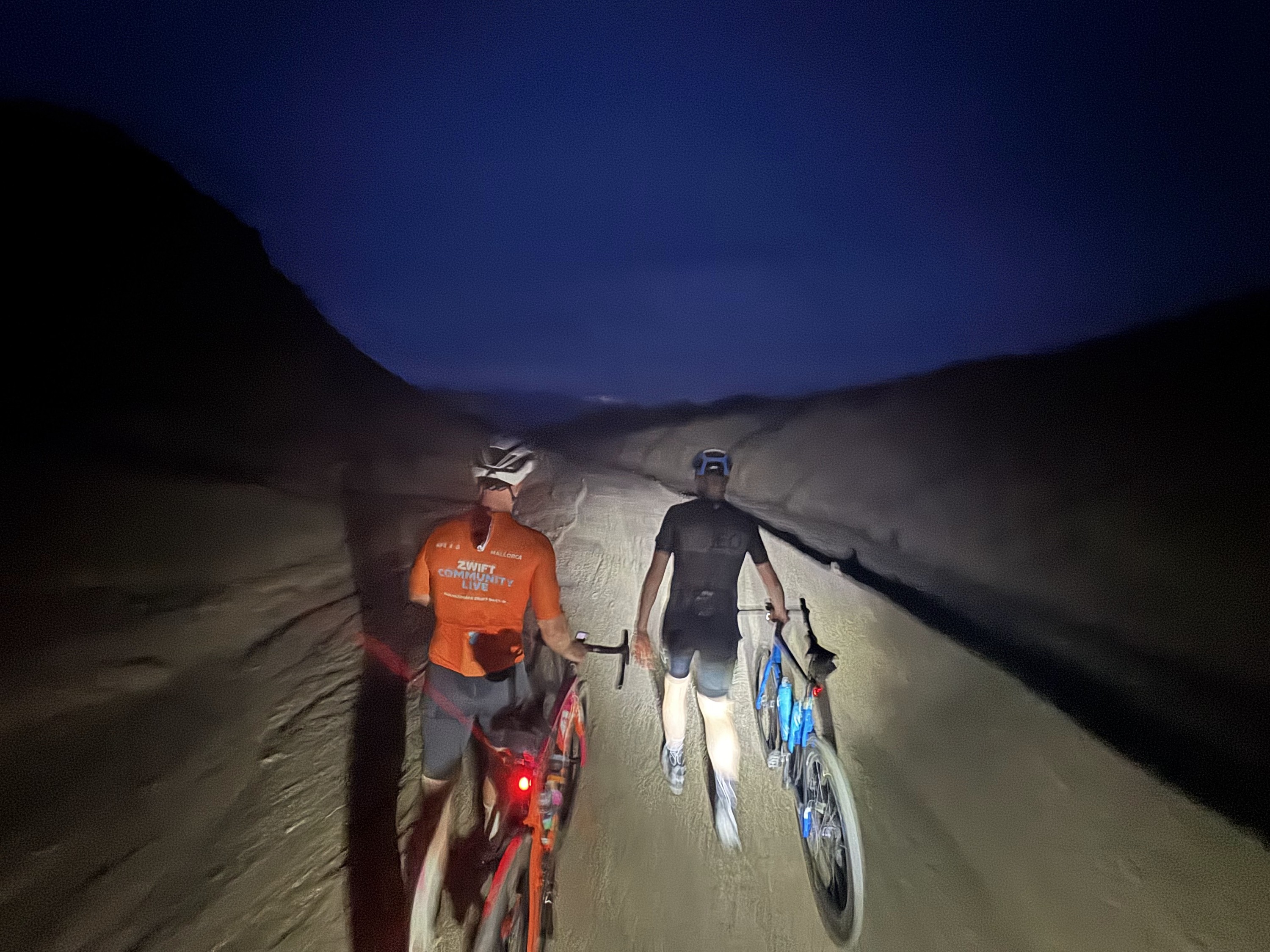
After 4.5km and 325 vertical meters of hidden heavy breathing, we finished the main portion of the climb. And we realized we had a problem. Or more accurately: I had a problem. It was dark. I had no light. And we were nowhere near home.
We began the main descent of Artist’s Drive, with me trying to stay sandwiched between Casey and Wagz so I could see the road. Our team plan worked well enough, which was good, because this wasn’t just any road: it was an unfamiliar, twisty, and steep descent. Made all the more interesting by random gravel patches deposited from recent flooding!
We were operating just on the edge of crazy, which is a rather fun place to be, when you get there on purpose. We only had to hike the bikes once, thanks to a particular deep gravel section. But apart from that, we made our way down, teasing Casey for his route suggestion and laughing at the irony of my gravel bike sitting at home in the garage, headlight and all.
By the time we returned to the main road it was pitch dark, and we still had 10km to go. We turned off all our lights for just a minute, to take in the total darkness of the place. Wow. Have you ever experienced that? It’s disorienting. Like you’re floating in space.
Turning the lights back on, we made our way to the hotel. When we arrived, we checked the stats: our 1-hour ride had turned into a 100-minute ride covering 40km and 747m of climbing. And although nobody said it, I think we all were thinking the same thing: I went too hard, and I’m going to pay for it tomorrow.
Jon, Casey, Wagz, and I sat around the dinner table Friday night, looking at weather apps and roadmaps to plan our new Saturday route. We decided to start in the morning with an out-and-back to Badwater Basin, since it’s a key tourist attraction, being the lowest point in North America (282′ below sea level). That would give us 55km.
Then we could refill bottles and restock snacks upon our return to the hotel, and decide if we wanted to continue with the second leg of the ride: heading north for a 75km loop that included a nice little 11km climb.
Jon planned to join us for the first leg, but left the second leg up in the air depending on how he was feeling. He has always ridden this event as a solo TT, so he wasn’t sure if he would want to ride part of it solo, or even make it a shorter day so he had the legs to take on Dante’s View the following day.
Act 2: The Big Day
Heading to Badwater, while the rain storm moves up the valley toward us
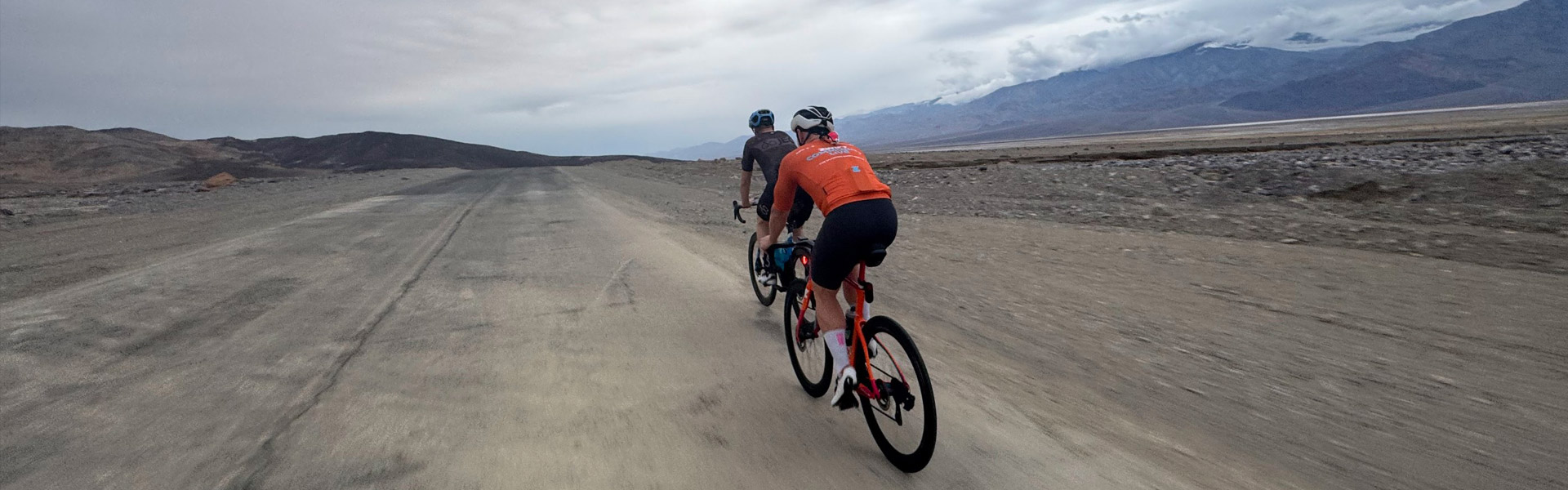
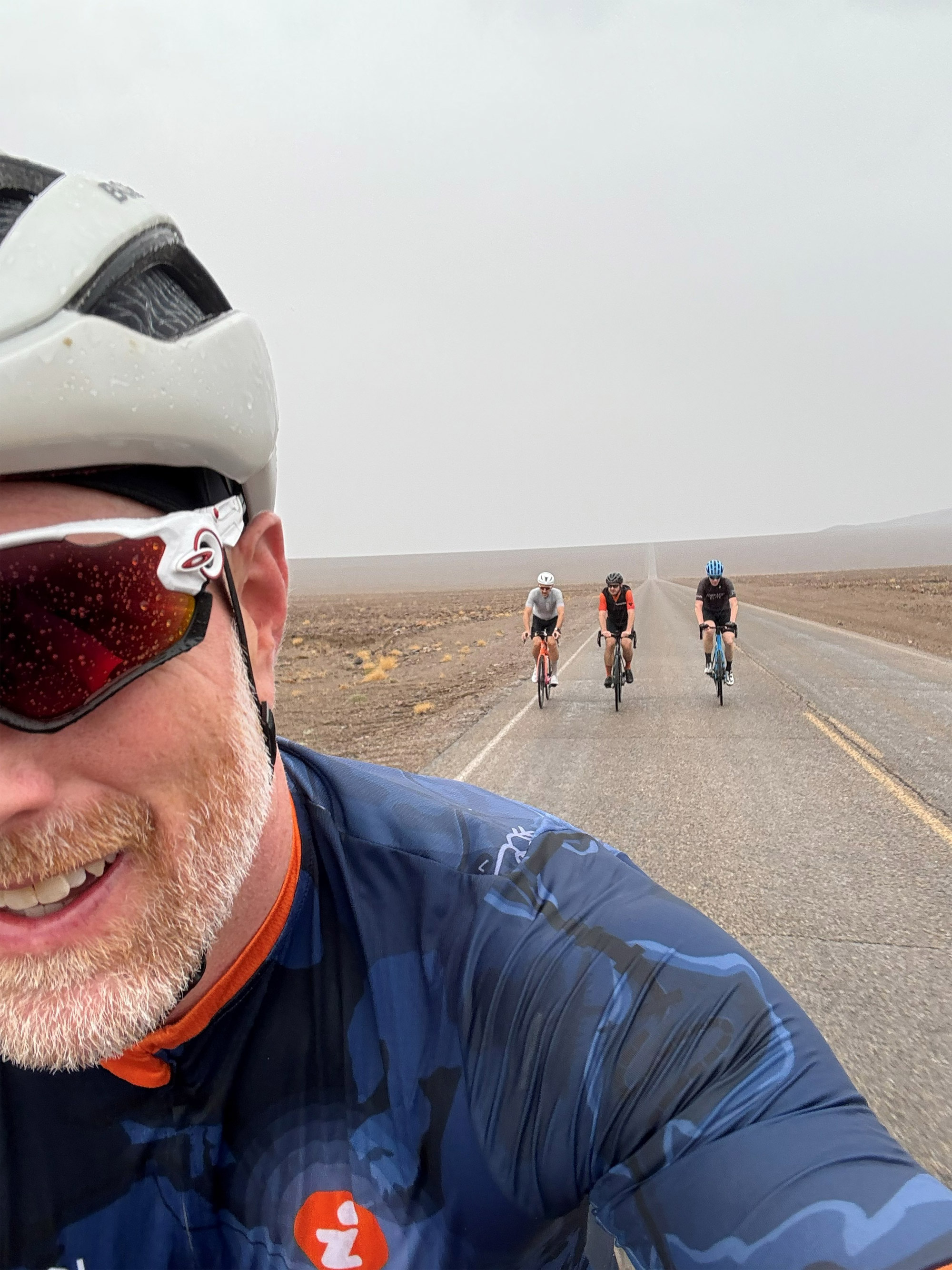
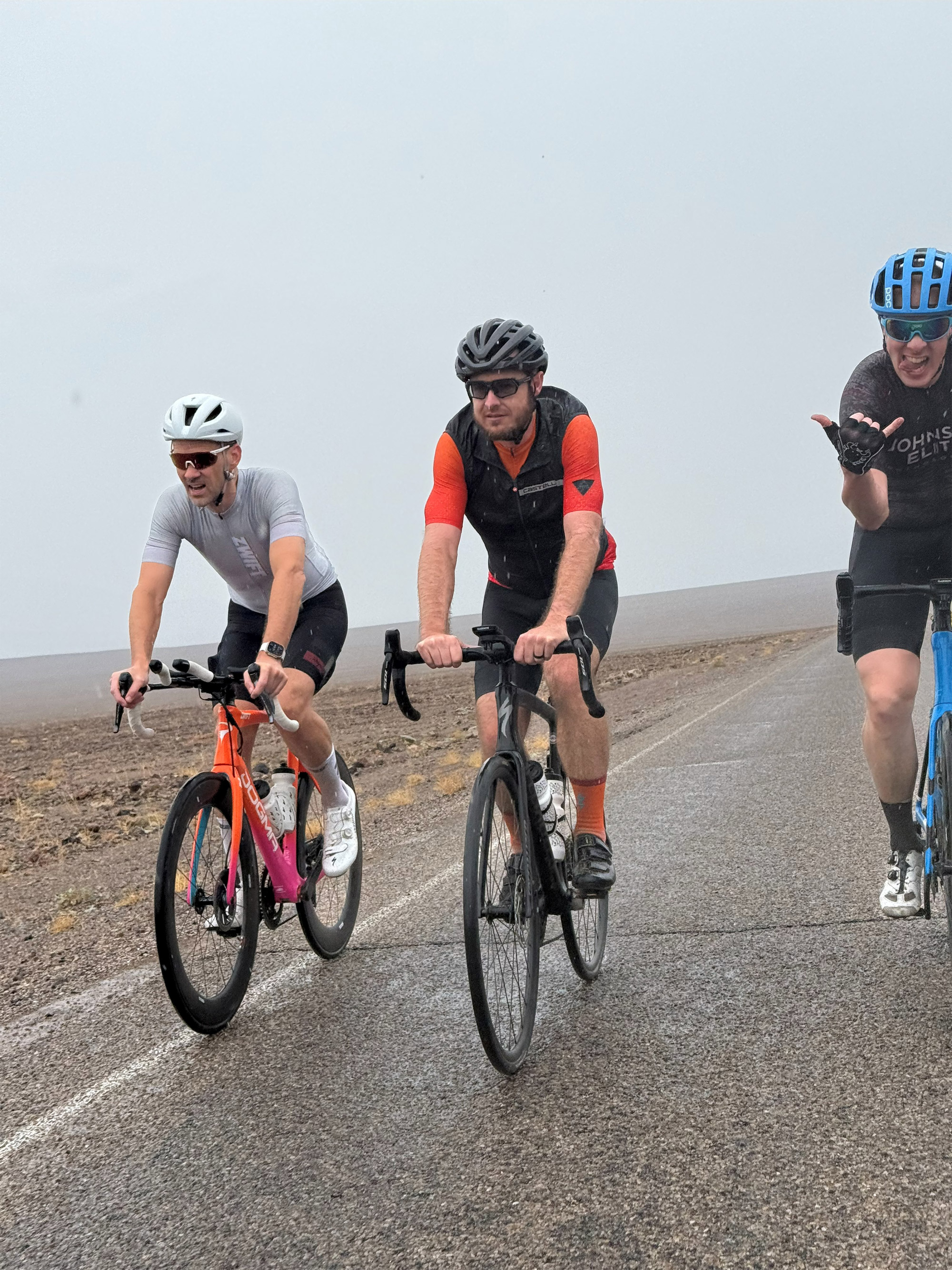
The four of us rode out from the hotel the next morning. Temps were in the low 60s, with light rain. We watched a handful of riders leave and head north, but we went south, hoping to finish up in low-elevation Badwater before things got too wet.
The road to Badwater Basin is rolling and smooth, and we quickly settled into an easy, albeit muddy, rhythm. Nobody wanted to push hard this early in the day, and it felt to me like the cancellation of the official event had given the whole affair a sort of casual feel. Which was nice.
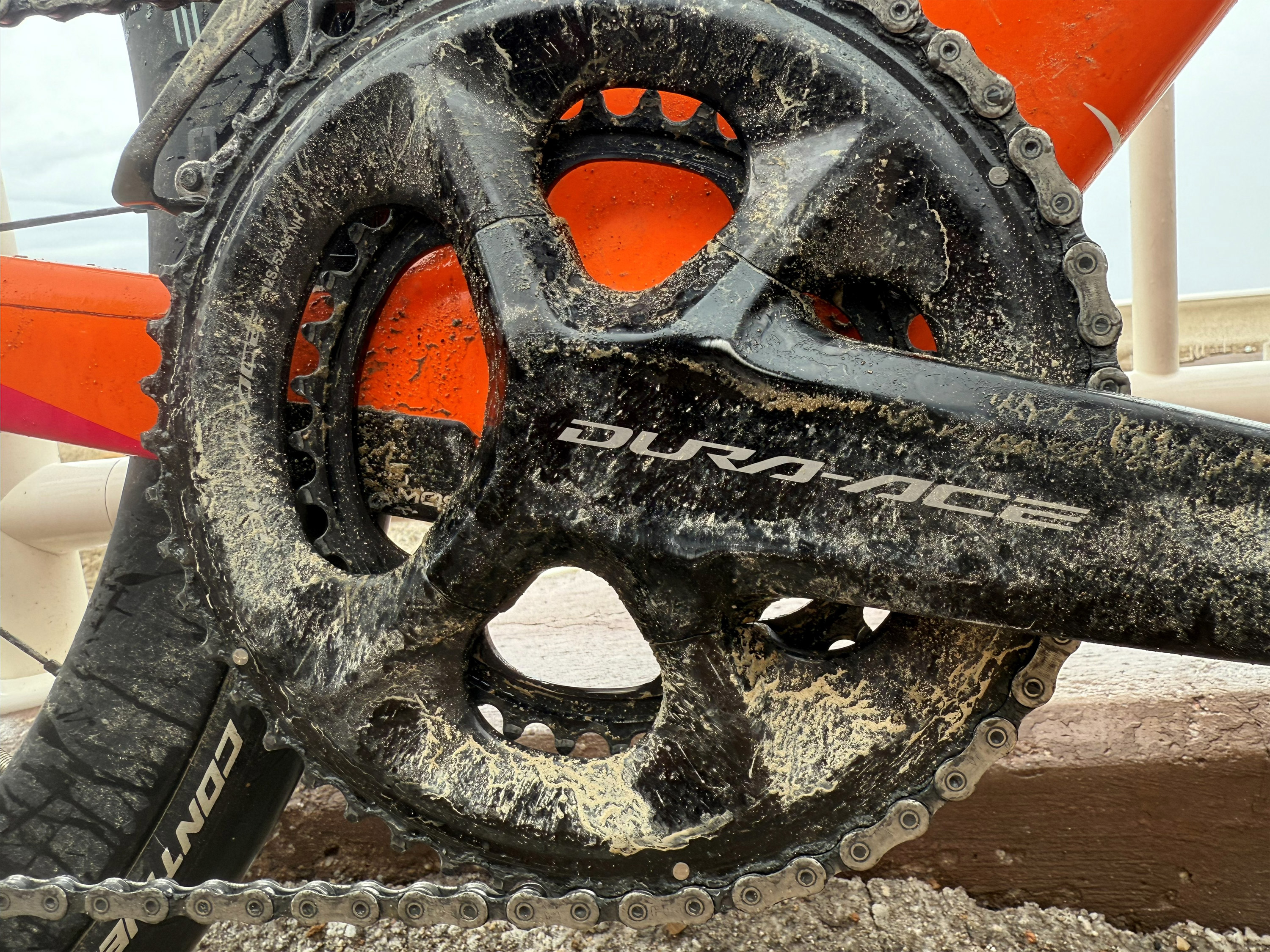
Alkaline mud was washing across the road’s low spots, and that mud quickly coated our shoes, socks, and backsides. It smelled distinctly like fresh, wet cement and left a slimy layer on bikes and clothes after rain washed most of it away.
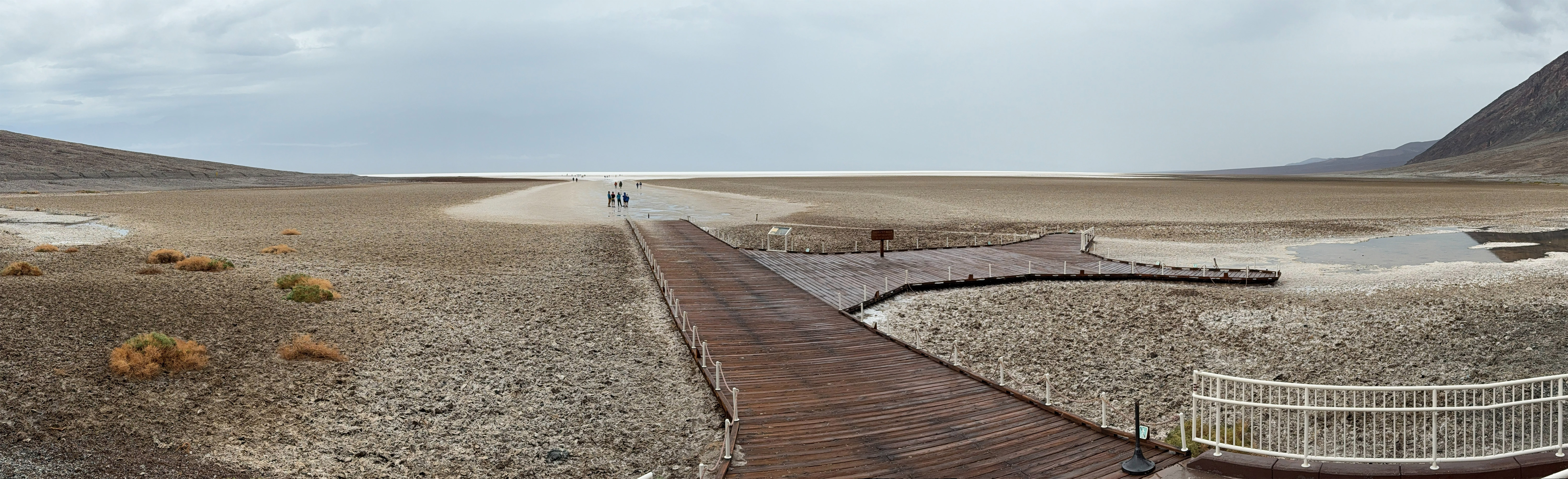
Badwater Basin was something to behold: a 200-square-mile salt flat with a sign on the nearby cliff marking sea level, 282′ above us. We looked around a bit, watched people walk out to the salt flats via the broad boardwalk, snapped a few photos, and then headed back to the hotel.
At the hotel, Jon decided to hit the shower, change clothes, then head out on the second leg solo. Wagz, Casey, and I decided to restock provisions and head out together. The rain was still light, the temperature just right, and the northern roads didn’t seem likely to flood even if it rained as forecasted.
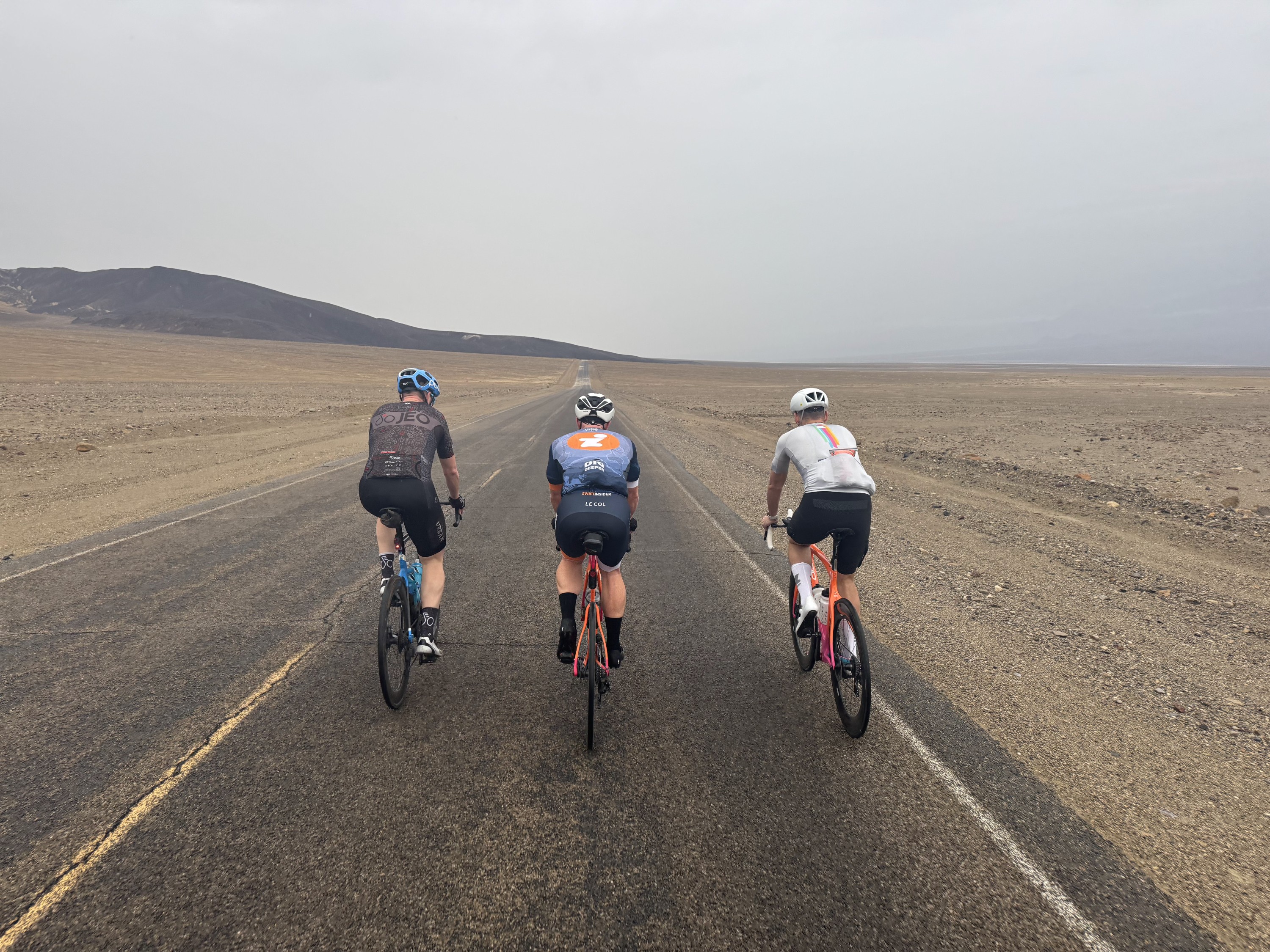
We started on HWY 190, churning through almost 30 flat kilometers. The best way to see the world is from a bicycle, especially if you’re not in race mode. The distant craggy mountains, the tumbleweeds, the sand dunes, the multicolored soils, the feel of the wind and rain, the unique smell of the place… everything mixed into a singular feast for the senses.
Eventually we turned left and onto the day’s big climb: Mud Canyon Road. 11km long and averaging 5.5%, this steady grade wasn’t bad apart from two things:
None of us could figure out how long the climb was. You would think we would have learned our lesson the previous night, but here we were, not sure if the climb was 6 or 12 miles long.
Casey tried to suck down a Honey Stinger mid-climb, but managed instead to inhale most of it into his windpipe. Between coughing fits, he said (and I quote): “It feels like there’s a porcupine in my throat,” and, “I don’t think I’ve ever had my throat hurt this bad.” Turns out, those Honey Stingers live up to their name if you ingest them just right. (Of course, Wagz and I considered attacking at this point, but decided against it.)
From the top of the climb we bombed the descent of Beatty Cutoff Road, then headed back to the hotel via HWY 190. It began to rain in earnest in these final kilometers, which was actually rather nice, as it washed away some of the mud caked onto our bikes and clothes.
After Casey took a long pull on the front, I went forward and upped the watts, figuring it would be fun to “make it interesting” as we hit the small rise heading into Furnace Creek. But Casey, feeling his monster pull, fell off the back. Then Wagz attacked in the gutter, forcing me to chase his wheel for shelter! I figured he would drop me like he often does near the end of Pizza Burner rides, but quickly saw he had gone too early, with legs that were too tired. I managed to chase back onto his wheel, then sprint to glory across the invisible townline.
131km and 1,321m of elevation on the day. Not bad for a cancelled ride.
Returning to the hotel, it was cleanup time. We hopped into our showers fully kitted up, rinsing the remaining mud from our bodies and clothes. Casey and I even hauled our bikes into the showers, which worked quite nicely. (Although we found the next morning that the water had left some rust spots on our chains and cassettes, probably due to the chemical makeup of the local water and/or soil.)
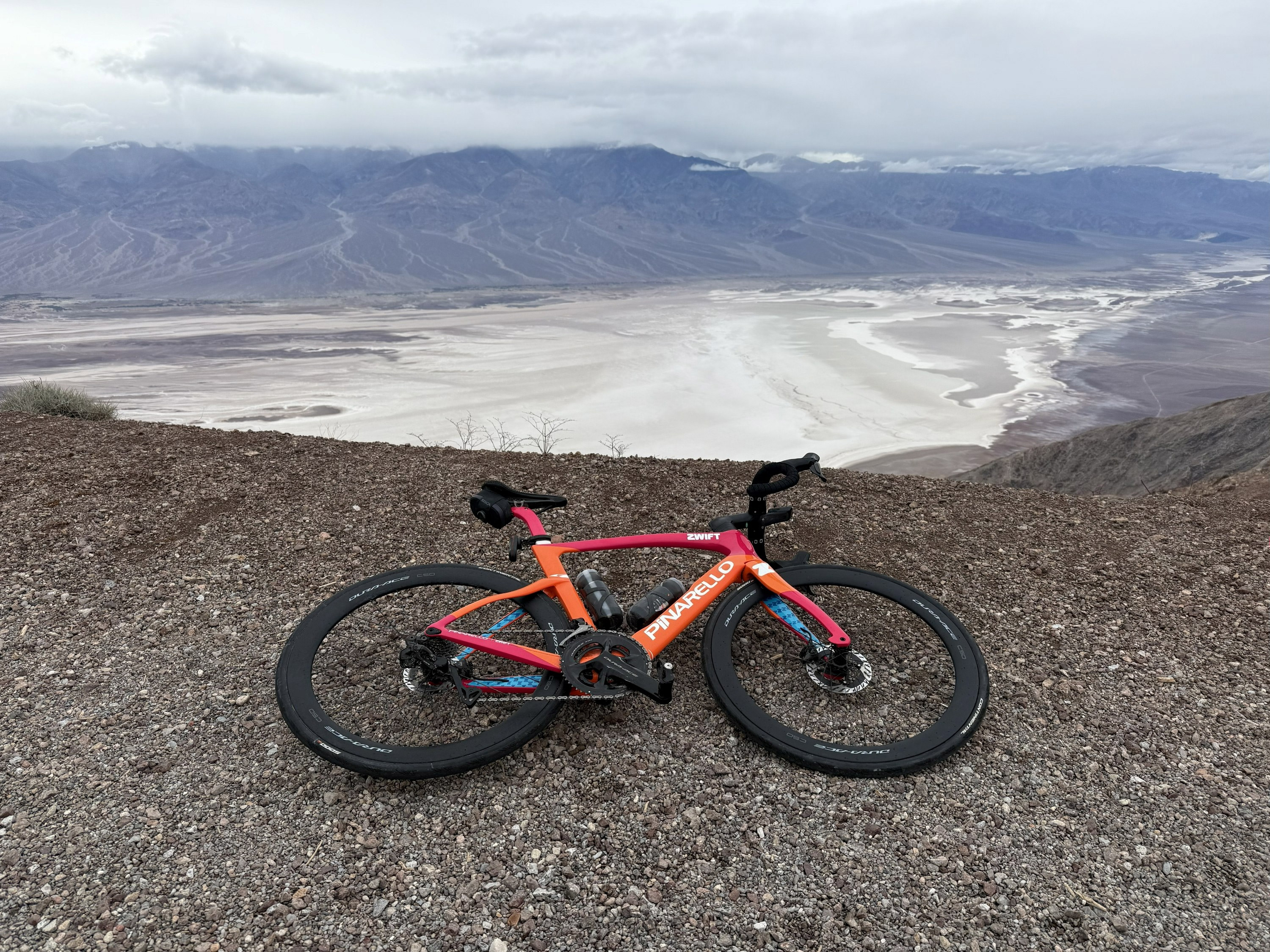
We reconvened with Jon for dinner at the all-you-can-eat buffet and shared stories of our rides. (Jon had ridden the same route as us, but the second portion was solo, on his Zwifty Pinarello with TT bars.) Soon enough, the conversation turned to the next day: what was our ride plan? Were we climbing to Dante’s View?
Wagz stated definitively what he’d been hinting at all day long: he needed to leave early to get back to his family. Jon felt like his legs were too cooked to take it on (he had been training for a half-marathon in the months leading up to this, and didn’t feel his cycling fitness was up to snuff.) And Casey chimed in with unexpected news: his parents, who had made the trip with him, wanted to head back early. He wouldn’t be riding the next day either.
But I’d had my heart set on attempting that epic climb, and my travel plans allowed me to stick around and do it. I let them know I was still going to go for it, even if they were only joining me in spirit!
As we wound down the conversation, our waiter came over to inform us that it was “Really coming down outside. You might want to head back to your rooms soon.” We left the restaurant to discover both main roads into the hotel were now flowing rivers, which was particularly irksome given we had our hearts set on ice cream.
That ice cream, it turned out, was served at a shop on the other side of the hotel grounds, requiring us to ford two newly-created driveway rivers. After spending some time trying to find a way across while staying dry, we made the decision to sacrifice one shoe/sock, stepping into the water and leaping the remaining distance across the road. It was a small sacrifice for ice cream.
Act 3: Solo, So High
The next morning I bid farewell to Wagz and Casey, and began the 40km ride from Furnace Creek (-190′) up to Dante’s View (5,475′). Blue sky was visible through the clouds for the first time since our arrival, along with fresh snow on the highest peaks. The air was crisp, with a stiff breeze blowing up from the south.
Knowing this was a long climb and that the steepest pitches were at the end, I kept my power squarely in the comfort zone, chugging along in zone 2 at around 210 watts.
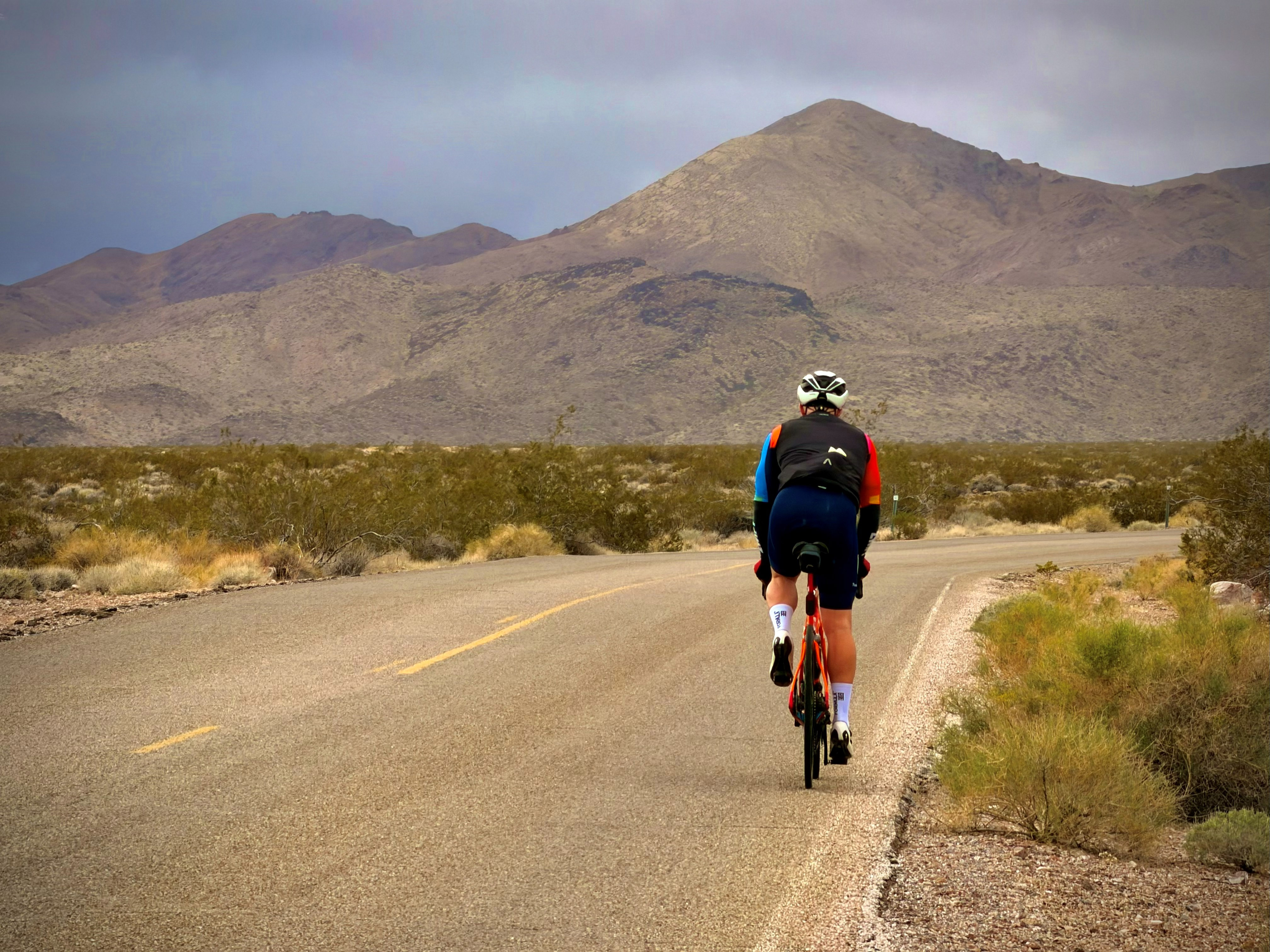
70 minutes in, I hit the halfway point (in terms of distance) to the top, and turned right off of HWY 190 onto the road to Dante’s View. I was feeling good, taking in the views while making slow but steady progress. The crosswind I’d been climbing with became a quartering headwind as the road shifted southward, but it was all doable, and I smiled and waved as the first cyclist I’d seen that day zoomed past on his way down from Dante’s View.
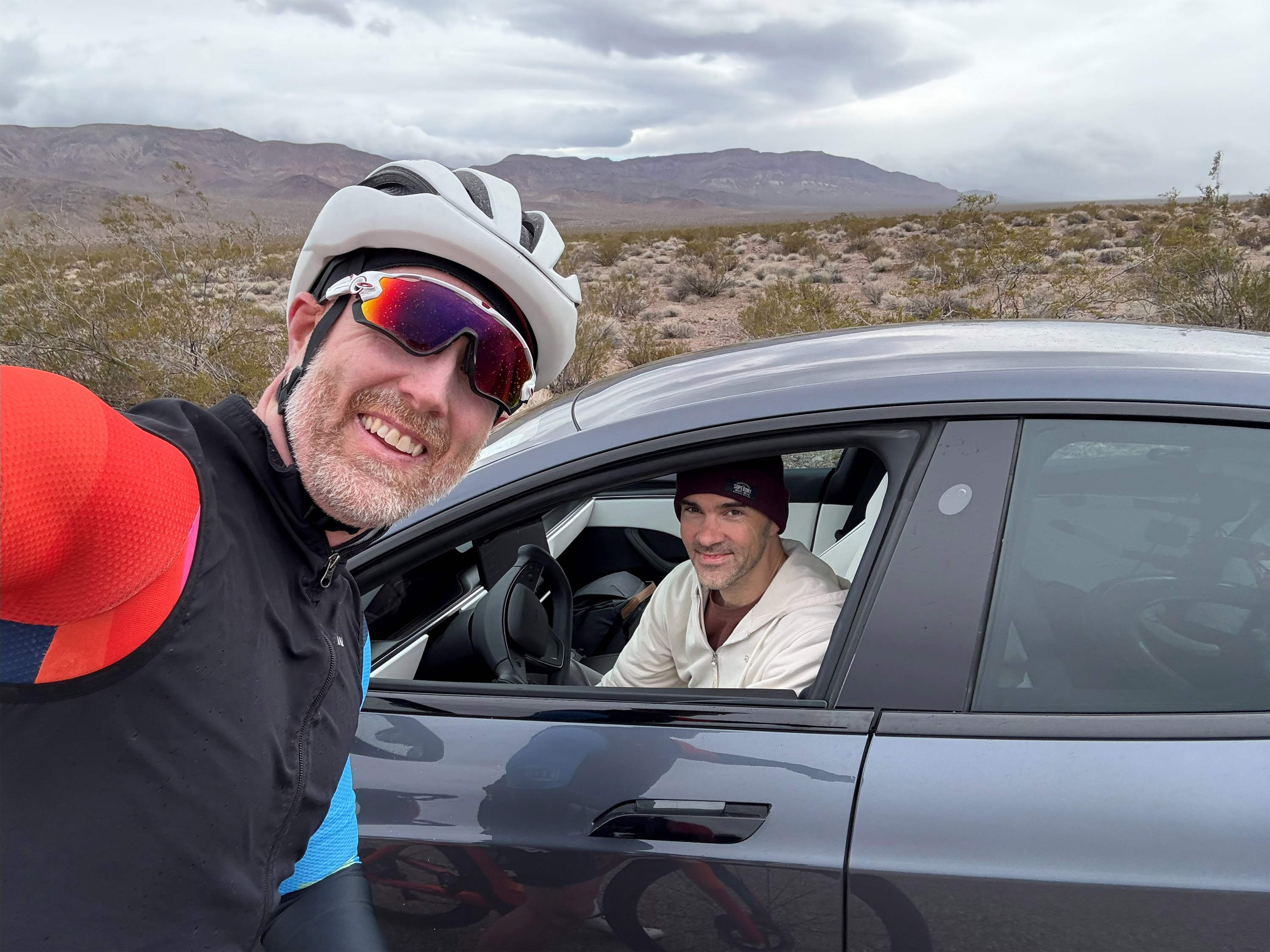
Traffic was sparse, and when my Varia radar indicated a car coming up behind, I scooted over to give it room. But this car slowed and pulled up alongside me. It was Jon! I had wondered that morning if I’d see him on the road, since he had said he’d never been up to Dante’s View. He asked if I needed anything – water? Clothes? A donut? I took a donut, then continued on as he zoomed up the road.
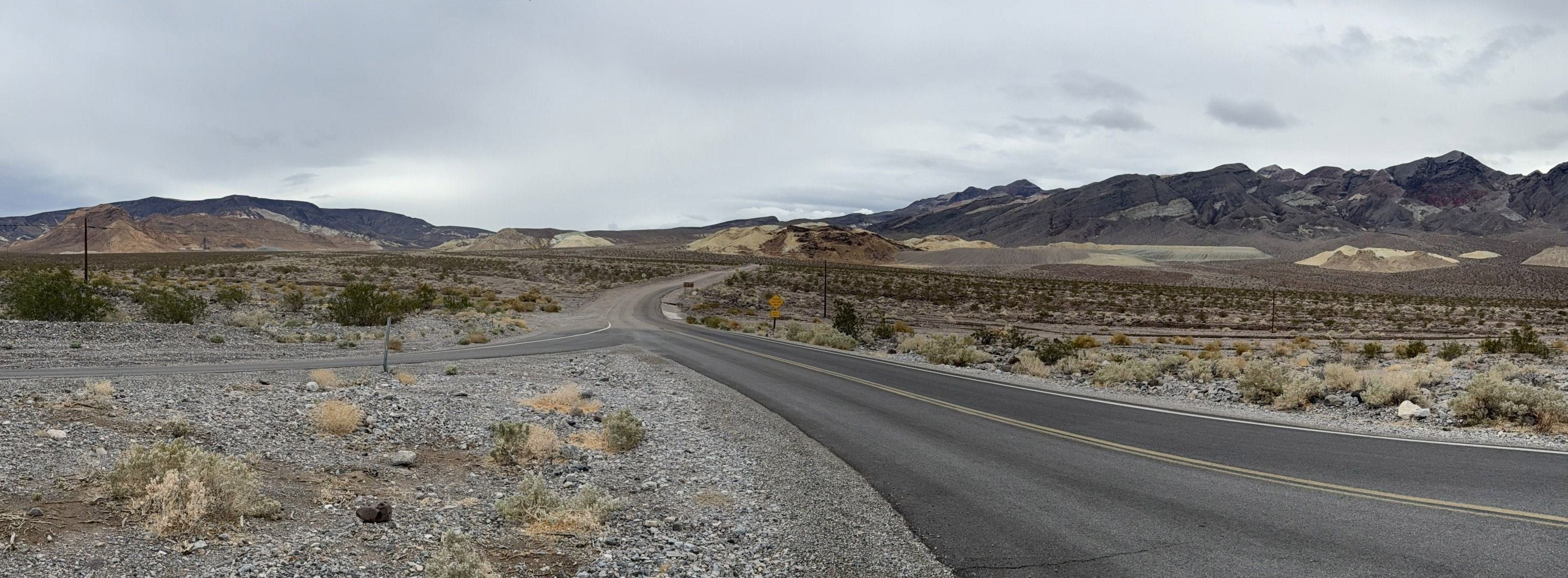
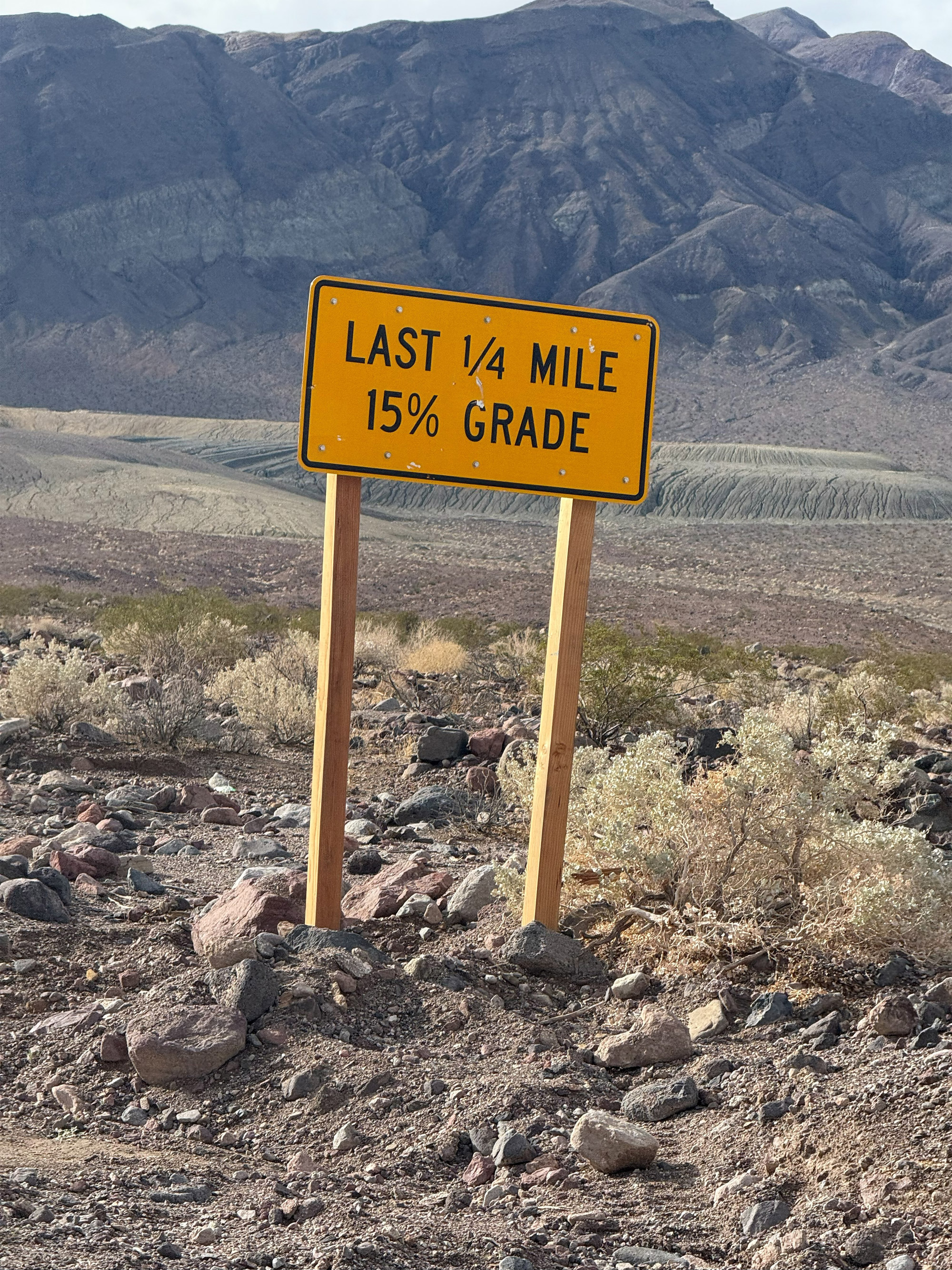
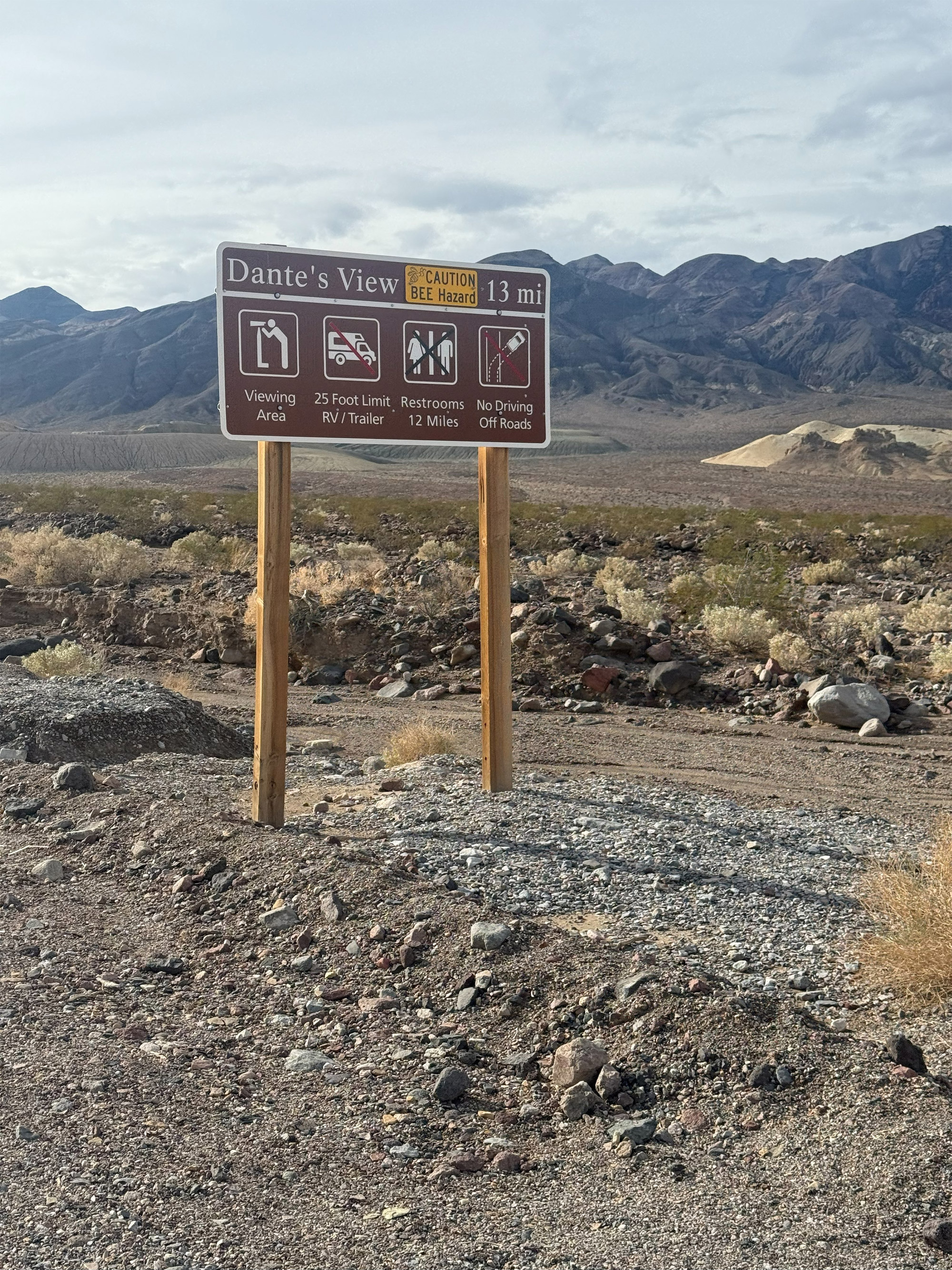
Three ominous signs on the way to Dante’s View…
31km in, everything changed. The road made a hard right, the landscape changed from a canyon to a wide-open prairie, and the wind, now a straight headwind, became stronger. And to my left, across the prairie, I saw the mist of rain marching toward me.
I was forced to increase my efforts substantially just to make meaningful progress. Not only was the wind stouter, but the road was steeper. (I didn’t realize this at the time, because Death Valley road pitches are oddly confusing. Sometimes it’s hard to know if you’re going up or down, or how steep the road really is!) Minutes before, I’d been climbing at 18kph while holding 210W, and now I was working at 250-275W to move forward at just 10kph. I shot a quick video to record the ridiculousness of it all:
Near the middle of the prairie, I saw Jon’s Tesla coming down the mountain. We pulled over and stopped, both smiling and shaking our heads as the wind howled around us.
“Do you want some warm clothes? I’ve got a wind jacket, some arm warmers…” Jon offered.
“No, I brought a vest, I think it’ll do the job,” I said, realizing it was probably time to put that vest on, as I’d worn just a jersey and bibs thus far, and the temperature was definitely dropping. I pulled out my vest and put it on, and even that took some doing, given how hard the wind was blowing!
We talked a bit more about conditions at the top: “It’s really windy and cold up there,” Jon said. He refilled my bottles with water, and I grabbed a handful of sour gummy worms. “Are you sure you don’t want more clothes?”
I took the arm warmers. And as I pulled them on, I could feel rain starting to fall. At the last minute, I took the wind/rain jacket he offered, because cyclists know it’s OK to ride in the cold, and also OK to ride in the wet. But wet and cold? Not OK.
Bidding Jon farewell, I continued the push across the prairie. It was getting colder. (Looking at my head unit’s data after the ride, the temperature dropped 15°F from the start to the end of the prairie.) I pulled over again and put on the wind jacket. Much better!
I gritted my teeth, counting down the kilometers.
7 to go… 6 to go… just keep pushing…
I found myself alternatively yelling into the wind, yelling at myself to keep pushing, and laughing whenever a particularly hard gust came up. It felt wild and crazy, but I also felt alive. It was man vs nature, me vs the mountain. I wasn’t giving up.
The interminable prairie section transitioned to a canyon road with 5km to go, and I began to longingly look around each corner, hoping the end would be in sight. The wind was howling down the canyon, my hands were growing numb, but I couldn’t stop now, not when I was so close!
After what felt like an endless number of blind curves with no end in sight, I rounded a corner to see the finish. But I groaned out loud when I saw it: the road pitch was unreal! Cars were driving up and down the final stretch, and it looked like they were climbing straight up into the sky.
“There’s no way I can climb that without stopping or walking the bike,” I thought to myself. But I gritted my teeth and began to hammer as the road pitched up to 15%. I used every trick in the book, swinging wide on the corners to flatten them out, alternating standing and sitting to recruit every muscle possible.
A cyclist came down from the top, the second one I’d seen on the day, and ominously yelled as he came past, “It’s worse coming down!”
I kept pushing, and soon came to a startling realization: I was going to make it. I wouldn’t need to stop and rest.
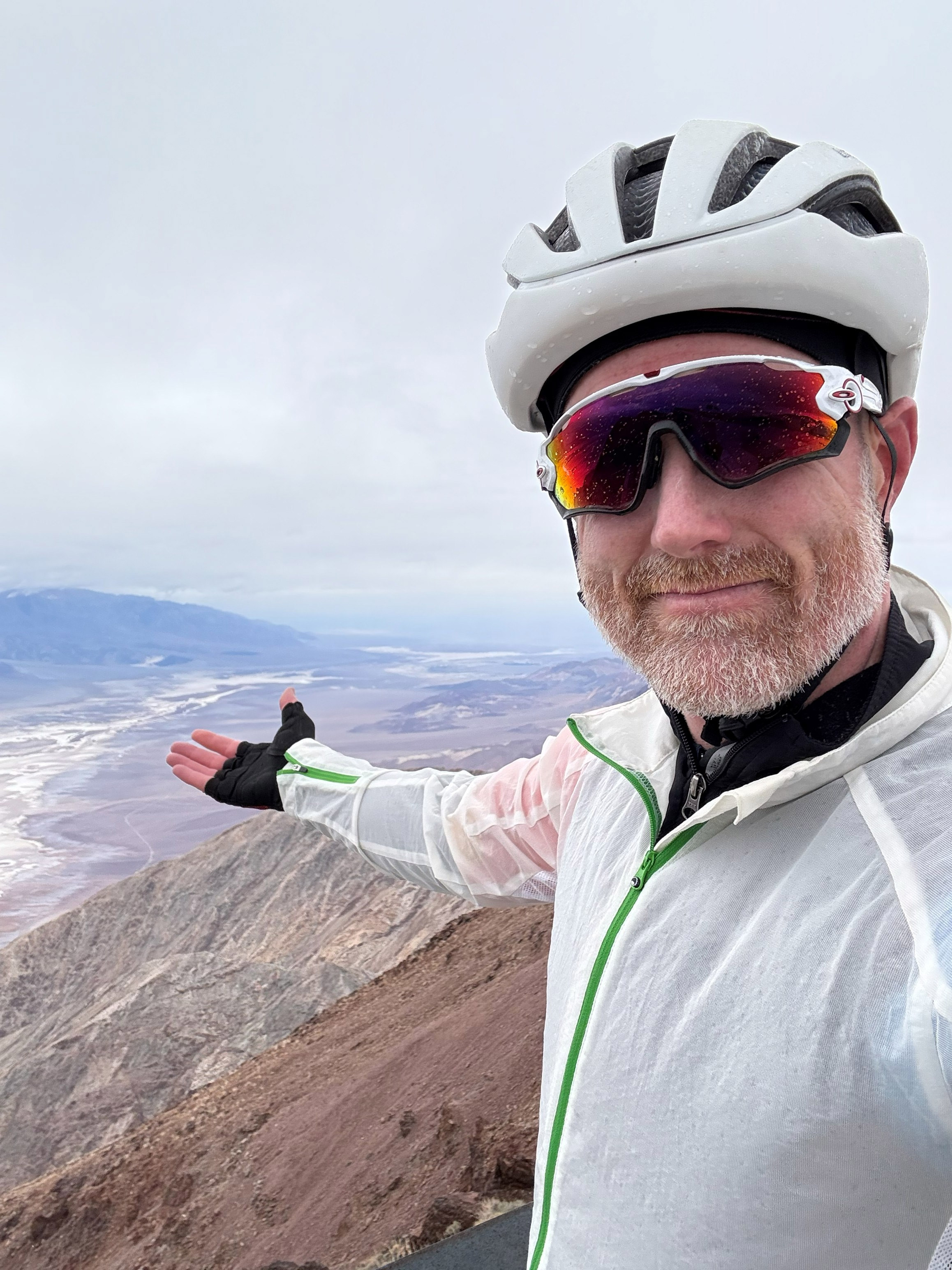
Despite the temperature now being squarely at 32°F, it was like the clouds parted and the sun came out. Hallelujah! I was at the top!
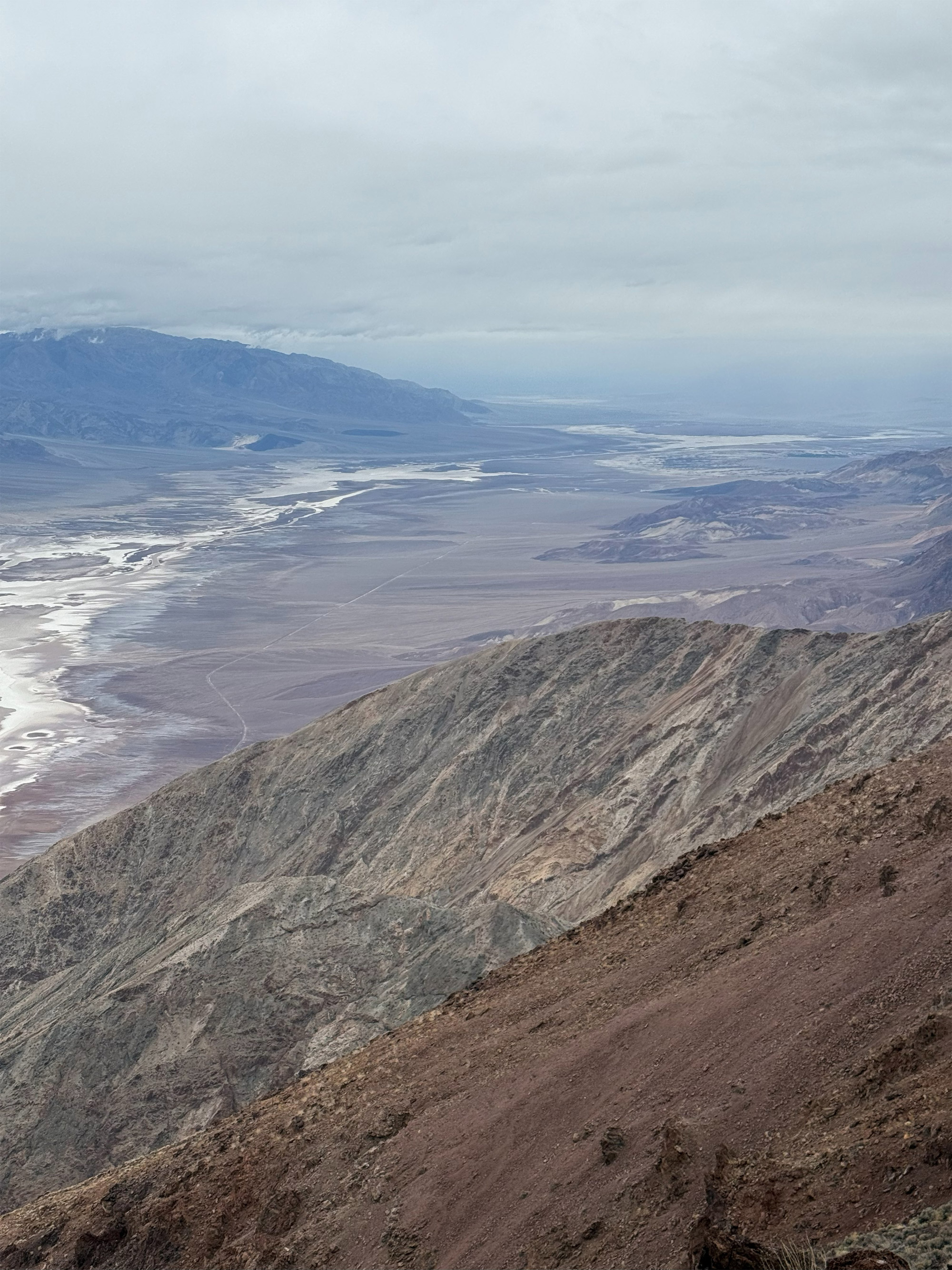
I stuck around for perhaps 10 minutes, drinking in the view while taking lots of pictures. It was a dizzying sight to look over the steep ledge and see Badwater Basin 5757′ feet below.
But the wind was howling, and my hands weren’t regaining feeling. Neither were my wet toes. I needed to get off that mountain before a deeper chill set in.
So I saddled up and began the tricky descent down the wet, steep switchbacks. The wind was howling in my ears, and I realized that rider was correct: it was worse coming down!
I figured the wind would subside as I made my way down, but it kept blowing hard, a crosswind hitting my front wheel and forcing me to constantly lean left to avoid being blown off the road. It was sketchy, and I was riding my brakes just to stay in control. I stopped twice to shake out my hands, to regain feeling. And as I left the prairie, I could feel the temperature warming.
I thought I’d descend the 40km home in well under an hour, but it actually took me 70 minutes due to constant braking in hard crosswinds. I can honestly say I enjoyed the climb more than the descent… and that’s saying something!
But don’t get me wrong. If I had to do it all over again, I’d do it all over again. This was one of those epic rides that builds confidence and reminds you of what cycling is all about. If you ever get a chance to ride to Dante’s View, do it.
This was one of those rare adventure weekends that all true cyclists love. It had the key elements: riding with friends, battling the weather, admiring new landscapes, and even conquering an epic climb. That kind of stuff is good for the soul, making memories while building physical and mental toughness.
While we were forced to change our initial plans, I’m happy we were able to repurpose those lemons into fine lemonade. Now I have to decide: where next? I’m open to suggestions…
Once again, this week’s top events come completely from Zwift’s community organizers! We’ve got two popular race series, a couple of feel-good group rides, and an extra-long ride with three pace options. See our picks below!
Cycling Time Trials (CTT) – the national governing body for time trials in England, Scotland, and Wales – launched their Winter Time Trial Series last week on Zwift. It’s proving hugely popular, with over a thousand finishers last week!
This week, due to popular demand, they’ve expanded their Saturday offering to two different events to accommodate riders in different time zones. Everyone is racing on Watopia’s Triple Twist (24.5km, 201m).
Regular ride leader Whitney Stidham was in a terrible bike crash back in September, and this Saturday is her first Saturday back, leading the 100km Giant Bagel Rolls Ride she’s led in the past. Join her, support her recovery, give her a Ride On, and get some endurance miles in!
Riders will be on Watopia’s Sugar Cookie route for 100km, at a 2.6-2.8 W/kg pace.
This event’s description text is entire in Polish, but it’s also got a lot of signups, earning it a spot on this list!
This is the second stage of a 5-week series which features a unique categorization scheme. Riders are categorized based on Zwift Racing Score, but into just two categories: 0-500, and 500-1000, with the higher category racing a longer route!
0-500 racers will be on Spinfinity (19.5km, 155m) while 500-1000 riders will be on Spinfinity Ultra (35km, 291m).
The Galaxy squad is celebrating teammate Gaby’s 80th birthday with a beginner-friendly spin around France’s Three Musketeers route (37.8km, 209m) on Saturday. The ride is not rubberbanded, but will be led at a pace of 1.6-2.2 W/kg.
Lots of riders already signed up for this one, and Galaxy says, “Everyone is welcome! However, we are looking to be especially encouraging to see ladies who are newer to Zwift, those trying to boost their fitness and endurance, or wanting to learn how to get more from their training just like Gaby does!”
A regularly featured event here on Zwift Insider, the BMTR Flat 100 consistently gets lots of joiners because it’s well-led and run consistently week after week, year after year.
This week’s ride is on Makuri Islands’ Wandering Flats, with three pace groups to choose from.
We choose each weekend’s Notable Events based on a variety of factors including:
Is the event unique/innovative in some way?
Are celebrities (pro riders, etc) attending/leading?
Are signup counts already high, meaning the event is extra-popular?
Does the ride include desirable unlocks or prizes?
Does the event appeal to ladies on Zwift? (We like to support this under-represented group!)
Is it for a good cause?
Is it just plain crazy (extra long races, world record attempts, etc)?
Is it a long-running, popular weekly event with a dedicated leader who deserves a shout out?
In the end, we want to call attention to events that are extra-special and therefore extra-appealing to Zwifters. If you think your event qualifies, comment below with a link/details and we may just include it in an upcoming post!
“NYC Showdown” ZRacing Series Details, November 24-30
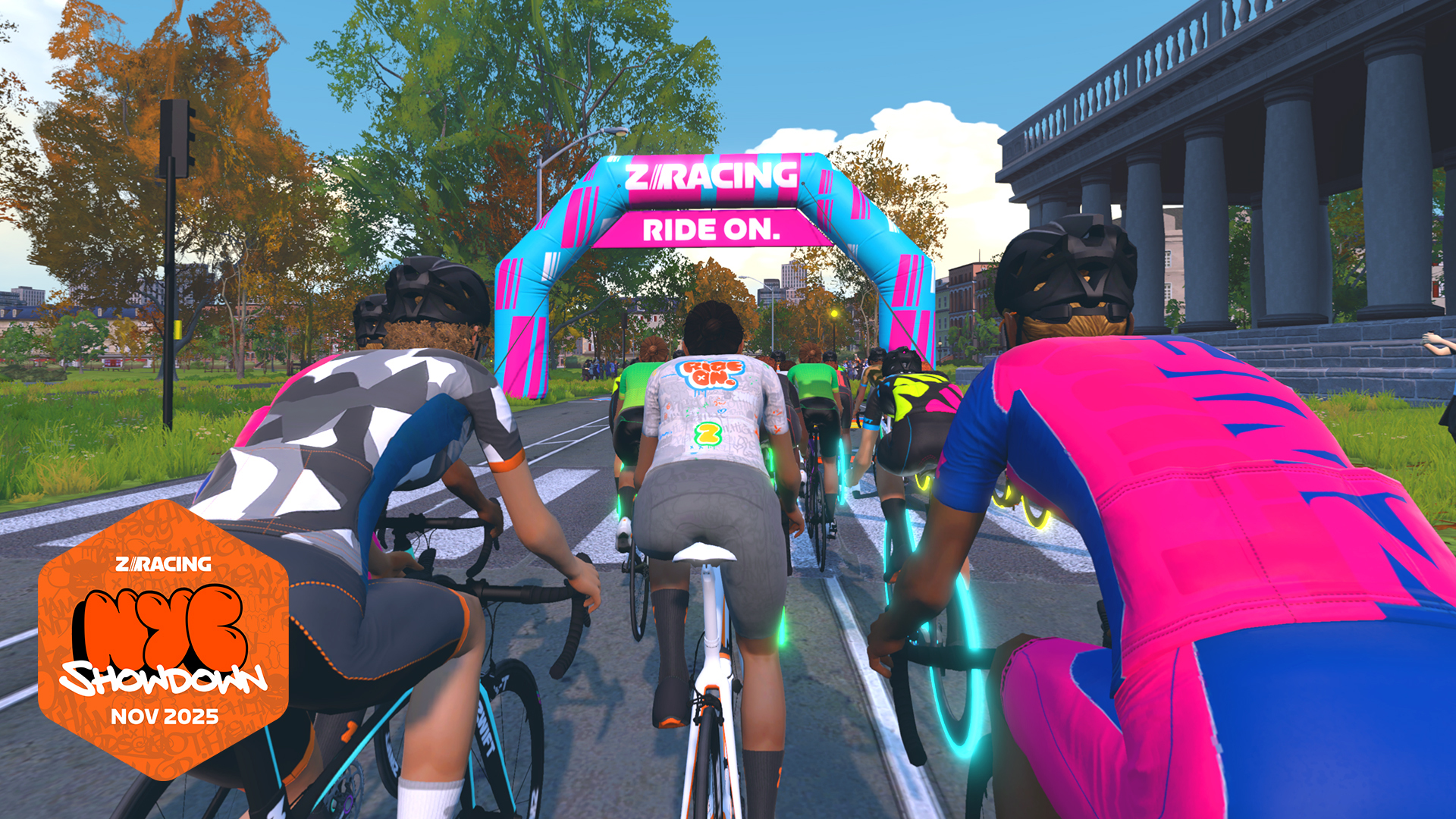
Next week, Zwift is mixing up their typical monthly ZRacing model by holding a week-long series of races on fresh New York routes. Each race is scheduled for just 2 days, but everything else is what we know and love about ZRacing… fast, hard races, with an overall time-based GC competition for the three races.
Your GC ranking is based on your best finishing time for each stage, and you can race each stage more than once to try for a better time.
Category Options
Zwift schedules three different flavors of ZRacing events in order to encourage “Fairer, more competitive racing for everyone.” They each use different racing score ranges for categorization and are titled Advanced, Range 1, and Range 2.
Extras
New: XP Bonus!
Zwift is moving away from giving badges for ZRacing, and instead will be doing XP bonuses. For this three-race series, riders will get a 500XP bonus for completing each stage.
Today, Zwift launched a new series of experimental Wednesday races dubbed “Crit Cade.” Similar events were held back in November 2023, but two years later, with many more Zwifters owning steering devices, the events may just have the numbers to make them interesting. Read on to learn all about Crit Cade…
These events are just like any other Crit City race you may have enjoyed in the past… except they’re totally different, for three reasons!
Steering Required: These events are designed to maximize the fun and engagement of Zwift Steering, so you must have a steering device connected to join the start pens.
Power Up Pandemonium: This race features the experimental Boost Powerups, which are given at the lap banner and must be used during the lap before picking more up at the next banner.
Speed Boosts and Hazard Pads: Blue Speed Boosts are scattered across the course to give you an extra injection of pace. But red Hazard Pads are also on course, and they slow you down! Watch out, because both types can move around and even swap.
You’ll need to stay fully engaged throughout the race if you want to come home with a win. It’s not just about putting out the power, it’s also about steering effectively, timing your powerups, and drafting whenever possible.
Watch the First Race
I signed up for the first race of the series, just to see how it unfolded from the comfort of my own desk. Watch the A category here:
Route and Schedule
Races are planned for each Wednesday, November 19 through December 31, at five time slots (0830, 1730, 1830, 1930, 2330, 0230 UTC) to cover peak time in all major time zones. See upcoming events at zwift.com/events/tag/critcade.
These events are held within the Zwift Labs club (sign up here). This feature is still in development, so you can share feedback within the club’s chat in the Companion app, or via the comments below (Zwift says they’re watching this post).
Share Your Thoughts
Have you tried a Crit Card Steering Race yet? Share your thoughts below!
The fourth race of Zwift Racing League 2025/26 Round 2 happens Tuesday, November 25, and it’s a team time trial on the new Watts the Limit route in NYC. This is an interesting TTT route, with plenty of pitch changes to keep us on our toes and unique characteristics that make it a much faster course than you might think.
Let’s dig into crucial segments, escalators, bike choice tips, and more!
Looking at the Route
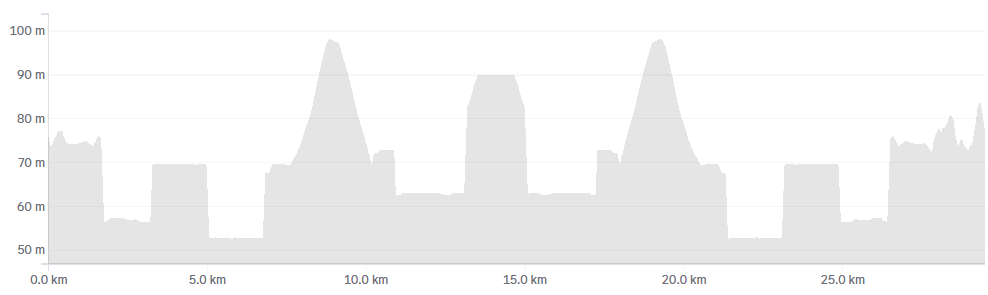
Watts the Limit is a fresh route from the recent New York map expansion. And while the Strava segment profile (above) may look lumpy – like a city skyline, in fact – it’s actually a fairly flat and fast route, thanks to escalators helping us out of the subway tunnels!
All categories will race a full lap of this out-and-back route, for a total of 31km with 219m of elevation. (Although it’s not really 219m, since ~95 of those meters are on escalators.)
Most of this course is close to pan-flat, with major elevation changes taking place quickly in between as you enter or exit subways. Here are the key points you’ll keep in mind as your team attacks this course:
Lead-In Kicker @1km (300 meters at 3.7%): this little bump near the end of the lead-in is short enough that it’s best to just hammer hard if you’re on the front, and stay in the draft if you’re behind. Keep the watts high so your speed stays up, then grab recovery on the flats and descents that follow.
Escalator @4.7km: the first of six escalators you’ll encounter today, these are going to play havoc with teams who have riders with widely varying weights. See “More On Escalators” below for details.
Escalator @8.2km
Manhattan Bridge @9.1km (1.2km at 1.6%): the bridge isn’t as steep from this side, so speeds will stay high and drafting will remain very important. Increase your power, but stay in formation. Recovery awaits on the back half of the bridge.
Escalator @14.5km
Hill to Grand Army Plaza @14.6km (400 meters at 2%): this little climb comes directly after the escalator, so keep the power up in order to maintain speed all the way up to the flat Grand Army Plaza turnaround at the top.
Escalator @18.7km
Manhattan Bridge @19.5km (1.1km at 2.4%): a bit steeper on this side, but still not a proper “climb,” so you’ll definitely want to lift the power while staying in formation up and over.
Escalator @24.5km
Escalator @27.8km
Final Kicker @30.5km (300 meters at 3.7%): almost there! Hammer this kicker just like you did at the start of the race, then go all-in across the top to empty the tank and finish fast.
Warning: the new escalators in NYC may prove tricky if there’s a big difference between the highest and lowest rider weights on your team!
Community feedback is saying, and our tests are confirming, that heavier riders slow much more on the escalators than lighter riders. (Heavier riders, take heart: Zwift knows about this issue, and internal sources tell me a change is planned soon to make escalators perform much more uniformly across various riders. Light riders: enjoy the escalators while you still can! 😁)
I ran bots of various weights up one of the longer escalators on the route (the final escalator you’ll hit, in fact). Each bot’s power was set so they would all have approximately the same escalator entry speed (~46 kph), and that power remained steady as they went up and over the top of the escalator. Here’s how much each bot slowed down between entering and exiting the escalator:
50kg bot @261W: slowed 3.2 kph
75kg bot @339W: slowed 11 kph
100kg bot @390W: slowed 16.1 kph
Of course, most teams won’t have a 50kg (or even 25kg) weight difference between riders. But the heavier you are, the more you should plan to push on escalators to keep your speed high. And lighter riders will probably want to keep their power fairly steady, to avoid shooting off the front!
Two more escalator tips:
Lower Your TD: These are steep, with gradients around 20%. If you have trainer difficulty set to 100%, it will feel like pedaling into a wall. I recommend setting TD to 50% or less for this course.
Follow the Wheels Down: The downhill ramps will also wreak some havoc due to varying rider weights and power outputs. Pay close attention and try to maintain your single-file position before, during, and after descending the ramps to maximize your draft benefit and keep speeds high. If you’re a lighter rider on the front during one of these descents, hammer out some of the watts you’ve saved on the escalators, as the heavier riders will fly past otherwise!
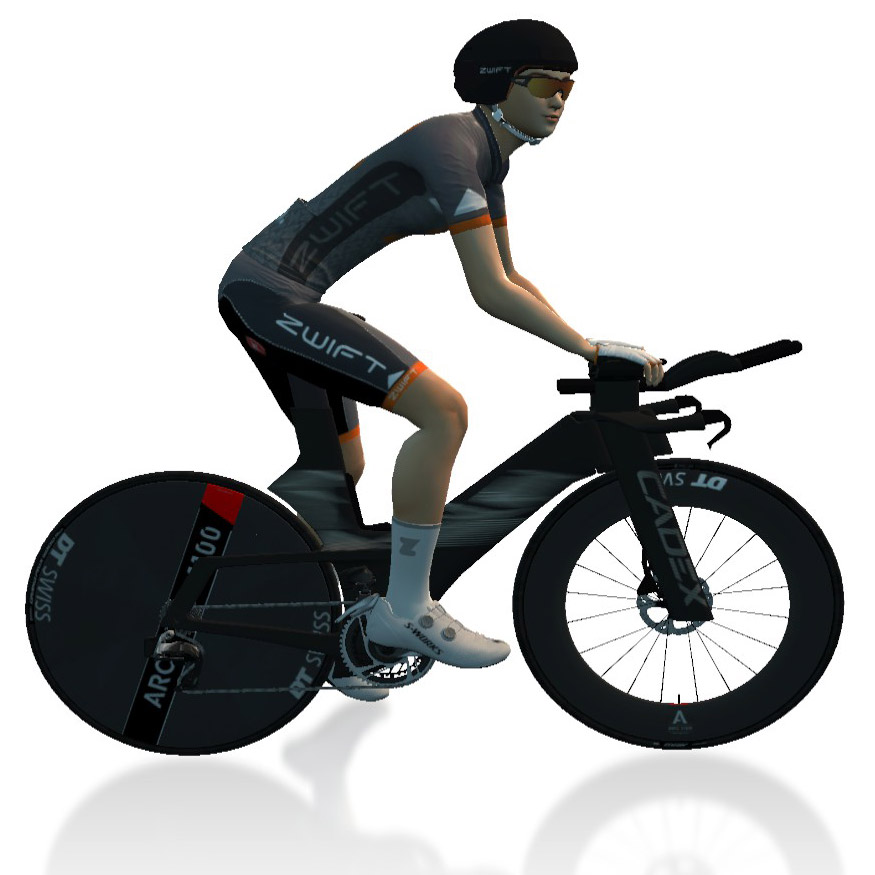
Bike choice here is simple: go aero. On a flattish route like this, weight doesn’t matter much, and aero is everything! The best setup by far is the CADEX Tri frame paired with the DT Swiss Disc wheels, but you’ll need to be at level 40+ to access this sweet rig:
Many recon rides are planned each week on the upcoming ZRL route. If you’re unfamiliar with this course, jump into an event and familiarize yourself with the route! Find a list of upcoming ZRL recon rides at zwift.com/events/tag/zrlrecon.
Additionally, riders in the Zwift community do a great job every week creating recon videos that preview the courses and offer tips to help you perform your best on the day. Here are the recons I’ve found (comment if you find another!):
Flatter courses like this week give valuable seconds to teams with big pure-power riders who can keep their power high on the front while staying in single-file formation to conserve in the draft behind. Extra seconds can also be gained by pacing smartly, ramping up the effort on short climbs and recovering a bit once you’re up to speed on the short descents.
On a course like this week’s, I highly recommend all team members set their Trainer Difficulty to the same value so you’re all feeling the gradient changes similarly. (When one rider has it set to 100% and another 25%, the first rider may ramp up power much more than the second when a climb hits, which can make a mess of your team formation.)
Your goal in a ZRL TTT is to get four riders across the line in the shortest time possible. That means every team’s pace plan will differ based on each rider’s abilities. I highly recommend having an experienced DS on Discord directing your team, especially if your team contains some inexperienced TTT riders.
Lastly, if you want to go further down the TTT rabbit hole, I highly recommend Dave Edmond’s Zwift TTT Calculator tool.