Motivation vs Discipline (Never Going Pro Podcast #4)
In this episode, Shayne, Ken, and Chris discuss Zwift Academy so far, motivation vs. discipline, and how planning comes into play for success in both aspects. They also discuss the science behind our audience question – “Why can’t I get close to my max heartrate while cycling?” Enjoy!
Related Links:
Show Transcript
Ken: Hey, guys. How’s everybody doing?
Shayne: Good, man. How are you?
Chris: I’m doing good.
Ken: Good. Good to hear from you. Did I ever tell you guys about the time I farted in a packed elevator?
Shayne: No.
Ken: It was wrong on so many levels.
Shayne: That’s much better.
Chris: That’s … I’m hesitant to us the word “better” with that joke, but it was better than the last one.
Ken: Okay. Good.
Chris: It’s better than the last one.
Ken: Well, hopefully our audience will enjoy it as well. Welcome to The Never Going Pro Podcast by Dads Inside Riding Trainers, featuring GC Coaching. It’s a podcast about riding bikes, and parenthood, and trying really, really hard at both. I am your host, Ken “the badger” Nowell. And with me is Shayne Gaffney, owner of GC Coaching.
Shayne: Hey, guys.
Ken: And Chris Gorney, fellow DIRT teammate, passionate cyclist, and outstanding dad.
Chris: How’s it going?
Ken: So let’s take a few minutes to catch up with everybody. Chris, how’s your week been?
Chris: Exhausting. I spent a week and a half on jury duty, and then flew out to California for work for three days, and then got home late last night. So I’m exhausted, although when I was out there, a friend of mine let me borrow a couple-year-old Pinarello to go on a ride, and had a lot of fun test-riding a bike I’ve never ridden before. I’ve never ridden a Pinarello before.
Shayne: Did it feel plush?
Chris: Honestly, it was terrible.
Shayne: Was it? Wow.
Chris: Yeah. It was loose. I don’t know how to say that other than the bike felt really loose, and it didn’t feel responsive. It wasn’t very stiff. It was an all-carbon bike, but it was, I felt like it just flexed so much, so you know.
Ken: That’s-
Shayne: Those are really expensive frames. A really expensive company too. I’m surprised they felt that way.
Chris: Yeah, well, maybe it was me [crosstalk 00:01:56].
Ken: I wonder if it was maybe the wheels perhaps. Who knows.
Chris: Well, it could’ve been that I also didn’t adjust the bike fit for the first 20 miles. I just got on it and started riding.
Ken: There you go.
Shayne: So that could definitely be part of it.
Chris: That might’ve been half the problem, but so adjust your bikes before you ride. Lesson of the day
Ken: So you’ve made it back home to your own rig?
Chris: I’m home. I’m going to go on a bike ride right after this, actually.
Ken: Fantastic. Cool. Well, I had a good week. I had a vacation in the Outer Banks of North Carolina, got to ride every day, also put on a couple of pounds, and just had fun, and hung out with my wife, and my kid, and my in-laws, so that was a really good time. But I hurt my back, so that has kind of sucked. I think-
Chris: How’d you hurt it?
Ken: Well, I think it was a couple of things. I did a little bit of kettlebell work down there. And I haven’t done anything core or stability work in months. And then I was in the drop bars on my road bike, and since I’m always on Zwift on the thing, I’ve never used the drop bars. And so I felt my back a little bit tight towards the end of the week, and I got out of the truck yesterday after a four-hour drive and picked up a heavy cooler out of the bed. And that just did it in. So yeah, my back is out of sorts. And maybe Shayne has some advice on that.
Shayne: Usually what I see is an issue with the hamstring shortening, especially if you’re getting out of a truck after four hours, because your knees tend to be bent for that four-hour time, which makes the hamstring muscles in the shortened position. And then if you combine that with riding the drops, which then elongates hamstring muscles and makes them work a little bit differently, that can spell disaster for your back. So I would think more hamstring stretching and maybe some form rolling, see if that makes it feel any better.
Chris: Well, if I know anything about Ken, it’s that he’s always had really tight hamstrings. Just it’s the only important thing I know about Ken.
Ken: Yeah, the hamstrings are tight. And I am absolutely terrible about doing anything stretching. I have limited amount of time to train. And so I spend every possible moment that I have on the bike, which I know that’s a mistake, but at this time-
Chris: I have hamstring issues way more on Zwift than I do on my bike out on the road. And the fit is the same. And I’ve never figured it out, but it’s when I ride the trainer, it’s just it must be because I’m sitting different or my weight’s just a little bit different. But during the summer season when I’m out on the road, I have no back problems, no hamstring problems, no injury problems, and I simply put my bike on a trainer. And all of a sudden if I ride too hard a couple days in a row, my hamstrings start hurting. It’s a strange thing.
Shayne: That’s I think from glutes not inactivity, but just decreased glute activity on the trainer than on the road. I’ll link the article I’m talking about in the show notes. But there’s this really good thesis that somebody did for a college. I think it was a college PhD. But he combined the muscle activity from outdoor riding to indoor riding. And the only difference he found was that the glute activity was a lot less on the trainer than it was outdoors, which can contribute to increased hamstring engagement because the muscles have to produce the power. So if the glutes are working less, the hamstrings and quads have to work harder to produce that power.
Ken: Is it just because you’re locked in one position on the trainer and we tend not to stand up very much, and we’re not going around turns?
Shayne: That’s a good question. The study didn’t really go into the why. It just kind of went into what the findings were. But I think the-
Chris: I really appreciate studies like that: “We found this. We don’t know why it’s happening, and it’s not really helpful, but, hey, we agree your hamstrings are hurting. Thank you.”
Shayne: I’ll take my PhD now, and I’ll be out the door. No, but I think the issue is that the trainer does keep your body in a fixed position, so you’re not having to keep the bike pointed straight down the road. So you’re using the stabilizing muscles and the hip abductor muscles a little bit differently, and that can decrease the gluten engagement. But, again, I can’t prove that by science.
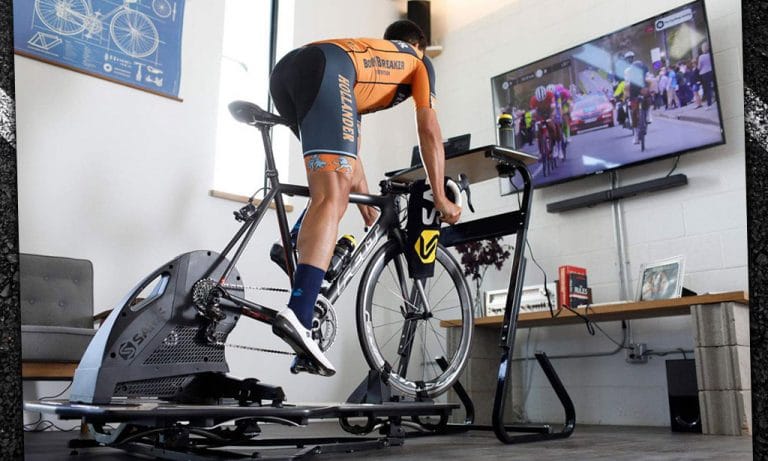
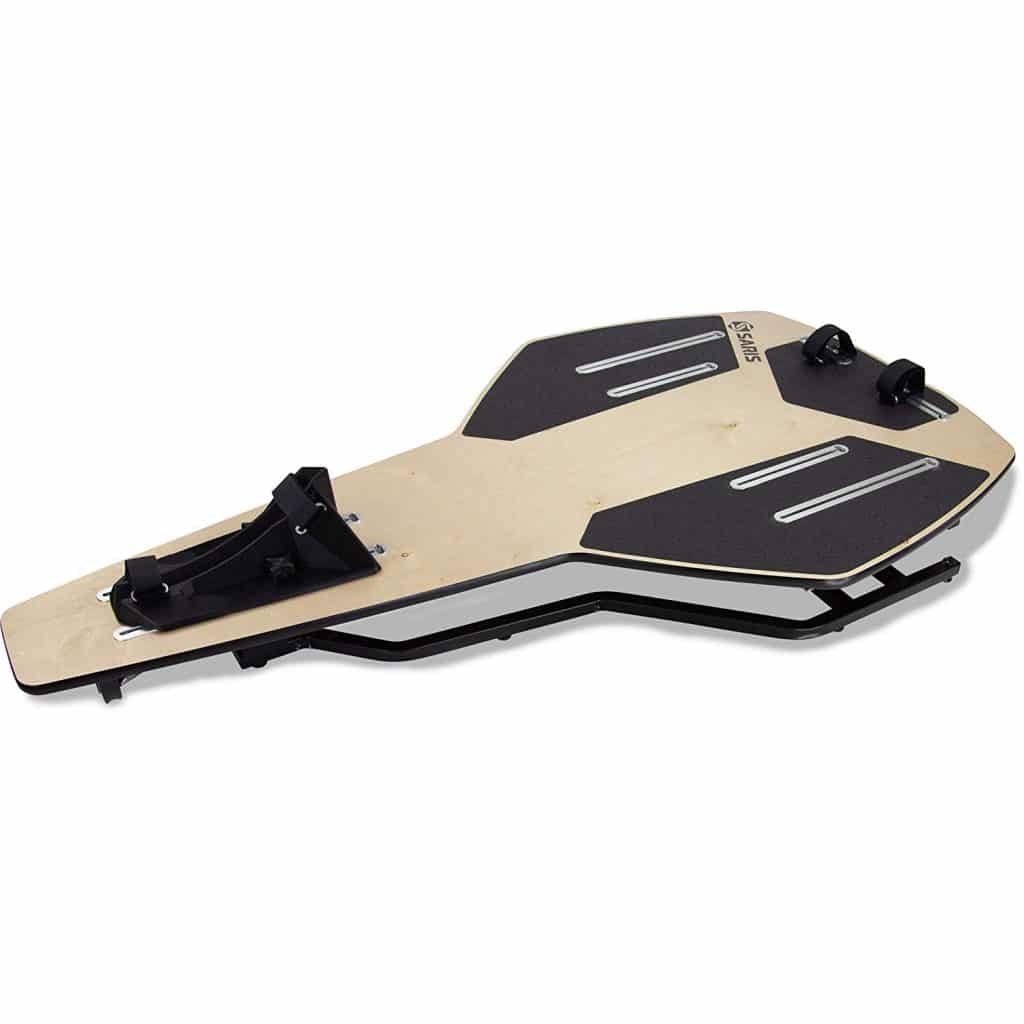
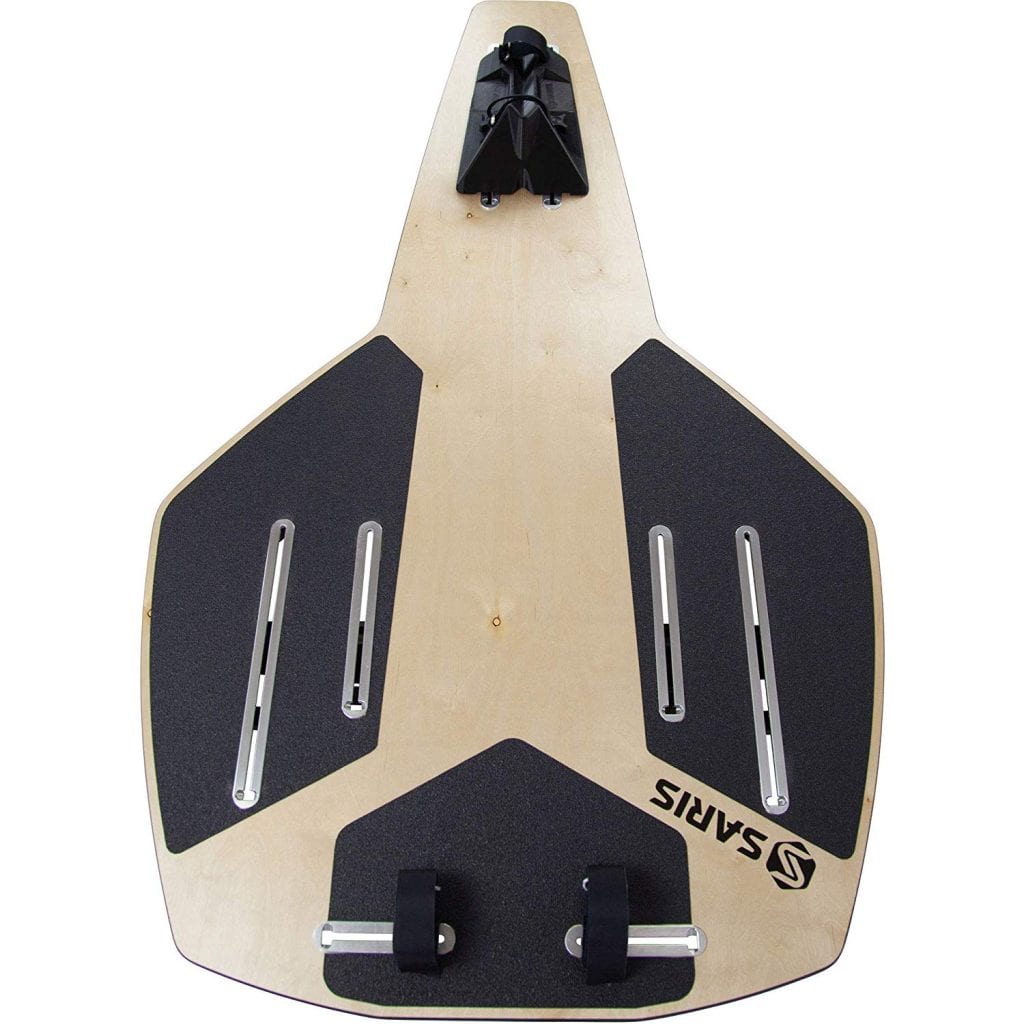
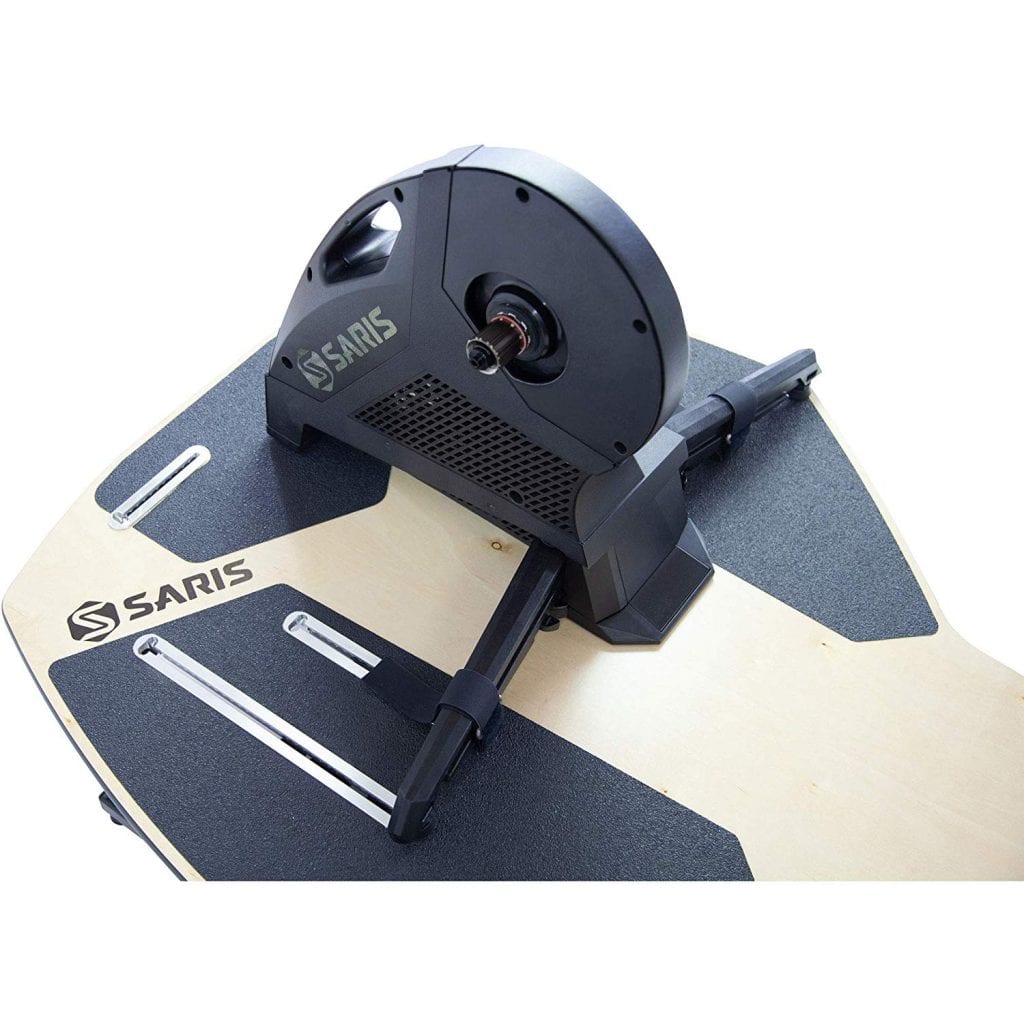
Chris: There’s a new trainer out there by Bkool, B-K-O-O-L. I think they had some troubles getting it to market, but it’s they’ve inserted some sort of like left-right pivot action into the trainer. And so it’s your bike’s almost kind of suspended from the back. And apparently it’s supposed to mimic like on the road riding more so for a virtual trainer. Interesting. I’ve never tried it.
Shayne: I’ve seen that with Cor Kinetic. Cor Kinetic has that Rock and Roll trainer. And then the Rocker Plate is another big one too that people are making with just tennis balls and mounting the trainer onto it to get that left and right, back and forth motion. Chad McNeese has a really good video on the Zwift Insider website about he made one just out of I think pieces of plywood and then I think three or four tennis balls. And it’s pretty simple to make because some of the ones, they’re a few hundred books to actually buy one.
Chris: And I know this is probably me being cynical but who is it? Is it Wahoo who’s got the bit that’s supposed to mimic incline and decline?
Shayne: Yeah, that’s Wahoo. That’s the climb.
Chris: I mean, I’m sure I would love it if somebody gave me one. But, I mean, you’re on a trainer. I mean, that … Anyway, and we could probably do a whole episode on people going crazy with their Zwift cave. Like they’re-
Shayne: Oh my God, yeah.
Chris: I’ve seen some crazy videos that people have gotten really … It’s almost like a VR room.
Ken: Well, and I think as Zwift and other indoor training platforms become a sport, you’re just going to see more and more of that, where it’s not the thing to do in lieu of riding outside, it’s just the thing that you’re doing for the sake of doing that. So, Shayne, what’s up with you? What have you been up to?
Shayne: Been up to same, same thing: going on vacations here and there, a couple long weekends, went to the beach last weekend. That was really cool, with the fam. And then I finished up all my work for the Zwift Academy. And now I’m just kind of enjoying people’s responses to it and answering questions and stuff when I can, which has been really fun to see people are really [crosstalk 00:08:19] this year.
Ken: For our audience out there, many of you may not know that Shayne does work for Zwift. He’s written some of their training programs, but you also had quite a bit of a hand in Zwift Academy. Tell us about your involvement with it.
Shayne: My involvement with that was the messaging component. So the other coaches designed the workouts, and I came in and kind of overhauled the messaging component. So all the typos and the misspelled and all that stuff is all from me.
Chris: So when I get that encouraging like, “You can do it. You’re almost there,” I can just like-
Shayne: That’s me.
Chris: … mentally curse you?
Shayne: Yeah.
Chris: “Shut the hell up, Shayne.” That’s what I’m going to be thinking the whole time.
Shayne: That’s right.
Chris: That’s good.
Shayne: You can blame me for all that stuff.
Ken: Right. And so I did I think workout number two, which was a race simulation. And that was tough. I barely made it through. There were three times during that workout that I thought I was going to quit. But it seems to me like any sort of well-designed workout which is based on your FTP is going to make you feel like you can’t finish it at least a few times. But you can if you just stick with it.
Shayne: And that’s where I try to time those motivational messages. At certain points where I kind of know that the athlete is going to feel like they’re really struggling and want to give up, I’ll kind of plug in a motivational messaging at that point, just hopefully give them a little bit more motivation to keep going.
Ken: Well, so I have another question: How many of you were on the Zwift Academy design team or whatever you would call it, the specialty team?
Shayne: One coach, Kevin Poulton, he designed the Power Duration Curve Measurement Tests, so the 20-second, and the five-minute, and the one-minute power duration. And then another coach, Elliot Lipski, he designed the race simulation workouts and the more kind of fun and loose workouts. And then I was involved with all of them in terms of the messaging. But I didn’t do any of the actual workout creation, the workout design. I just came in and did the messaging component of it.
Ken: Very cool. Very cool, man. It’s really cool to have a Zwift insider with us on this podcast. And so yeah, with that, so we got some cool topics for this week. And I wanted to go ahead and go over with them, with our audience really quick, the first topic is motivation and discipline. Topic number two is some practical tips and tricks for making ride time for yourself. And then topic number three, we have a focus question: Why can’t I get close to my max heart rate while training or cycling?
Ken: And so with that, let’s talk a little bit about motivation and discipline. My take on this, and I did a YouTube video for us and a article, and it was that motivation is good for your start-up energy to get started on something. But discipline is going to be that thing that carries you for the long haul because motivation can be very fleeting. And I’d love to hear what you guys have to say about those things and how it’s played out for you.
Chris: Shayne, you had a couple interesting articles you posted when we were kind of preparing for today that seemed to describe a good difference between motivation and discipline, right?
Shayne: Article that I was referring to was the Central Governor Theory, which isn’t so much about motivation and discipline, but it kind of goes into the play of how hard can you actually push in a workout? And is it you that’s pushing your body that hard, or is it your brain that’s allowing you to push yourself that hard?
Shayne: Some coaches think that the motivation and the discipline comes from a purely internal, or some coaches believe that it’s purely external. So I’m kind of a little bit of both, where I think you have to have some internal discipline and motivation to get up in the morning and get on the bike.
Ken: So with that, did they talk about external goals? For me, I’ve always tried to have a event that I’m preparing for that keeps me motivated.
Shayne: I would agree. So I think the first thing for any athlete is to have a goal, because that’s going to keep you motivated on a daily progression towards it. So that can be, like you said, an event. So it could be a charity event. It could be a race. It could be you want to get a FTP number or time or duration. It all depends on what you want to do for that week or that month.
Ken: And so, Chris, what are some of the things that keep you motivated? Or how does that sort of affect you?
Chris: That was my awkward silence there, is because I’m trying to … I was like, “Man, what does motivate me? Man, I don’t think I have a goal right now.”
Shayne: Well, your goal right now is just to smash KOMs.
Chris: That’s true. I was texting you that the other day. Back here in Kansas City, there is these two guys who are like semi-pros or pros who are … One of the guys clearly just like came through our city for like a week and just was on Strava and decided to go own everything. And then the other guy I think lived here for a little while. And I was coming off of a hard training season where I was just really, really strong a couple months ago. And so I decided I was going to go recapture KOMs for the honor of my city.
Chris: And so I’ve been doing a little bit of KMO hunting and really reveling every time I get one in front of these guys and I know that they’re getting an email that says, “You’ve been dethroned.” And then like, I mean, I’m sure they don’t care, but I’ve made my little nemesis. It hasn’t made the group I ride with as happy. But it’s fun. So that’s kind of my motivation right now coming out of a hard training season without any like races coming up. But I’m now actually beginning to think, what’s it look like to do let’s say starting in October, in another month and a half, what’s a winter training plan look like? And what do I want to start working towards coming out of the winter? So that’s kind of a fun thing. Discipline’s a little harder for me.
Chris: I actually first think of discipline in terms of family, like what’s it look like for me to be a good dad, and be disciplined in communicating with my wife, and scheduling things so that it’s not just getting up early, but it’s sometimes there’s race times that are in the middle of the day or something. And I actually find that a less or a seldom talked about discipline is communication like with family. If we’re saying parents and being a parent and being a family is more important than biking, than being disciplined to like schedule things and not burn your family down is actually a really hard discipline.
Ken: You said your wife is really active too. And so you’ve mentioned that it’s like high-fiving on the front porch as you both, one’s coming back from an activity; the other’s heading out. And that really struck me as being true for my wife and me as well.
Chris: Yeah, I was going to say it’s been a rhythm. When we first started dating, we went on a lot of runs. Actually, the morning of our wedding, we did a 10k race together. And we were going to run a half marathon that morning, but everyone complained so much. I don’t know what they thought was going to happen. I don’t know if they thought we were going to have heat stroke or get hit by a truck or something. I don’t know. So we shortened it. And ever since then, we’ve really made it important. And so it’s actually not a joke. I’d say three or four days a week, we high-five on the front porch because our daughter’s still sleeping.
Chris: So I’ll come home. And she’ll be sitting on the front porch with a bottle of water and then kind of say, “Hey, good morning. See you.” And then she’ll go for a run. And I’ll go inside and make coffee.
Ken: That sounds good. And so we also, we’re going to talk about tips and tricks for making ride time. And so I got some that I’d like to share. For me, I don’t ever really decide to work out, it’s just something that I do. Like waking up and going to work or feeding myself, exercise is just something that’s on the schedule. And I don’t really think of it as an option anymore; it’s been so many years. But there’s a few things that I do every single night to prepare. I set a bedtime alarm. So when that thing goes off at 8:40 at night, I know that it’s time to brush my teeth, to put down any screen time I have going on, and get ready for bed; otherwise, there’s no way I’m going to get up at 5:00 in the morning.
Ken: I lay out my kit. I lay out my socks. I put water bottles on my bike. And then I get a banana ready, and I get coffee set up. So I don’t think very clearly in the morning. And if I didn’t have that discipline, if I didn’t have those habits and was trying to think about what are the things that I need to do in order to be on the bike by 5:30, I’d never be able to do it. So those are the tips and tricks that I have for making sure that I’m getting in my ride time. Shayne, I know you’ve got some tips for us.
Shayne: Yeah, I have basically the same things that you do, which is just planning everything ahead of time, ideally the night before, if you’re going to be riding early in the morning. So I really don’t have much to add to that aside from maybe just making sure that Zwift is up to date, because I’ve had some issues in the past where people were going to bed and Zwift did an update that night before or whatever. And then they missed their group ride start time or whatever. So that’s the only thing I can add to that: Just make sure that you have Zwift up to date before the ride.
Chris: Hey, when I was living out in California, like you guys know, a couple months ago, the house we were renting, the WiFi there was so bad. You’d be fine if you’re on your phone or whatever. But then I’d get on and all of a sudden it’d be a Zwift update, and it was just like, I’m not even kidding, it pretty much canceled my ride. The WiFi was so bad, I mean, I probably took 30 minutes to update, so I’m like, “Well, I guess I’m done.” That happened to me like three times out there.
Ken: So you’re not kidding. That’s a great tip.
Chris: Yeah, definitely.
Shayne: What about you, Chris?
Chris: For me, I actually, I don’t know, I don’t want to kind of just continue to beat the same drum, but for me, it’s prep in the sense of just like it’s … This is going to be a little too vulnerable, but I will routinely find like underwear in random places in our house because we have a two-story house and our daughter’s bedroom is right above the front door. And so basically my goal is to get up and out of the house as quiet as possible without waking up my wife or daughter, which means I will take all of my stuff and put it in the kitchen, like on the kitchen floor the night before if I’m going to ride, either going outside or getting on the trainer.
Chris: And so inevitably I’ll be like cooking dinner or something the next night. And I’ll be like, “Who the hell … Whose underwear is in the kitchen? Oh, that’s my underwear,” because I’ll just walk downstairs [crosstalk 00:19:16]. And, I mean, it’s like people are coming over. I mean, I’d say that’s like two or three times a week. So I apparently have enough discipline to plan that but not enough discipline to put my clothes in the hamper.
Shayne: So I got to ask, boxers or briefs?
Chris: I’m a brief guy. I like the snugness. What can I say? Also, many a time just ridden to work and then done the kit under the jeans all day long.
Ken: Are you serious? [crosstalk 00:19:44].
Chris: Which I have to [crosstalk 00:19:46]. But yeah, it is, not to [crosstalk 00:19:52] kind of underwear I wear all the time, but it is both gross at the end of the day. I’ve also gone the other way where I’ve biked to work and I remembered all my work clothes except underwear. And then you have the dual choice of do I wear dirty kit all day, or do I just go commando? So that is-
Ken: Just commando.
Shayne: Commando.
Ken: Yeah, that’s my vote.
Chris: That’s me hoping that no one from my office listens to this.
Ken: Yeah, me too. Well, one of the comments, we sort of put this out there on the DIRT Zwift page, and we had a guy, Cory, he asked, he’s like, “How do you deal with getting yourself out of bed? I’m a morning person for the most part. And I can set my alarm for 4:00 AM to hit the road.” But he struggles getting on the trainer.
Ken: And so this brings me to another tip that I had: If you are struggling to get on the trainer and find it interesting, then you need to make it more interesting. And we had a comment from Jason Stern, our founder. He said, “Find the fun. Find events. Find races, and find friends. The only way this will work for you long term is if you are having fun.”
Ken: And I have definitely found that to be the case. And one of the best places on the Zwift Universe is the Dads Inside Riding Trainer Discord page. Those guys are on there all day. I don’t even think they have jobs. They’re just typing all day, making wisecracks. And then in the morning time it is just a radio cackle. There’s a radio chat for every single group and every single event that we do. And it’s super fun.
Ken: And once we get into race mode and we’ve got that audio going, and the team chat going, I swear I don’t even remember that I’m on a trainer. I mean, I might as well be on some single track or hitting the roads outside of town. If feels the exact same. It fools my brain.
Chris: I don’t know. Not me. I remember I’m on a trainer. I’m the antithesis.
Shayne: I love it. I love the trainer.
Ken: I want to get you doing more Zwift races this winter, and we’ll throw down together. And I promise you-
Chris: Well, I mean, I was getting up to race East Coast races last winter. And I think that just burned me out, because I was getting up at … You know. I was getting up at like 4:00 AM to ride with those guys because I wanted to help. And I just wanted to die. It was so early.
Ken: Yeah, it is a concentration of population on the East Coast. And so we’re trying to develop more events for Central Time. But it’s just a little bit …
Chris: It’s gotten better.
Ken: It is getting better. It is getting better. But I expect Zwift will grow quite a bit this winter.
Chris: I think I complained enough to Jason that at one point he was texting me, saying, “Hey, man, what time can you ride in the morning?” And he was I think scheduling races so that I was like just not complaining about getting up at 4:00 AM anymore.
Ken: Yeah, definitely. So those are some of our practical tips and tricks and motivation and discipline discussion. And we have a focus question: Why can’t I get close to my max heart rate while training/cycling? So let’s put our scientist on the line.
Shayne: So the big issue is finding what the max heart rate is. So the two main calculators are the Fox and the Tanaka. So Fox is from 1968. That’s the old 220 minus your age, which I’m sure everybody has heard about. And then Tanaka is 2001. And he says 208 minus .7 times your age. And I’m going to link all this stuff in the show notes too.
Shayne: So the issue is the study by [Zorsinsky 00:23:33] in 2014, and they compared the Fox and the Tanaka as well as gave just a little bit of a error tracking too. So they found a 12.4 beat-per-minute error on average for the 220 minus your age. And they found an 11.4 error for the 208 times .7 times your age. So both are off by about 10 to 12 beats per minute in terms of max heart rate. And the other issue is how do you actually find your max heart rate? Because the only way I know of us if somebody held you at gunpoint.
Chris: So I’ve been watching … kind of thinking about this question of the last couple weeks. I’ve been a lot trying to figure out my max heart rate and kind of just like, when does it peak? And I swear that there’s been a couple times that I’ve had like a really high heart rate. And I’m like looking back over my ride. And I’m like, “Man, I don’t remember working that hard.” And then I remember there was a time where a car almost hit us or something. And I’m like, “I think that was it.” I’m not even kidding. I think that there was something scary happened. And it like shot my heart rate up because I was just terrified.
Ken: Yeah, well, you don’t want to keep your kit on under your clothes after days like that.
Chris: Yeah, definitely commando days on those days.
Ken: Yeah, no kidding there. So is there a method for determining that max heart rate? Because I think what he was saying was he was doing like a 20-minute power test. And he would hit like a threshold heart rate. But certainly he could push it higher somehow.
Shayne: Right. So I guess that’s my point here is that knowing what your max heart rate is kind of useless. And it’s really useless if you’re trying to base training and prescribing training off of when you have access to a power meter. So I just wouldn’t use it, honestly. I would use power, or if you have it. And then if you have an ability to do an actual threshold test, which is typically the 20-minute version, you can take what you’re average heart rate is over the 20 minutes after you see that initial ramp-up. So it’s usually your heart rate will ramp up for about two to three minutes. And then it’ll stabilize and slowly trickle up after that.
Shayne: After you get that initial two- or three- minute ramp-up, then you’d see the trickle up, that’s the point that you want highlight. And that should be around what your average and threshold heart rate is. So it’s usually 17 minutes out of the 20-minute test. And then I would base your training prescriptions off of that or ideally just based off of what your functional threshold power is if you have-
Chris: See, I’m so grateful to hear that because I ride with some guys who have … I mean, there’s one guy I ride with who’s probably 35. And by God, he gets his heart rate to like 202, 204 every ride. And I’m not sure if I’m impressed by that or if I’m afraid he’s about to have a heart attack, and when I see that … And I know a couple guys like that. And I know another guy who’s in great shape, and I’m faster than him. And his heart rate is always on average 20 beats faster than me. And he’s not out of shape. He’s trained. But he’s just … It’s just different. And so I’ve kind of come to personal observational conclusion that max heart rate’s just crap because there’s a huge genetic difference, it seems, even just among people who are trained.
Shayne: Yeah. I mean, what’s your threshold heart rate?
Chris: Threshold? My threshold heart’s probably 155 to 160.
Shayne: What’s yours, Ken?
Ken: If I’m really getting after it, maybe 165, if I’m racing, yeah. And when I’m racing it gets higher. I think there’s some nerves going on there, some nervousness.
Chris: Shayne, are you asking, when you go from zone three to zone four, what’s that heart rate? Is that what you’re saying?
Shayne: Yeah. So if you were at your FTP or your estimated FTP, what would your heart rate be around? What number is that?
Chris: 160 or so.
Ken: 165.
Shayne: 160. Okay. I’m at 180 to 182. And I’m the same age as Chris is, because I’m 33 and Chris is … How old are you, Chris? You’re 32?
Chris: 33.
Shayne: 33. Yeah. So that’s kind of like a huge thing there would … Me and Chris are the same age, and we have a 25-beat-per-minute difference in threshold heart rate.
Ken: Well, and one thing that is true is I started using a heart rate monitor kit around the age of 30. And that was 14 years ago. And I cannot get it up to 180 anymore. I haven’t seen 180 in years, where I used to regularly see it on every single ride back then.
Shayne: Yeah, so the heart rate is really I think an output of the training, but it’s not really an input. What that means is the input is the actual work being done based off power, and then heart rate is the output of that work being done.
Chris: So here’s a question, Shayne: What’s your FTP right now?
Shayne: Right now it’s low. It’s only 235, 240.
Chris: See, that’s what’s interesting, is mine would be … I mean, I haven’t done the test for a little while, but it was like 290-something. I was right around 300. And my threshold’s 20 beats lower than yours. To me, that’s just so crazy. But you can ride side by side with a guy, pedal for pedal, and the heart rate data would be just wildly differently. That’s why I’m such a huge fan of perceived effort, because that way you can actually [crosstalk 00:29:30].
Ken: I do have a question for you, because I’m assuming there’s a lot of mountain bikers in the audience. And most of us have not invested in a power meter. So what about using a estimator for training stress for outdoor mountain bike rides? I mean, certainly there has to be some value in that.
Shayne: Absolutely, yeah, and like Chris was saying, just using RPE is a great-
Ken: Okay.
Shayne: Because if you’ve been racing or riding long enough, you can basically know just off of feel where you’re working at. It’s almost like when you’re driving a car at 40 miles an hour for a decade, you know how fast 40 miles on hour feels like.
Ken: Yeah. I guess you got a-
Shayne: [crosstalk 00:30:10].
Ken: … good point.
Shayne: You know what zone three, and zone four, or zone five, you know what that feels like just based off of experience. So RPE is great, especially if you’re racing where you don’t have time to look at your computer every three seconds to make sure you’re in the right zone or whatever. And if you’re also at the whim of a Peloton, you really can’t have control, you have to just go with the moves. So RPE is great, I think.
Chris: I’ll tell you that the most helpful thing that I’ve ever done for a long period of time training, and I didn’t know I was doing it on purpose at the time, but back in the day when I was single and I was competing in triathlons, I really stopped enjoying riding bikes and running because I was using heart rate monitors, and I was cadence. I was just tracking every … I was just hyper tracking the data. And I just started hating it.
Chris: So I decided to just pull everything but a watch off my bike, no heart rate, nothing. I’d literally, I had an old Timex watch, and I just started a clock. And I knew I needed to ride for three hours, and I needed to do a certain amount of it. And I started just going by perceived effort and like why this ride needs to feel like an eight to nine for an hour, or whatever.
Chris: And it was the most helpful thing I’ve ever done because not only did I start riding and having fun, now I’m back to using tech and stuff. I have all that on my bike. But it helped me listen to my body more than I was, because I was relying on tech rather than listening to how my body felt. And that year period where I just kind of learned to listen, it just made all the difference.
Chris: And now I can. It’s like you said: I know what “40 miles feels like,” 40 miles an hour feels like. But I also, I’m not so sure it’s not a good idea to go out and ride without tech for a while, even once or twice a week and just really feel what your body feels like.
Ken: Yeah, throw your bike computer in your back pocket and just go and have fun. I’ve seen people mount it upside down on their bars. So there’s certain things that you can get your information. But yet you’re not focused on it, and it’s not taking away from your experience.
Chris: For sure.
Shayne: Now we’re drawing on this a little bit too, but there’s this thing called No Garmin No Rules. It’s this website. And these people just sell the stickers, which is an old Garmin head unit. And it says “No Garmin No Rules” on it. So I literally give my athletes those types of rides, where I’ll just say the same things: “Put your computer in your back pocket and have a No Garmin No Rules kind of a ride because you need it for overall balance and I think just for mental health.”
Ken: Yeah, I definitely agree with that. Well, thanks for getting into the science behind that heart rate training. I think that’s really useful information to know. I also wanted to introduce to you guys a dude named Ed Zook. He is one our DIRT teammates. And Ed’s got a really interesting story. He’s figured out a creative way to use the Zwift platform to stay motivated. And at this time, Zwift does not support group workouts in their meetup feature yet.
Ken: So in other words, if you and I wanted to do the same workout, we’re going to have to work around it because meetups can’t do it. And so Ed and his training partner Nat realized they are very close in ability. So they start their workouts at the same time. And it’s because of the drafting dynamics, they’re able to stay together throughout any course that they ride on, which I think is really cool. So here is the interview with Ed. Enjoy. Ed, welcome to the Never Going Pro Podcast. How are you doing today?
Ed: I’m doing pretty good. I’m getting some rides in and feeling good.
Ken: Good. You get a ride in this morning?
Ed: Yep. It was the Tuesday DIRT ride. I can’t remember the name of it for the life of me, but got a little of recovery, maybe just a little bit of a recovery.
Ken: Sure. It was probably either Rolling Thunder or Watts Up.
Ed: It was Rolling Thunder. That’s what it was.
Ken: Fantastic. That was one of our early rides, which is basically not too long of a ride. It would be a building ride for our cat C and D riders and probably a endurance ride for B riders. One of the reasons I wanted to reach out to you was this week’s podcast we’re going to be doing some practical training tips to make sure that you get in your time on the bike every week. And I’ve noticed that you and Nat have come up with a solution to making sure that you get your rides in. So I’d like to hear a little bit more about it.
Ed: Well, so I guess Nat and I, I guess got together back in November when we both first joined DIRT and started doing rides and races and noticed each other. And we were about the same level. So we both planned out rides for this September. And he started talking to one of our other buddies about putting together a training plan. Then I kind of luckily joined in. And that was roughly 12 weeks ago when we started out.
Ed: So essentially came up with a 16-week plan before our events. And we just basically linked up on Messenger and planned out our times that we ride, which is 4:15 to 4:45 AM for me, being Central Time. And for him it’s between 7:15 and 7:45 PM in Australia.
Ken: Oh, wow, that’s really fascinating. And so for those of you that aren’t super familiar with Zwift and how their training plans work, there’s no real way for you to do training plans together. So the two of you have had to sort of adapt and overcome with some of the current training shortcomings in Zwift. So how do you piece that together? Are your numbers just so close that you can do the same intervals and the same zones without any issue?
Ed: Amazingly, yes. It’s pretty close. So what we ended up doing is we’ll message each other and figure out what time we’re going to start. And then we also put a ZWO file together, which we usually create just on one of the online create tools and email those back and forth. And once we do that, we load it in and we can’t even do a meetup because you can’t do a meetup and a workout at the same time. So we just plan our time, pick our route, and then meet on Zwift. And then we do a three, two, one countdown, and we unpause our workout, and we start rolling.
Ken: I think that that is just an amazing use of your resources. And then you use Discord so that you can chat in real time.
Ed: That’s right. That definitely helps with motivating each other a whole bunch.
Ken: Yeah, I’m sure, because I see you guys on their in the morning all the time, because I’m a lot of times jumping in, doing my own training workouts and see you guys on there. And we’ll catch up and we’ll shoot the bull for a little bit, usually when you guys are not doing an interval.
Ed: Definitely. That’s definitely right.
Ken: Sure. So what are some of the things that you do ahead of time to make sure that everything is ready to go? Because I know when that alarm goes off so early in the morning, so for you, what time are you actually getting out of bed?
Ed: I usually have my alarm set for 3:30. And I get up at 3:30. I make sure my water bottles are ready. And if I need a gel, I’ll try to pop that right away or eat a banana. Most of the time, I just go in fasted unless I know it’s going to be a really, really difficult ride or a longer ride, and take care of getting dressed and getting Zwift started, and all that stuff. We message each other, make sure we’re both up and moving. And if we have to delay 15 minutes one side or the other, then we do that. And yeah, we go from there. It’s just coordinate the night before and then make sure we’re coordinated about 15, 20 minutes ahead of time. And we hop on and get moving.
Ken: That sounds great. So do you put your water bottles on your bike or next to your bike the night before and get your kit out the night before?
Ed: I usually have my kit out, and it’s ready to go. Water bottles, what I’ll normally do is I’ll get them ready, and I like them chilled, so I’ll put them in the fridge. And then as I’m going upstairs to my family room where I have the bike set up, I just reach in the fridge, and grab them, and grab my phone, and head on upstairs, and make sure all the kids’ doors are closed so I don’t wake them up, and go from there.
Ken: That’s really good stuff. Are you getting enough sleep? I guess that’s one question that all the dads have.
Ed: That’s a really good question. So I guess it depends on who you ask. I try to get as much as I can, so normally in bed by about 9:30. If you look at the required amount of sleep that we’re all supposed to have, no, I’m not making it. I try to take a day on the weekend and try to sleep in a little bit. We have two rest days normally, so I try to make up for it on those days. But I’m generally getting roughly six hours, five and a half hours of sleep every night, so …
Ken: And for some people, that’s enough. For me, I definitely, I don’t think I could do that. I’m usually in bed around 9:15 or 9:30 and usually up between 5:00 or 5:30. I have to get my eight hours of sleep. And so for me, I’ve discovered if I don’t get a good night’s sleep, I’ll just roll over, turn the alarm off, and sleep in until I get as much sleep as I need. So you’re also career military. Is that right?
Ed: Well, I’m National Guard. So yes, I’m in the military. But being National Guard, I go one weekend a month, two weeks a year. It’s actually it ends up being more than that, but my regular day job is I’m an engineer with the Corps of Engineers.
Ken: Okay. I got you.
Ed: So-
Ken: I didn’t know if some of your military background got you into waking up really early in the morning.
Ed: Yes, I would say it did. This is a little bit earlier than what I’m normally used to, but yeah, normally between 5:00 and 5:30 would be a normal wake-up for me anyway.
Ken: Sounds good. So one last question for you. You said you’re training for an event in September. Can you tell us a little bit about it?
Ed: It’s really not a race, but it’s just a long mountain ride. And being from Texas, people kind of give a little bit of a giggle saying, “Mountain ride? Where’s there mountains?” Texas is quite huge. There’s mountains out west, the Davis Mountains. And my ride is a 76-mile loop. And it’s about 4,500 feet of climbing. There’s a couple major climbs in there. It’s going to be a lot of fun.
Ed: I did it last year, but I also, last year I did it after having been back on the bike for about a month and a half. So my goals this year are dramatically different than just surviving. Last year, that’s basically what it was is, “Oh man, I’m at the last rest stop. Can I make it the rest of the way?”
Ken: Sure. Well, best of luck to you. You feeling ready?
Ed: Oh, yeah, definitely. Doing it this way is so motivating, and it keeps you going towards your goals when you have somebody else that’s striving for a very similar event. And you’re on there to talk to each other and get each other through the had workouts. It’s just great. I know I’m ready for it. In fact, we just had a test event this past Sunday. And as it probably sounds, we’re going for our long ride, so we both increased all of our output tremendously. For basically 60 minutes on up, we’ve made huge strides. So it’s great.
Ken: All right, Ed. Well, it sounds like you’re ready. And thanks again for joining us for the Never Going Pro Podcast. And I will probably see you one morning next week as soon as I’m back from vacation.
Ed: All right. Appreciate it.
Ken: Thanks, Ed, for taking the time to let us interview you and share your story with the group. We really enjoyed hearing that. Again, everybody in our audience, thanks for tuning in. I’m Ken “the badger” Nowell, and we look forward to seeing you next time. I know that Shayne and Chris want to say a little something as we depart for this afternoon as well.
Shayne: I think, just to wrap the two topics up, motivation becomes discipline through proper planning. That’s what Mr. Gurney, Mr. Gorney has said, excuse me. And then take it a step further, motivation, discipline, and planning create a positive feedback loop that produces improvement. I think it’s a really great way to kind of marry those two aspects of training together.
Shayne: And then about heart rate, don’t use it if you have your power. That’s in a nutshell, because it’s not a good way to base your training off of, in my opinion, in my experience. That’s it for me. See you later.
Chris: My finished thought would be this last week I got a message from a buddy who had said our group rides had become too competitive, and too cocky, and just not fun anymore. So that just was a good reminder to me that whether you’re on Zwift itself or you’re out with friends, that if it’s not fun, if it’s not making your life better, you need to change something up. You need to not do it. It needs to be something that raises the bar in your life. And again, just like Jason says, find the fun. Make it fun, and motivation, discipline, and planning will all be way easier.
Ken: I agree with all those statements. Well, thanks again, everybody. And we will catch you here in a couple of weeks.
About the Podcast
Never Going Pro is a new podcast about riding bikes, being parents… and trying super hard at both. Hosted by Shayne Gaffney, Ken Nowell, and Chris Gorney. See all episodes on Soundcloud. Also available on Sticher and iTunes.