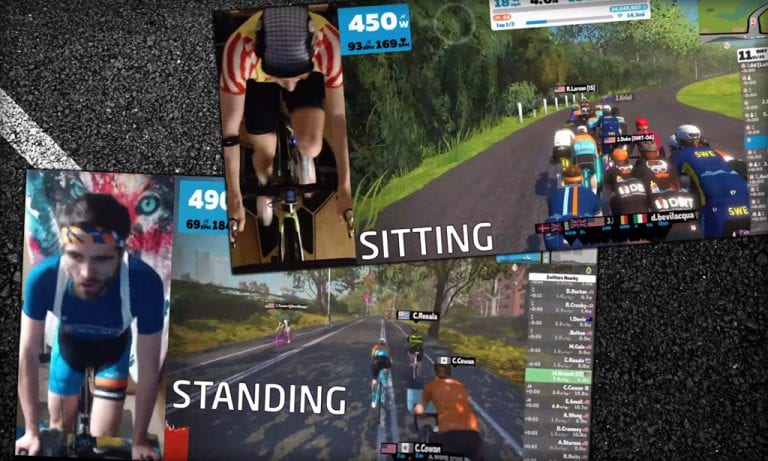
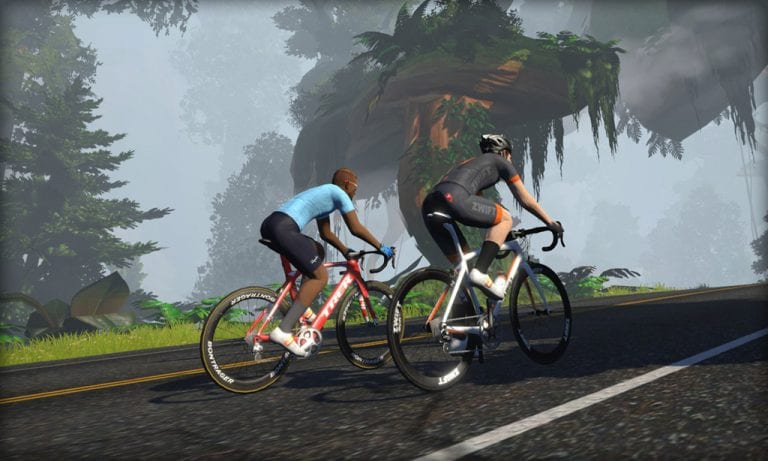
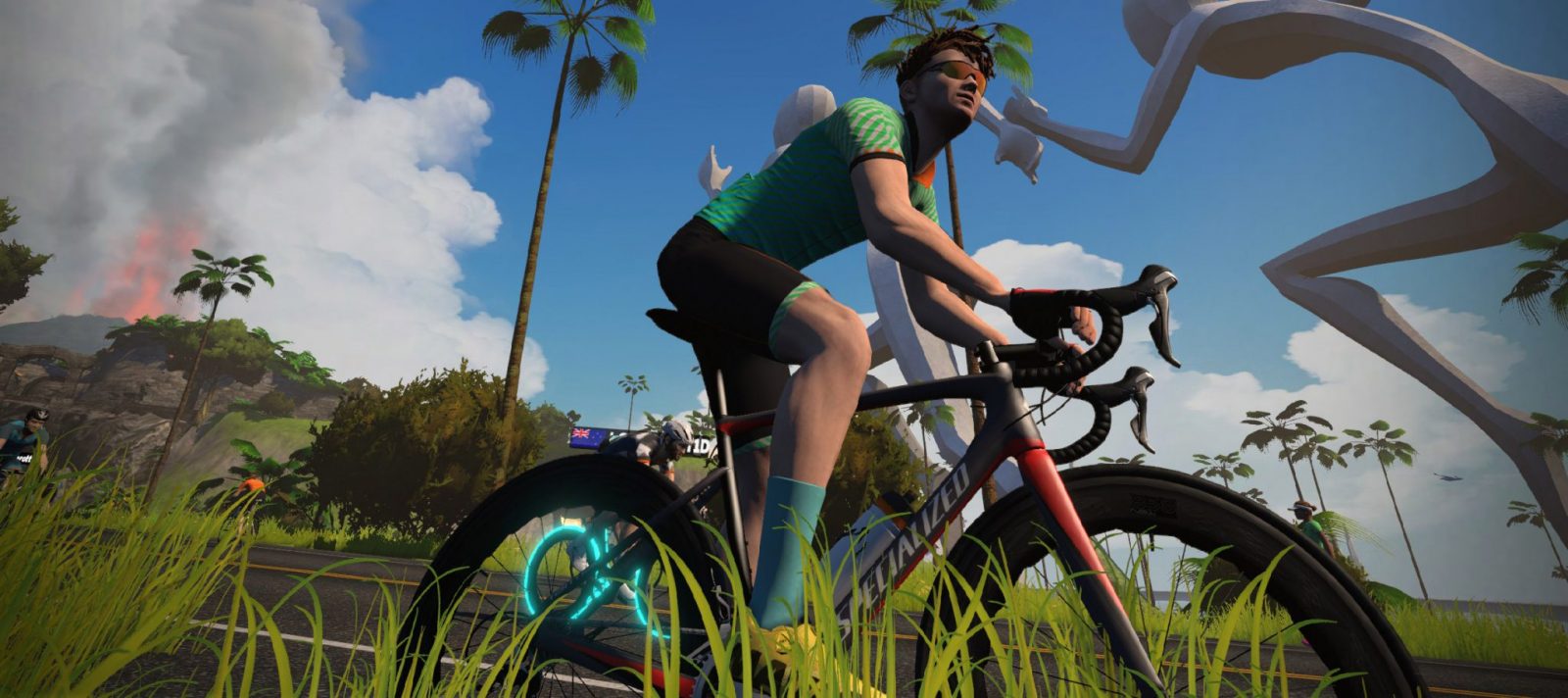
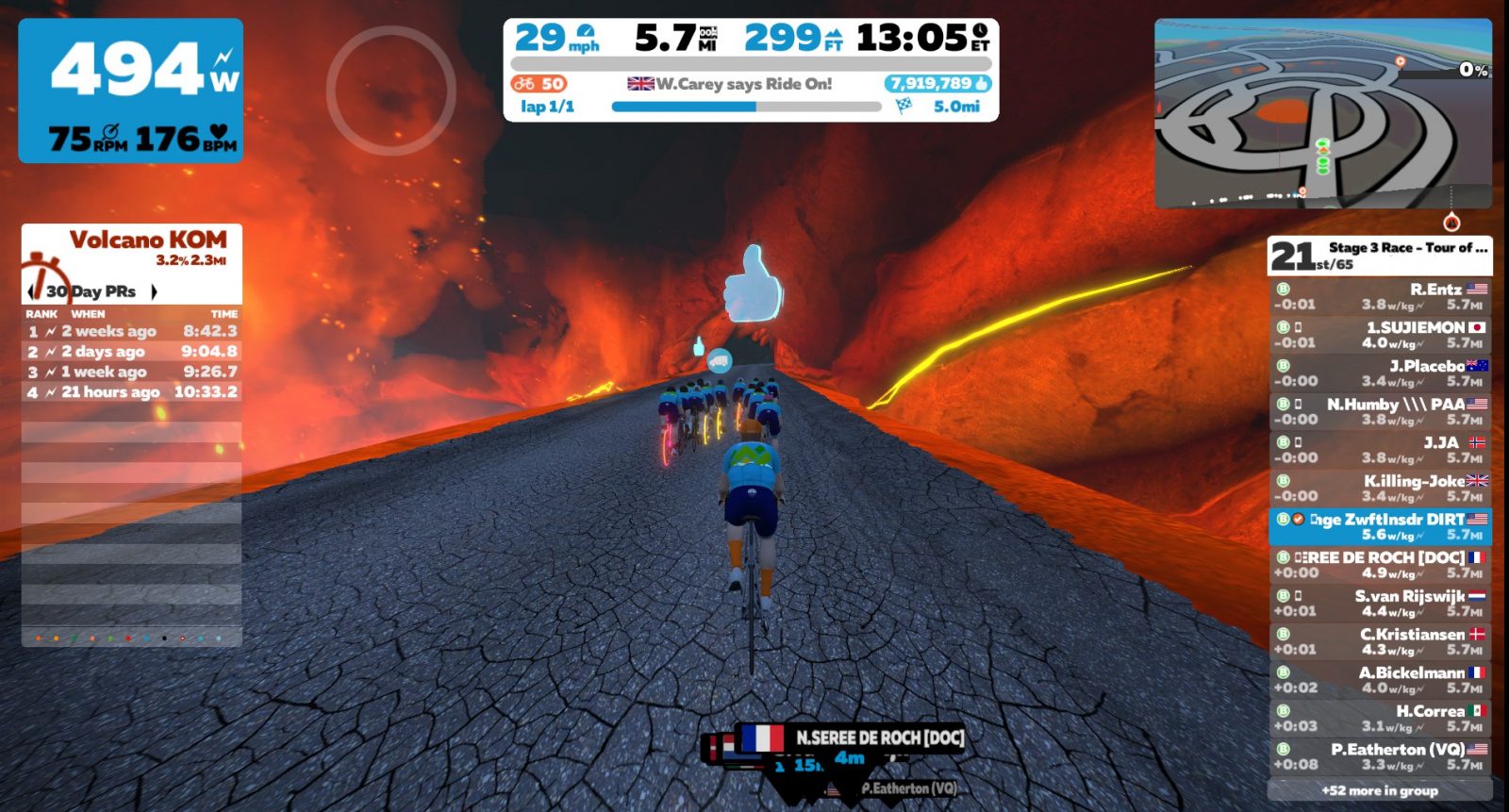
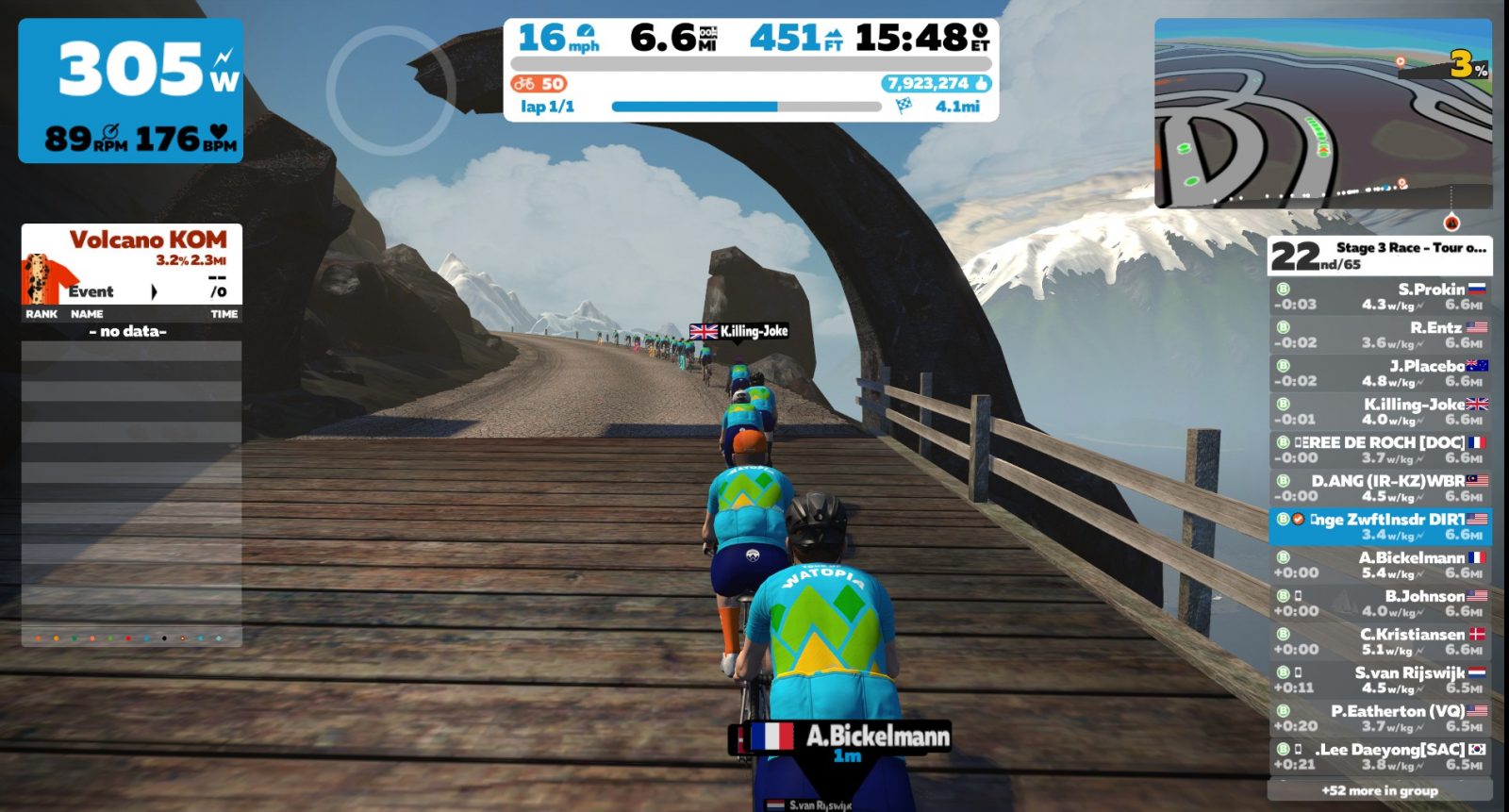
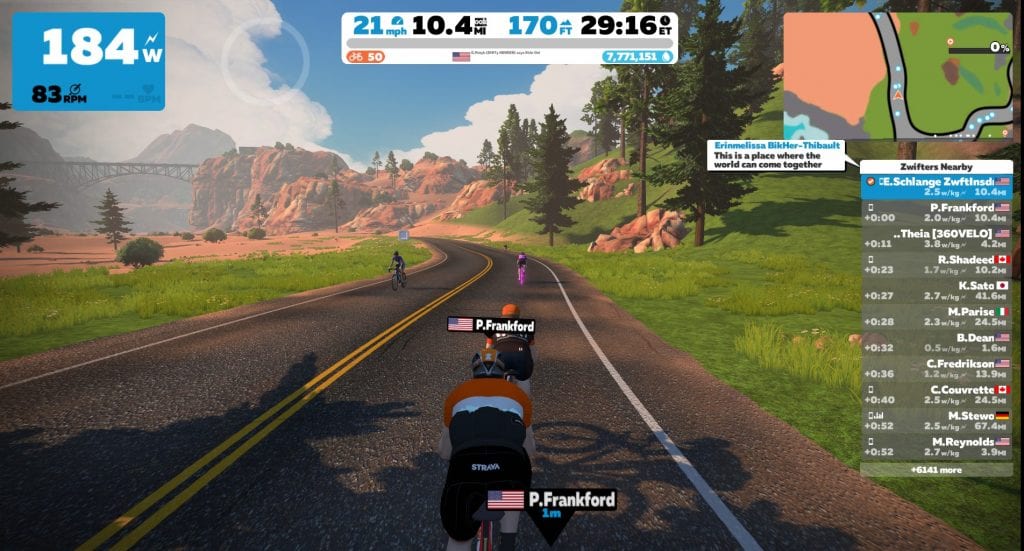
The difference between riding your bike indoors as opposed to outdoors isn’t just the scenery. Outside on the road, your position on the bike plays a very important role in determining your success: the aerodynamics of your bike and position influence your speed significantly, which is why cyclists constantly chase the perfect position and equipment. Indoors, we see almost the exact opposite. While maximum efficiency is still the goal, racers do not need to focus on aerodynamics whatsoever — maximum power production in the most comfortable riding position, regardless of aerodynamics, is everything.
This means that the choice to sit, stand, or use a combination of the two is completely up to the racer, and it’s a contentious debate among the racers on our own team!
The Case for Standing
Indoor Specialist racers Matt Brandt and Ryan Larson believe the best way to produce sustained power inside is out of the saddle. Shifting into a massive gear, lurching forward and stomping the pedals at sub-70 rpm, these two racers can stand at threshold power forever.
Ryan, a former collegiate middle-distance runner-turned-cyclist has always favored standing while doing hard efforts on the bike. “When I first started cycling, one of the hardest things for me was to get my legs adapted to spinning at around 90 revolutions per minute (rpm). The problem I was having was that my legs would get tired way before my heart rate would max out.”
Ryan found Zwift when a friend introduced it to him in 2017, and his muscle memory from his running days became his secret weapon. “When I started racing on Zwift, I could go back to what my legs were used to and use my calves and quads in a similar manner to when I ran. Since I am on the lighter side, standing also allows me use the little weight that I have to maintain a threshold much longer than if I would sit and spin. By switching my position from sitting, to hovering over the saddle, to standing straight up, I activate different muscles so I can maintain power but save the muscles I use to snap when a break occurs or when it’s time to sprint to the line.”
Ryan has used this technique to be a dominant force in the Zwift Pro-Am racing circuit in 2019 and 2020, and it’s begun to trickle into some of our other racer’s styles as well. Matt Brandt, known for his gutsy breakaway attacks, didn’t adapt to the standing technique until after seeing Ryan smash an effort out of the saddle in a race stream.
Matt has shown that this skill can be perfected by committing to practicing the effort. “I began doing standing intervals back in 2009. I was competing in UCI 1.1 races with a professional Italian road team and as the races hit the climbs, I struggled. I started doing hill repetition intervals on the famed Monte Serra climb in Tuscany, and found myself riding out of the saddle for longer and longer — until I could do the entire climb without sitting.”
It wasn’t until Matt saw Ryan dominating races out of the saddle on Zwift that the technique came back to him. “I realized: we have smart trainers that can give us the perfect amount of resistance needed. If I can get the feeling of flying-free, out of the saddle pretending my old teammate Andrew Talansky is chasing me down when I am off the front of a Zwift race, then I am 100% going to embrace that. Do what motivates you!”
The Case for Sitting
On the other side of the spectrum, Indoor Specialist racer Matt Gardiner contends that the best way to produce sustained power is seated by turning the legs over at a steady, strong cadence.
Matt, a recently “retired” long-course triathlete and time trial (TT) specialist, is pretty good at doing the same thing for a very long time. On the TT bike, that means putting out consistent power in the saddle while staying as still and aerodynamic as possible. After years of racing and riding the TT bike for triathlon, putting out power while seated has become second nature.
“For me, sitting and spinning a higher cadence allows me to pedal through fatigue — almost as if I can fake my legs into pushing more power. As long as I keep my legs spinning against the trainer’s resistance, I’ll keep up with my competitors.” Matt excels at mid-range climbs on Zwift like London’s Box and Leith Hill KOMs, and Watopia’s Volcano KOM. “I’ve always ridden climbs seated. When I joined Zwift in 2016, I worked on my climbing relentlessly after getting dropped in races when the road turned up. Every week, I would ride Box Hill as hard as I possibly could, glued to the saddle. In between those efforts, I filled my riding with workouts in Erg mode; pedaling against the trainer’s set resistance with my eyes closed.” This approach to riding has earned him success in Zwift’s Pro-Am racing series, a state championship in time trial, some incredibly fast half-Ironman bike splits, and the course record at his local monthly time trial series.
The Case for the All-Rounder
It’s clear that the indoor trainer gives racers the chance to optimize their riding style to produce the best power in every given situation. While there isn’t a right or wrong way to ride the bike indoors, we have found it could be beneficial for racers to vary their position — engaging different muscles to stave off fatigue and improve on weaknesses. A racer for Indoor Specialist who has found balance in standing and seated efforts is Tully Lyster. A former elite triathlete and current time trial weapon, Tully regularly works on seated, low-cadence efforts at high wattage, but can jump out of the saddle for long climbs: always racing with his trainer difficulty set to 100%.
“Every week, I aim to do 2 strength and endurance sessions using a climb like Watopia’s Epic KOM. These sessions usually feature three 20-minute tempo efforts seated at under 55 rpm, and one 15-min effort out of saddle at less than 50 rpm. In Zwift races, I am typically seated on the flats, but when racing hard up a climb I’m up and out of the saddle. Do what works best for you, maintaining your form, heart rate and power!”
What About You?
What position do you think is optimal for races and rides indoors? Do you find yourself out of the saddle regularly, or are you a seated spinner? Share your preference and reasons in the comments below!
While there doesn’t seem to be a right answer to these questions, it does appear that there are benefits to each. Developing your riding style by practicing out of the saddle efforts or seated climbing could offer you an edge on your competition. Give your position some consideration and push yourself to try something new!
Zwiftcast Episode 78: Peak Zwift Revisited, Community Reaction to the Virus + Operation Cofidis
The Zwiftcasters are working from home! But then we always do 🙂 Simon, Shane, and Nathan are back together to discuss how the extraordinary events of the past weeks have been personally impacting them, the sport they love – and the cycling game that is providing both escape from, and therapy for, a troubled world.
That doesn’t mean we are ignoring the virus – that’s impossible. And we hope Listeners understand that we can’t not talk about what everyone is talking about.
In light of the huge surge of Zwifters onto the platform, many of them new, the Zwiftcast has re-opened the Peak Zwift Guessing Game. Tune in to see how big Simon, Shane, and Nathan think the surge will be.
The importance of online communities in these difficult times is elevated and the chaps discuss how the Zwift Community is responding, with increased participation in events and lots of special guest pro riders turning up and helping to foster a sense of togetherness.
And we have the full extraordinary story of how Zwift staff negotiated their way through a locked-down quarantine zone in the UAE to bring some relief to pro riders stranded in their hotel rooms by the virus.
These are difficult and distressing times… but remember: you never feel worse after a bike ride. We hope you enjoy listening.
Zwift CEO Eric Min on Entrepreneurship, eSports and Reinventing Indoor Cycling
The Common Threads podcast has just released its latest episode which features an hour-long interview with Zwift CEO Eric Min. Many Zwifty topics are discussed, including:
The growth of Zwift from inception to today
Eric’s vision for the company and the importance of “betting on a few things”
Speed Tests: Steady w/kg Across Various Body Weights
In an earlier post, we dug into how rider weight affects speed on Zwift, specifically calculating how much each kilogram of weight slows (or speeds) a rider on Zwift.
Many readers asked us for similar data based on watts per kilo. That is, if we hold w/kg steady, how much does each kilogram of body weight (and the corresponding additional wattage required to maintain the same w/kg) slow or speed the rider on Zwift?
First we summarize the data, then we discuss conclusions. Enjoy!
First, a Disclaimer
Zwift is a rich simulation of outdoor riding in which many variables are taken into account to provide a realistic experience. What we’re trying to do here is show simplified test results to illustrate basic cycling physics which apply in Zwift and outside.
There are many, many variables which these tests do not include: varying rider heights, drafting, bike weight or aerodynamics, rider posture, etc. Our goal here is to focus on w/kg. But in practice, there is a lot more going on!
All of our tests were done using a single rider in isolation – so no draft effect. This rider was 183cm (6′) tall and used the Zwift Aero bike with 32mm Zwift wheels.
The Data
Climb Test
Climbing tests were completed up Alpe du Zwift, an 8.5% average gradient which is 12.2km long.
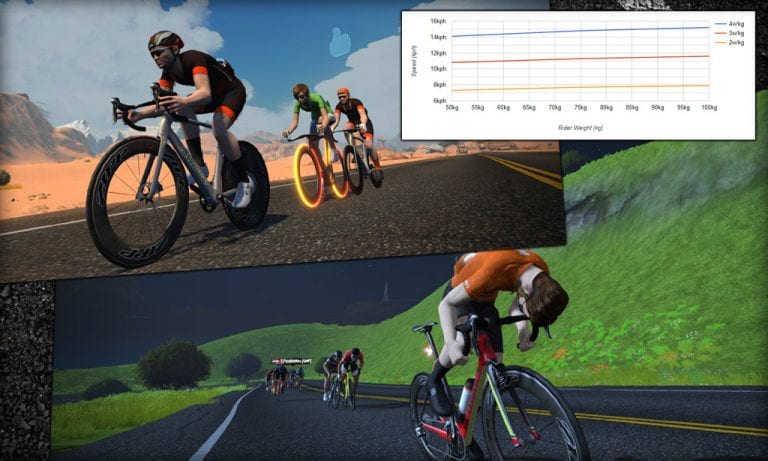
Power to weight ratio (w/kg) is a very good predictor of speed on steeper climbs. For example, we see here that two riders of wildly varying weights (50k to 100kg) are separated by only .6kph when they both hold 2w/kg.
When holding 2w/kg: every kilogram of weight + 2 watts makes you ~0.012kph faster
When holding 3w/kg, every kilogram of weight + 3 watts makes you ~0.016kph faster
When holding 4w/kg, every kilogram of weight + 4 watts makes you ~0.022kph faster
At 75kg, each additional w/kg increases your speed by ~3.55kph
Why is there a speed difference at all, and why is that difference greater at 4w/kg than 2w/kg? Read “Conclusions” below for further discussion.
Flat Test
Flat tests were completed over two laps of Zwift’s Tempus Fugit route, a 0% average gradient which is 34.6km long.
Speed varies significantly on flat roads between riders of different weights who are holding the same w/kg. For example, the speed difference between 50kg and 100kg riders both holding 2w/kg is 3.8kph. And like the climb test showed, this speed difference is even greater at higher w/kg: the difference between 50kg and 100kg riders at 4w/kg is 5.5kph.
Notice also how the speed gap between 2w/kg and 3w/kg is wider than the gap between 3w/kg and 4w/kg? Again–it’s just physics! As you speed up, each additional kilometer per hour requires more added power than the one before.
When holding 2w/kg: every kilogram of weight + 2 watts makes you ~0.076kph faster
When holding 3w/kg, every kilogram of weight + 3 watts makes you ~0.084kph faster
When holding 4w/kg, every kilogram of weight + 4 watts makes you ~0.11kph faster
At 75kg, each additional w/kg increases your speed by ~4.4kph
Descent Test
Descent tests were completed down Alpe du Zwift, an -8.5% average gradient which is 12.2km long.
Here we see the largest speed difference between rider weights, and this makes sense because gravity is now working in favor of the heavier rider.
When holding 2w/kg: every kilogram of weight + 2 watts makes you 0.206kph faster
When holding 3w/kg, every kilogram of weight + 3 watts makes you 0.21kph faster
When holding 4w/kg, every kilogram of weight + 4 watts makes you 0.214kph faster
At 75kg, each additional w/kg increases your speed by ~1.95kph
Conclusions
Our Zwift test results don’t tell us anything an experienced cyclist hasn’t already learned outdoors. Still, let’s discuss some of the findings and how they’re applicable to riding and racing on Zwift.
Don’t Attack on Descents
Look at the speed difference between each w/kg band on the climbs or flats versus the descent. Notice how the speed difference is much greater on climbs and flats. This (along with safety concerns outdoors) is why you don’t see riders putting in big digs to attack on descents: the speed you gain just isn’t worth it!
Example: on the Alpe descent, if a 75kg rider bumped up their wattage from 2w/kg to 4w/kg, their speed would increase by 3.9kph, or 5.7%. If they had put in the same effort on flat ground their speed would increase by 8.8kph, or 28.2%. More than double the difference! But get this: put in that same effort while climbing the Alpe and the rider’s speed increases by 7.7kph, or 92.2%. This is why racers attack on climbs–because you can put massive time gaps into the competition.
Heavy Wins
As the road gets steeper, riders at the same w/kg will see their speeds coming together. On a steeper climb like the Alpe, speeds stay quite close together, varying at the most in our tests by just 1.1kph (between 50kg and 100kg riders both at 4w/kg).
But why is it that when two riders are holding the same w/kg, the heavier rider will always be faster? There are multiple reasons, actually–but one big reason is what we’ll call “true w/kg”–that is, including the weight of the bike in our w/kg number.
Suppose we have two riders, 100kg and 50kg, both riding at 3w/kg. But let’s say they’re on 9kg bikes. If you add that bike weight to the rider’s weight and calculate the true w/kg, you get this:
100kg rider + 9kg bike @ 300 watts = 2.75w/kg
50kg rider + 9kg bike @150 watts = 2.54w/kg
So even though both riders are holding 3w/kg, the heavier rider is holding a higher true w/kg.
Another reason heavier riders go faster is that, unless you’re climbing straight up (which is impossible), your effort isn’t only lifting you up the hill–it’s also driving you forward by overcoming the forces of air and rolling resistance. Heavier riders are putting out more pure watts than lighter riders, meaning (in simple terms) there are more watts available to overcome air and rolling resistance after the lifting is done.
But Light Really Wins
But let’s not misinterpret the data. While the heavier rider always wins at the same w/kg, what we see in reality is that it’s really tough for a heavy rider to hold high w/kg. Making 400 watts of power is much more work for a 100kg rider than making 200 watts is for a 50kg rider.
So while our theoretical 100kg rider would be faster up the Alpe at 4w/kg than the 50kg rider at 4w/kg, there are very few 100kg riders who can hold 400 watts all the way up the Alpe! By comparison, there are many lightweight riders who can hold 4w/kg all the way to the top.
At the upper echelons of our sport, there are riders who can hold 6w/kg+ for over an hour. But those riders never weigh 100kg! The biggest are perhaps 80kg (Cancellara), but most are closer to 60-70kg (Froome, Dumoulin).
But Heavy Wins (Until the Climbing Starts)
On the other hand, if we look at Zwift’s standard w/kg-based race categories in light of the data above, it’s not hard to conclude that lighter riders face a significant disadvantage in flat races. Yes, you won’t find many heavy riders able to hold 5w/kg to win A races, but you will find plenty of heavier riders who can hold 3.1w/kg, meaning they could race as a C and really put the hurt on lighter riders. (In a flat race, a 100kg rider at 3w/kg will travel over 3kph faster than a 60kg rider holding 3w/kg.)
This is why many flat C races are won by racers weighing 90-100kg. Check out the category C results of this recent race, for example.
So what’s a lightweight D, C, or B racer to do? Skip the flat races. Enter events with significant climbs, where speed differences between weights are much smaller! If you’re able to hang with the heavier riders on the flats, then punch it up the climbs at a higher w/kg than the heavy riders can sustain, you can create the winning selection.
Longer-term, we’d like to see results-based categorization take the place of w/kg-based categories. But until that happens, lighter riders will need to race smart on the flats, attack on the climbs, and perhaps lobby for more climbing races.
Larger Variance at Higher Power
As watts per kilo increase, the speed difference between riders of varying weights also increases. So we see up the Alpe the 100kg rider is .6kph faster than the 50kg rider at 2w/kg, yet at 4w/kg the 100kg rider is 1.1kph faster. Almost twice the speed difference. Why is this?
Again, our “true w/kg” idea explains most of this difference:
At 2w/kg, the difference in true w/kg between a 100kg and 50kg rider is 0.14w/kg
100kg rider + 9kg bike @ 200 watts = 1.83w/kg
50kg rider + 9kg bike @ 100 watts = 1.69w/kg
At 4w/kg, the difference in true w/kg between a 100kg and 50kg rider is 0.28w/kg
Immunity, Recovery & Low Energy Availability (Performance Nutrition Podcast)
With the COVID-19 pandemic impacting everyone, I thought Zwifters might find this particular Performance Nutrition Podcast episode quite useful. It deals with a topic many of us are especially concerned with right now: keeping our immune system strong while training, including science-backed strategies for optimal recovery and nutrition!
The episode includes interviews with five different experts:
Expert exercise immunologist Dr. David Pyne, PhD provides a brief overview of how the immune system works, how it’s impacted by exercise and what testing tells us about athletes.
Christy Aschwanden, author of Good To Go, talks about what big data can tell us about recovery and how to incorporate periodized recovery into your routine.
Sport dietician Jen Sygo, MSc shares the importance of adequate fueling for elite sport and the consequences of low energy availability (LEA) on health and performance.
Performance nutrition director at PN Brian St-Pierre talks about vitamin D and immunity.
Miguel Mateas, PhD(c) discusses stress, the gut-brain connection and how this can deeply impact your overall health.
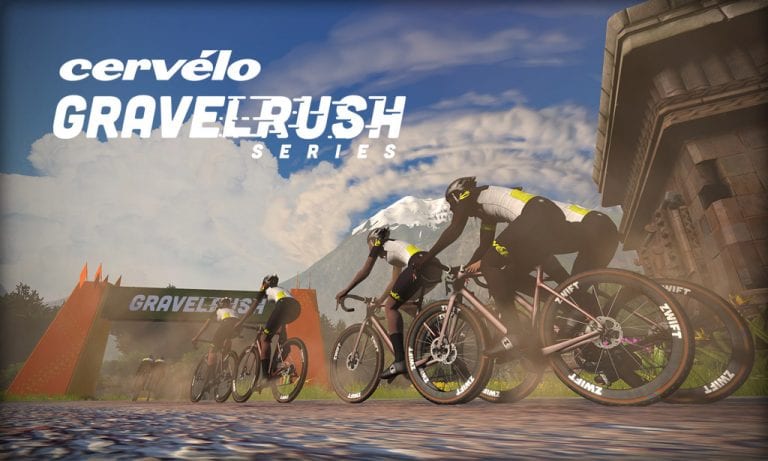
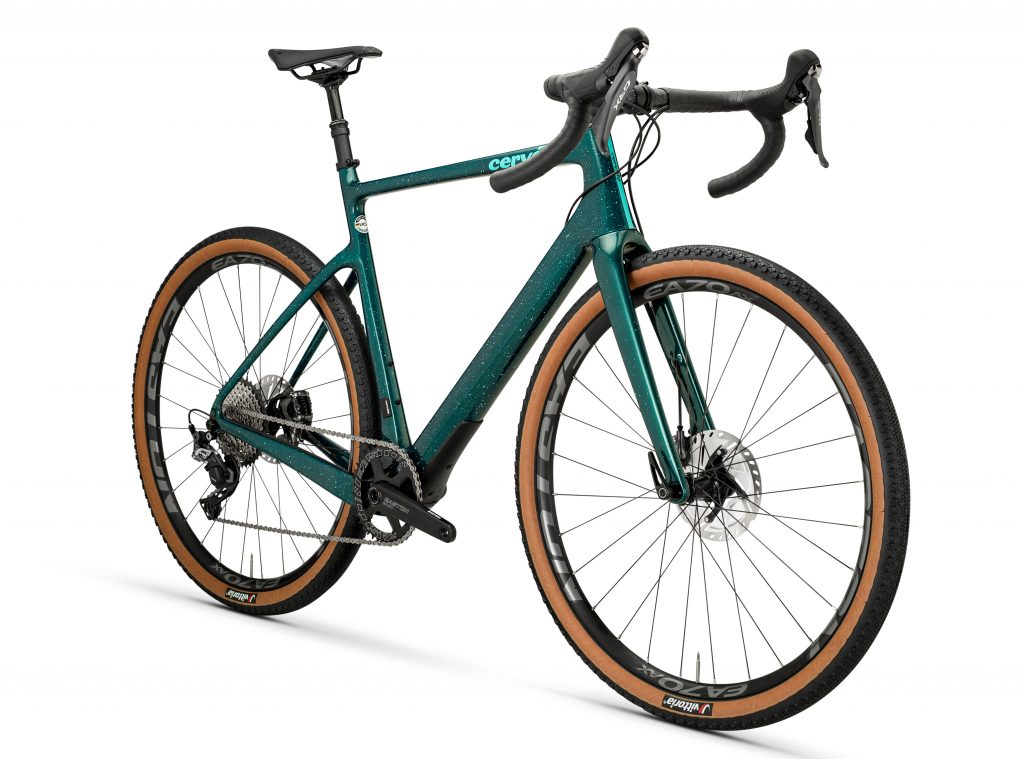
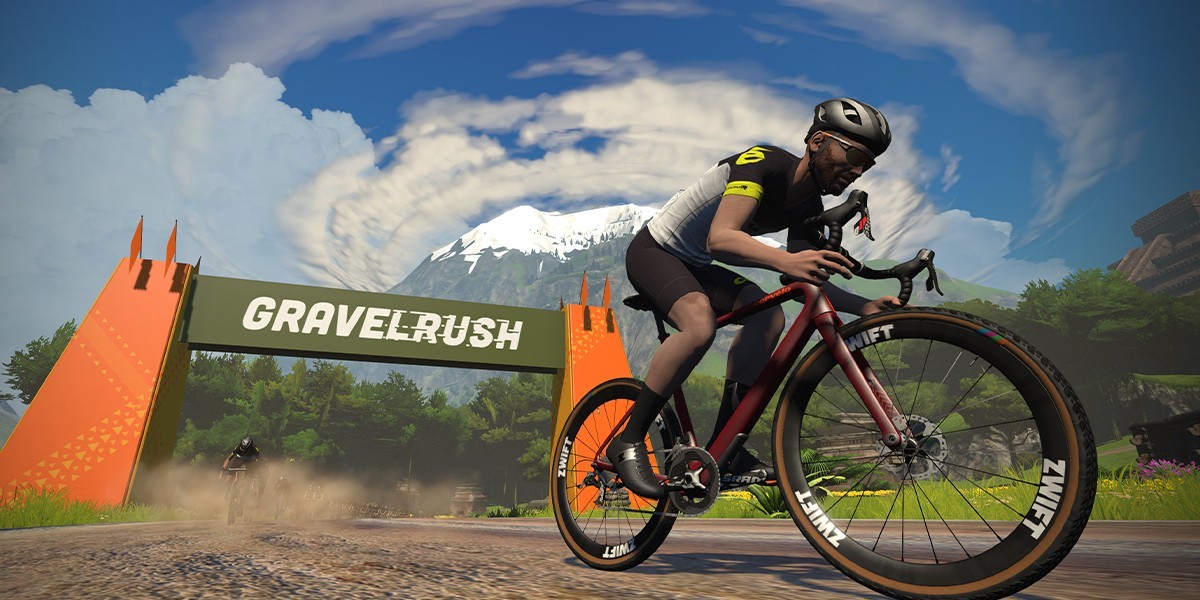
Zwift has just announced a first-of-its-kind event series: the gravel and mixed-terrain-focused “Cervélo Gravel Rush Series”. This four-event series happens on Thursdays beginning March 26th and ending April 16th. Along the way riders will get to test different Cervélo rigs on different routes, with a final race where riders can bring whatever bike they’d like.
There’s also a sweet kit to unlock, and an incredible grand prize drawing. Here are the details…
Editor’s note: Monica is undertaking the “Couch to Route Hero” challenge of riding all 67 “free-ridable” Zwift routes (and getting all the badges) in 11 weeks. Each week she shares her story of the previous week’s struggles and accomplishments. Follow along on her journey, take the challenge yourself, and be sure to give her a Ride On if you see her on course!
I rode two 5+ bidon rides this week! In the days before each major ride I walked around head down, moping. I was dreading what was about to happen, wondering how I could have been so stupid to sign myself up for this. In the days that followed each 5+ bidon ride I walked around head held high, shoulders back, hands on hips trying to find ways to “casually” bring up what kind of ride I had just done!
The Week Lined Up
I added 4 route badges this week for a total of 56. Only 11 left! I rode 179.45 miles, with 15,437’ of climbing in 15 hours and 16 minutes. The biggest week of my entire life!
I was scheduled to ride Figure 8 Reverse in Watopia on Friday. It’s an easy 2 bidon route. But I just wasn’t feeling great. Felt like my glands were swollen and I was fatigued. I don’t think I had fully recovered from riding the Mega Pretzel just 5 days before.
Because I work with highly vulnerable people each week I need to make sure I’m not putting myself into a position to get sick. I also don’t want to ruin my immune system for what may come. So I skipped the ride and will tack it on the week after the PRL Full.
The Mega Pretzel
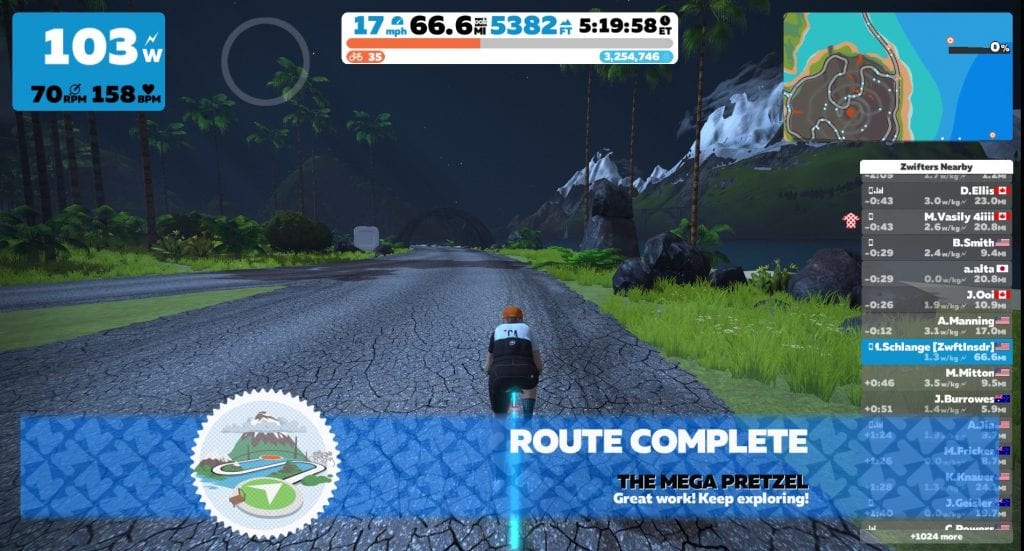
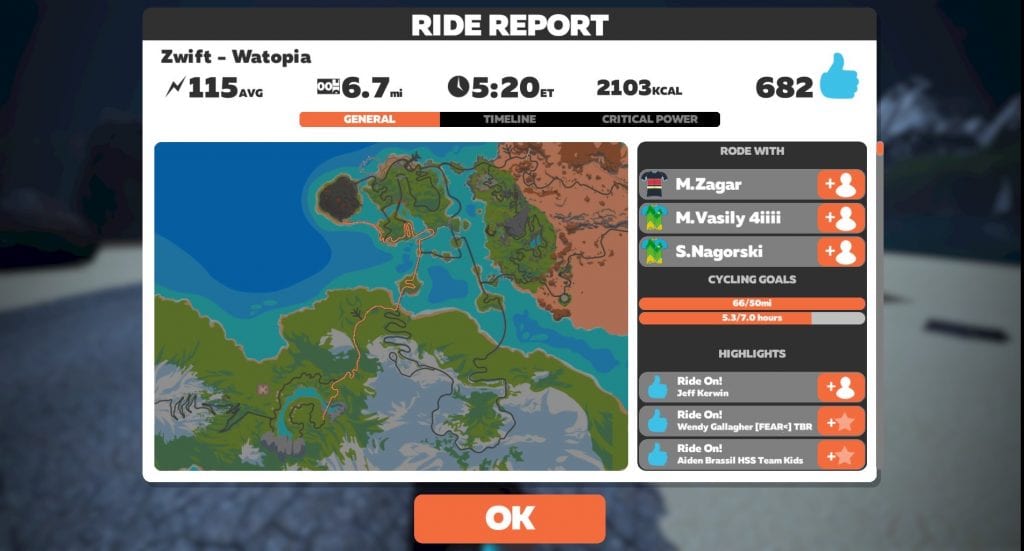
The Mega Pretzel is 66 miles long with around 5,000’ of climb. So that I wasn’t overwhelmed by this distance I broke it up into 11-mile chunks. I’d ride for 11 miles and then take a break. This was my first mistake. 11 miles is no big deal if you’re on the flats, but there’s a lot of climbing in this route. 11 miles through the jungle and then up the Epic KOM Reverse takes 100,000 hours (roughly) to complete.
My entertainment for the day went like this: start with my favorite podcasts, then watch some old tv shows, then listen to motivating music. This worked well to switch things up and keep my focus off of how long I’d been on the bike.
By hour 3 I was exhausted. And not even close to being done. I stopped to change my bibs and socks, stretch, and wash my face and hands. I felt so much better!
At mile 50 the pad of my left palm was hurting pretty bad. My thighs started burning a lot. I’d never felt this type of burn before. Front, back, top, bottom… my whole thigh was in severe pain.
At mile 60 my lower stomach area kept cramping up. That was a weird sensation I don’t think I’ve felt since I was in labor with my youngest kid.
In the last 10 miles or so I started getting messages from people in game. At mile 52 I saw Steve Beckett of Zwift HQ riding near me. He sent an encouraging message that gave me some renewed energy! All of the messages and ride ons helped A LOT!
Eric sat with me for the last 30 minutes or so. It was good to have someone in the room to hear me suffer.
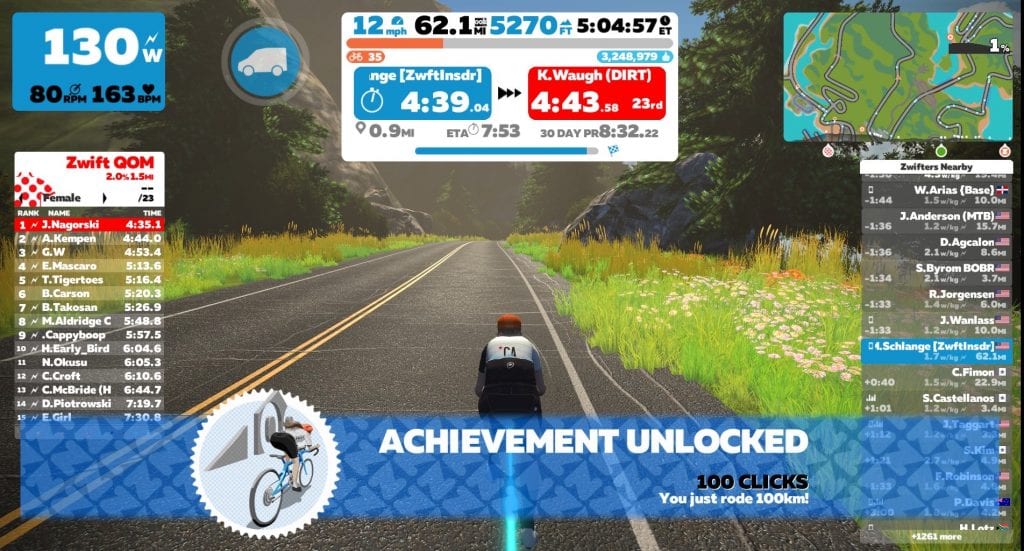
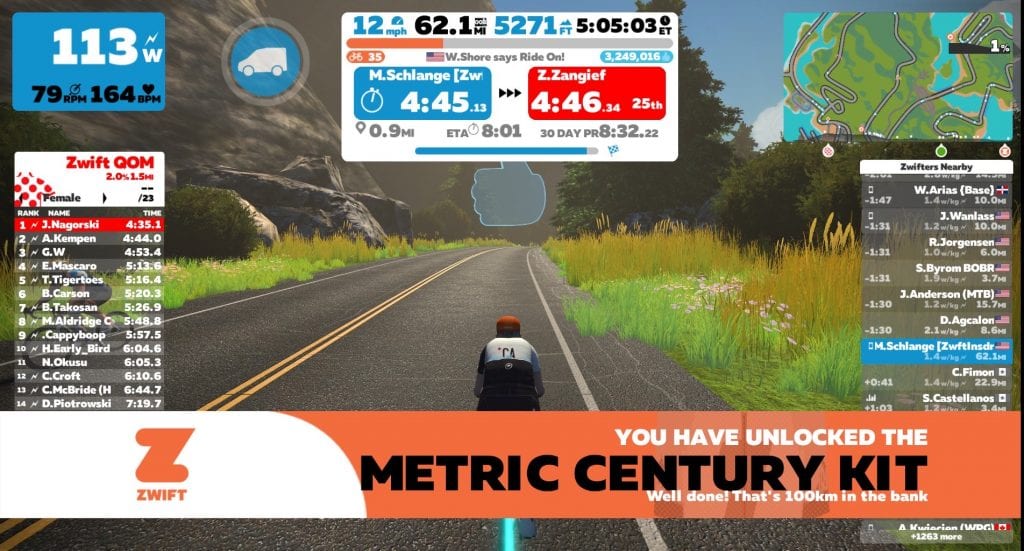
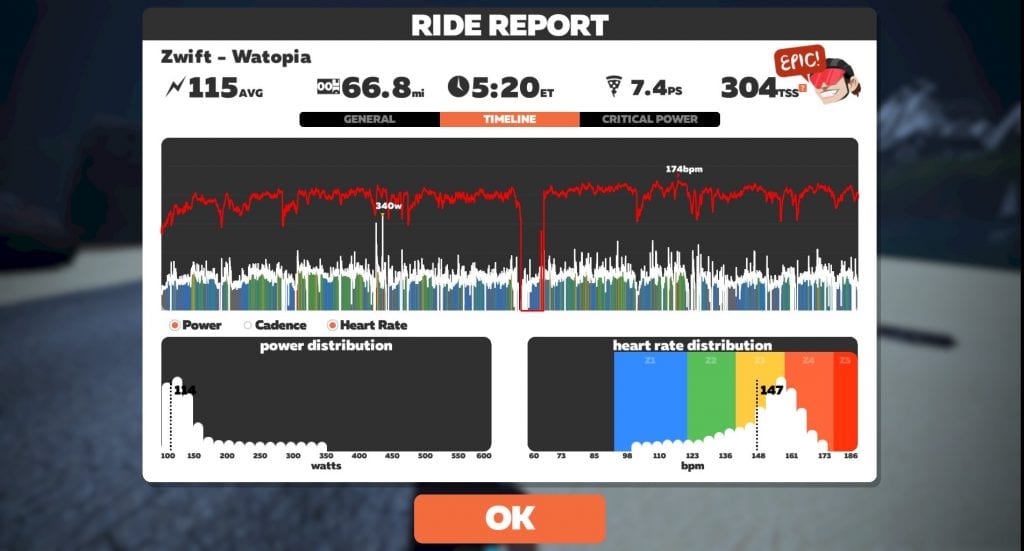
I finally finished, slowly pulled my own leg over my bike with my own hand, and got in the shower where I promptly threw up. (Aren’t you glad you’re following this journey of mine?) Final ride time: 5 hours and 19 minutes.
Finally got my century kit!
Thanks to the DIRT team and everyone else for all the Ride Ons!
Eric sent our teen out to pick up Pad Thai with Prawns for my dinner that night. I felt well cared for and could feel just how proud of me he was. It felt great!
What would I have done differently? A few small things: wear gloves so my hands wouldn’t hurt, put on Eric’s PR lotion early on so I would have less leg pain, take breaks at certain time intervals instead of mileage, and start earlier so I had more of the day to eat lots of food afterward.
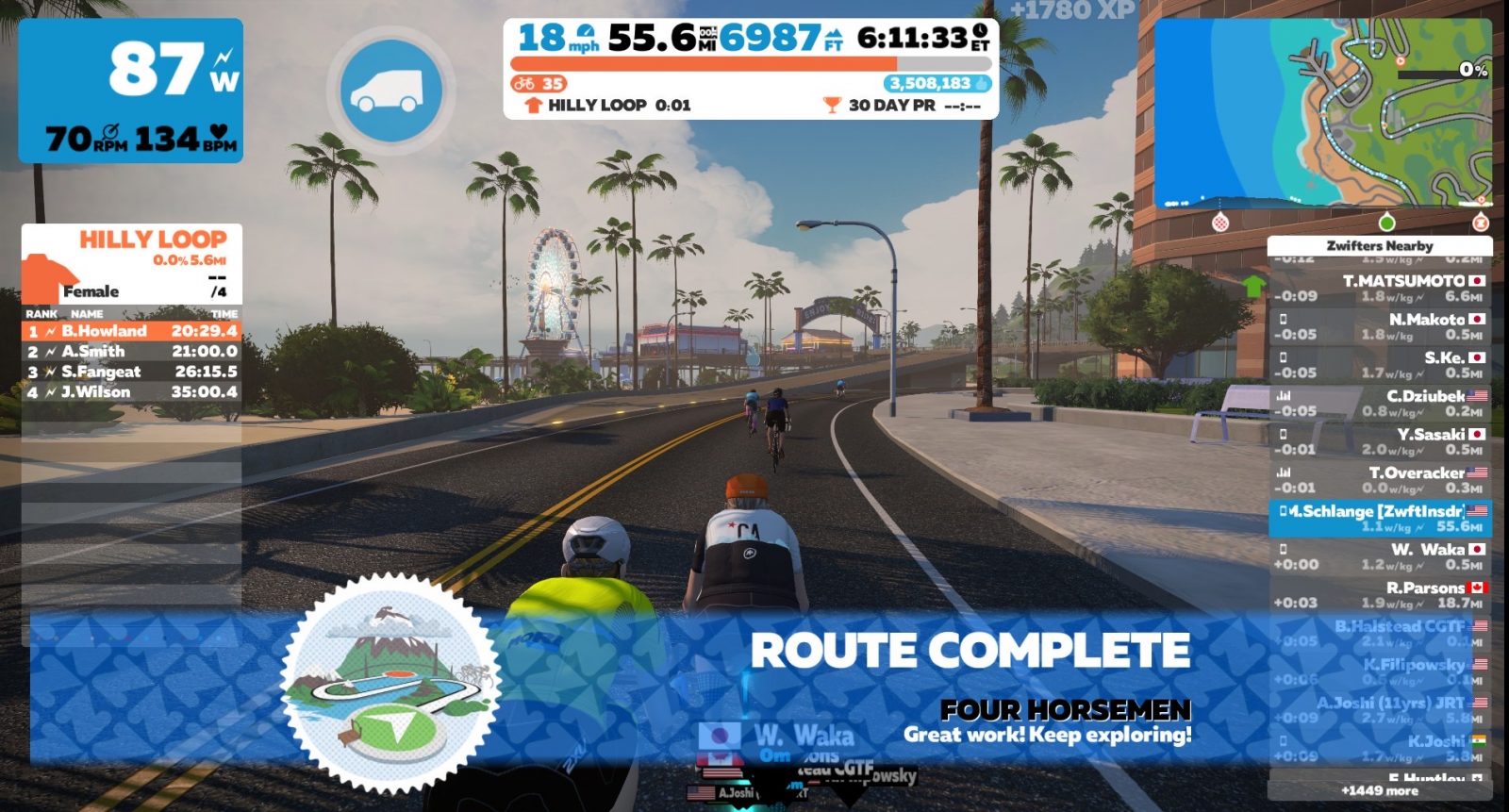
Watopia’s Four Horsemen
My second 5+ bidon route came up way too soon! I really didn’t want to do this, mainly because of the Alpe.
I decided I needed to do the whole route in Zone 1 or 2 so as not to deplete my immune system. I did pretty well until the Alpe where I ended up in Zone 3 as I ran out of gears. And patience.
Halfway through this route I realized (because my legs were burning) that I didn’t try Eric’s PR lotion. I put some on and about half an hour later my legs quit burning and stayed that way the rest of the ride!
I decided to mentally break the route up into 6 sections. The Hilly Route, the Volcano Climb, the Epic KOM, the Radio Tower climb, the Alpe du Zwift, and the Jungle Loop. It helped to think “3 down, 3 to go.”
I also decided to take a break approximately every hour. If the hour mark landed near a descent I’d work it around that instead. That worked until hour 3 when I did a bib/sock change, after which each hour dragged on too long. My life motto is “I do what I want!” so I used that to justify stopping every 45 minutes instead.
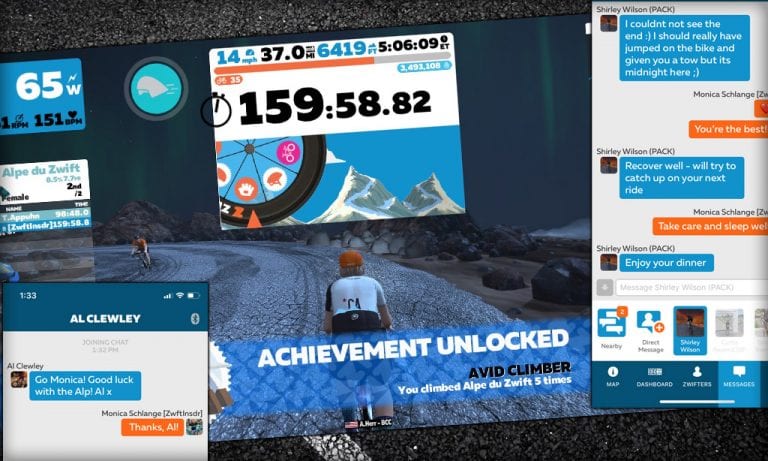
New and old Zwift friends reached out to me during this ride and it was wonderful! A guy called Snappy Little and I had a good chat about doing workouts during route badge questing. Susan Jelinski, a Canadian Zwifter and I chatted about how Coronavirus is affecting our area of the world. My buddy Lewis Dinsdale from Liverpool did a “Ride with Monica Schlange” to encourage me and warm up while waiting for his group ride to start. Many others wrote messages and gave ride ons. It was amazing!
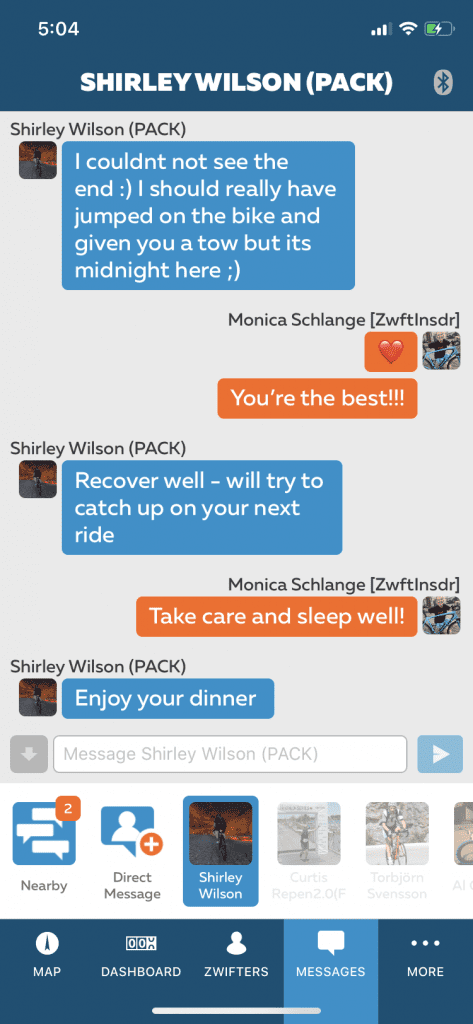
Shirley Wilson from PACK logged on to Zwift just to be able to message me in game. She was in the UK and stayed on for an hour and a half encouraging me through each area. “Any chance you finally got those Meilenstein wheels?” “You’re almost through the gravel!” “Looking strong!” It was nearly midnight for her when I finished and she was there in the in game messaging just to tell me how proud of me she was.
This ride took me 6 hours and 10 minutes. If that discourages you from riding it yourself, please keep in mind that my FTP is only 2.0/wkg.
Next Week
The current plan is to ride Greater London 8, Muir & the Mountain, Rising Empire, The Uber Pretzel, and Watopia’s Figure 8. I’ve heard everyone say that the Uber Pretzel is harder than the PRL Full so I might only ride it and 3 other routes this week.
How About You?
What routes did you ride? If you’ve done the Uber Pretzel what advice do you have for those of us who haven’t? How has this Coronavirus stuff affected your Zwifting?
Over the past few weeks, the world has gone crazy. What started in China spread to Italy, Spain, Iran and now the rest of the world. With COVID-19 bringing massive lockdowns to cities, states and entire countries there is no better place to ride a bike than the world of Zwift.
With many newly-arriving Zwifters worldwide there are a few tips that I think all of us experienced Zwifters need to follow. Let’s cut these newbies a little slack and lend a teaching hand as these new riders find out how many meters the Tron bike actually requires, how to see the real race results on Zwift Power, and most importantly how to connect with the Zwift community more intimately. Whether that’s through group rides, races or just a social club environment, let’s make these folks feel welcome.
My plan is to race each Tour of Watopia stage, so today it was stage 3 at 6:10am. One lap of Whole Lotta Lava, a route which I must confess I’d never ridden! But I knew this would be the toughest ToW race for me, since the Volcano KOM is just long and steep enough to drop an “overmuscled cyclist” like myself.
Because of this, I wasn’t foreseeing a podium. But my legs felt good so I wanted to test them and see what sort of a result I could get.
About the Route
Whole Lotta Lava (see route details) is a short route which divides nicely into thirds, distance-wise. The first third is flat, the next is a climb, and the final is a descent and flat to the finish. It begins with a lead-in from the start pier, then a lap around the Volcano Circuit in the counter-clockwise direction. The second time you pass the turn off to the volcano KOM you take it, riding up to the top then descending down. After the descent it’s a short, mostly-flat run-in to the finish line at the Volcano Circuit start/finish banner.
Many races here are 2-3 laps long, but ToW races are short, so we only raced one lap, meaning our race was only ~17.5km (10.9 miles).
While the KOM is the key part of this route, it’s important to understand that it’s not a steep climb, so speeds stay high enough that drafting still makes a big difference. (Example: I averaged 19.2mph up the KOM in today’s race.)
Bike + Wheel Choice
Lots of folks haved asked me what the best bike frame and wheelset is for this route. The answer is simple if you’re looking at what is fastest over the entire course: use the most aero setup you’ve got, just like a flat race. That’s what I did for today’s race, because I hadn’t looked closely at the segment timings until after the race.
Zwift’s best climbing bike frame (the Specialized Tarmac Pro) beats the most aero frame (Specialized Venge S-Works) by 4 seconds up the Volcano KOM. But that difference is taken back on the descent, and take back even more so on the flats.
Interestingly, the best climbing wheels (Lightweight Meilensteins) are actually 1-2 seconds slower up the KOM compared to the best aero wheels (disc, Zipp 858, ENVE 7.8 or 8.9, etc).
But here’s where it gets interesting. The Specialized Tarmac Pro will get you up the KOM faster than any other frame. What if you coupled it with the most aero wheels? You would have the fastest climber for the route, but would take a slight hit on the flats and descents.
Specialized Tarmac Pro + Zipp 858’s – the ultimate Volcano KOM weapon? (Unless you go with a disc wheel, but I just can’t bare the aesthetics!)
For a rider like myself, this is absolutely the better solution. Why? Because I can sit in the front pack on the flats and descents just fine, while I know I’ll struggle to stay with the front up the KOM. So I can afford to take a slight hit on the flats and descents, if it means some advantage on the climb.
Warmup
I rolled out of bed at 5:15am, chewed a piece of caffeine gum, put some PR lotion on the legs, and kitted up. Then I hit Tempus Fugit for a 10-mile warmup, getting my heart rate up to 160bpm via a combination of longer seated efforts and a few shorter out of the saddle sprints. My legs were feeling pretty good today, despite 55 miles of Zwift yesterday. Let’s race!
The Start
Today’s race started off with a tough but doable 90 seconds at 350 watts to hang with the front group. The lead-in takes you quickly up the ramp toward the volcano, pushing watts higher than you’d get on a flat start. But our group settled into a typical B-race pace by the time we hit the glass tunnel bridge to the volcano.
We chugged our way around the Volcano Circuit quickly, and before we even crossed the start/finish banner our group of 64 was reduced to 35. Ten minutes into the race we made the left-hand turn onto the Volcano KOM. It was go time!
The Climb
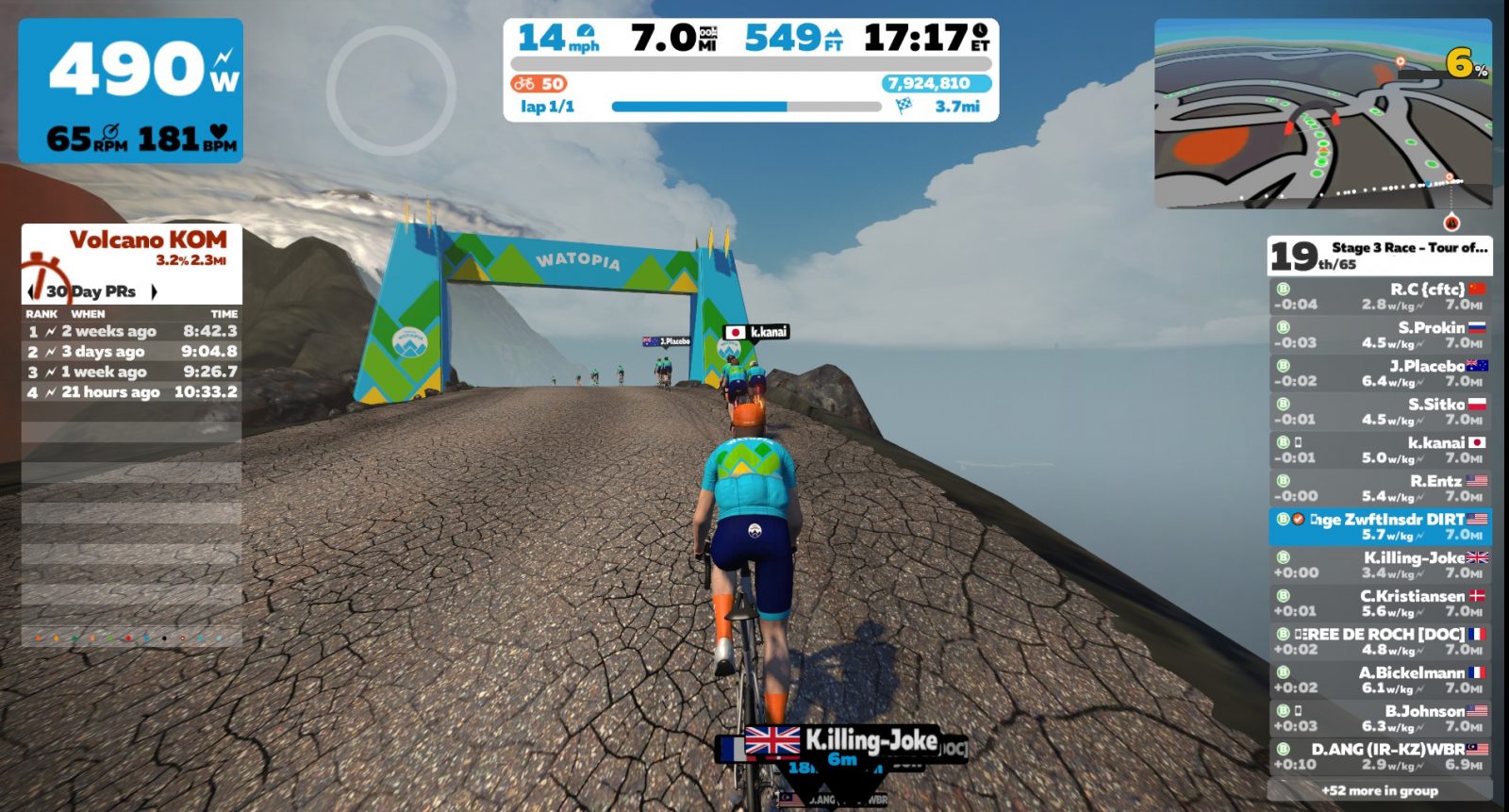
The Volcano KOM isn’t a particularly hard climb, as climbs go. At 3.7km (2.3 miles) long, with an average gradient of 3.2%, B riders will typically finish it in 7-9 minutes at race pace. Mentally, I break this climb up into 4 parts. Here’s how each part went for me in today’s race:
Part 1 – Initial Climb
The first third of the climb is a fairly steady climb, with two small downhill bumps. I hammered hard here to stay with the stretching-out front group, averaging 358 watts for 2-1/2 minutes. I could tell I was pushing over my limit, but I knew that holding the front group’s wheels was the only chance I had at winning the race, so I kept pushing.
Part 2 – Flat Through the Volcano
Pushing to get back in touch
We turn to ride through the volcano, and the road flattens out for a bit. Our group’s speed surged here, as it always does when the road flattens out. I pushed hard to get back in touch with the group across this section then tried to take a couple good breaths, knowing the next big push was just around the corner. Our group of 35 had been reduced to 26 at this point.
Part 3 – Long Climb
Our strung-out front group
This is the longest continuous climb section on the Volcano KOM, and it can feel like forever. It’s around 1 mile long, but it always feels longer! This is where the more serious attacks happen, and that is exactly what happened in our race – it strung out even more, to the point where I wasn’t sure just where the front was anymore.
I was just trying to survive at this point, pushing harder than I’ve pushed in a race in a long time. I averaged 338 watts for 3-1/2 minutes on this section. Then came the final push.
Part 4: The Kicker
One final push – everything I had!
The climb ends with a final steep kicker. If you’ve got anything left, a hard push here can gain vital seconds. A feather powerup would be a big help – but I didn’t have one. My oxygen-deprived brain had me thinking the front of the race was just up the road, so I went all-in to grab onto the wheels of the small group ahead of me.
457 watts average for 90 seconds got me in touch with that group, but when I crossed the KOM banner I realized the front was blown apart, and our group was several seconds behind the group ahead, which was several seconds behind the front group. Dang!
Post-race bonus: I set a new PR of 7:18 on the Volcano Climb. My previous best was 8:14!
The Finish
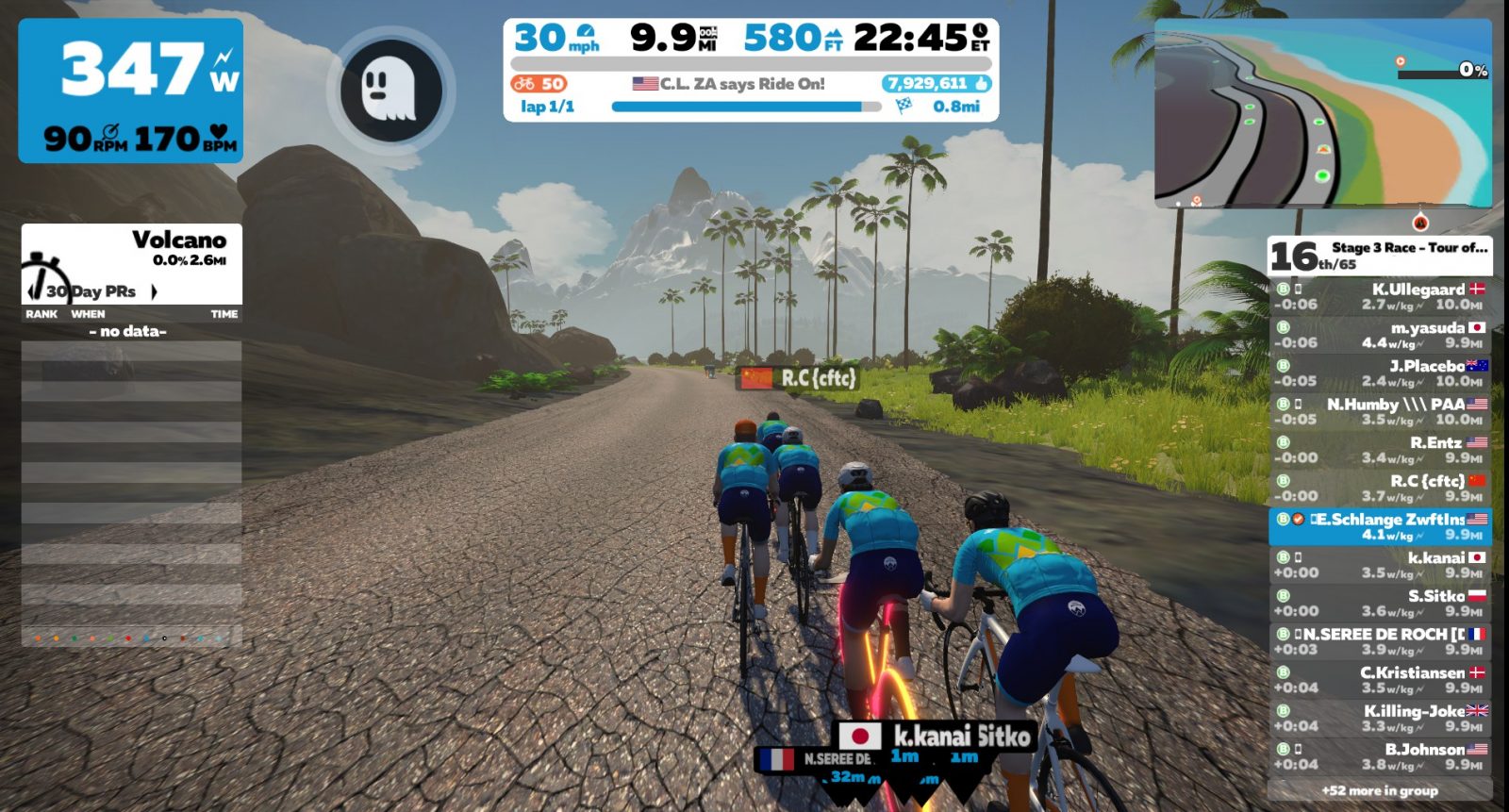
My small group of four riders zipped down the KOM. We all needed a little recovery after the climb, it seemed. Once I caught my breath I decided to push the pace a bit to catch a rider up the road, which we did. I ended up with a PR on the Volcano descent as well!
The ghost powerup wasn’t useful at all today
When we reached the end of the descent, with less than a mile to go, there were four groups of riders I cared about. One group was the front of the race: too far away to catch. The next group was just 6 seconds up the road – and I wanted to catch them. Then there was my group of 5 riders. And behind us, another group was quickly gaining ground! Could we stay away?
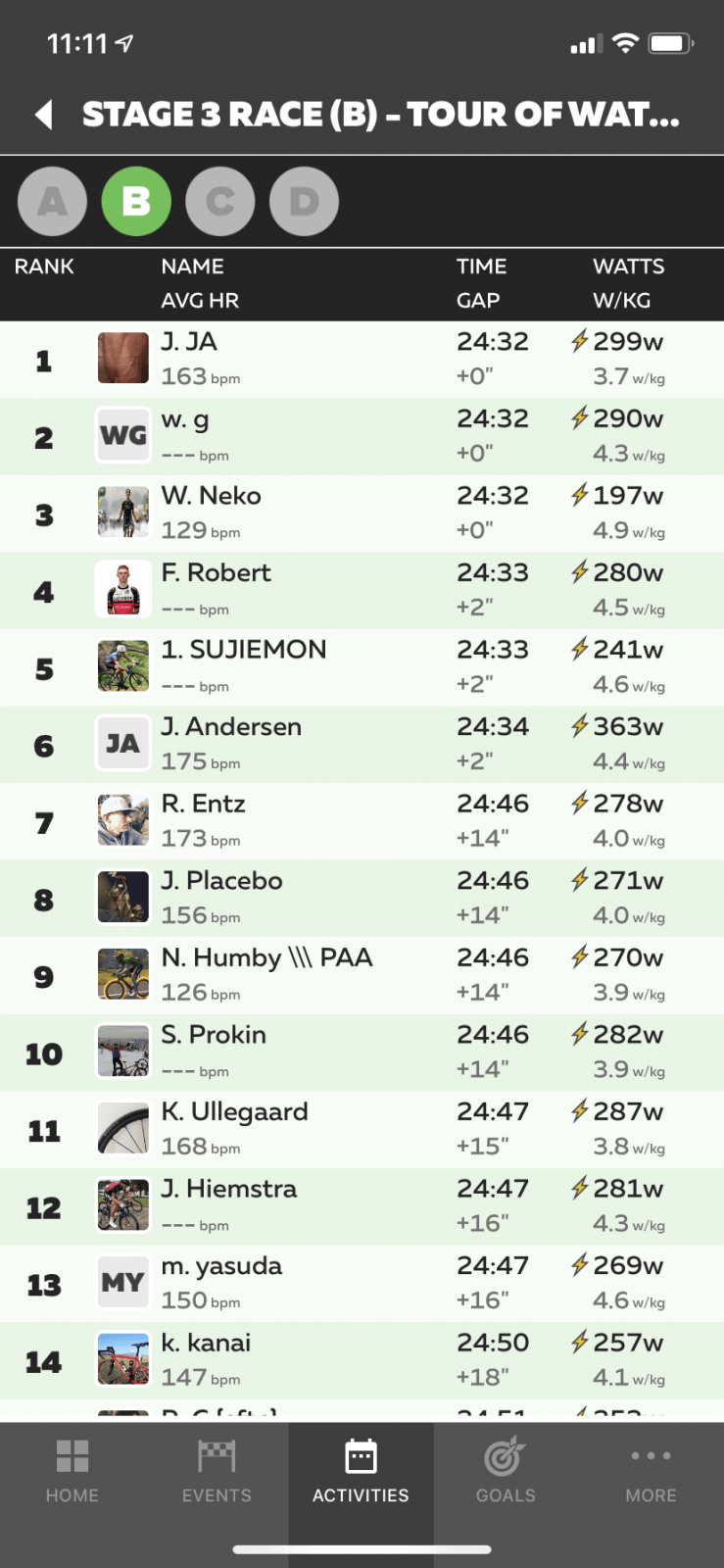
As we hit the ramp into the Volcano my group caught the group ahead, then the group behind us caught the churning mass of avatars. It was mayhem, and I had pushed so hard to catch the group ahead that I didn’t have much left! I emptied what I had into the pedals, but was passed by several riders, resulting in an 18th-place finish according to Zwift. ZwiftPower would award me 11th.
As it turns out, the front group of 6 was composed of 5 sandbaggers and one legit rider. Kudos to “JAJA” for hanging with the sandbaggers and taking the win – their pace was no joke, with an average w/kg of 4.4.
Until Zwift finds a way to enforce category limits, sandbaggers will do what sandbaggers do, especially in C and D races. Most of the B races I’ve done aren’t significantly affected by sandbagging, but today’s certainly was. Think about it: without that group pushing the pace at A-level w/kg up the climb, could I have hung with the front group and been in the mix for the podium at the finish? Maybe, maybe not.
It’s not worth thinking about too much, since it’s a situation that can’t be changed. But I do think it’s worth talking about, which is why I mention it here!
Takeaways
My only takeaway from this race is “I don’t like climbing races, but they sure push me to my limits.”
Flat races aren’t easy, of course, but I usually don’t feel like I’m truly giving it everything until the final sprint. In today’s race, I truly gave everything I had over the top of the volcano. That’s a good thing, in terms of training to get stronger. I should do more races on the Volcano. Even though I don’t want to.
What About You?
Have you raced stage 3 yet? How did it go? Share below!
By now, we’ve all been touched by the COVID-19 pandemic. For some, life has been dramatically altered – working from home, school cancelations, quarantines, travel bans, even hospitalization. It feels as though the world has turned upside-down – and nobody knows when it will return to normal.
As the COVID-19 story developed, the Zwift Community realized it is built on a platform perfectly positioned for this crisis. It’s an angle many of us had never really considered – but Zwift offers a way for the world to exercise safely at a time when outdoor riding or running may be unwise, discouraged, or even unlawful.
Zwifter Barry Mainwood said it well: Aside from being able to get some good exercise in it’s the last place where all of us from all over the world get to hang out together and socialize. And for that, I’m grateful for Zwift.
It could be said that zwifting helps us fight the effects of COVID-19. At the same time, COVID-19 is affecting the way we use Zwift! Let’s dig into these ideas a bit more.
The Effects of COVID-19 on Zwifters
More Meetups
I’m part of the Betty Designs team which is a worldwide triathlon team. A number of the girls have had races cancelled and/or are now working from home. We’ve been organising meet-ups so that we can get together while getting some exercise, all without leaving home. I’ve become an expert on time zones and Zwift meet-ups in the last couple of days. It’s super fun to do and is a great way to have some kind of social life without physically being around people.
Nadine Voice
Zwifters are taking advantage of Zwift’s Meetup feature more than ever, since it makes it easy to create events for a select group of friends. When you’re unable to ride outdoors with local buddies, riding virtually (and even using Discord) is the next best thing.
With the cancellation of organized youth sports, having two side by side trainers, and a lot of healthy energy at home, we are doing meetups with our kids… motivating them with the idea that if they ride x miles in a week / month, they can earn a Fitbit (a highly desired device at ages 9 and 10).
Sarah Goodrich
With more Zwifters using Meetups than ever before, we’re also seeing more requests for Zwift to upgrade Meetup functionality. Particularly, Zwifters are asking for the option to allow late joining of Meetups, and to hide non-Meetup riders on screen.
Work From Home=More Zwifting
Millions of office workers have been asked to work from home for the foreseeable future. The elimination of commuting time and nearby availability of their Zwift setup means more Zwifting for these members of our community.
I’m working from home and all travel for work is canceled – so I might finally get the chance to zwift every day for two weeks in a row and get that ‘unemployed’ badge.
Philippe Armbruster
Zwift As the Only Option
In some areas of the world right now, cyclists simply cannot ride outdoors – it’s against the law! Spain and Italy have banned it entirely, with Spanish authorities reportedly handing out hefty €3,000 fines for infractions.
I am part of a local cycling club in Madrid, currently on lockdown. On Sunday I arranged a meetup with my fellow colleagues to replace our long ride (110 km with 1.5 times Big Foot Hills circuit). Every day going forward I will be organizing varied meetups (recovery rides, workouts, races). Many have discovered Zwift through this initiative 🙂 and thanks to Discord we could feel “virtually” closer!
Hugo Angelina
Experienced Zwifters are happy to have a way to ride in countries where outdoor cycling is prohibited, but there are also new riders discovering Zwift because it’s their only alternative:
I’m in the Red Zone in Italy, about 40km from the city were all this COVID-19 thing started… a lot of guys here are discovering Zwift these days. With my team we are organizing meetups every Sunday and Saturday… As we know meetups needs to be improved a lot (late join could solve a lot of problem for my team for example).
This morning a Uber Pretzel meetup with a lot of great Italian guys.. thanks to Zwift.
Fabio Mux
Zwift As the Safe Option
Some Zwifters are riding exclusively on the platform during this time because they are part of the high-risk groups for COVID-19, or they live with people who are high-risk. Zwifter Brian McEntire coined the term “Social Zwiftancing”, which is exactly what these Zwifters are doing!
Having close family members who are in the very high risk group, Zwifting allows me to reduce the chances of picking up an infection that, while highly likely to be trivial for me, would be fatal for them. Having Zwift makes that a very minor sacrifice.
Alasdair MacMillan
As someone who lives in Seattle, the weather is not ideal for outdoor riding yet, so I’m thankful to have Zwift available as it makes long training sessions tolerable while staying indoors. Of course, now that we’re also a hotbed for Covid-19, the idea of me wiping out somewhere and needing medical attention when so many people who fall into the ‘vulnerable population’ are needing help – it seems like a selfish decision… I’m more than happy to hang out in the ‘pain cave’ until we get through this.
Lynn Johnson
Zwift As Stress Relief
This is a stressful time for everyone, for many reasons. We all know exercise is a powerful stress reducer and happily, Zwift provides a way for us to exercise in the safe environment of our own homes.
Really grateful for Zwift. Normally I’m the only one in the family who does it, but now that we’re all couped up in the house isolated, it’s a great outlet to get some exercise, pass the time, and release any tension we may all have. One of my kids (9 and 13) is really taking a liking to it!
Andres Sulleiro
I Zwift a lot anyway, but I am trying very hard to social distance as much as possible to protect my asthmatic daughter. Zwift is keeping me sane. People who think they don’t have to worry about this because they aren’t in a high risk population have no idea the stress involved in trying to protect a vulnerable person in their home. It. Is. Stressful. Zwift is helping me manage that stress. I am so, so thankful for my indoor Queen. Still riding outside, but love the ease and flexibility of my indoor set up. Kudos to Zwift!
Shelly Baldwin Brown
Events with Pros
With nearly all bike racing cancelled worldwide in the coming weeks, pro teams are looking for ways to keep their riders healthy and in-shape. Zwift seems perfectly-positioned to meet this need, and Mitchelton-SCOTT was the first world tour team to really figure this out and begin making some lemonade from the lemons with their “Where the World Rides” series. Surely other pro teams will follow suit soon, but even if they don’t, we’re already seeing more pro riders using the platform for everyday training.
I’m loving the additional TOW time slot events and the interactions with the professional riders. Cycling Canada has recommended a suspension of activities on the calendar until early May and will re-evaluate mid April. It looks like Zwift will be the only competitions here for the next 45 days.
Blair Drader
Zwifters love interacting with pro riders, and this situation is providing an opportunity for pros to put in some substantial training alongside their fans. Smart teams like Mitchelton-SCOTT will move quickly to plan events that help their athletes train while reaching out to current and new fans.
For the pro riders this is like cancelling their purpose, like soldiers with no war to fight. So it’s really nice to connect with fans, talk up sponsors, and do something productive!
Jeremiah Bishop
Events Moving Indoors
It takes some time to make it happen, but we’re seeing some of the canceled outdoor events moving to Zwift in various ways. While organizers may not be able to perfectly replicate the outdoor event, someone may be able to do something, even if it’s as small as Mitchelton-SCOTT’s homage to the canceled Strade Bianche.
Zwift just announced the Absa Cape Epic Race Week, being held during the same dates as the Absa Cape Epic race was scheduled to be held before it was canceled. There are many community organizers who are attempting to move outdoor events to Zwift as well:
Since all IRL races for amateurs are canceled in Poland we (as a community Polska Społeczność Zwift – ZTPL Cycling Club) are planning to ride our own virtual tour, ZTPL.CC Tour 2020. Right now we are waiting for ✅ from Zwift HQ.
Jacek Tarach
I run the local Escape Velocity races and in March/April I had eleven events scheduled. Now all on hiatus. I’m hoping to get going in May with our weekly crits and BC Provincials in June. In the meantime (Zwift event schedulers willing) I’ll be adding some additional weekend races targeted at our Spring Series participants.
Stuart Lynne
Nathan Guerra over at Zwift Community Live has been keeping his finger on the pulse of these new events. Other community members are also trying to support events which have had to suddenly move to a virtual venue:
At ZMS Live Stream we have offered to stream any events that are being transferred to Zwift to help with awareness and soften the blow where possible, particularly charity rides that still need the support despite cancellations. We are already working with some riders and groups on additional streams and happy to try and squeeze in as many as we can.
Damon Bates
Solidarity
There’s definitely a feeling of goodwill and solidarity permeating group rides on Zwift. We’re seeing Zwifters checking on other riders via in-game messaging, especially those in Spain and Italy:
While I was quietly ambling along doing the Out and Back route badge today just before I reached the QOM arch a group of 5 Italians blasted past me. Usually this would have me mutter something under my breath but today it really made me smile that they had somewhere they could all ride together, fast and safely.
Sarah Strange
Trainer Sales Spike
I’m getting some inquiries from friends on how to set up a minimalist Zwift pain cave (dumb trainer and speed sensor for z-power). Wonder what the worldwide supply of ant+ dongles and/or the Garmin speed and cadence 2 sensor is.
Gene Edwards
We’re even hearing rumors of a spike in sales of indoor cycling equipment! Panic-buying smart trainers? Perhaps it’s a thing! Here’s one funny story:
I work in a bike shop and a very forward-thinking fellow came in last night 15 minutes before the shop was to close to panic-buy a smart trainer. He doesn’t even have a bike to go on it right now, but all his friends have been raving about Zwift and he’s realized it might be the only way to stay exercising soon.
Diana Wilson
At a time of the year when many cyclists are moving away from Zwift and heading outdoors, we’re hearing more and more stories of riders trying out Zwift for the first time. And loving it, of course!
I live in Redmond WA, work in Kirkland WA. We are at ground zero. Earlier in the year I started toying with Zwift. Started to really enjoy it (coming from Peloton). Then as COVID-19 started heating up, my last non-food shopping trip was to the bike shop to get a Kickr. Wanted to be sure that the next few weeks/months are awesome!
Craig Wiley
Training Load Mindfulness
Note: we are not medical professionals. We believe the information shared below is broadly applicable to most people, but that does not mean it applies to you! It is best to consult your doctor if you have questions or need recommendations regarding exercise or nutrition.
During this time it’s important to do what we can to stay healthy – not only for ourselves, but for those we could potentially infect if we get sick! Because of this fact, we’re seeing more and more discussion and questions about howtraining load affects immunity.
The basic answer is: if you’re not feeling sick, then it’s best to keep getting regular exercise, as this boosts your immune system. But don’t overdo the training, as this will tax your immune system, making you more susceptible to health problems.
Here’s a thorough and informative paper titled “The Compelling Link Between Physical Activity and the Body’s Defense System” from the Journal of Sport and Health Science. Click the link to read the full article, but we’ll summarize a few key points which we believe are especially useful to Zwifters during this time:
Moderate-to-vigorous intensity exercise of less than 60 min is now viewed as an important immune system enhancer.
“In contrast, high exercise training workloads, competition events, and the associated physiological, metabolic, and psychological stress are linked with transient immune perturbations, inflammation, oxidative stress, muscle damage, and increased illness risk.”
Upper respiratory tract infections (URTI) follow a J-curve model that links URTI risk with exercise workload. Moderate training results in a 40-50% reduction of URTI risk, while elevated training results in an elevated (2-6x) risk of URTI. So again, moderate training is recommended, while high workloads are not.
“Immunosenescence is defined as immune dysregulation with aging. Emergent data support that habitual exercise is capable of improving regulation of the immune system and delaying the onset of immunosenescence.”
“The most effective nutritional strategies for athletes, especially when evaluated from a multiomics perspective, include increased intake of carbohydrates and polyphenols.” Fuel your rides well with carbs, which leads to “reduced stress hormones, diminished blood levels of neutrophils and monocytes, and dampened inflammation.” And be sure to eat fruits and vegetables high in polyphenols, which exert “a variety of bioactive effects that are important to athletes including anti-inflammatory, antiviral, antioxidative, and immune cell signaling effects.”
What Hasn’t Changed
The COVID-19 pandemic has changed everyday life for billions of people, and as you can see from the testimonials above, it’s even changing the way we use Zwift.
But there’s a lot on Zwift that hasn’t changed at all. We’ve still got our amazing community. We’ve still got hundreds of fun events to choose from every day, and a powerful platform to host them all.
What About Zwift HQ?
How is Zwift HQ handling the COVID-19 situation? We reached out to see if they could give us any insight into whether traffic numbers are higher due to COVID-19, whether Zwift is changing their plans to better support Zwifters during these times, etc. Here’s what they said:
As you know, we never comment on subscriber numbers. As an at-home training service, we’re in a stronger position than most, and as the climate changes, we’re likely to see some changes in community behavior (that change being more activity). That said, assuming a more active base, we’re working on adding new events throughout the calendar to keep our community moving and training.
Translation: Zwift is working to get more events added to keep the community motivated during this time.
Zwift is definitely talking to pro teams and event organizers about partnering together in the coming weeks – but there is a lot of planning that has to take place to pull these events off. Yesterday, when asked about Zwift stepping in to help with some of the canceled events, Zwift Game Designer Jordan Rapp said this:
What About You?
How has COVID-19 changed your Zwifting, if at all? Are you finding Zwift especially useful during this time? Share below!