Zwift does a wonderful job of keeping our community motivated by providing a plethora of carrots to motivate riders and runners. One common carrot found in Zwift’s grocery basket is the prize drawing. These are typically random drawings made up of everyone who finishes a particular event, and the prizes are usually supplied by the brand who sponsors the event – so a Cervelo bike for the Cervelo Gravel Rush series, a trip to ride El Giro de Rigo for the Zwift El Giro de Rigo series, etc.
But Zwift doesn’t announce the prize winners via its social channels, which leaves some Zwifters asking: who won?
Good news! It’s easy to find out. Zwift has created a page which lists all winners of past sweepstakes, and you can find it right here.
It’s also pretty cool to see the long list of giveaways and winners – lots of lucky Zwifters over the years! (Unfortunately, a quick page search of “schlange” doesn’t turn up any hits. But that won’t stop me from trying…)
I always look forward to reading one of Eric’s (or the many other contributors) ‘How the race was…’ articles as they inspire me to keep racing and improving on Zwift. After a recent race of my own, I felt compelled to write in and do my own article on how the race was both lost and won. Here we go!
A Little Background
My name is Ryan Dummer, I’m 27 years old and hail from the town of Port Talbot in South Wales (UK). Whilst I haven’t been cycling that long (around 5 years now) since the start I have sought to improve my riding and training to try to get the most out of myself. I purchased a smart trainer and found Zwift in the process. I have raced the local amateur crit circuit for the last two years and was looking forward to my first season as a cat 2-grade racer – until all the races got cancelled due to coronavirus.
I have used Zwift off and on for 18 months, and one of my favourite features is the ability to race on the platform. Whilst I’m not an inexperienced Zwift racer I am inexperienced at competing in the B category, having only recently moved up after a run of good results and podium positions in the C category. I am a heavier rider at 86kg, so only tend to target the flatter races as I do not go uphill well in real life or on Zwift.
Since joining the ‘B brigade’ I have actively sought out events that keep the categories separate (please Zwift make more events separate as I want to know who it is I am racing against). Because of this, I have a new favourite race map where the categories always seem to race separately – Crit City.
To date I have taken part in 8 races on this map but never have I taken part in one of the shorter 8-lap events, instead preferring to sign up for the longer 16 to 20 lap options. I did however quite fancy really testing my legs in a super explosive (and presumably harder) 8 lap event. So, the challenge was set – 8 laps of the Downtown Dolphin route setting off at 09:46 am.
(I must say that having now raced an equal amount of times on Downtown Dolphin and the Bell Lap I much prefer Downtown Dolphin as the effort seems to be more steady with the one big surge up the cobbled climb each lap whereas Bell lap can be much more on/off over the rollers and doesn’t seem to settle into the same rhythm.)
Lap By Lap
I have always heeded the advice to join the start pens early and aim to be there at least 10 minutes before any event to be in a position at the front of the start grid, so imagine my surprise when even 10 minutes before the scheduled start time I was the 46th rider to join! This would have easily been the most I have seen on a Crit City race if we had started then and by the time the timer hit zero we were up to 158 riders in my B event!
I followed my usual routine in the final 10 seconds of the countdown, ramping my watts up to around 700 as the clock hits 0 to make sure I am near the front when we all leave the pen and the hardest part of any Zwift race begins.
Can I hold on long enough to make the front selection? When I first started Zwift racing this was always an issue for me as my VO2, 5-minute type power is one of my weakest points. However, a winter spent really focusing on improving my 3-5 minute power has helped me to usually able to hold on long enough to make the front selection in Zwift races.
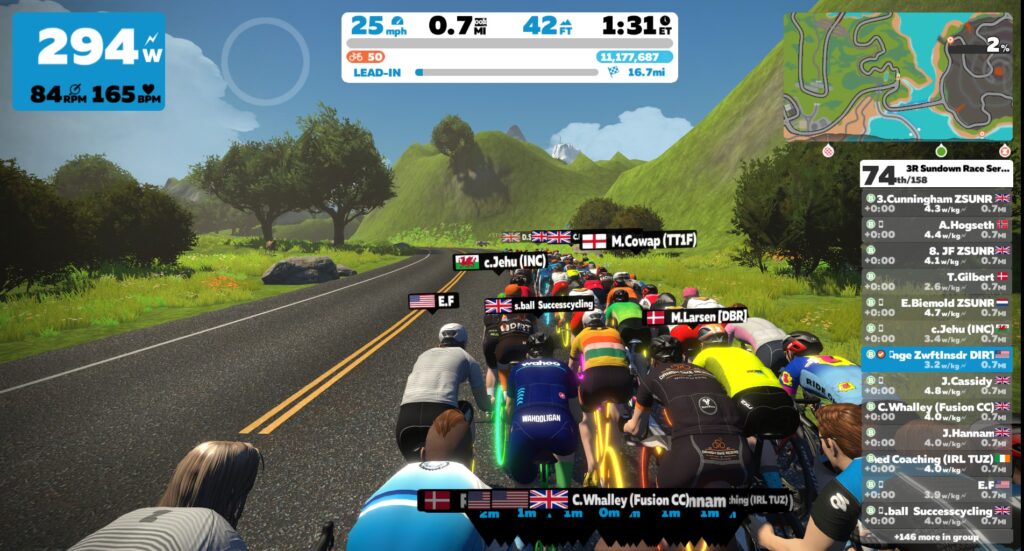
The initial group size made it difficult to track how many riders made the front, but after a first lap average power of 380W and a new best lap time for me of 2:04 we appeared to have ~40 riders in the front group. I tried my best to maintain my position in the top 10 as our group was further whittled down to around 25 after the second lap average of 330w.
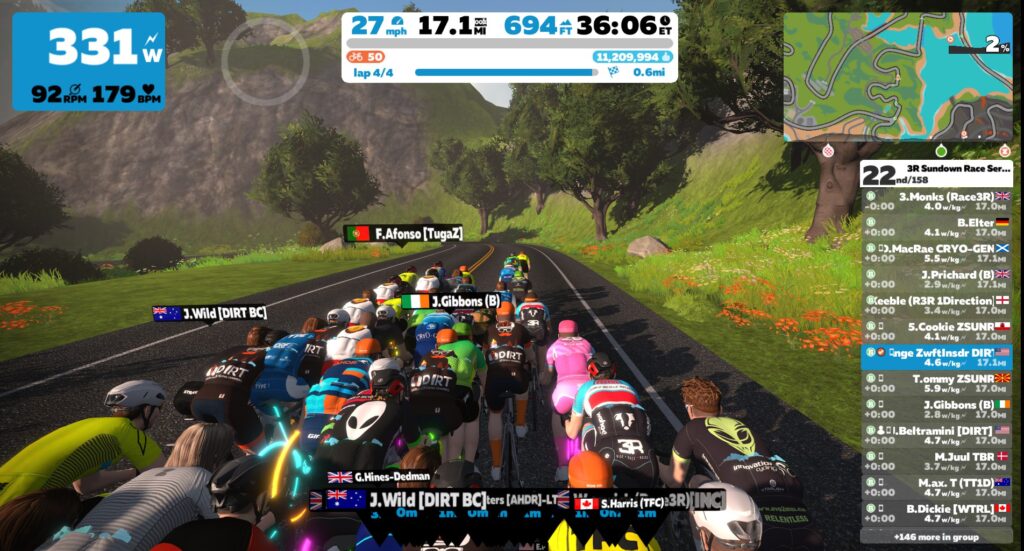
The pace didn’t drop after the second lap, with my power for the next 5 laps averaging between 324 and 337 watts. We fell into the predictable rhythm of steady as you cross the finish line up to the base of the cobbled climb before raising the power to ~500W to stay towards the front on the climb, pushing hard on the top before a slight recovery back over the rollers.
The pace felt hard but to my surprise, I didn’t feel totally ‘on the rivet’ and was able to hold between 5-10th position in the group that had been slashed from the initial 158 riders to 14. To my even greater surprise, I managed to close a gap that started to open after the brick climb on lap 4 when the rider in front of me lost the wheel!
However, by lap 6 I felt I needed to use the draft van I had been holding to have a little respite from the relentless pace after we pushed hard to move through a large group of dropped riders on the rollers and across the finish line. I just hoped that the powerup gods would smile on me in the final two laps!
The Finish
Me about to use my draft van after working hard to pass through a large group of dropped riders
Lap 7 passed by fairly uneventfully but I now had a decision to make: do I use my feather powerup and hope for a slightly more useful one such as the Aero Helmet for the final lap? Or do I keep it and use it on the bricks during the final lap? I chose to chance it, activating the feather just before we hung a right onto the bricks on lap 7.
I was filled with a little trepidation as we passed through the finish banner for the final time. Would I get the aero helmet I so desired? “No” was the answer. In fact, I only got an XP bonus! Not that much use in a race!
The much-expected surge in pace I have previously experienced in Crit City races did not fully materialise in the final lap, maybe because of the relentlessly high pace. I was in 9th position of a final group of 11 (a little too far back in hindsight) as we hit the base of the brick climb for the final time. I pushed hard to make sure I was not distanced on the climb and held position until the top. Was I going to get to the sprint in the final group? No. As the road flattened out after the climb the group in front of me pushed ever so slightly harder and the elastic snapped, leaving me riding in a no man’s land for the final 500m with a group of 8 ahead and 2 behind.
I held my position with a solid effort but without needing to sprint as I stayed away from the two chasers without being able to catch those ahead.
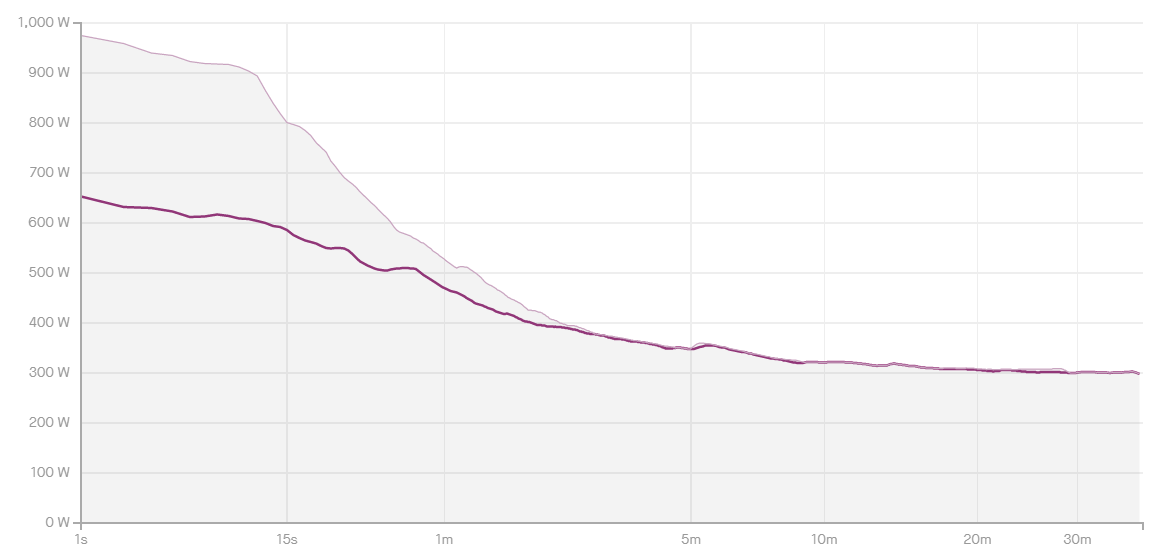
The Zwift results placed me in 9th position, 2s ahead of the chasers and 9s back from the winner. But I was mightily happy with my performance as I felt I had really dug as deep as I could go and left nothing in the tank. I finished the race with an average power of 335W, far above anything I have managed before! I was further vindicated when I received the notification saying I had added a full 11 watts to my FTP. I was a happy boy!
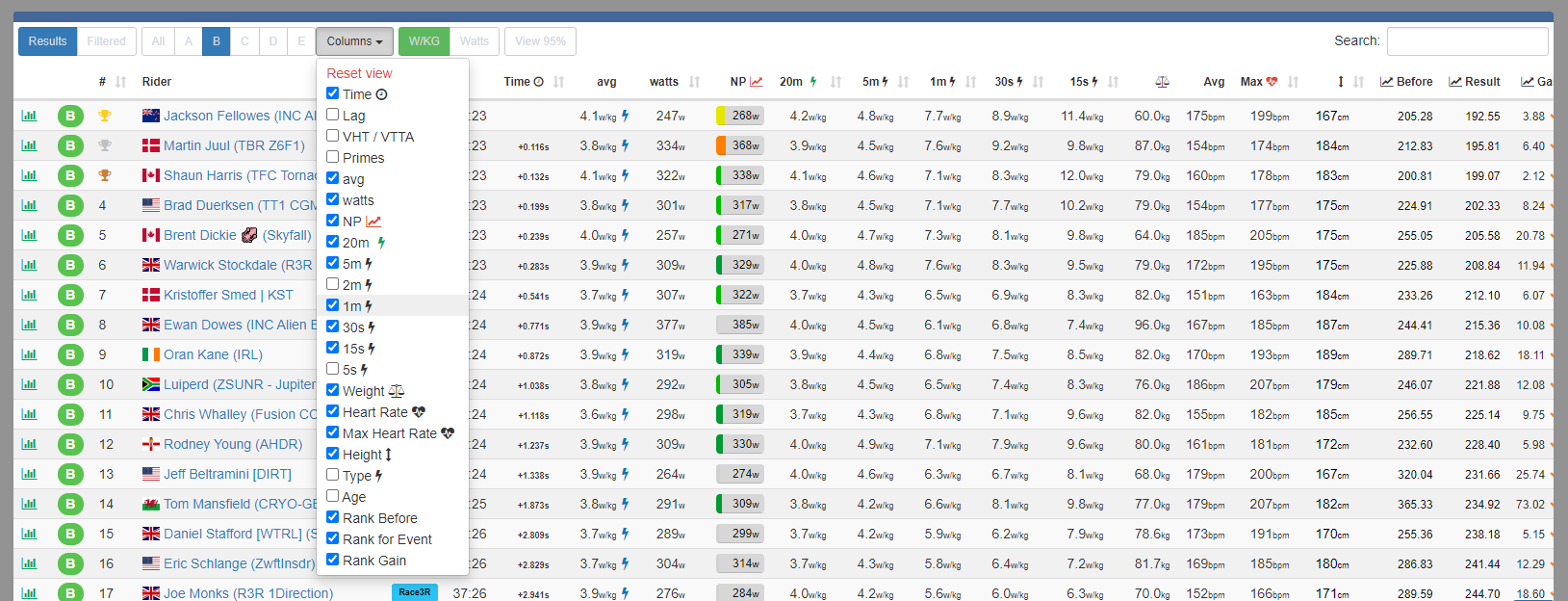
And this, I thought, is where the race was lost. Until I took a closer at the results to find that all 8 riders in front of me were well above the category power limits, meaning they were disqualified. Zwift Power raised me to 1st, so the race was in fact won! My first gold cup as a B grade rider… now I was a happy boy!
In fact, many riders behind me were also well above the category limits. As I looked at the results in Companion I discovered that only 10 of the top 50 had an average power within cat limits.
Although I do realise the allowable number can be a bit higher when Zwift Power apply their 95% principle, what I do know is that many were well over 4 w/kg and this told me two things
There were an awful lot of sandbaggers in this race and
I must be quite good at drafting and conserving energy to have held the front group where many riders averaged 4.6-5 w/kg while I stayed within the power limits!
Takeaways
Push yourself: When I was racing in cat C I felt as if I was pushing my limit but knew I kind of fell between two cats and was wary of what cat B had in store for me. However, I have discovered that I could go deeper than I knew and within a few races I am competing at the pointy end of the category above! So my advice to anyone who feels as if they fall between categories is to challenge yourself and race in the one above, as it’s unlocked potential for me I didn’t know I had.
Work on that final lap power: I need to work on improving my ability to go beyond my threshold in the final lap to hang with the very front of the race and stay in contention at the final sprint. All bar one of my B grade races have gone like this, where I haven’t quite been able to push that bit harder in the final km, which means I come in 10 or 20 seconds back from the winner.
Indoor training is a powerful tool: This year I have trained more indoors than ever before and I am fitter than I have ever been! Even though I have done fewer training hours it has been more focused and each session has a purpose. I am seeing the benefit of this.
Aims for the future: My current aim is to try and become a solid ‘upper end’ B racer before progressing into the A’s. I also want to develop a racing team mentality by competing in events with the newly-formed Bike Doctor Zwift race team I have joined.
I hope you enjoy reading my write up as much as I have enjoyed writing it and I’d like to extend my gratitude to Eric and the whole Zwift Insider team who do a great job at bringing us news and content from the exciting world of Zwift. Ride On!
With more big events than ever in our virtual cycling paradise, it’s easy to miss some really cool rides! Here are 5 events this weekend that you won’t want to miss.
Special thanks to Jesper at ZwiftHacks with his Events app which provides powerful event filtering tools so we can narrow the weekend list from 400+ events to just a handful.
Esteban Chaves’ Ride For Smile
Join Mitchelton–Scott pro rider Esteban Chaves for a fun, fundraising ride. 100% of donations will go to the Dan Marino Foundation and the Esteban Chaves Foundation: two organizations coming together to help children overcome physical and developmental disabilities. Charitable gifts are encouraged but not required.
This event is an easy, beginner-friendly ride aimed at Zwifters looking for a group ride experience at an average lap pace of around 1.5w/kg for 45 minutes. If you’re not speedy and you’re new to group rides here’s a great place to start!
It can be frustrating to always race against others much lighter than yourself, no matter how strong you are! We like the idea of a race for Clydesdales (men over 84kg) and Athenas (women over 70kg), and this race does just that. 5 different categories to choose from (2 for women, 3 for men) based on the Marine Corps divisions for Clydesdale and Athena athletes.
Ladies: care to see how you stand up against other women your age? This race is for you! Categories correspond to your age, rather than rider strength or fitness. A: 29 years or under, B: 30-39 years, C: 40-49 years, D: 50-59 years, E: 60 years and over.
EUROSPORT Polska “eOTA Wyscig Amatorow” Series by ZTPL.CC
This weekly stage race, mostly for amateurs, is being broadcast on EUROSPORT1, and Eurosport’s FB and YT pages. The best male and female racers at the end of the stages will be announced. Race one or all of the stages and watch for top cyclists from around the world out there on course with you!
Got other events that stand out this weekend? Share below in the comments! And if you participate in any of these events, let us know how your ride went.
I signed up for the “Haute Route Community Rides // Quatch Quest” event last Saturday because I was looking for a longer, harder race effort. Turns out, I found exactly what I was looking for.
The Warmup
I started my race prep the same way I always do – a couple pieces of caffeine gum and some PR lotion on the legs. Running a bit late once again, my warmup was abbreviated (18 minutes). That would be just enough time to formulate my race plan and select my frame and wheels.
Race Plan
By my estimation, I would be finishing this ride in just under 2 hours. So I had no intention of going all out from the start! Still, I planned to push it for the first few minutes to hopefully make the front selection and get a free fast tow until we hit the Epic KOM at around 10km.
I had no illusions about what would happen once we hit the Epic KOM. This was a combined start event, so even if I managed to hang with the front group of A’s and B’s to the foot of the Epic climb, I would be quickly dropped by the climbers in both categories as we tackled the ~25-minute mountain. I can’t hang with the strong climbers up long climbs like the Epic KOM even on a good day, plus I wasn’t going all-out on this climb anyway, knowing the Alpe was waiting.
Everything between the top of the Epic KOM and the start of the Alpe would be recovery. Then it would be ~55 minutes of draining whatever I had left to summit the Alpe.
I knew the B podium was far from attainable for me in this race. So today’s goal was just to push myself to the limit in a long, challenging race effort.
Frame and Wheels
I knew I didn’t want to ride my typical aero race rig for this route, since approximately 80 minutes of the 120-minute effort would be spent on long climbs. I used our frame ranking charts and wheel ranking charts to decide which equipment to ride. Here’s what I settled on, and why:
Specialized Tarmac Pro Frame: 15s slower on our ~50-minute flat test compared to the Specialized Venge I use for flatter races. But it’s 15s faster up the Alpe (~50-minute climb). So I was essentially making an even trade for performance on the flats vs performance on climbs. With 2/3 of this race being on climbs, and me always losing the most places on the inclines, this is a smart trade to make!
Zipp 454 Wheels: 11s slower on our ~50-minute flat test compared to the Zipp 858s I use for flatter races. But they are 5s faster up the Alpe (~50-minute climb). With twice as much climb time in today’s race as descent/flat time, this meant I was making a roughly even trade in terms of performance, but shifting the advantage to where I’m weakest: on the climbs.
My chosen rig for this race: Specialized Tarmac Pro + Zipp 454s
The Start
The clock hit zero and we jumped out of the desert start pen. This route begins by heading through Titans Grove, which is a punchy way to start a race!
This was a combined category event, and we had a total of 773 riders in all categories. (I’m not sure how many of those starters were B’s, but we ended up with 115 B finishers.)
I hammered in an attempt to hang with the front pack, but the riders strung out quickly thanks to strong racers on the pointy end really pushing the pace. Due to some combination of those strong riders, my somewhat fatigued legs, and knowing the Alpe was up the road, I just didn’t have the heart to keep pushing. I sat up after just a few minutes, jumping into a small group around 95th place where I could ride tempo and save my legs for the big climbs.
I would end up with a PR on the Titans Grove Southband segment. Not entirely surprising, since I’ve rarely raced this section!
Pushing the pace up the short Titans Grove Reverse KOM
Epic KOM
Soon enough we were at the start of the Epic KOM, and I found myself in ~120th place, surrounded mostly by B’s, with a few tired A’s and some obviously confused “C’s” in the mix. I set a goal: to finish in the double digits. (This goal would keep me fighting to the end of the race, as you’ll see!)
There were lots of Spanish speakers on this ride, which was cool to see since this was a benefit ride for Mexican medical services. Lots of flags from South American countries, Mexico, and Spain – and plenty of Spanish dialogue. I jumped in with joking replies of my own, but never got any response. I envisioned the Spanish dudes reading my messages and shaking their heads. Gringos, am I right?
I averaged 268W for the Epic KOM, putting in a time of 25:38 – almost 2 minutes off my PR, which was set in the Haute Route stage 1 back in April. Not impressive by my standards, but you can’t PR everything all the time! When I’m a little off my game, I try to focus on keeping my effort high, and race smarter so my mind can hopefully offset my body’s weakness a bit.
For the Epic KOM, riding smart meant using drafting and momentum to my advantage. For drafting, I would sit on wheels as much as possible, especially on flats and descents where air resistance is a big factor. Momentum is an interesting one to play with near the top of the Epic KOM – if you hammer a bit while descending, so you carry extra speed/power into the starts of the rises, you’ll usually put some time into nearby riders. It takes practice and some route knowledge, but using the game’s momentum to your advantage is a very useful technique when racing routes that have descents leading into short climbs.
Here’s a good spot to keep momentum high…
Cresting the Epic KOM
Never pass up a chance to supertuck!
Soon enough I found myself off the front of our group, supertucking down the Epic KOM’s backside. With no packs up the road in the sight there wasn’t much incentive to hammer, so I took it easy until the chase group behind caught me on the climb into the Jungle Circuit. We would ride together at a tempo pace until the foot of the Alpe.
The Alpe
I started the Alpe around 110th place, but there were a fair number of riders just ahead or behind. How hard would I have to work to finish into the double digits?
My pacing strategy wasn’t exactly consistent, as I flipped between holding a steady tempo, chasing a wheel ahead, getting out of the saddle for short, harder efforts, and chasing the powerup countdown timers. The pressure to keep my power up was constant, though, as I could see a steady line of B riders just behind me! I found myself trading places with the same handful of riders repeatedly: Nutriperformance, Braz, Hincapie (not that Hincapie), Sura, Oso, Buenaventura.
Chasing the powerup timer
Chasing riders through the snowbanks
One third of the way up I began to notice how sweaty I was. Now, I’m a pretty sweaty dude – I get warm easily, and sweat a lot when that happens. So I use a strong fan and dress to stay as cool as possible on Zwift. But sweat was dripping everywhere. I could feel it in my shoes, which wasn’t normal. Was it because the shoes were new? I didn’t think so – they were the exact same shoes I’d had before (Specialized Torch), just a new model year. I had already used up one sweat towel and headband, having swapped to fresh ones at the bottom of the Alpe. My KICKR Headwind had been on high the entire time. But I just couldn’t seem to cool down!
As we neared the top I was still ranked in the double digits, but just barely. Rounding the final hairpin I was in 97th, with Hincapie just ahead and Meza and Buenaventura just behind. I always seem to have a little extra left for that final push to the line after the final Alpe turn, and today was no different. I pushed it extra hard all the way to the line, which was a good thing because other riders around me were pushing too! I finished 97th according to Zwift, 48th in the B’s. ZwiftPower would place me 41st.
I was pleased with my performance overall, although I think I could have done a bit better if I had handled my cooling better (see below). I set some power bests for 2020 in the 1:40-1:56 range. And I set a PR on the Titans Grove Southbound segment, as well as destroying my Quatch Quest PR (I had ridden it twice before, but as solo efforts). I was 3-4 minutes off my best time Alpe times, but that’s not surprising given my two faster efforts were both in races on the much shorter Road to Sky route.
Takeaways
I have a theory on my sweat issue for this ride, and it centers around humidity. While my smallish office/pain cave wasn’t particularly hot, it was enclosed, and a two-hour hard ride made the room quite humid, as evidenced by condensation on the windows and that lovely “rain forest feeling” I got when I walked back into the room after finishing the ride.
My theory is, once the room hit a certain humidity level, my sweat was no longer evaporating at a high enough rate to cool me down. So my takeaway here is: for races over an hour or so, I need to run my A/C unit in dehumidifier mode, to keep the air dry.
The aftermath. It was much worse than it looks. My shoes were dripping sweat out the bottom as they sat on the floor!
Hydration Note
Because of all the sweating, I decided to weigh myself when I got out of the shower. Despite emptying almost 4 bidons during the race, I had dropped from 180 to 176 pounds during the ride. Wow!
One strategy I’ve heard riders use is to weigh themselves before and after big rides, then drink enough water to replace whatever weight was lost. That would mean drinking around 60oz of water in my case, and you know what? I didn’t do that.
Instead, I drank a big glass, changed my clothes, and headed outside to work on fixing our pool – a job that would involve several hours and a lot of sweat. And I didn’t drink enough water during that job, either.
The result: I was still feeling my Quatch Quest effort 3 days later. Re-hydrating is a big key to recovery, and I really blew it on this day. Never again!
Your Thoughts
Questions or comments? I’m especially interested in your thoughts on sweating/room humidity and hydration. Share below!
This year would have seen the 34th edition of the Tour of the Gila, one of the few remaining iconic, internationally-known American stage races. Unfortunately, it was cancelled due to COVID-19, like so many other events. But organizers have announced a Virtual Tour of the Gila to be held on Zwift from May 22-24th! Here are the details…
Invitation-Only
The virtual Tour of the Gila is only open to invited men’s and women’s USA Cycling-registered domestic elite, UCI Pro and USA Crit teams.
Race Format
Like a true stage race, riders must complete each stage in order to start the next day.
Stage 1: Team Time Trial (TTT) Start Times: women’s team kick off at 5:45pm Mountain Time with the men’s team kick off at 7pm
Stage 2: Circuit race (67.4km), reminiscent of the Tour of the Gila Fort Bayard stage with a fast, flat finish Start Times: men start at 10:00am Mountain Time and women at noon Mountain time.
Stage 3: Queen stage (72.6km) – a challenging final stage on the Medio Fondo route that finishes atop the Epic KOM – similar to Tour of the Gila’s queen stage to Piños Altos. Start Times: men start at 10:00am Mountain Time and women at noon Mountain time.
Watch the Races Live
Zwift Community Live will be streaming the races, so check them out on Facebook or YouTube. Nathan Guerra and Dave Towle will be commentating.
About the Organizer
The Virtual Tour of the Gila is made possible by Project Echelon Racing. Eric Hill, who runs Project Echelon Racing, recognized how difficult the racing season was for riders and worked to create a virtual Redlands Classic which recently finished on Zwift. After a successful virtual Redlands, Hill shared, “Pulling together these events hasn’t been easy, but the effort has certainly been worth it as it is inspiring to see how the cycling community has come together in this unique way and how we have been able to help close the gap between e-sports and ‘In Real Life’ competition. It’s always good to be agile and think with an open mind. I truly believe that there is an opportunity for cycling to come out on top of the current COVID-19 situation if we do this right.”
This is an open invitation to our entire Zwift family to join us for a worldwide effort to finish the mountain bike portion of the CeramicSpeed Mission together! To do so you must be signed up for the CeramicSpeed Mission and ride 25 miles (40 km) on a mountain bike.
When and How This Will Work
When? Saturday, May 30
Time? Whatever time is convenient for you
How do I sign up for this ride? Just show up! There’s no official event, that way we can all ride whenever is convenient for each of us!
How long is the ride? Ride as far as you need to complete the mission. Some of us will need to ride a full 5 laps to complete the 25 miles for the mission. Others who’ve been working on the mission will only need to ride the number of miles they still have left.
What bike should I choose? Be sure to ride a mountain bike! They’re faster in the dirt AND required to get your mountain bike miles in for the mission.
Should I change my name? Yes! Add “ZI Ride” to the end of your name so we can see each other better!
I don’t see the ride listed as an event! Where do I sign up? There’s no official event, that way we can all ride whenever it is convenient for us! Just show up when convenient for you. Lots of other people will be out on course at nearly all times of the day.
When will Monica be riding? I (Monica) have the full 25 miles to ride so I’ll start on Saturday, May 30 at 8am PT (GMT-7), but you can start whenever it is convenient for you!
Will I be done with the Mission once I ride the 25 miles? The mission includes 75 miles on a road bike and 50 miles on a time trial bike. If you finish those before May 30 then yes, you’ll be done with the mission after this ride is over! Learn all about the CeramicSpeed Mission >
Let’s Do This!
Who is with me? Let’s get a ton of us out there so it’s even more fun!
Strava rolled out a massive set of changes yesterday – the largest raft of changes in recent memory, in fact. The changes are centered around encouraging users to become paying subscribers, which, as Strava says, “… ensures that Strava can serve athletes decades from now, and in an up-front way that honors the support of the athletes we serve today.” Or in plain English: Strava isn’t yet profitable, but they need to get there. So they’re going to cater to athletes willing to pay a fee for the service.
Given the context of seeking profitability, it’s no surprise that yesterday’s changes expand the features available for subscribers. But Strava has also reduced the features available to non-subscribers, making the subscription service more appealing while doubtlessly driving non-subscriber masses to take up pitchforks and light torches.
Here’s a quick summary of those changes, in case you haven’t yet read the details:
New features for subscribers:
A big Routes update, with planning & recommendations on iOS and Android
Matched Rides: Analyze performance on identical rides over time
See your full workout history with Training Log on iOS
Workout Analysis is now available for all activity types
Grade-Adjusted Pace (GAP) now on iOS and Android
Coming soon: A whole new way to compete on segments…
Subscription-only features that were previously free:
Overall segment leaderboards (Top 10 view is still free)
Comparing, filtering and analyzing segment efforts
Route planning on strava.com, with a huge redesign launching soon!
Matched Runs: Analyze performance on identical runs over time
Training Log on Android and strava.com
Monthly activity trends and comparisons
Non-subscribers will still have access to the following (not an exhaustive list):
Depending on your subscriber status, and how you use Strava, these changes may have a big impact on your usage of the platform. Or they may have no impact at all!
Subscribers aren’t losing any functionality – they’re getting a few upgrades, in fact, including an improved route builder and fitness stats on the mobile app.
Non-subscribers, however, will notice a reduced feature set compared to the Strava they’ve grown accustomed to. For Zwifters, this will be most noticeable when it comes to tracking your leaderboard rank on segments, and comparing/analyzing your segment times.
Leaderboard Rank: non-subscribers will only see the top 10 leaderboard, as well as their own ranking, for a segment. You can’t see the rankings of your friends, club members, etc. If you’re anything like me, you don’t really pay attention to your overall rank on Zwift segments – with tens of thousands of riders competing on each segment, my overall rank just isn’t a useful metric. (It’s very useful for outdoor segments, though!)
Analyzing Segment Times: What I do pay attention to are my historical times on segments. I like to see how many efforts I’ve made on a particular segment, and those segment times. This segment analysis is going away for non-subscribers.
Veloviewer Changes
Many of you have enjoyed using the Zwift Insider Route Hunter Leaderboards powered by Veloviewer. As part of yesterday’s change, Strava has greatly reduced the data available to third party apps like Veloviewer. The good news is, for paying subscribers, Veloviewer leaderboards will continue functioning just as they did before.
For non-Strava-subscribers, though, Veloviewer (and other third-party apps) can no longer grab your segment times via the Strava API. So Veloviewer’s leaderboards will become more of a checklist of segments, and less of a ranking tool.
Overall the response from the community seems to be quite negative, but that’s not surprising, given that ~95% of Strava’s users aren’t paying subscribers. Strava’s challenge here is that they gave away so much for free for so long. When you try to take all that free goodness away, you’ll get some angry users.
Me? I’ve been a Strava subscriber for years, because I find the service useful and affordable. (How else would I chase live segment KOMs in my IRL rides?) So these changes don’t impact me directly, although I can see how they will make segments less interesting for non-subscribers, which is a bit of a bummer for everyone.
An Opportunity for Zwift, and Others
This is purely speculation on my part – but I’d say Strava’s latest changes open the door even wider for Zwift (and other companies) to step in and provide a useful, free solution to the activity tracking and route-creation needs of their customers.
What if Zwift Companion could show me segment analysis for my Zwift rides? Right now the only PR data I can see is in-game, and it only lasts for 30 days. What if segment PRs were stored forever and accessible to be analyzed? What if we could view KOM/QOM data, comment with user tagging, filter by friends lists and Clubs, and more? All included in the price of your Zwift subscription.
I’d love to see it – but I suspect it’s not high on Zwift’s list of priorities. And that’s probably a good thing, for now.
Your Thoughts?
Are you a non-subscriber who is annoyed by these changes? A subscriber who is perfectly fine with it? Or something else? Do you think there’s a place here for another company to swoop in and build a Strava-beater? Or perhaps such a platform already exists? Share your thoughts below!
During lockdown, some Zwifters have taken on some seriously massive challenges! Take South African pro cyclist Willie Smit for example. The Burgos–BH rider headed to Watopia on April 14, where he tackled a continuous 1,000-kilometer ride, covering every meter in 37 hours. After broadcasting certain parts of the ride live on YouTube, he posted the final data on Instagram: 8,150 meters climbed. 17,081 calories burned. Kev chats with Willie about the next-level undertaking in this episode.
Alpe du Zwift is by far the longest, hardest, most intimidating climb in game. Modeled as a GPS-accurate replica of the famous Alpe d’Huez, its 21 hairpin turns average 8.5%, and riders climb 1035 meters (3,396′) over 12.2 km (7.6 miles) to reach the summit.
Many Zwifters who’ve never climbed Alpe du Zwift ask the same question: how long will it take me?
Luckily, ZwiftPower has built up a history of Alpe du Zwift segment times, so you can see what sort of time you can expect.
To get to the data, go to ZwiftPower.com and click Segments>Alpe du Zwift, then click Analysis. Or just click here. You be greeted with a chart like this:
Mouse over each point in the graph to see the w/kg and time of each ZwiftPower user’s Alpe personal best!
Using this data we can make some time estimates based on w/kg:
2 w/kg: 90 minutes
2.5 w/kg 75 minutes
3 w/kg: 62 minutes
3.5 w/kg: 55 minutes
4 w/kg: 49 minutes
4.5 w/kg: 44 minutes
5 w/kg: 40 minutes
5.5 w/kg: 37 minutes
6 w/kg: 35 minutes
6.5 w/kg: 32 minutes
Pretty cool, huh? Keep in mind these are just estimates. Your time will vary based on frame/wheel choice, your height and weight, how much drafting you’re doing, and when you apply your power on the climb (hint: go hardest when the road is steepest). But the above estimates should be within a minute or two of your finishing time.
Dig Deeper
You can use the ZwiftPower tool to look up Power vs Time graphs for all timed segments in Zwift. This includes Box Hill, the Fuego Flats sprint, the Central Park loop, and much more! Just click “Segments” in the main menu to get started.
Our favorite Aussie Lama Shane Miller has released a Swift Zwift Tip quickly explaining some recent changes to Zwift for AppleTV.
The modifications to the pairing screen make it clear that Zwifters must pair their Bluetooth devices by one of these two methods:
Using Zwift Companion (on your phone), which works via your local network and does not limit the number of devices you can connect; or
Directly to AppleTV, which only allows two device connections
The two connection limit is one of the hassles which AppleTV users have to put up with. This isn’t a limit from Zwift, but from Apple. There are various ways around it, but if you’re running up against that limit the simplest (and cheapest) solution is to just use Zwift Companion.
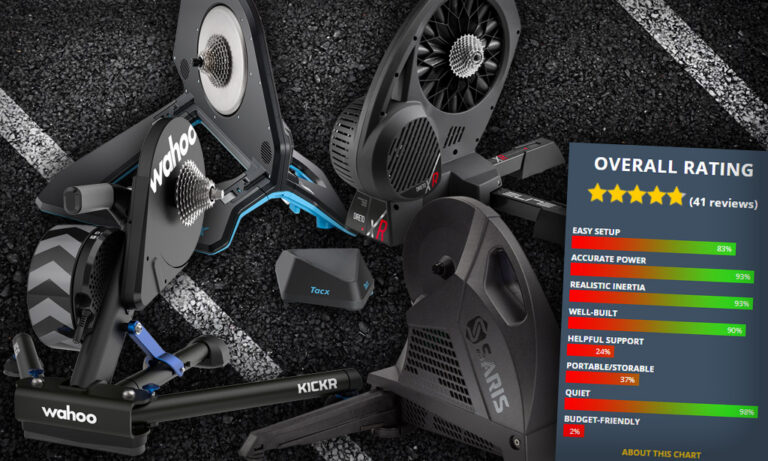
On the other hand, if you have a smart trainer with built-in cadence such as the Wahoo KICKR line, Tacx Neo and other smart trainers, Saris H3, or any Elite interactive trainer, you can pair up your heart rate monitor as well as your smart trainer directly to AppleTV and be off and Zwifting in no time!