The fourth race of Zwift Racing League 2022/23 Round 2 happens Tuesday, November 29th. We’re returning to Neokyo’s “Sprinter’s Playground” route, which made its previous appearance in the ZRL finals.
This guide includes tips for bike choice, powerups, and maximizing your performance across 12 (yes, 12!) sprints. Ride smarter… ride harder. Let’s dig in!
Looking at the Route: Sprinter’s Playground
This route may feel like a Playground across one or two laps. But three? Madness. It all adds up to 12 sprint points across 37.3km of racing with 202m of elevation gain.
This course has no real climbs, and with 4 sprints per lap most riders won’t have the legs to push on the uphills anyway. There is one bump heading into the Railway Sprint, which some riders may try to exploit to get off the front and stay away – but that’s a trick your body won’t let you repeat on a course like this.
The best advice we can give you for success on this route is to ride a recon and learn the layout of each sprint. You need to know where each sprint begins and how long it lasts so you can make smart choices about which sprints you’ll attack and which sprints you’ll surf wheels. With 12 sprint segments across the race, you simply can’t go all-in on each one!
Tower Sprint Rev: 320m long and flat, the first sprint of the lap often gives bonus points to riders who know the route and can thus start early, before the start line is visible.
Castle Park Sprint Rev: 210m long and flat, this is one of the shorter sprints on the course, and one whose start line will surprise you if you don’t know your route.
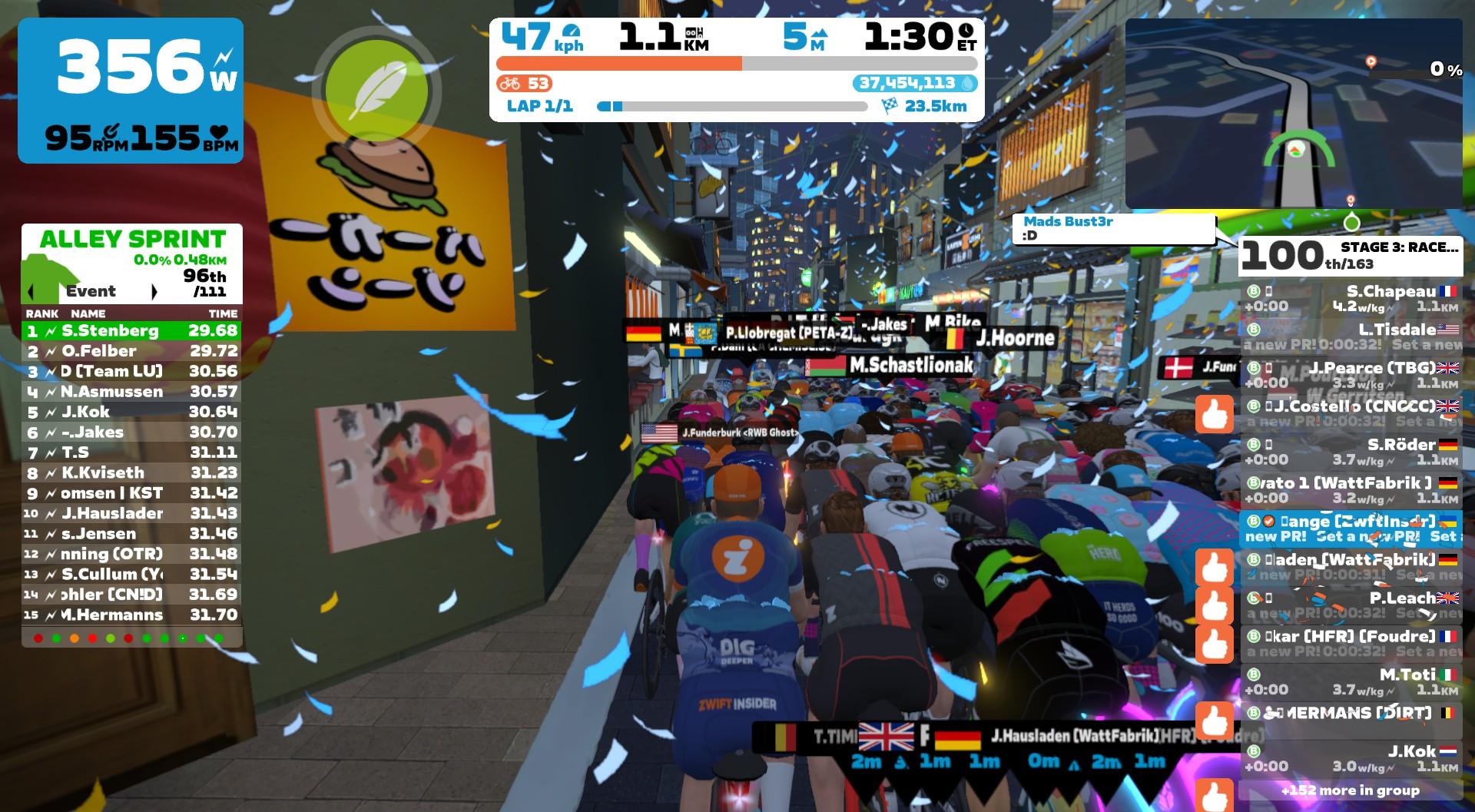
Alley Sprint: 480m long and flat, this is the second-longest sprint on course. Coming quickly after two previous sprints, expect many riders’ efforts to be blunted.
Railway Sprint: 640m long and slightly downhill, this is the longest sprint on course, and it comes just after a bit of an uphill bump. Watch for some riders to go long, while other riders start from the back to chase FTS points, assuming a regroup will closely follow.
The finish is a bit tricky here too, since you can’t see it until it’s too late to react. Pre-ride the route, watch your distance to go once you’ve left the Arcade, and good luck with timing it well!
Riders will be awarded powerups through each sprint banner, meaning we’ll get 12 powerups in this race. Three powerups will be randomly given out at each banner:
Aero Boost (helmet): makes you more aerodynamic (reduces your CdA by 25%) for 15 seconds. Use this if you’re contesting a sprint or attacking in the wind at high speed.
Draft Boost (van): increases the draft effect you are experiencing by 50% for 30 seconds. Use at higher speeds (flats and descents) when you are already drafting off another rider (since this powerup only helps when you are drafting.)
Invisibility (ghost): makes you invisible to other riders for 10 seconds. Disabled within 200m of the finish line. Use when you want to get away from one or more riders. Deploy then hammer, in hopes that you will create enough of a gap that your opponents can’t grab your wheel.
Bike Frame + Wheel Choice
This is a flat course with no real climbs and only sprint points to be had, so aero is everything.
Grab the fastest frame and wheels out of your garage. You may even consider making a purchase with some of those Drops you’ve got in the bank!
This chart shows the maximum points a team of 6 could earn.
As the chart above shows, this race is all about the sprint points, and in particular those FAL points. Here are the strategies we predict racers will employ for the finals:
Pick and choose: no rider can put in a max effort for 12 sprints, so smart sprinters will be picking their efforts based on their power profile, current powerup, and how the legs are feeling. Are you a 30-second sprinter, or a 15-second? Can you attack and stay off the front for a bit? Make choices that maximize your strengths.
Tag team: teams, with the help of Discord, will do some coordinated efforts on particular sprints. This can be quite effective when attacking off the front for FAL points, as riders can trade pulls and stay away from the hard-charging pack.
3-sprint breakaway: with the first three sprints of each lap happening within a 2.8 km window, a small breakaway (perhaps 2-3 riders from one team) could potentially gap the peloton and grab top FAL points for three sprints. It’ll take a big effort to stay away, but the rewards will be rich!
Attack Short, Sit In Long: the Alley and Railway sprints are long efforts. Many riders will conserve their sprint power and only target the first two, shorter sprints.
Your Thoughts
Any insights or further thoughts on this race? Share below!
Last week’s Tiny Races in Urukazi were extra tough – a bit longer than usual, so riders had less time to recover between races. (Apologies to D’s who couldn’t make the time cuts – we’ll try to keep things a bit shorter in the coming weeks.)
This week saw perhaps the closest podium contests we’ve seen since Tiny Races began! The Zone 1 C men had a points tie for first place (in which case the win goes to the rider who placed highest in the most races). The Zone 1 A race came down to just one point, but Tiny Race veteran Joakim Lisson managed to best Mickael Plantureux (HEX). Zone 2 women’s A competition was also separated by one point, where Daniela Istrate (AEO) edged out Kristen Kulchinsky (Twenty24). And several other races were decided by just 5-10 points!
Friend of the site Nathan Guerra won the Zone 3 A battle and live-streamed all the action, including a rant about not getting the planned anvil powerup for race 4. (Related note: Zwift now thinks they fixed the event misconfig that caused this.) Check it out:
A: none B: Anna Rogers (REVO) C: Natasha Williams (REVO) D: Jadene White
This Week’s Routes: A Tricky Mix
This week’s routes each have a bit of trickiness to them. When do you use your powerup? When do you surf the wheels, and when do you attack? And of course: do I use a gravel or road bike on the Road to Sky race?
Approaching Road to Sky finishRoad to Sky finishApproaching London Loop finishLondon Loop finish
Race 1: Beach Island Loop (6.166km, ends at JWB Sprint) This will be a painful finish! Everything will kick off when we hurt the Dirty Sorpressa snaking up to the Italian Villas. But wait – you’ve got some cobbled road following the Sorpressa, plus the JWB Sprint! Where do you use your powerup? When do you attack?
Powerup: Aero
Race 2: Queen’s Highway (1 lap) A cheeky little counter-clockwise loop with a drawn-out final sprint that’s slightly uphill. This one is all about timing: modulating your power to efficiently maintain momentum on the short climbs, activating your powerup for maximum effectiveness… and where should you start your final sprint?
Powerup: Draft
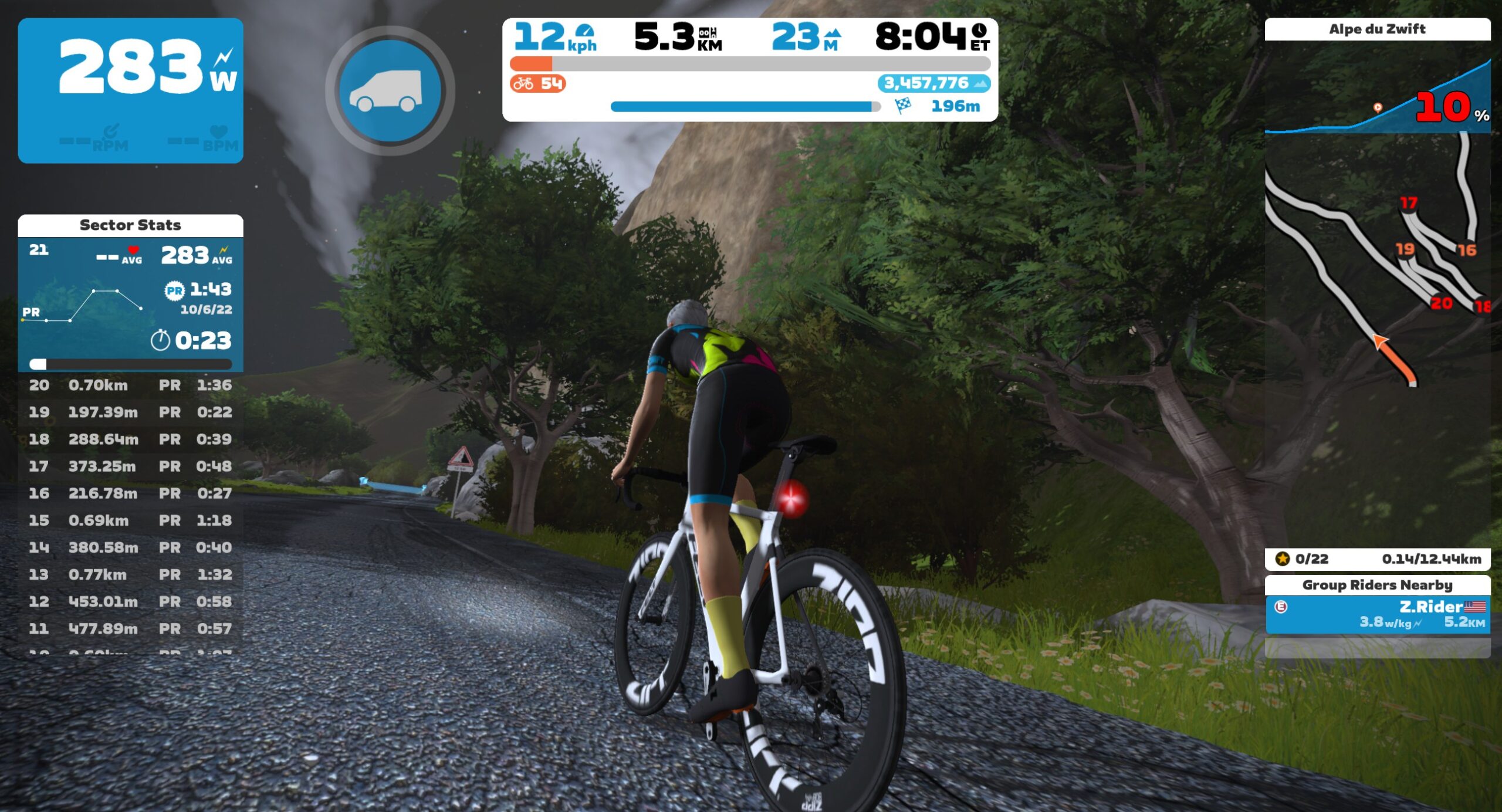
Race 3: Road to Sky (5.5km, ends well before first Alpe hairpin) This will be interesting. A jungle dirt lead-in followed by 400m of Alpe du Zwift climbing. Do you choose a gravel bike, or a road bike? Depends on where you want to attack. But you’ll have a feather thanks to the invisible powerup arch at the bottom of the Alpe!
Powerup: Feather
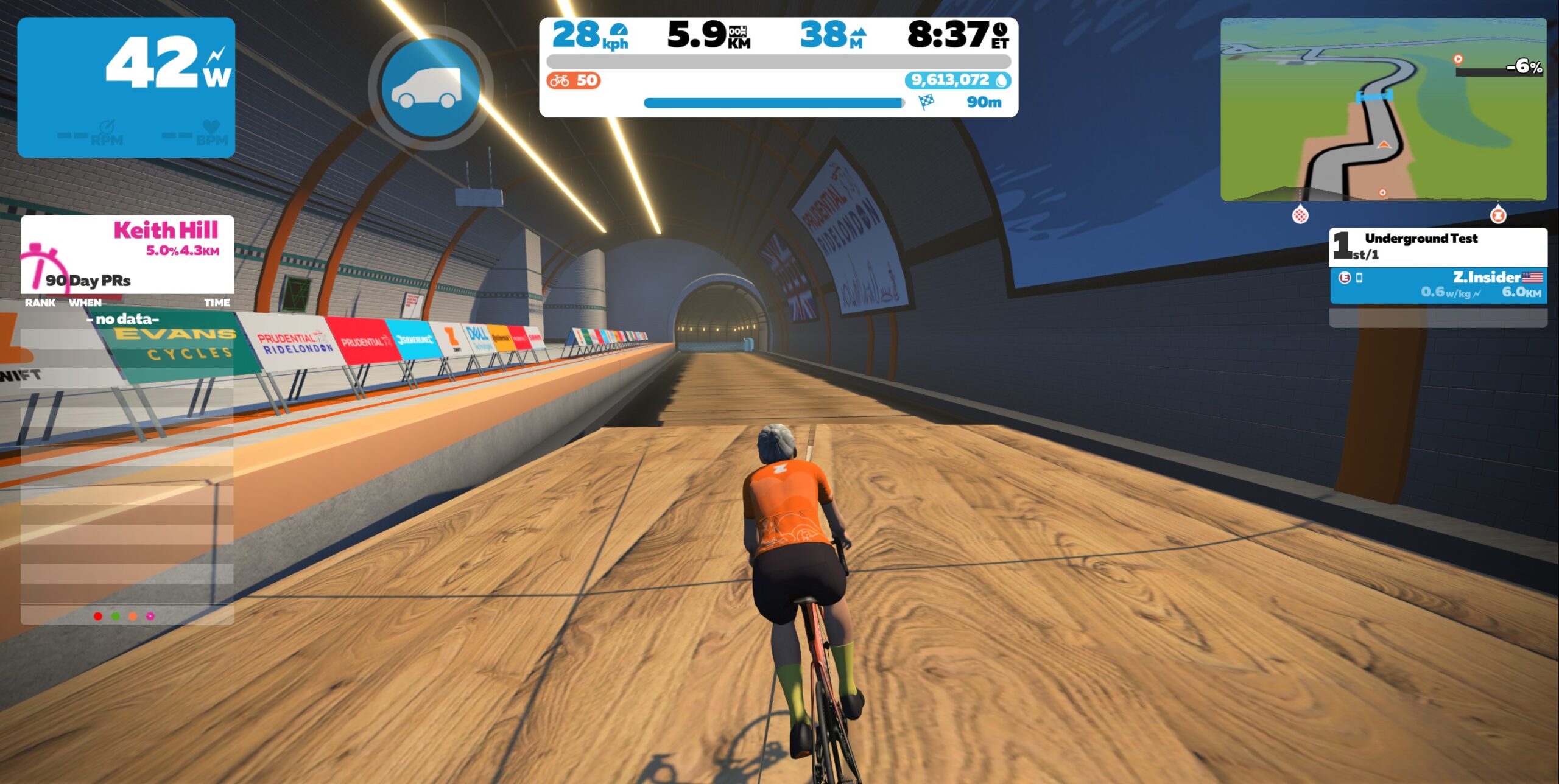
Race 4: London Loop (6km, ends in tunnel exiting Underground) The short climb up Northumberland Ave will stretch out the pack and provide a place for climbers to drop some sprinters. Then we’ll dash past Big Ben and over the bridge into pell-mell chaos in the Underground finish!
Zwift displays preliminary race results in game when you cross the line, but points are computed after all four races are finished, with final results on ZwiftPower. (We have to do some data processing on our side to compute results, so if your rankings don’t show up right away, be patient.)
Riders will earn points based on finish position in each of the 4 Tiny Races. The category winner of each week’s series is the rider with the most points across their timezone’s 4 races. Here are the links for each timezone’s results on ZwiftPower:
Tiny Race rules are simple. Four races, four rules:
You must have a ZwiftPower account, because final results are processed by ZwiftPower (learn how to sign up)
No skipping then returning. These races are meant to be raced as a set of 4. If you need to leave early, that’s fine… but once you miss a race in your hour’s set of 4, don’t come back and race another or you’ll be disqualified from that race since you rested while others were racing! (Example: racing only races 1 and 2 is fine. Racing 1, 2, and 4 is not – you will be DQ from race 4. And if you race 2, 3, and 4, you’ll be DQ from all those races, since you skipped race 1!)
Heart rate monitors are required for podium finishers
ZPower/Virtual power is not allowed. Smart trainer/smart bike or power meter required.
Join a Chat & Chill Cooldown
Immediately following each hour’s racing, we’ve scheduled 30-minute “Chat & Chill” events where riders from all categories can spin out their legs together and have some fun chatting about how it all went down. Find them at zwift.com/events/tag/tinyraces.
Last week Garmin, owner of Tacx, announced the upcoming release of the Tacx NEO Bike Plus. This is the successor to the Tacx NEO Bike and includes the following upgrades:
Revamped handlebar and shifter design
Ability to customize shifters and replicate Shimano, SRAM, and Campagnolo
Increased crank length options to 5 (165mm-175mm)
Seat tube width reduced by 10mm to minimize thigh/leg rub
Redesigned quick adjustment levers
Increased USB power in one port
Of course, it also comes with a price increase – the NEO Bike Plus is priced at $3999.99US, a full $800 more than the NEO Bike and equal in price to the new Wahoo KICKR Smart Bike.
More Specs
Apart from the upgrades listed above, the specs of the new NEO Bike are the same as the old NEO Bike. Which doesn’t mean they aren’t impressive! These bikes, on paper at least, are as good as anything else on the market:
Power Accuracy: +/-1%
Max Wattage: 2200W
Max Gradient: 25%
Road feel (cobbles, bricks, etc) on supported platform
Easy bike adjustment/fit
Works without being plugged in
Downhill drive simulation
Pedaling metric capabilities
Built-in fans
Integrated (small) display for data metrics
Availability
Garmin says the NEO Bike Plus will be available in January 2023. You can register to be notified when the bike is available here.
Digging Deeper
Early reviews on the NEO Bike Plus are saying Garmin did a great job with the new handlebar and shifter setup… but power accuracy issues exist which need to be fixed. Overall, once the power accuracy issue is addressed, we think this new NEO Bike will be seen as a minor upgrade to its predecessor. (It’s not enough of an upgrade to justify replacing your current NEO Smart Bike, but people shopping for a new smart bike will want to give the NEO Bike Plus a look.)
Mountain Massif All-Star Ride with Ed Clancy November 26
On Saturday 26th November, 3x Olympic Team Pursuit Gold medalist Ed Clancy will join me in cycling the “Legends and Lava” course at 3pm CET/2pm GMT/9am EST/6am PST in the second outing of the “Mount Massif All-Star Ride”.
Ed joined me in September on the first All-Star ride, and we both enjoyed the experience, so have decided to host another event.
It was through Zwift that I first connected with Ed during my time at the Global Bike Festival in June 2022. During our conversations there we spoke about Zwift, and Ed was keen to be part of an event and connect more with the Zwift community. So the first All-Star Ride with Ed happened in September, and everyone seemed to enjoy it, with Ed fielding many questions.
In the leadup to this second ride, I thought it would be good to share the detailed interview I conducted with Ed at the Global Bike Festival. If you like what you read from Ed, join us on our ride and interact with him directly!
About Ed Clancy
For those of you that are not familiar with Ed, he is the most successful Team Pursuit cyclist in history, having won gold with Team GB at three successive Olympics. In 2021 he completed his fourth Olympic games in Tokyo, marking his sixteenth year as a Team GB team pursuit cyclist.
In 2009 he was awarded an MBE for his services to cycling and in 2017, an OBE.
Zwift and the UCI 2020 World Championships
Ed was keen to set the record straight about his participation in the 2020 UCI Men’s Elite Indoor World Championship on Zwift, which he unduly received some criticism for. He noted, “It was hard.”
Ed explained the Great Britain team needed to field a team and that only eligible athletes could be considered. To be eligible, athletes needed to be in the established anti-doping programme. This meant that the pool of selection for the British team was very limited and consequently Ed was invited to take part. Not wanting to disappoint anyone, Ed agreed, knowing full well that achieving a good result was going to be difficult because the style of riding on Zwift is completely different to that of a track sprinter. Ed noted, “it’s really hard, if you have not targeted it” – which was the case with Ed, who was keen to emphasise that he was fully committed.
Memories from the Bike
There should be no doubting Ed’s commitment, nor his love of all things cycling. We talked about his best memories on a bike. Professionally speaking Ed noted, “It had to be Rio in 2016. All the Olympic Gold medals are special. Doing an Olympic cycle is hard work, doing two is really hard work, and the third one I had back surgery. With 9 months to go, I had a prolapse and it was pretty bad. I would have lost motor function in my leg, so I had to have surgery. There was 9 months to go and the idea of winning an Olympic medal was pretty far-fetched. There were some dark times, we were losing to the Aussies for 3.5km of a 4km race, and to cut a long story short, we won by a few tenths of a second. If it was only for a couple of days, I felt like a champion – that was my best professional memory.”
Ed continued to share his stories which involved well-known cyclists Mark Cavendish and Geraint Thomas. “In 2003 and 2004 I lived with Mark Cavendish and we used to ride around on our bikes and we were on about £3000 but we had the time of our lives. We worked hard and really worked hard. There was one particular day when we were out in Italy in Firenzuola doing a track race and we just rode off on our easy day and took our bikes into a field and played on some hay bales. It was just a day with my mates, having fun.”
Staying on the theme of having fun, I asked what he enjoyed most when cycling: training or racing? Ed noted, “Nine out of ten times I would enjoy training. When you get to a big event, there is a lot of stress and pressure, worrying about what might happen. Your brain goes mental, prophesying what might go wrong. But when the stars align and you are on the top of the podium with your best mates, there is not a yacht you can buy that feels as good as that. So for that reason only I would say racing. It has to be.”
Talking of friendships, I asked who he was particularly close to in those days, “Geraint lived down the road, he was my best mate and I really admired him and still do but these days he lives out in Monaco so I don’t see him as much. I was also close to Steven Burke.”
Pedigree
Ed has four Olympic medals from his career as a track cyclist: three gold medals in the Team Pursuit and one bronze in the Omnium. To add to his collection, he has a combined six gold medals at the World Championships from the two disciplines. He is a proven winner.
However, what is fascinating is that when Ed and I talked about road racing he explained that aerobically, he didn’t think he was much better than the average club rider “I am 80 kilos with a threshold of 382. In terms of my turn of speed I could go a flying 200 half a second quicker than Cav, speed was always my strength but endurance was my Achilles heel. I was just not good enough.”
At this point, I pointed out that he might not have thought himself “good enough” but only in that area. But that speaks volumes about Ed as person. He is the most natural, humble and normal person you would wish to meet, despite a list of incredible sporting achievements that fills several pages.
However, what sets Ed apart is how astute he is. He explained that “given the option to carry G’s bottles around in Paris-Nice, or winning Olympic gold medals in Team Pursuit and be the best Team Pursuit rider that walked the planet” he chose the latter. “I just thought I would do one thing well. You can do anything in life, but you can’t do everything.”
Motivation
I was intrigued to understand what kept Ed motivated for all those years, given the immense success he had achieved. “I loved it!” Ed said, but then admitted that “the truth is that you are not always motivated. Motivation is an emotion and it comes and goes, but because I loved what I did, seven or eight days out of ten, I was happy to get on the bike. But it’s those two days out of ten that separate the good from the great. The way I see it, and I see it with Chris Hoy and Geraint Thomas, they just crack on. It’s commitment. It’s black and white, you commit or you don’t. I took it as far as I could and don’t have any regrets.”
Marginal Gains and Training
“Marginal gains” is a real thing, Ed explained, noting that in cycling you look for improvements in each component, including human performance. “Human performance is the same, Steve Peters might help you find 0.1%, as you might have more testosterone as you are happier, or more endorphins as you are sleeping better, sleep hygiene might get you 0.1%, it’s really targeted. It’s difficult to put a tangible number on these things. The concept of “Marginal gains” was seen in practice in Beijing.” Ed explained that the closing of the gaps between cyclists nowadays is because that knowledge has become widely known.
Now retired, Ed still trains, explaining that he has no other interest other than riding bikes. “I’ll ride my road bike at least once a week, my mountain bike two or three times a week or if the weather is bad, the turbo. I like my motorbike trials. When you add it all up, I am pretty much out on my bike every day.”
Retirement
Ed explained that in terms of retirement he knew he was going to retire in Tokyo. “I had drawn a line in the sand for August 2020, but it was delayed with Coronavirus. I had a decision to make in March 2020. Do I retire now or do I hang on for the next 18 months? I had options and realised what I did was really special and decided to go down fighting. It didn’t go as I was hoping in Tokyo. I hung in there for another 18 months and I am glad I did. The last Olympic cycle, I couldn’t have done anything else.”
The dedication to win a medal at the Olympics was revealed as Ed explained that “I never went out, I never missed any days of training. I wanted to race and win and it didn’t happen.”
Transition
I was interested to learn how he has managed to transition away from the bike. “Trial and error. There are things that I thought I would really enjoy that I didn’t, and things that I thought were not for me but I actually really loved. I am coaching the Under-23’s, British triathletes, like Alex Yee. I have worked with the Innovation team within British Cycling on skinsuit design and track testing. I have always been an ambassador for performance coaching, but it is something I am doing more of and I absolutely love it. Anything you can do to make people more successful and happier. You can help people.” He went on to note “the idea that two different people can have the same lives but one is looking at the world through a difference lens and has a completely different perception of it. I find that fascinating.”
Ed’s honesty was refreshing as he explained in detail that “it was difficult coming off the defeat in Tokyo and finding out where your interests lie outside of Team Pursuit. It was weird to realise you don’t have the tools in your body to do the job. I still want to perform but don’t have the same vehicle to do it.”
Consultancy
In terms of performance coaching and the next phase of his life, he has established Pursuit Line, which is a consultancy company that is “inspired to take your performance to the next level.”
Ed is not doing this alone. Knowing the value and importance of having a good team, Ed has partnered with Phil Kelly, an Elite performance coach and award-winning business owner and consultant. Currently, Ed is working with the British Under-23 Track cycling team to make them better, happier and facilitate their success.
Summing up
For those who joined the September ride, it was interesting to listen to what Ed had to say about his career. For me, the insights he provided about what he learned over the years performing at the highest level were special. Those who attended the ride will not be surprised to learn that his performance coaching services are in high demand, however, despite his busy schedule, I will look forward to our second event!
It’s worth noting that following the completion of our first “Mountain Massif All-Star ride” Ed was keen to do this again, hence why we are hosting another event. So if you want to find out more from Ed and fancy just a leisurely ride, join us on 26 November at 3pm CET/2pm GMT/9am EST/6am by signing up here. As an added bonus, you will unlock the “Mountain Massif” jersey upon completing the ride!
For more information, be sure to join the “Mountain Massif” club on Zwift to get the latest updates.
In this week’s Top 5 Zwift Videos, we take a look at some race analysis, a young rider’s first ramp test, and advice for healthy weight loss with Zwift.
Zwift Racing League 2022/23 Race #1 Highlights
This is from the previous round of Zwift Racing League, but it’s still worth a look! Nathan Guerra analyzes his first ZRL event of the 2022/23 season with team OMG They Killed Kenny.
Can I win our BIGGEST Zwift Race… with the CRAZIEST finish yet?!
Jake Sanderson and his SNOW team show off some teamwork in the SNOW CC Racing League.
Zwift race – Month 1 offseason training plan ep. 2
Steve Grusis (The Cycling Greek) includes Zwift racing in his off-season training. See how it goes for him!
Zwift FTP Test (Functional Threshold Power)
Robb Armstrong talks his nephew through his first ramp test to find his FTP.
Lose Weight. Don’t Feel S#*t. Use Zwift.
If you want to lose weight with Zwift while staying healthy and feeling good, James LeBaigue (Nutrition Triathlon) has some advice for you.
Got a Great Zwift Video?
Share the link below and we may feature it in an upcoming post!
Registration is now open in game for the Zwift Pro Training Camp which runs from November 21-January 15. Discover what it takes to train like the best, and join special events to actually ride with the best!
Each block features four workouts inspired by riders from the team including Wout van Aert, Annemiek Van Vleuten, Michael Matthews, and Geraint Thomas. In addition to the rider-inspired workouts, each team has supplied two additional workouts designed to develop specific rider strengths.
Here is the list of training blocks and workouts. (For workout details find the specific events in the Companion app or visit zwift.com/zwift-pro-training-camp.)
Train Like a Grenadier (Nov 21-Dec 4)
Geraint Thomas: GC Rider
Tom Pidcock: CX Champion
Elia Viviani: Sprinter
Cameron Wurf: All-Rounder
Additional Workouts:
Anaerobic Capacity
All-Rounder
Train Like Jumbo-Visma (Dec 5-19)
Marianne Vos: TT Workout
Wout Van Aert: VO2 Max Training
CorynLabecki: Sprint Workout
Sep Kuss: Cadence Efforts
Additional Workouts:
Women’s Team Recovery Ride
Men’s Team Ride
Train Like Movistar (Dec 20-Jan 2)
Annemiek Van Vleuten: All-Arounder
Ivan Garcia Cortina: Sprinter
Sara Martin: All-Arounder
Carlos Verona: Climber
Additional Workouts:
Women’s Team Workout
Men’s Team Workout
Train Like BikeExchange-Jayco (Jan 3-15)
Taniel Campbell: All-Arounder
Michael Matthews: Sprinter
JessAllen: Domestique
LawsonCraddock: All-Arounder
Additional Workouts:
Women’s Team Workout
Men’s Team Workout
On-Demand + Scheduled Events
Following Zwift’s recent theme of schedule flexibility, all Zwift Pro Training Camp workouts will be available as on-demand workouts as well as group events. Each block’s on-demand workouts will become available on the first date of that block. Group events will be scheduled hourly during the date windows listed above.
Unlock Team Caps
We can’t unlock the pro team kits (those are for team members only, silly!) but you’ll unlock a team hat for each team you work out with.
Ride With a Pro
Want to ride with the actual riders from the teams that inspired these pro workouts? Of course you do!
Pros from each of the four teams will be joining specific events throughout the series. A calendar of “Ride With a Pro” events is available at zwift.com/events/tag/protrainingcampridewithpro
How the Race Was Lost: Dropped In Pain Cavern (Turf N Surf)
While I haven’t shared a tale of race loss for several weeks, there’s no reason to fear, dear reader: I’ve been losing races both handily and frequently despite my lack of reporting. The simple truth is, they haven’t been interesting losses.
Today’s race, though, was worth recounting about because it was on a brand-new and (I think) quite interesting route. The race course 1 lap of Turf N Surf, as featured in Stage 3 of November’s Race Makuri series.
If you haven’t ridden this route yet, give it a go! I found it to be visually stunning, with ever-changing views. You begin and end in Neokyo but will also covers the two Urukazi connector roads (which I think are the coolest parts of the new map) and Urukazi proper as well.
Warmup with Coco
Since this was just a “fun race”, I did my typical casual pre-race prep: two pieces of caffeine gum (200mg) around an hour before the race, plus some PR lotion on my legs.
Then I hopped in with the Coco pace partner pack in Watopia and spun out my legs for about half an hour, getting my heart rate up around 160 to blow out the cobwebs. With a few minutes to go I joined the pens, seated atop my trust virtual S-Works Venge + DT Swiss Disc wheels.
What I Knew Going In
Having spent no small amount of time in and around Urukazi these past few weeks, I had a solid idea of what I was getting myself into with a race on Turf N Surf. Or so I thought. In my head, the course was a fairly simple counter-clockwise loop starting at Neokyo Harbor, riding through Neokyo, then descending to Urukazi before climbing back to the finish at Neokyo Harbor.
I knew there would be two difficult spots: the climb up to the Shisa sprint (not an official KOM but I made a segment anyway) and the climb up through the cavern back to Neokyo (another newly-minted segment). Interestingly, both of those climbs have very similar specs, on paper. Both are just over 2km, averaging 2.5-3%. But the Pain Cavern Climb (as I’ve named it) just hurts so much more. Maybe it’s because the gradient isn’t steady. Maybe it’s because it comes later in the ride.
Regardless, I figured Pain Cavern would be my nemesis in this race. If I could survive in the front group through the cavern, I might have a shot at a good result.
The Start
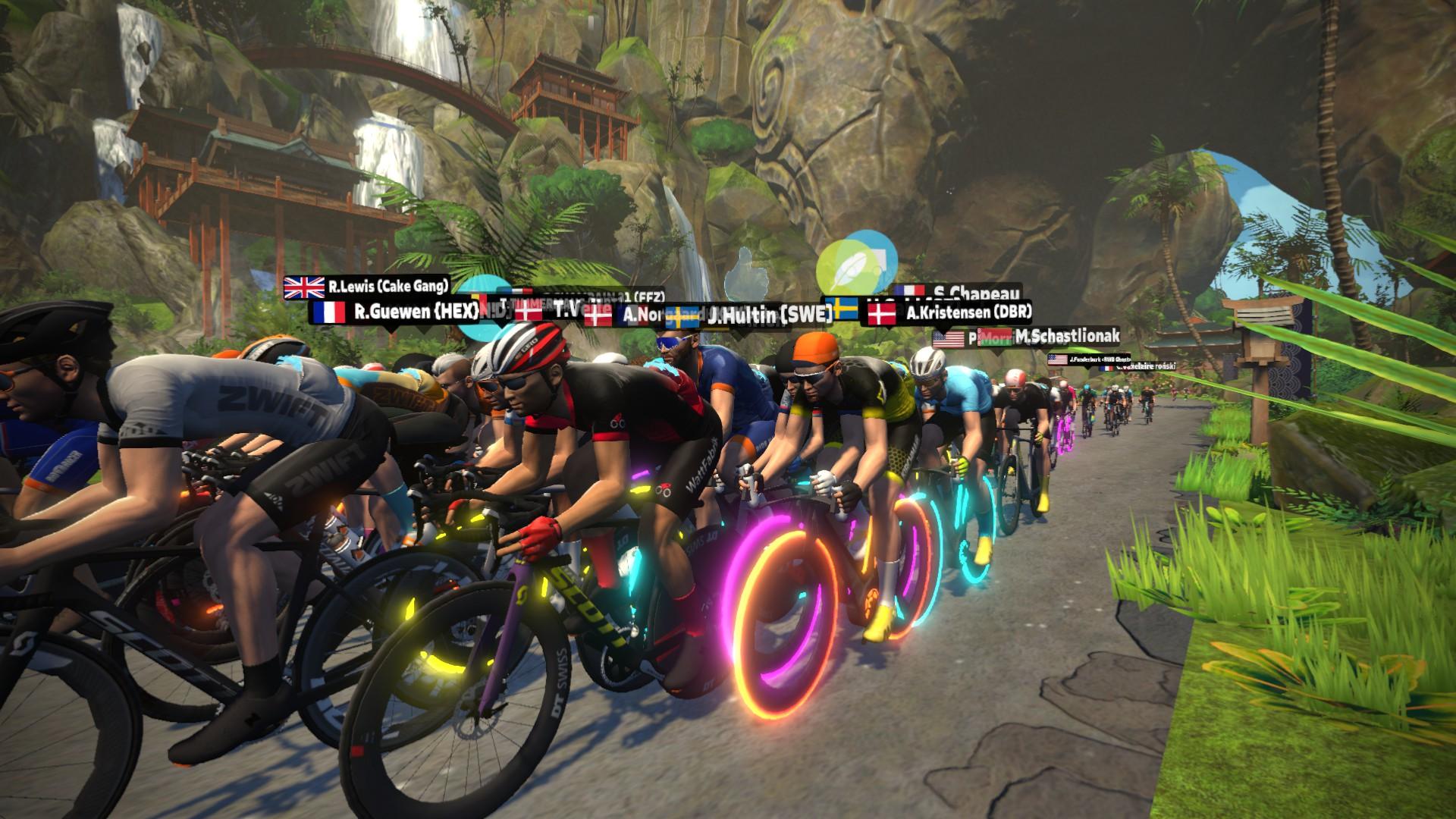
Turf N Surf begins tamely enough, with ~8km of flat roads through Neokyo and out Neokyo Tunnel, before taking a left into the slot canyon connector descent. We had a big group of 163 Bs which included some strong riders, meaning the pace would be high regardless of what I did. So I just sat in the pack and conserved my energy!
The Weirdness of Large Pelotons on Zwift
A big ol’ blob (and I’m only seeing part of it)
Racing with large groups on Zwift can be a bit crazy since Zwift only renders the closest 100 riders. Yes, it’s true: whether you’re looking at the avatars on screen, or the dots on your minimap, Zwift only shows the 100 nearest riders! (This is done to keep the CPU load down, since each rider’s position must be constantly computed by your machine.)
This presents an obvious problem in a race with 163 Bs: what if I’m so far back that I don’t see what’s happening at the front?
It can be a real problem, especially in places where attacks happen and gaps form. If you’re too far back your minimap and screen will make it look like you’re sitting in the front pack, but there may actually be a pile of riders ahead who aren’t even visible on your screen. Yikes!
One way to get some added visibility in this situation is to have ZwiftPower’s live view of your event up on another screen. This only updates every 30 seconds, though, so it’s far from perfect.
The only foolproof method of seeing what’s happening ahead is to stay near the front. I like to ride a few bikes from the front, which put me around 30-60th place in today’s race. Be warned, though: this strategy gets increasingly challenging as pack size increases, which is why big races of 300+ riders are never easy on Zwift – because everyone is pushing to stay near the front!
Ascending to the Shisa
Our first climb of the day (which I’ve named the Festival Harbor Climb CCW) came 14.5km into the race. At 2km long and 2.6% gradient, last week’s Tiny Races taught me that this climb is draftable and short enough for me to hang on, even with a strong pack. So I buckled down and hammered my way up, staying in the wheels and averaging 342W over 3:36 to stay with the front group.
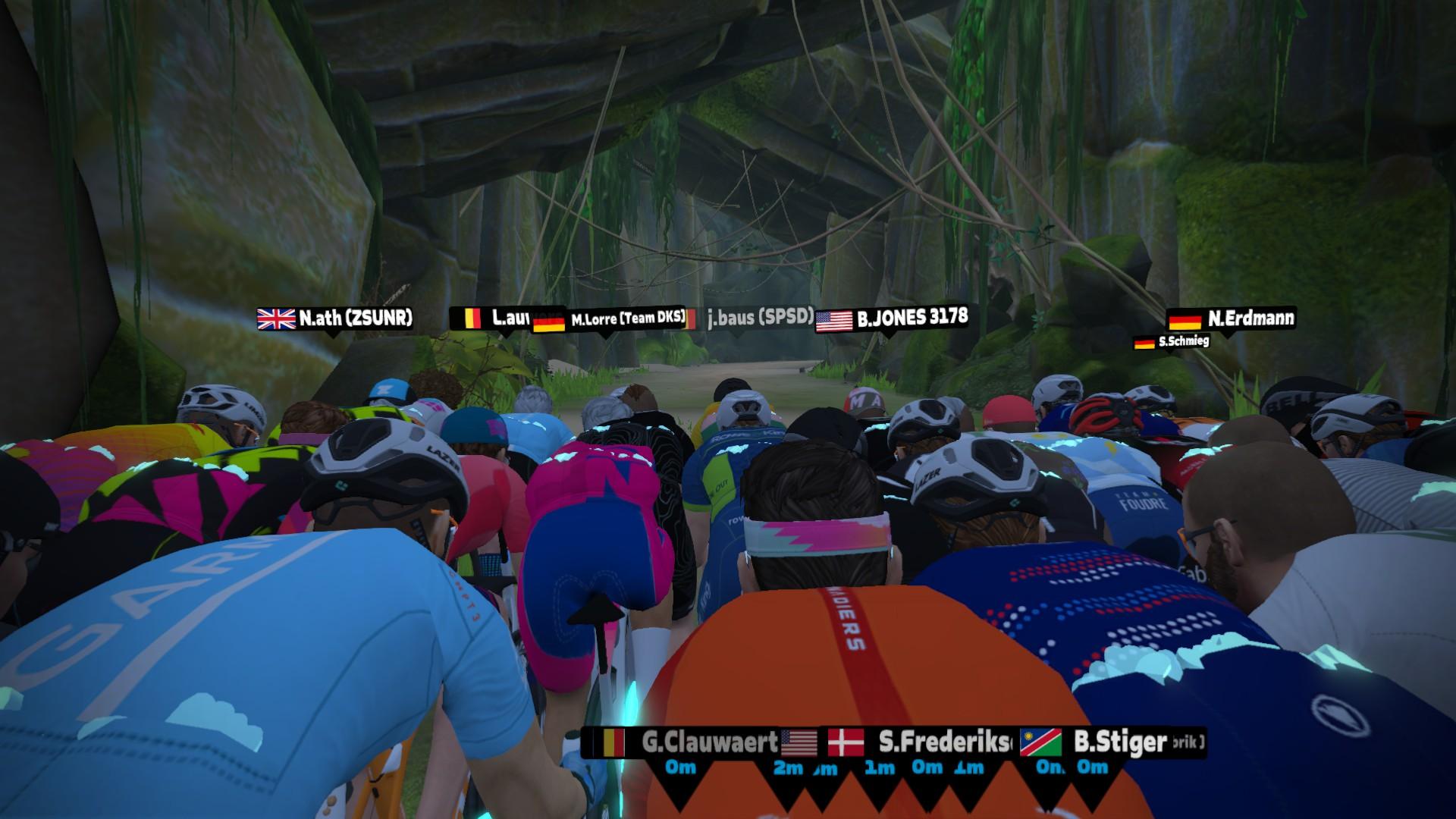
In the pack at the top of the Festival Harbor Climb CCW
This climb whittled our front group down from over 100 to around 70. I settled in for the descent to the boardwalk, then surfed the wheels through Mangrove Maze to the next big challenge: the cavern.
Pain Cavern
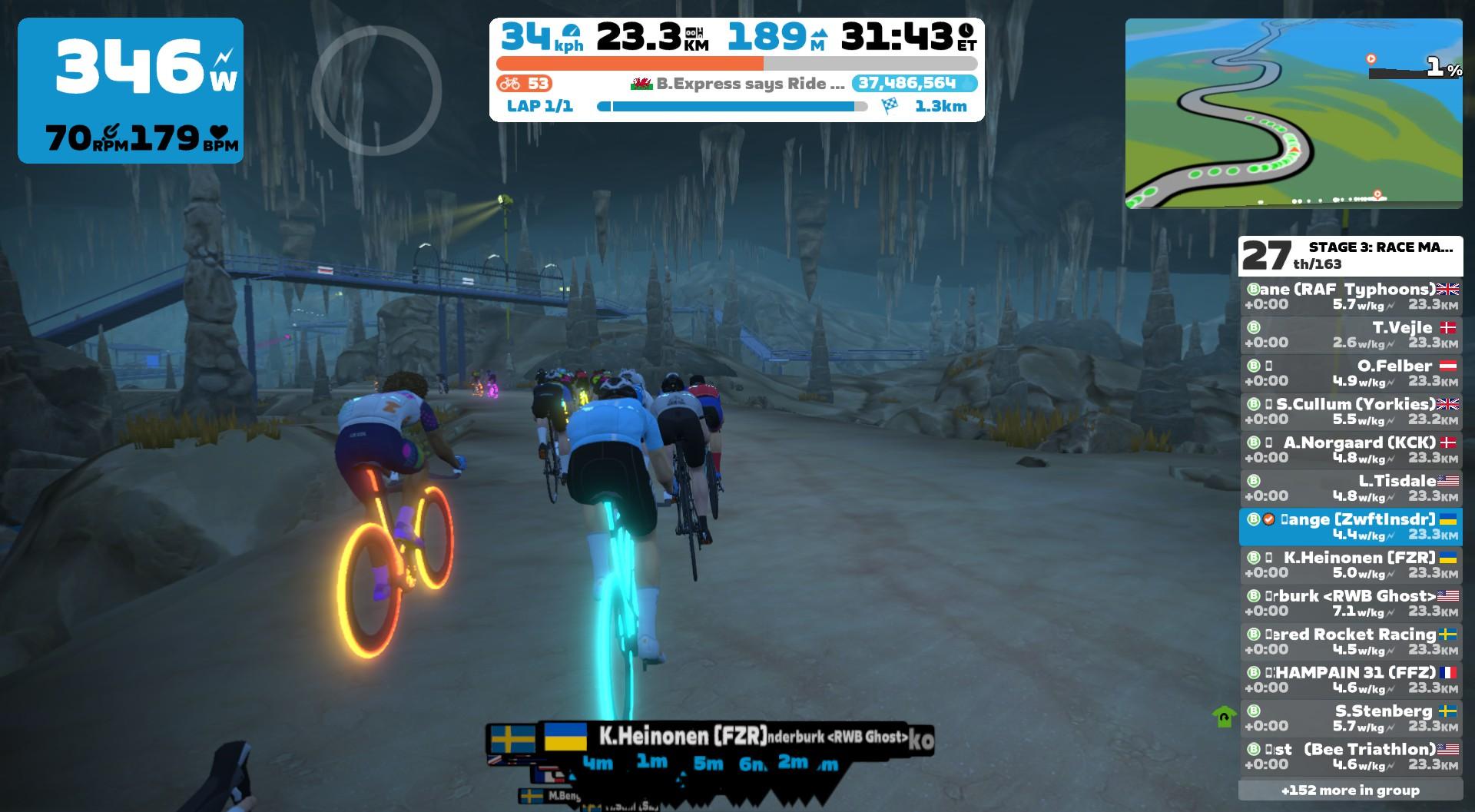
Entering the cavern of despair
We turned right out of Urukazi, and the road tilted upward. That’s when I realized something unsettling: I really didn’t know this climb well at all. I knew it wasn’t terribly long – my HUD said we only had 3km left. But where were the steep bits that required hammering, and where were the flatter parts useful for recovery?
Some riders are content to just hop onto an unfamiliar route and hammer away. That makes me nervous. I like to know the route intuitively, but you don’t get that by looking at route maps or riding it once. It takes time, repeatedly riding a route at race pace, to make it something you can ride intuitively.
The group began hammering, and I did the same, just trying to climb efficiently while staying in touch with the front. I thought I was doing well, holding a good position up the figure 8 climb. But I didn’t know what was ahead.
The road flattened a bit after the figure 8, and one rider attacked. Another followed. I was on the rivet just trying to hold on, and as the pack began to stretch out, riders were passing me and I had nothing left. You know that feeling, right? The. Worst.
Vainly trying to hold onto the stretching pack
With only 1 flat kilometer to go, a pack of ~25 front riders formed ahead, with a few pushing the pace off the front. All I could do was sit in the wheels of my chase group, trying to recover a bit for the final push to the line.
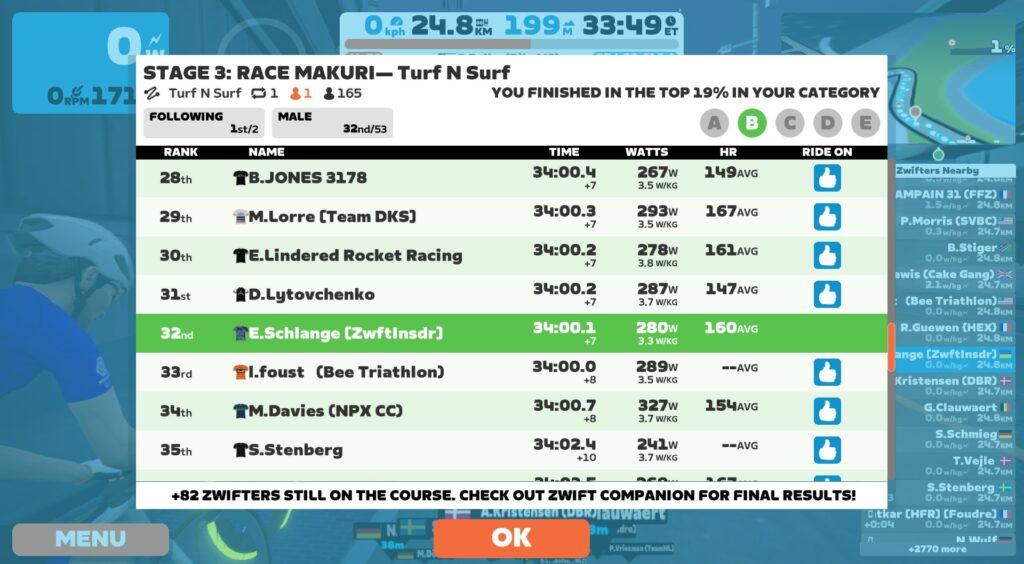
That final push was nothing special – a weak-legged standing half-sprint, bringing me across the line in 32nd place.
My first takeaway is that Turf N Surf is a fun race course. Everyone gets to spin together for the first 14km or so, riding on the flats and through the connector canyon descent. But the two key climbs prove attritional: they whittled our pack down from ~100 to ~70 to ~25.
Those two key climbs are brilliant places to push the pace and shed some competitors if you’ve got the legs for it. The Pain Cavern, especially, can reward a late attack near the end of the climb when many others are already on the rivet.
Takeaway #2: this route is a perfect example of how strong VO2 power is so crucial for much of Zwift racing. The two key climbs on Surf N Turf are 3-5 minutes long (depending on your race category), so if you’re strong in that power window you can push hard on the climbs, sit in for the other parts, then smash the finish against a much-reduced pack.
For me, I hammered hard on that final climb, averaging 364W for 3:48, which is near my limits. It just wasn’t enough. I set a 6-week power PB in the 15-33 minute window with this race, but a combination of me riding that last climb a bit inefficiently plus some strong Bs attacking at the right time (wrong time for me, right time for them) meant I wasn’t even close to the front at the end.
Last takeaway: the B category is growing more competitive as winter arrives. Almost all of the top 10 finishers had a ZwiftPower ranking of 150 points or better (I’m currently at 147), and a few were close to 100. A strong bunch of killer Bs for sure!
Final Note: An Elevation Mystery
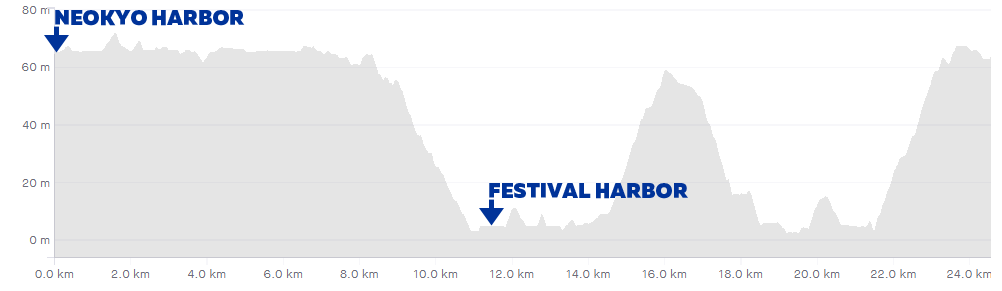
Here’s a fresh Zwift mystery for you to ponder: how is it that Neokyo Harbor, which sits just above the ocean, is ~60m higher in elevation than Urukazi’s Festival Harbor? Here’s the Strava elevation profile for Turf N Surf:
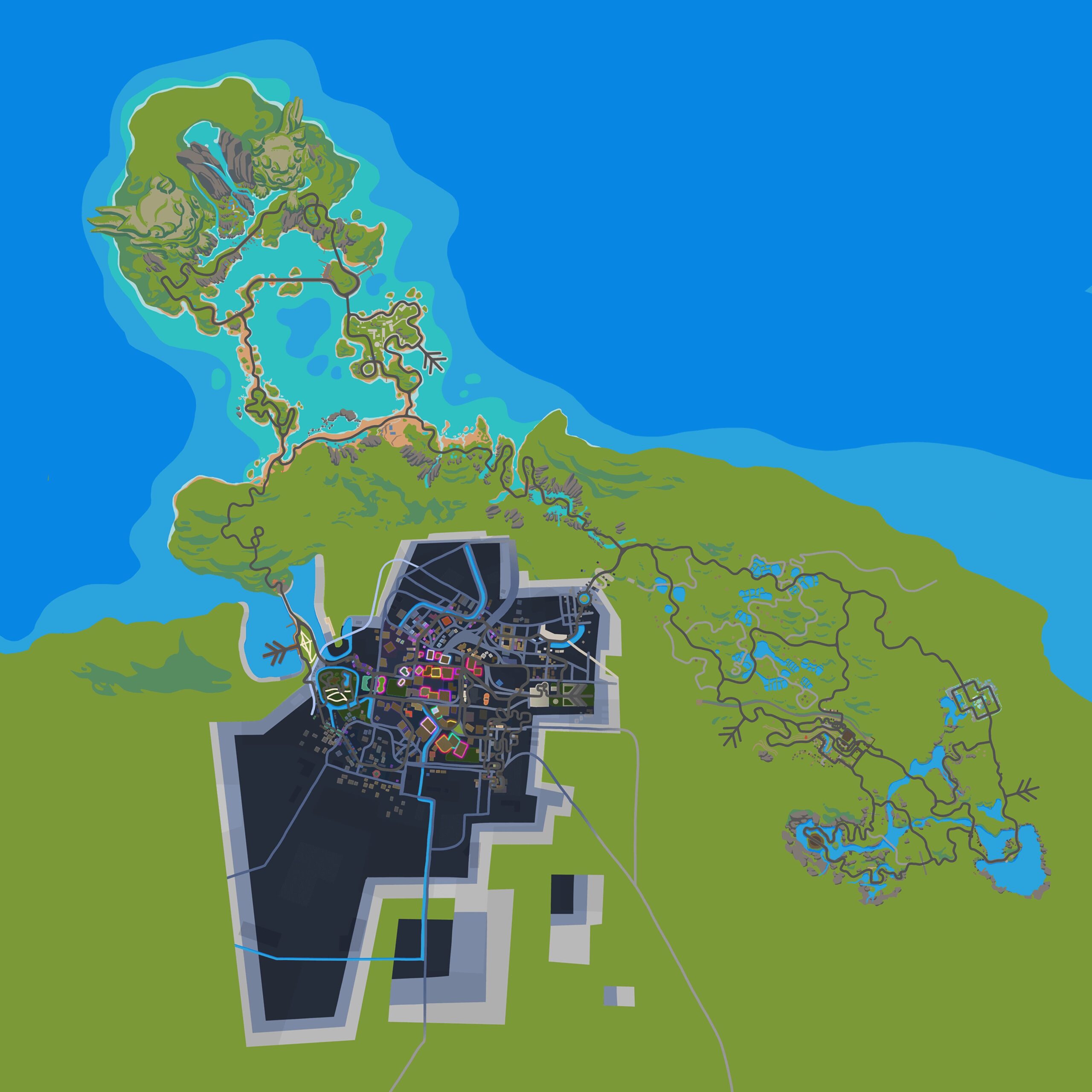
Based on the minimap from Zwift, both harbors are on the same ocean:
Clearly, Zwift’s worlds allow real-world physics to be warped. Or perhaps there’s a series of giant locks outside of Neokyo Harbor that isn’t visible on the minimap? 😊
Your Thoughts
Have you raced Turf N Surf yet? What did you think? Share below!